Athletes

Dennis Rodman’s Tattoos: Bulls, Infinity and a Lifetime of Ink

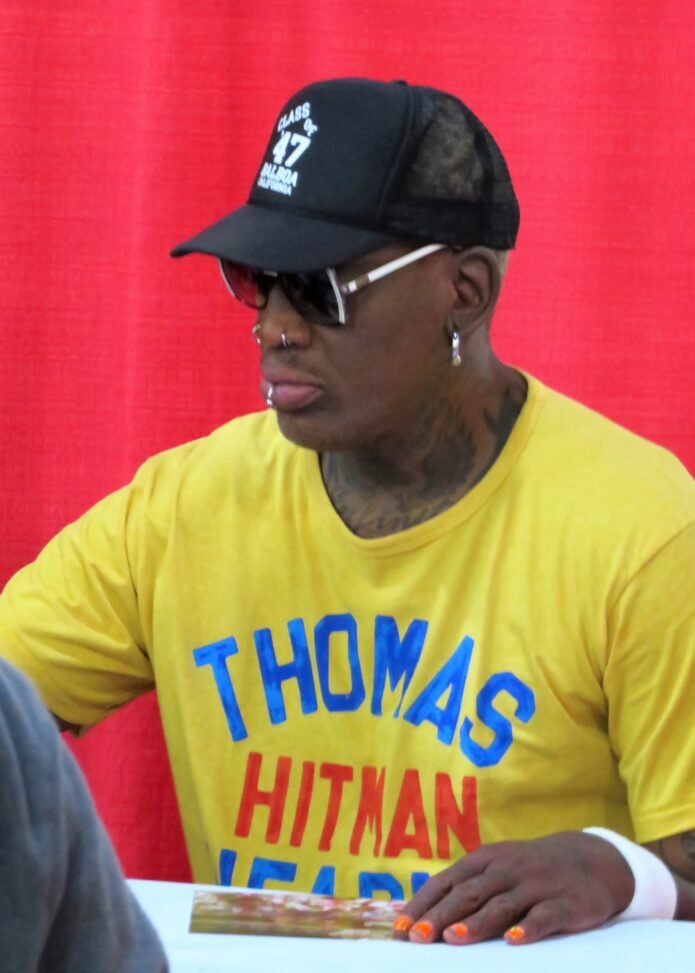
Dennis Rodman’s tattoos are as much a part of his public image as his dyed hair and piercings. They cover his chest, stomach, arms, neck and face, mixing tribal patterns with words, portraits and sports references. Photos show distinct designs rather than one continuous sleeve.

Rodman has said tattoos helped him give physical form to pain. In an interview with Graham Bensinger, he described body modification as an outlet. That offers some context, though he has not given a personal explanation for every tattoo or a private story for each mark.

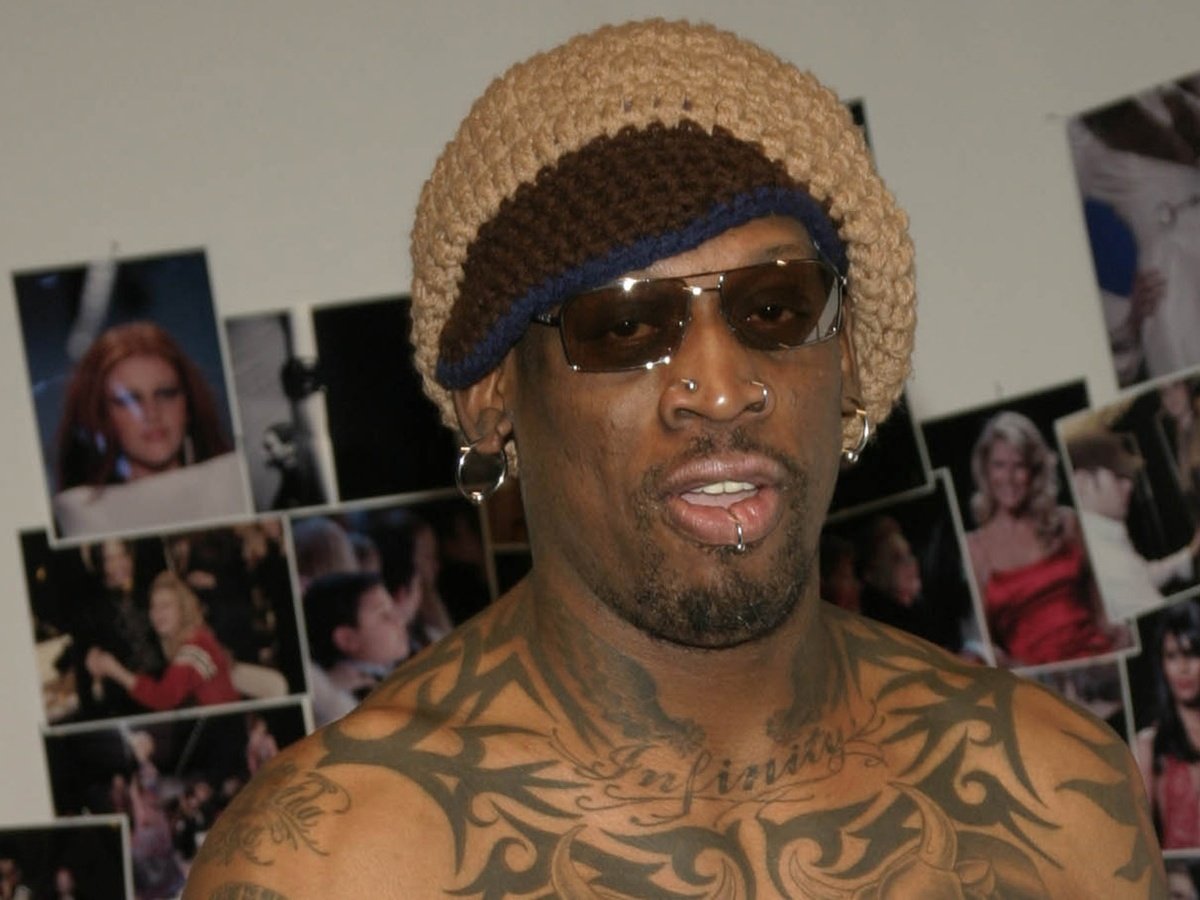
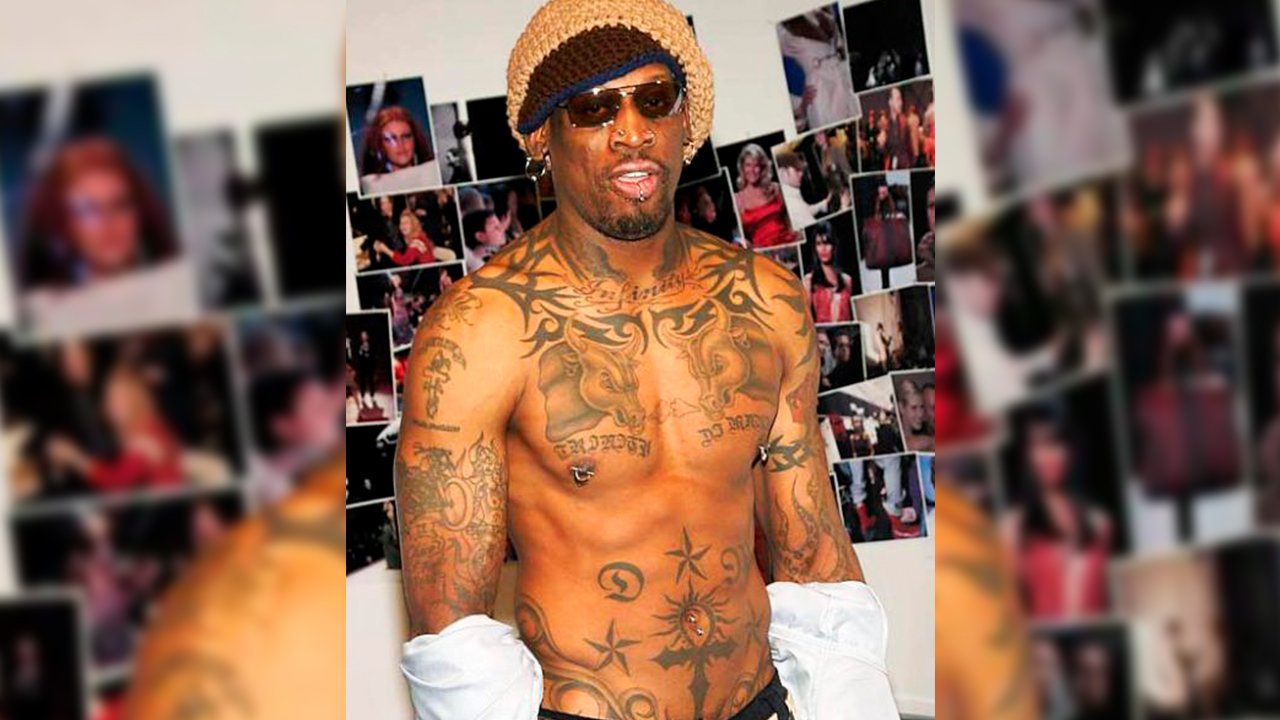
The paired bulls give Rodman’s chest its most recognisable centre
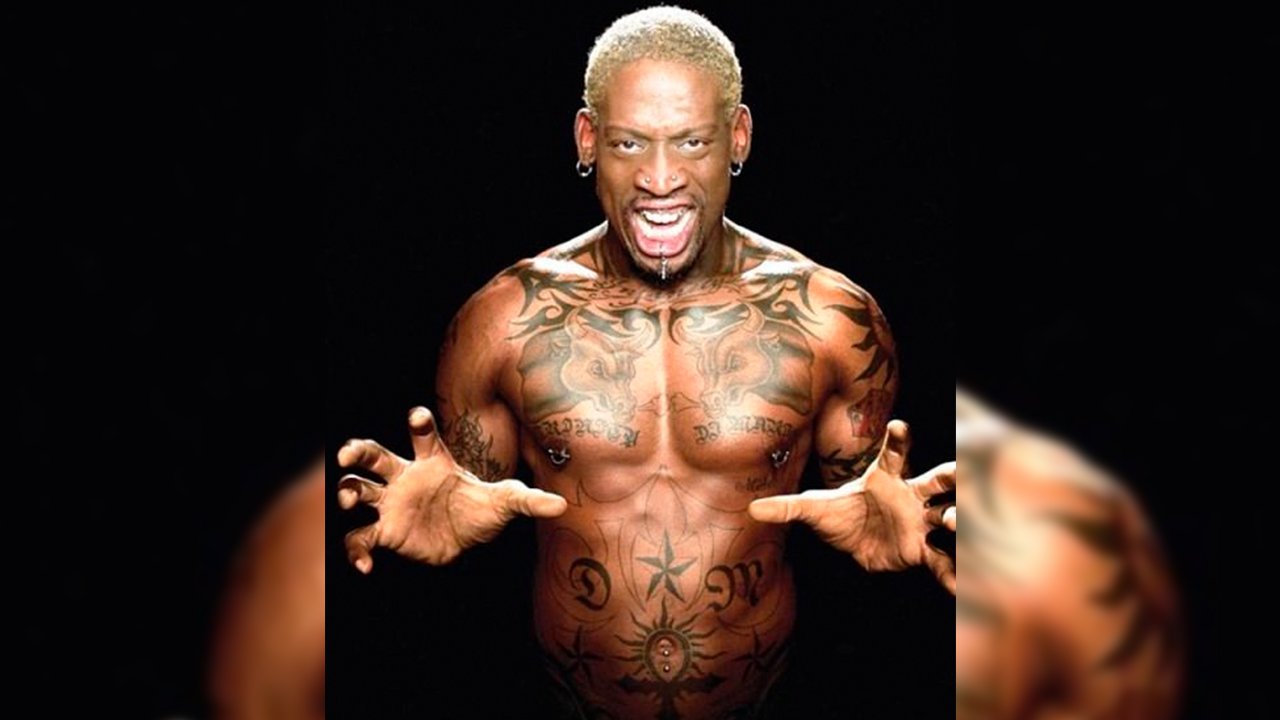
Dennis Rodman showing the paired bull chest tattoos

Two inward-facing bulls fill the centre of Rodman’s chest, forming a mirror image. TUDN’s captions call them angry or furious, and photos show the heavy outlines and shading that make them stand out beside the surrounding ink.

The bulls give Rodman’s tattoo map its scale. They are large enough to show in a tank top or open shirt, and their paired heads remain the first thing the eye picks out among the surrounding designs.

Rodman’s basketball persona can make the bulls look like a statement about aggression, but the available sources identify only the animals and their placement. His interviews explain what tattoos have meant in his life more broadly; they do not tie this pair to one season or team.

Infinity appears as lettering rather than an isolated picture
Dennis Rodman showing Infinity lettering at the neck and wrist

The word Infinity appears on Rodman’s right wrist and again at the base of his neck. The repeated lettering links two very different parts of the collection: large imagery across the chest and a simple word at the wrist and neck.

In photos, lettering can be obscured by hair, jewellery or the angle of a wrist. TUDN’s captions identify the word and both locations. Rodman has not attached a further personal philosophy to it in the cited material.

Infinity’s clean line contrasts with the large shapes across his chest. Both approaches sit together without following one consistent tattoo style, a contrast that comes through in upper-body photos.

A motorcycle, cross and bracelet build the right-arm group
Dennis Rodman showing motorcycle and cross tattoos on his right arm

TUDN identifies a motorcycle, cross and bracelet among the tattoos on Rodman’s right arm. They bring three different shapes together: machinery, a religious symbol and a band around the limb. Each stands out within the tattooed sleeve.

The arm looks different from one pose to another. A turned shoulder can hide the inside of the bicep, while a flexed forearm brings some designs forward and leaves others in shadow. Captions name the pieces; the photo shows how they sit together.

Rodman’s style can lead people to read every tattoo as part of one rebellious persona, but his arm holds separate images with their own shapes and proportions. They can be understood individually even though they share the same space.

The upper back carries the tribal work and the RODMAN lettering
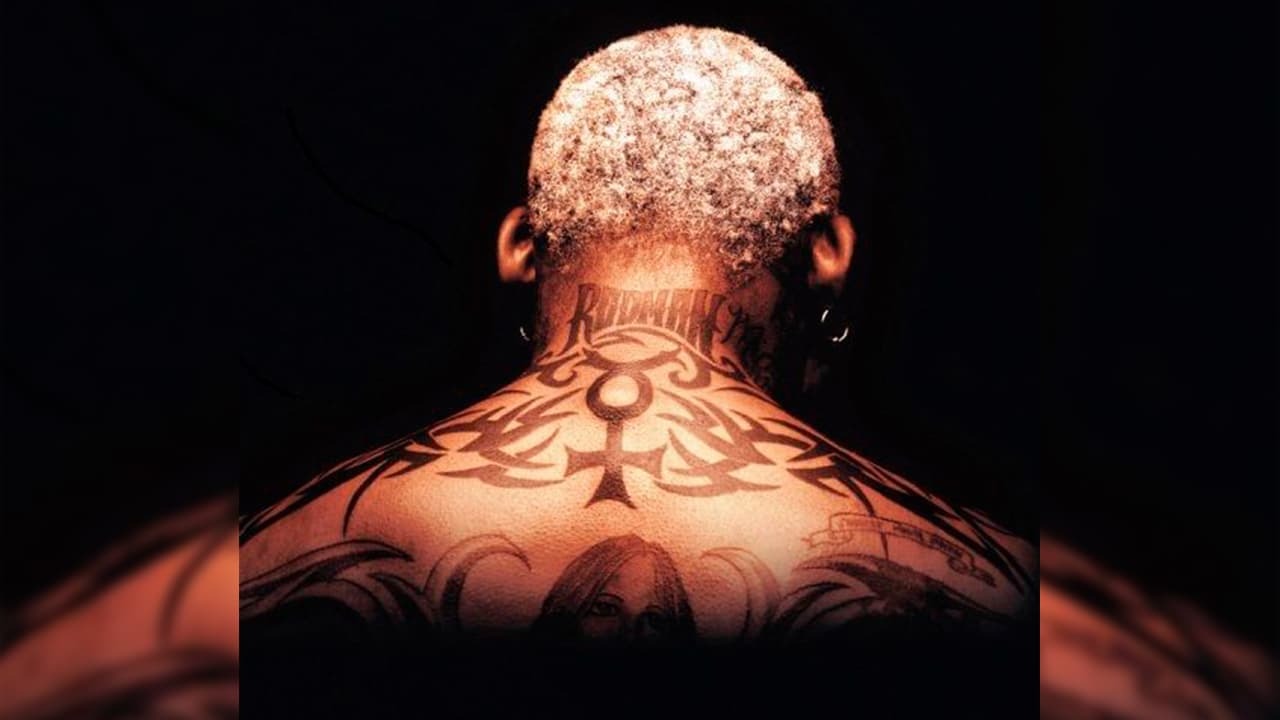
Dennis Rodman showing his upper-back tribal tattoos and RODMAN lettering

Across his shoulders and upper back, tribal lines curve around the shoulder blades and meet at a dark symbol below the nape. Photos also show RODMAN on the back of his neck. The lettering can disappear under a collar or his hair, but it gives the back piece a personal touch.

The tribal pattern leaves open skin between wide and narrow black lines, which keeps it readable from a distance. Up close, it looks like connected bands and points rather than one solid panel. A small ankh-like or looped symbol sits in the centre, though no personal meaning has been confirmed for it.

Other portraits and symbols continue farther down Rodman’s back. A photo crop can hide that lower area, so one image rarely shows the full composition. The upper tribal lines and neck lettering follow the shape of his shoulders.

Portrait imagery moves from the arm to the face
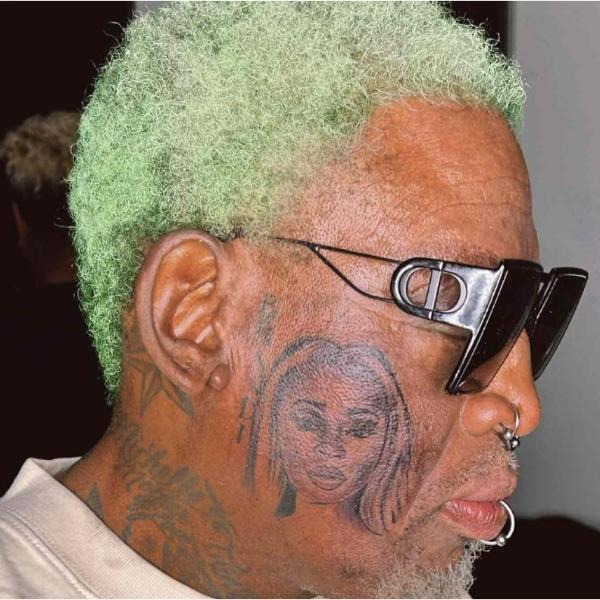
Dennis Rodman cheek portrait tattoo of Yella Yella

TUDN identifies a child’s face on Rodman’s left arm; later reporting describes a portrait of his partner on his cheek. They were added at different times and should be treated as separate portrait tattoos, not one design.

Portraits are harder to identify when an image is blurred, and cover-ups or different expressions can complicate comparisons. The Chicago Sun-Times covered the later session and recorded Rodman’s own reaction. The cheek portrait can be described without adding a relationship story he has not shared.

Placement changes the effect: an arm portrait can be covered by clothing, while a cheek portrait is part of every close-up. That visibility helps explain why the newer piece drew attention of its own.

What Rodman’s tattoo record actually establishes

Rodman’s main tattoos are easy to name, even if smaller marks are less clear. The paired bulls, Infinity lettering, motorcycle and cross on his arm, and portrait pieces appear in photos and published captions. Other designs can be described by their look and location when no meaning has been shared.

Rodman has talked about his tattoos for decades. The Los Angeles Times covered him discussing them in the 1990s; later photo features show how the collection changed with his public image. Newer pictures add to that timeline rather than replacing the older ones.

There is more below the chest than the four headline designs suggest. Published inventories list a sunburst around the navel, a cross and star-like marks on his stomach, plus tribal work across the torso. Older reports mention a green apple with a skeleton-like face on his calf. These pieces can be hard to see when clothing or a crowded photo cuts them off.

The arms bring together machinery, religious shapes, portraits and bands, while the back and neck carry lettering and tribal work. Listing the individual pieces says more than simply calling Rodman heavily tattooed: bulls, Infinity, the motorcycle, cross, bracelet, RODMAN lettering, sunburst, portraits and the cheek tattoo.

Large bulls anchor the chest; Infinity links the wrist and neck; a motorcycle and cross share an arm; portraits move from arm to face. The specific designs and placements keep Rodman’s collection recognizable without settling into one formula.
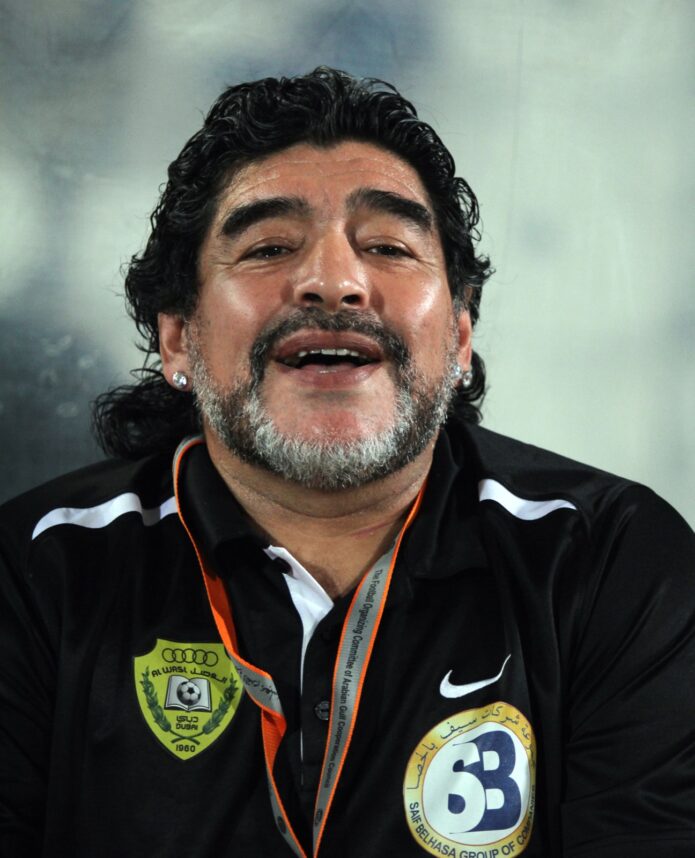
Diego Maradona’s Tattoos Put Football, Family and Cuba on His Skin

Maradona’s tattoos bring together football, family and politics. Photos show two portraits and lettering for his daughters, while interviews and reports give context to some of the designs.

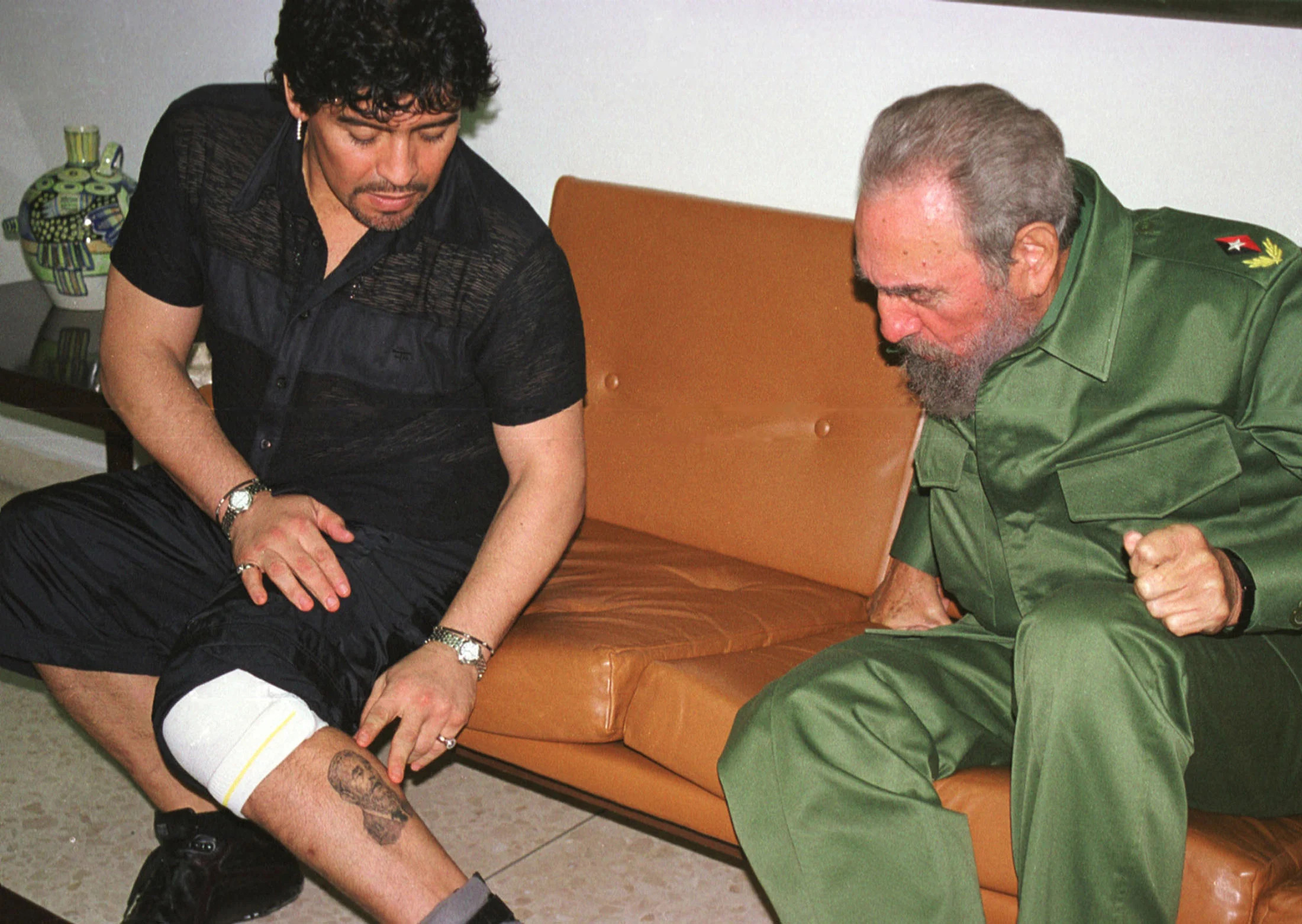
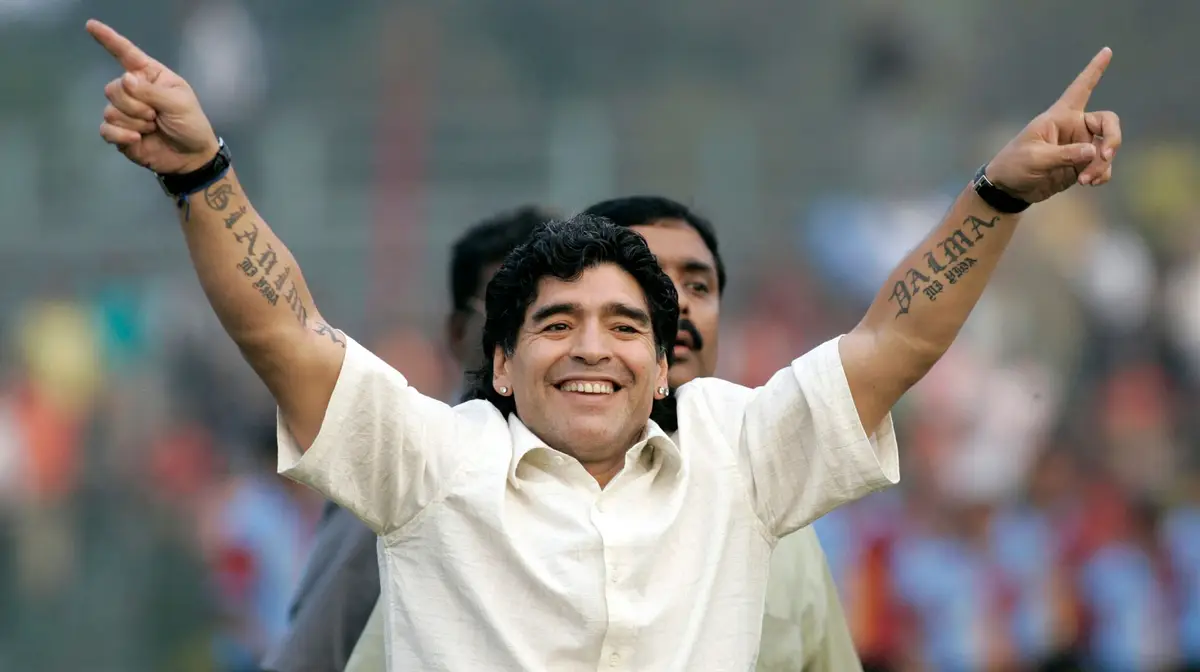
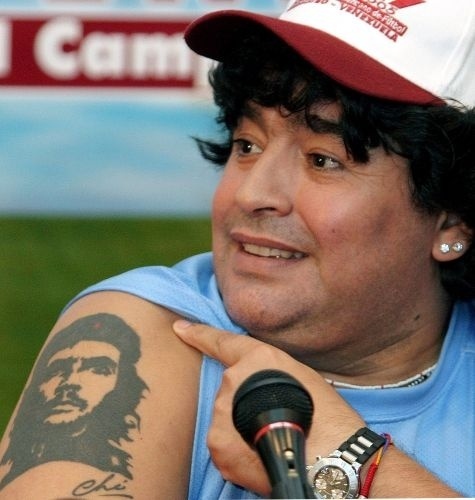
Che Guevara is on his right arm; Fidel Castro is on the left calf he connected to his famous left foot. The family pieces are more direct. Dalma and Gianinna are written across his forearms, and reports also describe a heart tattoo shared with Claudia Villafane and their daughters. Maradona’s comments help explain why some of the pieces mattered to him.

Che Guevara’s portrait sits on Maradona’s right arm

Diego Maradona showing his Che Guevara portrait tattoo on his upper arm

The black portrait of Che Guevara on Maradona’s right arm is the design most often connected to his politics. Interview and football photos show it when his sleeve rides up or he wears a sleeveless shirt. In a Reuters image republished by UOL, Maradona points to the portrait himself.

Coverage places it on his right arm, though some sources describe the spot as the shoulder. It stretches across an area that can look different from different angles. When a photo doesn’t show its edge, “right arm” is the clearest description.

Maradona spoke about what the portrait meant to him. El País and the Los Angeles Times link it to his admiration for Guevara and his relationship with Cuba and revolutionary history. In one reported statement, he said, “I carry him on my arm and in my heart.” That puts his personal attachment on record without asking us to read a separate message into every feature.

A close photo helps separate the details: UOL’s image shows Guevara’s face, but compressed stadium photos can blur the eyes, hair and hat into a dark patch. Ageing ink, sleeve position and lighting also change how the tattoo looks. The subject is clear even when those details are not.

Fidel Castro’s portrait covers the left calf linked to his famous foot

Diego Maradona showing the Fidel Castro portrait tattoo on his left calf

Fidel Castro’s portrait appears on Maradona’s left calf, the leg he associated with his famous left foot. El País reported that Maradona received treatment in Cuba and later had a portrait of Castro inked there. Other accounts mention Castro’s signature too, so it’s more than a generic face tattoo.

The calf placement links the portrait to football: Maradona saw his left leg as his most important sporting asset. The choice also reflects his friendship with Castro and admiration for the Cuban leader, which are better supported explanations than football alone.

In a Yahoo Noticias photo, Maradona lifts his trouser leg while Castro looks at the tattoo. The portrait and its size are easy to see, and the picture catches the two men together rather than showing the tattoo in isolation.

Maradona called Castro a second father, according to reports on their relationship during and after his time in Cuba. That supports the tattoo’s personal significance, but those statements should stay attributed to him. The portrait doesn’t verify every political stance later linked to Maradona.
The photo records both the tattoo and the friendship: it shows the design on Maradona’s calf, while later stories supply the timing and background.

Dalma and Gianinna are written across Maradona’s forearms

Diego Maradona showing Dalma and Gianinna lettering on his forearms

The names of Dalma and Gianinna on Maradona’s forearms form the clearest family part of his tattoo map. Photo coverage shows them when he raises both arms, while Infobae reports longer dedications including “Dalma mi vida” and “Gianinna mi vida.” The photos crop the writing differently, but the names are visible.

Unlike the portraits, the lettering names its subjects directly. The forearm placement also makes the tattoos easy to see in football celebrations and interviews, so more public photos exist than for some of Maradona’s smaller marks.

Infobae links the family lettering to work done in Cuba and discusses it beside the Che and Fidel tattoos. The timing matters, but the guide should keep the dates straight. A map can show the designs together and keep their histories distinct.

In a SIC Noticias photo, Maradona raises both arms so the names are visible together. It confirms their general placement, but isn’t sharp enough to capture every flourish. A close-up is needed for a full transcription.

Reports also mention a small heart shared with Claudia Villafane and their daughters. It belongs beside the forearm names as another family reference, but the designs are different: the heart is shared and appears in family photos; the words are direct dedications on Maradona’s arms.

What the photographs establish about Maradona’s tattoo collection

Maradona’s public tattoo record covers a lot of ground, though it may not be complete. The clearest evidence documents Che on his right arm, Fidel on the left calf and Dalma and Gianinna’s names across his forearms. Reports also mention a shared heart and other marks. Those should be labeled by source; unclear details shouldn’t be presented as confirmed biography.

That keeps Maradona’s tattoos readable without reducing the collection to one political message. The portraits reflect admiration and friendship; the lettering is about his family. Photos show where the designs sit, while interviews and reports add context to the relationships behind them.

Jordan Clarkson’s Tattoos: Nipsey Hussle, Allen Iverson and a Rapidly Built Sleeve

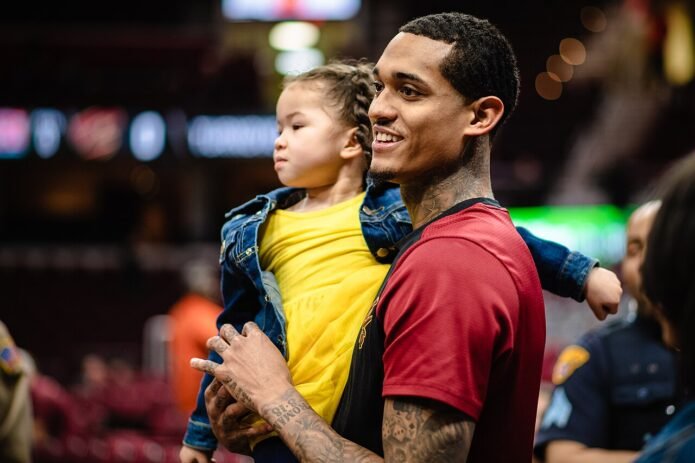
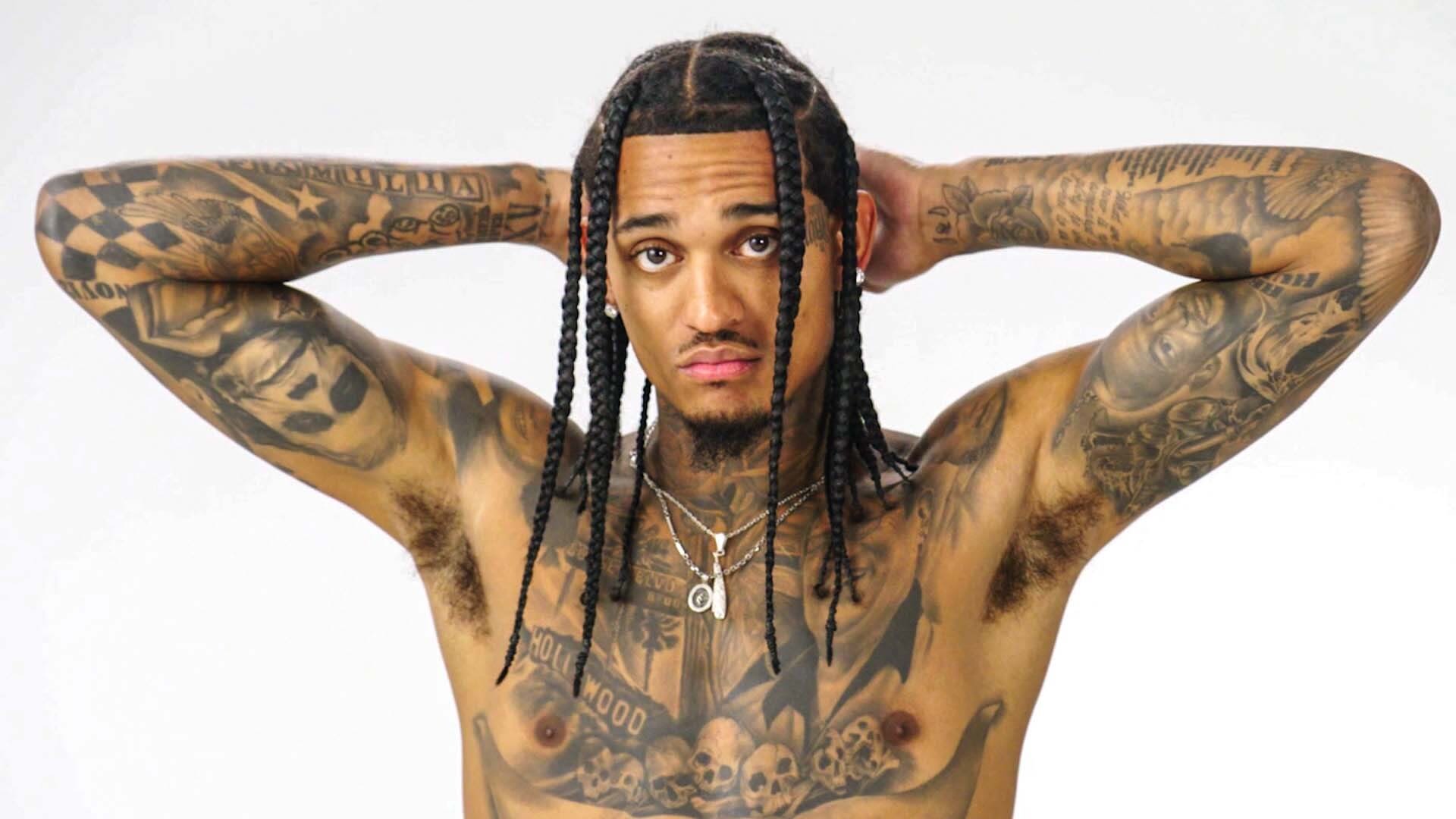
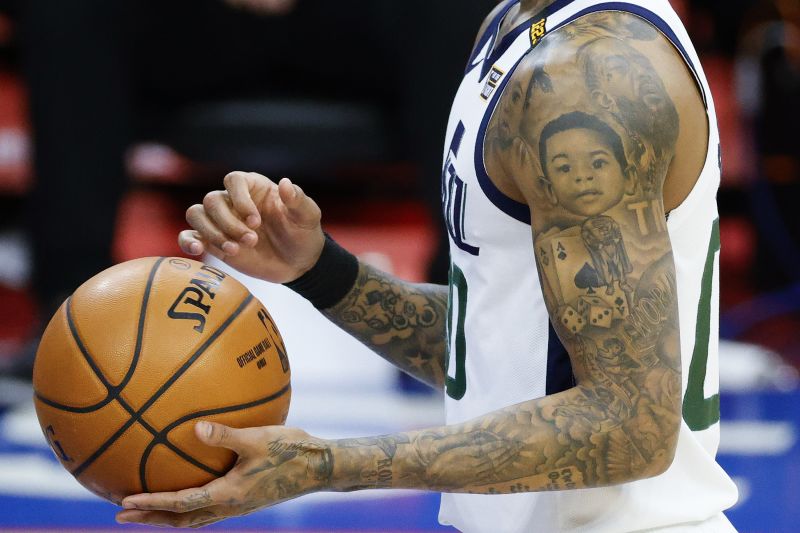
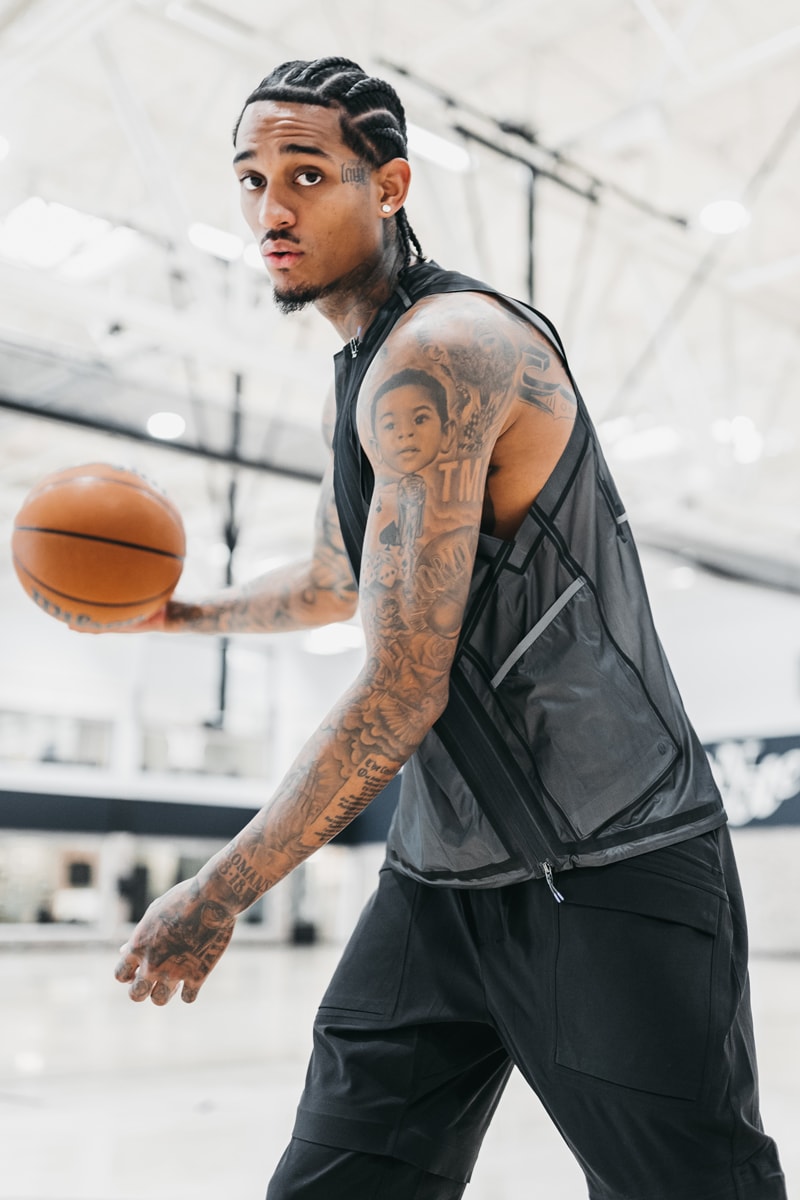
Jordan Clarkson told GQ he started without tattoos, then built a sleeve over roughly two or three months. It now includes portraits of Nipsey Hussle and Allen Iverson, a peace sign on his knee, and the small initials he got first. Clarkson names the people and designs that matter most to him, giving the best-documented pieces a clear story.

Nipsey Hussle and Allen Iverson anchor Clarkson’s sleeve

Jordan Clarkson showing his tattoo sleeve, including portrait and basketball designs

The two portraits Clarkson discusses are of Nipsey Hussle and Allen Iverson. Nipsey connects the sleeve to a contemporary artist and community figure; Iverson to basketball. In GQ’s tattoo tour, both appear among the rest of the arm work, tied to Clarkson’s own interests.

Clarkson names each subject, and the photos show how the portraits sit among the other tattoos. Even when they appear close together, they remain separate designs.

The Nipsey Hussle portrait

Jordan Clarkson showing the Nipsey Hussle portrait tattoo area

Clarkson’s Nipsey Hussle portrait is part of a wider tradition of memorial tattoos and admiration pieces. The subject he identifies is the key detail. The portrait stands on its own without guessing at a private event or attaching every nearby symbol to Nipsey.

Angle and lighting can change how the portrait looks. A close-up is more useful than a game photo with Clarkson’s arm in motion. Check the face and placement against a clear image; blurry marks nearby aren’t confirmed tattoos.

The Allen Iverson tribute

Jordan Clarkson showing the Allen Iverson portrait tattoo area

Clarkson identifies Iverson as the subject of his second portrait tattoo. Iverson influenced a generation of players, giving the design a clear basketball connection without adding a private reason Clarkson hasn’t shared.

Clarkson’s explanation matters. A jersey number or silhouette might only suggest a basketball reference, but a portrait gives viewers a face to recognize. The article names Iverson because Clarkson does, not because someone guessed from a distant photo.

The peace sign on the knee

Jordan Clarkson showing the peace sign knee tattoo tattoo area

GQ also notes a peace sign on Clarkson’s knee. It’s smaller and simpler than the sleeve portraits, and belongs to an earlier stage of his tattoo history. The source identifies the symbol and location, but doesn’t give a detailed personal meaning.

Peace signs can suggest calm, unity or personal beliefs, but Clarkson hasn’t confirmed those meanings in the reviewed sources. What’s clear is the symbol, its position on his knee and its place among his earlier tattoos.

Initials came before the sleeve

Jordan Clarkson showing the sleeve and initials tattoo area

Clarkson says his first tattoo was a small set of initials. It came before the portraits and connected work that later filled his sleeve. Initials are personal lettering, but the public source doesn’t assign them a larger story.

His sleeve followed quickly. Clarkson describes a two-to-three-month stretch when he and the tattoo artist worked almost every day. That helps explain how the collection grew from one small mark into a developed sleeve.

How the sleeve developed

Jordan Clarkson tattooed sleeve

A sleeve is made of separate tattoos, even when the designs share an arm. Clarkson’s brings together portraits, symbols, initials and later additions. He names some pieces; the rest are best described as surrounding shading or supporting designs until a source identifies them.

Photos from different dates can make the sleeve look changed. A later image may show more shading, while an older one leaves space between the portraits. That may reflect new work or lighting, so dated photos are needed before calling a piece altered or covered.

Meaning and evidence levels

Clarkson names the portrait subjects, so their personal context is clearest. The peace sign and initials are easy to identify, though he hasn’t explained them in detail. Other sleeve work completes the composition, but every small symbol doesn’t need a separate story.

This keeps the tattoo list from pretending to be a full biography. Clarkson’s comments support the connections he has explained; photos add placement and visual detail. Anything the sources leave unanswered should stay open, rather than be filled with a familiar tattoo cliché.

What the GQ Tattoo Tour confirms

Jordan Clarkson Allen Iverson tattoo

GQ’s Tattoo Tour gives four solid starting points: the Nipsey Hussle and Allen Iverson portraits, the peace sign on Clarkson’s knee, and the initials he got first. He also says he built out much of the sleeve over a few intense months, though the source doesn’t give a full inventory of every design.

To compare images, start with the two portraits, then look for the knee sign and initials in photos that show those areas. Uniforms and camera angles can hide much of the body, so dates and settings matter. Identify only what the sources support and leave uncertain details unnamed.

Jordan Clarkson’s tattoos show his basketball influences, a tribute to Nipsey Hussle, and how quickly the sleeve took shape. The portraits carry the clearest stories; the peace sign and initials came earlier. The additional work fills out the sleeve, though Clarkson hasn’t publicly explained every design.

Jordan Burroughs Tattoos: JB Wings, Olympic Rings and the Ink Behind His Wrestling Story

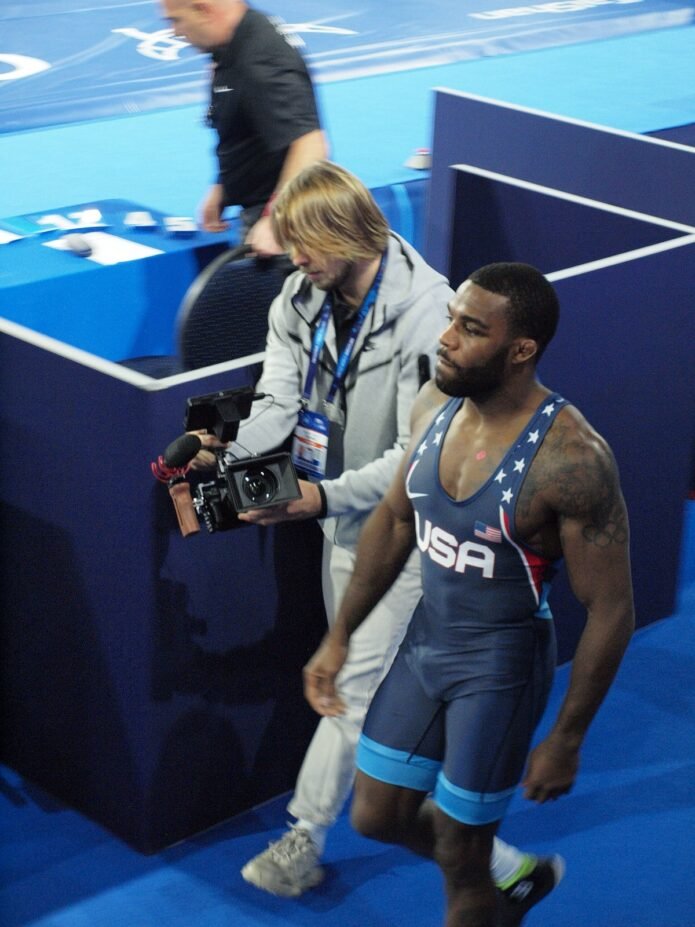
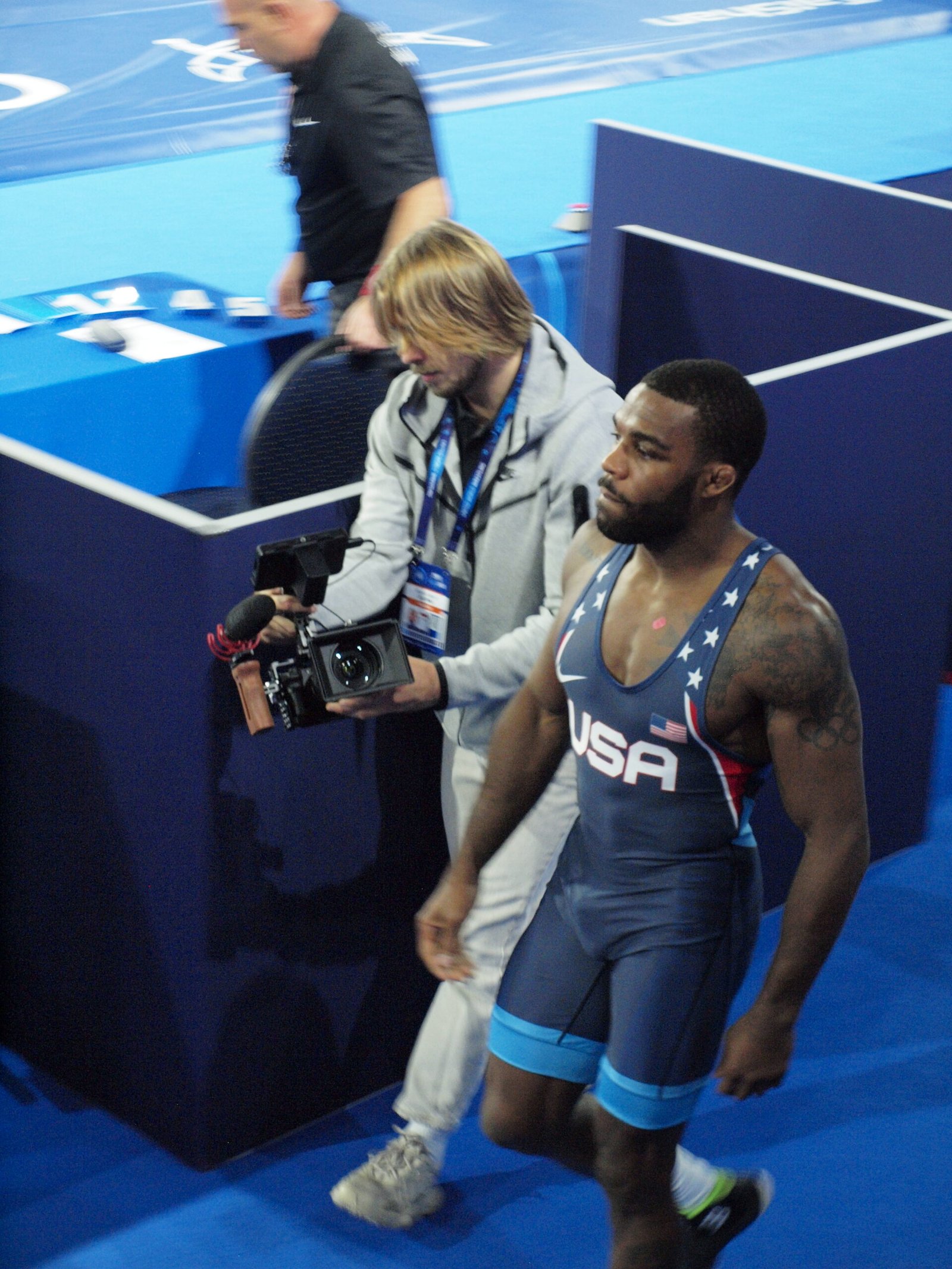
Jordan Burroughs has said his tattoos mark different stages of his life and wrestling career, rather than following one plan. In a Team USA interview, he recalled getting his first tattoo in July 2005 and tied later designs to goals and Olympic milestones. He shared several examples, but not a complete count of every mark on his body.

His first tattoo was the JB wings on his back

Jordan Burroughs JB initials and wings back tattoo

Burroughs said his first tattoo was his initials, JB, with wings on his back. He got it in the summer between his junior and senior years of high school, after his parents agreed. He remembered paying 150 dollars and going home to show the design to his friends.

He got it years before the Olympics, while he was preparing for college wrestling. The initials and wings are visible in photos, but Burroughs has not given the design a separate meaning.

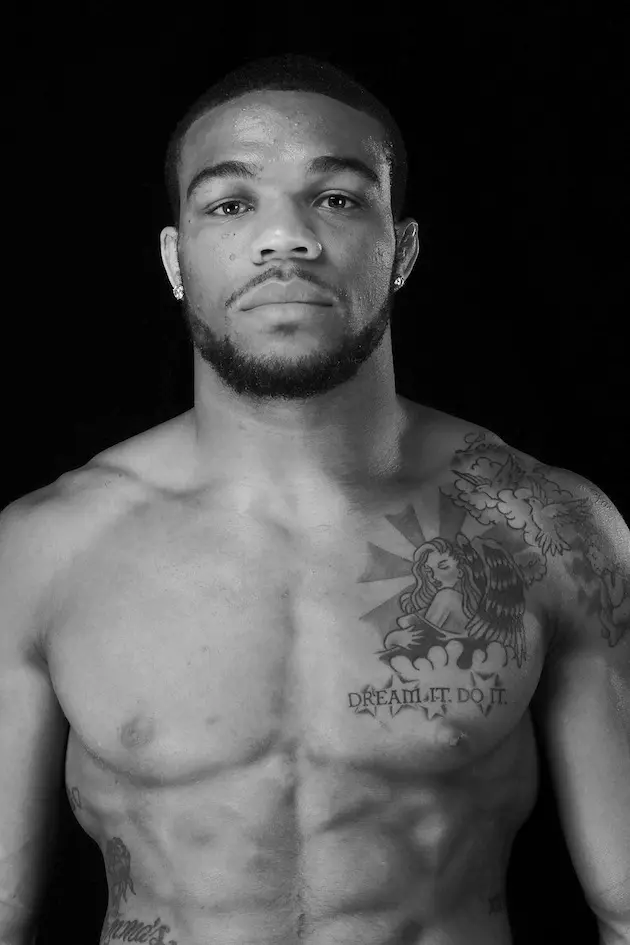
“Dream and do it” on his chest

Jordan Burroughs Dream and do it chest tattoo

Burroughs has described the Dream and do it lettering on his chest as a mantra. To him, it means difficult goals are possible when he is willing to put in the work. He tied the phrase to his own training and ambitions.

The first tattoo marked a personal transition, and he showed it to friends right away. The chest phrase keeps those ambitions in view. Burroughs gave the wording as “Dream and do it,” rather than the more familiar alternative, an important distinction when describing the tattoo.

His Olympic rings tattoo is on his left arm

Jordan Burroughs Olympic rings tattoo on left arm

Burroughs said he got the Olympic rings on his left arm after making the team. He went on to win gold at the 2012 Olympics.

The Team USA interview ties the rings to making the team; competition photos show how they sit on his left arm.

His tattoos mark different chapters in his wrestling career

Jordan Burroughs tattoo lettering

Burroughs described his tattoos as reminders of where he was at a particular point in life. He also spoke about the freedom of tattooing, a chance to step outside the tightly disciplined routine of an elite athlete.

The designs chart those stages: the JB wings came in high school, “Dream and do it” reflects his approach to ambitious goals, and the Olympic rings mark making the team. Burroughs has spoken appreciatively about his tattoo artists, comparing their approaches to painters and the way they shape a finished piece. He has not described a single symbolic system for the collection, and the interview does not name every artist.

What Jordan Burroughs has said about his tattoos

Burroughs’s first tattoo, the JB initials and wings on his back, dates to July 2005. He later got the chest phrase and, after making the team, the Olympic rings on his left arm.

A photograph can show a mark without telling us when it was added, who tattooed it or what it means. Burroughs discussed several designs in a Team USA interview, but did not give a complete list. A Jordan Burroughs tattoo guide can stick to what he has confirmed and leave the gaps open.

His tattoos are hard to count from photographs alone: training shots catch different angles, and competition clothing can hide a design. His first back tattoo, chest lettering and Olympic rings are the clearest reference points.

“Dream and do it” is the phrase whose meaning Burroughs has explained most clearly. He tied it to believing hard goals were possible with effort. That does not make every nearby tattoo a reference to a medal or tournament; he linked the rings specifically to making the team.

The photographs are clearest about placement: initials and wings on the back, lettering on the chest, rings on the left arm. Light, pose and distance can all change how a tattoo appears.

Read in order, the tattoos move from a high-school decision to an Olympic milestone, with the chest mantra in between. They trace different chapters of Burroughs’s life without forcing every design into one theme.

Michael Phelps Keeps His Two Documented Tattoos Close to the Pool

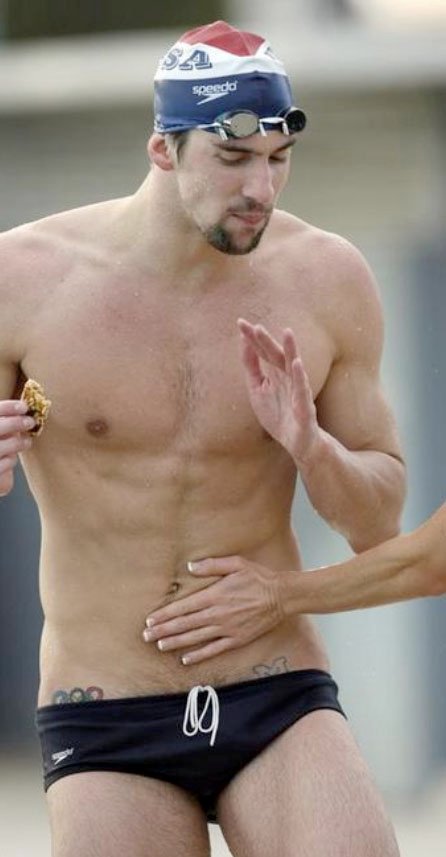
Michael Phelps has two documented tattoos: the Olympic rings on his right hip and an outlined M on his left. Both sit low on his hips, usually beneath swimwear. Swimming photos show the marks, while published accounts offer different explanations for the letter.

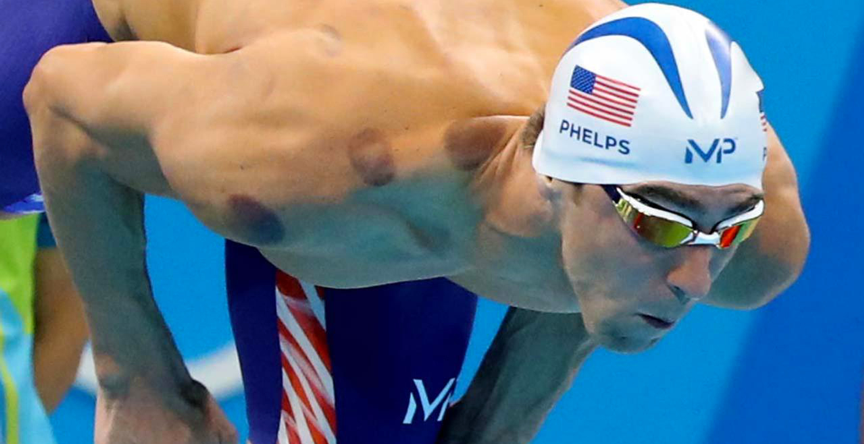
The large purple circles on Phelps’s back and shoulders during the 2016 Rio Olympics were often mistaken for new tattoos. They were temporary marks from cupping therapy, a recovery treatment.

The Olympic rings sit on Phelps’s right hip

Michael Phelps showing the Olympic rings tattoo on his hip

Phelps’s Olympic rings tattoo sits on his right hipbone, just above the line of his swimwear. The Guardian’s 2008 Olympic photo gallery identified the rings in a training image; later coverage connected the design to athletes marking their Olympic participation. The tattoo stays hidden under everyday clothes and appears when a racing suit sits lower on the body.

Phelps competed at five Olympic Games, so the rings mark the event at the center of his career. In distant photos the interlocking circles can blur into a dark oval; closer images show the design clearly.

Romper noted that an athlete could claim the design after completing an Olympic Games, tying it to participation rather than the ambition to compete. It does not mark a particular medal count.

It turns up most often in poolside and training photos, where the suit leaves the hip exposed. A waistband can cover part of it, but its placement is consistent across the images.

The outlined M on his left hip has no confirmed meaning

Michael Phelps showing small tattoos on both hips beside a pool

An outlined M appears on Phelps’s left hip. Some coverage reads it as Maryland, where he was born and raised; other accounts connect it to the University of Michigan, where he trained earlier in his career.

Neither explanation appears in a direct comment from Phelps, so the safest description is simply the outlined letter on his left hip. A photograph shows its shape and position, but not what it stands for.

The Vanishing Tattoo poolside photo shows both hip tattoos together. The M sits close to the suit line and is too small for detail beyond its shape and location.

Some tattoo guides call it the Maryland M. That is a common reading, but Phelps has not confirmed it.

The famous circles on Phelps’s back were cupping, not tattoos

Michael Phelps showing circular cupping marks on his back

During the 2016 Rio Olympics, the large red and purple circles on Phelps’s back and shoulders were mistaken for tattoos. Coverage of the moment explains that they came from cupping therapy, not ink. AS and Scripps News reported that suction cups can leave temporary circular bruises.

Their size and color made the marks striking against a swimmer’s bare skin, especially at a high-profile event.

That leaves two tattoos in the published record: the Olympic rings and the M. The cupping photos explain the Rio images, but they add no ink.

Both tattoos are small and easy to miss: one is a clear Olympic emblem, the other a letter whose meaning Phelps has not confirmed.

Their placement also shapes which photographs document them. Racing suits expose the hips; everyday portraits rarely do. An early Olympic gallery and a later family photo of Phelps holding his newborn son happen to catch the tattoos clearly.

The rings appear in Beijing-era coverage; the M drew renewed attention around Rio. That dates its public appearance, not when it was inked. The timeline needs that distinction to avoid making an older tattoo look like a new Olympic-era addition.

The story written across David Beckham’s tattoos

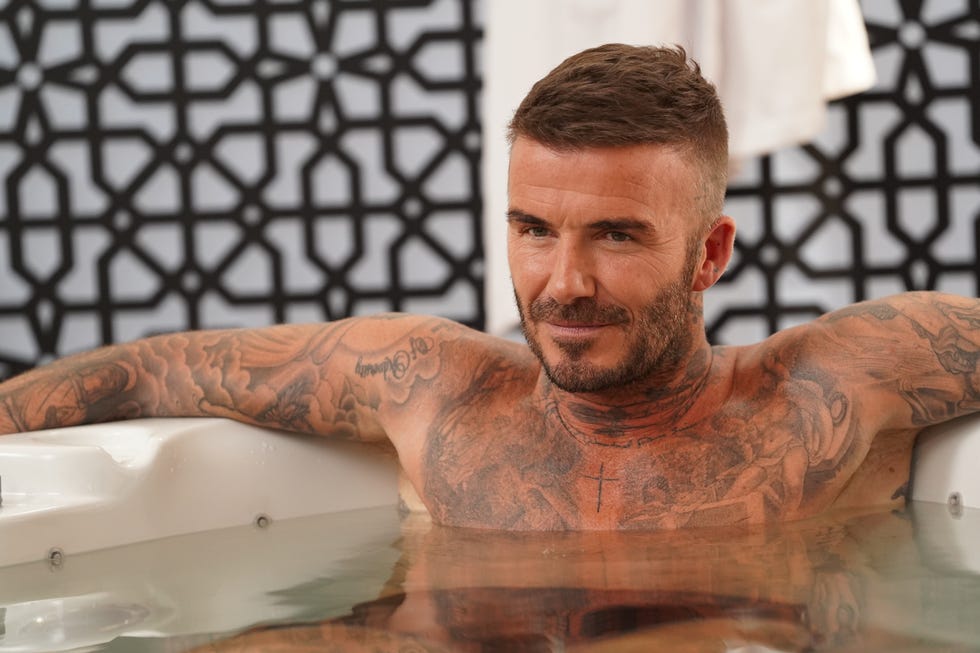
David Beckham’s tattoos began with a few family pieces and grew over decades into a collection of names, religious images, handwritten messages, dates and shaded scenes. They now cover his neck, back, chest, ribs, arms, hands and legs. Following the collection by placement makes more sense: photos can hide details, and not every reported meaning has been confirmed.

The counts are only snapshots. In a 2013 CNN interview, Beckham said he had 32 tattoos and that his favourites included his children’s names. He added, “They all have a meaning.” A 2016 GQ profile put the count at about 40. Later inventories counted more than 60, including a detailed Men’s Health list, and director Fisher Stevens said Beckham was nearing 100 while they filmed the Netflix documentary. The totals vary because sleeves hold many separate motifs and Beckham has kept adding new work.

The neck has become a cluster of family tattoos

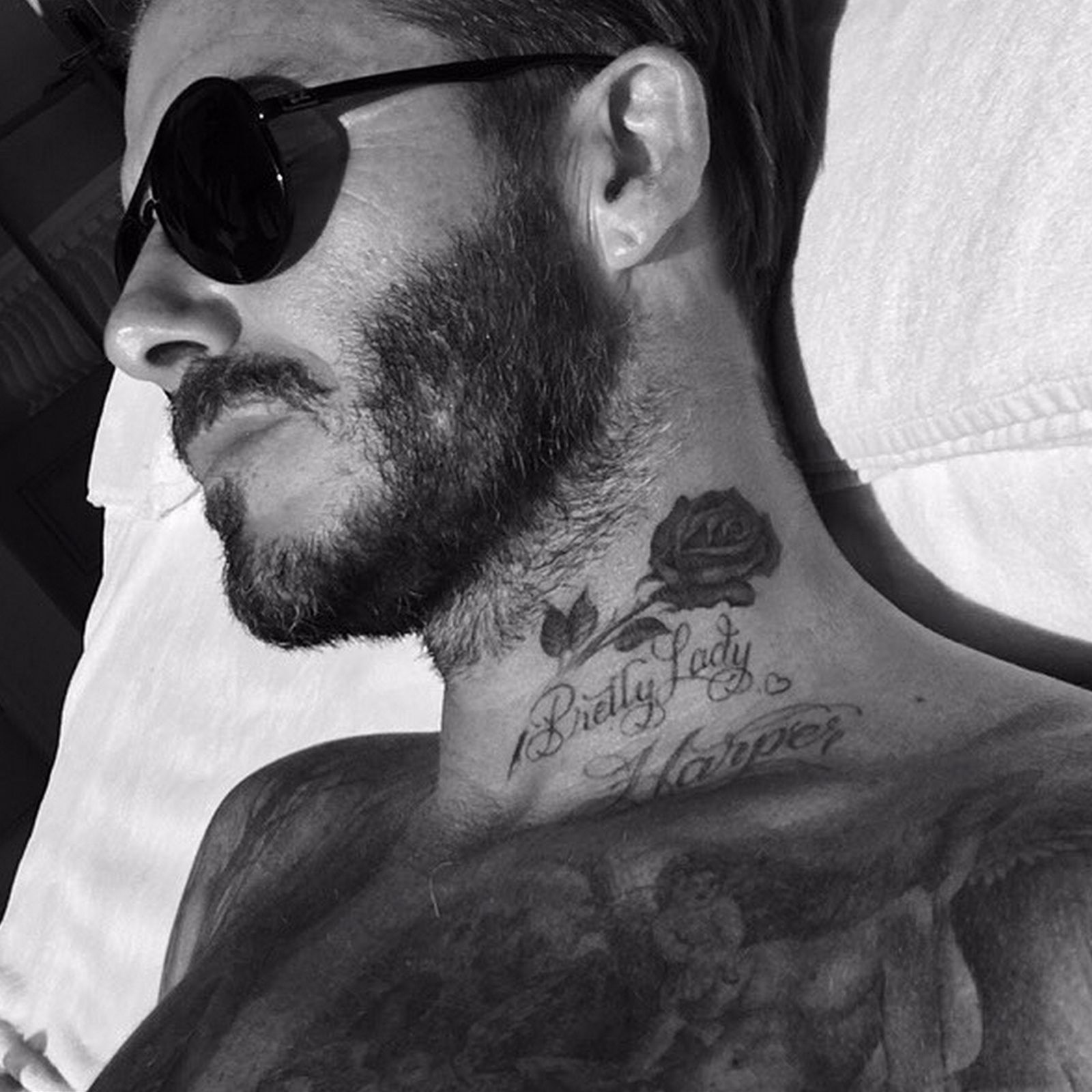
Close view of David Beckham’s neck rose and Pretty Lady Harper lettering

Beckham’s neck tattoos were added over time. On the left, “Pretty Lady” sits above Harper’s name. Higher up, a rose is paired with “I love you” and birds that reach toward his hairline. Close-up photos show a tiny rose near his ear and a small black heart on the ear itself. A solar-system design on the side of his head can disappear beneath his hair.

At the back of his neck, a winged crucifix sits above Romeo’s name. Lower at the front, a rose sits beside “dadda do it”, split by a small black horse. Reports link the horse to Victoria, though the image alone can’t confirm that. On his collarbone, “Buster” is the nickname Beckham uses for Brooklyn.

Together, the tattoos now fill the neck from the hairline to the shoulders. The close-up above makes the fine script easier to read; wider portraits show where the pieces meet.

The back is organized around a guardian angel and his sons’ names

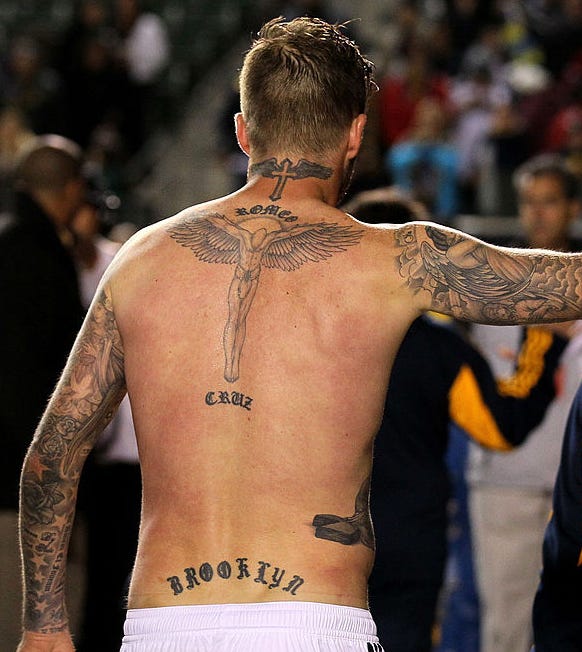
David Beckham’s back tattoo with a winged angel and his sons’ names

Tattoo inventories identify the guardian angel between Beckham’s shoulder blades as his first tattoo. Beckham later added wings, expanding the small figure into a broad back piece. His sons’ names frame it: Romeo near the neck, Cruz lower on the spine and Brooklyn across the lower back. Beckham added the names later.

The back can look different from one photo to another. A collar can hide Romeo’s name, a match shirt covers most of the design, and the camera angle shifts where Cruz and Brooklyn appear. Dated, straight-on photos show the layout more clearly than distant match shots. The image above captures the wings and names together.

Beckham has spoken about the importance of his family tattoos. His comments support the connection for his sons’ names, but he hasn’t given the same explanation for every bird, angel or line of script.

Chest imagery brings faith and family into the same frame

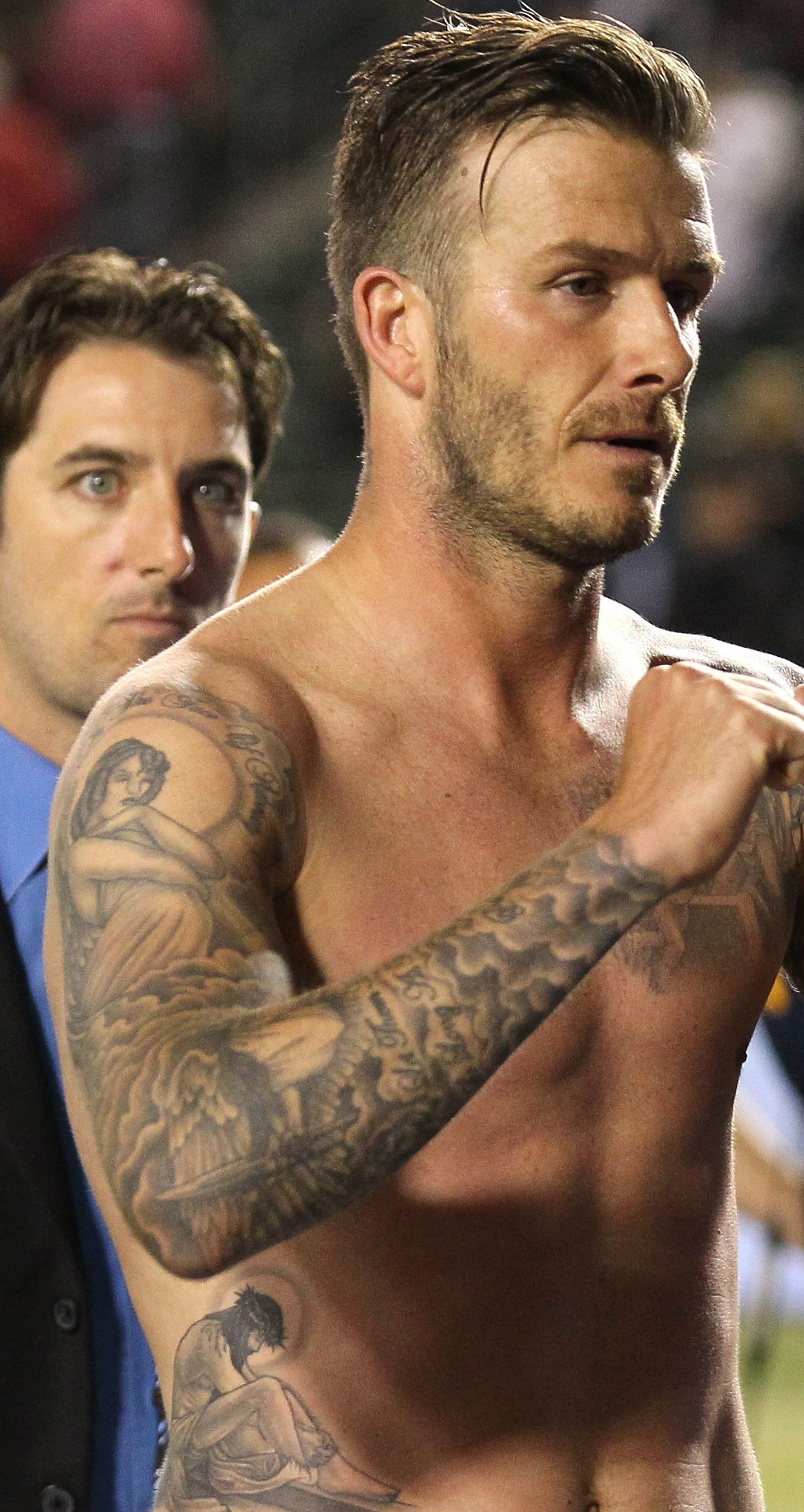
David Beckham displaying his chest and arm tattoos

The best-known chest design shows Jesus being carried by three cherubs. In an interview covered by GOAL, Beckham said the cherubs represent Brooklyn, Romeo and Cruz, and described the image as his sons looking after him.

On the opposite side of his chest is another large religious image. Tattoo guides identify it as a scene associated with The Agony in the Garden, though published accounts don’t agree on the label. A simple cross sits between the two designs.

The chest isn’t one continuous picture: the religious images, lettering and central cross were added at different times. The image above shows how the chest work meets the sleeves.

His ribs and sides hold a ship, inscriptions and family dates

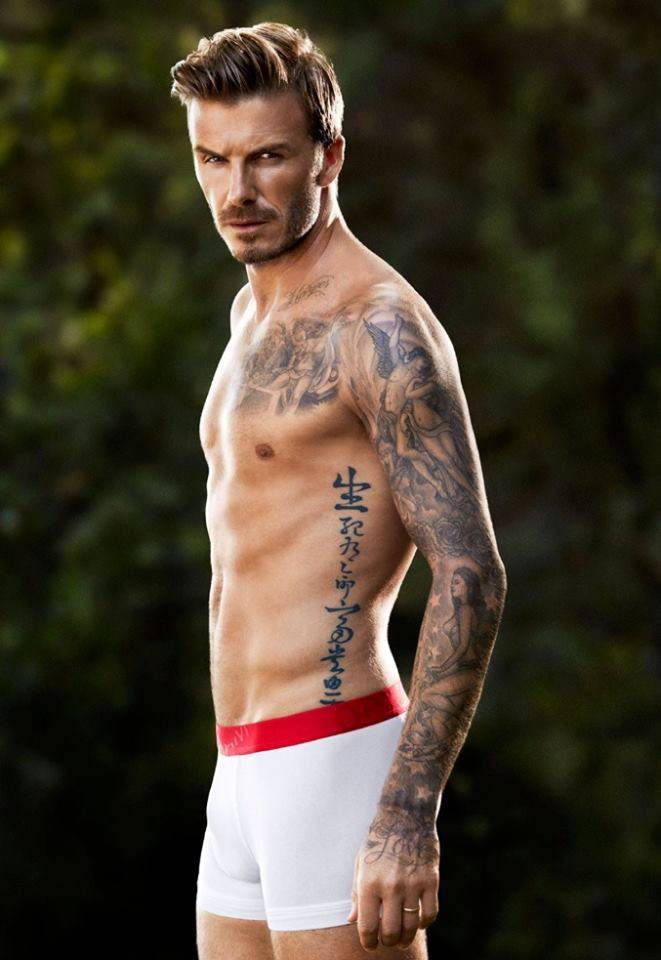
David Beckham Chinese-character rib tattoo shown clearly

Under one arm is a full-sailed ship that matches the one on his father’s arm. A passage from the Bible sits below it. On the other side are an eagle in flight and a portrait of a Native American chief. Family and faith recur throughout the collection. The sources don’t offer a broader explanation for either the eagle or the portrait.

Chinese characters from Confucius’ Analects run down his left side. Men’s Health translates the passage as a reflection on life and death, riches and honour. Nearby are 1975, his birth year, “Mum & Dad” and “We Love You Daddy”, which reports say his children wrote by hand. A woman in a forest has also been photographed on his torso, though available sources don’t explain it.

The characters are difficult to read in most photos. The image above makes the lettering easier to see, though the available sources don’t offer a reliable line-by-line translation.

The arm sleeves combine portraits, roses, scripture and numerals

David Beckham’s tattooed arm sleeve with religious imagery and lettering

Beckham’s sleeves grew in layers. One arm has an angel near the shoulder, along with clouds and cherubs. Lettering includes “In the Face of Adversity” and “Let Them Hate As Long As They Fear.” Lower down are “Pray for Me”, “Perfectio in Spiritu”, the Roman numeral VII and “De Integro”, usually translated as “again” or “anew.” Seven is also his shirt number.

On the other arm are a Renaissance-style Cupid carrying Psyche, ten roses around the elbow and a portrait of Victoria among stars and dark shading. Nearby, “Ut Amem Et Foveam” is usually translated as “to love and cherish.” A Hebrew line from the Song of Songs reads “I am my beloved’s and my beloved is mine.” Victoria’s name appears in Sanskrit on his forearm; one guide notes that the spelling includes an extra letter.

Sleeve counts vary depending on whether every rose, star or cherub is counted separately. Men’s Health says Mark Mahoney is a more recent go-to artist; GOAL connects Louis Molloy to earlier work and credits Gabe with the Chinese characters. The credits point to several artists, not just one.

Hand and finger tattoos make the smallest designs easy to spot

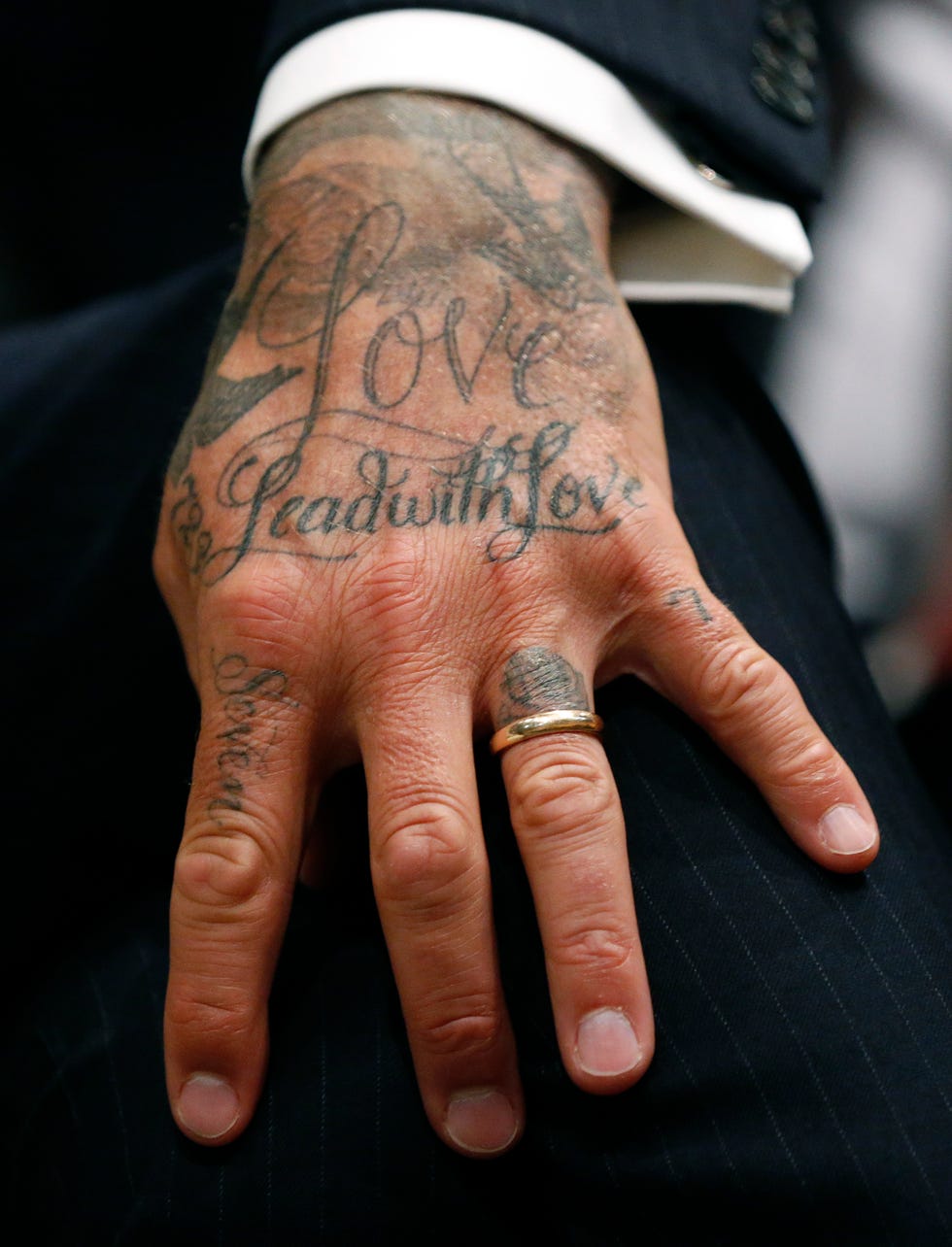
Close-up of David Beckham’s hand lettering and finger tattoos

Several hand tattoos use short phrases. One hand has “Love” across the top, flanked by a swallow on either side, with “Lead with Love” below. Another cluster includes Victoria’s name, a hummingbird, “Dream Big, Be Unrealistic,” and “My Love.” Beckham wore the number 32 at AC Milan; 723 combines the seven and 23 he wore during his football career.

His fingers carry the number seven, a rose and 99, which Beckham has connected to 1999, the year he married Victoria. Harper also drew a small stick figure on his palm. These small tattoos are easy to miss, though close photographs and Beckham’s comments explain several of them.

Hands are tricky to photograph clearly: fingers turn, palms close and lettering curves around the skin. The close-up above keeps the hand large enough to read, unlike a full-body shot where the marks are easy to miss.

His leg tattoos include angels, a lion and a recent prayer design

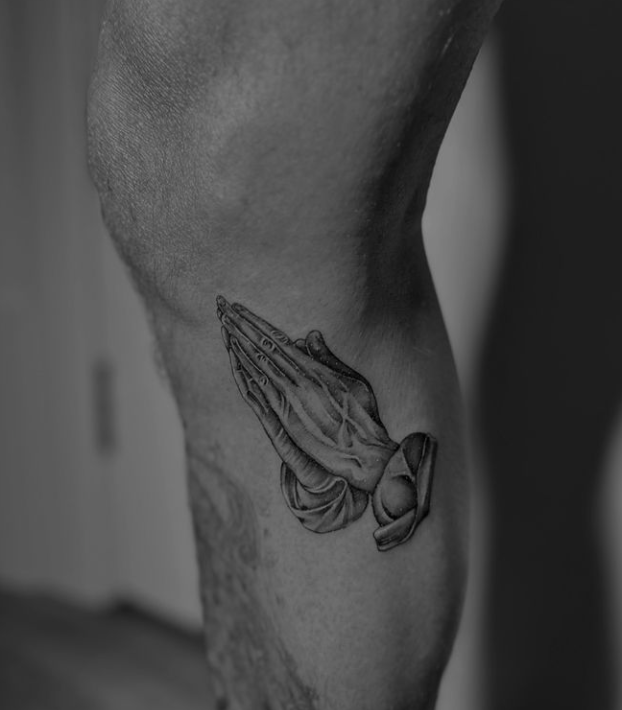
David Beckham’s black-and-gray praying hands tattoo below the knee

Beckham’s legs are less visible in everyday photos. Inventories identify two running cherubs on his right ankle or lower leg, a lion’s face on his left thigh and a bird on his left calf. In 2024, he showed a new black-and-gray tattoo of hands clasped in prayer just below the knee on the side of his leg. The image above shows the new design, not the older ankle and thigh pieces.

The 2024 report credited London tattoo artist Certified Letter Boy with the design. Beckham shared it in Instagram Stories but didn’t explain what it means to him.

Trousers cover most of Beckham’s legs, so the older tattoos appear less often in interviews and event photos. Inventories list their locations and designs, but they’re harder to compare with the frequently photographed tattoos on his back, hands and neck.

Beckham has said he gets tattoos when inspiration strikes and has singled out his children’s names as favourites. He has explained some designs; published accounts leave the rest unexplained.

Conor McGregor’s Tattoos: From the Gorilla to the Tiger

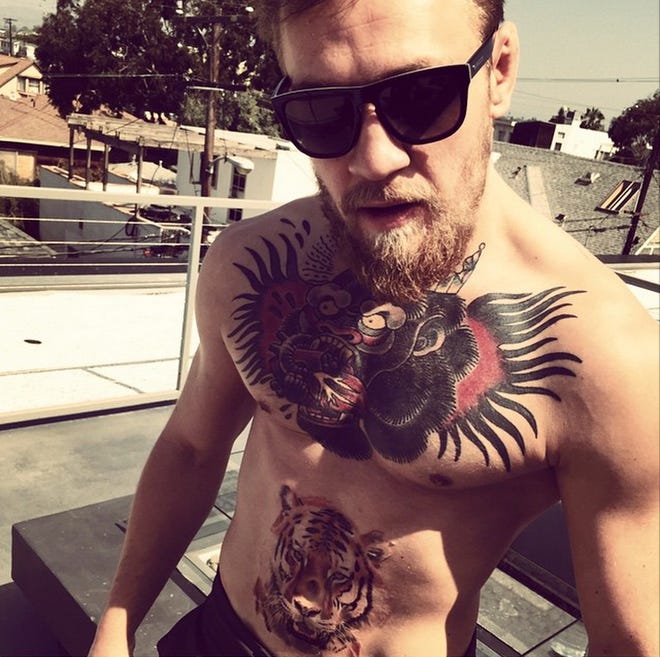
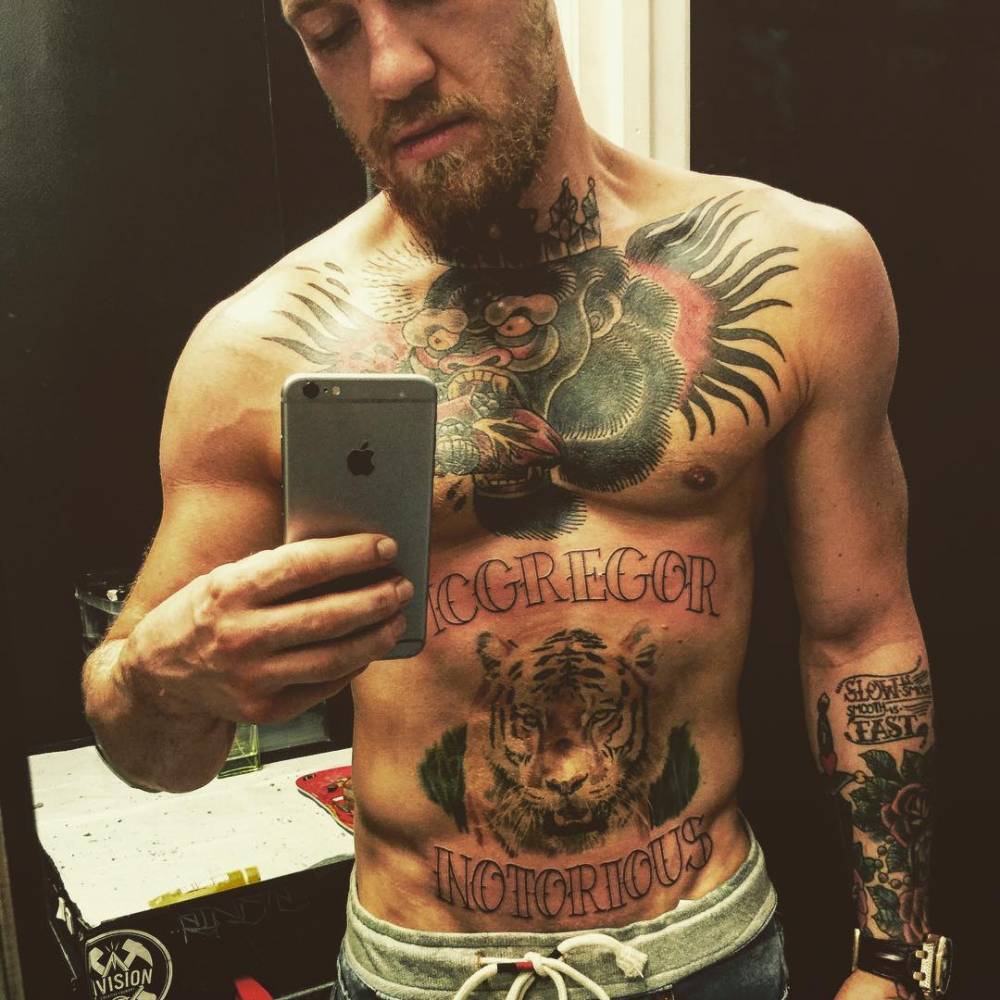
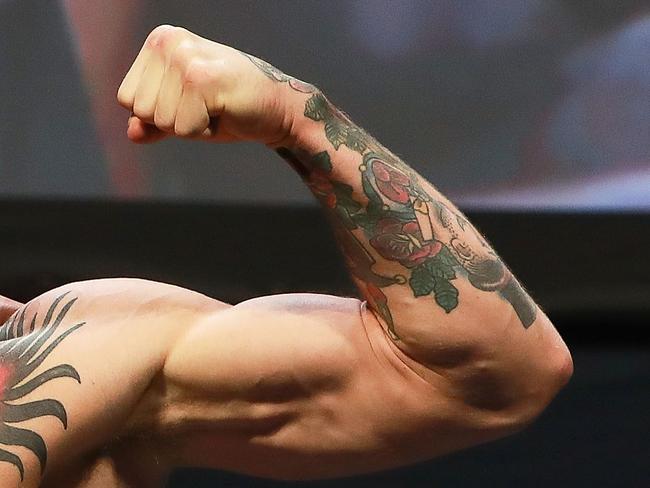
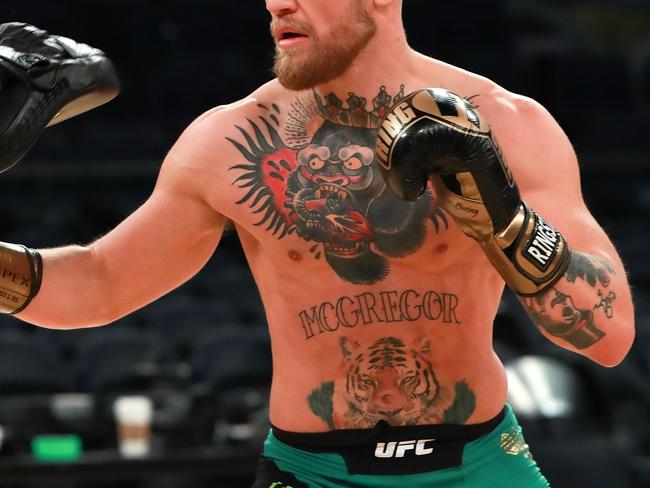
Conor McGregor’s tattoos are concentrated on his chest, stomach, arms and wrists. The crowned gorilla on his chest, the tiger on his stomach and the lettering around it are the best-known pieces. They were added at different points in his UFC career, giving the front of his torso a layered look.

The crowned gorilla on his chest

Conor McGregor in 2015 with his gorilla chest tattoo and torso lettering visible

The large chest piece shows a gorilla wearing a crown and holding or eating a bloody human heart. McGregor has talked about the tattoo on UFC programming and described its imagery in direct terms. The design is clear in photographs, though its full personal meaning is less certain.

Esquire described the gorilla as a major piece at the centre of McGregor’s upper body. Training, weigh-in and interview photos show it clearly. It sits above the stomach lettering and tiger, linking the front of the torso.

The tiger on his stomach

Conor McGregor tiger stomach tattoo

McGregor added the tiger in 2015, before his fight with José Aldo. UFC reported that it sits on his lower torso, with “McGregor” and “Notorious” arranged around it. MMA Fighting also covered the addition in the run-up to UFC 189.

The tiger sits between the two words, so photos often make the stomach look like one large panel. Its placement and date are well documented; online claims about what the animal represents have not been confirmed by McGregor.

“McGregor” and “Notorious” lettering

Conor McGregor MCGREGOR and NOTORIOUS lettering tattoo on his midsection

“McGregor” runs across the upper stomach, with “Notorious” below the tiger. The words use the public name and nickname associated with his fighting career. UFC’s 2015 report dates the addition, instead of relying on an undated photograph.

Older photos show a different stomach layout before the tiger was added. Later fight-week images bring the tiger, both words and the chest gorilla into the same frame.

Wrist and forearm tattoos

Conor McGregor dagger and rose tattoo on his forearm

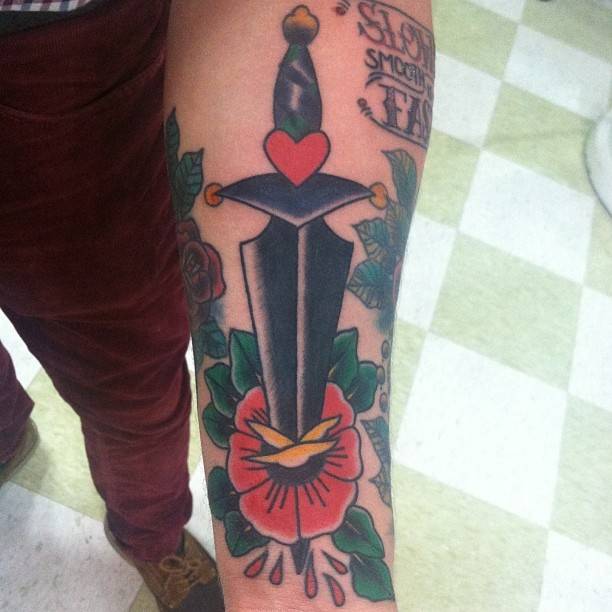
Esquire noted a mustached man in a top hat on McGregor’s left wrist, alongside the phrase “slow is smooth, smooth is fast.” The wording is visible in photographs and often listed among his recognizable smaller tattoos.

Other arm photos show a rose, a clock and additional lettering. Those pieces are harder to date because they are not always visible together, and the available accounts do not establish when each one was added.

Artists and studios behind the work

UFC’s 2015 report links the stomach tiger to Pin at Sideshow Tattoo in California, giving that piece a specific artist and studio.

MMA Fighting interviewed Steve Butcher about a separate chest tattoo and described a twelve-hour session at FY Ink in Toronto. Butcher said the work was outside his usual style and commented on the quality of McGregor’s existing tattoos. These accounts point to different artists and studios across the collection.

How McGregor’s collection changed over time

Conor McGregor tattoo collection

The chest gorilla was already a defining feature in early profile coverage. The tiger and stomach lettering came later, creating a larger composition across the front of McGregor’s body. His wrist and forearm pieces appear in interviews and training photos, though sleeves and camera angles often hide them.

The dates matter. A photo from before 2015 cannot show the tiger UFC reported ahead of the Aldo fight. Later images may capture more arm work, and any tattoo count belongs to the period it describes.

What is confirmed and what remains unclear

Conor McGregor tattooed arm

The clearest record covers the chest gorilla, stomach tiger, “McGregor” and “Notorious” lettering, the wrist phrase, and artist credits tied to particular pieces. Other small designs are visible in photographs, but their dates and meanings are not always public.

No reliable source establishes the meaning of the animals or credits the whole collection to one tattooist. The reports do identify particular designs, dates and artists; the rest need no invented backstory.

Frequently asked questions

Who tattooed McGregor’s tiger?

Conor McGregor tattooed torso

UFC connected the 2015 stomach tattoo with Sideshow Tattoo and named Pin in its accompanying post.

What is McGregor’s largest tattoo?

Conor McGregor gorilla and tiger tattoos

The crowned gorilla on his chest is among his largest and most visible pieces.

Does he have tattoos on his arms?

Conor McGregor torso tattoos

Yes. Photos show lettering, the wrist phrase, a rose, a clock and other smaller work on his arms and wrists.

Other documented details

Conor McGregor pocket watch and rose tattoos on his forearm

UFC coverage places the tiger before McGregor’s fight with José Aldo and records the words around it. That lets the earlier chest piece and later stomach design be dated separately.

The wrist phrase has its own context. Esquire described it alongside the top-hat figure, but did not connect it to the gorilla or tiger.

The artist credits are specific: Pin and Sideshow Tattoo are tied to the stomach tiger, while Butcher discussed a different chest session at FY Ink. The accounts indicate more than one artist may have worked on McGregor, without assigning the whole collection to one person.

Weigh-in and training photos show the front of the torso most clearly. His back, sides and legs appear less often, so the record there is thinner. Esquire helps identify some of the smaller arm and wrist work; its personal meanings remain private where McGregor has not discussed them.

Lewis Hamilton’s Tattoos Trace Faith, Family and the Track

Lewis Hamilton’s tattoos include a compass and lettering across his chest, family and faith words on his shoulders, a later lion, and religious and musical imagery on his back and arms. No single photograph shows the whole collection: Men’s Health portraits capture the chest, while other coverage reveals the lion and back pieces.

Hamilton has described the compass as a guide connected with faith, and the lion as a reminder of emotional control and the sun’s power. Family and Faith appear across his shoulders. Other tattoos are visible in published coverage without a public explanation.

The compass and Powerful Beyond Measure set the chest’s direction

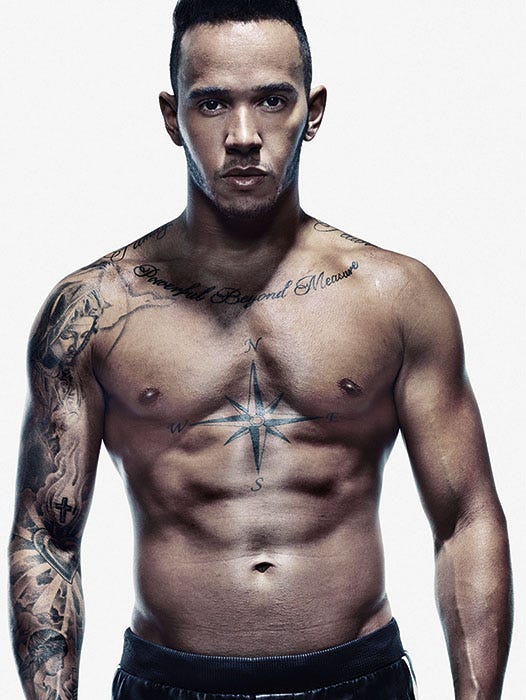
Lewis Hamilton showing the compass and Powerful Beyond Measure chest tattoos

The compass anchors Hamilton’s best-known chest portrait, below the script Powerful Beyond Measure. Its directional letters give the design a literal sense of orientation. Digital Spy’s account of the Men’s Health shoot says Hamilton connected the compass to faith as a guiding force.

The phrase runs across his upper chest, framing the compass. It has also been reported as a quotation Hamilton uses as a reminder. The words add a personal line to the navigation imagery, rather than serving as a generic slogan.

The African lion adds a newer chest focal point

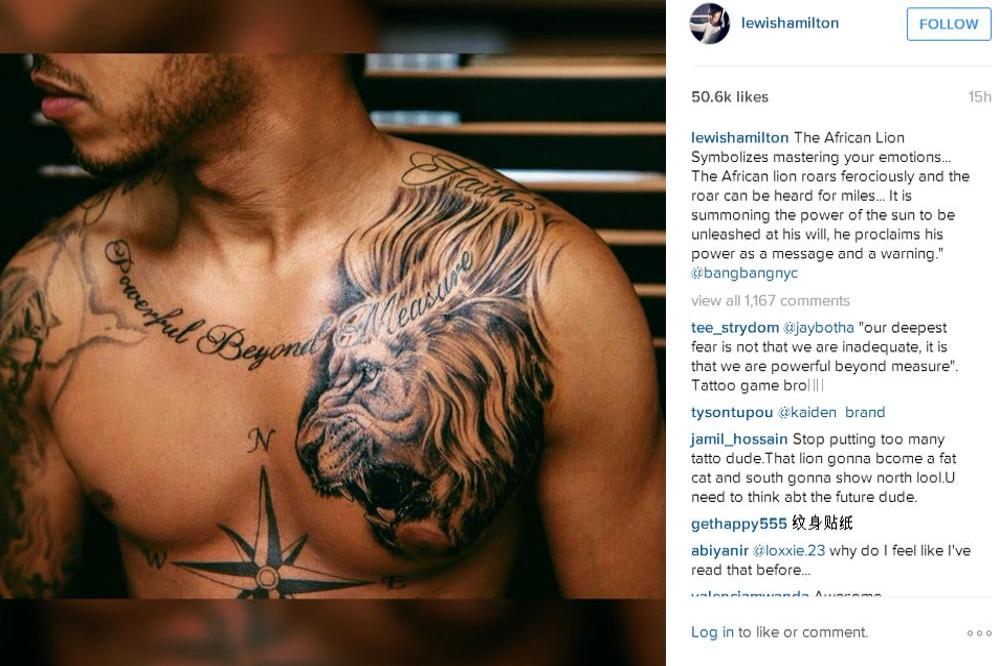
Lewis Hamilton showing the African lion chest tattoo

Hamilton later added a detailed African lion to his chest. Female First reported that Bang Bang made it and quoted Hamilton saying it represented mastering his emotions; the roar also calls up the sun’s power as both message and warning. The report connects the image, artist and explanation in one account.

The lion’s mane fills a substantial part of the chest and gives the compass a second focal point. Hamilton’s own explanation sets out the idea without making the tattoo a key to every later decision in his life.

Family and Faith are written across the shoulders

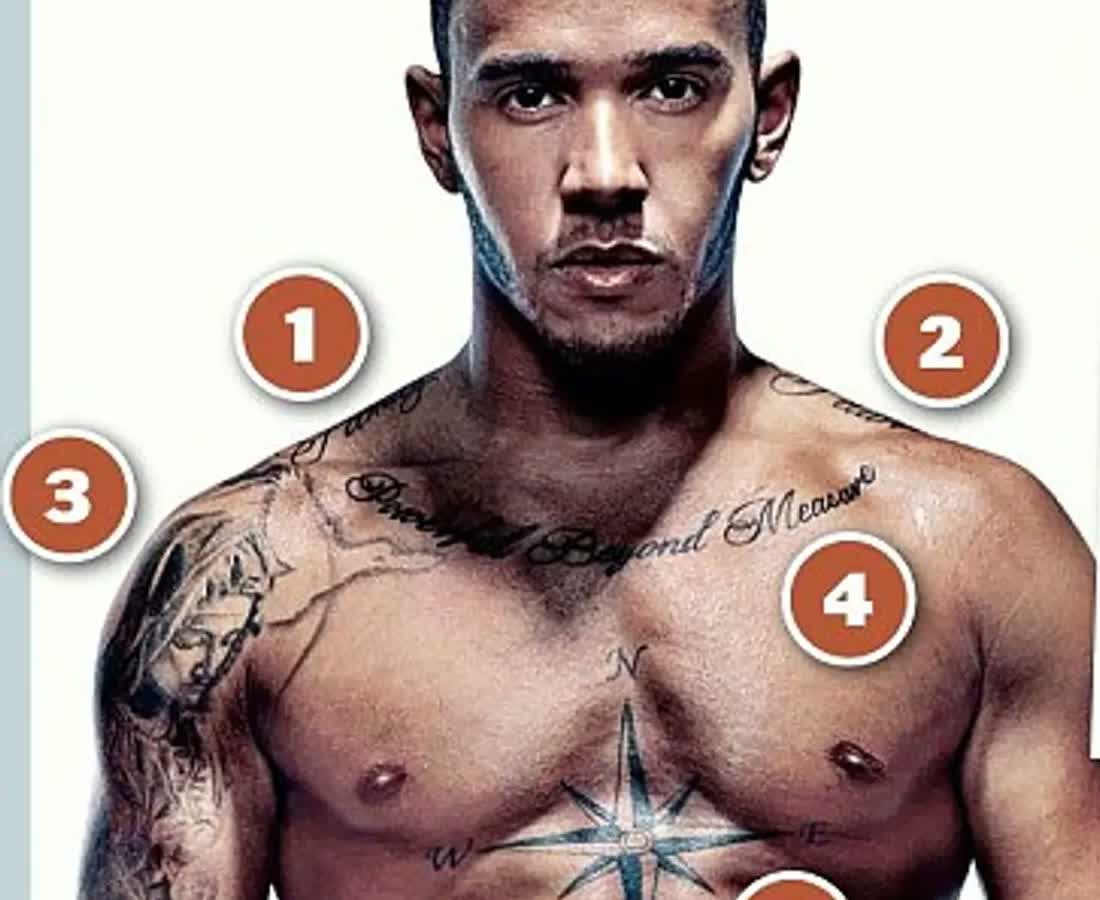
Lewis Hamilton showing the Family and Faith shoulder lettering and chest tattoos.

Men’s Health coverage identifies Family and Faith as separate words across Hamilton’s shoulders. A wide portrait shows them more clearly than a racing photograph, where clothing can hide them.

The shoulders use readable script, while the chest pieces are built from detailed imagery and directional lines. Together they give Hamilton’s tattoo map two different visual registers.

The winged cross carries Hamilton’s message across his back

Lewis Hamilton showing the Still I Rise cross and wings back tattoo

Digital Spy describes a Pietà on one arm, a sacred heart, musical notes and a large cross with angel wings on Hamilton’s back. Yahoo Sports also places religious and music references in the wider collection. The photographs show different parts at different angles, so the full arrangement is rarely visible in one frame.

The Pietà refers to Michelangelo’s sculpture of Mary holding Jesus. The sacred heart adds another religious image, while the musical notes connect the tattoos to Hamilton’s interest in music. The back is seldom visible in ordinary interviews, so published descriptions help place those designs.

How the tattoos fit together across the body

Lewis Hamilton showing multiple tattoo placements

A chest portrait shows the compass and lion; separate photos and interviews are needed for the arm and back work. Hamilton’s tattoo record is strongest when each design is tied to its location.

The motifs move from guidance to control, family, faith and music. They look different from one another but share a personal weight.

Newer photographs may reveal details older coverage missed. The compass, chest phrase, lion, shoulder lettering and the Pietà, sacred heart, musical notes and winged cross show the collection’s range.

Finn Bálor’s tattoos, from an astronaut to a hometown seagull

Finn Bálor’s tattoos started with a small astronaut on his hand and grew into a playful mix of drawings, plants, birds and personal lettering. Family and home show up in several of the stories he has shared. Photos show the shape and placement; Bálor’s explanation gives a tattoo its personal meaning.

The astronaut looking toward the moon

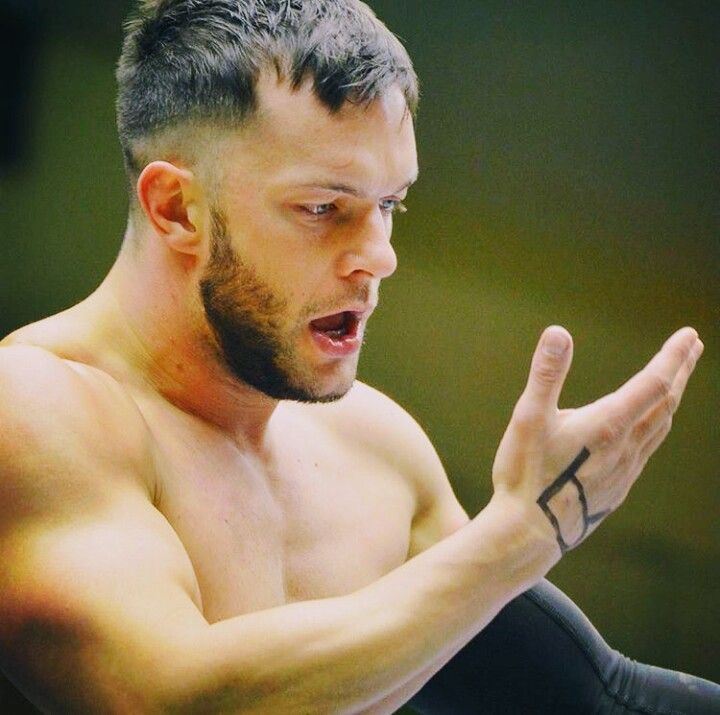
Finn Bálor’s astronaut and moon tattoo on the hand

The little astronaut on the top of Bálor’s left hand is the design that started the public story of his tattoos. In a WWE feature, he described himself holding a space helmet and looking toward the moon. He linked it to the idea of “following your dreams.”

A hand tattoo is hard to hide during a match or interview, but this one is a compact, finely drawn scene. Early ring shots barely show it; a close-up brings out the moon, helmet and tiny figure. Bálor had thought about getting ink for years but worried he might change his mind. As he got older, he became less concerned about permanence, and the astronaut opened the way for a larger collection.

The dinosaur Veronica drew for him

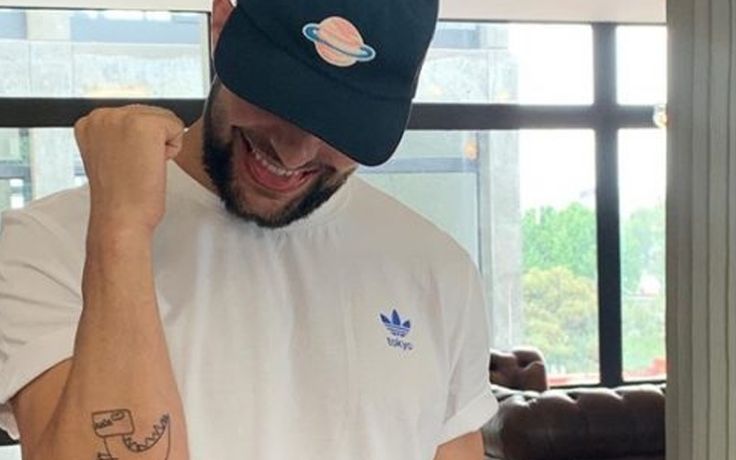
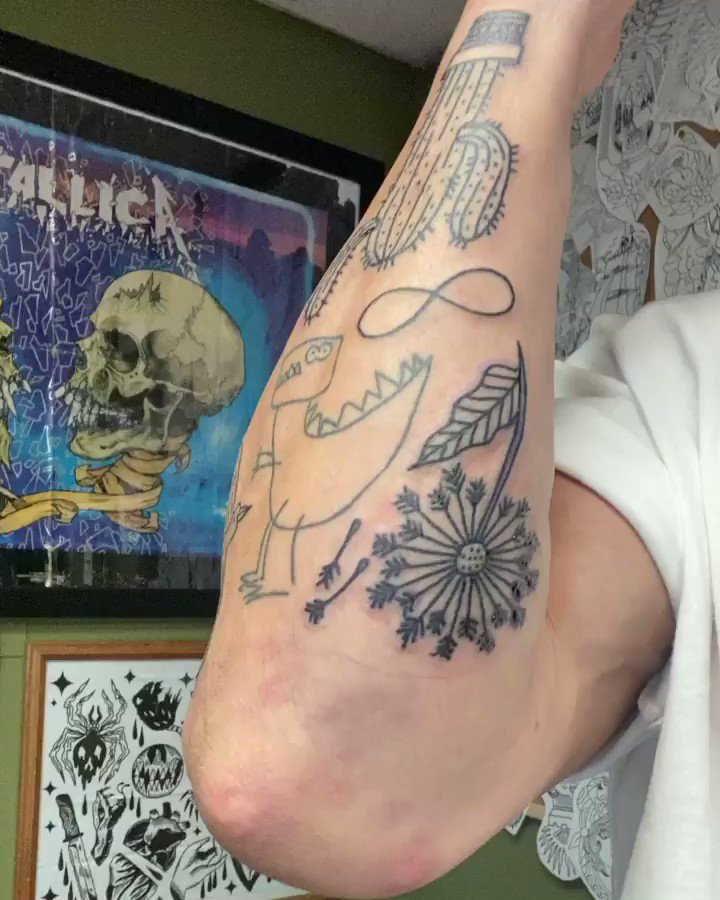
Finn Bálor shows the dinosaur tattoo on his elbow

The cartoon dinosaur near Bálor’s right elbow was drawn by his wife, Veronica. He chose to have her doodle tattooed on his arm, keeping its oversized head and loose outline. Its charm is in that personal origin and sketch-like look.

The elbow bends around the design, so a still photo can flatten it; in a moving clip its shape reads more clearly. The astronaut is finely drawn, while the dinosaur has a looser, hand-sketched feel. That contrast adds to Bálor’s tattoo collection.

Dandelion, cactus and seagull beside the dinosaur

Finn Bálor’s forearm tattoos: dinosaur, dandelion, cactus and seagull

In August 2020, Bálor showed a dandelion, a cactus and a seagull beside the dinosaur. They sit close together on his forearm but read as separate doodles: a round seed head with fine lines, a short upright cactus and a recognizable bird. Together, they make that patch of skin look like a sketchbook page.

Bálor has explained the seagull: it represents his hometown, a small fishing village in Ireland. He hasn’t given the dandelion or cactus a separate meaning. The other two can simply be named and described as visible tattoos, without borrowing internet symbolism about wishes, resilience or survival.

The three additions came after the dinosaur and filled out the same arm. Their scale and linework work well together, but nothing suggests the whole forearm was planned as one composition. Of this group, the seagull is the only design Bálor has publicly connected to a specific meaning.

The matching date and coordinates with Vero Rodríguez

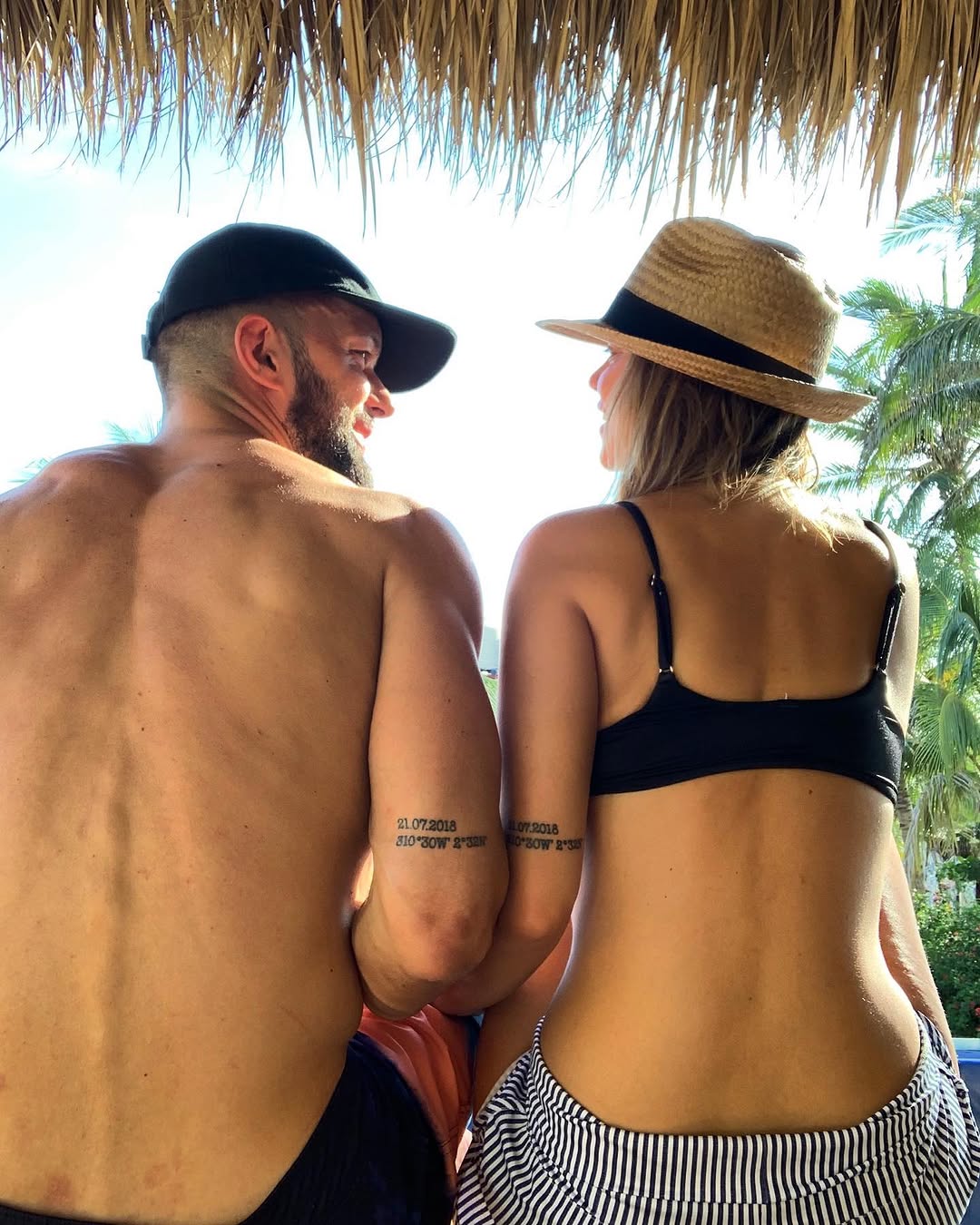
Finn Bálor and Vero Rodríguez show matching date and coordinate tattoos on their arms

Bálor and Vero Rodríguez have matching tattoos on the backs of their arms, just above the elbows. The close-up shows a date and coordinates on each. The date reads 21.07.2018; the coordinate line is smaller, and some digits blur in compressed images.

Reports covered the matching ink in July 2019, before their wedding that August. Some linked the numbers to when and where the couple met, but Bálor hasn’t confirmed that. The reports don’t establish a specific anniversary or proposal; the exact reference remains theirs to explain. The writing is understated on the back of the arm, a different look from the cartoon designs.

His wife’s name on his hand

Finn Bálor inspecting the tattoos on his hand

Bálor has also put his wife’s name on his hand. He calls it the tattoo that opened the floodgates: after getting it, he felt more comfortable adding other designs. It sits naturally in the timeline between the matching couple tattoo and the later illustrated pieces.

The photo shows where the lettering sits; Bálor’s comments explain why it mattered in the timeline. He chose his wife’s name and says that tattoo changed how readily he approached the next ones.

How the collection grew

Bálor has said he was artistic at school and nearly went to art college. He admired tattoos for years but hesitated, worried that his tastes would change after making a permanent choice. With age, he became more relaxed about it. That helps explain the mix on his skin: a dreamlike astronaut, Veronica’s dinosaur, a hometown bird, small plants and personal lettering don’t need to share one style.

Reports placed the matching date and coordinates in 2019; the astronaut and dinosaur followed that year, and the dandelion, cactus and seagull appeared the next summer. In 2021, Bálor described the collection as still growing, not as a finished sleeve. He may have added tattoos since then, so these public reveals aren’t a complete count of what he wears today.

What can be said with confidence

The stories Bálor has shared are the clearest ones: the astronaut is about pursuing dreams, Veronica drew the dinosaur, and the seagull points to his Irish hometown. The matching date and coordinates, along with his wife’s name, document relationship tattoos, though their exact private meaning hasn’t been confirmed. The dandelion and cactus are identifiable, but he hasn’t given them a meaning.

Together, they make a personal tattoo map: an astronaut on the hand, drawings down the forearm, his wife’s name and a shared date-and-coordinate design. The pieces don’t need one grand theme. Bálor has shared the stories behind some of them and left the others as drawings he liked enough to keep.

The Stories Behind Dave Bautista’s Tattoos

Bautista’s tattoos have changed over the years, so they don’t read as one tidy set of symbols. In GQ’s tattoo tour, he says the designs connect across his body and jokes that he has “like three” tattoos. Some have been reworked, others sit beside later additions, and his explanations often provide more context than a list of images can.

One connected collection, built over decades

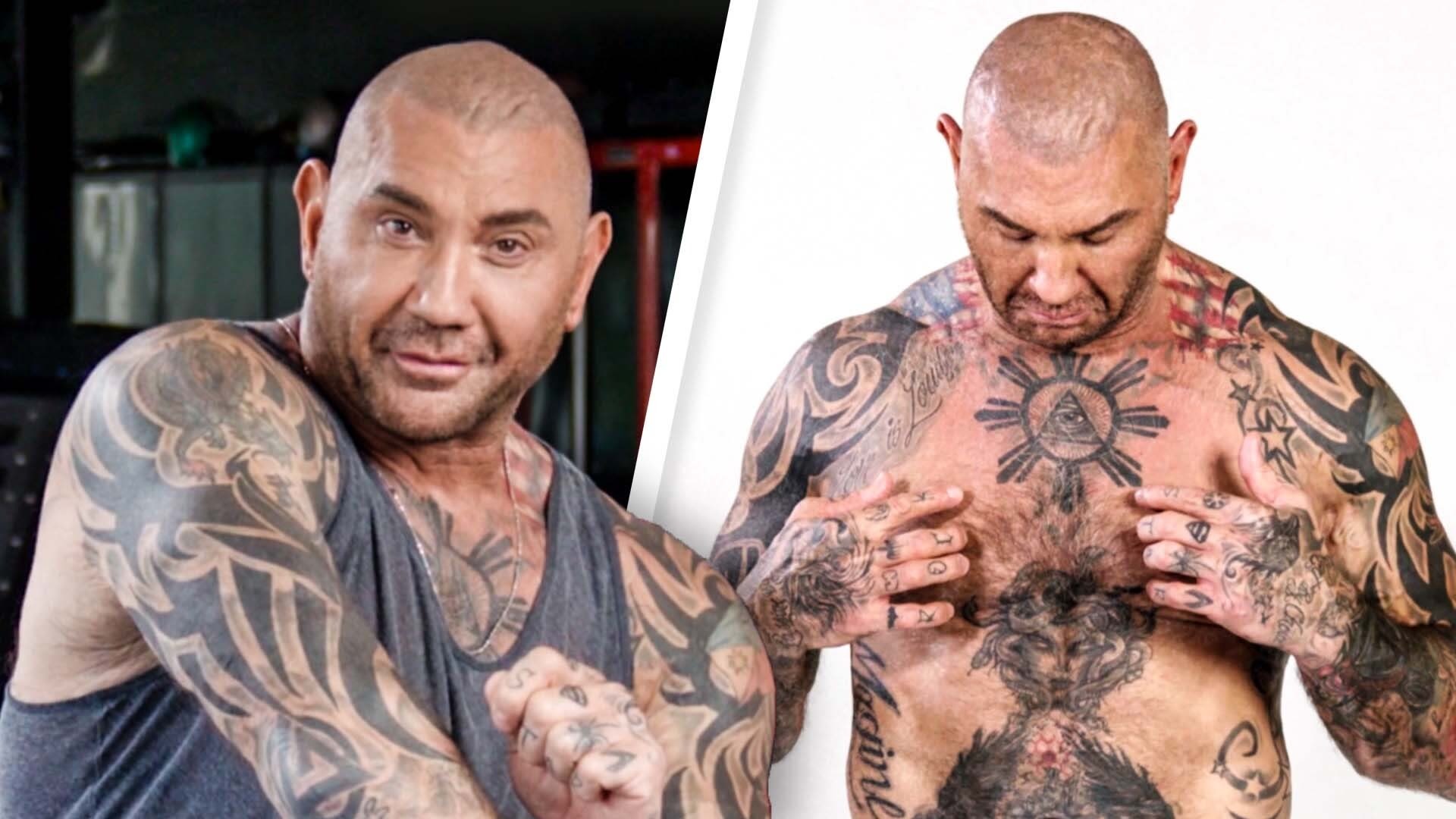
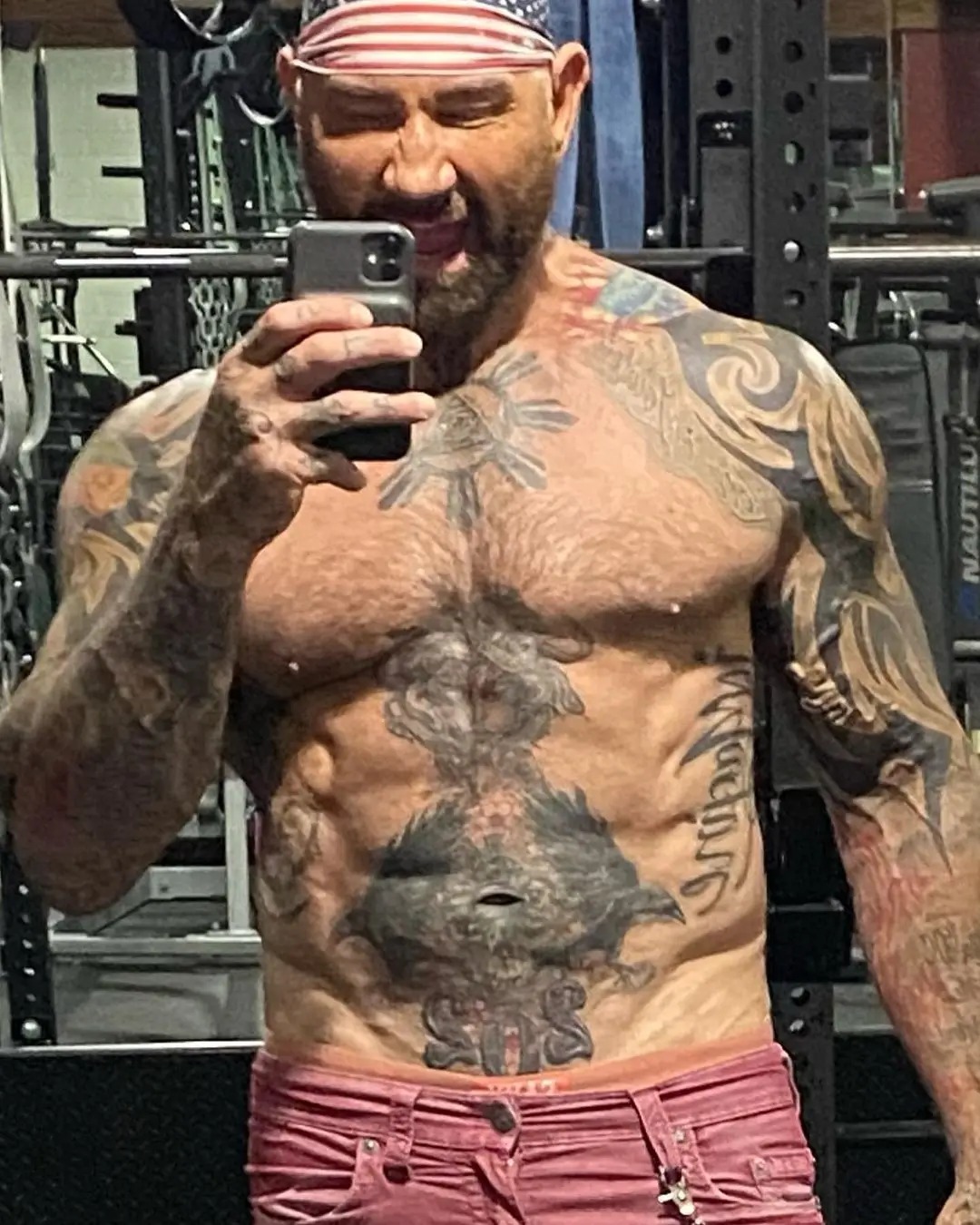
Dave Bautista tattoo collection

The full view makes clear this isn’t one uniform sleeve. Bautista’s chest, arms, hands, legs and back carry family references, pop culture, memorial portraits and tattoos he later covered. He says wrestling damaged the large back piece, which took close to 50 hours and needed retouching. That’s a practical detail, not a hidden meaning. A useful guide to his tattoos starts with what can be seen and adds his own explanations where he has given them.

GQ is the best source for Bautista’s own account, but he doesn’t explain every image. Photos show placement and appearance; they can’t fill in the meaning for him.

His Filipino and Greek heritage across the chest and arm

Dave Bautista’s chest and arm tattoos, including heritage imagery visible in a Glass Onion still

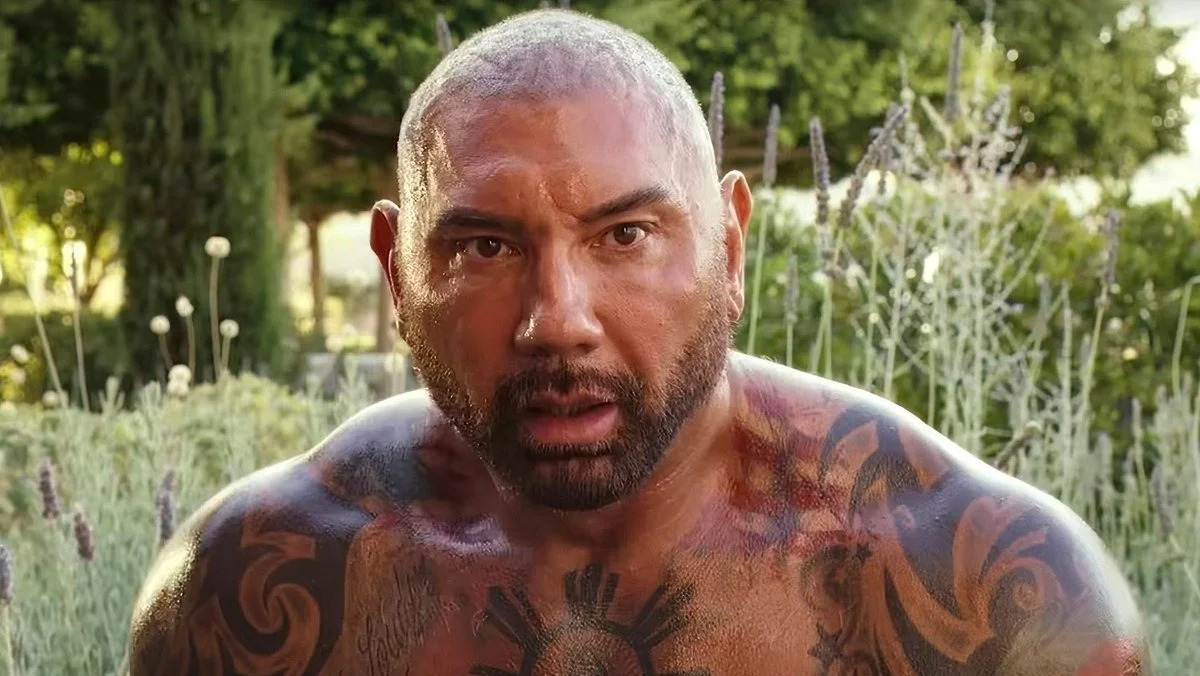
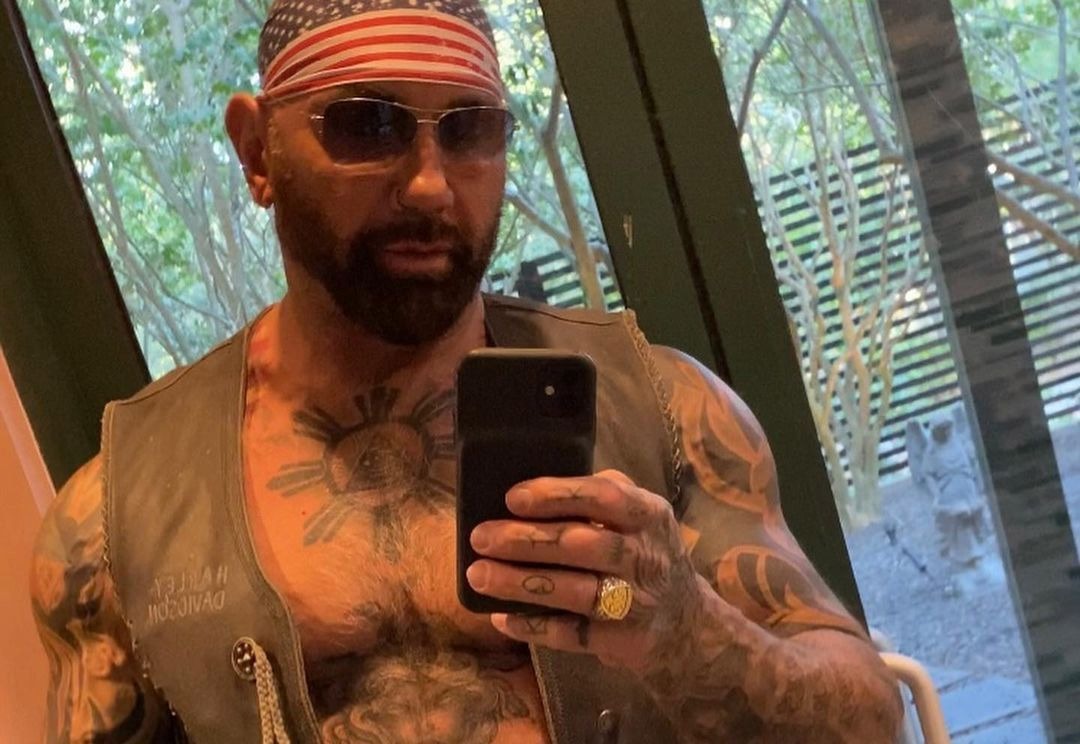
Bautista has spoken about his Greek mother and Filipino father. His tattoos show both sides of his family: flags of Greece and the Philippines on his upper arm, with a Filipino sun and stars nearby. A sun surrounds the Eye of Providence on his chest. The images are identifiable, but they don’t give every line one sweeping meaning.

In an interview, he said these designs let him carry his background with him. The flags sit among his other tattoos rather than as a separate display. A photo shows their placement; his words explain the family connection.

The old tattoo he covered after a friend’s anti-gay remarks

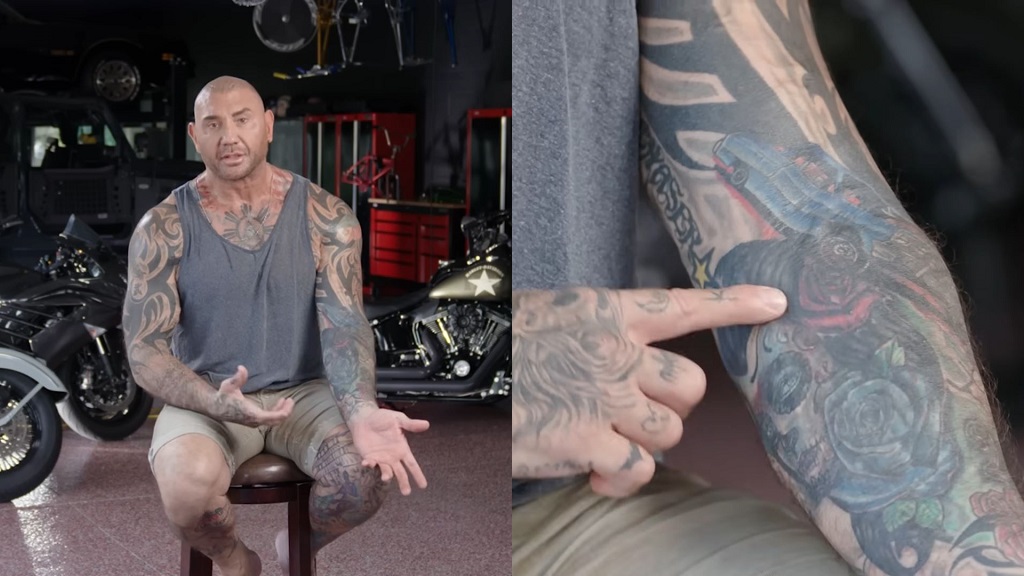
Dave Bautista points to a forearm tattoo during an interview about a tattoo he covered

One of Bautista’s clearest tattoo stories is about a cover-up. He says he covered a team logo after a friend made anti-gay remarks. He doesn’t name the person in GQ’s tour, so there’s no reason to guess. He did say he no longer wanted the logo on his body after hearing those comments.

The cover-up is part of the tattoo’s history, not just a before-and-after detail. Bautista has described other older pieces being reworked too. The interview explains why he wanted the logo gone; the photo shows the area, not who the former friend was or which teammate it represented.

Old-school imagery on his arms and hands

Dave Bautista at an event with several tattoos visible across his arms

His arms mix several styles. On his left hand, Bautista points out a raven and says it came out less menacing than he had pictured. GQ also shows a Gracie Fighter emblem on his elbow that was tattooed backward, lightened and done again. He remembers the swelling afterward. Those details make the tour memorable without turning the mishap into lore.

Some designs connect him to music and entertainment. Bautista discusses Wu-Tang Clan and RZA, along with logos tied to projects he worked on, including Avengers, Guardians of the Galaxy and Spectre. A wide event photo shows the overall coverage, but close-ups are needed for smaller designs and lettering.

He also has pin-up tattoos on his feet, which he says were painful to sit through. An unfinished Japanese fortress behind one knee was another difficult placement. The tour records what he got and what the sessions felt like, without assigning a broad cultural meaning to the designs.

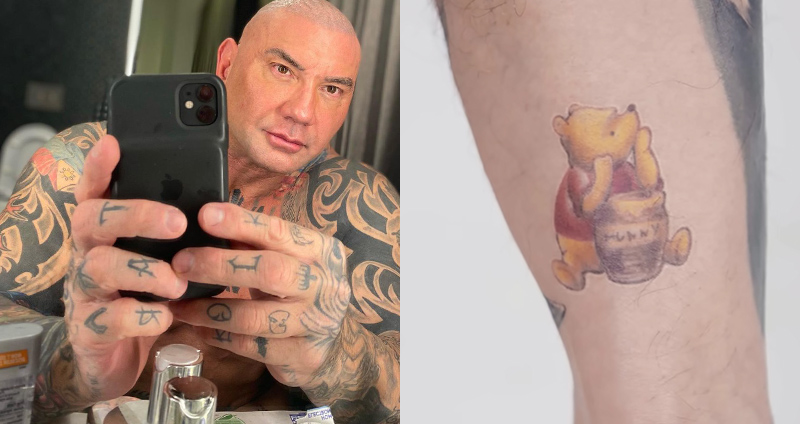
The Winnie-the-Pooh tattoo on his leg

Winnie-the-Pooh tattoo on Dave Bautista’s lower leg, shown beside a portrait of the actor

This is one of the collection’s lighter stories. Bautista says he got a Winnie-the-Pooh tattoo after his young co-star Chloe Coleman was disappointed to learn he didn’t have one. It began with a child’s enthusiasm, not a bid to create a profound symbol.

The tattoo sits on the back of his leg, where it stands out against the darker pieces elsewhere. Bautista says he enjoys that contrast. The photo shows Pooh; the interview gives the story behind his choice.

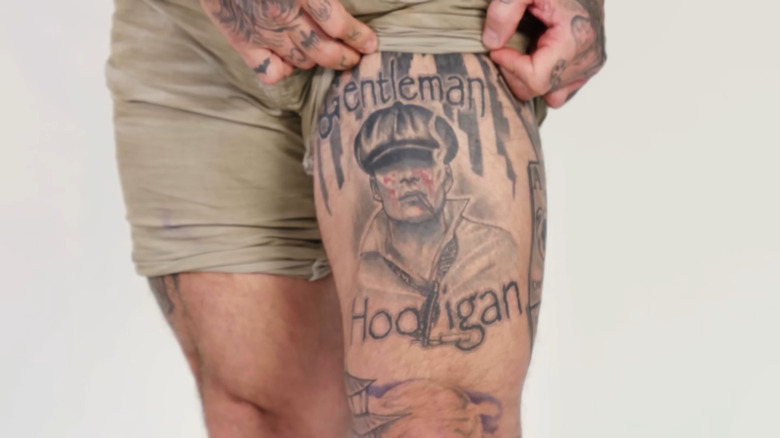
Cillian Murphy’s Tommy Shelby on his thigh

Portrait tattoo of Cillian Murphy as Tommy Shelby on Dave Bautista’s thigh, with the words Gentleman Hooligan

Bautista has a thigh portrait of Cillian Murphy as Tommy Shelby from Peaky Blinders. The lettering reads “Gentleman Hooligan.” It’s a direct nod to a character and performer he admires. The photo shows the design; there’s no need to add a private explanation he hasn’t given.

The thigh placement helps explain why it rarely appears in red-carpet shots. It’s a large portrait, unlike the smaller marks on his hand or the flags on his arm. Together, the designs show why one “signature style” doesn’t describe his whole collection.

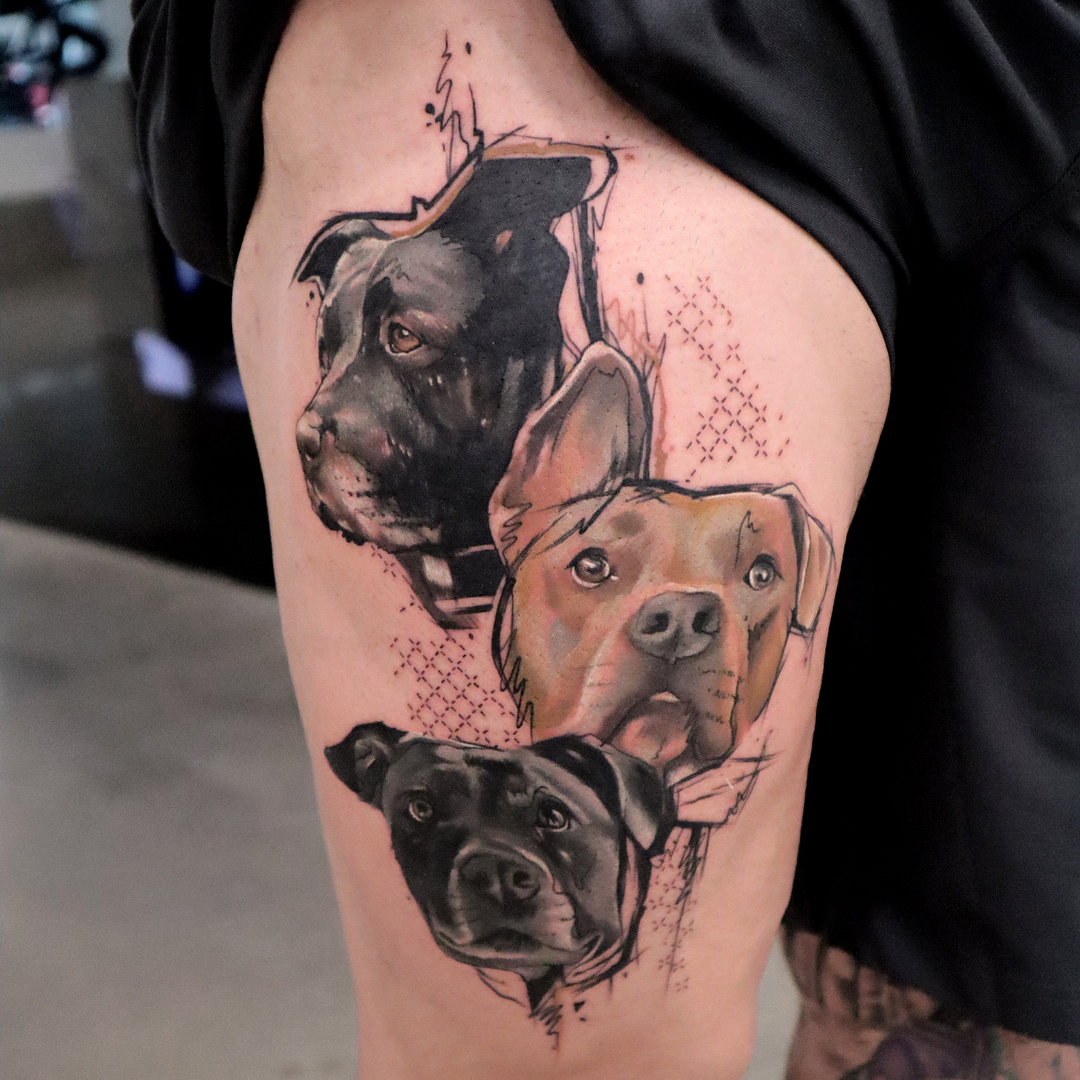
Dog portraits he calls his favorite tattoos

Portraits of Dave Bautista’s dogs tattooed on his thigh

GQ’s tattoo tour includes portraits of Bautista’s three older dogs, which he calls his favorite tattoos. He describes them as a way to keep his dogs close. That meaning comes from Bautista himself, rather than an inference from the pictures.

Family also appears in stories from his videos. Bautista got a tattoo with his grandmother Helen during the “Glorious” video and let her choose the lettering. Another is a tribute to his friend Noah, a painter and community activist who died. Bautista’s own account gives these tattoos context an outsider couldn’t supply.

At 18, his first tattoo was a heart with the words “Heart of stone.” He later covered it with the roots of a cherry-blossom tree. Wrestling also led to retouching his large back piece, which took many hours. Like the team-logo cover-up, those changes show how a tattoo can record one moment and later be altered.

What his tattoo tour reveals about living with the ink

Dave Bautista tattoo tour

Bautista is frank about what it takes to live with his tattoos. Wrestling affected the large back piece and meant it needed retouching. He describes painful sessions on his feet and behind his knee, and an elbow design that had to be corrected. A heart tattoo was later covered with a cherry-blossom tree; he also replaced the team logo after a friend’s anti-gay remarks.

His collection hasn’t stayed fixed. Some pieces he still likes; others he has chosen to revise, cover or leave unfinished.

How to read Bautista’s tattoo collection

Dave Bautista tattoos across chest and arms

Some tattoos have clear stories because Bautista has explained them: the heritage flags, Pooh, his dogs, his grandmother Helen, Noah and the team-logo cover-up. Others are visible, but their meaning isn’t fully documented in the GQ interview.

Close photos can identify a raven, portrait, logo or placement, but not necessarily why he chose it. Bautista’s tattoos span family, friendship, pop culture and older work, along with changes he made later. Sticking to those details is more accurate than giving every image a stock meaning.