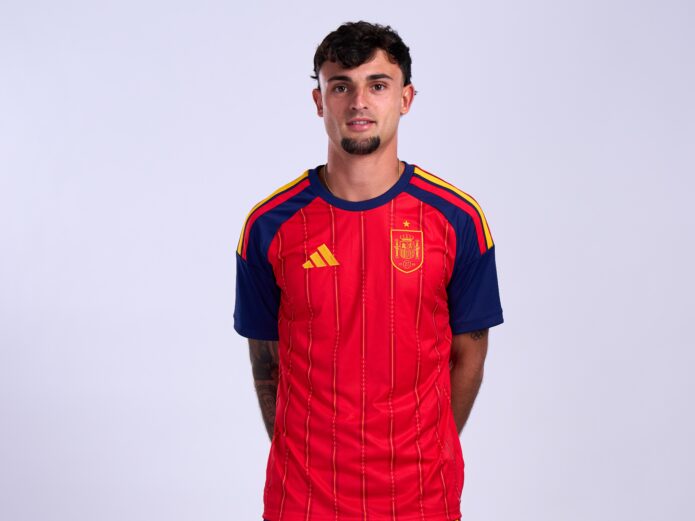
Marc Pubill’s tattoos connect football milestones to the people and places that shaped his early career. The Spain defender has spoken openly about preserving major memories on his skin, especially the World Cup and the Paris 2024 Olympics. Recent photographs also show that the collection is broader than one small symbol. His forearms carry substantial black and grey work, while the Olympic rings and the words “PARIS 2024” sit where cameras can pick them up during matches and official portraits.
The clearest documented explanation comes from the Spanish Football Federation. In its account of Pubill’s first goal for Spain, the defender said, “I like tattoos. I think the World Cup is something really special that had to be there, just as I have the one for the Olympics.” El Desmarque likewise reported that he showed the World Cup tattoo and described other pieces as tributes to his grandparents. That combination gives the collection a clear emotional centre: competition, family and the milestones that made his rise feel real.
What Marc Pubill’s tattoos document
Pubill’s visible tattoos are not presented as a catalogue with an official numbered inventory. They are documented through interviews, match-day photographs and club imagery. That matters because a photograph can show the placement and appearance of a tattoo without proving every private detail about when it was made. The strongest evidence comes from images where Pubill is identifiable and the ink is visible on his exposed arm.
One of the most useful published photographs combines a close view of an arm with a clear view of Pubill in a Spain training top. The crop makes the character of the larger piece easy to see: dark shading, a portrait-like central form and smaller lettering below. It also explains why a single posed portrait cannot represent his entire collection. Different arms and angles reveal different parts of the work.
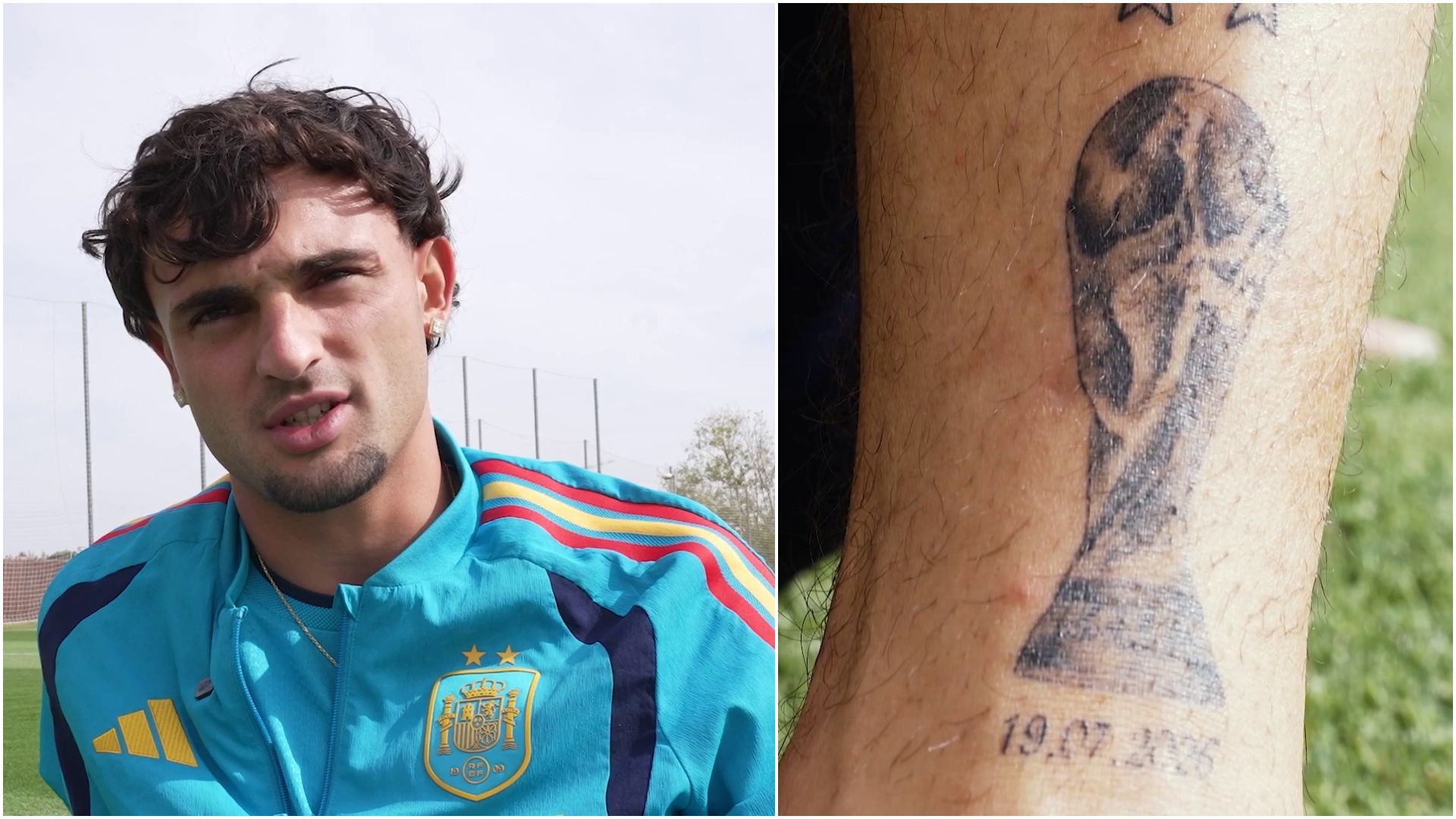
The image is especially valuable because it joins identity and tattoo detail in one frame. The face, Spain clothing and close tattoo crop all belong to the same published photograph, so the close-up can be read as evidence about Pubill rather than as an unattributed body-art image. The visible design is best described conservatively as a large shaded forearm tattoo with a portrait-style centre and lettering. Its precise subject has not been formally identified in the sources reviewed.
Paris 2024 Olympic rings on his bicep tattoo
The most readily identifiable design in Pubill’s tattoos is the Olympic rings with the wording PARIS 2024. Telemadrid’s Atlético presentation photograph shows the small bicep tattoo clearly while Pubill wears the club’s red-and-white shirt. The placement is high on the arm, above the elbow, and the lettering sits above the rings in a compact horizontal arrangement.
That tattoo has a straightforward biography. Pubill won Olympic gold with Spain in Paris, and the rings preserve the event as a personal milestone. The mark is small enough to read as a date-and-symbol piece rather than a full sleeve element, but it has strong visual clarity. It is also one of the rare designs whose subject, date and significance are all supported by published reporting rather than only by image interpretation.
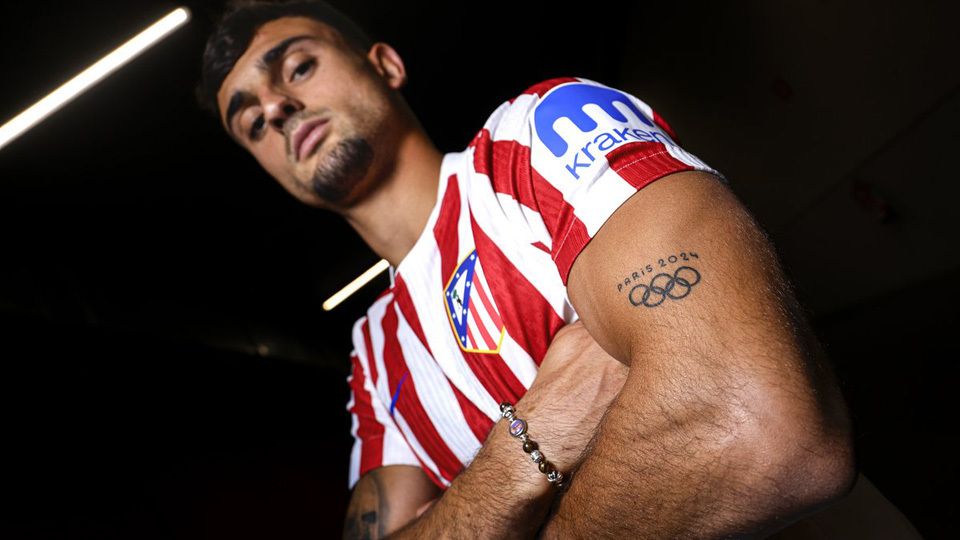
The Olympic tattoo also shows how Pubill’s collection balances concise symbols with larger shaded work. The rings are instantly legible from a distance, while the larger pieces on his forearms require a closer look. Together they create a record of his career in two visual languages: a compact emblem for the achievement itself and more detailed work for the personal history around it.
A national-team memory from Spain
Pubill has directly connected one tattoo to the World Cup. The RFEF interview describes him as a tattoo enthusiast and quotes him saying that the tournament was too important to leave unmarked. The World Cup piece therefore has a documented meaning, not simply an inferred one. It represents the significance of wearing Spain’s shirt and reaching a stage of the game that he considers special.
El Desmarque adds a useful visual and personal detail. The outlet reported that Pubill showed the World Cup tattoo while discussing tattoos dedicated to his grandparents. The report places the ink within a wider family story rather than treating it as a detached football logo. That framing also fits the way he spoke about his first senior Spain goal, which he dedicated to family, his girlfriend and his brothers.
The World Cup reference works because it carries both public and private weight. The tournament is a shared national event, but the decision to put it on skin belongs to Pubill. The lettering and shaded elements are visible in the close view, yet the published evidence does not justify inventing a more exact translation or a hidden story for every mark.
A full view of both tattooed arms
LaLiga’s official player imagery provides a different perspective from the close editorial photographs. In the portrait, Pubill faces the camera in Atlético’s shirt with both arms visible. The Olympic rings can be seen on one arm, while the other carries a much larger shaded composition. Seeing both sides at once helps explain why descriptions that mention only the Olympic tattoo leave out a substantial part of the collection.
The larger arm piece appears densely shaded and portrait-led, with dark blocks and lighter skin breaks creating a strong black-and-grey effect. The photograph does not establish the exact subject of the image or every small mark around it, so those details should remain undescribed. What it does establish is the scale and placement: the design covers a broad section of the upper arm and continues toward the elbow.
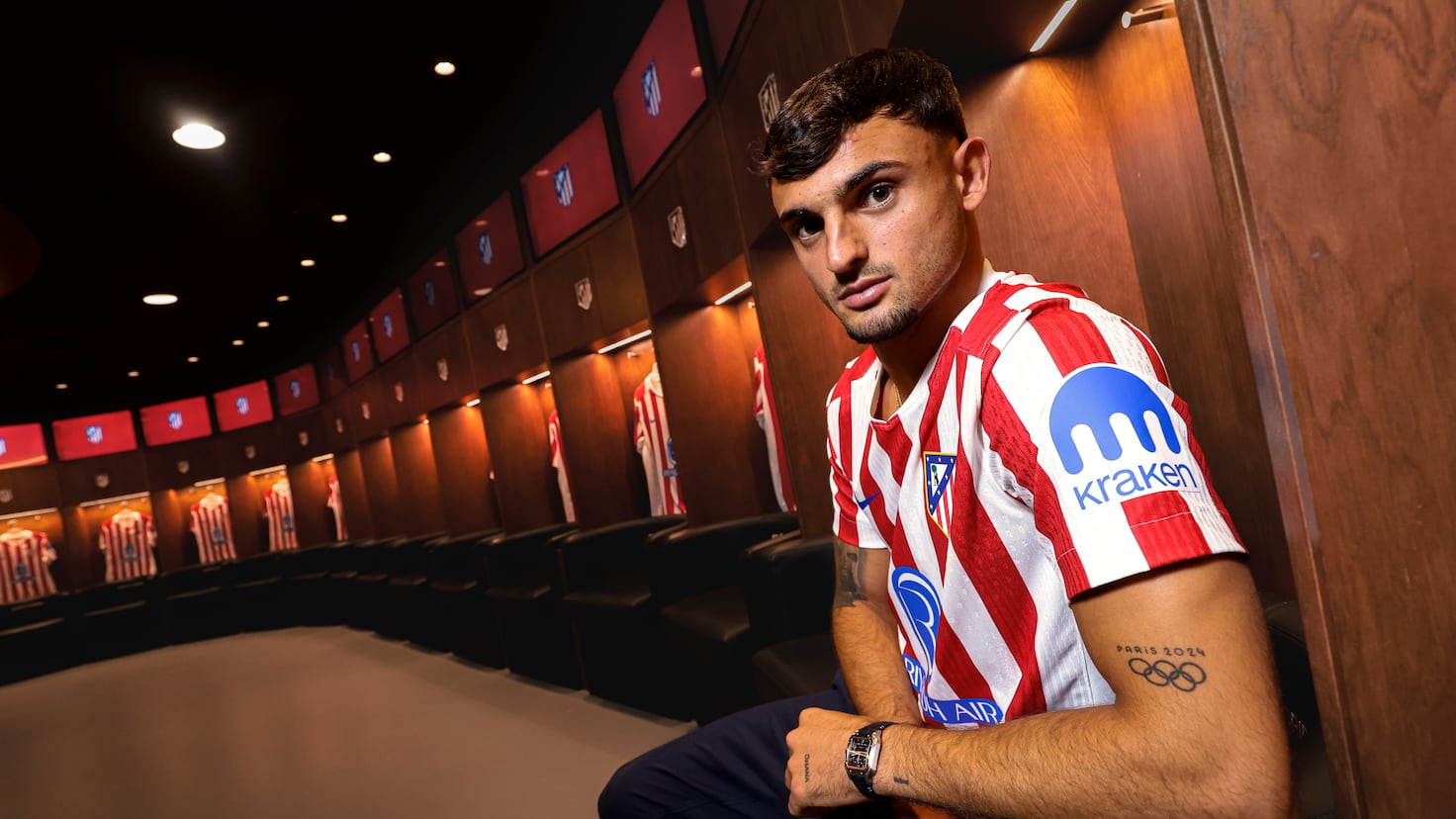
This official image is also useful because it is not a cropped tattoo reveal. Pubill’s face, kit and full stance remain visible, which makes the arm work part of a genuine player portrait rather than a detached close-up. The contrast between the small Olympic symbol and the larger shaded piece is clear, and the two designs appear to belong to a collection that has grown in stages.
The official portrait and the Olympic mark
LaLiga’s square player portrait provides a second full-body reference for the arm placements. It is separate from the locker-room photograph and uses a different pose, shirt and background. Pubill faces the camera while both arms hang naturally, allowing the Olympic rings to remain visible on one side and the darker coverage on the other to be read as part of the same collection.
The value of this photograph is its straightforward scale. It does not isolate a tattoo or exaggerate a detail. Instead, it shows how the ink sits within a professional football portrait, with the arm designs extending beyond the portion visible in a short-sleeved shirt. The image also confirms that the Olympic symbol is not the only tattoo that can be seen in official player material.

Viewed alongside the close crop and the Atlético images, this portrait makes the collection easier to understand. The Olympic mark is the neatest identifiable symbol, while the opposite arm carries a much heavier composition. Each source contributes a different kind of evidence, and none needs to be repeated to make the pattern clear.
The side profile and larger forearm work
A separate side-profile photograph published in connection with Pubill’s Atlético arrival shows the scale of the forearm tattoo from another angle. The image catches him in the club shirt with his arm turned toward the camera. It is not the same composition as the LaLiga portrait: the posture, background and angle are different, and the forearm is presented as a side detail rather than as part of a straight-on player headshot.
From this view, the shaded work reads as a substantial composition that follows the shape of the arm. The darker upper section, the central face-like form and the lighter lower area remain visible. The angle does not reveal a reliable title for the design, and the available reporting does not assign one. The responsible description is therefore visual and specific without claiming a meaning Pubill has not stated.

The side profile adds an important dimension to the record. A tattoo can look compact when the arm is held close to the body, then appear much larger when the arm turns and the skin is shown from the side. This photograph demonstrates that difference. It also keeps the article from treating one famous Olympic symbol as the whole story, because the collection includes larger work that is visible in ordinary club imagery.
Milestones behind the collection
Pubill’s own explanation makes the collection unusually easy to read as a timeline. The World Cup and Olympics are not abstract subjects chosen for decoration. They are experiences he associates with representing Spain and progressing through elite football. The wording reported by RFEF places both events alongside his statement that tattoos are a way to preserve what matters.
His first senior goal for Spain adds another layer. RFEF says he dedicated that goal to family, his girlfriend and his brothers. El Desmarque’s account of the tattoos refers to tributes to his grandparents. The available material does not say that a particular visible portrait tattoo depicts a named relative, so that link should not be overstated. It is safer to say that family is part of the documented emotional setting around the collection.
That distinction gives the tattoos a coherent story without turning every visual detail into speculation. The Olympic rings are identified. The World Cup tattoo is discussed by Pubill. The larger shaded designs are visible, but their exact subjects remain private or undocumented in the sources reviewed. A strong account can hold those facts together without pretending that the photographs answer questions they do not answer.
What the photographs confirm about placement
The photographs confirm several placements. The Olympic rings and “PARIS 2024” sit on the upper arm near the bicep. Larger shaded work covers a broad portion of the opposite upper arm and extends down toward the forearm. The close-up photograph shows additional lettering and dark detail on the lower arm. The exact boundaries of every design are not always visible because shirts, poses and crops cover different sections.
That is why the collection should be described through a set of photographs rather than one definitive diagram. The official club portrait gives scale. The Atlético presentation image gives a clean view of the Olympic mark. The side profile shows how the larger forearm piece wraps with the arm. The close crop supplies detail that the wider portraits cannot capture. Each photograph adds evidence without being repeated.
There is also a difference between what is visible and what is confirmed by words. Published sources confirm the World Cup and Olympic meanings. They do not provide a complete list of every symbol in the larger shaded pieces. Keeping that boundary clear is important for accuracy, especially when a design is partially covered or photographed under changing light.
Pubill on memory and family
Pubill’s quoted comments are the clearest guide to the collection’s meaning. “I like tattoos. I think the World Cup is something really special that had to be there, just as I have the one for the Olympics.” That sentence explains the two most identifiable milestone tattoos and shows that he views them as memory markers. It does not claim that every piece has the same public explanation.
The family context is equally important. When speaking about his first goal for Spain, he dedicated it to the people who supported him. The tattoo reporting mentions grandparents, while the RFEF account names family, his girlfriend and his brothers. Those details suggest a player who connects achievement to relationships, but the sources stop short of mapping a specific family portrait onto a particular visible design.
That restraint leaves room for the collection to develop. Pubill is still early in his senior career, and the tattoos already mark several turning points: Olympic success, World Cup ambition and his first Spain goal. The photographs show a growing set of designs, while the interviews explain why national-team milestones matter to him. Taken together, they offer a grounded picture of a footballer using ink to keep his career memories close.
Watch the RFEF video feature, “Marc Pubill scores his first goal for Spain,” for the player’s wider reflections on the national-team moment that sits behind the most clearly documented tattoos.