
Jordan Henderson tattoos are best understood through one unusually well-documented design: the Champions League trophy he had tattooed after Liverpool won in Madrid in 2019. Reports identify the occasion, the California artist and the thigh placement, while later images show how the piece sits within a wider public story about football, leadership and memory. The surviving photographs do not justify a limitless catalogue of designs, but they do support a careful account of what Henderson chose to make permanent.
The most useful way to read the collection is to keep the evidence close to the person and the event. A studio photograph shows the trophy clearly. A separate body-art frame supplies another view. Match, portrait and parade photographs then explain the career that gave the tattoo its emotional weight. The result is a tattoo story built around a precise achievement rather than a collection of guesses.
A trophy became a permanent record
Jordan Henderson’s best documented tattoo is a Champions League trophy on his thigh, a piece connected to Liverpool’s 2019 victory in Madrid. The story is unusually clear because Henderson discussed it in an interview with The Independent, while reports from the time traced the image back to California tattoo artist Tommy Montoya. This is not a design identified only from a fan crop. The occasion, placement and broad subject are supported by contemporaneous reporting.
The choice also says something about the kind of memory Henderson wanted to keep. He was not marking a vague football ambition or a team slogan. He was recording a specific achievement that had changed his standing as Liverpool captain. The trophy is therefore both a piece of sports memorabilia and a private reminder of a season that had been building toward one night in Madrid. The visual idea is direct, but its context is layered.
A trophy became a permanent record matters visually. The frame should be read alongside the reporting, because Henderson remains the subject and the achievement remains the anchor of this section.
The Champions League trophy tattoo became the first documented mark
The studio photograph associated with Montoya shows the trophy design in a close, controlled frame. Henderson is identifiable beside the artist, and the tattoo is large enough to read as a deliberately rendered cup rather than a vague patch of dark shading. The image does not prove every fine line or date that later captions have assigned to it, but it does establish the central design and the relationship between the player and the tattooist.
That distinction matters. Sports coverage often compresses a personal decision into a neat celebration headline, while the photograph preserves a more useful piece of evidence. It shows Henderson choosing to make an achievement visible on his body. The tattoo is not presented as a joke or a temporary fan gesture. It is a permanent image of silverware, placed where it can remain part of his story even when the match itself becomes archival history.
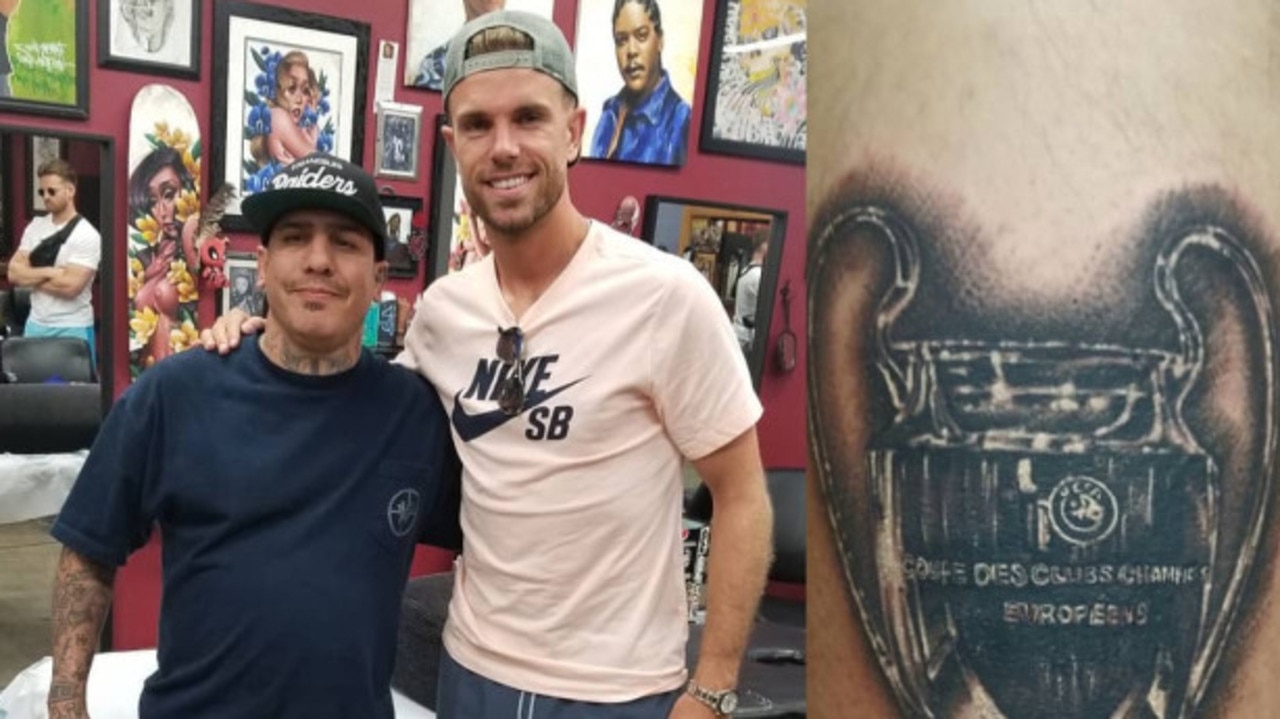
The Champions League trophy tattoo became the first documented mark matters visually. The frame should be read alongside the reporting, because Henderson remains the subject and the achievement remains the anchor of this section.
A second tattoo view shows how the trophy reads on the thigh
A separate image gives the tattoo a different scale and orientation. Henderson lifts his shirt to reveal lettering and body art across the back and upper body, while the frame makes clear that the trophy photograph from the studio session is not the only public view of his ink. The two photographs should not be treated as interchangeable frames from one shoot. They come from different visual contexts and reveal different parts of the collection.
The comparison is useful because a thigh tattoo can disappear in ordinary football photographs. Shorts, socks and the movement of a match keep the skin covered, while a relaxed portrait or a deliberately lifted shirt changes the evidence completely. Henderson’s tattoo story therefore depends on close-up and wider images working together. One image establishes the trophy motif; the other demonstrates how his body art sits within a larger map of lettering and marks.
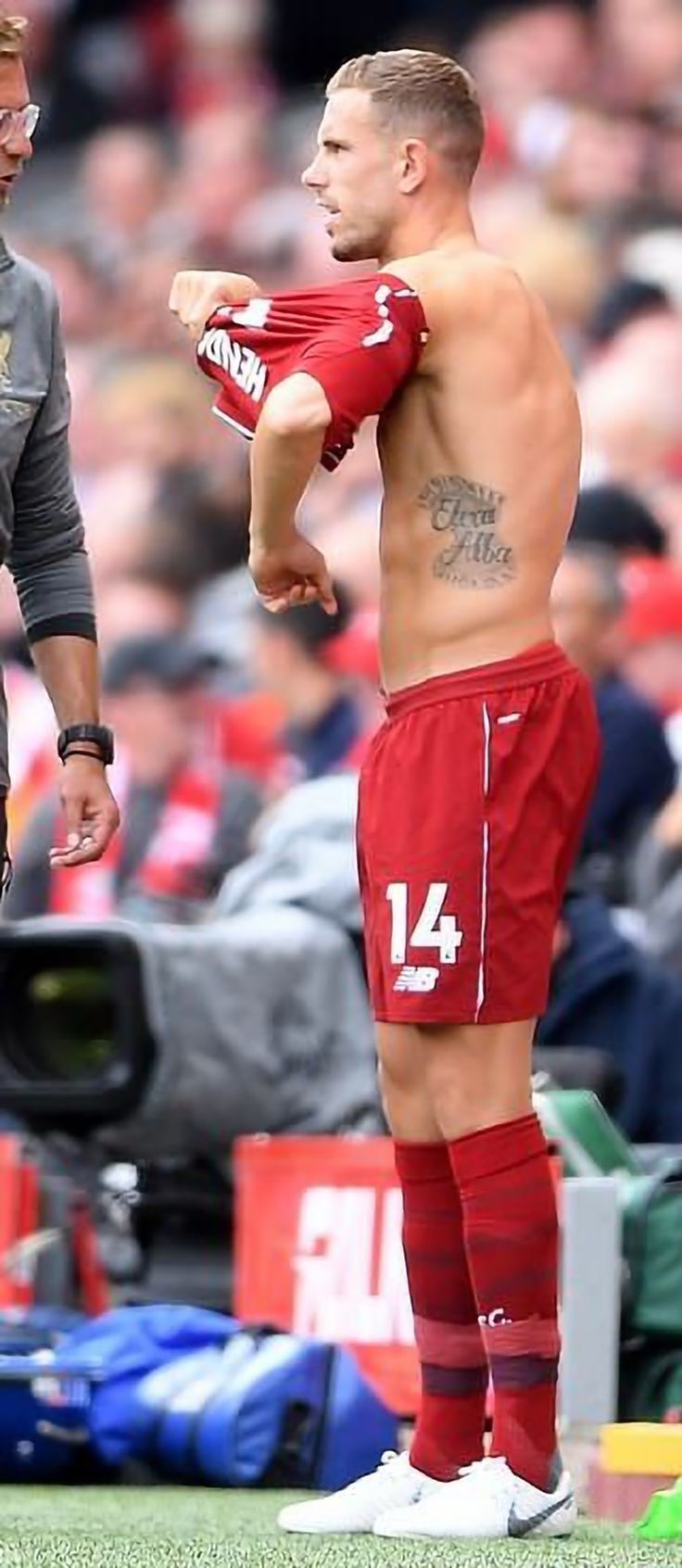
A second tattoo view shows how the trophy reads on the thigh matters visually. The frame should be read alongside the reporting, because Henderson remains the subject and the achievement remains the anchor of this section.
A match-day frame adds context
The clean Salzburg match photograph places Henderson back in the environment that made the trophy tattoo meaningful. He is shown as a working footballer rather than as a model presenting body art, and the face-visible frame helps anchor the tattoo story to the correct person. This supporting frame supplies career context and gives readers a recognisable portrait of the captain whose achievements the tattoo records.
That separation between evidence and context keeps the article honest. A portrait from a match cannot reveal a covered thigh, and it should not be described as if it does. It can, however, show the public role that sits behind the design. Henderson’s appearance in a Liverpool shirt, his posture on the pitch and the period of his career all help explain why a trophy became a meaningful subject for permanent ink.

A match-day frame adds context matters visually. The frame should be read alongside the reporting, because Henderson remains the subject and the achievement remains the anchor of this section.
The captain behind the collection
The Chelsea match photograph adds another angle on Henderson’s public image. His face and profile are visible, while the action setting keeps the focus on leadership, movement and the demands of elite football. Those details matter because tattoos are often discussed as isolated objects. Henderson’s documented piece makes more sense when read alongside the work of being a captain, the pressure of major finals and the expectation that a player should carry a club’s history in public.
The photo also provides a useful counterpoint to the tattoo studio frame. In one image Henderson is connected to an artist and a finished design. In the other he is absorbed in the work that made the design worth commemorating. The tattoo does not replace the career narrative. It sits inside it, preserving one achievement without pretending that a single trophy explains the whole person or the whole collection.

The captain behind the collection matters visually. The frame should be read alongside the reporting, because Henderson remains the subject and the achievement remains the anchor of this section.
A public career with private boundaries
The parade image widens the frame again. Henderson appears among teammates and supporters, surrounded by the public celebration that followed Liverpool’s success. It is a group photograph, but his face remains identifiable and the scene makes an important point about visibility. A footballer’s achievements are shared with a crowd, while the tattoo is worn on one body. The design turns a collective victory into a personal object without removing it from its team history.
That tension explains why the tattoo has attracted so much attention. Fans recognise the trophy and the moment it represents, yet the decision to get it was still Henderson’s. Reports about teammates predicting a future Premier League trophy tattoo add a playful edge, but they do not establish that a second trophy was completed. The careful account is simpler: one Champions League trophy tattoo is well documented, and its meaning is grounded in the 2019 triumph.

A public career with private boundaries matters visually. The frame should be read alongside the reporting, because Henderson remains the subject and the achievement remains the anchor of this section.
Why the placement changes the reading
Placement is part of the design story. A trophy on the thigh is hidden during much of a football match, which gives the tattoo a different rhythm from an arm or neck piece that appears in every candid photograph. The thigh also has enough visual space for a recognisable object, allowing the cup to be read as an image rather than reduced to a tiny emblem. The public photographs reveal it because Henderson chooses a moment when the usual boundaries of sports clothing are relaxed.
The placement also protects some privacy. Henderson has spoken openly about the Champions League design, but the image does not turn his entire body into public property. Viewers can understand the tattoo’s subject and occasion without claiming to know every mark he may have elsewhere. The available evidence is strongest when it stays close to what the photographs and interviews actually show.
Why the placement changes the reading matters visually. The frame should be read alongside the reporting, because Henderson remains the subject and the achievement remains the anchor of this section.
How one football moment became permanent
Henderson’s tattoo is compelling because the source trail is unusually specific. The Independent connects the tattoo to his Champions League success and describes the earlier blank canvas on the opposite thigh. The Liverpool Echo report identifies the California artist and the European Cup image. Later football coverage explains the joke about a possible Premier League design. Each source adds context, but none requires an invented confession about the tattoo’s private meaning.
What remains is a strong, restrained interpretation. The trophy records a turning point in Henderson’s career, the tattooist’s image documents the making of the piece, and the wider photographs show the player who carried that achievement into public life. The tattoo is not merely football decoration. It is a permanent timestamp, a visible reminder of a final that changed Liverpool’s modern history and Henderson’s place within it.
How one football moment became permanent matters visually. The frame should be read alongside the reporting, because Henderson remains the subject and the achievement remains the anchor of this section.
The documented record is strongest when it stays concrete
Celebrity tattoo coverage becomes unreliable when every visible mark is given a confident name. Henderson’s case offers a better model. The Champions League trophy is supported by a direct interview, contemporaneous reporting and multiple distinct images. A second body-art photograph broadens the visual record, but it should not be used to invent a catalogue of designs that the sources do not identify. The right conclusion is that the central tattoo can be described with unusual confidence while lesser-known details remain open.
That confidence comes from the balance between words and photographs. The words establish the occasion and the artist. The images establish subject identity, placement and visible form. Match and parade portraits supply career context without being mislabelled as tattoo close-ups. Together, those layers create a fuller account of Henderson’s tattoos while leaving room for parts of his personal collection that have not been documented publicly.
The documented record is strongest when it stays concrete matters visually. The frame should be read alongside the reporting, because Henderson remains the subject and the achievement remains the anchor of this section.
Permanent ink can turn a shared sporting moment into a private archive. Henderson’s documented trophy tattoo does exactly that, while the surrounding photographs show why the design continues to attract attention.