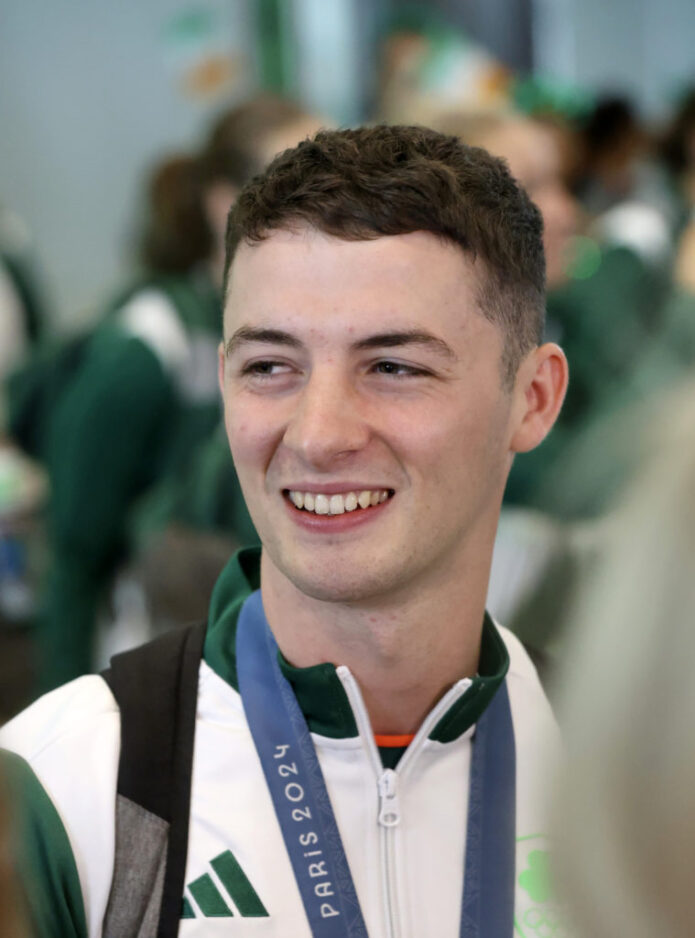
Rhys McClenaghan’s documented tattoo record centres on one clear design: Olympic rings on his forearm. The source-led gallery below pairs that genuine tattoo photograph with distinct, clearly labelled identity and competition portraits. The supplemental images provide context only and are not presented as additional tattoo evidence.
Rhys McClenaghan’s Olympic rings tattoo
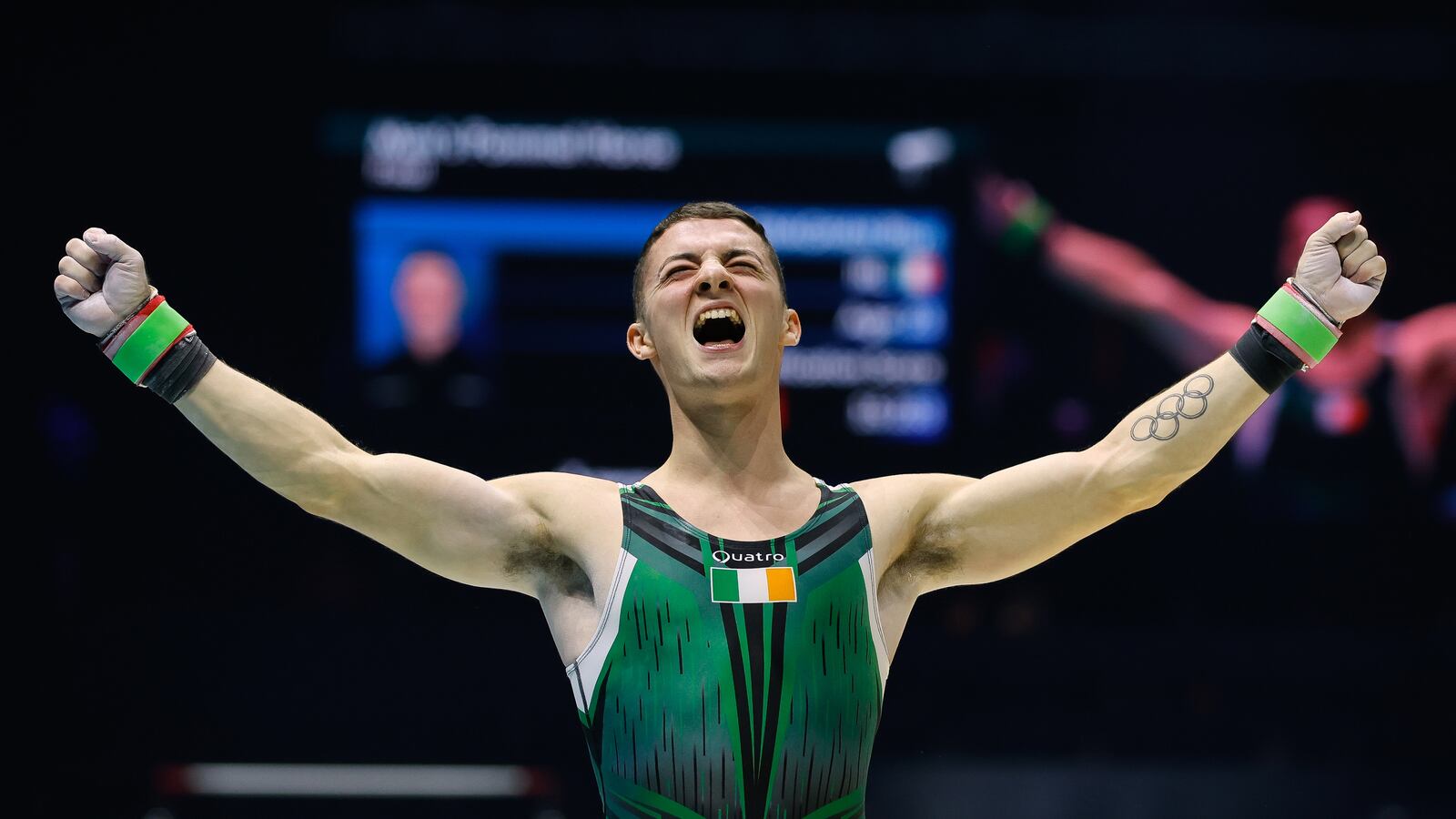
Rhys McClenaghan has a clearly documented Olympic rings tattoo on his arm. The Irish Times profile that discusses the ink explains that he chose the design after becoming an Olympian, making the tattoo a direct marker of a milestone rather than an unverified detail repeated from a fan gallery. A separate Getty image from the Paris cycle shows the rings on his forearm while he trains on pommel horse. Those two sources provide a sound visual and editorial foundation.
The inspected Irish Times photograph shows McClenaghan celebrating after a competition, with both arms raised and the rings visible on the forearm at the right side of the frame. The face is also visible, so the image connects the design to the athlete rather than presenting an anonymous arm. The linked reporting supplies the reason he gave for choosing Olympic rings. Together, the image and the interview-level detail establish the design and its documented context.
The tattoo is compact and immediately legible. Five interlocking rings sit in a simple outline on the forearm, a placement that can be read when McClenaghan raises his arm or works on an apparatus. It is not necessary to add an imagined date, lettering, artist credit or private story. The available material supports the visible Olympic symbol and the athlete’s explanation that the ink marked his arrival as an Olympian.
The phrase Olympic rings tattoo can be used precisely here because the visual evidence and the written account agree. The rings are not being inferred from an Ireland team logo on a tracksuit, a medal, or a graphic in a broadcast. They are visible on skin in the inspected photograph. That distinction is the important editorial boundary when a celebrity or athlete appears in many branded competition images.
A close training frame
McClenaghan’s wider career makes the tattoo’s timing easier to understand. He became Ireland’s first Olympic gymnastics finalist at Tokyo and later won pommel horse gold for Ireland in Paris. The tattoo was reported in the period after he had achieved the Olympic milestone he described. The design therefore sits within a documented career timeline, although the sources do not say that every later result changed its meaning.
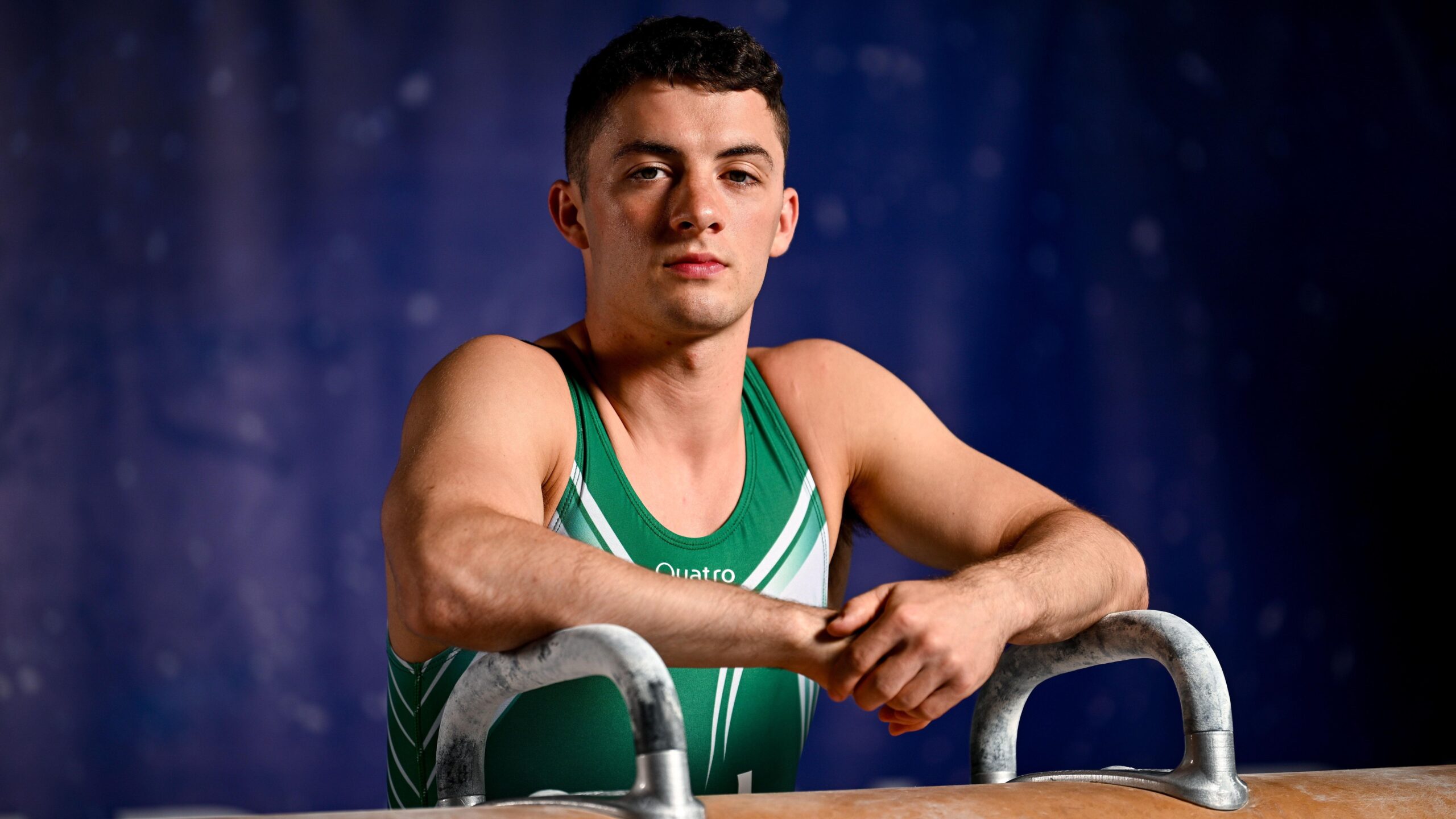
A BBC Sport competition portrait gives a separate view of McClenaghan in his specialist event. He is face visible at the apparatus, with his posture and expression captured during training. That image is supplied as a supplemental identity reference, not as proof of another tattoo. The forearm is not mapped as tattoo evidence in that frame, and its role is to help readers recognise the person behind the documented close-up.
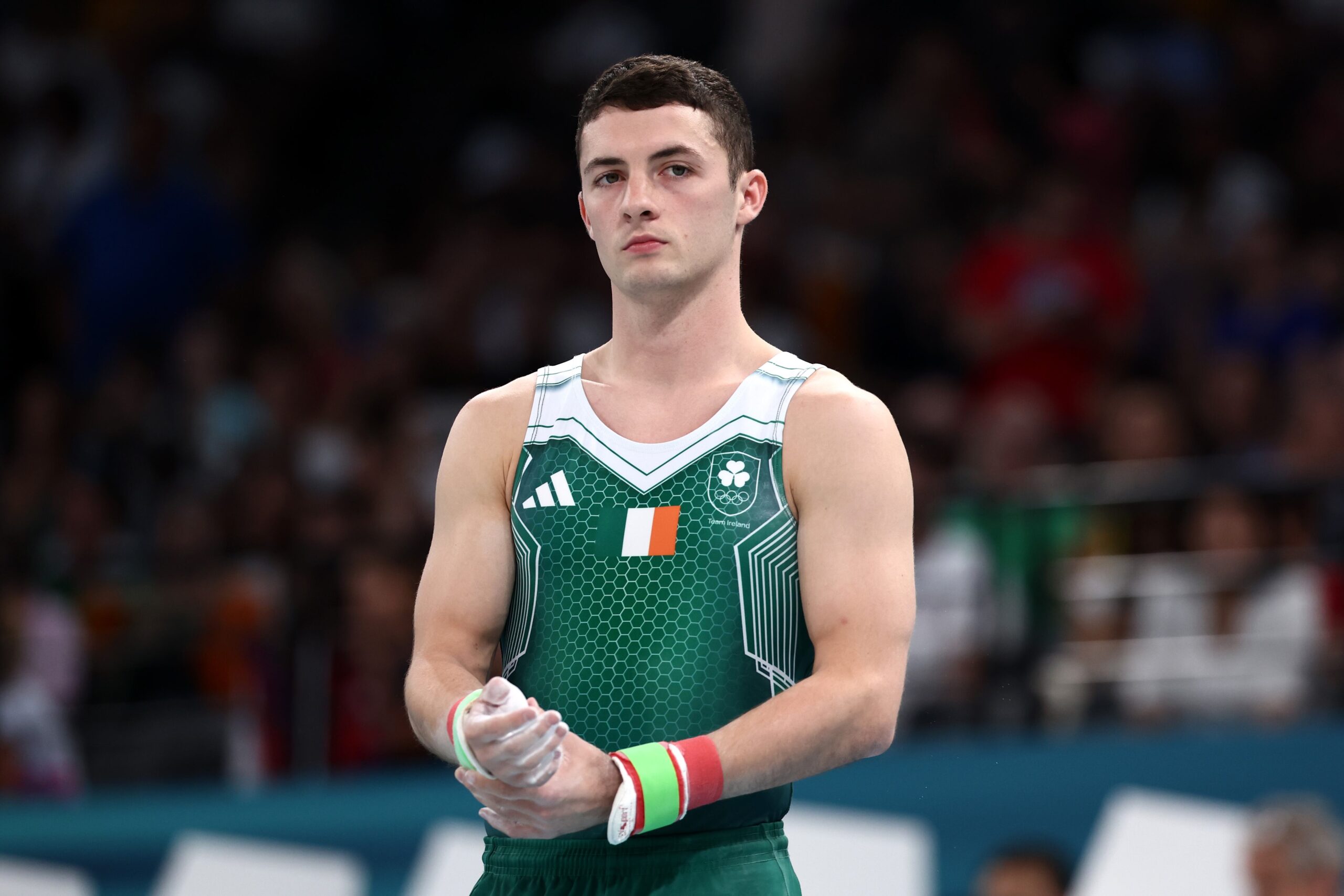
The current Irish Times competition image offers another distinct reference point. McClenaghan appears at the pommel horse in a green Ireland leotard, with his face clear and the apparatus filling the foreground. It places him in the later stage of his career, after the Olympic breakthrough. The photograph is useful context for the athlete’s public profile, but no extra ink claim is attached to it.
The athlete in a current competition frame
A separate Irish Times portrait from the Paris build-up shows McClenaghan standing in a green Team Ireland jacket. His face is plainly visible and the setting identifies the national-sport context without requiring a caption to do the work. This is a supplemental portrait with a different composition from the competition photographs. It does not replace the rings image and it does not add a second tattoo to the inventory.
The Olympic rings symbol is closely tied to the athlete’s own words in the 2022 Irish Times profile. He described feeling proud to get the tattoo because he had become an Olympian and the first Irish Olympic finalist in gymnastics. That explanation is more reliable than a generic interpretation that treats every Olympic athlete’s tattoo as a symbol of family, luck or national pride. The wording here stays with the reason actually reported.
The evidence also leaves room for the design to have personal meaning beyond the sentence quoted in the source. A milestone can carry several associations at once, especially for an athlete whose training, national representation and Olympic results are linked. Still, those possible layers are not separately documented. The responsible description separates McClenaghan’s stated reason from any reader interpretation of the rings.
The 2024 route to Paris

The forearm placement matters because it is visible in action. Gymnastics produces photographs in which arms extend, grip, support and rotate, giving the camera occasional views of the skin. The close-up used here is stronger than a distant event image because the rings remain identifiable and the subject is established. Other action frames can show the same general area, but they should not be treated as new tattoo evidence unless the design is genuinely visible.
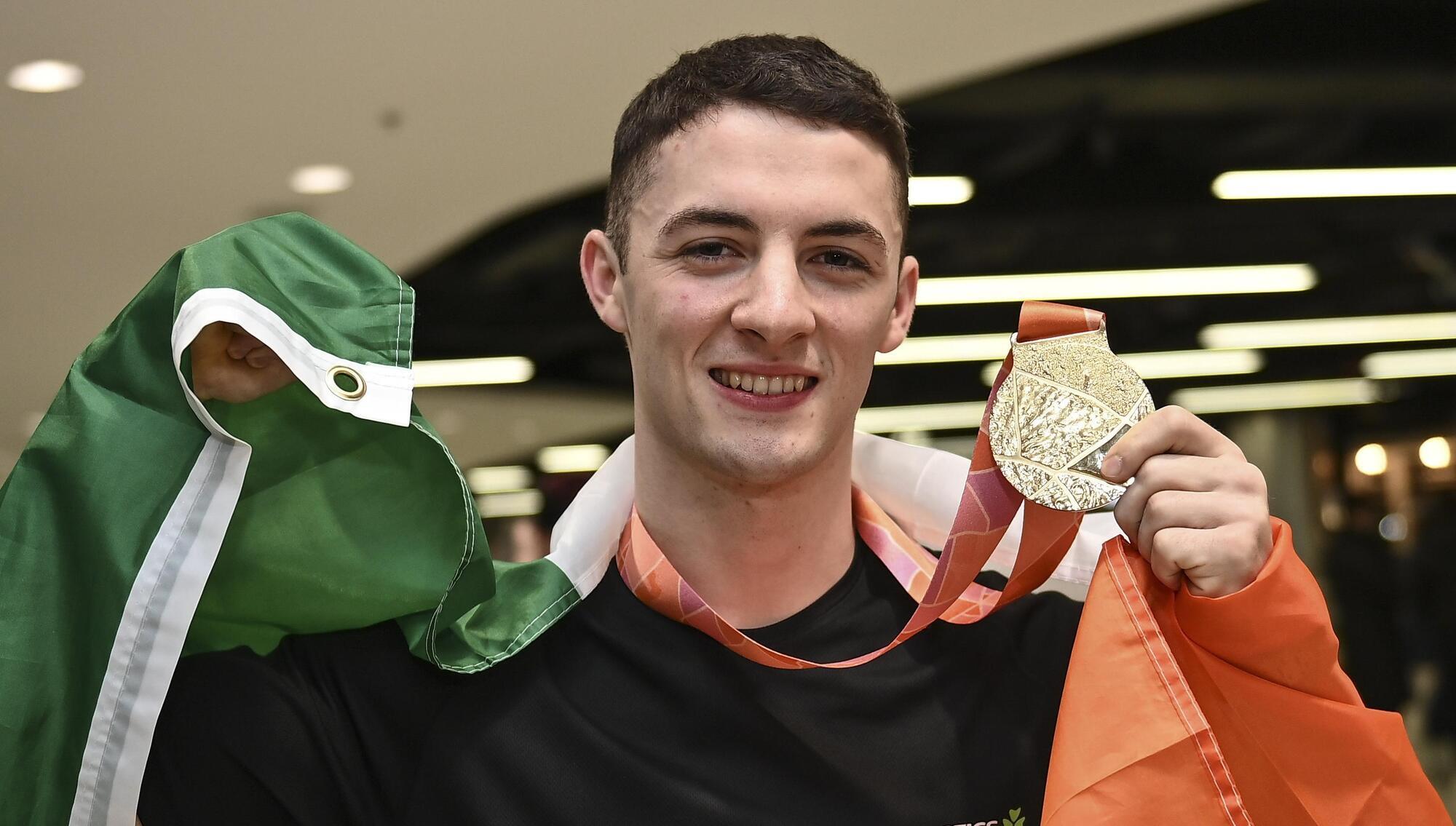
The Irish Examiner image in this dossier is used for a different reason. It shows McClenaghan with his face visible after a major sporting moment, holding his medal against an Irish backdrop. The inspected frame does not clearly show the rings tattoo, so the image is labelled as a supplemental identity photograph. That limitation is preserved instead of turning a patriotic scene into a false tattoo close-up.
This separation is especially important for a gymnast because uniforms, hand grips and apparatus create visual distractions. A green leotard logo can resemble a symbol at a glance, while a medal ribbon can draw attention away from the forearm. Only the inspected image that contains the rings on skin is used for the tattoo-specific claim. The other photographs are there to show the athlete across different published settings.
The Irish identity behind the medal
McClenaghan’s Olympic history has several dates that can be confused. He competed at Tokyo in 2021 after the Games moved from 2020, and he later won the Paris 2024 pommel horse final. The tattoo story comes from the period when he was reflecting on becoming an Olympian. A careful profile can mention the timeline without claiming that the rings were redesigned after each medal or that a later competition created a new tattoo.
The face-visible portraits also support a basic identity check across time. Hair, clothing, camera angle and setting change from one source to another, but the same athlete is recognisable. This is why a separate featured portrait is useful even when the inline gallery already contains a tattoo photograph. It gives the page an unambiguous identity image while leaving the tattoo-specific section to the source that actually shows the ink.
The featured Irish Post photograph shows McClenaghan with his Paris gold medal at the Team Ireland homecoming. It is deliberately kept apart from the inline tattoo photographs. Its job is to present a clear, face-visible image of the athlete and his public Olympic context. It is not described as showing the rings, and no tattoo claim is made from the medal celebration frame.
A boundary for interpretation
The visual record is therefore built from different kinds of evidence. The Irish Times photograph provides the close visual proof of the rings. The BBC, later Irish Times and Irish Examiner photographs provide distinct supplemental views of McClenaghan. The featured homecoming portrait identifies him in a separate setting. Each file has one job, and the article does not use a generic competition image as a substitute for tattoo evidence.
The tattoo’s meaning can be discussed without pretending that every detail has been published. The Olympic rings are an obvious emblem of the Games, but McClenaghan’s documented explanation is the stronger basis for the article: he was proud to mark becoming an Olympian. It is fair to connect the tattoo with that milestone. It is not fair to invent a hidden reference to a coach, a family member or a particular Olympic host city.
The sources do not identify the tattoo artist or studio. They also do not give a precise appointment date, needle style, ink brand or complete aftercare story. Those omissions are normal in a sports profile and do not weaken the basic evidence. A reliable tattoo page can state what is visible, link it to the athlete’s reported reason, and leave production details unfilled when no authoritative source supplies them.
Why the evidence stays narrow
The same care applies to the count of tattoos. This dossier confirms one design, the Olympic rings. It does not turn the page into a catalogue of every mark that might appear in a training photograph. If another design becomes documented in a future interview or a genuinely clear image, it can be added as a separate entry. For the current record, the rings remain the only tattoo claim supported to the required standard.
McClenaghan’s sport gives the tattoo a distinctive visual setting. Pommel horse work depends on rhythm, hand placement and long lines through the arms, so the forearm can enter the frame naturally. The rings are seen because the source photograph catches an open arm position, not because the editor has enlarged an unclear patch of skin. That difference keeps the image evidence honest and makes the description easier for a reader to verify.
Recent coverage also shows why supplemental photographs are useful. McClenaghan has continued to compete, recover from setbacks and work toward another Olympic cycle. A current competition image gives the tattoo story a living career context, while the older profile explains why the design was chosen. The two roles should not be collapsed. One source documents the symbol and the other helps locate the athlete in time.
The documented record in one view
The athlete has spoken publicly about pressure, mental health and the discipline required to perform on pommel horse. Those themes help explain why a milestone tattoo might matter, but they do not supply a private interpretation of the rings. The article can acknowledge the demanding path around the design without claiming that the tattoo is a medical, motivational or psychological statement. The visible symbol and the reported Olympic milestone are enough.
A good reader-facing record finishes with a clear distinction between fact and inference. Fact: McClenaghan has an Olympic rings tattoo on his forearm, and an Irish Times profile records his pride in getting it after becoming an Olympian. Fact: the inspected image visibly shows the rings on his skin. Inference: the tattoo may carry additional associations for him. The final point remains possible rather than confirmed.
The result is a focused profile rather than a crowded gallery. One genuine tattoo photograph is the hard visual anchor, and the remaining inline files are distinct, labelled portraits that provide identity and competition context. None is mapped as showing a tattoo unless it passes the visual check. That arrangement gives readers enough material to recognise McClenaghan while keeping the Olympic rings claim tied to the right image.
Rhys McClenaghan’s Olympic rings tattoo is a small but unusually well-supported piece of his public visual record. The symbol is visible in the inspected Irish Times image, and the accompanying reporting supplies a direct reason for the choice. His later competition and homecoming photographs add context without being mislabelled as tattoo evidence. What remains unknown, including the artist and any deeper private meaning, is left open rather than filled with guesswork.