Musicians

Tattoo guides for singers, rappers, DJs and musicians, with photographs, documented meanings and the stories behind their designs.

Britney Spears tattoos, from a healing mark to pink dice

Britney Spears has spoken about a few tattoos, but most of the record comes from photos taken over the years. Her Hebrew neck lettering is one of the rare designs with her own explanation. The Chinese character on her hip is less clear: she once thought it meant one thing, while later coverage corrected the translation.
There is no single reliable count. Ink fades, gets covered or appears only in passing photos, and later additions change the list. Spears’s own comments settle a few meanings; photographs help identify some of the rest.

The Hebrew lettering at the back of her neck
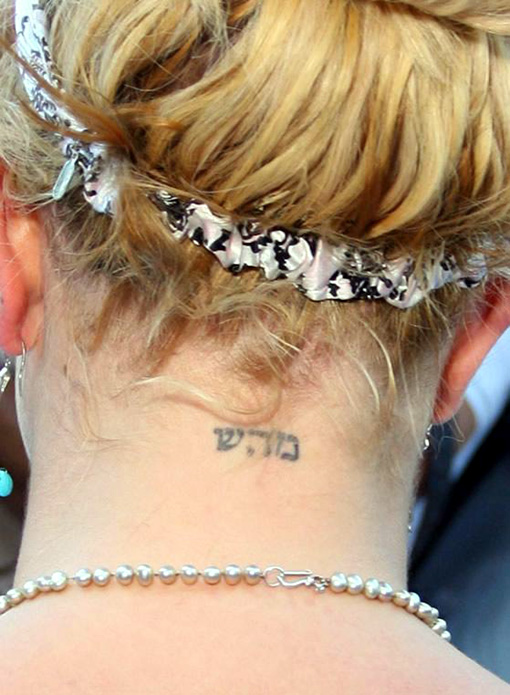
Britney Spears’s Hebrew lettering tattoo at the nape of her neck

The small Hebrew letters Mem Hey Shin sit at the nape, easy to miss when Spears wears her hair down. She has said they mean “healing” and called this her favourite tattoo. That is her own explanation, not a guess made from a photo.
She later posted an edited image with the lettering removed, saying she wanted to see how she might look without it. That picture is not proof of removal: it shows curiosity about a change, not that the ink was gone. Clear photos still show the compact black mark.
The nape placement gives the tattoo a private quality. It appears when her hair is swept up, but usually stays hidden. Spears’s own word, “healing,” tells us what she has said it means; there is no need to turn it into a grand statement about her life.

The Chinese character at her right hip
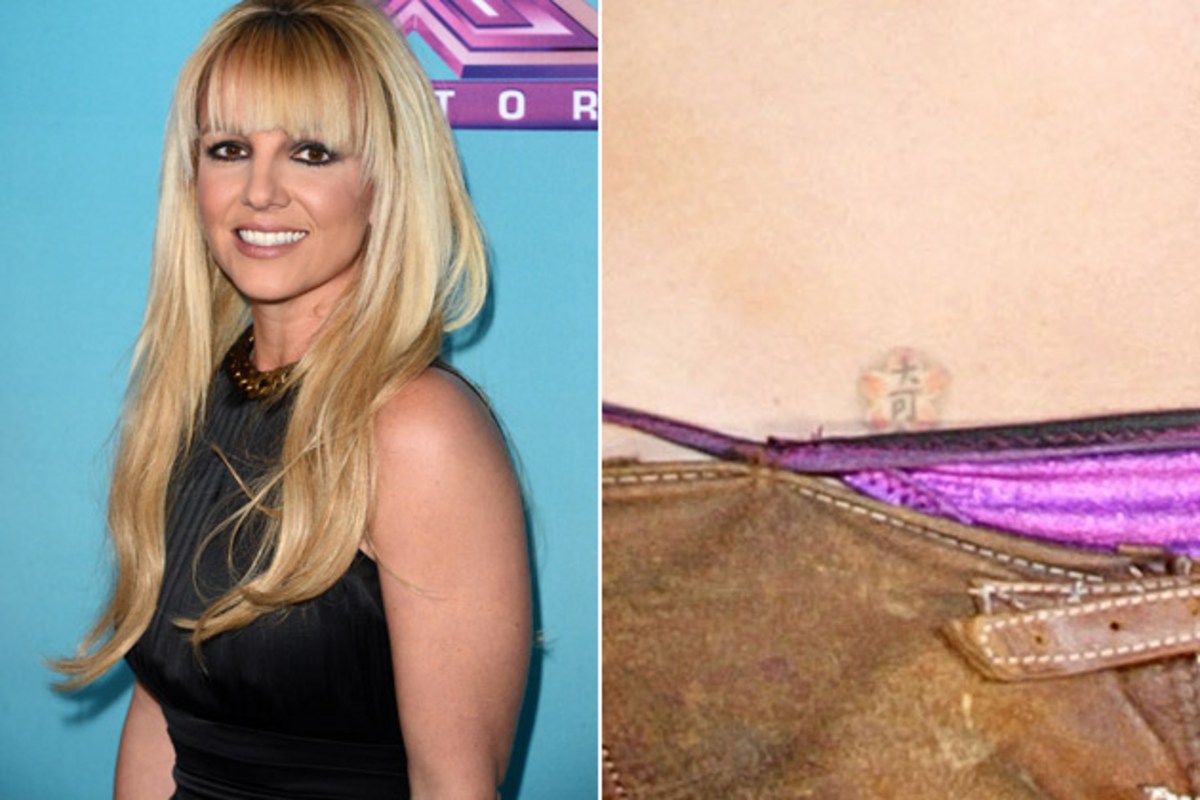
A published photograph showing the Chinese character tattoo near Britney Spears’s right hip

Spears’s right-hip tattoo is a Chinese character inside a small floral outline. In 2006, she reportedly said she thought it meant “mysterious”; later coverage gives the closer translation as “strange.” That mismatch is what the record supports. No deeper message has been confirmed by Spears.
The design is tiny and sits low on the hip, so many photos show only part of it. The character is visible in the available image, though not sharply enough to make out every brush detail. The flower is part of the outline, not a separate large tattoo.
Older inventories also list a small cross on the opposite hip. It is separate from the Chinese character, even though both sit near the waistband. A clear, well-sourced photo of the cross is harder to come by, so its shape and personal meaning remain uncertain.

Pink dice on the inside of her left wrist
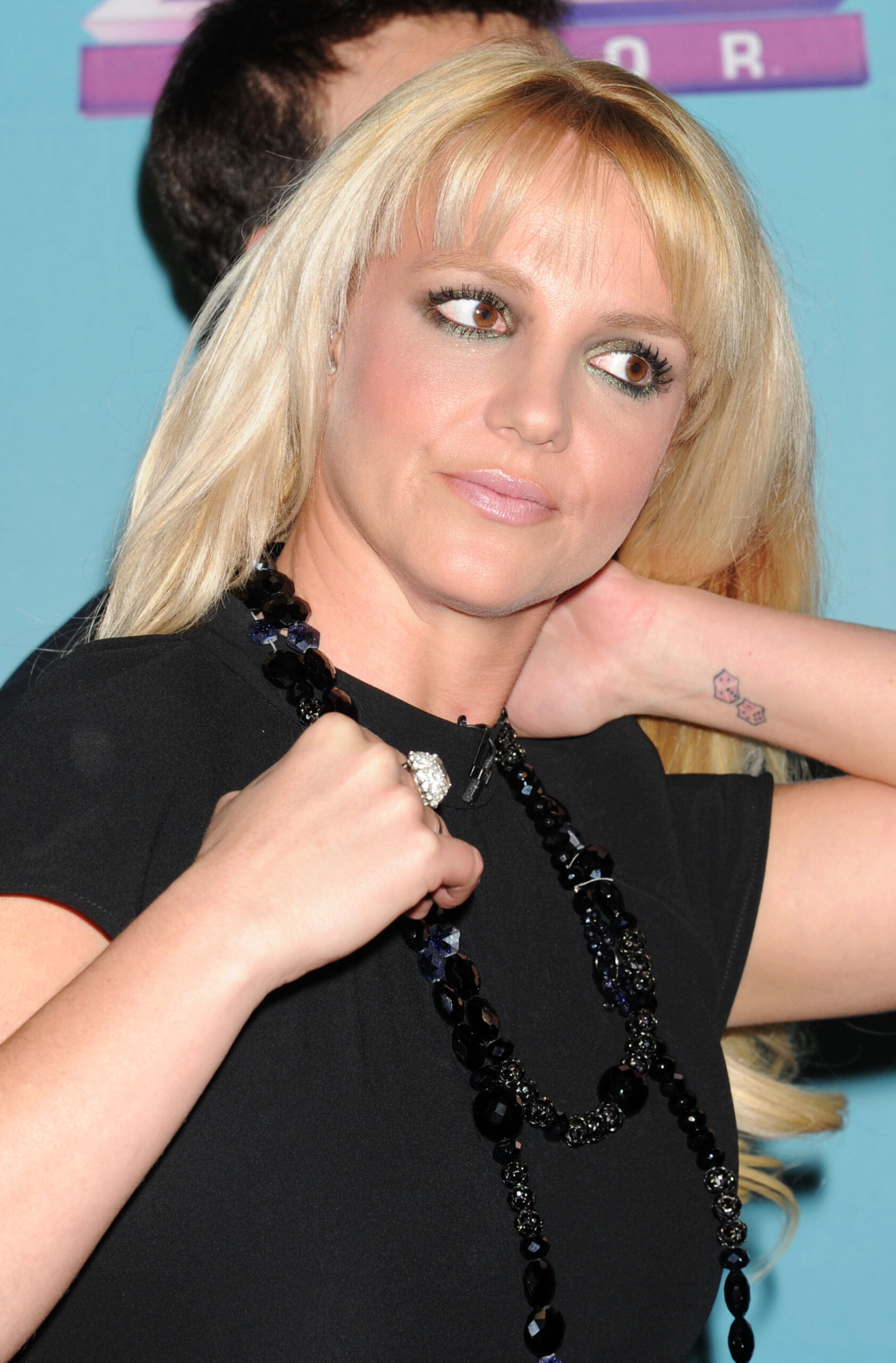
Britney Spears’s pink dice tattoo on the inside of her left wrist

The pair of pink dice on Spears’s inner left wrist is one of her most recognisable designs. She and Kevin Federline got matching dice during the European leg of the Onyx Hotel Tour in 2004: hers were pink, his blue on his right wrist. Contemporary reports and photos document the shared tattoo.
The timing is documented, but there is no confirmed message hidden in the dice. In 2020, Spears publicly wondered whether to remove hers. Wondering about it is not the same as having it removed; later photos still show the design.
The two pink dice add a small hit of colour to her inner left wrist. In compressed older photos the ink can look pale, but a close shot shows the pair and where she wears them.

The pink lips on her right wrist
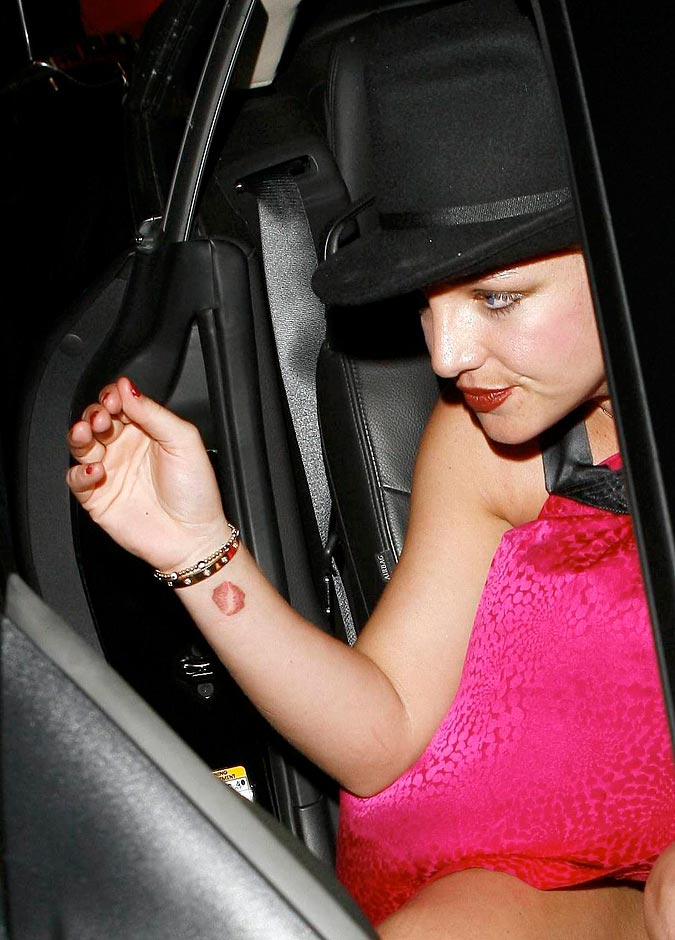
Britney Spears’s small pink lips tattoo on her right wrist

A second wrist tattoo sits on the right wrist: a small pink pair of puckered lips. Quick captions sometimes mix up the two designs, especially when a photo is mirrored or cropped. The dice are on the inner left wrist; the lips are on the right. No reliable source gives a meaning for either design.
The lips are simple and easy to read from their outline and colour, even though the tattoo occupies only a small patch of skin. Spears has not given a well-documented reason for choosing them. Fan pages have their own theories, but those are not her account.
In photos, the two wrist tattoos can look like a set: the dice connect to a shared 2004 moment, while the lips read as a standalone pop-art image. There is no evidence that Spears planned them together.

A flower and vine across her foot
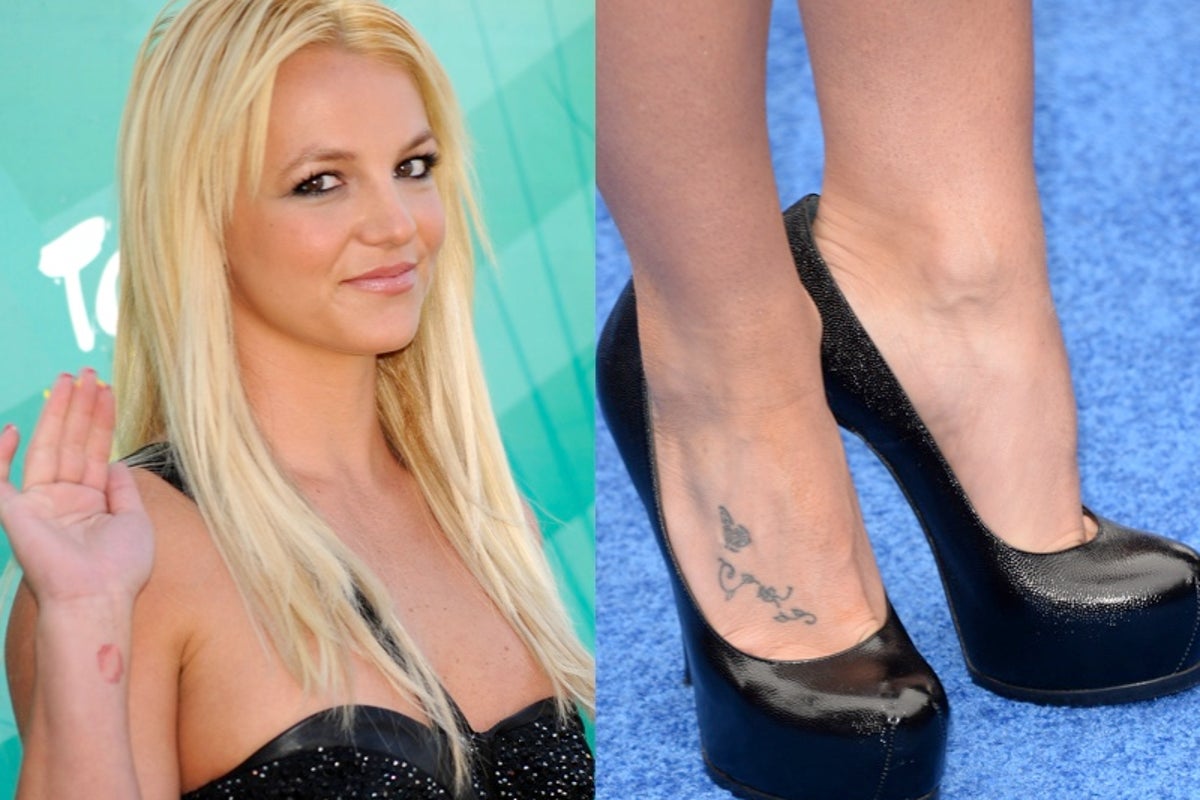
Britney Spears’s flower and vine tattoo near her foot and ankle

Photos of Spears in heels show a flower-and-vine tattoo near her foot and ankle. The fine line traces her foot rather than forming a large leg piece. Angles and lighting obscure smaller details, but the vine and flower are easy to make out.
A distant red-carpet shot can make the mark look as if it sits on the ankle; closer photos show more of the foot. Shoes and the way she bends her foot hide parts of the line. A fuzzy image alone cannot show the tattoo has changed or disappeared.
Spears has not publicly assigned the flower a meaning. Calling it a memorial or a symbol of renewal would be guesswork. In some photos, the small design peeks out above a sandal.

The lower-back fairy and the red snake added years later
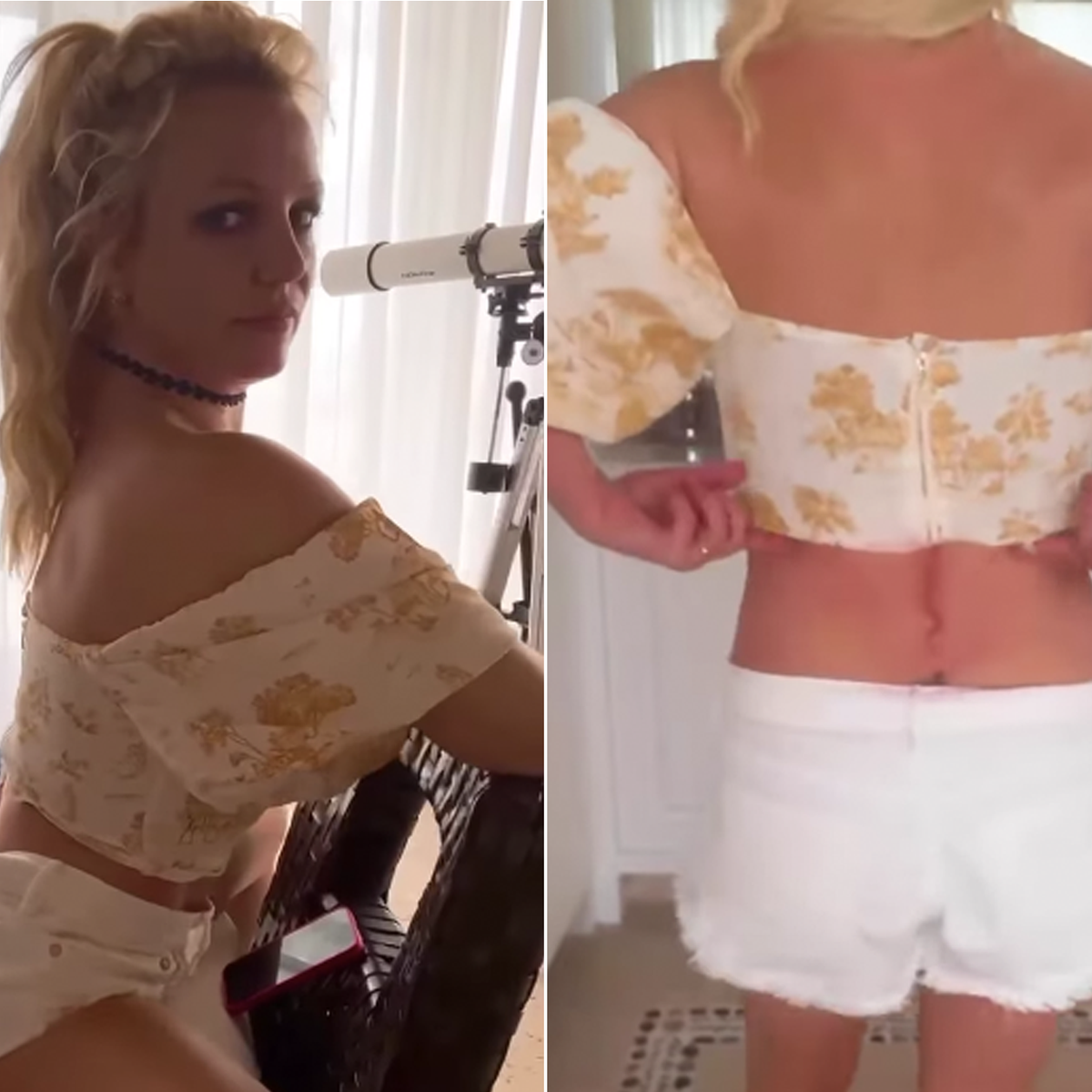
A public image showing Britney Spears’s lower-back tattoo area

Spears had a fairy tattoo on her lower back by the early 2000s. Later reports describe a colourful figure, but available photos are not sharp enough to make out the wings, face or exact colours. Online accounts attach symbolic meanings to it, though no first-person explanation from Spears is widely documented.
In 2023, she revealed a red snake tattoo on her lower back and said she was excited about it. The serpent sits above the older fairy, adding a later design in a different style. Spears gave no personal meaning for the snake; breakup theories circulating then came from others.
The reveal survives in compressed video stills, too soft for a close description. They show where the bright red design sits, but not its finer details. A sharper, verified photo would make it possible to say more.

Small marks, later additions, and one tattoo she regretted
Britney Spears small neck tattoo and later tattoo details
Later photos show a tiny triangle between the thumb and index finger of Spears’s right hand, a small star inside her right arm, and a mark on her right ring finger. She said she did not know why she got the triangle. That is the clearest explanation she has given for any of these small marks.
From Maui in January 2023, Spears posted that she had gotten a new tattoo a few days earlier and wrote that it “sucks” and needed fixing. The design is not clear in the post, so its shape and placement remain unknown. Her regret is on record; the tattoo itself is not.
These marks disappear easily in ordinary photos: the hand triangle is tiny, finger ink vanishes when the hand turns, and the Maui tattoo was never shown clearly. Without a sharp image, there is no way to tell exactly what she meant.

What the photographs can and cannot tell us

Spears’s tattoos make more sense as a changing collection than as a fixed list with one theme. She has shared the meaning of the Hebrew lettering, while the dice have a documented shared origin. The hip character comes with competing translations; other designs are visible, but their private stories remain hers.
The evidence varies from one tattoo to the next. Some stories come from Spears, some are clear only in photographs, and a few designs are still hard to see. Together, they record choices made at different points in her life—some explained openly, others kept to herself.
More musician tattoo guides

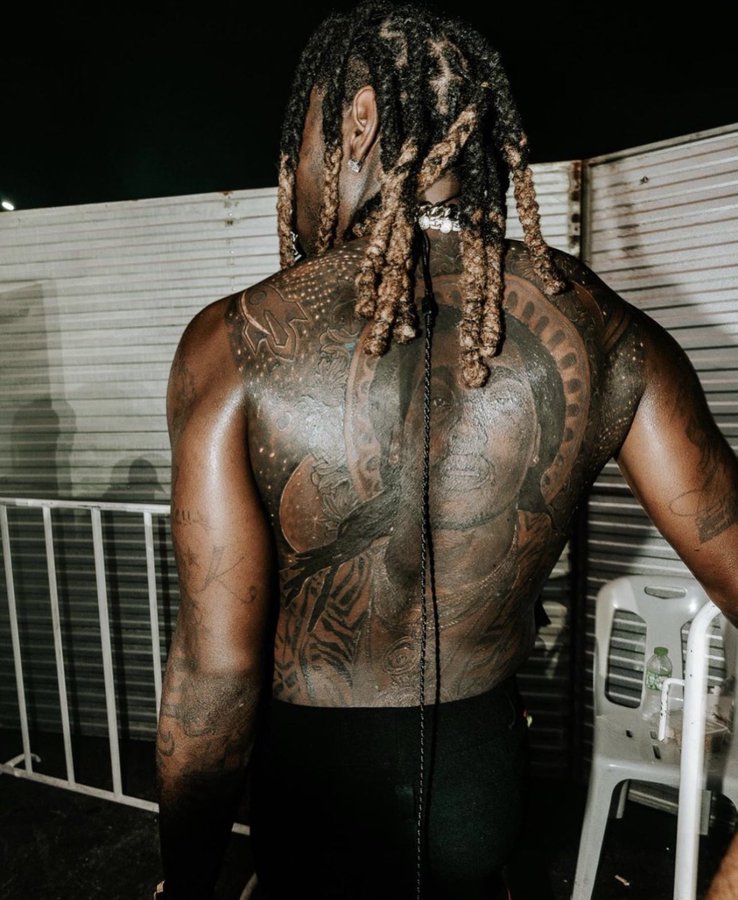
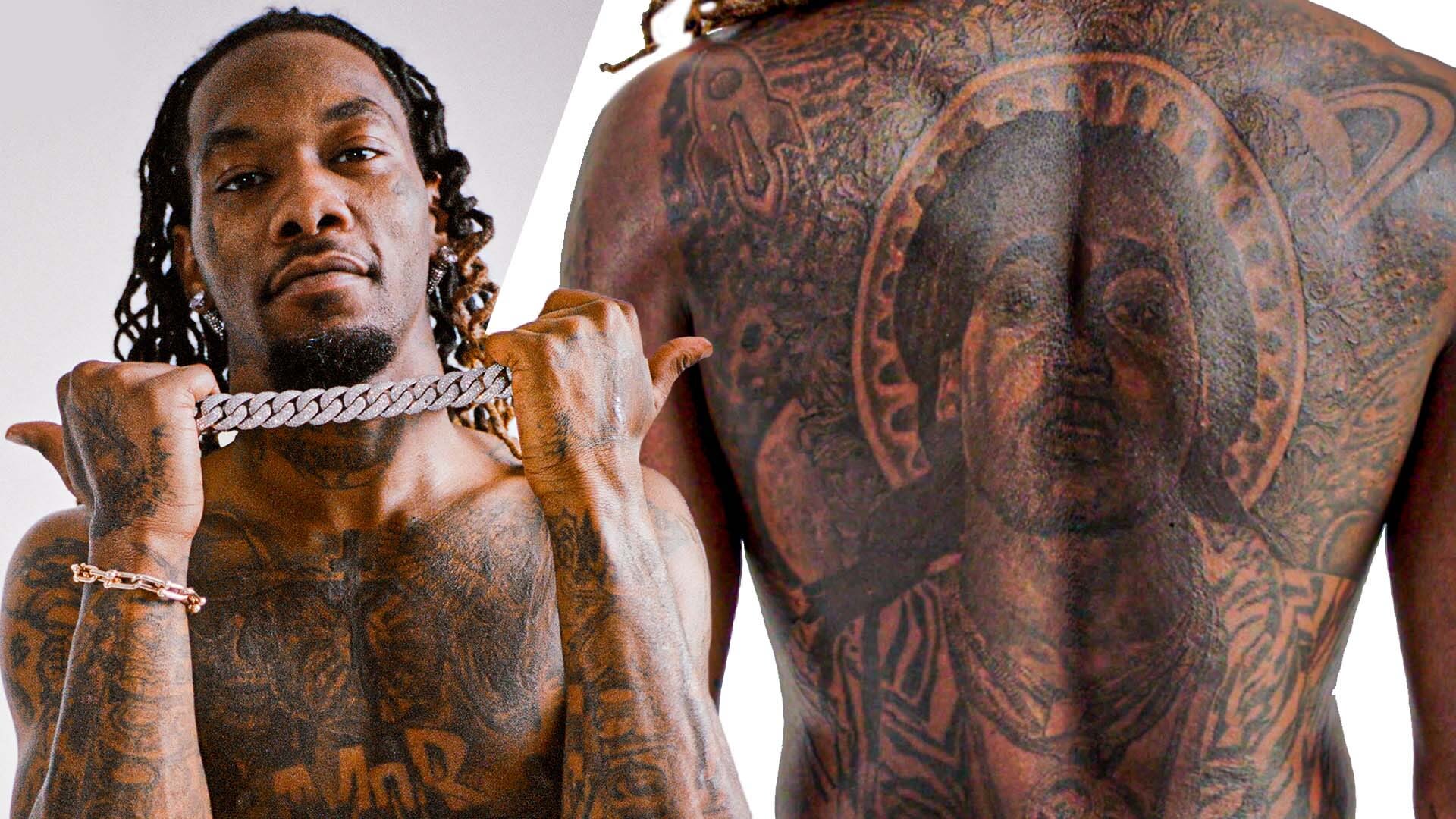
Offset’s Takeoff portrait and the tattoos he got young

A GQ Tattoo Tour gives the clearest account of Offset’s ink. He says he started getting heavily tattooed at 15, has ten face tattoos and spent eight hours having Takeoff’s portrait done across his back. He also talks about portraits of his children on the backs of his legs. The rest of his collection covers his arms and hands.

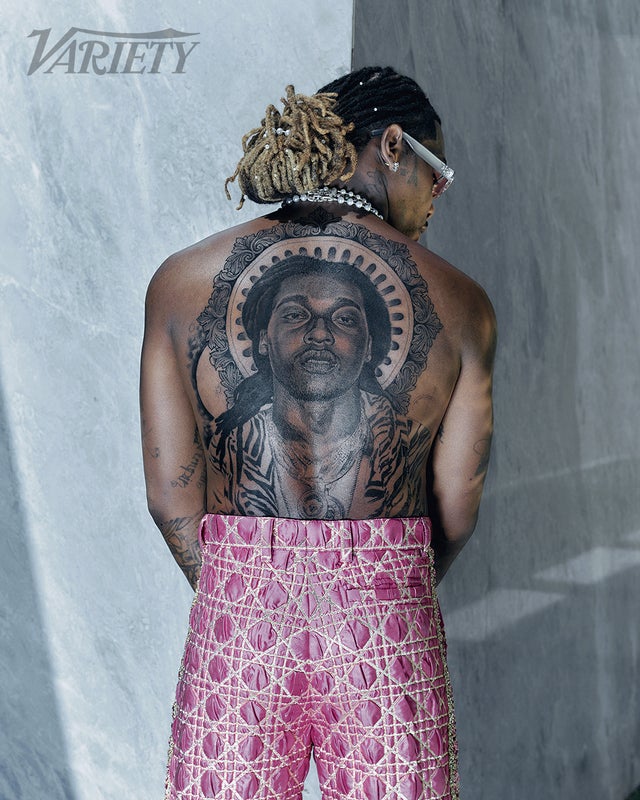
The Takeoff portrait is the emotional centre of Offset’s collection

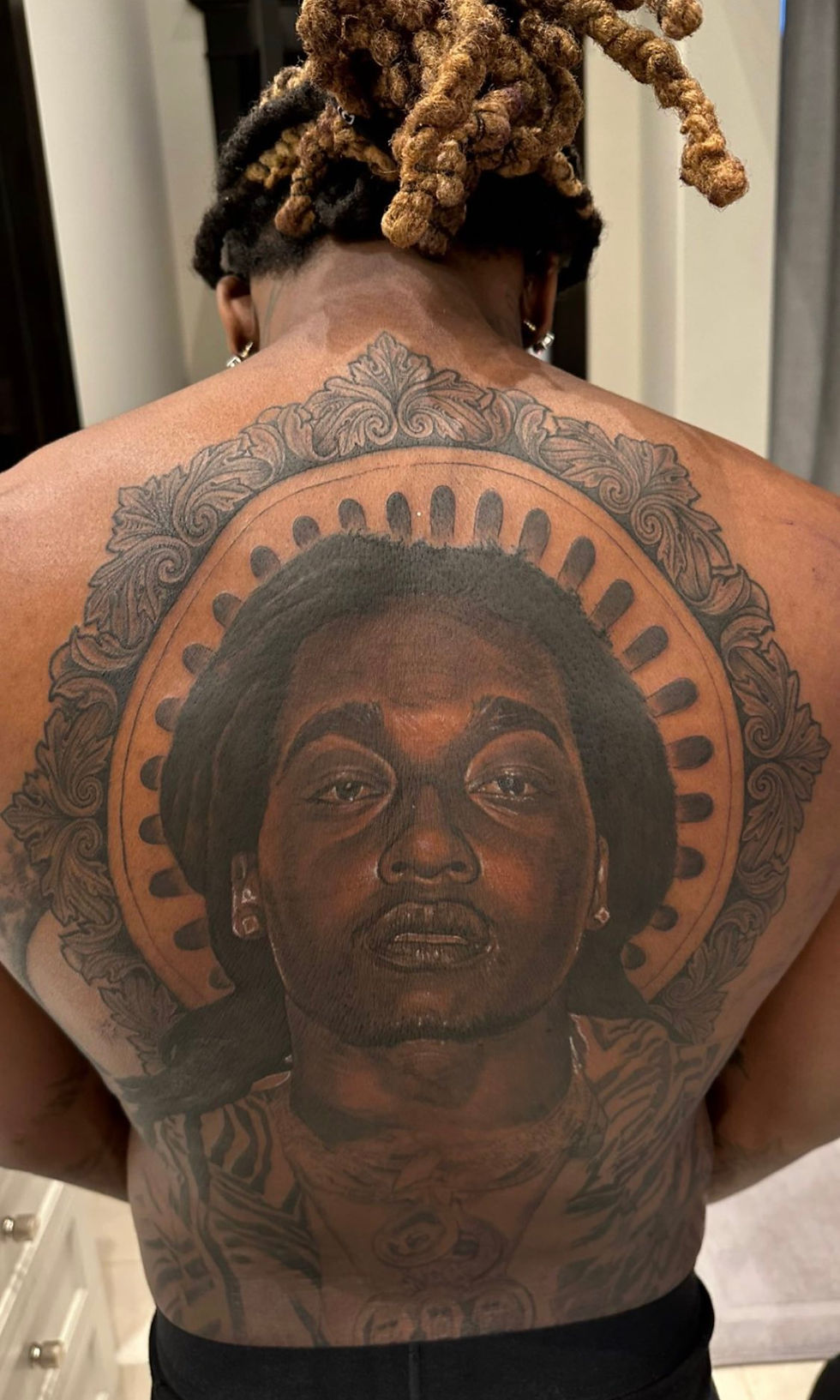
Offset’s Takeoff portrait tattoo across his back, shown in a vertical photograph.

Offset says the Takeoff portrait across his back took eight hours in one session. It honours his late best friend and former collaborator. The time gives a sense of its scale: this is a full back portrait, not a small symbol that disappears in a crowd shot.
The portrait has a specific story: it honours Takeoff. Offset has explained how long it took, while photos show how it fills his back. That is enough to understand the tattoo without adding a private message he has not shared.

Why the back portrait needs dated images

Offset’s Takeoff back portrait tattoo in a separate photograph.

Back tattoos are hard to catch because clothes cover them and interviews rarely show the wearer’s back. Onstage, a photo may show one shoulder; shirtless shots reveal the whole portrait. The GQ episode gives the design room and shows it clearly.
Lighting and distance can hide detail, and later photos may catch changes around the portrait. The central facts remain the same: it is a large portrait of Takeoff, and Offset says it took eight hours.

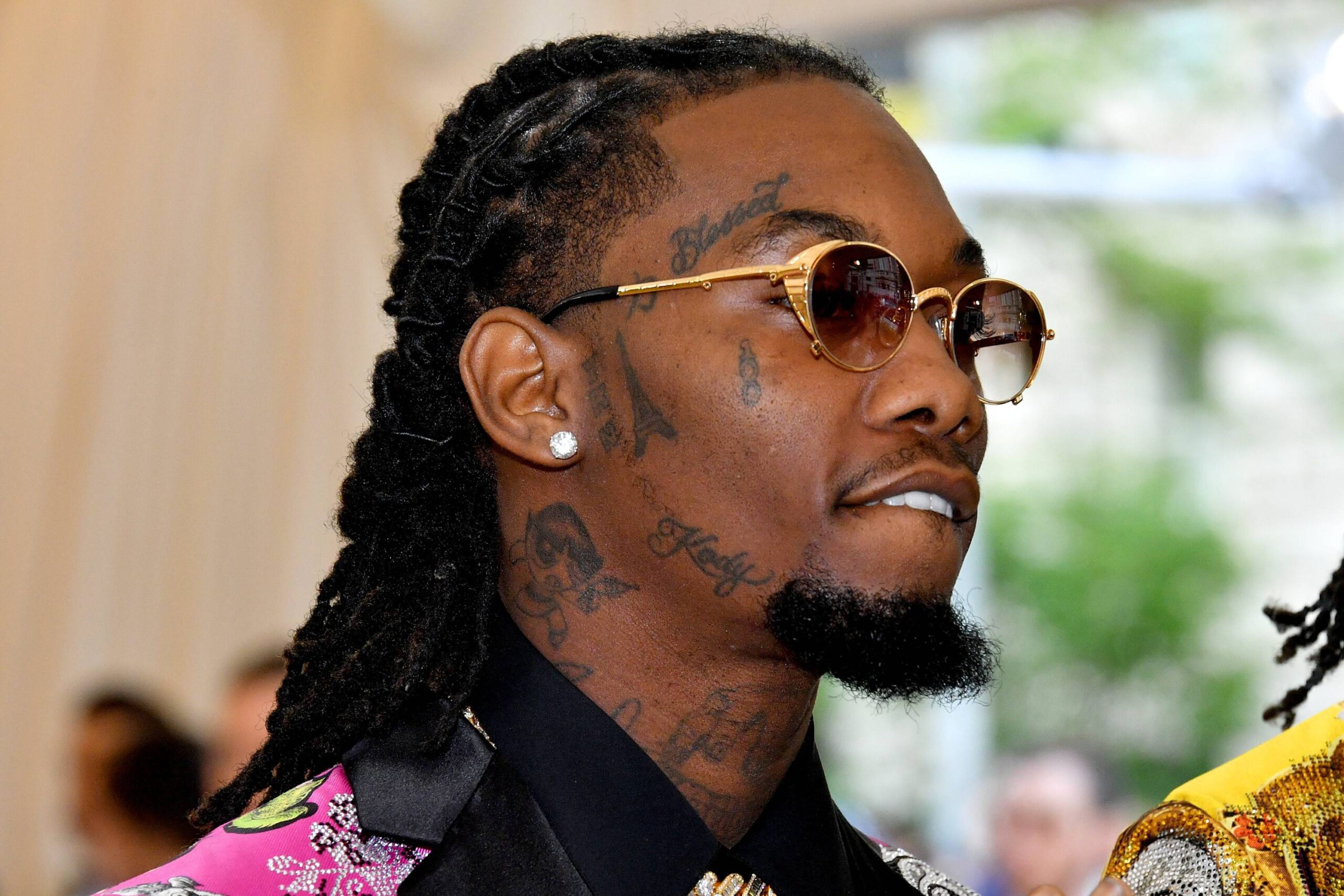
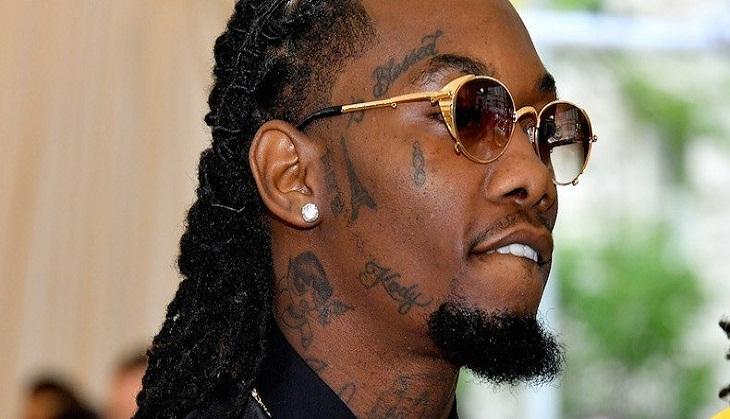
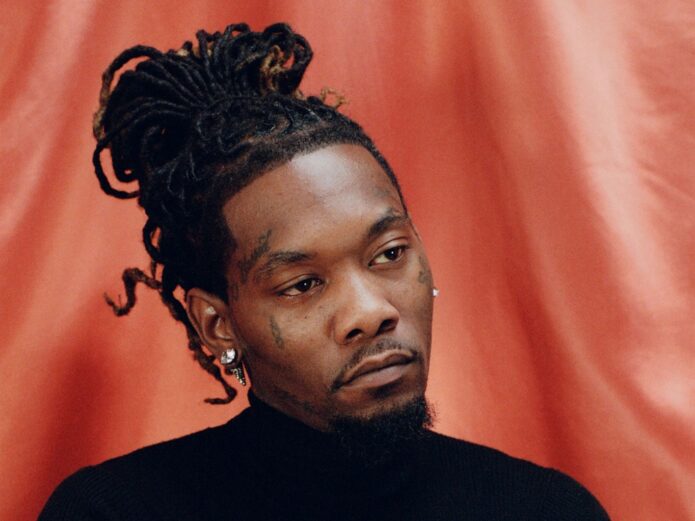
Offset’s ten face tattoos developed young

Offset’s visible face tattoos, including script and small designs along his cheek and brow.

Offset says he started getting tattoos at 15 and has ten tattoos on his face. That was his count in the GQ interview, not an official total for every later year. Face tattoos can be added, covered or changed, so the number belongs to the time he gave it.
His mother objected. Offset remembers she slapped him when he got face tattoos and told him his face was too beautiful. That reaction is part of his story: it was a family response to his choice, not a judgment about anyone else’s tattoos. It also shows he knew the facial work would change how people saw him.

What the face tattoos can and cannot tell us

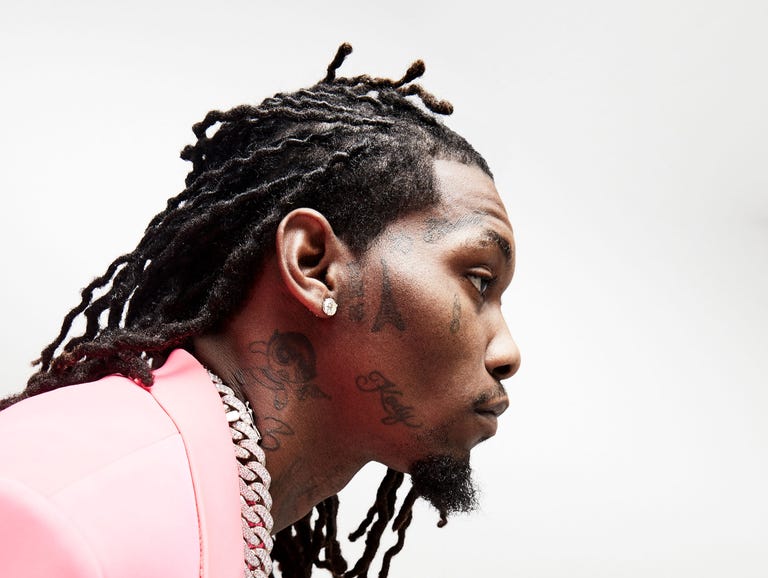
Offset’s face tattoos in a distinct side-profile photograph.

A close photo can show several designs, but tiny marks around the eyes, cheeks and hairline are easy to misread. Stick to the names Offset gives directly; the number ten offers context, not a meaning for every symbol.
The camera catches different parts of Offset’s face from each angle. Turning his head brings one cheek into view while hiding the other; makeup, facial hair and stage lighting can blur the lines. A front-facing interview and a profile shot reveal different details.

Portraits of his children

Offset’s family-name tattoos shown in a close-up face photograph.

Offset says he has his children’s faces tattooed on the backs of his legs. Those portraits belong beside the family pieces, not the Takeoff memorial: both are portraits, but one honours his children and the other his friend and collaborator.
Trousers hide leg tattoos in everyday photos. Offset’s account confirms the portraits even when a picture shows only his upper body; a clear image would be needed to describe each child’s design.

Arm and hand work fills the wider collection

Offset showing his tattooed arms, hands and torso during a tattoo tour.

Offset’s arms and hands carry more work, visible in the Tattoo Tour and public photos. Some smaller pieces can be named from what he says; others are hard to make out. His narration fills in details the images alone cannot show.
There is plenty beyond the face and back: arm and hand pieces, the Takeoff portrait and his children’s faces. Some dark shapes could be mistaken for separate tattoos. The clearest sections are the memorial, the face work, the family portraits and the wider arm-and-hand collection.

How the collection changed over time

The collection grew in stages. Offset began young with facial tattoos; later photos show the large portraits and family pieces. A patch of skin visible in one picture may be covered in another, while a design can simply be hidden by clothing or angle.
Dates matter most for the face-tattoo count. Offset gave the number ten in the GQ episode, so it belongs to that interview. Later photos may show changes, but a new count needs a clear source.

What Offset’s Tattoo Tour confirms

Offset showing the large Takeoff portrait tattoo across his back.

Offset’s GQ Tattoo Tour names the eight-hour Takeoff portrait, dates his face-tattoo period to age 15 and shows the portraits of his children on the backs of his legs. He also describes ten face tattoos and broader work on his arms and hands. Together, the pieces connect friendship, family and the public image he has built through ink. Smaller marks are harder to identify without a clear photo or his own description.
Each part of the collection is photographed differently. The back needs a full view, the face needs more than one angle, and the legs need a photo without trousers. That is why the Tattoo Tour fills in details everyday pictures miss.
The collection runs through loyalty, family and public image. The Takeoff portrait anchors it; the face tattoos record an early decision that changed how he was seen. The portraits of his children and the arm work round out the story, even when smaller designs are hard to identify.

More musician tattoo guides

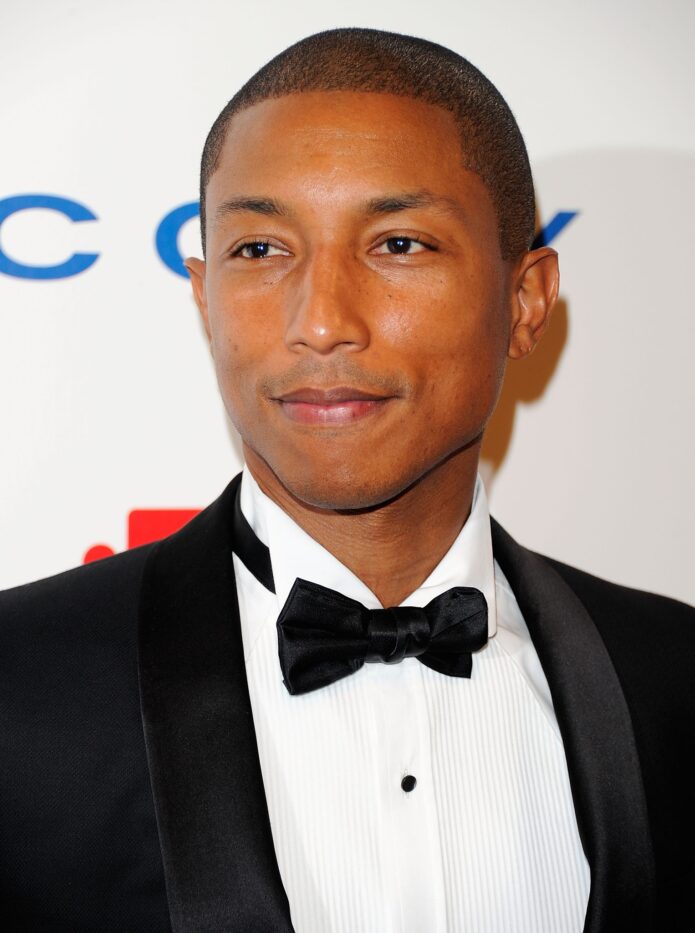
Why Pharrell Williams Wasn’t Happy With His Tattoos

Pharrell Williams once wore extensive tattoos across his arms, neck and upper body. In the early 2000s, they were a big part of his look. Years later, he spoke openly about wanting some of the ink removed. His story is as much about that change as it is about the tattoos themselves.

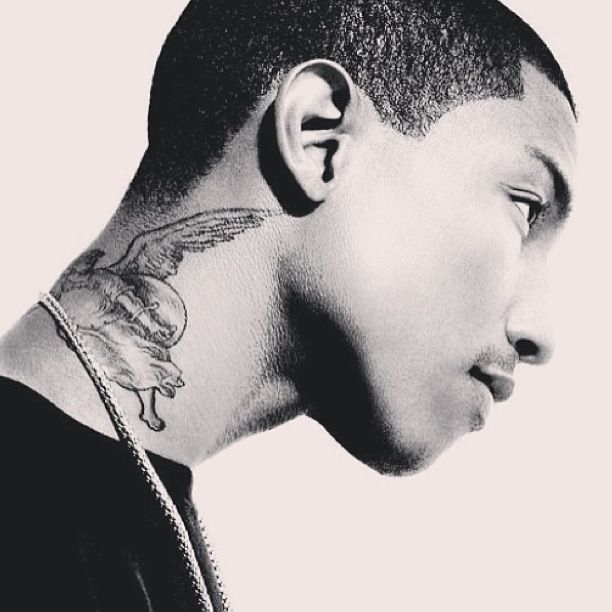
The winged figure on the right side of his neck is the best-known piece. Older photos show heavier work on both arms, including cherub-like figures, flames and dark shading. Pharrell has mentioned an angel on his neck and a cherub on his arm, though a photograph cannot identify every figure or confirm every label used online.

Photos show the neck tattoo clearly, but its exact identity is less certain than some accounts suggest.

The winged angel on Pharrell’s neck stayed when other tattoos were removed

Pharrell Williams winged angel tattoo on the neck

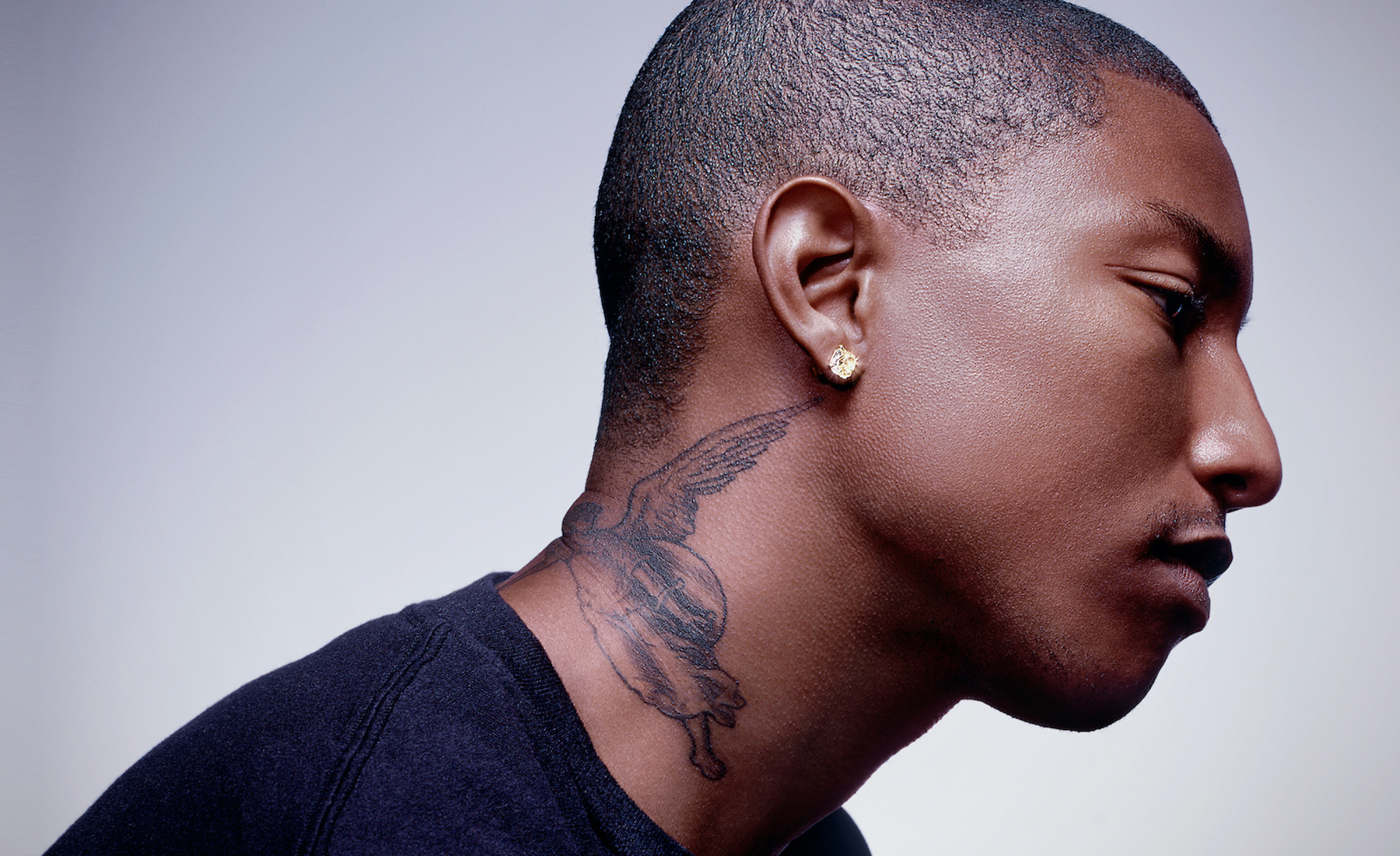
The neck tattoo is a large black-and-grey figure with wings spread around the side and back of his neck. In a side view, the wing is usually the first detail to catch the eye; turn him slightly away and the lower figure and darker shading come into view. Its placement keeps it visible with a short haircut or an open shirt.

Anil Gupta is generally credited as the artist. The figure is often called a guardian angel or Archangel Michael and described as carrying a shield. Pharrell has confirmed that it is an angel, but the specific name comes from tattoo coverage rather than a direct quote that settles its identity.

The neck angel also seems to have survived while much of the arm work was removed. Pharrell spoke about taking off most of his collection, but said the neck piece was not part of that plan. Later photos show his arms looking cleaner while the angel remains a familiar part of his appearance.

Studio portraits bring out the fine lines and shading; red-carpet shots can flatten the darker areas and make the wings look like one solid shape. A side profile may catch only half of it. Since the tattoo wraps around a curved part of the body, the angle changes what you can see.

Pharrell’s arm tattoos included a cherub and heavier fire-inspired work

Pharrell Williams cherub and arm tattoos

The arm tattoos made up the largest part of Pharrell’s old collection. Older photos show dark, shaded figures and ornamental shapes, some with a cherub-like look. Guides also mention portraits and flames, though the pictures do not always separate every design clearly.

Pharrell has said he had seven tattoos, including a cherub on his arm and an angel on his neck. That is the clearest count from him, and it identifies two designs. It is not a complete map of the old arm work.

In some photographs, the cherub looks like a small angelic portrait inside a larger arm design. In others, its shading blends into the surrounding ink. The face and the softer wing-like or ornamental shapes around it are the details that stand out.

When Pharrell talked about removal, he put it bluntly: “I got fire on my arms”. The line conveys how extensive the arm work felt to him, but it does not mean every tattoo was literally a flame.

Older photographs preserve designs that later faded or disappeared, and they show how much variation there was. A close portrait may make the cherub look like the whole tattoo; a wider shot reveals smaller marks around it. His arms were a busy collection built up over time, not matching sleeves.

A close-up can show one design, but a wider, clear photograph is needed to see how it fits among the rest. When part of a tattoo is hidden, its exact name may remain uncertain.

Why Pharrell wanted some of the tattoos removed

Pharrell Williams undergoing laser tattoo removal on his arms

The removal story is just as important as the original tattoos when tracing how Pharrell’s look changed. In 2008, he described a skin-graft idea: growing new skin and placing it over the tattoos. He later said it was a joke based on something he had seen in the news. The treatment he actually pursued was laser removal.

He said the tattoos belonged to an earlier part of his life and that he had started to feel finished with them. His line, “I’m a grown man”, captures the mood better than a polished makeover story. He was talking about his own collection, not saying tattoos were wrong for everyone.

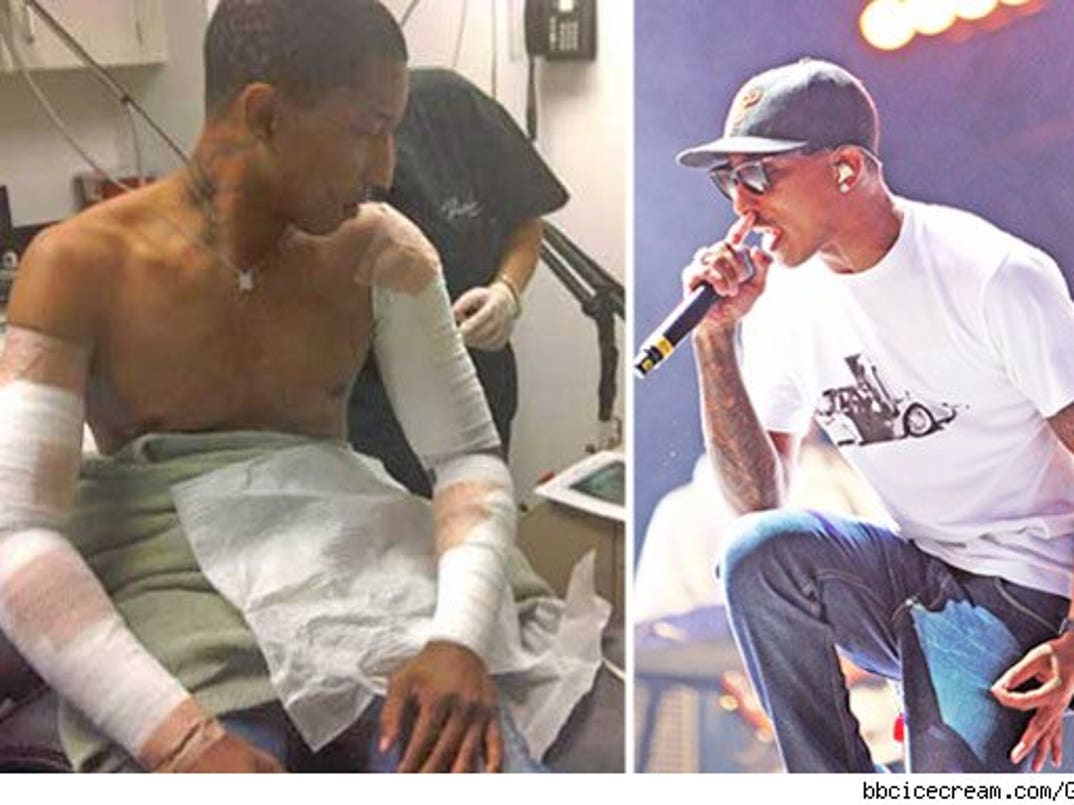
The laser process was painful, and Pharrell did not try to dress it up. He shared photos of his arms wrapped in bandages and joked that they looked “extra crispy.” Those images show the recovery as well as the change in appearance. Large, dark tattoos can take repeated treatments, and results vary by colour and body area.

Photos from the N.E.R.D. years show a dense arm collection that is mostly absent from later fashion portraits. Both sets of pictures are accurate; they capture different moments. Dated tattoo coverage helps make the timeline clear as Pharrell’s body art changed in public.

The neck angel makes the timeline easier to follow: it remained recognisable while the arms changed. Calling Pharrell heavily tattooed fits those earlier years, but may not describe his appearance now in the same way.

Pharrell’s tattoo record is really about change, not a perfect inventory

Pharrell Williams portrait showing his neck tattoo

No set of surviving photographs offers a complete list. What is clear is the winged angel on his neck, the cherub on his arm, the broader arm collection and a later removal process that faded or erased much of the older work.

The remaining details are trickier. In a soft image, a shadow can resemble lettering, an arm crease can look like an outline, and a half-hidden portrait can be mistaken for a cherub. Some parts of the old work are simply hard to make out.

The tattoos fit the experimental image Pharrell carried during the N.E.R.D. years. His style has always moved between music, clothing, jewellery and visual art; the dense arm designs felt at home in that period. The later removal reflected a shift away from that version of himself.
The neck angel is still the easiest tattoo to identify: its placement, shape and artist are all well documented. The arm work belongs in the story too, even if photos make each design harder to separate. It was a substantial collection made up of several pieces, not one simple sleeve.

The headline should not make it sound as though Pharrell disliked all his tattoos or wanted everything removed. He grew tired of the arm work and pursued laser removal because it no longer felt right for him. He kept the angel on his neck; the older designs remain part of a heavily tattooed period in his life.

Pharrell Williams’s neck tattoo in a black-and-white profile portrait

More musician tattoo guides

Katy Perry’s Tattoos: Jesus, Sanskrit and the Story Behind Her Ink

Katy Perry’s tattoos move through gospel roots, pop eras and personal milestones. The cursive word Jesus on her wrist and a Sanskrit phrase she once shared with Russell Brand sit alongside bright ankle designs tied to albums and tours. Some meanings came from Perry herself; others are best left open.

Perry has spoken about some tattoos, especially the ones marking music milestones. With others, like the lotus or a tiny finger design, the image may be all we know.

Jesus and the lotus sit opposite each other on the wrists

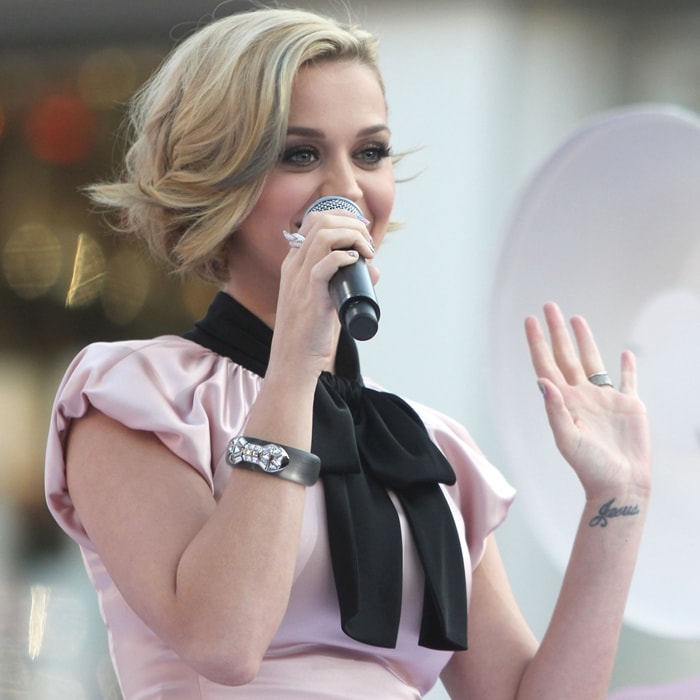
Katy Perry’s Jesus wrist tattoo
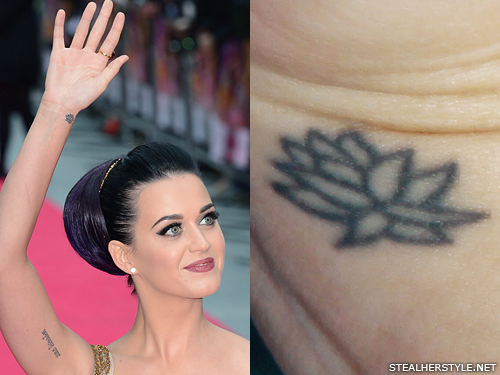
Katy Perry’s lotus wrist tattoo

The cursive Jesus on her left wrist is one of her earliest and best-known tattoos. She got it when she was young, while her public identity was still closely tied to gospel music. It is a small, clear line that shows whenever she plays guitar or lifts her hand.

Her other wrist has a simple lotus. People often read the flower as a symbol of new beginnings, but Perry has not offered one definitive explanation. The fine-lined, compact design balances the lettering on her other wrist.

Seen together, the two wrists show different sides of the collection: one is a word with a clear religious reference, the other an image with room for interpretation.

The Sanskrit phrase on her bicep records a shared idea

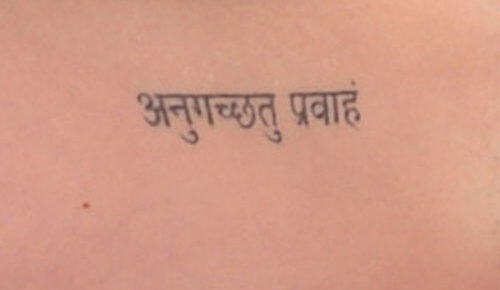
Katy Perry’s Sanskrit go with the flow tattoo on her bicep

Inside her right bicep, Perry has the Sanskrit phrase “Anuugacchati Pravaha,” usually translated as “go with the flow.” It was a matching tattoo with Russell Brand, a short phrase chosen for its message as much as its script.

The lettering sits high on her arm and can disappear beneath a sleeve, so it is easiest to see when Perry raises her arm. It also looks quite different from the playful ankle pieces: longer, more deliberate and built around words.

The phrase belongs to a specific moment in their relationship, but later events do not change what the couple chose at the time. It stands on its own without being tied to the marriage’s later history.

Strawberry, peppermint, cherry and prism turn album eras into ankle tattoos

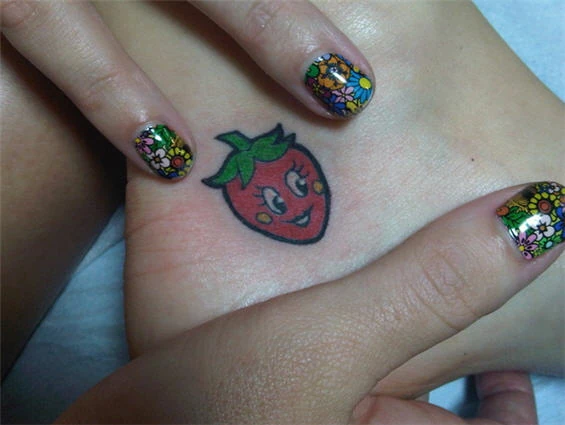
Katy Perry’s smiling strawberry ankle tattoo
Katy Perry’s smiling peppermint ankle tattoo
Katy Perry’s cherry blossom ankle tattoo

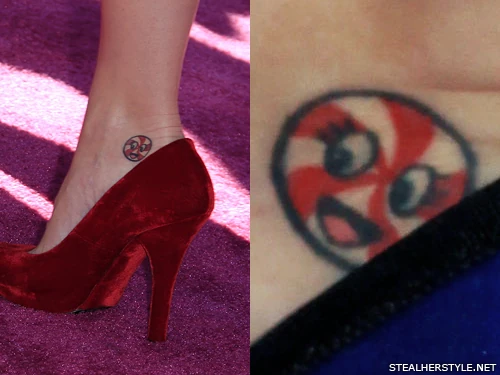
The ankle tattoos turn Perry’s career timeline into body art. A smiling strawberry represents One of the Boys, while the smiling peppermint belongs to the candy-coloured world of Teenage Dream. Both are small, bright and playful.

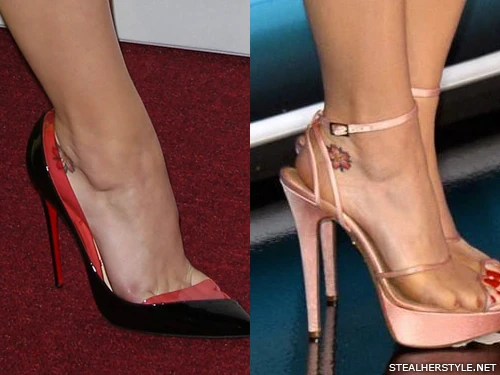
A prism arrived with the Prism era, giving the ankle group a more geometric shape. Perry also has a cherry blossom there. Online accounts sometimes attach a broad symbolic meaning to it, but its design, placement and pop-art feel are clear.

Each ankle tattoo points to a different period in Perry’s music. Their color and simple silhouettes make them easy to recognize, even in performance photos.

Hello Kitty and XLIX mark the playful side of the collection

Katy Perry’s Hello Kitty finger tattoo
Katy Perry’s XLIX Super Bowl finger tattoo

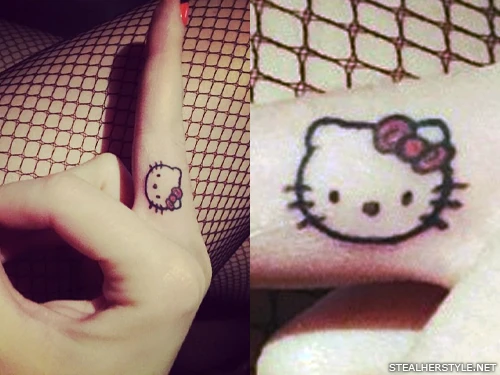
On one finger is a small Hello Kitty, tied to the character’s anniversary and Perry’s birthday timing. It suits the collectible, playful side of her image. The figure is instantly recognizable but easy to hide when she holds a microphone or curls her fingers.

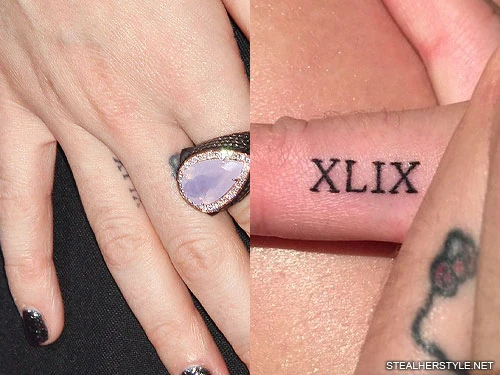
She also marked her Super Bowl XLIX halftime appearance with the Roman numerals XLIX. The finger placement keeps the milestone discreet, more like a personal reminder than a large piece of branding.

Both finger tattoos show how a tiny image can hold a specific memory. A tattoo can be meaningful because of the moment it marks, even if it covers only a few millimeters of skin.

What Katy Perry’s tattoo record actually tells us

Perry’s tattoos combine faith, relationship history, album imagery and career milestones. She has explained Jesus, the matching Sanskrit phrase, the album-era ankle pieces and XLIX for the Super Bowl. The lotus, Hello Kitty and cherry blossom are clear designs too, even if their private meanings have not been fully explained.

Colorful imagery makes the collection unmistakably pop, but the placements give it shape: words on the wrists and bicep, album art around the ankles, and small finger tattoos for a character and a major performance. Together, they read like a timeline of Perry’s life in music.

More musician tattoo guides

Blink-182’s tattoos, member by member

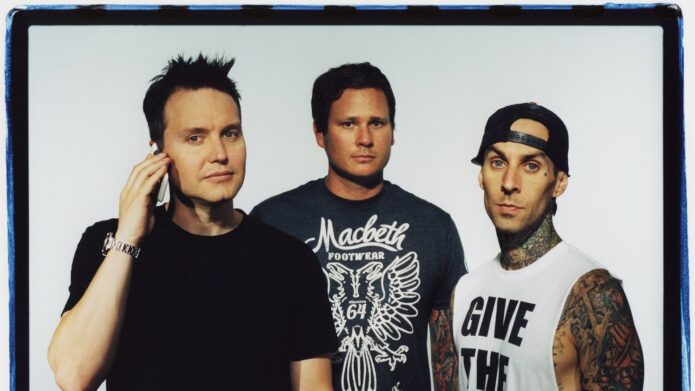
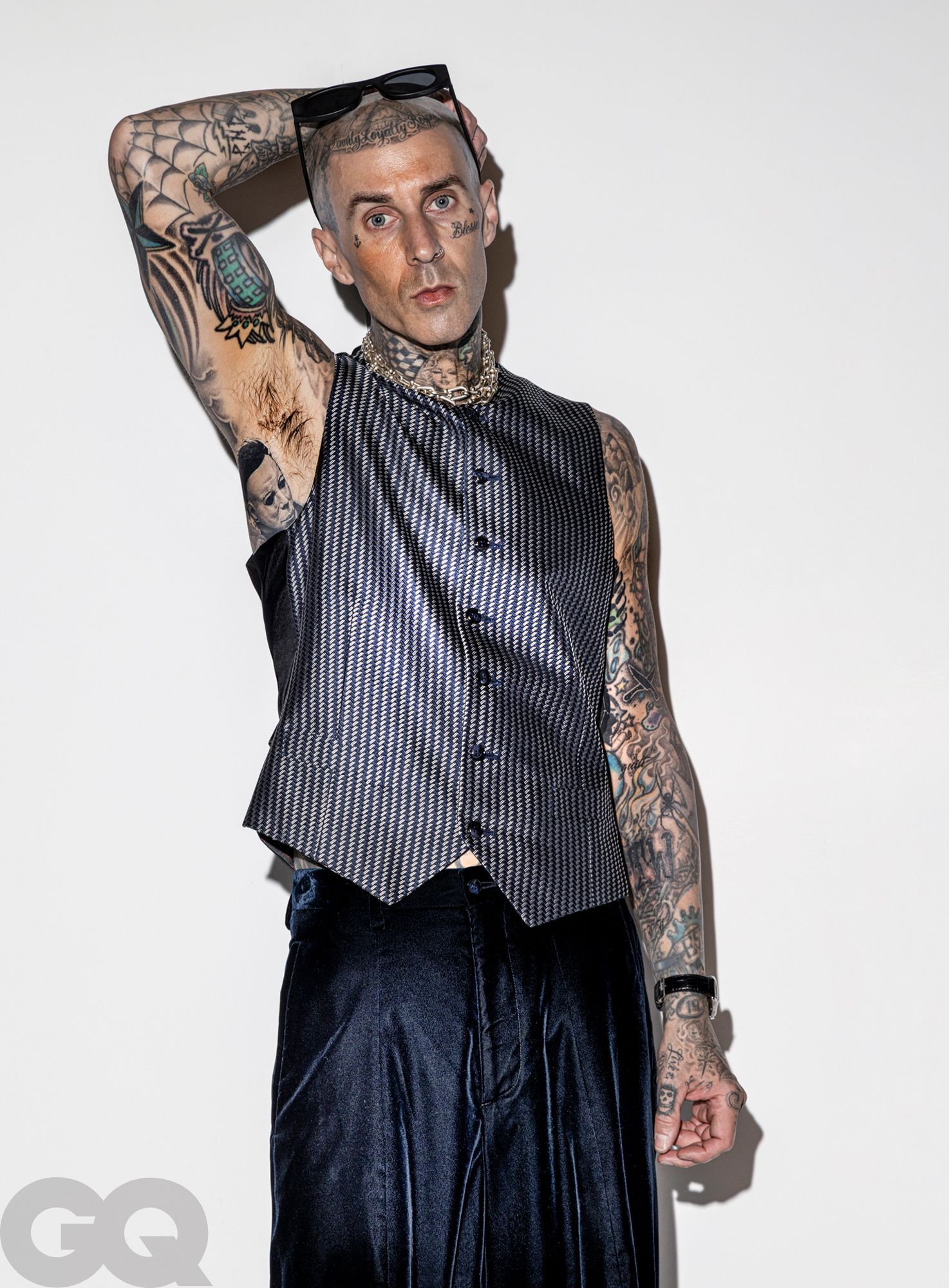
Blink-182’s members have very different amounts of visible ink, and some tattoos are easier to identify than others. Mark Hoppus has a few well-known pieces; Tom DeLonge has a colorful right-arm sleeve; Travis Barker is tattooed from head to toe. Matt Skiba’s hand and neck ink shows in photos, but the individual designs are hard to make out. For Scott Raynor, the band’s original drummer, there is no reliable public list of tattoos.

Matt Skiba’s visible tattoos resist a precise inventory

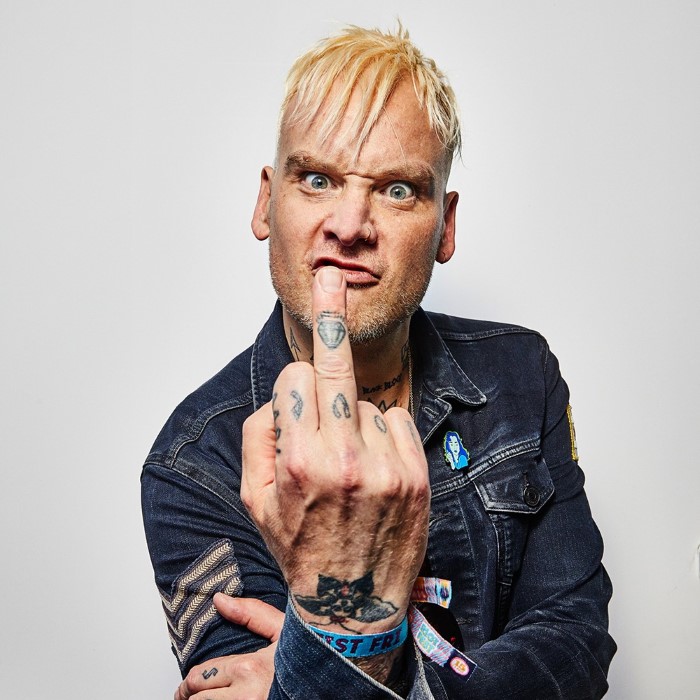
Matt Skiba with visible hand and neck tattoos

Matt Skiba joined in 2015, recorded California and Nine with the band, then left when Tom DeLonge returned. TheAudioDB’s artist photo shows ink on his hands and neck, but not enough detail to identify individual designs. Scott Raynor’s tattoos are similarly hard to confirm from photos; there is no tattoo design that can be confidently attributed to him.

Mark Hoppus kept his tattoos close to family

Mark Hoppus’s forearm Grim Reaper tattoo, designed by Dabs Myla and tattooed by Dan Smith

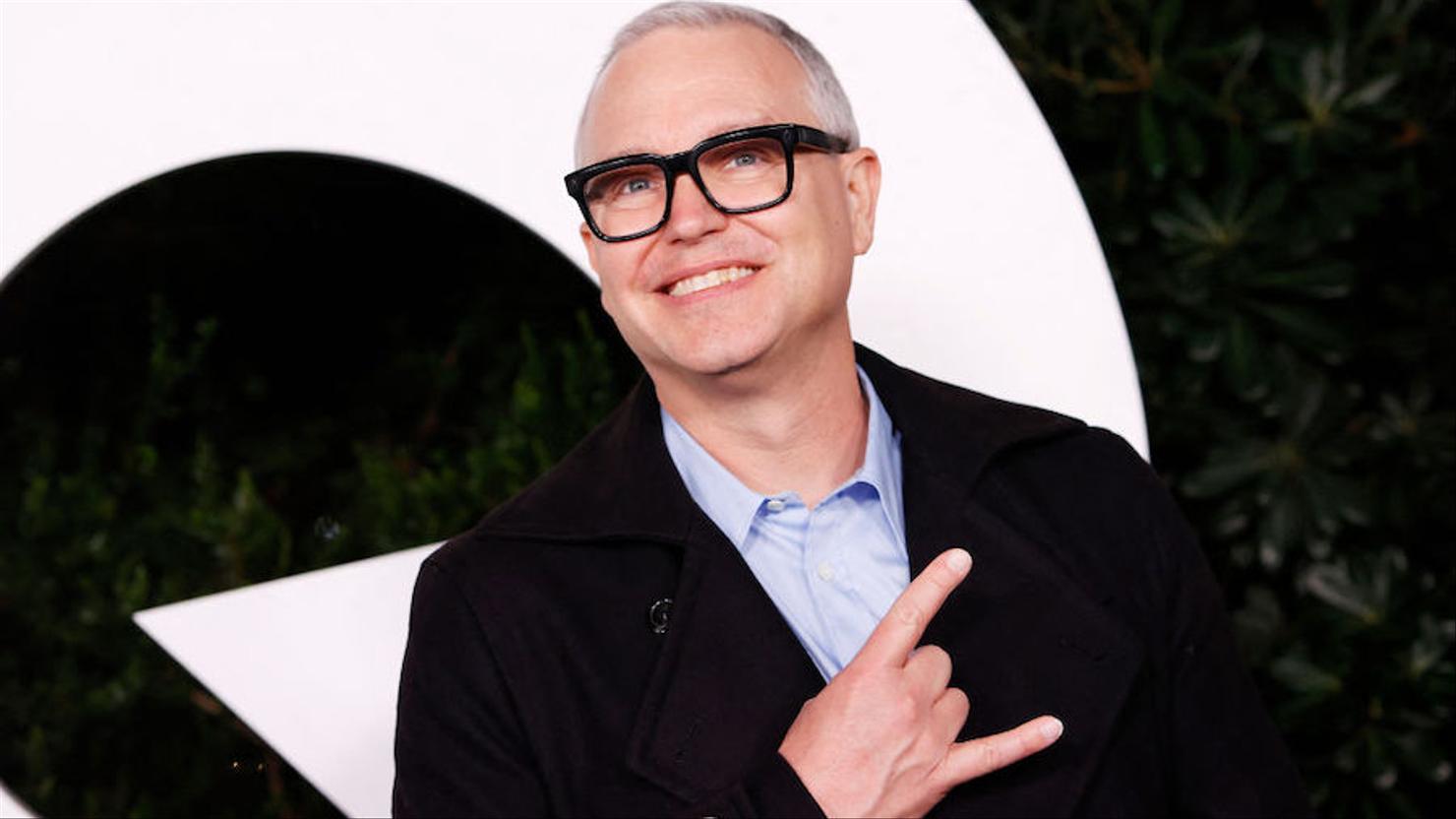
Hoppus has fewer tattoos than his bandmates. The names “Skye” and “Jack” sit on his wrists for his wife and son. iHeart revisited the older “Skye” tattoo when covering his later ink, and photos show the matching pair. They are small family tributes, separate from the much larger work of his bandmates.

In 2022, Hoppus added a larger forearm piece: a big-eyed Grim Reaper with a scythe. Artists Dabs Myla created the character, and Dan Smith tattooed it. Dabs Myla called it “DEATHY” on Instagram, captioning one post, “Not this time DEATHY!” The tattoo came after Hoppus announced he was cancer-free. That context gives it extra weight, even though he has not publicly explained every detail. It is a playful Grim Reaper tattoo made after a frightening year, with the artists and timing documented.

Put together, Hoppus’s tattoos are a pair of family names at his wrists and one striking forearm character. It is a small collection beside his bandmates’ sleeves, and the designs are personal rather than Blink branding.

Tom DeLonge’s right arm became a colorful sleeve

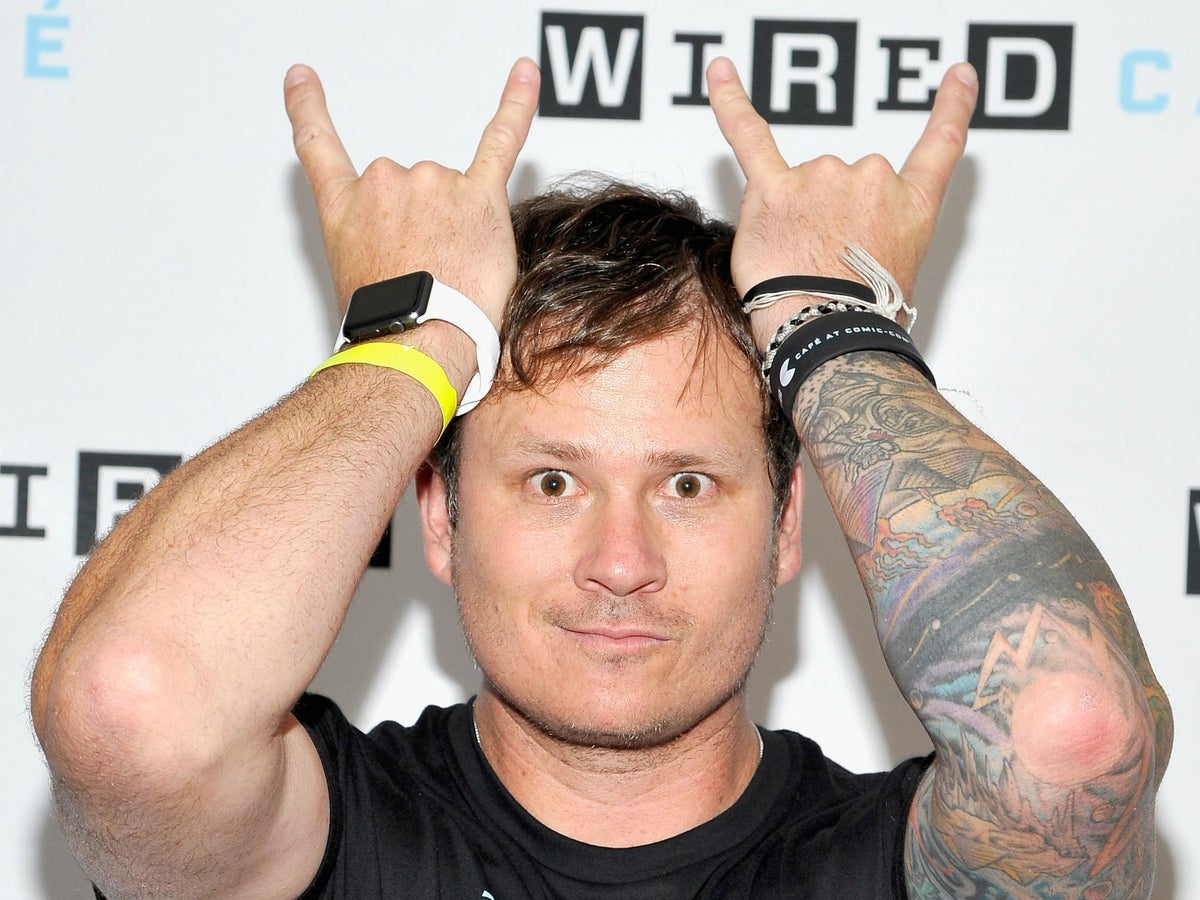
Tom DeLonge with his colorful right-arm tattoo sleeve visible

DeLonge’s most distinctive tattoo is the right-arm sleeve. Early-2000s photos show it taking shape; later portraits show a filled-in mix of outlines, color and small filler designs. It reads as one large piece today, though it was built up over time rather than done in one sitting. Individual shapes are hard to name from photos, so the overall design is the clearest story.

One clear symbol is a large “V” associated with Angels & Airwaves, the band DeLonge formed after an earlier Blink-182 split. Tattoodo identifies it as the band’s logo, making it a career reference within the sleeve.

Travis Barker’s tattooed upper body in a GQ portrait

DeLonge’s interest in UFOs can make blurry shapes tempting to call aliens, but the photo itself does not support that. It shows a colorful sleeve; coverage identifies the V logo. The other designs are visible, but there is no reliable key to what each one means.

That one-arm focus sets DeLonge apart from Hoppus’s small wrist tattoos and Barker’s extensive coverage. Dated photos also show the sleeve changing over the years rather than appearing fully formed all at once.

Travis Barker began with punk references and lettering

Travis Barker’s tattooed upper body in a GQ portrait

Barker has given far more first-person detail than either bandmate. He told GQ his first tattoos came at 15: a Bones design and a flame linked to Dag Nasty, the hardcore band he loved as a teenager. He described hanging around tattoo shops, waiting for an open chair. Those early choices belong to his skate and punk years, long before Blink-182 made him famous.

At 18, before joining Blink-182, Barker had “self-made” tattooed across his knuckles. He told VICE he chose the phrase as a promise to earn a living through music without a fallback plan. That meaning belongs to the knuckle lettering; it does not explain every skull, flame or portrait elsewhere on him.

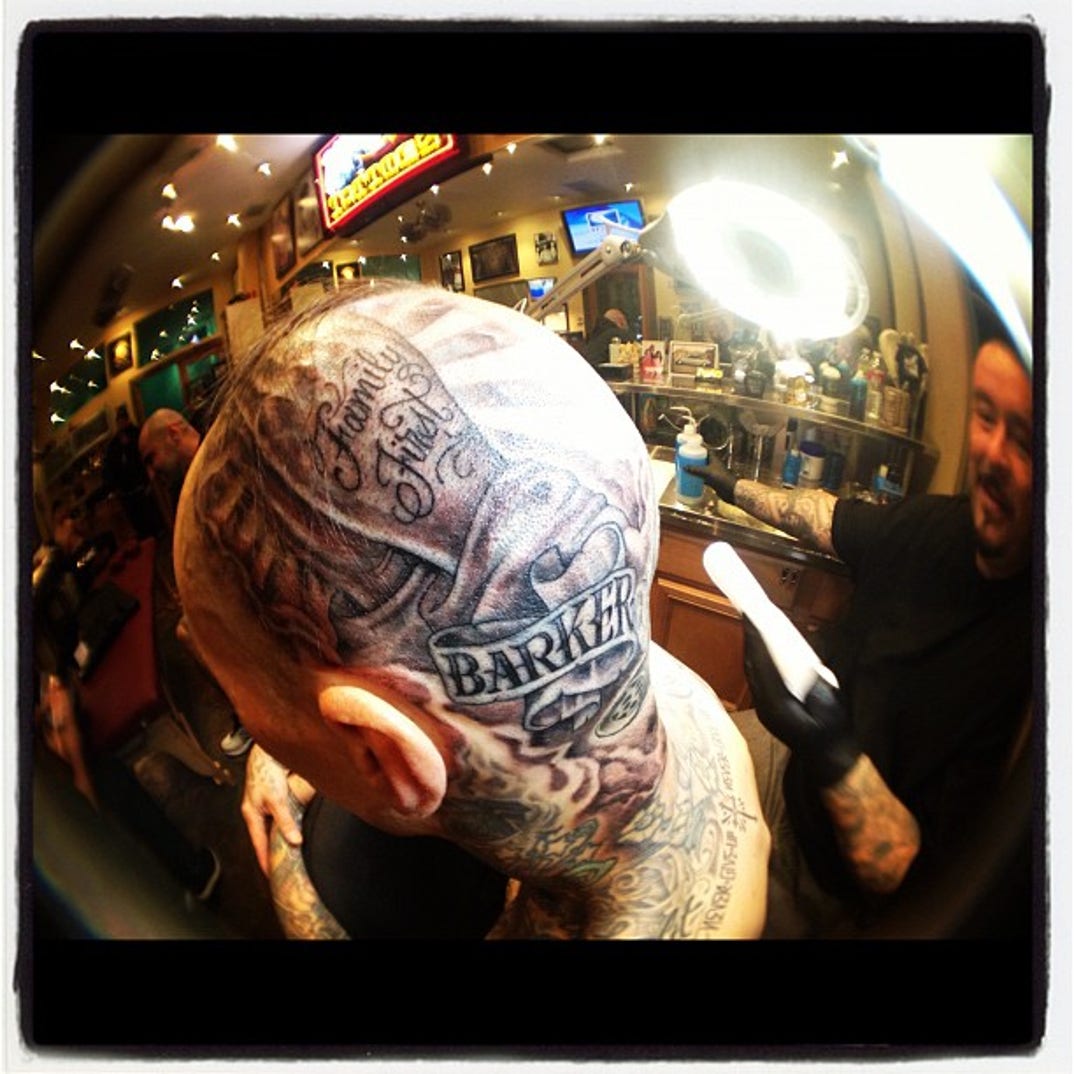
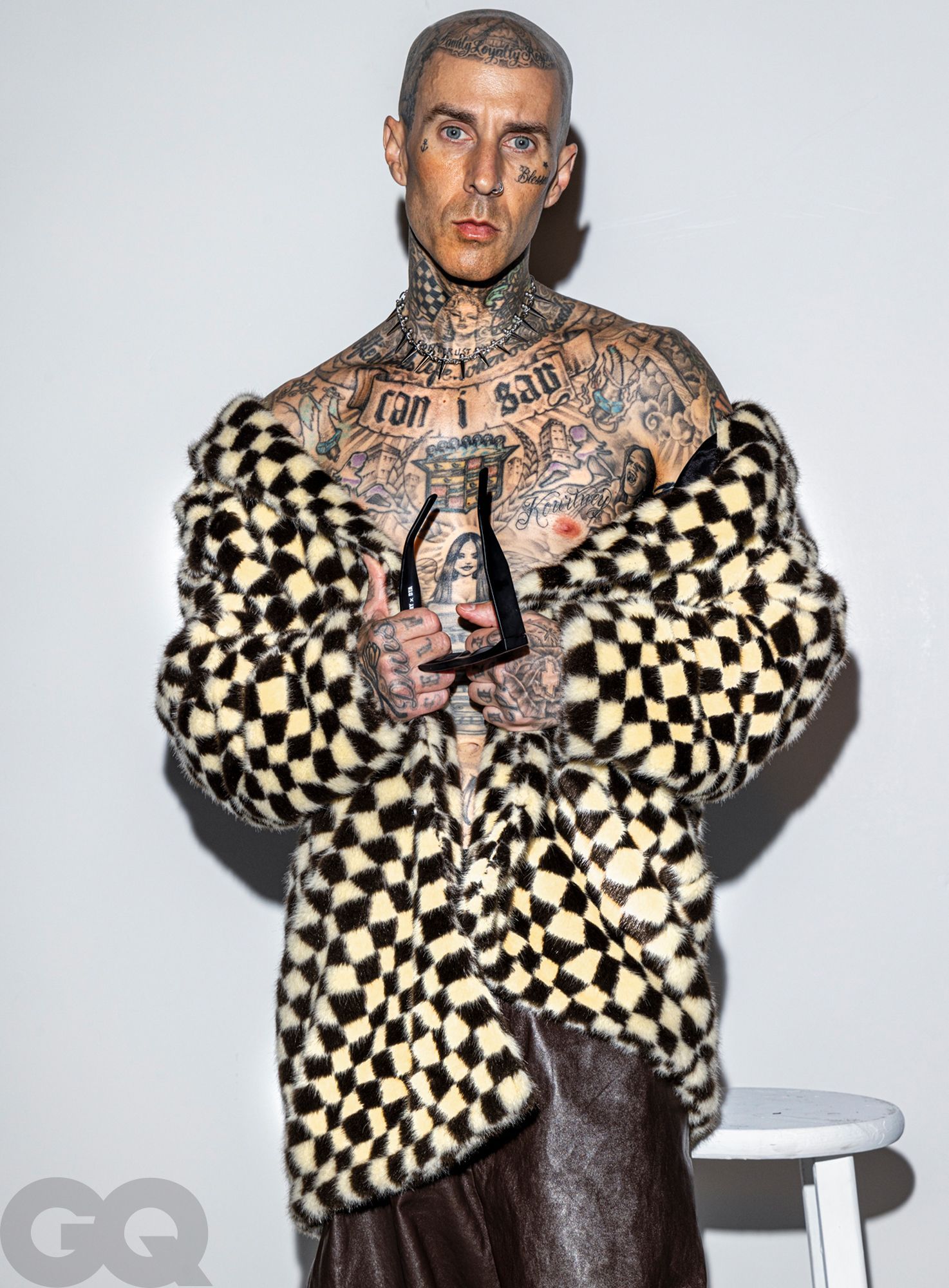
Barker’s music references include other bands and projects. He identified a Transplants gas mask on the back of his head and described an “Can I Say” tattoo linked to Dag Nasty’s album. Those are specific references in a much larger collection. A blurry stage photo is not enough to attach one story to every hard-to-read patch of ink.

The head and neck combine script, religious images and a band mark

Close profile showing Travis Barker’s scalp, head and neck tattoos

In his VICE interview, Barker named several tattoos on his head: a Transplants gas mask at the back, the script “one life, one chance”, praying hands by Mr. Cartoon, a rose and a Virgin Mary. He also said he was raised Catholic and that prayer is part of his life. That background helps explain the religious imagery, though not every tattoo is a statement of faith.

Placement helps make sense of the group. The gas mask sits at the back of his head; the script, hands, rose and religious figure are elsewhere. A side-profile photo shows how much ink covers his head and neck, though it cannot reveal everything at once. Barker’s interviews help identify the individual pieces.

Barker has worked with many artists over the years. In GQ, he named Jon Sanchez, Mike Dewey, Larry Garcia, Mr. Cartoon, Franco Vescovi, Chuey Quintanar, Mike Giant and Mark Mahoney as favorites. The list covers collaborators he admires; it does not assign an artist to every tattoo in a photograph.

The back piece turns family portraits into a single composition

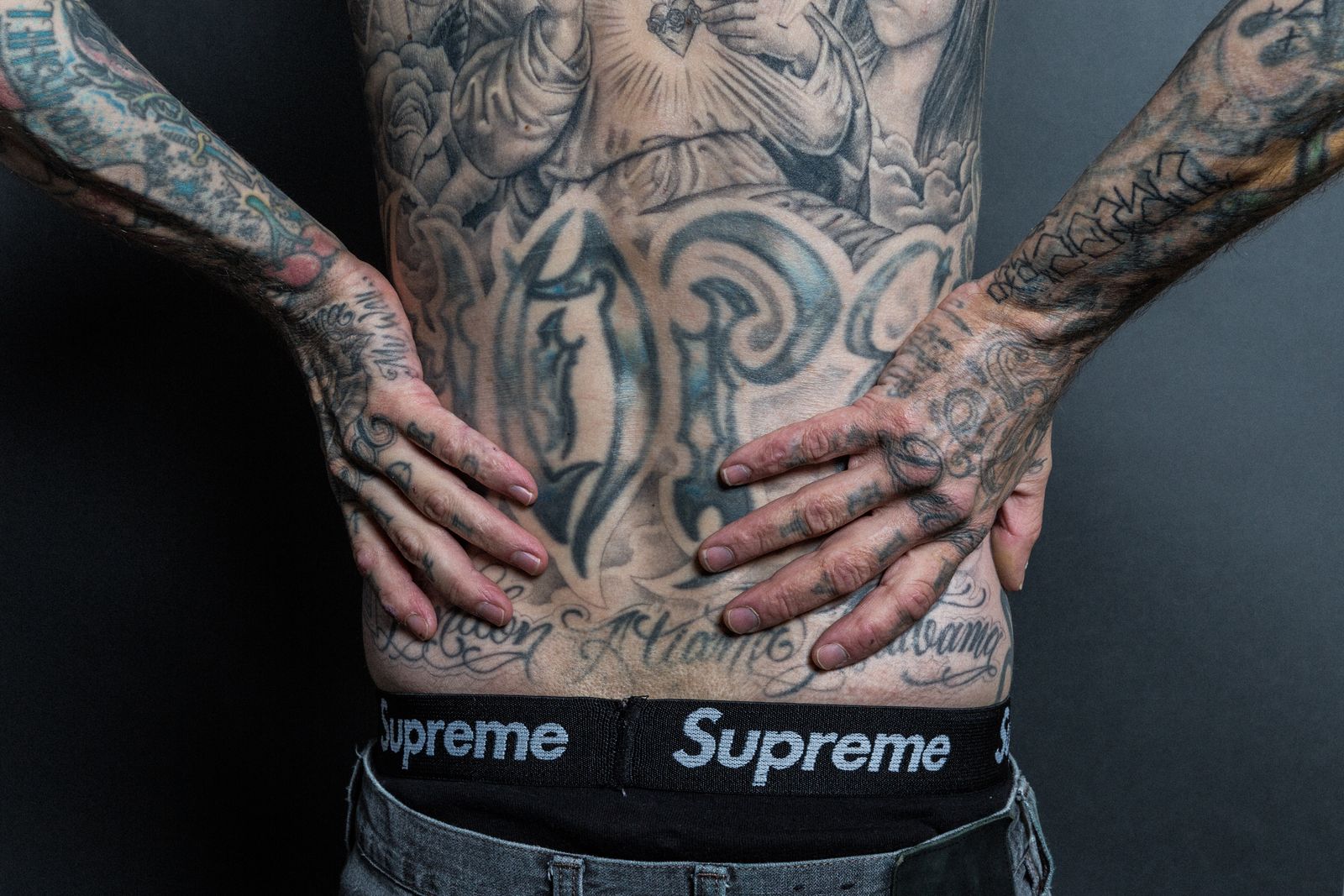
Travis Barker’s large back tattoo with family portraits, religious imagery and lettering

After the 2008 plane crash, GQ reported that skin from Barker’s back and thighs was used for grafts on his legs and feet. He later wanted to tattoo his back again and put his family there. The finished piece brings portraits of his parents and children into a larger design with religious figures, ornamental shapes and lettering. Barker described long sessions with Franco Vescovi and Chuey Quintanar.

VICE names Barker’s father, mother, son Landon and daughter Alabama among the family members represented. In the photograph, the portraits sit together inside one composition rather than as separate headshots. Barker said he was not ashamed of the crash scars; they are part of his life. The grafts and the later family portrait work remain distinct parts of the story.

Barker described the back piece as a tribute to his family. That meaning belongs to this design; it need not be extended to every tattoo nearby.

Torso script and the tattoos his children added

Travis Barker’s torso tattoos, including chest and ribcage lettering

Barker said the large Cadillac script down his ribcage took 12 hours to complete. He also identified “Can I Say” on his chest as a reference to Dag Nasty’s album. The photos show where the tattoos sit; his interviews explain their connections and what it took to get them.

His children have added their own tattoos. Barker told VICE each child had a place on his thigh where they could draw: Landon made a cross with his name and the initials L and A, while Alabama added a heart. Barker called the patch a kind of sketchbook. GQ described how it began when Landon asked for a tattoo and Barker let him draw on his father instead.

Some of Barker’s older leg tattoos are gone. He said the crash burns destroyed much of the ink on his legs; tributes to friends Lil Chris, Che and DJ AM were among the pieces he said remained. A concert photo from years ago does not show exactly what is still there today.

Across the band, the contrast is striking: Hoppus has family names and one forearm character, DeLonge has a colorful sleeve, and Barker has punk lettering, band references, head tattoos, portraits, religious images and designs made by his children. There is no single Blink-182 tattoo style; each member’s collection looks different.


Macklemore’s Tattoos, One Story at a Time

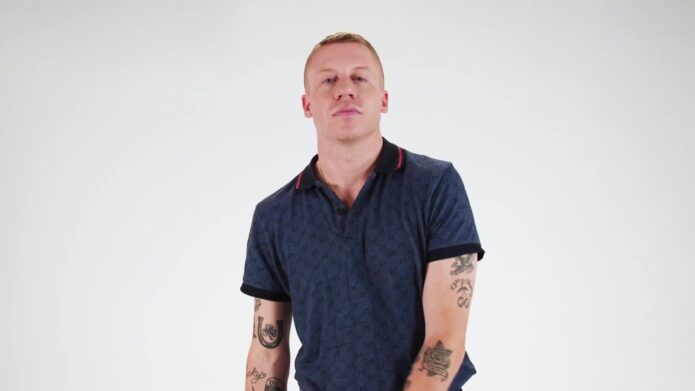
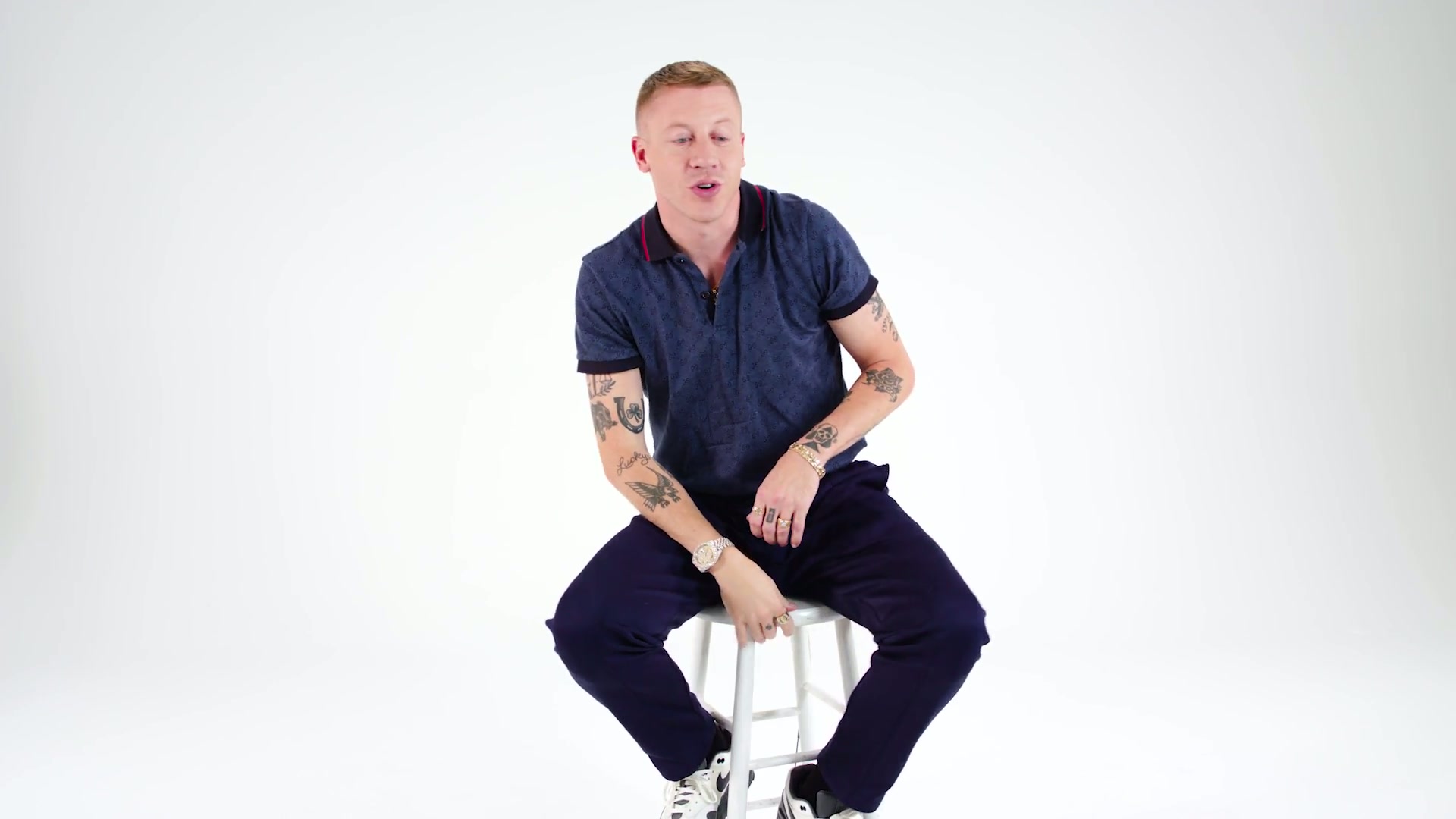
Macklemore waited until his thirties to get tattooed. What started with a small clover on one finger grew into a bold mix of traditional animals, lettering, portraits and family tributes. In GQ’s Tattoo Tour, he explains several choices himself. Some tattoos come with explanations from Macklemore; for others, the photographs are all that is available.
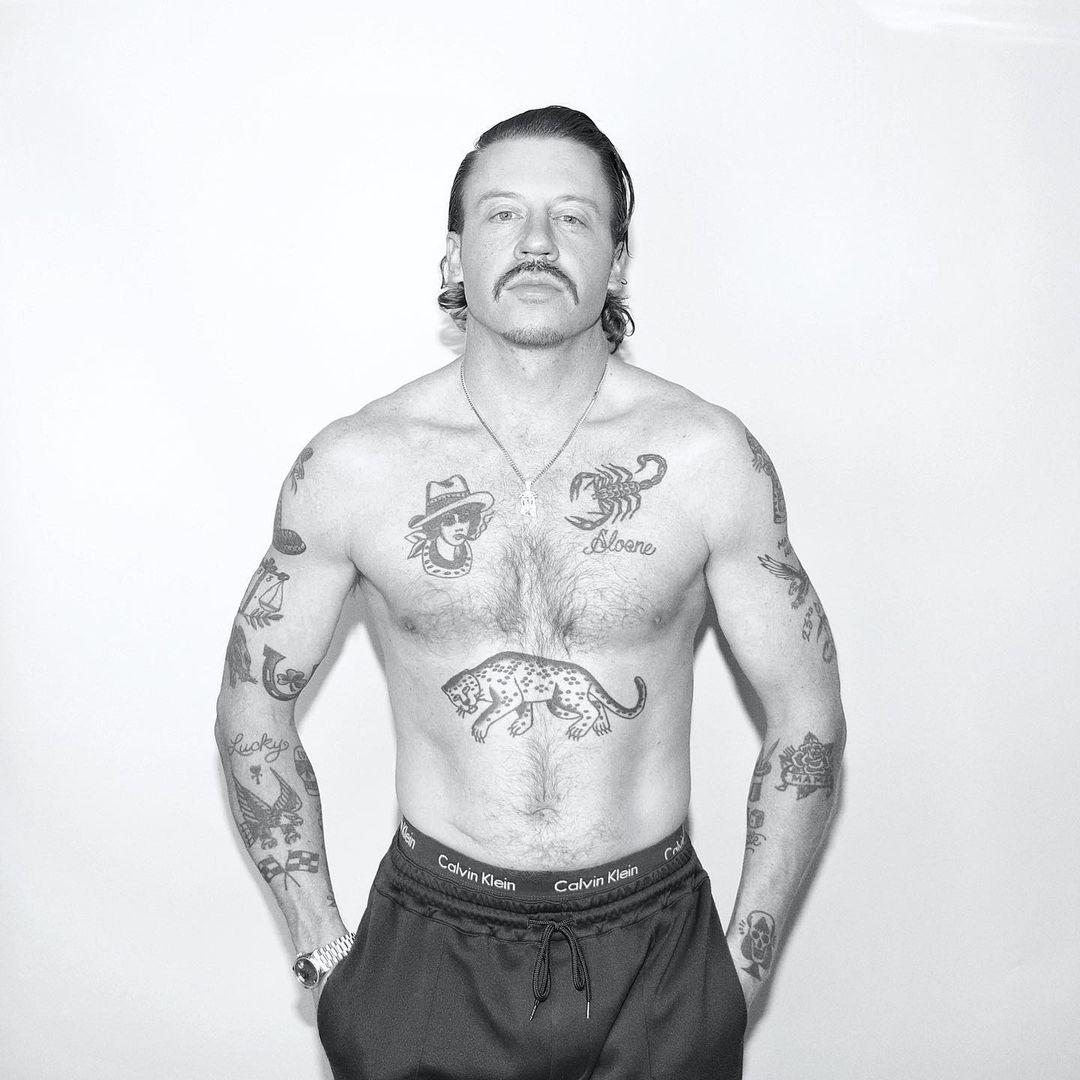
Chest and stomach tattoos, from Sloane’s name to the leopard

Macklemore holding his daughter, with the Sloane lettering tattoo visible on his chest
Close view of Macklemore’s chest tattoos, including traditional-style illustrated designs
Macklemore’s leopard tattoo across his abdomen, shown in a clear shirtless photograph

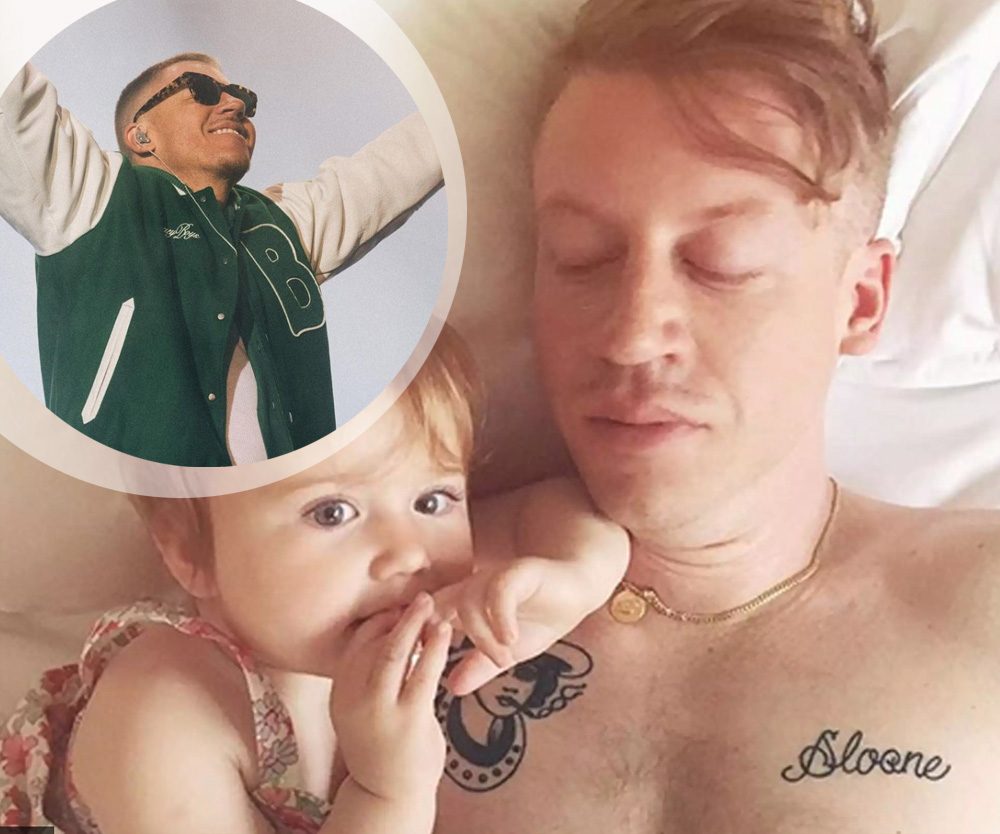
The name Sloane is one of the easiest family tattoos to read. In the GQ video, Macklemore points out his daughter’s name written across his chest. It is a straightforward dedication in a prominent place. From farther away, the script shrinks to a few dark strokes, so a close photo makes a difference.

A scorpion on the left side of his chest sits near Sloane’s lettering. Its compact, illustrated shape contrasts with the open script. Macklemore has not shared a personal meaning for it, but its placement is clear.

On the other side is the woman smoking a cigarette that Macklemore points out in the GQ tour. A second account describes her in a hat and scarf. The cigarette and clothing give the small portrait its character, but Macklemore has not said who she represents.

The leopard across his abdomen is a good example of meaning arriving after the design. Macklemore says he chose it because it looked tough, then later connected it to “don’t play with death, don’t do drugs.” That is his own reading, not a universal meaning of leopard tattoos. The big cat spans his stomach and is usually hidden by clothes.

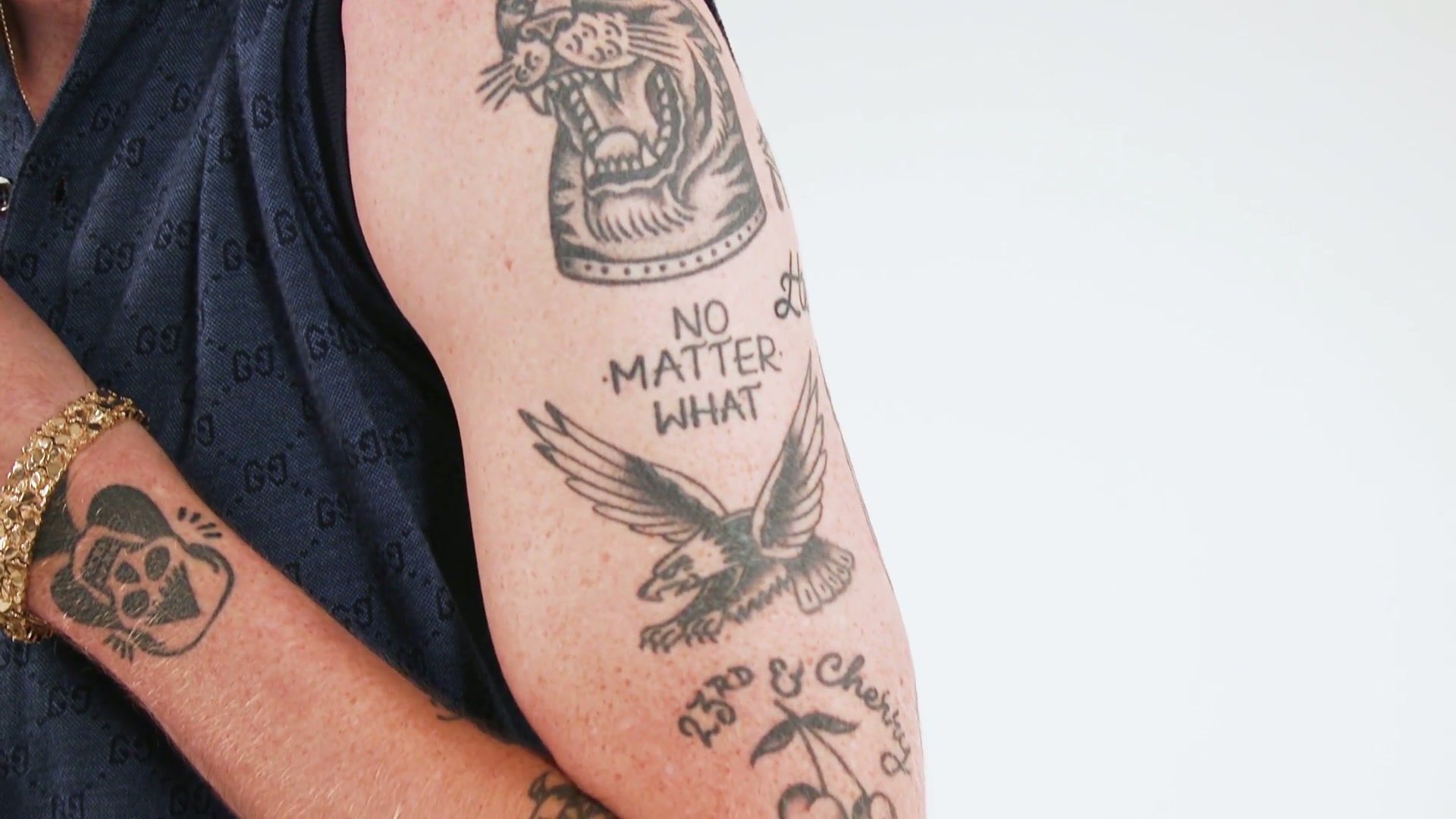
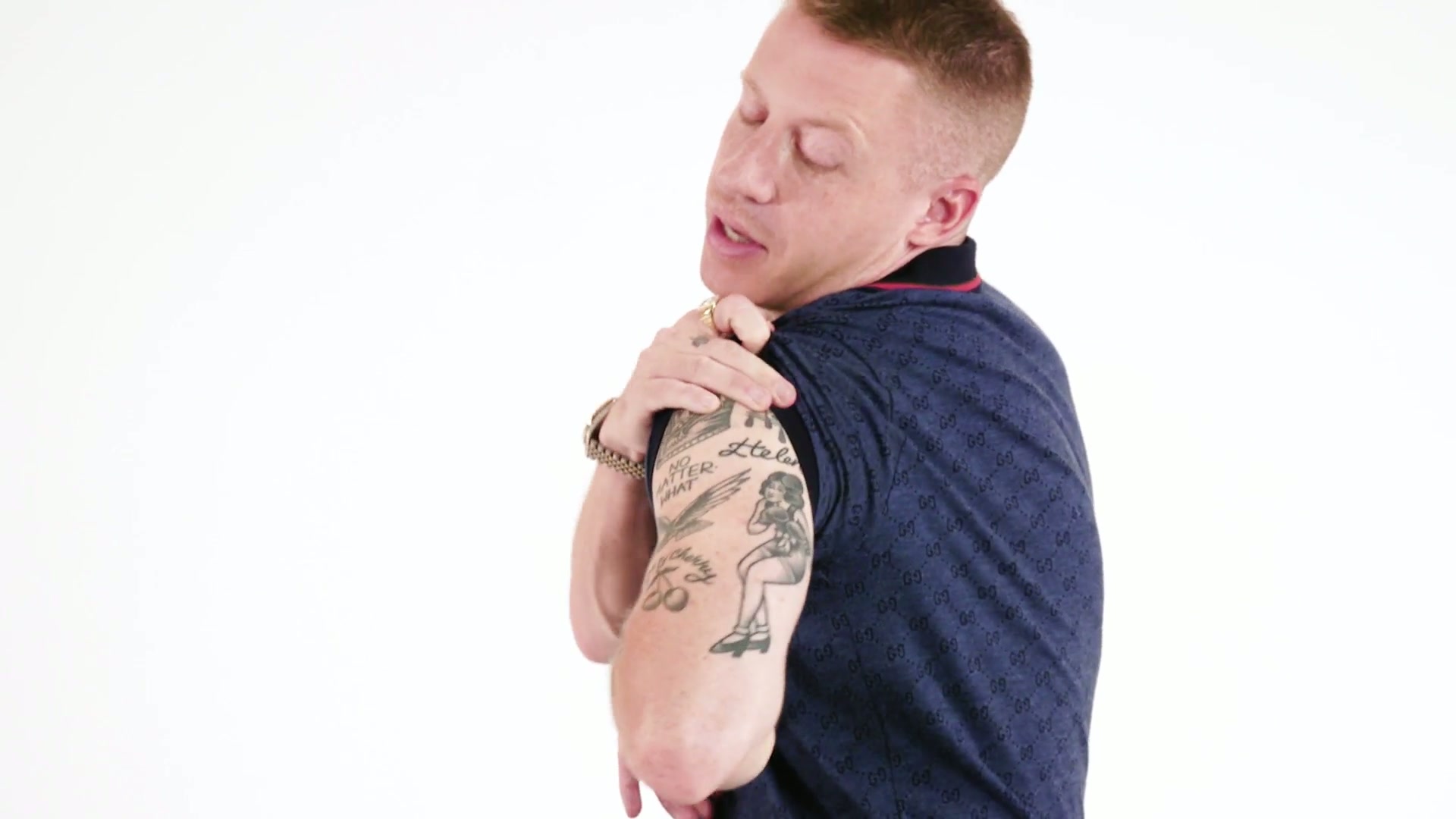
There is also a stacked piece with a tiger, an eagle and the words “NO MATTER WHAT” on the left shoulder. The tiger sits above the eagle, with the words between them. Macklemore has not explained the phrase’s private meaning.

Arm, wrist and hand pieces carry the stories he has told

Macklemore finger and hand tattoos shown in the GQ Tattoo Tour

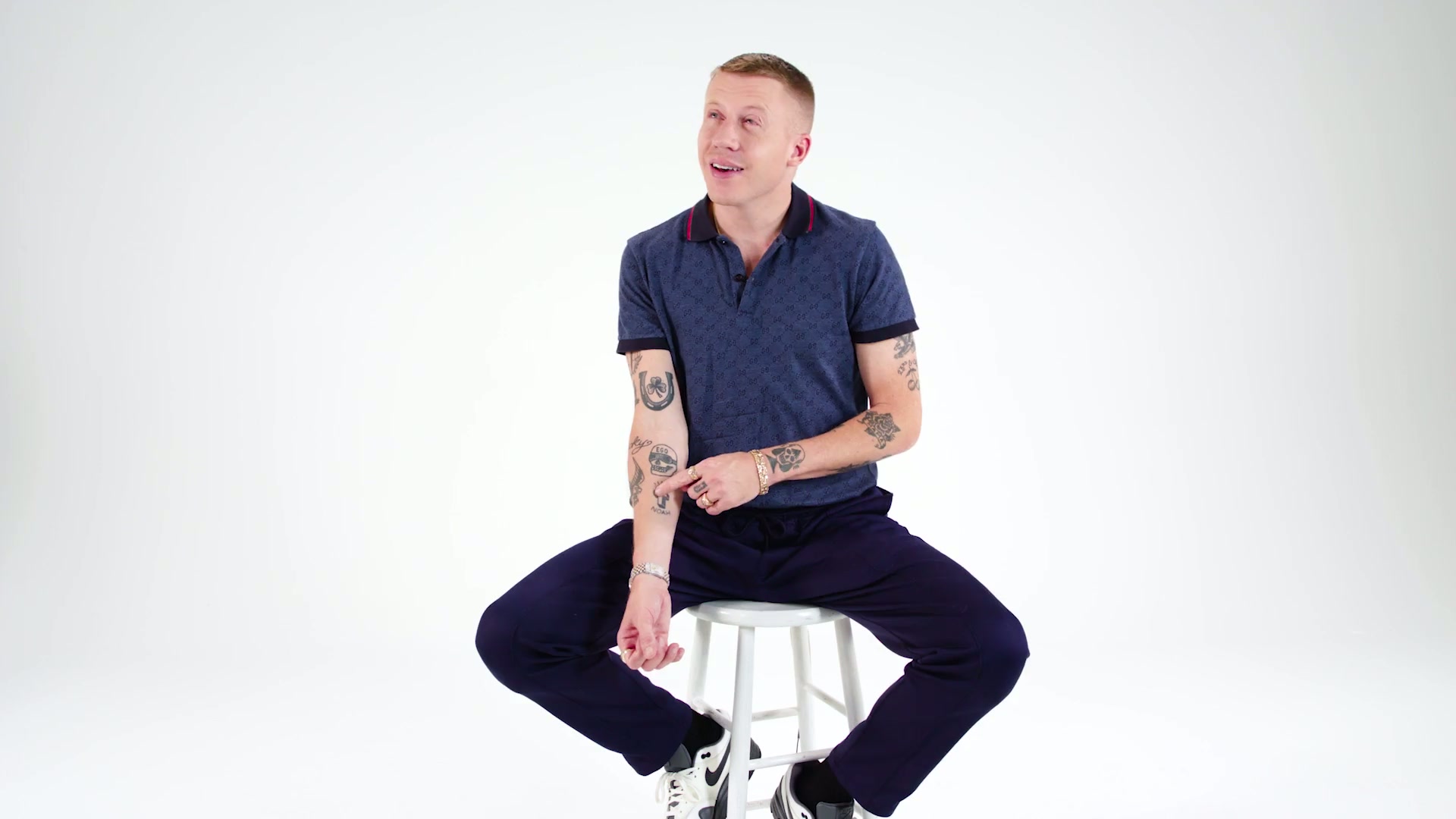
Macklemore has said he liked “American traditional” tattoos and wanted to keep that style when he started. On tour, he might set out to get one and return with several—about fifteen in all, by his account. That helps explain why his arms feel like a collection of separate pictures rather than one planned sleeve.

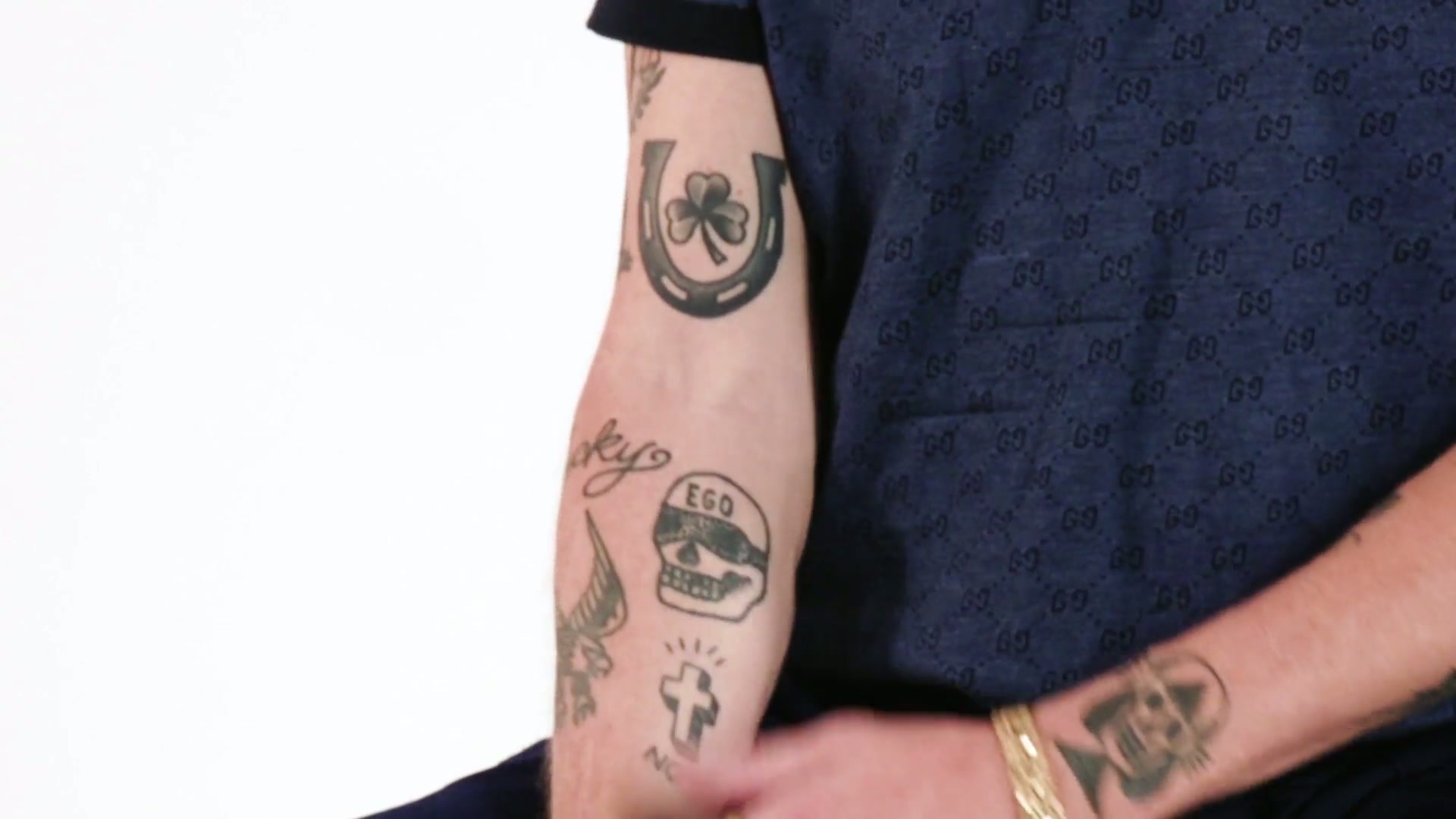
The first tattoo was a three-leaf clover on a finger. He got it while Ryan Lewis was getting tattooed and joked that it was off-centre. Macklemore links it to his Irish background but never gave it a grand meaning. He later said he stopped worrying about the placement. A separate list also shows a clover beside a horseshoe on his right bicep, though he has not explained that one. The small finger piece is part of the story he tells.

The flower with a “MAMA” banner has a clear family connection. Macklemore says he meant it for both his mother and his wife, Tricia, whom he jokes is his child’s mama. He chose that shared word instead of tattooing his wife’s name, which he says is a bad idea for a marriage. He has not assigned a separate meaning to the flower itself.
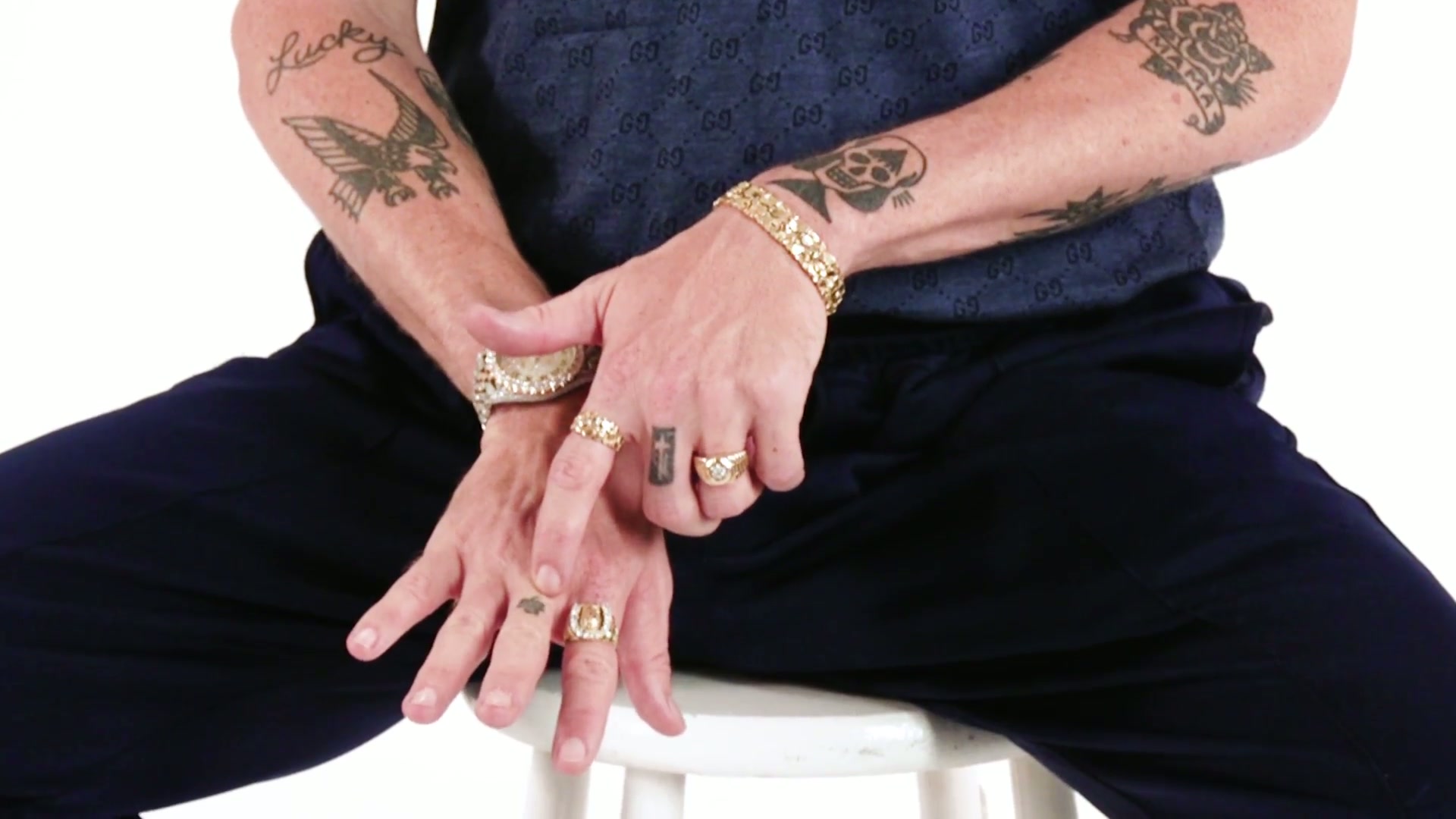
Macklemore’s flower tattoo with the MAMA banner, shown in GQ’s Tattoo Tour.

The Helen tattoo came from a day with his grandmother while filming the “Glorious” video. Helen picked the font, and Macklemore got the lettering tattoo while they were together. GQ confirms her role in choosing it. A secondary tattoo catalogue also describes a woman’s portrait as Helen, but does not say whether it is the same tattoo or a separate one. The lettering has a clear story; the portrait remains a reported visual entry.

Macklemore Helen portrait tattoo on his upper arm

The Noah tribute is another story Macklemore has told himself. Noah was a close childhood friend, painter and community activist who died. Macklemore says the tattoo keeps his friend’s memory close. A separate listing places a cross and the name Noah on the inner right forearm, near a skull marked “EGO.” Macklemore confirms the memorial, but does not identify every nearby detail.
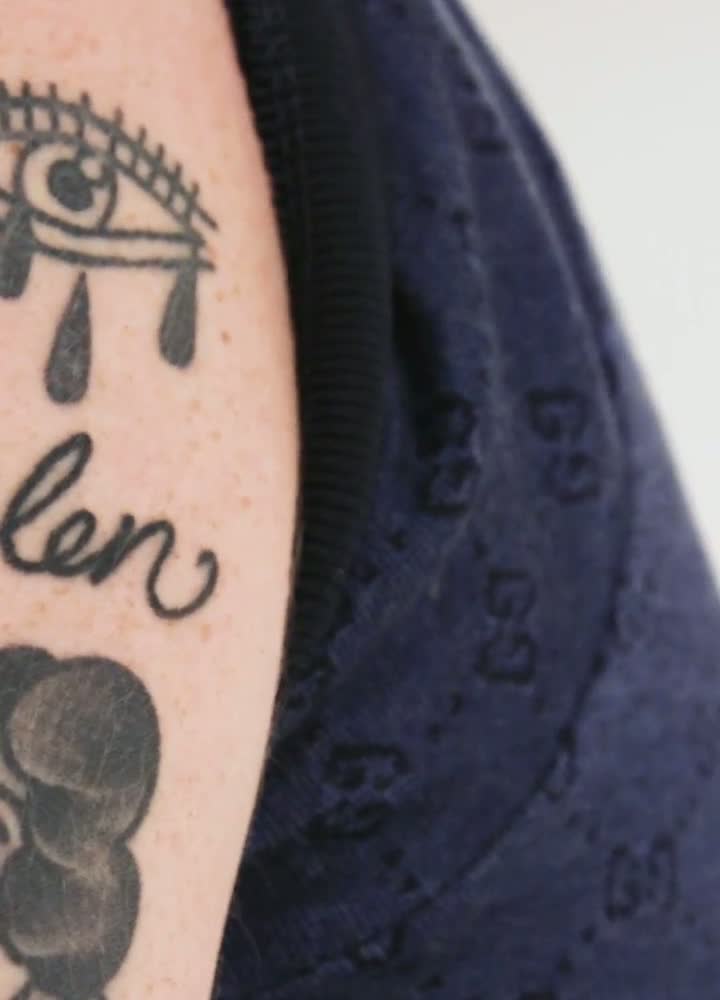
Macklemore Noah memorial and EGO skull tattoos

“23rd & Cherry” ties a place to his recovery. Macklemore identifies it as the Seattle street and fellowship hall where he got sober. He calls it home and says the tattoo helps him stay sober. The inventory places the words with cherry imagery on his upper arm; GQ supplies the personal story. It is both an address and a turning point he has chosen to keep close.

Macklemore 23rd and Cherry forearm tattoo

The rest of the arm designs are clearer in photographs than in Macklemore’s own explanations. The inventory lists a parrot on the left forearm, a skull pierced by a spade on the left wrist, and a small cross inside a square on the left middle finger. They sit among traditional-style pictures rather than forming one continuous sleeve. His line about death and drugs came with the leopard story, not the skull.

Macklemore EGO skull and cross forearm tattoos
Macklemore forearm tattoos shown in a GQ Tattoo Tour close-up

On the right arm, the same list shows a woman on the outer forearm, checkered flags near the wrist, and an eagle with a small heart and the word “Lucky” above it. It also records a horseshoe beside a three-leaf clover on the right bicep, and a serpent above scales, the number 33 and branches on the right shoulder. The designs are visible; Macklemore has not given a specific meaning for each one.

Another entry pairs dice with the word “Seattle” on the inner left forearm. It is described as a hometown tribute. Macklemore’s GQ sobriety story, though, is about “23rd & Cherry,” not necessarily the dice. Both may point to Seattle without carrying the same story.

One list also labels a right-upper-arm design a rat, but its description is vague. Without a clear photo or Macklemore’s own identification, the label is uncertain. It notes a shark above the left kneecap as well; that placement is reported, but he has not given the shark a meaning.

No single grand theory ties all of Macklemore’s tattoos together. He has talked about the traditional style, getting several tattoos on tour, the crooked clover he learned to accept, and pieces connected to family, friendship and recovery. Some designs come with stories in his own words; others are known mainly from photos. That mix is part of what makes the collection feel personal.

More musician tattoo guides

Chris Brown’s tattoos span faith, family, and bold art

Chris Brown says he was 13 when he got his first tattoo: Jesus with musical notes, a design he connected to singing as a gift from God. He told the story in an interview with Music Times, drawing on an earlier Urban Ink conversation. The idea was small, but it set a pattern that runs through much of his collection: faith and music.

Brown has added new work, covered older pieces and shown the collection in stages, so there is no final count. Some meanings come from interviews or the artists; others are simply what a clear photo reveals.

Arm, hand, and chest ink is where the collection reads like a diary

Chris Brown performing with his tattooed arms visible
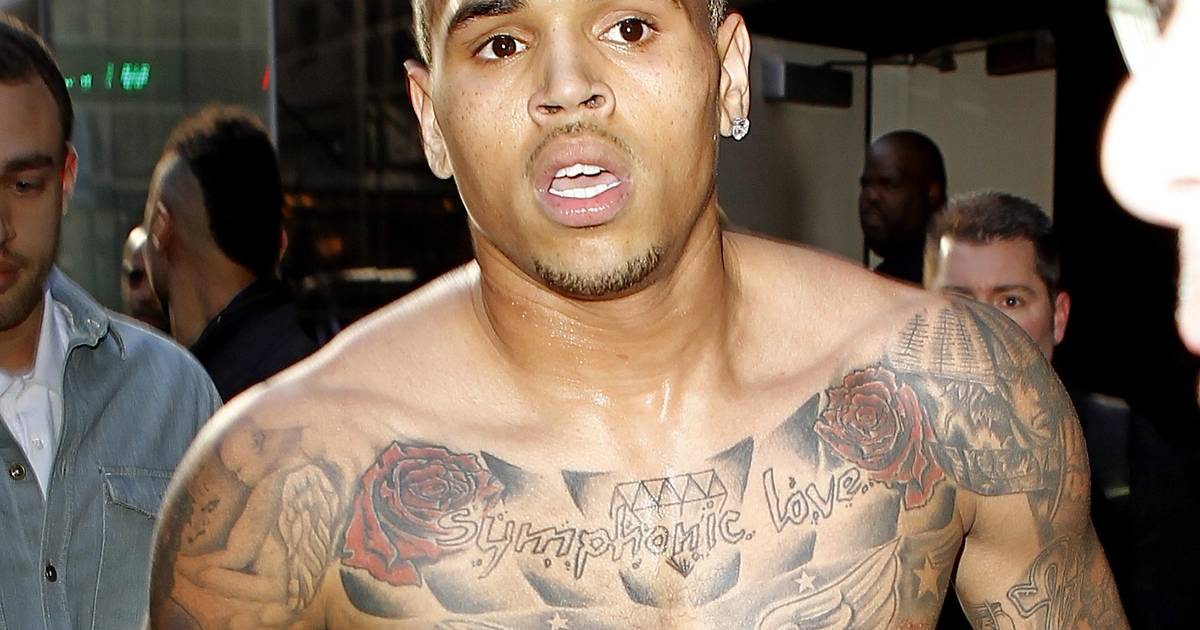
Chris Brown's Symphonic Love lettering, roses, and wings across his chest

The arm tattoos mix portraits, lettering, stars and playful designs rather than forming one continuous sleeve. In BET’s gallery, Brown says the two ninja figures and the words “Darkness to Light” refer to leaving the wrong crowd and choosing his own direction. That story gives the phrase more weight than a general label like “transformation.” Photos show how densely the sleeve is filled; Brown explains what the words mean.

Wide shots can hide the smaller details. BET notes black-and-white stars on his arms and wrist, as well as a colorful sleeve. A tattoo list identifies the name Joyce on his inner wrist, a reference to his mother. Brown has also described a hand design tied to Virginia: two “ups” and two “downs”, a spray can from his graffiti years, and a “B” for Brown. He has explained these details himself.

The chest is more composed. BET’s 2013 gallery identifies “Symphonic Love” across his chest, framed by wings and roses. The phrase also became the name of Brown’s children’s charity. The eye catches the lettering first, then follows the wings and flowers outward into one sweeping design.

Brown’s upper body is layered, with newer pieces partly covering older ones. A photo from one year may not show what is there now. His first Jesus-and-music tattoo belongs to the same thread of faith and music, though its exact placement is hard to make out in a distant performance shot.

The neck artwork changed, then became a public argument

Close view of Chris Brown's 2012 sugar-skull design on his neck

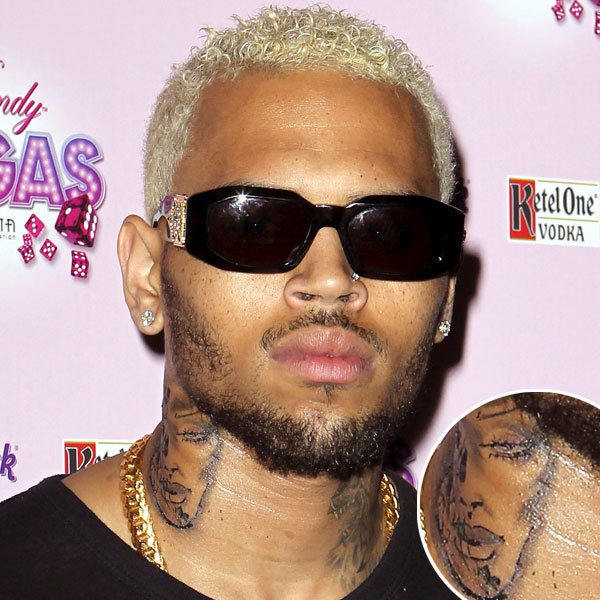
In 2012, a new face tattoo on Brown’s neck drew immediate attention. Some viewers saw a resemblance to Rihanna after the 2009 assault. The timing became the story, but neither the resemblance nor the timing proves what the image was meant to depict.

Brown’s representative called it a sugar skull associated with Día de los Muertos, inspired by a cosmetics design he had seen. Tattoo artist Peter Koskela also denied that he had tattooed a battered woman or Rihanna. E! News reported their explanations, while The Guardian covered the strong reaction. The two accounts can sit side by side: that is how Brown’s camp described the tattoo, and the perceived resemblance explains why it drew backlash. A photo cannot settle intent.

Brown has added more around his neck since then. Reports later noted a lion, and stars behind the ear appear in tattoo galleries. An older close-up is only one moment in a changing design.

King Rico’s head piece pairs a bull with a woman’s face

Chris Brown showing the bull and woman's-face tattoo across the back of his head

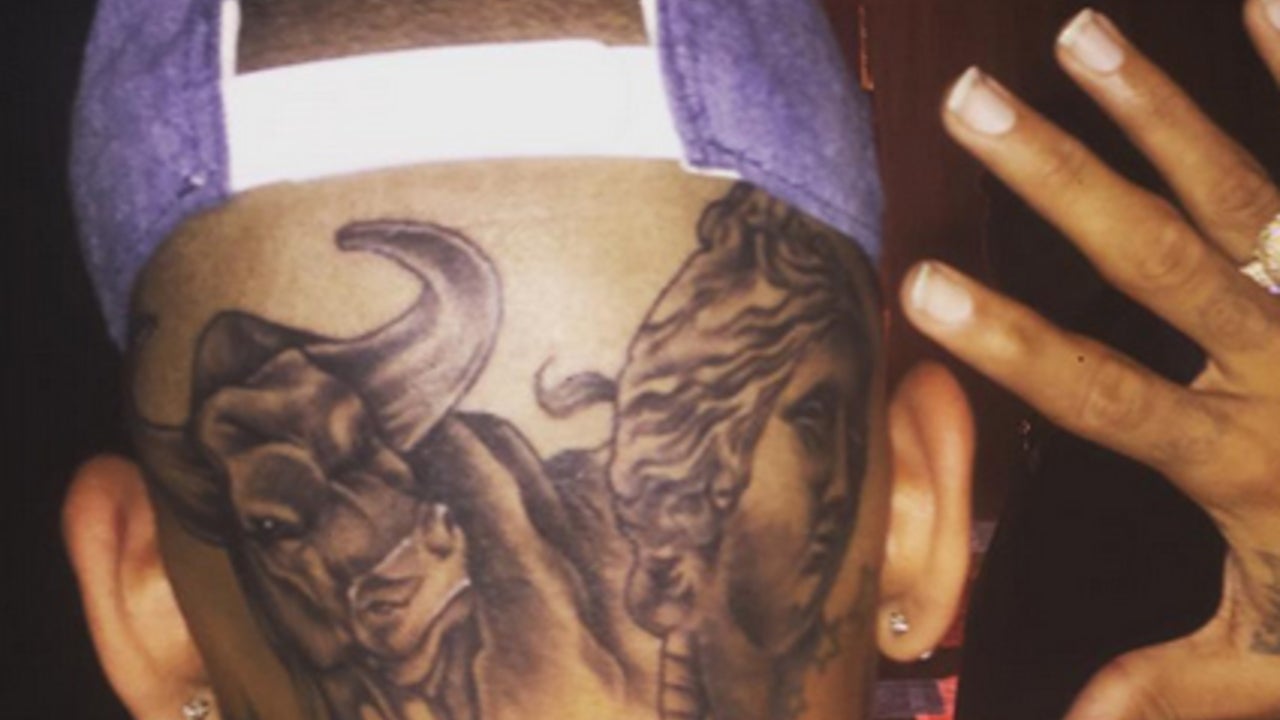
In August 2015, Brown showed a large black-and-gray tattoo across the shaved back and side of his head. Entertainment Tonight identified a bull and a woman’s face and named Bronx tattoo artist King Rico. The design extends into star work behind the ear, linking it to a wider composition.

Brown’s post around the reveal linked the bull to his Taurus sign and the woman’s face to Venus. That is the explanation he shared; the image alone cannot tell us why he chose those subjects. There is no need to add claims about protection, romance or spirituality that he has not made.

The woman’s face is sometimes confused with the 2012 neck tattoo, but they are separate pieces, made three years apart by different artists. Koskela was credited with the neck work; King Rico did the later head tattoo.

Royalty’s portrait on his back is different from the later name tattoos

Chris Brown's black-and-gray portrait tattoo of his daughter Royalty on his back

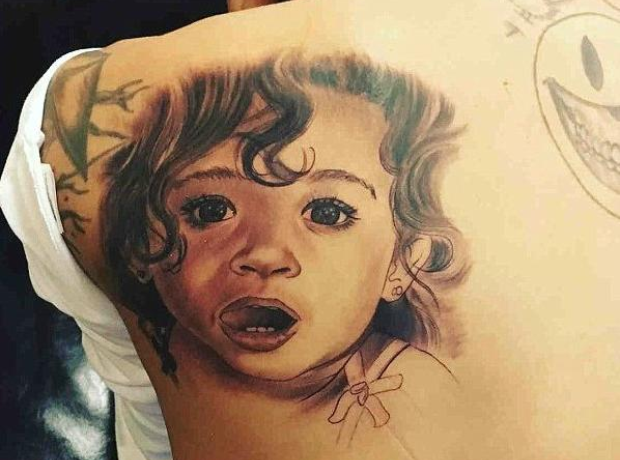
In June 2016, Brown shared a work-in-progress portrait of his daughter Royalty across his back. Inked reported that Fred Tattoo began the portrait; The Source placed the session in Copenhagen and identified the artist as Fred of Exotic Tattoo Murcia. Brown’s caption said it was not finished yet, which explains why later photos can look different.

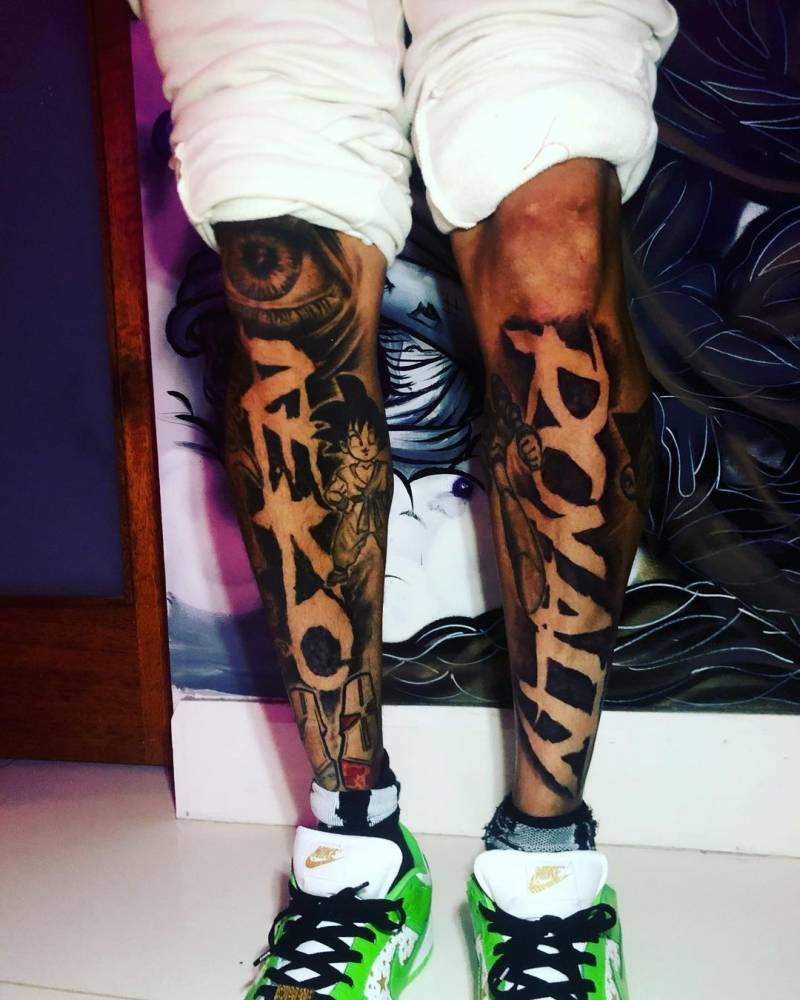
This is a portrait, not the same tattoo as the large “ROYALTY” lettering added to a shin years later. The back piece turns a photograph of his daughter into a black-and-gray image; the leg work pairs names with illustrations. Both are family tattoos, but they were separate projects by different artists.

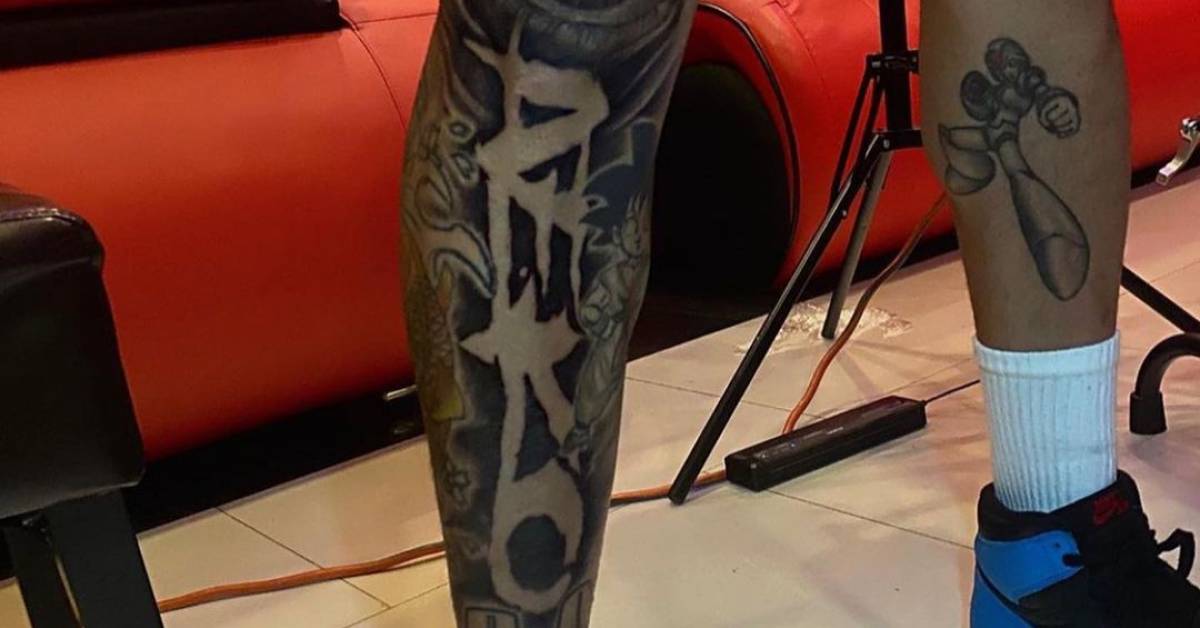
Royalty and Aeko’s names take up both shins

Chris Brown's Royalty lettering and illustrated tattoo on one shin
Chris Brown's Aeko lettering and character tattoo on the other shin

In March 2021, Brown showed the paired designs running down both shins: Royalty on one leg and Aeko on the other. He captioned the reveal “My world on my legs”. Complex credited tattoo artist Ganga, who had also worked on Brown’s Air Jordan face tattoo.

The names are only part of the designs. Photos show the Royalty lettering alongside an illustrated character and the Aeko lettering with a large eye and anime-style figure. The pair reflects Brown’s interest in animated characters, and both legs need to be seen to understand the layout.

Brown introduced the leg pieces together; that does not make them a finished set.

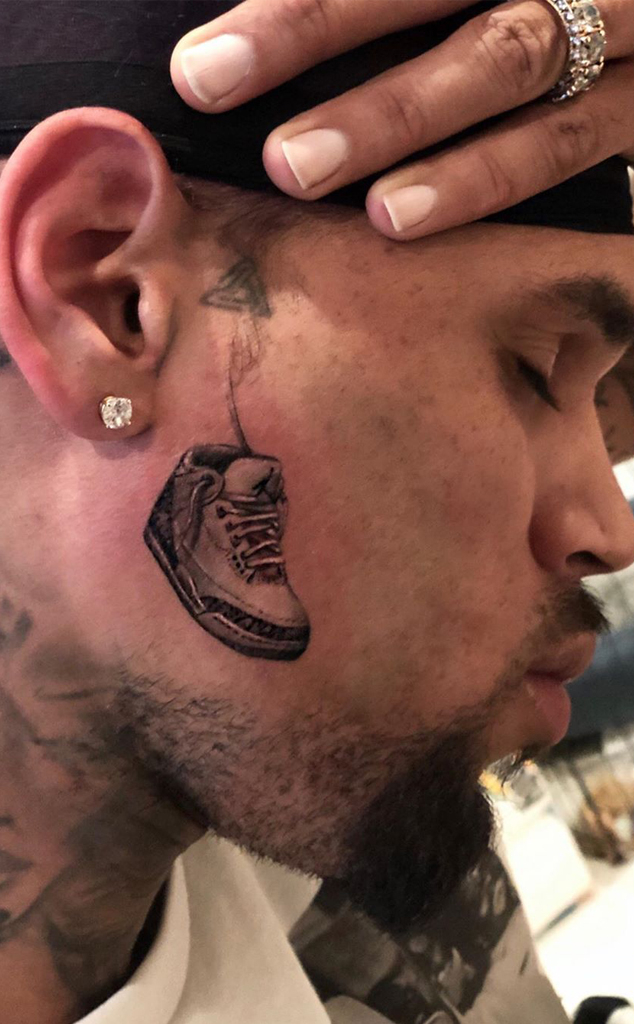
The Air Jordan on his face is an unmistakable design choice

Close-up of Chris Brown's Air Jordan sneaker tattoo on the right side of his face

In February 2020, Brown added an Air Jordan 3 sneaker to the right side of his face, below a small Black Pyramid logo. Artist Joaquin “Ganga” Lopez shared the work, and reports connect him with Brown’s earlier Darth Vader tattoo on his stomach. E! News also noted the shoe design and artist credit.

The sneaker is one of Brown’s most recognizable tattoos, but it is separate from the small logo above it and the larger head and neck work. Ganga identified it as an Air Jordan 3 and shared a close photo, making the design easy to confirm.

Brown’s collection is huge, and its meanings come from a mix of his own comments, artists’ accounts and dated photos. Each reveal captures one point in a changing set. Where he has not offered an explanation, the design can speak for itself.

More musician tattoo guides

6LACK’s Tattoos Are a Map of the Choices He Made

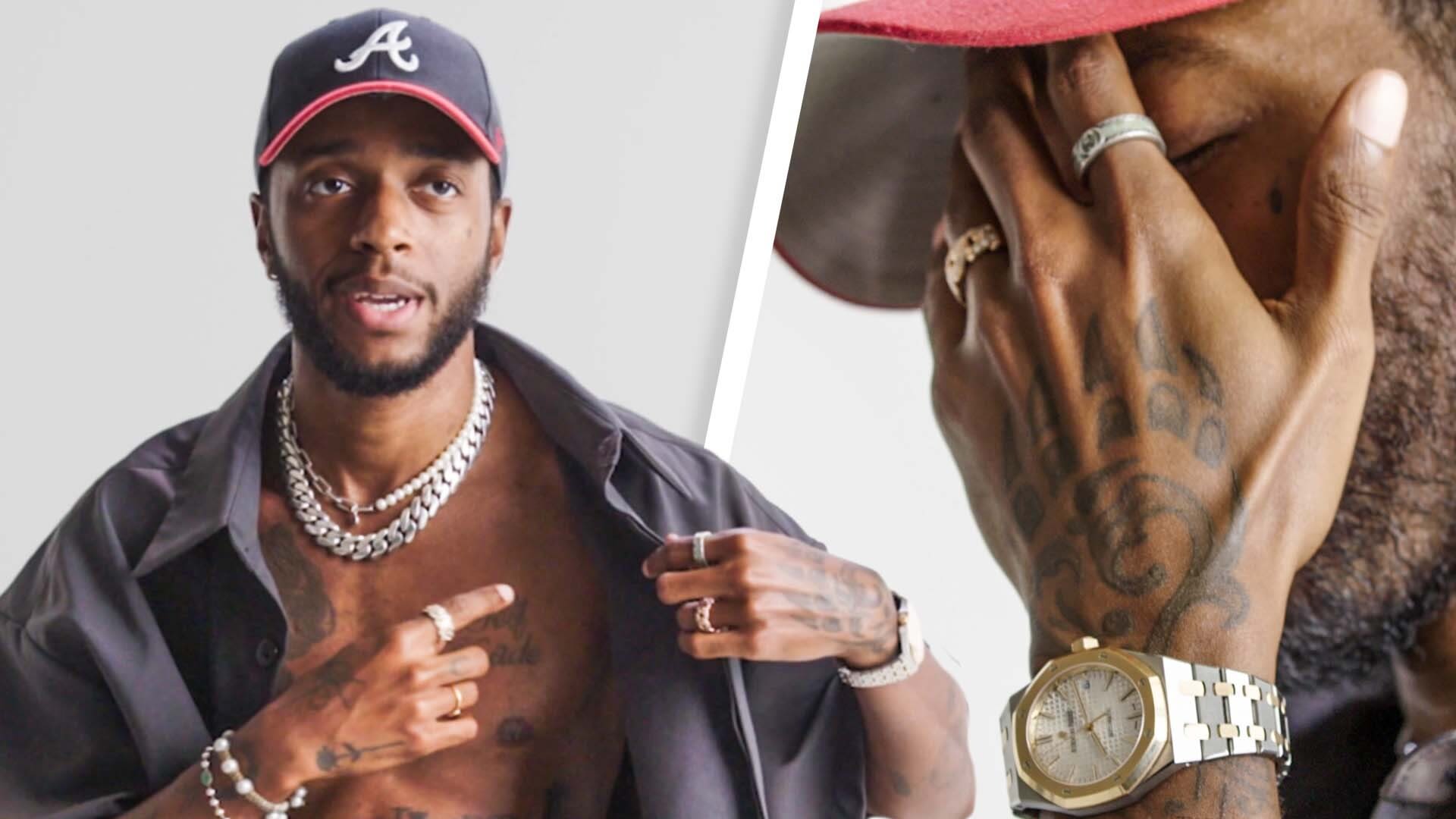
6LACK talks about his tattoos in a direct, down-to-earth way. He names the designs, explains some choices and admits when a tattoo began as a quick decision. The collection includes a first piece he later called a bad buy, a hand tattoo he still loves, and drawings he got simply because he liked them.

His 2023 GQ tattoo tour covers his chest, arms, hands, neck and newer designs. An i-D interview from 2017 adds more about the bear claw. Together, the conversations say more than online lists that attach a fixed meaning to every shape.

His first tattoo was a few cursive letters on his chest

GQ tattoo-tour image of 6LACK pointing to the cursive self-made tattoo on his chest, with a close view of hand tattoos

The first was “self-made”, in small cursive on his chest. He told GQ the phrase came to him during spring break at Valdosta State. He stopped at a tattoo shop without a design in mind; the words simply occurred to him. He wanted something straightforward that he would not regret.

He tied the tattoo to a decision about work. At the time, visible tattoos could still make it harder to get hired. He did not want to plan his life around the kind of job other people expected him to have; he wanted to make music and do work he cared about. For him, the phrase marked the choice to take that risk, not a slogan added after success.

He has also joked about the less romantic side. In a later GQ conversation, he said the first tattoo cost too much for what it was; in i-D, he called it his least favourite. That does not erase what it meant at the time. It can mark an important decision and still be a design he would not choose again.

GQ does not pin down the exact year, the tattooer or which side of his chest bears the phrase. What 6LACK remembers is the spring-break setting and the decision to pursue music.

The bear claw on his hand marks the leap into music

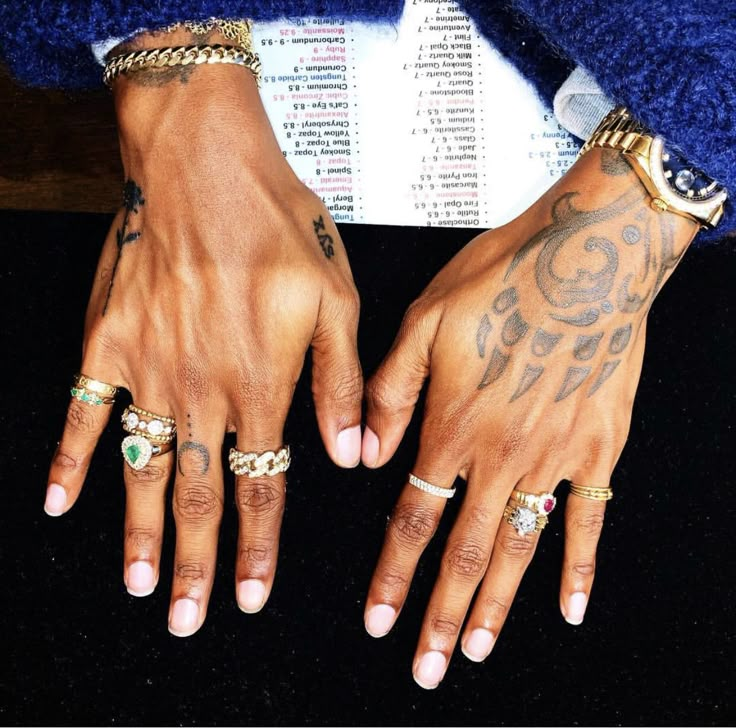
Close photograph of 6LACK’s tattooed hands, including the broad claw-like motif and smaller hand designs

The bear claw on his hand is the tattoo he calls his favourite. In i-D, he remembered getting it just before he stopped looking for a conventional job and committed to music. In GQ, he connected the claw to that same choice: a tattooed hand might close some doors, but he chose the life he wanted.

He links the bear and big cats with quiet strength, staying undisturbed and feeling at home in their surroundings. He has a panther head and a small geometric bear too, but those are separate designs in his account. The claw marks his career decision; the animals reflect qualities he admired.

The hand piece hurt most as the needle neared his wrist bone, he said. That spot could bring a tear, while he tried to treat the rest of the session as meditative. The black panther took longer to heal because of its dense shading and needed a touch-up. Those details show what living with the tattoos was like.

Photos show more small marks across his hands and fingers, but the bear claw is the one he has explained most fully. Some lines in close-up images remain hard to identify.

His arms and neck mix hand-drawn symbols with music and pop-culture references

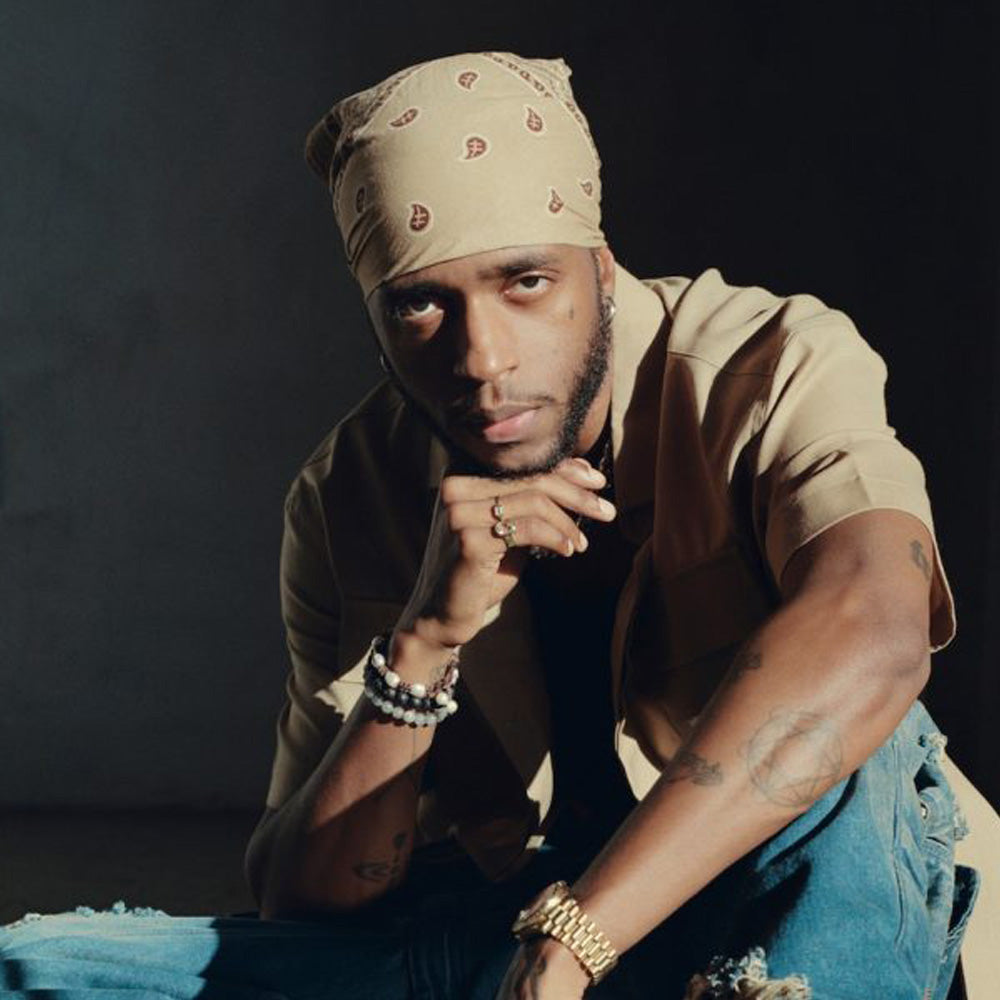
Official 6LACK portrait with separate tattoos visible on his forearm

Drawing is part of how 6LACK works. He said he often sketched or edited designs before getting them tattooed. Near the wrist is an ensō, or Zen circle, which he connects with accepting imperfection and finding value in what remains unfinished. He also said the wrist bone was one of the most painful places for him.

From there, he describes a cluster of related designs: water symbols, the Cancer constellation, a small crab, and the Seed of Life. He connects the water marks and crab to his Cancer sign, and the Seed of Life to creation and how physical things relate. He jokes that this is his “woke arm.”

His other arm has dragons, which he says came after a binge of Game of Thrones. He likes medieval stories, magic, kings and queens, so the designs began as a straightforward nod to a show and an aesthetic he enjoyed.

He also points out a small bear and the shaded panther among his animal tattoos. The bear is geometric; the panther’s dense shading made it slow to heal. Several other shapes came from his own sketches. The interview shows the spread of the work, though not every mark is clear in a still image.

One forearm tattoo is more like a note to himself than a symbol: “talk about it”. He got it during a tour when he kept holding back things he wanted to say until the silence caused trouble. The words remind him to speak while a feeling is present, before it grows into something bigger.

His compass has a practical purpose. He told GQ he is unusually preoccupied with directions, time and being on time—then admitted he had arrived late that day. There is a little humor in that: an instrument for finding your way, on someone who knows he does not always get there on schedule.

Family and the number six share space in his hand tattoos

6LACK’s small rose tattoo on the back of his hand

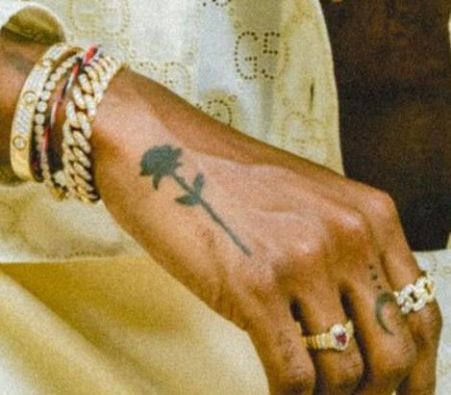
Some of his most direct tattoos are for his daughter, Syx. He has her name on his hand and a rose for her middle name. He also links Metatron’s Cube and the digit 6 to her and his favourite number. He says the cube’s six points reflect how things are made and connected. He drew the number on his iPad first, then preferred the simpler version once it was tattooed.

The name is a separate hand tattoo from the rose for Syx’s middle name. In GQ, he groups the cube and the six with his daughter and his favourite number. Short summaries sometimes fold the name, rose and geometry into one supposed tattoo, though they are separate designs.

He also has a small “Barbara” tribute to his grandmother. He said Barbara was the grandparent he felt closest to, and that the tattoo was his tribute after she died. He discussed it while explaining his mother’s concerns about his face tattoos. GQ gives the relationship and reason, but not the exact placement.

Another family reference honours a cousin known as Speed. He also showed a Prince tribute, with a purple line at the bottom, which he got after Prince died. They are two separate memorials, not one sleeve or part of Syx’s designs.

Several pieces connect directly to music. Atlanta artist Ink by Kali made a sound-wave tattoo for the lead single from Since I Have a Lover and a separate “lover” mark. GQ does not give an exact location for either one. He also names the East Atlanta Love Letter acronym and a mark tied to the Free 6 album, but trails off before describing where they sit.

The neck carries a Mamba reference to Kobe Bryant. 6LACK said Bryant was his favourite athlete and that the late player’s mindset influenced how he approached music. He got the tattoo after Bryant died. That is the connection he has shared.

In GQ’s 2023 tour, he also showed Totoro, Jiji from Kiki’s Delivery Service, and a lotus flower. He named the films as favourites and described the designs as among his more recent tattoos at the time. “Recent” refers to the interview, not to the present day.

One symbol behind his ear is a drawing he made himself. He told GQ he had it tattooed without assigning it a fixed meaning and rarely sees or remembers exactly what it looks like. Sometimes he likes a drawing and gets it; there is no bigger story attached.

What the interviews establish, and what they leave open

6LACK has not published an official tattoo count. His GQ conversation identifies many designs, but it is a tour, not a numbered catalogue. Some pieces are clear in a photo; others are covered, faded or hard to place. He explains the bear claw in detail, while the symbol behind his ear has no defining meaning for him.

The best-supported list includes the cursive self-made chest tattoo; the bear claw and animal designs; the ensō, water and Cancer references, Seed of Life and dragons; his reminders and compass; Syx’s name and rose; the six-related geometry; tributes to Barbara, Speed, Prince and Kobe Bryant; and the music and Studio Ghibli pieces. That is a substantial collection, even if not every shape in every photo can be named.

A photograph may confirm that a tattoo exists without showing enough detail to identify it. Dates help track changes, and 6LACK’s own descriptions fill in much of the rest: commitment, family, drawing, music, and the jokes he does not need to explain away.

More musician tattoo guides

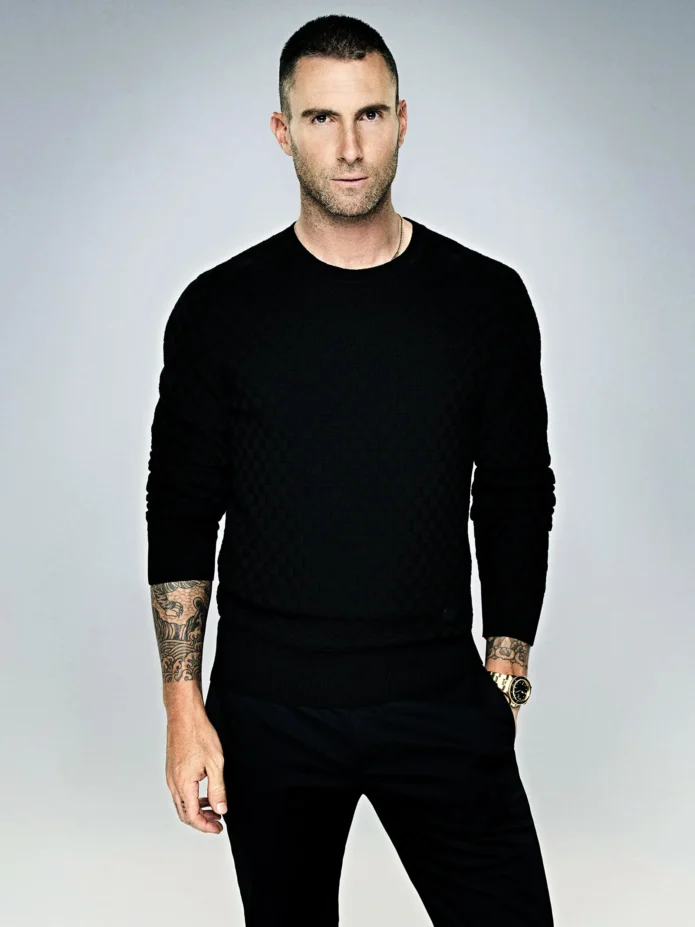
Adam Levine’s tattoos, from his first dove to roses for the reaper

Adam Levine’s tattoo collection has grown piece by piece, from an early dove to a large backpiece and tattoos across his neck, arms and legs. Traditional animals and flowers fill some of the space; other designs have stories he has shared. A few were simply pictures he liked.

The photos and interviews confirm plenty of designs, but not every meaning. This guide sticks to tattoos Levine has discussed or that show clearly in pictures, and leaves the rest open. There is no official count; cover-ups and new work quickly date older lists. For another collection, see our Selena Gomez tattoo guide.

The neck and head kept changing after he said he was done

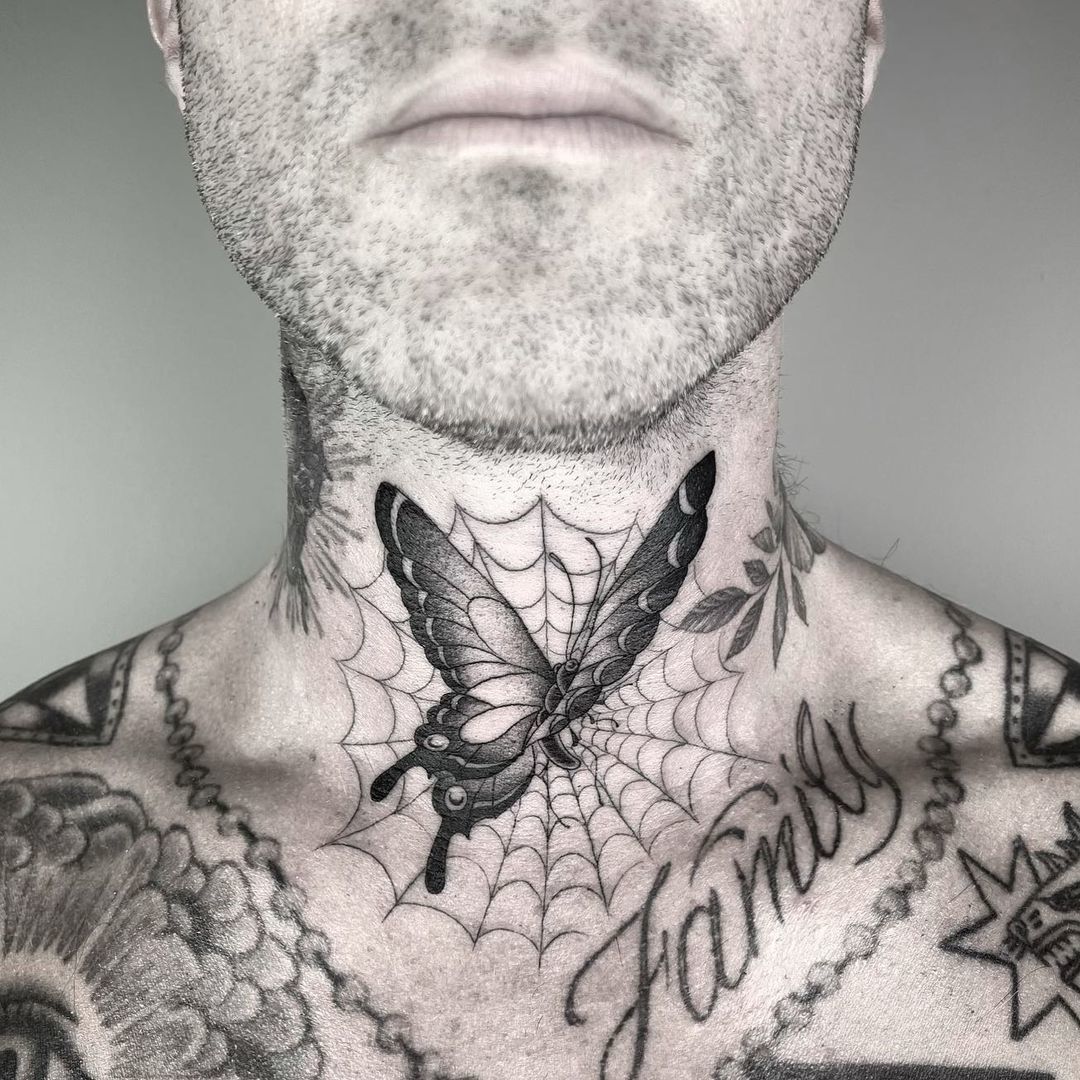
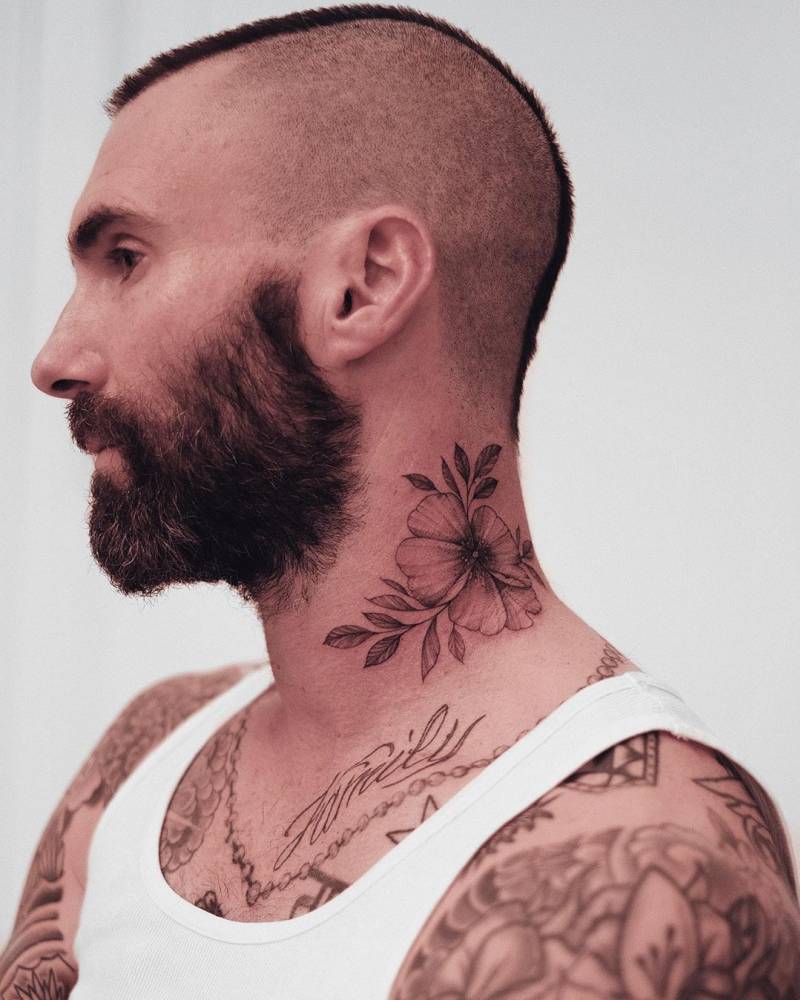
Adam Levine’s butterfly and spiderweb neck tattoo

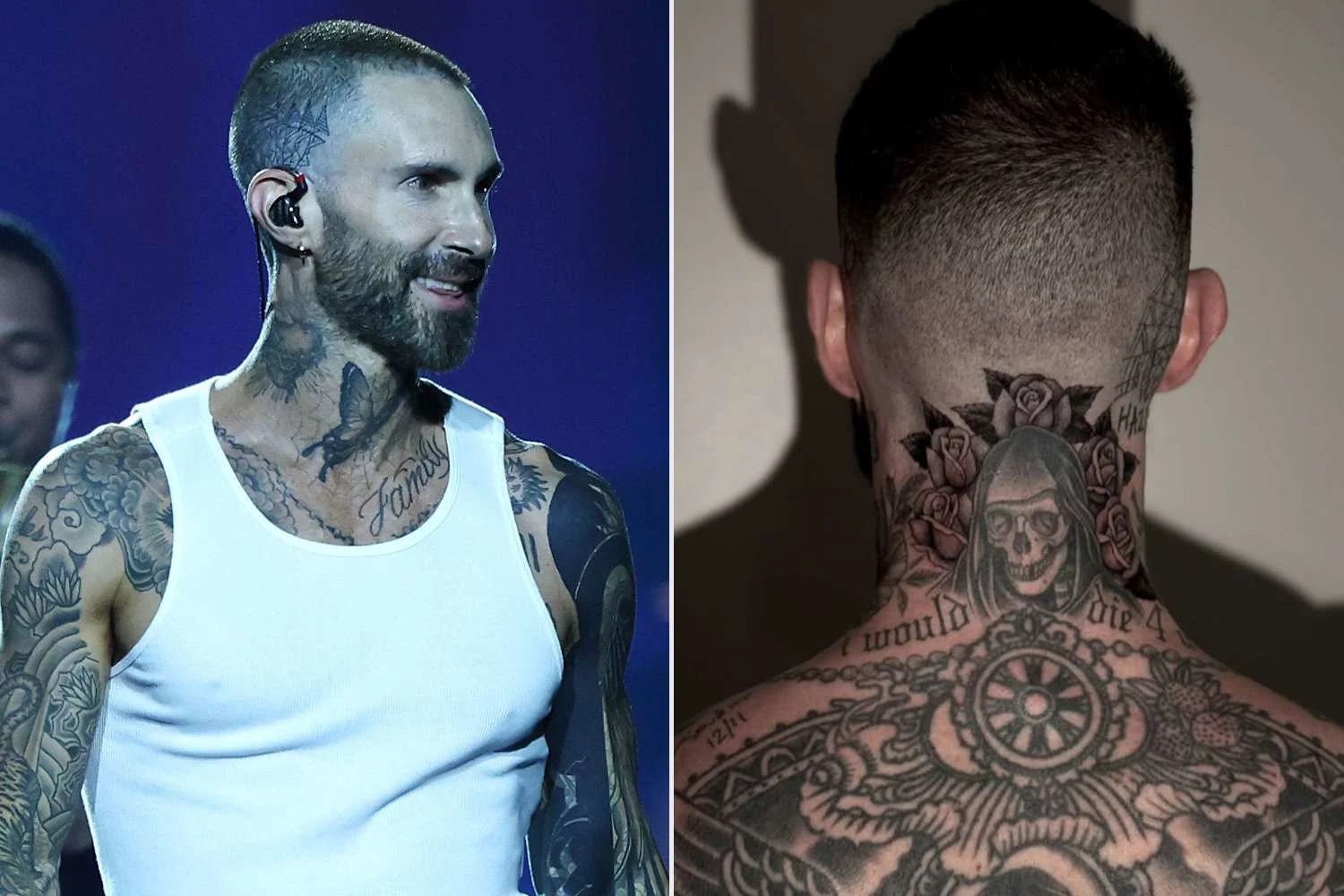
The latest additions show how quickly old tattoo lists go stale. In July 2025, Levine joked that a painful sleeve cover-up had left him “kind of done with the pain” and said he was running out of room. Four months later, he was back in the chair, adding more work around his head and neck.

Roses for the reaper and the mark above his ear

Adam Levine's 2025 black roses framing the existing reaper tattoo on his head and neck

In November 2025, Levine posted black roses framing the reaper already on his head and neck, with the caption “Roses for the reaper.” Tattooer Nathan Kostechko, who had worked on other neck pieces, said the roses brought life to the existing design. The reaper was already there; the roses are the new layer. EntertainmentNow quoted both Levine’s caption and Kostechko.

The small geometric design above Levine’s right ear was already there in 2024. Tattooer Scott Campbell shared the stencil and finished work, confirming the placement and his involvement. Neither man gave it a personal meaning.

The butterfly caught in a web

Adam Levine's butterfly caught in a spiderweb tattoo on the front of his neck

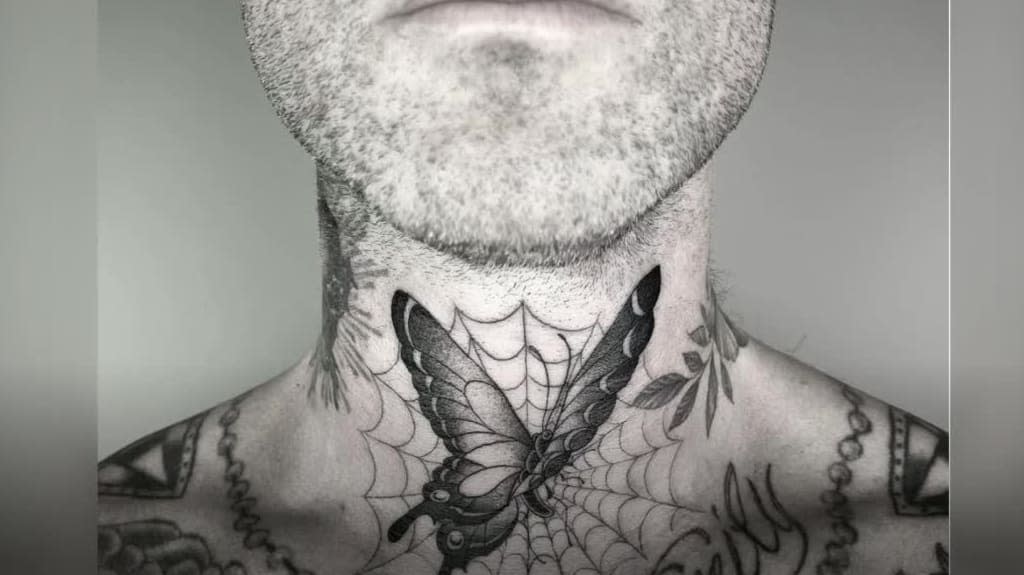
In October 2021, Levine added a butterfly caught in a spiderweb at the center of his throat. Nathan Kostechko did the tattoo. When Instagram went down, Levine joked that the sensible response was to “tattoo your throat.” That is the explanation he chose to share; he has not tied the image to a deeper meaning. Us Weekly placed it above the “family” lettering and beside a leaf tattoo.

The flower and sacred heart on either side

Adam Levine's fine-line flower tattoo on the side of his neck

A fine-line flower sits on the left side of Levine’s neck. Published coverage credits tattooer Sasha Masiuk. It is a single bloom with leaves, not a sprawling rose sleeve; older photos make it easier to see than current stage shots.

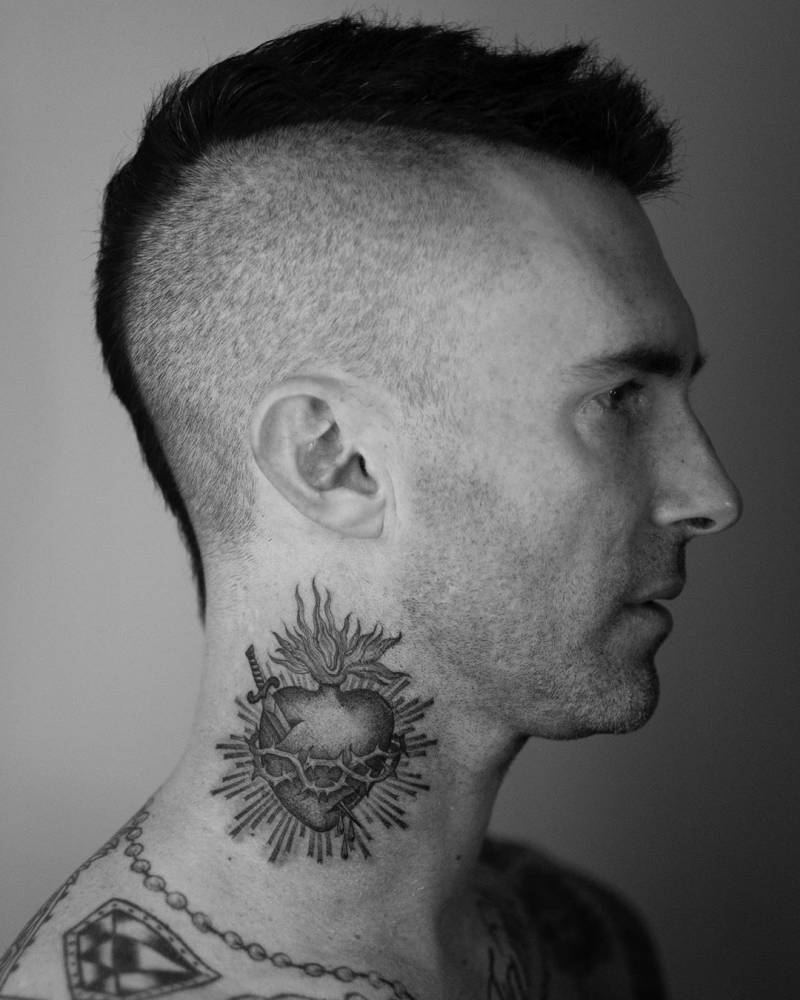
Adam Levine's sacred heart tattoo on the opposite side of his neck

On the other side, a small sacred heart has been credited to Kostechko. The compact design combines a heart, rays and a blade-like detail. Alongside the flower, butterfly, leaf, “family” lettering and later roses, it makes the neck a cluster of separate tattoos. Levine has not described one story that connects them all.

The backpiece is a whole scene, not one isolated mermaid

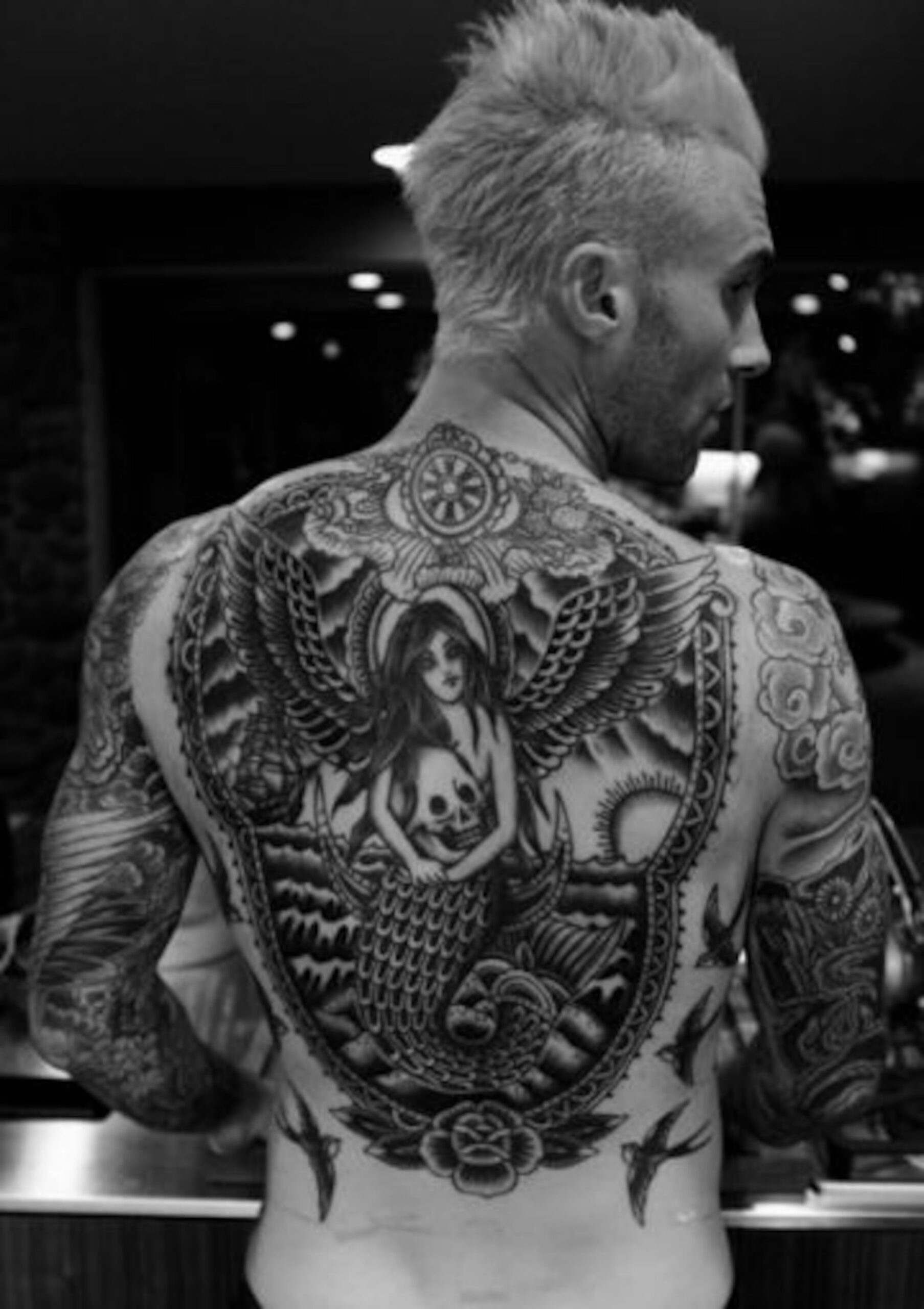
Adam Levine full-back mermaid tattoo with wings and skull

The backpiece is a full black-and-grey scene, with a winged mermaid holding a skull at its center. Swallows, a ship’s wheel and other nautical details fill the space around her. It stretches from shoulder to shoulder, beginning at the nape and running toward the waist. Calling it only “the mermaid tattoo” misses how the other elements make it a complete scene.

Six months in the making

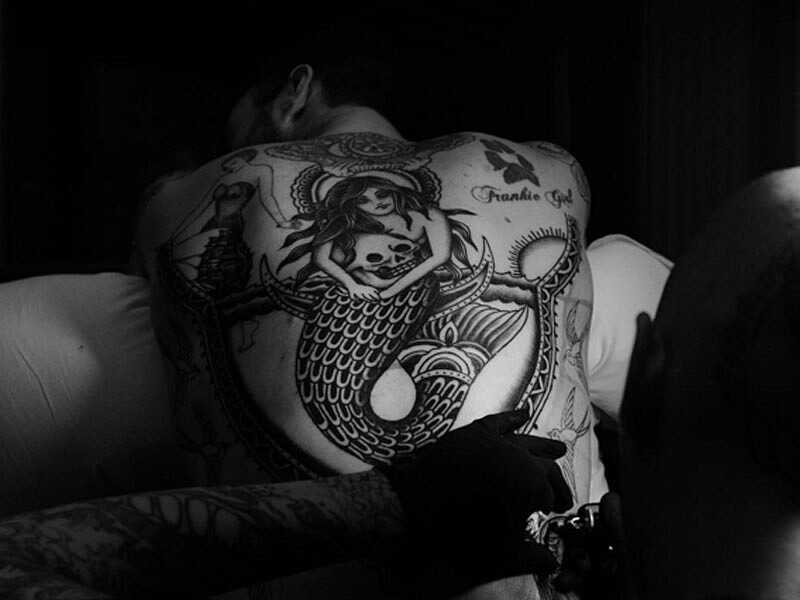
Adam Levine during a session for his large mermaid back tattoo

Levine posted the finished work in February 2016, crediting Bryan Randolph of Spider Murphy’s Tattoo in San Rafael. Us Weekly said the project took about six months; Levine’s caption read “6 months in the making.” A work-in-progress photo shows the scale, but the finished image gives the clearest view of the scene. Levine has not said what it means, so tying it to a particular person or event would be speculation.

Early tattoo roundups also mention a paw print and the name Frankie high on Levine’s back, reportedly a tribute to his dog. The small pieces are separate from the mermaid mural. Recent photos do not show clearly whether either is still visible under later work.

His chest and abdomen mix lettering with traditional images

Adam Levine's upper-chest tattoos, Sanskrit lettering and floral shoulder designs

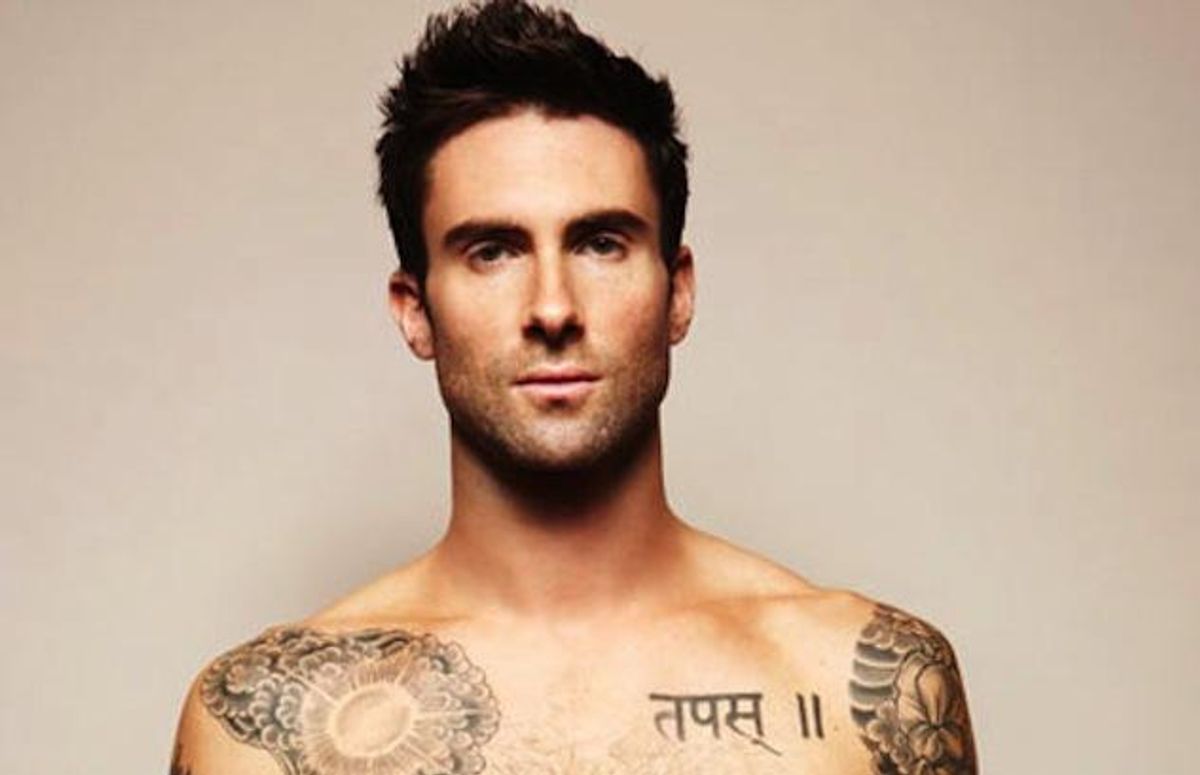
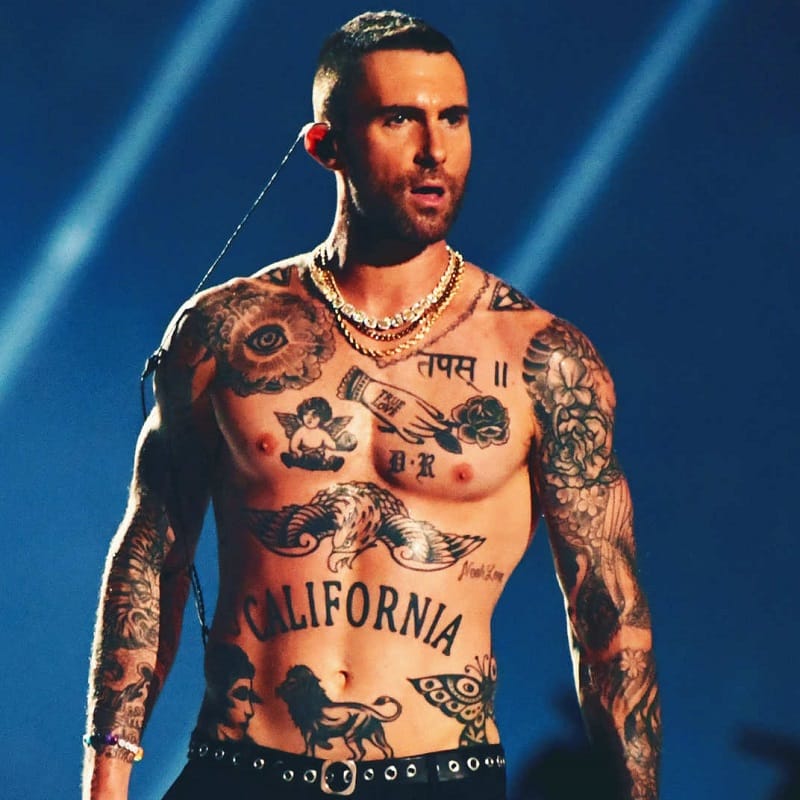
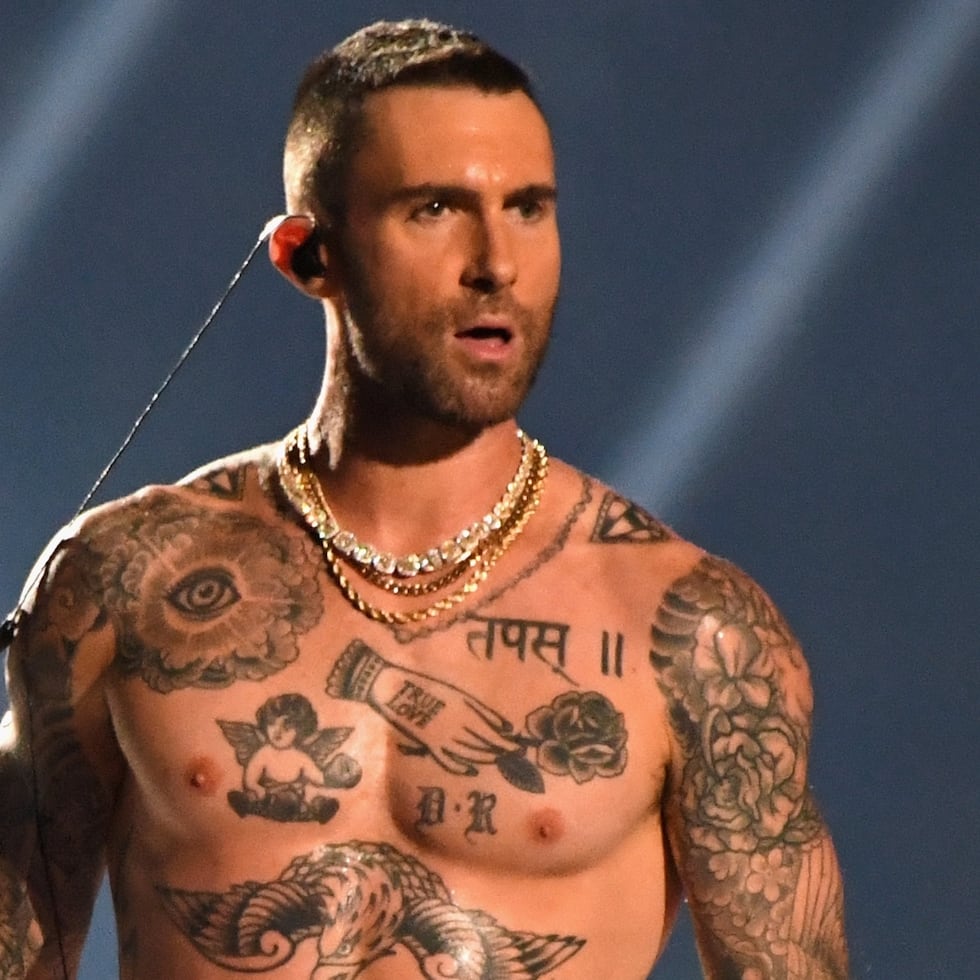
Several chest and stomach tattoos are easy to pick out: the Sanskrit word tapas above his heart, a rosette, large bird and animal designs, and California across his abdomen. A wide performance photo shows how closely the pieces sit together.

Adam Levine chest and abdomen tattoos including California lettering

Levine has explained “tapas” more than most of his tattoos. In an Inked interview reported by Us Weekly, he linked the word to yoga and to an idea of inner fire or determination. He also cautioned that people might misread it. He has not offered the same kind of explanation for the rest of the chest work.

The eagle spreads across his upper abdomen, near a lion and other motifs. Nearby are a hand holding a rose, a cherub and smaller flowers; a shark is reported on his ribs, an animal he has said fascinates him. Photos show the larger designs across his front, while the shark sits around his side. Lighting and camera angles hide some finer details. The word California is clear across his stomach. Levine has spoken about his connection to Los Angeles, but has not tied the lettering to a specific story.

The beaded chain tattooed around his neck and upper chest began as a necklace Levine picked up in Japan. He told Inked he got bored and had it tattooed, then added that he liked it. He has said not every tattoo needs a meaning; this one came from a design he wanted to keep.

The sleeves grew from individual symbols into dense coverage

Adam Levine tiger tattoo and sleeve work on his arm

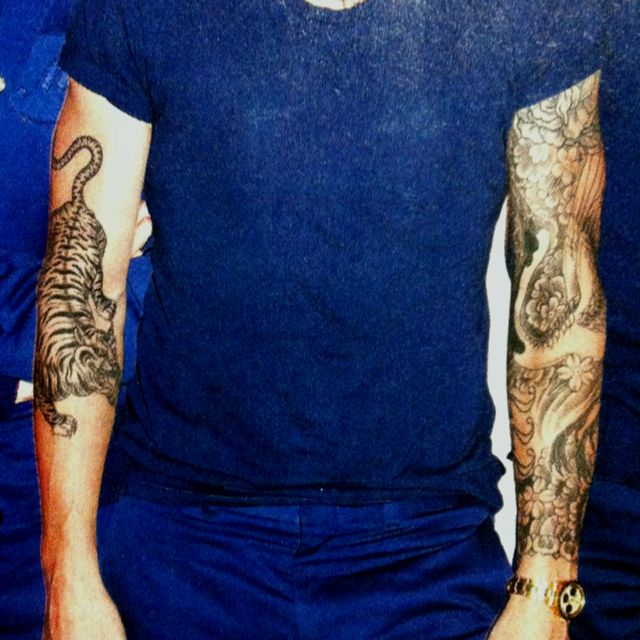
A tiger stands out on Levine’s right arm. He has said it was inspired by a book of Tibetan drawings. In photographs, the animal sits amid the denser sleeve work that has grown around it.

Adam Levine's floral and bird designs on a tattooed forearm

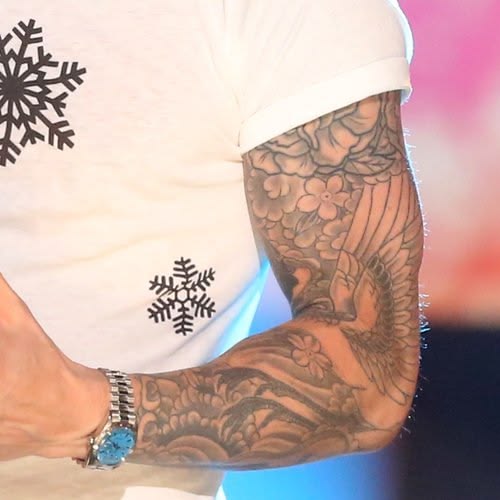
Older arm photos also show a dove, cherry blossoms, birds and musical imagery. Levine has said the dove was his first tattoo: he got it at 21, after the September 11 attacks, as a peace symbol. Cherry blossoms fill the area around it. A guitar and small birds appear on his forearms too, though they can disappear into the larger sleeve in performance shots.

Some pieces mark Levine’s career and home. Tattoo roundups associate 222 with the address of Maroon 5’s first recording studio and the Roman numeral X with the band’s tenth anniversary. “Los Angeles” appears near a shoulder. Older reports identify the marks, though newer photos do not show every letter clearly.

The heart for his mother

Close view of Adam Levine's heart tattoo with Mom lettering on his forearm

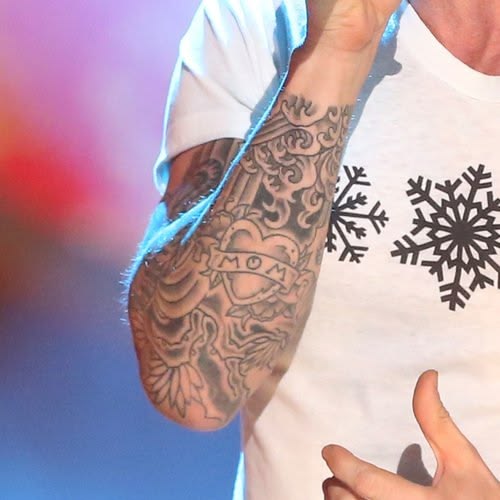
A heart with “Mom” inside is one of the clearest family tributes in older photos. Levine joked that it was a last try at winning his mother over, and that she disliked this tattoo a little less than the others. The dedication is straightforward; the joke is his.

Early tattoo guides also list a pin-up on one shoulder, along with the paw print and Frankie lettering on his back. Those details come from older inventories; recent photos do not make clear whether they are still visible.

“True Love” is the hand tattoo he still singles out

Adam Levine's hands held forward to show the True Love lettering across his knuckles

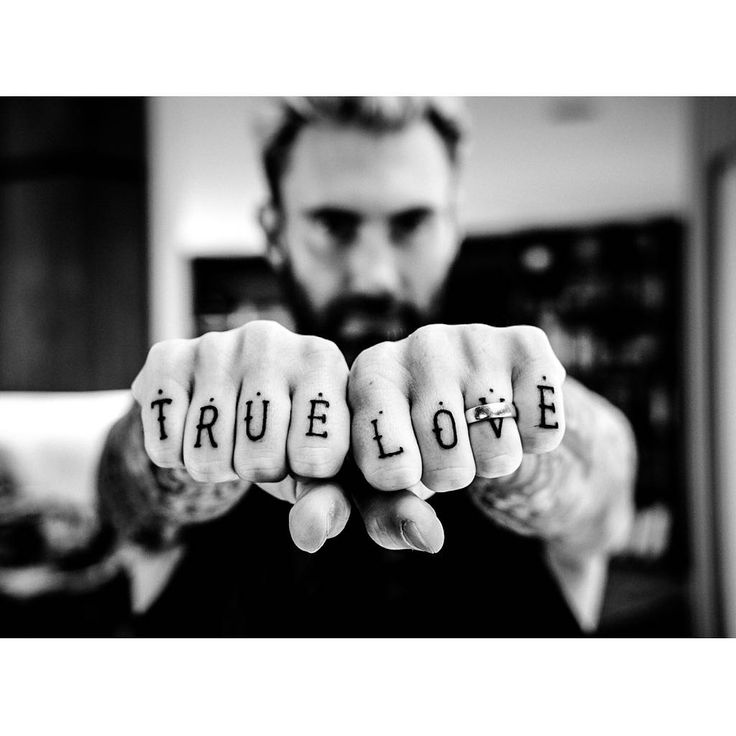
The words “True Love” across Levine’s knuckles are among his best-known tattoos. In 2019, he told People he had once ruled out hand tattoos, then changed his mind. By 2025, he named them among his favorites, while joking that choosing one was difficult. The phrase is easy to spot in performance photos and has stayed legible as the sleeve around it has grown.

The hand tattoos also break a rule Levine once set for himself. An earlier interview quoted him saying he would not get tattoos on his hands or below the waist. He later did both. So much for that rule.

The leg work took long sessions and covered new ground

Adam Levine's large black-and-gray ocean wave tattoo wrapping from ankle toward the thigh on his left leg

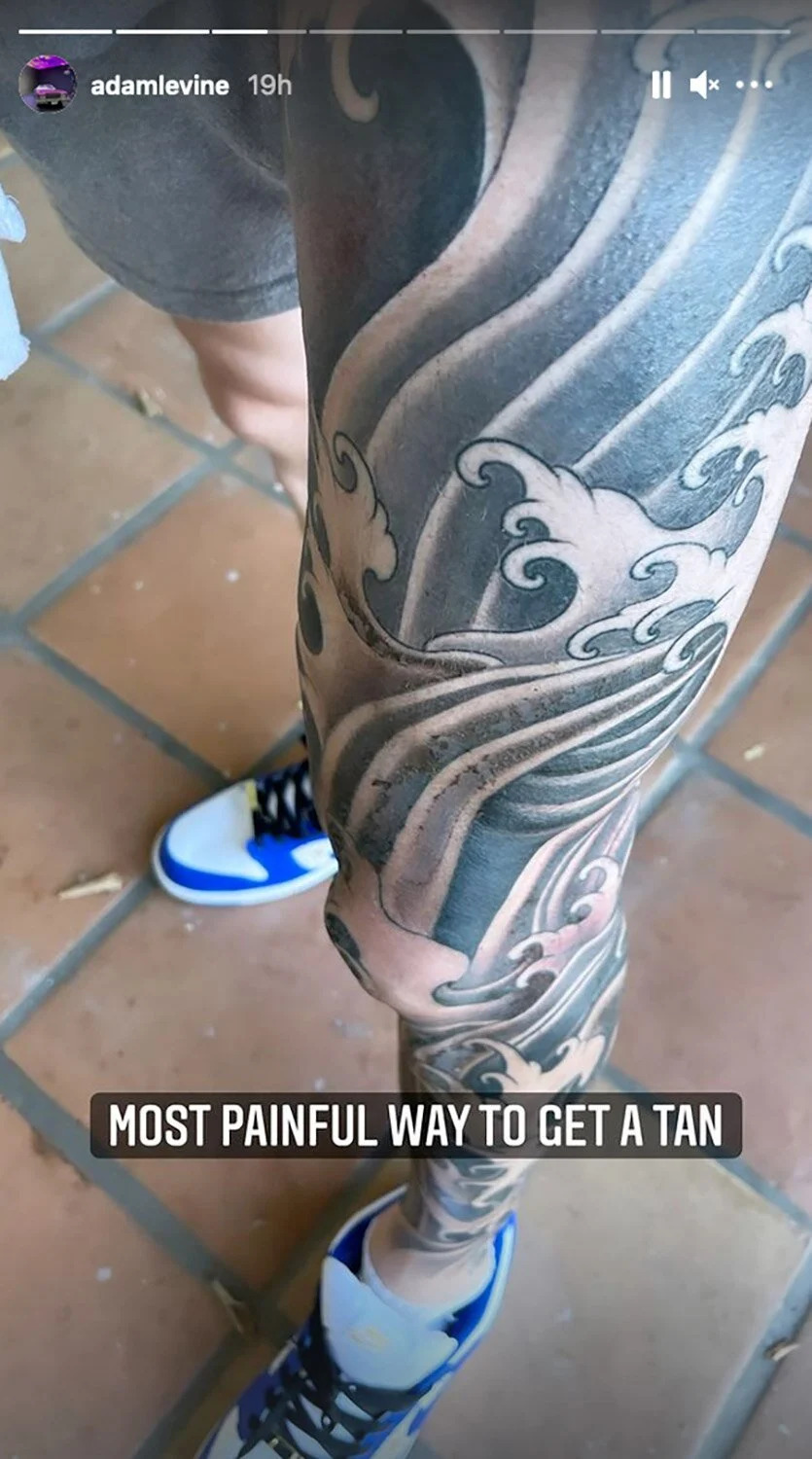
A large ocean wave wraps around Levine’s left leg, running from the ankle toward the thigh. Nathan Kostechko worked on it over several sessions; reports say the tattoo took three days. A cropped stage photo can make the design seem like a much smaller tattoo than it is, so the full view gives a better sense of its scale.

In August 2021, Levine spent 13 hours over two days on a large right-leg tattoo with Bill Canales. Coverage described it as Japanese-inspired, but the available photos do not show enough to identify every figure.

There is no reliable official tattoo count

Adam Levine shirtless with a broad view of tattoos across his chest and arms

Online lists put Levine’s count somewhere in the high twenties or above 30, depending on when they were written and whether a sleeve counts as one project or many tattoos. Cover-ups and later additions make the total shift. In July 2025, he said he was running out of room after covering one sleeve; by November, black roses had grown around the reaper on his head and neck. There is no official number.

The collection makes more sense as a timeline than a tally: early work such as the dove and California lettering, then the traditional animals and flowers, the long backpiece, and later tattoos across his neck and legs. Some pieces are personal, some are jokes, and others were simply images Levine liked. He has said not every tattoo needs a meaning. You can read the collection that way, without asking every design to tell the same story.

More musician tattoo guides

What Do Selena Gomez’s Tattoos Mean?

Selena Gomez has a mix of small lettering, family tributes, religious images and tattoos she got with friends. The list has grown over the years, and older counts cannot account for every new piece or cover-up. Dated photos and the explanations she has shared give the clearest picture.

How many tattoos does Selena Gomez have?

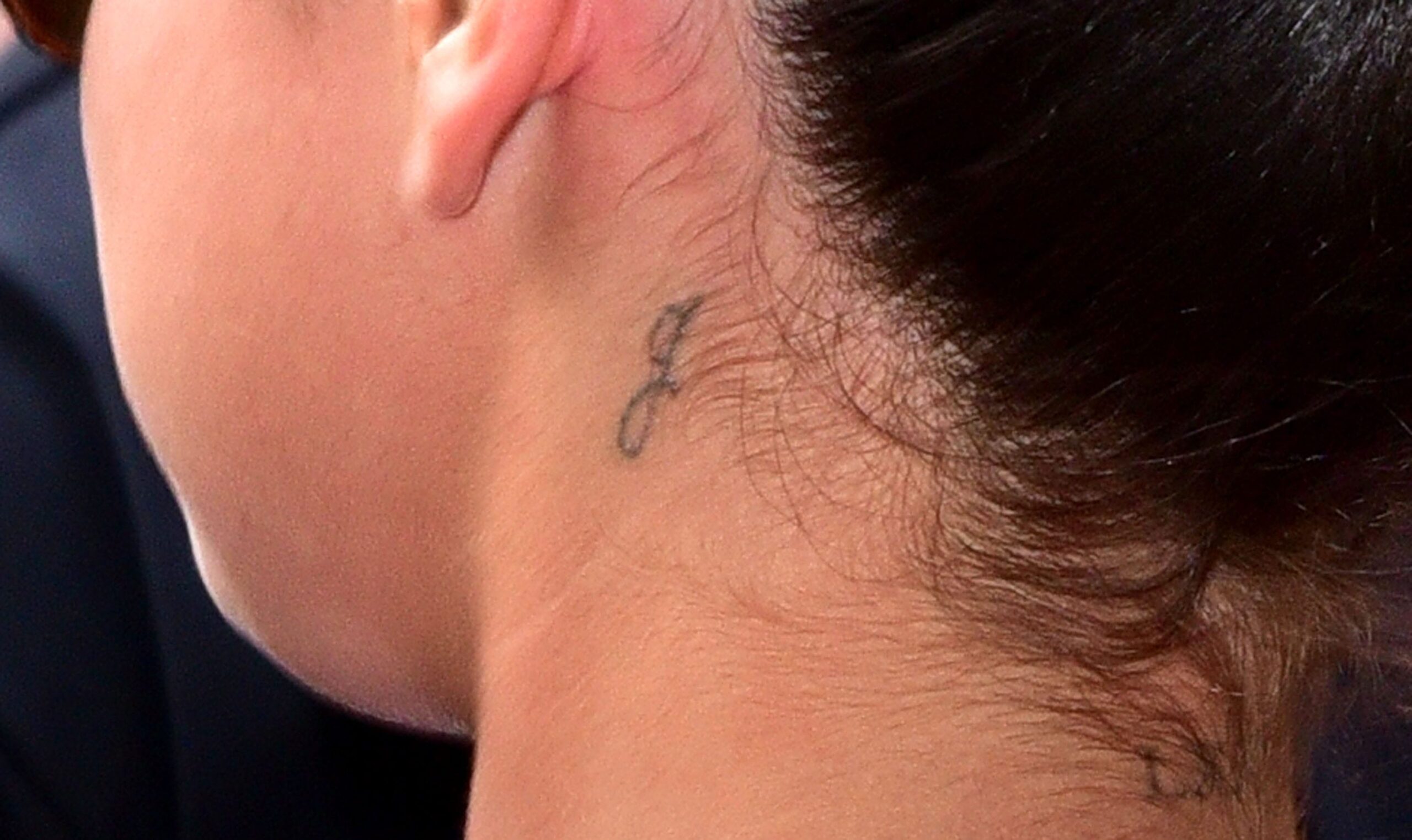
Selena Gomez tattoo at the nape of her neck

Published roundups have counted 16 or 18 tattoos, depending on when they were written. Women’s Health and Business Insider each put together broad galleries; neither number is an official total. Gomez has added work since then, and some smaller pieces are hard to distinguish in photos. Those counts are snapshots, not a final tally.

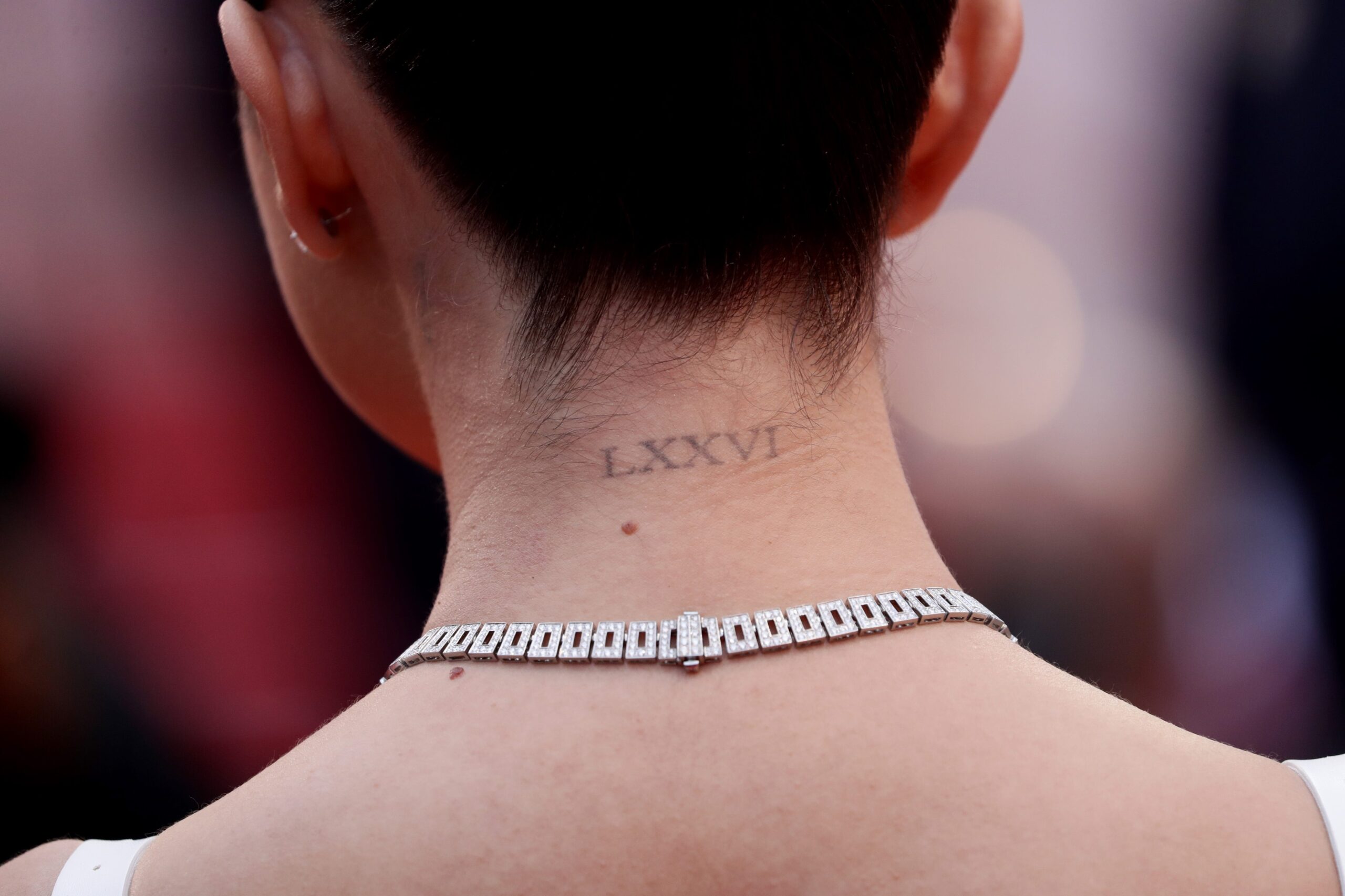
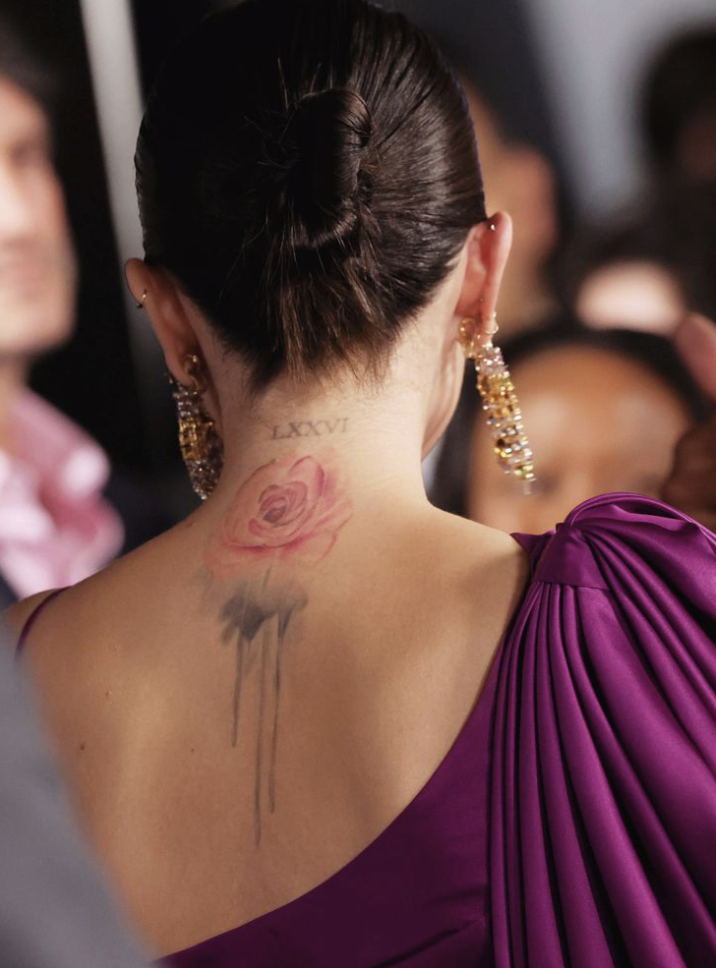
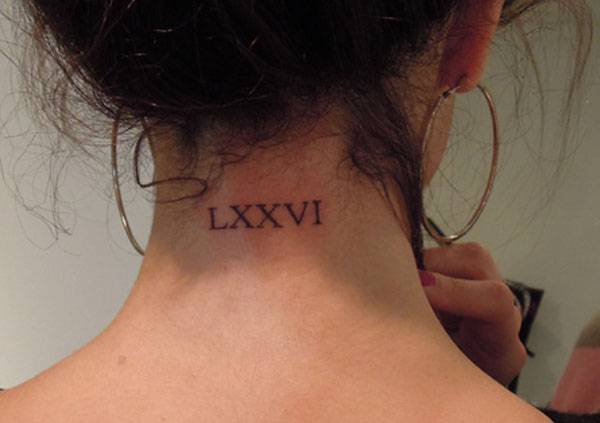
Several tattoos have a well-documented story: LXXVI at the nape of her neck, the rose across her back, the semicolon and the Rare lettering. Other designs show clearly but come with little explanation. I stick to what Gomez or a reliable report has said.

The LXXVI Roman numeral tattoo

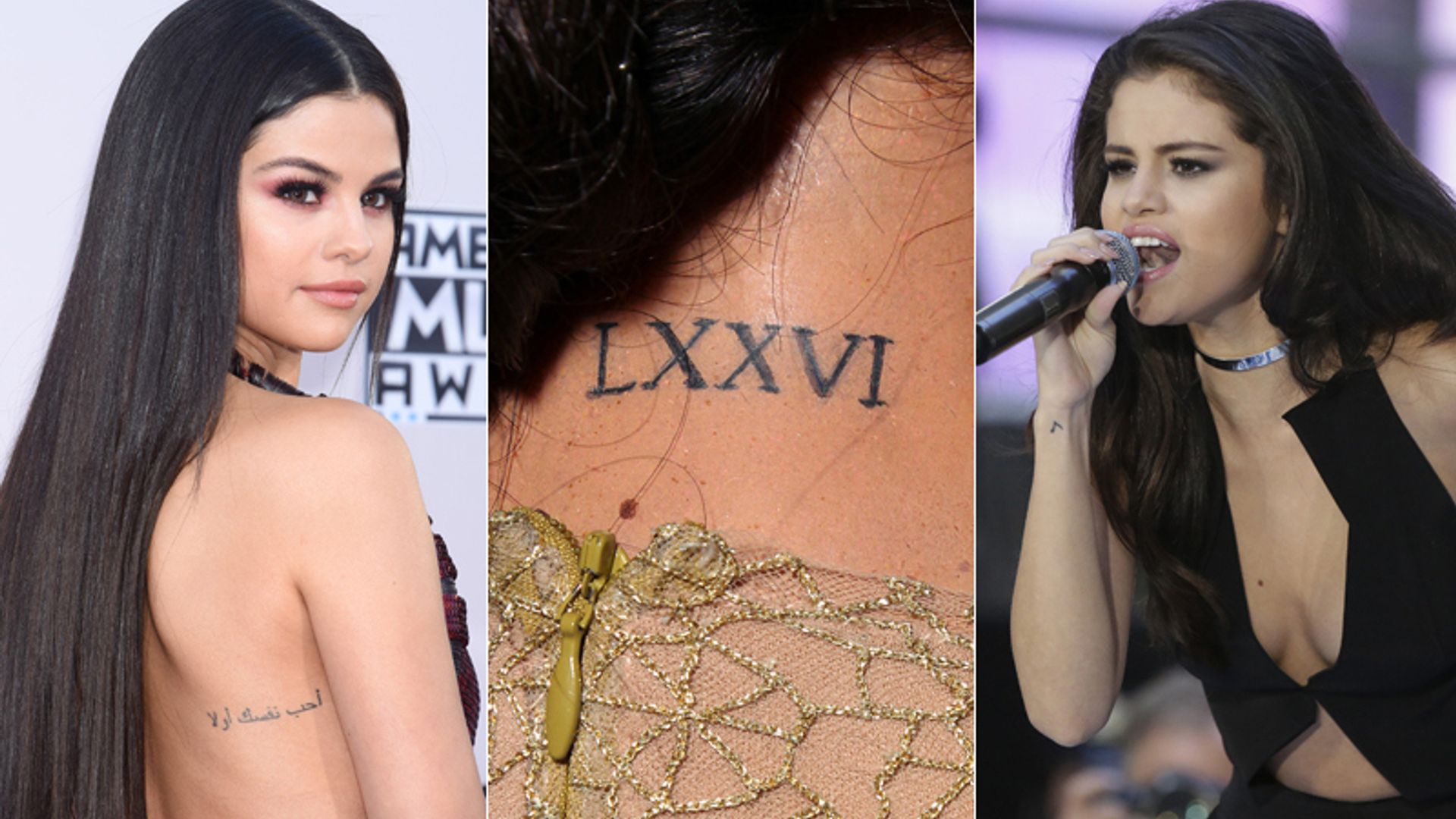
Selena Gomez’s LXXVI Roman numeral tattoo at the nape of her neck

LXXVI, the Roman numeral for 76, sits at the nape of Gomez’s neck. Business Insider’s report linked it to her mother Mandy Teefey’s birth year, 1976, and named tattoo artist Keith “Bang Bang” McCurdy. The small numbers show when Gomez wears her hair up; when it is down, they disappear.

Here, the details line up: 76 is tied to Teefey’s birth year, the artist is named and the placement is known. Gomez has not described a broader story beyond that family connection. The reported meaning is specific enough on its own.

The large rose on her back

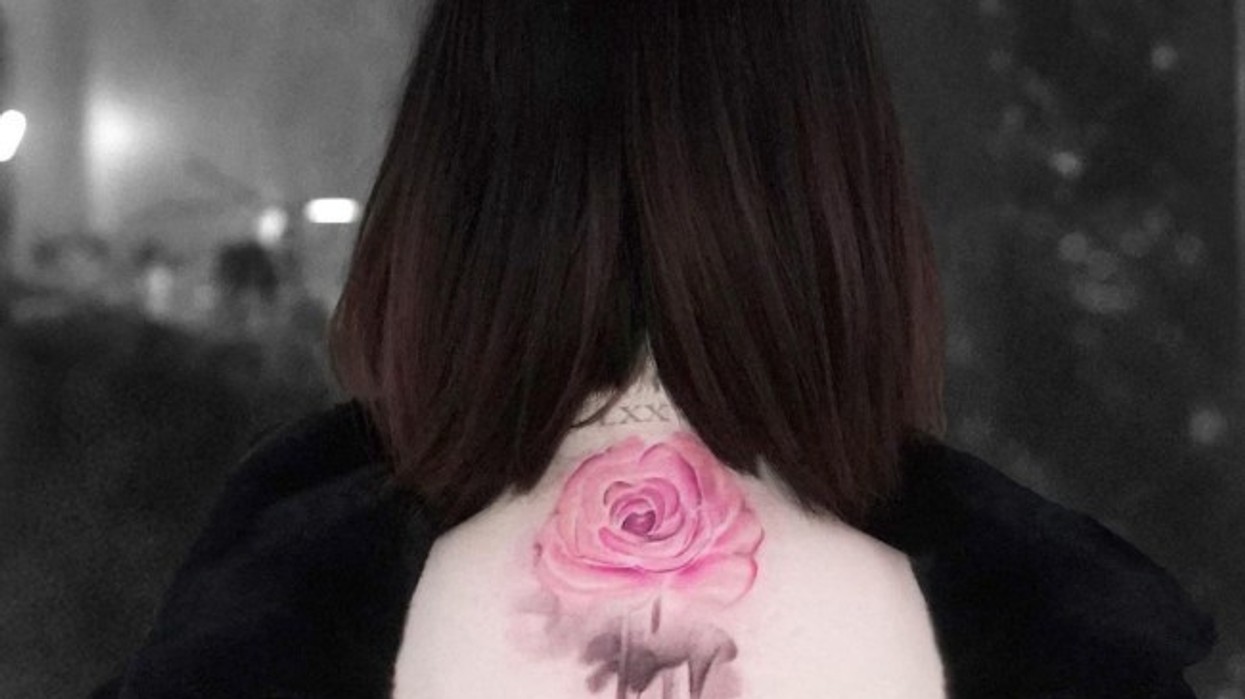
Selena Gomez’s pink rose tattoo across her upper back

A large pink rose tattoo spans Gomez’s upper back and runs toward her spine. Women’s Health and other coverage describe it as a collaboration with her friend Julia Michaels. Photos of the pair’s matching or coordinated tattoos brought the design wider attention.

Some reports call the rose watercolor, referring to its soft pink shading and drip-like edges. That describes its appearance; it does not confirm the tattooist’s technique. The flower is easy to identify, but any deeper meaning should come from Gomez rather than from the usual symbolism attached to roses.

The semicolon tattoo

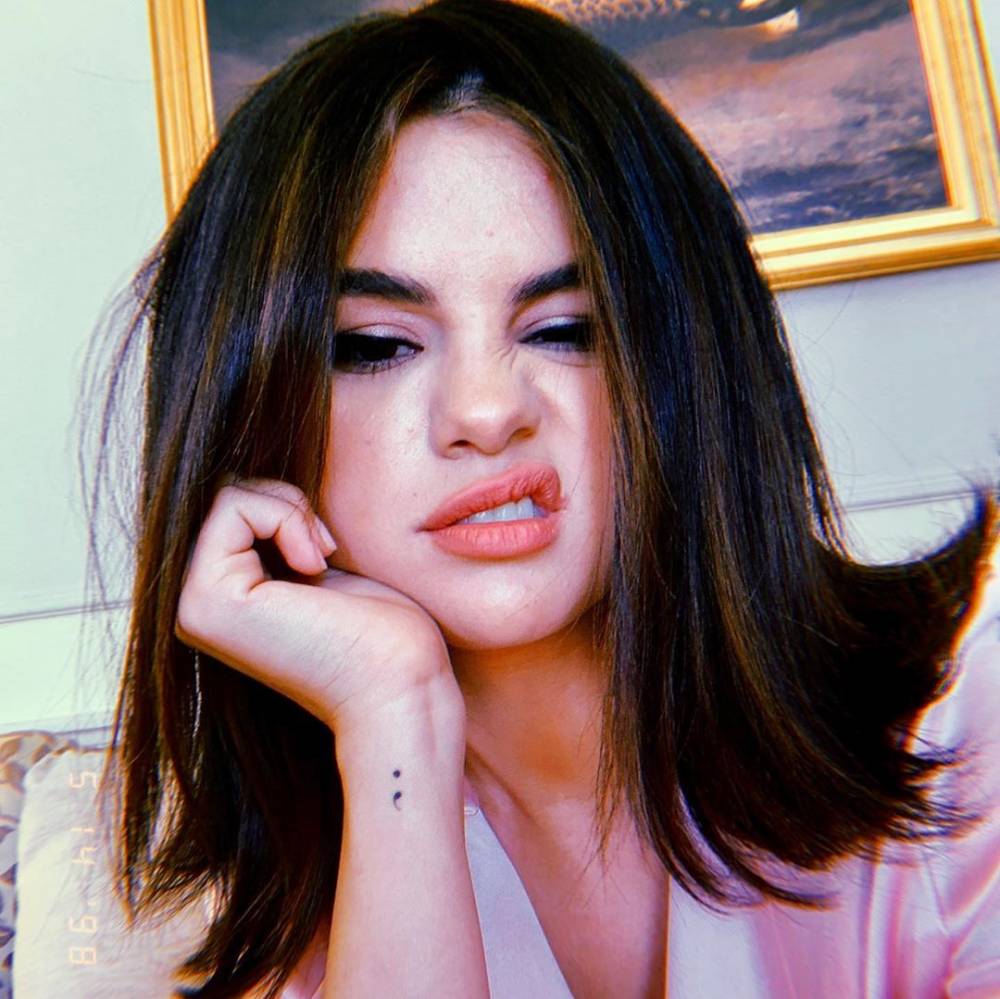
Selena Gomez semicolon wrist tattoo

Gomez has a small semicolon tattoo linked to Netflix’s 13 Reasons Why. E! News reported that she got it with cast member Alisha Boe and executive producer Tommy Dorfman. The semicolon has become a sign of continuing a sentence after a pause and is used in mental-health advocacy. In Gomez’s case, the reporting connects it to the show and its wider conversation.

The punctuation is easy to miss in photos. A tattoo can reference a public project or a broader idea, but it does not tell us anything private about someone’s health.

Rare lettering behind the ear

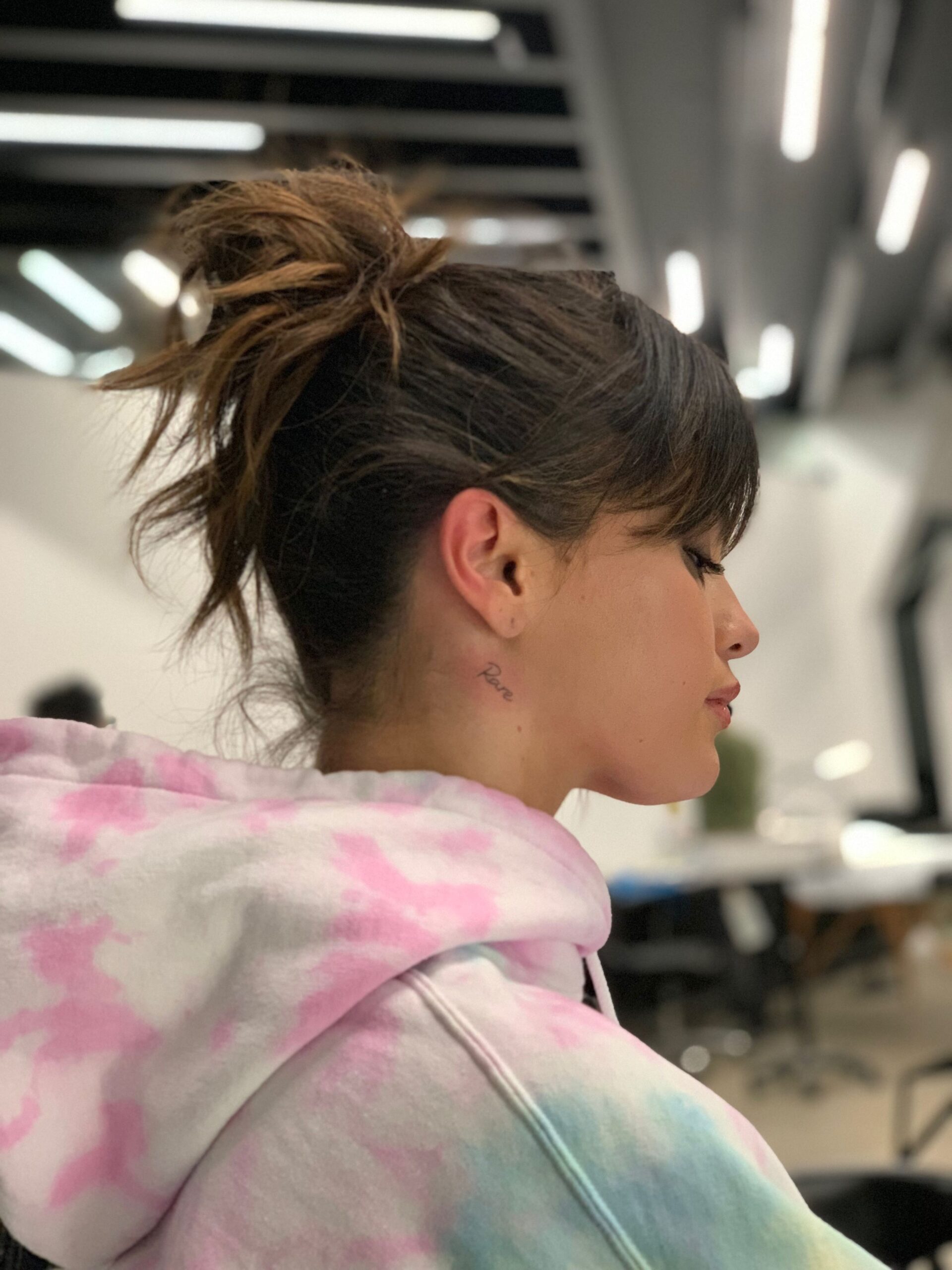
Selena Gomez Rare tattoo behind her ear

Gomez got a small Rare tattoo near the side of her neck around the album’s release. Reports at the time connected the lettering with the record, and photos place it beneath or behind her ear. The timing makes this one of the clearer links between her music and her tattoos.

Some galleries place it on the left, others on the right. Unless a clear photo settles the question, calling it a small neck tattoo from the Rare era is more accurate.

Arabic lettering and other small designs

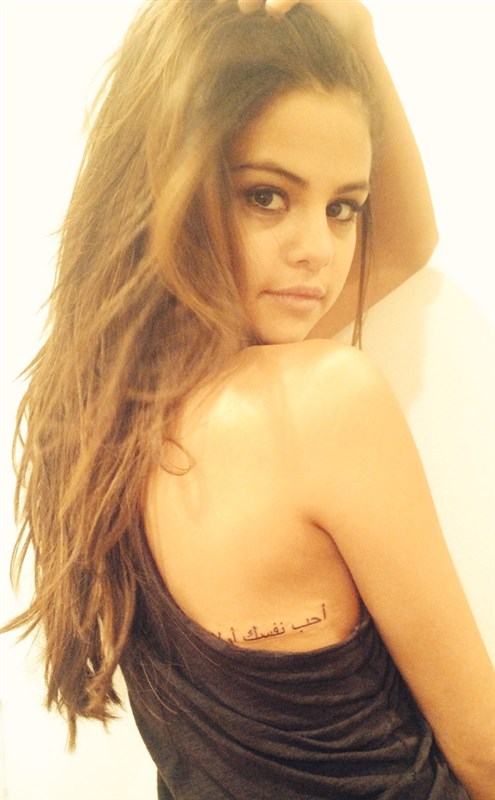
Selena Gomez’s Arabic script tattoo along her back and side

Gomez has also been photographed with Arabic script along her back or side, most often translated in coverage as “love yourself first.” That translation is widely repeated, but stylized lettering can be read differently. It is safer to call it the published translation than a meaning Gomez has personally confirmed.

Other designs listed in the major galleries include a music note, a cross, Sunshine in her grandmother’s handwriting and small marks tied to family or friends. A few have a named artist or direct story; for others, the photos show the design but not its private meaning.

Artists connected with Selena Gomez tattoos

Keith McCurdy, known as Bang Bang, is the artist most often linked to Gomez’s Roman numeral neck tattoo. Coverage also lists her among his clients. Other pieces came from different artists or collaborative sessions, so the whole collection cannot be credited to one studio.

An artist’s style alone cannot confirm who did a tattoo. Fine lettering near the neck, a large rose on the back and a tiny semicolon show how different Gomez’s pieces are, but the artist needs to be named by a reliable source.

How her tattoo style has developed

Selena Gomez small tattoo collection

Gomez’s tattoos range from tiny marks to larger illustrative pieces. The neck numerals and Rare script are subtle; the rose across her back takes up much more space. Family dates and handwriting sit alongside music references and designs linked to public projects. No single style describes the whole collection.

Photos need dates too. A red-carpet shot might show her neck and hide her back, while performance clothes can cover other tattoos. Ink softens over time, and newer work may cover an older piece. A dated photo with its original caption says more than an undated repost.

Frequently asked questions

What does Selena Gomez’s LXXVI tattoo mean?

Close-up of Selena Gomez’s LXXVI Roman numeral tattoo at the nape of her neck

Published coverage identifies LXXVI as a reference to 1976, her mother Mandy Teefey’s birth year. The tattoo sits at the nape of Gomez’s neck and has been associated with Bang Bang.

Who did Selena Gomez’s rose tattoo?

Close view of Selena Gomez’s pink rose tattoo on her upper back

Reports connect the large rose on Gomez’s back with a tattoo session involving Julia Michaels. They are described as coordinated tattoos, but the exact division of design work has not been reported clearly.

What does Selena Gomez’s semicolon tattoo represent?

The semicolon was linked to 13 Reasons Why and done with people connected to the show. It is often discussed alongside mental-health advocacy, but the tattoo does not reveal Gomez’s private health details.

Does Selena Gomez have a Rare tattoo?

Yes. She has a small Rare tattoo near or behind her ear, associated with the album. Sources differ on the exact side, so the broader placement is safer.

Taken together, Gomez’s tattoos touch on family, music, friendship and moments from her public life. Some stories are specific: the year her mother was born, a rose shared with a friend, a semicolon linked to a television project. The rest can stay less certain.