admin

Rag’n’Bone Man’s Ink Runs from His Face to His Fingertips

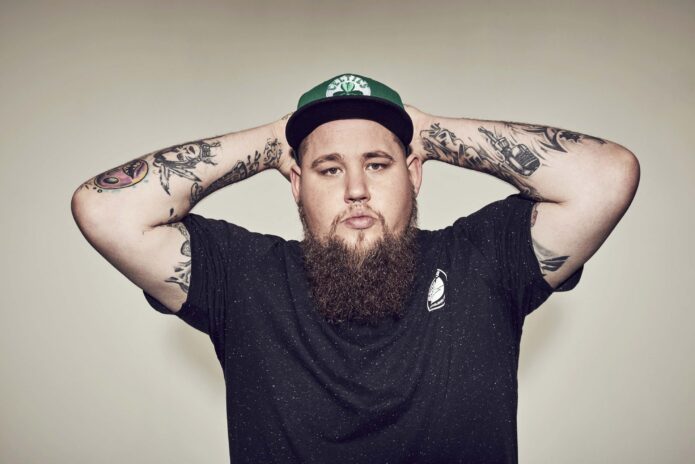
Rag’n’Bone Man’s tattoos have spread across his neck, face, hands, and arms. Music runs through much of the collection: microphones, notes, instruments, lettering, skulls, and old-school flash sit together in a dense, slightly unruly mix.

Some pieces show clearly onstage; others only appear when he lifts a hand or turns his head. The singer has explained the meaning behind a few designs, especially the words on his fingers. There’s more here than random decoration, with plenty of details to notice from different angles.

This guide sticks to tattoos that can be seen and documented. Where Rag’n’Bone Man has talked about a piece, that context helps explain it. Where the story isn’t clear, it’s better to leave it that way than turn a guess into fact.

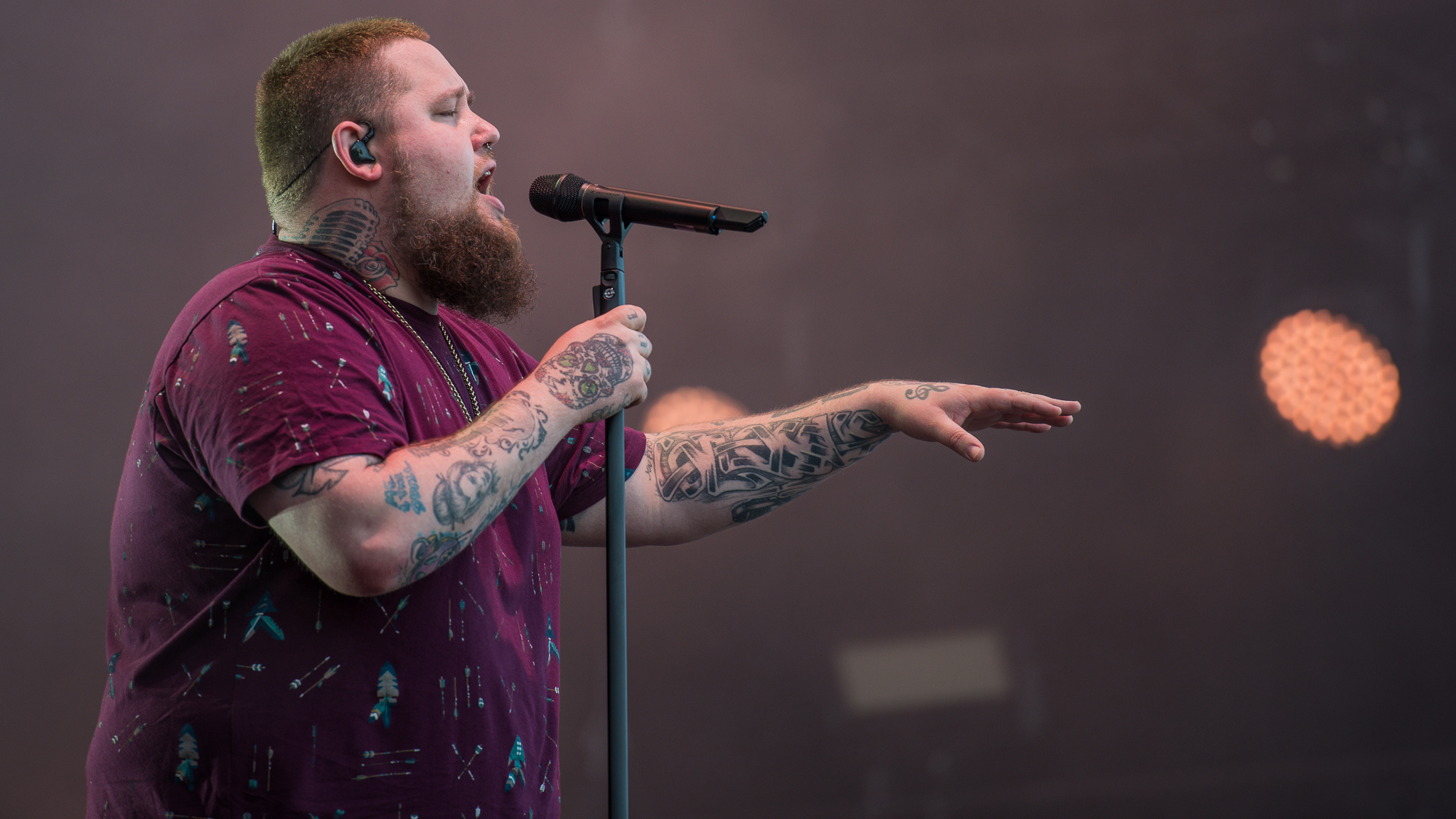
The microphone and rose on his neck
Rag’n’Bone Man neck microphone and rose tattoo

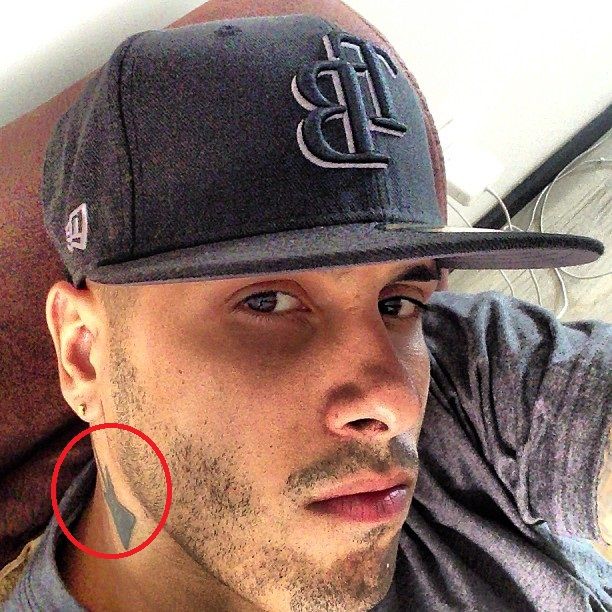
The neck tattoo is one of the quickest ways to recognize Rag’n’Bone Man from the side. A microphone and rose sit below and behind his ear, with the design trailing down his neck. The pairing suits him: the microphone connects to his work, while the rose softens the look.

It can appear different from one photo to another. In bright light, the outlines and darker sections show clearly; under stage lighting, they can blend into the beard and shadow near his ear. The placement gives him a distinct profile, so even a quick performance shot tends to catch part of it.

The neck piece feels like an anchor for the collection. It’s close to his face and difficult to hide, and more personal-looking than a generic star or number. The rose also contrasts with the heavy black linework elsewhere on his arms.

Face tattoos that sit close to the eye and jaw
Rag’n’Bone Man face and forearm tattoos

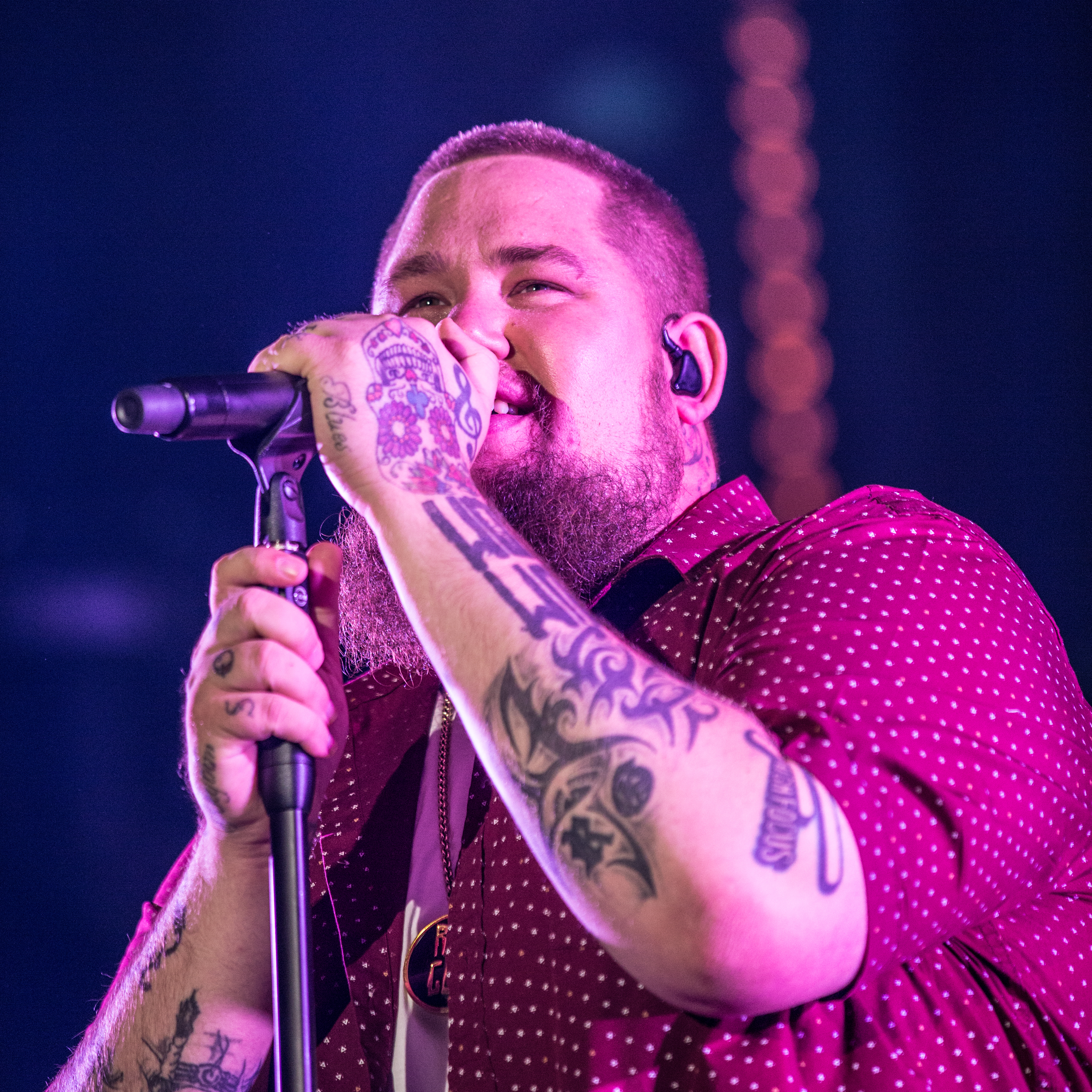
Rag’n’Bone Man has several small facial tattoos that can disappear behind his beard or in a distant photo. There’s a dark mark and graffiti-like work around the jaw, lettering above his eyebrow often read as “MNO,” and a small line or halo-like mark near his cheek and eye.

These aren’t large portrait tattoos covering his face. They’re small bits of writing and symbols placed around the shape of his eye, brow, and jaw. They can be difficult to read in a concert shot, but a close portrait brings out the details.

The face work echoes the rougher, more hand-drawn style of the tribal shapes, lettering, and old-school images on his arms. It gives his face the same scruffy, lived-in feeling as the rest of his ink.

Words, a purple bomb and a portrait on the forearm
Rag’n’Bone Man forearm words bomb and portrait tattoos

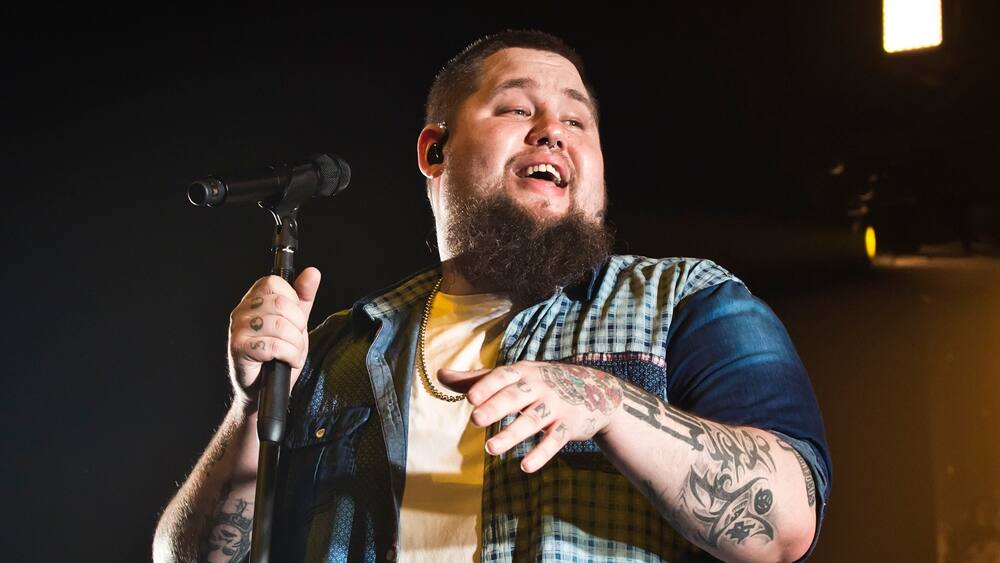
The right forearm gathers several very different designs in one place. “ME & THE DEVIL” runs across the arm beside a purple bomb and a woman’s portrait. The words catch the eye first; the portrait adds a human element, while the bomb has a rough, almost cartoonish feel.

There’s no need to force them into one big story. The lettering reads like a personal phrase, while the bomb and portrait look like separate flash-style choices picked up over time. Together, they make the arm feel like a scrapbook rather than a planned sleeve.

The phrase can also look different as he moves. An elbow or shadow may break up the letters when his arm is bent. When he reaches toward the crowd, the forearm opens up and the designs are easier to distinguish.

Guitars, instruments and the music theme
Rag’n’Bone Man instrument and arm tattoos live

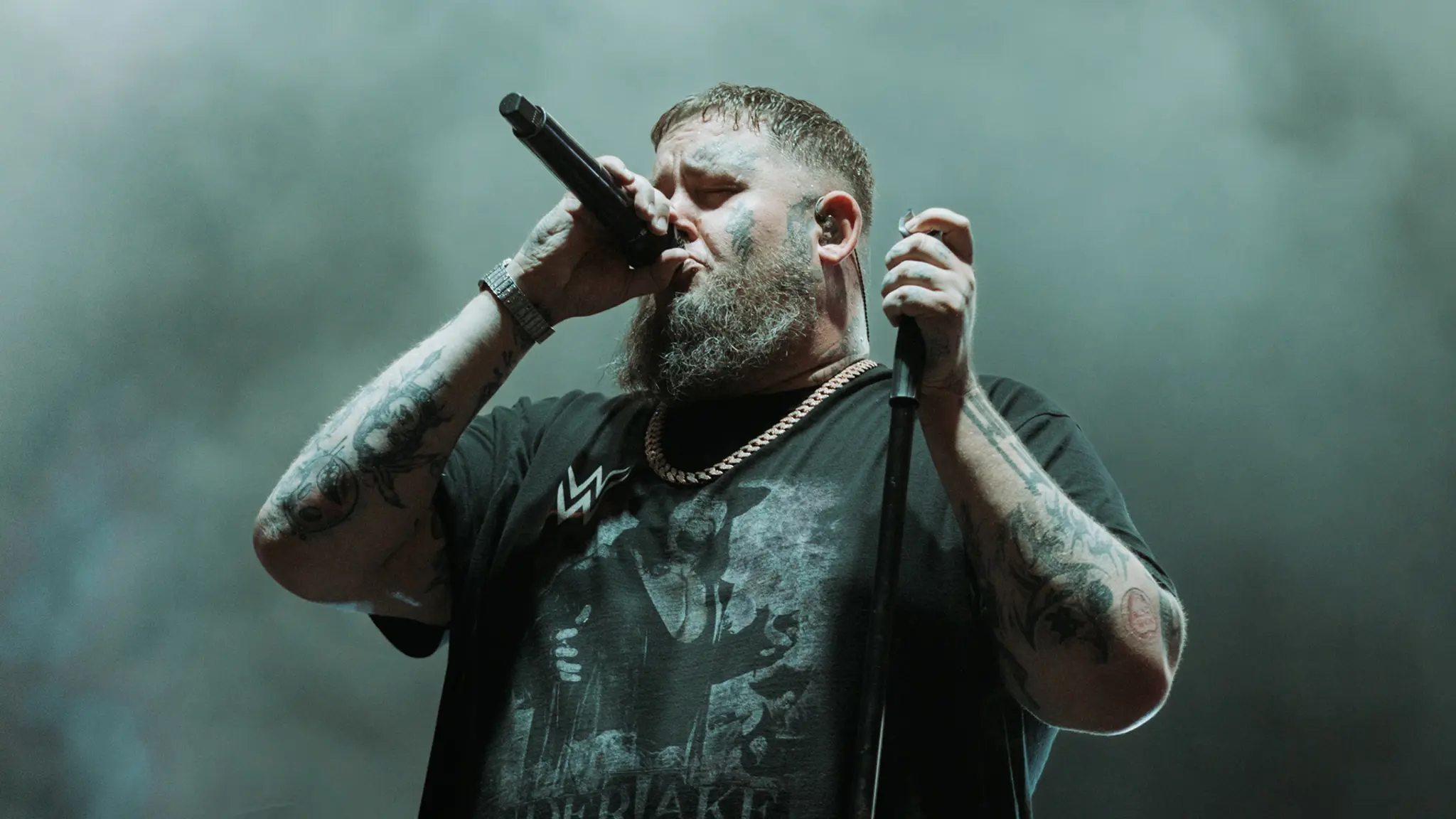
Music is one of the strongest themes in Rag’n’Bone Man’s tattoos. His arms include a guitar, another instrument, a harmonica, music notes, and a red Indian figure. A circular arrangement of notes also wraps around his right wrist.

The instruments help connect the sleeve without making every design match. A guitar has a familiar outline and long straight edges; a harmonica takes up less space. Notes fill the gaps and bring the separate images together when you see the arm from a distance.

The wrist design works as a useful visual break. It circles a small area like a badge instead of filling the whole forearm. Details like that keep the sleeve from becoming a solid wall of black ink.

His arm tattoos also look different when he’s holding a microphone. One arm may be raised toward the camera while the other hangs lower, revealing different images. Several views help show the collection more fairly.

Tribal shapes, HIGH FOCUS and the forearm lettering
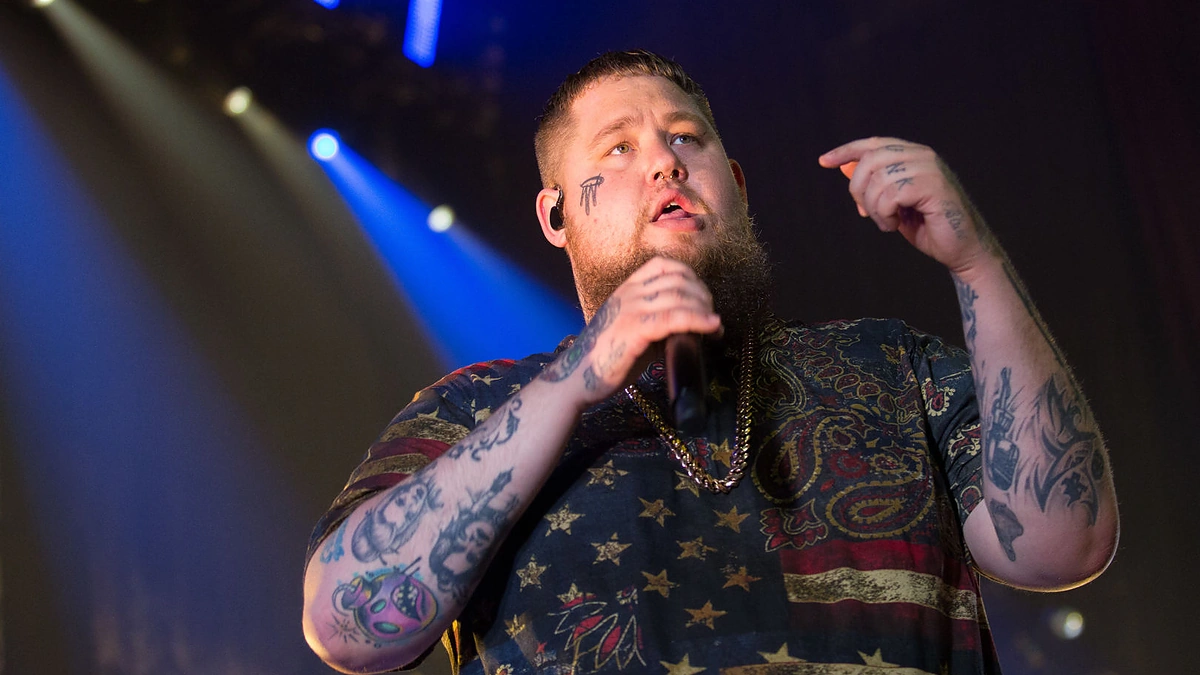
Rag’n’Bone Man tribal sleeve and forearm lettering tattoos

Some of the boldest blackwork is on Rag’n’Bone Man’s left forearm. Close-up photos show tribal-style shapes, an eye, lettering that reads “RUM COM,” and another design marked “HIGH FOCUS.” There’s also an “HF” connected to those words.

The smaller lettering can be hard to make out in performance shots, so it’s best to stick with what’s visible. Thick tribal curves sit beside block letters, a small eye, and other symbols.

A microphone appears lower on his left forearm as well. It links the arm to his music, but it’s separate from the microphone on his neck. Here, the image sits among text and dark shapes, adding another piece to the patchwork.

“SOUL” and “FUNK” came from his childhood fascination with biker knuckle tattoos. That backstory helps explain why the lettering is bold and compact rather than delicate. It’s meant to be read up close, especially when his hands wrap around a microphone.

Hands, candy skulls and the SOUL and FUNK fingers
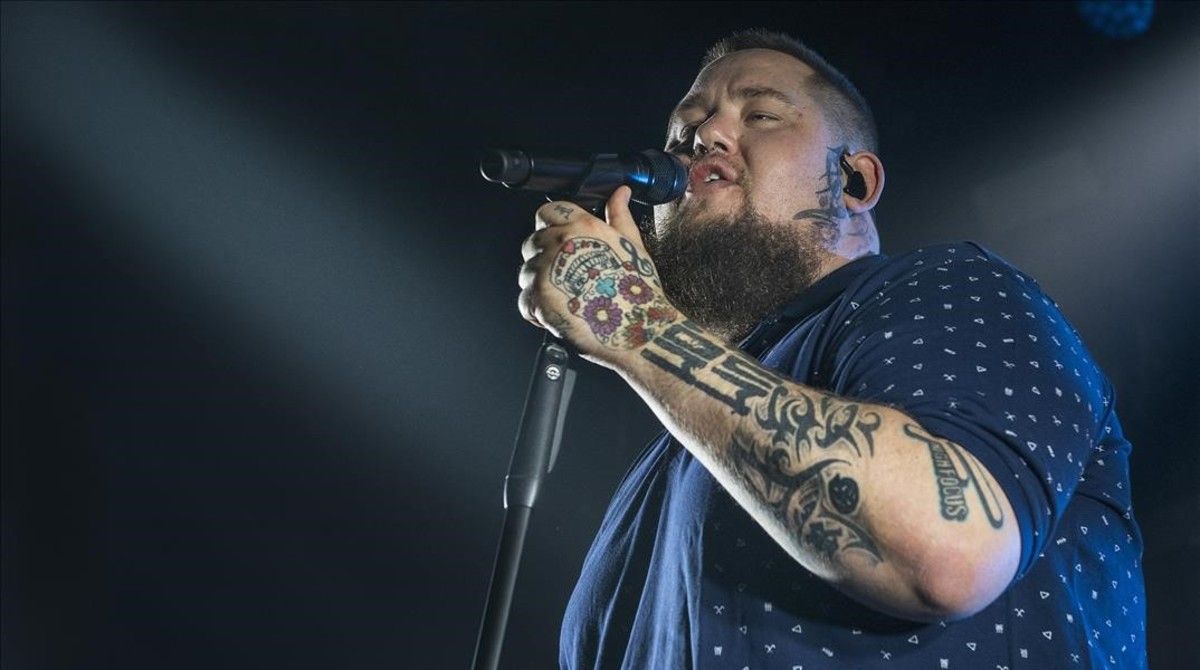
Rag’n’Bone Man candy skull hand tattoos and SOUL FUNK fingers

The hand tattoos are hard to miss. Rag’n’Bone Man has candy skulls across both hands, with “SOUL” and “FUNK” spelled across his fingers. One hand reads “Rhythm” and the other “Blues,” extending the musical theme.

Finger tattoos are small but change the whole look because they stay visible while he holds a mic, waves, or points. “SOUL” and “FUNK” feel like two sides of the same musical identity, while “Rhythm” and “Blues” are direct nods to the music he loves.

The candy skulls add colour and a more traditional tattoo feel. They’re not tiny filler designs; the bold hand pieces draw the eye before the lettering does. In some photos their details are clear, while in others a microphone or his fingers cover part of the image.

His hands show why one hero shot isn’t enough for a tattoo article. A wide portrait reveals how heavily tattooed they are, but close stage photos let readers make out the skulls, letters, and smaller marks.

The collection keeps growing in a rough, musical style
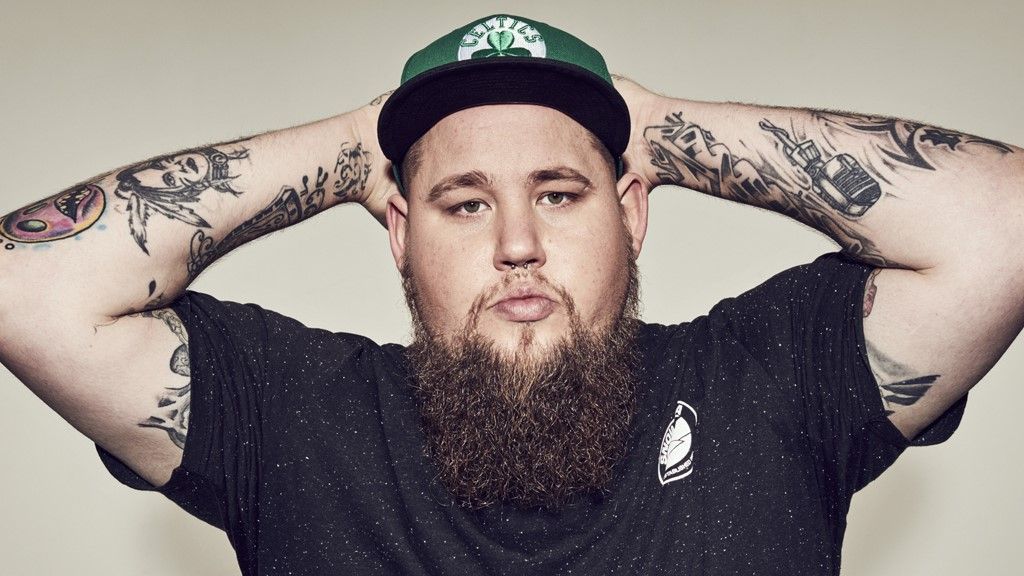
Rag’n’Bone Man detailed right arm tattoo collection

Taken together, Rag’n’Bone Man’s tattoos have a clear mood without following one neat style guide. The neck microphone and rose sit beside face lettering; his arms mix instruments, tribal work, portraits, words, notes, and small symbols. Candy skulls and musical phrases carry through to his hands.

That crowded look is part of the appeal. The tattoos seem collected over time instead of designed in one afternoon. Some are serious, some playful, and some simply suited the space. It’s more like building a set list than designing a logo.

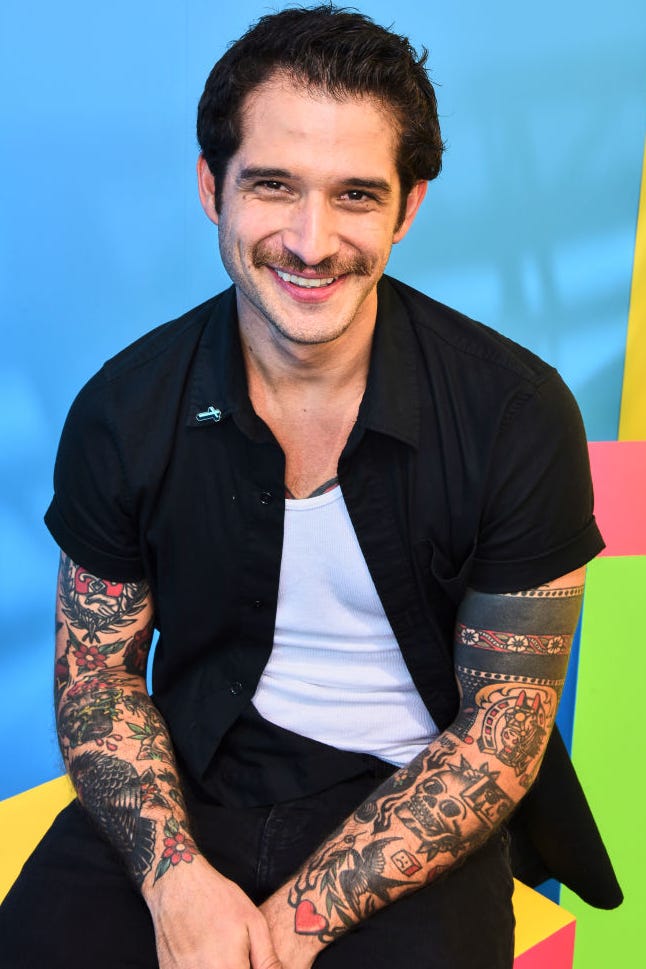
He joins plenty of performers who have made tattoos part of their stage image. Like Tyler Posey, he mixes personal references with easy-to-spot designs, though Rag’n’Bone Man’s arm and hand work is much heavier.

Smaller marks may not appear in every public photo, so this guide sticks with pieces that can be identified. Even with that cautious approach, there’s plenty to see: music symbols, instruments, skulls, words, portraits, tribal lines, and facial tattoos. The more angles you find, the easier it is to separate the details.
More musician tattoo guides

Inside Lil Xan’s Face Ink and the Stories Behind It

Lil Xan’s face tattoos are hard to miss, but they’re only one part of a much larger collection across his neck, hands, arms, and chest.

Some designs connect to his music and the Xanarchy name; others are about family, friends, grief, or the way he felt when he got them. He has also said a few small marks don’t have a deep meaning. That mix gives the collection more to it than a list of words on his face.

ZZZ, LOVER and Candy are the face tattoos everyone notices first

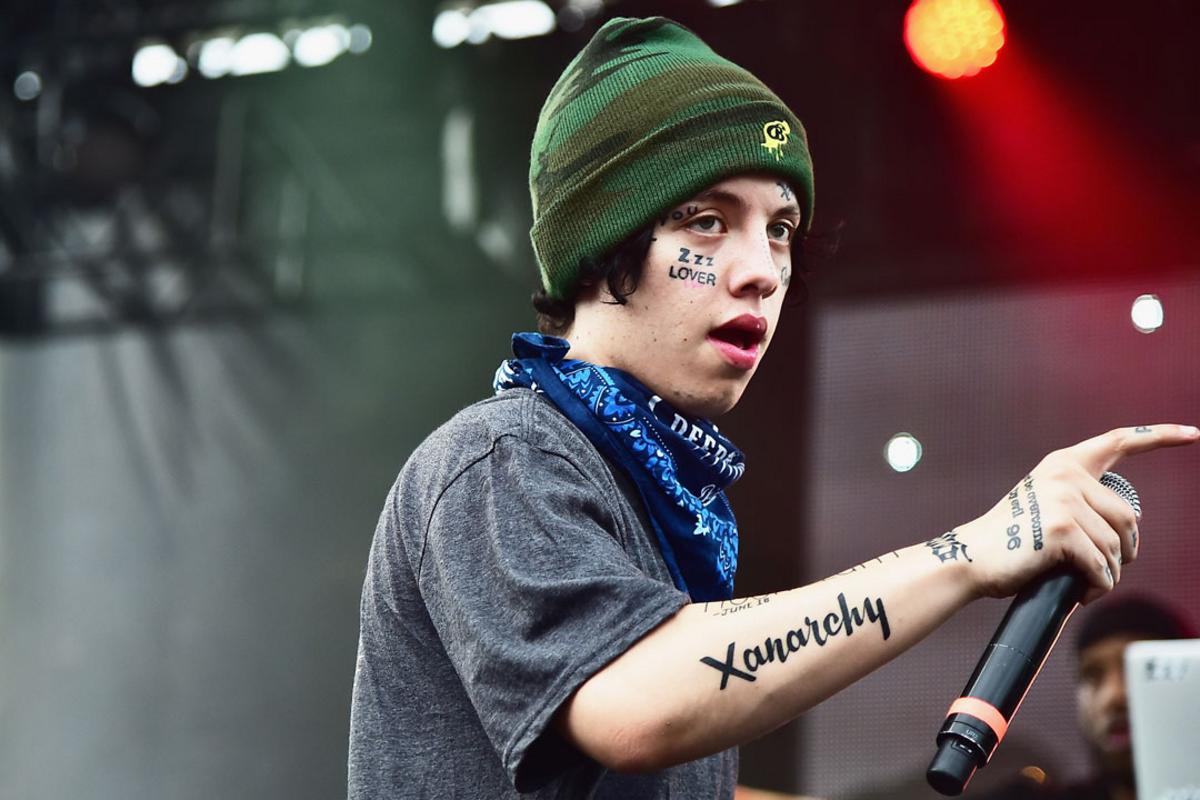
Lil Xan Xanarchy face tattoos

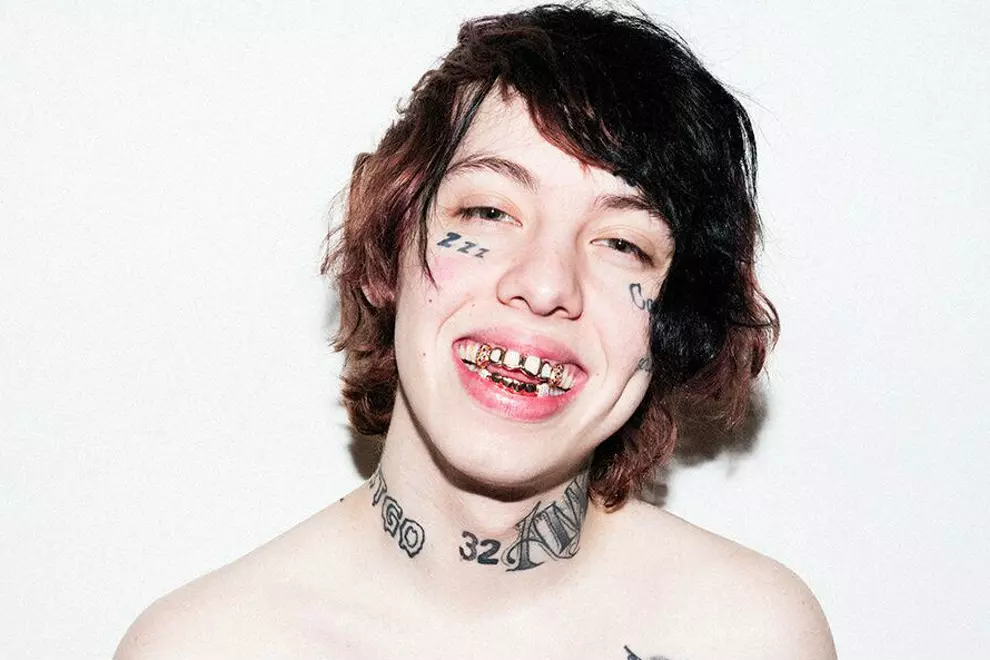
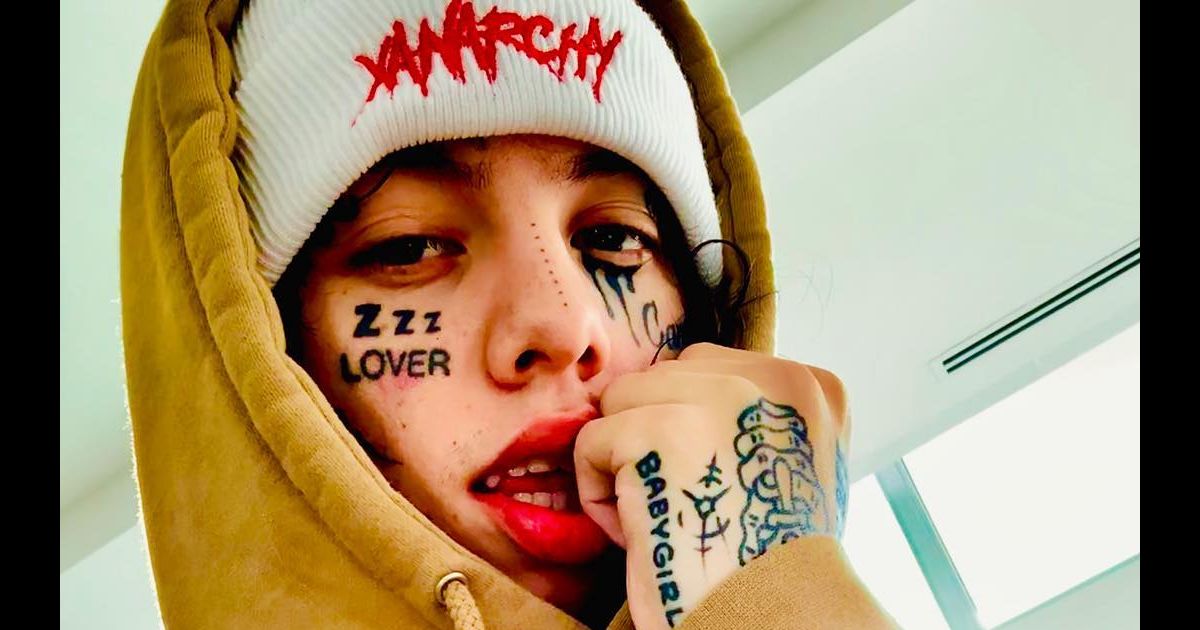
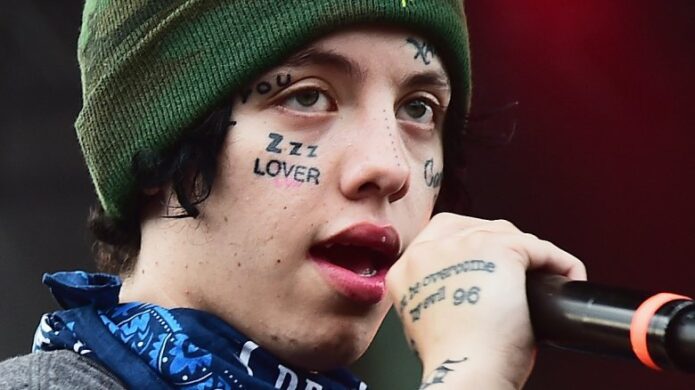
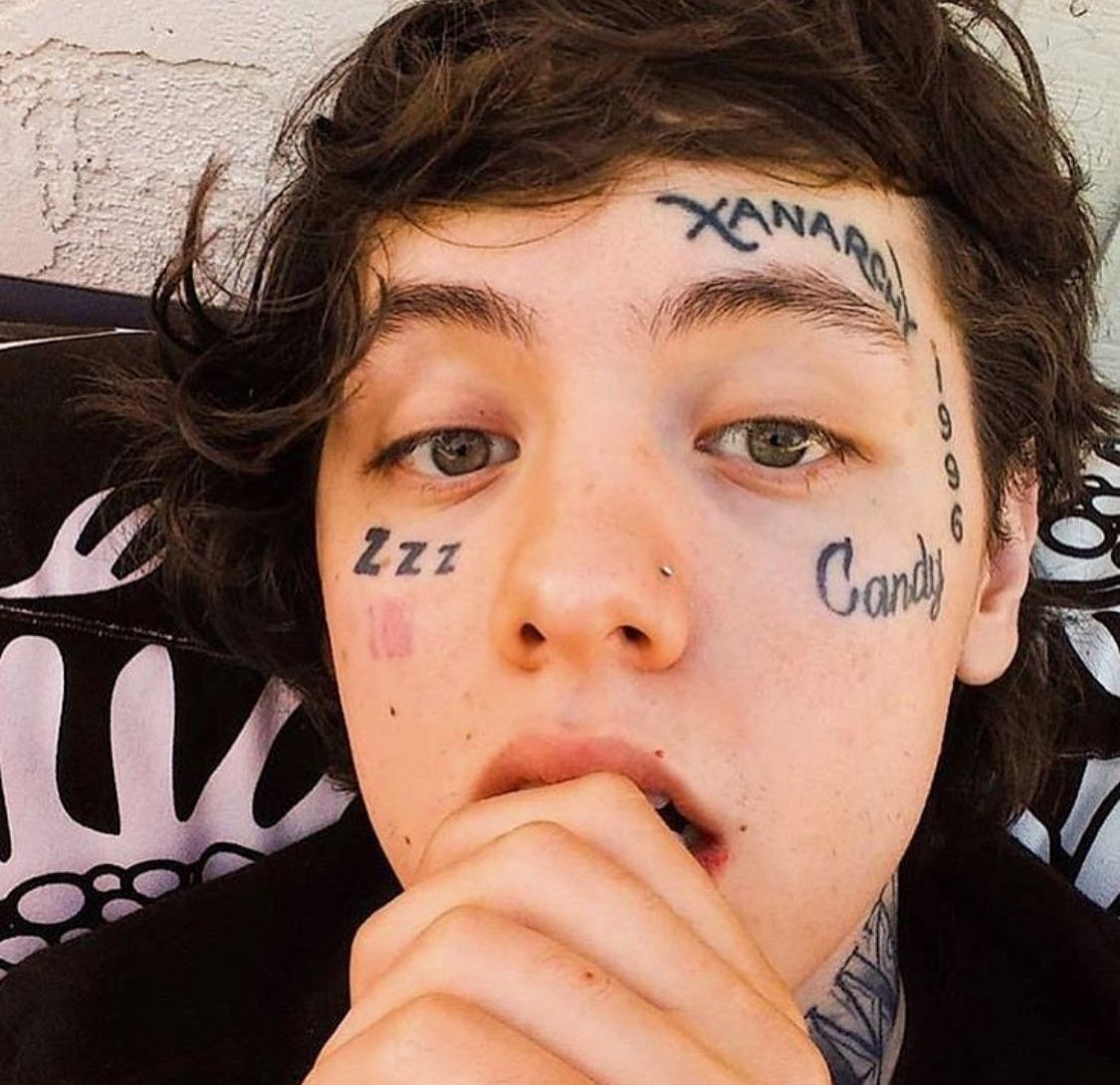
The most recognizable group sits around Lil Xan’s eyes and cheeks. ZZZ is below one eye, with the larger LOVER lettering beneath it. On the other cheek, Candy refers to his mother’s name.

He has said the ZZZ tattoo is one of the few pieces without a major meaning. In one interview, he called it the only tattoo he would describe as meaningless. That’s useful context: not every small mark needs a dramatic backstory.

The LOVER lettering replaced an earlier “LOW” tattoo. The change shows how his face ink has developed over time; it wasn’t always a fixed design, and a cover-up can change how it looks in photos.

Small drips and symbols also appear around his eyes, nose, and forehead. They can be easier or harder to see depending on the light, his hair, or makeup. Those details are best treated carefully instead of counted as new tattoos whenever another photo reveals a line.

The style is blunt by design. These aren’t fine-line portraits hidden near an ear; the lettering is meant to be read, which is why his face looks different even in ordinary photos where most of his body is covered.

XANARCHY appears on his arms and above his eyebrow

Lil Xan Xanarchy forearm tattoo

XANARCHY connects Lil Xan’s tattoos to his stage identity. The word appears on his forearm and has also been seen above his eyebrow, making his name highly visible.

The Xanarchy movement grew from his experiences with Xanax and his decision to talk more openly about addiction and recovery. The tattoo isn’t subtle, but that suits the name: it represents a music identity as well as a part of his life he has discussed publicly.

The forearm lettering is large enough to read from a distance. It often stands out in live photos, even when his face is turned away. Smaller, mixed designs surround it, so the word gives the area a clear focal point.

His arms also have doodles, numbers, symbols, and darker work that can look different from one photograph to another. The tattoos came together quickly, and not every piece seems planned to match the next. There are gaps, overlaps, and different lettering styles.

Some people like that uneven look; others don’t. Either way, it’s personal to his image. A clean sleeve would tell a different story. These arms feel like a record of different phases.

The neck and chest carry dates, numbers and a hummingbird

Lil Xan 32 neck and DEC 3 chest tattoos

The number 32 and other small lettering appear on Lil Xan’s neck, while DEC 3 is on his chest. The date has been linked to an important birthday, adding a timeline to the upper-body ink.

A hummingbird also appears on his chest beneath the lettering. It brings a softer image to an area otherwise dominated by numbers and dark symbols. It can disappear under a shirt, but shirtless photos show how it fits into the layout.

Other chest designs include darker shapes and small writing near his collarbone. Some are hard to read in older photos or are partly covered by chains and clothes.

The neck work affects the overall look. Face tattoos can be covered with makeup or hair, but throat ink remains visible in most outfits. The number and lettering also link the face to the chest, so the tattoos don’t stop at one obvious boundary.

It helps to separate what’s visible from what’s confirmed. Lil Xan has explained some dates and phrases, but hasn’t publicly given a backstory for every symbol on his neck. A careful guide names the readable pieces and leaves the rest open.

His hands are covered in small words and symbols

Lil Xan Baby Girl hand tattoo

Lil Xan’s hands are often on display when he holds a microphone, phone, or cigarette. One of the clearest designs is BABYGIRL, written down the hand in bold letters.

Another hand design includes “supreme april 96,” along with small marks, numbers, and doodles. The phrase has been discussed as a personal reference, and 1996 is also his birth year. Its exact arrangement can be hard to make out as his fingers bend or the hand is partly hidden.

Tiny symbols appear around the fingers and wrist, from simple sketches to darker shapes that blend into the line work. Hand tattoos often fade faster than upper-arm designs, so older photos may make them look heavier than newer ones.

The hands fit his overall approach. He doesn’t seem interested in keeping the ink easy to hide. Even when his face is out of frame, the lettering can give away who’s in the photo.

They also make the collection feel less polished. The large face words get attention first, but the small hand marks show the everyday messiness of tattoos added at different moments rather than in one planned session.

Memento mori became a tribute to Mac Miller

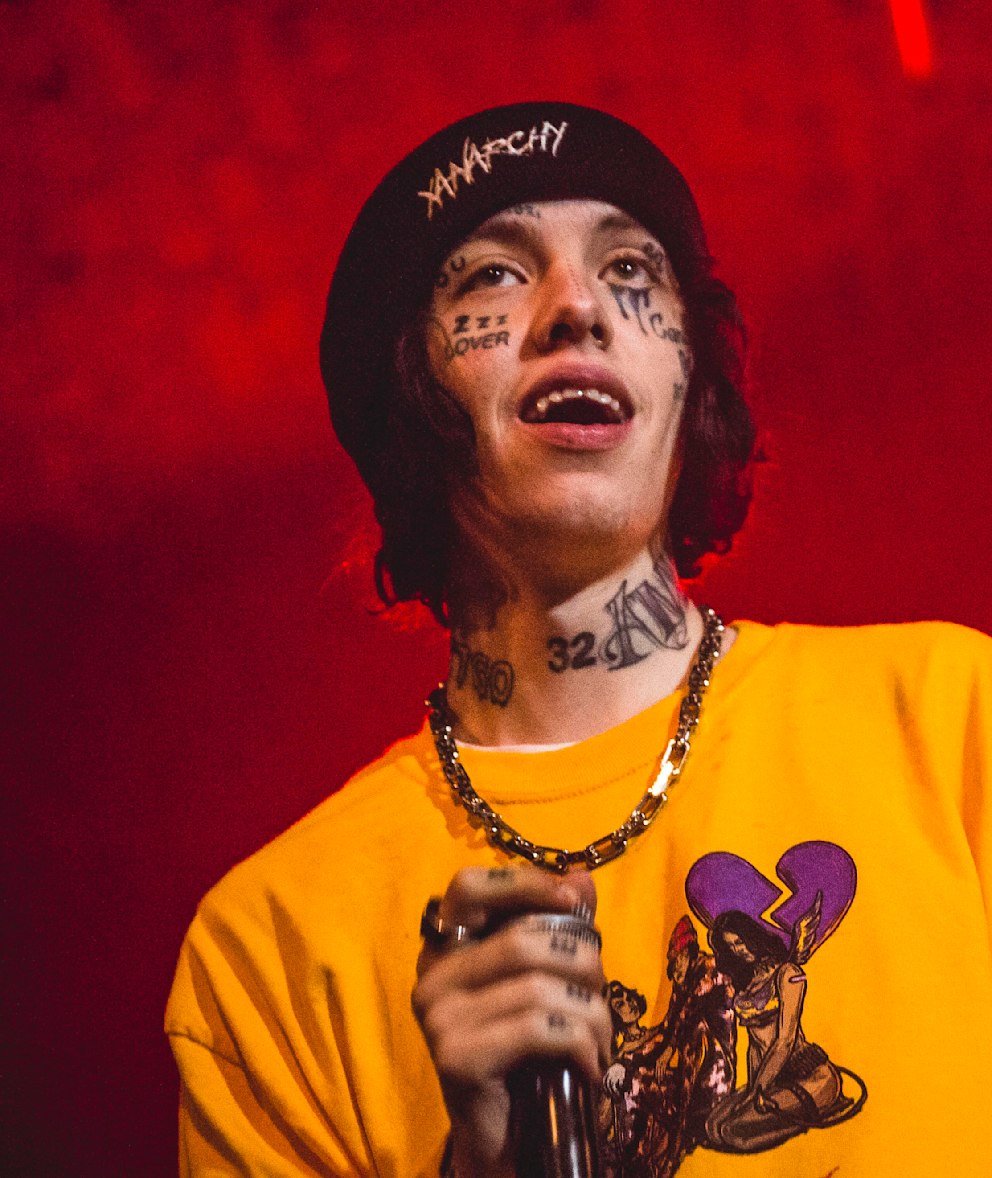
Lil Xan Lover live performance tattoos

One of the more serious pieces in Lil Xan’s collection is “memento mori”, a Latin phrase meaning “remember that you will die.” He got the face tattoo after Mac Miller died, calling it a tribute and a reminder of mortality.

Placement changes the effect. The phrase could have gone on an arm or chest, but above his eye it becomes part of his public identity in every photo. It sits alongside ZZZ, LOVER, and the dripping-eye designs, mixing a serious idea with more playful or chaotic imagery.

Here the tattoos connect clearly to grief and the wider rap community. Lil Xan has his own history with addiction and has spoken about moving away from it. The tribute doesn’t explain his whole life, but it gives one piece of face ink a clear reason and moment.

He has also had a tattoo inspired by A Clockwork Orange, with a dripping design around his eye. It’s more stylized than the lettering and shows that his face tattoos aren’t all words and numbers.

Some of these designs have changed, faded, or appeared at different stages in photographs. That’s why a timeline helps. A close-up from 2018 might show fresh lettering or a version that looks slightly different years later.

Photos also frame the collection in different ways. Face and hand tattoos appear in a standard portrait, while the chest and arms may be hidden. Wider shots fill in that missing context and help separate earlier designs from newer ones, especially where face lettering has changed or been covered.

Lil Xan’s tattoos tell a messy, very visible story. The face ink carries his name, jokes about sleep, love, family, and grief. Xanarchy appears on the arms, small hand marks add personal notes, and the neck and chest fill in the rest.

Not every tattoo needs a grand explanation. Some marks are there because he liked the look; others came from a particular moment, and some have meanings he hasn’t shared. The useful thing is to keep confirmed stories separate from guesses.

Taken together, the collection is less about one perfect style than a changing identity. The words are bold, the symbols are often small, and the face remains the first thing people notice. That combination makes the tattoos stand out even when he’s fully dressed.

More musician tattoo guides

Inside Leandro Paredes’ Ink: La Bombonera, “VIVERE” and Argentina Memories

Leandro Paredes has the kind of tattoo collection that makes a football shirt seem to hide half the story. Without the shirt, a large chest scene comes into view alongside religious art, lettering, dates, family details, and black-and-grey work down both arms.

There isn’t one theme tying every piece together. Some tattoos are about Boca Juniors and Argentina; others are personal, and smaller marks show up most clearly in close match photos. Here’s what can be seen and what has actually been reported.

La Bombonera and the beach scene across Paredes’ chest

Leandro Paredes Bombonera chest tattoo session

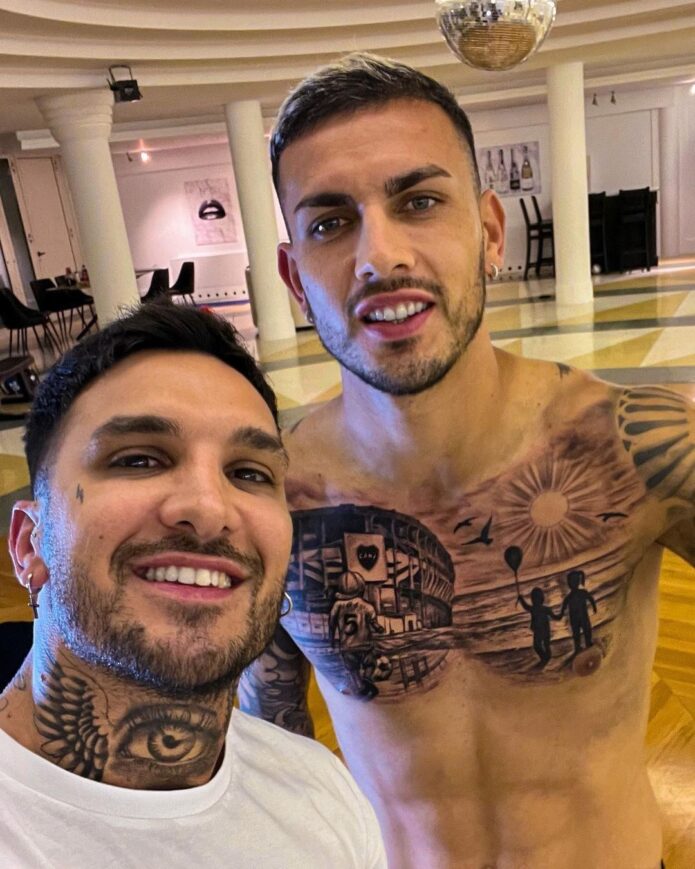
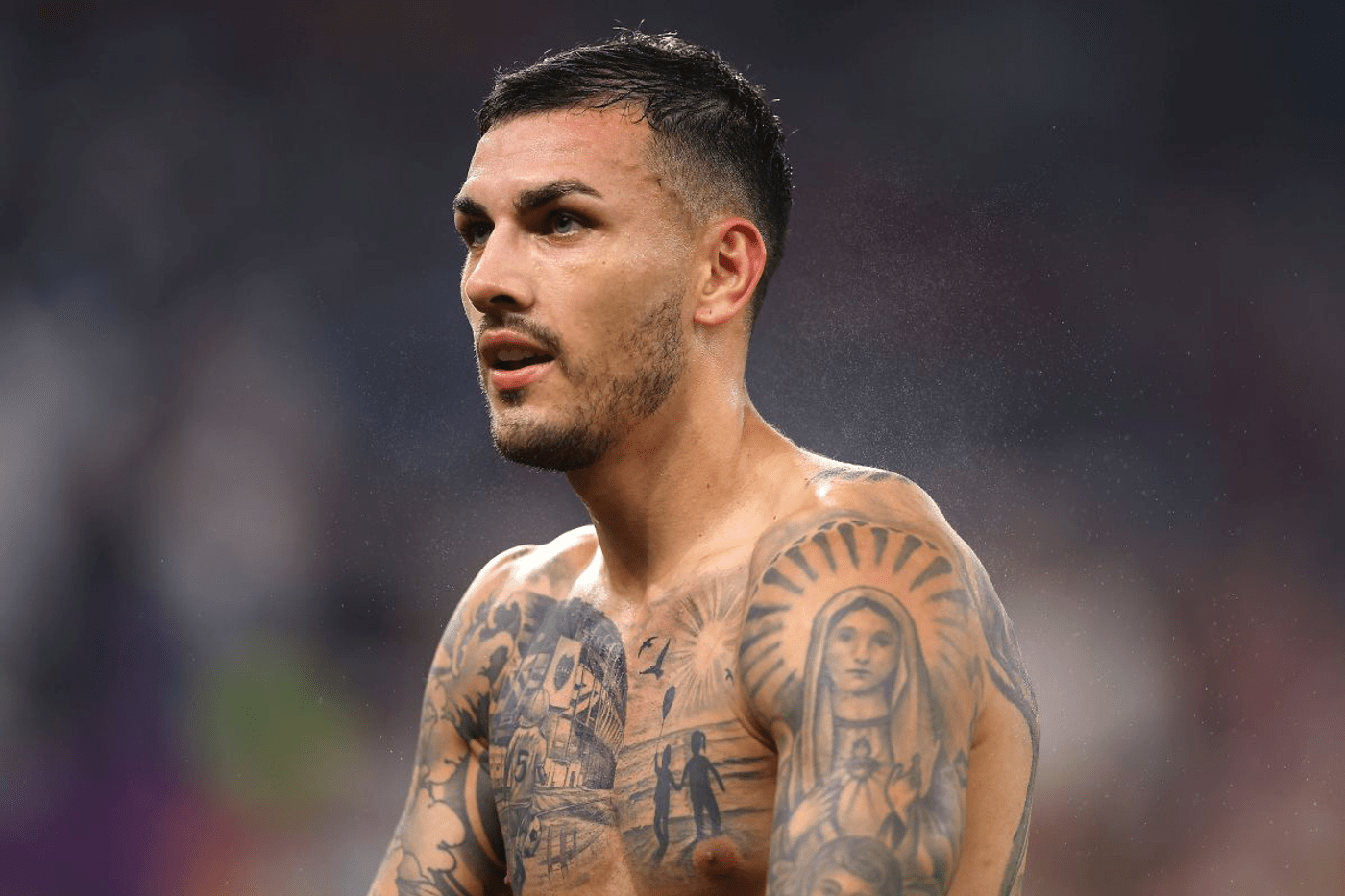
The main talking point is Paredes’ chest tribute to Boca Juniors. On the right side, La Bombonera appears in fine detail. It’s the stadium where his football story began, rendered as more than a simple club badge.

A small footballer wearing number five appears in the design. Five is Paredes’ shirt number, giving the scene a personal touch. The stadium, player, and ball turn the image into a small football memory, not just a building inked across his chest.

The other side shifts to a beach scene: two children holding hands, with a balloon, sun, and birds in the background. Reports connect the children to his family, though it’s safest to describe the design as family-centred without guessing at private details.
The contrast makes the chest piece work. One half feels busy and football-focused; the other is quieter and more nostalgic. Paredes gives his Boca history and personal life space side by side instead of folding them into one generic design.

The religious figures on his shoulder and upper arm

Leandro Paredes religious chest and arm tattoos

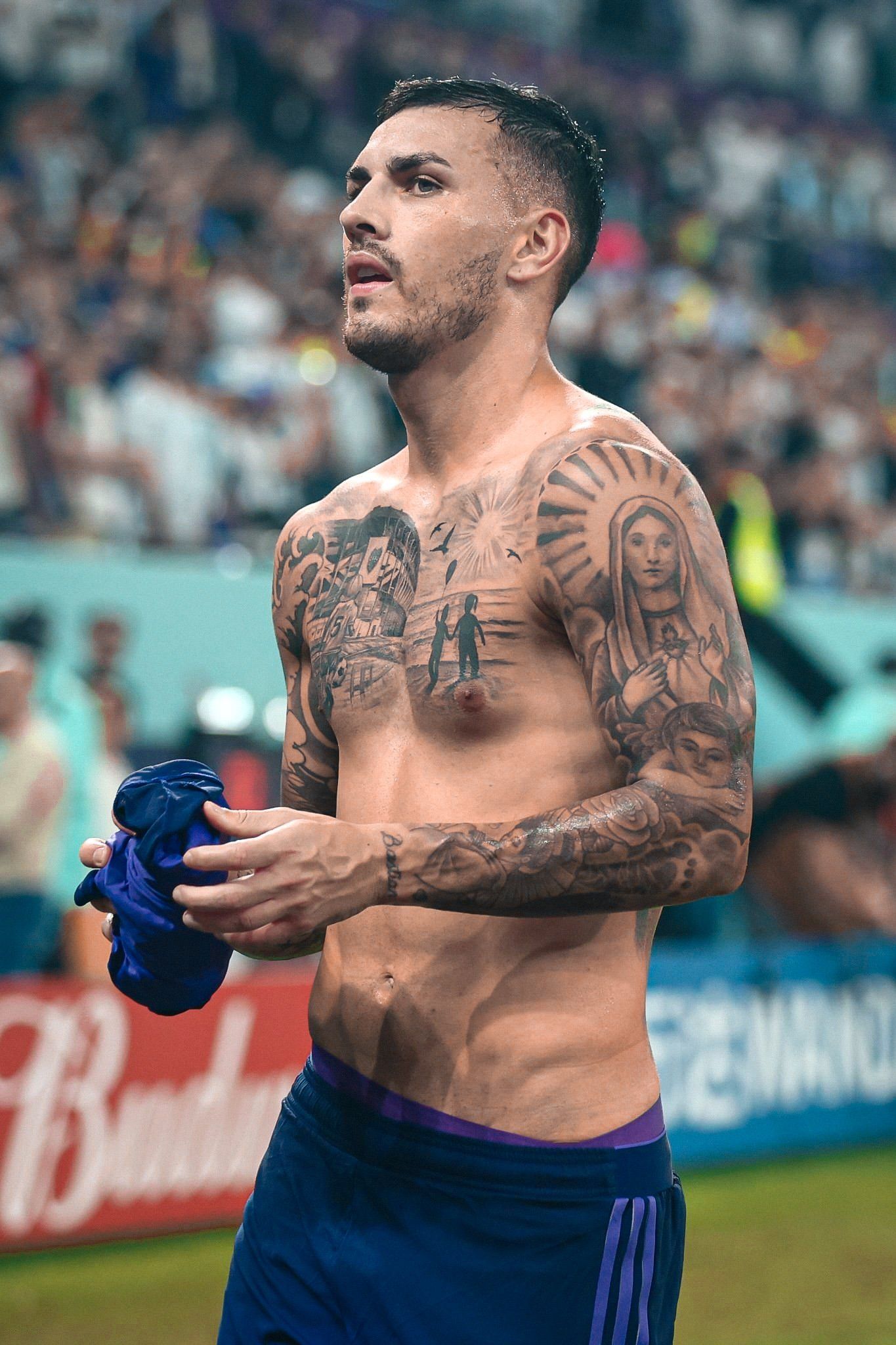
Some of the most recognizable images on Paredes’ right shoulder and upper arm are religious. A large black-and-grey portrait of the Virgin Mary is framed by lines that radiate outward, making the shoulder stand out even from a distance.

Below it, another religious figure takes up much of the upper arm. The shading gives it a heavier look than the chest’s cleaner lines. These aren’t small wrist symbols; they help explain why his arms look so covered when he plays in short sleeves.

The images are clear, but Paredes hasn’t explained the private meaning behind every part. Rather than invent a dramatic story, it’s fair to say that religious portraits and devotional imagery form a major part of his upper-body tattoos.

Classic black-and-grey work carries the design: faces, soft shading, and strong outlines. It also links the shoulder to the chest, rather than making it feel like a separate sticker. Seen from the front, the radiating lines and religious portrait frame the rest of the chest work.

“VIVERE” on the neck and the 1994 date on his stomach

Leandro Paredes VIVERE neck and 1994 abdomen tattoos

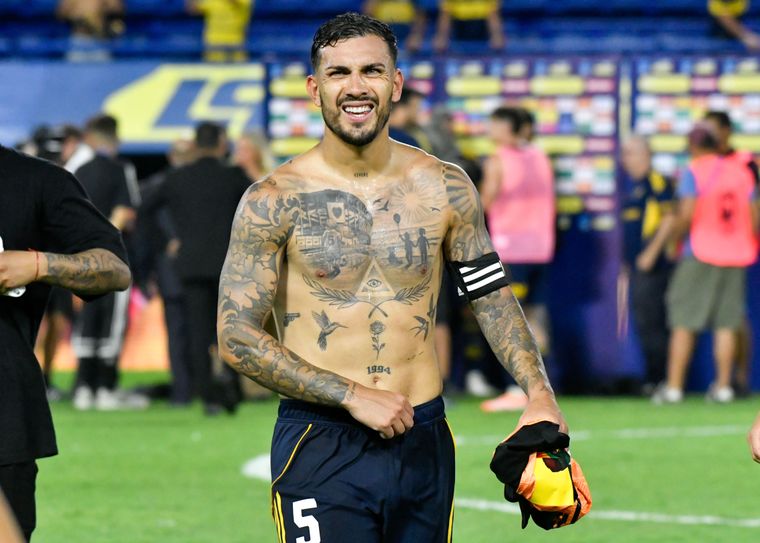
Two smaller details sit near the middle of Paredes’ body. The word “VIVERE” is low on his neck, and 1994 is tattooed on his abdomen. The date marks his birth year and gives the larger collection a simple personal anchor.

“Vivere” means “to live” in Italian. Paredes has played in Italy, France, Russia, and Argentina, and the short word sits just above the chest work without competing with it.

The date is much plainer: four clear numbers without a portrait or large scene around them. That simplicity breaks up the heavier shading and gives the eye somewhere quieter to rest.

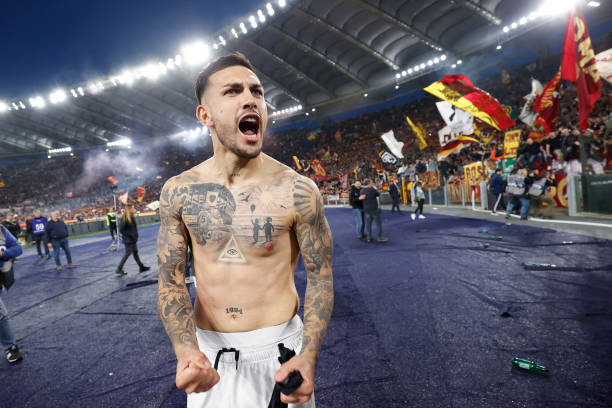
Below the date, photos show a triangle with an eye, laurel-like branches, small birds, and a flower. Since those tiny marks don’t all have confirmed explanations, it’s better to describe what’s visible than make up a story for the whole area.

Black-and-grey arm work, birds and the smaller chest symbols

Leandro Paredes chest tattoo portrait

Paredes’ arms are filled with black-and-grey work, and they look different depending on whether he faces the camera or turns sideways. Clouds, dark shading, and smaller images run from his shoulders toward his wrists.

Small birds and dark shapes across his chest help connect the larger designs. They may not be the headline tattoos, but they keep the stadium, sun, and beach scene from floating on their own. Leaves, a flower, and little marks around the stomach serve a similar role.

The collection mixes realistic portraits with simple symbols. A detailed religious image can sit near a tiny bird or plain date without everything needing the same style. That gives the tattoos a lived-in look, as if they grew over time rather than being planned as one full bodysuit.
Reports also mention family names and lettering near his wrist and lower arm, including his son Giovanni’s name. Those details can be hard to read in wide match photos, but close-ups show how the small pieces matter alongside the chest work. They make the collection personal without turning every design into a public statement.

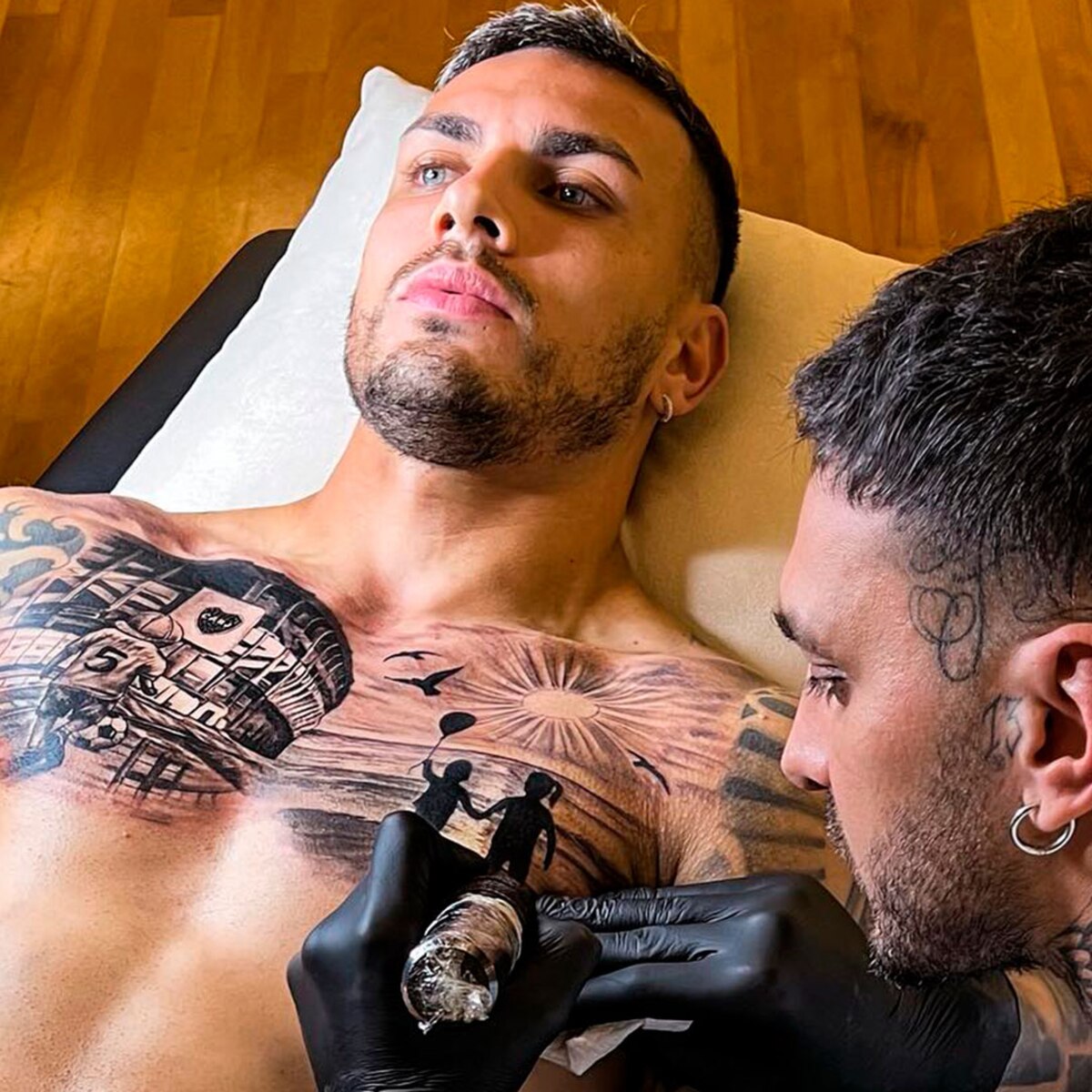
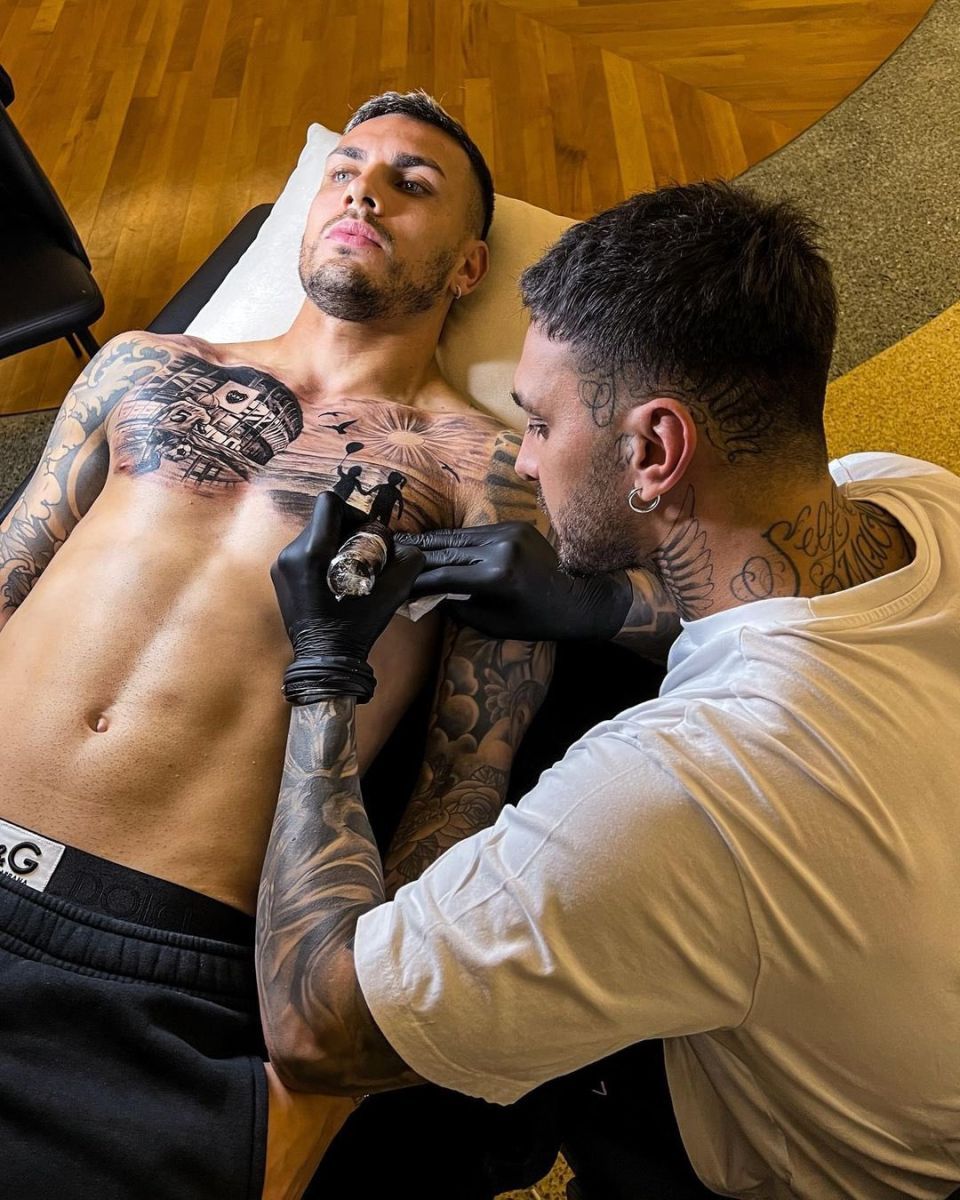
The chest piece was done by Valentino Russo

Leandro Paredes Bombonera tattoo session in progress

Italian tattoo artist Valentino Russo created the Bombonera piece. Photos from the session show the stadium and beach scene taking shape in layers of black and grey across Paredes’ chest.

Those images help explain the level of detail in the finished tattoo. The stadium front, number-five shirt, children, sun, and birds all need different shading. It was more involved than a small emblem that could be finished quickly.

Older photos of Paredes can look very different because the chest piece wasn’t always there. Newer images show a fuller front than earlier photos from his time in Europe. Tattoo collections change as people add work around existing designs.
Russo’s composition connects Paredes’ football past with his family life without forcing them into one portrait. La Bombonera represents the club that raised him; the children and beach scene point toward home and memory. That makes for a more personal tribute than placing a Boca crest alone in the centre.
The Copa América tattoo and the football memories on his legs

Leandro Paredes leg and torso tattoos after Roma match

Paredes also has football-related tattoos lower down. After Argentina won the 2021 Copa América, reports noted a trophy tattoo on his left leg. He had just won his first senior international title with Argentina, making it a natural memory to mark.

Leg tattoos can be easy to miss beneath a match kit, and warm-up photos may show only a small section. A clear image of his leg adds context that a stack of standard action shots can’t provide. It also separates the Copa América design from the chest piece instead of reducing the entire collection to one large tattoo.

His football memories go beyond a single trophy. The number five appears in different parts of the collection, while La Bombonera links the club of his childhood to the player he became.

Taken together, the tattoos move from Boca and family to Argentina, religious portraits, and small lettering. Some meanings are documented; other marks are simply visible details best left open. That balance keeps the guide accurate without pretending Paredes has published a complete catalogue.
What Leandro Paredes’ tattoos say as a whole

Paredes has a lot of ink, but the collection doesn’t feel random. Family, football, faith, and the places that shaped him keep returning. La Bombonera is central, but it shares the chest with softer images rather than replacing everything else.

The smaller details keep the larger designs from feeling too heavy. 1994, VIVERE, birds, flowers, names, and small symbols break up the portraits and stadium scene. They also show how the tattoos grew in stages rather than arriving as one fully planned design.

Photographs clearly show the religious portraits, Bombonera, beach scene, date, neck lettering, family references, and Copa América memory. Other marks are too small or covered to identify with confidence. That’s fine: a guide can say what’s visible without giving every shadow an invented backstory.

What stands out is how comfortably Paredes wears the mix. A large Boca tribute, an arm portrait, and a small stomach date all appear in the same frame. The result is busy, personal, and unmistakably tied to football, with enough quiet detail to keep drawing the eye.

More athlete tattoo guides

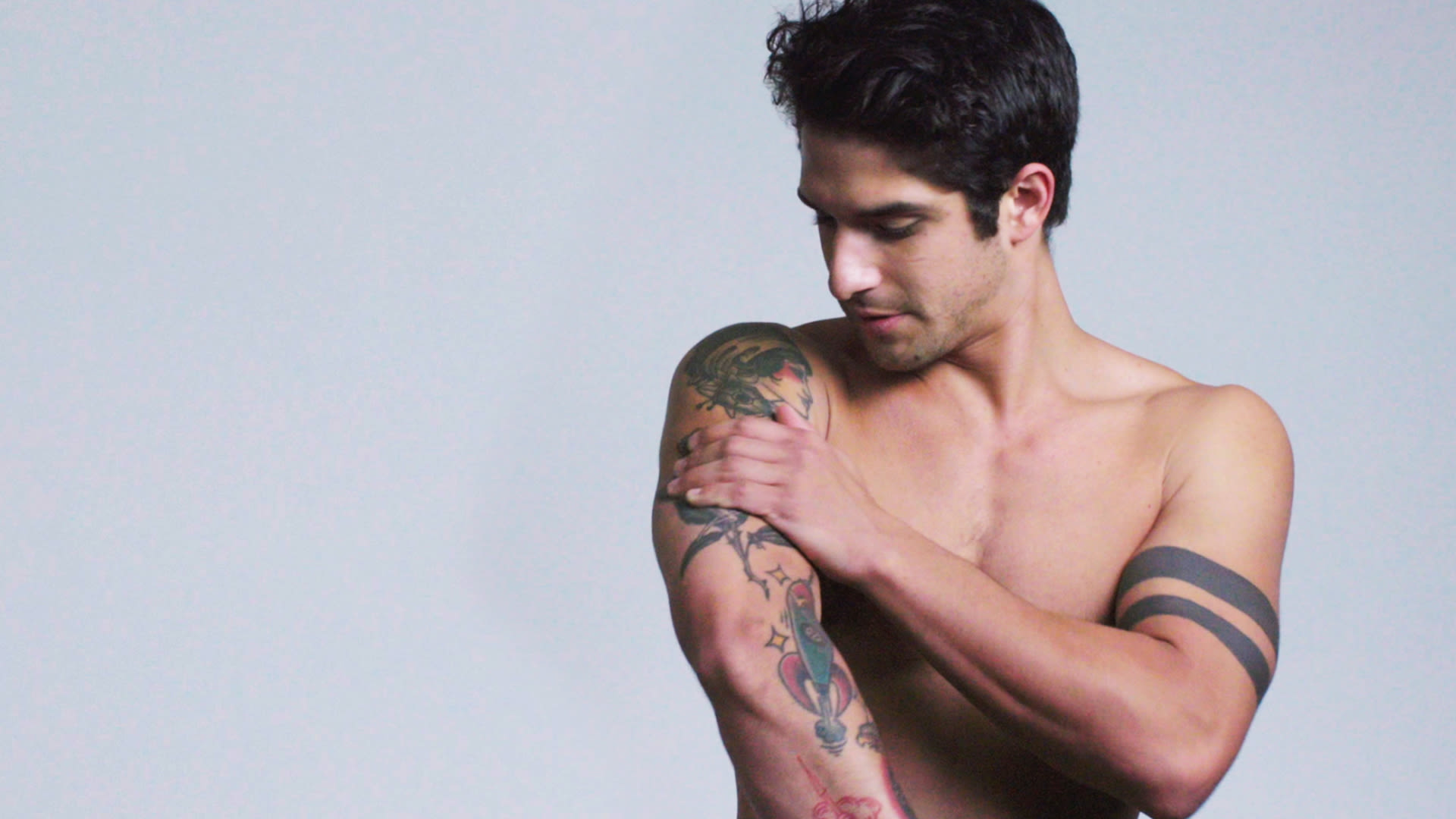
Tyler Posey’s Ink Has Always Been a Work in Progress

Tyler Posey’s tattoos have never seemed like a finished project. They began with a small Blink-182 reference and grew into colourful traditional pieces, black armbands, chest and leg work, and odd little drawings that feel more like a sketchbook than one planned sleeve.

The designs don’t all match, and Posey hasn’t tried to make them look as if they came from one big plan. In his Teen Vogue tattoo video, he talked through the first piece, the painful leg work, his arm designs, and why acting often means covering the ink with makeup.

He has also said in recent interviews that some older tattoos don’t mean as much to him now. That doesn’t make them pointless; it shows how the collection has changed with him, and how a tattoo’s story can shift over time.

The first tattoo came from Blink-182

Tyler Posey shoulder and forearm tattoos

Posey has said his first tattoo was the opening note from a Blink-182 song. It’s a small design, but it says a lot about the rest of his collection. He was a huge fan of the band and had been thinking about tattoos since he was around ten or twelve, well before he could get them.

He has described drawing little outlines of himself on paper and filling them with tattoo ideas. That’s close to how his actual collection developed: serious pieces beside jokes, traditional flash, and small designs that looked good at the time.

The Blink-182 note came before the bigger commitments. As an actor, Posey had to think about placement. His arms and hands needed to stay manageable because the makeup team on Teen Wolf had to cover the tattoos for Scott McCall scenes.

His colourful arm tattoos mix traditional designs with black bands

Tyler Posey gypsy shoulder tattoo

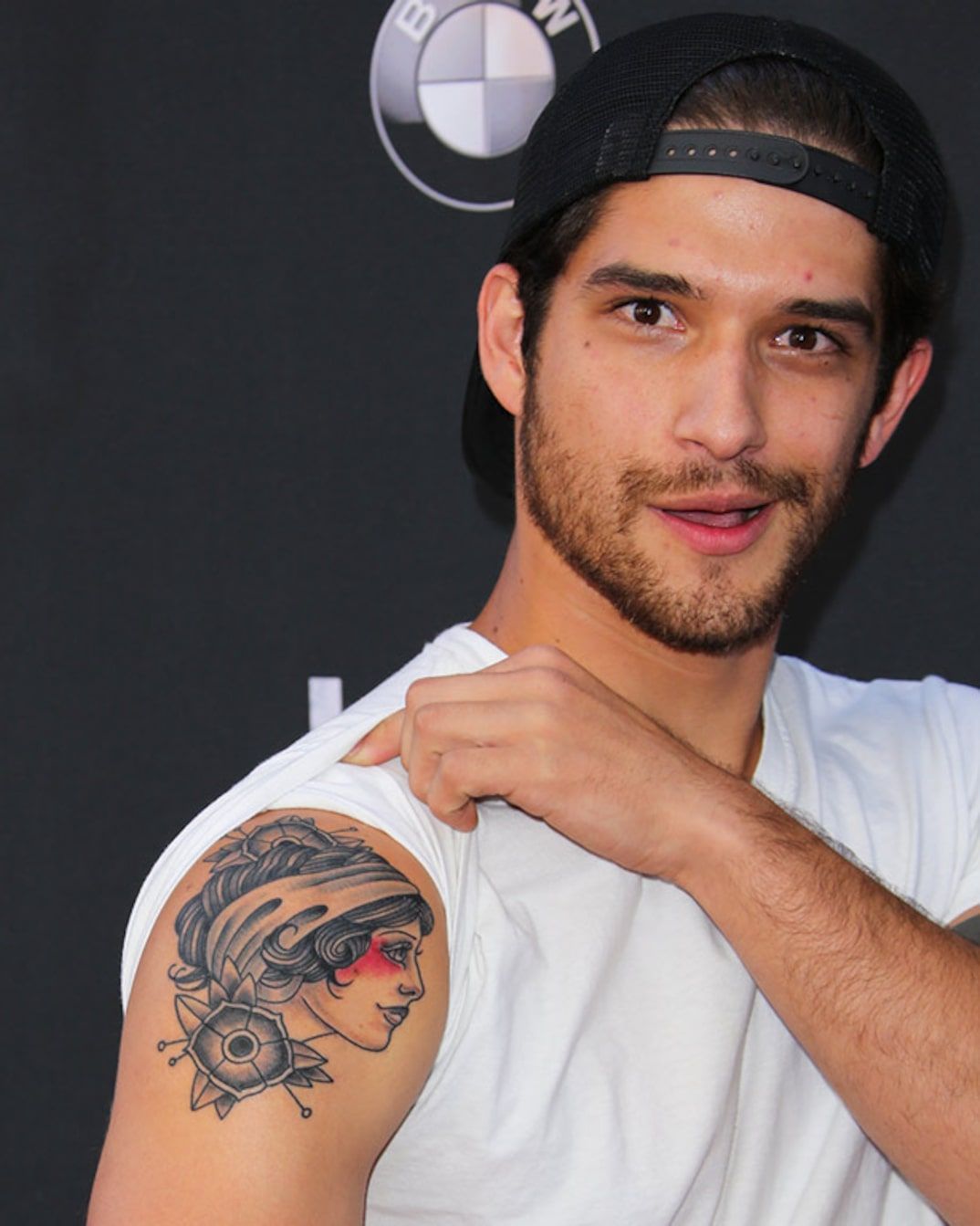
Most people notice Posey’s arm work first. One shoulder has a colourful gypsy woman; the forearm carries a dagger, streetlight, skull, umbrella, and other traditional-style designs. They’re bold enough to read from a distance, but they don’t form one solid blackout sleeve.

Posey has said he chose different artists because he liked seeing how each handled a similar broad style. The outlines, colour, and shading vary, so the sleeve feels like it grew over time instead of being ordered from a catalogue.

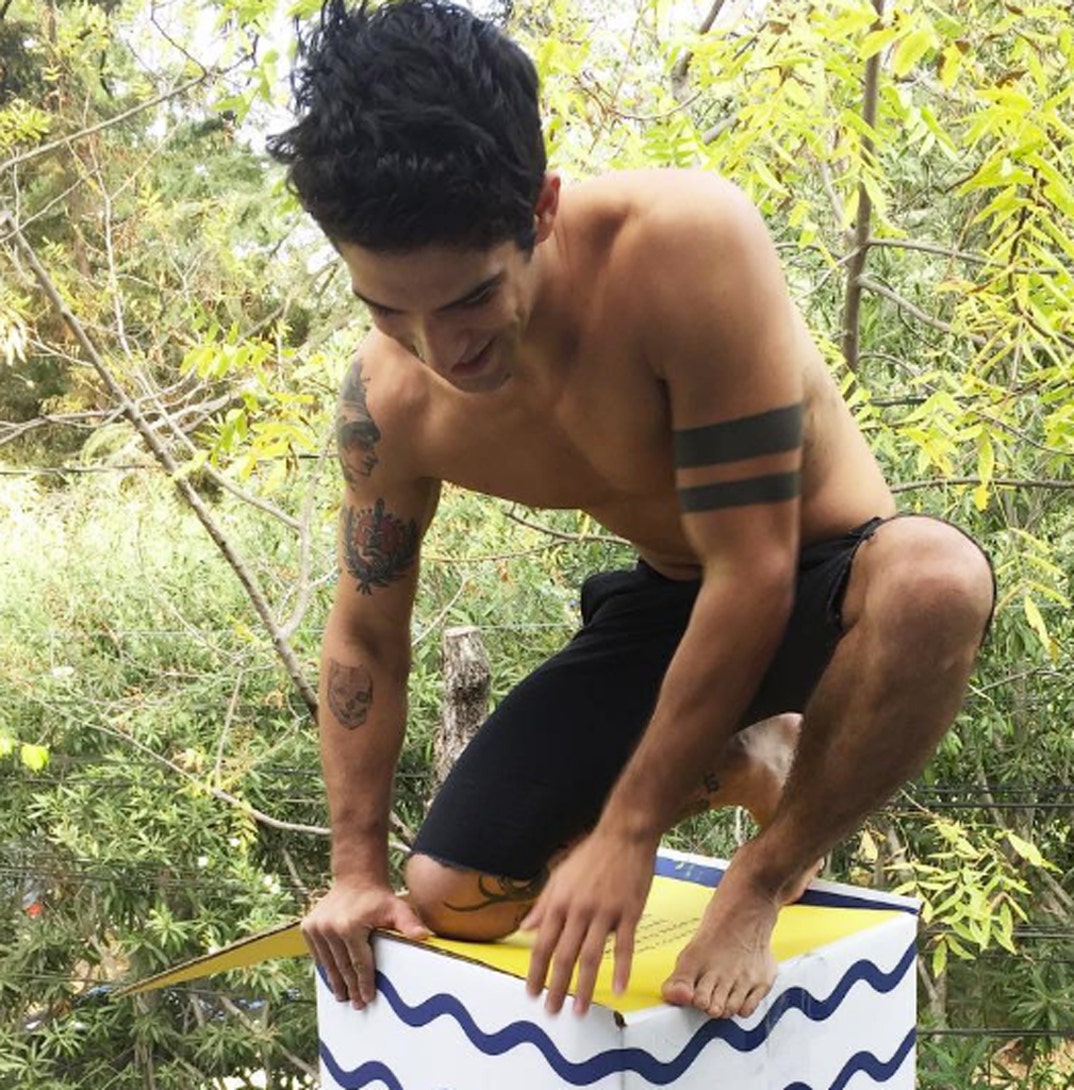
Two solid black armbands are another recognizable part of his look. They sit high on the arm and create a strong contrast with the colourful work. In photos, the black bands can make the red, green, and yellow designs look even brighter.

There’s also a practical story behind the arm tattoos. Posey has explained that moving onto his forearm made the ink much harder to hide. For television, the makeup department had to shave and carefully cover his arms and body. He loves the tattoos, but acting made each new one more complicated.

The leg work includes a painful full-colour piece

Tyler Posey colorful arm tattoos outdoors

Posey’s leg tattoos are less visible in everyday photos, but he has described them as some of his most painful work. In the Teen Vogue tour, he showed a colourful piece on the back of his calf and said it hurt because there’s little padding in that area.

He didn’t frame the pain as a badge of honour. It was more of a warning. The calf design is packed with colour, with very little skin showing through, and was a different experience from a small line or quick arm symbol.

Other leg tattoos include an American traditional tiki from a trip to Hawaii, a small sign, and a hot-air balloon. They give the lower part of the collection a travel-and-memory feel. They aren’t all deep tributes, but they mark places and moments that stayed with him.

Photos of the leg work can be tricky to read because shorts, socks, or the camera angle hide parts of it. A seated portrait might show the dagger and lower-leg designs but not the upper thigh. One picture rarely tells the full story.

The eagle and chest tattoos changed the whole look

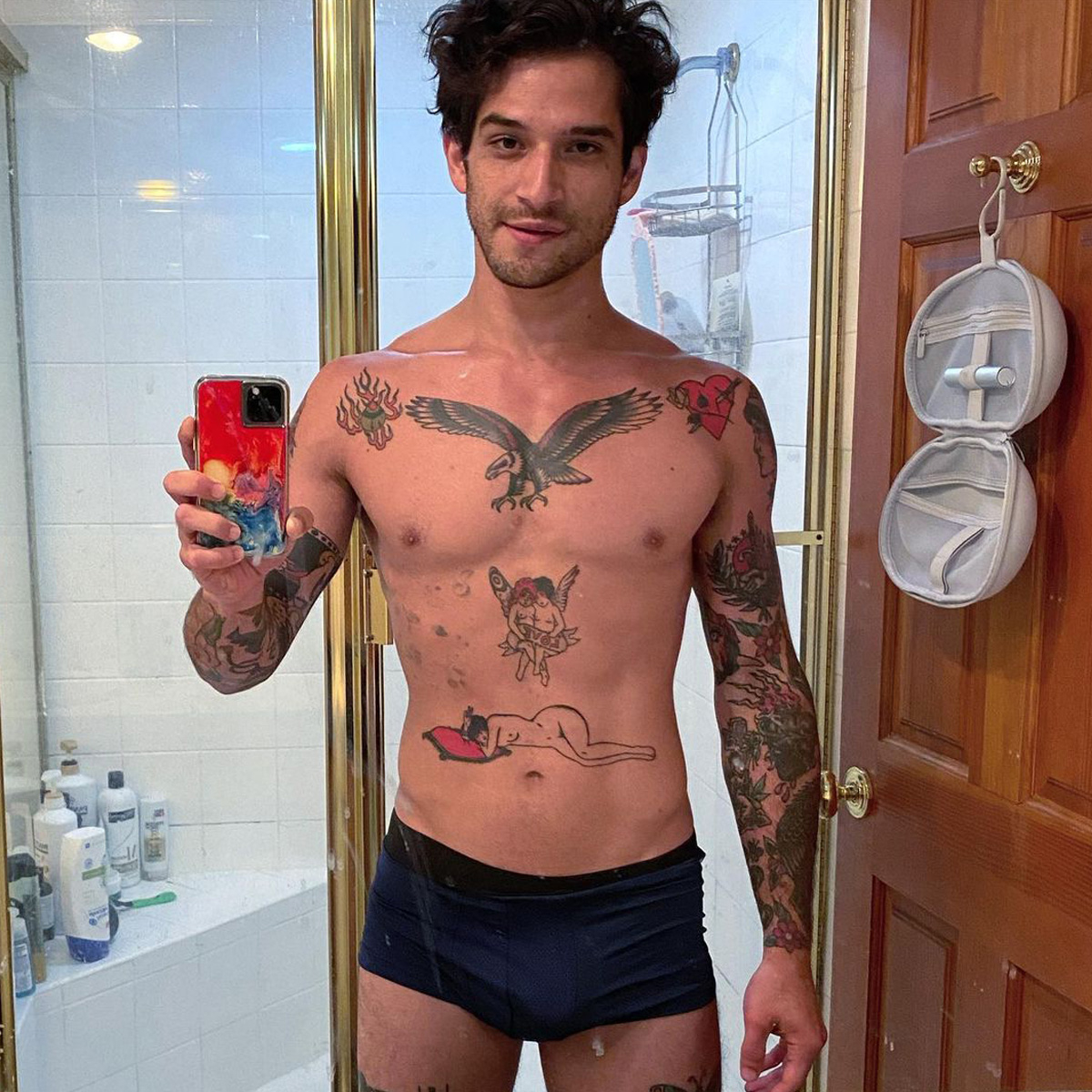
Tyler Posey eagle chest tattoo

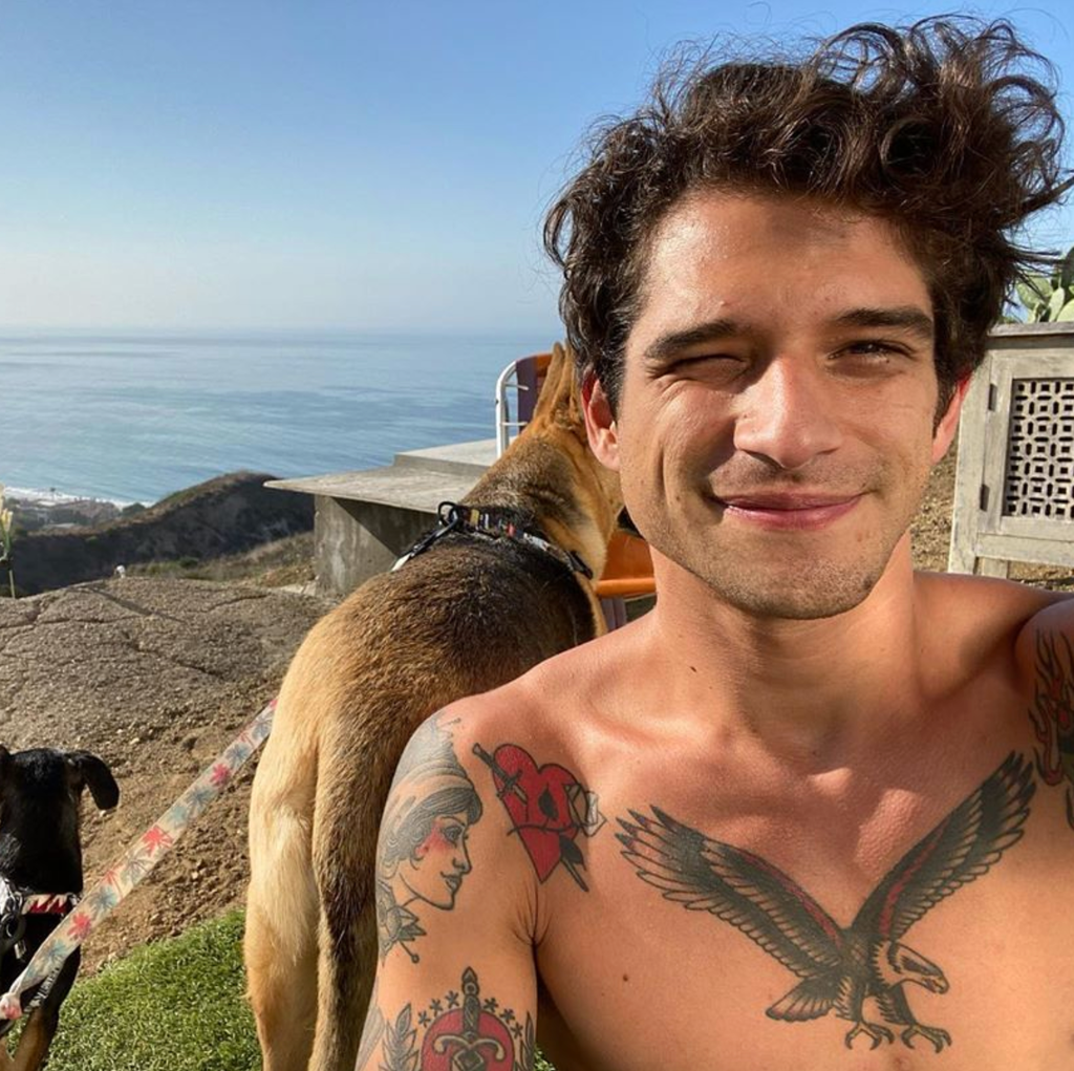
The large eagle across Posey’s chest is one of the easiest tattoos to spot in shirtless photos. Its wings stretch across his upper chest, giving the collection a centre that the smaller early pieces didn’t have.

Nearby are a red heart pierced by a dagger and other small designs around his stomach and ribs. The chest work starts to feel connected, though each tattoo still keeps its own shape and colour.

A cherub-like figure sits lower on his torso, with smaller marks that show up differently depending on the light. Some older photos make the chest look more open; later mirror shots reveal more work around the eagle and down his sides.

The chest ink shows how much Posey’s look changed from the actor-friendly image at the start of Teen Wolf. An eagle isn’t easy to hide with a little concealer. Shirtless, it becomes part of the first impression.

That doesn’t mean the eagle has one confirmed meaning that explains the whole collection. It works visually as a bold traditional bird, and Posey seems comfortable getting tattoos because he likes the image as well as any story behind it.

Comedy masks, skulls and umbrellas keep the collection playful

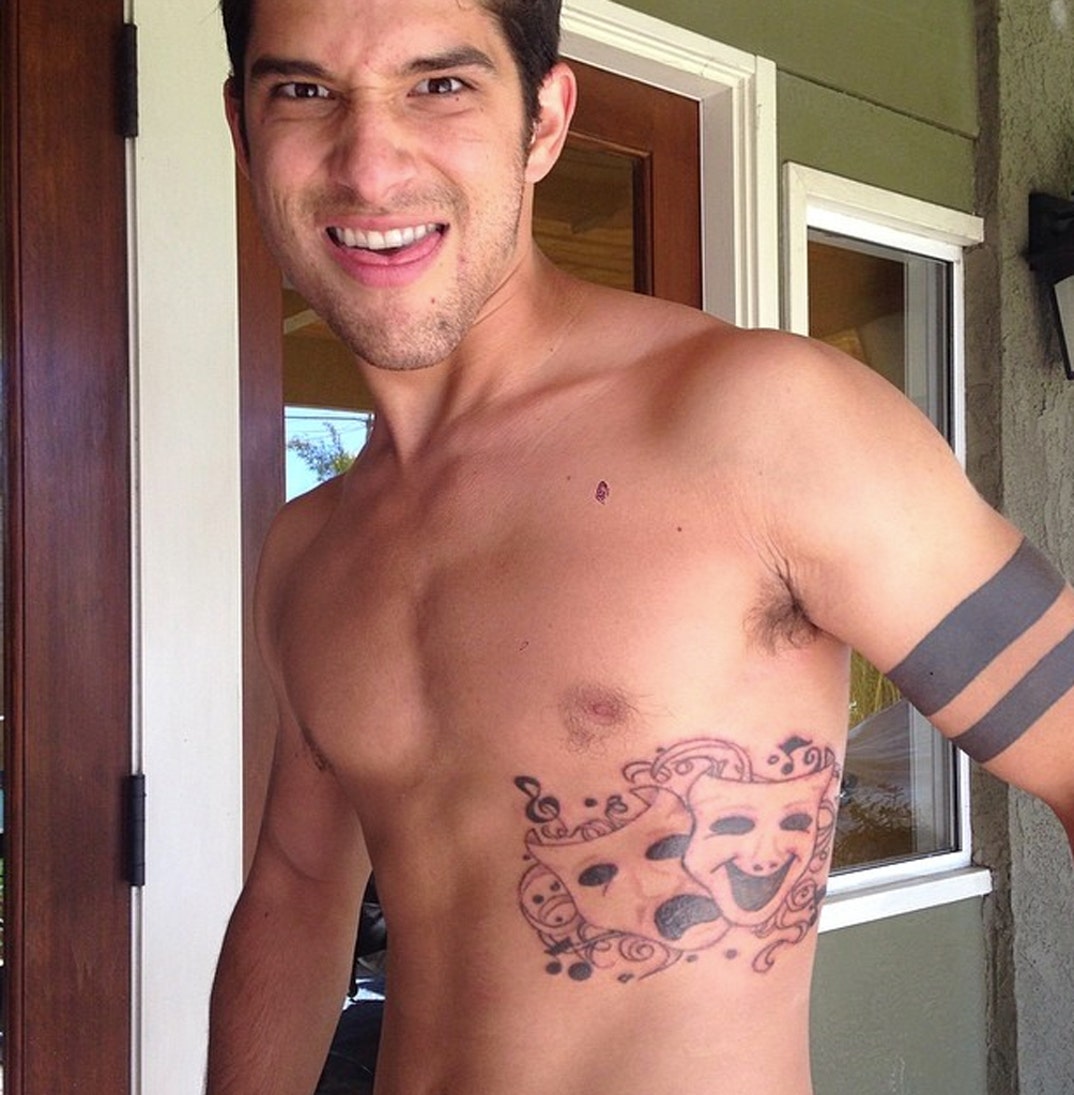
Tyler Posey comedy and tragedy masks tattoo

One of Posey’s more unusual designs is a comedy-and-tragedy mask on his side. The faces bring theatre imagery into a collection that already jumps between music, travel, traditional flash, and personal jokes.

His smaller skull and umbrella tattoos add to the mix. Posey has said he got those two in one session, then added the dagger and streetlight soon after. They may sound simple when listed one by one, but together they add energy to the arm.

He also has a clown, a hot-air balloon, and other small drawings around his body. None of these needs to be forced into one theory. Sometimes he liked the look, remembered a place, or wanted a design that suited the mood.

That relaxed approach is probably why the collection feels less polished than a carefully planned full suit. Blank spaces, different line weights, and tattoos facing different directions make it look lived-in rather than digitally arranged.

Posey’s tattoos had to work around his acting career

Tyler Posey eagle chest and sleeve tattoos

For years, Posey’s main limit on new tattoos was work. He wanted to keep adding ink, but filming meant the makeup department had to hide his arms, chest, and legs. That took shaving, layers of makeup, and careful checks under bright set lights.

It’s easy to forget how much effort that takes when an actor appears bare-skinned on television. Posey’s tattoos are a major part of his look off set, but the show could make them almost disappear. That contrast is why old photos and interviews help when tracing the collection’s timeline.

He has also admitted that some designs no longer carry the meaning they once did. That’s normal with a large collection. A tattoo can begin as a favourite-band reference or a travel memory, then become part of an earlier version of you while the image remains.

The result feels honest because the tattoos aren’t being presented as one perfectly planned story. There’s a Blink-182 note, a painful calf piece, an eagle, a gypsy woman, black armbands, comedy masks, a heart and dagger, a tiki, and plenty of smaller marks. Some have clear explanations; others are simply part of the visual mix.

Tyler Posey’s tattoos work best as a growing scrapbook. His arms carry the bold traditional colour, the eagle anchors the chest, and the legs hold some of the most painful work. The collection keeps changing, but the approach stays much the same: choose tattoos he likes and let them build on each other.

Alex Terrible’s Tattoo Suit: Winged Skulls, Snakes and a Past He’s Had to Explain

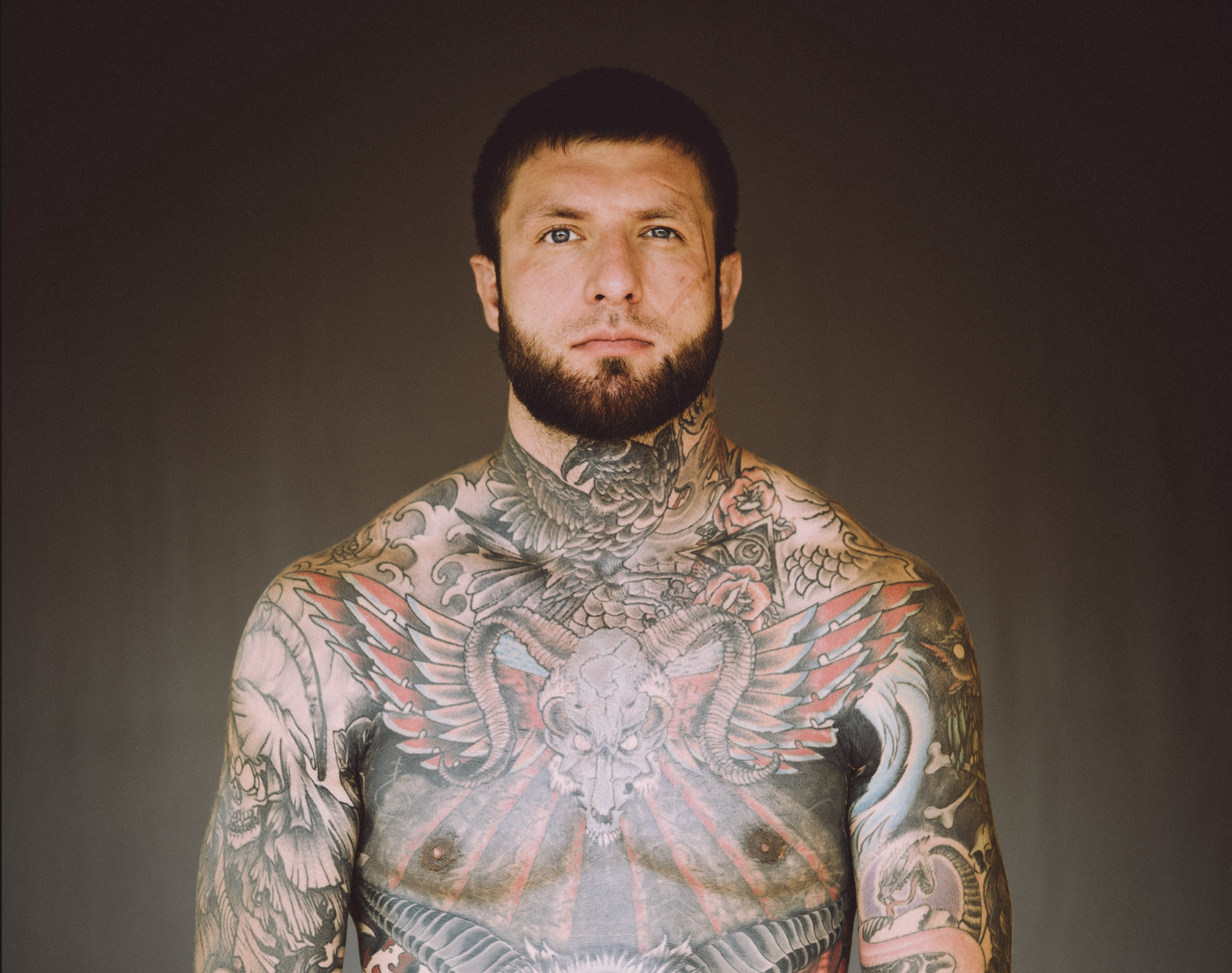
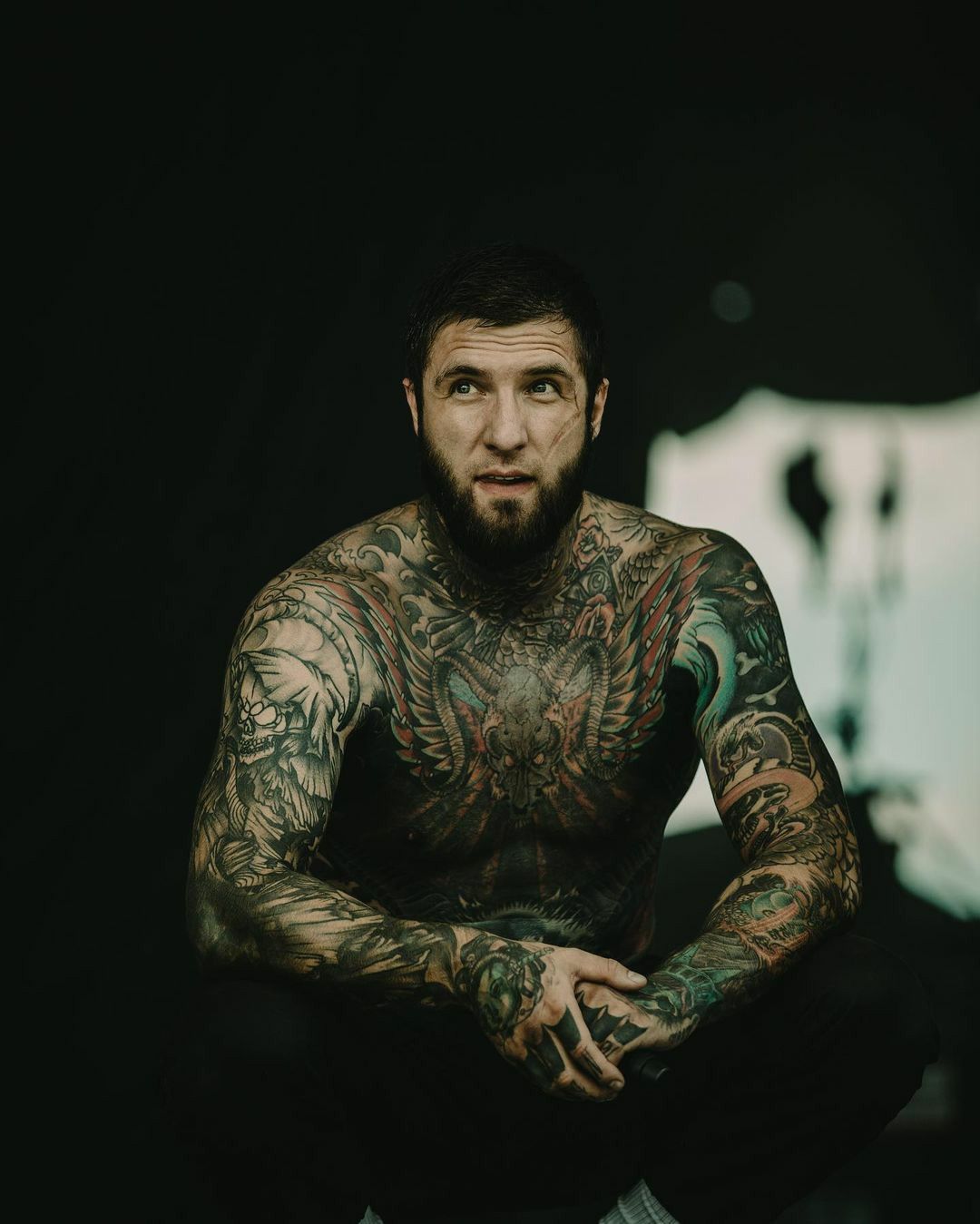
Alex Terrible’s tattoos often make an impression before he starts singing. The Slaughter To Prevail frontman has dark, colourful, densely shaded work across his chest, neck, arms, hands, and stomach.

A large winged skull anchors the collection, surrounded by rays, creatures, and ornamental black-and-grey designs. Snakes, flowers, faces, bones, and smaller hand tattoos appear around it. There’s also a difficult part of the story to address: some earlier symbols were connected to far-right imagery, and he has since covered one.

The winged skull that dominates Alex Terrible’s chest

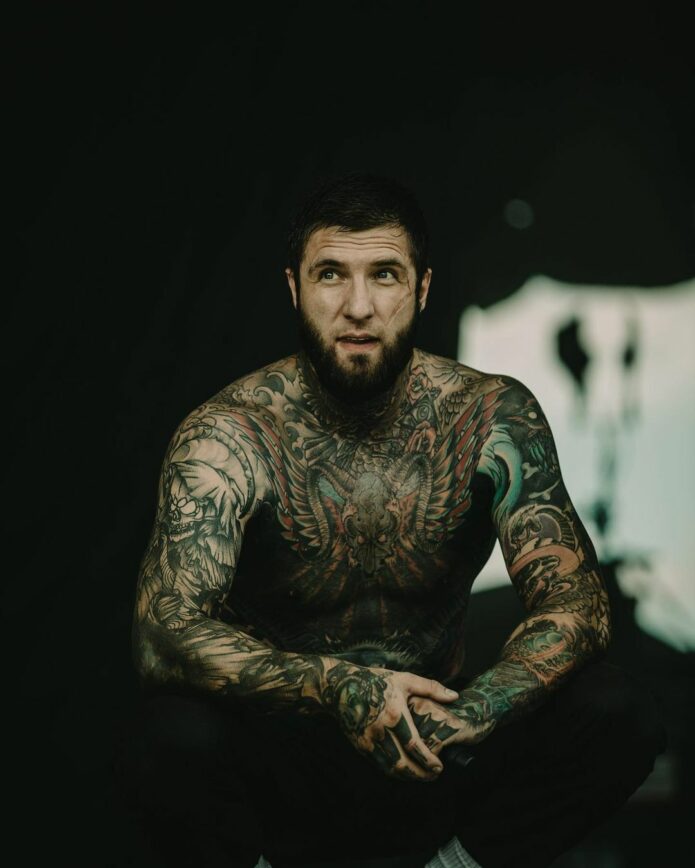
Alex Terrible winged skull chest and arm tattoos

The main chest design is a large skull with wings spread across his pectorals. The skull sits in the centre and its wings reach toward both shoulders. Red highlights break through the dark shading, adding colour to an otherwise gothic piece.

Below the skull, skeletal and demonic shapes continue down his torso. Above it, the neck and upper-chest tattoos help the whole front read as one composition rather than a lone skull surrounded by bare skin.

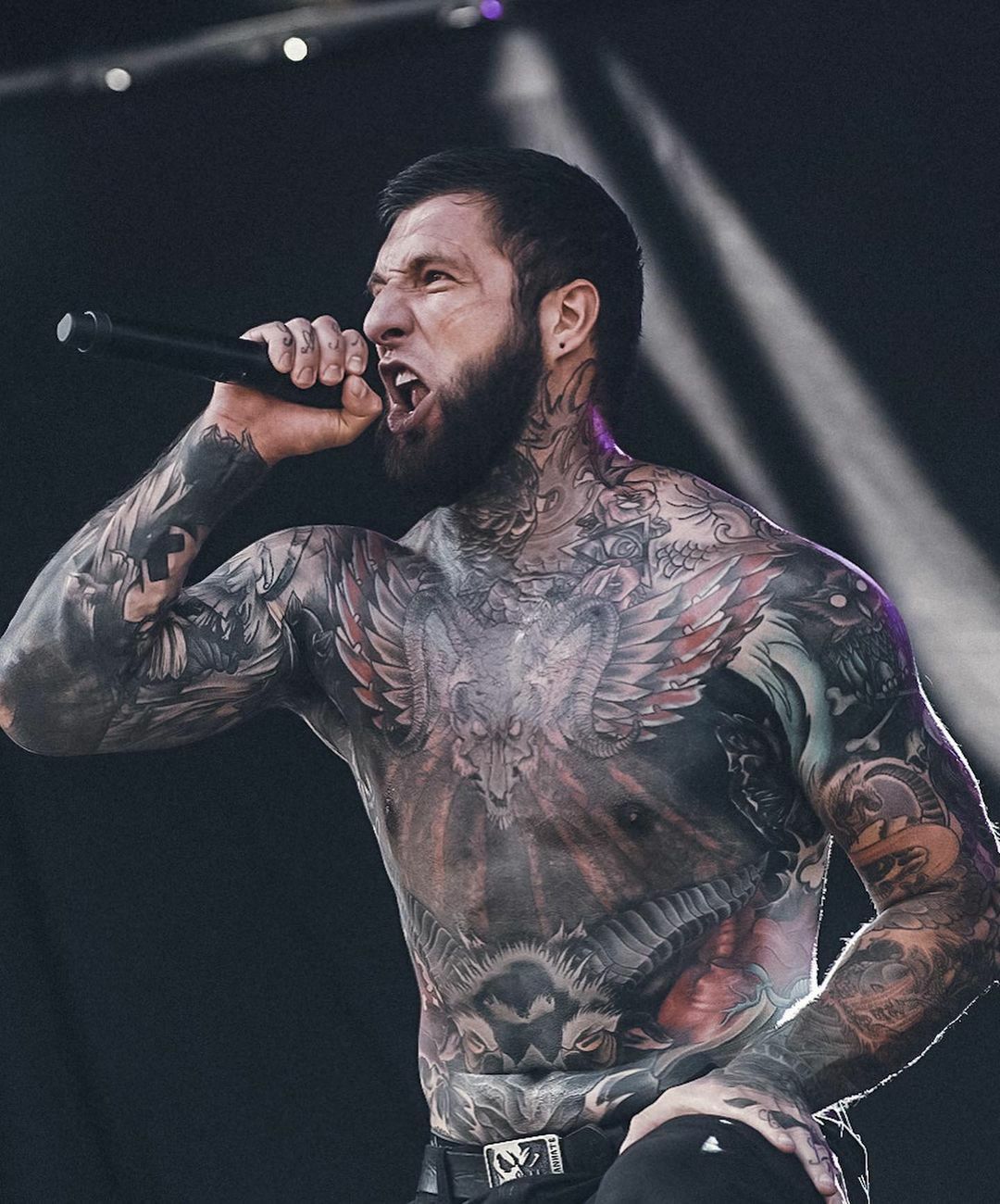
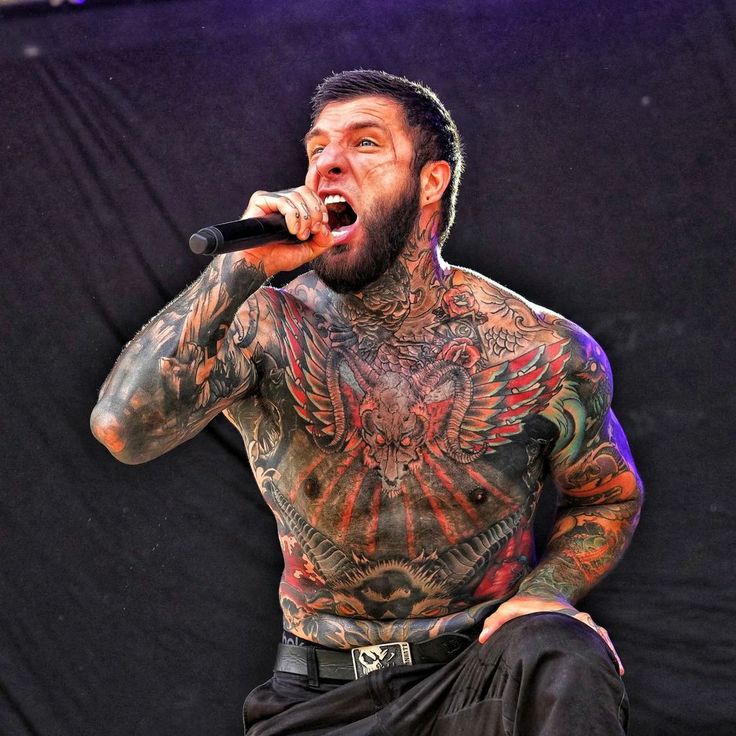
It’s the image most people recognize when Terrible performs shirtless. Concert lights bring out the red sections; in studio photos, the grey shading and smaller lines around the wings are easier to see.

There’s no need to assign one grand meaning to every part. The design suits his deathcore image, but that alone doesn’t tell us what each skull, wing, or ray means to him. What’s clear is that the chest is built around a dark central figure, with surrounding work extending across the torso.

Neck tattoos, roses and the details around his shoulders

Alex Terrible chest and neck tattoos

The tattoos continue above the collarbone. Terrible’s neck is covered in detailed black-and-grey work, including a large bird-like or winged design beneath his beard and smaller shapes running toward the sides.

Flowers and leaves fill the shoulder area. They add a slightly traditional tattoo feel beside the darker, more monstrous figures across his chest. Petals, curling lines, and shaded sections appear around the larger images.

That mix keeps the upper body from reading as one solid block of black. Some areas have heavy fill; others leave enough skin visible for the outlines to breathe. In a close portrait, the shoulder details are easier to make out than during a fast concert.

Smaller marks around the collar and upper chest are harder to identify from a distance. Rather than name every dark patch as a separate symbol, it’s fair to treat them as part of the larger neck-and-shoulder work unless Terrible has explained a particular detail.

The arm sleeves are packed with skulls, snakes and colour

Alex Terrible full torso tattoos

Both arms are covered from the shoulders toward the hands. They aren’t exact mirror images, but share the same dark, gothic mood as the chest.

Skulls, bones, and animal shapes appear across the sleeves, with snakes winding through darker sections. The linework is busy, and colour arrives in smaller flashes rather than big blocks. Reds, greens, and muted orange tones sit among the black and grey.

Faces and ornamental shapes are easier to see in a mirror or posed portrait. Onstage, low light and dense designs cause the arms to blend with the chest. A well-lit photo reveals much more.

His forearms and hands also carry smaller tattoos, including lettering and dark shapes without a clear public explanation. They add to the full-suit effect, but one photograph isn’t enough to invent a story for every mark.

The stomach and lower torso turn the chest piece into a full suit

Alex Terrible bathroom mirror tattoos

One reason Terrible’s tattoos look so dramatic is that the artwork continues below his chest. The stomach has another large dark design, with sharp forms and shading that connect to the winged skull above.

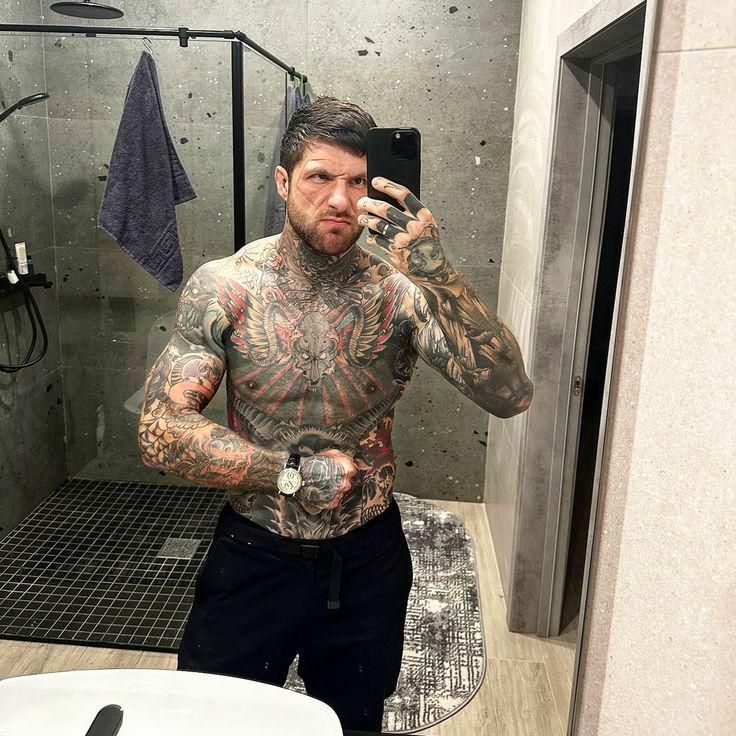
Mirror photos show how much of the lower torso is covered. Faces, curved ornamental lines, and heavy shading fill the ribs and stomach. The result is closer to a bodysuit than a chest tattoo paired with a couple of sleeves.

The stomach work changes the balance of the overall design. Without it, the winged skull would be the natural stopping point. With the abdomen filled, the eye moves from the neck and chest down across the body and out through both arms.

The tattoos were added over time, so not every section has the same colour or age. Some areas look brighter and sharper; older pieces have softened into the surrounding shading. That’s normal in a collection this large and doesn’t mean every difference is a new design.

What the tattoos say about his metal image — and what they don’t

Alex Terrible winged skull stage tattoos

The connection to Terrible’s role as a deathcore frontman is obvious. Skulls, wings, horns, snakes, and dark figures fit the visual language of extreme metal. They also hold up under harsh stage lights, where a fine-line design might disappear.

But the tattoos aren’t just a costume. Terrible has talked about getting ink when he was young and wanting to look like the musicians he admired. That early influence shows in how much space the designs cover: a youthful fascination with heavy music became a lasting visual identity.

He has said the tattoos became part of his character. A shirtless performance turns them into part of the show, but they still belong to the person beneath the stage persona. It helps to distinguish what the imagery looks like from claims about what each design means.

The full suit is dramatic, but not completely uniform. Some areas are colourful, others nearly all black and grey, and some smaller tattoos feel like separate ideas added between larger sessions. That unevenness makes the work feel lived-in rather than digitally arranged.

The Black Sun tattoo was covered, and the history matters

Alex Terrible full tattoo suit mirror

One part of Terrible’s tattoo history needs clear context. He once had a Black Sun, also known as a Sonnenrad. The symbol has older historical roots, but Nazi and white-supremacist movements appropriated it, and it is widely recognized in that context today.

Terrible has said he got it when he was younger, during a period when he was drawn to far-right people and ideas. He has denied being a Nazi and called the tattoo a poor decision from that stage of his life. The visible point is that he later covered the Black Sun, so older photos may show a symbol that isn’t visible in more recent ones.

Reports have also linked him to an Othala rune tattoo on his foot. That symbol has been appropriated by white-supremacist groups, while also having older, pre-Nazi meanings. It’s safest to explain that history and the controversy without treating a photo as proof of what Terrible believes today.

That context is part of the tattoo story, not something to hide behind the skulls and colour. A tattoo can have a private intention and still carry a public history that other people recognize. Covering one design changed what is visible, but it didn’t erase why people continue to ask about it.

Outside that controversy, the rest of the tattoos read as a large metal-inspired body project. The chest skull, wings, snakes, roses, bones, and dark sleeve work make a recognizable look that has followed him from small venues to bigger stages.

Alex Terrible’s tattoos are a full visual identity

Terrible’s tattoos aren’t subtle, and they were never meant to be. The winged-skull chest, packed sleeves, neck work, and filled stomach make a look closely tied to his music.

The clearest details are the central skull, wings, red accents, animals, roses, and dense arm work. Smaller pieces deserve a closer photo before anyone tries to name them or assign a meaning.

There’s a timeline in the collection. Early tattoos helped build his metal image, later sessions filled in more of his body, and covering the Black Sun changed what appears in newer photos. Different images may reflect changes to the tattoos, rather than one photo being false.

Put simply, Terrible has a dark full-body tattoo suit with a lot of detail. It stands out under concert lights, in a bathroom mirror, and in a studio portrait. The images are loud, but a closer look rewards attention—as long as confirmed details stay separate from guesses.

More musician tattoo guides

Sergio Ramos’s Tattoos: Family Names, Football Numbers and a Fully Inked Back

Sergio Ramos’s tattoos read like a scrapbook of his life: family names, football numbers, religious images, match memories, portraits, and lettering across his chest, back, arms, hands, and legs.

He has dozens of designs, and counts vary as he adds new ones. It’s more useful to focus on the tattoos that have been clearly photographed or explained than to pretend every small mark has a confirmed story.

The style is large, busy, and personal. Some pieces form dense sleeves; others stand on their own, like “DAD” across a shoulder or the large 1986 on his stomach. The details range from a full back scene to small initials and dates.

That contrast is part of the appeal. A portrait across the back needs room, while a birth date or initial can fit on a finger and still matter just as much. Ramos seems comfortable with both: a large new image one year, then small numbers that only make sense once someone asks.

Football photographs aren’t usually taken to show tattoos. Shirts, tape, armbands, sweat, and lighting can all hide or soften the work. Clear views tend to come from shirtless portraits, hand close-ups, and occasional post-match photos.

The family lettering is impossible to miss

Sergio Ramos family lettering chest and body tattoos

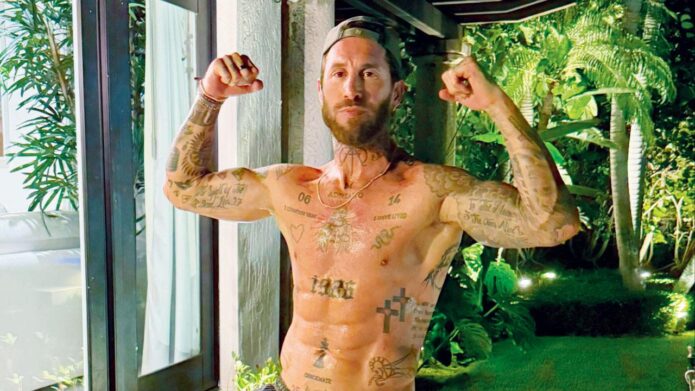
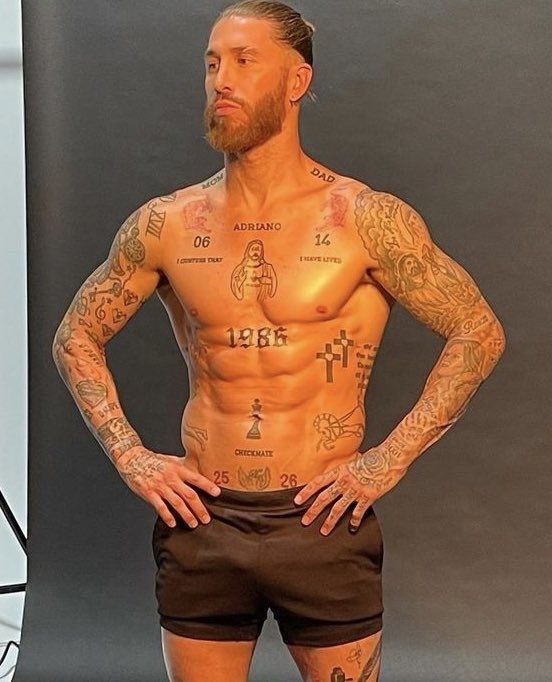
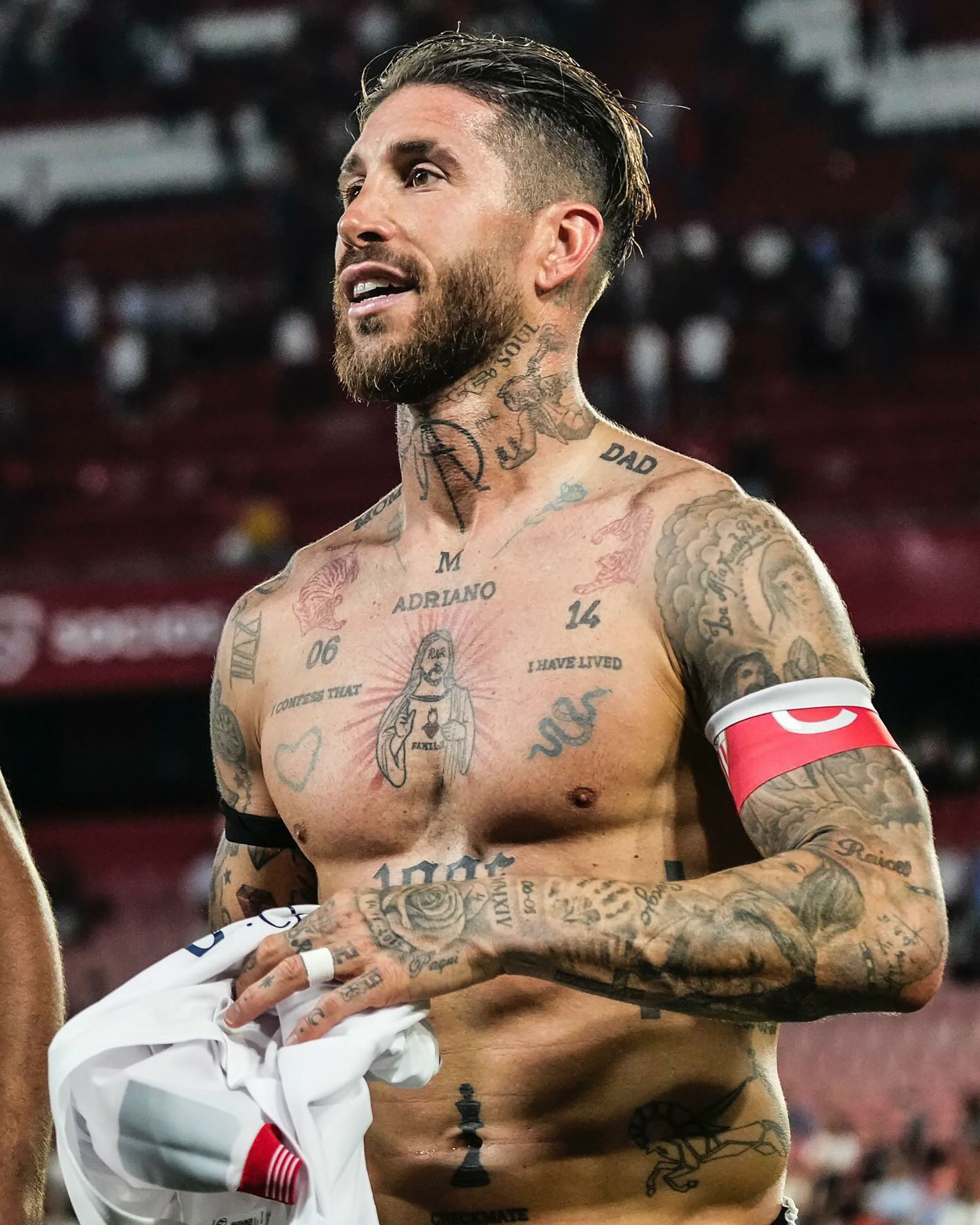
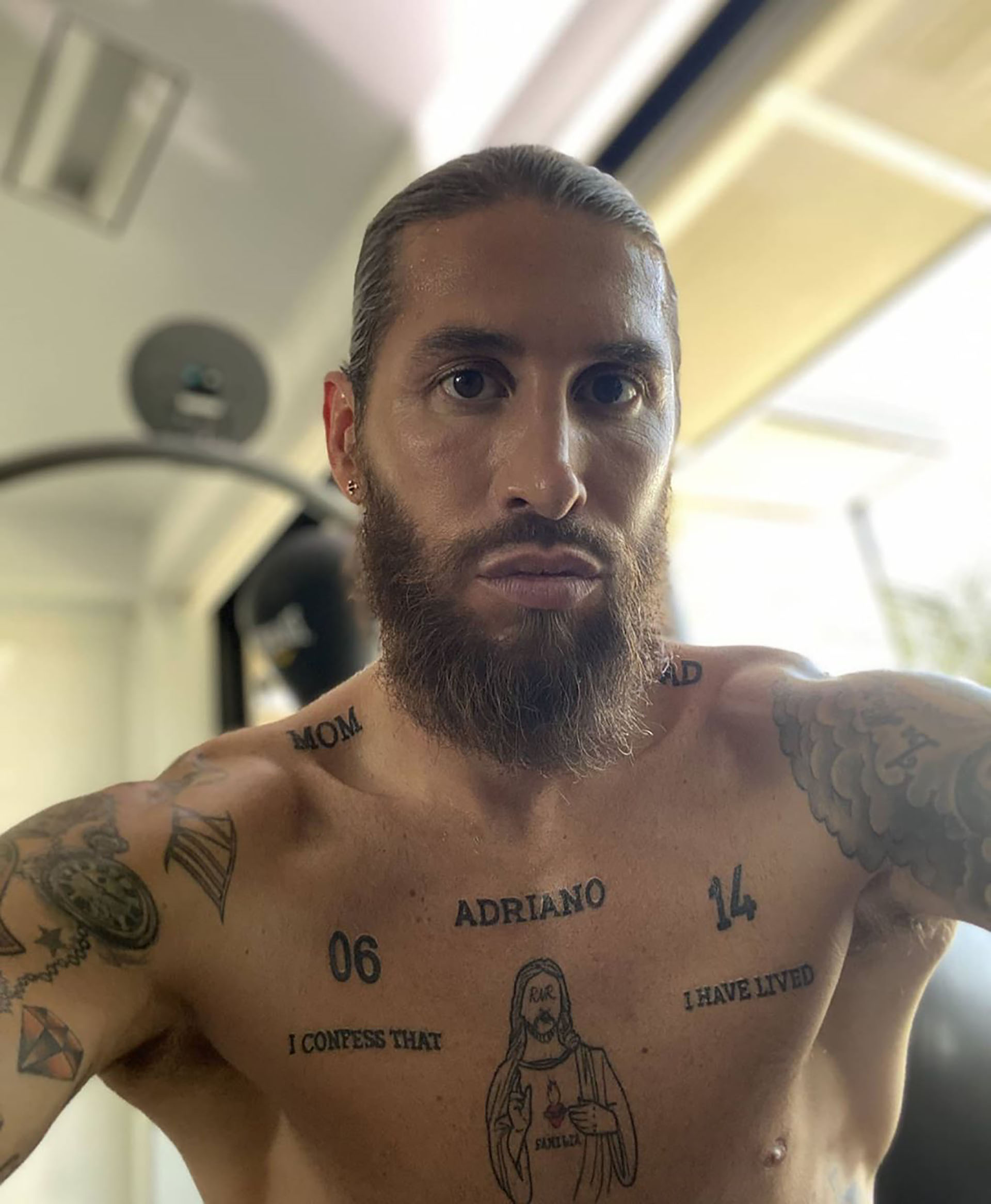
Ramos’s chest has some of the clearest personal lettering in the collection. “MOM” sits on one side, with “DAD” above the other shoulder. The words are simple and bold, giving a clear centre to his heavily tattooed body.

The name ADRIANO appears across his chest as a tribute to his son Máximo Adriano. Nearby numbers include 06 and 14, though explanations of every number vary. The family names are direct; the smaller numbers work more like private markers.

Beneath the central chest work, the phrase “I CONFESS THAT I HAVE LIVED” comes from Pablo Neruda’s memoir. It adds a reflective note to an area that already brings family, literature, and faith together.

His chest piece mixes Jesus, numbers and “1986”

Sergio Ramos Jesus chest tattoo and 1986 tattoo

At the centre of Ramos’s chest is a figure of Jesus. The letters R and R appear around the design as a nod to Ramos and Pilar Rubio. It’s larger than the names and symbols nearby, making it the visual anchor of the torso.

Just below it is the large 1986, his birth year and one of the easiest details to spot in shirtless photos. Beneath and around the date are smaller images, including a chess design marked “CHECKMATE”.

The chess reference suits Ramos’s competitive, tactical, slightly theatrical way of talking about football. It doesn’t need a complicated private backstory to work. A pawn, a word, and a birth year make the stomach a small collection of personal markers.

The back is a full scene of lions, religious imagery and script

Sergio Ramos detailed back tattoo with lion and religious imagery

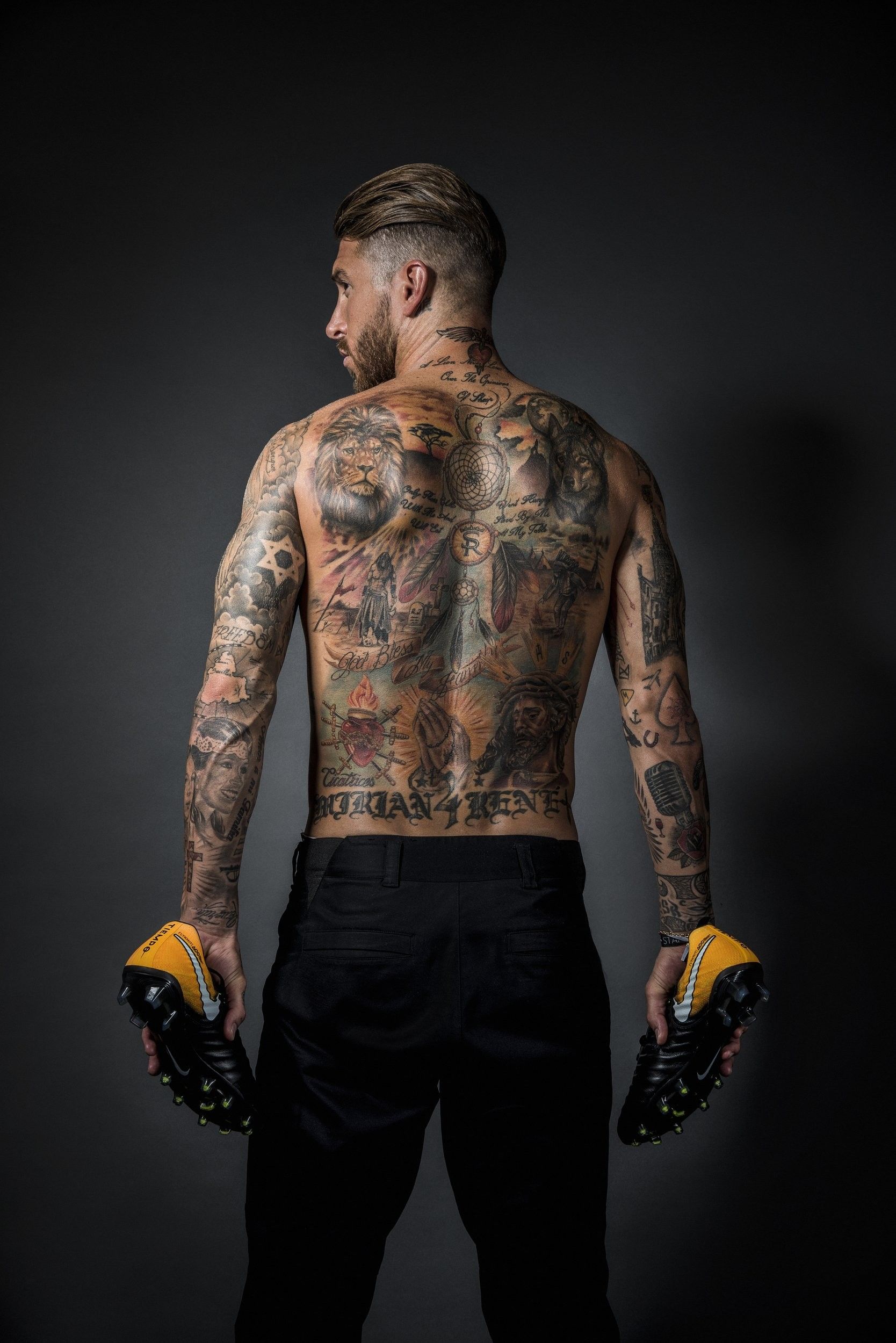
The scale grows on Ramos’s back. A large lion fills one side, with a dreamcatcher, religious images, figures, and long script around it. From a distance it reads as one composition, but there are many separate designs within it.

One photo shows “GOD BLESS MY FAMILY” across the lower back. It echoes the family words on his chest, while the back piece has a darker, more dramatic feel from the lion, clouds, and shaded figures.

A dreamcatcher and religious figures, including imagery connected with Jesus, appear elsewhere in the design. Ramos hasn’t publicly explained every part, so it’s better to describe the artwork clearly than invent meanings for each cloud or line.

Ramos uses numbers to record his football career

Sergio Ramos chest and neck tattoos after a football match

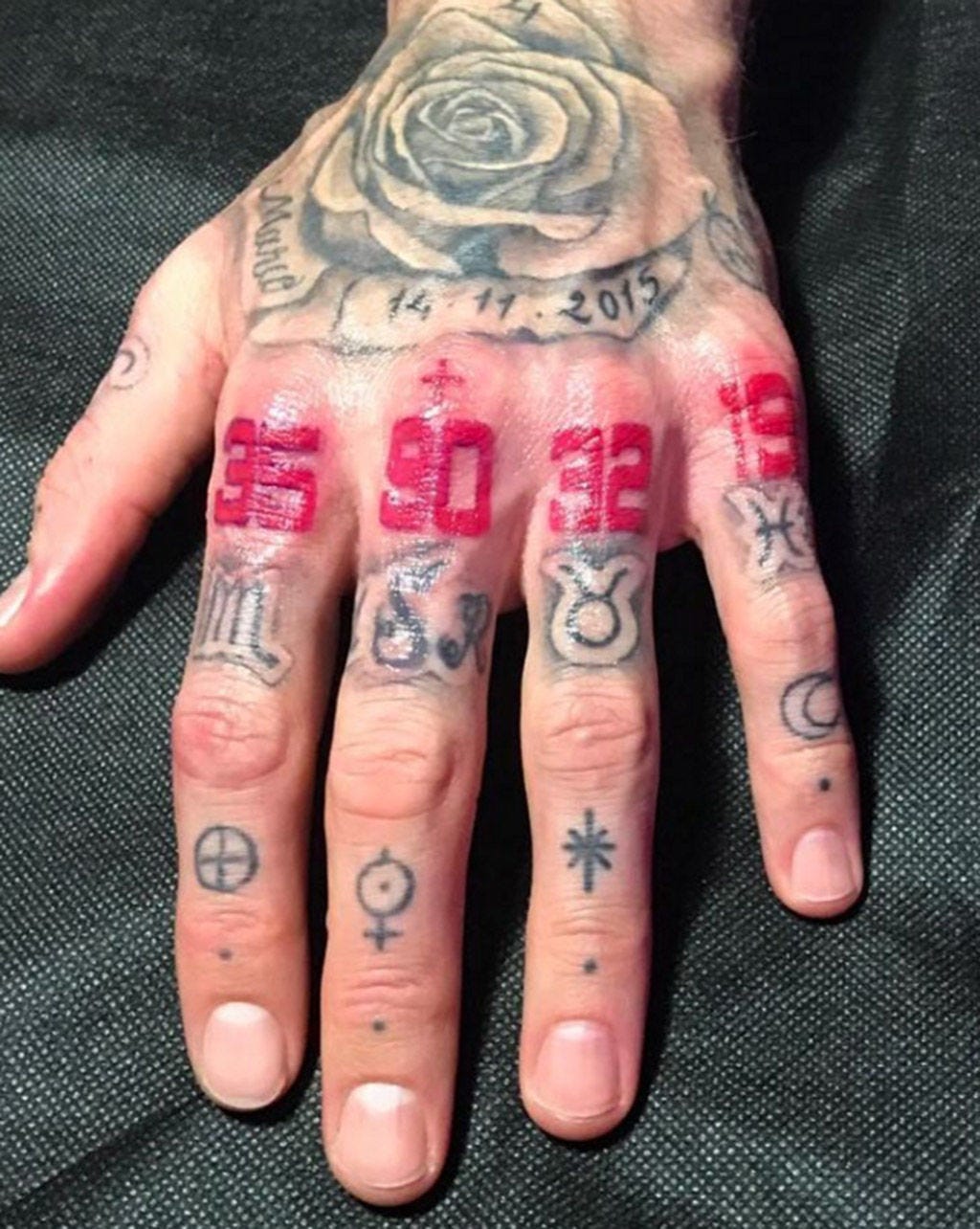
Football memories show up throughout Ramos’s tattoos. The best-known example is a set of hand numbers: 35, 90+, 32 and 19. They refer to different career moments, including early shirt numbers, his Spain debut, and the stoppage-time goal that became part of Champions League history.

His trophy tattoos follow the same idea. The World Cup, Champions League wins, and other major moments appear on his calves and legs, turning his body into a record of matches that matter to him. Rather than a generic ball or club crest, he often marks a specific number, date, or competition.

That’s why the tattoos feel so tied to his career. Ramos has played at the top level for long enough for the collection to grow with him. After a match, the designs show a player keeping track of the moments that shaped his path.

The hand tattoos carry dates, children’s details and career numbers

Sergio Ramos red knuckle number tattoos and rose hand tattoo

The hand work is smaller but just as full of detail. Red numbers across the knuckles stand out beside older black symbols, Roman numerals, and a rose. The date 14-11-2015 appears around the flower and has been connected with an important family moment.

Ramos has also used his hands for names, birth information, and symbols linked to his children. One account describes numbers recording details such as birth times and weights. It’s very much his approach: turn a personal fact into something permanent.

The rose softens the design, while the red numbers give it the feel of a small sports scoreboard. That contrast makes the hand tattoo stand out: sentimental, but still sharp and competitive.

The sleeves are packed with portraits, symbols and old-school pieces

Sergio Ramos tattooed arms and chest in shirtless portrait

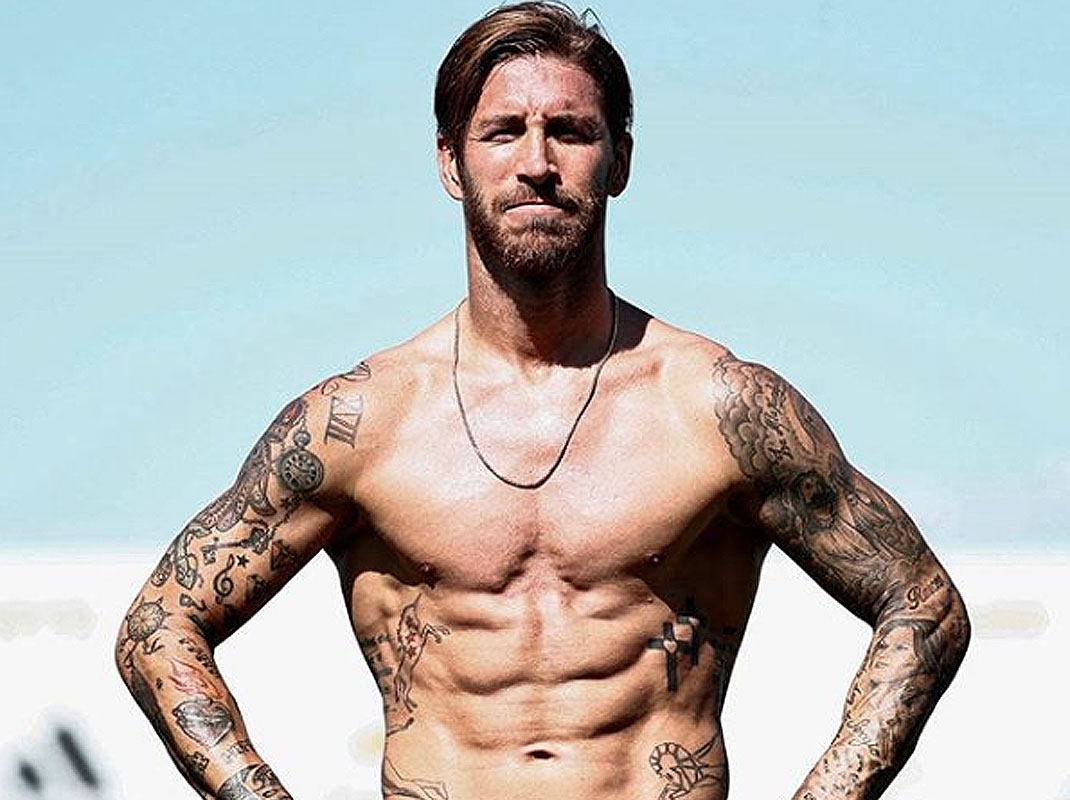
Both arms carry portraits, lettering, religious designs, animals, and smaller symbols. From one angle the sleeves look traditional, with shaded faces and bold outlines. From another, the gaps and newer pieces make it clear the work was added over many years.

Ramos has tattoos connected to family, friends, and football figures, including a tribute to Antonio Puerta. Other designs refer to music and art, such as Michael Jackson and a Salvador Dalí-inspired elephant. Banksy-related images bring a more playful street-art note.

The sleeves aren’t one style. They shift from realistic portraits to text, symbols, and colour, making them look more like a personal collection than a matching set planned in one sitting.

Ramos also has visible tattoos on his neck, legs, and lower torso. The neck pieces show in shirtless photos, while the leg work includes trophies and other career memories. Some smaller designs only appear when he wears shorts or turns away from the camera.

One well-known lower-body tattoo is tied to the 2014 Champions League final in Lisbon. Another marks Spain’s 2010 World Cup win. These designs do the same job as the numbers on his hand: they keep important football memories close, long after a match is over.

There are more personal and unexpected designs lower down, including a Banksy-inspired figure and a toy associated with one of his children. That variety keeps the collection from becoming a list of trophies. Depending on where you look, the ink can be serious, religious, funny, or sentimental.

Taken as a whole, Ramos’s tattoos are detailed and full of references. Family names sit beside religious figures; career numbers share space with portraits, flowers, and old-school symbols. Some meanings are confirmed, others are widely reported, and a few can’t be known from a photograph.

That uncertainty is part of the appeal. Ramos clearly likes tattoos that preserve something: a child’s birth details, a World Cup, a late goal, or a person he wants to remember. He doesn’t need one neat theme to tie it all together.

One photo is never enough for a heavily tattooed footballer. A front view catches the family lettering and 1986; a back view shows the lion and dreamcatcher; close-ups reveal the red numbers on his hand. Together, the photos make the collection easier to follow.

Ramos’s body art is busy, but not random. It records years of football, family, and personal references in different styles. The pieces don’t all have the same mood, and that’s what makes the collection feel like his.

More athlete tattoo guides

Georgia Stanway’s 100-Plus Tattoos: Tiny Symbols, Big Football Memories

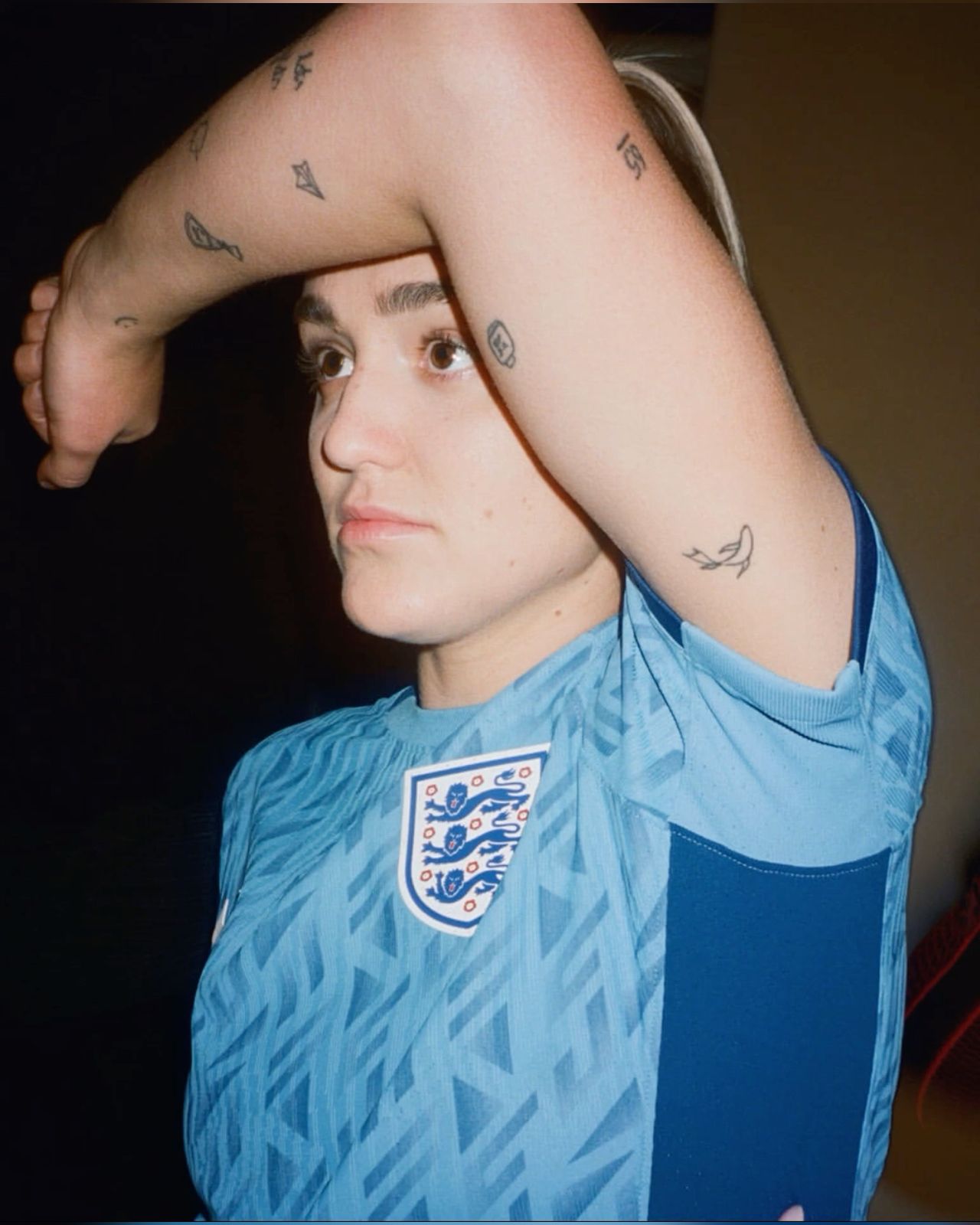
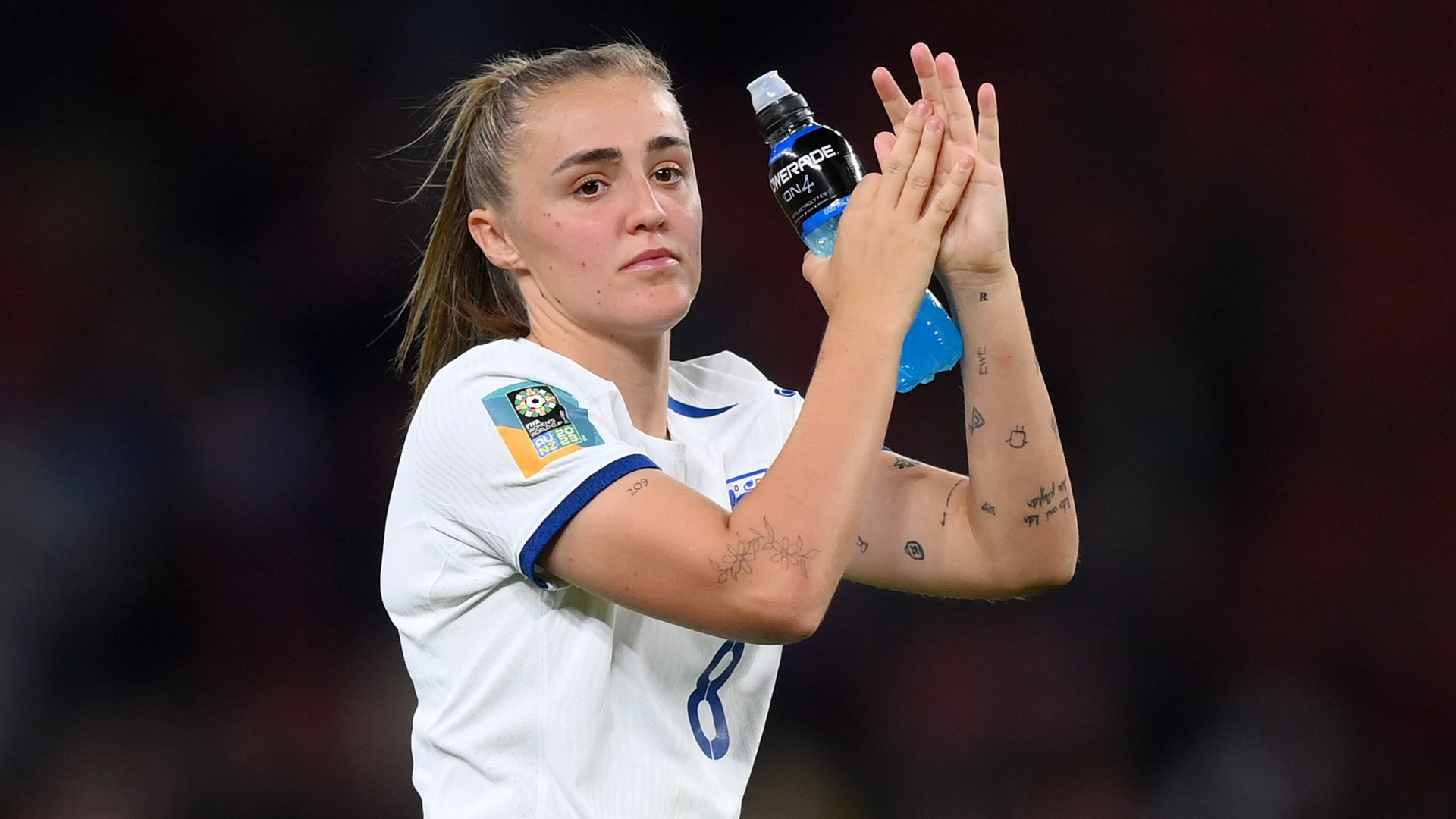
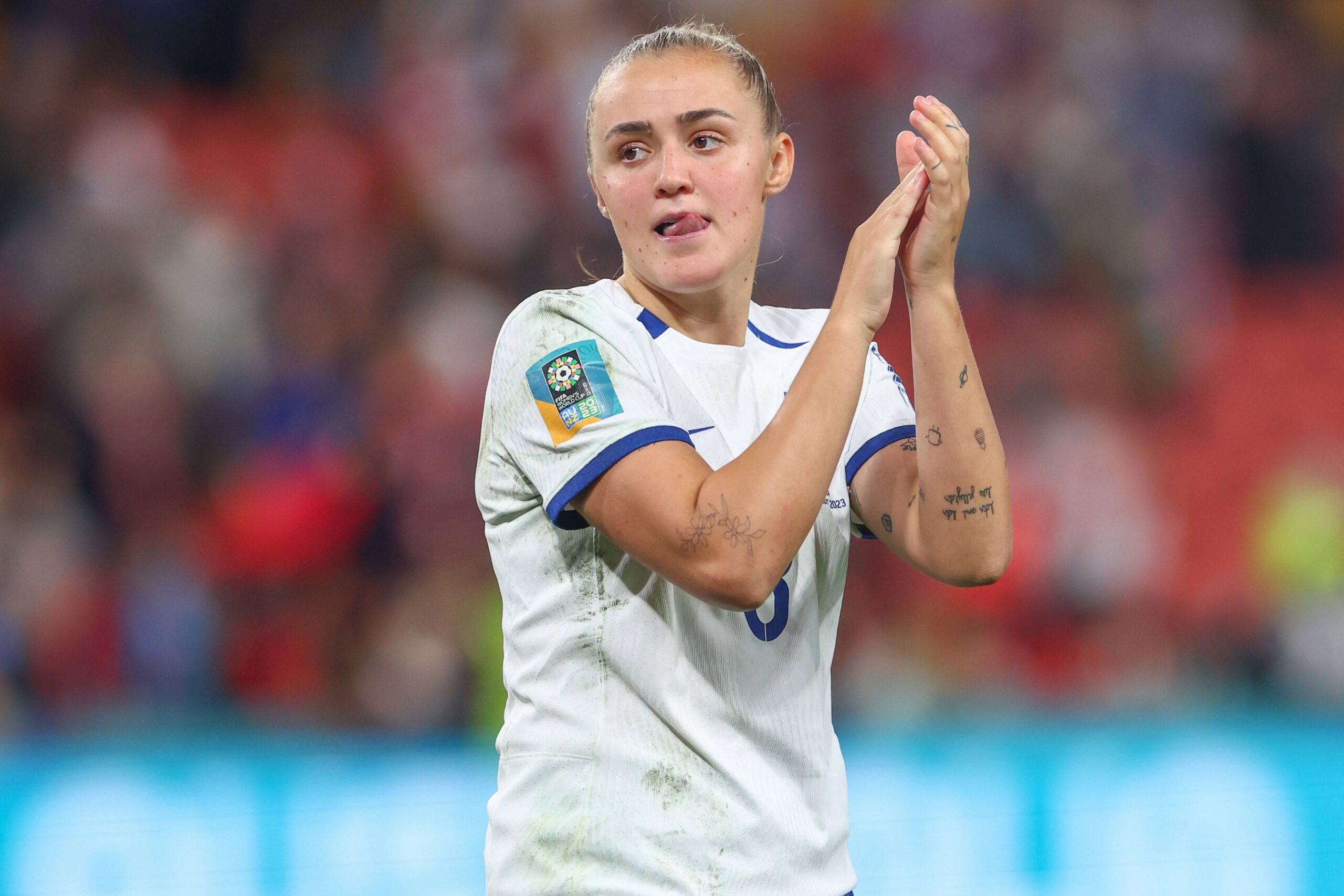
Georgia Stanway’s tattoos aren’t built around one giant sleeve. Small symbols, short bits of lettering, football memories, and other marks are spread across her arms and legs. Together they form a record of her life in football.

Stanway has said she has more than 100 tattoos, adding to the collection as her career moved from Manchester City to Bayern Munich, England, and Arsenal. Many designs are small enough to disappear under a shirt or socks, so they’re easiest to spot in a close-up or a relaxed photo after a match.

She has also taught herself to tattoo and has worked on team-mates. The story is not only about what’s on her skin, but how she treats tattooing as a creative outlet away from elite football. Here’s a look at documented pieces, while leaving the meaning of tiny marks open when it hasn’t been explained.

Georgia Stanway’s small arm tattoos are the heart of the collection

Georgia Stanway scattered forearm tattoos

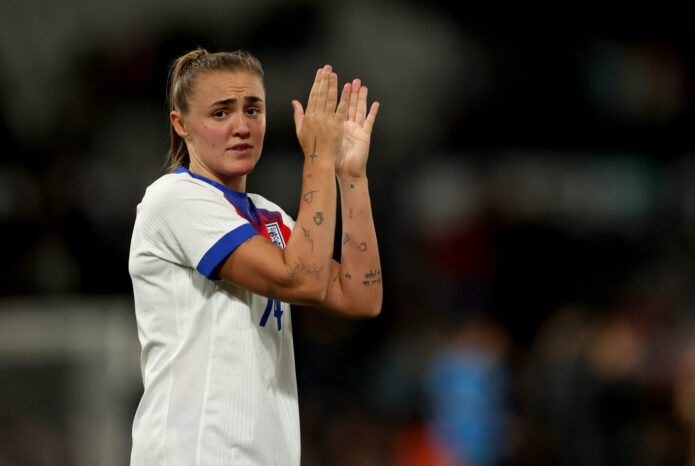
Most photos of Stanway’s tattoos begin with her arms. The designs are small, fine-lined, and spaced out rather than packed into one dark block. A close-up from an England photo shows little shapes on her upper arm and forearm, including simple outlines and symbols that look almost like doodles.

That patchwork look is central to her style. She likes small designs that can sit alongside one another over time rather than planning a huge piece from the start. One tattoo may be a personal reminder, another may be about football, and a third may simply be something she liked enough to keep.

It’s worth being cautious about identifying every tiny image. A blurry match photo can make a line look like a letter or turn a small icon into something else. The broad picture is clear: Stanway has many small arm tattoos, but the meaning of each isn’t always public.

The “Whatever the Weather” tattoo marks her move to Arsenal

Georgia Stanway Whatever the Weather forearm tattoo

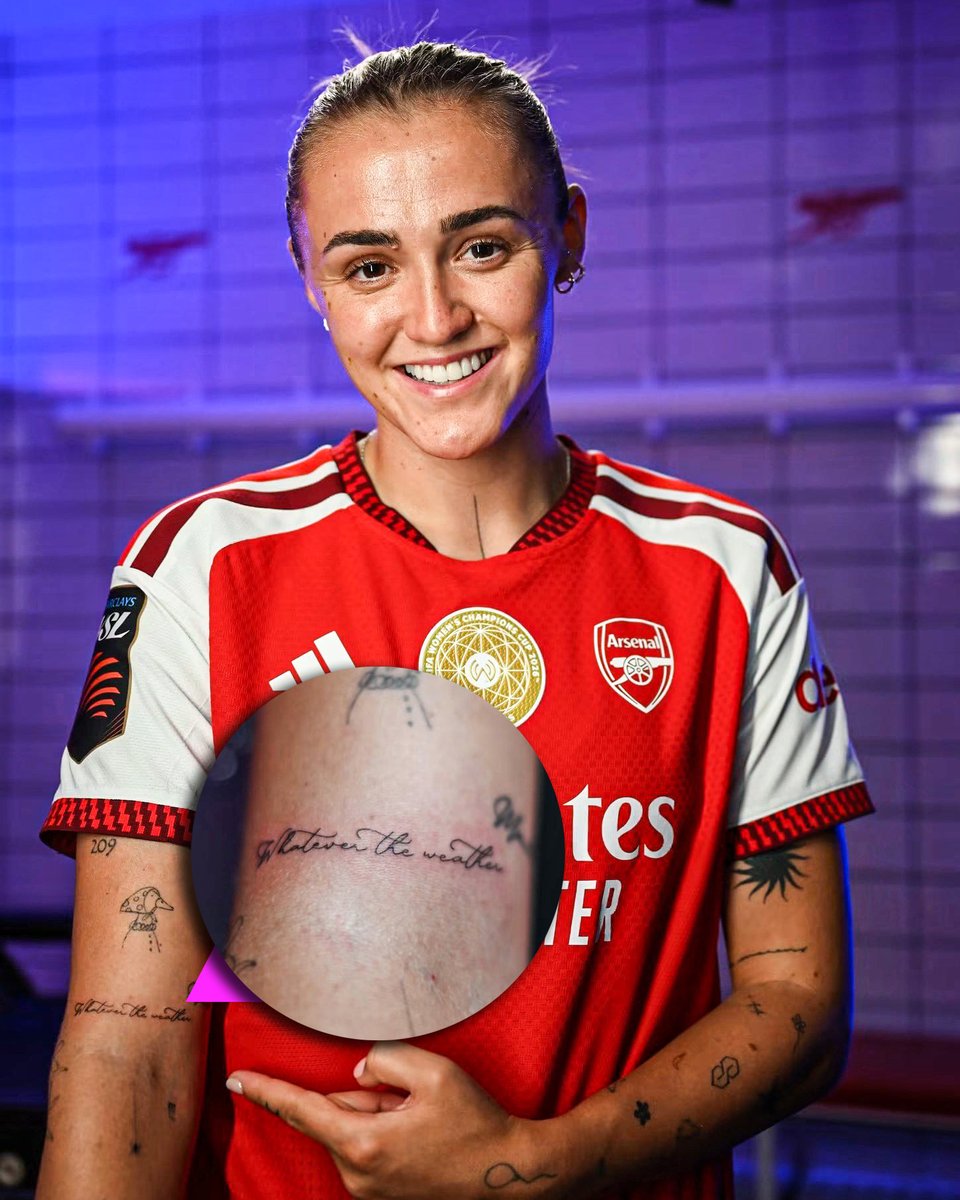
One of Stanway’s clearest tattoos is “Whatever the Weather” on her forearm. The phrase appeared around the time she moved to Arsenal and fits the attitude she has brought to the next stage of her career.

The loose script feels more personal than a block club logo. It stands on its own as a reminder to stick with something through both the good days and the difficult ones.

The timing gives it another layer. Stanway spent four seasons at Bayern Munich before returning to England, and the tattoo marks a transition between chapters. By then she already had a large collection, but this phrase connects to a specific football decision.

“HOME” sits beneath a small arch of stars

Georgia Stanway HOME stars forearm tattoo

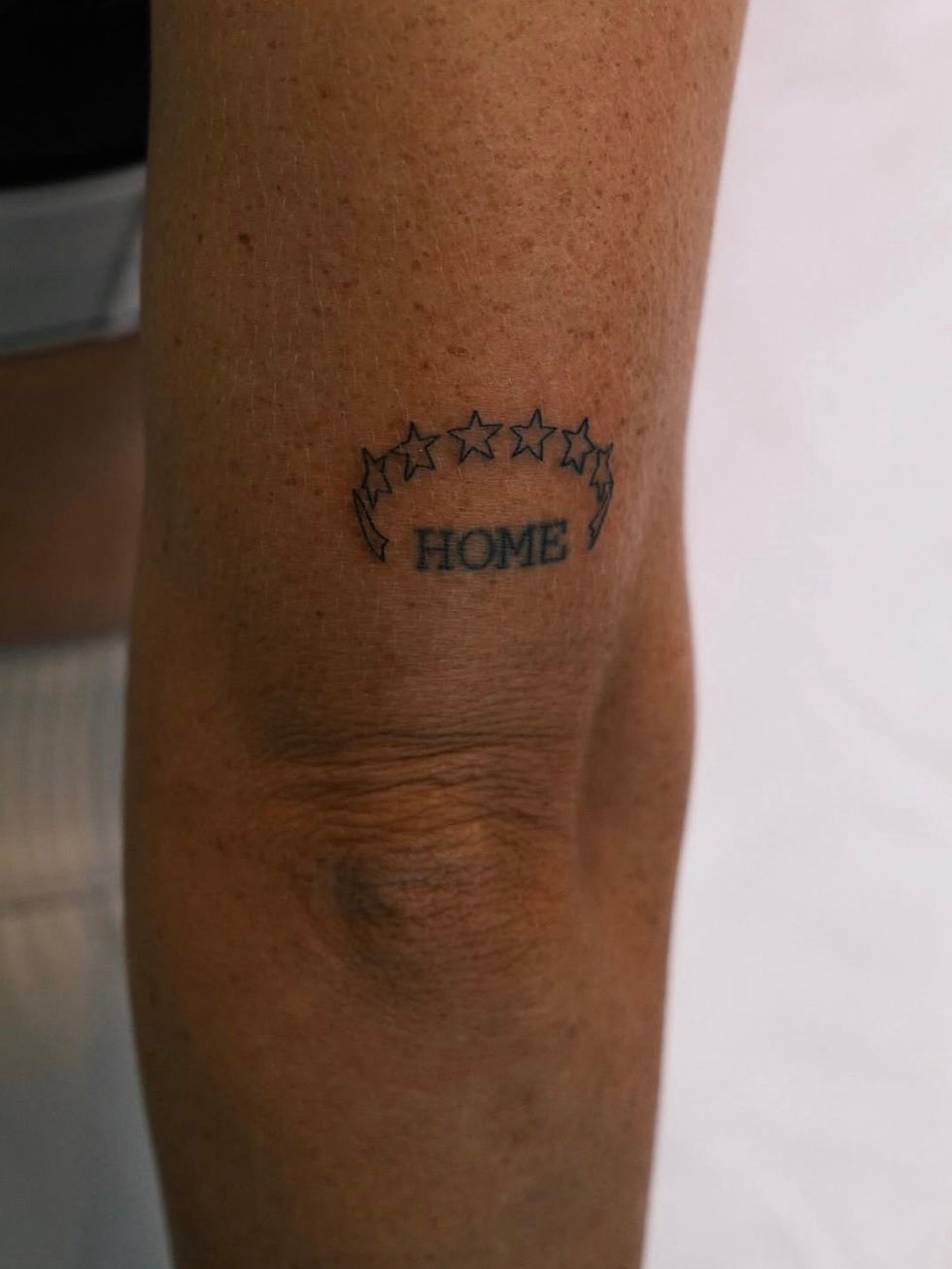
Another clearly documented piece is “HOME” under an arch of stars. It sits on her arm just above the elbow in simple black lettering. The stars curve above the word, giving it the feel of a small badge or sign.

It’s tempting to settle on one meaning, especially with Stanway moving between England and Germany. But the design could work on several levels: family, the north of England, football, or the people and places that keep her grounded while she travels.

The stars are worth noticing, too. They don’t necessarily stand for a trophy. Visually, they finish the lettering and give the small tattoo a shape that reads from a distance.

Football memories show up as numbers and tiny milestones

Georgia Stanway England arm tattoos

Stanway’s football tattoos often mark specific moments rather than general fandom. One well-known example is 19:32, the time the final whistle sounded in England’s Euro 2022 final win. It’s a detail only she may think about every day, which is part of why it works.

She has also shown the Roman numeral II on the back of her arm, representing England’s two European Championship wins. It’s a small mark for a huge achievement: two tournaments and a second victory that changed the story again.

Other football references include her number 31, which became closely associated with her Bayern Munich years. Photos don’t always make it clear whether a number is on her shirt or skin, so it’s safest to rely on what Stanway has explained and what close-up images show.

The Olympic rings connect the tattoos to her wider career

Georgia Stanway wrist and arm tattoos

Stanway also has the Olympic rings, a simple design linked to another part of her football journey. The familiar symbol needs little decoration and marks her experience representing Great Britain on a major stage.

This tattoo helps make the collection feel like a diary. The rings don’t try to explain the full tournament or recreate a medal; they simply mark that she was there. The same idea appears in the time tattoo and Roman numeral: a short visual cue carrying a much larger memory.

The rings can be hard to see in photos because her arms are often covered by sleeves, tape, or warm-up layers. One clear image is more useful than a dramatic portrait where the tattoo disappears into shadow.

Her legs give the collection more room. Bayern Munich photos show tattoos on her thigh, including floral details, a cherub-like figure, and the number 31. Compared with the small forearm marks, this area looks like a more deliberate group.

The number 31 is easy to connect to her Bayern years, but the surrounding imagery deserves caution. A photo can show a cherub, flowers, and lines without confirming a private story for each. The visual details are clear, even when the personal explanation isn’t.

That contrast makes the leg work interesting. The arms feel like a running list of small ideas; the thigh pieces have more weight because they can be viewed together. They still fit Stanway’s small-tattoo style, but have more room to breathe.

Stanway’s tattoo hobby changed how she sees the craft

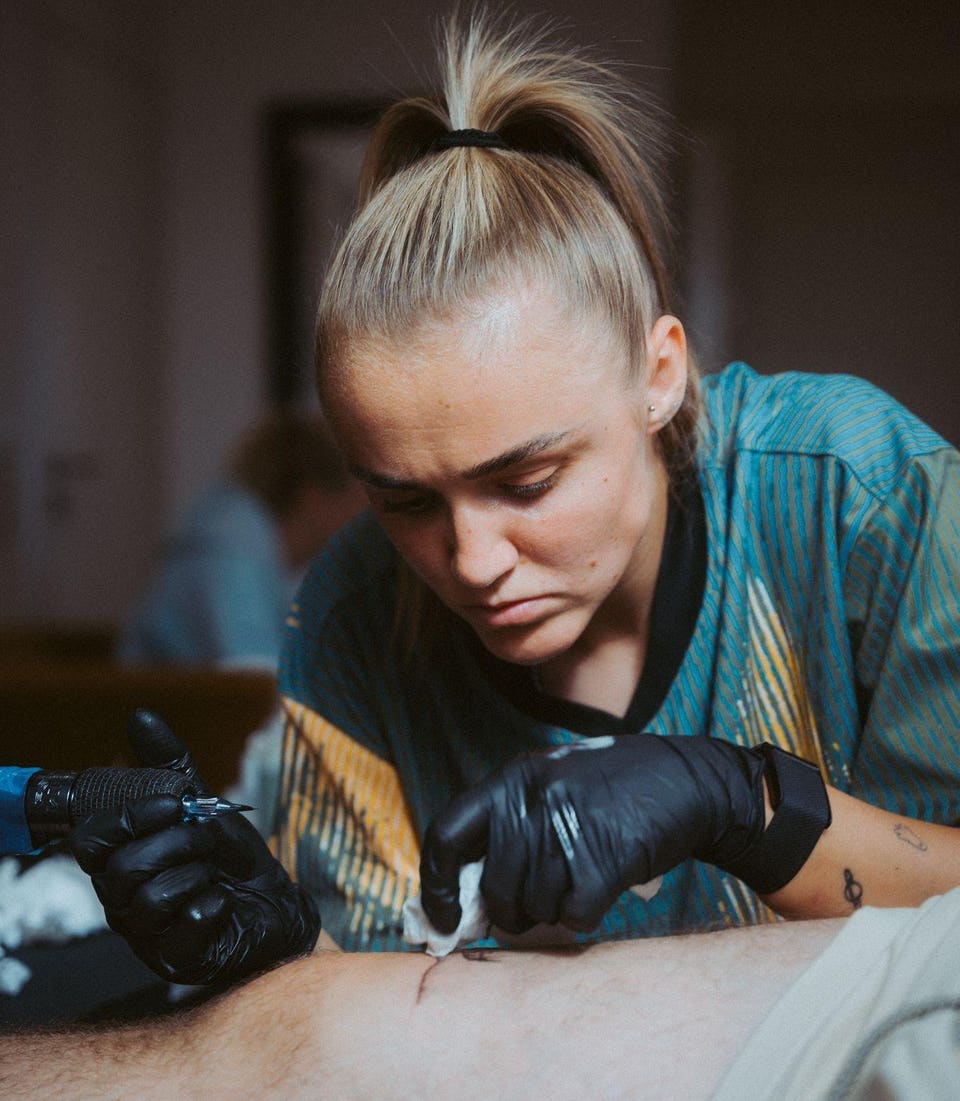
Georgia Stanway tattooing a client

Stanway’s interest grew beyond a personal hobby after she moved to Munich. She began practising with a machine on artificial skin before working on people. She has mentioned the added pressure of tattooing team-mates, knowing she would see the results at training every day.

That gives the rest of the collection context. Stanway isn’t only gathering tattoos; she’s learning how they’re made. Her own style leans toward small icons, simple line work, and a patchwork approach. The designs don’t need to match perfectly because each can arrive at a different time.

She has tattooed friends and team-mates, including designs related to their football stories. That doesn’t mean she did every tattoo on her own body, but it explains why the craft has become part of her life away from the pitch. As she said in an interview, “I’ve always had a love for tattoos.” The interest clearly goes beyond a passing trend.

Some tiny marks relate to family, home, or people around her. Others have been described as drawings or simple symbols rather than named designs. That’s normal for a collection this large; not every tattoo comes with a full explanation.

It’s more useful to see Stanway’s ink as a changing collection than a finished set. New marks appear, older ones sit alongside them, and certain tattoos only show in particular photos. Their small scale makes the overall look feel personal instead of staged.

Together, the tattoos tell a relaxed story. There are major career memories in the Olympic rings, 19:32, and the Roman numeral II, alongside tiny doodles, lettering, stars, and shapes she may simply have liked. That mix keeps the collection from feeling like a list of trophies.

Stanway’s tattoos are busy without looking over-planned. They build like a football career: one choice, one season, one memory at a time. Some have clear meanings; others are small pieces of ink only she fully understands.

The best photos show the tattoos clearly without making her look like a display stand. Close-ups of her arm, “Whatever the Weather,” the HOME design, her thigh, and match photos each reveal something different. Together, they show why her ink deserves more than one generic portrait.

More athlete tattoo guides

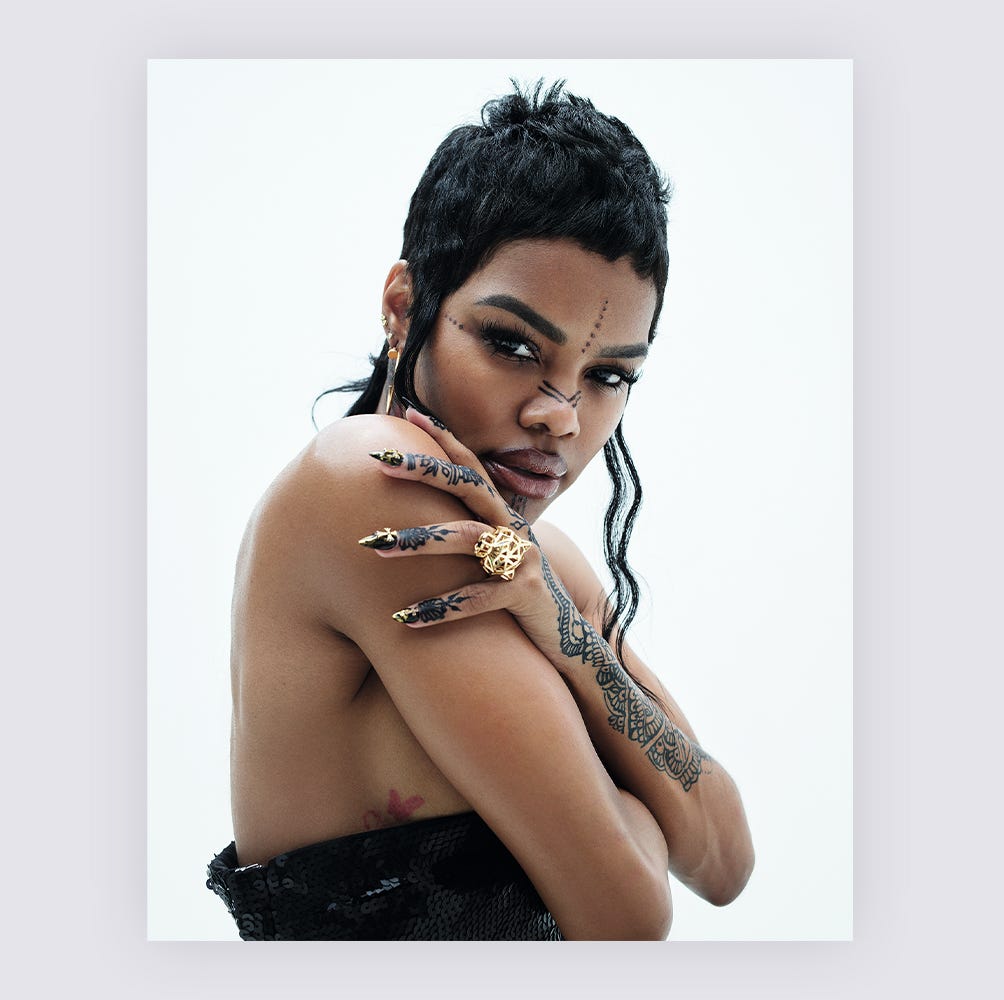
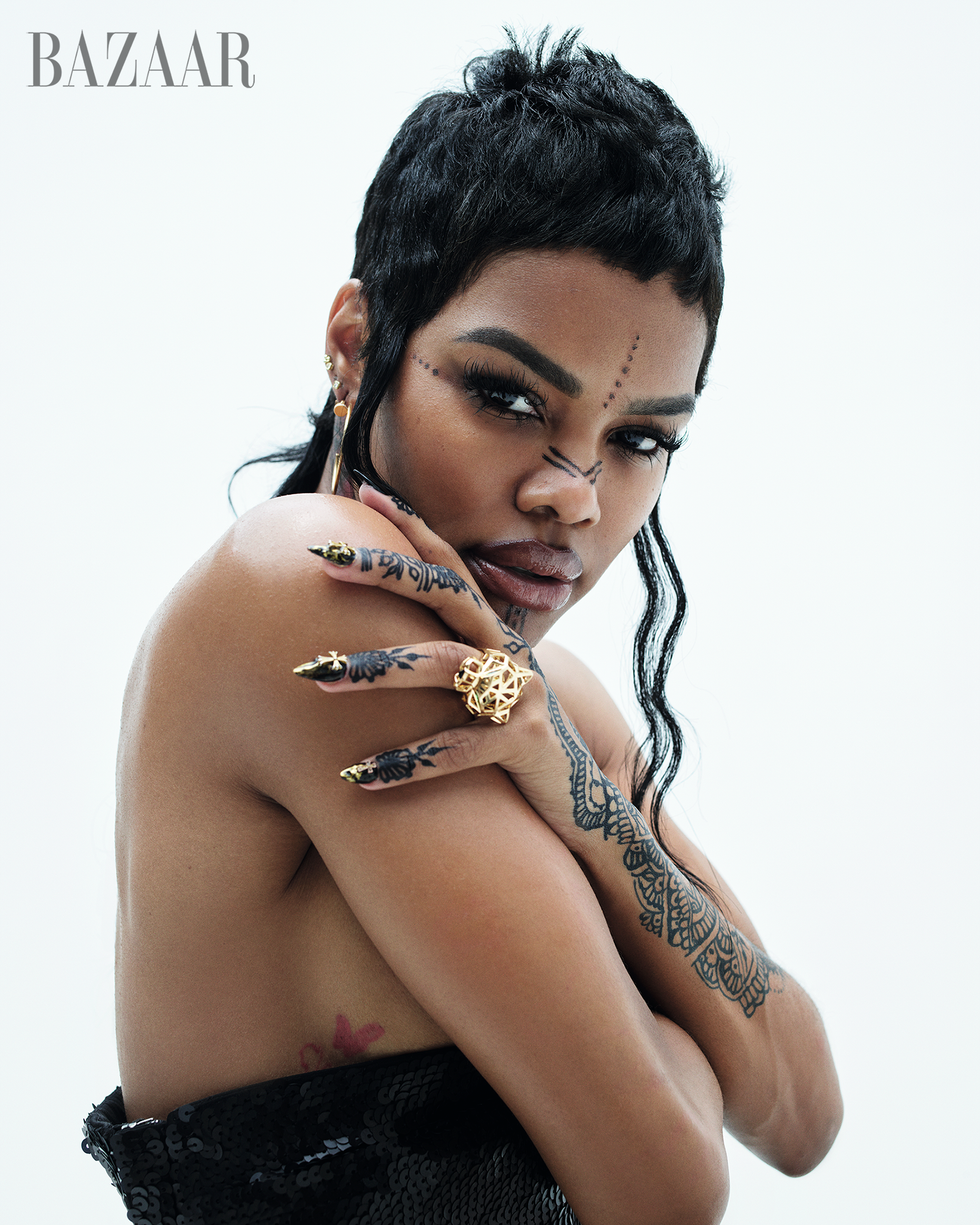
Teyana Taylor’s Tattoos Run From Banksy Butterflies to G.O.O.D. Music Ink

Teyana Taylor’s tattoos can be easy to miss when she’s fully dressed, then hard to ignore when an outfit reveals her sides, stomach, or legs. She has bold black designs, old-school lettering, small pops of colour, and larger pieces that cross different parts of her body.

There’s no single style holding everything together. A hip portrait sits beside tribal work across her stomach; a small diamond and “shine on you crazy diamond” appear on her upper arm, while a G.O.O.D. Music logo marks a chapter in her career. She also has playful designs, including gummy bears in Pan-African colours and the Rolling Stones tongue.

Taylor’s tattoos aren’t just background decoration. Many connect to music, friendship, identity, or how she wants to present herself. Others seem to have been chosen because they suited the moment and looked good. That variety is part of what makes the collection fun.

The portrait on her hip turns the tribal work into a bigger piece

Teyana Taylor tribal hip tattoo

One of Taylor’s most striking designs is the portrait of a woman with an afro on her left hip. It extends a larger tribal pattern that travels from her hip toward her waist. This isn’t a small flash tattoo hidden in a corner; the portrait is a focal point that changes how the surrounding lines read.

The face is stylized rather than a straightforward celebrity portrait. That graphic quality lets it sit alongside the nearby tribal shapes. From a distance, the section looks like one flowing design; up close, the face becomes the detail that makes it feel distinctive.

Most outfits cover a hip tattoo, so this one tends to appear in swimwear, stage costumes, or a dress with a dramatic cut-out. That’s why older photos can make it seem as though Taylor has fewer tattoos than she does. The ink is there; it just isn’t always on display.

The design follows the curve of her waist instead of sitting like a sticker on open skin. That makes it bold while still working with the placement, and helps explain why it photographs so well when visible.

The tribal stomach design is one of her hardest pieces to catch clearly

Teyana Taylor tattooed forearms portrait

Taylor also has a large tribal design across her lower stomach. Public photos often show only part of it, especially when clothes cover the centre. Cropped images and partial views circulate online, so it’s better to describe the placement carefully instead of claiming every line can be identified from one photo.

The visible sections have the thick, sweeping look associated with tribal work. They form a strong border around the stomach and lower waist, unlike the finer lettering on her arm. The focus is shape and coverage rather than a written message.

Taylor has revealed portions of the design in high-cut outfits and runway looks. Those images show that the tattoo extends beyond the small edge that may appear with everyday clothes. But the full piece still isn’t visible in every photo: a side angle can show the hip while hiding the centre, and a front view may do the reverse.

It’s best not to merge this work with the hip portrait as if the two were one tattoo. They’re close together, but the portrait has its own face and placement, while the stomach design is about movement and coverage.

Her hip lettering and Roman numerals add a quieter layer

Teyana Taylor hand and forearm tattoos

Not all of Taylor’s tattoos are meant to dominate a photo. Smaller marks and Roman-numeral details appear around her hip, within or near the larger black design. They’re easy to overlook beside the busier tribal lines.

That contrast adds variety. A large tattoo can make a collection seem to be all about scale, but the smaller lettering gives Taylor’s ink a different rhythm. Heavy shapes, open skin, fine lines, and close-up details all have a place.

Some numerals have been described as personal dates, although sources don’t consistently confirm a specific meaning. It’s tempting to fill in the blank, especially when the numbers sit in a private area. The careful description is simply that the Roman numerals are visible and their exact story hasn’t been fully explained.

The uncertainty doesn’t make the design less interesting. Line work and placement can be worth noticing even when the person wearing the tattoo hasn’t given a full explanation.

The Rolling Stones tongue tattoo brings a flash of colour

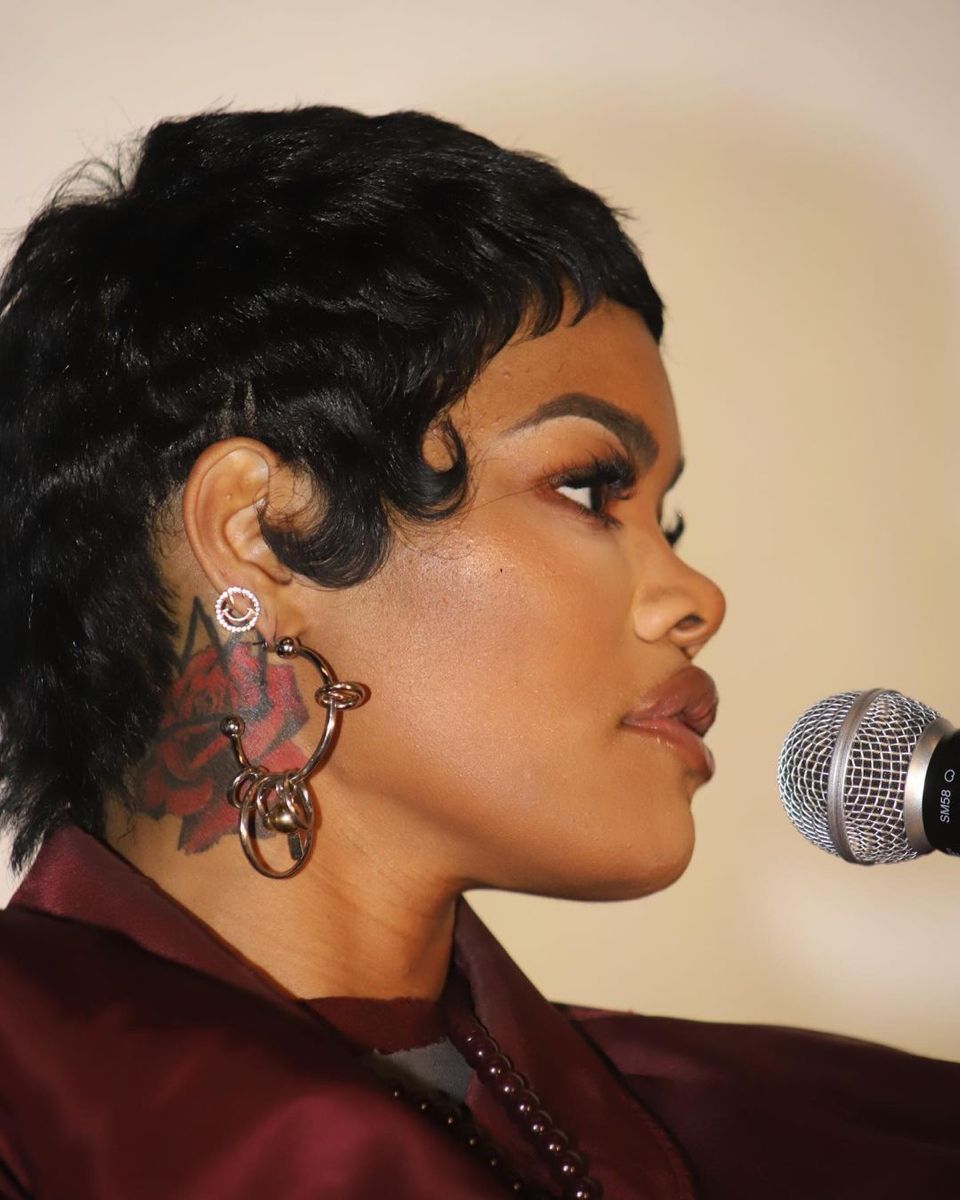
Teyana Taylor rose neck tattoo

Taylor’s Rolling Stones tongue tattoo is one of the most recognizable designs in the collection. The red-and-black image refers to the band’s famous logo; the bright colour makes it stand out among the black tribal work.

The tattoo is on her left butt cheek, a playful choice that isn’t meant to be visible at every public appearance. When an outfit reveals it, the design becomes part of her look rather than something she needs to explain in an interview.

That logo contrasts with the G.O.O.D. Music tattoo on her arm. The Stones reference points outward to a band and music history; the G.O.O.D. design points back to Taylor’s career and the people she worked with. Both are music tattoos, but they do different things.

Colour changes the effect, too. Red draws the eye, while the black outline keeps the logo from looking like a temporary sticker. Its simple, graphic quality is exactly what makes it work.

The gummy bears use colour to make a personal flag

Teyana Taylor spine tattoo portrait

Another playful design is a group of three gummy bears in red, yellow and green. The colours refer to the Guinean flag, giving this small tattoo a link to identity and heritage. It has a very different mood from the tribal designs and more serious lettering.

The bears are simple shapes, but the colour choice gives them a clear purpose. They aren’t random sweets dropped into an otherwise black-and-grey collection. Together they work as a small flag, placed in a way that feels personal rather than designed for every event.

This tattoo can disappear in a wide photograph. A close-up is needed to distinguish each bear and see how the colours sit beside one another. A full-body shot shows that Taylor has plenty of ink, but can’t capture a small coloured image clearly.

Alongside the Rolling Stones tongue, the gummy bears show Taylor’s ease with humour and colour. Her collection can move from dark tribal work to a bright character tattoo without every design needing to match.

The G.O.O.D. Music tattoo marks an important career chapter

Teyana Taylor performance forearm tattoo

One of the clearest career tattoos in Taylor’s collection sits on the inside of her left forearm. It shows the G.O.O.D. Music logo with an angel above the words “getting out our dreams.” She got it while signed to the label, making it a record of a career chapter as well as a logo and lettering design.

The forearm placement makes it easier to see than her hip and butt tattoos. It appears in interviews, music videos, and event photos whenever her sleeve shifts. Jewellery and movement can still hide some of the words, so a close-up gives a better sense of the layout.

The angel above the logo softens what might otherwise look like a company mark. The wording adds another layer: “getting out our dreams” connects the tattoo to the idea of building a career and making something happen.

Taylor’s work has moved through music, dance, acting, and fashion. The G.O.O.D. Music design belongs to an earlier chapter, but remains part of the larger story. It preserves a place, people, and a moment that mattered as she grew into the artist she is today.

The neck and spine work make the back of her ink feel deliberate

Teyana Taylor neck and spine tattoos red carpet

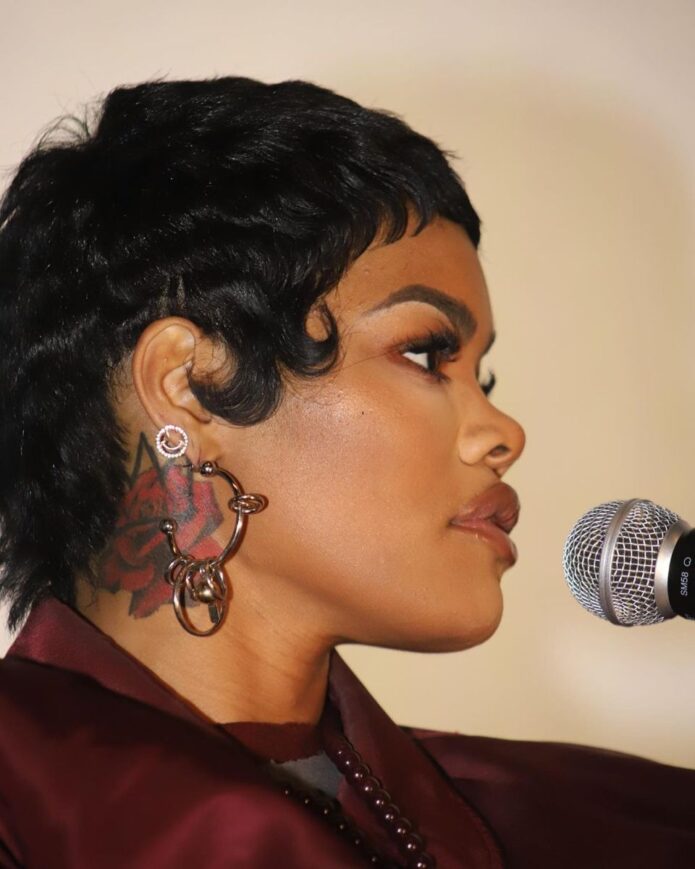
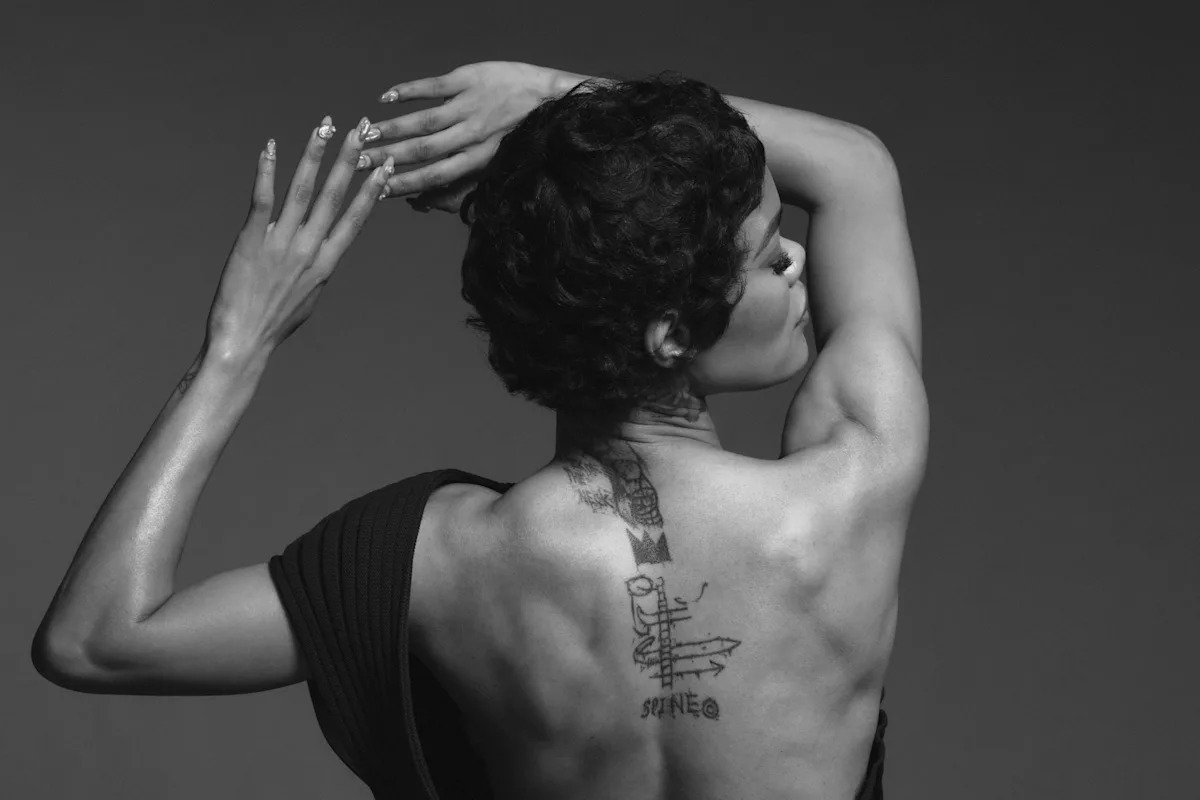
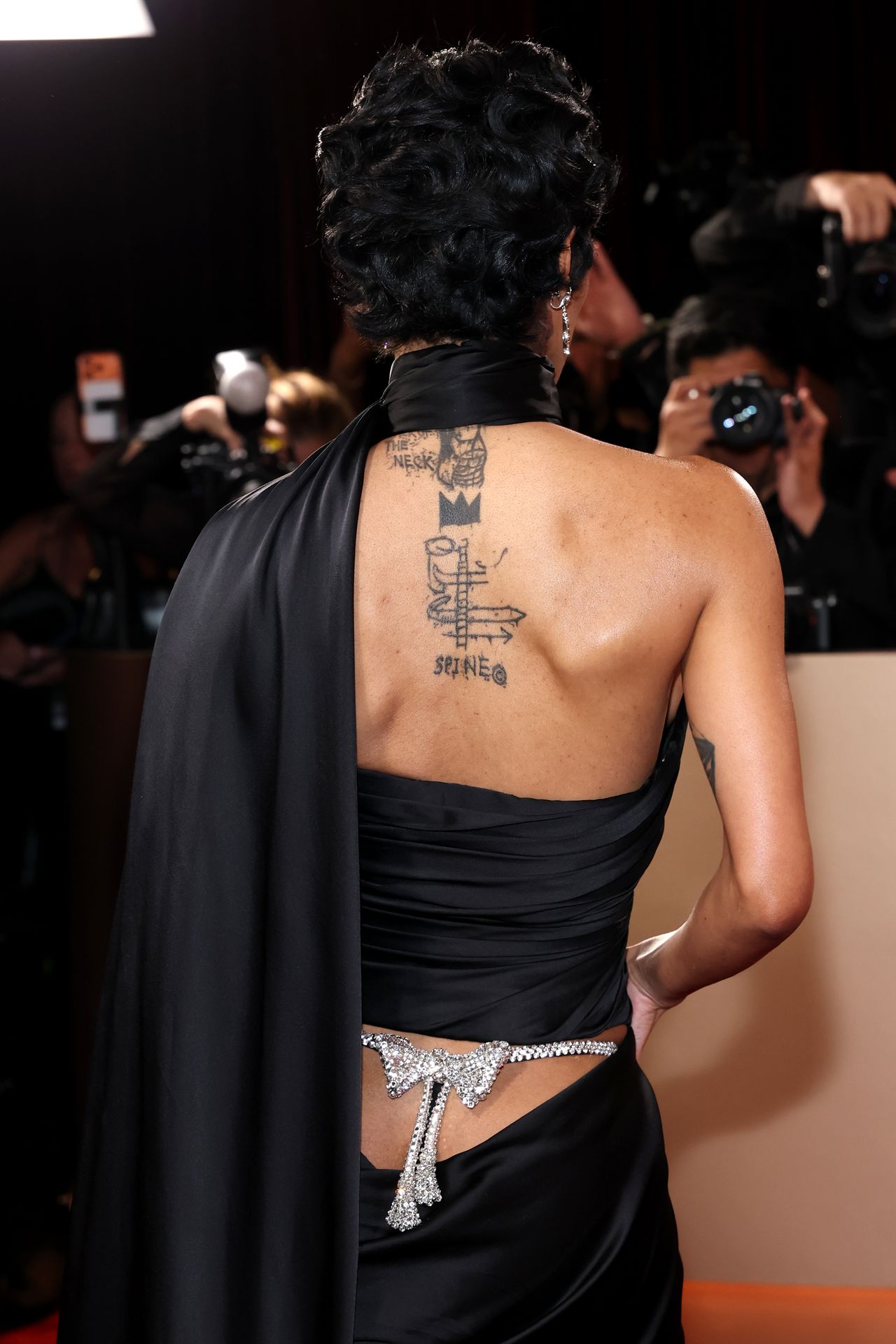
Recent red-carpet photos have drawn attention to Taylor’s neck and spine tattoos. The long central design shows when she wears an open-back dress, giving her back a strong vertical line. It has a different effect from the sideways flow of the hip tattoos.

Spine designs can be tricky to photograph because posture changes how the lines look. A straight-on view may show the main path, while a turned shoulder can make it appear broken into separate pieces. Taylor’s fashion choices reveal the tattoo in some shots and cover it in others, so several views help.

The neck design adds another focal point above it. Together, the neck and spine pieces make the back feel deliberate, even though the rest of Taylor’s tattoos come from different periods and styles. The front is busy and varied; the back has a cleaner central structure.

As a whole, Taylor’s tattoos mix music references, body-shaped blackwork, small colour jokes, and designs tied to her life. It’s easiest to read them piece by piece. The portrait, tribal work, G.O.O.D. Music lettering, Rolling Stones tongue, gummy bears, and spine ink each have their own visual role without needing one forced meaning.

Nicky Jam’s Ink Runs from a Colombian Owl to Family Portraits

Nicky Jam has been getting tattoos since childhood, and the collection shows it. It doesn’t follow one tidy style or form one giant sleeve. Family names, religious images, music references, cartoon characters, and pieces from different stages of his life all have a place.

In his GQ tattoo tour, he said his first mark came at ten: a letter for his brother, which his father later covered after discovering it. By fifteen, Nicky had moved on to a tribal design. He kept adding ink over the years, so the result feels collected rather than planned as one project.

Here’s a closer look at the designs that are easiest to identify, from the large neck owl to his daughters’ names. Where Nicky has explained a meaning, that context is included; where a photo only shows a mark, the description stays with what can be seen.

The spread-winged owl takes over Nicky Jam’s neck

Nicky Jam owl neck tattoo

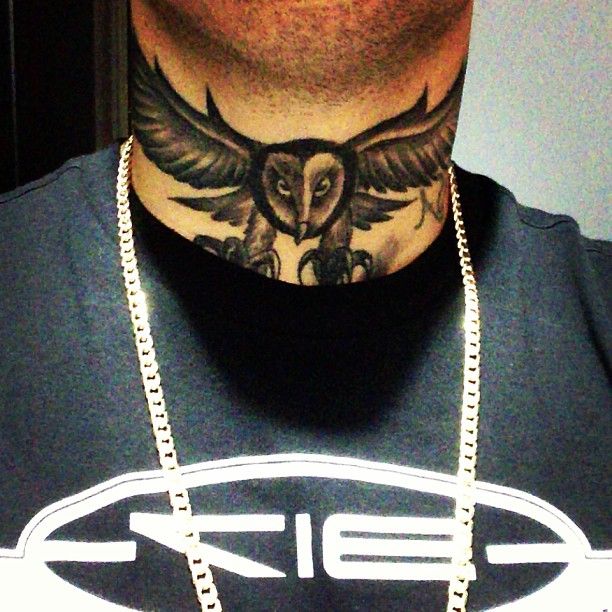
The spread-winged owl on Nicky Jam’s neck is likely the first tattoo people notice. It sits high and stretches to both sides of his neck. In some older photos, the dark shape almost looks like a scarf; Nicky has talked about changing and extending it after the initial session.

He told GQ the tattoo was done in Colombia and that he disliked the first version. He said the black ink made it look as if he were wearing a scarf. Later, he had white ink worked through it and added more underneath, turning the heavy block into a fuller design.

Nicky connects the owl with recovery and learning to take better care of himself. That doesn’t mean it’s only a “recovery tattoo.” It is also a dramatic neck piece, and the changes made to it are part of its story. The final design has more layers and movement across the neck.

His mother’s portrait is one of his most personal pieces

Nicky Jam mother portrait forearm tattoo

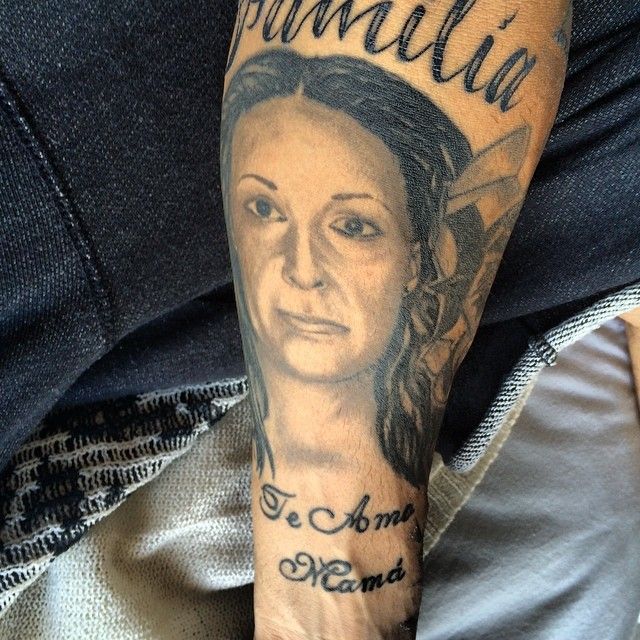
On his left forearm, Nicky has a portrait of his mother, with “Familia” above it and “Te Amo Mamá” below. The traditional framed layout lets the words and portrait work together instead of looking like three separate tattoos.

It’s one of the designs he has explained most clearly. In his GQ tour, he said the portrait was made to honour his mother and described their long separation. “Te Amo Mamá” means “I love you, Mom,” while “Familia” keeps the message focused on family as a whole.

Alex Chiong of Alex Chiong Tattoo Studio in North Miami did the tattoo. Its placement makes it easy to show in interviews, which is why it appears in many photos. Nicky has called it one of his favourites, along with the man climbing stairs on his other forearm.

The Puerto Rican sun and Luciana sit across his chest

Nicky Jam Luciana chest tattoo

Nicky’s chest has a Taino sun god design with the name Luciana underneath. Two birds sit higher on either side, loosely framing the central sun. The broad placement gives the design room, unlike the smaller lettering and symbols on his arms.

The sun connects to Nicky’s Puerto Rican roots. He has described it as a symbolic Indigenous sun, while Luciana is one of his daughters. The birds add movement, but there’s no need to invent a private meaning for every feather or line. The family reference is clear in the name, and the cultural reference comes from the sun.

Nicky has said the chest hurt more than his neck because the needle was working near bone. The piece is not a small name tucked under a shirt; it’s a broad chest tattoo worked carefully across a sensitive area.

Music notes, three dots and a cross mark out his face

Nicky Jam three dots face tattoo

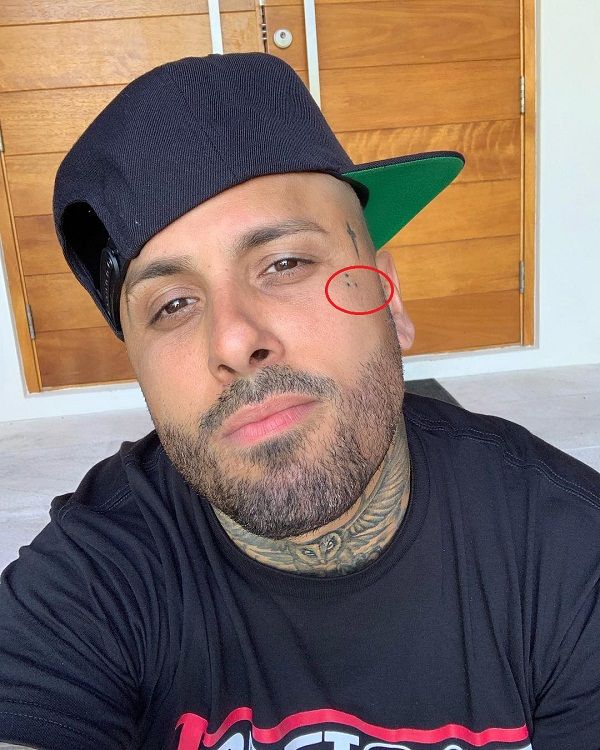
Nicky began his face tattoos with small musical notes. He later added three dots beside his left eye and a cross near his left eyebrow. Other small music-related marks appear around his face and behind his ear. Though compact, these tattoos change his look because they’re placed where people notice them.

He said the music notes came first and he continued from there. The three dots and cross are separate designs rather than one large image. In older photos, facial hair and lighting can make one mark disappear while another stands out.

Nicky has always liked tattoos in places others might avoid. He has talked about enjoying the contrast between a clean-cut face and rougher body art. The small face pieces show how a few marks can make his look more recognizable and harder-edged.

The climbing man and time-machine idea fill his forearm

Nicky Jam stairs time machine forearm tattoo

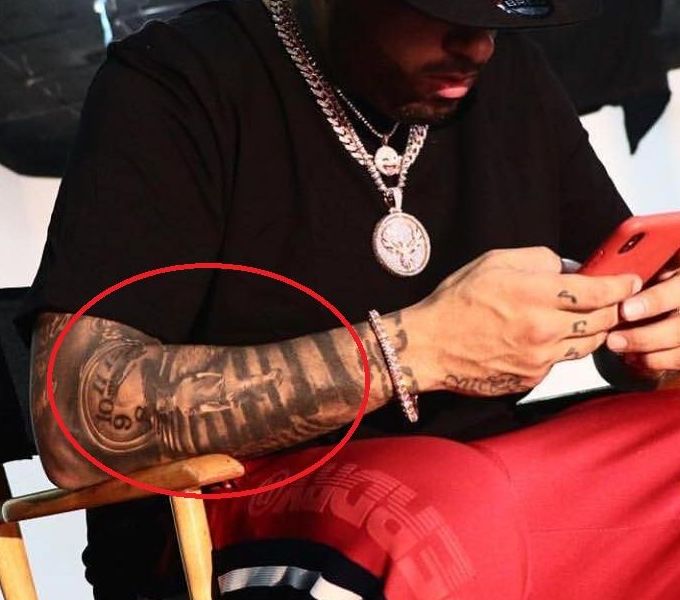
One of Nicky’s favourites is the man climbing stairs toward a time machine on his right forearm. It tells more of a story than many of his names and symbols. Rather than a word or logo, the image suggests movement, effort, and a destination.

Nicky has mentioned this piece when asked which tattoos mean the most to him, but hasn’t given it a long public explanation. The figure climbs upward, and the time machine brings in a touch of science fiction without making it look like a simple cartoon.

The forearm gives the design space to run along the arm. It’s visible in short sleeves but sits among his other writing and symbols, so close-ups show far more than distant red-carpet photos.

Marvin the Martian brings a comic-book streak to his leg

Nicky Jam Marvin the Martian leg tattoo

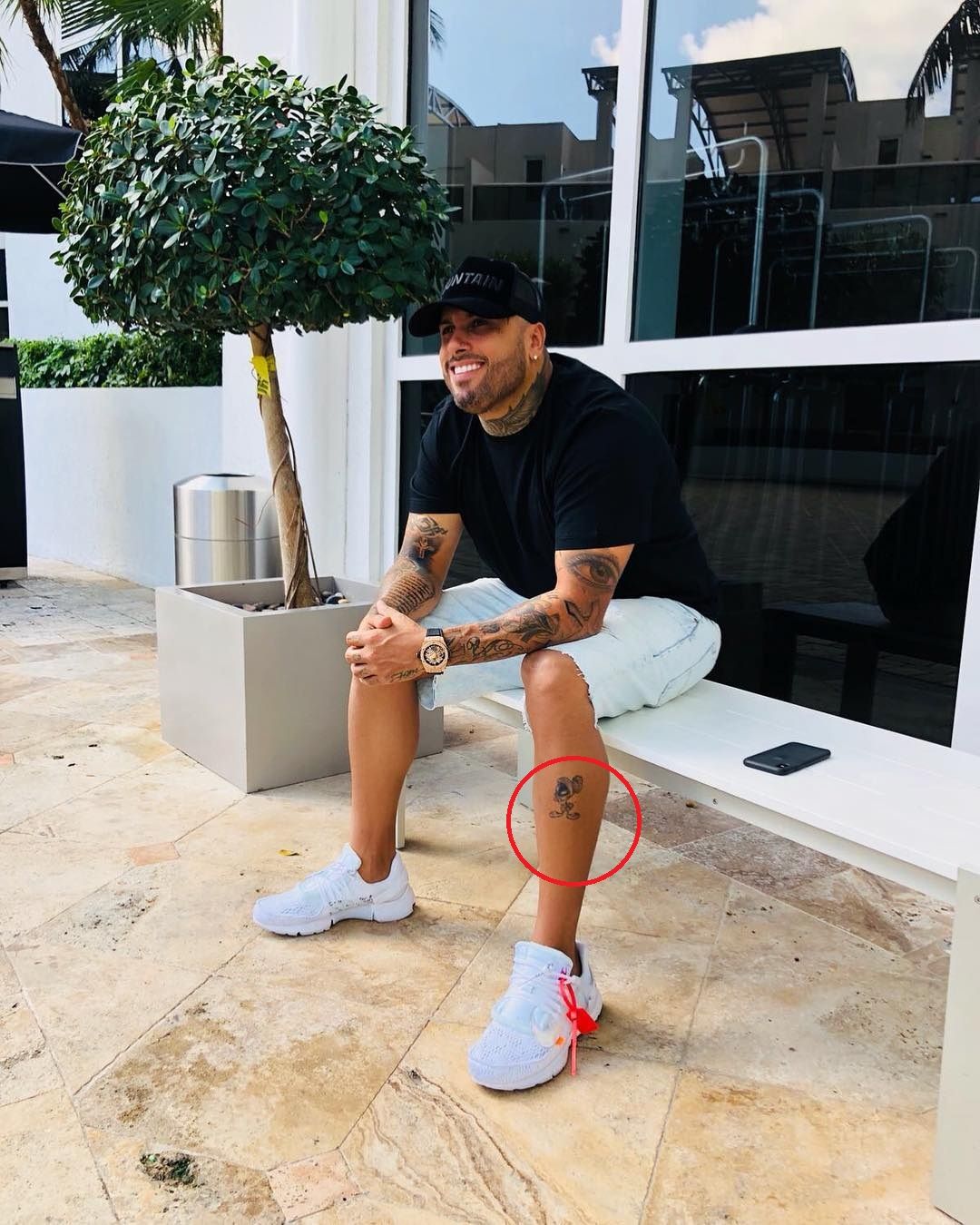
The Marvin the Martian tattoo on Nicky’s left lower leg is one of the collection’s more playful pieces. It stands apart from family portraits, religious imagery, and music lettering, which is part of why it catches the eye.

Tattoo artist Samu Rico is credited with the Marvin design and a Daffy Duck tattoo on Nicky’s opposite lower leg. The pair gives his legs a different mood from his upper body. The owl and mother portrait invite a look at their personal stories; Marvin is more direct, a cartoon character he chose for the image.

Leg tattoos can be difficult to judge in performance photos because trousers and shoes hide them. A clear close-up helps distinguish the character from the darker designs around the lower leg. The image shows why the tattoo deserves its own space instead of being lost in a generic list of small pieces.

The tiger gives one forearm a sharper look

Nicky Jam tiger forearm tattoo

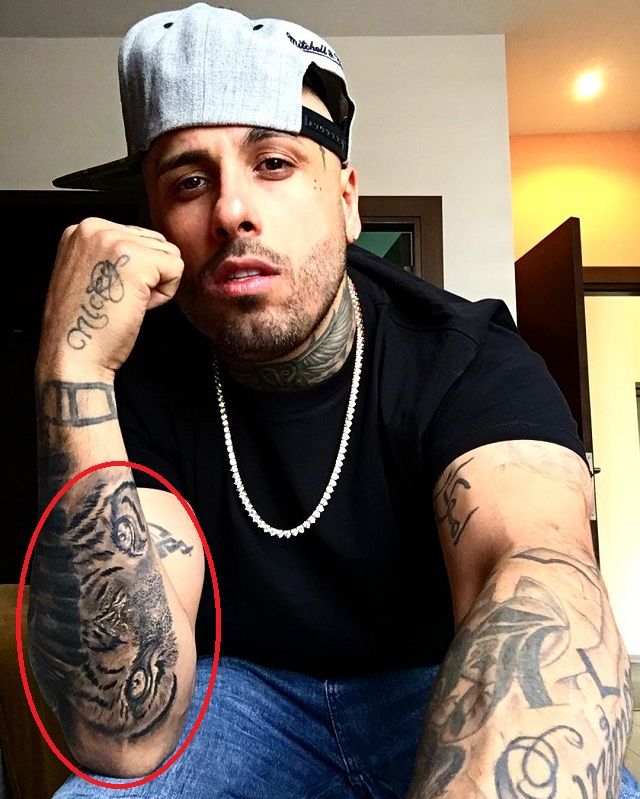
A tiger face on Nicky’s right forearm adds a more aggressive animal image. The bold central face and heavy shading anchor that part of the arm, with smaller marks around it.

Nicky hasn’t given the tiger a detailed public explanation like he has for his mother’s portrait or his daughters’ names. It’s more accurate to describe the image and placement than to assign a meaning. Animal tattoos can mean many things; there isn’t enough here to say this one represents strength, danger, or anything else.

The tiger also shows how varied Nicky’s choices are. One arm can hold a realistic animal, a daughter’s name, music references, and abstract marks. The collection is busy, but the pieces can still be understood separately when the photos are clear.

An eye and Celtic crosses add a heavier religious edge

Nicky Jam eye elbow tattoo

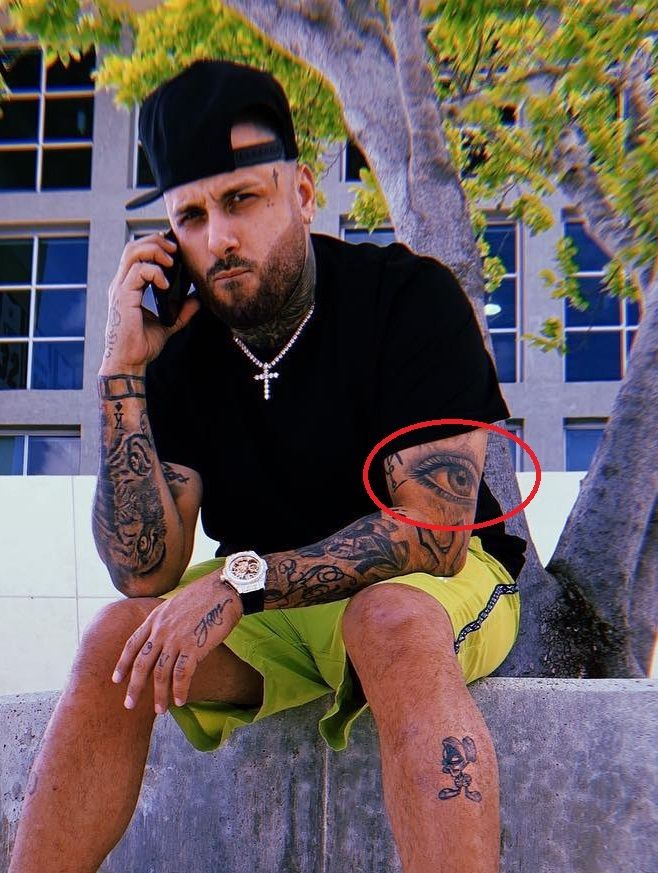
Nicky has an eye tattoo on his left elbow and Celtic cross designs on his arm and the back of his neck. The elbow eye is a small focal point that can disappear under clothing but stands out in a close-up.

The cross by his eyebrow is separate from the Celtic crosses, so they shouldn’t be treated as one large religious design. Nicky has other spiritual imagery, too, but the collection doesn’t need one theme. Some pieces relate to faith, some to family, and others are designs he liked.

Elbow skin bends, and photos can flatten the shape, so a wide portrait may not show the eye clearly. A close view makes its placement easier to see without claiming more than the image shows.

Arabic writing and an old astral band show how early he started

Nicky Jam Arabic upper arm tattoo

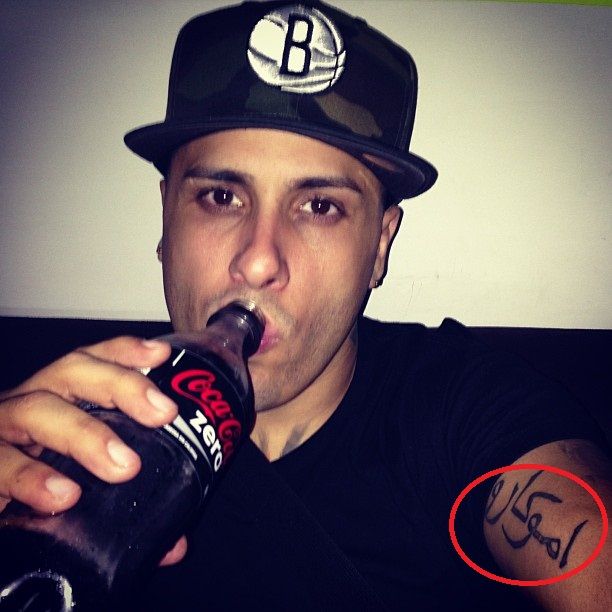
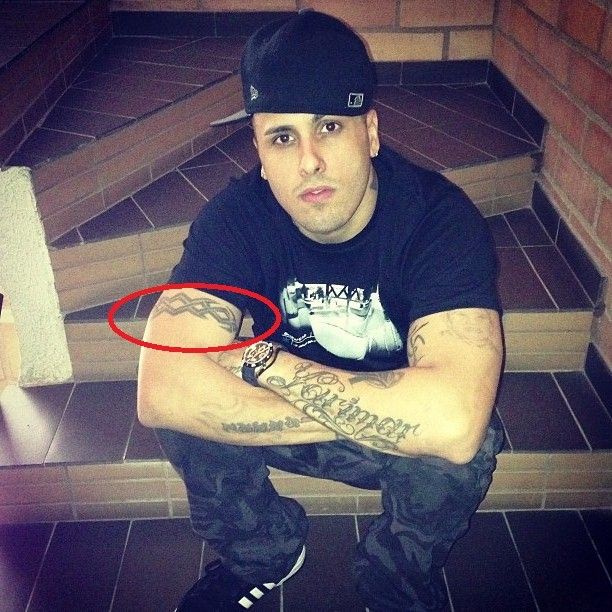
His upper arms include an Arabic phrase and an astral band. The writing needs a sharp photo before anyone tries to identify the exact words. It sits among other tattoos, so distant shots can reduce it to a dark strip.

Body Art Guru records it as the first tattoo Nicky got at around ten years old. His GQ interview adds another detail: the first mark was a letter for his brother, later covered by his father. The accounts suggest his tattoo history developed over time; they don’t mean every early design is still visible today.

Nicky has said he got tattoos year after year and eventually ran out of room. That helps explain the mix of tribal work, newer lettering, and detailed portraits. The collection grew as different ideas and memories mattered to him.

Names, logos and small pieces fill in the gaps

Nicky Jam astral band upper arm tattoo

Smaller tattoos fill the spaces around the larger designs: Yarimar and Isabel on his forearm, ALYSSA on his neck, “Love” across his knuckles, music symbols on his hand, a Japanese character he says means “warrior,” and an NJ logo on his wrist. He also has a guitar on his neck, more music notes behind his ear, and words across parts of his abdomen and chest that are not clearly identified.

Nicky has explained some details himself. Yarimar is his daughter’s name, the NJ symbol is his brand, and he says the Japanese character means warrior. Other marks are visible in photos but don’t have a clear explanation. It’s better to keep that distinction than give every line a dramatic backstory.

His lower legs also have Daffy Duck on the right and Marvin the Martian on the left. The available high-resolution material shows Marvin more clearly, so this article uses that photo rather than a tiny or blurry image for Daffy. The design has been reported, but the photograph needs to be clear enough for readers to see it.

Nicky Jam’s tattoos are a timeline as much as a style

Nicky Jam guitar neck tattoo

Seen together, Nicky Jam’s tattoos trace a loose timeline: early tribal influence, face designs he added later, a family portrait and names, the Puerto Rican sun, an owl connected to recovery, and cartoon characters that keep the collection from feeling too serious.

His own explanations give the clearest context: “Te Amo Mamá” honours his mother, Luciana and Yarimar are his daughters’ names, the NJ mark connects to his brand, and the owl belongs to a period when he was trying to take better care of himself. Other pieces can be enjoyed as part of a packed, lived-in collection built over decades.

That’s the appeal of Nicky Jam’s tattoos. They don’t look like a showroom set planned in one day. They feel personal, sometimes messy, occasionally playful, and closely tied to the places, people, and music that have followed him through life.

More musician tattoo guides

Chet Hanks’ Eye, Cross and Micaiah Tattoos Tell a Bigger Story

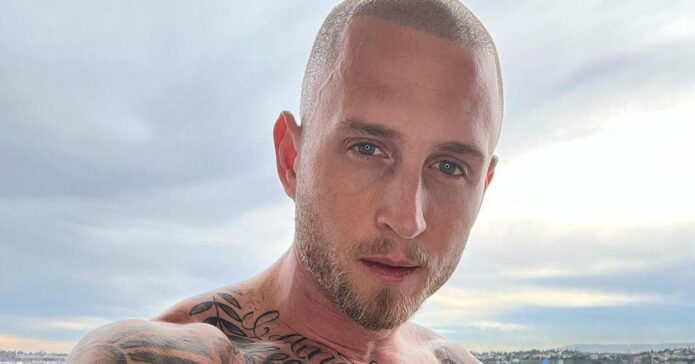
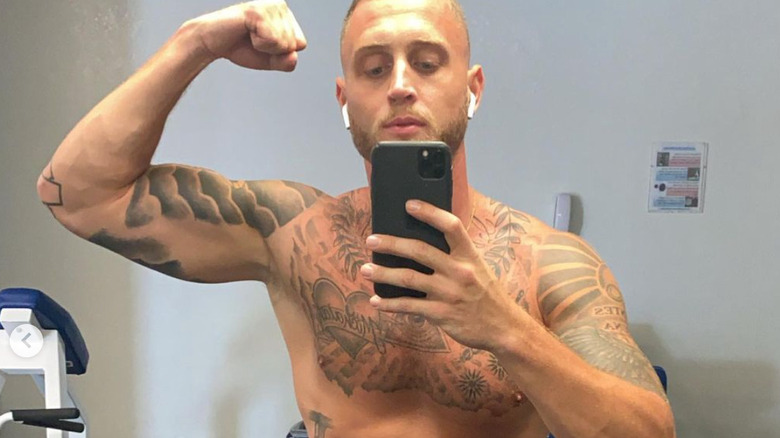
Chet Hanks’ tattoos have never been especially discreet. The first thing that stands out in a shirtless photo is usually the dark work across his chest and shoulders, with more ink running over his back and arms. There is no single style tying it all together: religious imagery sits beside family tributes, lettering and older pieces that look like they were added at different times.

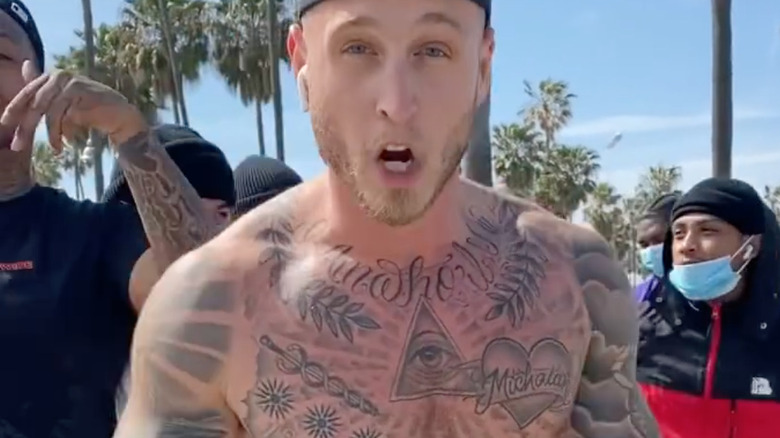
Some tattoos come with a clear story; others are harder to place. The eye inside a triangle drew conspiracy theories, while Hanks said he was “extremely spiritual”. Later, a large cross took over the middle of his chest, during a period when he spoke about faith and trying to live more honestly. The older designs are still there around it, including the eye, his daughter’s heart and the work on his back.

That mix is part of what makes his collection interesting. A striking symbol can invite a lot of guesses, but Hanks has pushed back when people have read more into a design than he intended. Looking at what he has actually said, alongside what is visible in photos, gives a clearer picture than treating every tattoo as a hidden message.

The eye inside the triangle is about faith, not a secret society

Chet Hanks eye of providence chest tattoo

The most familiar design on Hanks’ chest is the eye inside a triangle. It sits within a larger piece, framed by laurel leaves and decorative shading. The eye is often called the all-seeing eye, so it did not take long for online theories about the Illuminati to attach themselves to it. Hanks has said that is not what it means.

He has described the tattoo as spiritual, connected to his belief that God watches over people and has a plan for their lives. The finer details around the eye do not each have a confirmed explanation, so there is little reason to assign them one. His own account is straightforward: it reflects his faith, not membership in a secret group.

The design also works as the centre of his upper chest. The triangle gives the eye a crisp outline, while the leaves and shading spread the piece toward his shoulders. In a shirtless photo, it reads almost like an emblem, which helps explain why it draws attention before the smaller lettering nearby.

It is a bold tattoo, but the reason Hanks has given for it is personal rather than mysterious. He wanted a reminder of his beliefs and chose a symbol with a long history in religious art. That is enough to understand the piece without adding a theory to it.

The heart over his chest is for his daughter, Micaiah

Chet Hanks Micaiah heart chest tattoo

Just below the central chest design is a heart with “MICAIAH” inside, a tribute to Hanks’ daughter. The placement over his heart makes the family meaning plain, and the name gives the design a personal focus rather than leaving it open to interpretation.

Hanks has connected fatherhood with getting sober and changing direction. He has talked about learning that a baby was on the way and finding a reason to close one chapter of his life. The tattoo cannot tell that whole story on its own, but it sits alongside it as a permanent reminder of his daughter.

The lettering is easy to make out in close-up photos, with the heart giving it a clear frame. There is no need to guess at the meaning: it is his daughter’s name, placed where it will always be visible to him.

That makes it a different kind of piece from the eye nearby. One speaks to his beliefs; the other is a direct tribute to family and a turning point in his life. They share the same stretch of skin, but each carries its own story.

The Byzantine cross became a huge chest statement

Chet Hanks Byzantine cross chest tattoo

In 2023, Hanks showed a large cross across his chest. It is heavier and more elaborate than the smaller marks nearby, with thick black lines, rays and ornament spreading over his upper torso. Once it appeared, it became the main feature of his chest and shifted the balance of the tattoos around it.

He described the new work as part of a change in direction and connected it with serving God. Hanks said he wanted to move away from a public persona that had started to feel like a character and live in a way that felt more honest to him. The tattoo was presented as part of that shift, not just a new look.

The cross is big enough to stand out from a distance, but it is made up of more than the central symbol. There is lettering above it, a heart shape off to one side and ornamental work that meets the existing tattoos. Those details help it feel built into the collection instead of like one design placed on bare skin.

It also changed how the older chest tattoos read. Photos from before the cross show the eye, family name and other chest pieces more clearly; newer images put the cross in the foreground. The earlier work is still there, but it no longer gets the first look.

His arms and shoulders are packed with religious and symbolic work

Chet Hanks Audentes Fortuna Juvat chest tattoos

Away from his chest, Hanks has large sleeves and shoulder pieces with saints, clouds, floral details, symbols and dense black shading. A phrase reported on his right side reads “Audentes Fortuna Juvat,” commonly translated as “fortune favours the bold.” It suits the confident image he often projects, though the translation is clearer than any claim about why he chose that particular wording.

It can be hard to map the tattoos from photographs alone. Sleeves overlap, clothes hide parts of his arms, and lighting can make the same shading look different from one image to another. A gym mirror photo might show his bicep and chest but miss the forearm; a beach shot may reveal his side while leaving the shoulder in shadow.

Some of the religious imagery is easier to identify. A Virgin Mary with baby Jesus has been described on his left shoulder, and other photos show saintly figures against cloud-like backgrounds. The dark outlines and packed detail make these pieces feel related to the eye and cross on his chest.

Still, it would be a stretch to give every tattoo one overarching spiritual meaning. Hanks has smaller and older pieces too, and some may simply have appealed to him at the time. The collection has built up over the years, with new designs joining older ones as different images or ideas catch his attention.

The back piece adds another layer to the collection

Chet Hanks new cross chest tattoo

Hanks has also shown a large cross and religious back tattoo, which is easy to miss in photos taken from the front. Recent coverage of his family has also pointed to a matching cross connection with Rita Wilson. The back piece deserves a look in its own right, rather than serving only as a footnote to the chest tattoo.

A back piece changes how you read a tattoo collection. Front-facing photos can make the chest and sleeves seem like the whole story, but the back adds another broad area of ink and gives Hanks a strong silhouette from behind.

The family connection brings a more personal note to a set of tattoos that can look intense at first glance. Related or matching designs can be a way of keeping family close, even when the tattoos themselves are large and dramatic.

There is only so much to confirm from public photos. Smaller marks along his sides and ribs show up in some shots and disappear in others. The eye, Micaiah heart, cross, shoulder imagery and lettering are easier to identify, so it makes sense to focus on those instead of treating every patch of shadow as another tattoo.

What Chet Hanks’ tattoos say as a group

Taken together, the collection circles around faith, family, recovery and reinvention. The eye and cross are the clearest expressions of faith; the heart with Micaiah’s name is a direct family tribute. The lettering and sleeves add the more public, attention-grabbing side of Hanks’ style.

There is a timeline in the ink, too. Older photos show a mix of chest symbols and arm work, while the later cross became a much larger focal point. As new tattoos are added, the older ones can change in feel without disappearing. They sit beside the newer work and become part of a different overall picture.

Not every piece is meant to be decoded. Hanks has explained some of his tattoos, while others are visible without a reliable account of why he chose them. Keeping those two things separate matters, especially when a symbol attracts online theories. The collection is more interesting when confirmed details are left apart from speculation.

The contrast between the dramatic look and the personal reasons is part of the story. The eye reflects his faith, the heart carries his daughter’s name, and the cross marked a change he wanted to make. The designs are striking, but the explanations he has given often come back to family, belief and moving forward.

Hanks’ tattoos cover a lot of skin and bring together religious scenes, family lettering, older work and newer additions. There is no single style to sum them up, and some parts remain hard to see clearly in public photos. The clearest way to read the collection is piece by piece, sticking to what Hanks has said and leaving the uncertain parts open.