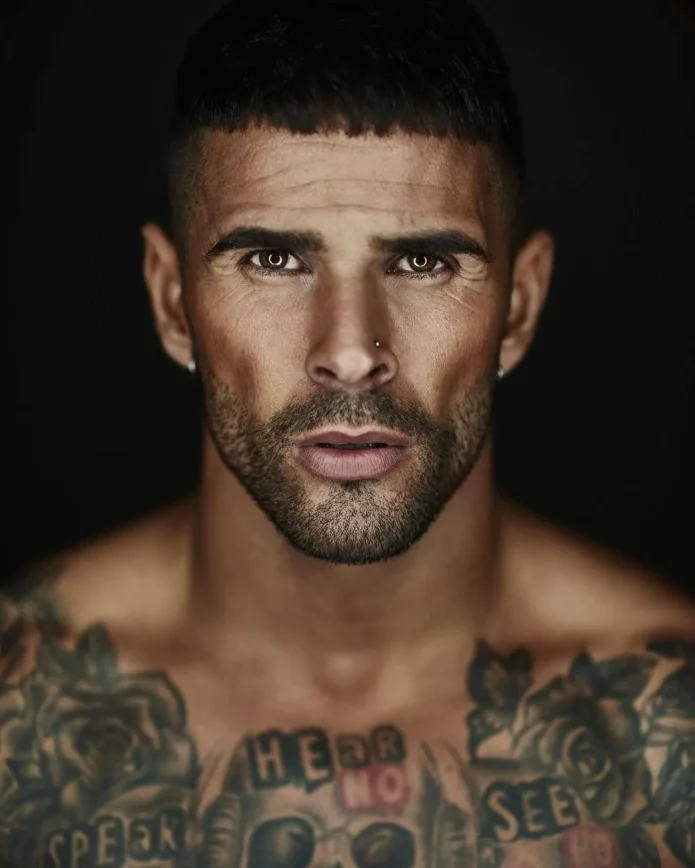
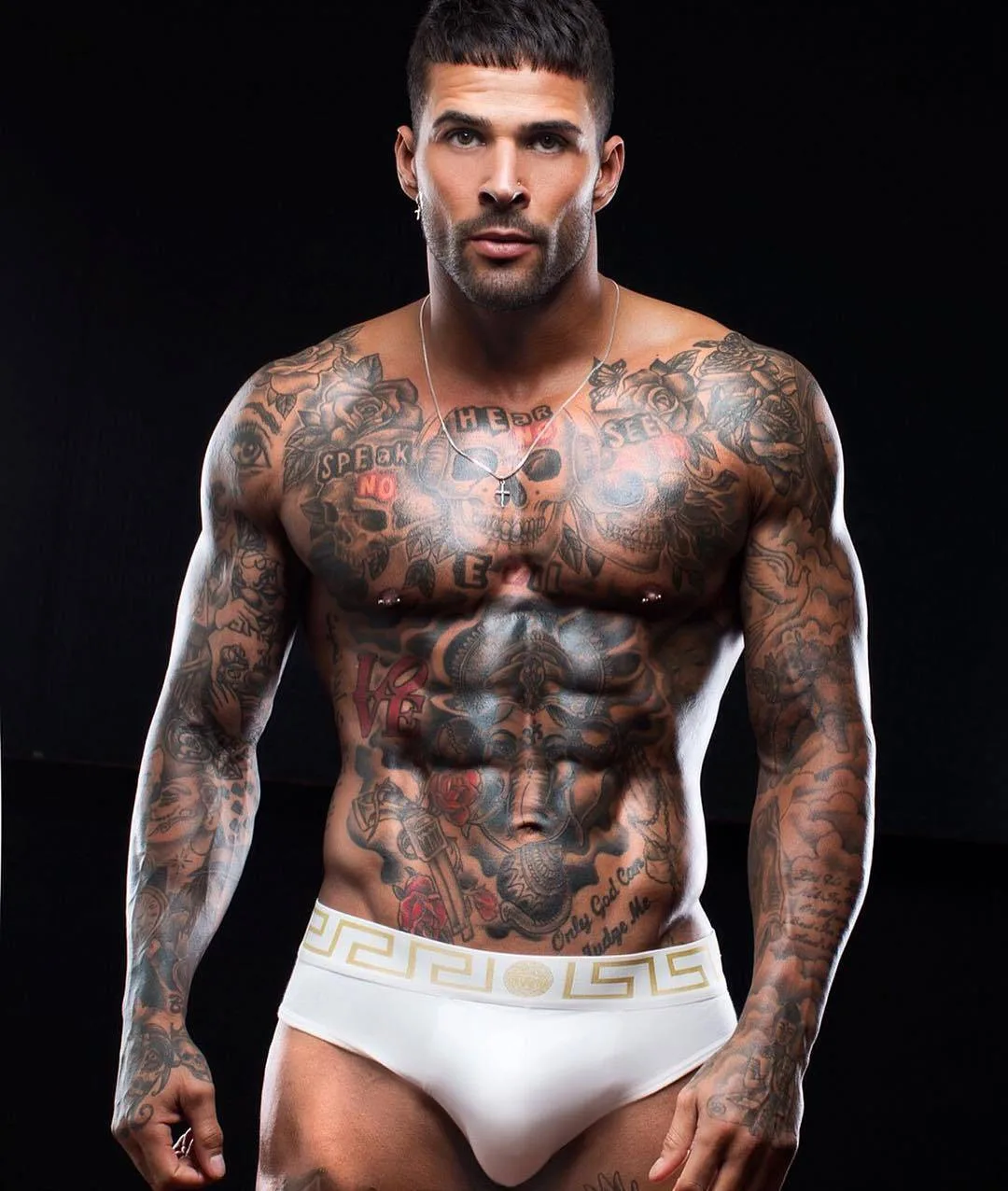
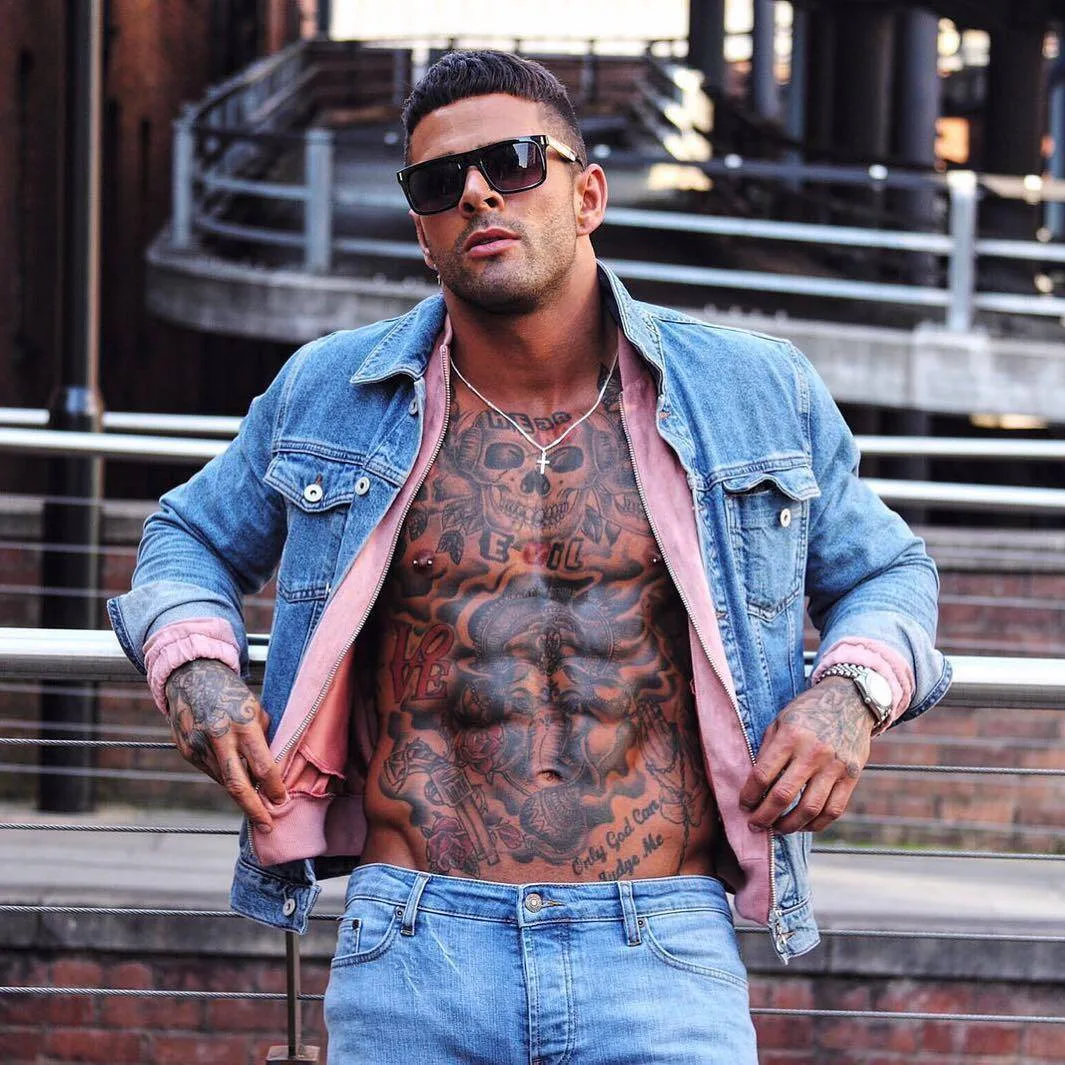
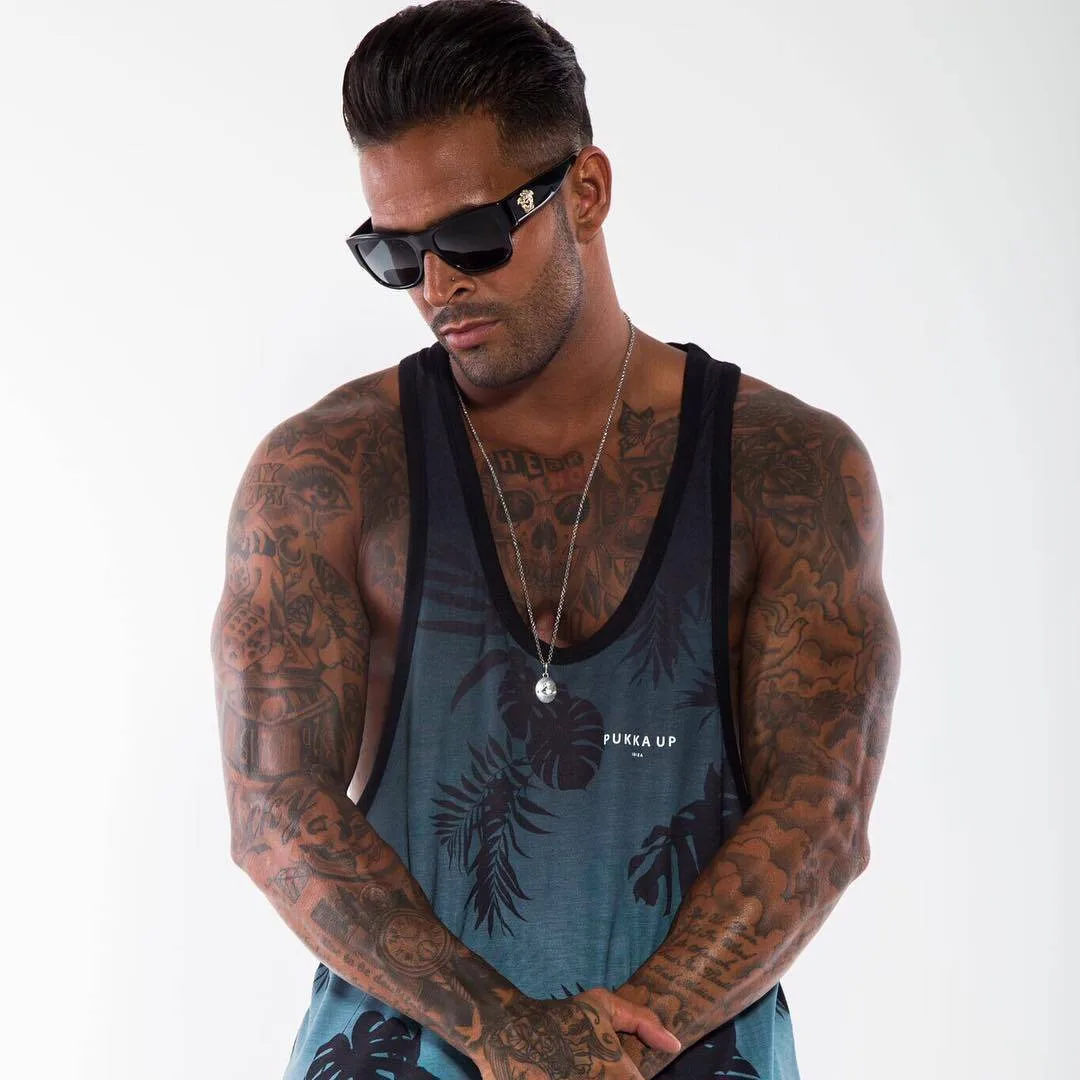
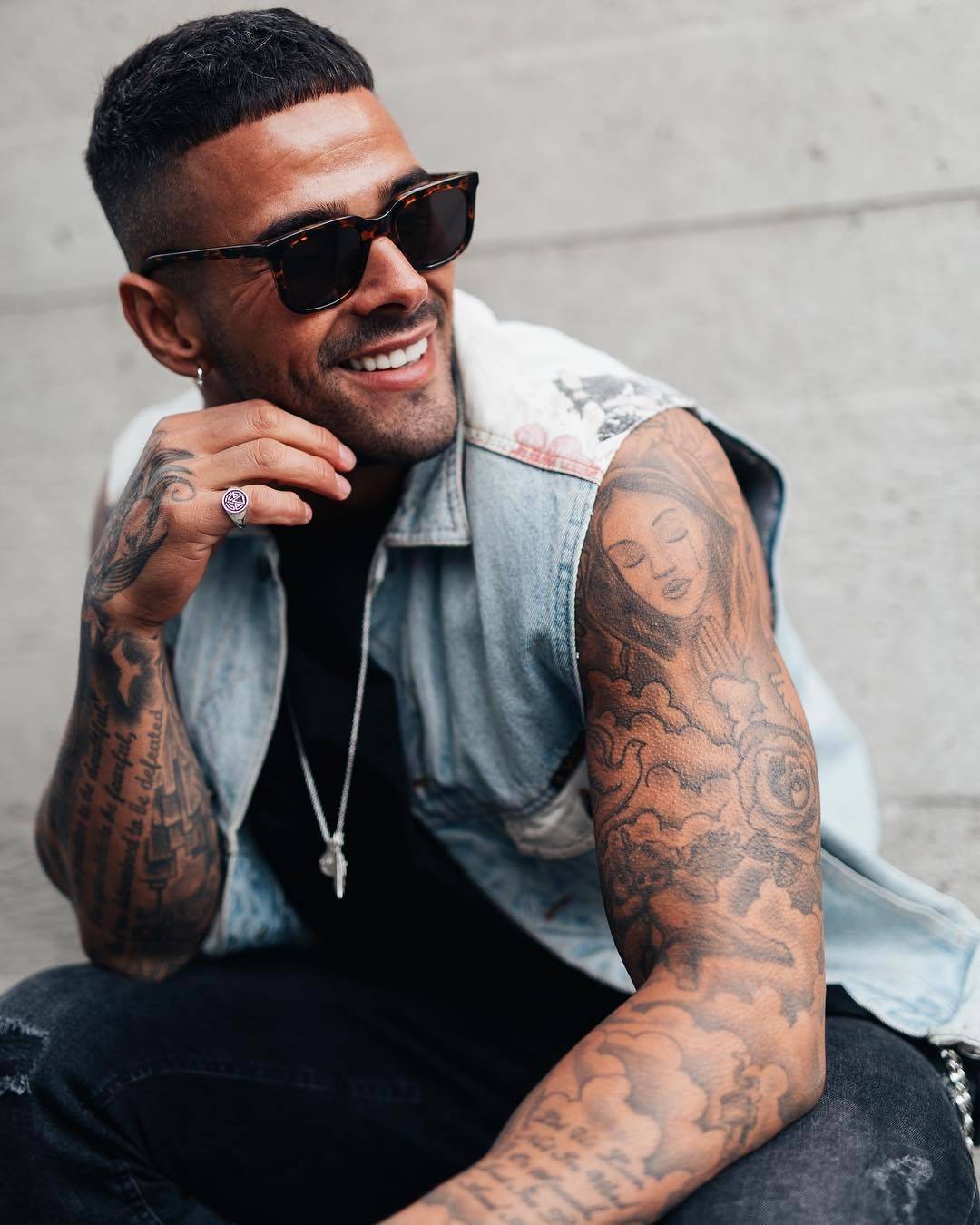
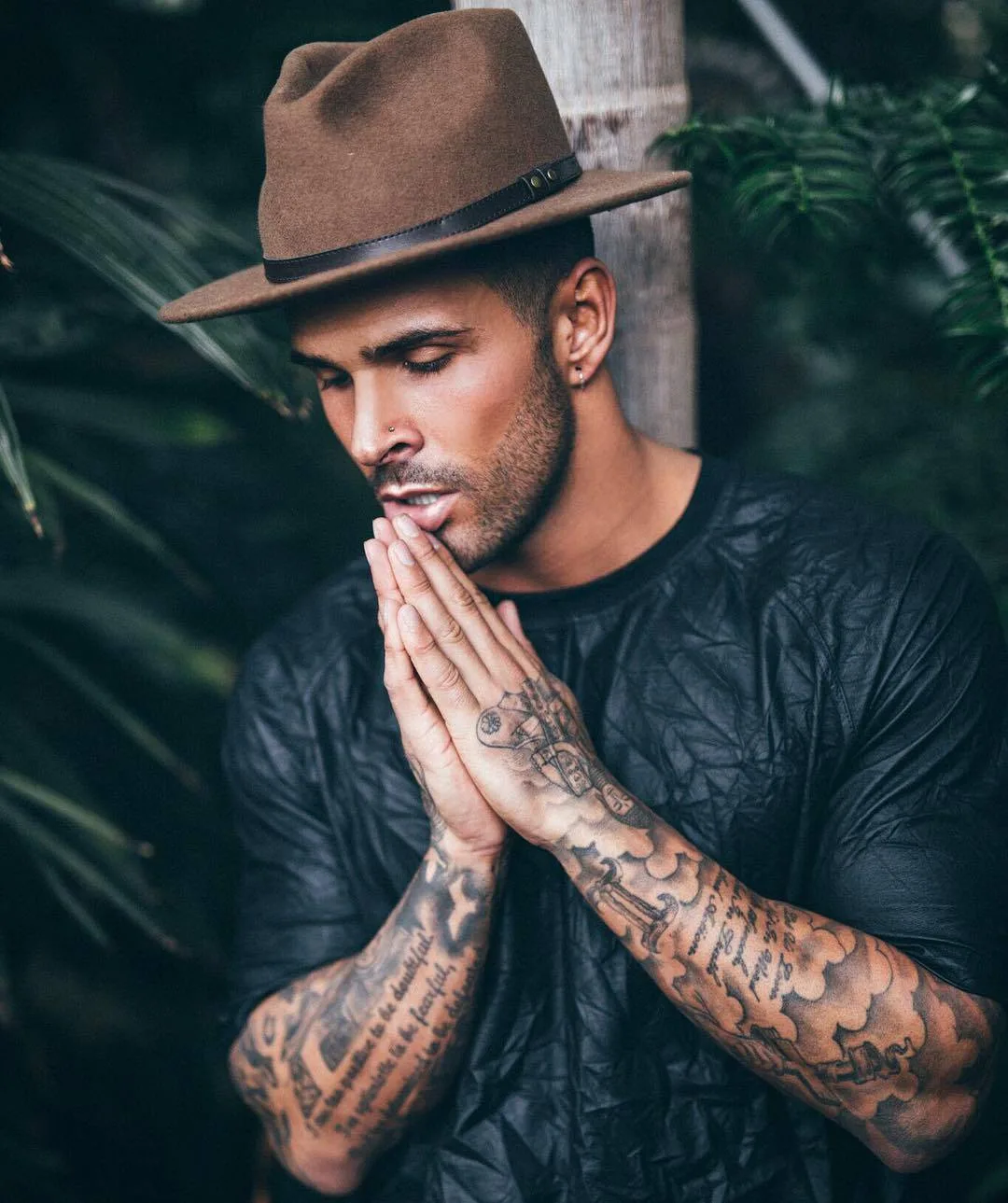
Leon Scott’s tattoos include three skulls across his chest, a rib-like design on his abdomen, clocks, dice and faces in his sleeves, and script that reaches his hands. Bold outlines, soft shading and touches of red keep the separate images distinct.
In a July 2026 Inked interview, the British fitness model and former footballer said David Beckham’s story-driven tattoos first caught his attention. Scott’s first piece, in 2004, copied Beckham’s winged cross. He now calls his collection “a timeline of my life.”
The three skulls and roses across his chest
Three skulls fill Leon’s upper chest. The middle one faces forward; the other two sit beneath short phrases drawn from the hear-no-evil, speak-no-evil and see-no-evil theme. Red panels lift the lettering out of the black-and-gray work. Leaves and layered roses fill the space toward his shoulders.
Each face has room for its eye sockets, nose and teeth, so the skulls remain clear rather than merging into one dark patch. The flowers soften the edges without hiding the three-part arrangement. Scott has spoken about tattoos as personal, but hasn’t tied a specific meaning to these skulls or roses.
The skeleton-style abdomen tattoo, revolvers and script
A bone-like design runs down Scott’s abdomen. Curved dark bands suggest ribs, with smaller shapes following a central line toward his navel. Lower down, two outlined revolvers sit among roses, including a red flower at one side. Near the waistband, the script reads “Only God Can Judge Me.”
Scott has spoken about his Christian faith in connection with a separate Jesus portrait across his back, which he linked to his baptism and commitment to Christ. That context is part of his story, but it doesn’t establish the exact history of this abdomen inscription.
The clock, dice and face designs in his right-arm sleeve
Scott’s right sleeve brings together an eye, dice, a Roman-numeral clock and a grinning face on the forearm. The clock curves around his arm; the dice add hard square edges beside the softer shading. A second round dial appears near the wrist, with small lettering and darker fill between the larger images.
Each subject keeps its own outline, but the shared shading helps the sleeve read as one piece. The clocks and dice may suggest time or chance to a viewer; Scott hasn’t confirmed those meanings.
The woman’s portrait, bird and clouds on his left arm
A woman’s portrait sits high on Scott’s left arm. Her eyes are closed, and a head covering with long dark lines frames her face. Below it, rounded clouds, a circular detail and a bird with spread wings bring wider shapes into the sleeve. The portrait’s quiet expression contrasts with the grin on his opposite arm.
Scott has discussed his Christian faith, but the woman’s identity and the bird’s meaning aren’t established. Visually, the cloud shapes connect the portrait and bird while leaving lighter gaps between them.
The forearm script, clouds and hand tattoos
Script runs along the inner forearms, alongside shaded clouds and outlined images. The lettering follows the length of each arm, but the words aren’t clear enough at every angle to quote in full. Larger lines and compact designs continue over the backs of his hands, while the fingers are more lightly tattooed.
The forearm work has a finer scale than the chest skulls, but the dark outlines and shading carry the sleeves down to the wrists. Scott also spoke with Content Cast about football, modeling, business and getting tattooed.
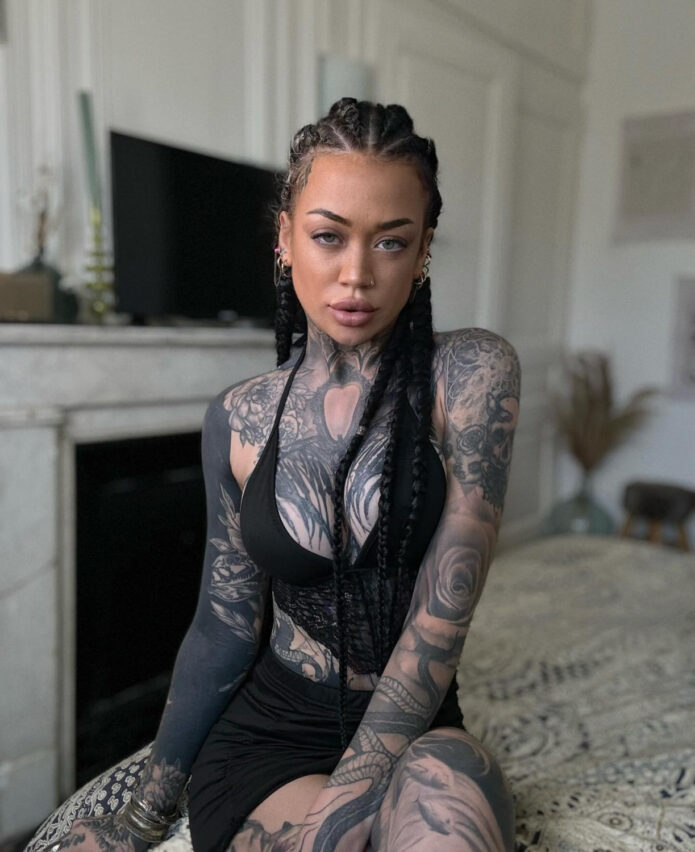
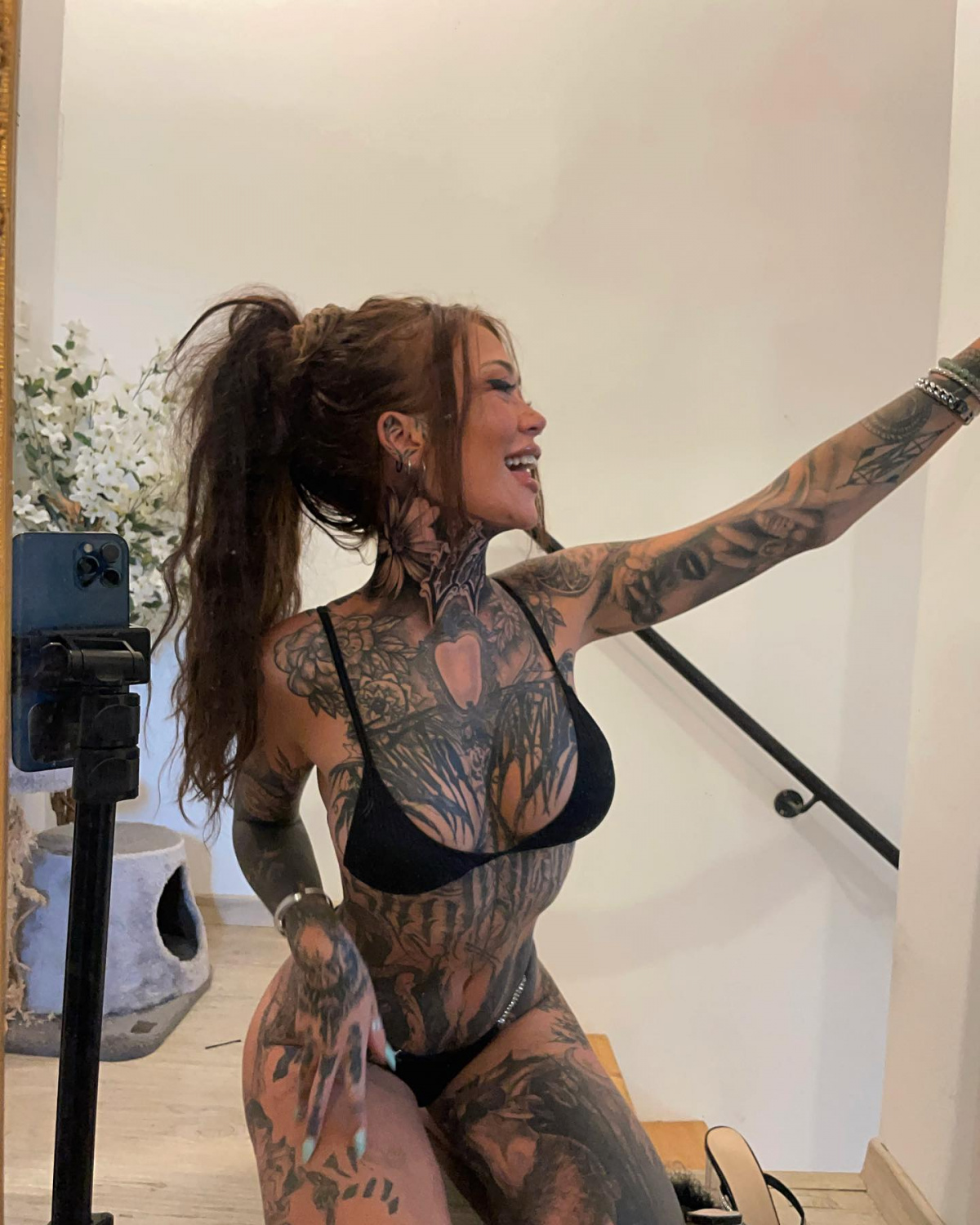
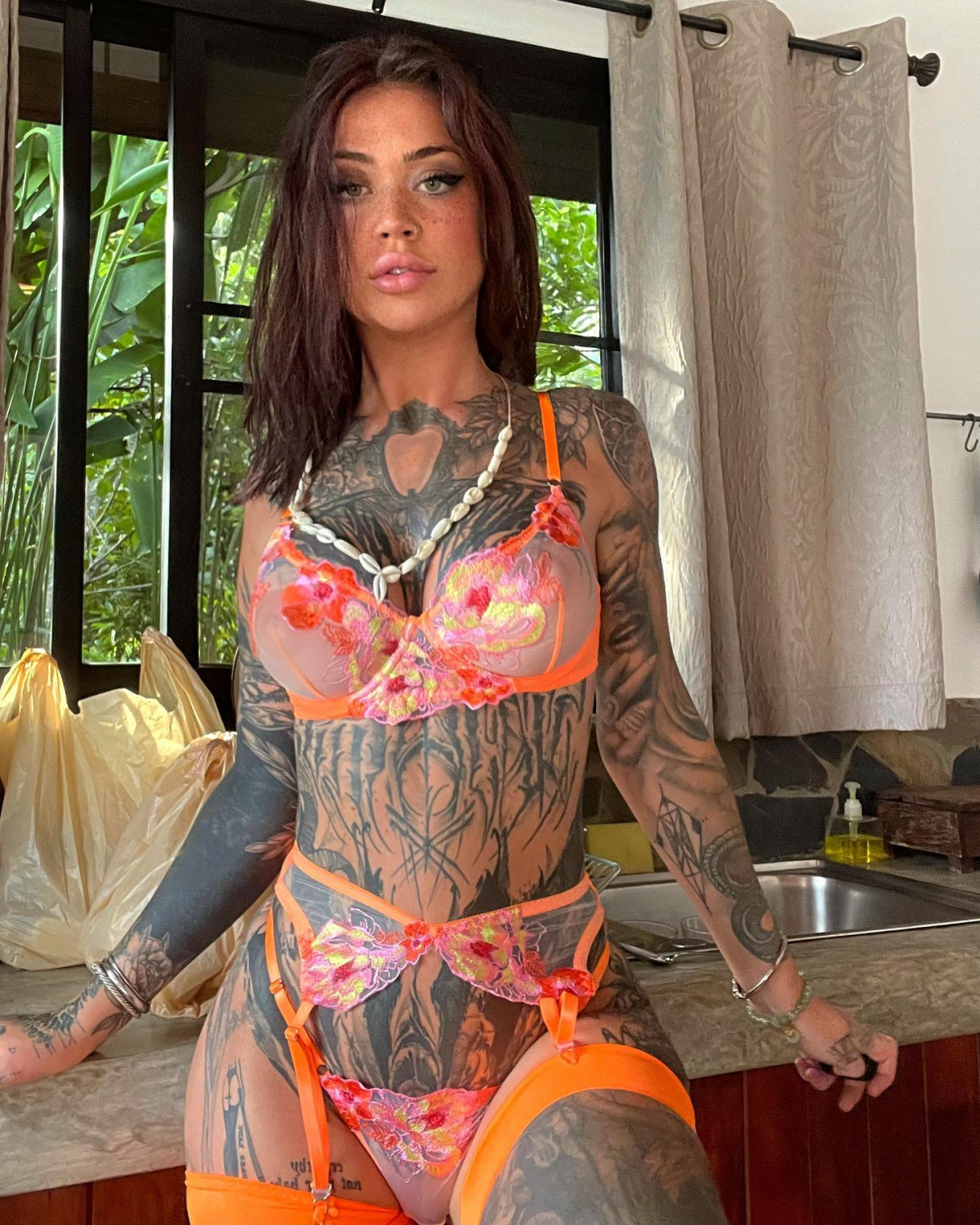
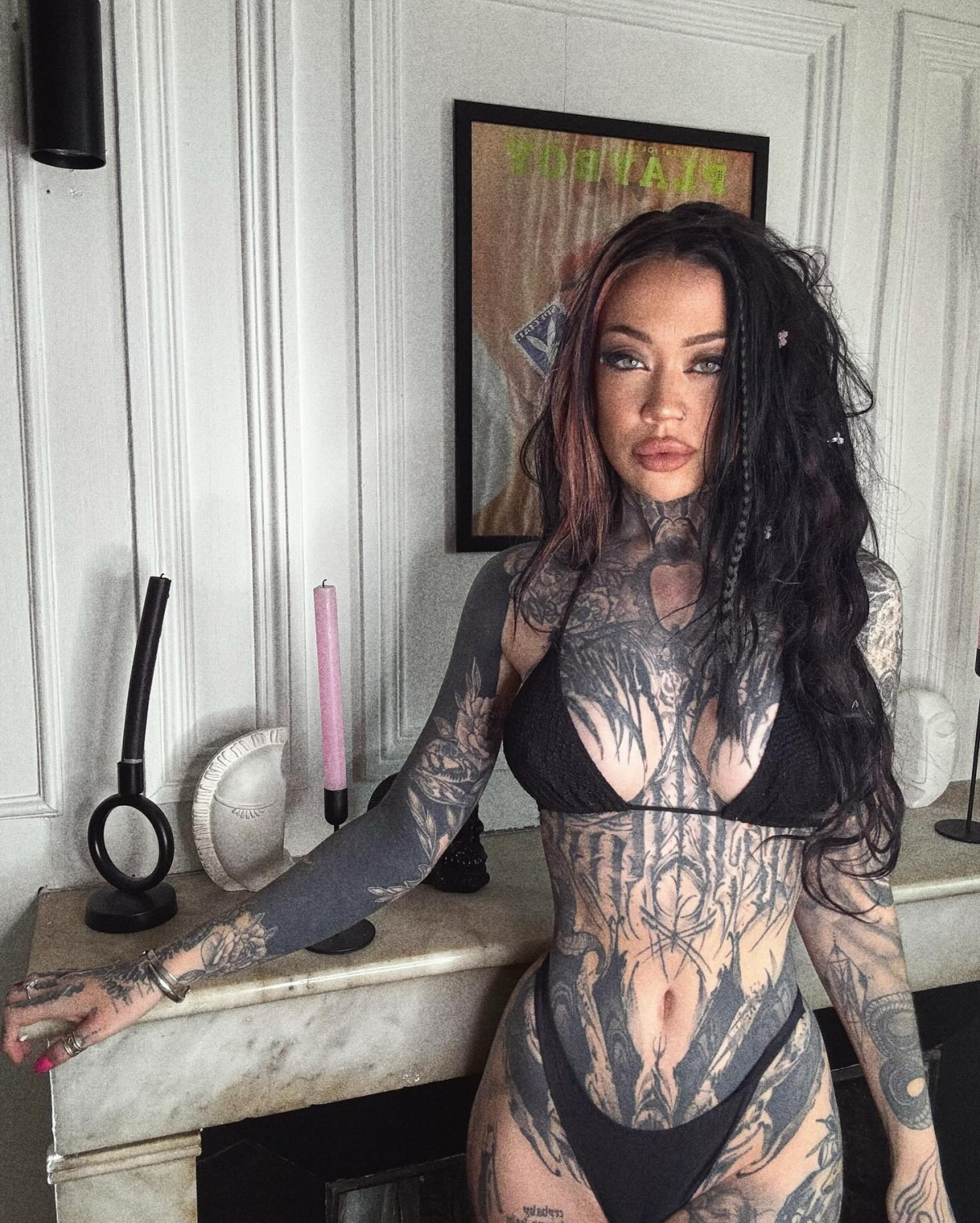
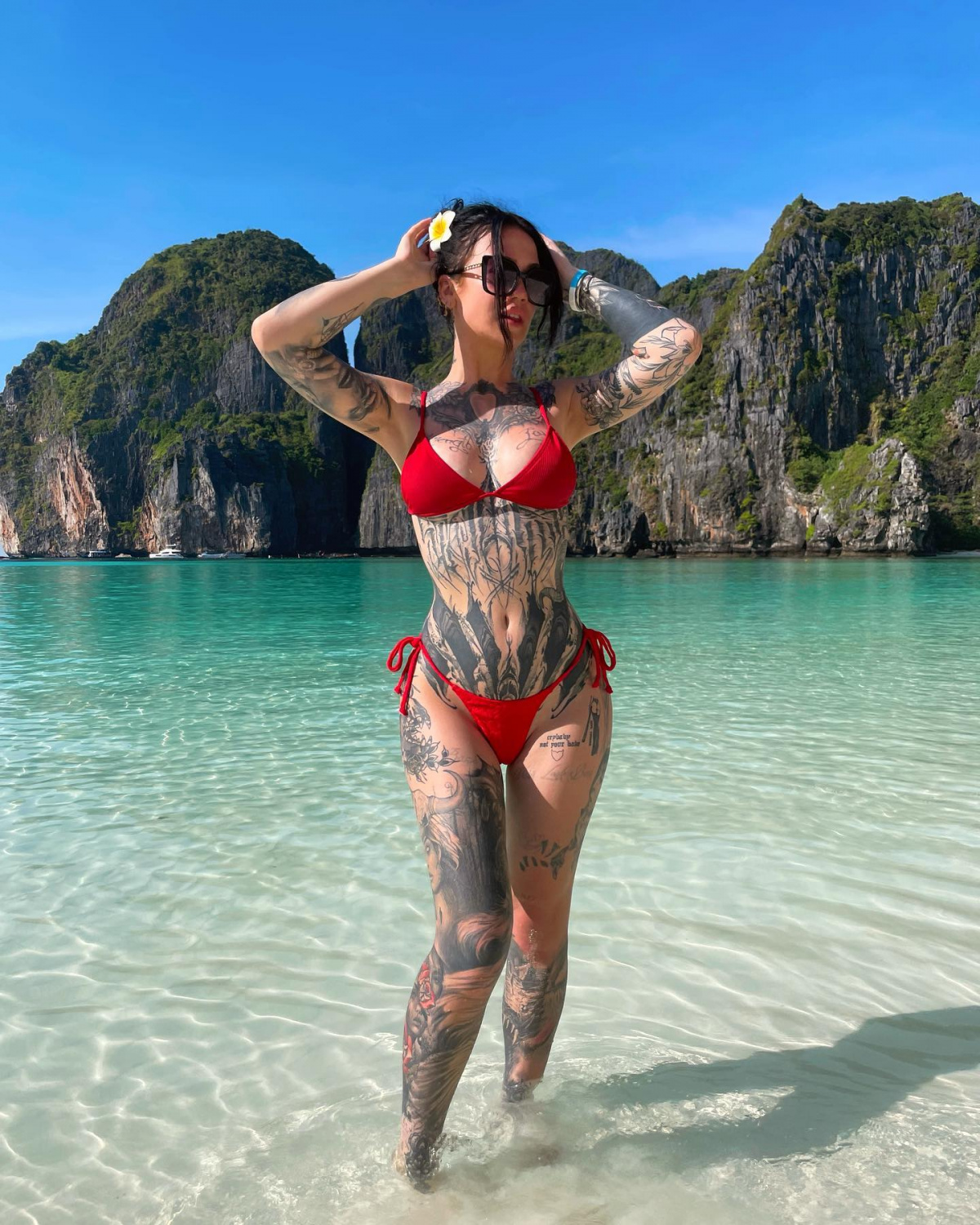
Ozzo, also known as Ozzora, is a French tattoo model and artist whose work pairs sharp blackwork with flowers, shaded portraits and open skin. Her neck and torso combine into a dense composition; her arms and legs vary in coverage, with a few red details breaking up the dark palette.
Her ornamental neck tattoo and open chest detail
Ornamental lines rise along the front of Ozzo’s throat, while a large flower wraps around the side beneath her ear. At the base of her neck, a rounded opening narrows into a point inside a dark frame. The bare skin creates a heart-like shape against the surrounding ink; its appearance alone doesn’t tell us what it means to her.
The flower’s softer petals contrast with the fine curls of the neck design and the darker chest work below. The open center gives the otherwise dense upper-body tattoo a clear focal point.
The pointed blackwork across her chest
Ozzo’s chest piece spreads from the center in long, uneven points. Some reach toward her shoulders; others taper down across her chest. Bare channels separate the darker marks, so the sharp silhouette doesn’t turn into one solid patch. Flowers near the shoulders bring rounded petals beside the angular lines.
The design reads clearly from a distance, while finer marks show up closer in. Its character comes from the way the points spread and leave space between them.
Her branching stomach tattoo and central linework
Long black marks branch down Ozzo’s abdomen, following the length of her torso rather than forming a band. Near the center, finer lines make an oval-like shape with intersecting strokes below it. That small detail sits between heavier areas of ink, and wider dark forms curve around the sides near her waist.
The central motif is abstract in the available image, so it can’t be identified as a particular rune or religious symbol. The open skin around it keeps the fine lines distinct from the darker branches.
The blackout sleeve with flowers and a snake
A broad black field covers much of one sleeve, broken up by lighter flowers and a snake near the elbow. Its head and teeth add a sharper shape among the petals. The floral details stand out against the dark background because their outlines and open areas have room to show.
Her other arm has more visible shaded motifs, including a large rose and curved lines near the wrist. The two sleeves share a dark palette, but their different levels of solid coverage keep them from mirroring each other. The photos don’t establish whether the blackout work covers an older tattoo.
Her leg tattoos, shaded portraits, and red accents
Ozzo’s leg tattoos vary in coverage. One side has a dense arrangement running down from the thigh, including a shaded face whose identity isn’t established. The other leaves more skin between its lettering, smaller symbols and a larger shaded design lower down.
Small red details break up the mostly black-and-gray work. Against the heavier thigh coverage, they read as accents rather than a shift to an all-over color palette. The video below shows Joshua Beatson demonstrating blackwork on a separate horror tattoo.
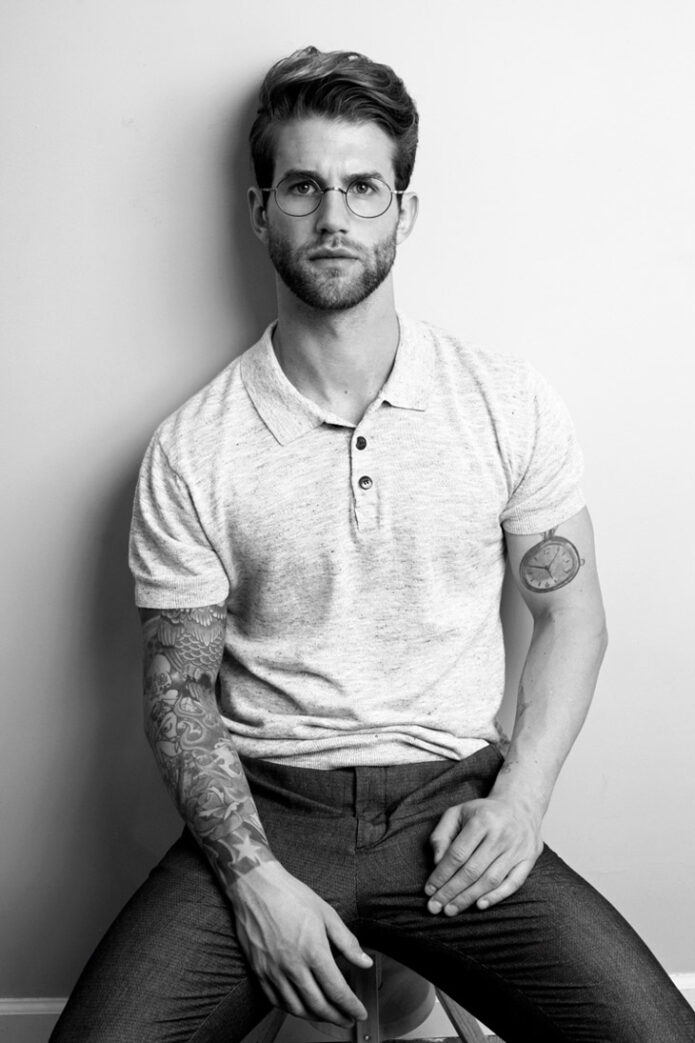
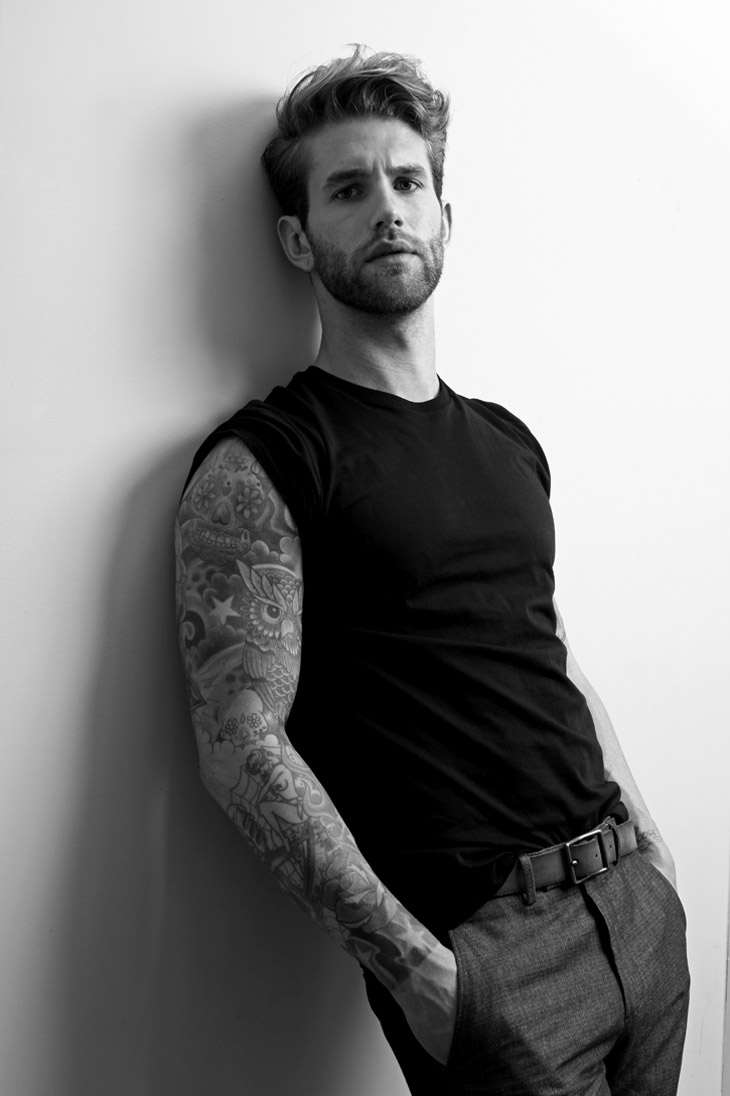
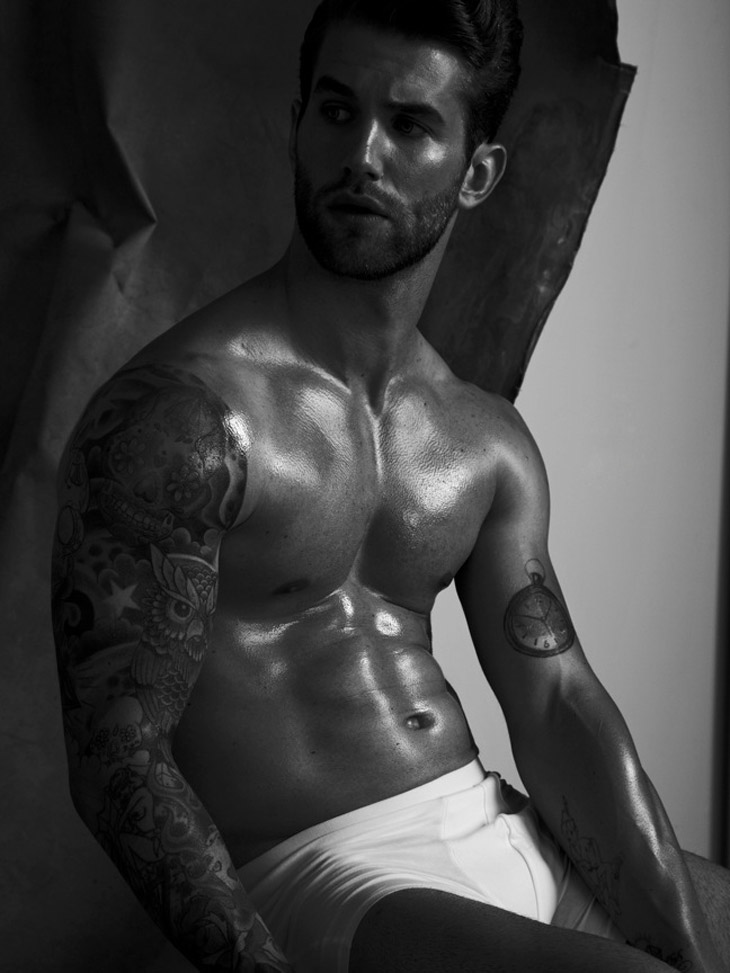
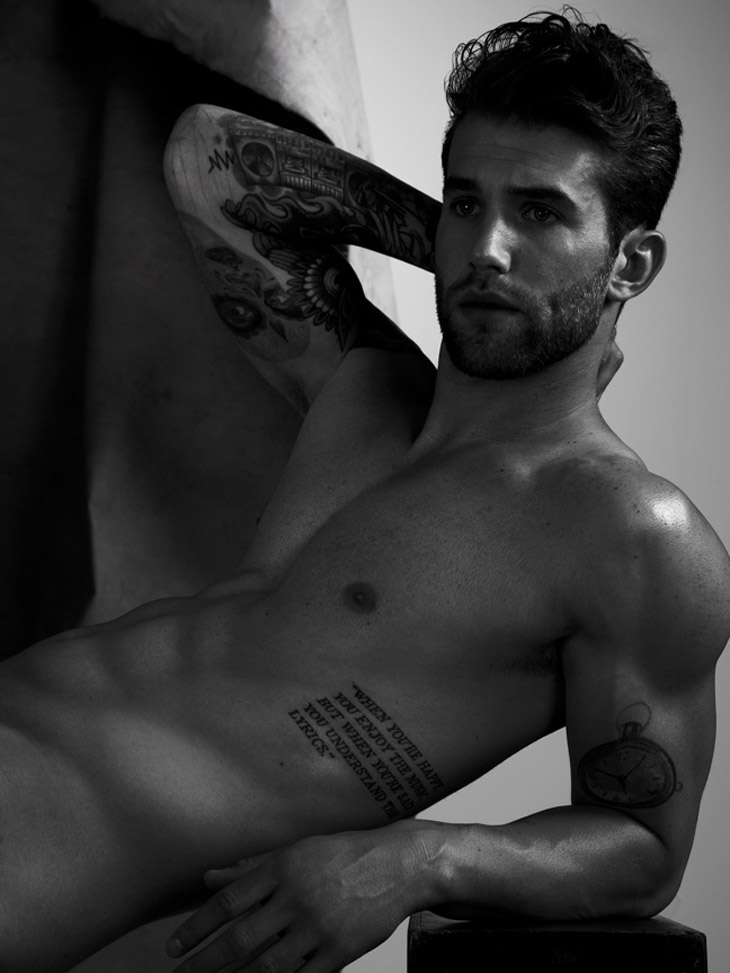
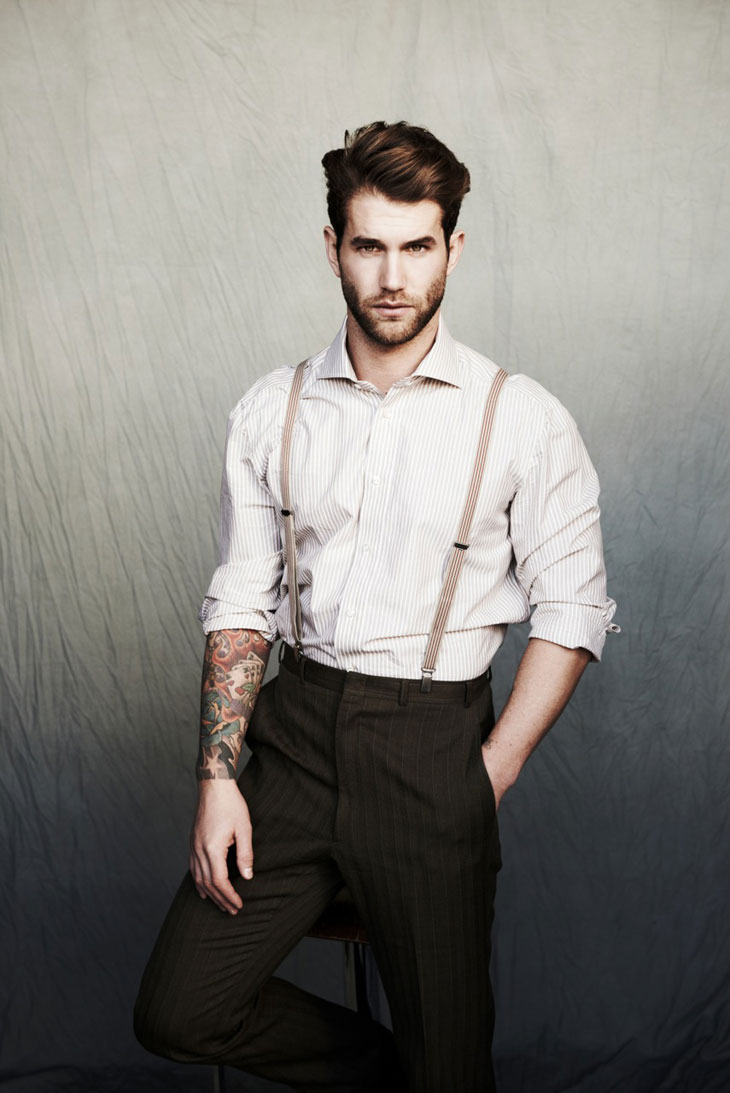
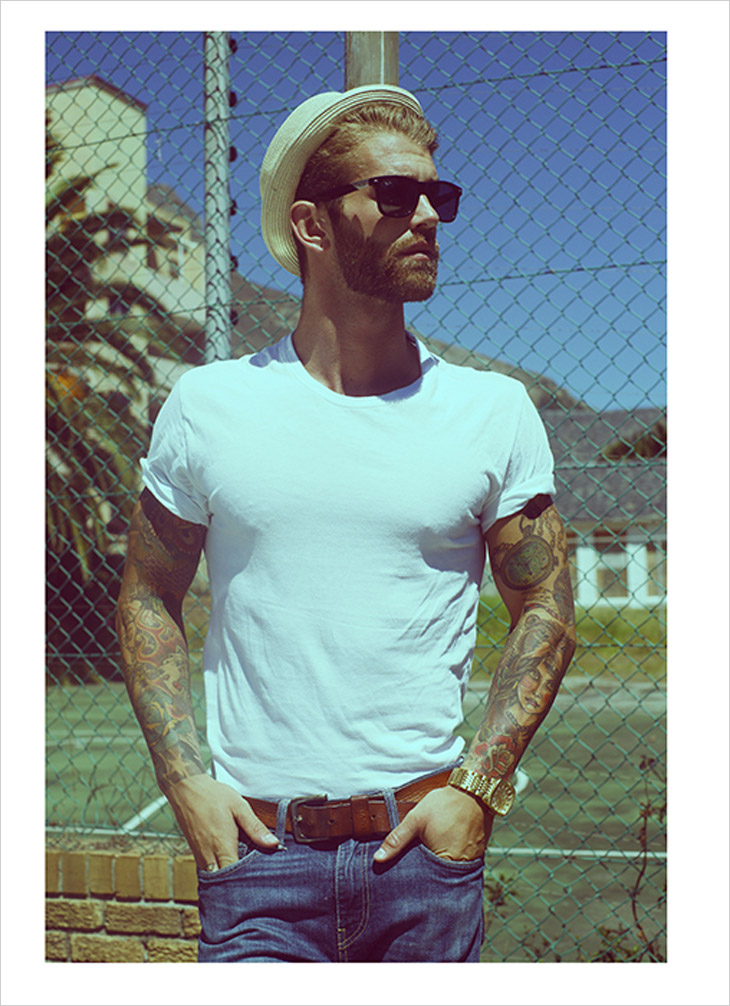
Andre Hamann’s tattoos mix an owl, a pocket watch, flowers, stars and smaller shapes across his arms, with a block of lettering along his ribs. The German model began getting tattooed at 16. In a 2016 interview with n-tv, he said the pieces mark different periods of his life and that their meaning matters to him.
The photos here are from an earlier stage of his modeling career, so they show the collection as it looked then. They don’t explain the personal story behind every design, but they do show how he placed dense sleeves beside more open areas.
Right upper-arm owl tattoo
An owl faces forward on Hamann’s right upper arm. Its large round eyes and pointed outline stand out above rows of curved feather shapes. Stars, rounded forms and a decorated skull sit nearby, but the owl keeps a clear silhouette within the busy sleeve.
Hamann hasn’t given a specific meaning for this owl in the interview discussed here. Its bold face and repeating feathers are easy to see without assigning it a familiar symbolic meaning.
Left upper-arm pocket watch tattoo
A pocket watch sits on Hamann’s left upper arm. A dark rim frames the dial, with a small loop at the top and hands inside. In the early shirtless photo, open skin around the watch gives it room to read as a single object, unlike the denser sleeve on his other arm. The image doesn’t make an exact time or personal story clear.
Left rib lettering tattoo
Compact rows of uppercase lettering sit along Hamann’s left ribs. The block is visible in a turned, seated pose, but the full wording curves away from the camera. It’s best to leave the text unquoted rather than guess at words the photo doesn’t show.
The stacked lines make a neat, contained shape beside the larger images on his arms. Hamann has said meaning matters to him, though the wording here isn’t fully legible in these photographs.
Right wrist star tattoos
Dark stars sit near the edge of Hamann’s right sleeve, close to the hand. Their simple points contrast with the curls, faces and rounded forms higher on the arm. A rolled sleeve reveals them even when most of the upper-arm work is covered. The interview doesn’t identify a personal meaning for these stars.
Left forearm flower tattoos
Flowers cover part of Hamann’s left forearm, including a reddish bloom near the wrist and leafy shapes around it. The photograph has a strong color tint, so it isn’t a reliable guide to the ink’s exact shades. The petals and leaves have a looser outline than the pocket watch’s round rim.
The Calvin Klein film below shows Hamann and his tattoos in motion.
Cervena Fox is a British-born model, tattoo artist and fire performer. Her colourful sleeves sit alongside large thigh pieces and smaller hand tattoos. In a 2025 interview, she recalled getting her first tattoo at 15 and already wanting a full body suit. The early swallows came from memories of birdwatching with her grandmother.
Fox tattoo sleeve on her right arm
A pale fox face stands out against orange and red tones on Fox’s right arm. Dark outlines keep its features distinct as the sleeve bends around her shoulder. She has said she planned and drew the sleeve while at college, when she was researching Japanese mythology. That gives the design a background beyond the tempting guess that she chose a fox because of her surname.
Pirate portrait and roses on her left arm
A female pirate portrait anchors Fox’s left sleeve, with a large rose below it. Fox has linked the pirate to her mischievous side and said she drew the character when she was 16. A black-and-white photo brings out the dark shapes around the face and the layered petals of the flower.
In a 2015 Inked interview, Fox said she spent two years planning her sleeves and sometimes tested designs with marker before committing. She named Antony Fleming as her go-to artist at the time.
Hand lettering and small finger tattoos
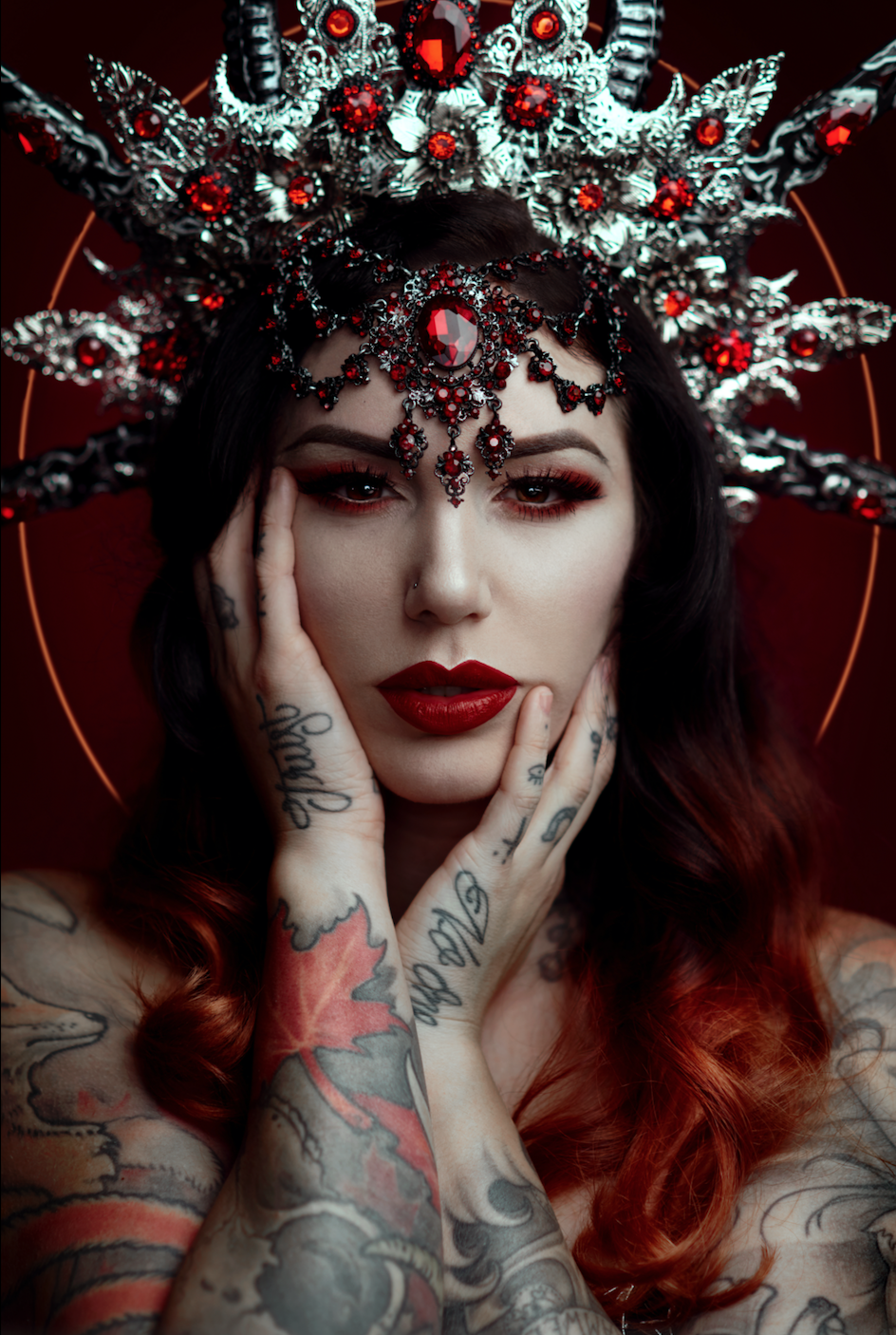
The lettering on Fox’s hands reads Stay and Golden, one word on each side. The sweeping script turns the phrase into two parts that meet when she frames her face. Smaller symbols sit on her fingers, including an eye-shaped mark. Fox hasn’t supplied a private explanation for each symbol.
Red maple leaf on her right forearm
A red maple-shaped leaf brings a bright patch of color to Fox’s right forearm. Its pointed outline stands apart from the surrounding curves, while warmer orange tones and dark borders connect it to the rest of the sleeve. The photos don’t establish a national or personal meaning for the leaf.
Lily, lettering and ornamental thigh tattoos
On Fox’s thigh, a large lily sits above two lines of lettering—Heaven has and No rage—with a darker, cross-like ornament below. The flower’s long petals, separated text and radiating lower design each have their own space. The visible words don’t reveal a longer inscription or explain what the ornament means to her.
Fox has also said Megan Massacre encouraged her to return to tattooing after an earlier apprenticeship. She discussed that at the London Tattoo Convention; see Megan Massacre’s tattoos for more about the artist. Fox’s tattoo tour is below.
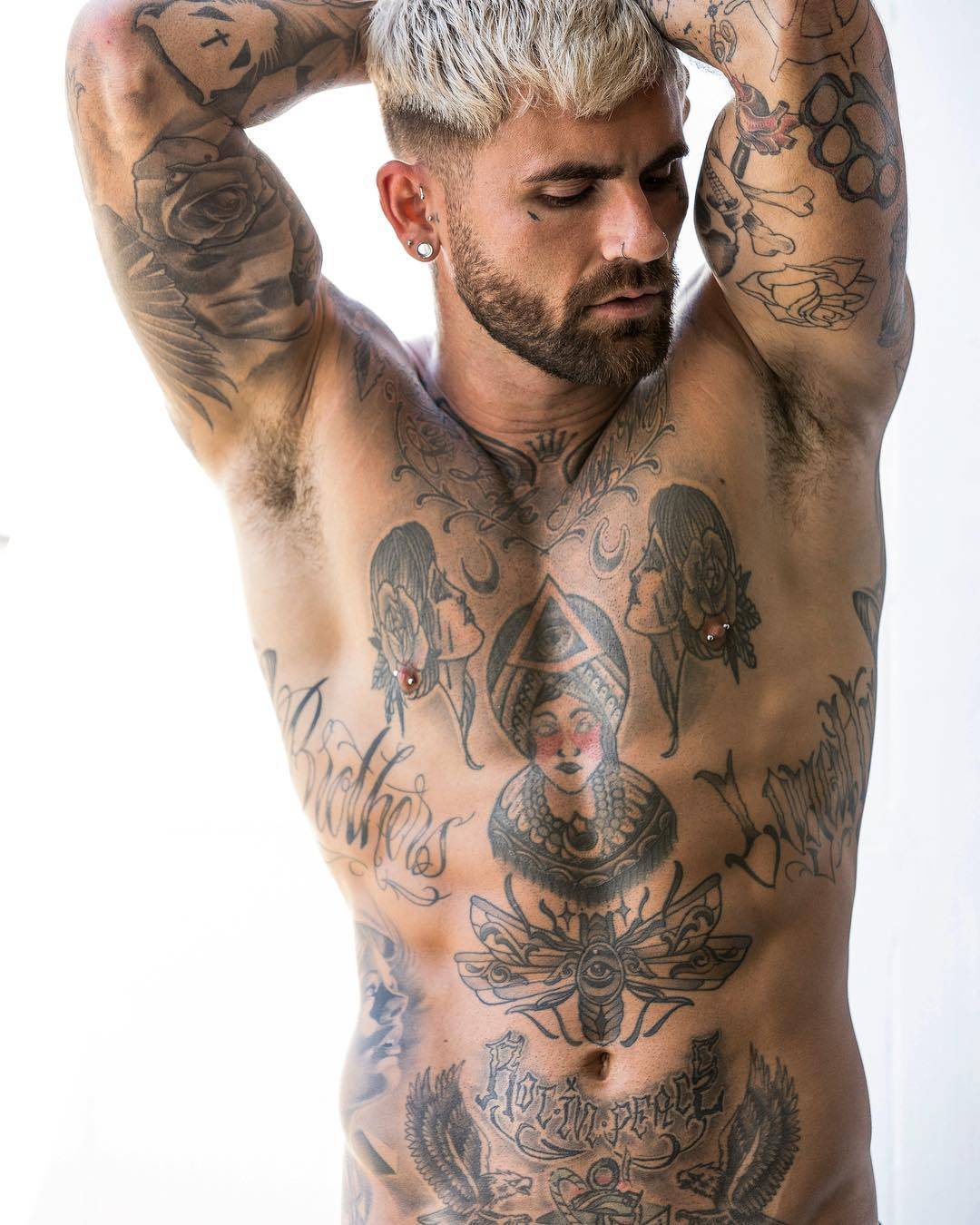
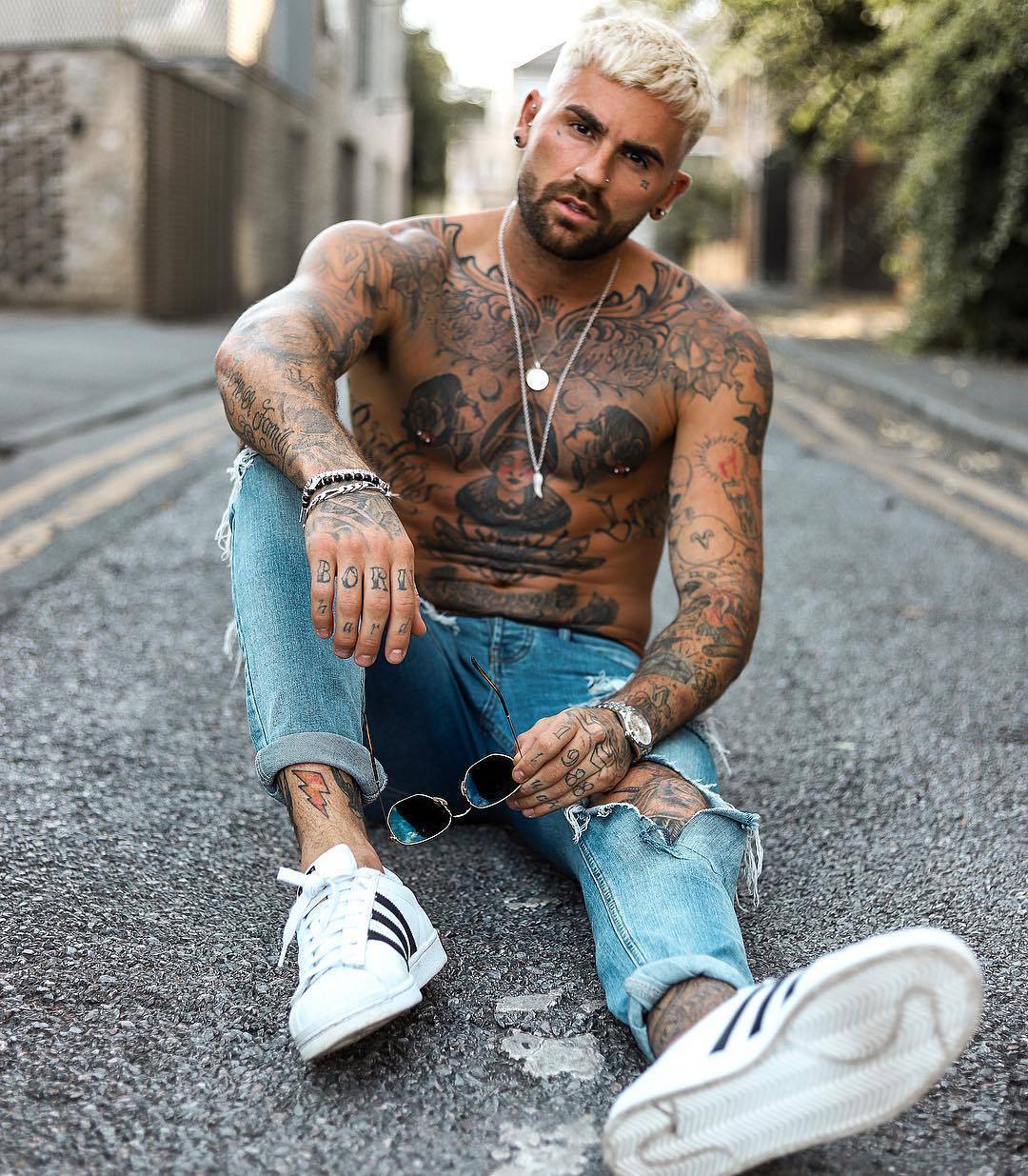
Australian model Chris Perceval’s tattoos mix large images with lettering and smaller symbols. A rose sits at the front of his neck; the chest combines ornamental script and portraits; his arms carry traditional-style pictures, and an eye sits inside a winged insect on his stomach.
The rose tattoo at the front of his neck
A large, outlined rose sits directly beneath Perceval’s beard, with its bloom facing forward. The petals fold toward the center and open out around it. Smaller neck work carries toward the sides, while the rose draws the eye from his face down to the chest. He also has a small number tattoo on his cheek. The photo doesn’t establish a personal meaning for the flower.
Ornamental lettering across his upper chest
Ornamental lettering and curling flourishes stretch along Perceval’s upper chest, above two inward-facing profiles. Roses sit beside the portraits; between them, a triangle with an eye rests above a larger woman’s face. The script makes a decorative upper border, though parts of the wording are obscured by the angle and a necklace.
The profiles, central portrait and lettering each have different linework and shading, but sit close together across the same section of chest.
The candle, portrait and rose tattoos on his left arm
Perceval’s left arm has a traditional-style mix of pictures: a woman’s profile and rose near the shoulder, a tall candle with a reddish flame, and another rose with warm red and orange tones lower down. The candle’s straight sides contrast with the rounded petals. The visible portraits and flowers aren’t identified as particular people or events.
The eye and winged insect tattoo on his stomach
A moth-like insect spreads across Perceval’s stomach just above the navel, with an eye at its center. Long panels and curled details fill the wings, while thin legs extend from the body. A heavily shaded woman’s portrait with colored cheeks and a beaded head covering sits above it; lettering and birds continue below. The lighter wing areas help keep the two central images distinct.
BORN lettering on his right hand
BORN runs across the fingers of Perceval’s right hand, with a large decorative letter on each finger and a smaller line below. The word lines up when his fingers are together and shifts as he moves his hand. His other hand has different letters and symbols, including a circular design, rather than a matching copy.
Perceval’s Q&A below was filmed while he was being tattooed. He talks about tattoos, training, business and life in Australia.
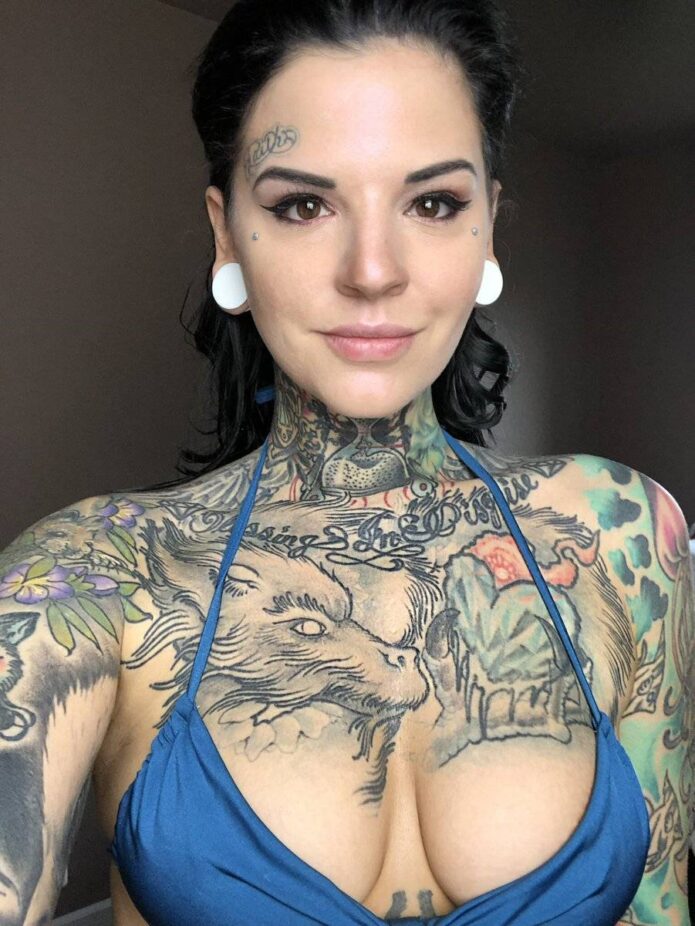
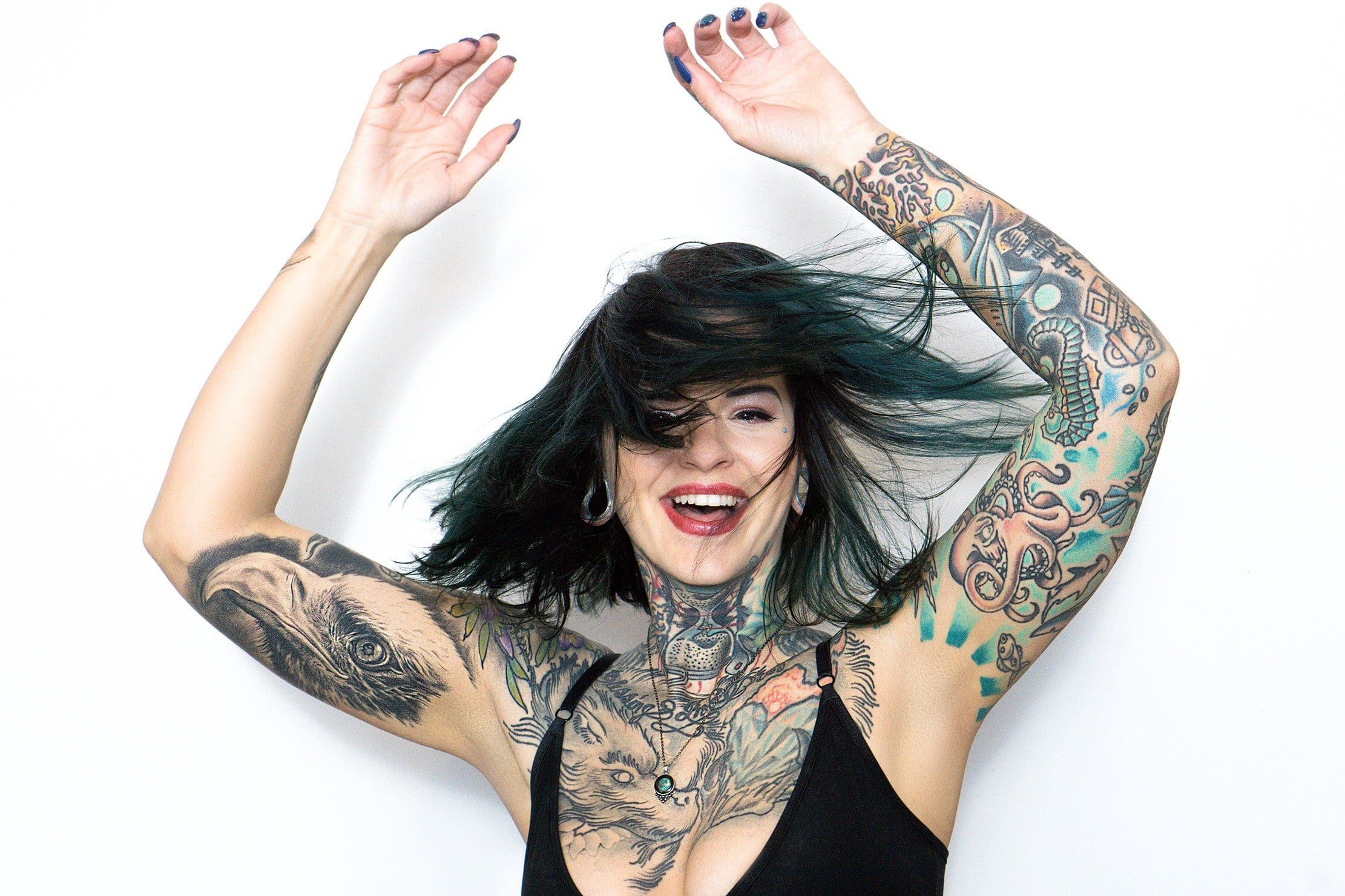
Tattoo model and creator Heidi Lavon’s collection includes a canine head and diamond across her chest, an eagle and ocean sleeve, portraits on her hands and faces on both thighs. In a 2018 InkAddict interview, she recalled starting with a pirate ship on her back, a heart on her chest and a Jason Voorhees mask on her thigh; she said the mask was later covered with a black panther. The photos below show a later stage of her collection.
The animal head and diamond tattoos across her chest
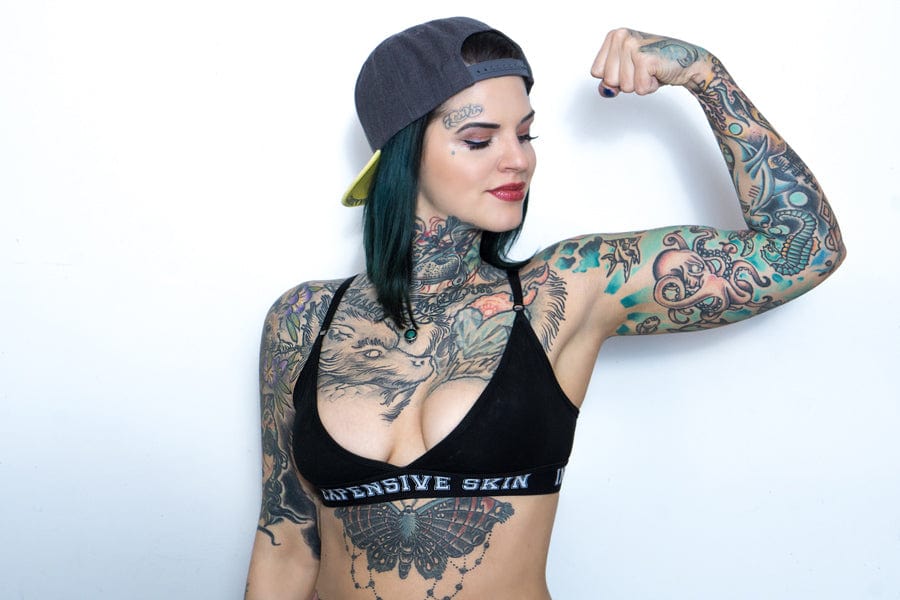
A large canine head stretches across Lavon’s upper chest, its muzzle angled toward a faceted blue-green diamond. Flowing fur lines reach toward her shoulders, while straight edges and color give the stone a different texture. Lettering sits closer to the collarbones, and overlapping designs continue up the neck.
The eagle head tattoo on her upper arm
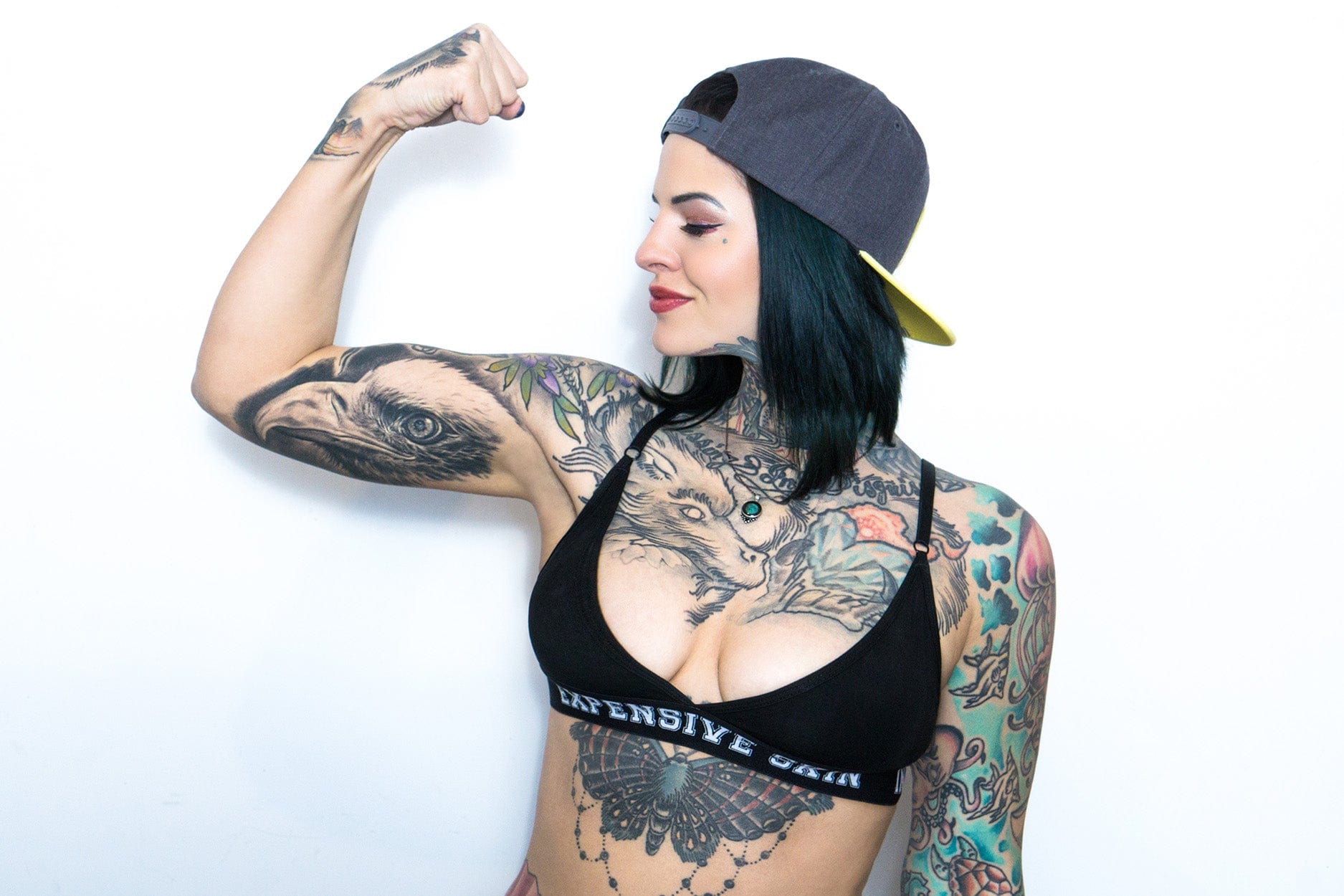
A black-and-gray eagle head fills Lavon’s right upper arm. Its hooked beak and round eye stand out against layered feather shading. Smaller purple flowers and green leaves sit nearby; they add color without competing with the bird’s face.
The octopus and seahorse tattoos in her ocean sleeve
Lavon’s other arm has a colorful ocean scene, with an octopus high on the arm and a ridged seahorse near the elbow. The octopus’s tentacles curl around its head; the seahorse’s narrow snout and segmented body give it a different outline. Blue-green patches, small sea shapes and touches of pink and orange fill the spaces between them.
The portrait tattoos on the backs of her hands
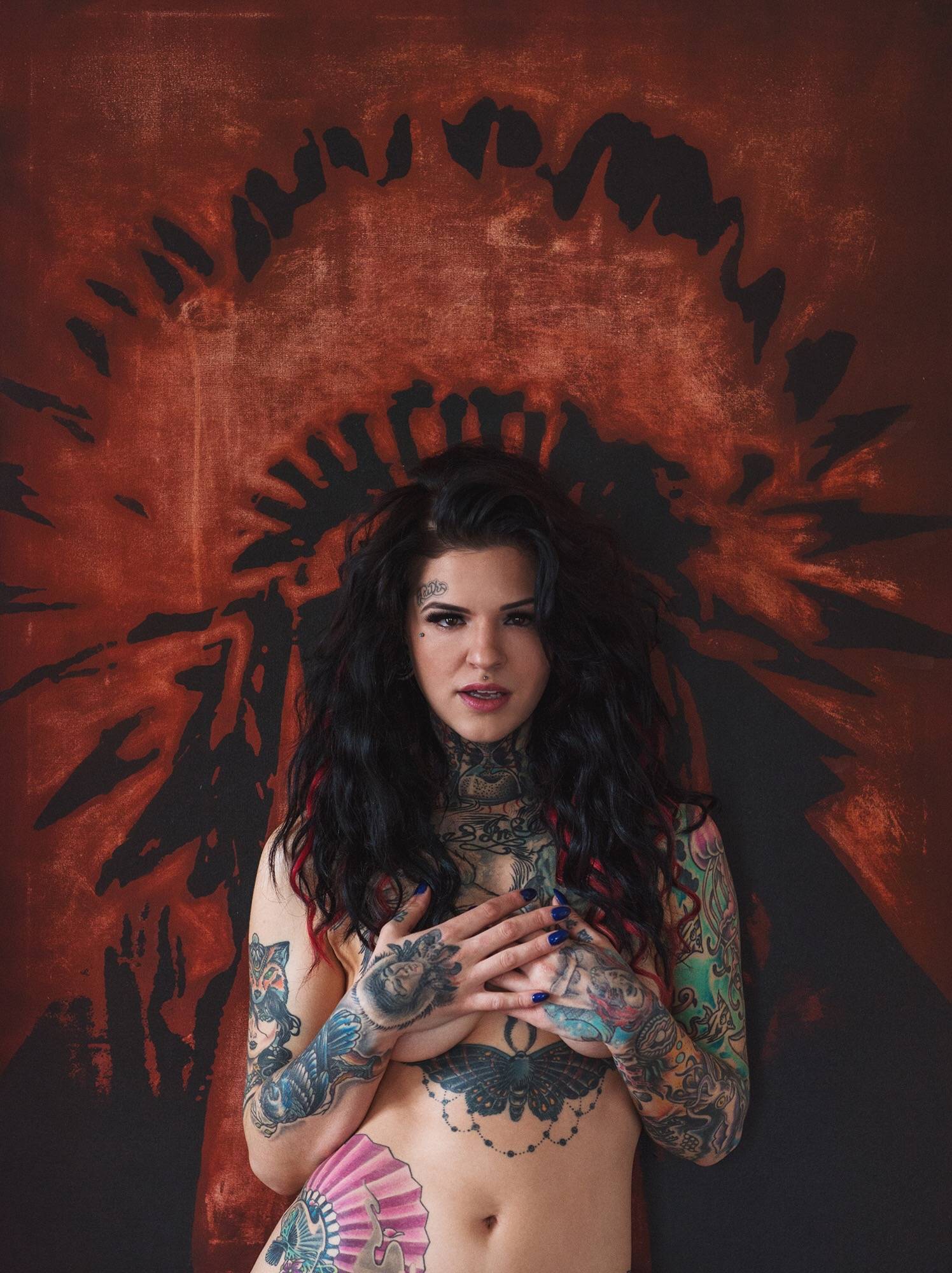
Each of Lavon’s hands has a portrait. One face is softly shaded and framed by dark hair; the other uses red and blue-green color with a stronger border around the head. The expressions and treatments differ, though their placement gives the pair a connection.
The woman portrait tattoos on her thighs
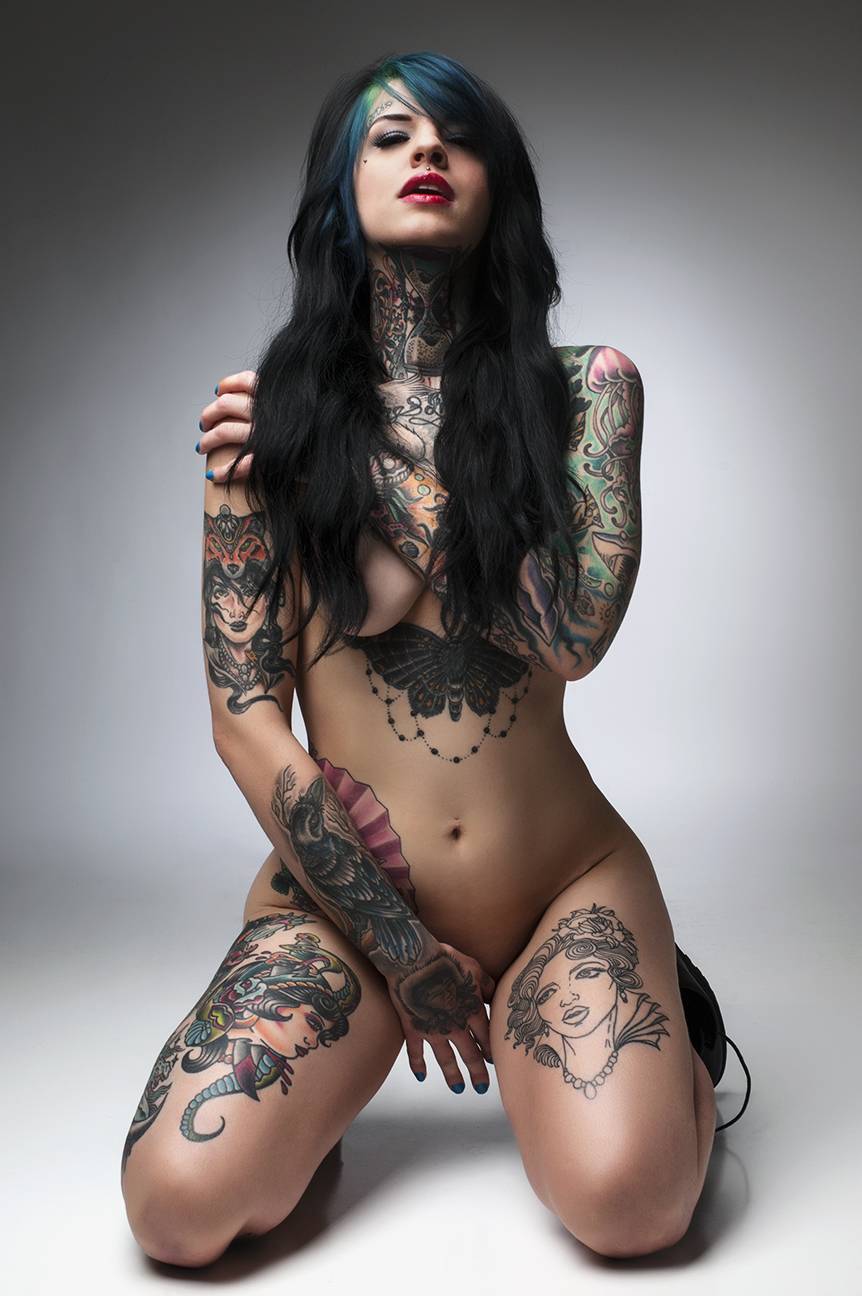
Woman’s faces sit on both of Lavon’s thighs. One portrait uses color and decorative framing; the other is mostly linework, with curled hair and a necklace. One turns into profile, while the other faces more toward the viewer. The two treatments show different ways of building a portrait in the same general placement.
Lavon’s updated tattoo tour below shows how these earlier pieces sit alongside the work she has added since.
Anna Bell Peaks’ tattoos include roses and script across her chest, a butterfly on her stomach, a watch and flowers on her arm, and ornamental work on her legs. In a 2015 AllHipHop interview, she said she had 27 tattoos at the time—a count from that interview, not a current total.
The Judge Me Not chest tattoo and paired roses
Judge Me Not curves across Peaks’ upper chest between two roses near her collarbones. Smaller flourishes sit below the words. In the July 2015 AllHipHop interview, she said the phrase marked a turning point: she wanted to live for herself and worry less about other people’s opinions.
The lettering uses thick strokes and finer loops, while red petals and small green leaves frame the phrase. Together, the script and flowers make a wide chest design.
The butterfly stomach tattoo and sweeping side lines
A dark butterfly runs vertically down the center of Peaks’ abdomen. Patterned wings open around a narrow body, with long curves continuing toward her navel piercing. The piercing sits in the open space below the tattoo. Bold wing edges keep the butterfly distinct from the sharper abstract lines sweeping around her waist. Her reason for choosing this design isn’t established here.
The pocket watch and rose tattoos on her forearm
An open pocket watch anchors the design on Peaks’ right forearm. Its round face and hinged lid sit beside a winding chain-like line, with red roses and smaller circular details nearby. The image doesn’t establish a specific time or personal story for the watch.
The skull and rose tattoos in her right arm sleeve
A large skull and shaded rose fill Peaks’ right upper arm, with smaller forms around them and watch-and-flower work continuing below. Dark eye sockets give the skull a strong outline; lighter areas across the bone and layered petals keep the two images separate. This arm uses more black and gray than the brighter work elsewhere in her collection.
The thigh script, ornamental heart and leg flower tattoos
Flowing script sits beside an ornate heart on one thigh. The writing is partly obscured in the photo, so the full passage can’t be transcribed. Linked heart-like shapes form a lighter band around the other thigh, while colored flowers follow the calf. The larger designs and narrow band use different amounts of open skin.
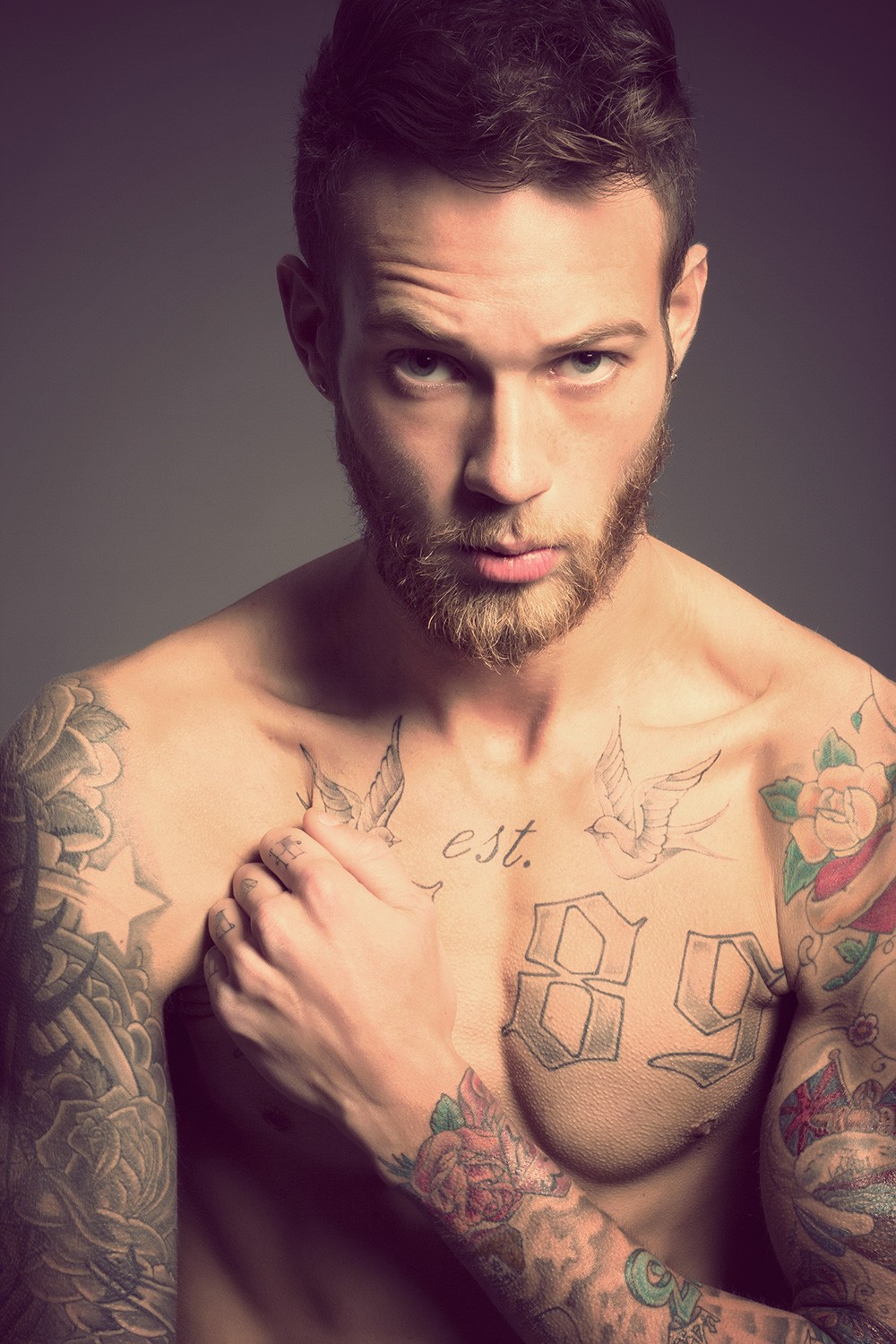
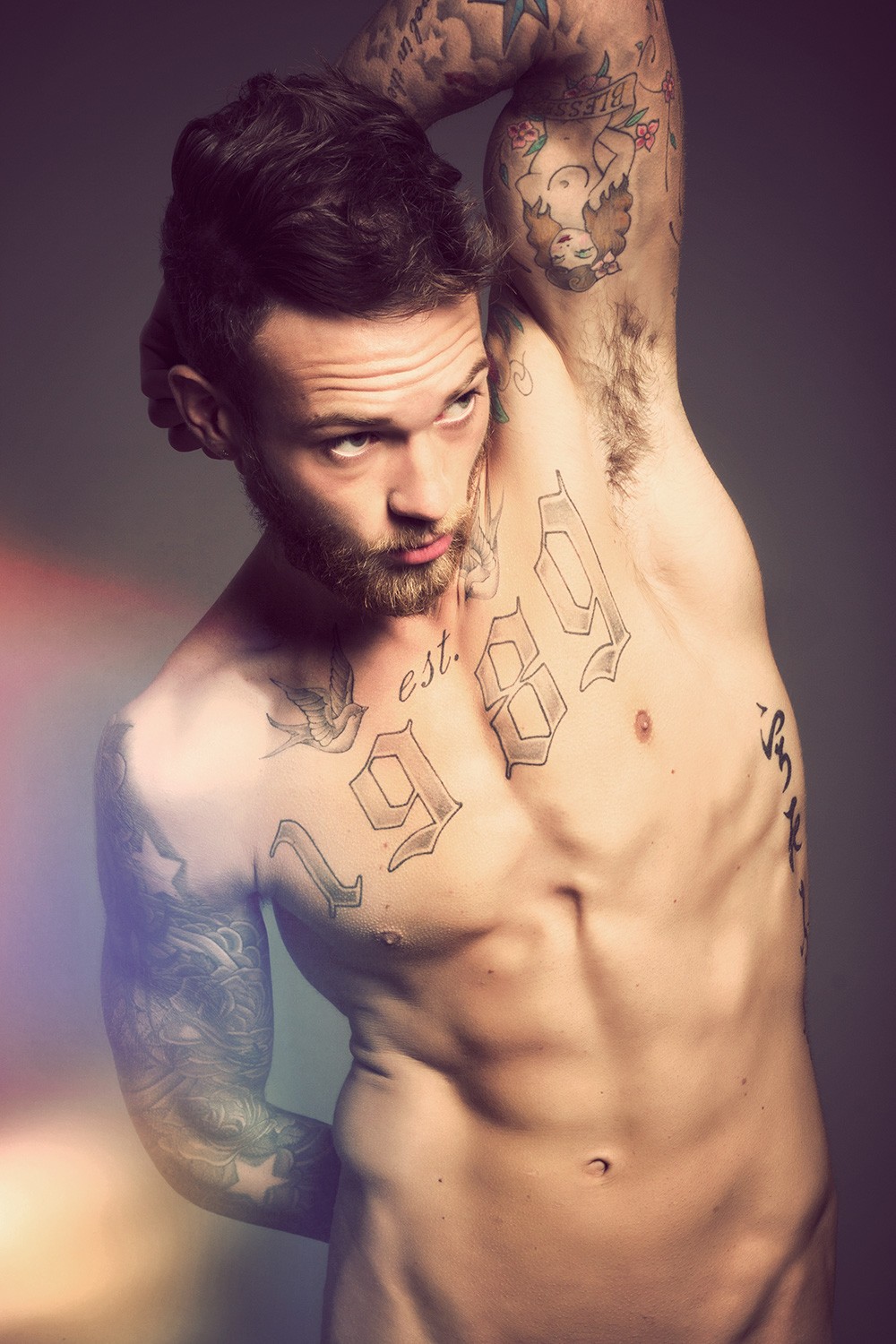
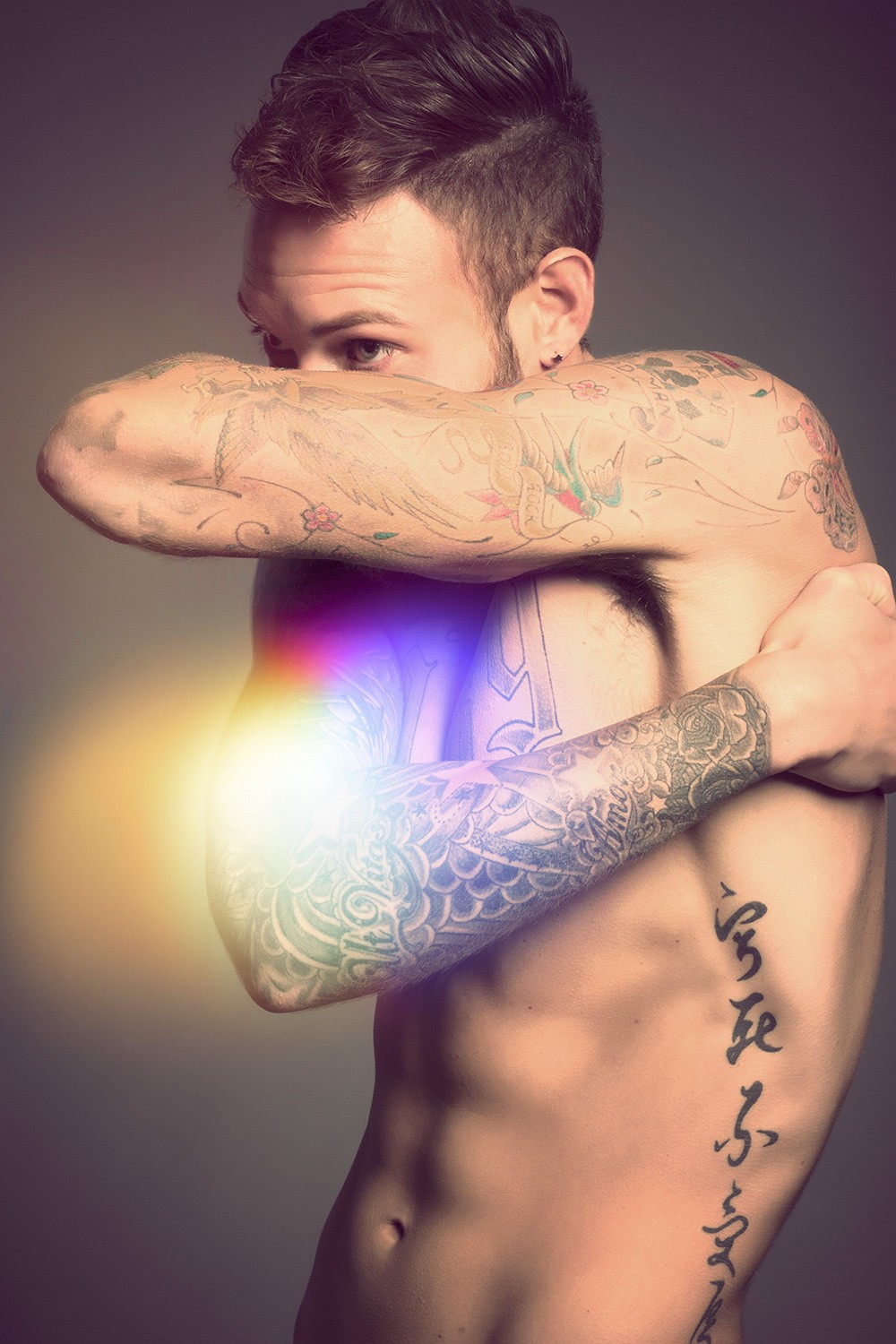
Billy Huxley’s chest numbers and arm tattoos appear in early portraits by Maciek, published in December 2012. They’re a snapshot of his collection then, not a current inventory. The photos show numerals, birds, flowers, lettering and small designs on his fingers.
An Inside Story essay about an earlier interview says Huxley collected tattoos for individuality rather than to impress other people. His Tattoodo artist profile now lists American traditional among his styles. That doesn’t identify who tattooed him or establish the style of each tattoo, though several pieces in these portraits use bold outlines and illustrated subjects.
The 1989 chest tattoo, est. lettering and two birds
The large outlined 1989 numbers span Huxley’s chest, with enough space between them to stay distinct. Their tall, pointed strokes have a gothic look rather than the shape of plain block digits.
Above them, small cursive est. lettering usually means “established,” so the layout reads like a date. The photograph doesn’t say what year or milestone it marks.
Two smaller birds sit above the writing. Their swept wings and forked tails look swallow-like, and both face toward the centre. The birds soften the heavier numbers; open skin keeps all three parts clear instead of joining them into one dark band.
The diamond and small lettering on his fingers
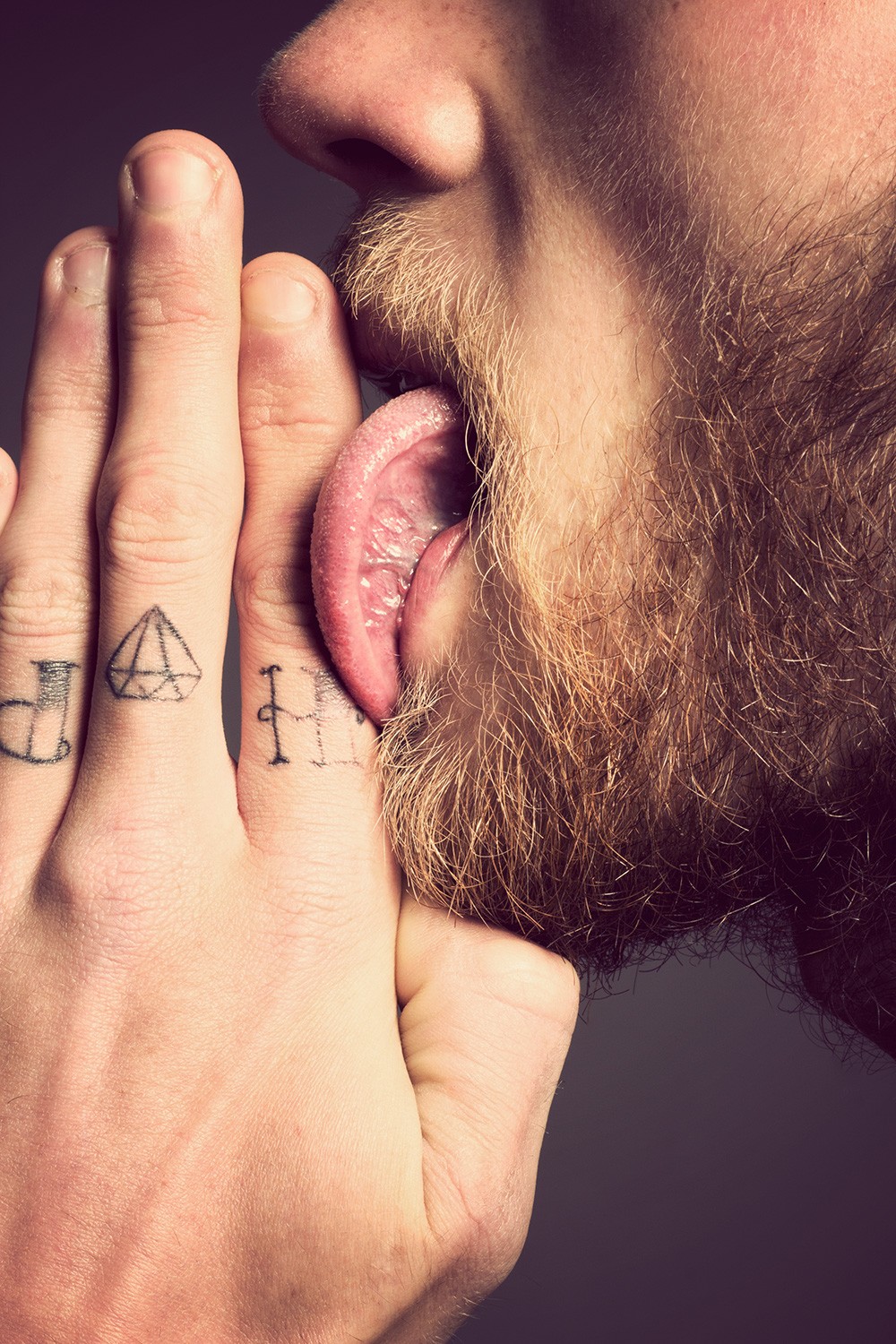
A close portrait shows a small outlined diamond and letter marks on Huxley’s fingers. The diamond uses straight lines, a broad top and a pointed base to suggest a cut stone without trying to look realistic.
A serif-style H is visible on a neighboring finger. Other marks appear nearby, but the photo doesn’t show a complete word clearly enough to transcribe.
His hand is close to his face in the portrait, which makes the small designs easy to notice.
The red rose and shaded flower tattoos at his wrists
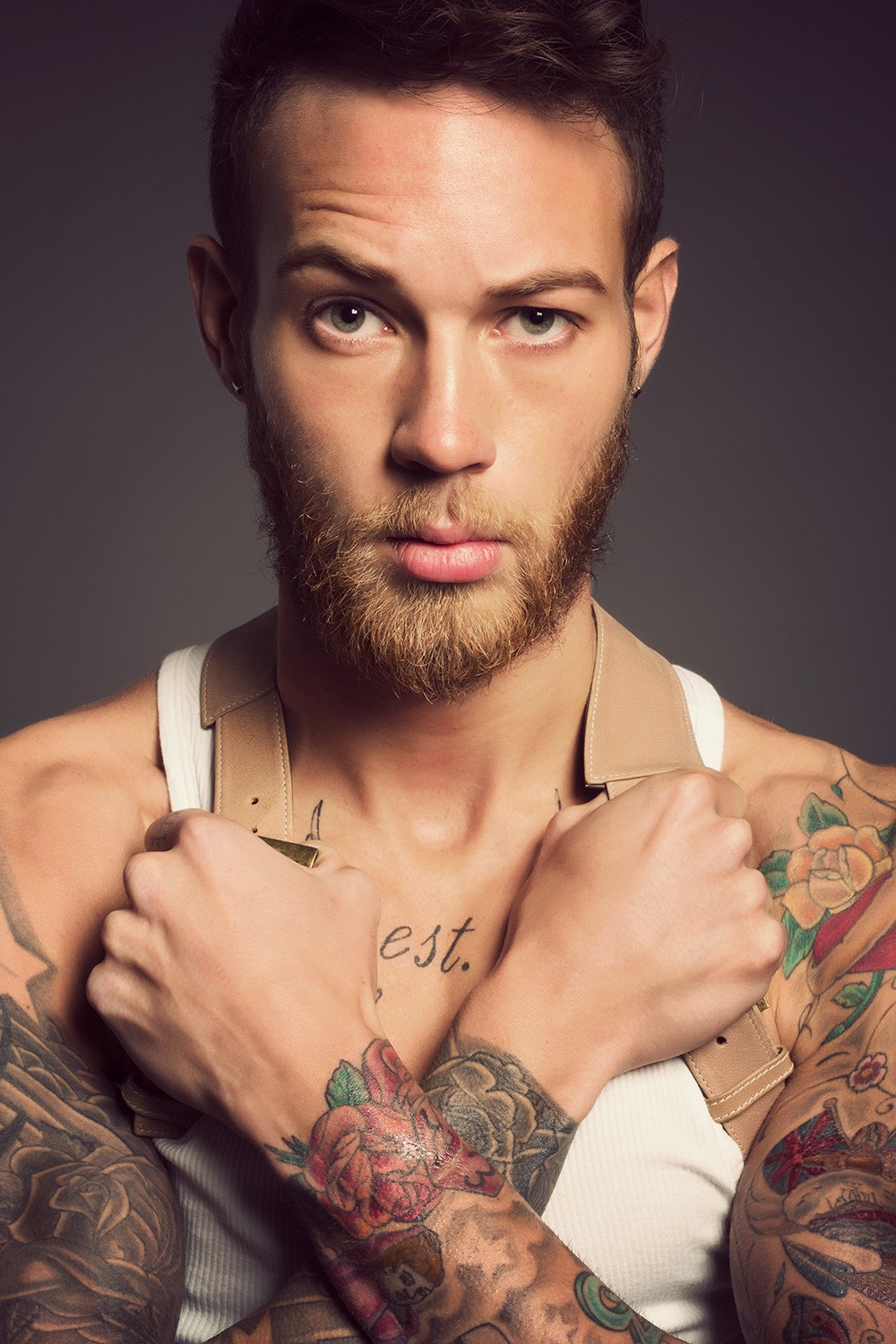
When Huxley crosses his wrists, a red rose with green leaves stands out against the darker ink around it. Layered petals and a clear outline keep the flower’s shape visible where the red shading deepens.
The other wrist has a darker, gray-shaded flower. The two share a subject but use different treatments. A small pale skull-like face is partly visible below the red rose; the overlapping hands obscure some of its outline.
The photograph doesn’t establish a personal meaning for the rose. Its visible details are enough to identify it: red petals, green leaves and a rounded shape near the wrist.
The pin-up portrait and flowers on his inner arm
With his arm raised, Huxley shows a colored pin-up portrait on his inner upper arm. The woman has wavy brown hair and a low neckline, with a flower near her hair and smaller floral details around the image.
The outlined features and blocks of color give it an illustrated look, not a photographic portrait. The woman hasn’t been reliably identified, so naming her as a partner, actress or relative would be guesswork.
A curled banner runs around part of the picture. Some lettering is visible, but the angle and bend of the arm make an exact reading uncertain. The inner arm also turns away when relaxed, then opens into view when Huxley lifts it.
The spread-wing bird, flowers and card symbols on his sleeve
A larger bird with outstretched wings fills part of Huxley’s upper arm. Fine feather lines make its silhouette more detailed than the two small chest birds. Flowers and a curled banner sit around it as separate designs rather than one continuous scene.
Near the shoulder are playing-card suit shapes, including dark spade- and club-like marks. Their simple outlines contrast with the feather detail below. The upper-arm work is lighter than the darker foreground on the forearm.
The photos show the birds, flowers, banner and card suits, but don’t establish a personal meaning for every symbol.
The Models 1 TV interview below offers a brief portrait of Huxley and his work with photographer Mr Elbank; it isn’t an explanation of each tattoo.
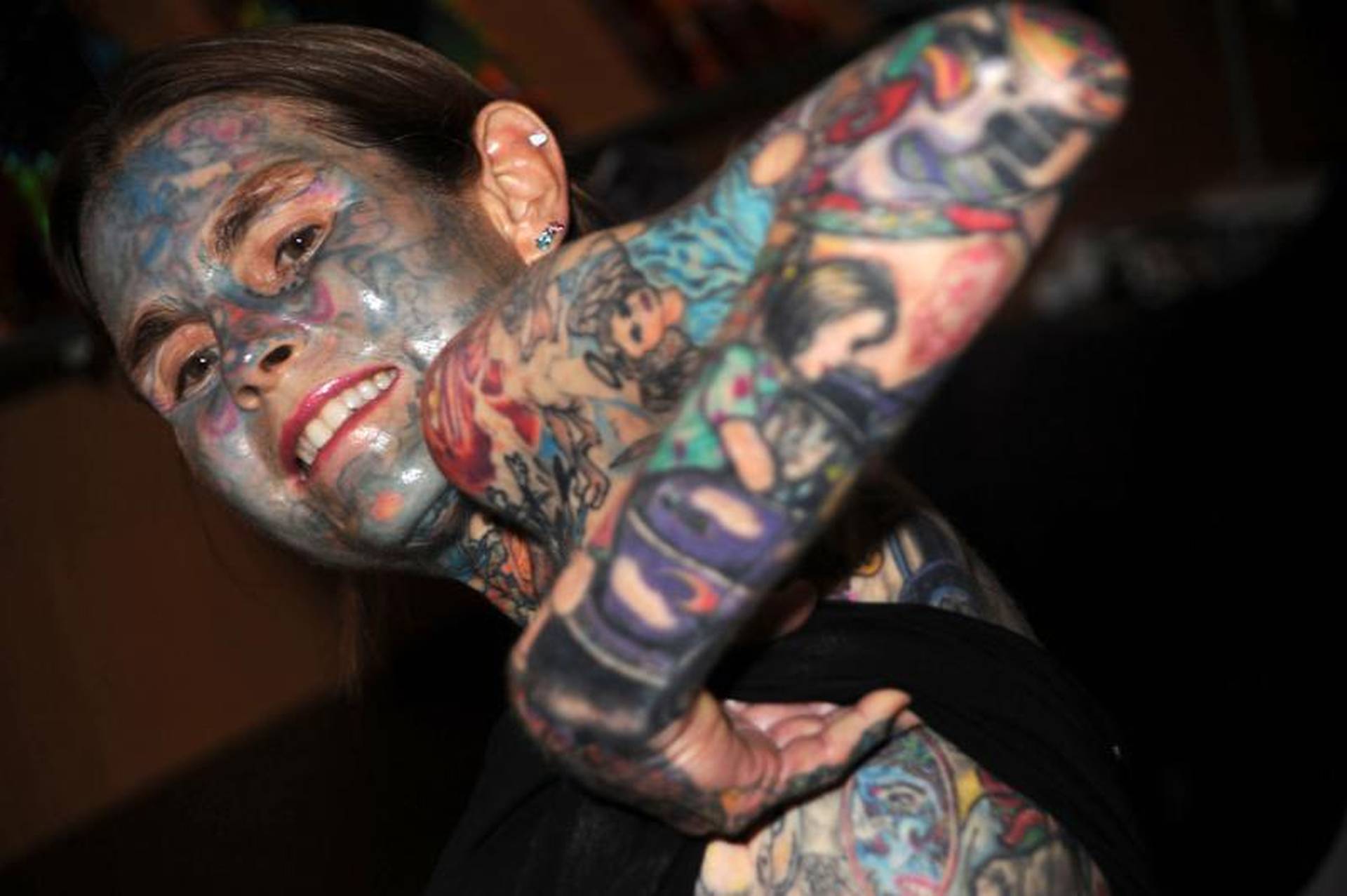
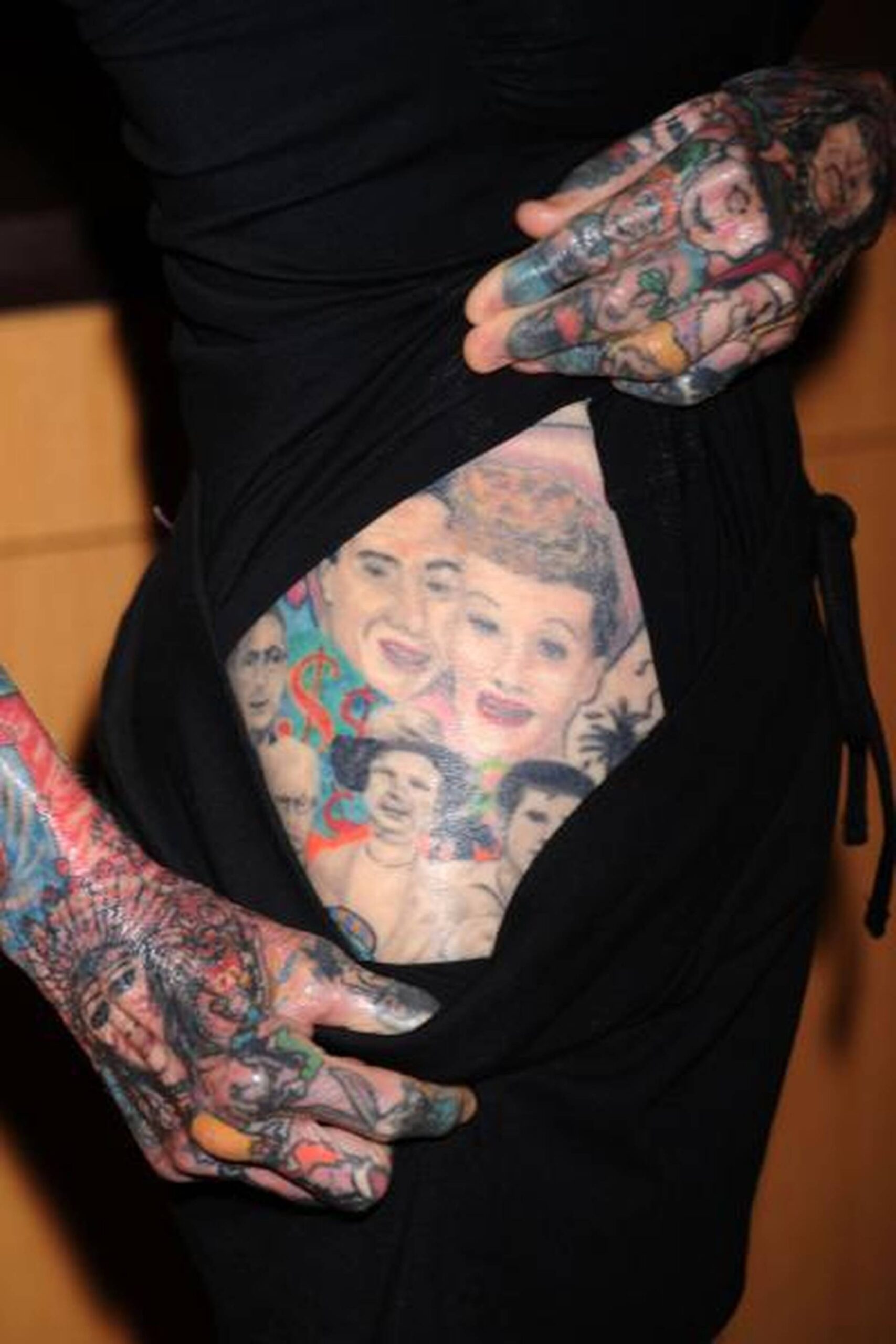
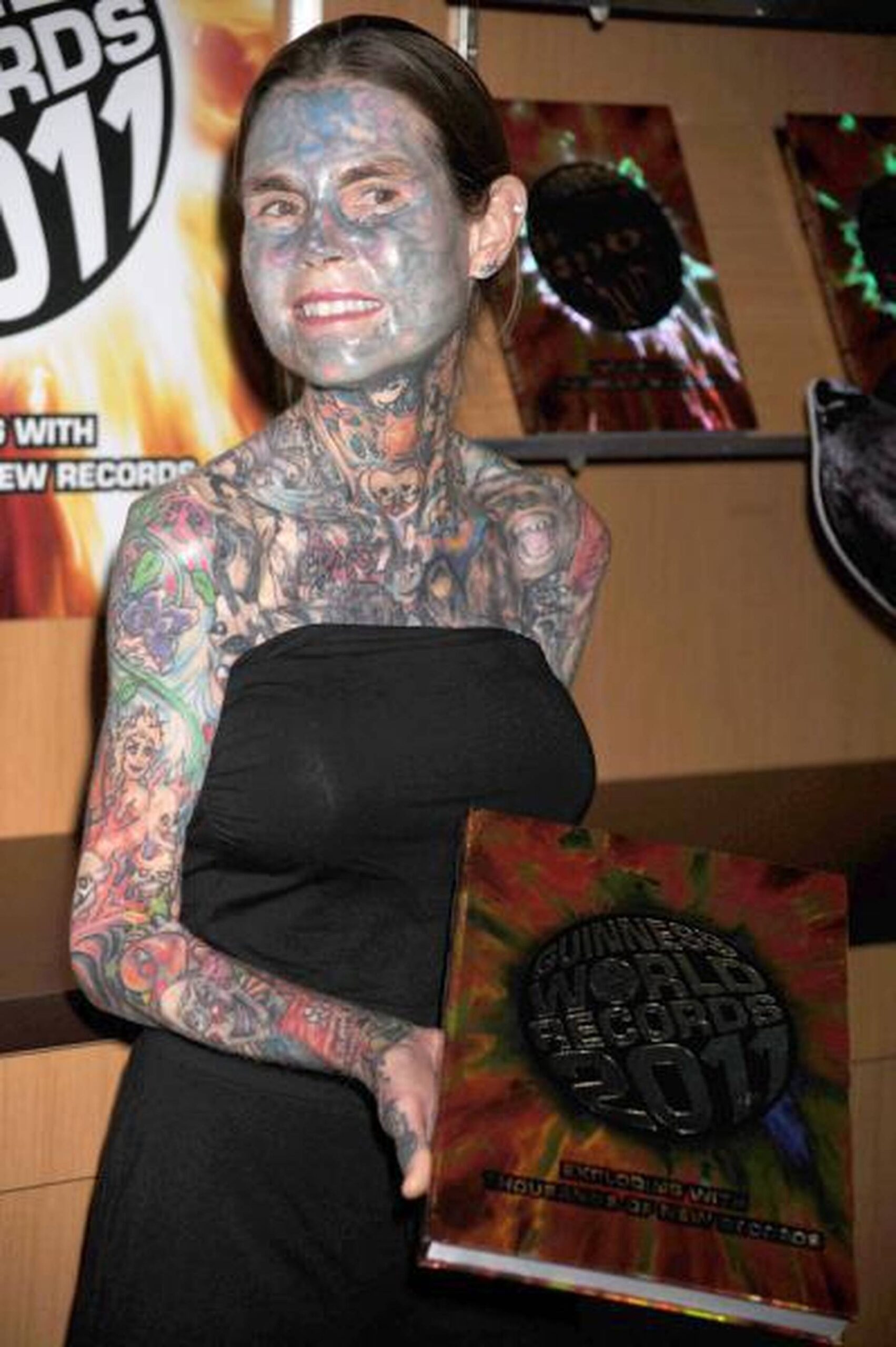
Julia Gnuse’s tattoos cover almost all of her body. Known as The Illustrated Lady, she has designs across about 95 percent of her skin, from her face and neck to her hands, torso and legs. The collection brings together cartoons, underwater scenes, portraits and bright character art; it isn’t built around one matching sleeve or a single theme.
Gnuse began getting tattooed after porphyria caused painful blisters and scarring. An early attempt to match the scars with tattoo pigment didn’t work as planned, so she turned to colorful designs instead. Over time, that first idea grew into a full-body collection and a look people recognize. What started as a response to a skin condition became a personal collection in its own right.
Photos of her work show how color, spacing and scale can connect pieces from different artists and periods. The sections below look at the placements that stand out and what their layout can teach someone planning a smaller collection.
Julia Gnuse’s face and neck work
Face and neck tattoos are hard to miss. In photos, the ink around Gnuse’s eyes, cheeks and neck changes with the light and camera angle. It sits close to her features, so a close-up can feel as visually full as a full-body shot.
A face tattoo will appear in most introductions, work photos and family pictures. Hair, makeup and collars can change what is visible, but they won’t hide it. If you’re considering facial ink, try the shape with temporary ink and check it in daylight while your face is relaxed, smiling and turned to each side.
You can use a similar framing effect on an upper arm, thigh or shoulder without making the design part of every expression. Placement decides how often a tattoo is in view.
Julia Gnuse’s hands and forearms
Close photos of Gnuse’s hands and forearms show small marks on her fingers and the backs of her hands, alongside larger images on her forearms. The pieces sit near one another, so your eye moves from the tiny details to the larger scenes without following one continuous sleeve.
Hands take a lot of wear in everyday life. Washing, sunlight and constant movement can soften fine lines, so a simpler design with open space may hold up better than a detailed picture squeezed into a narrow area. Ask an artist to show healed hand tattoos, not only fresh photos taken after an appointment.
Forearms give a design more room, though the wrist and arm change shape as you turn them. Check the stencil with your arm relaxed, palm up and palm down. A word or face may look straight in one position and angled in another. Plan for an arm that moves, not a flat picture.
Julia Gnuse’s chest and upper-body scenes
Gnuse’s upper-body photos show large colorful scenes alongside smaller faces, symbols and lettering. The chest and shoulders give those pictures room, while repeated colors and line weights help the different subjects sit together.
Chest and stomach tattoos move when you breathe, sit or raise your arms. Check a stencil standing, sitting and reaching overhead. See whether the main subject stays centered and whether its edges follow the ribs or waist in a way that feels right to you.
Cartoons, underwater creatures and portraits may seem like unrelated choices on paper. They can still make sense together when they reflect one person’s interests. You don’t need to repeat the same symbol across the body; a shared mood, palette or level of detail can tie separate ideas together.
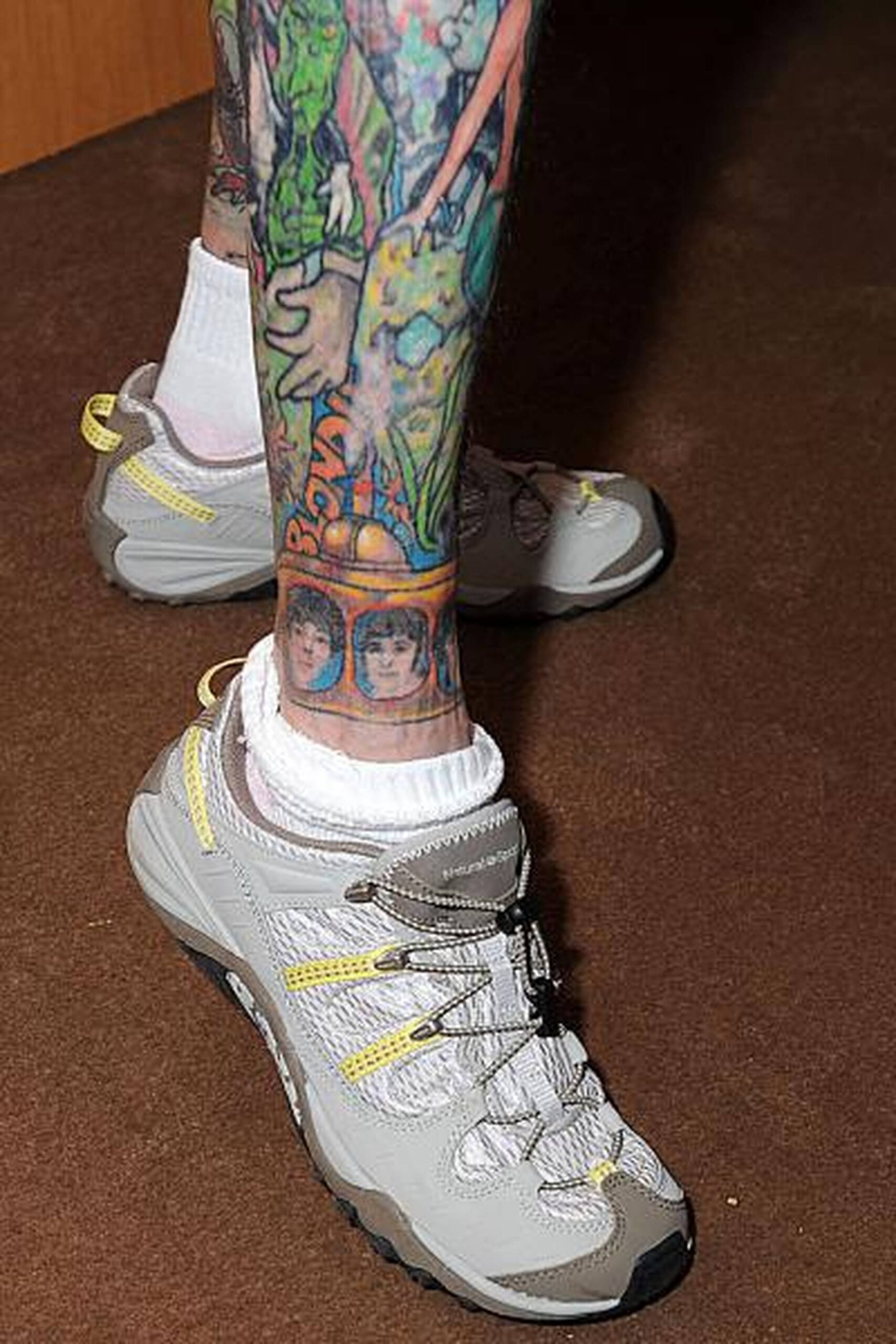
Julia Gnuse’s leg tattoos and colorful character pieces
The lower-leg photo shows some of the more playful pieces in Gnuse’s collection. Bright character faces and compact scenes fit the long shape of the legs, and the outlines leave each image room to read on its own.
Legs can work well for a larger tattoo that you may want to cover. The thigh has space for a portrait or broad scene; the calf and ankle suit designs that follow the length of the limb. Check a stencil while standing and walking, since a design can sit differently when the muscle tightens.
Color depends on more than choosing bright pigments. Contrast, open skin and neighboring tones all affect how the design reads. Leave enough space around a face or central character so the colors don’t run together as the tattoo ages. Open skin is part of the palette.
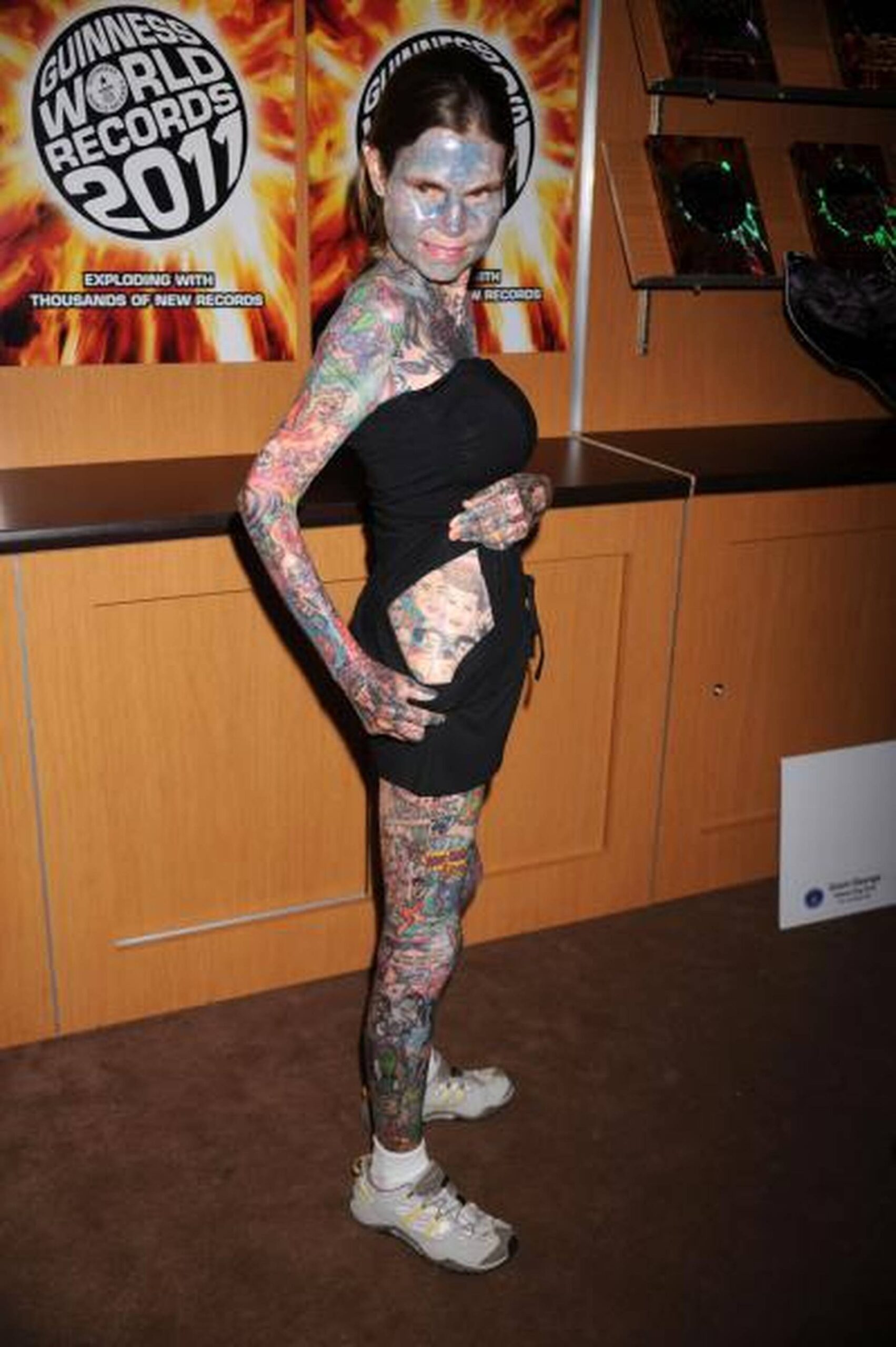
Julia Gnuse’s full-body tattoo layout
The full-length side view shows how Gnuse’s tattoos fit across her body. The pieces face different directions, and they don’t form one large mural. Smaller marks sit near larger images, while brighter sections break up the darker ones. Each part of the body frames the design in a different way.
If you’re building a collection, you don’t have to plan every inch at once. Start with the areas that matter most to you and live with those pieces before adding more. Photograph yourself from the front, sides and back; some gaps are hard to see in a mirror. Clothing changes the layout too, whether you’re in a T-shirt, swimwear or a winter coat.
Let the size follow the subject. A face, animal or scene usually needs more room than a simple symbol. A tall design may suit a leg, while a wider one can follow the shoulder or chest. Give an important image enough space to read clearly.
What her collection teaches about commitment
Gnuse’s collection is an extreme example, but the same choices come up with a first tattoo: placement, scale, color and how one design sits beside another. The photos show that different subjects can share a body without being forced into one theme.
Start with images or stories you expect to care about after the excitement of a new appointment passes. It can help to name the part of a reference you like—the palette, cartoon style, portrait shading or the way it wraps around a joint. That gives an artist more to work with than a request to copy someone else’s photo.
Choose an artist whose work fits the design. Realism, color, lettering, blackwork and large layouts call for different experience. Look at healed tattoos and ask how the design might move, fade in sunlight or sit beside another piece. If an artist suggests simplifying a crowded design or making it larger, ask what will help it stay readable.
Visibility is part of the decision. Face, neck and hand tattoos are likely to appear in everyday photos and outfits. Legs, chest and stomach pieces give you more say over when they’re seen. Think about what fits your work, relationships and comfort level.
Leave some space if you want room to add to the collection. Open skin can keep a colorful design from feeling crowded and give a detailed portrait room to stand out. Waiting between appointments also lets you see what the body actually needs next. A pause can be part of the design process.
Healing matters as much as the next reference image. Follow your artist’s aftercare instructions, protect fresh work from strong sun and avoid picking at peeling skin. Judge the tattoo once it has healed, not only when the color is new and the surface is fresh.
Gnuse’s collection reflects her own interests and circumstances. You can borrow the confidence and sense of play without copying the exact subjects. Let each new piece earn its place in your collection.
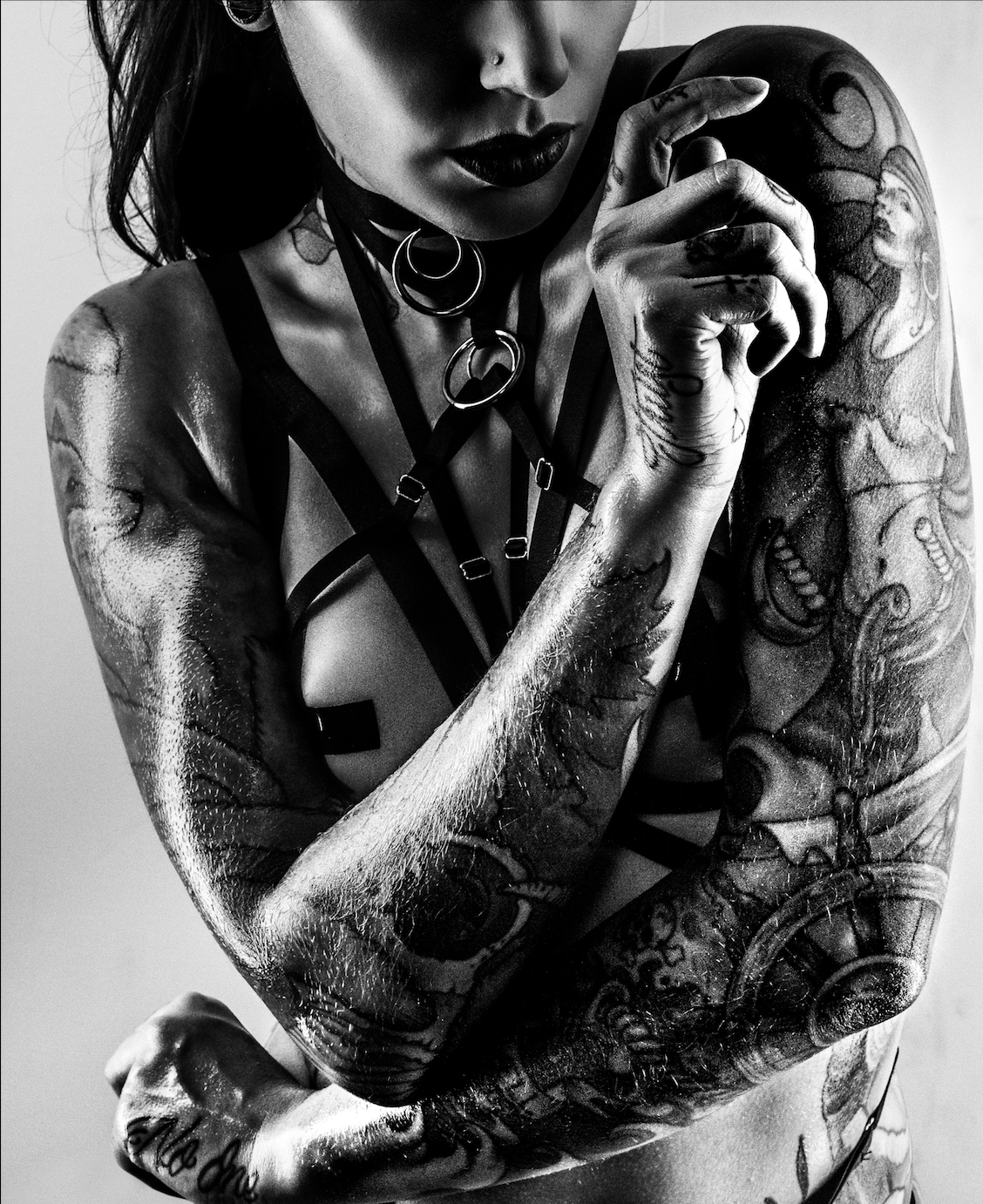
Monami Frost’s tattoos use heavy blackwork, realism, lettering, and a blackout section on one arm. The ink reaches across her face, neck, arms, hands, torso, and legs, so the collection reads as a body-wide mix of designs rather than a single sleeve.
The contrast between dark coverage and open skin keeps the pieces distinct. Fine lettering and lighter details sit beside large black areas, giving each part of the collection a different weight. The photos below show how those choices work across different parts of the body.
Monami Frost full-body tattoo layout
A full-body photo shows the amount of coverage across Frost’s arms, torso, and legs. The dark areas repeat across the body, while lettering and portraits add smaller details. The layout is easier to understand from the front, side, and back than from one close-up.
A collection can grow in stages. Taking photos of the existing work before adding more makes it easier to see where another piece would fit. A design that looks balanced straight on may leave a gap when the shoulder turns or an arm lifts.
Clothing also changes which tattoos are visible. A sleeveless top, crop top, or shorts reveal different parts of the layout, so it helps to plan around what you usually wear.
Monami Frost black arm and hand tattoos
The blackout section is one of Frost’s most recognizable tattoos. It forms a solid dark shape, while the other arm and the hands show faces, symbols, and lettering. The large block reads from a distance; smaller marks become clearer up close.
Blackout work takes planning. Previous tattoos, healing, touch-ups, skin, and the time needed for sessions all affect the result. An artist can explain what can be covered and show examples of healed work.
Hand tattoos have their own considerations: hands move often, get washed, and are exposed to the sun. Small lines can soften, so the design needs to be simple enough to remain readable. Clear shapes and realistic sizing work better than squeezing a detailed scene into a small area.
Monami Frost leg and thigh tattoos
The leg photo shows portrait work and ornamental shapes on the thigh. The broad area gives a portrait room for detail, while the knee and lower leg create natural breaks in the layout.
Leg tattoos can be covered more easily than ink on the face, hands, or neck. Before settling on a portrait, check the stencil while sitting, standing, and bending the leg. Muscle movement can change how the features line up.
A reference photo can show the expression or lighting you want, but the artist may need to redraw it for the curve of the thigh. A reference is a starting point, not a template to trace exactly.
Monami Frost face and neck tattoo details
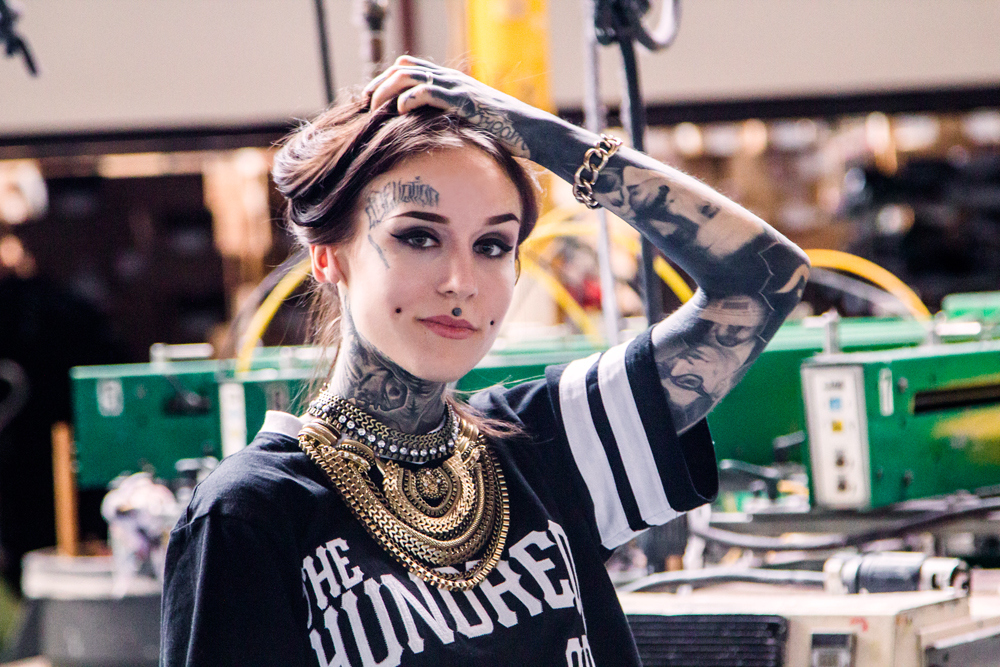
Frost’s forehead lettering, cheek mark, and dark neck work frame her eyes and jaw. From a distance the tattoos make a strong outline; close up, the lines and smaller details become easier to see.
Face and neck placement changes with expression, hair, collars, and light. A stencil can be checked in daylight as well as in a studio mirror, with the head turned and the face relaxed.
These tattoos are visible in nearly every setting, which can matter at work, with family, or while traveling. A small mark still becomes part of how the face is seen, so it helps to choose a design you are comfortable carrying into everyday life.
Monami Frost white ink forehead tattoo
A close-up shows a pale forehead design that is subtle from some angles and easier to see when the light catches it or the hair moves away. A lighter detail can break up a dense area of blackwork.
White ink still needs careful placement and realistic expectations. Its appearance can change as it heals and with sun exposure or skin tone. An artist with healed examples can show how it looks in natural light.
A pale mark, a highlight, or an open shape can draw the eye across a darker section. Contrast can make a design clearer without making every part bolder.
How to build a collection with strong contrast
Frost’s collection pairs very dark work with lighter details and open skin. A blackout arm can sit beside fine face lettering; a portrait can share space with smaller marks. The contrast, placement, and scale connect the pieces without making them all alike.
Start with the subjects you expect to care about for a long time, then decide which areas of the body suit each one. Take photos of the existing tattoos from several angles before planning another piece. A clear space may help a portrait or line of text remain readable, and it can leave room for future work.
Choose an artist whose healed work matches the style you want. Portraits, blackout, lettering, and large body layouts each call for different skills. Ask how the design will move with the body and how it may look as it heals. A small change in scale can make fine lines easier to read.
Visibility is another part of placement. Face, neck, and hand tattoos show in most photos and introductions; tattoos on the torso or legs are easier to cover. Think about how that fits your life before deciding where a piece belongs.
Collections often develop over time. You don’t need to fill every open patch at once; living with the existing layout can make the next choice clearer. Follow the artist’s aftercare instructions and judge the result by the healed tattoo, not just the fresh photo.
The dark work is only one part of Frost’s look. The open spaces, fine lettering, and lighter forehead design affect how the heavier sections read. Use those choices as inspiration, then make the subjects and placement your own.