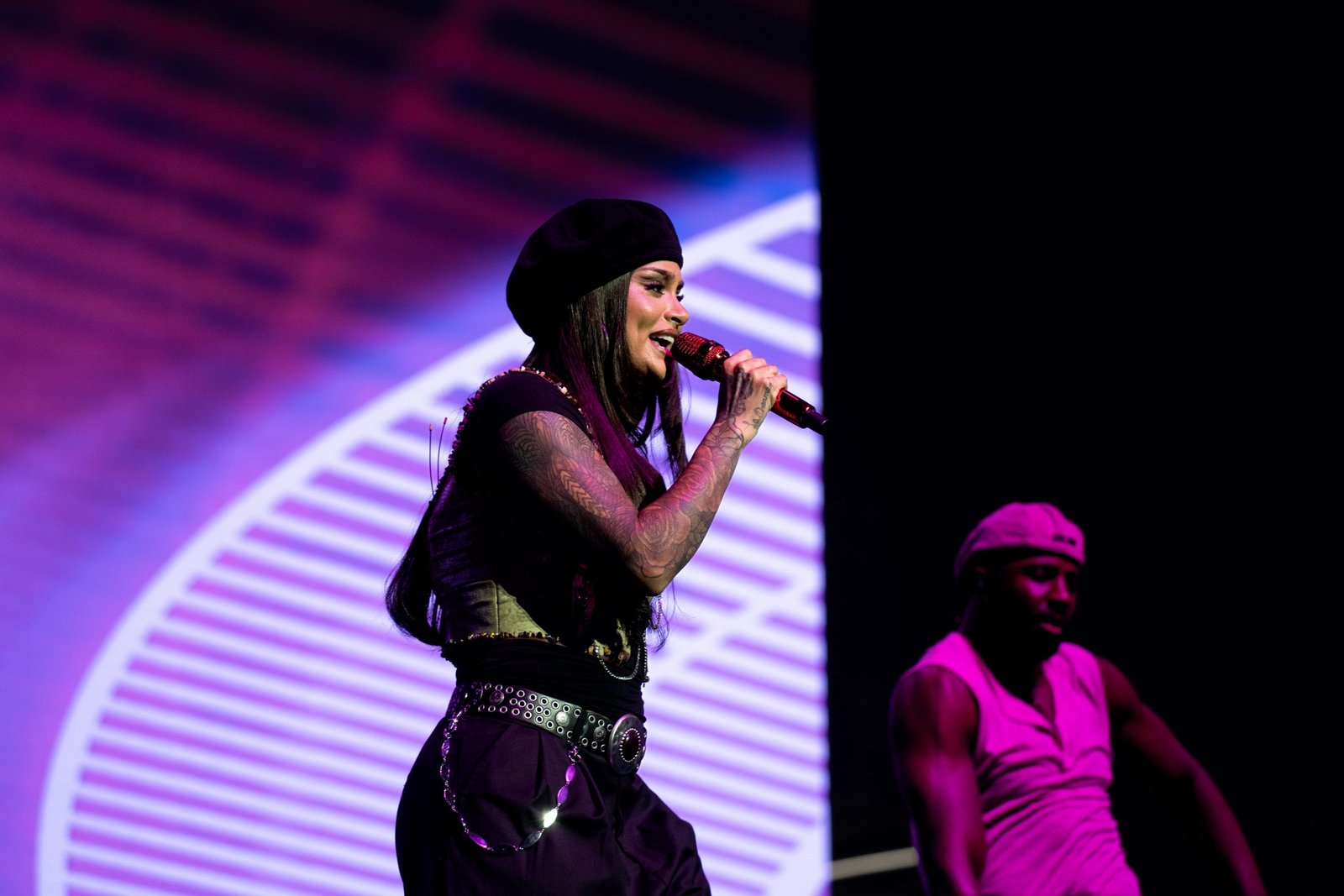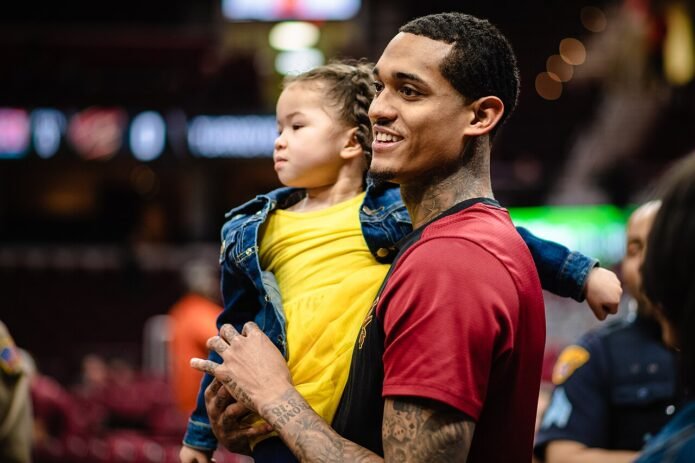
admin

Jordan Clarkson’s Tattoos: Nipsey Hussle, Allen Iverson and a Rapidly Built Sleeve

Jordan Clarkson told GQ he started without tattoos, then built a sleeve over roughly two or three months. It now includes portraits of Nipsey Hussle and Allen Iverson, a peace sign on his knee, and the small initials he got first. Clarkson names the people and designs that matter most to him, giving the best-documented pieces a clear story.

Nipsey Hussle and Allen Iverson anchor Clarkson’s sleeve
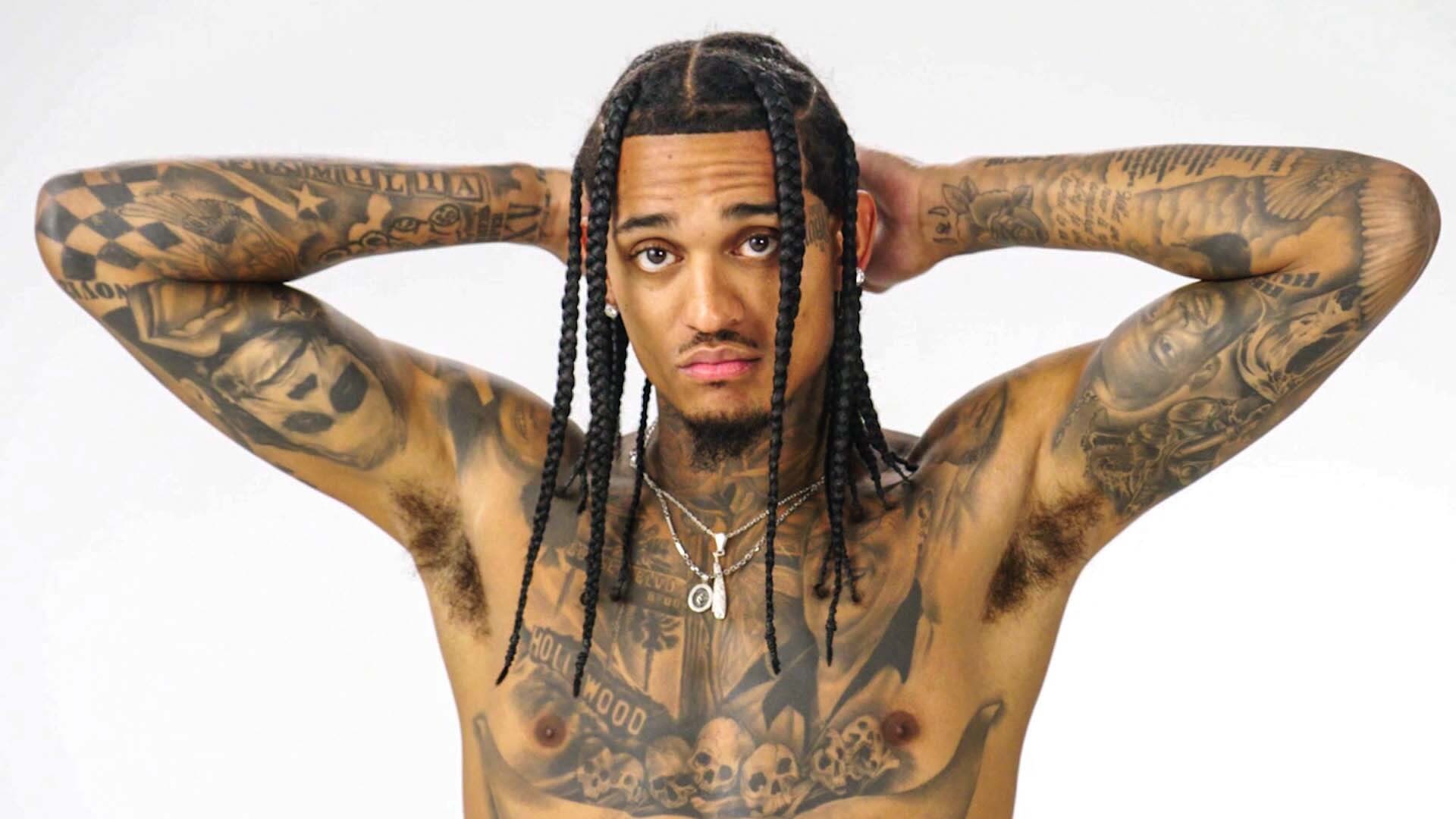
Jordan Clarkson showing his tattoo sleeve, including portrait and basketball designs

The two portraits Clarkson discusses are of Nipsey Hussle and Allen Iverson. Nipsey connects the sleeve to a contemporary artist and community figure; Iverson to basketball. In GQ’s tattoo tour, both appear among the rest of the arm work, tied to Clarkson’s own interests.

Clarkson names each subject, and the photos show how the portraits sit among the other tattoos. Even when they appear close together, they remain separate designs.

The Nipsey Hussle portrait
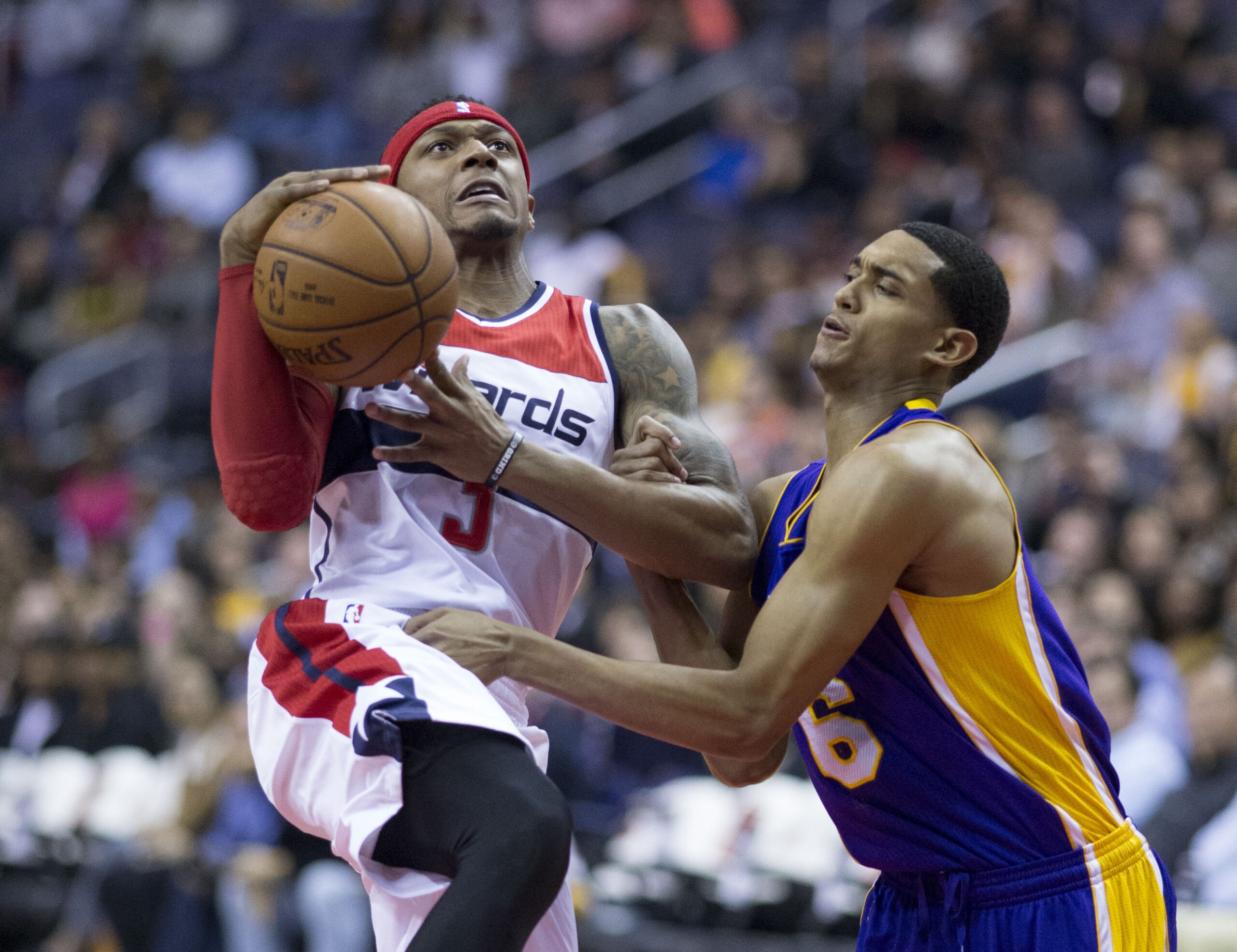
Jordan Clarkson showing the Nipsey Hussle portrait tattoo area

Clarkson’s Nipsey Hussle portrait is part of a wider tradition of memorial tattoos and admiration pieces. The subject he identifies is the key detail. The portrait stands on its own without guessing at a private event or attaching every nearby symbol to Nipsey.

Angle and lighting can change how the portrait looks. A close-up is more useful than a game photo with Clarkson’s arm in motion. Check the face and placement against a clear image; blurry marks nearby aren’t confirmed tattoos.

The Allen Iverson tribute
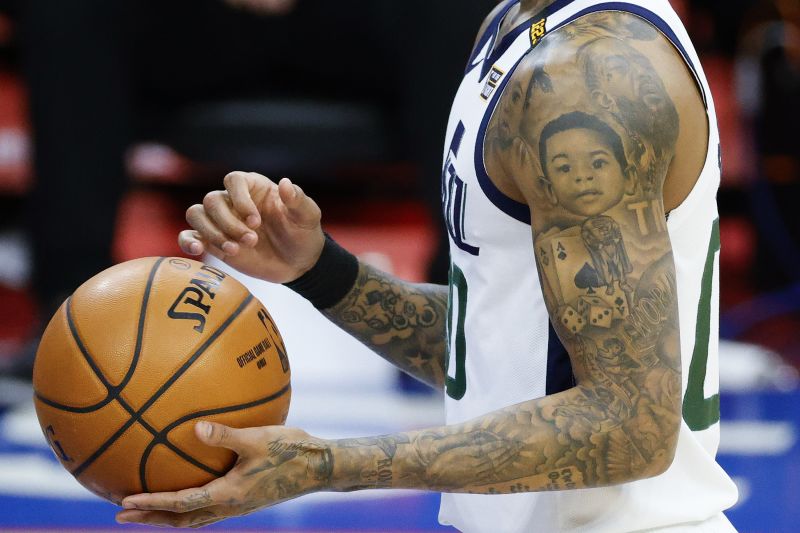
Jordan Clarkson showing the Allen Iverson portrait tattoo area

Clarkson identifies Iverson as the subject of his second portrait tattoo. Iverson influenced a generation of players, giving the design a clear basketball connection without adding a private reason Clarkson hasn’t shared.

Clarkson’s explanation matters. A jersey number or silhouette might only suggest a basketball reference, but a portrait gives viewers a face to recognize. The article names Iverson because Clarkson does, not because someone guessed from a distant photo.

The peace sign on the knee
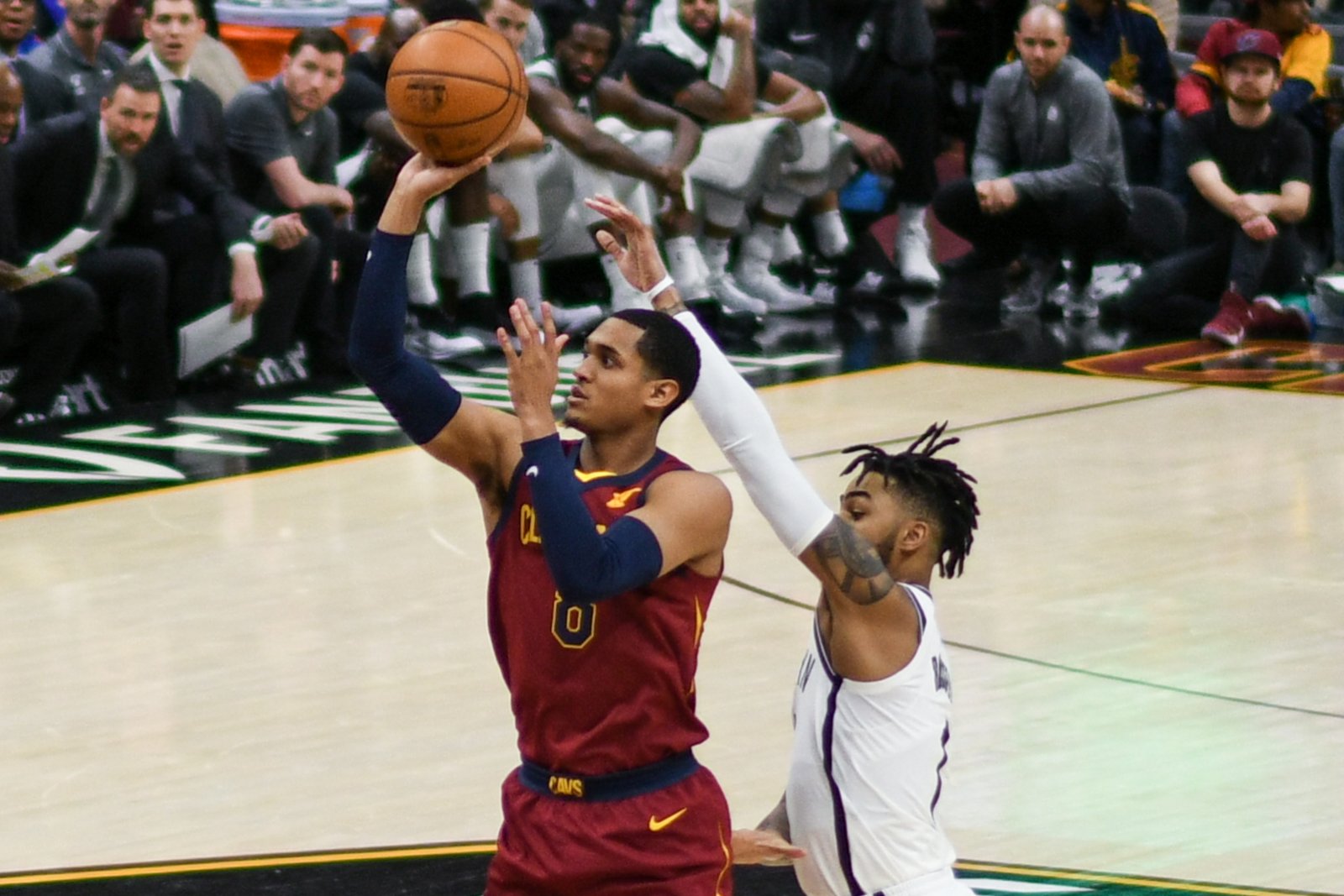
Jordan Clarkson showing the peace sign knee tattoo tattoo area

GQ also notes a peace sign on Clarkson’s knee. It’s smaller and simpler than the sleeve portraits, and belongs to an earlier stage of his tattoo history. The source identifies the symbol and location, but doesn’t give a detailed personal meaning.

Peace signs can suggest calm, unity or personal beliefs, but Clarkson hasn’t confirmed those meanings in the reviewed sources. What’s clear is the symbol, its position on his knee and its place among his earlier tattoos.

Initials came before the sleeve
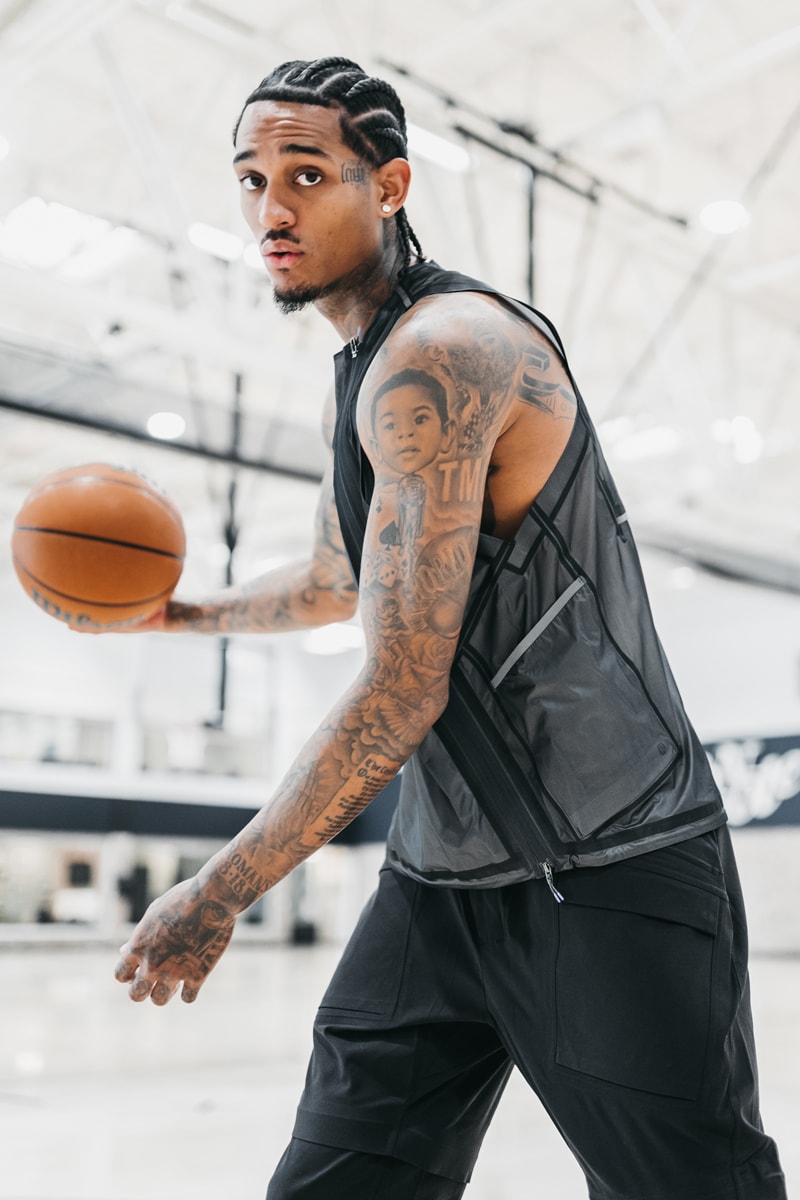
Jordan Clarkson showing the sleeve and initials tattoo area

Clarkson says his first tattoo was a small set of initials. It came before the portraits and connected work that later filled his sleeve. Initials are personal lettering, but the public source doesn’t assign them a larger story.

His sleeve followed quickly. Clarkson describes a two-to-three-month stretch when he and the tattoo artist worked almost every day. That helps explain how the collection grew from one small mark into a developed sleeve.

How the sleeve developed
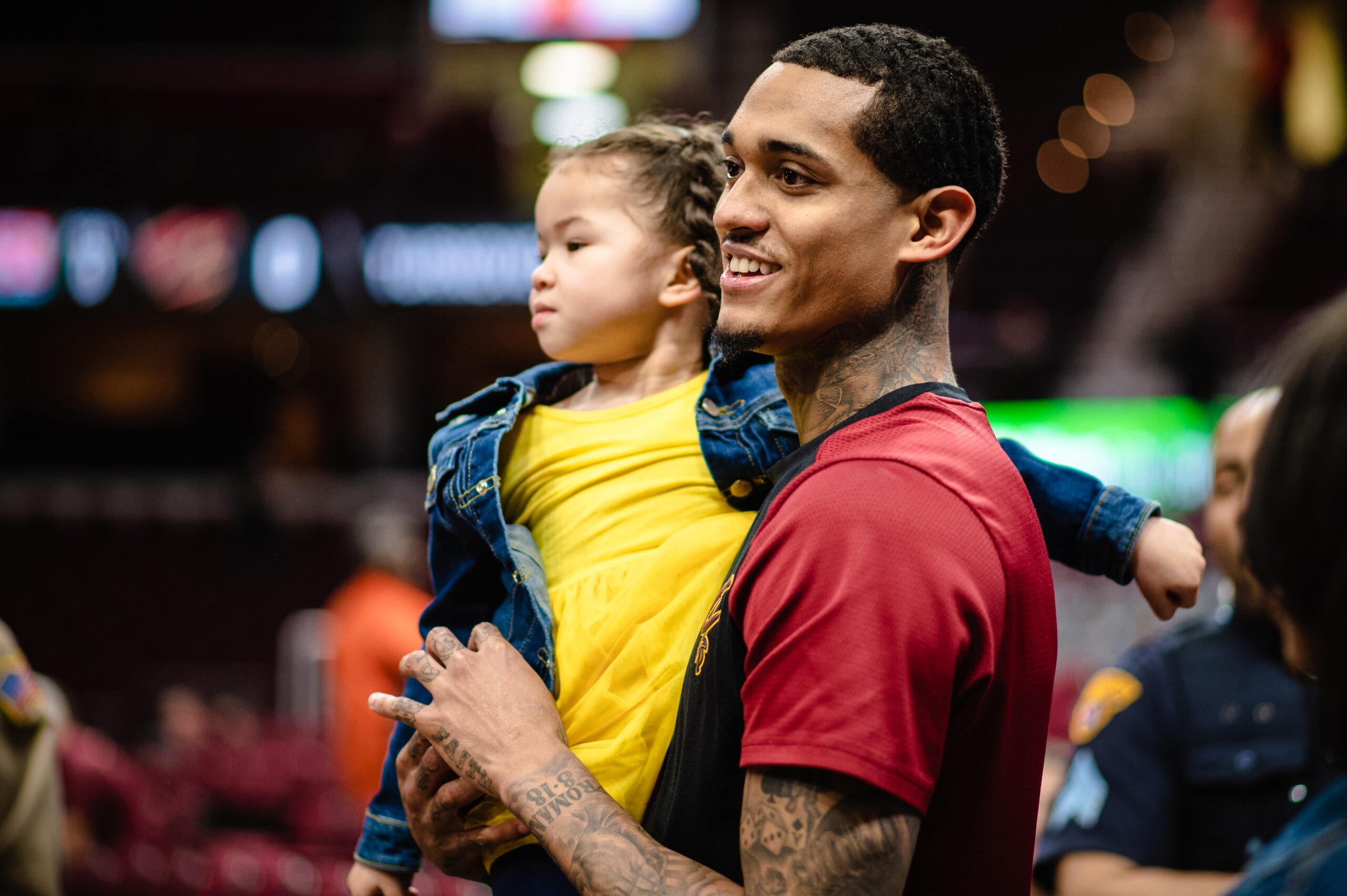
Jordan Clarkson tattooed sleeve

A sleeve is made of separate tattoos, even when the designs share an arm. Clarkson’s brings together portraits, symbols, initials and later additions. He names some pieces; the rest are best described as surrounding shading or supporting designs until a source identifies them.

Photos from different dates can make the sleeve look changed. A later image may show more shading, while an older one leaves space between the portraits. That may reflect new work or lighting, so dated photos are needed before calling a piece altered or covered.

Meaning and evidence levels

Clarkson names the portrait subjects, so their personal context is clearest. The peace sign and initials are easy to identify, though he hasn’t explained them in detail. Other sleeve work completes the composition, but every small symbol doesn’t need a separate story.

This keeps the tattoo list from pretending to be a full biography. Clarkson’s comments support the connections he has explained; photos add placement and visual detail. Anything the sources leave unanswered should stay open, rather than be filled with a familiar tattoo cliché.

What the GQ Tattoo Tour confirms
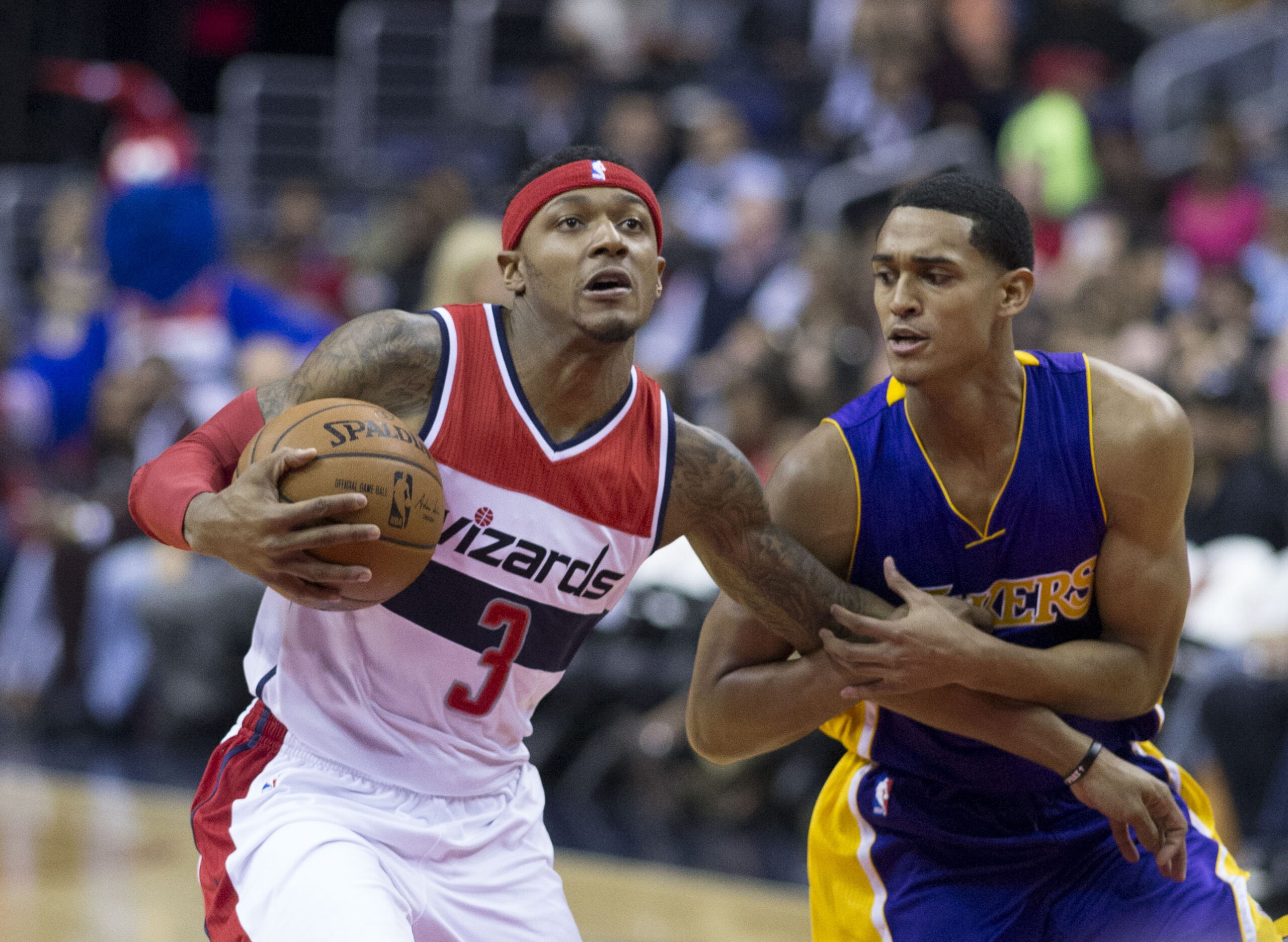
Jordan Clarkson Allen Iverson tattoo

GQ’s Tattoo Tour gives four solid starting points: the Nipsey Hussle and Allen Iverson portraits, the peace sign on Clarkson’s knee, and the initials he got first. He also says he built out much of the sleeve over a few intense months, though the source doesn’t give a full inventory of every design.

To compare images, start with the two portraits, then look for the knee sign and initials in photos that show those areas. Uniforms and camera angles can hide much of the body, so dates and settings matter. Identify only what the sources support and leave uncertain details unnamed.

Jordan Clarkson’s tattoos show his basketball influences, a tribute to Nipsey Hussle, and how quickly the sleeve took shape. The portraits carry the clearest stories; the peace sign and initials came earlier. The additional work fills out the sleeve, though Clarkson hasn’t publicly explained every design.
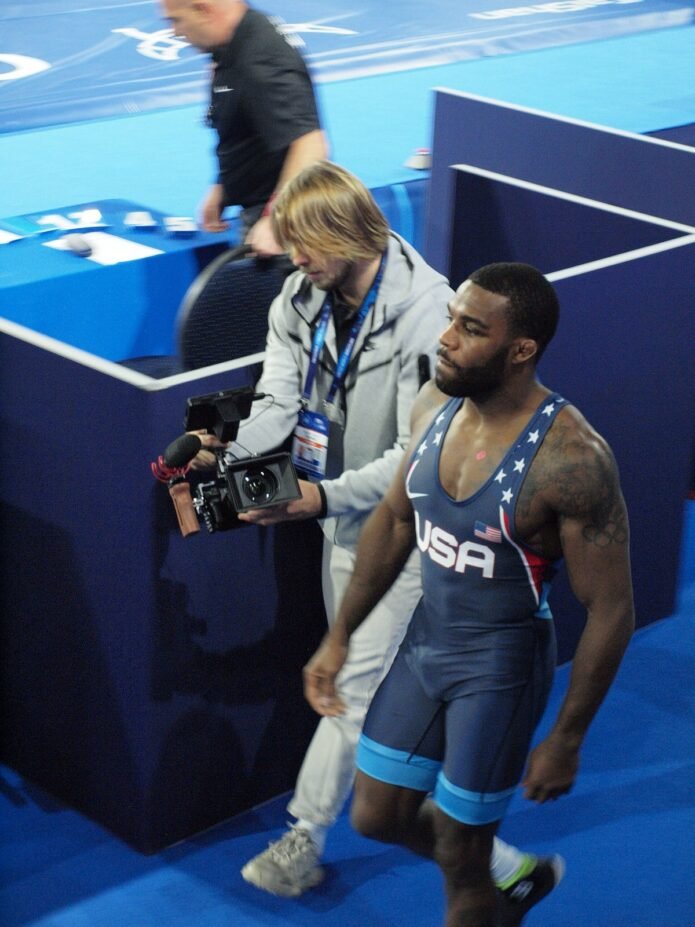
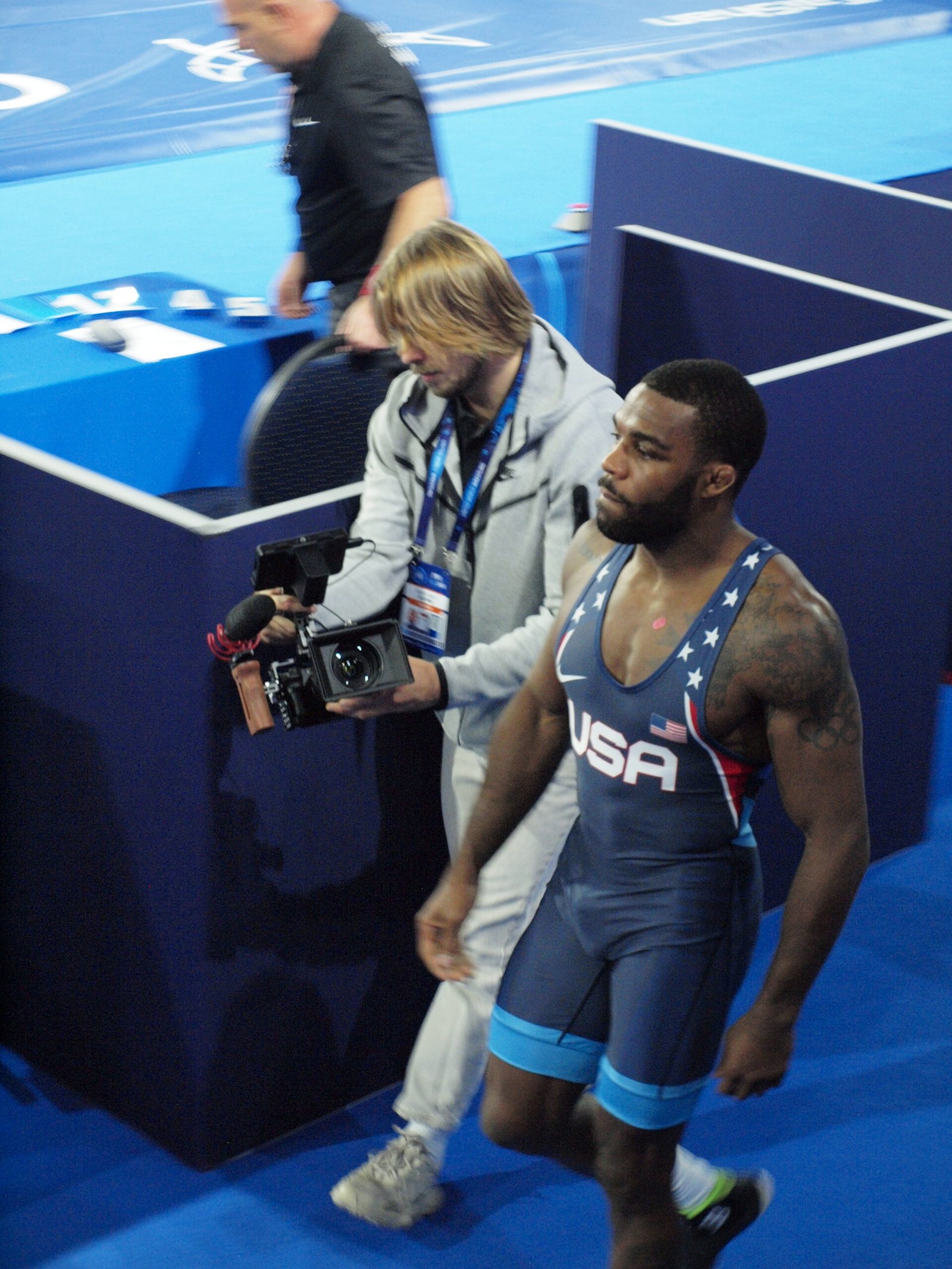
Jordan Burroughs Tattoos: JB Wings, Olympic Rings and the Ink Behind His Wrestling Story

Jordan Burroughs has said his tattoos mark different stages of his life and wrestling career, rather than following one plan. In a Team USA interview, he recalled getting his first tattoo in July 2005 and tied later designs to goals and Olympic milestones. He shared several examples, but not a complete count of every mark on his body.

His first tattoo was the JB wings on his back

Jordan Burroughs JB initials and wings back tattoo

Burroughs said his first tattoo was his initials, JB, with wings on his back. He got it in the summer between his junior and senior years of high school, after his parents agreed. He remembered paying 150 dollars and going home to show the design to his friends.

He got it years before the Olympics, while he was preparing for college wrestling. The initials and wings are visible in photos, but Burroughs has not given the design a separate meaning.

“Dream and do it” on his chest

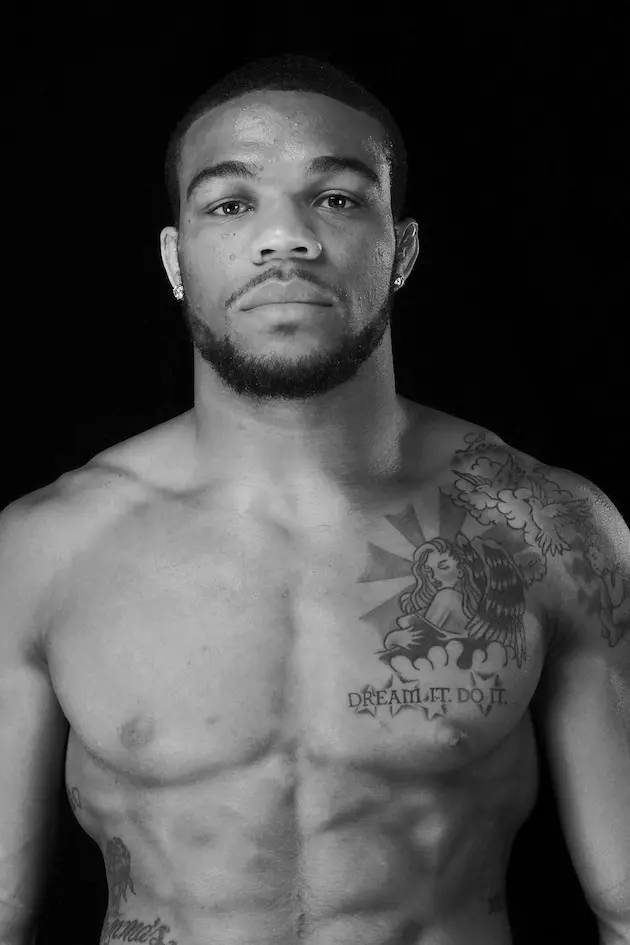
Jordan Burroughs Dream and do it chest tattoo

Burroughs has described the Dream and do it lettering on his chest as a mantra. To him, it means difficult goals are possible when he is willing to put in the work. He tied the phrase to his own training and ambitions.

The first tattoo marked a personal transition, and he showed it to friends right away. The chest phrase keeps those ambitions in view. Burroughs gave the wording as “Dream and do it,” rather than the more familiar alternative, an important distinction when describing the tattoo.

His Olympic rings tattoo is on his left arm

Jordan Burroughs Olympic rings tattoo on left arm

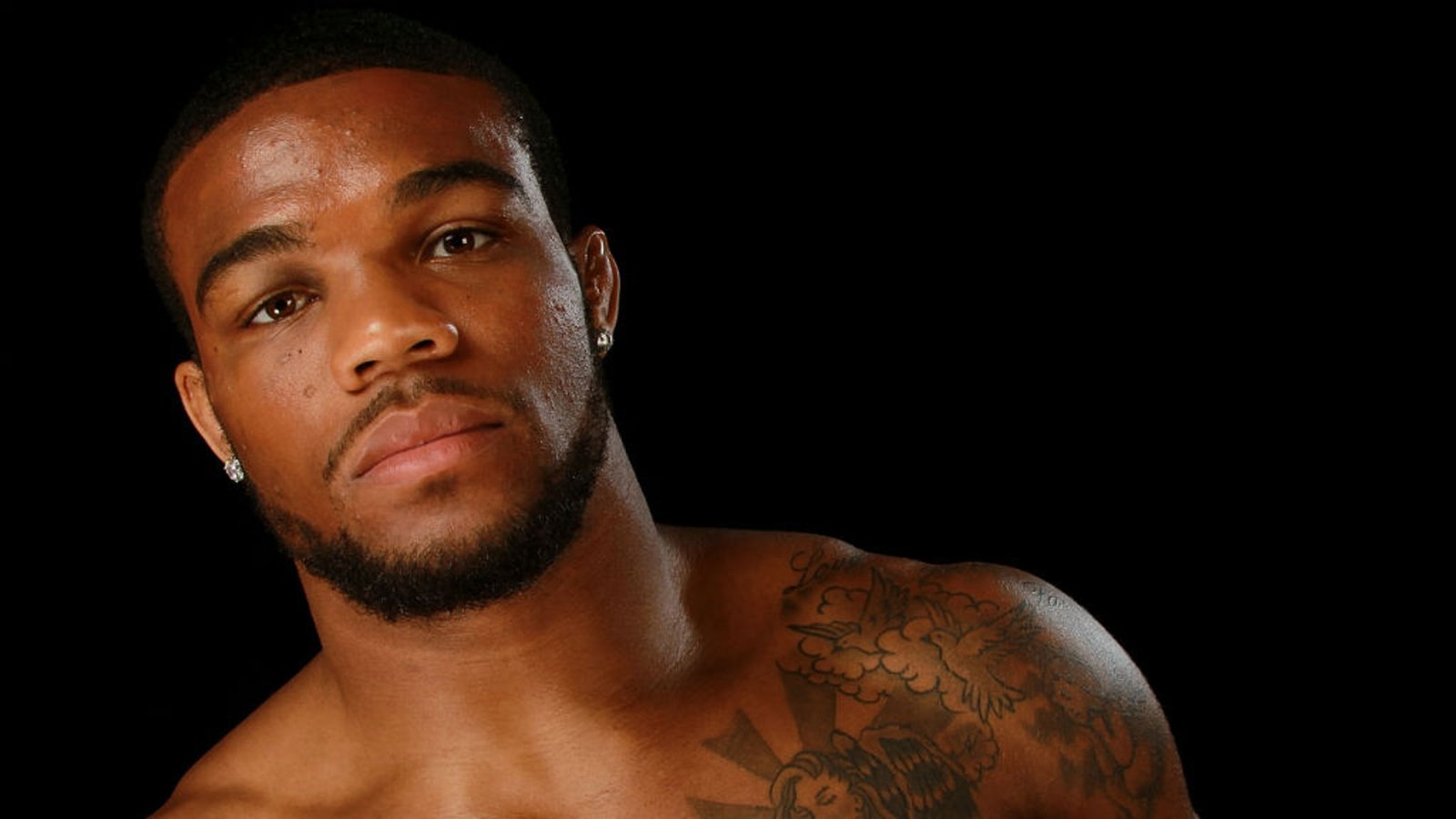
Burroughs said he got the Olympic rings on his left arm after making the team. He went on to win gold at the 2012 Olympics.

The Team USA interview ties the rings to making the team; competition photos show how they sit on his left arm.

His tattoos mark different chapters in his wrestling career

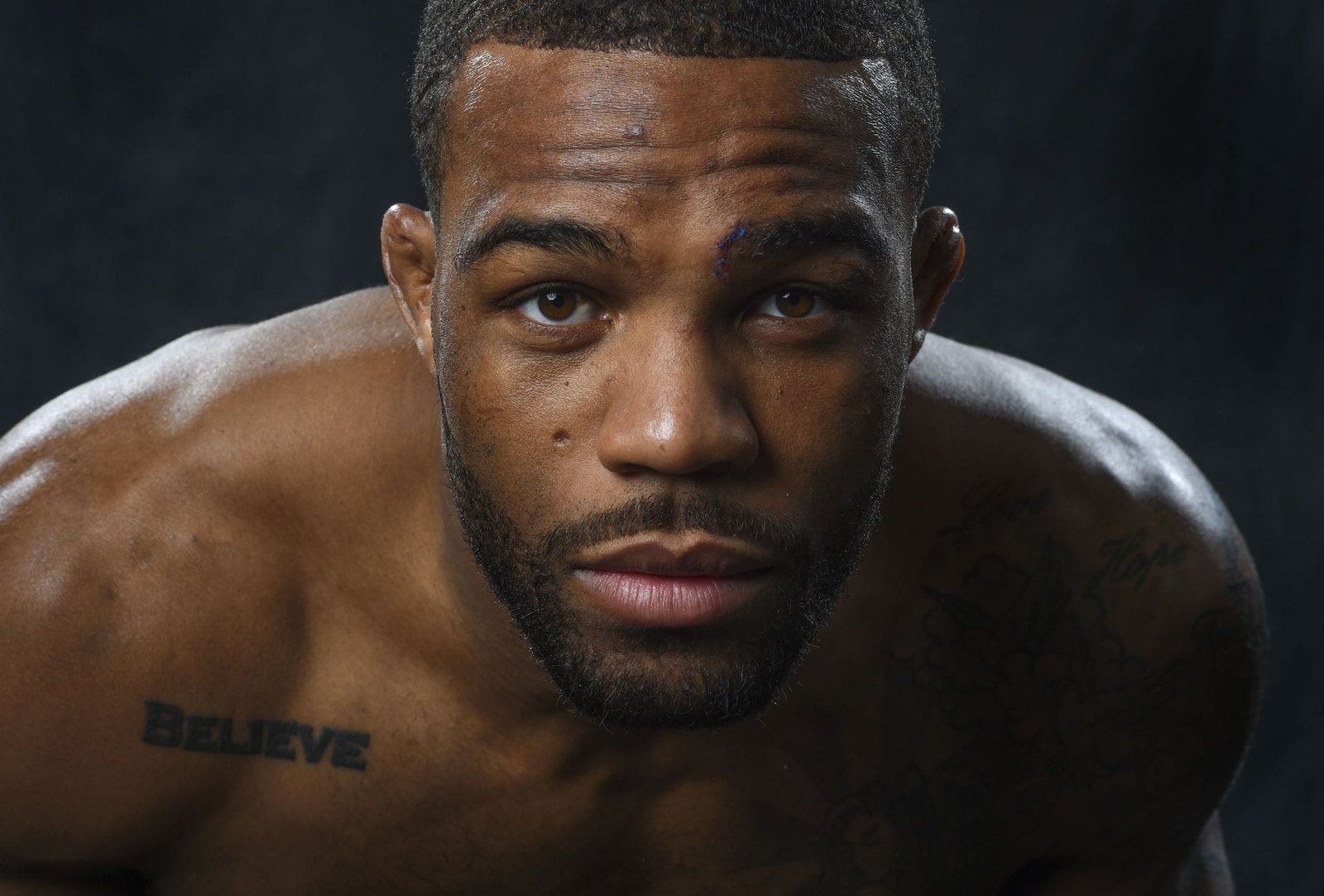
Jordan Burroughs tattoo lettering

Burroughs described his tattoos as reminders of where he was at a particular point in life. He also spoke about the freedom of tattooing, a chance to step outside the tightly disciplined routine of an elite athlete.

The designs chart those stages: the JB wings came in high school, “Dream and do it” reflects his approach to ambitious goals, and the Olympic rings mark making the team. Burroughs has spoken appreciatively about his tattoo artists, comparing their approaches to painters and the way they shape a finished piece. He has not described a single symbolic system for the collection, and the interview does not name every artist.

What Jordan Burroughs has said about his tattoos

Burroughs’s first tattoo, the JB initials and wings on his back, dates to July 2005. He later got the chest phrase and, after making the team, the Olympic rings on his left arm.

A photograph can show a mark without telling us when it was added, who tattooed it or what it means. Burroughs discussed several designs in a Team USA interview, but did not give a complete list. A Jordan Burroughs tattoo guide can stick to what he has confirmed and leave the gaps open.

His tattoos are hard to count from photographs alone: training shots catch different angles, and competition clothing can hide a design. His first back tattoo, chest lettering and Olympic rings are the clearest reference points.
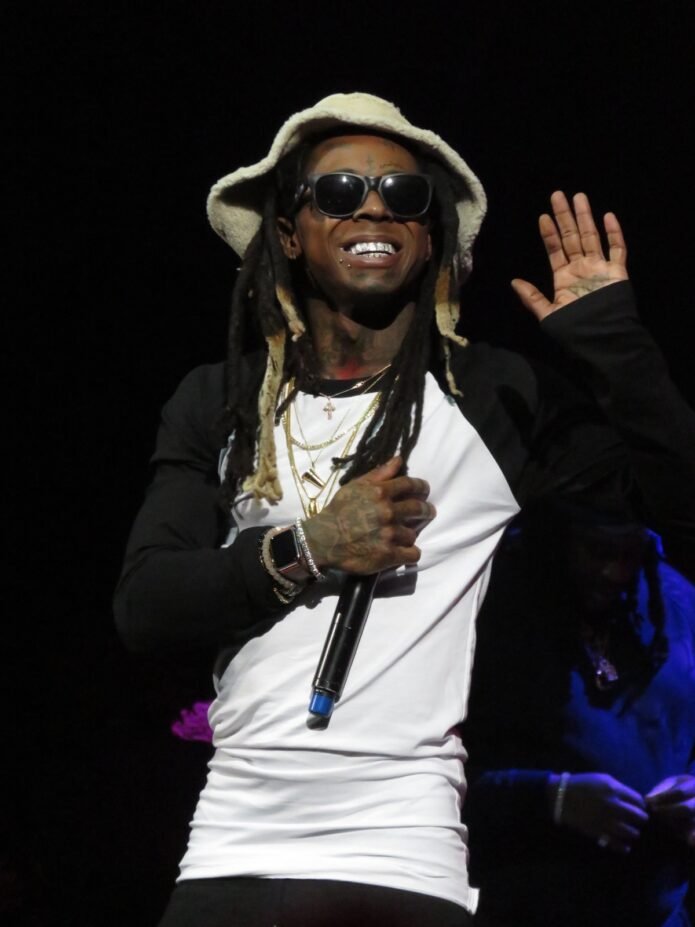
“Dream and do it” is the phrase whose meaning Burroughs has explained most clearly. He tied it to believing hard goals were possible with effort. That does not make every nearby tattoo a reference to a medal or tournament; he linked the rings specifically to making the team.

The photographs are clearest about placement: initials and wings on the back, lettering on the chest, rings on the left arm. Light, pose and distance can all change how a tattoo appears.

Read in order, the tattoos move from a high-school decision to an Olympic milestone, with the chest mantra in between. They trace different chapters of Burroughs’s life without forcing every design into one theme.

More athlete tattoo guides

Dave Grohl's Tattoos Trace His Route Through Punk, Metal and Friendship

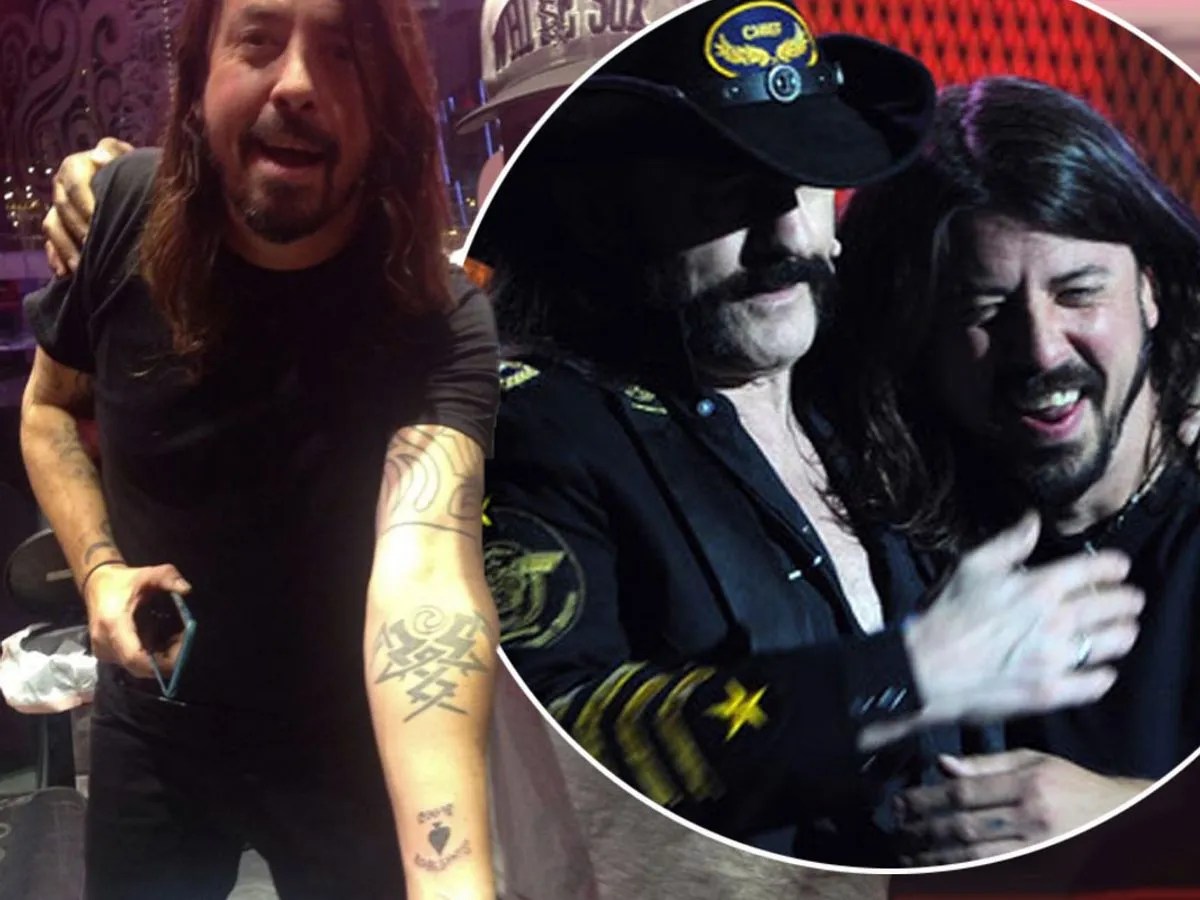
Dave Grohl’s tattoos trace the music and friendships that shaped him, from early punk influences to later tributes. The Ace of Spades tattoo, for example, came after Lemmy Kilmister’s death. The collection reflects decades of changing musical loyalties rather than one matching set.

In interviews, Grohl has said he made his Black Flag tattoo himself and described an arm tattoo he connected to John Bonham. Photos help show where the later designs sit, including the Motörhead tribute.

Grohl’s early tattoos include Black Flag and a pentagram

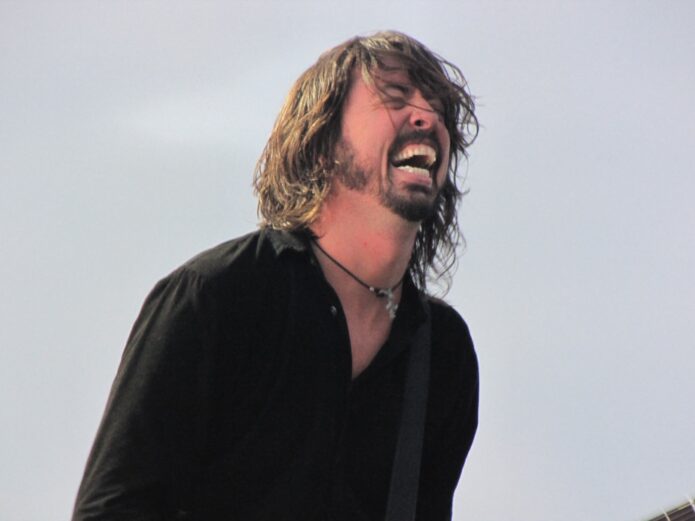
tattoo detail

An archived interview recounts a pentagram Grohl got as a teenager. The surviving photo is too soft to show the design clearly, so this image gives a sense of his early arm tattoos rather than a close look at the symbol. The story places the tattoo in the music culture around him; it is separate from the Black Flag piece.

A pentagram can carry different associations, but Grohl’s interview does not tie his to a particular belief or ritual. Its appearance alone is not a reason to assign one.

The Black Flag bars are bold and direct, while the pentagram leaves more room for interpretation. Together, they show a young musician drawing on the subcultures around him, rather than following one set of symbols.

Grohl’s tattoo stories move through punk, metal and his admiration for drummers like John Bonham. The designs came from different times, but they are closely tied to the music and people he valued.

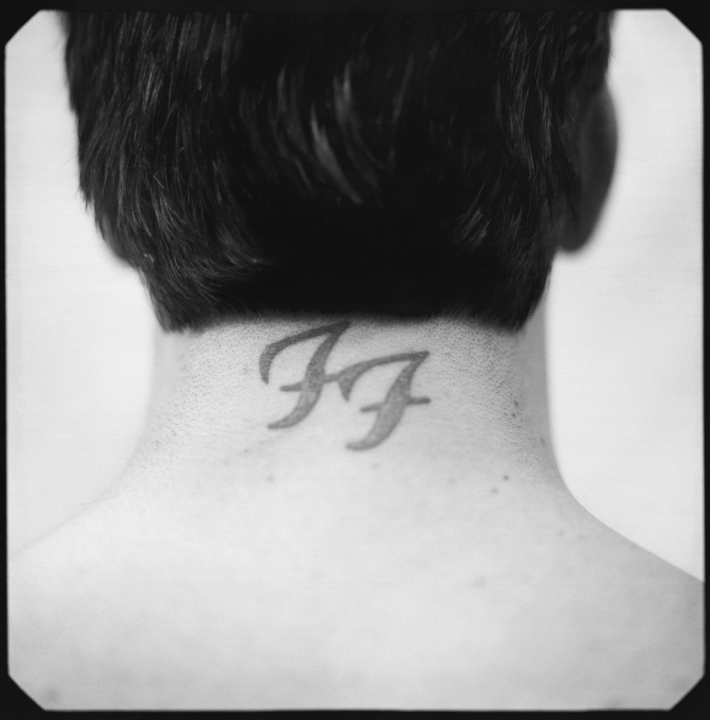
Dave Grohl Foo Fighters neck tattoo

The Foo Fighters tattoo on Grohl’s neck brings his own band into the picture alongside the artists he admired.

The Black Flag bars remain the clearest link to his early music. They read at a glance, though a distant stage photo can blur the lines.

Other pieces reflect music, friendship and personal memory. Larger tattoos stand out at a glance; smaller designs on the forearm, shoulder or hand take a closer look.

His collection has changed over decades. Old symbols sit beside newer lettering, and some ink has faded. A dated photo helps place a design in time instead of making its changing appearance look like a new tattoo.

Band symbols and memorial designs have their own histories, but one tattoo’s meaning does not explain the marks beside it. Grohl has discussed some connections; the others can be described by their shape and placement.

The arm symbol Grohl linked to John Bonham adds one more musical influence: a drummer he has spoken about admiring.

Grohl’s smaller tattoos can be hard to spot beside the larger music designs. In concert photos, his wrist or forearm may be turned away, and stage lighting can hide fine lines. A sharper image gives a better look, though it may not date the tattoo.

“Music” is a useful thread through the collection, but it does not tell the story of each tattoo. Black Flag, memorial pieces and other band-related images each have a different history. Grohl has explained some connections; others show only what is on his skin.

The Ace of Spades and other music tattoos

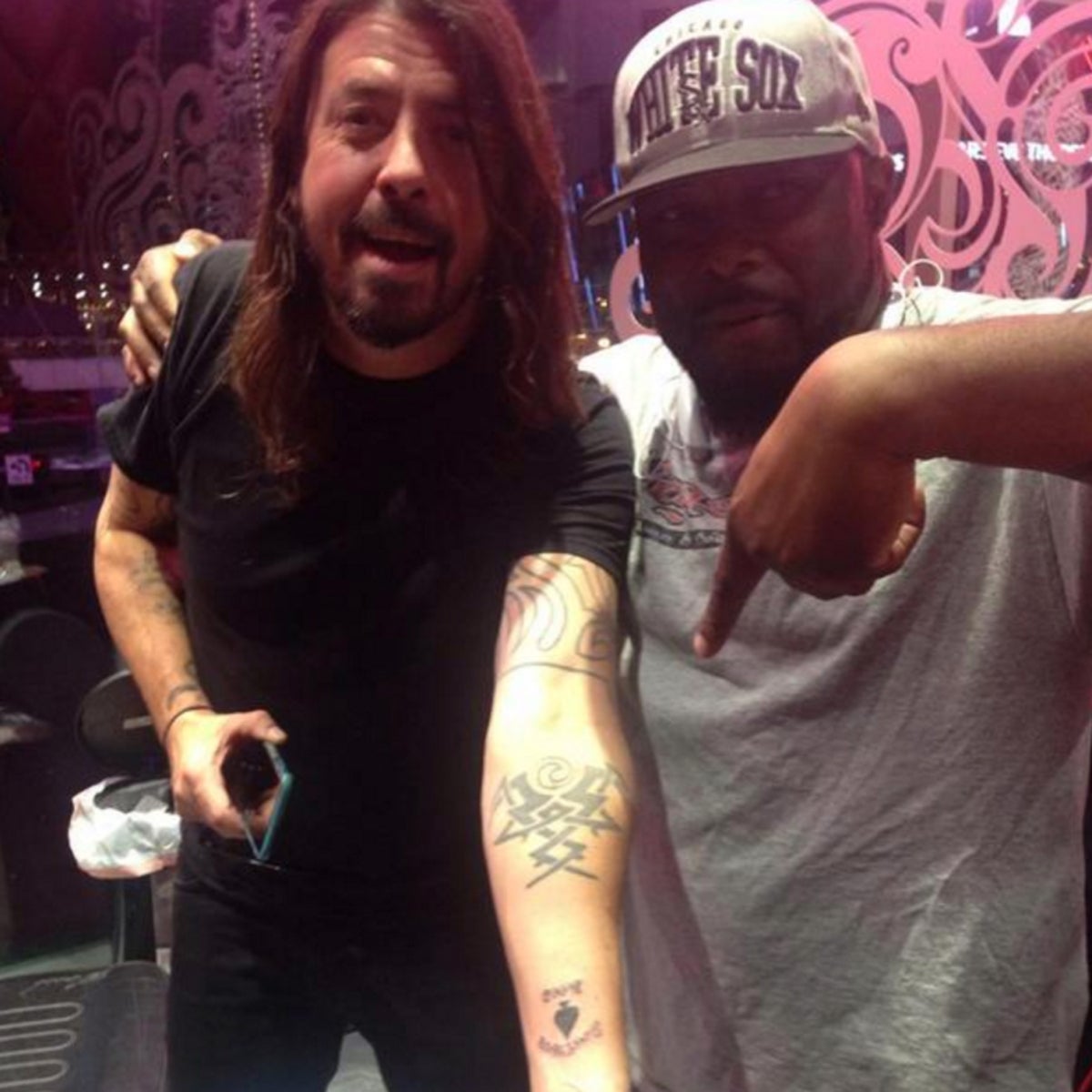
Dave Grohl Ace of Spades tattoo

Grohl’s Ace of Spades and related tattoos give the collection a sharper edge. The high-resolution photo shows the card design more clearly than a dim concert shot, and the link to Motörhead places it in the music he admired.

Each piece belongs to its own period. The Ace of Spades, Black Flag and other band references grew from different moments in Grohl’s musical life.

Grohl’s tattoos are easier to understand as a timeline than as a matching set. Black Flag recalls the music that caught his attention early; the playing-card image and smaller marks sit within a wider history of punk, metal and touring. One shared theme is not needed.

The Black Flag tattoo has the plain force of a teenage music obsession. It is a simple design, but it stayed with Grohl. His connection to the band speaks to influence and allegiance, a different story from a family tribute.

The Ace of Spades leaves more room for interpretation. The card is strongly linked with Motörhead and rock culture, but photos cannot say which part of that history meant most to Grohl when he got it. The band reference is clear; a more personal meaning would need confirmation from him or a reliable interview.

Small pieces are harder to date. A clear forearm shot may show where a design sits but not when he got it, while a concert photo can hide fine lettering. An image is useful, but it does not provide a complete timeline.

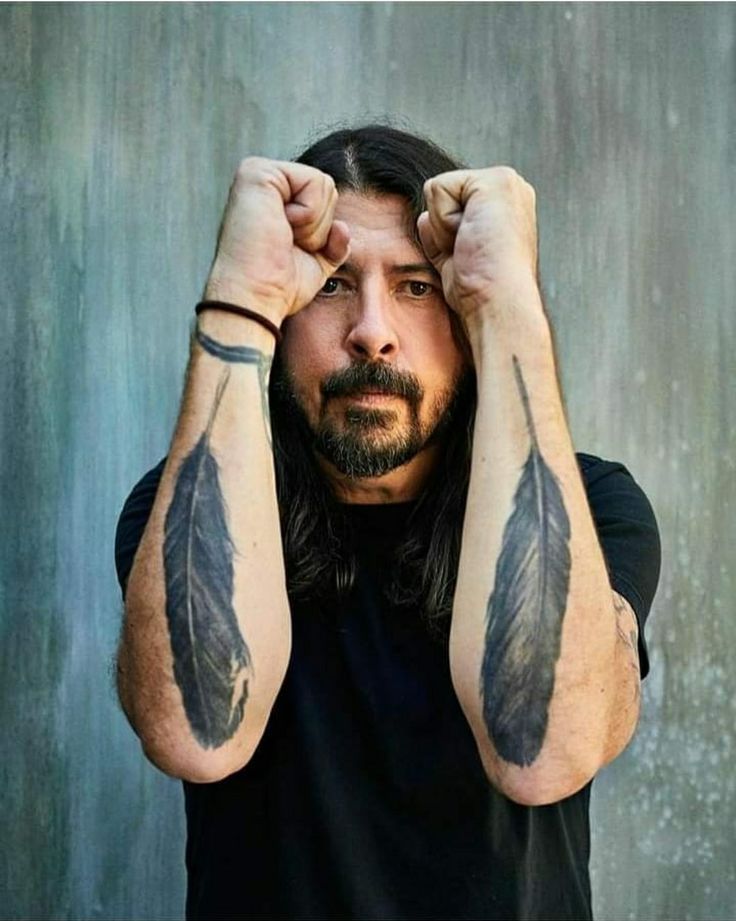
Dave Grohl matching feather tattoos on his forearms

Grohl’s forearm tattoos often come into view when he plays guitar or talks into a microphone. He can cover them with sleeves, but the ink has also become part of his public image. The collection looks accumulated over years of bands and touring, rather than designed as one brand.

Grohl has tied Black Flag to his early musical influences, and the Ace of Spades points to the rock and metal world around Motörhead. The smaller marks are best described by what the photos show when he has not explained their meaning.

Age and photo quality can make the collection look different from one picture to the next. A dark stage shot may swallow a tattoo, while a close portrait shows its edges. Ink also fades; a change in appearance does not necessarily mean new work or a cover-up.

Nothing in the collection suggests a coordinated style. The tattoos span records, bands, friendships and the years between small venues and arena stages. Some carry stories Grohl has shared; others are simply visible parts of his life.

The history behind each design matters more than a dramatic meaning added afterward. Grohl has shared part of that history in interviews; older photos and concert images fill in the rest of the picture.

More musician tattoo guides

Bam Margera’s Tattoo Collection Goes Way Beyond the Heartagram

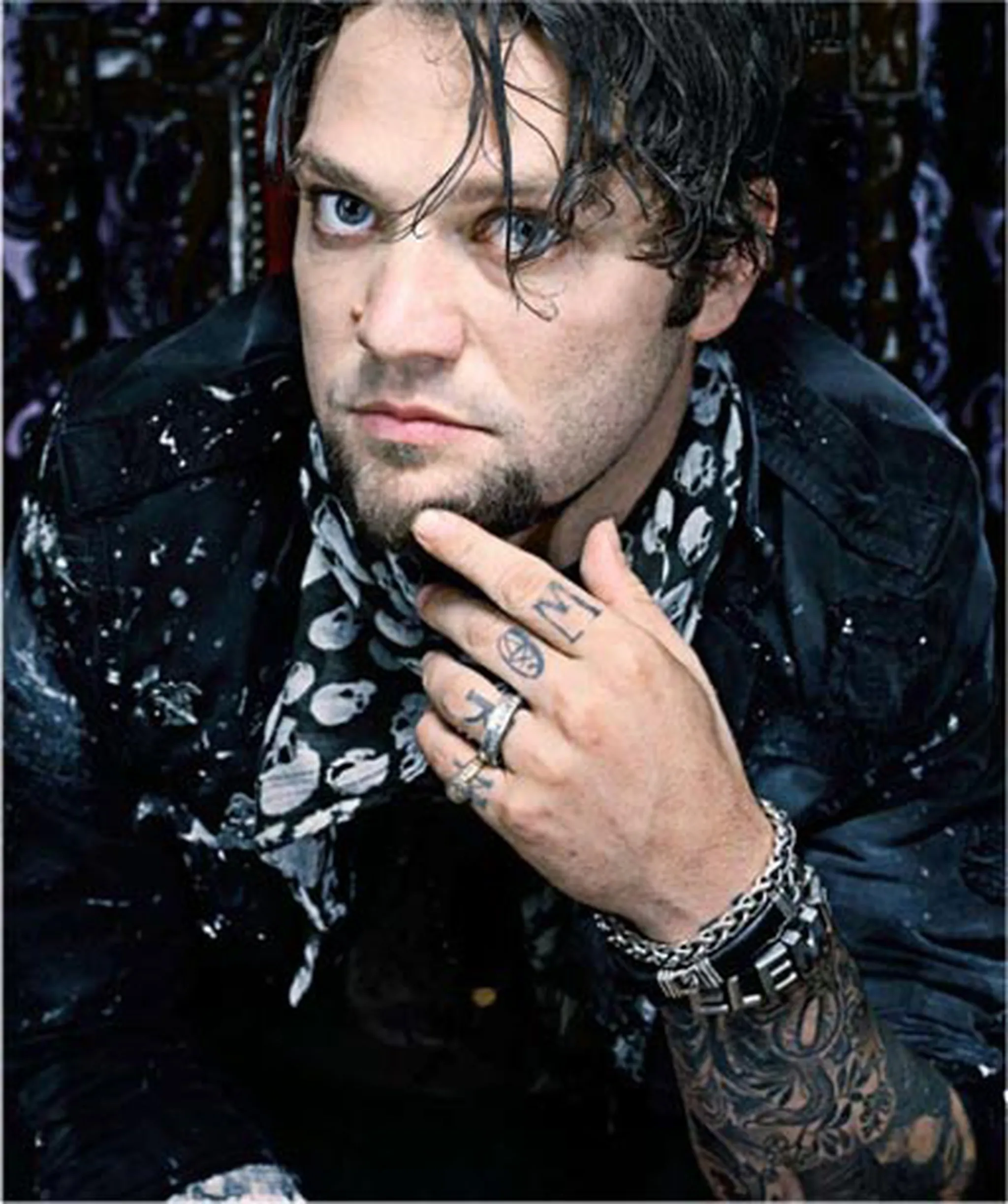
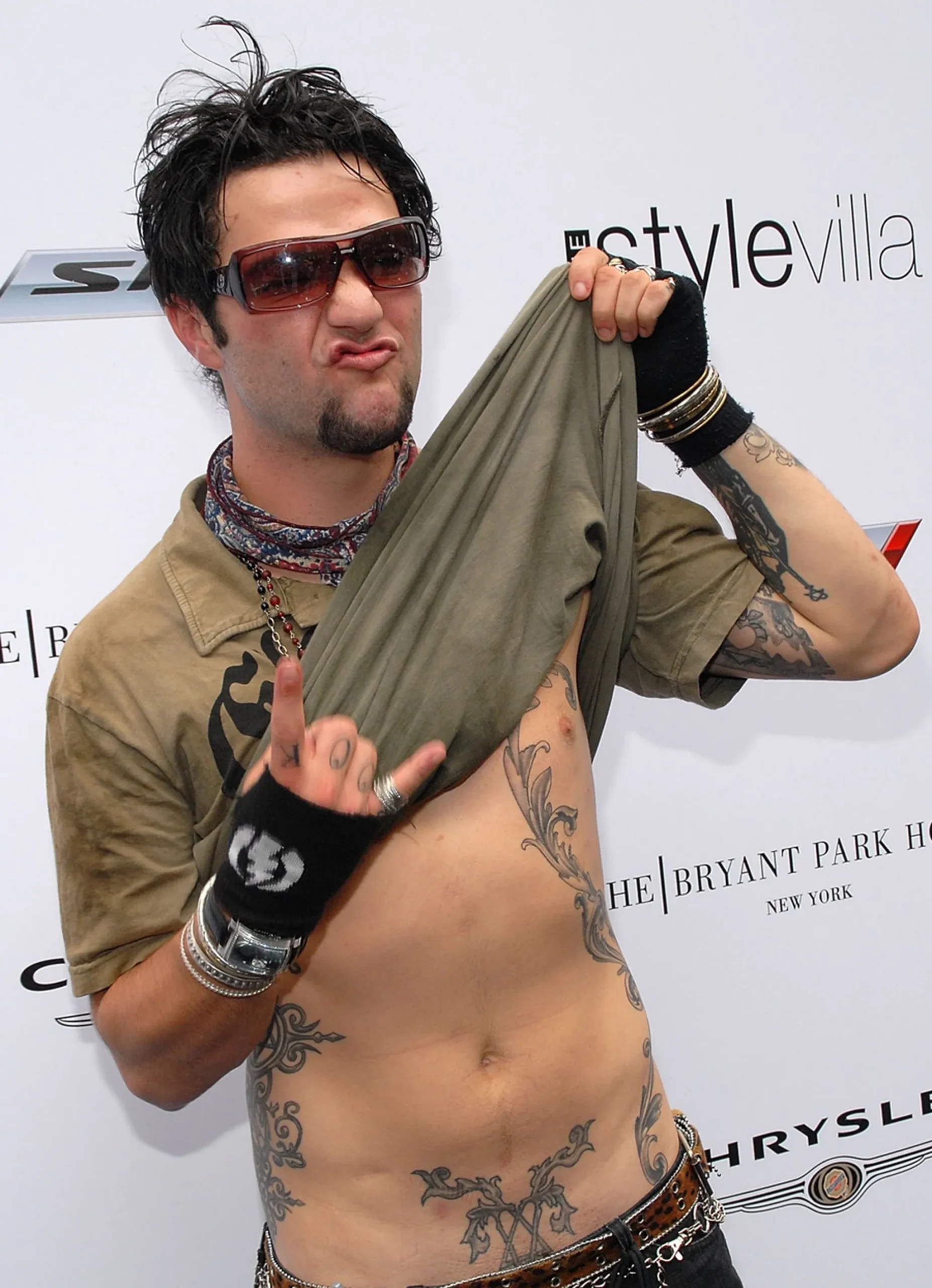
Bam Margera has a much larger tattoo collection than the short lists usually show. Alongside bold symbols and lettering, there are portraits, skate references and hand tattoos that come into view when he raises his sleeves or turns toward the camera. Added over different periods of his life, the pieces feel more like a scrapbook than a planned sleeve.

Tattoo inventories and close-up photos identify Heartagram, Book Worm, Anathema, Sigillum Diaboli and DILLIGAF. Other pieces are easier to recognize than to explain: photographs show portraits, a razorblade or ornamental linework, but say little about what Margera thought of them.

Heartagrams, the first heart and Margera’s HIM connection

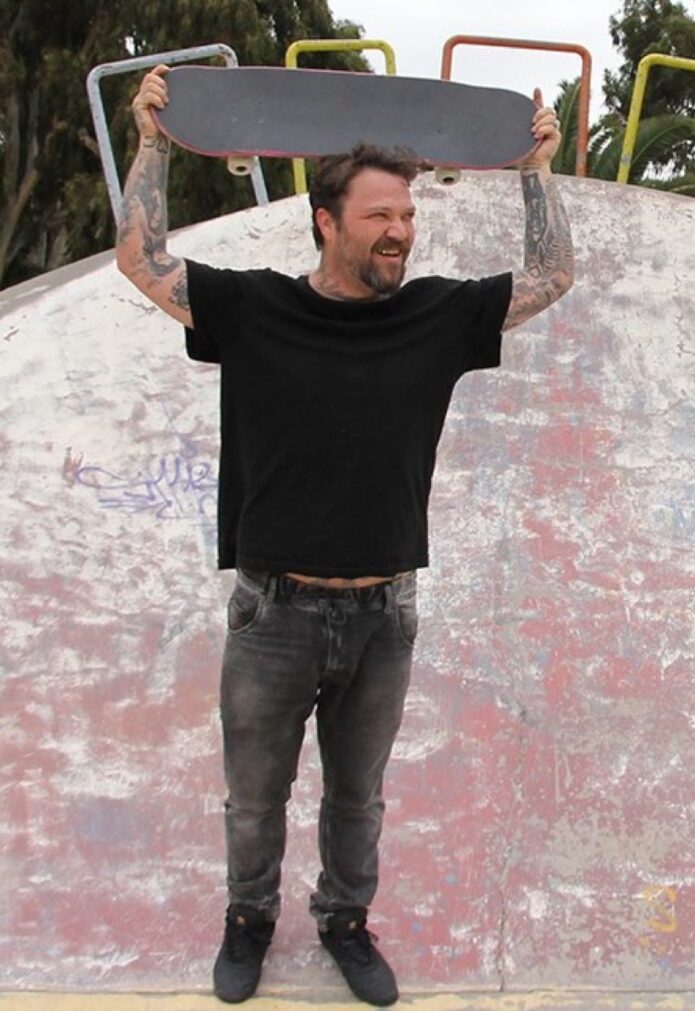
Bam Margera showing his tattooed arms and skate-era ink

The Heartagram combines a heart with an inverted pentagram. It is HIM’s symbol, and Margera’s friendship with frontman Ville Valo gives it a personal connection. HIM’s imagery also ran through his skate videos, television appearances and music projects.

Tattoo inventories list a small heart as Margera’s first tattoo, followed by a Heartagram. The design later appeared on his wrist and ribs, with a larger version reported low on his abdomen among ornamental work.

In press photos, the wrist design is easy to miss and the ribs are usually covered. When it shows, the heart sits above the symbol’s two sharp points. The placements vary, but the connection stays the same: HIM and Margera’s friendship with Valo.

The Heartagram has an instantly recognizable shape, and accounts consistently connect it to HIM.

“Book Worm” covers both hands

Bam Margera finger lettering and hand tattoos

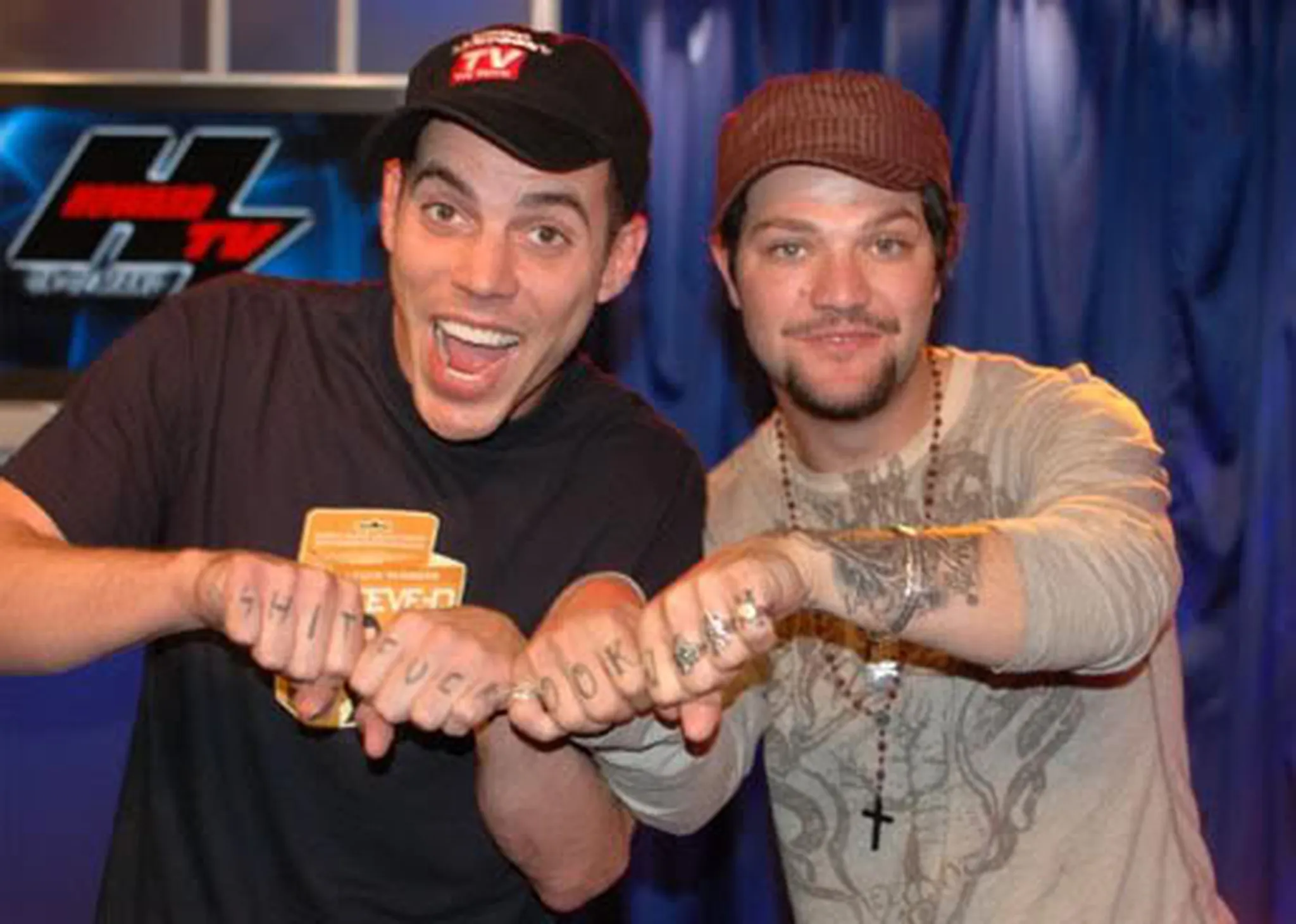
Book Worm runs across Margera’s fingers: “BOOK” on one hand, “WORM” on the other. The words read as one tattoo when he puts his hands side by side; apart, the letters can look like separate knuckle designs.

Small hearts sit inside the O’s, giving the lettering a playful touch that echoes the heart imagery elsewhere in his collection. The phrase sounds like a joke, though no source ties it to a particular book or person.

Like other finger tattoos, the lines can soften with time, and bright light can make them look heavier in one photograph than another.

A close-up makes the layout clear: the hearts inside the O’s are visible, and the two words line up when Margera brings his hands together.

Portraits, blades and skate references fill the arm tattoos

Bam Margera full arm tattoo sleeve with lettering and portraits

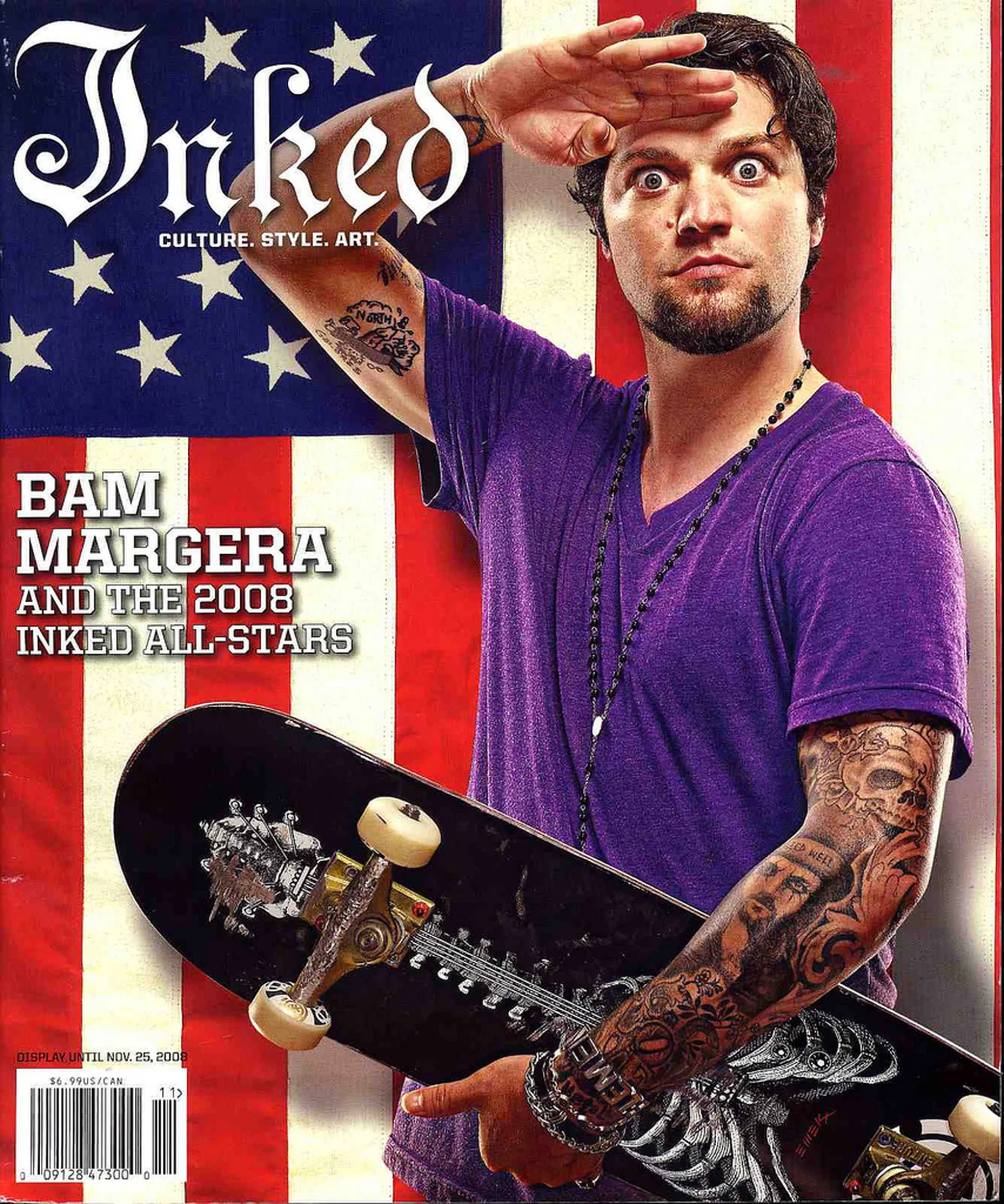
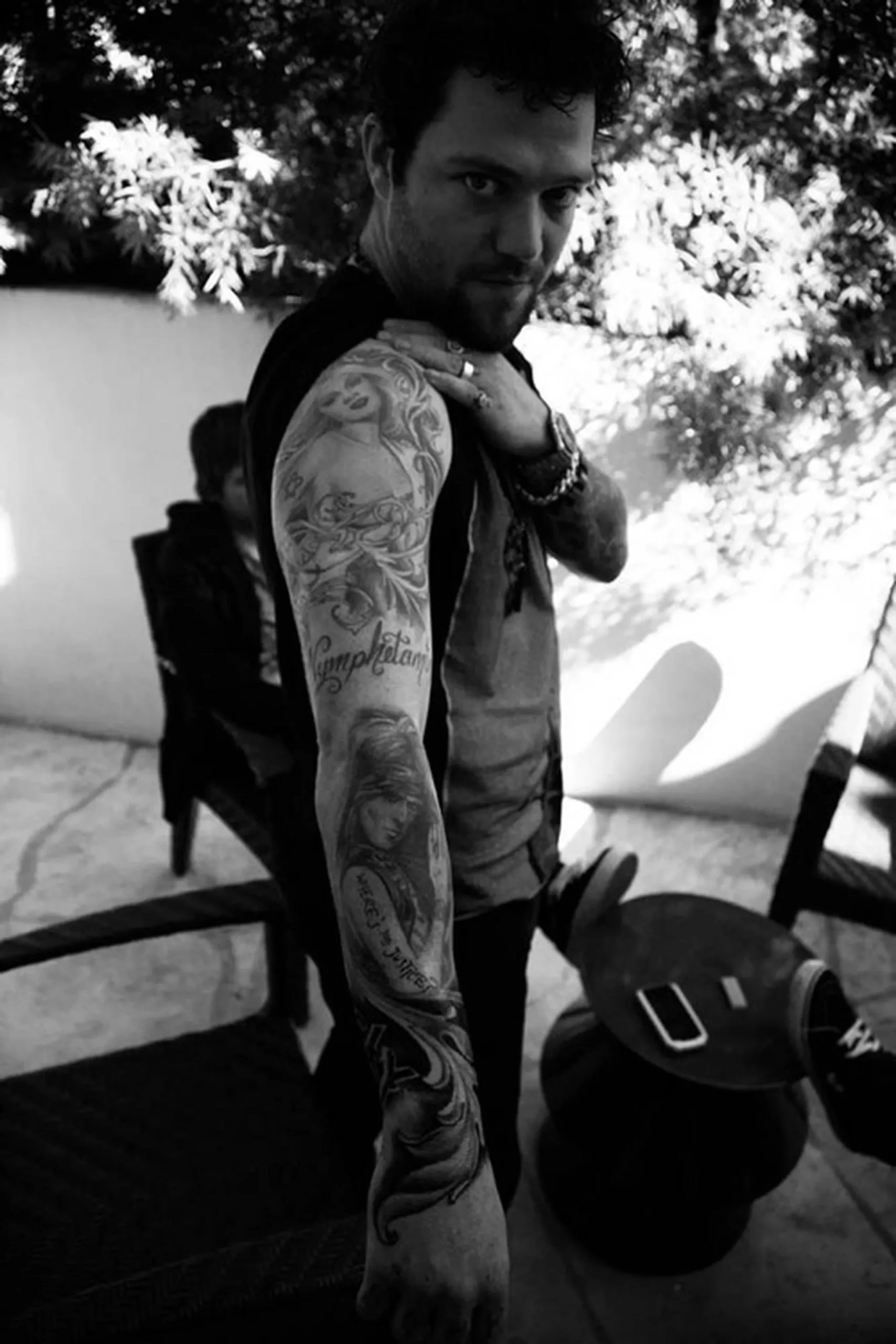
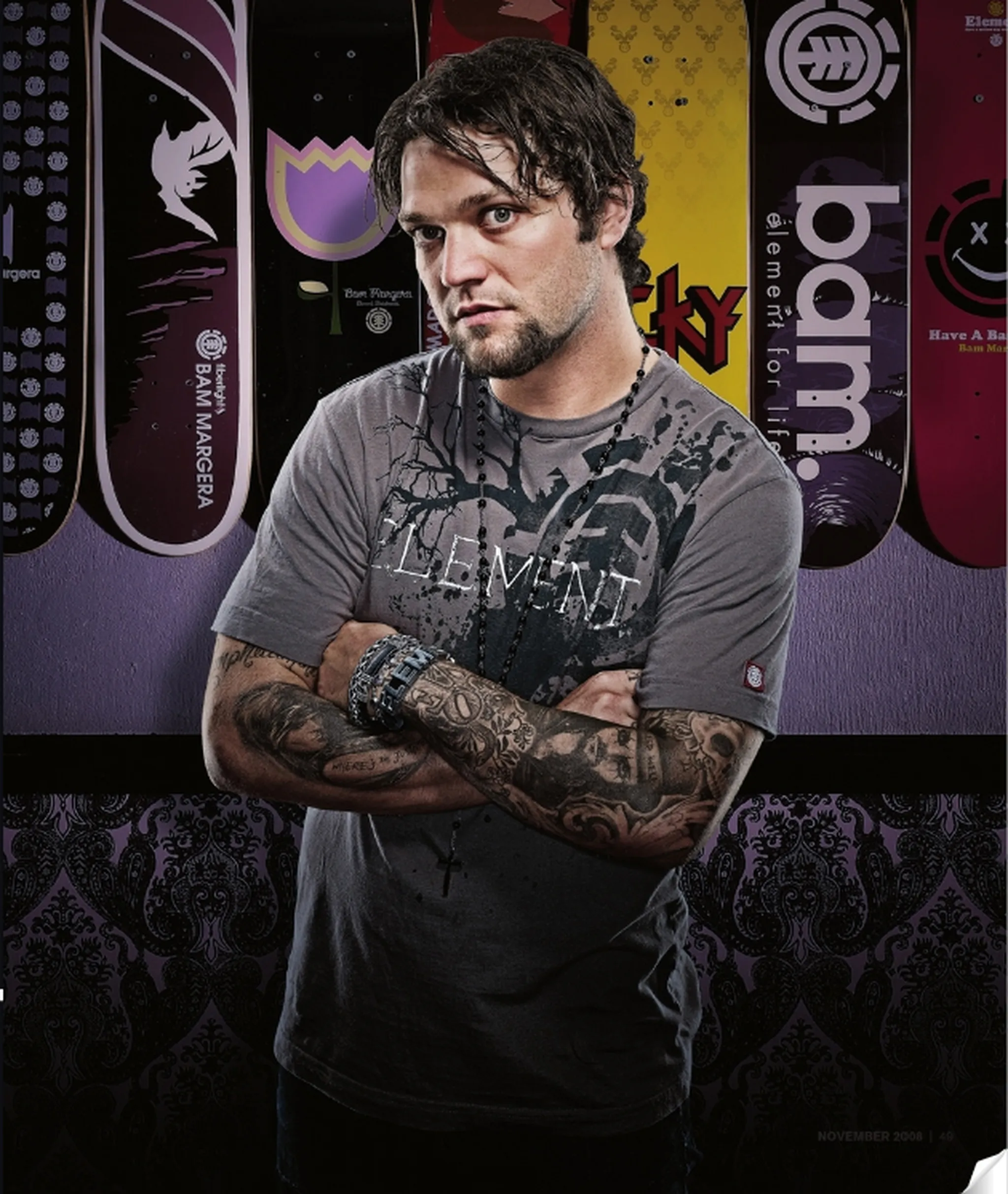
Margera’s arms carry the densest cluster of tattoos. The sleeve layers portraits, scrollwork, traditional shapes and lettering over older pieces. Some of the work, including a large right-arm portrait, is credited to Kat Von D from his Miami Ink years.

A razorblade tattoo on the left arm turns up in older inventories and stands out against the larger portraits nearby. Its sharp shape breaks up the portraits and scrollwork around it in photographs of the sleeve.

Older photographs also show arm portraits, traditional shapes, a skull and other dark motifs. Several are easy to pick out, though the designs do not all have reliable names.

DILLIGAF appears on Margera’s wrist and stands for “Do I Look Like I Give A Fuck.” The precise date is unclear. Its blunt lettering sits apart from the darker portraits higher on the arm.

His sleeve took shape over multiple sessions with different artists. Dated photos show the portraits, lettering, blade and filler accumulating over time; an undated shot captures only one stage.

Anathema and the smaller tattoos around his face

Bam Margera hand and arm tattoos in a close portrait

Anathema runs across the front of Margera’s neck, where it is easy to see in interviews and skate footage. The dark lettering has a different feel from the playful Book Worm design.
“Anathema” has a dictionary meaning, but the word alone does not explain why Margera chose it. Tattoo references identify the lettering and its placement, not his reason for getting it.

The small Arabic script above Margera’s right eyebrow is reported to read Phoenix. Because face tattoos can be hard to read in photos, this small piece is easy to miss. It belongs to a later period and is separate from the neck lettering.

Hand photos show more small marks around the fingers and knuckles. Some letters are clear; others are too blurred to identify.

Torso tattoos fill the spaces between larger designs

Bam Margera torso, side and arm tattoos

The torso holds the tattoos a T-shirt usually hides. Inventories mention a chest flourish, Heartagrams on the ribs and decorative lines down Margera’s side. Curled lines and dark outlines link the pieces without turning them into one design.
One rib design also appeared on Element skate decks and Filthy Note clothing, tying it to Margera’s skate and production work.

Catalogue descriptions mention a “cosmic pope” or a HIM-related symbol among the chest and torso tattoos. The image is unusual, and the catalogues describe its appearance more clearly than its personal meaning.

Sigillum Diaboli is linked to HIM imagery and Margera’s wedding-era tattoos. Some reports describe it as a replacement for a wedding ring, which places it in that period of his life.

A full-size photograph gives a clearer view of how the rib work sits around the chest and side; in small thumbnails, the details blur together.

Britney Spears and other later additions

Bam Margera Britney Spears tribute tattoo on his neck

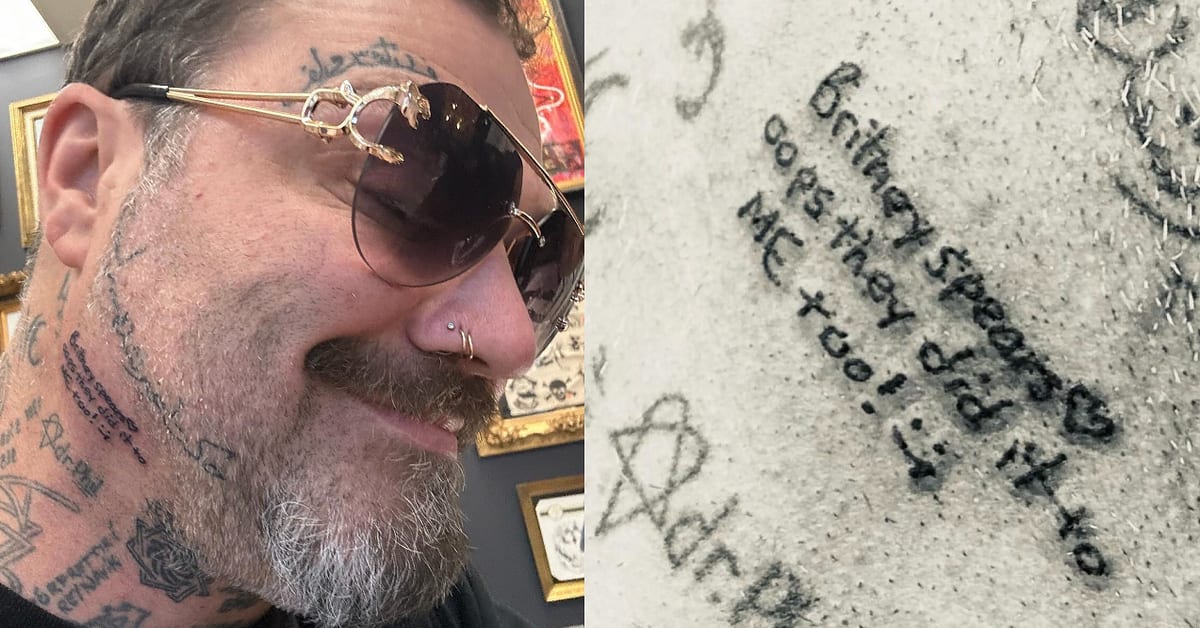
A later neck tattoo references Britney Spears. It is a pop-culture tribute tied to the Oops!… I Did It Again era, apart from the older HIM and skate-era pieces.

The tribute is small and easy to miss in a full portrait; the close-up shows where it sits.

Older tattoo catalogues also list a Don Vito portrait on his leg, along with other portraits and symbols. The records help identify what a design resembles and where it sits, even when they do not explain why Margera chose it.

Family designs and marks visible in just one blurry photograph are harder to confirm. A catalogue entry is a useful lead, but it does not mean Margera has explained the design himself.

How the tattoos fit together

Bam Margera arm tattoo close-up

Seen over time, the tattoos show different chapters of Margera’s life. HIM and skate references sit alongside later lettering, portraits and decorative work, with no single style taking over. Even the lettering varies in tone: Book Worm is playful, while Anathema and DILLIGAF are more blunt.

Some designs have a clear name or connection; others are known mainly from photographs. The difference between what can be seen and what has been explained runs through the collection.

That patchwork is the clearest thread: the tattoos accumulated over the years, each in its own style, instead of following one plan.

Dave Navarro’s Tattoos Read Like a Private Diary in Public

Dave Navarro’s tattoos stretch across his back, chest, shoulders, arms and hands. Some have a clear explanation from Navarro himself. Others are easy to identify in photographs and tattoo catalogues, but have no reliable public explanation. The distinction leaves plenty to describe without inventing a story for every skull, card or flourish.

The named tributes are the parts of the collection Navarro has discussed. The surrounding traditional imagery is best read from what the photographs show.

Constance, the name he wears low on his back

Dave Navarro Constance tattoo lettering

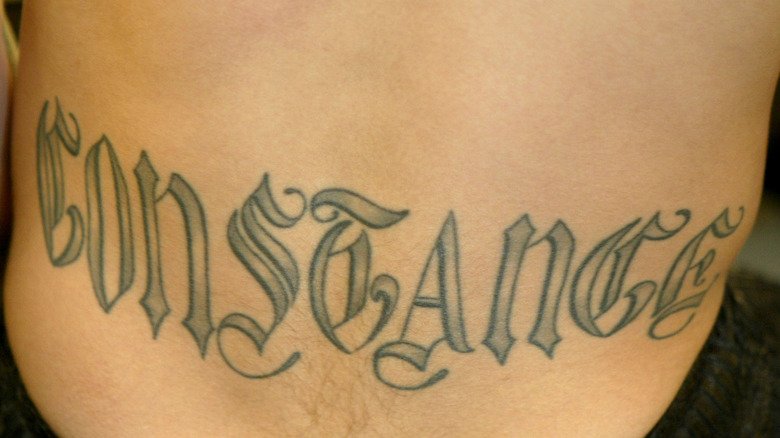
The lower-back lettering reads Constance, a tribute to Navarro’s mother. Charlie McDonald of Mayhem in Los Angeles is credited as the artist. Tucked low and central, the name feels more private than the bold chest work, even when Navarro is photographed shirtless.

A simple written mark can carry more weight than a large image. The lettering sits where clothing can hide it, but the name reads immediately when it is visible.

A portrait and memorial lettering fill the left side

Dave Navarro arm tattoo portrait and memorial lettering

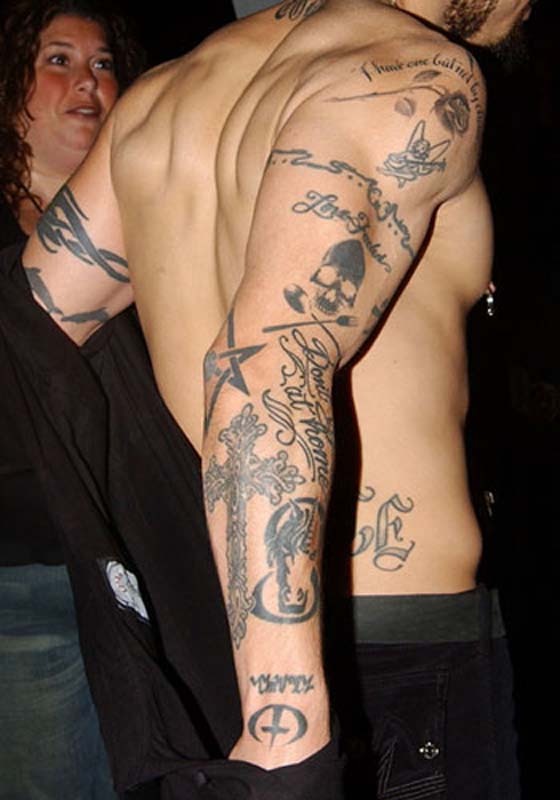
Photographs of Navarro’s left side show a portrait associated with his mother, surrounded by flowing script and smaller traditional motifs. The surrounding arm appears to have been built over several sessions, so one photograph cannot date the portrait. The face is the main image; the script and smaller marks give the arm a scrapbook feel.

Catalogues also identify memorial lettering and a skull in the same area. The smaller designs sit alongside the realistic portrait, old-school outlines and narrow script, but Navarro has not publicly explained each one.

“Surrender Dorothy,” the phrase Navarro has explained

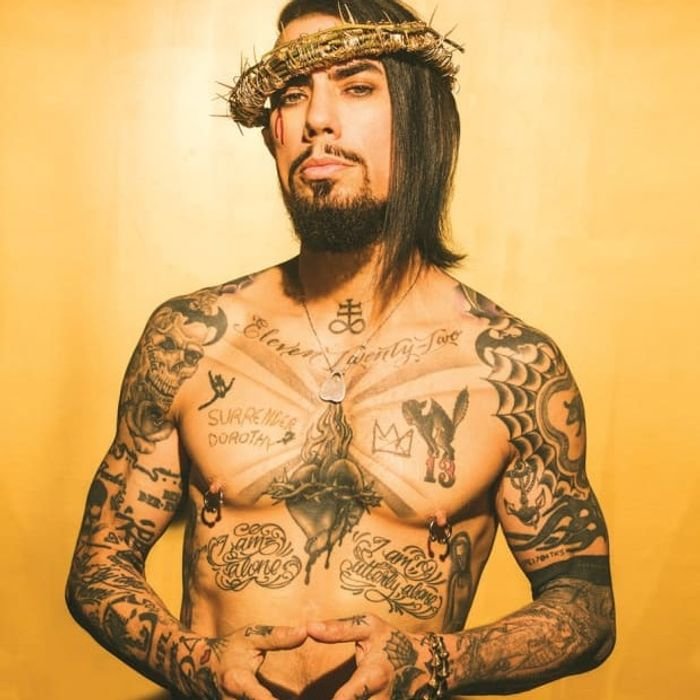
Dave Navarro Surrender Dorothy chest tattoo

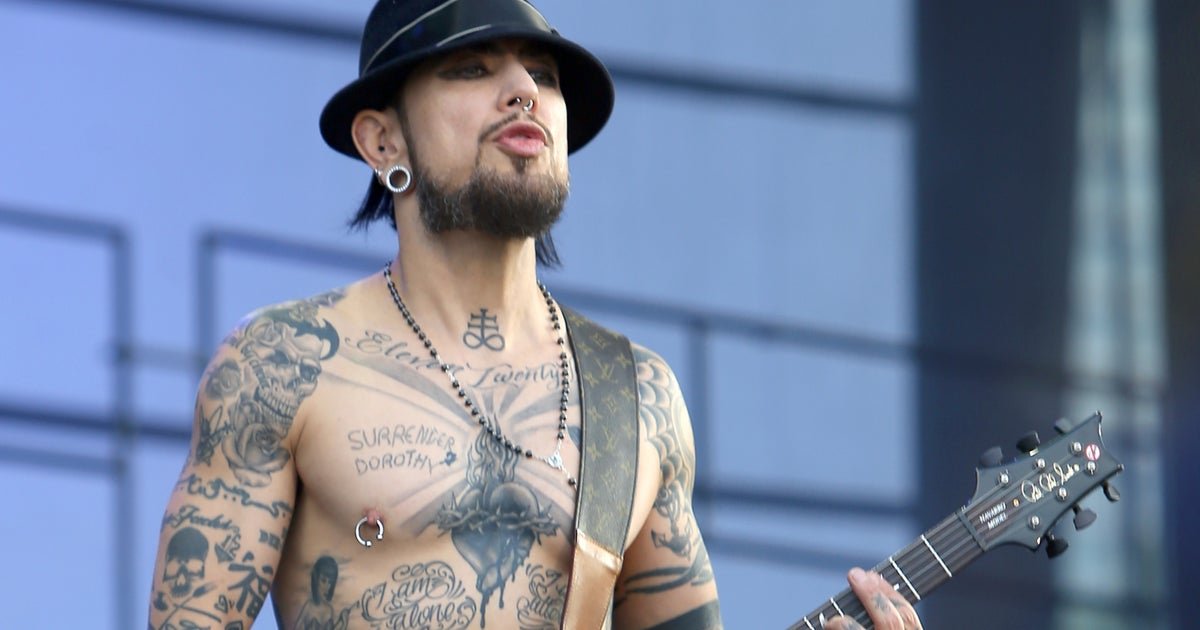
“Surrender Dorothy” is one of Navarro’s best-known chest tattoos. In an interview, he connected “surrender” with letting go and allowing life to be what it will be. The phrase also recalls The Wizard of Oz, giving the lettering the feel of both a quotation and a sign.
Ornamental blackwork frames the words, with a heart, crown and other flourishes nearby. Navarro’s interview explains the phrase; the photograph shows how it sits across the larger chest composition.

Eleven Twenty-Two across the upper chest

Dave Navarro Eleven Twenty-Two chest tattoo

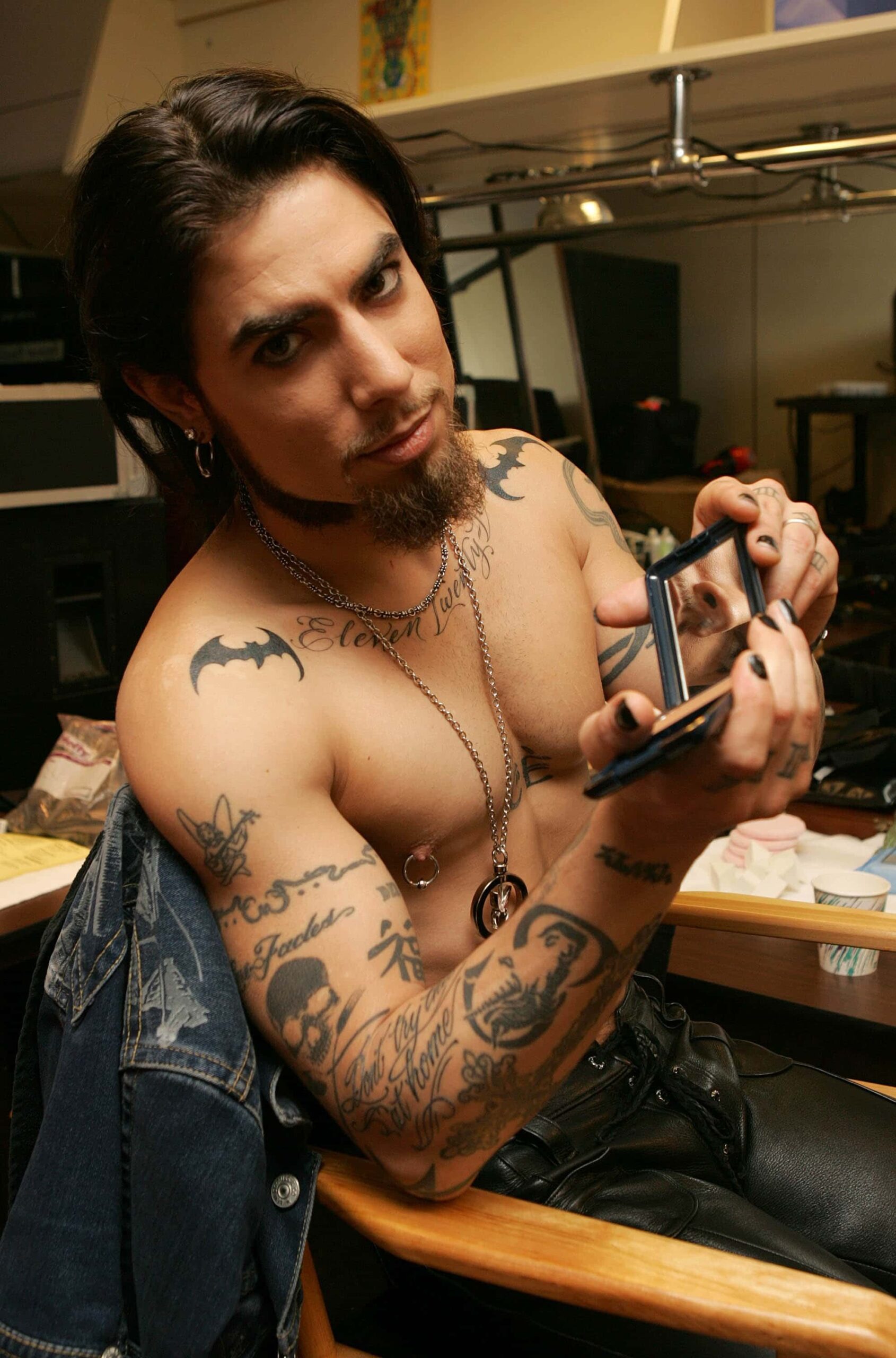
“Eleven Twenty-Two” stretches across Navarro’s upper chest. The numbers are clear, but public descriptions do not establish which personal event the date marks.

The inscription sits among heavy black-and-grey imagery, mirrored script and ornamental shapes, folded into a larger chest design. Its position is as striking as the date itself.
Heart, crown and mirrored lettering anchor the chest

Navarro’s chest includes a large flaming or sacred-heart image, crown-like details and ornamental blackwork. Published photographs also show mirrored script lower on the torso, including the reported phrases “I am alone” and “I am utterly alone.” The wording is visible, though its connection to the surrounding images has not been explained publicly.

The heart draws the eye first; script spreads outward and the blackwork fills the spaces around it. A distant event photograph can lose the small symbols that make the composition easier to read.

CE initials for Carmen Electra

Dave Navarro CE initials chest tattoo

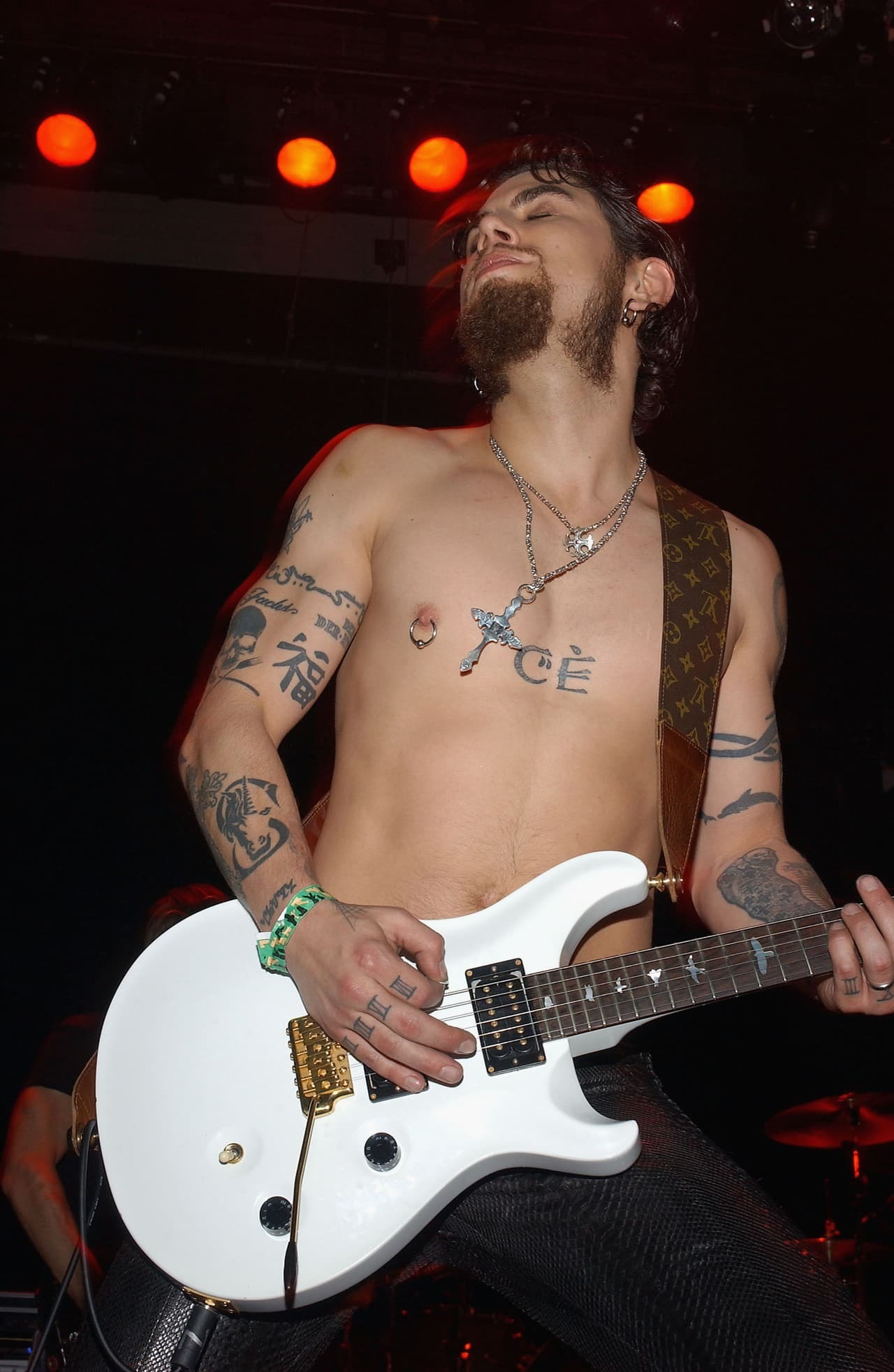
Photographs and entertainment coverage identify CE on Navarro’s chest as a tribute to Carmen Electra. The initials are clear and easy to distinguish from the surrounding designs.

The chest tattoos around the initials fold them into a larger black-and-grey composition, but CE remains its own relationship tribute, distinct from “Eleven Twenty-Two” and “Surrender Dorothy.”

A Celtic cross and playing-card suits on the forearm

Dave Navarro Celtic cross and card-suit forearm tattoos

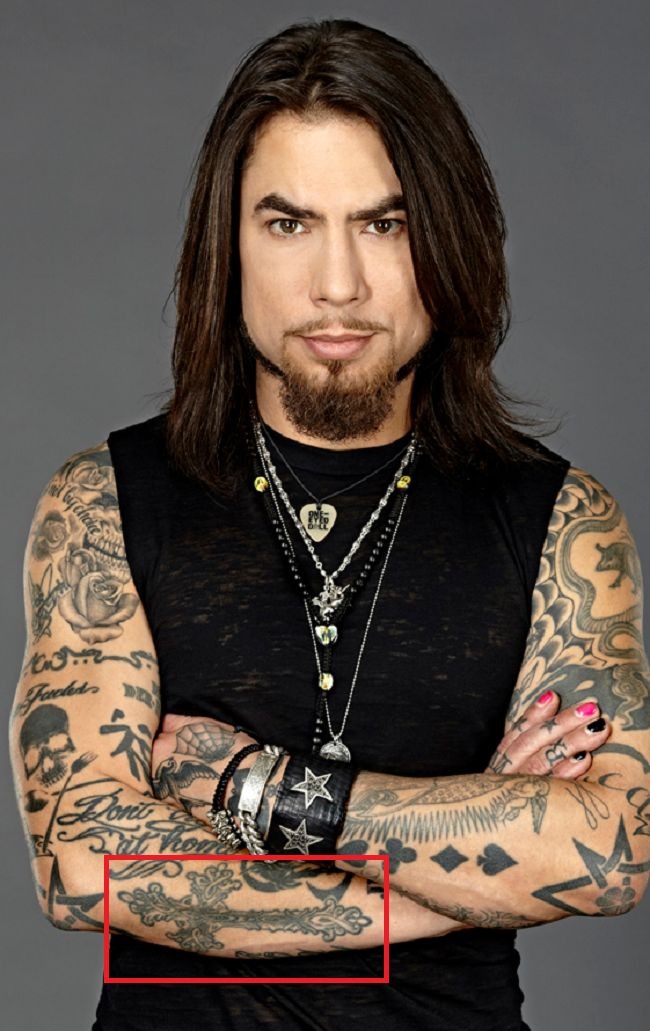
A Celtic cross is regularly identified on Navarro’s forearm, alongside playing-card suits, ornamental flourishes and other traditional-style marks. Its strong outline keeps it readable even when the arm is photographed at an angle.

Catalogues also list skull-and-crossbones imagery, a pierced-skull motif and narrow script near the wrist. The pieces can overlap in a single photograph, but each is a separate design.
Man’s Ruin, cards and dice across the arms

Dave Navarro traditional arm tattoos with pin-up and card motifs

Specialist tattoo inventories identify a traditional “Man’s Ruin” pin-up in a martini glass, with aces, twos, dice, a liquor bottle, skull-and-crossbones imagery and a banner nearby. The pin-up, gambling symbols and bold outlines draw on classic flash designs.

Taken together, the group gives Navarro’s arms a Sailor Jerry-inspired look. Elsewhere, the memorial and family work brings a different tone to the collection.
The arm also carries the One Hot Minute fairy logo, a reference to Navarro’s Red Hot Chili Peppers period. Among the pin-ups, cards and heavy outlines, it can look like another decorative figure; its connection to the band is more specific.
What the photographs show and leave open

Navarro is sometimes said to have more than ninety tattoos, though totals vary depending on whether a connected cluster counts as one piece or several. One list may group a portrait with its lettering; another may count every card, banner and small symbol separately. An inventory is more useful than a firm total.

Repeatedly documented designs include Constance, the family portrait, memorial and name lettering, Surrender Dorothy, Eleven Twenty-Two, the central heart-and-crown composition, mirrored loneliness script, CE initials, the Celtic cross, skulls, card suits, dice, Man’s Ruin, the One Hot Minute fairy logo, and additional shoulder and hand marks. Photographs show how the tattoos sit together; Navarro’s interviews explain only some of them. A design can be plainly visible even when its personal story has not been shared.

Nicki Minaj’s Chinese Tattoo Has a Clear Phrase and a Complicated Backstory

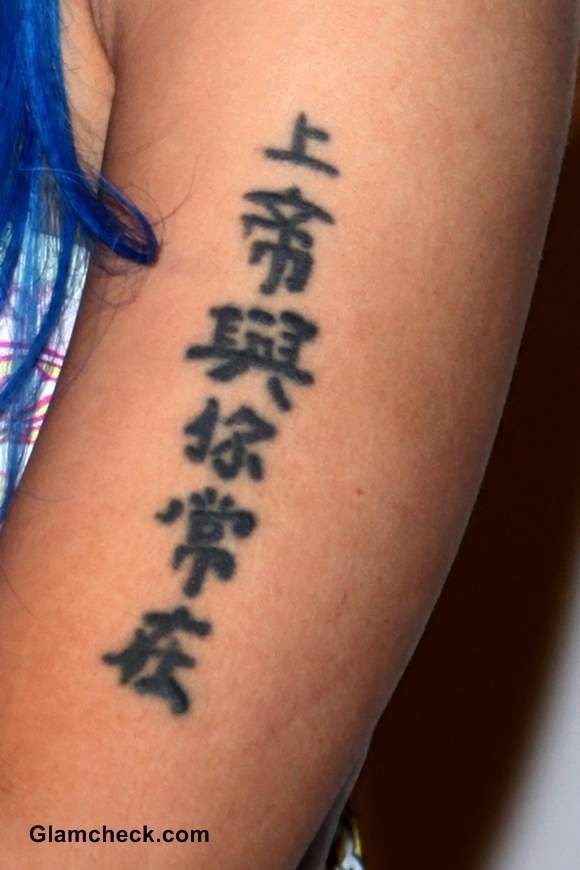
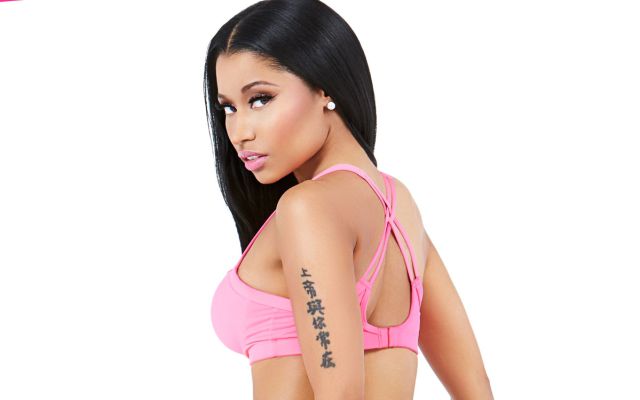
Nicki Minaj’s Chinese tattoo is easy to recognize but more complicated to explain. Six traditional characters, 上帝與你常在, run down her left upper arm. English coverage gives two common translations: “God is always with you” and “God is always with me.”

It is often described as Minaj’s first tattoo, which she got at about sixteen. Later reports say she regretted choosing such a visible spot; she had first considered the back of her neck. Language specialists have also questioned some of the character forms. The phrase is easy to identify, but its history and lettering need care.

The six Chinese characters form the tattoo’s central message

Nicki Minaj showing Chinese characters tattooed on her upper arm

The six characters 上帝與你常在 anchor the design. Cheng & Tsui transliterates them as Shàngdì yǔ nǐ cháng zài and explains the common Christian reading. 上帝 can mean God or a supreme deity; the remaining characters convey being with someone and staying present.

English sources render that last idea in slightly different ways. Capital XTRA uses “God is always with you,”; other references say “God is always with me.” “You” and “me” reflect different English renderings, not different characters. It helps to give both common readings while keeping the original visible.

The vertical arrangement makes the phrase easy to recognize. It is not a single-character mark or a textless symbol. All six characters and their order matter; Chinese writing is not a set of interchangeable English initials.

This tattoo also shows why character tattoos need a language check. Cheng & Tsui and Sinosplice have analyzed the writing instead of repeating an online translation. Their analyses support the intended blessing while pointing out that some strokes are inaccurate.

The vertical writing sits on Minaj’s left upper arm

Nicki Minaj displaying the vertical Chinese tattoo on her left arm

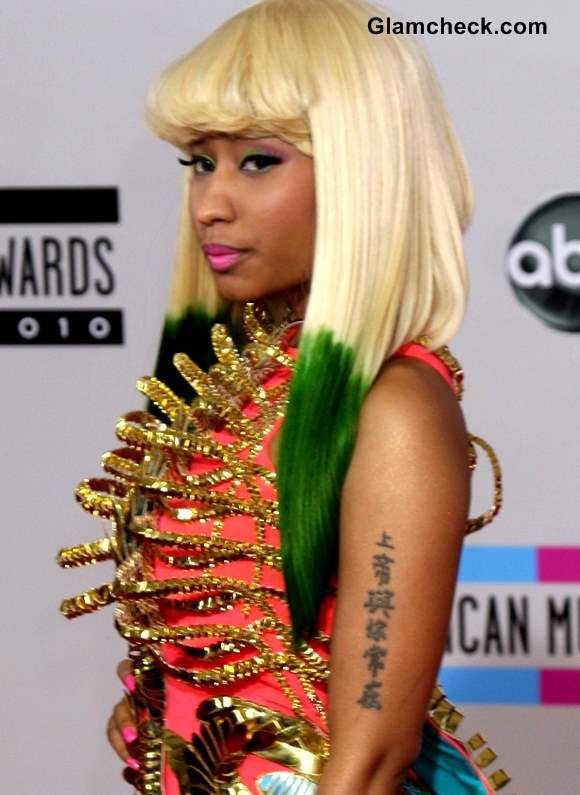
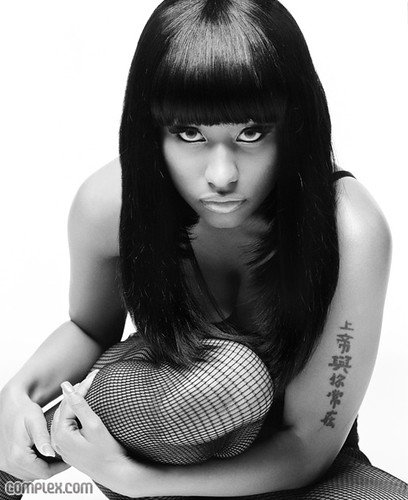
Minaj’s Chinese writing runs down her left upper arm and bicep. Capital XTRA and photo coverage place it there; Glamcheck describes it as being on the upper part of the limb. The arm is visible in sleeveless performances and red-carpet photos, which helped make the design familiar early in her career.

Steal Her Style reports that Minaj considered the back of her neck before choosing her arm. That made the tattoo easier for photographers and fans to see, but it also turned a teenage decision into a permanent part of her public image.

The characters follow the curve of her arm in a narrow vertical column, not a horizontal banner. The bicep bends as she turns, so distant photos can shorten the column or blur neighboring characters. Close-ups are better for reading the full phrase.

Her later regret was about placement, not necessarily meaning. Reports say she wished the tattoo were somewhere less visible, while still identifying the phrase as a religious blessing. That’s more precise than saying she hates the design.

Traditional forms and uneven lettering complicate the translation

Nicki Minaj showing the vertical Chinese writing on her left upper arm

The tattoo uses traditional Chinese forms, including 與 rather than the simplified 与. Sinosplice examines the characters individually and says some are uneven or missing strokes. Cheng & Tsui compares them with standard forms and notes that the intended sentence can still be understood, even if the calligraphy isn’t fully accurate.

That distinction matters: the translation comes from reading the sequence as a sentence and comparing it with language analyses, not guessing from appearance alone. The phrase conveys a familiar blessing, but the handwriting may not meet a native calligrapher’s standard.

For anyone considering a Chinese-script tattoo, check the wording with a fluent reader before copying it. A design can matter to its wearer and still contain an awkward form or nonstandard stroke. Criticism of the lettering doesn’t prove Minaj had no intention behind it.

Minaj’s Chinese tattoo also appears in discussions of her music persona. Some later coverage connects it to her lyrics and public image, but the tattoo predates those references. She chose it as a teenager, and it stayed visible as her music and styling changed. It is the same set of characters in each photo.

What can be stated confidently about the Chinese tattoo

Nicki Minaj’s Chinese-character upper-arm tattoo

The clearest description is straightforward: Minaj has a vertical, six-character Chinese tattoo on her left upper arm, commonly read as a blessing that God is always with someone. She got it as a teenager, considered a different placement and later regretted how visible the arm location was. Language analyses say some characters look rough or nonstandard.

The real interest lies in the tattoo’s context: the wording, placement and calligraphy all matter. Show the original characters beside any English translation, and label that translation as a reported reading. That keeps the guide accurate without turning a teenage tattoo decision into a claim about Minaj’s private faith.

More musician tattoo guides

Lil Wayne’s Tattoos Reach From His Eyelids to a Full-Body Suit

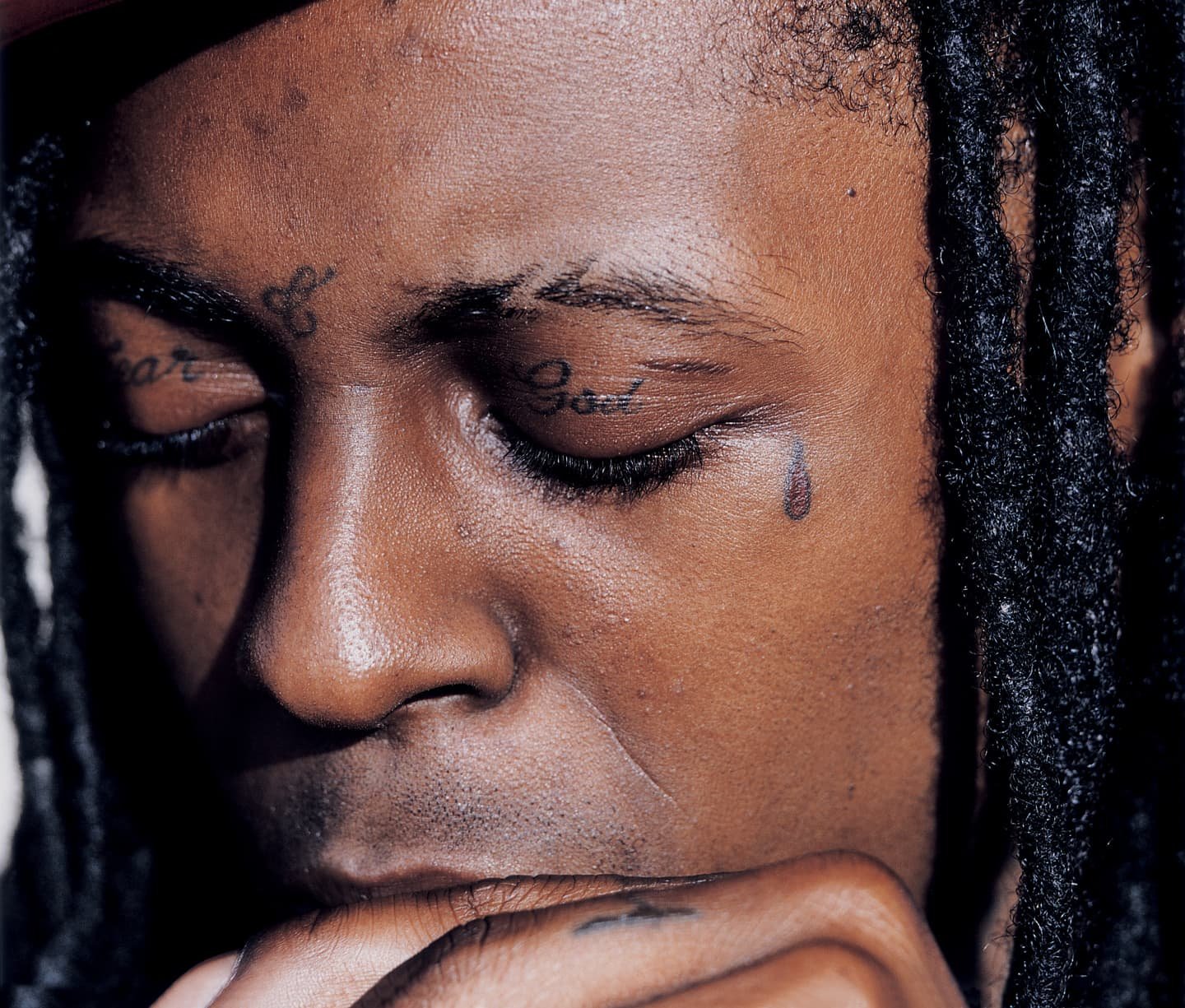
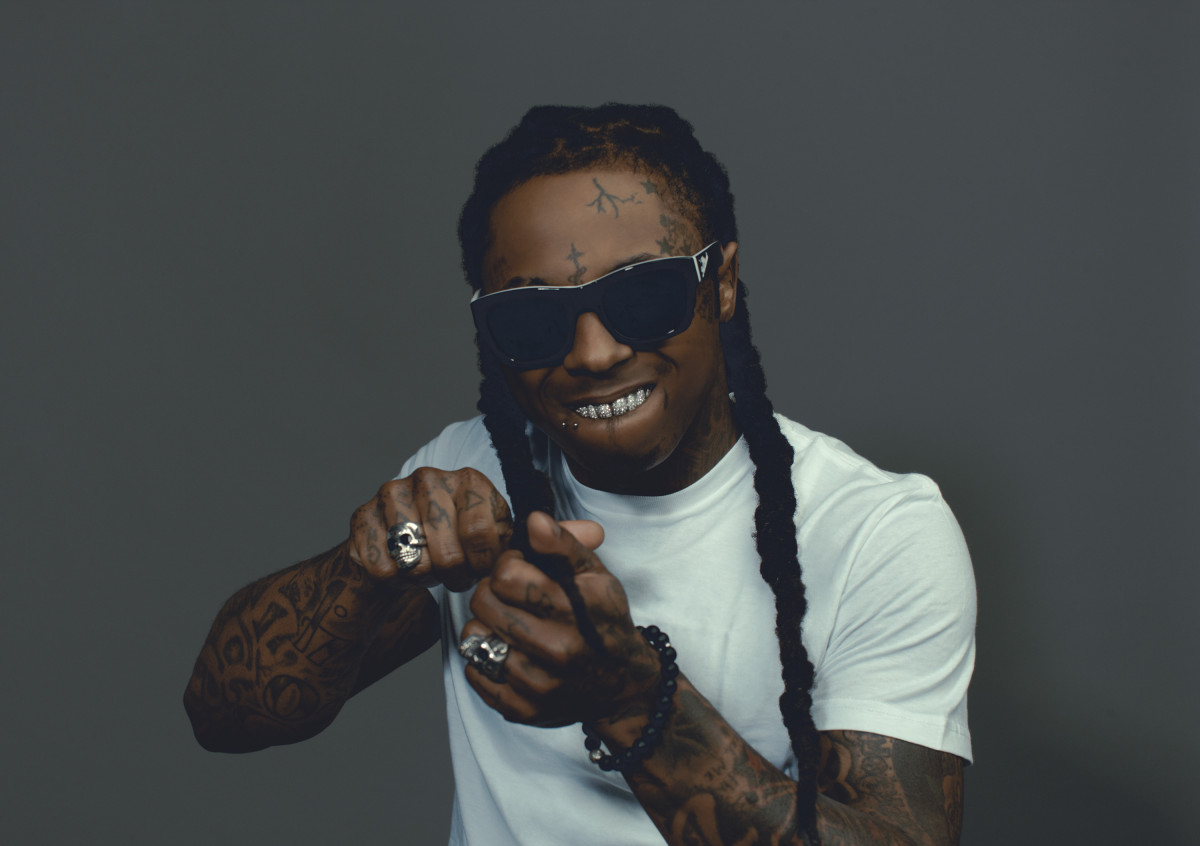
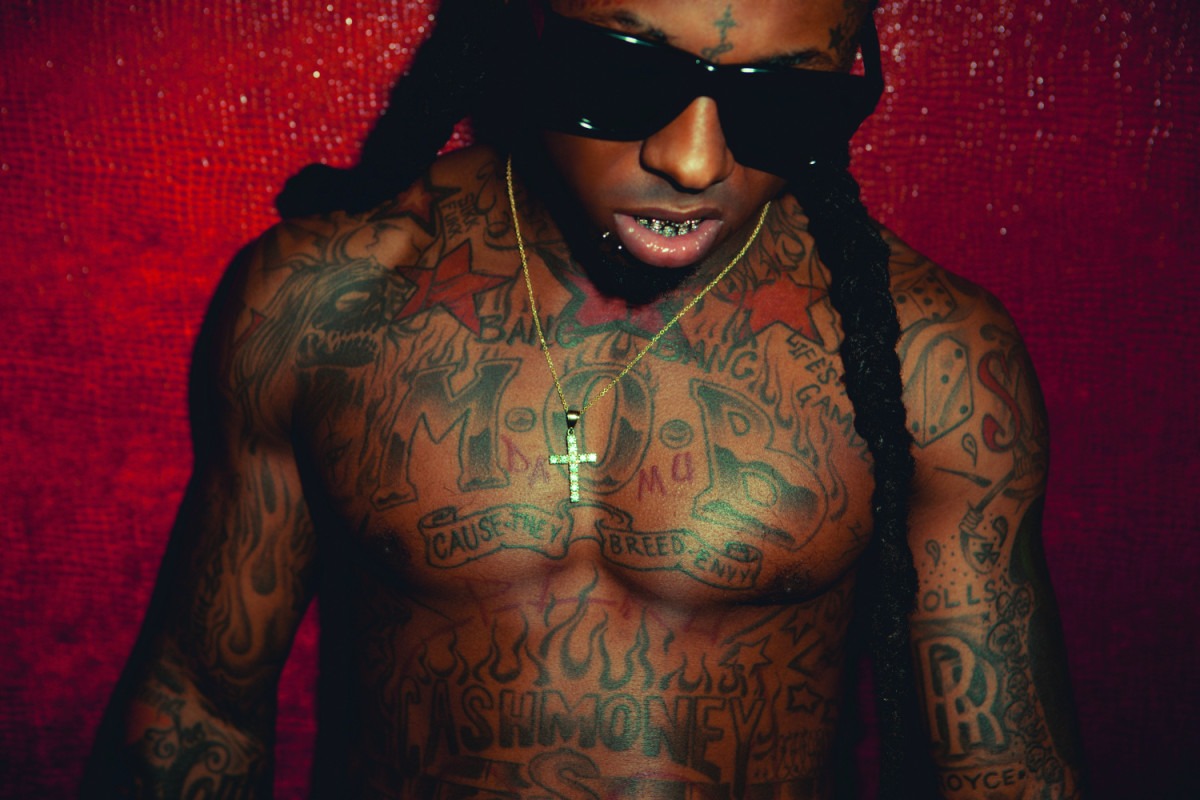
Most people recognize Lil Wayne by a few close-ups: “Fear God” across his eyelids, teardrops under his eyes and “I Am Music” above one eyebrow. His tattoos cover much more, from his face and neck to his chest, arms, hands, back and legs. In a 2017 interview, his former tattoo artist Dow Hokoana said she had done about 300 tattoos on him and helped complete a full-body suit.

Wayne added the work over many years, often in private sessions, and each photograph shows only part of it. Some tattoos have clear explanations; others are visible but remain personal. A neat numbered list would miss that history.

His face holds faith, music and unmistakable lettering

Close-up of Lil Wayne showing the Fear God eyelid lettering and teardrop face tattoos

The clearest explanation is “Fear” on the right eyelid and “God” on the left. In a 2008 Guardian interview, Wayne was asked what he feared and answered, “Nothing. Fear, God… That’s it.” The phrase is direct; it needs no extra symbolic theory.

Above his eyebrow, “I Am Music” reads like a statement of identity. In that Guardian profile, Wayne called himself music. The words are part of his public image, not hidden beneath clothing.

Other face tattoos make the area more like a patchwork than a single design. BET’s gallery shows “Misunderstood” running down his face, with stars nearby, a fleur-de-lis on his cheek as a New Orleans reference, “East Side” under his jaw and a C between his eyes. Wayne hasn’t given one explanation for every mark; gallery captions identify what’s visible but don’t settle its private meaning.

The teardrops are recognizable but easy to overread. Some tattoo lists assign them a specific story, but a shape’s conventional meaning isn’t evidence about Wayne. The same applies to the cracks, cross and other marks around his forehead and cheeks. A photo shows where the ink sits, not why he chose it.

In December 2014, Wayne added an Eye of Providence to his chin and Arabic writing above an eyebrow. Early reports translated it as “Momma’s boy.” The FADER later updated its story after Arabic speakers questioned that reading. It’s safer to call it “Arabic lettering,” than repeat the translation as fact. The writing is visible; the first translation was disputed.

Chest and stomach lettering trace the Cash Money years

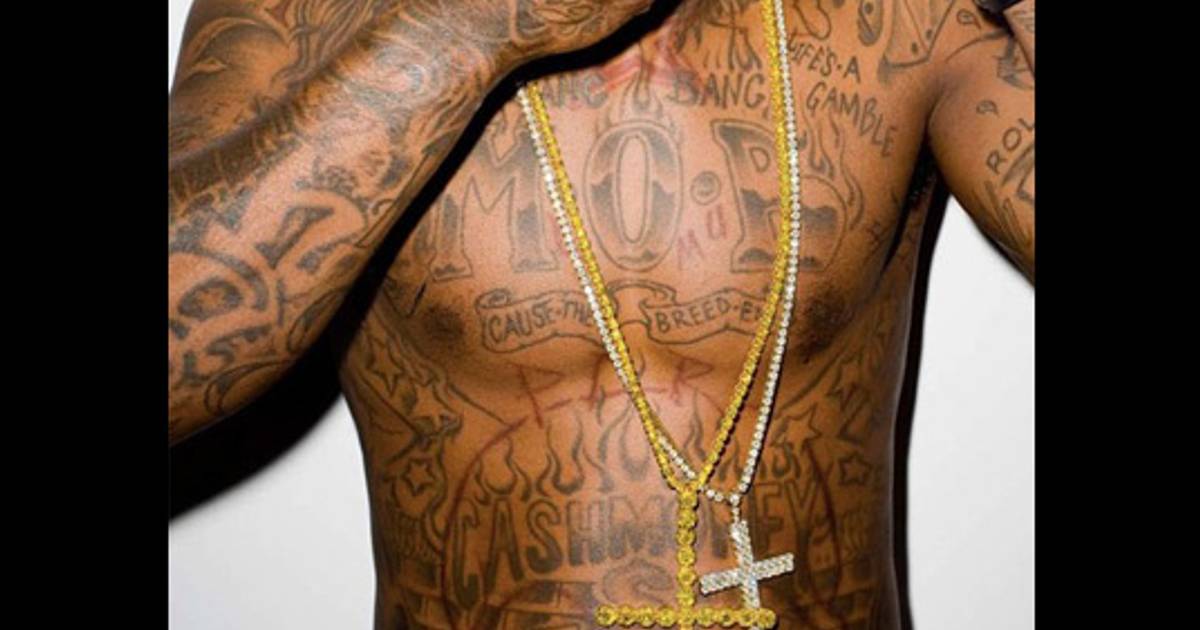
Lil Wayne’s tattooed chest and stomach, including M.O.B., Cash Money, Bang Bang and Life’s a Gamble lettering

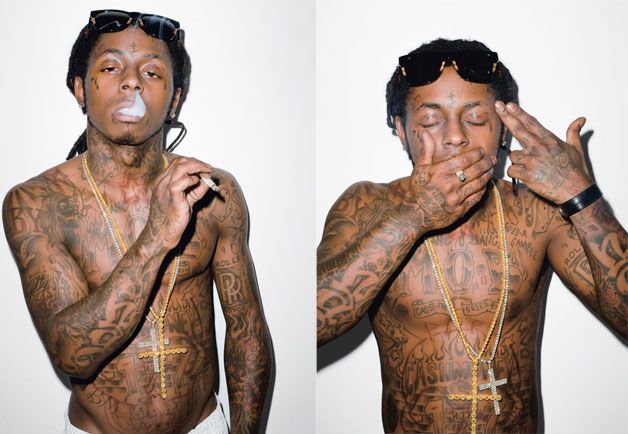
Wayne’s torso carries some of the collection’s largest pieces. BET’s gallery identifies “M.O.B.,” “Cash Money,” “Bang Bang” and “Life’s a Gamble” across his chest and stomach. From a distance, the words form a dense field; closer photos make several phrases readable in the same shot.

“M.O.B.” is often expanded by other tattoo guides, but BET lists the initials without a direct explanation from Wayne. Keep them as printed rather than presenting an unverified expansion as his definition. “Cash Money,” is straightforward label text from the career that made him known.

On his abdomen, 17 refers to New Orleans’ 17th Ward, according to BET. Other catalogues list “Apple Eagle,”, “BM JR,”, “R.I.P. TB,”, red skulls and more lettering low on his stomach. The photos don’t verify every item equally clearly, so keep those entries attributed rather than presenting them as equally certain.

Biographical accounts say Wayne got his father’s name tattooed at 14, then later added “Cash Money” across his stomach. The public reports don’t give a session-by-session record. Still, the names and affiliations link family, New Orleans and the label that launched his career.

His arms and hands carry names, dates and hometown details

Lil Wayne’s tattooed forearms and hands in a Universal Music press portrait

His arms mix names and dates with references to New Orleans and music. The gallery shows “Baby” over a bird on his upper right arm, described as a tribute to Bryan “Birdman” Williams. BET also identifies “9-27-82,” his birth date, on a forearm, plus “Thugged Out” with an alien and a Rolls-Royce logo on the left arm.

Other entries include “Slim,”, “Nae” on each forearm, “504,”, and “In Memory of Rabbit: It’s Up to Me.” Some tattoo catalogues link the last phrase to his stepfather, Reginald “Rabbit” McDonald. Blanket labels such as “gang tattoos” miss the range: names, family tributes, hometown markers, jokes and brand references share the collection.

BET captioned several close-ups of Wayne’s hands. One is “A Gun” on his right palm; another is “The World” on his left. “Concrete Street” runs across both hands, and a small smiley face sits inside his lip. Other catalogues list “HOT” and “BOY” across the hands, “SQAD” and “SHIT” on his fingers, “TRIGGER” on an index finger, plus “Shake Junt” and “Skateboard” designs. These small marks are hard to make out in stage photos; close-ups work better.

Where a tattoo sits changes when it can be seen. Forearm lettering is usually visible; a palm appears only when Wayne turns his hand toward the camera. “The World” and “A Gun” read like short visual jokes, but they don’t explain his beliefs or life. Photos confirm the words and placement; his reasons are another question.

The full-body project includes work most photos never show

Archival GQ portrait showing Lil Wayne’s extensive face, chest and arm tattoos

Wayne’s former tattoo artist, Dow Hokoana, told The FADER she completed about 300 tattoos on him over seven years. Her aim was to build a full-body suit. They often started around midnight and worked until morning; on tour, she sometimes met him at a hotel after a show. This was a long-running project, not just a face-tattoo phase or a few memorable chest pieces.

Hokoana named designs that rarely make short lists. One cheek tattoo is a cloud and lightning bolt, chosen after Wayne spotted a bolt on her daughter’s backpack. She said he sometimes wanted a design simply because he liked it, without a grand explanation. That’s a useful counterweight to the habit of assigning life-changing meaning to every mark.

She also described ten Vegas-style showgirls wrapping around his hip, an Andy Warhol Campbell’s soup can, and a colorful checkerboard across his backside. Hokoana said the full-body project was completed, but kept one intimate design private, saying Wayne could discuss it himself if he chose. That boundary should stand.

Catalogues also list a prayer and map of Louisiana on his back, a skull and leg work, including a Jay-Z verse often identified as “Lucky Me.” The available portraits don’t show all these pieces clearly. Keep the descriptions attributed to those catalogues rather than calling them independently verified close-ups.

What the record can say without guessing

Lil Wayne showing his chest and arm tattoos

The clearest picture comes from three sources. Wayne’s own words explain “Fear God”. BET’s captions identify words and placements across his face, torso, arms and hands. Hokoana’s interview shows how extensive the body-suit project became and names pieces that rarely make short lists.

Those sources don’t give a current tattoo count or a dated record of every session. Wayne’s tattoos changed over time, and photos may show old, altered or newly added work. No single image captures the whole collection.

His tattoos grew alongside his public identity. The face carries words about music and faith; the chest and stomach reference Cash Money and New Orleans; the hands and arms add names, dates and jokes; the body suit includes work cameras rarely capture. That’s more specific than treating every tattoo as a mystery, and it stays close to what the photos and interviews show.

More musician tattoo guides

The story written across David Beckham’s tattoos

David Beckham’s tattoos began with a few family pieces and grew over decades into a collection of names, religious images, handwritten messages, dates and shaded scenes. They now cover his neck, back, chest, ribs, arms, hands and legs. Following the collection by placement makes more sense: photos can hide details, and not every reported meaning has been confirmed.

The counts are only snapshots. In a 2013 CNN interview, Beckham said he had 32 tattoos and that his favourites included his children’s names. He added, “They all have a meaning.” A 2016 GQ profile put the count at about 40. Later inventories counted more than 60, including a detailed Men’s Health list, and director Fisher Stevens said Beckham was nearing 100 while they filmed the Netflix documentary. The totals vary because sleeves hold many separate motifs and Beckham has kept adding new work.

The neck has become a cluster of family tattoos

Close view of David Beckham’s neck rose and Pretty Lady Harper lettering

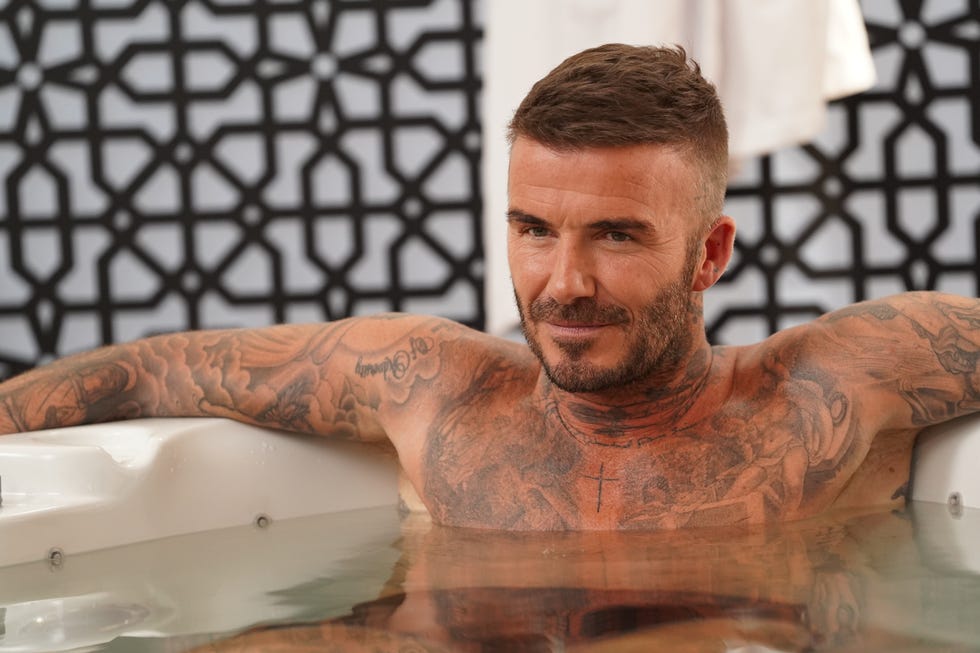
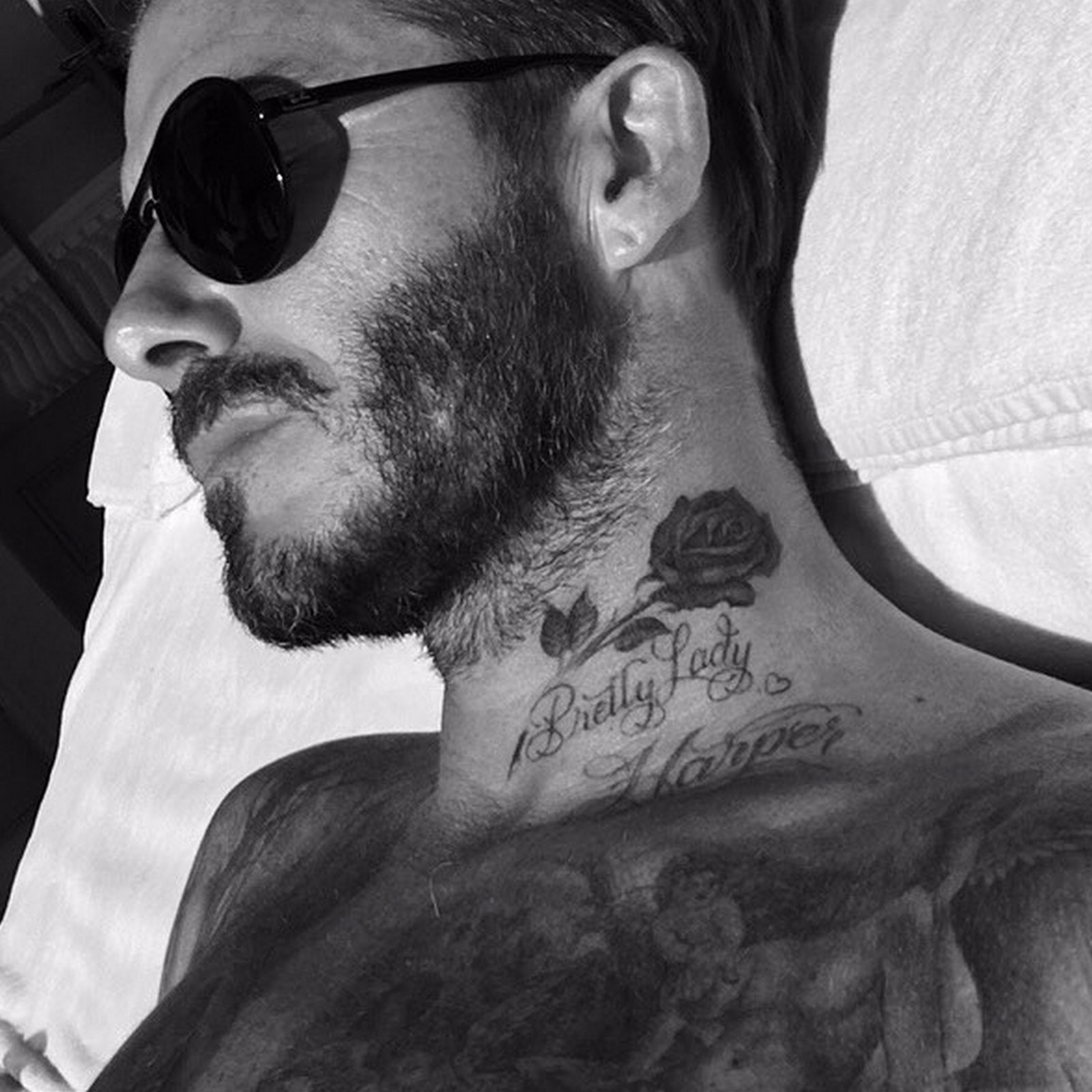
Beckham’s neck tattoos were added over time. On the left, “Pretty Lady” sits above Harper’s name. Higher up, a rose is paired with “I love you” and birds that reach toward his hairline. Close-up photos show a tiny rose near his ear and a small black heart on the ear itself. A solar-system design on the side of his head can disappear beneath his hair.

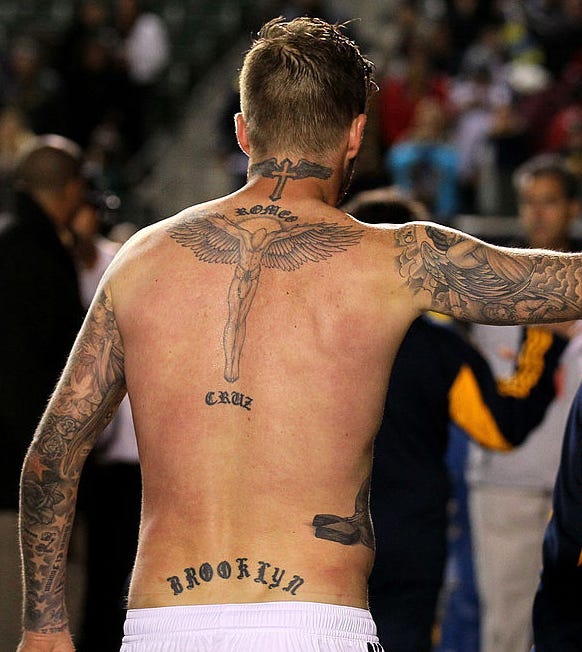
At the back of his neck, a winged crucifix sits above Romeo’s name. Lower at the front, a rose sits beside “dadda do it”, split by a small black horse. Reports link the horse to Victoria, though the image alone can’t confirm that. On his collarbone, “Buster” is the nickname Beckham uses for Brooklyn.

Together, the tattoos now fill the neck from the hairline to the shoulders. The close-up above makes the fine script easier to read; wider portraits show where the pieces meet.

The back is organized around a guardian angel and his sons’ names

David Beckham’s back tattoo with a winged angel and his sons’ names

Tattoo inventories identify the guardian angel between Beckham’s shoulder blades as his first tattoo. Beckham later added wings, expanding the small figure into a broad back piece. His sons’ names frame it: Romeo near the neck, Cruz lower on the spine and Brooklyn across the lower back. Beckham added the names later.

The back can look different from one photo to another. A collar can hide Romeo’s name, a match shirt covers most of the design, and the camera angle shifts where Cruz and Brooklyn appear. Dated, straight-on photos show the layout more clearly than distant match shots. The image above captures the wings and names together.

Beckham has spoken about the importance of his family tattoos. His comments support the connection for his sons’ names, but he hasn’t given the same explanation for every bird, angel or line of script.

Chest imagery brings faith and family into the same frame

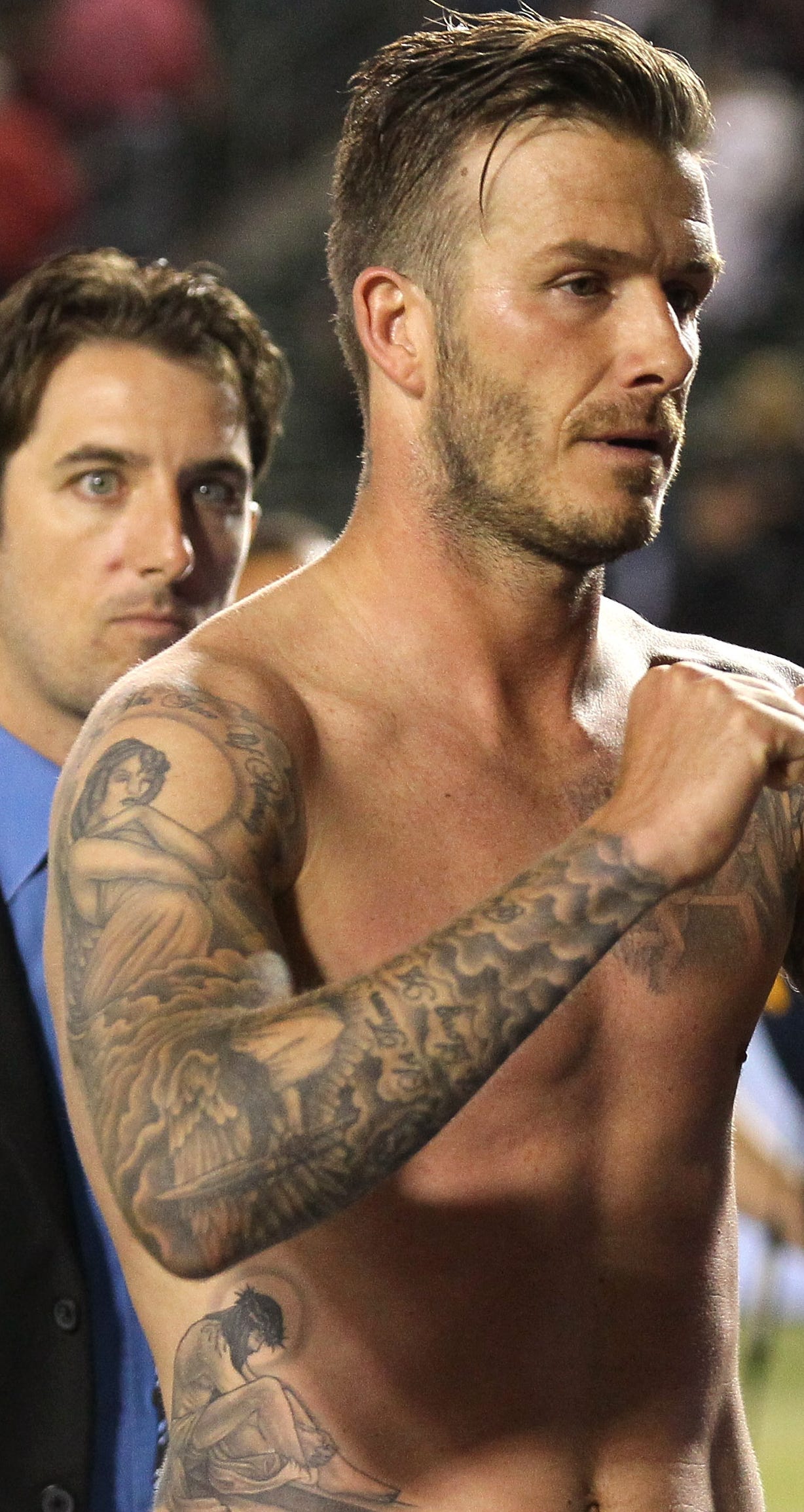
David Beckham displaying his chest and arm tattoos

The best-known chest design shows Jesus being carried by three cherubs. In an interview covered by GOAL, Beckham said the cherubs represent Brooklyn, Romeo and Cruz, and described the image as his sons looking after him.

On the opposite side of his chest is another large religious image. Tattoo guides identify it as a scene associated with The Agony in the Garden, though published accounts don’t agree on the label. A simple cross sits between the two designs.

The chest isn’t one continuous picture: the religious images, lettering and central cross were added at different times. The image above shows how the chest work meets the sleeves.

His ribs and sides hold a ship, inscriptions and family dates

David Beckham Chinese-character rib tattoo shown clearly

Under one arm is a full-sailed ship that matches the one on his father’s arm. A passage from the Bible sits below it. On the other side are an eagle in flight and a portrait of a Native American chief. Family and faith recur throughout the collection. The sources don’t offer a broader explanation for either the eagle or the portrait.

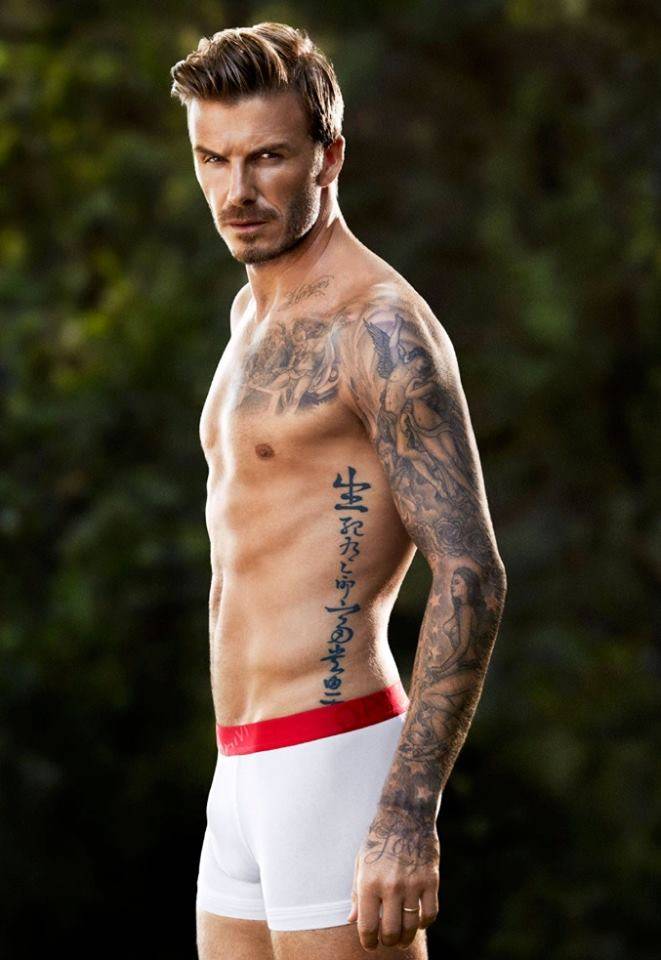
Chinese characters from Confucius’ Analects run down his left side. Men’s Health translates the passage as a reflection on life and death, riches and honour. Nearby are 1975, his birth year, “Mum & Dad” and “We Love You Daddy”, which reports say his children wrote by hand. A woman in a forest has also been photographed on his torso, though available sources don’t explain it.

The characters are difficult to read in most photos. The image above makes the lettering easier to see, though the available sources don’t offer a reliable line-by-line translation.

The arm sleeves combine portraits, roses, scripture and numerals

David Beckham’s tattooed arm sleeve with religious imagery and lettering

Beckham’s sleeves grew in layers. One arm has an angel near the shoulder, along with clouds and cherubs. Lettering includes “In the Face of Adversity” and “Let Them Hate As Long As They Fear.” Lower down are “Pray for Me”, “Perfectio in Spiritu”, the Roman numeral VII and “De Integro”, usually translated as “again” or “anew.” Seven is also his shirt number.

On the other arm are a Renaissance-style Cupid carrying Psyche, ten roses around the elbow and a portrait of Victoria among stars and dark shading. Nearby, “Ut Amem Et Foveam” is usually translated as “to love and cherish.” A Hebrew line from the Song of Songs reads “I am my beloved’s and my beloved is mine.” Victoria’s name appears in Sanskrit on his forearm; one guide notes that the spelling includes an extra letter.

Sleeve counts vary depending on whether every rose, star or cherub is counted separately. Men’s Health says Mark Mahoney is a more recent go-to artist; GOAL connects Louis Molloy to earlier work and credits Gabe with the Chinese characters. The credits point to several artists, not just one.

Hand and finger tattoos make the smallest designs easy to spot

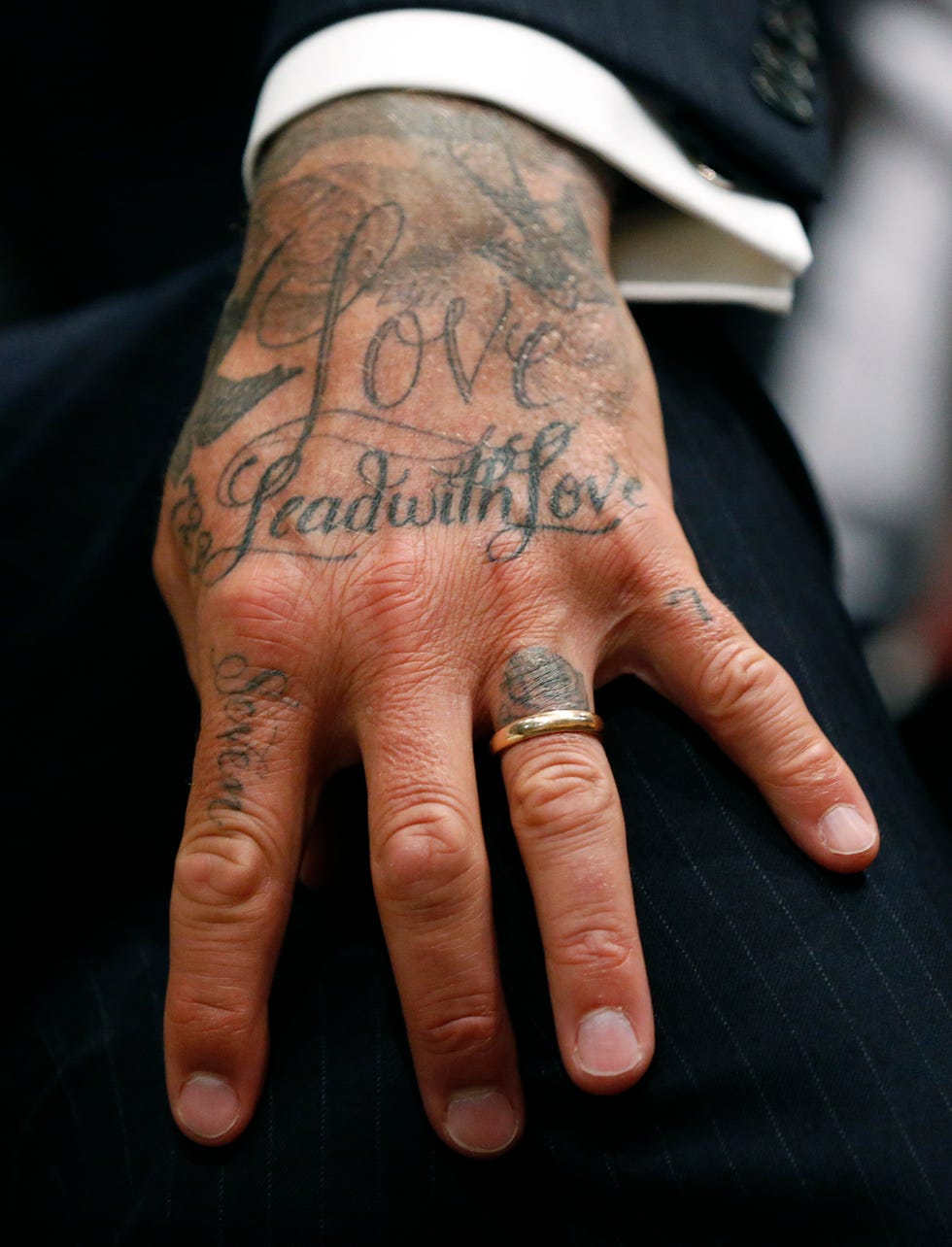
Close-up of David Beckham’s hand lettering and finger tattoos

Several hand tattoos use short phrases. One hand has “Love” across the top, flanked by a swallow on either side, with “Lead with Love” below. Another cluster includes Victoria’s name, a hummingbird, “Dream Big, Be Unrealistic,” and “My Love.” Beckham wore the number 32 at AC Milan; 723 combines the seven and 23 he wore during his football career.

His fingers carry the number seven, a rose and 99, which Beckham has connected to 1999, the year he married Victoria. Harper also drew a small stick figure on his palm. These small tattoos are easy to miss, though close photographs and Beckham’s comments explain several of them.

Hands are tricky to photograph clearly: fingers turn, palms close and lettering curves around the skin. The close-up above keeps the hand large enough to read, unlike a full-body shot where the marks are easy to miss.

His leg tattoos include angels, a lion and a recent prayer design

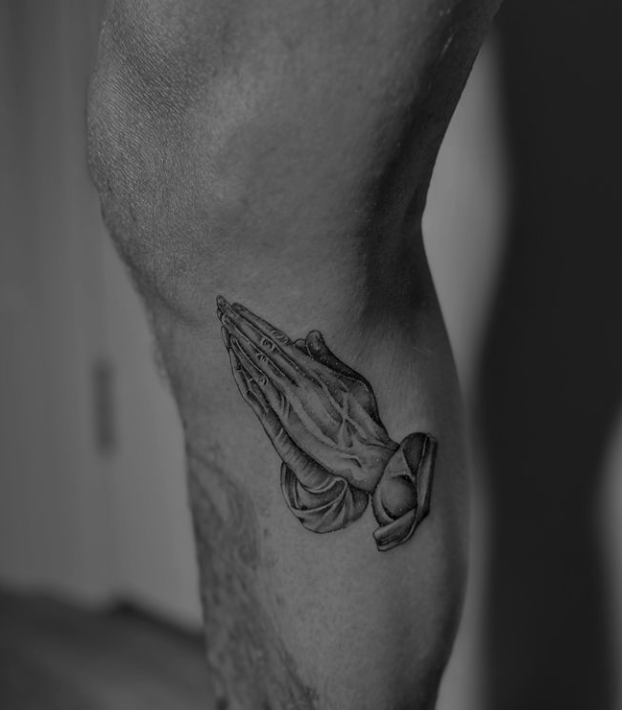
David Beckham’s black-and-gray praying hands tattoo below the knee

Beckham’s legs are less visible in everyday photos. Inventories identify two running cherubs on his right ankle or lower leg, a lion’s face on his left thigh and a bird on his left calf. In 2024, he showed a new black-and-gray tattoo of hands clasped in prayer just below the knee on the side of his leg. The image above shows the new design, not the older ankle and thigh pieces.

The 2024 report credited London tattoo artist Certified Letter Boy with the design. Beckham shared it in Instagram Stories but didn’t explain what it means to him.

Trousers cover most of Beckham’s legs, so the older tattoos appear less often in interviews and event photos. Inventories list their locations and designs, but they’re harder to compare with the frequently photographed tattoos on his back, hands and neck.

Beckham has said he gets tattoos when inspiration strikes and has singled out his children’s names as favourites. He has explained some designs; published accounts leave the rest unexplained.

More athlete tattoo guides

Chris Farley Lives On in These Fan Tattoo Tributes

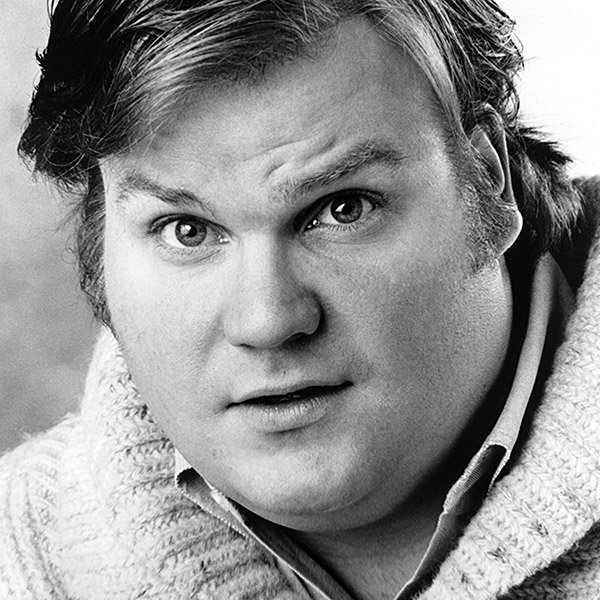
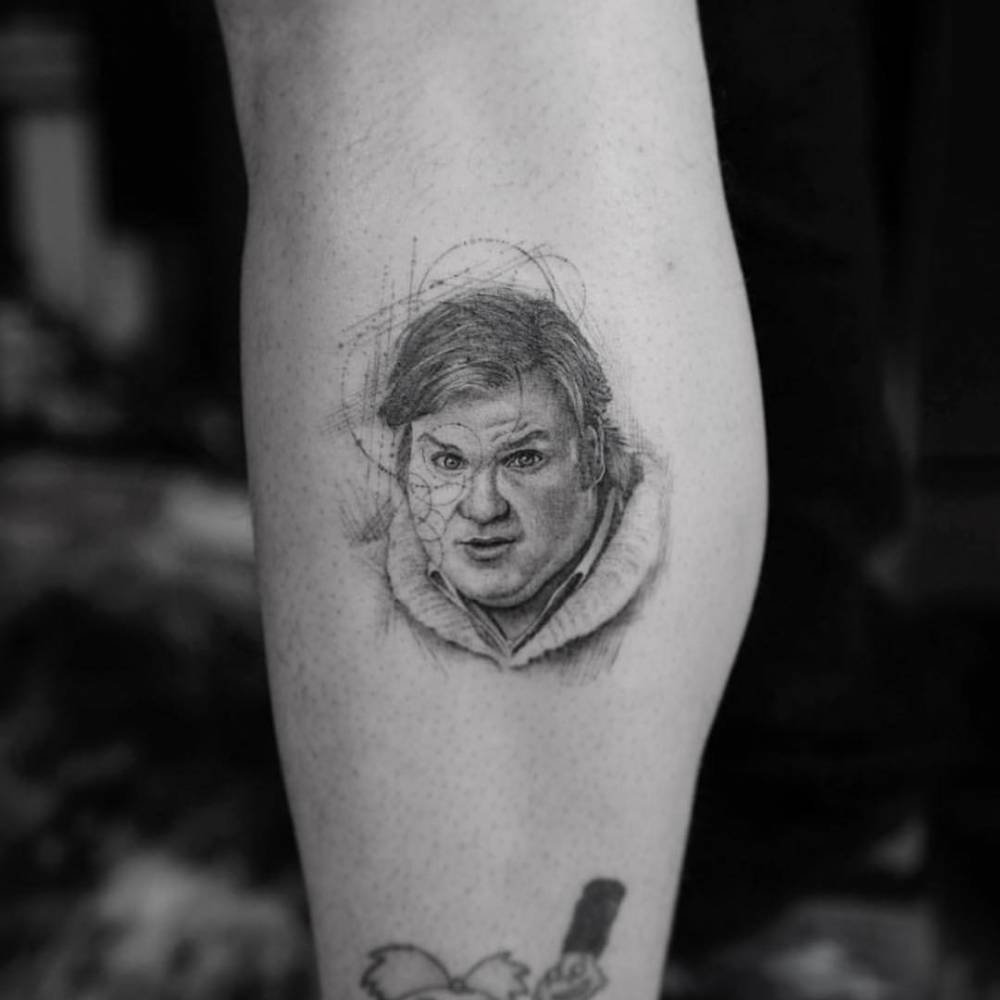
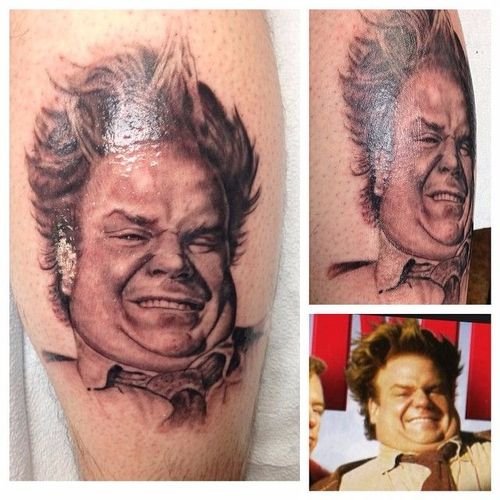
Chris Farley died in 1997, but fans still get tattoos of his portraits, characters and familiar lines. The designs celebrate his work; they aren’t tattoos Farley was known to wear himself. Many draw on the physical comedy and warmth that made even a short scene memorable.

Examples in tattoo galleries and memorial features tend to fall into three groups. Some fans choose realistic portraits of Farley in black and grey or colour. Others choose characters such as Tommy Callahan from Tommy Boy or Todd O’Connor from Saturday Night Live. Still others use comic lettering, props or a scene that points to a film without spelling out Farley’s name. The styles vary, but each points back to the same performer.

Realistic portraits keep Chris Farley’s face at the centre

Realistic Chris Farley portrait tattoo on a fan's calf

Portrait tattoos of Chris Farley are the most direct tributes in these examples. Tattoo Filter features a fine black-and-grey micro-realism portrait credited to Dr. Woo; the Mike DeVries gallery shows another realistic fan portrait. The likeness rests on the details: his eyes, cheeks and open grin. If those don’t read clearly, the tattoo could be a generic face.

Size makes a difference. A calf or forearm gives the artist room to shape the jaw, hair and expression; a small design has to simplify them. The Tattoo Filter portrait keeps the face in focus without much competing detail around it. Fans who know Farley’s screen presence may recognise him from the expression alone.

The source pages identify Farley and sometimes the artist or gallery, but rarely say why a particular person chose the portrait. The tattoo shows admiration for Farley and his performances. Without more from the wearer, there’s no reason to tie every portrait to grief, a particular film or a private event.

Tommy Boy turns a favourite character into a calf tattoo

Chris Farley as Tommy Callahan from Tommy Boy in a fan tattoo

Tommy Callahan gives fans another way to remember Farley. Tattoodo’s gallery includes a black-and-grey tattoo of him as the central character in Tommy Boy, credited to Jay Cunliffe. It points to a role rather than a generic celebrity portrait; the film’s scenes, wardrobe and comic personality make the reference clear.

A character piece asks for more than a likeness. Clothing, posture and props help identify the role, while the expression carries Tommy’s frantic optimism. A calf gives a vertical figure room; on a wrist, the same design might have to lose detail to stay readable.

Tommy Callahan has a recognizable stance and a particular kind of panic. A fan might choose him as shorthand for the whole film, or for a scene where Farley loses control and wins the audience back.

Tattoodo identifies this as a Tommy Boy tribute by Jay Cunliffe. It doesn’t give the fan’s reason for choosing it, so that part is best left open.

Comic lettering and scenes preserve Farley’s loudest jokes

Colourful Chris Farley Vote for Donnelly fan tattoo

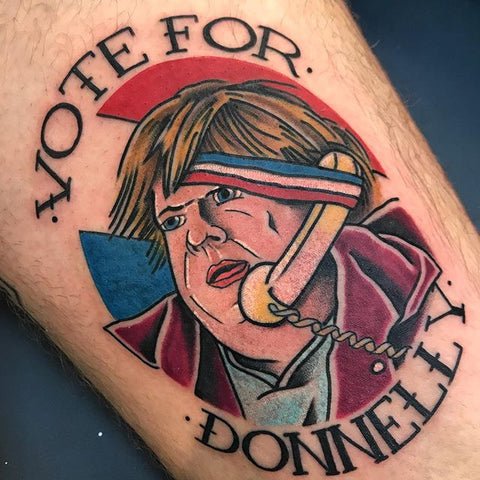
Some fans tattoo the joke instead of Farley’s likeness. Ultimate Tattoo Supply’s memorial feature shows colourful designs and familiar comic references, including a Vote for Donnelly parody tied to his political sketches. Inked Magazine’s roundup includes several more, with Farley alongside fellow performers, graffiti-style lettering and scenes built around a line or character.

A line of dialogue can bring back a sketch’s rhythm; a costume or prop can point straight to a film. Colour can keep the tattoo as playful as the performance. These are still memorials: they remember the comedy that made people laugh.

The sources name some words and subjects, but the photos don’t always reveal which scene the wearer had in mind. They show the tattoo itself, not necessarily the reason the fan chose it.

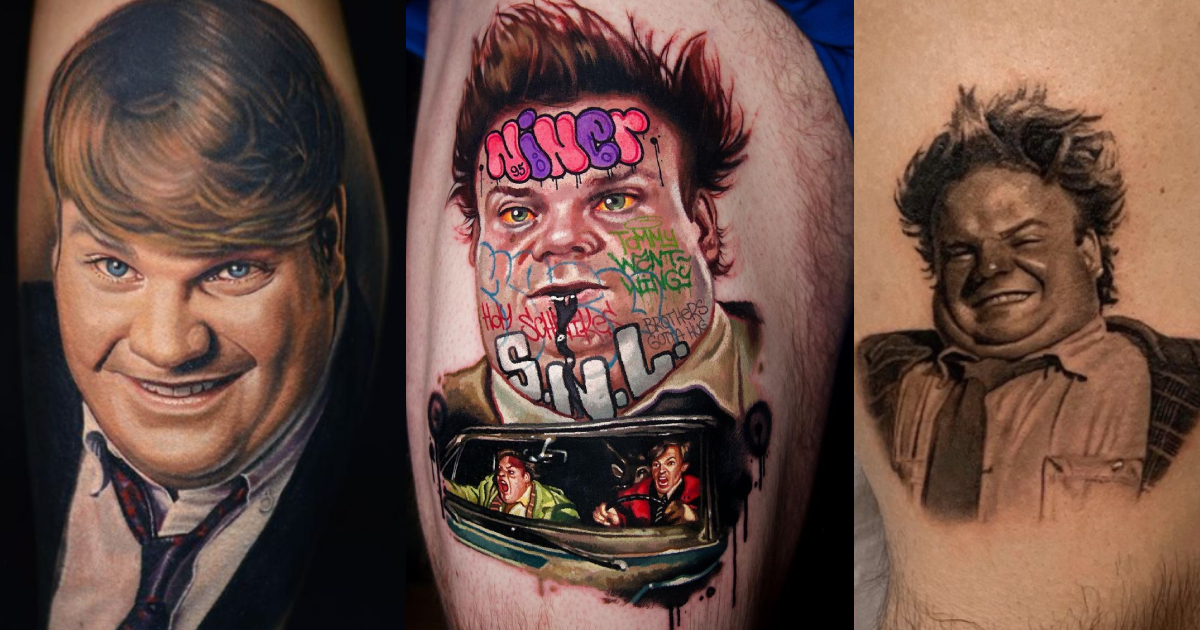
Some designs combine several references: Farley’s face with SNL lettering, a character beside a prop or a film line under a portrait. When one image holds the focus, the extra details can read as a memory board instead of clutter.

SNL characters make the tribute about performance as well as identity

Collage of Chris Farley fan tattoos featuring portraits and comedy characters

Some fans choose Farley as Todd O’Connor from the Bill Swerski’s Superfans sketches on Saturday Night Live. Tattoodo tags the tattoo with Farley and the Da Bears reference, tying it to one of his SNL characters.

A portrait depends on getting Farley’s face right; this piece also relies on the pose and costume that identify Todd O’Connor. The sketch’s exaggerated sports-fan world supplies the rest of the context.

The choice can reflect when a fan first got to know Farley. Someone who remembers the Superfans sketches may choose Todd; another might pick Tommy Boy, Billy Madison or Beverly Hills Ninja. Each design marks a different way into his work.

The public image shows the costume and pose; Tattoodo’s page confirms the Todd O’Connor reference. That makes it possible to describe the tattoo clearly without attaching a private meaning the fan hasn’t shared.

What Chris Farley fan tattoos have in common

The tributes share a recognizable detail—a smile, a character or a joke—that leads back to Farley’s work. A Tommy Boy or SNL tattoo can name the role; a phrase or prop can bring back a particular scene.

The galleries identify subjects, artists and characters, but rarely explain why someone commissioned a design. The fan tattoos are tributes to performances and jokes viewers want to remember, not a record of Farley’s own ink.

If you’re planning a tribute, choose the memory before the style. Use a clear reference photo for a portrait, a pose that reads as the character, or enough space for a quote and its scene. The result should point to a specific performance, line or expression that matters to you.

More actor tattoo guides

Kehlani Tattoos: Face Ink, Maori Design and What They Mean

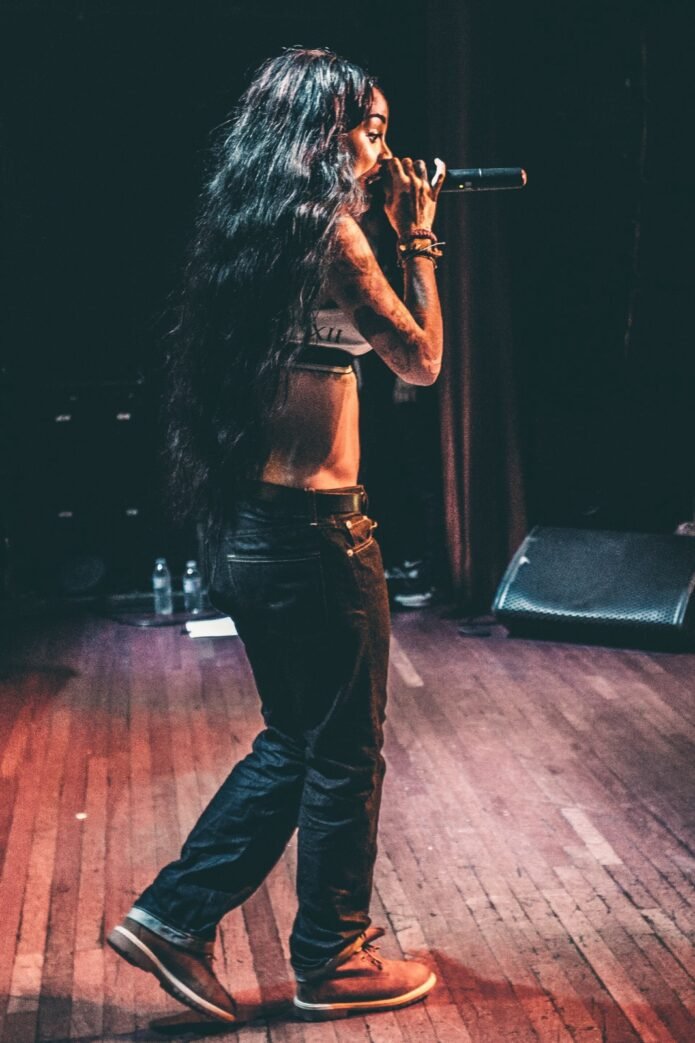
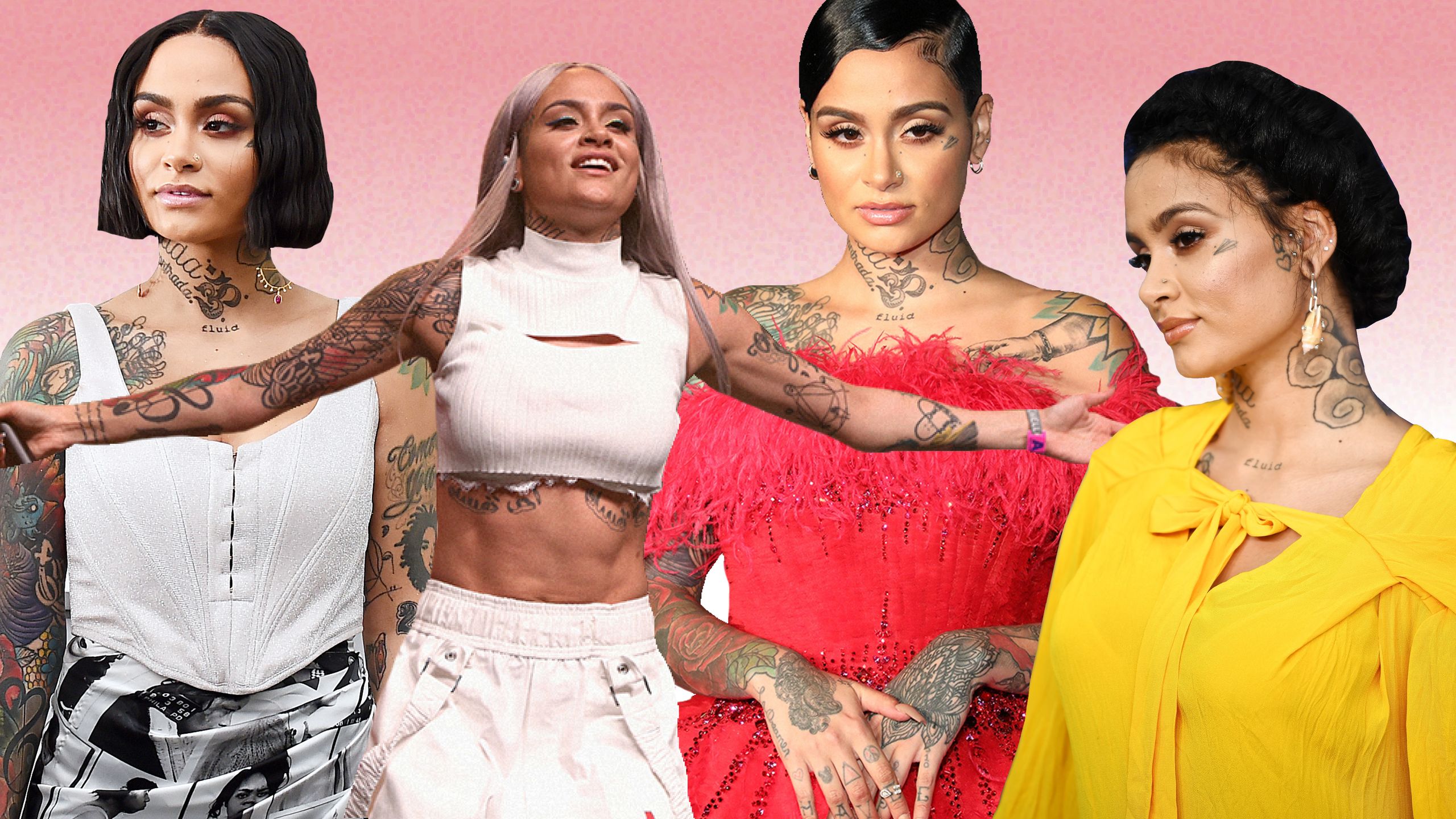
Kehlani’s tattoos span their face, neck, hands, arms, torso and legs, and the collection has changed over time. Teen Vogue mapped the designs by body area in 2020. More recently, Kehlani said they were considering removing some face tattoos, so older photos are only a snapshot.

Face tattoos

Kehlani face tattoos

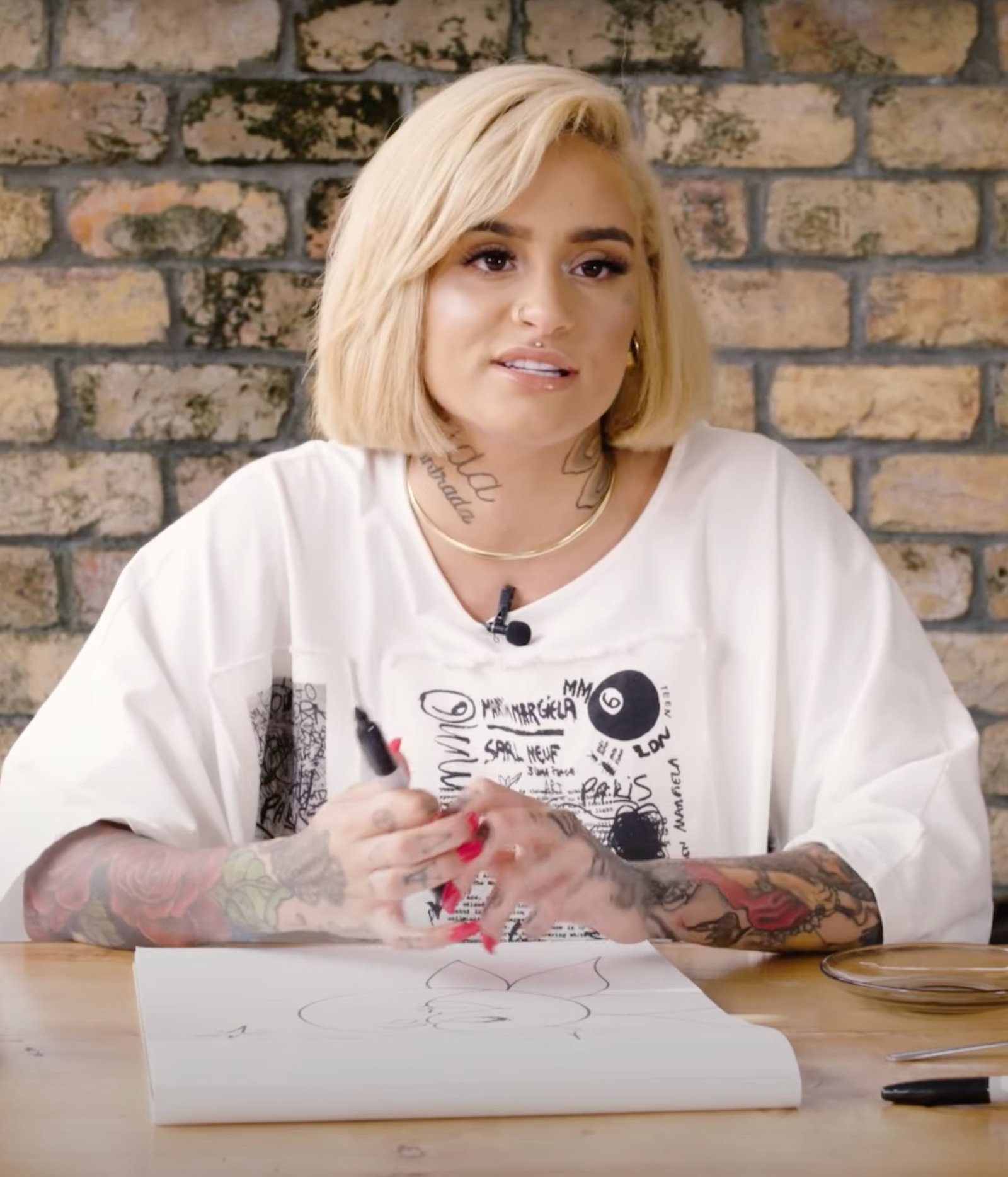
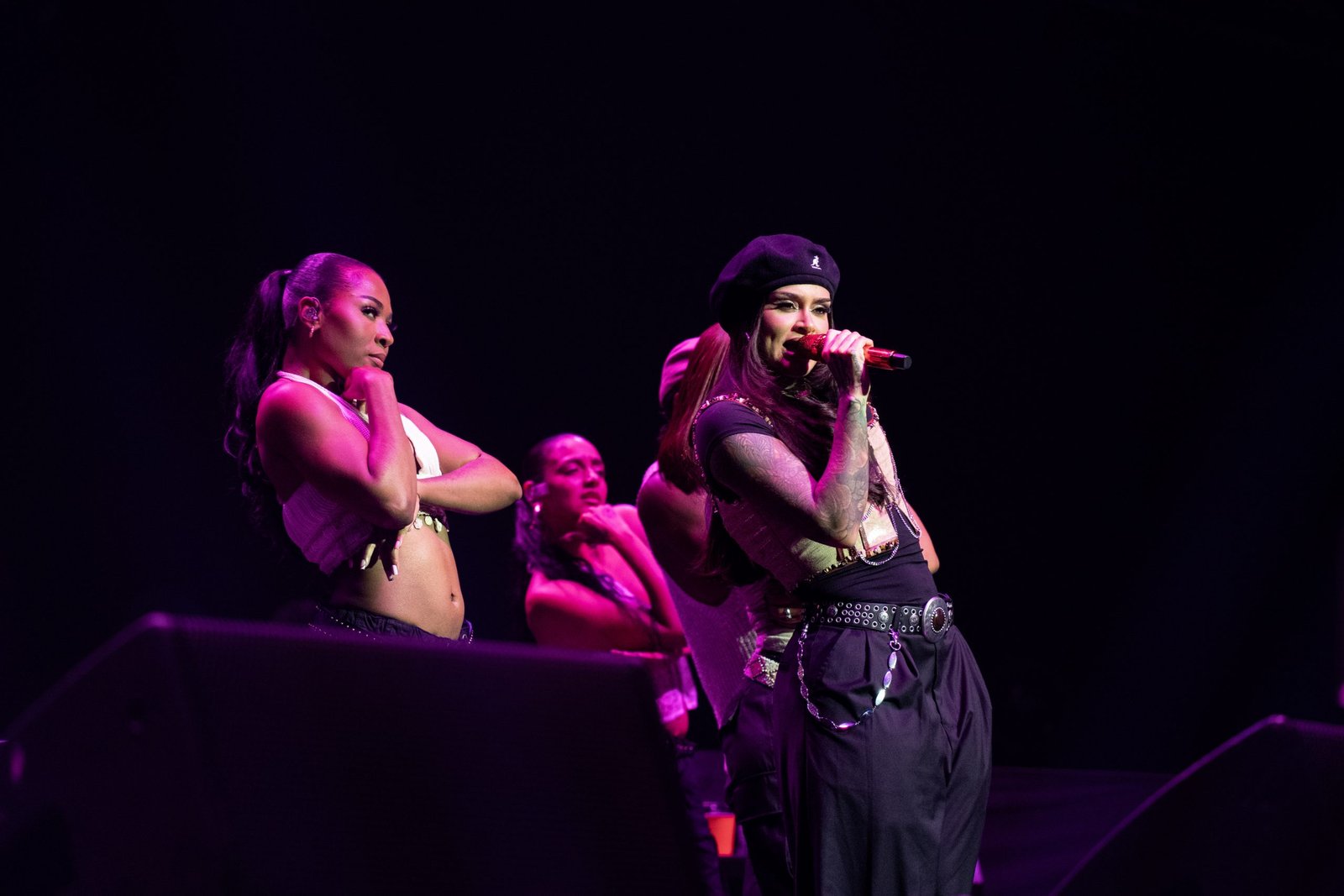
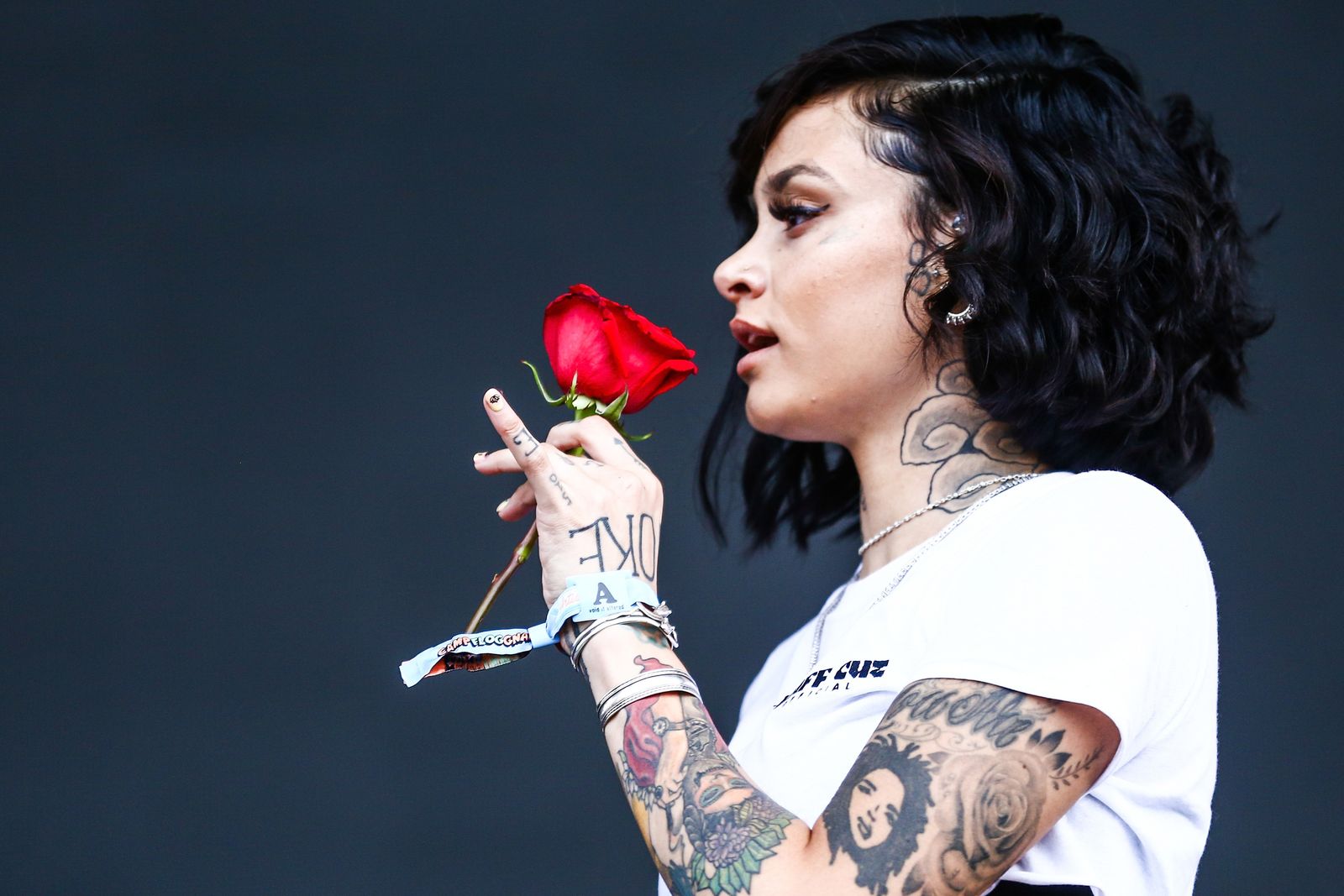
Kehlani has a queen-of-hearts symbol near the left temple, Espíritu Libre on the right, four dots beneath the eyes and a paper plane under the left eye. In a 2015 interview, they said the face tattoos hurt less than many people might expect, Teen Vogue reported.

In a 2026 interview with VICE, Kehlani said they were considering removing the face tattoos to feel fresher and have more freedom with their appearance. They also worried that face ink can leave a person looking locked into one style.

Perdida y encontrada on the neck

Kehlani showing her face tattoos

Kehlani got the phrase perdida y encontrada tattooed on their neck in 2016. Teen Vogue translated it as “lost and found.” Kehlani said it marked recovery after a major heartbreak and felt therapeutic, a reminder that getting lost didn’t mean they couldn’t find themselves again.

A Japanese-style cloud runs along the left side of Kehlani’s neck. Their throat bears a large Om symbol with the word fluid beneath it. Teen Vogue linked fluid to Kehlani’s discussion of sexual orientation. Hair and clothing can make these visible designs easier or harder to see in photos.

The WOKE hand tattoo and lotus cover-up

Kehlani tattoo detail showing hand and face ink

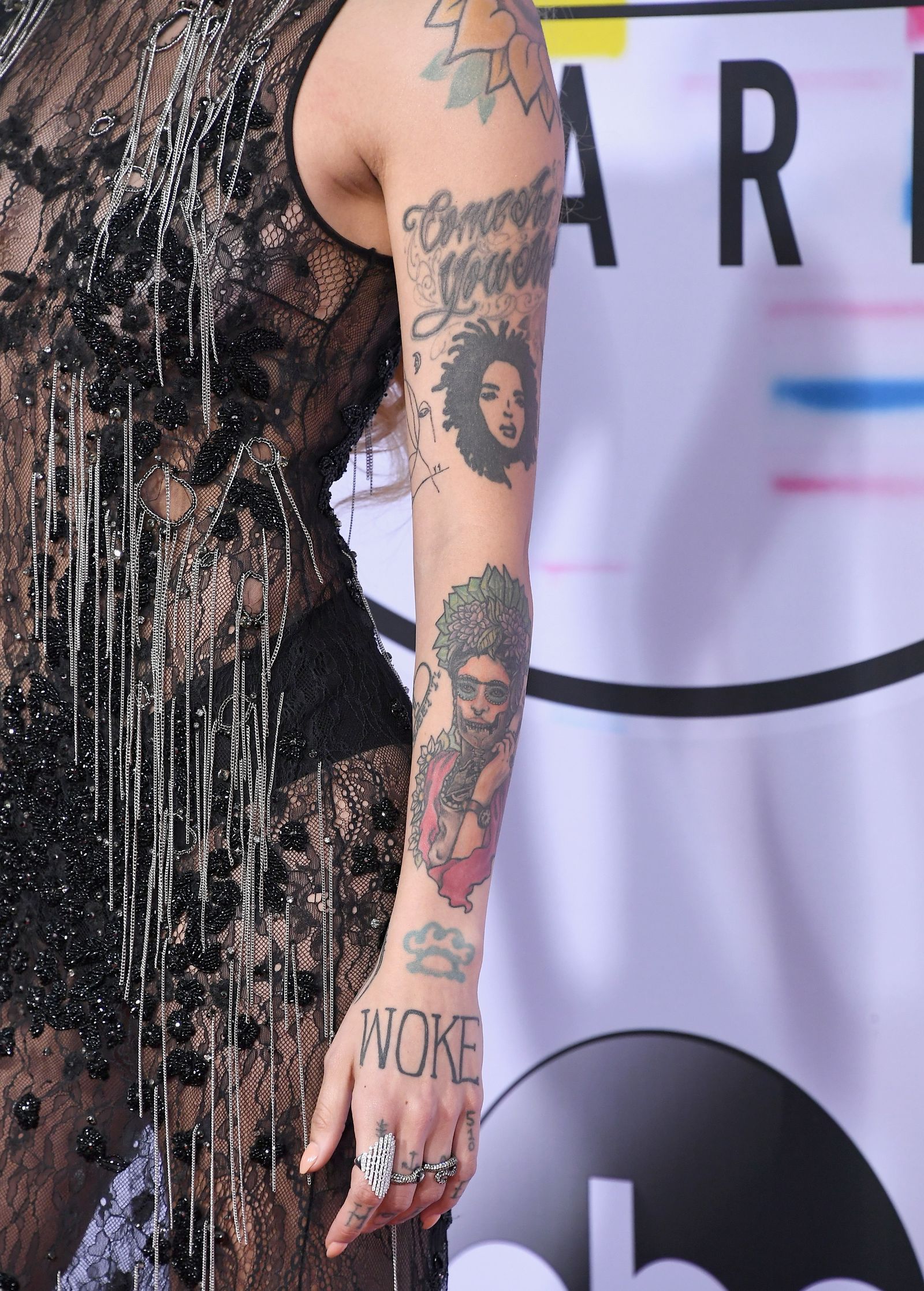
In 2018, Kehlani’s WOKE hand tattoo was covered by a double lotus, BET reported. They said they had once felt very sure of their own knowledge, but later felt the word had become too fixed a statement.

BET quoted Kehlani describing the lotus as a design that wrapped around and carried forward the idea behind WOKE. Teen Vogue credited the cover-up to Dillon Forte. The redesign changed the meaning of the tattoo as well as its appearance.

First hand tattoos and messages

Kehlani showing the hand lotus cover-up tattoo

Kehlani told The Fader that their first tattoo was HAVE HOPE across the knuckles, Teen Vogue reported. They got it for a best friend who was moving away and whom they called a sister. Their hands later gained small symbols, including an arrow, anchor, Venus sign and the number 510.

Other hand tattoos include a peace sign, triangle, Mickey Mouse, heart, paisley pattern and the phrase La Dreamer. Teen Vogue said it was a nickname for a girl Kehlani met while in foster care. That explains La Dreamer; it doesn’t explain every tattoo on their hands.

The Maori family tattoo

Kehlani tattooed arm showing the family-tattoo context

During a 2017 trip to Australia, Kehlani flew in a New Zealand artist to create a traditional Māori tattoo. Teen Vogue reported that it represents whānau, or family. Six koru stand for four siblings living on earth and two who had died; two mangopare, or hammerhead sharks, represent guidance and strength through adversity.

Kehlani’s account explains the family symbolism and the artist’s connection to the design. The tattoo’s Māori tradition is part of that context too.

Arm portraits and music influences

Kehlani showing the Maori tattoo

Kehlani’s left arm has a sunflower on the shoulder, a portrait of Lauryn Hill with Come As You Are, and a portrait of Frida Kahlo. They said Frida had influenced their personality, strength and art, Teen Vogue reported. The Lauryn Hill portrait uses the cover of The Miseducation of Lauryn Hill; Kehlani said it reminds them to stay focused and make a great album.

The right arm has a colourful sleeve of peacock feathers and roses. Los Angeles artist Miryam Lumpini later enlarged and brightened the sunflower, Teen Vogue reported. Kehlani hasn’t given a specific meaning for the sunflower or the sleeve’s filler designs, so those meanings remain open.

Torso and leg tattoos

Kehlani tattooed arm showing the family-tattoo context

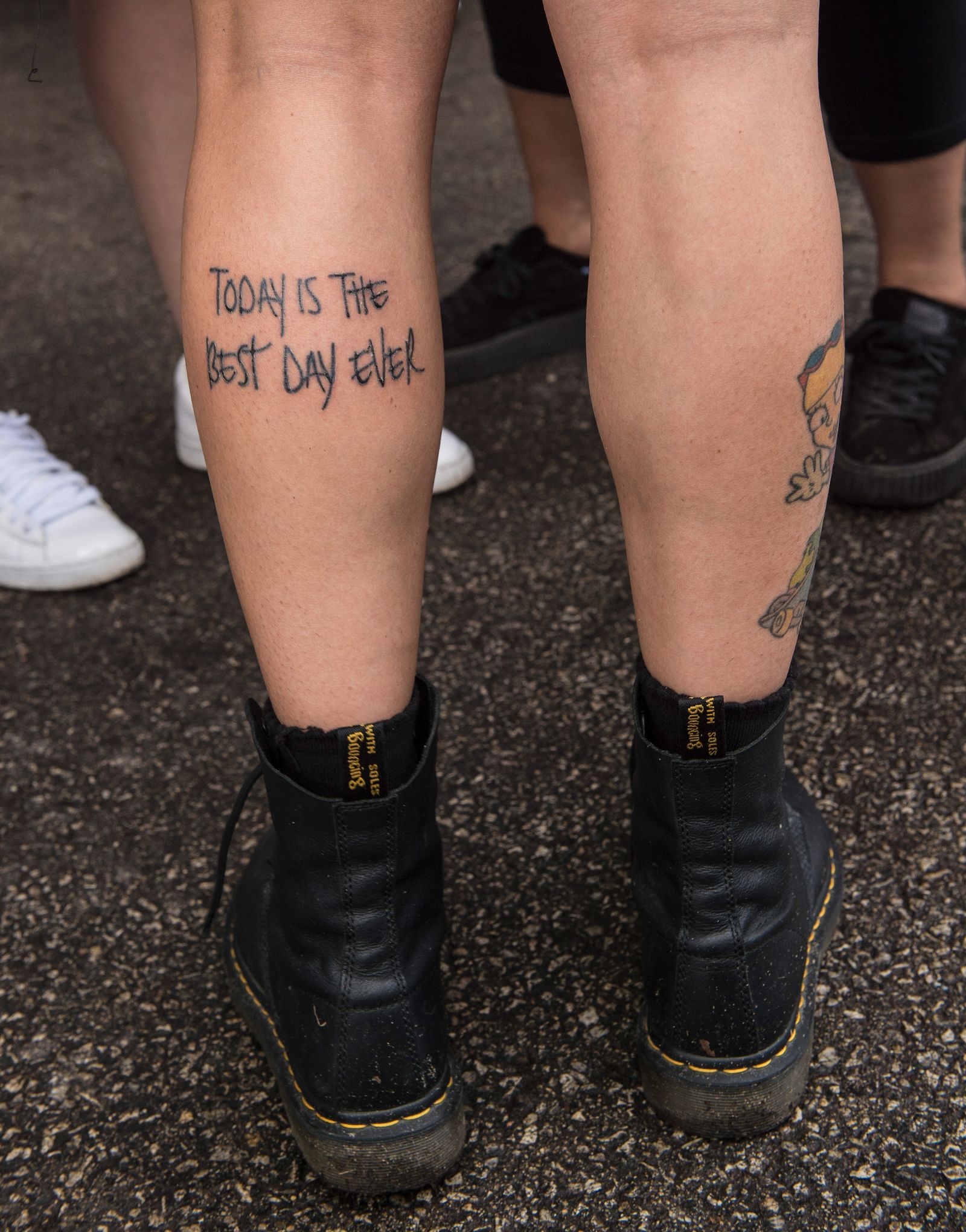
A large Tsunami tattoo spans Kehlani’s torso, a reference to the nickname Lani Tsunami. Other reported designs include marine animals and Arabic lettering translated as “forgive yourself.” Between the shoulder blades is a quote about surviving hardship. Teen Vogue also documented Today Is the Best Day Ever beside a portrait whose subject Kehlani hasn’t named.

Pop culture turns up on Kehlani’s legs too: Mia Wallace and Vincent Vega dancing in a Pulp Fiction scene, a longboard with a palm tree and waves, and Reggie Rocket from Rocket Power. Kehlani said Reggie reminded them of their tomboy childhood and helped them ignore other people’s judgments. Other reported designs include Betty Boop, an unidentified portrait, and a spider and rose pierced by a dagger.

How the collection has changed

Since Teen Vogue’s 2020 gallery, Kehlani has covered WOKE and discussed removing the face tattoos; other pieces have also been expanded or reworked. The gallery is a snapshot, so a tattoo shown there may not look the same now.

Kehlani’s collection includes phrases, portraits of artists, family symbols, pop-culture characters, Māori work and tattoos tied to personal changes. They have explained some designs. The photos show what others look like, but don’t establish what each one means.

Frequently asked questions

What happened to Kehlani’s WOKE tattoo?

Kehlani showing arm portrait tattoos

In 2018, Kehlani covered the WOKE hand tattoo with a double lotus. They said their view of the word had changed and described how the lotus carried its idea forward. Teen Vogue identified Dillon Forte as the cover-up artist.

What does Kehlani’s Maori tattoo mean?

Kehlani said the Māori design represents whānau, or family. Its koru refer to siblings and the mangopare to guidance and strength.

What does perdida y encontrada mean?

Perdida y encontrada means “lost and found” in Spanish. Kehlani described the neck tattoo as a therapeutic reminder after heartbreak.

Are Kehlani’s face tattoos being removed?

VICE reported in 2026 that Kehlani was considering removing the face tattoos to feel softer and have more freedom with their appearance.

Kehlani’s tattoos reflect friends, family, music and culture, with many tied to personal growth. The face and hands show the most visible shifts: WOKE became a lotus, and Kehlani has discussed removing face ink. They’ve explained other pieces too, including the neck phrase, Māori family tattoo and portraits. The remaining photos show what the designs look like, but not what each one means to them.

More musician tattoo guides