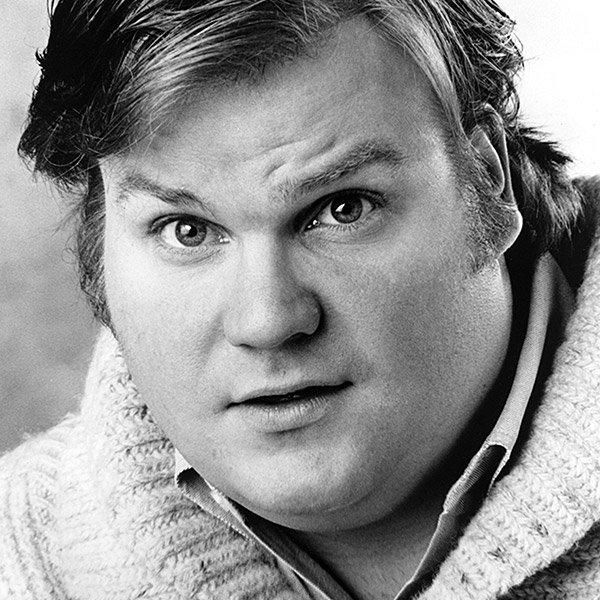
Chris Farley died in 1997, but fans still get tattoos of his portraits, characters and familiar lines. The designs celebrate his work; they aren’t tattoos Farley was known to wear himself. Many draw on the physical comedy and warmth that made even a short scene memorable.
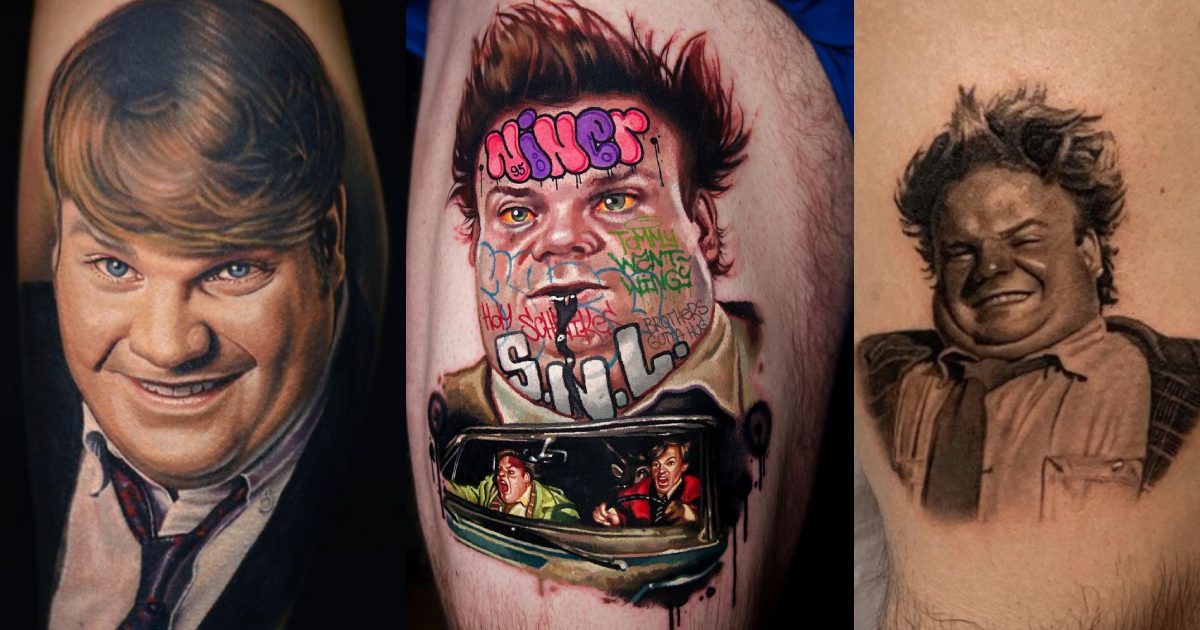
Examples in tattoo galleries and memorial features tend to fall into three groups. Some fans choose realistic portraits of Farley in black and grey or colour. Others choose characters such as Tommy Callahan from Tommy Boy or Todd O’Connor from Saturday Night Live. Still others use comic lettering, props or a scene that points to a film without spelling out Farley’s name. The styles vary, but each points back to the same performer.
Realistic portraits keep Chris Farley’s face at the centre
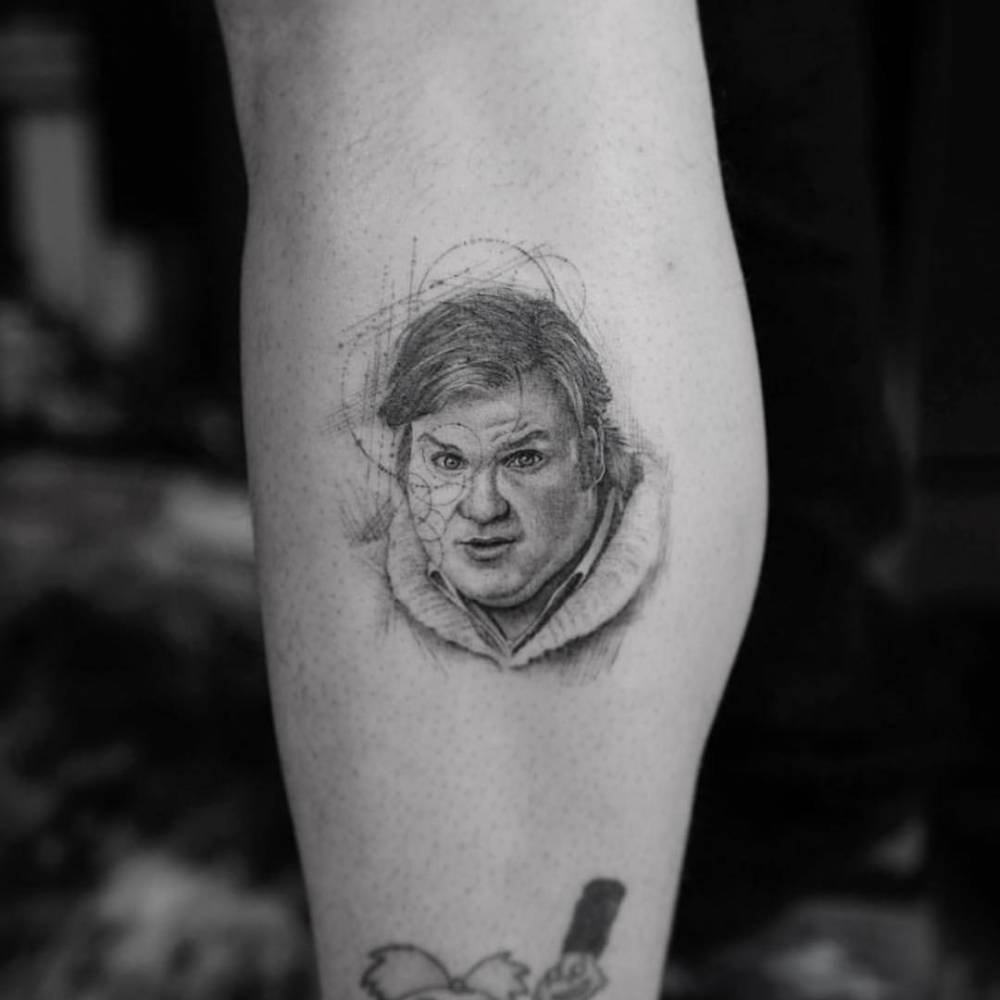
Portrait tattoos of Chris Farley are the most direct tributes in these examples. Tattoo Filter features a fine black-and-grey micro-realism portrait credited to Dr. Woo; the Mike DeVries gallery shows another realistic fan portrait. The likeness rests on the details: his eyes, cheeks and open grin. If those don’t read clearly, the tattoo could be a generic face.
Size makes a difference. A calf or forearm gives the artist room to shape the jaw, hair and expression; a small design has to simplify them. The Tattoo Filter portrait keeps the face in focus without much competing detail around it. Fans who know Farley’s screen presence may recognise him from the expression alone.
The source pages identify Farley and sometimes the artist or gallery, but rarely say why a particular person chose the portrait. The tattoo shows admiration for Farley and his performances. Without more from the wearer, there’s no reason to tie every portrait to grief, a particular film or a private event.
Tommy Boy turns a favourite character into a calf tattoo
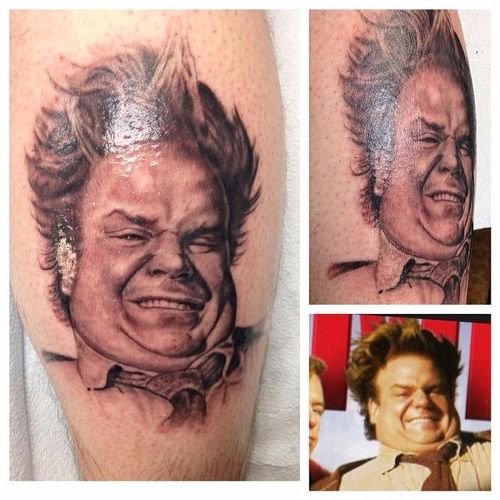
Tommy Callahan gives fans another way to remember Farley. Tattoodo’s gallery includes a black-and-grey tattoo of him as the central character in Tommy Boy, credited to Jay Cunliffe. It points to a role rather than a generic celebrity portrait; the film’s scenes, wardrobe and comic personality make the reference clear.
A character piece asks for more than a likeness. Clothing, posture and props help identify the role, while the expression carries Tommy’s frantic optimism. A calf gives a vertical figure room; on a wrist, the same design might have to lose detail to stay readable.
Tommy Callahan has a recognizable stance and a particular kind of panic. A fan might choose him as shorthand for the whole film, or for a scene where Farley loses control and wins the audience back.
Tattoodo identifies this as a Tommy Boy tribute by Jay Cunliffe. It doesn’t give the fan’s reason for choosing it, so that part is best left open.
Comic lettering and scenes preserve Farley’s loudest jokes
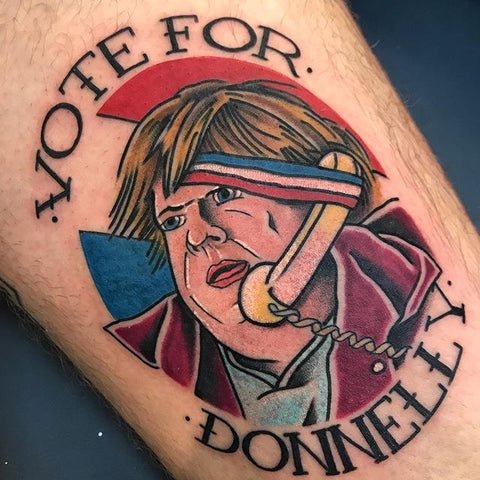
Some fans tattoo the joke instead of Farley’s likeness. Ultimate Tattoo Supply’s memorial feature shows colourful designs and familiar comic references, including a Vote for Donnelly parody tied to his political sketches. Inked Magazine’s roundup includes several more, with Farley alongside fellow performers, graffiti-style lettering and scenes built around a line or character.
A line of dialogue can bring back a sketch’s rhythm; a costume or prop can point straight to a film. Colour can keep the tattoo as playful as the performance. These are still memorials: they remember the comedy that made people laugh.
The sources name some words and subjects, but the photos don’t always reveal which scene the wearer had in mind. They show the tattoo itself, not necessarily the reason the fan chose it.
Some designs combine several references: Farley’s face with SNL lettering, a character beside a prop or a film line under a portrait. When one image holds the focus, the extra details can read as a memory board instead of clutter.
SNL characters make the tribute about performance as well as identity
Some fans choose Farley as Todd O’Connor from the Bill Swerski’s Superfans sketches on Saturday Night Live. Tattoodo tags the tattoo with Farley and the Da Bears reference, tying it to one of his SNL characters.
A portrait depends on getting Farley’s face right; this piece also relies on the pose and costume that identify Todd O’Connor. The sketch’s exaggerated sports-fan world supplies the rest of the context.
The choice can reflect when a fan first got to know Farley. Someone who remembers the Superfans sketches may choose Todd; another might pick Tommy Boy, Billy Madison or Beverly Hills Ninja. Each design marks a different way into his work.
The public image shows the costume and pose; Tattoodo’s page confirms the Todd O’Connor reference. That makes it possible to describe the tattoo clearly without attaching a private meaning the fan hasn’t shared.
What Chris Farley fan tattoos have in common
The tributes share a recognizable detail—a smile, a character or a joke—that leads back to Farley’s work. A Tommy Boy or SNL tattoo can name the role; a phrase or prop can bring back a particular scene.
The galleries identify subjects, artists and characters, but rarely explain why someone commissioned a design. The fan tattoos are tributes to performances and jokes viewers want to remember, not a record of Farley’s own ink.
If you’re planning a tribute, choose the memory before the style. Use a clear reference photo for a portrait, a pose that reads as the character, or enough space for a quote and its scene. The result should point to a specific performance, line or expression that matters to you.
10 thoughts on “Chris Farley Lives On in These Fan Tattoo Tributes”