Musicians

Tattoo guides for singers, rappers, DJs and musicians, with photographs, documented meanings and the stories behind their designs.

Lemmy Kilmister Tattoos: Ace of Spades and Arm Ink

Lemmy Kilmister never seemed interested in a polished look. His tattoos fit the huge hat, mutton chops, black clothes and Motörhead attitude. The Ace of Spades is the piece most people remember, but the writing and other forearm designs show up too.

Lemmy spent most of his career in a shirt, vest or jacket, so his lower arm is often the easiest place to see his tattoos. The same few designs appear from different angles and under different lights. This article sticks to clear details instead of treating every dark patch in a concert photo as a separate tattoo.

The Ace of Spades tattoo is the one everyone remembers

The best-known tattoo in Lemmy’s collection is the Ace of Spades on his forearm. It’s a fitting choice for the Motörhead frontman behind the song that became the band’s calling card. The card and spade are easy to pick out in close photos, even when a microphone, bass or jacket sleeve partly blocks his arm.

The design is large enough to read onstage. In some photos, the surrounding ink looks dark; in others, lighter skin makes the outline sharper. Either way, the Ace is the part fans recognize first.
Lemmy Kilmister Ace of Spades arm tattoo

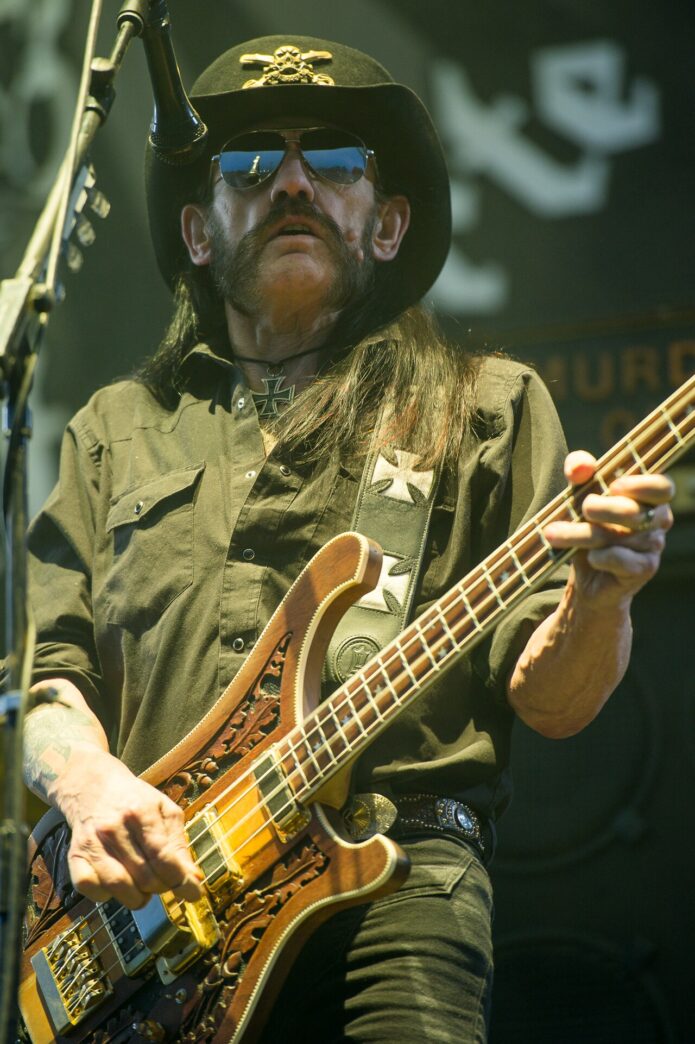
This stage photo shows the tattoo in context. Lemmy is playing bass and moving under bright lights, not posing for a tattoo portrait. The Ace of Spades is still clear on his arm.

“Born to Lose, Live to Win” is tied to the same rock-and-roll story

Photos and tattoo articles often identify Born to Lose, Live to Win among Lemmy’s arm tattoos. The words have the same rough, defiant tone found in his songs and interviews.

The lettering is easier to read up close than in a wide concert shot, where it can blend into the forearm’s shadows. A closer photo shows the old-school letter shapes and spacing. It’s safer to describe those visible words than to guess at every small mark around them.
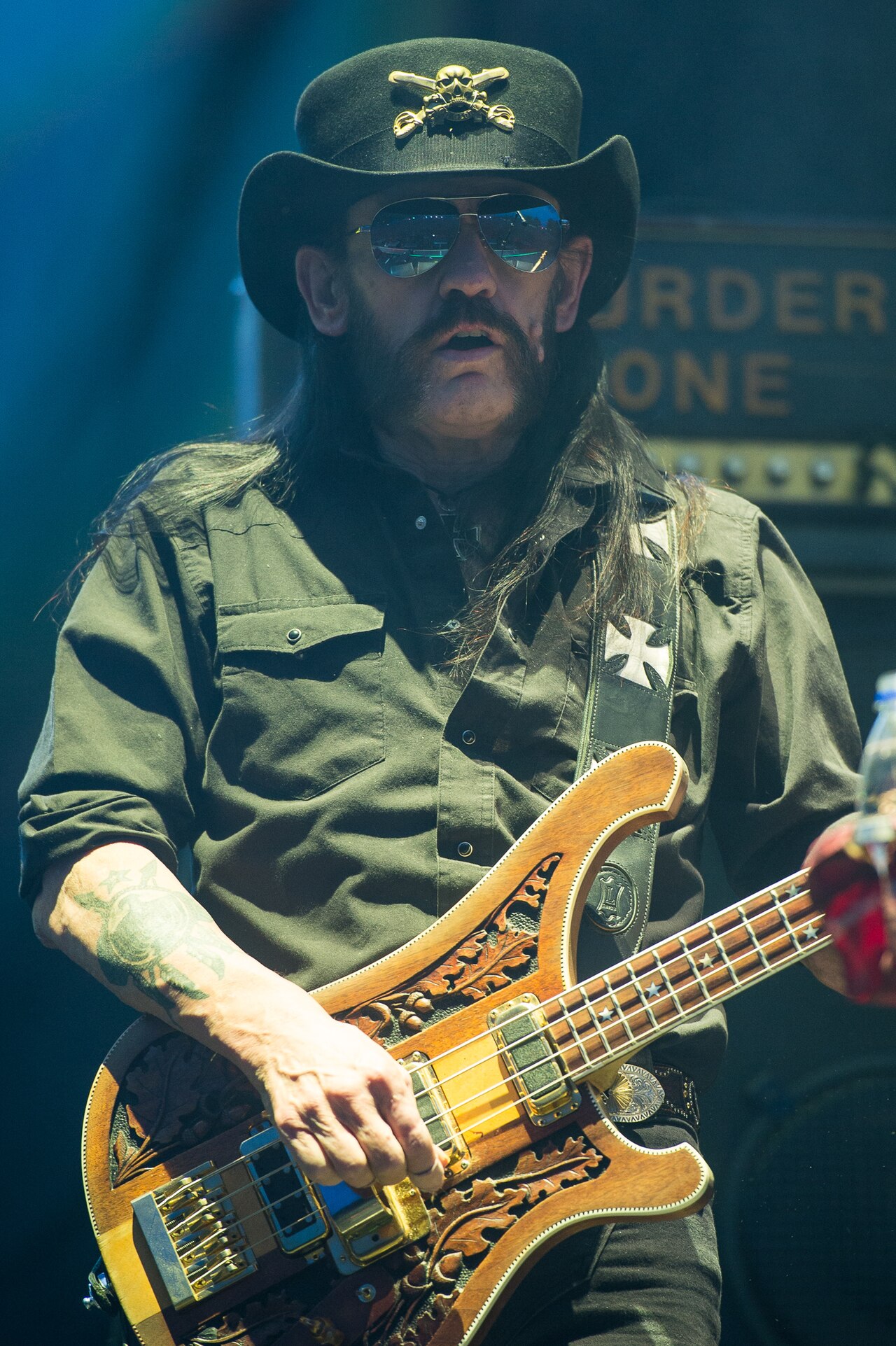
Lemmy Kilmister forearm ink closeup

In this close-up, the arm is lit from the front and the lines are sharp enough to follow. The tattoo has the heavy look of classic biker and rock ink, rather than a fine-line style.

His forearm tattoos were made to show up onstage

Lemmy’s forearms often stayed visible even when he wore a black shirt, so they show up in performance photos around his instrument. That strip of skin is where viewers can usually spot his tattoos during a Motörhead set.

As Lemmy reached for the strings or lifted a hand, his forearm caught the light. The tattoo could look pale and greenish in one photo, then much darker in another. Stage lights, flash and the age of the image can change its appearance without the ink itself changing.
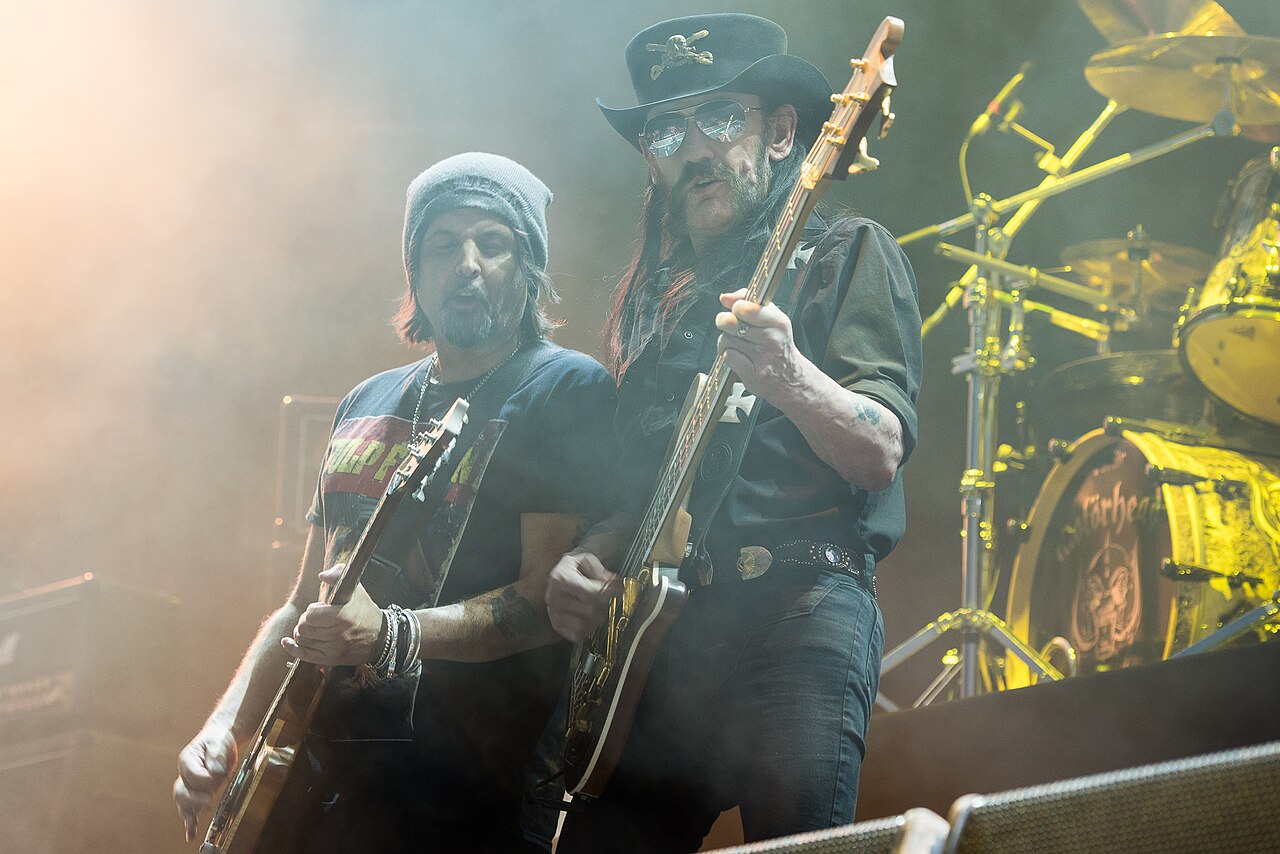
Lemmy Kilmister forearm tattoo live

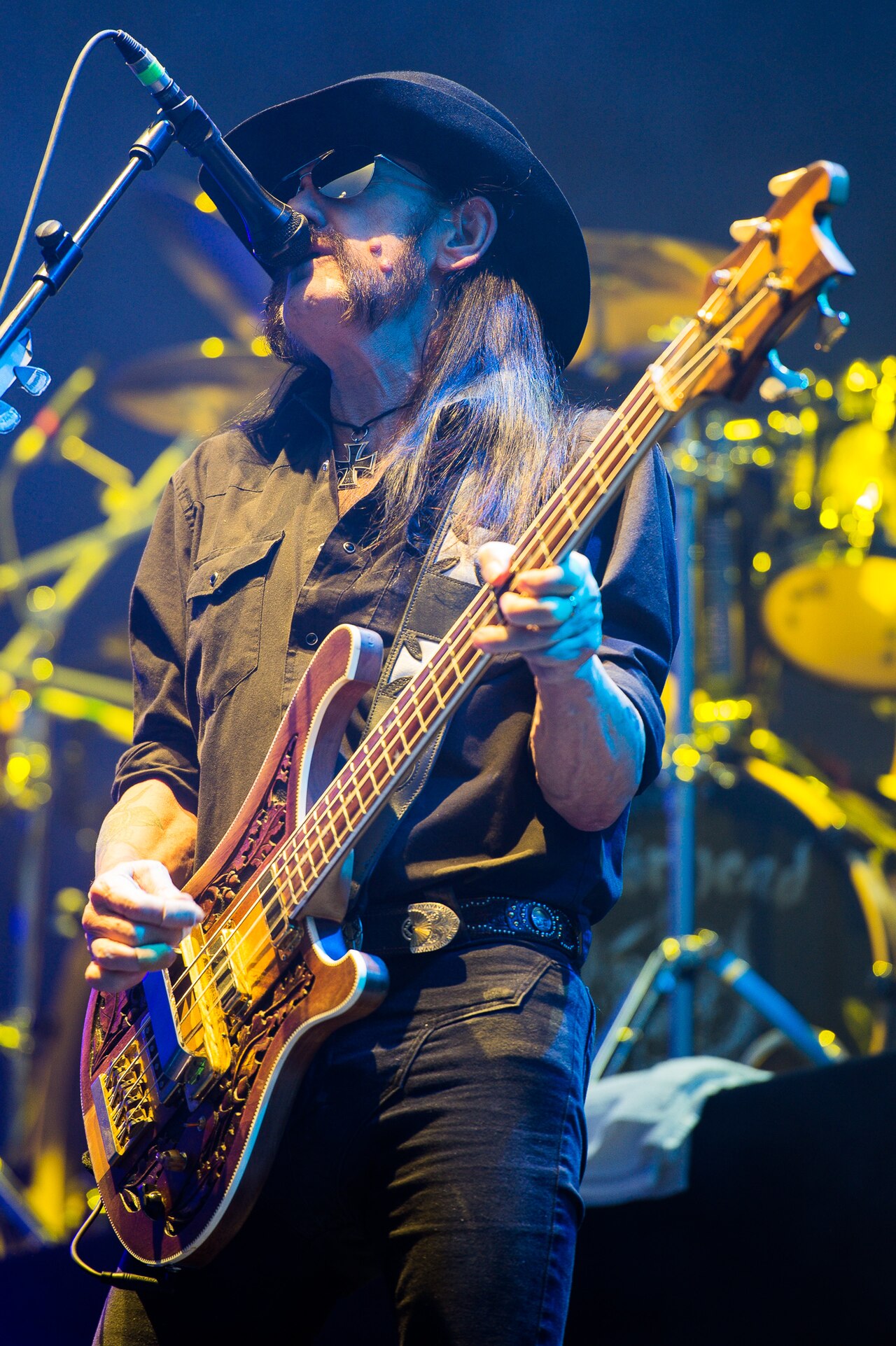
This live photo shows the tattooed arm while Lemmy is playing. It isn’t a close-up, but the darker work is still visible. The ink appears alongside his hat, bass and stage clothes, as it did in many performance shots.

The same ink can look much darker under concert lights

Old concert photos can distort tattoo details. Red and yellow lights turn skin orange, while shadows hide lighter parts of a design. Flash can make every line look harsh, so one image may not be enough to tell what’s on Lemmy’s arm.

Clearer photos separate the main lettering from smaller background marks. The Ace of Spades keeps its shape even in poor light; tiny details are harder to identify. Some may be tattoo lines, but they can also disappear into a cuff or the grain of an old photograph.
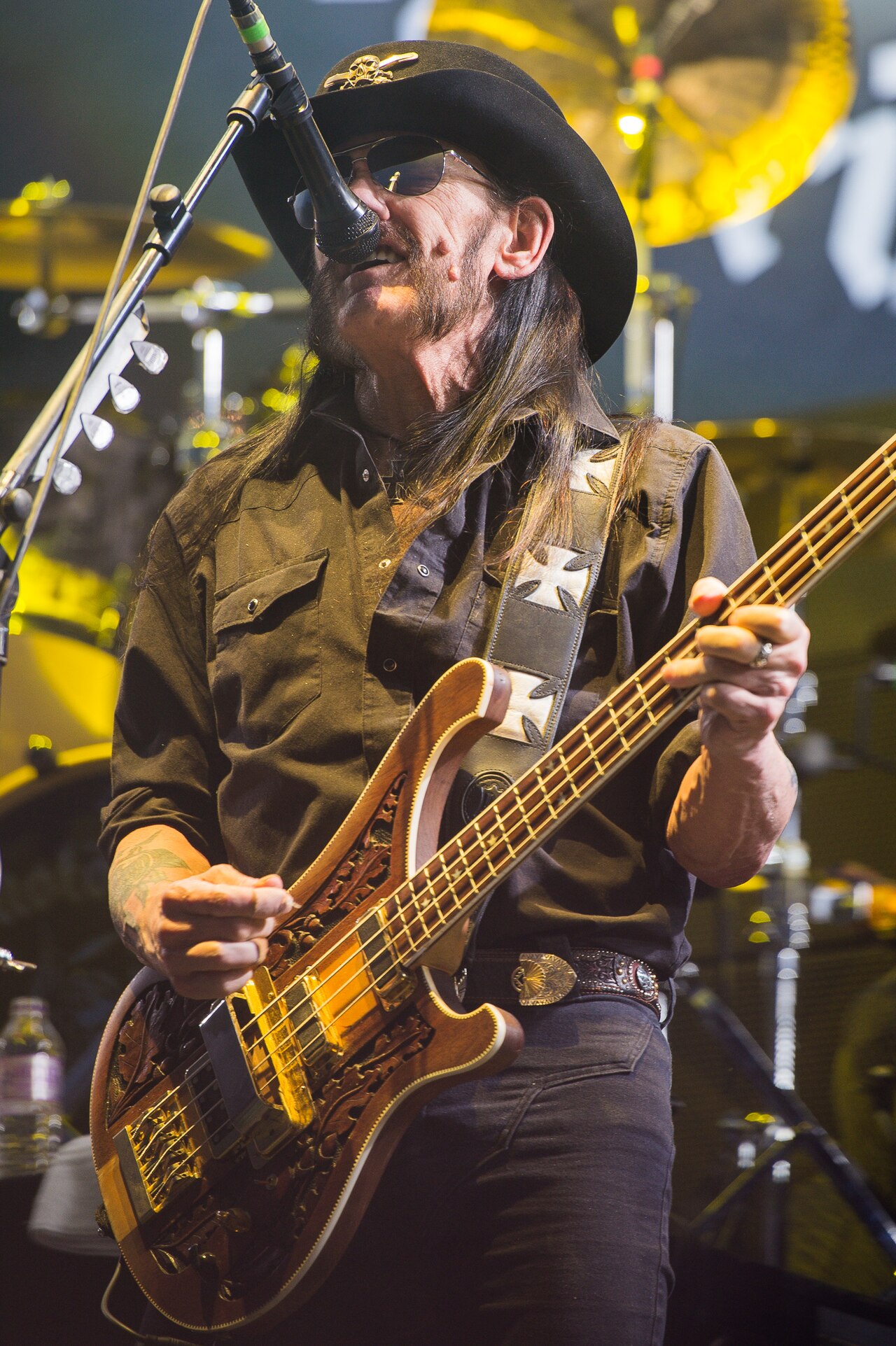
Lemmy Kilmister forearm tattoo onstage

In a wider stage frame, the tattoo looks smaller because the whole performance is in view. The forearm is still the place to look, but a design that reads clearly up close can be hard to make out from a distance.

There was more arm ink than just the famous ace

The Ace of Spades gets the most attention, but photos show other shapes and lettering around it. Some details are clearer than others, and the edges can be hard to separate when Lemmy bends his arm or a sleeve covers part of it.

The forearm has a worn-in look, with shading and older lines beside other marks. The photos suggest the designs were added over time, rather than planned as one matching sleeve. That gives the arm a more personal feel than a uniform flash sheet.
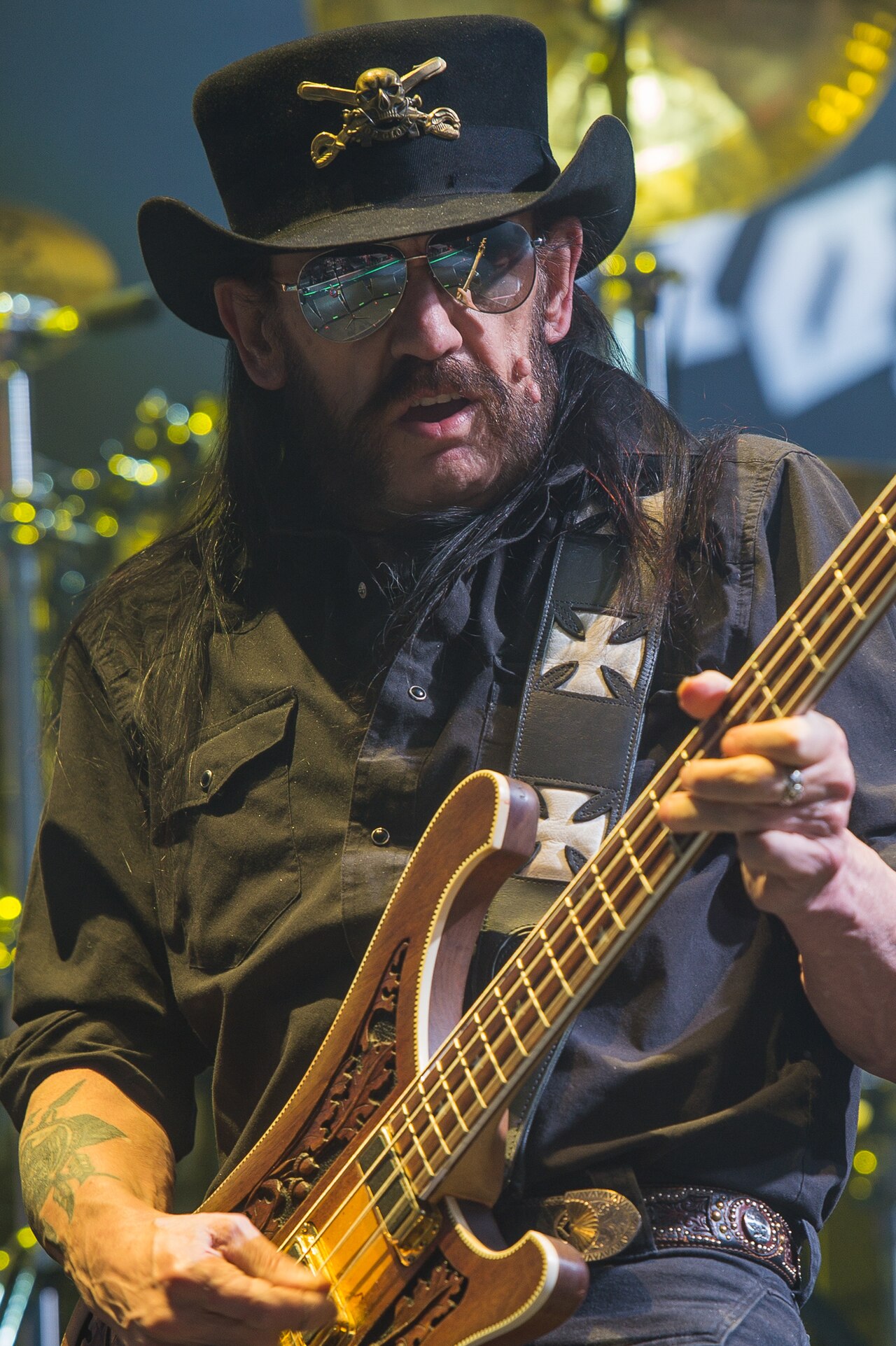
Lemmy Kilmister arm tattoo closeup

The close-up shows how the different marks sit together. The larger pieces are readable, but there’s no confirmed meaning for every small line. It’s better to describe what can be seen than to give each mark a story.

What is actually confirmed about Lemmy’s tattoos?

The clearest facts are the visible ones: Lemmy had the Ace of Spades on his arm, the “Born to Lose, Live to Win” wording is widely reported, and his forearm tattoos appear in years of concert and backstage photos. His ink is closely tied to Motörhead’s image, but that doesn’t give every symbol a public meaning.

Photos also show a cross necklace, guitar strap or shirt fold across his chest. Those aren’t tattoos, though a dark image can make them look like ink. Shadows around his beard and sleeves can be misleading too. Clear arm photos are the best evidence for his tattoos.

The Ghostemane tattoo gallery offers a contrast: his face and neck are covered in ink, while Lemmy’s arm is known for the Ace of Spades and the lettering around it.

A quick video look at Lemmy and Kat Von D

Lemmy appeared in a short L.A. Ink clip while Kat Von D worked on him. The video shows the tattooing process up close, a different view from a still concert photo.

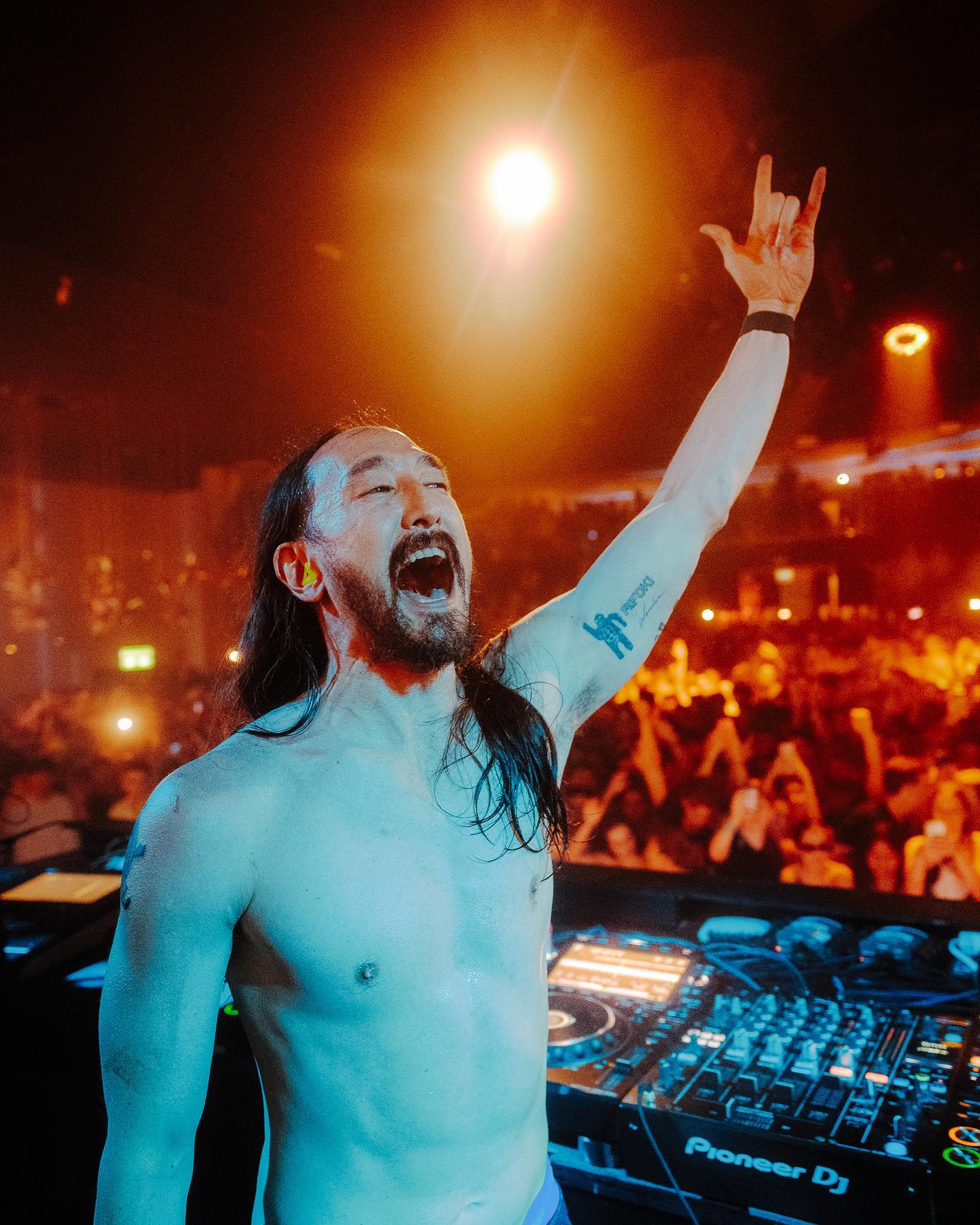
Steve Aoki Tattoos: Dim Mak, Metazoo, HiroQuest and More

A lot of Steve Aoki’s tattoos connect to his music, the people he works with and the projects he has built. Some point to Dim Mak; others mark a tour stop or an album. A few came from the kind of chaotic night that makes sense in Aoki’s world.

His collection isn’t one matched sleeve. It has grown like a scrapbook: bold lettering, bright color, cartoon and anime touches, and plenty of arm work. Aoki has spoken about some of the stories behind the designs, so there’s more to them than a list of images.

The details here come from Aoki’s own posts, tattoo-session photos and interviews. Where the ink is clear but its story isn’t, the meaning stays open.

Dim Mak is the biggest thread in Steve Aoki’s tattoos

Dim Mak is a recurring mark in Aoki’s tattoo photos. He founded the label in 1996, and its name and logo appear on his arms. Dim Mak links the punk records he loved, the label he ran and the community that grew around it.

Steve Aoki Dim Mak and arm tattoos

In the photo above, the Dim Mak lettering on his upper arm is large and dark. It reads like a badge, alongside other words and symbols. The arm looks more like a record of his work than one isolated design.

Aoki has described Dim Mak tattoos as part of the label’s culture. People connected to it have gotten similar pieces, especially when the crew is on the road. The ink connects him to that community, which has been part of his life for decades.

His posts show the tattoos in ordinary settings: backstage, at a party or while he’s getting ready for a show. That casual view fits the way he shares the label’s history and his work with fans.

The Metazoo and HiroQuest pieces are bright and easy to spot

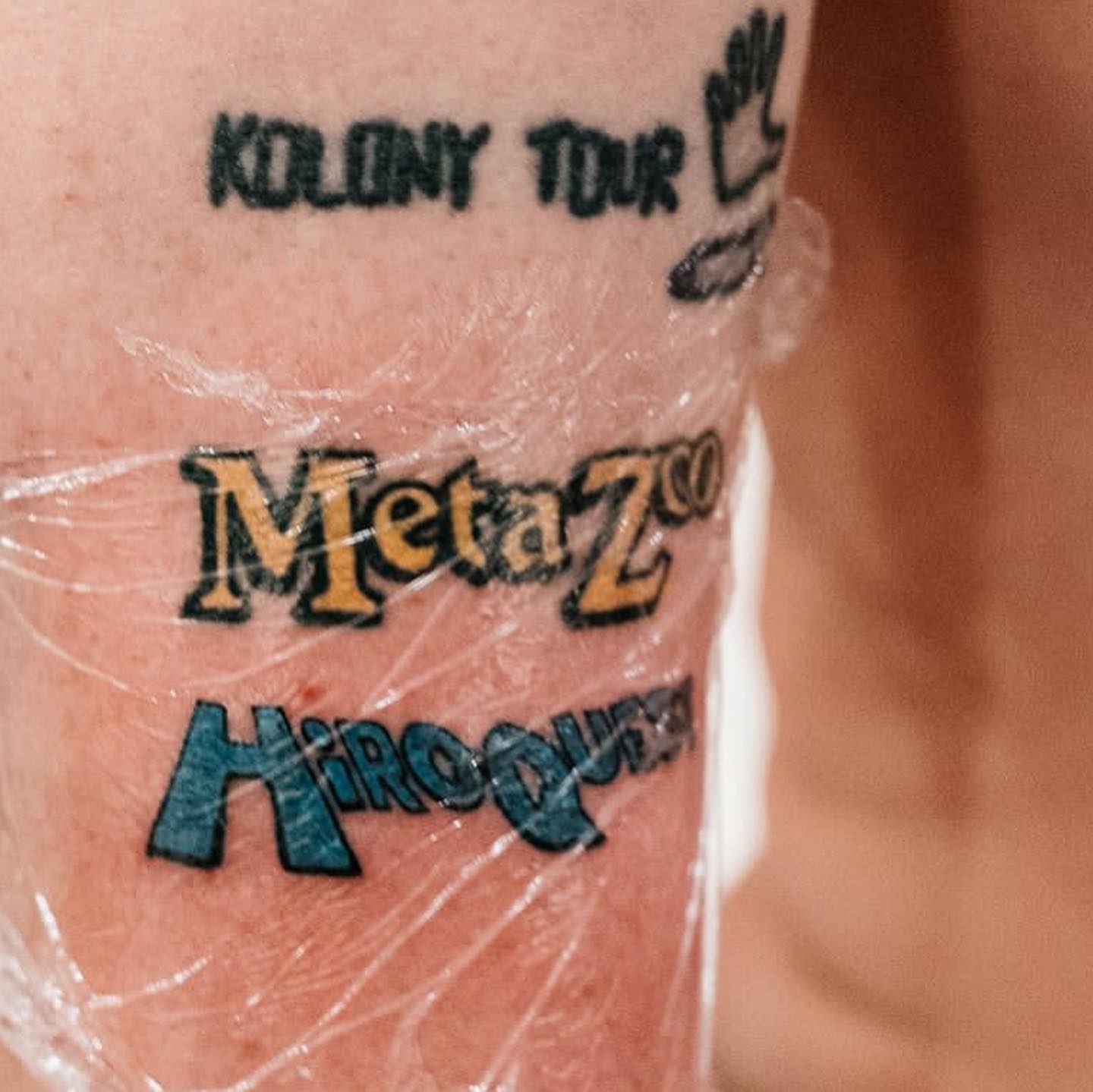
Recent work brings more color into the collection. In an Instagram update, Aoki showed Metazoo lettering and linked it to the world around his HiroQuest project. The bright outlined letters stand apart from the older black ink on his arms.

Steve Aoki Metazoo and HiroQuest tattoos

The close-up shows orange and blue letters beside the older black work. Aoki added the new design beside the older ink, giving his arm a layered look.

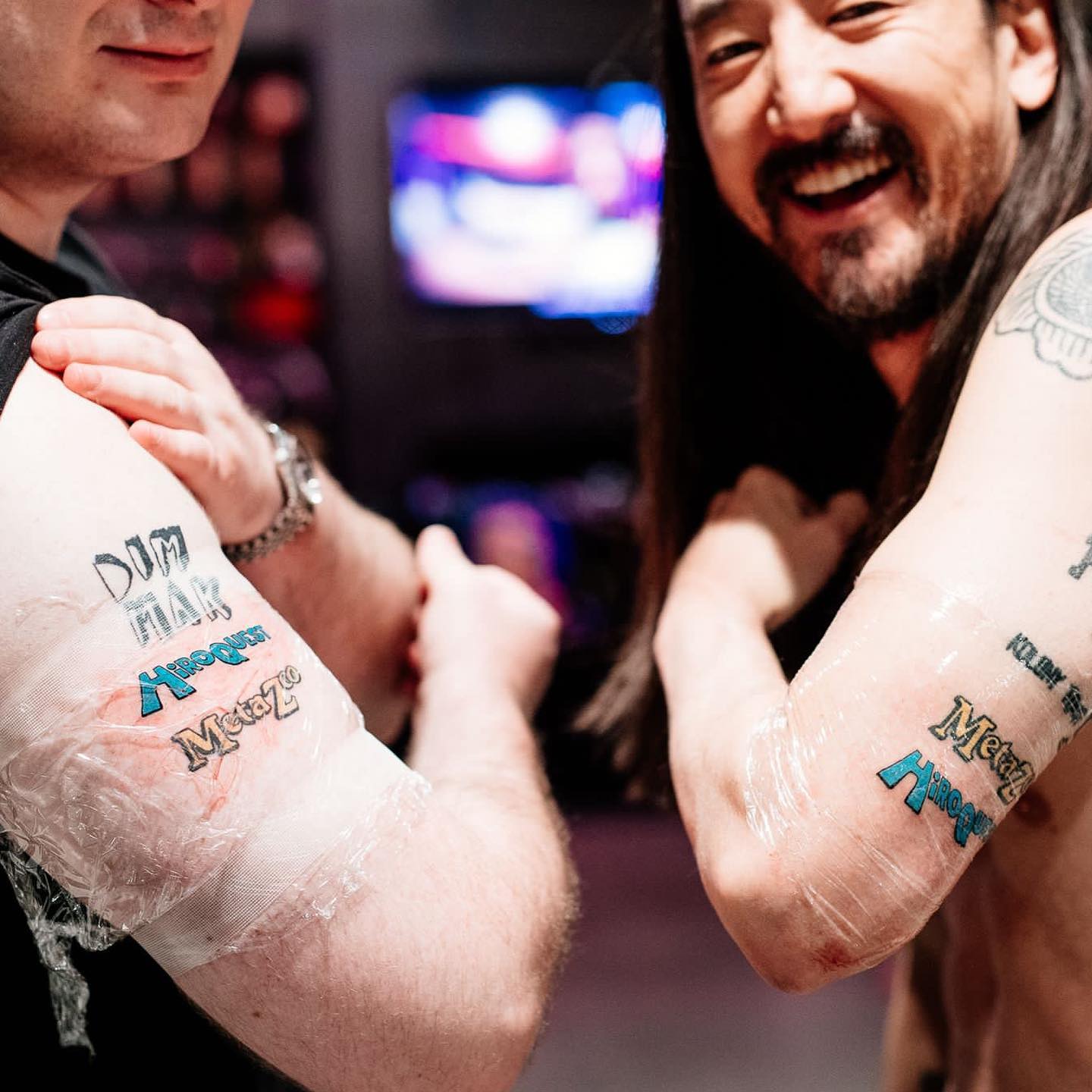
Steve Aoki Metazoo and HiroQuest arm tattoos

A wider photo shows the same tattoo and another person getting matching artwork. Aoki wrote that HiroQuest was inked on his body forever. It marked a particular project and moment, and stays with him after the project moves on.

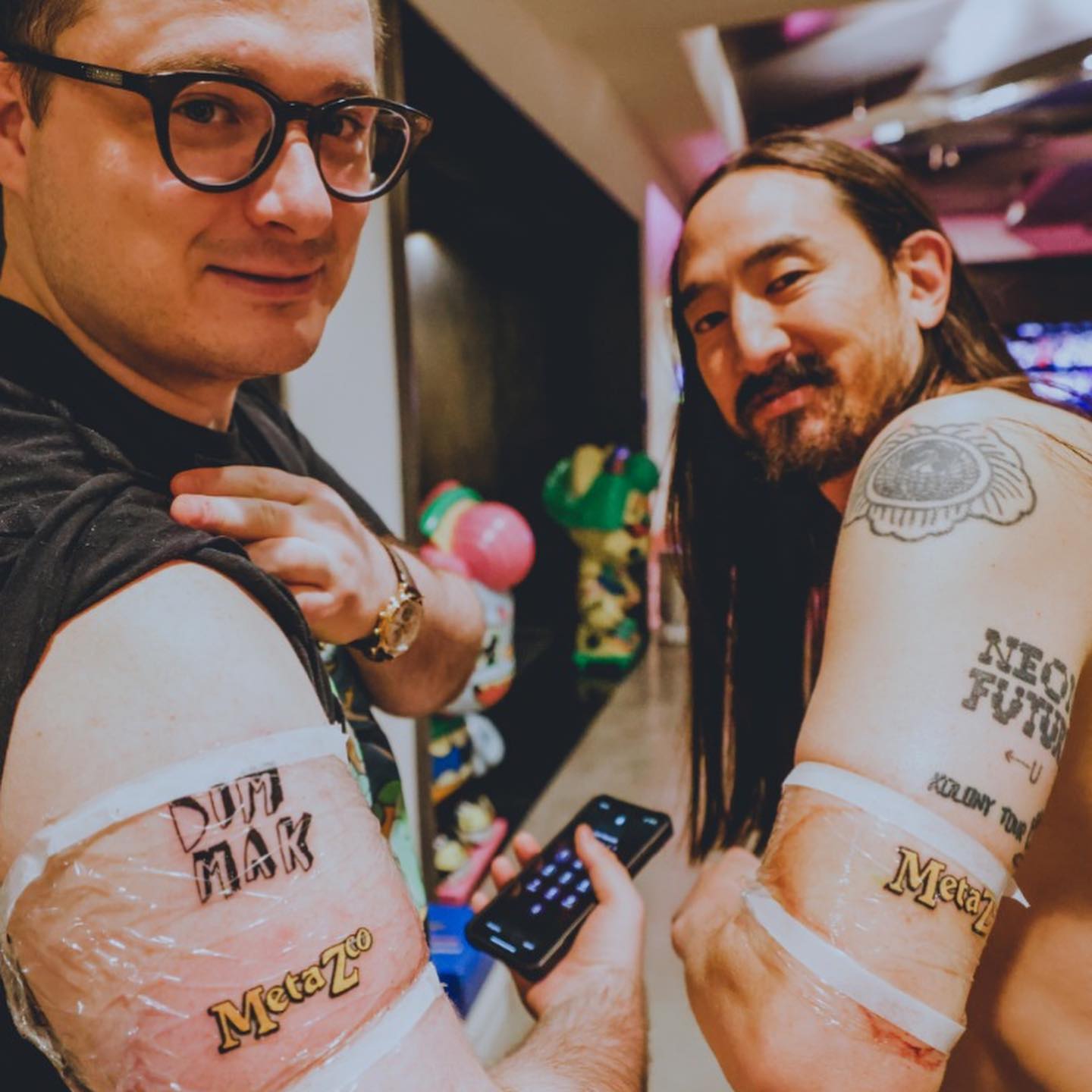
Steve Aoki Metazoo tattoo

The third view shows the lettering uncovered and how it sits across his arm. Aoki’s post connects it to his own project, and the clear photo makes the design easy to identify.

His upper arms carry darker, bolder pieces too

Not every Aoki tattoo is a large logo or a project name. Photos also show smaller writing on his forearms and upper arms. Tattoo coverage identifies the phrase “I’ll Sleep When I’m Dead”. It fits his public image and his work touring, producing and running a label. A concert photo also shows a darker design higher on his arm.

Steve Aoki upper arm tattoo detail

This concert photo gives a closer look at the darker upper-arm design. The black work has a heavier feel than the colorful Metazoo lettering. Its full meaning hasn’t been explained, so the placement and style are clearer than any story attached to it.

Other small marks sit among the lettering. Photos show some of them, but there’s no public account that confirms the meaning of every symbol. Tattoo lists can turn a guess into a fact; it’s better to describe the marks and leave their meaning open.

The writing balances the newer project names. The colorful pieces point to specific work, while the smaller words read more like reminders. They don’t have to match to feel personal.

Matching tattoos connect Aoki to music and touring friends

Aoki has shared tattoos with people from his music world. The best-known example is the “MIC Drop” tattoo connected to his work with BTS and Desiigner. The collaboration went beyond the song: the tattoos gave the artists a lasting reminder of time they spent together.

He has also posted about getting crew tattoos in Mallorca. Aoki describes it as an annual tradition when he plays there. The designs change from year to year, but the tattoo keeps a memory of the festival trip and the people who were there.

Many of the stories are about who was there: a crew, a label or a particular tour stop. The tattoo becomes a souvenir from that chapter.

The collection mixes serious label history with playful pop culture

Alongside the music and label references, Aoki has shown tattoos with a lighter touch. One post features a Hello Kitty and Aoki design, a playful fit with his cartoon and pop-culture references. He also uses bright outlines and imagery that recalls games and anime.

The mix doesn’t look planned as one sleeve. A label reference, a phrase and a colorful character can sit together without matching. Some pieces point to a memory; others seem to be designs he liked.

Dim Mak began with punk and alternative music. Aoki’s later projects reach into dance music, gaming, anime and digital art. The tattoos span that same range; they don’t all have to say the same thing.

What is confirmed, and what is still unclear

Aoki’s own Instagram posts, tattoo-session photos and interviews give the clearest details. Dim Mak is well documented, and the Metazoo and HiroQuest lettering is visible in close-ups. Tattoo coverage has also connected the “MIC Drop” design to the BTS collaboration and discussed his Mallorca crew tradition.

Other claims are harder to confirm. A small symbol may be visible without any explanation, and an old or dark photo may not show enough detail to identify it. That doesn’t mean the tattoo isn’t real; it means its meaning isn’t known. Uncertainty is better than a made-up story.

For another music-world collection, compare this one with Axl Rose’s tattoos. Aoki’s designs point to projects and touring crews; Rose’s ink has a more personal rock-and-roll feel.

Why Steve Aoki’s tattoos stand out

Aoki’s collection stands out for its mix: Dim Mak lettering, short phrases, colorful Metazoo and HiroQuest designs, tattoos shared with collaborators, and playful pop-culture images. There’s no single sleeve theme tying it together.

His tattoos keep changing with his work. He’s still touring and creating, so new ink may appear with a new project. The collection is an ongoing record, not a finished display.

Clear photos show the letters, colors and placement without relying on blurry reposts. Close-ups also make it possible to compare the newer pieces with the older arm lettering and see how the different chapters sit together.

The interview below has Aoki talking through the stories behind his tattoos. It’s a chance to hear the explanations in his own words.

More musician tattoo guides

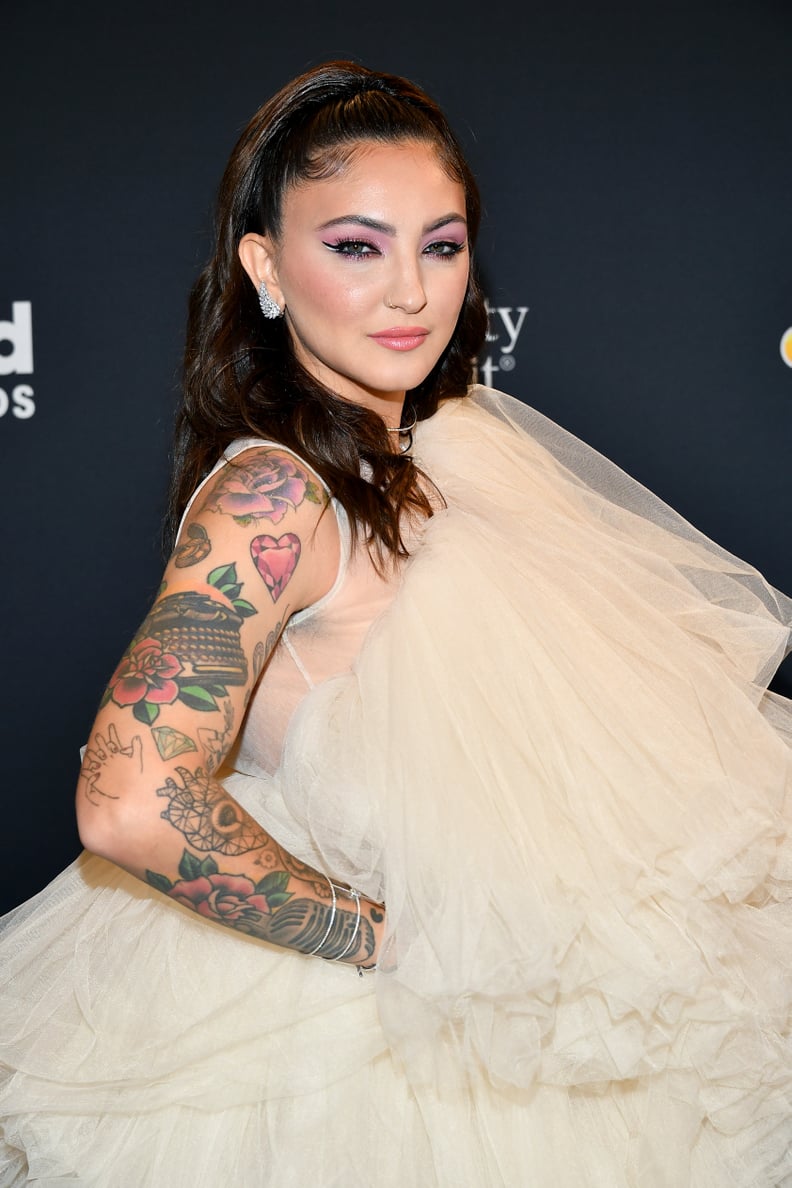
Julia Michaels Tattoos: 35+ Pieces, Meanings and Photos

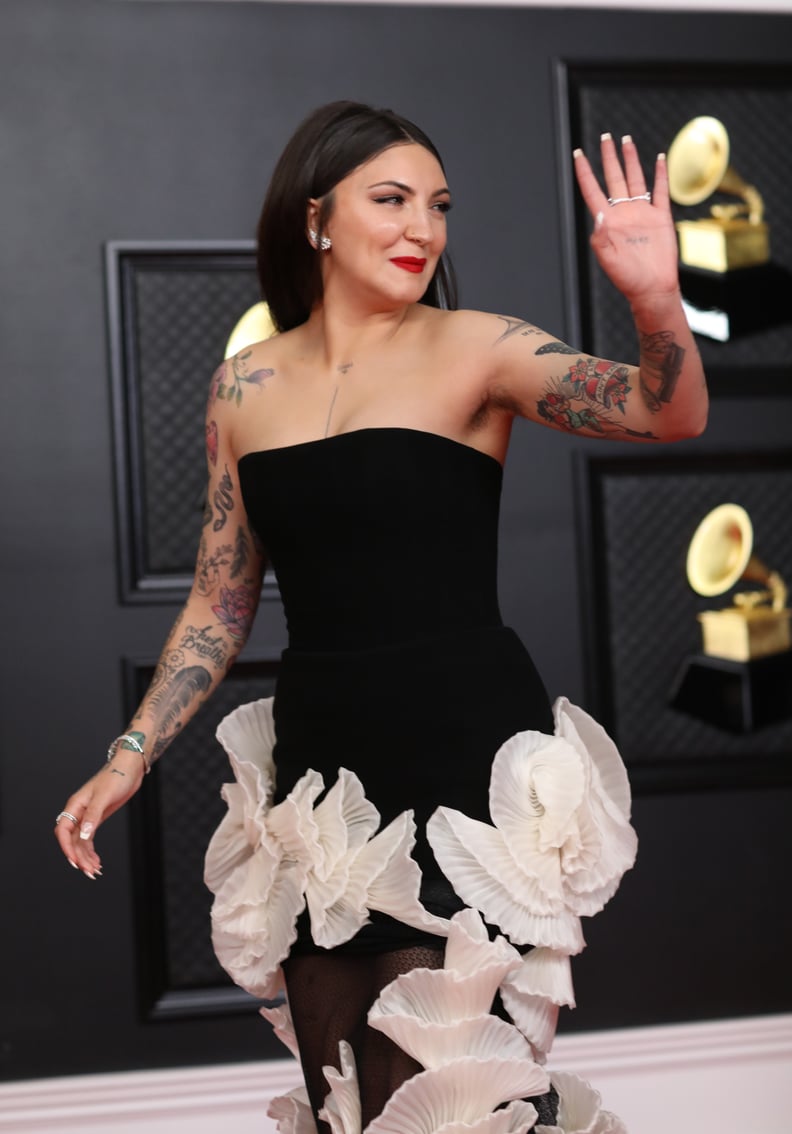
Julia Michaels has been getting tattoos for more than a decade and still adds to the collection. She has more than 30 pieces, most on her arms, with others on her hands, neck, back and legs.

The designs range from music references and flowers to jokes, self-reminders, and tattoos she got with friends or family. She often gets several pieces in one session, so the total can climb quickly.

Some tattoos tie directly to her songwriting; others are private reminders she has explained in interviews. This guide focuses on pieces that are easy to identify and have a clear story.

The pink piano that points back to music

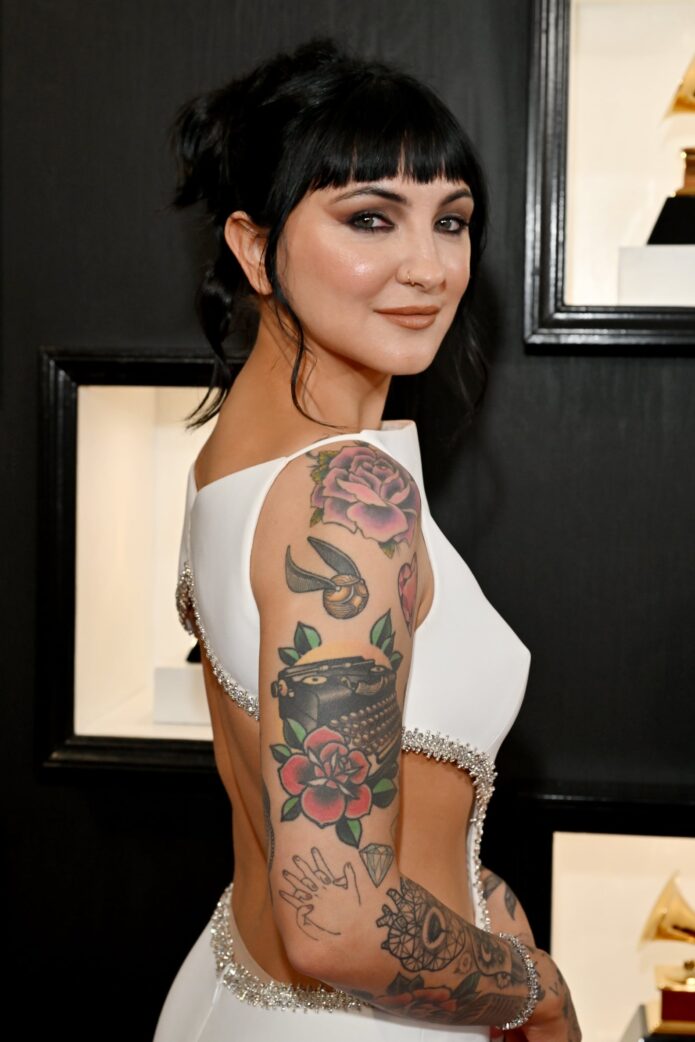
One of Julia’s early tattoos is a pink piano on her left inner forearm. She got it in 2012 to mark her music career. Its position makes it easy to see in red-carpet photos and performances.

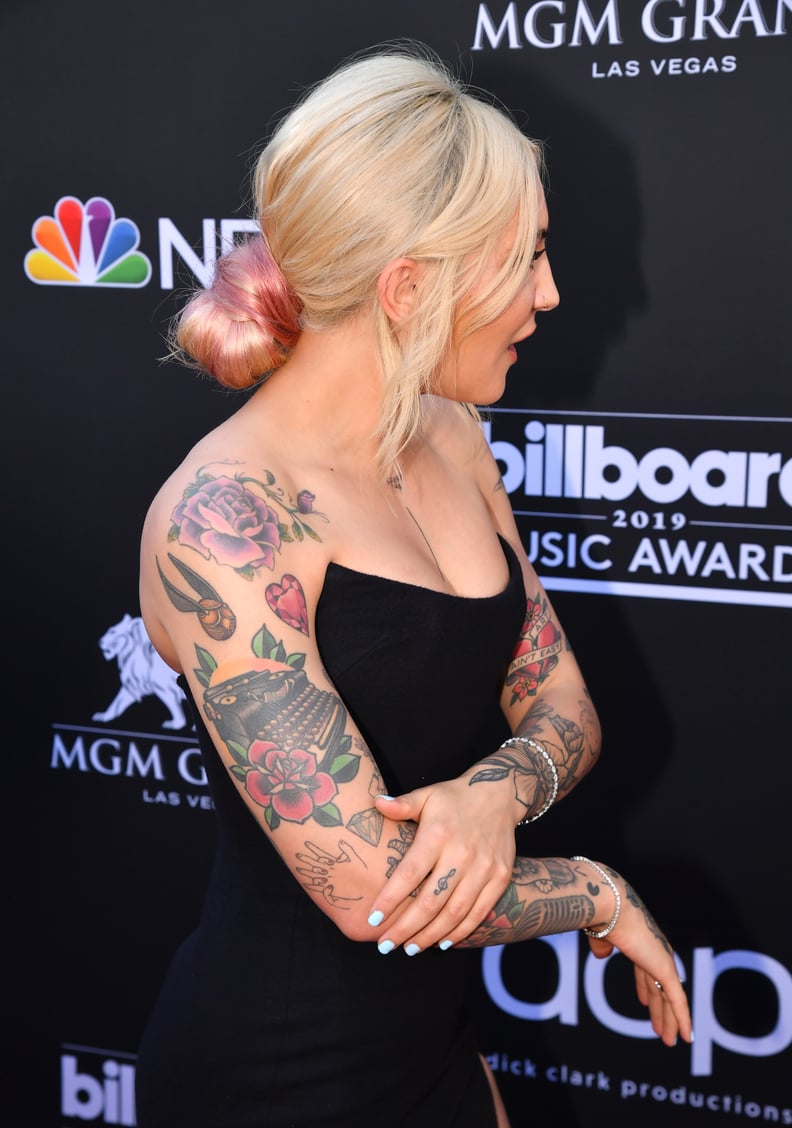
The piano is one of several designs tied to writing and music. Julia also has a vintage microphone with a rose, a typewriter, and a music note on one finger. Together, they trace her connection to writing and music.

Her approach is straightforward: if something matters to her, she puts it on her skin. An image she likes can be reason enough too. The designs don’t have to share one style.

The bird in flight above her elbow

Julia Michaels bird in flight arm tattoo

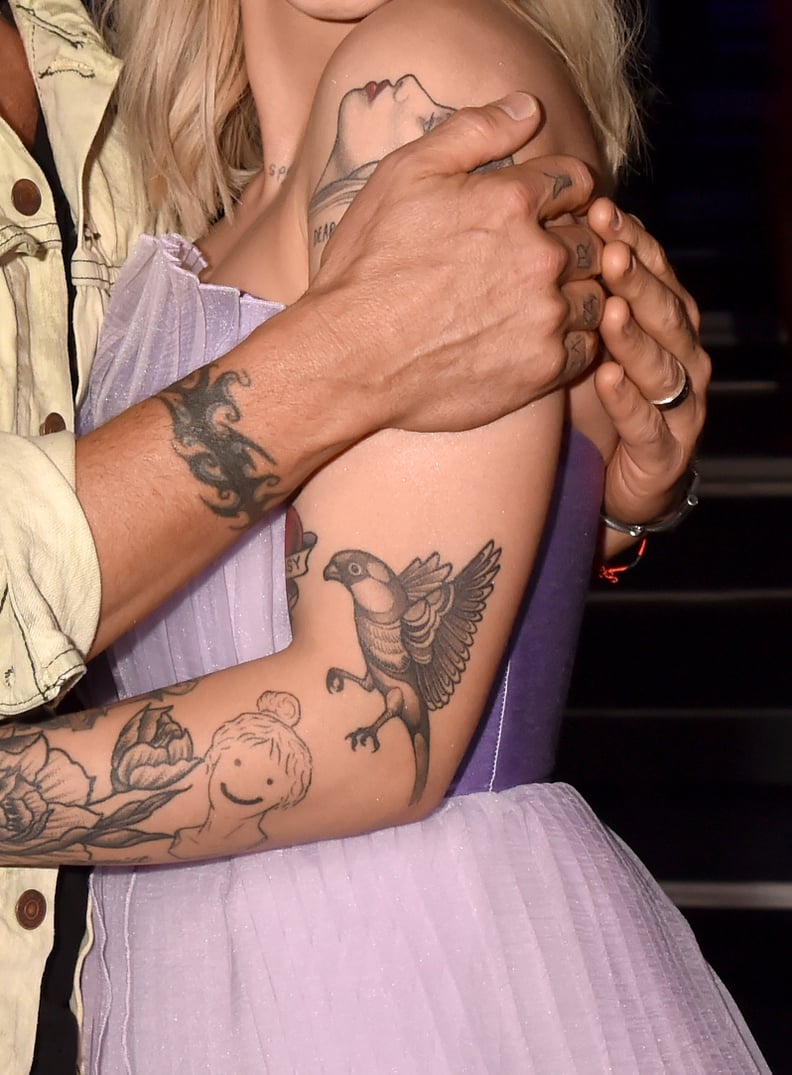
In summer 2018, Julia added a bird in flight to her left arm, just above the elbow. The black-and-gray design sits among her other tattoos. She hasn’t shared a specific meaning for it, so there’s no need to assign one.

Some of Julia’s tattoos come with a full explanation; others are images she wanted to keep. The bird is quieter than the lettering and heavier designs around it, and helps break them up.

The bird adds movement to the arm. Unlike the flower or typewriter nearby, it looks as if it’s heading somewhere. It stands out without bright color.

“Art Aint Easy” and the broken heart

Julia Michaels Art Aint Easy broken heart tattoo

On her upper inner left arm, Julia has a red, traditional-style broken heart with the words “Art Aint Easy” around it. The phrase is blunt and suits a songwriter who turns messy feelings into songs.

The red ink stands out against the darker tattoos nearby. The words sit close to the heart, so they read as part of the image instead of a separate caption.

There’s a dry joke in “Art Aint Easy.” It sounds like something to say after a long writing session or a song that took forever to finish. The tattoo can be both a reminder and a joke.

The “Protagonist + Antagonist” flower

Julia Michaels flower protagonist and antagonist tattoo

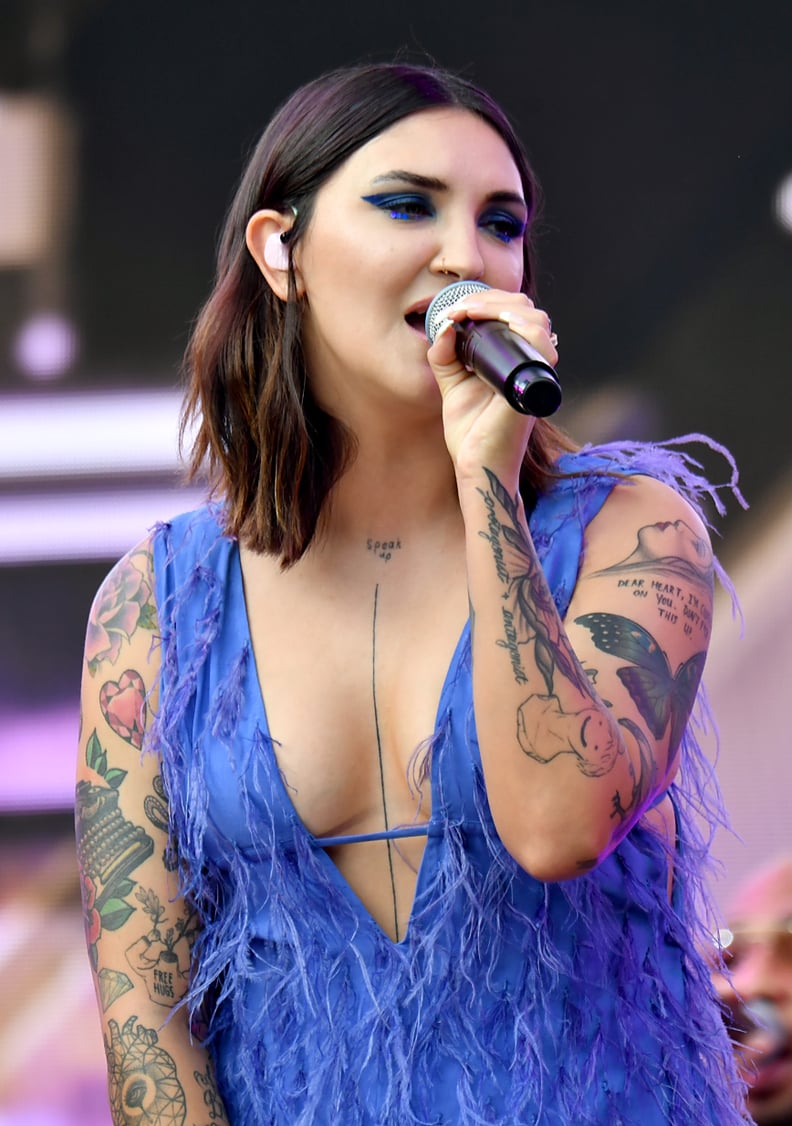
A large flower covers part of Julia’s left forearm, with “protagonist + antagonist” in script beside it. The phrase sounds like a note from a writing session, which fits her work better than a generic quote.

Julia has talked about carrying both sides of yourself. The words connect with how she thinks about characters, conflict and the stories inside a song.

Other flowers appear across her arms, including roses and a colorful lotus she later called an artichoke. The motif returns, but each tattoo has its own feel: this one is about writing and identity, while the shoulder rose is more decorative.

On her left arm, Julia has a pin-up girl in a green dress on the inside of her bicep, a faceless woman and a doll-like bust. The vintage images have a slightly strange feel. Some of Julia’s tattoos are meant to look odd.

The vintage microphone with a rose

Julia Michaels vintage microphone and rose arm tattoo

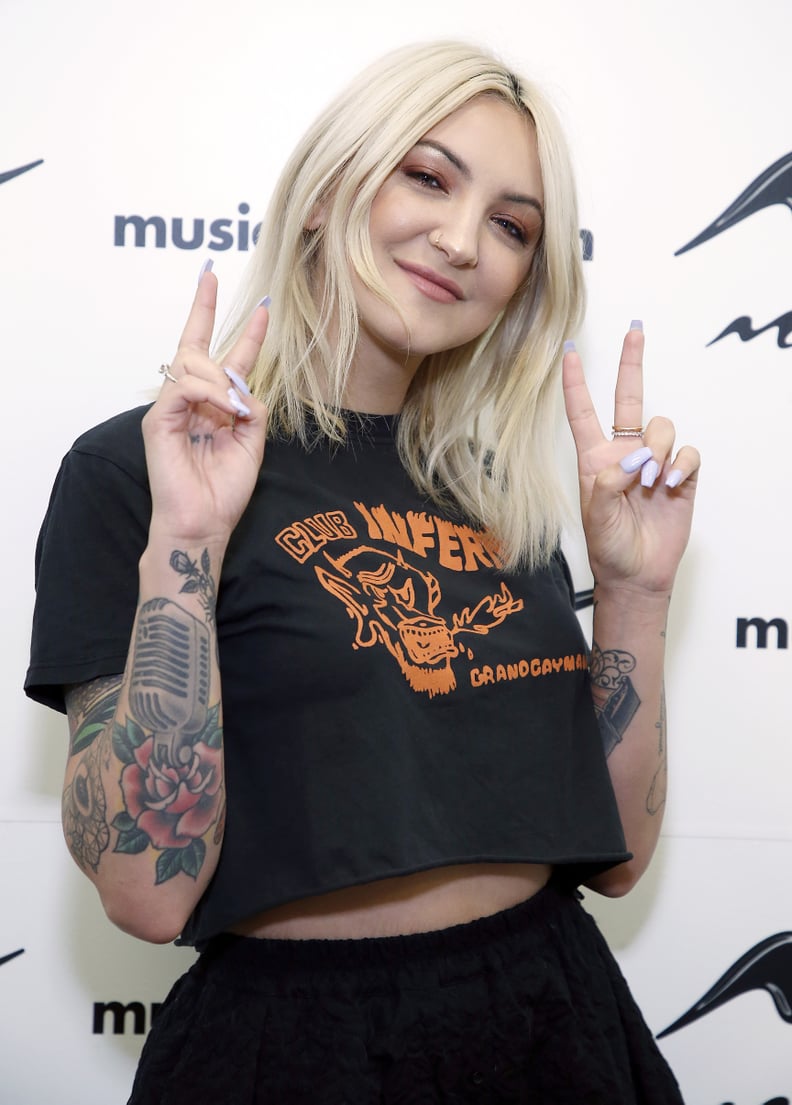
Julia got a vintage microphone on her outer forearm in 2012, with a rose below it. It’s one of her clearest music tattoos, and the old-fashioned microphone gives it a classic look.

The rose softens the microphone design and connects it to the other flowers on her arms. Across the collection, music, words and floral images turn up in different combinations.

The microphone dates to roughly the same period as the piano, before some of the larger arm pieces were added. The tattoos have grown together over time, not appeared as one finished sleeve in a single session.

The typewriter on her upper arm

Julia Michaels vintage typewriter arm tattoo

Julia’s typewriter sits high on her right arm. Like the piano and microphone, it points to her work, but this one is about words themselves.

The simple image sits easily beside the more colorful tattoos. Julia doesn’t need every design to be a large portrait or a complex scene; a small typewriter says plenty for someone who writes for a living.

The typewriter is easy to read as a reference to her work. She hasn’t shared when or why she chose it, but its place in the collection is clear.

The rose wrapped around her shoulder

Julia Michaels pink rose shoulder tattoo

A pink rose wraps around Julia’s right shoulder. It’s one of the more visible flowers, especially in sleeveless photos where the bloom follows the curve of her shoulder.

Flowers appear beside words, instruments, hearts and characters in Julia’s collection. The shoulder rose is softer than the broken heart and more traditional than the “Protagonist + Antagonist” flower.

The rose adds color to an arm where much of the work is black and gray. Those small flashes of pink and red keep the collection from looking flat when the pieces sit together.

Miley Cyrus’s tattoos offer a useful comparison: both singers build a personal style from smaller pieces, while Julia’s collection keeps returning to music, words and flowers.

The perception symbol and light bulb

Julia Michaels perception symbol and light bulb arm tattoos

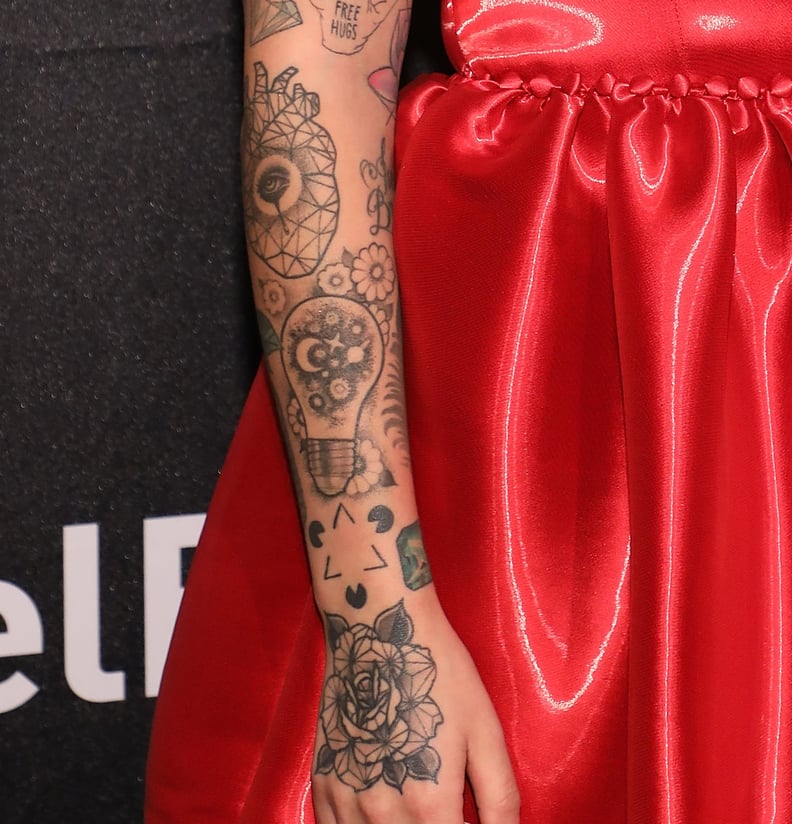
On Julia’s right arm, a perception symbol combines two triangles and three circles. She has explained that it represents how the brain can see something as whole even when parts are incomplete. It turns an idea about the mind into a simple design.

Above it is a light bulb with a solar system inside. Julia has said the bulb represents thoughts and the subconscious mind. Both tattoos were added in March 2017, so they work as a pair despite being separate designs.

The same arm has a geometric heart and eye, a “Free Hugs” sweater and other small pieces. The perception symbol is thoughtful without dominating the rest of an arm covered in different ideas.

The tattoos that remind her to speak up and breathe

Julia Michaels Speak Up neck tattoo

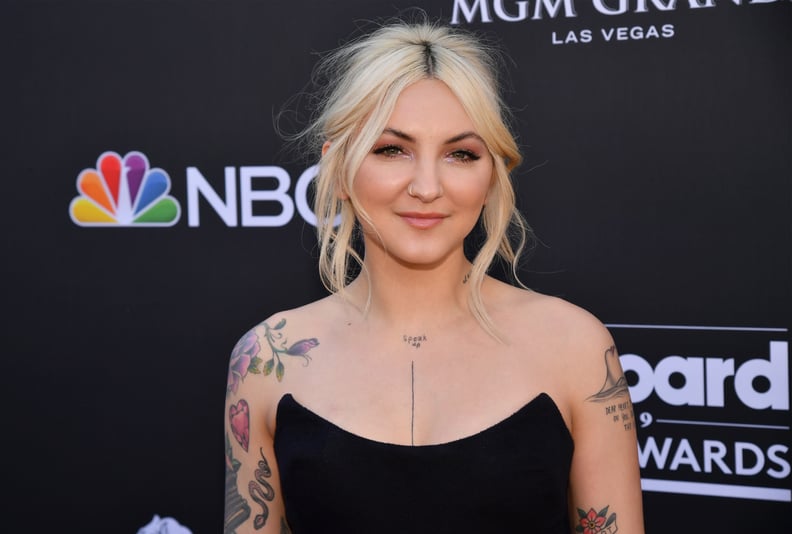
Julia has a “Speak Up” tattoo below her neck, with a line running down her chest. She calls it one of her favorites because she doesn’t always speak up and wants reminders to be bold and brave.

She also has “Just Breathe” on the inside of her right wrist and an “I am” tattoo on the side of her neck, followed by a blank space. The open ending leaves room for possibilities instead of fixing her to one label.

On her right hand, Julia has “I love you” in her own handwriting. She has said she got it to remind herself to love herself, because she sometimes forgets.

The funny and very specific pieces

Julia Michaels right hand rose tattoo

Not all of Julia’s tattoos are about music or self-care. She has a golden snitch she got with her dad because she’s a Harry Potter fan, a baby-pink snake for her Slytherin side, a scorpion for her zodiac sign, and four gemstones for her fans, whom she calls her “little gems.”

Other designs include a rain cloud with blue drops above one knee, “Calm” with a down arrow, and “Kiss Here” across the middle of her back. Her hands have roses, a bee, a music note and a red heart, plus matching arrows she got with Selena Gomez.

One colorful lotus didn’t turn out the way Julia expected. She said she went in without enough research, came away with something that looked like an artichoke, then added a large X and the words “bad idea.”

What Julia Michaels’s tattoos say about her

Julia’s tattoos don’t make one big statement. They’re more like a notebook: songs, friends and family, self-reminders, images she liked, and a funny mistake. The reminders are small, but they’re part of what makes these tattoos feel personal.

The collection is easy to recognize because it keeps growing. Julia adds pieces in groups, letting new tattoos sit beside old ones as the whole thing changes with her. There’s plenty of meaning in the collection, but it doesn’t feel too polished; the mistakes and jokes are part of it too.

Julia has more than 30 tattoos, but no single theme explains them all. The piano, broken heart, flowers, microphone, typewriter, perception symbol and small reminders give the best sense of the mix.

Watch Julia Michaels talk about her tattoos

In this short interview, Julia talks about some of her favorite tattoos and what they mean:

Jhené Aiko Tattoos: 20+ Pieces and Meanings

Jhené Aiko’s collection includes a lotus on her side, a Dharma wheel on her shoulder and a large back piece with a dragon, phoenix, flowers and crystals. Some tattoos honor family; others came during difficult periods, and a few have changed or been covered.

She has said that getting tattooed during painful periods helped her turn those feelings into something lasting. Her collection includes spiritual symbols, family tributes and cover-ups from different points in her life.

Public accounts document more than 20 tattoos on Jhené. This guide sticks to pieces that are clearly visible or have a reported story, and separates what she has explained herself from what can be confirmed in photos.

Jhené Aiko’s first tattoo was a lotus

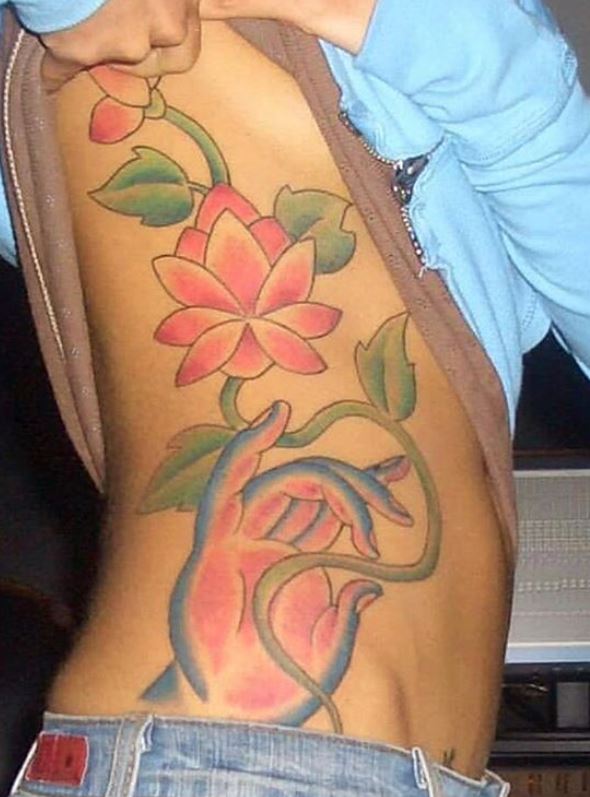
Jhené has said her first tattoo was a large lotus on her side. She connected it with Buddha and researched the symbol before getting it. The lotus became an early reference point for later pieces, many of which return to flowers or spiritual imagery.

The lotus runs along the side of her torso and into a hand design. The flower, leaves and fingers cover a good stretch of skin, in soft color rather than a black outline. Its warm, traditional palette also appears in some of her earlier tattoos.

Jhene Aiko hand holding lotus rib tattoo

The hand gives the piece a calm, almost storybook quality. The flower is easy to spot, but the hand makes it look different from a standard lotus tattoo.

A second lotus design sits along her ribs. A hand reaches through the leaves to hold the flower, with pink and orange petals, green leaves and a long stem running down her side.

The Dharma wheel on her shoulder

One of Jhené’s easiest tattoos to identify is the Dharma wheel on her shoulder. It has a clear round outline, spokes and smaller details around it. The wheel sits high enough to show when she wears a bare-shoulder top.

The Dharma wheel is associated with Buddhist teaching and the path toward understanding. Jhené has spoken about her interest in spiritual ideas. She wears it close to her head and heart, off the center of her chest.

Jhene Aiko rising sun shoulder tattoo

Her shoulder and back tattoos sit close together, and some have been changed or covered. That makes the full count hard to pin down. The wheel itself is easy to recognize, even in older photos.

The red script on her collarbone

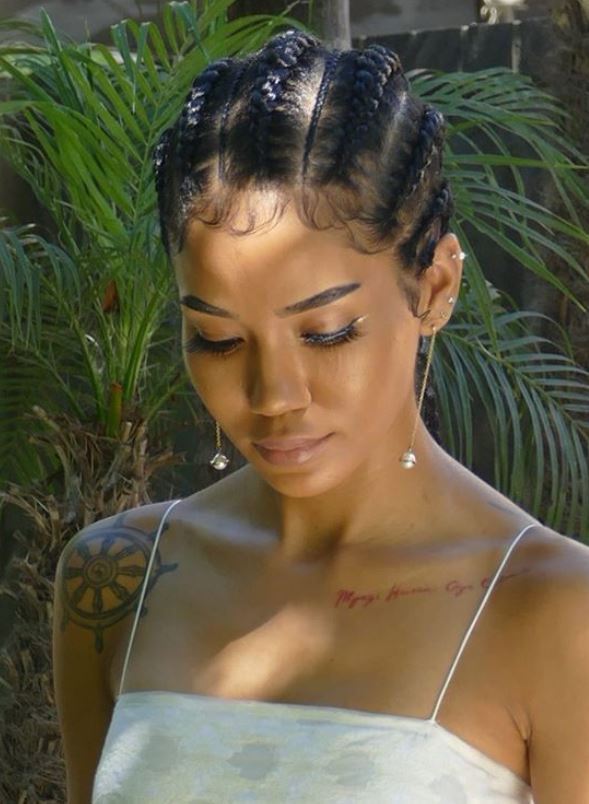
A red script tattoo across Jhené’s collarbone reads “Miyagi Hasani Ayo Chilombo.” Miyagi was her younger brother, who died in 2012 after a battle with cancer. It’s a direct tribute, and the red ink looks softer than the black lettering used in many name tattoos.

The script follows her collarbone and shows in low-cut tops and red-carpet photos. Because the name is readable in close-ups, it’s one of the tattoos with a clear connection to a person and a specific event.

Jhene Aiko Miyagi Hasani Ayo Chilombo collarbone tattoo

She has added a small sun and other marks around her upper chest and shoulder. The collarbone script remains the main focus. Beside the large back piece, it’s simple, but the name makes its meaning clear.

Her old back tattoos and the Chilombo cover-up

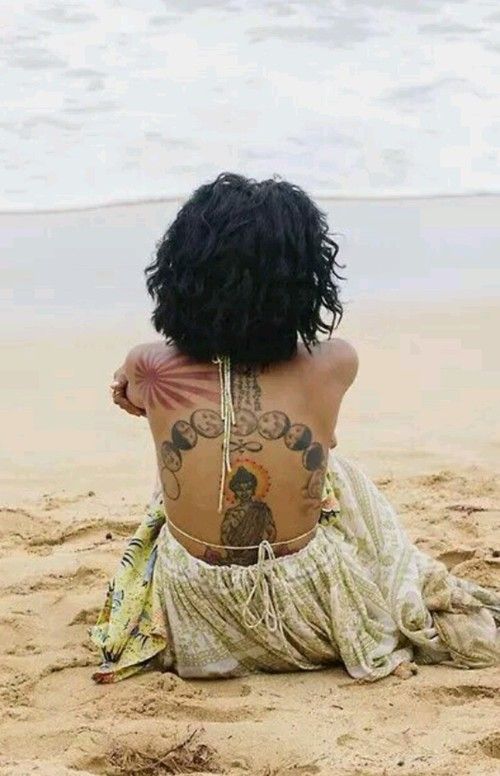
Older photos show Japanese lettering, moon phases, a Buddha seated on a lotus and an infinity symbol across Jhené’s upper and middle back. The pieces cover much of the area, with open skin between them.

Jhene Aiko older back tattoos

The older tattoos sit as separate pieces: moon phases curve around her back, the Buddha sits near the middle, and the lettering runs down from her neck.

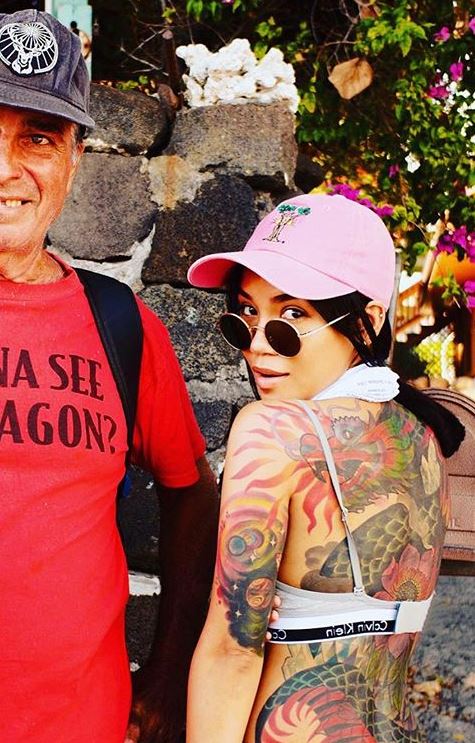
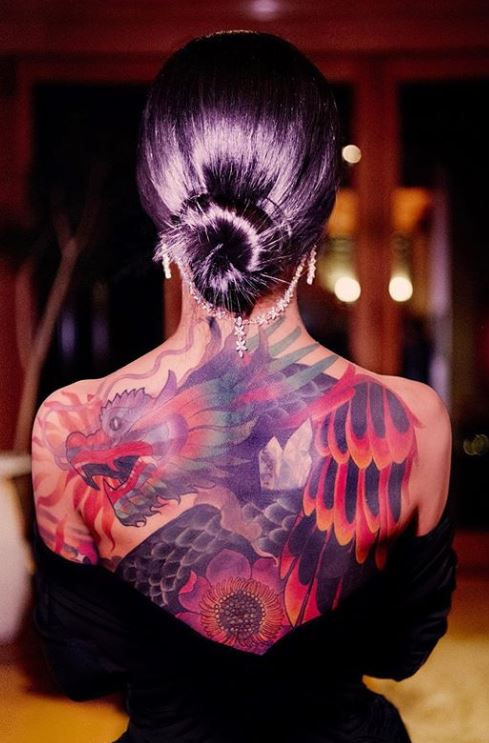
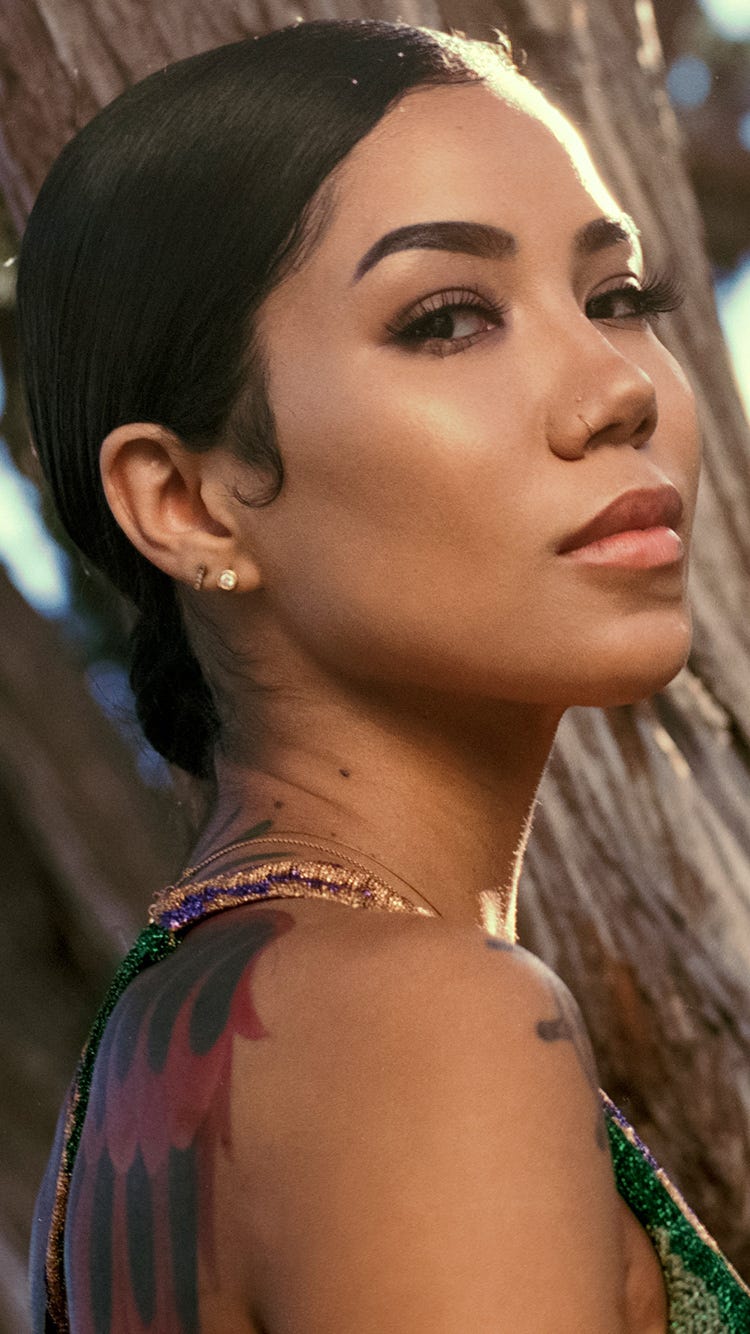
She later started covering the old tattoos with a much larger piece. In a Refinery29 interview, Jhené described it as a dragon wrapping around a flower and crystals. She said she was drawn to mystical creatures and noted that she was born in 1988, the Year of the Dragon.

Jhene Aiko dragon and phoenix back tattoo

The newer back piece is colorful: a dragon fills one side, a phoenix spreads across the other, and flowers sit between them. Jewel-like shapes and crystals give it the look of a fantasy illustration.

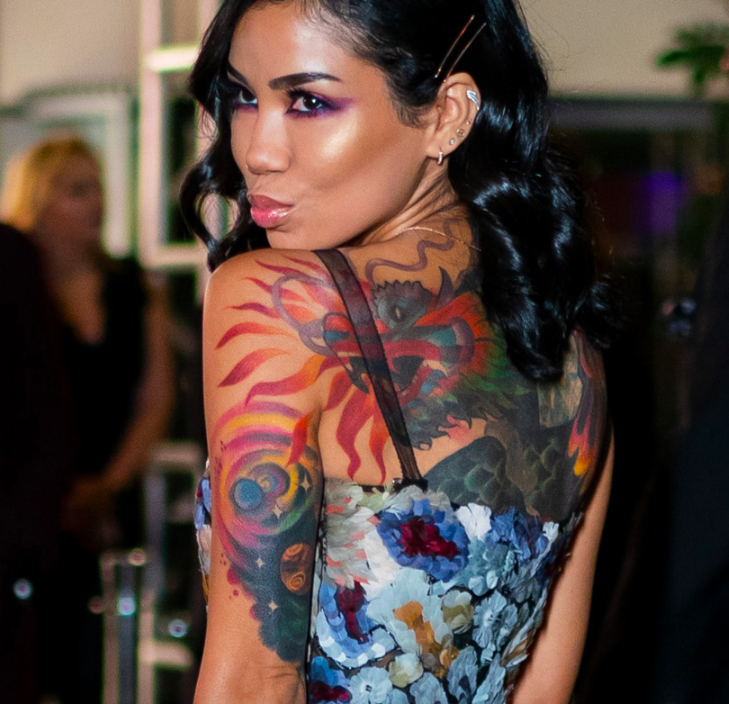
Jhene Aiko dragon and galaxy tattoos

The color reaches around her shoulder and upper arm. Red rays from the old rising sun still show in some photos; other parts are under the newer work. That overlap can make the tattoo count look different from one year’s photos to the next.

A full outfit shot can hide much of the tattoo. Close-ups show the fingers and petals, though some colors have faded. The main image is still clear.

A lotus links the back piece to Jhené’s first tattoo, though the designs are different. Both put a flower at the center and have a spiritual feel. The rib tattoo is also easier to keep private than the work on her shoulder, back or wrists.

Wrist tattoos, the penny, and Pisces

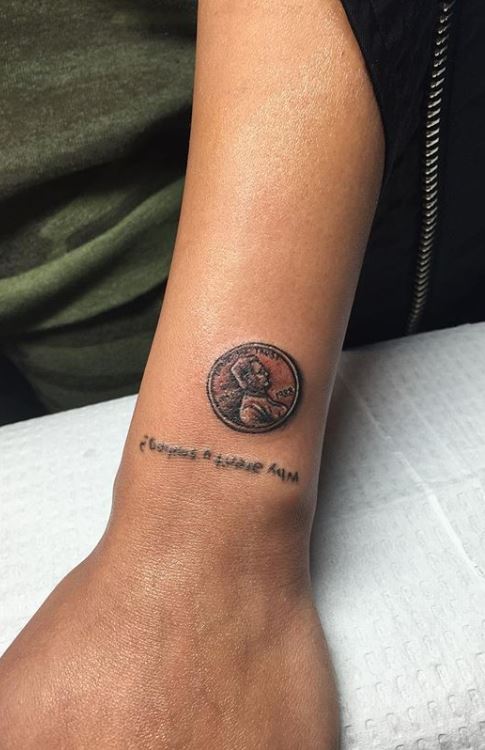
Jhené has several smaller tattoos around her wrists and forearms. One wrist has a tribute phrase reported as “Why aren’t u smiling?”, in memory of her brother. She also has a penny tattoo and a Pisces symbol for her zodiac sign.

Jhene Aiko wrist tribute tattoo

The fine lettering takes a close-up to read, and the small coin-like image is easy to miss. Neither tattoo is flashy, but both connect to personal details.

Jhene Aiko Pisces wrist tattoo

Her Pisces tattoo is easier to make out: two fish in blue ink on her wrist. Bracelets cover part of it in some photos, but the shape shows when she raises her hand.

There are other small marks on her forearms and hands. Some are hard to identify in quick phone photos, and tattoos can fade or be covered, so it’s safer to stick to marks that can be seen than to assign a meaning to each one.

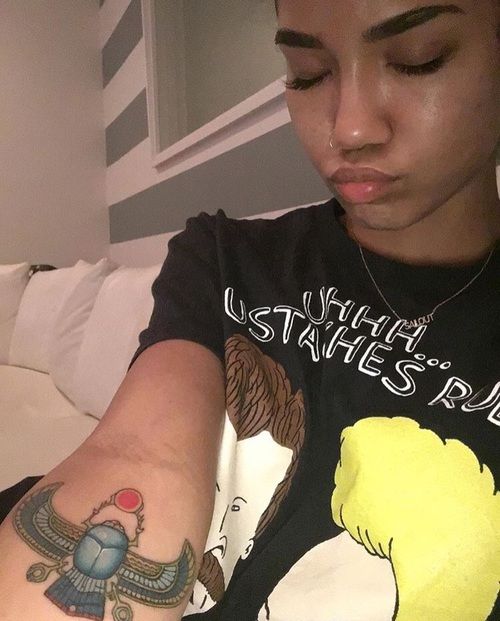
The scarab on her forearm

A scarab on Jhené’s forearm has a round body, wings and decorative lines around it. The surrounding shapes give it an Egyptian feel without making it look like a plain symbol copied from a flash sheet.

Jhene Aiko scarab forearm tattoo

The forearm gives the scarab space for its details, and the tattoo appears in casual selfies unlike the pieces on her back and ribs. It sits between the large color work and her smaller black-and-gray designs.

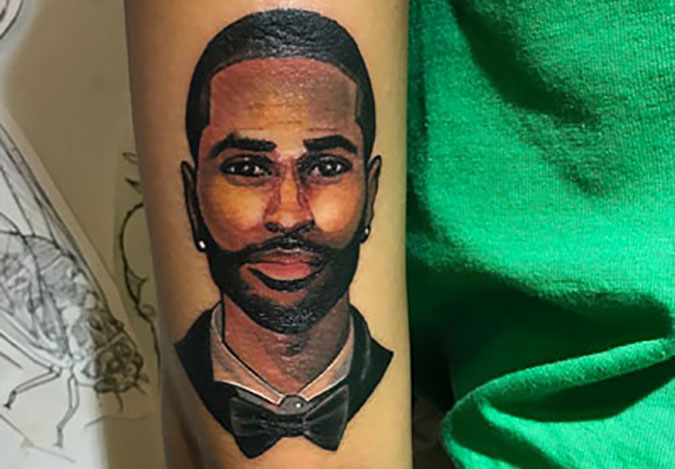
The Big Sean portrait and the galaxy cover-up

Jhené once had a detailed portrait of Big Sean on her arm, which she got while they were together. The image was recognizable as him, making it a direct tattoo about their relationship.

Jhene Aiko Big Sean portrait tattoo

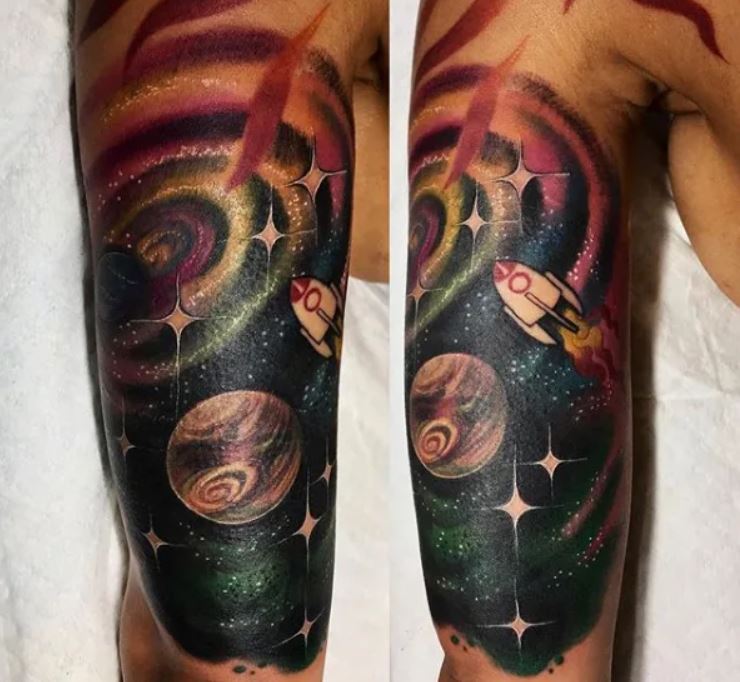
After they broke up, she covered the portrait with a colorful galaxy of planets, stars and a small rocket, shaded in deep blue and purple. The portrait focused on one person; the cover-up reads as a small universe of its own.

Jhene Aiko galaxy sleeve tattoo

There’s enough detail here to reward a close look: tiny stars, round planets and a small rocket sit inside the darker shading. The galaxy covers the portrait completely, giving the arm a different subject.

The Bushido principles on her leg

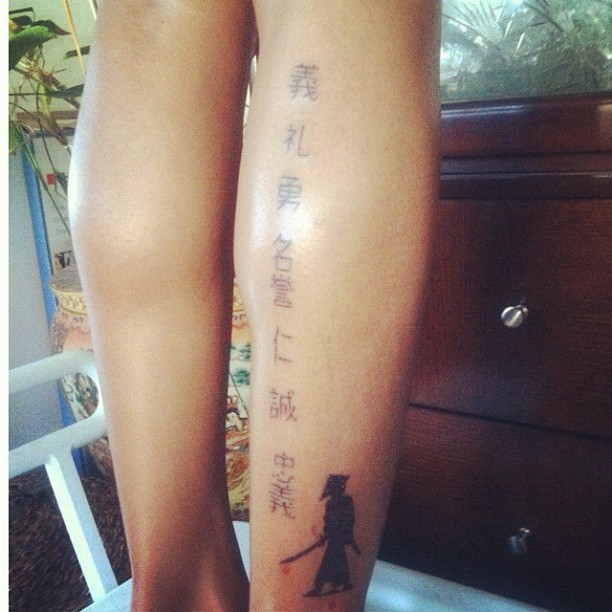
Japanese lettering on Jhené’s leg is connected with the seven principles of Bushido. It runs vertically beside a small samurai. Bushido is often translated as “the way of the warrior,” another Japanese reference alongside the lettering on her back.

Jhene Aiko Bushido principles leg tattoo

The lettering looks pale in photos, so it’s hard to read from a distance. Up close, the vertical lines and small warrior near the bottom are easier to see. She also has small mushrooms around one ankle, though the photos don’t show them clearly.

The small neck tattoo

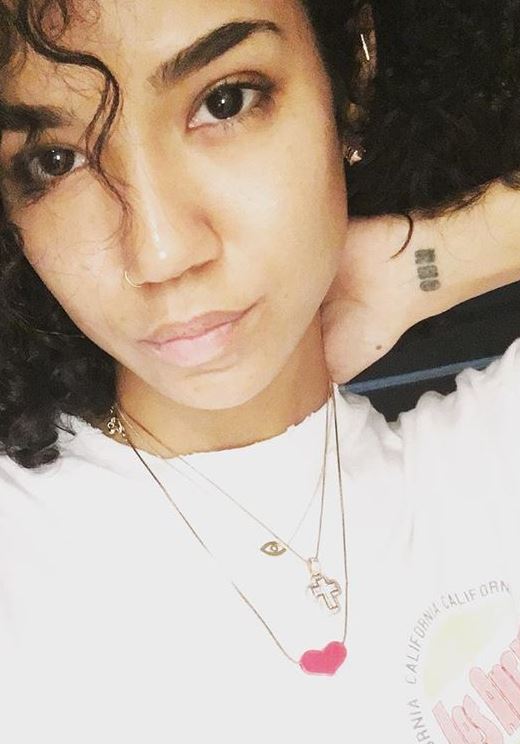
A small tattoo at the back of Jhené’s neck appears in close-up selfies. It consists of stacked dark marks, much less prominent than the back piece or galaxy cover-up.

Jhene Aiko neck tattoo

There’s no reliable public explanation for the neck tattoo. The stacked marks are visible, but there’s no need to give them a larger story.

Why Jhené Aiko’s tattoos feel so personal

Jhené’s tattoos include family names, spiritual symbols and designs she has reworked over time. The lotus recurs, the dragon-and-phoenix back piece grew over an older collection, and the galaxy replaced a portrait tied to a past relationship.

Jhene Aiko shoulder tattoos

She has said tattoo sessions helped her turn emotional pain into something beautiful. The back piece and galaxy cover-up both replaced earlier tattoos, so her collection reflects more than one stage of her life.

Jhené’s larger, colorful pieces contrast with the smaller, more delicate designs in our guide to Julia Michaels’ tattoos.

Watch Jhené explain the Big Sean tattoo

In a short Capital XTRA interview, Jhené talks about the Big Sean portrait tattoo and the story behind it:

More musician tattoo guides

Frank Iero Tattoos: MCR Ink, Family Tributes and More

Frank Iero’s body art covers almost every part of him. The mix includes band symbols, hearts, family tributes, skulls, animals, jokes and short bits of writing.

He has had years to build it up. Frank has played in My Chemical Romance and L.S. Dunes, worked on solo projects and added tattoos as his life changed. His page in our musician tattoo archive is full of different kinds of ink.

This guide covers tattoos visible in photos or described by Frank and tattoo publications. Some older designs have since been covered, so photos from different years may show different versions.

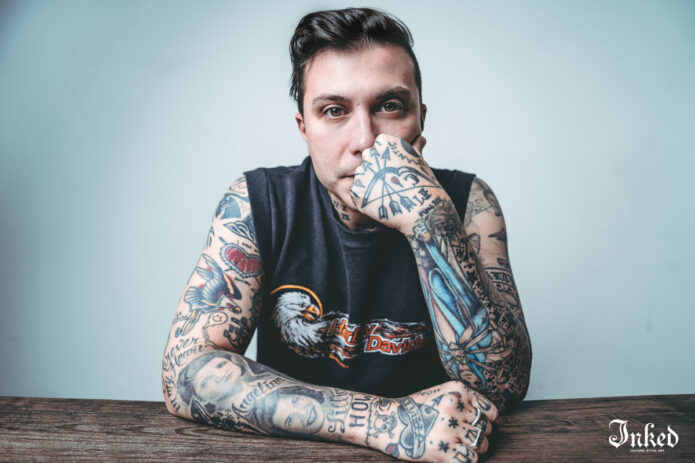
Frank Iero’s arm tattoos

Frank’s arms set the scrapbook tone of his collection. Traditional shapes, portraits, lettering, filler marks and darker designs sit beside brighter work; no one style runs across the whole arm.

One visible piece is a portrait of his grandfather. Frank got it after appearing on LA Ink. In photos, the portrait sits among hearts, birds, stars, lettering and other small designs. The story behind it is warmer than much of the surrounding work.

A large winged figure and roses wrap around his wrist. Other pieces point to music and bands, including a Black Flag symbol; photos also show claws, animals and small filler icons. New tattoos often fill the spaces beside older ones.

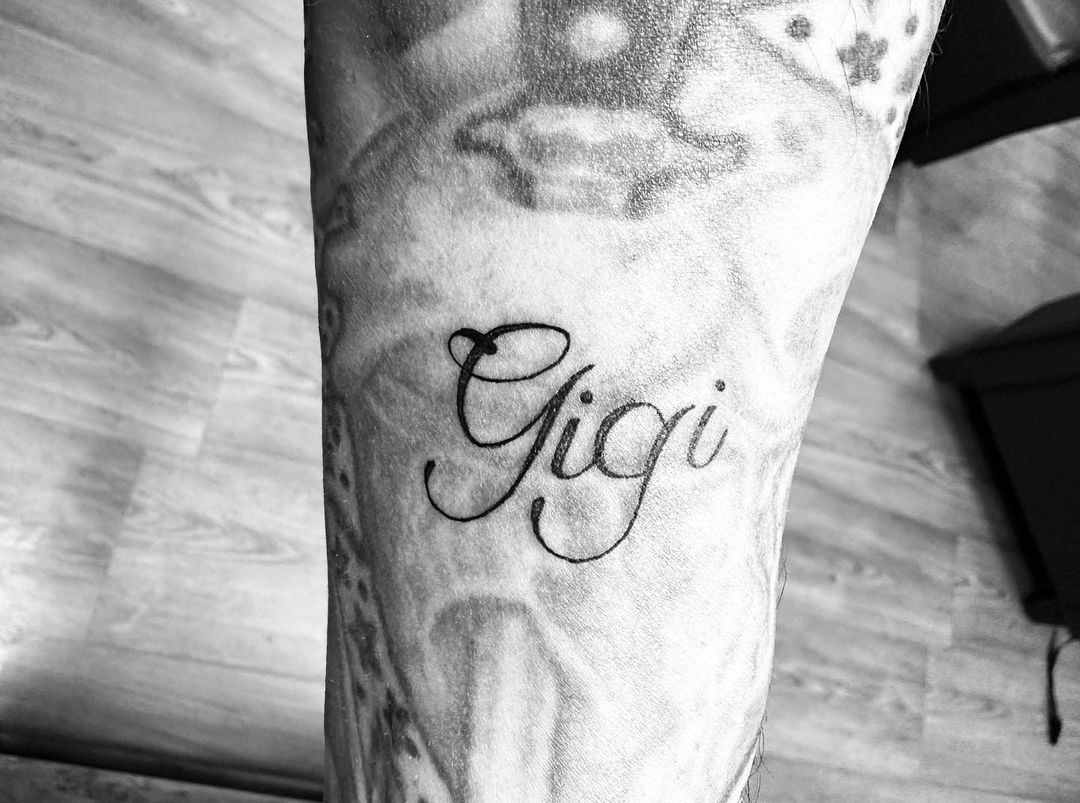
Frank Iero’s Gigi forearm tattoo
Frank Iero’s “Gigi” forearm tattoo is shown in close-up.

The “Gigi” tattoo is one personal example. The simple lettering sits over an older, heavily tattooed area. The name is easy to read, but older pieces remain around it, making the sleeve look like it grew over time.

His head and neck tattoos

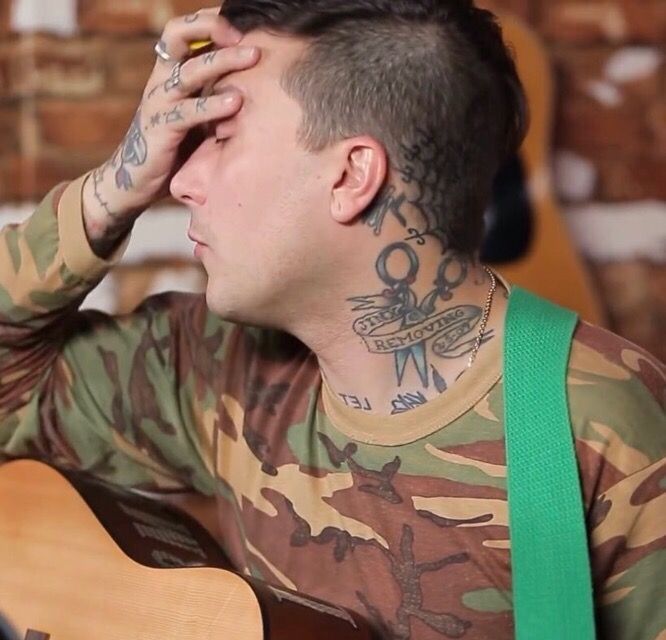
The head and neck pieces show clearly when Frank’s hair is short. They include a grim reaper on the side of his head, a scorpion, a cross connected to his solo work, and the Skeleton Crew logo behind one ear. A spider web covers part of the back of his head, though his hair can hide it.

Scissors and words on his neck include “Jinx Removing” and the date “2-5-07.” Together, they read like a dated note he wanted to keep.

Frank Iero’s scissors and lettering neck tattoos
Frank Iero’s neck shows the scissors design, lettering and other small pieces around it.

The designs range from thick, cartoon-like outlines to small words and symbols. Together they change his profile when his hair is short enough to reveal them.

The big back tattoos

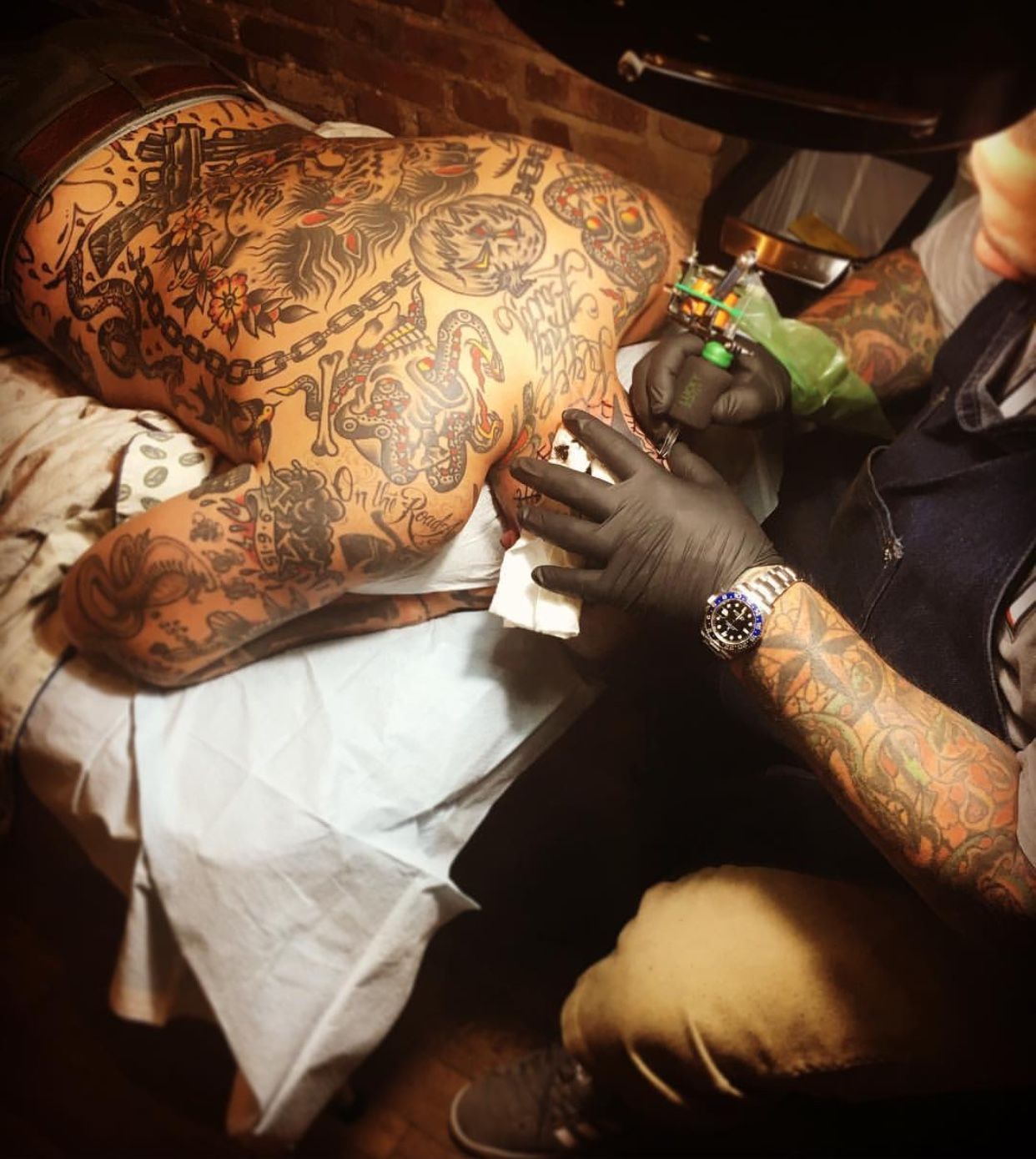
The back is packed: “Keep the Faith” across the top, a jack-o’-lantern, skulls with snakes around the shoulder blades, three horse heads, flowers, chains and crossed guns lower down.

The images cluster around darker subjects: death, horror art, damaged things, animals and writing. They make the back look like a patchwork that grew over time, rather than a single piece laid out all at once.

Frank Iero’s large back tattoo work
Frank Iero’s back is covered with skulls, snakes, horses, flowers, chains and lettering.

Snakes run down his sides, with cracks, skulls and small birds nearby. They’re easy to miss in a full-body photo; close-ups show how many separate pieces make up the back.

Frank Iero’s chest pieces

The chest has changed over the years. Older photos show “Hope” and “x Jamia x”; later ones show the large “I Am A Graveyard” piece and more heavy work across the upper chest.

“I Am A Graveyard” fits the gloomy wording Frank often chooses, but it also sits within a larger composition of bold shapes, color and black shading. Older lines remain visible beside or beneath newer tattoos, so the chest shows work from different periods.

Frank Iero’s chest tattoos
A close photo shows Frank Iero’s crowded chest tattoos and colour work.

Some tattoos are still easy to see; others have been partly covered or blended into newer work. That’s why the same area can look different in photos taken years apart.

Hand tattoos and the “Bookworm” trick

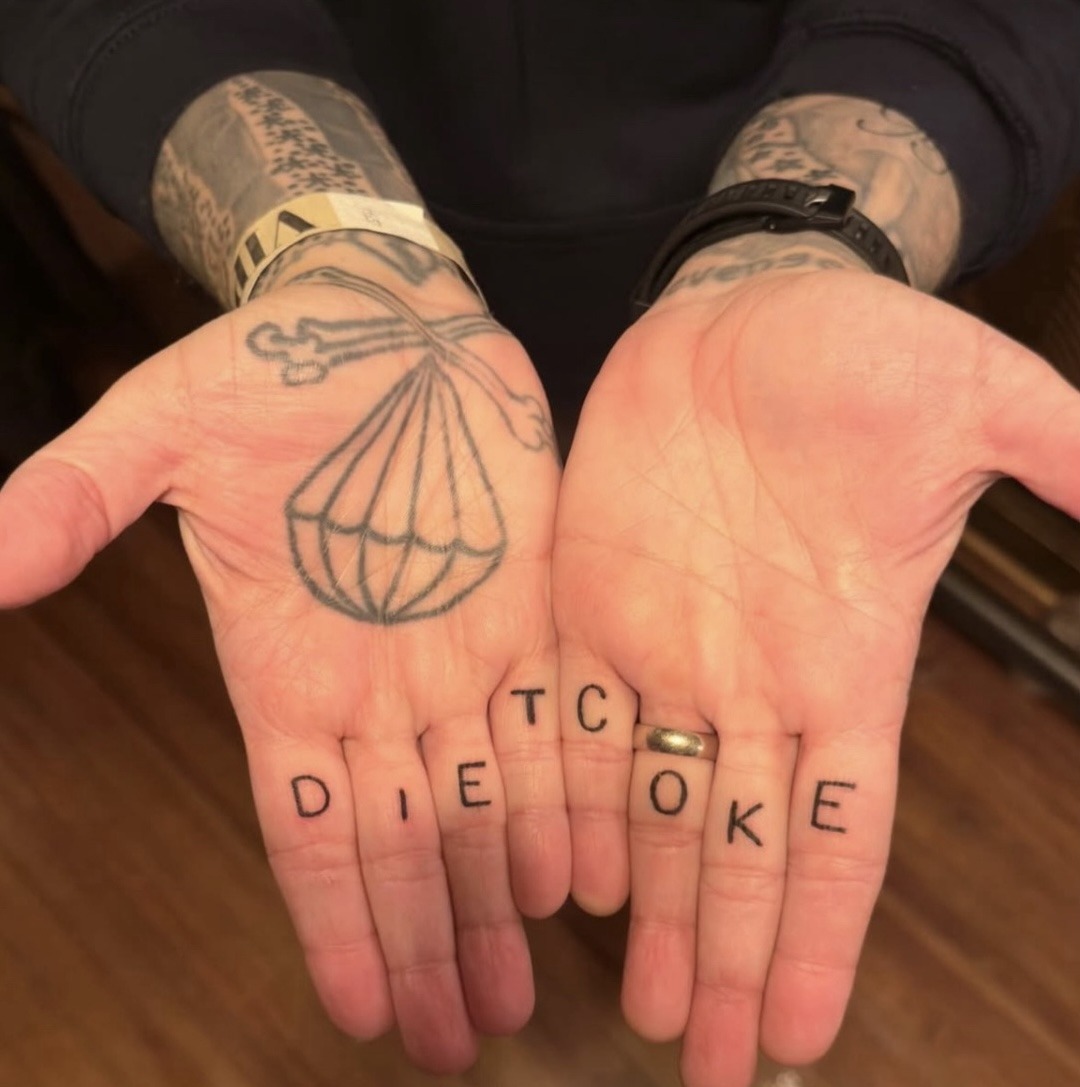
His hands hold several small tattoos. “Bookworm” is one of the clever ones: The word only reads properly when Frank puts his fingers together. It’s a small visual joke, not a design that needs a long explanation.

“Diet Coke” runs across his fingers, and a parachute with crossed bones sits on his palm. Another photo shows a Yankees logo on his thumb, with the number 13 below the nail. They’re easy to see when he holds a microphone or guitar.

Frank Iero’s palm and finger tattoos
Frank Iero’s palms and fingers show the parachute, crossed bones and “Diet Coke” lettering.

His feet are tattooed too: “Doom and Gloom” across the toes, with a demon face on each foot. The title is as direct as the artwork.

Leg tattoos, hearts and strange little characters

His legs carry a panther on the knee, a Wu-Tang Clan logo, a barbed-wire heart, a bleeding heart, a Grim Reaper, a boxer, a Freddy Krueger glove, and a Joe Cool figure in a “Meh” shirt.

Some leg pieces are memorials; others are jokes. There’s a crossed-out cheese wedge, tiny bugs, a macaroni, a skull, “Kill’em all,” numbers and designs that look like running jokes between friends. The mix keeps the collection from becoming uniformly serious.

Frank Iero’s detailed leg tattoos
A close-up of Frank Iero’s leg shows lettering, older cover-up work and several small designs.

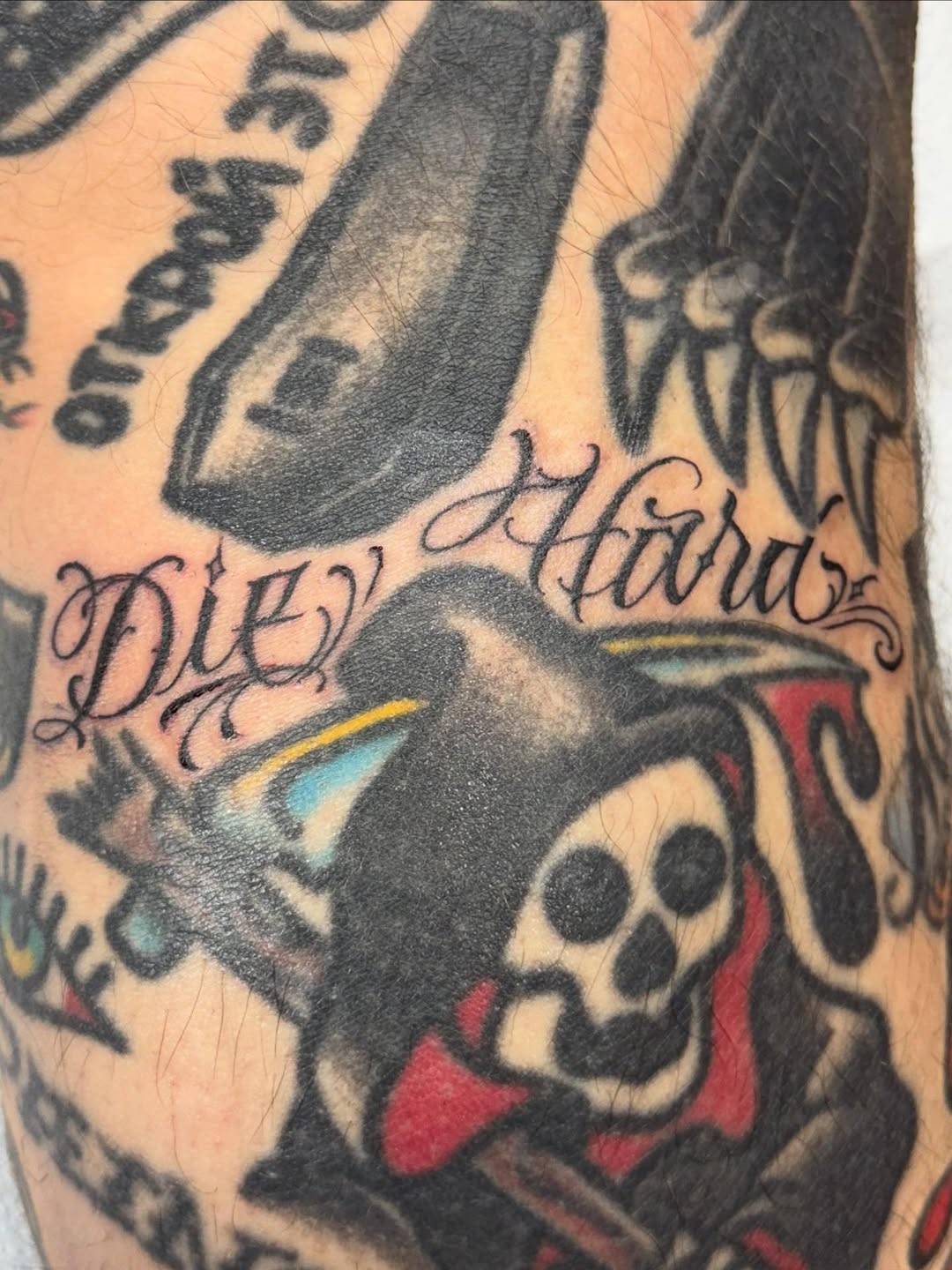
“My Blood, My Strength” surrounds a bleeding heart on his shin. The tattoo covers an older anatomical heart; Frank’s later work replaces it rather than leaving it untouched. The new image is brighter and easier to read, while the covered design remains part of the area’s history.

What Frank Iero’s tattoos say about his style

It’s hard to sort the collection into one style. Traditional hearts, band logos, horror images, family portraits, script, jokes and tiny symbols sit together. The tattoos look collected over time, not matched.

Some designs explain themselves; others need context. “Bookworm” is clear when you bring his fingers together; the grandfather portrait makes more sense with the LA Ink story. “Doom and Gloom” is direct. Other pieces may simply have looked good to him or fit a joke at the time.

There was no single plan. Frank kept adding tattoos he wanted to carry, then made room for the next one.

Watch Frank Iero talk about tattoos

This older interview shows Frank talking through some of his tattoos:

More musician tattoo guides

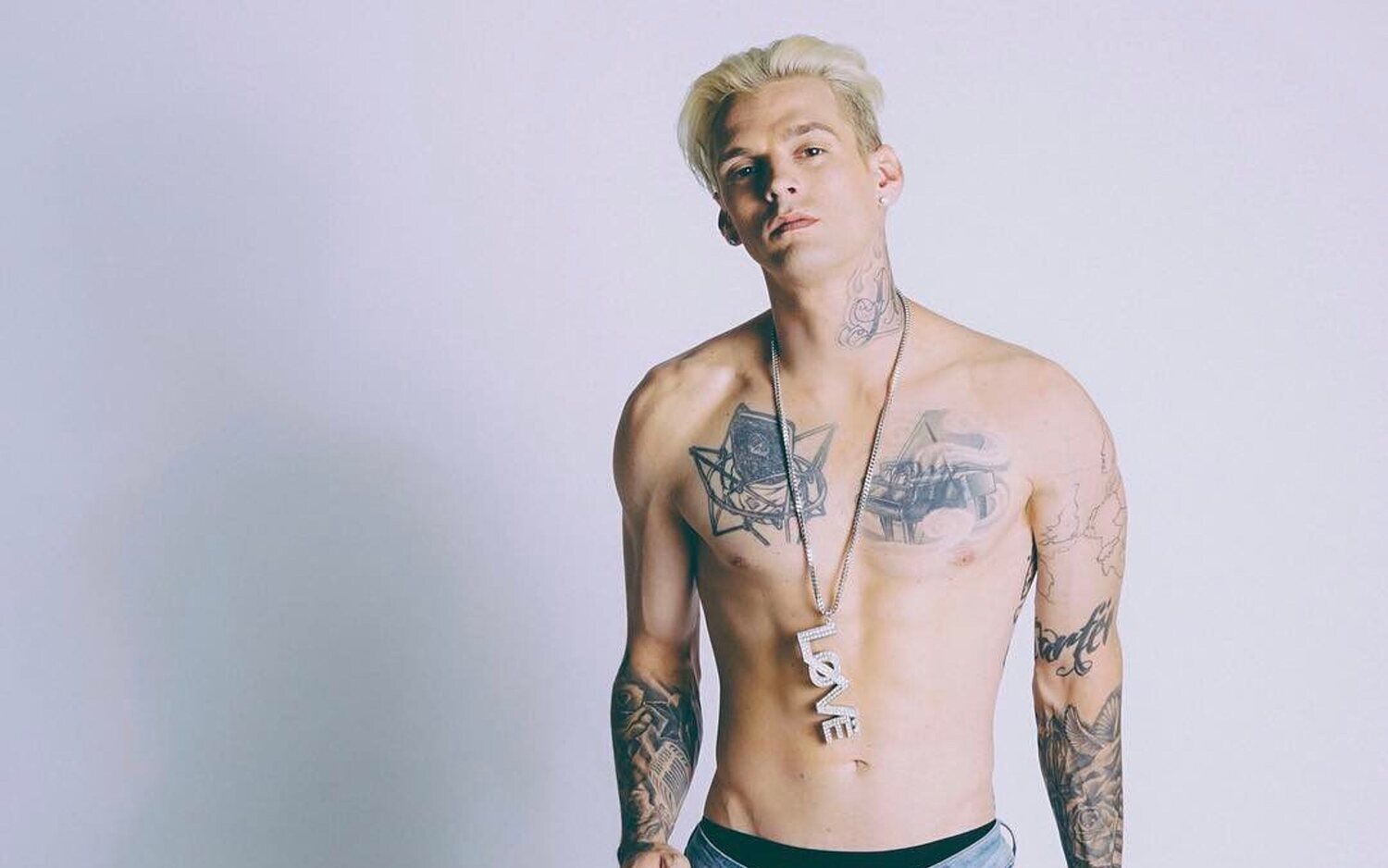
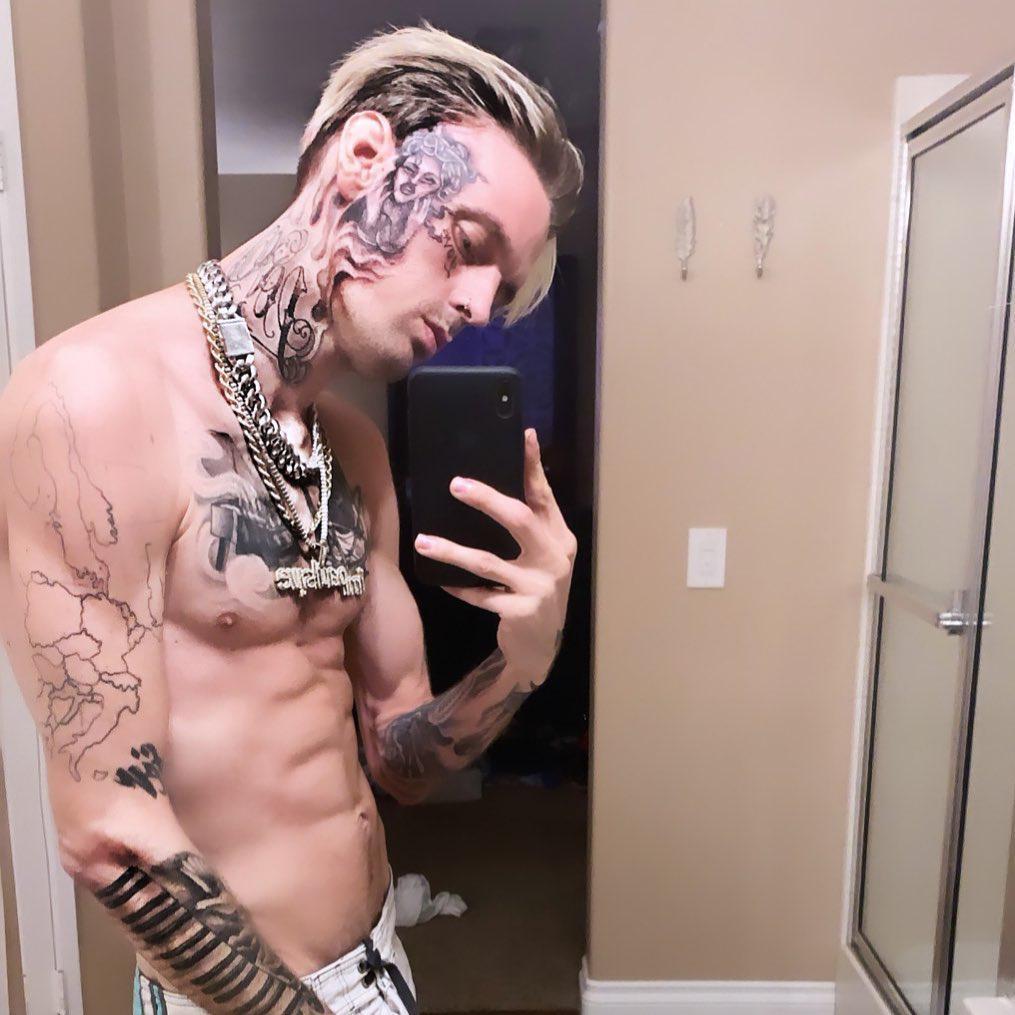
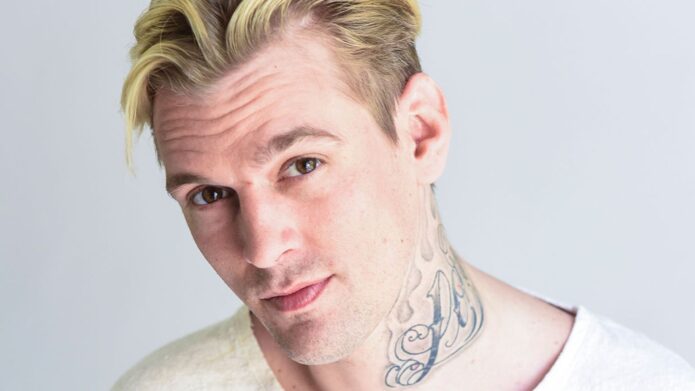
Aaron Carter Tattoos: His Chest, Neck and Face Ink Explained

Aaron Carter’s tattoos grew more visible over the years, spreading across his chest, neck, arms and face. Some designs were tied to music; later pieces changed the way he looked in photos and onstage.

His style shifted, and he spoke at different points about liking tattoos while also considering removal. The clearest account comes from dated photos and interviews, which show how the chest work, neck lettering and face tattoo appeared at different times. The site has more musician tattoo stories.

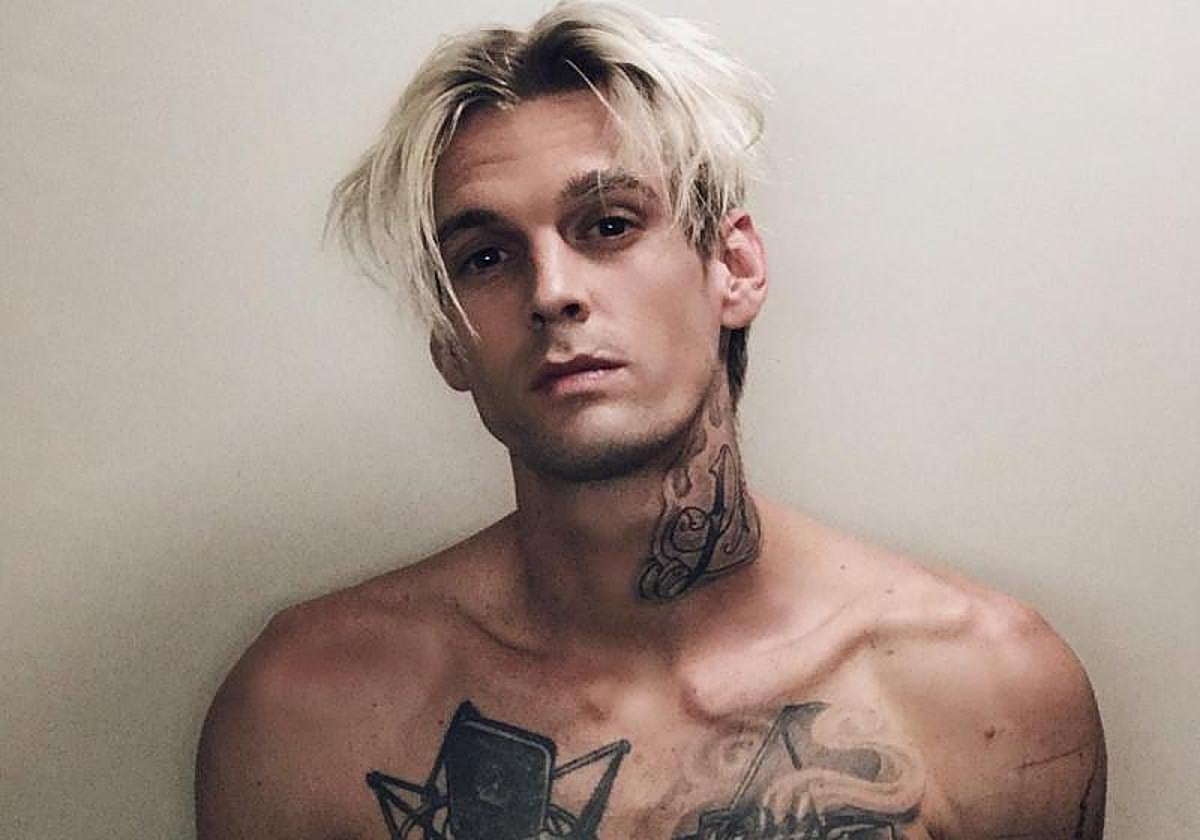
Aaron Carter’s microphone chest tattoo

Aaron Carter microphone and chest tattoos

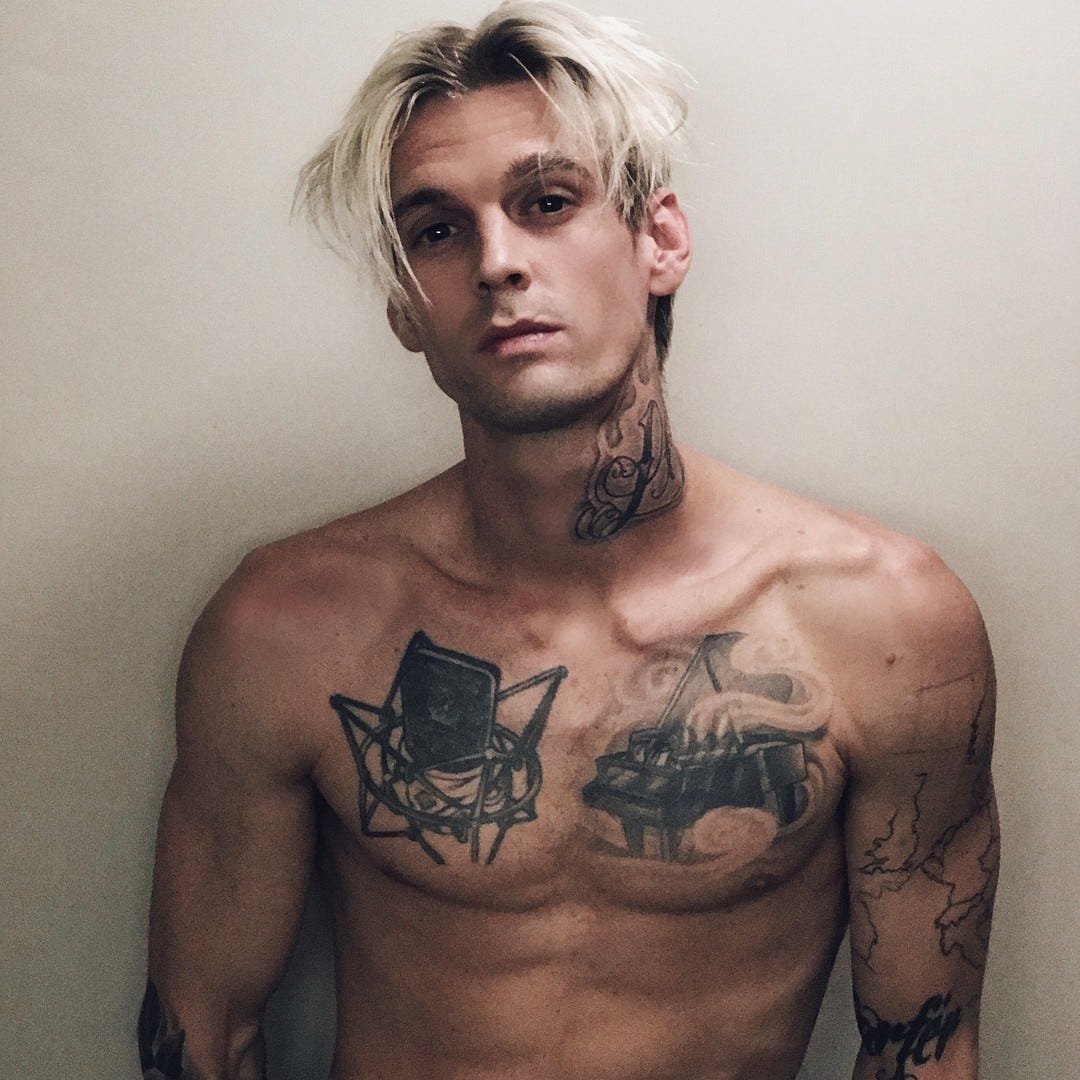
A microphone sits high on Carter’s chest and is visible in several shirtless photos. Singing was central to his career from childhood, so the music design fits the public image he had built.

In wider photos, the microphone sits among darker lines and other pieces. Carter added work around existing tattoos over time, leaving the chest looking more like a patchwork than one isolated design.

What is clear: the microphone appears in multiple portraits. The exact date and artist aren’t well documented.

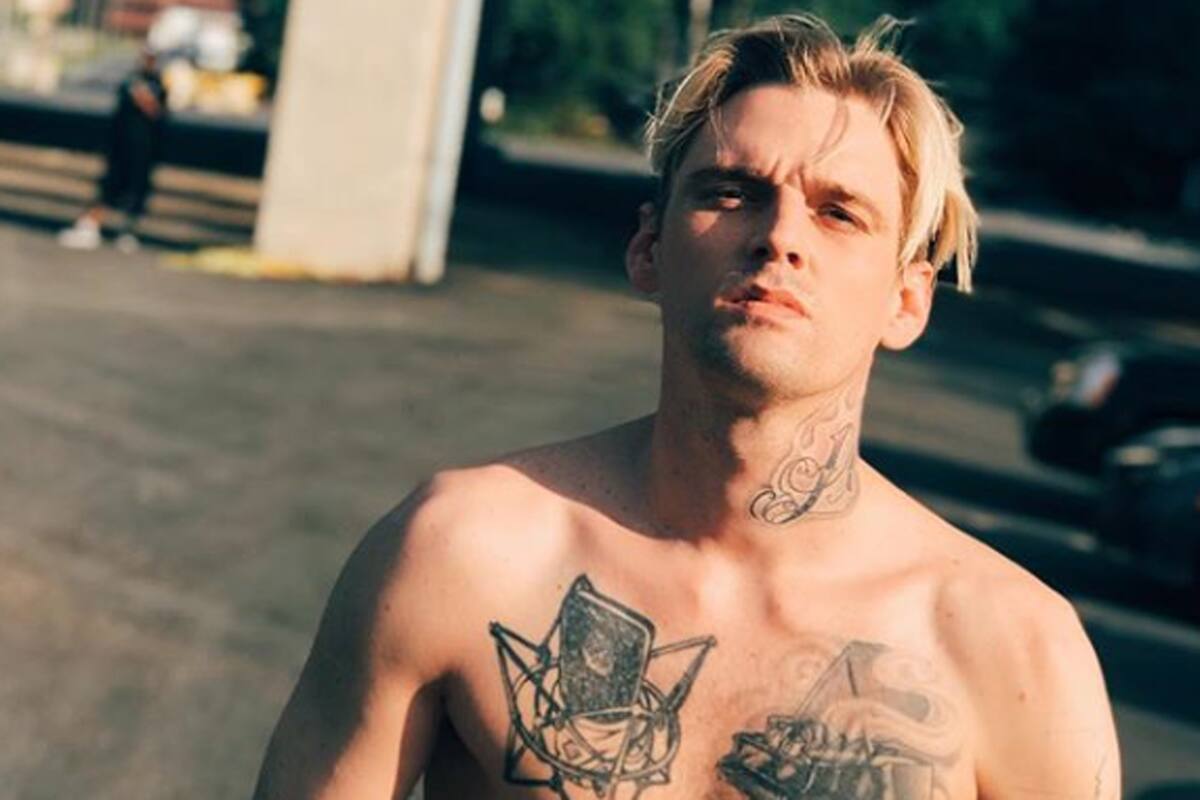
The grand piano tattoo on his chest

Aaron Carter grand piano and torso tattoos

A grand piano appears on the other side of Carter’s chest. In wider photos, it sits opposite the microphone and gives the chest a clear music theme.

The two designs point to performing and music-making, though Carter hasn’t offered a detailed explanation of the pair. A close crop can make the chest look like one large dark area; from farther back, the separate pieces are easier to make out.

The piano was part of the main chest layout, not a small hidden tattoo. Chains and necklaces often crossed the area in photos.

The large LOVE tattoo across his neck

Aaron Carter LOVE neck tattoo

The large word LOVE across the front of Carter’s neck became one of his most recognizable tattoos. It appears in many later portraits and changed how his face and neck looked together.

Carter later discussed removing some tattoos because he wanted more options for acting and other work. That doesn’t establish that the neck piece was removed; it shows that his views on his ink shifted over time.

Smaller lines and shapes sit around the lettering. Shadows and photo angles hide some details, so it’s best to stick to what can be seen.

The side-of-neck and profile work

Profile photos show additional linework wrapping toward the side of Carter’s neck and close to his jaw. Some lettering and curved shapes are visible, though they’re easy to miss in straight-on pictures.

From the side, the coverage looks more connected than it does in a front-facing photo. The ink continues around the neck instead of ending at the word on the front.
The meaning of every mark in this area hasn’t been confirmed. The photos show extensive neck work, but they don’t explain each symbol.

His face tattoo and the LOVE mark under the eye

Aaron Carter face and neck tattoo view

In 2019, Carter showed a large Medusa design on one side of his face. Photos from that period also show a small LOVE mark beneath his eye.

Carter said his mother inspired the Medusa tattoo. The design drew a lot of attention because it changed his appearance so sharply; that explanation is more reliable than guesses about the meaning of each snake or line.

The broad design and the small lettering can be seen in photos, but the symbolism of every detail hasn’t been fully explained.

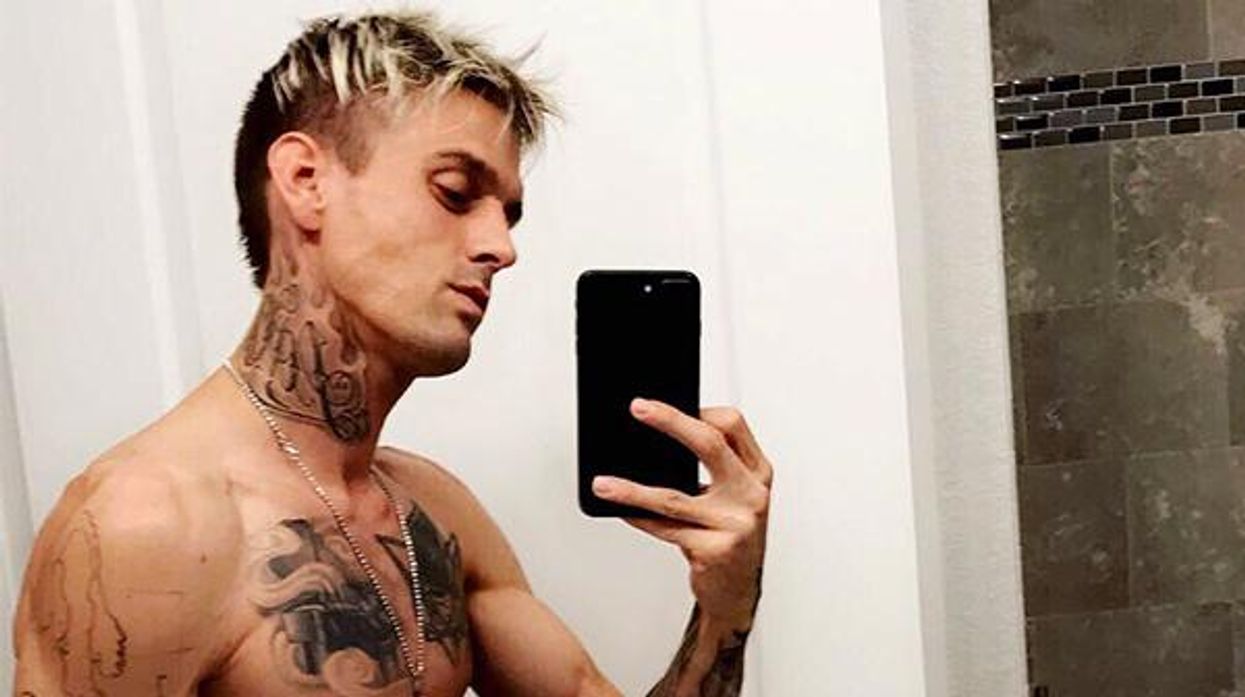
How the arm and torso tattoos fit together

Aaron Carter bathroom neck and torso tattoos

Carter’s arms and upper torso carried smaller designs around the larger chest and neck pieces. Wide photos show ink down both arms, while close-ups reveal lines and shapes that can disappear in a crop.

The coverage built up over time rather than forming one even sleeve. Some areas look dense and dark; others leave more skin visible.

Lighting, filters and camera angles make smaller details hard to identify. The photos support broad coverage, but not a confident label for every blurred shape.

Why Aaron Carter’s tattoo style kept changing

Aaron Carter face neck and arm tattoos

Carter’s tattoo collection changed alongside his public look. The microphone and piano brought music to the chest; the LOVE neck tattoo was more prominent, and the Medusa face piece pushed the change further.

He also talked about removal, showing that his view of tattoos could change. Those comments add context to why photos from different years may look so different.

It helps to compare images by date. The chest designs, neck lettering and face tattoo belong to different points in his life, not one fixed snapshot.

Watch Aaron Carter discuss tattoo removal

The video below shows Carter discussing removal and a laser session, adding his own perspective on how he felt about some of his tattoos.

More musician tattoo guides

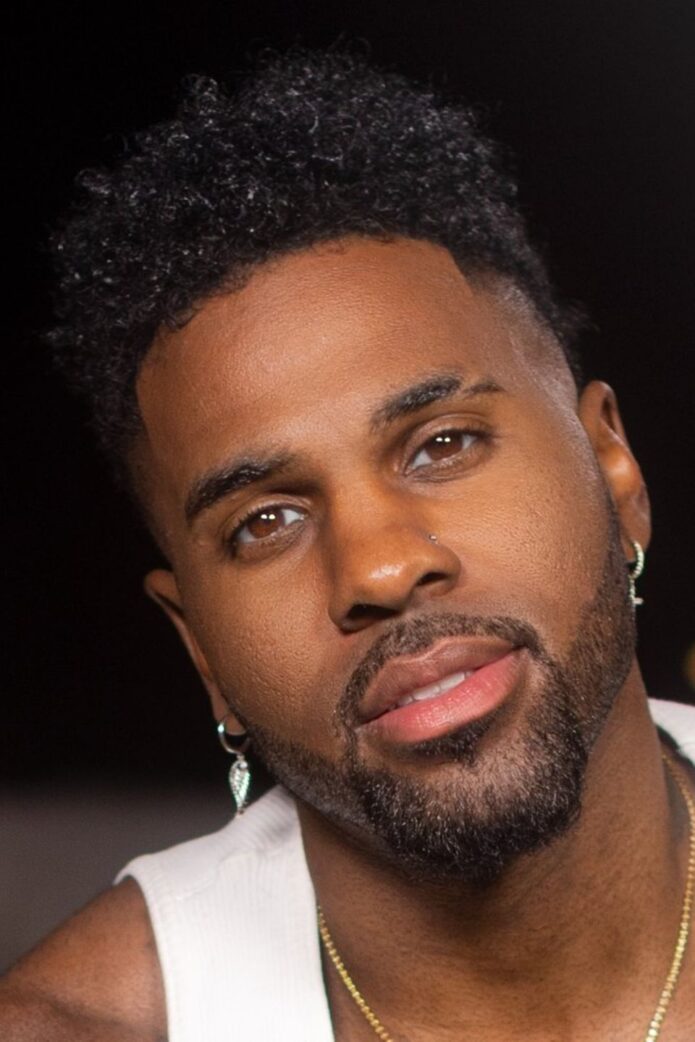
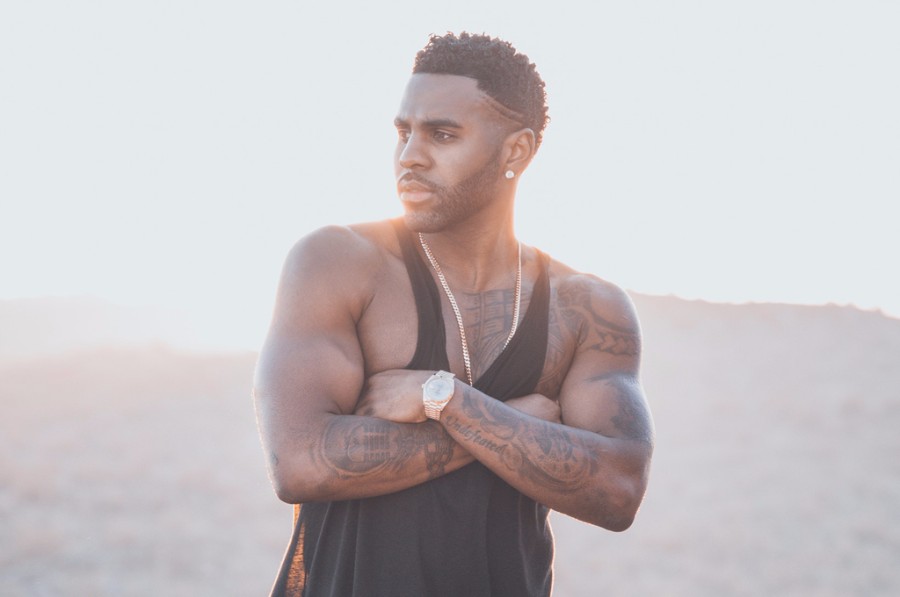
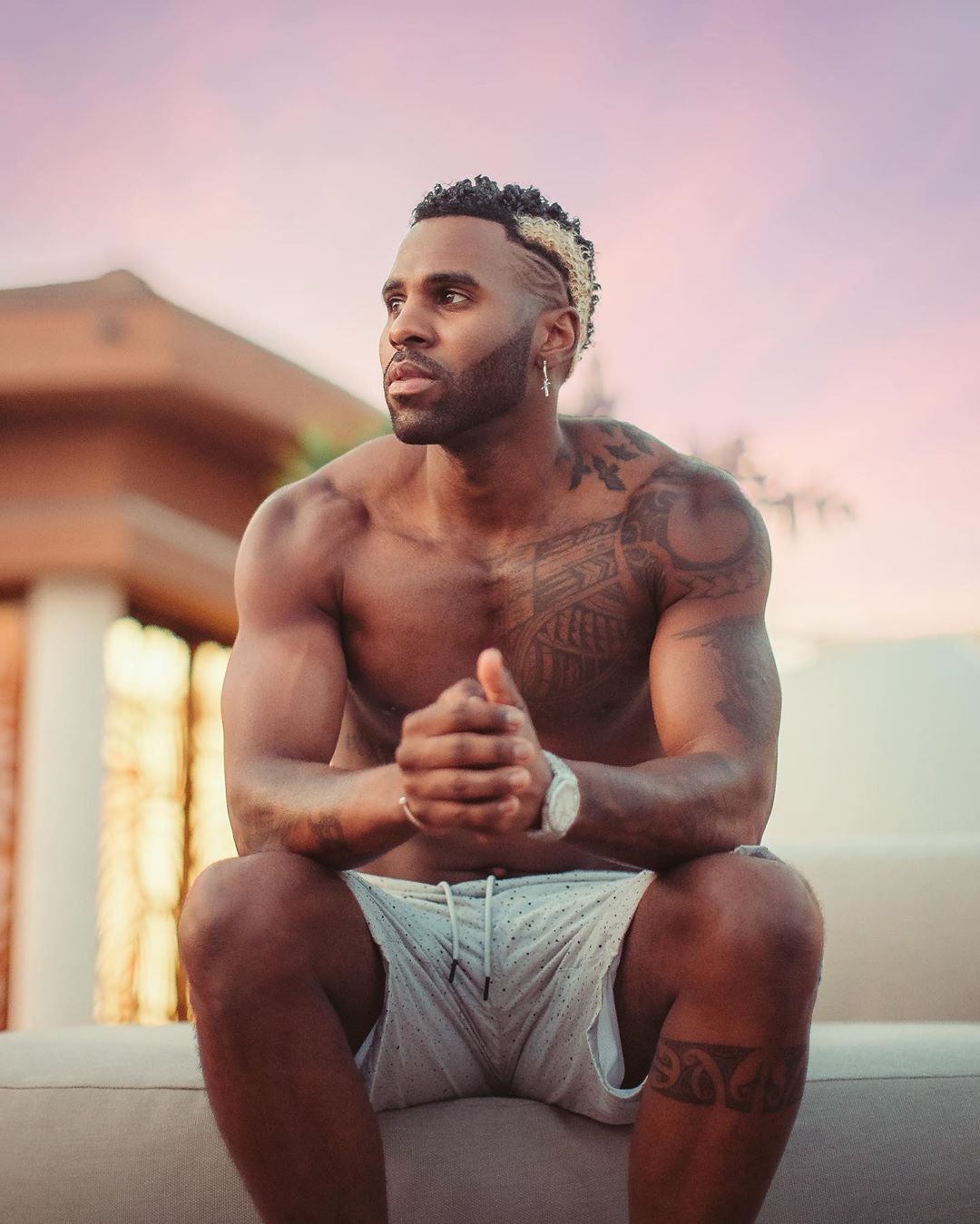
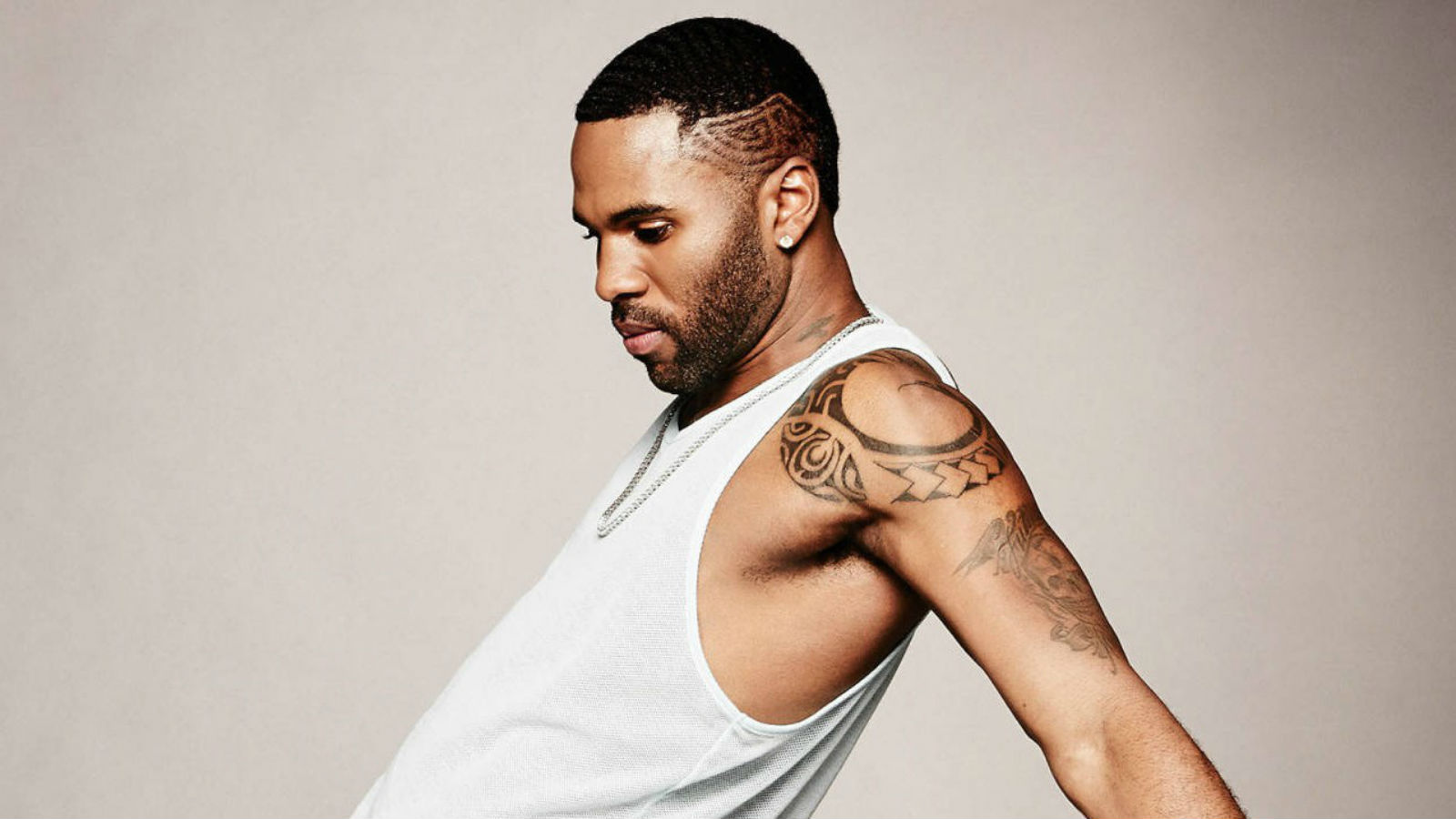
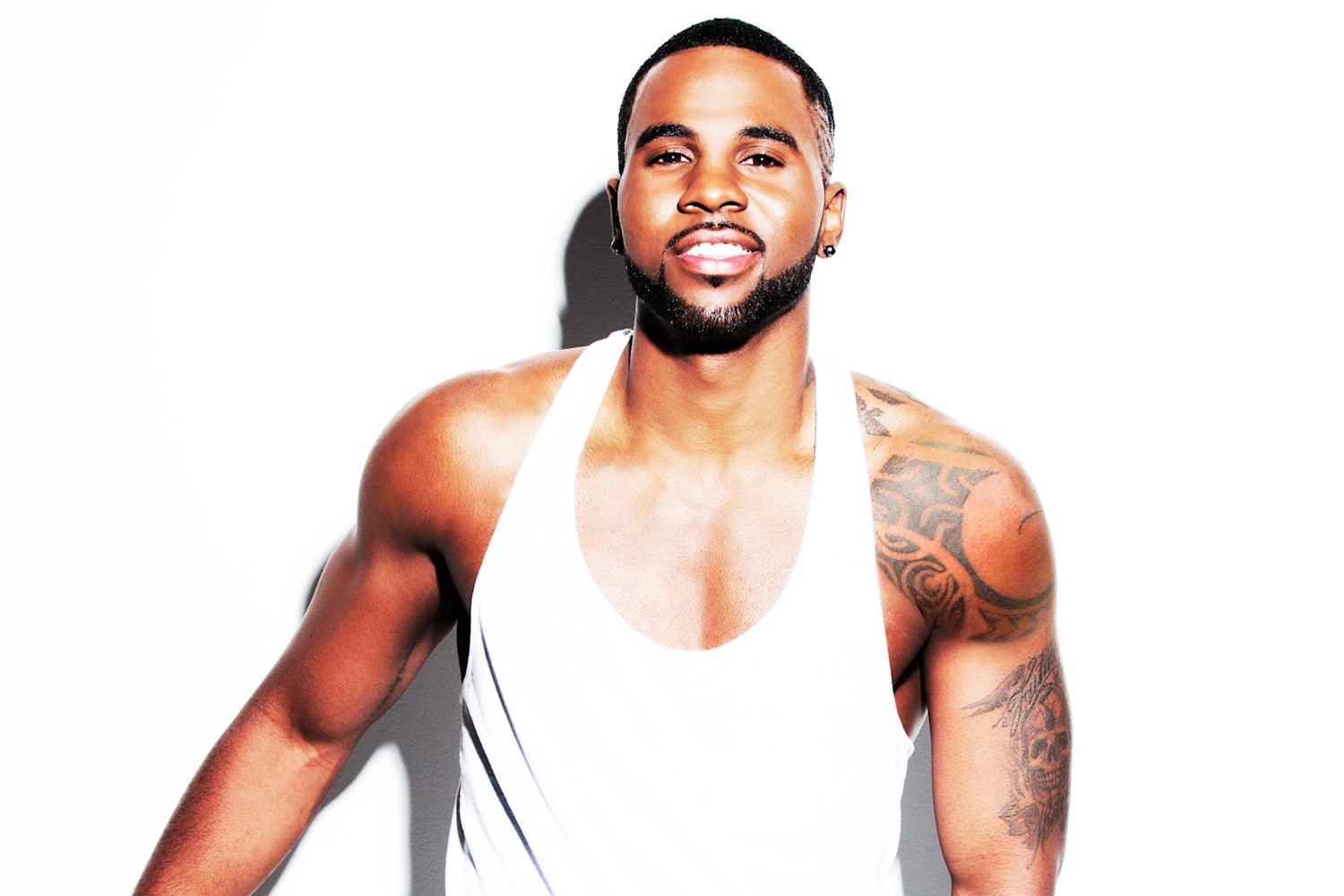
Jason Derulo Tattoos: Tahitian Warrior, Chest and Arm Ink

Jason Derulo’s tattoos range from a large Tahitian warrior design on his shoulder to the fine-line name of his son, King. He has described his ink as marking different chapters in his life, and photos show pieces across his shoulder, chest, arms and leg.

Some stories come from Jason’s own interviews; the meaning of every smaller mark hasn’t been explained. This profile sticks to what he has said and what the photos show. More music profiles are in the site’s musician tattoo collection.

Jason Derulo’s Tahitian warrior tattoo

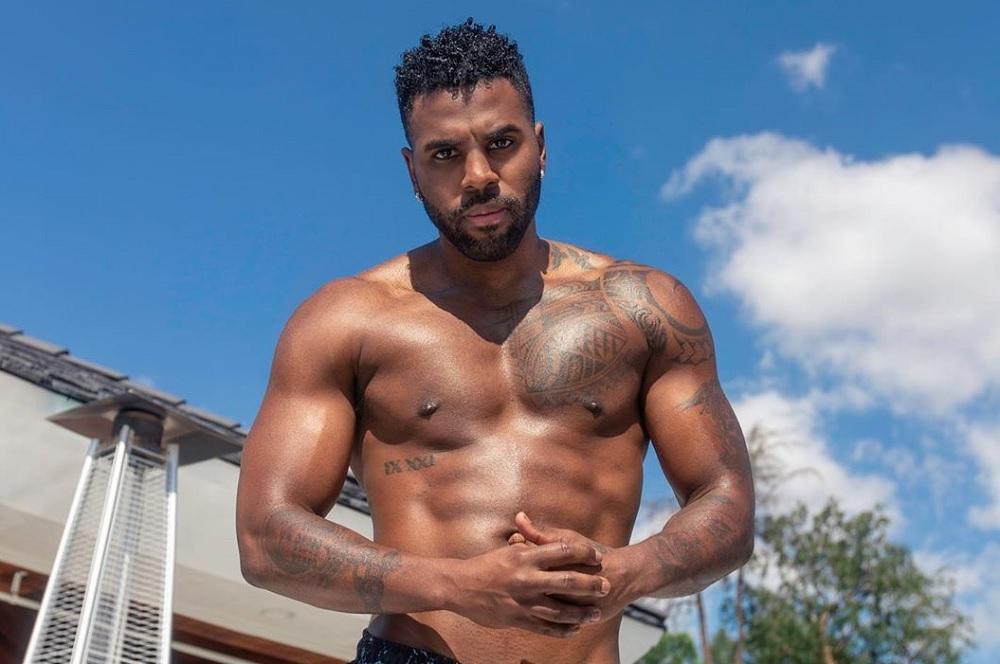
Jason Derulo Tahitian warrior shoulder and chest tattoo

The largest and best-known piece covers Jason’s left shoulder and extends onto his upper chest and arm. Bold black shapes follow the shoulder, forming a connected pattern rather than a small, separate image.

Jason has said he got the warrior design during a trip to Bora Bora. He described it as a symbol of the fighter in him. That is the clearest explanation he has given for the tattoo.

Coverage often calls the pattern tribal and links it to Tahitian and Polynesian-inspired work. Those labels can be broad, so it’s better to describe the design and keep Jason’s own explanation in view.

The large chest and shoulder pattern

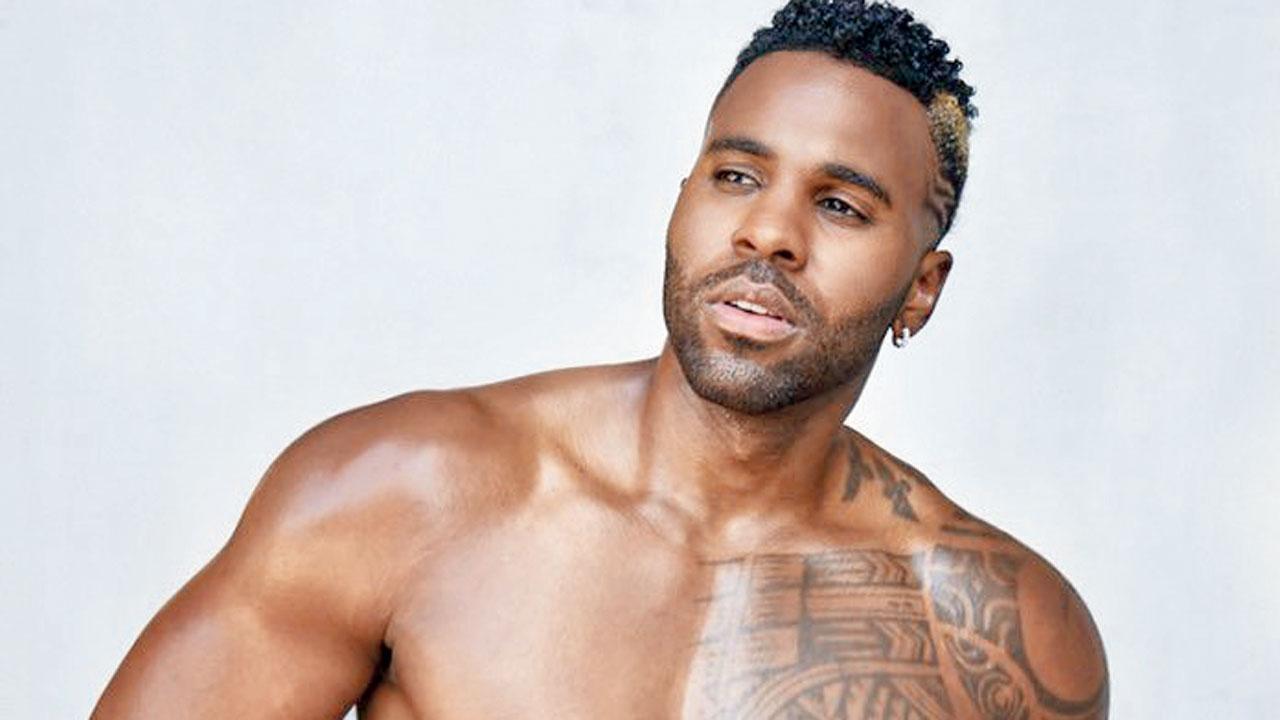
Jason Derulo chest and shoulder tattoos

From the front, the shoulder piece joins a wider pattern across the upper right side of Jason’s chest. Dark bands, curves and geometric lines follow the chest and shoulder.

Large areas of black and strong outlines keep the shapes visible in wider photos. In some pictures, the pattern can look like armor because it follows the contours of his upper body.

Jason hasn’t explained each part of the chest design separately. The warrior story is documented; the smaller shapes are easier to describe by appearance than by name or meaning.

Jason’s arm tattoos and sleeve-style ink

Jason Derulo arm and chest tattoos

Jason’s arms carry darker bands, lettering and smaller designs that extend the shoulder work. Photos show substantial coverage, though the ink doesn’t form one continuous sleeve from wrist to shoulder.

Some details are clearer in sleeveless photos than in red-carpet shots, where a jacket or the lighting can hide them. A close view is often more useful than a picture taken from across a stage.

Jason has described tattoos as markers of different chapters. The mix on his arm looks like pieces added over time, rather than one large project planned all at once.

The smaller chest, neck, and side tattoos

Jason Derulo shoulder arm and neck tattoos

Photos also show smaller designs around Jason’s chest and near his neck, along with lettering and compact symbols on his arms. They can be hard to make out in performance shots but clearer in portraits.

One fine-line tattoo bears the name of his son, King. Jason pointed it out in a recent conversation and joked that it looked different from the larger pieces around it.

The scale is a sharp contrast: the warrior pattern is bold and wide, while King’s name is small and direct. Jason hasn’t said that every design needs to match the others.

Matching tattoos and tattoos tied to relationships

Jason Derulo shoulder tattoo portrait

During his relationship with Jordin Sparks, Jason spoke about a matching tattoo they shared. He discussed it in an interview around the release of his album Tattoos.

A matching design can take on a different meaning after a breakup. Jason’s public comments confirm the tattoo and that it was tied to the relationship; they don’t tell us everything about how either person felt about it later.

The album title also played with the idea that songs, like tattoos, can mark a period in someone’s life. Jason wasn’t saying every song described a particular tattoo. He was talking about how memories can stay with you.

How Jason Derulo’s tattoo collection has changed

Jason Derulo shoulder and arm tattoos

Older photos show less coverage than later ones, especially around Jason’s shoulder, chest and arms. Much of the newer work appears to have been added around existing pieces.

Jason has described his tattoos as meaningful. The clearest stories are the warrior design from Bora Bora, the relationship-related matching ink and the name of his son. Other designs are best described by what the photos show.

Travel, family and relationships all appear in his tattoo history, alongside designs whose meaning he hasn’t shared. The collection has changed over time, rather than staying fixed around one image.

Watch Jason Derulo talk through his tattoos

The video below gives a closer look at how the larger designs sit across Jason’s shoulder, chest and arms.

More musician tattoo guides

Kid Cudi Tattoos: Head Ink, Kurt Cobain Tribute and More

Kid Cudi’s tattoos aren’t random decoration. Some tie back to music and memory; others belong to the visual world he has built around himself. The clearest pieces show onstage. Others appear only when he wears a tank top, raises a hand to his face or posts a close-up.

There’s plenty of guesswork around his collection. I’m sticking to tattoos visible in clear photos or discussed in tattoo coverage; where Cudi has explained a meaning, I’ll say so. The rest stays open.

Kid Cudi’s big head tattoo

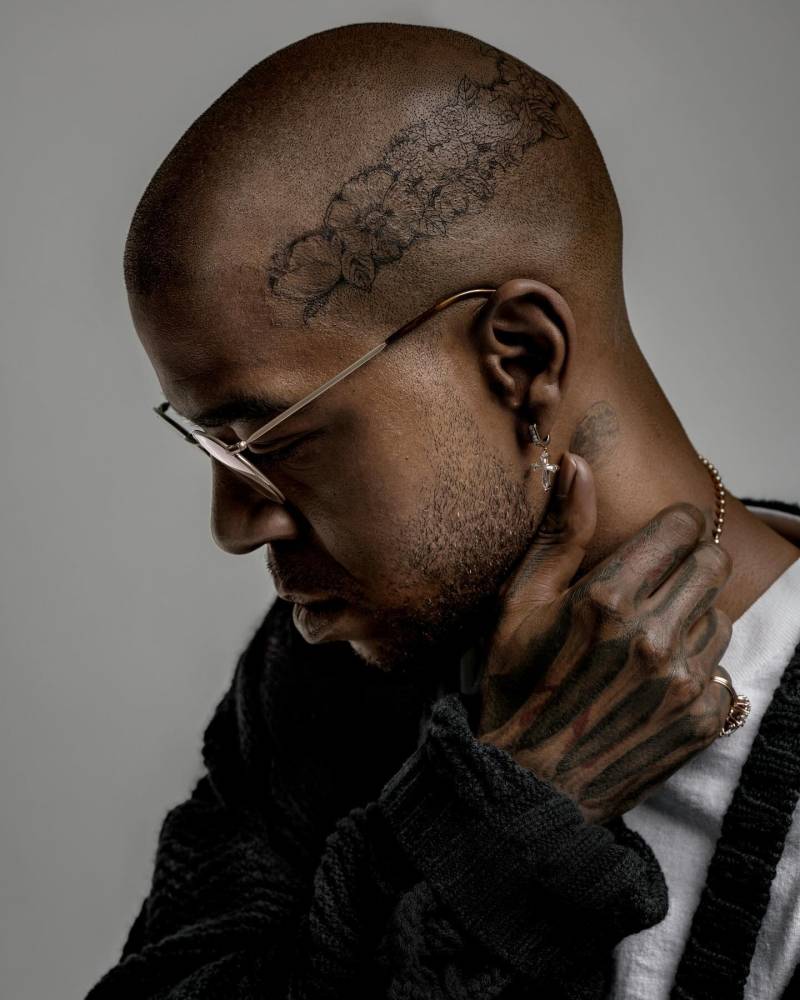
Kid Cudi floral head tattoo

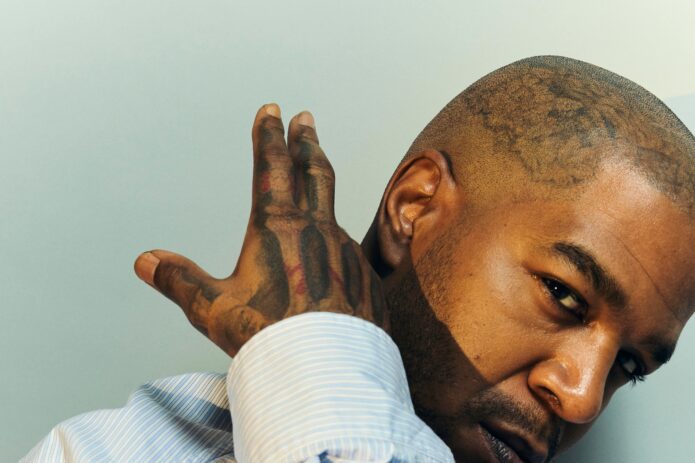
The largest recent piece runs over the top and side of Cudi’s head. Fine-line details frame the words “a view into my mind”. It’s a bold place for a tattoo, and it suits a musician whose work often lets listeners hear what’s going on in his head.

Tattoo coverage links the work to Dr. Woo, the Los Angeles artist known for small needles, clean outlines and plenty of open space. In photos, the design reads as a fine-line map across the scalp rather than a block of black; the shape of the head stays visible around it.

Cudi showed the tattoo around 2024, and viewers quickly focused on the words. They read like a statement about how he uses music to explain himself. The phrase also fits the rest of the collection, where many pieces connect to a person, a memory or a private idea.

The Kurt Cobain tribute on his arm

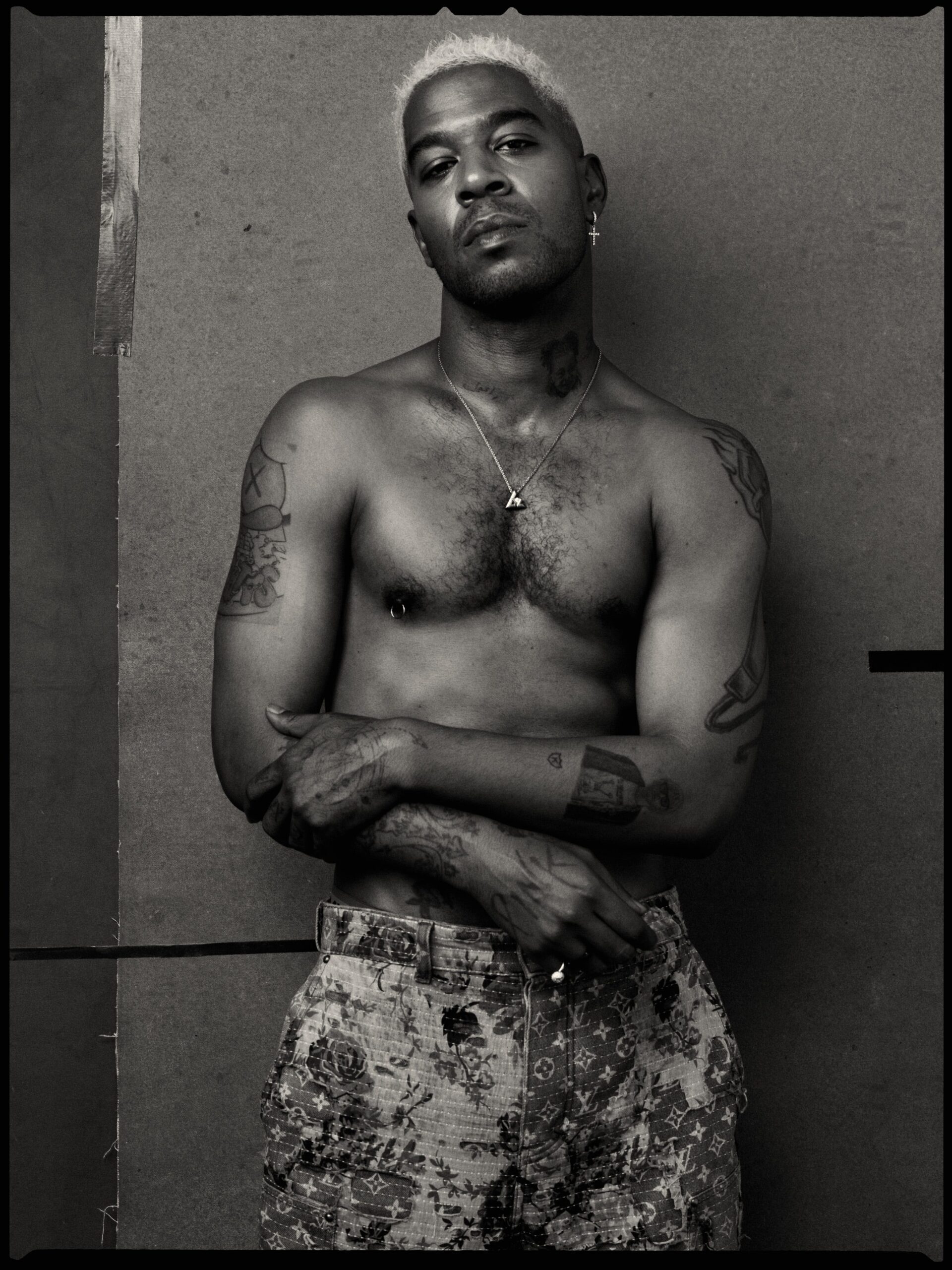
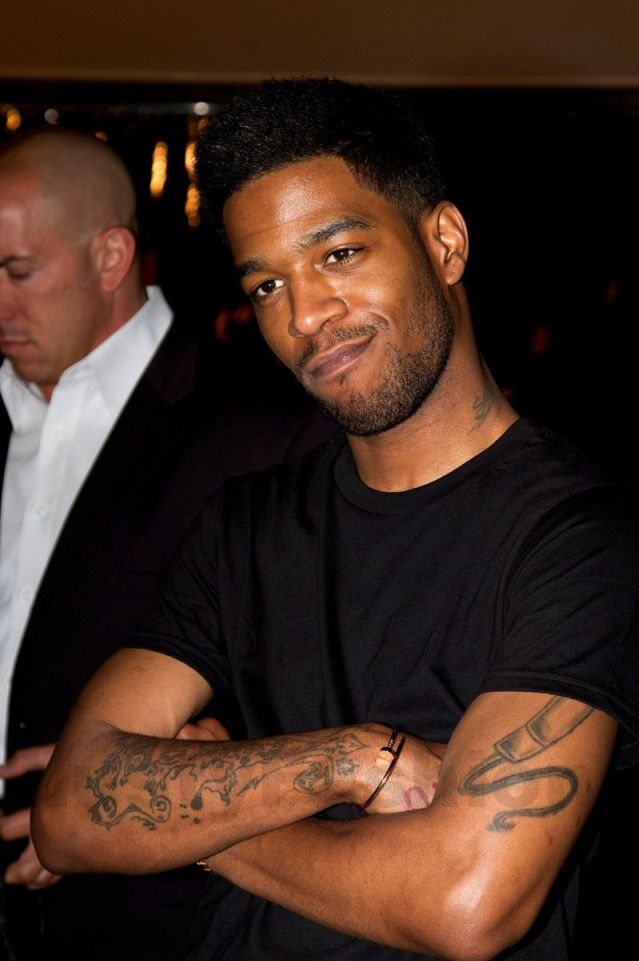
Kid Cudi shirtless showing arm and neck tattoos

One of the clearest stories in Cudi’s collection is the Kurt Cobain portrait on his forearm. It appears in shirtless and live photos. Cudi has spoken about Cobain with respect, making the tattoo a direct tribute rather than a design fans have to decode from a blurry picture.

Cudi has called Cobain an influence. Both artists turned uncomfortable feelings into music other people could hold onto. The portrait reads as a lasting reminder of that kind of honesty, which Cudi values in music.

Portraits can lose definition when they’re small or the photo is soft. In sharper images, the shape of Cobain’s face and hair is visible. The surrounding arm work gives the portrait space, so it doesn’t look like a sticker on otherwise bare skin.

The documented point is the link to Cobain’s influence, not a story about every line in the portrait. Cudi’s comments support the tribute. The finer details and the date he got it are less clear, so there’s no reason to invent a deeper explanation.

Hand tattoos, including the pinky ink

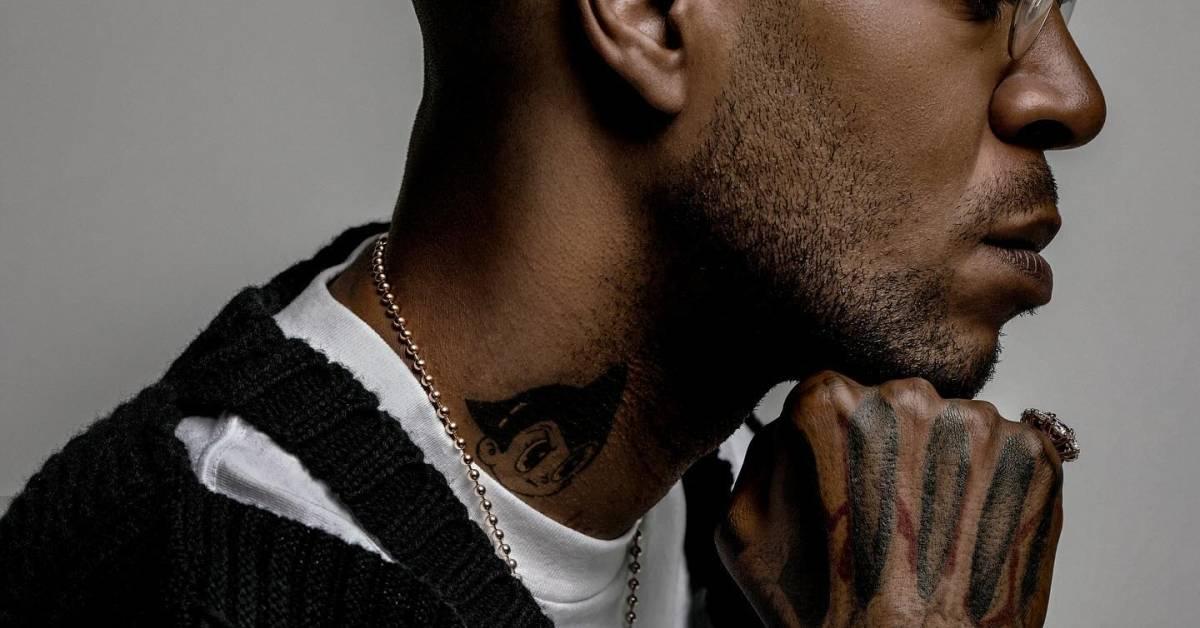
Kid Cudi hand and neck tattoo close-up

Cudi has tattoos on his hands and fingers. They show in photos when he holds a microphone, covers his mouth or poses with a hand near his face. One small design is often called a pinky tattoo, though that label seems to come from where it sits on the hand.

Hand tattoos tend to fade and soften faster than upper-arm pieces. They’re washed, bumped and exposed every day, so clear close-ups help. The photos show a group of small designs, not one glove-style tattoo.

Fine lines also climb from his hand toward the wrist and neck. They sit beside his rings and stage clothes, which helps them stand out in performance photos. There’s no full public guide to what each small mark means, so it’s better not to assign a story to every shape.

Moon Man and the space-themed ideas

Kid Cudi forearm tattoos visible with arms crossed

Cudi’s Moon Man character has been part of his music and visual world for years, especially through the Man on the Moon albums. Some tattoos have a spacey, map-like feel, with moon, sun and orbit details that sit naturally beside that identity.

A crescent or circle in a photo isn’t automatically a Moon Man tattoo. Online posts sometimes make that connection too quickly. Cudi’s tattoo imagery does share themes that recur in his records: night, distance, isolation, dreams and looking at life from just outside the crowd.

The forearm tattoos fit that loose visual language. They weren’t made as one matching sleeve, but together they look like a collection of symbols. That seems more in keeping with Cudi than a symmetrical, planned design. The pieces look gathered over time, each with its own small history.

The older GOOD and BAD head design

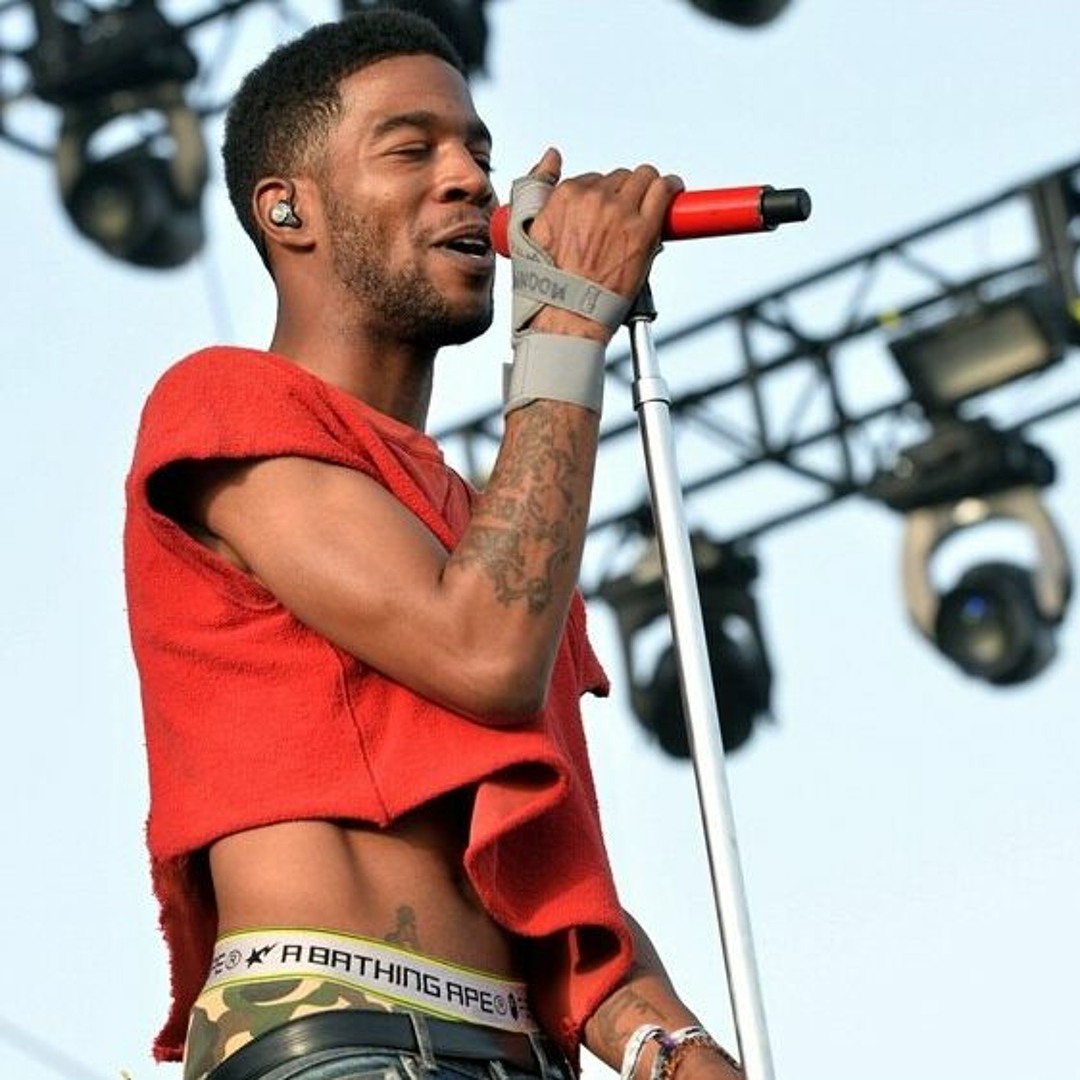
Kid Cudi performing with visible arm tattoo

Before the newer head piece drew attention, earlier coverage had documented a GOOD/BAD split-face design on Cudi’s forearm. It’s one of the earlier tattoos that shows how his collection has changed: graphic, easy to recognize and built around a clear contrast instead of fine shading.

The good-versus-bad theme can be read a few ways. It might point to tension in his music, different sides of his personality or the idea that people aren’t only one thing. Cudi hasn’t given a long explanation, but the design can still feel personal.

Performance photos show the tattoo as Cudi moves. It isn’t hidden under a sleeve or heavy stage makeup. The lighting changes its appearance, but the main shape stays clear beside the other arm pieces.

What Kid Cudi’s tattoos seem to have in common

Cudi’s tattoos often connect to identity and inspiration, but he hasn’t confirmed every meaning publicly. The Cobain portrait has a clear artistic link; the words on his head are visible and direct; and the Moon Man themes line up with his music. Other interpretations need room for uncertainty.

His tattoos have changed over time. Earlier pieces look more graphic and direct; newer work uses fine lines and lettering that follow the shape of his head, hand and neck. Taken together, they look less like random flash and more like a visual diary built piece by piece.

Kid Cudi talks about his ink

The linked video gives a quick look at the newer head tattoo and some older pieces: Kid Cudi got a new head tattoo.

For more music tattoo stories, browse the musician tattoo section. Here, I’ve stuck to designs visible in clear photos or tied to Cudi’s comments and published tattoo coverage, leaving fan theories out when there’s no evidence for them.

More musician tattoo guides

Ricky Martin Tattoos: Family, Spiritual Symbols and More

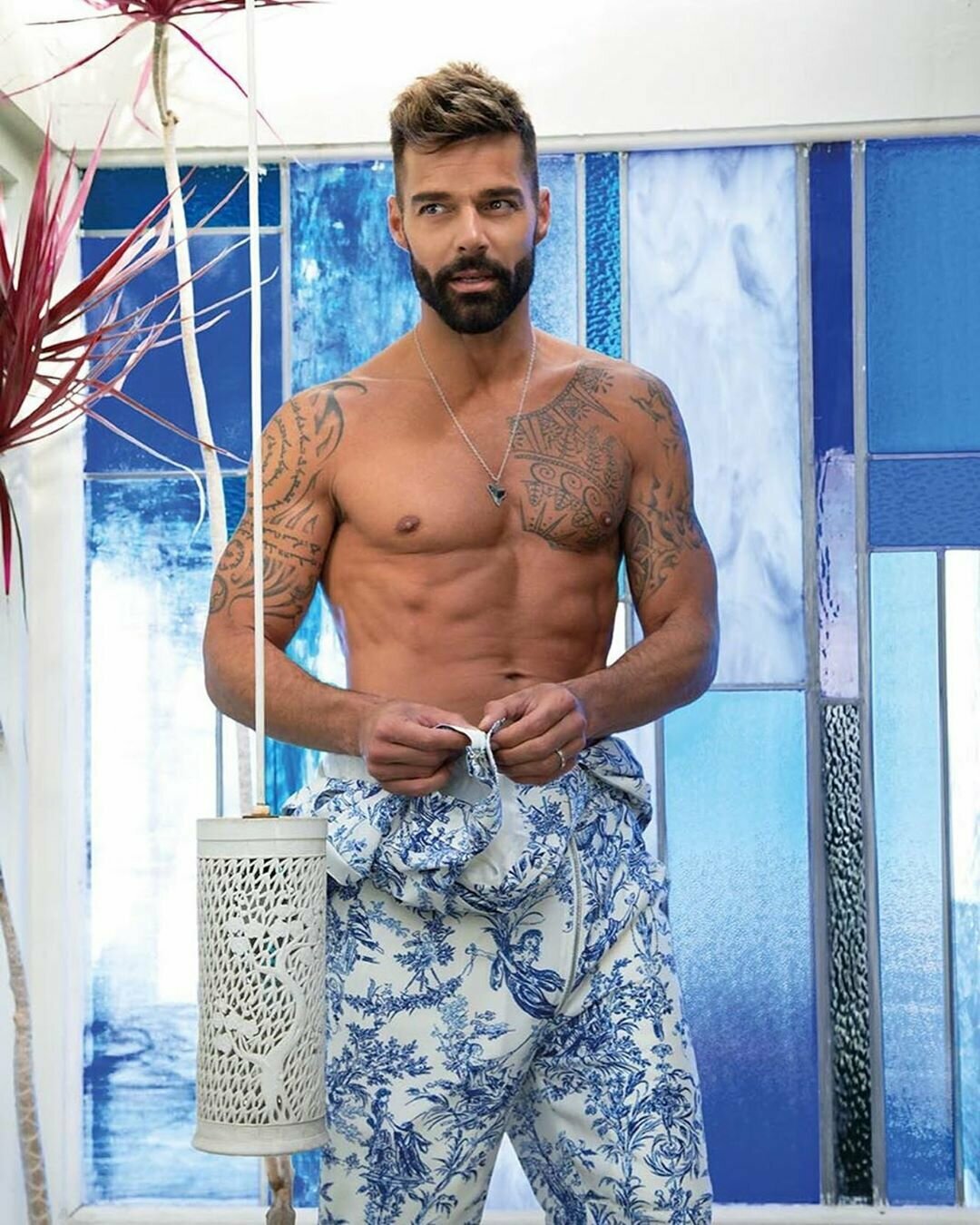
Ricky Martin’s tattoos include a figure surrounded by the four elements, an Aramaic prayer, family designs and symbols such as a lotus and Om. The collection combines large pieces with smaller marks across his arms, chest and leg.

Photos show different parts from year to year, and some older work has been covered or changed. This guide sticks to designs visible in clear pictures or described in tattoo coverage, keeping uncertainty where the explanation isn’t settled.

The four-elements tattoo on his left arm

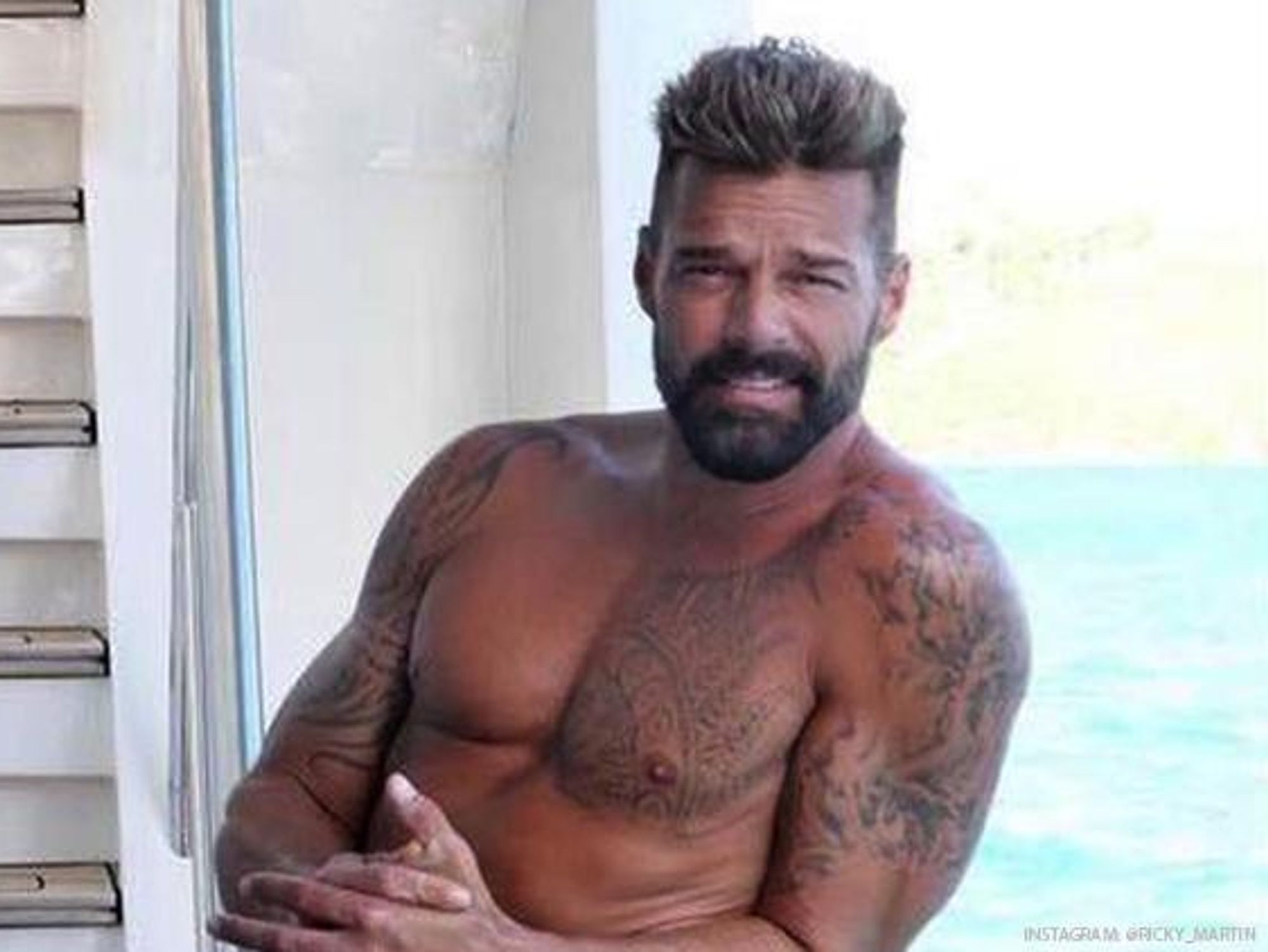
Ricky Martin showing chest and arm tattoos

One of Martin’s best-known tattoos is a female figure on his left arm, often described as surrounded by earth, fire, air and water. The large design is easy to see in sleeveless and shirtless photos.

Coverage connects the image to nature and the four elements. The shapes around the figure give it a more symbolic look than a stand-alone portrait.

Martin hasn’t explained every line in detail. The reported connection to the elements is the clearest account, so there’s no need to assign a separate meaning to each small mark.

The Aramaic Lord’s Prayer tattoo

Ricky Martin shirtless showing arm tattoos

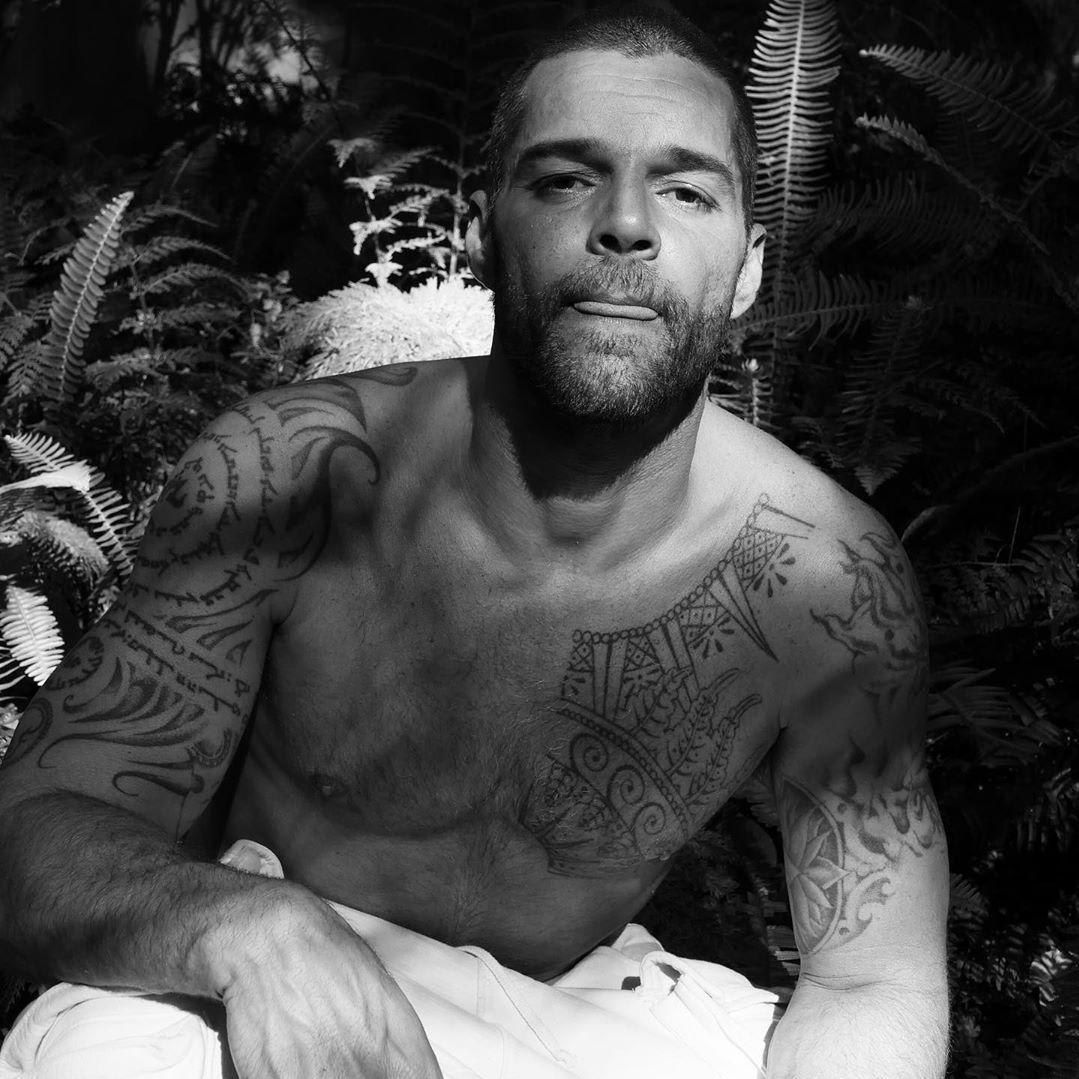
Martin has a prayer tattoo in Aramaic on his right arm. The script wraps around the arm like a band of writing, adding a spiritual piece to the collection.

Clearer shirtless photos show the writing following the shape of his arm. It sits among other symbols and images rather than replacing them.

Coverage describes the Aramaic text as a religious reference. Translations vary online, so the exact wording shouldn’t be treated as certain without a reliable source.

The tattoos linked to his children

Ricky Martin tattoo linked to his four children

Several tattoos have been described as tributes to Martin’s children: Lucia, Matteo, Renn and Valentino. Photos and tattoo guides show writing and symbols associated with his family.

Newer pieces have also been linked to his children and changes in his family life. Their placement is described differently across articles and photo crops, but the family connection recurs in coverage.

Martin has spoken about the importance of his children. The reported family designs fit that context, though the details of every mark aren’t laid out in a single public inventory.

The lotus, sun, and Om symbols

Ricky Martin showing lotus and arm tattoo details

Other tattoos identified in coverage include a lotus on the inner arm, a sun and an Om symbol. They’re smaller than the main figure and chest work, but add more spiritual and nature imagery.

The lotus is often read as a symbol of growth or change, while Om is associated with spirituality. Martin hasn’t published a complete explanation of each piece.

These symbols sit beside older designs rather than forming one uniform sleeve. Some are bold and dark; others leave more open space around the lines.

The chest and shoulder work

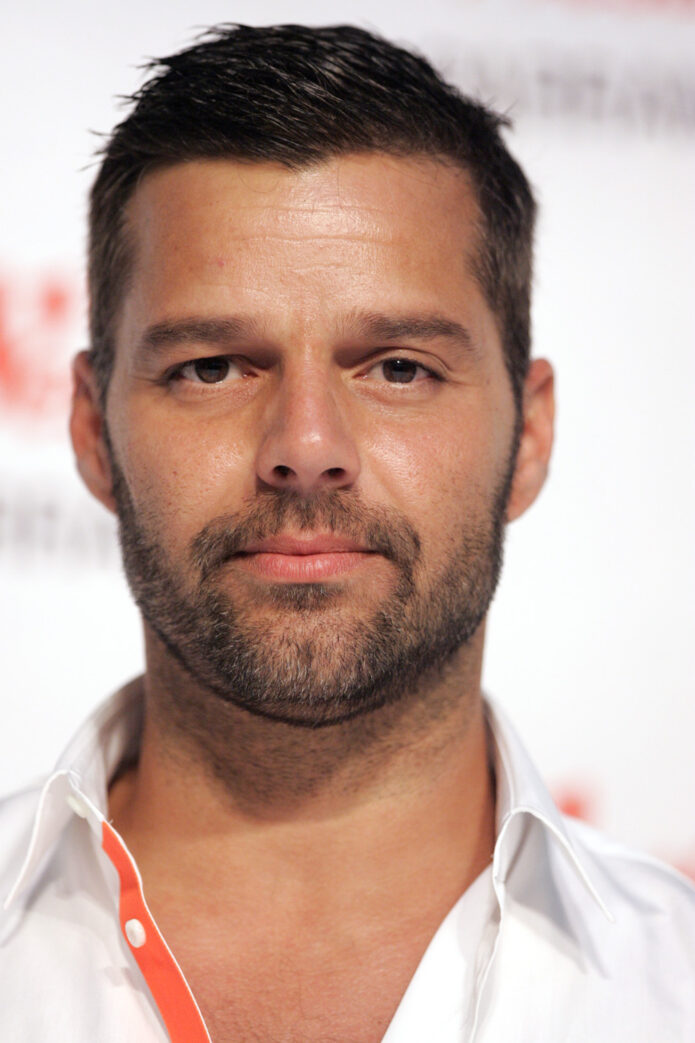
Ricky Martin tribal tattoos in sunglasses portrait

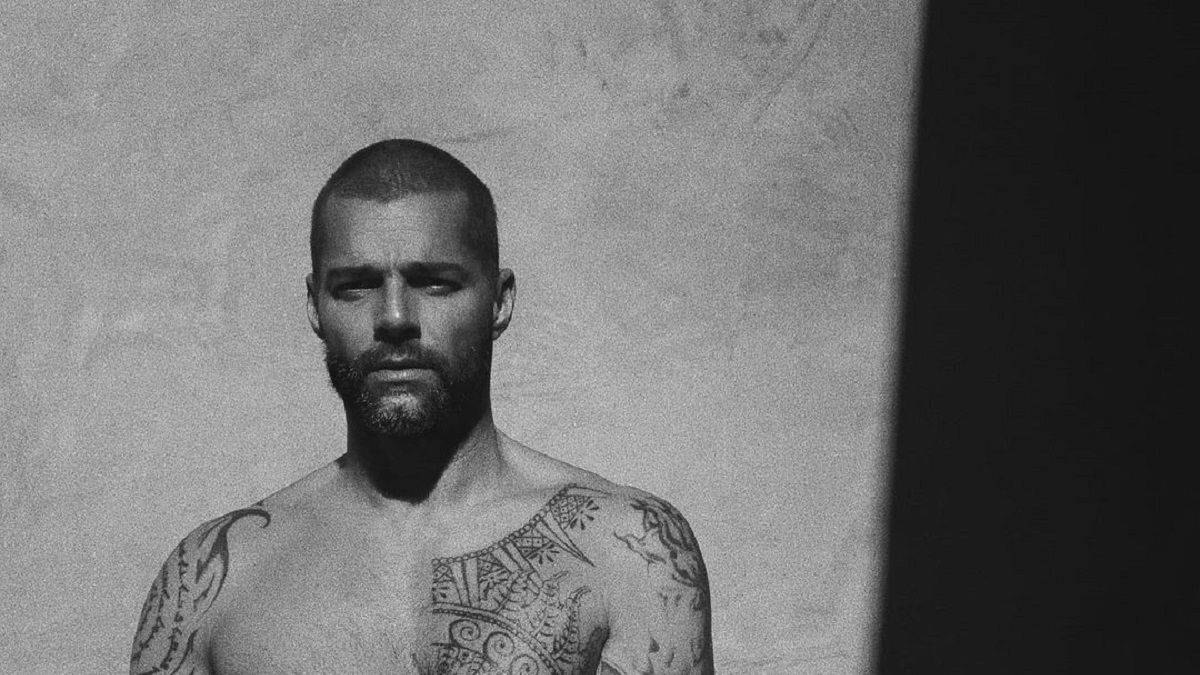
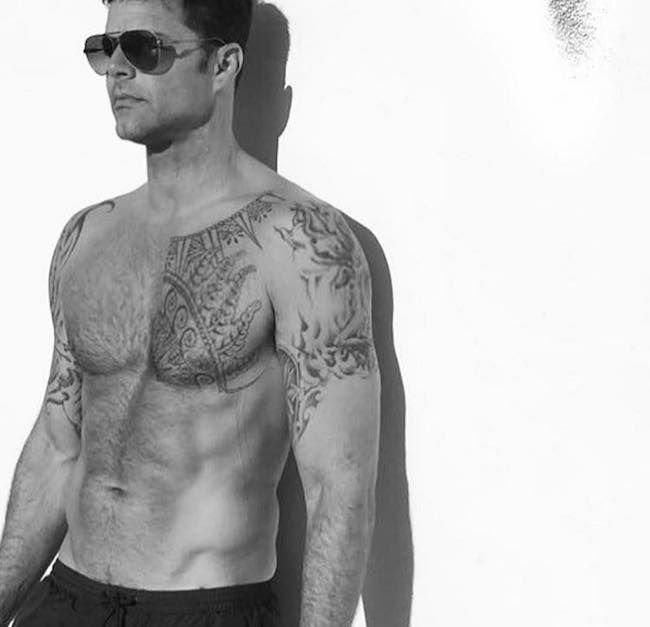
Martin’s chest and shoulders carry bold linework and geometric shapes that extend toward his arms. Black-and-white photos make the larger designs easy to see.

Some articles call the work tribal-inspired; other images show more flowing lines and symbols. The pieces were added at different times, so the upper-body tattoos don’t all form one continuous design.

Coverage also mentions a small rose and sword, along with other marks around his arms and torso. Those details are easier to see in close photos than in red-carpet shots.

The newer leg tattoo

Martin has shown a newer leg tattoo that coverage links to his children. He discussed the design during the quarantine period, when he was sharing more personal updates from home.

Photos of leg tattoos can be difficult to compare because of clothing, angle and lighting. The images do show that his collection continued to grow beyond the older arm and chest designs.

What Ricky Martin’s tattoos have in common

Family, spirituality and nature recur across Martin’s tattoos. The reported family pieces sit alongside the Aramaic prayer, Om, lotus and four-elements design.

The collection has changed over time: some pieces are large and easy to spot, while others appear only in shirtless or sleeveless photos. Older work has also been covered or changed.

Martin hasn’t given one public explanation for every tattoo. The clearest accounts connect the designs to family, faith, nature or a particular period in his life.

Ricky Martin on family and his ink

The clip below is about Martin’s children and adds context to the family side of his tattoo collection. It isn’t a tattoo tutorial.

More singer profiles are in the musician tattoo section.

More musician tattoo guides

Rick Ross Tattoos: The Stories Behind His Chest, Face and Body Ink

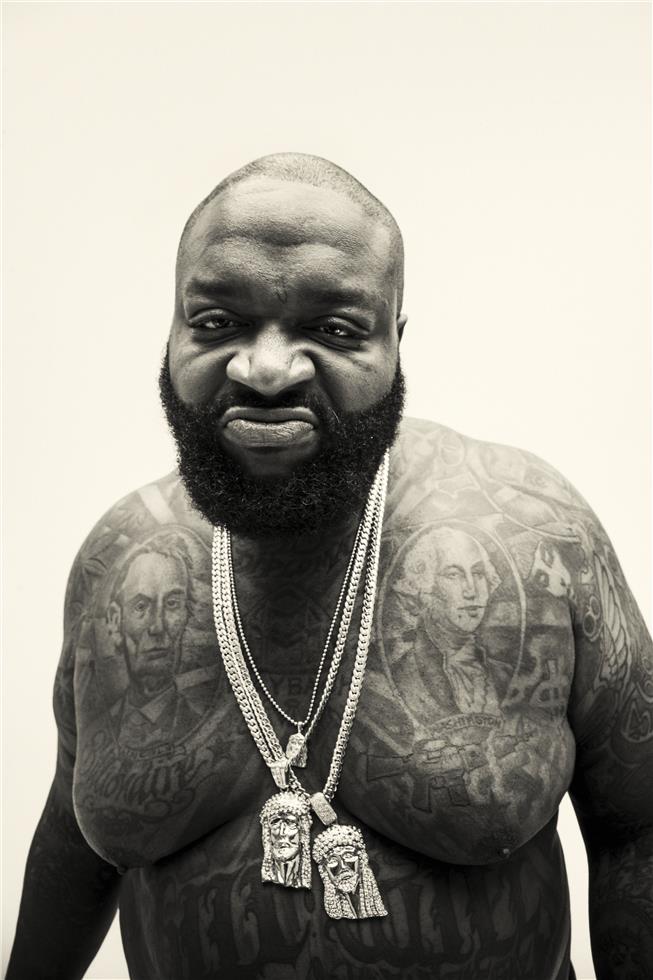
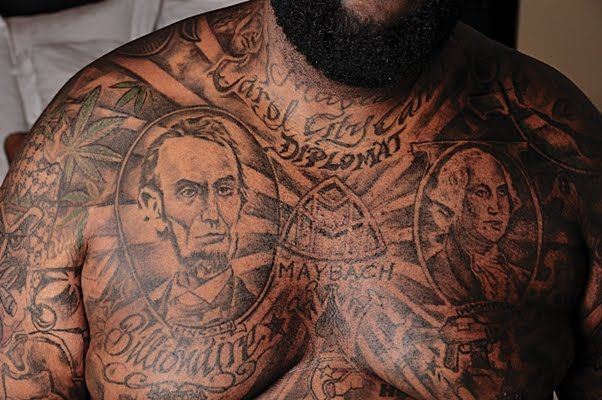
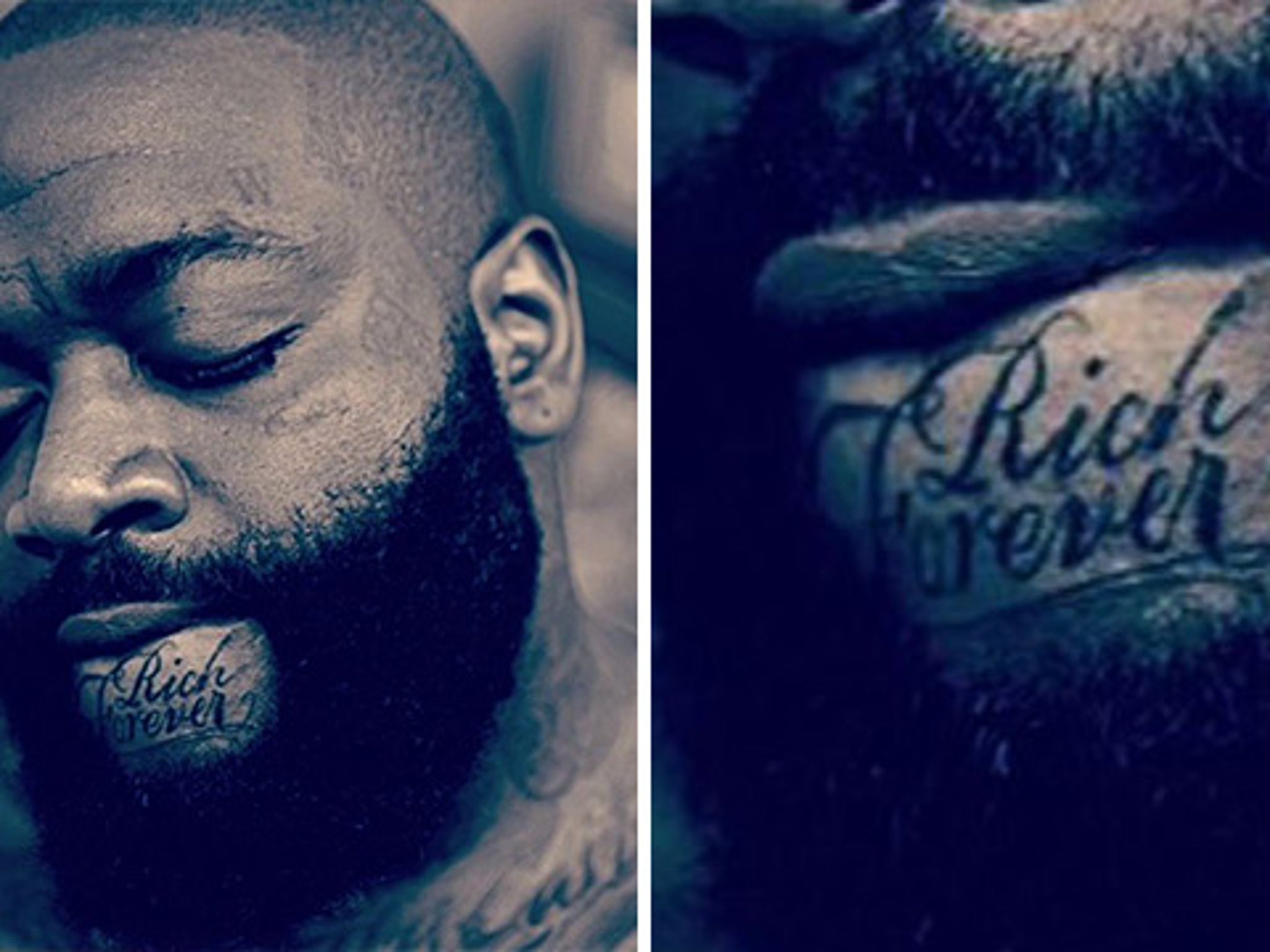
Rick Ross’s tattoos include chest portraits of George Washington and Abraham Lincoln, the words “Rich Forever” under his lip, and smaller work across his hands and arms. He has said he has well over 100 tattoos.

The collection also includes money symbols, names, religious imagery and memorial pieces. Some details are easy to read; others blend into the larger designs. Ross’s own comments explain part of the story, while photos show how the work sits across his body.

George Washington and Abraham Lincoln across his chest

Rick Ross chest tattoos with portraits

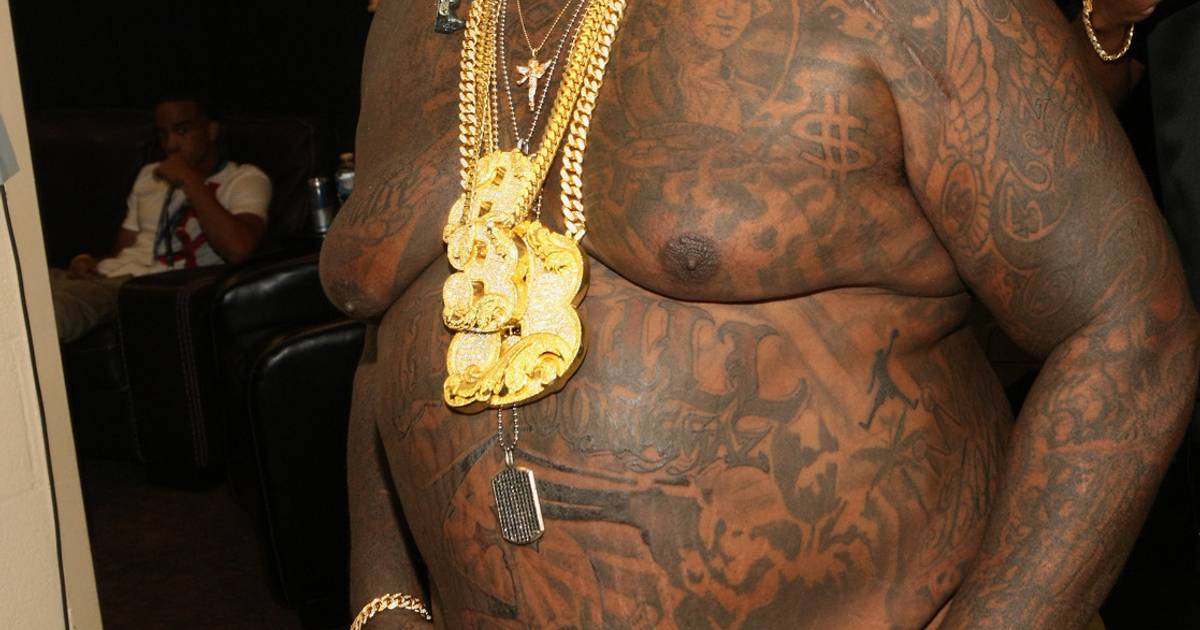
Washington is tattooed on one side of Ross’s chest and Lincoln on the other. The portraits cover much of his upper chest, with shading and lettering around them that make the area read as a broad panel.

The faces are the clearest landmarks in the design. The surrounding script and symbols fill in the chest and extend toward both shoulders.

Lighting changes how sharply the portraits show. Wider photos also reveal how the chest work connects with the tattoos on his shoulders.

The “Rich Forever” tattoo under his lip

Rick Ross Rich Forever chin tattoo

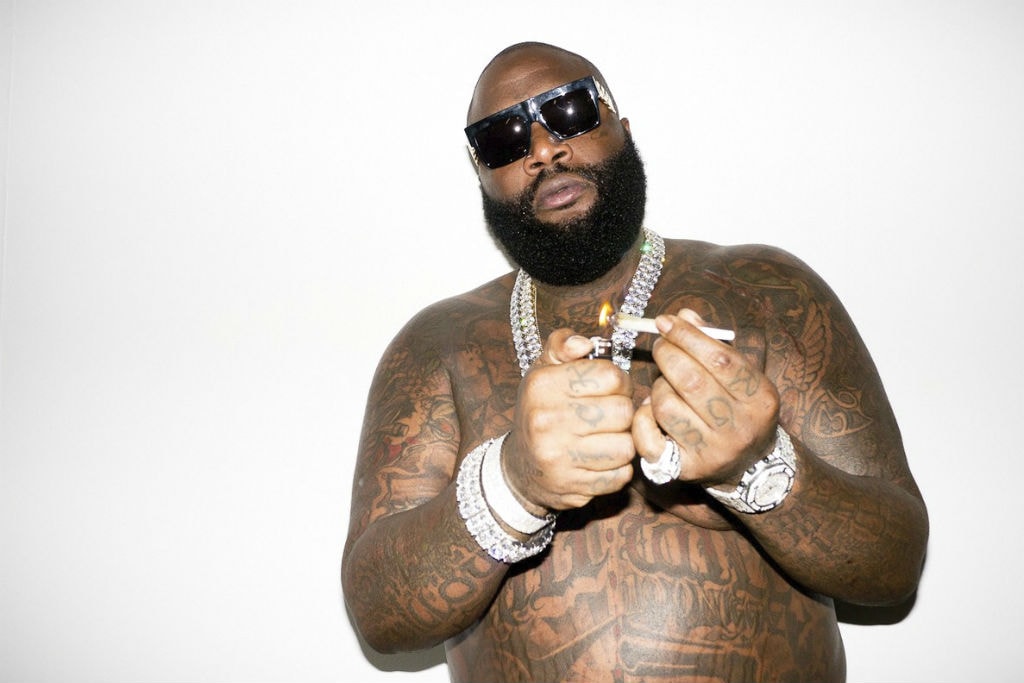
Ross added “Rich Forever” under his lower lip in 2014. It’s small next to his torso work, but its placement makes it hard to miss in a close photo.
He has used “Rich Forever” as a name and phrase in his music and business life. The face tattoo puts those words in plain view.

Photos show the lettering against his beard; its shade can look blue-grey or dark depending on the image. It is one of the shorter messages in a collection that also has large portraits and body pieces.

Arms and shoulders packed with layered work

Rick Ross arm and shoulder tattoos

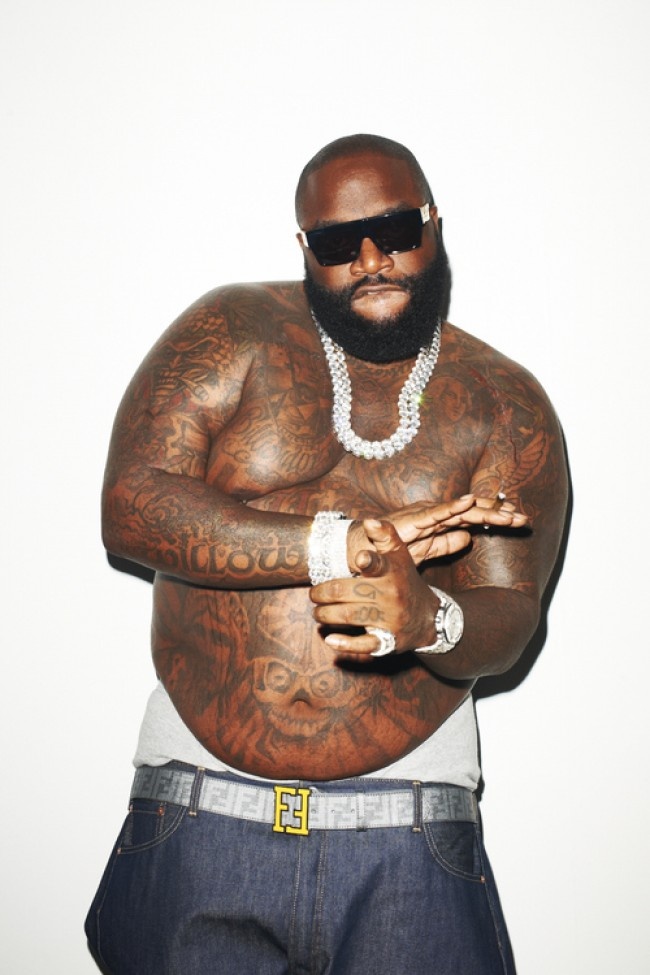
Portraits, script, shading and curved shapes cover Ross’s arms from the shoulders toward the forearms. When he crosses his arms, the designs overlap and can look like one connected piece.

Ross has described tattoos as “timekeepers”: reminders of a person, period or event. His arms show work added over the years, rather than one uniform design planned all at once.

The shoulder tattoos use dense black-and-grey shading. Stage photos can hide small details, while studio pictures make portraits and lettering easier to see.

Large torso work, money symbols and skull imagery

Rick Ross torso and stomach tattoos

Ross has said he has more than 50 dollar signs tattooed in different places. They sit among portraits, lettering, skulls and shaded designs across his torso.
He has also mentioned a skull on his stomach, with the navel worked into the design, along with “Chill Will” and “100 Million” tattoos. These pieces can be hard to see in red-carpet photos, where clothes cover much of his torso.
The work has accumulated over time. Newer tattoos fill spaces around older ones, while some designs have been covered or built into the surrounding ink.

Hands, knuckles and the Jesus piece on his forearm

Rick Ross hand and forearm tattoos

Ross has said his parents’ birth dates appear in Roman numerals on his lower knuckles. “Rick Ross” is spelled across the top knuckles, and a “W” stands for win.

His forearms include religious imagery. In an Inked Magazine session, longtime artist Lordgyn “Gino” Belizaire worked on a custom Jesus design on Ross’s left forearm.

The lettering on his hands is easy to read in close photos; the forearm piece takes more space. The session shows the work being added, rather than only as a cropped image after the fact.

Why Rick Ross keeps adding to the collection

Ross has described his tattoos as reminders of things he admires and believes in. He has also talked about memorial pieces for his father and friends who died.

He has said some tattoos didn’t come out perfectly, but that he doesn’t regret the ink. For him, the memories matter more than a spotless canvas.

For more music-related tattoo stories, browse the musician tattoos section. Photos show different parts of his chest, arms, face, hands and torso, and the collection has continued to grow.

More musician tattoo guides