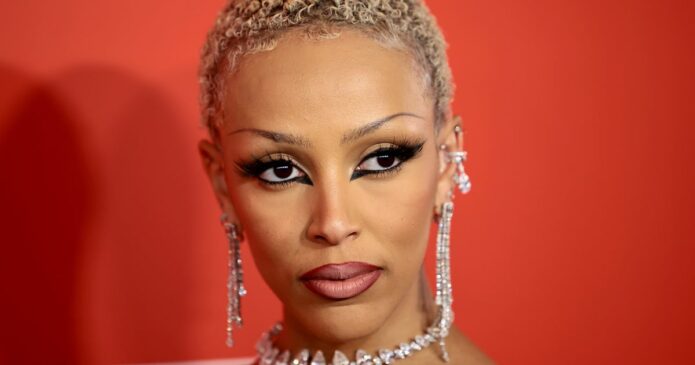
Doja Cat’s tattoo collection grew quickly, but it does not feel random. Her newer work leans toward bones, insects, blades, unusual little creatures and long passages of text. Some designs can disappear under a sleeve; others are hard to miss, especially the bat skeleton across her back. She has also shown tattoos that were mistaken for demonic symbols, then explained them in her own terms. That mix of shock, art history and personal symbolism is what makes the collection worth mapping carefully.
There is no reliable final count of Doja’s permanent tattoos. She has added pieces in bursts, and some striking designs appeared in photos before many details were reported. This guide sticks to work that is clearly visible or has been discussed by Doja, her artists or reliable coverage. The forehead writing she wore at the 2024 Grammys stays separate: it was a fashion moment, not permanent ink.
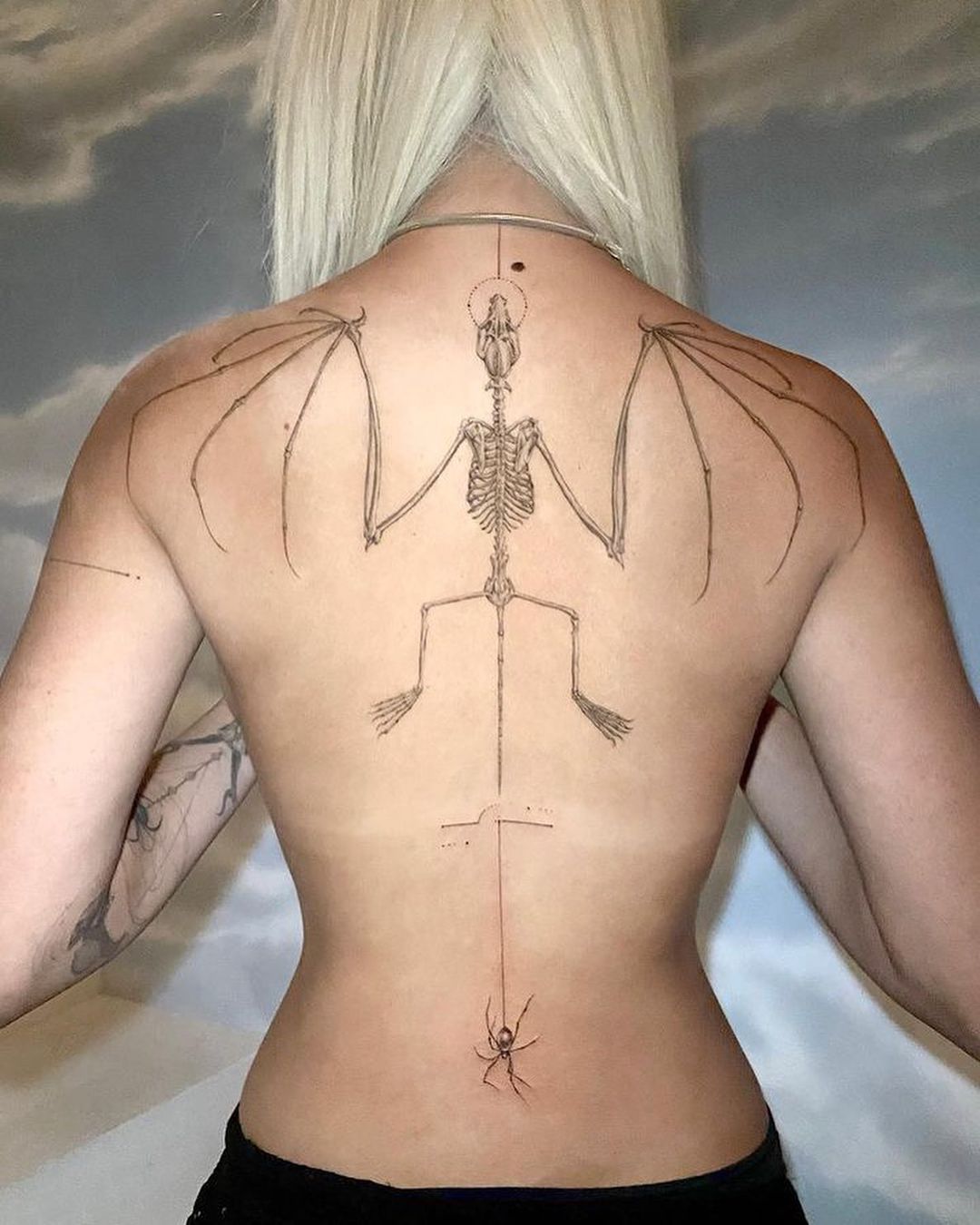
Doja Cat’s bat skeleton covers the back from shoulders to spine
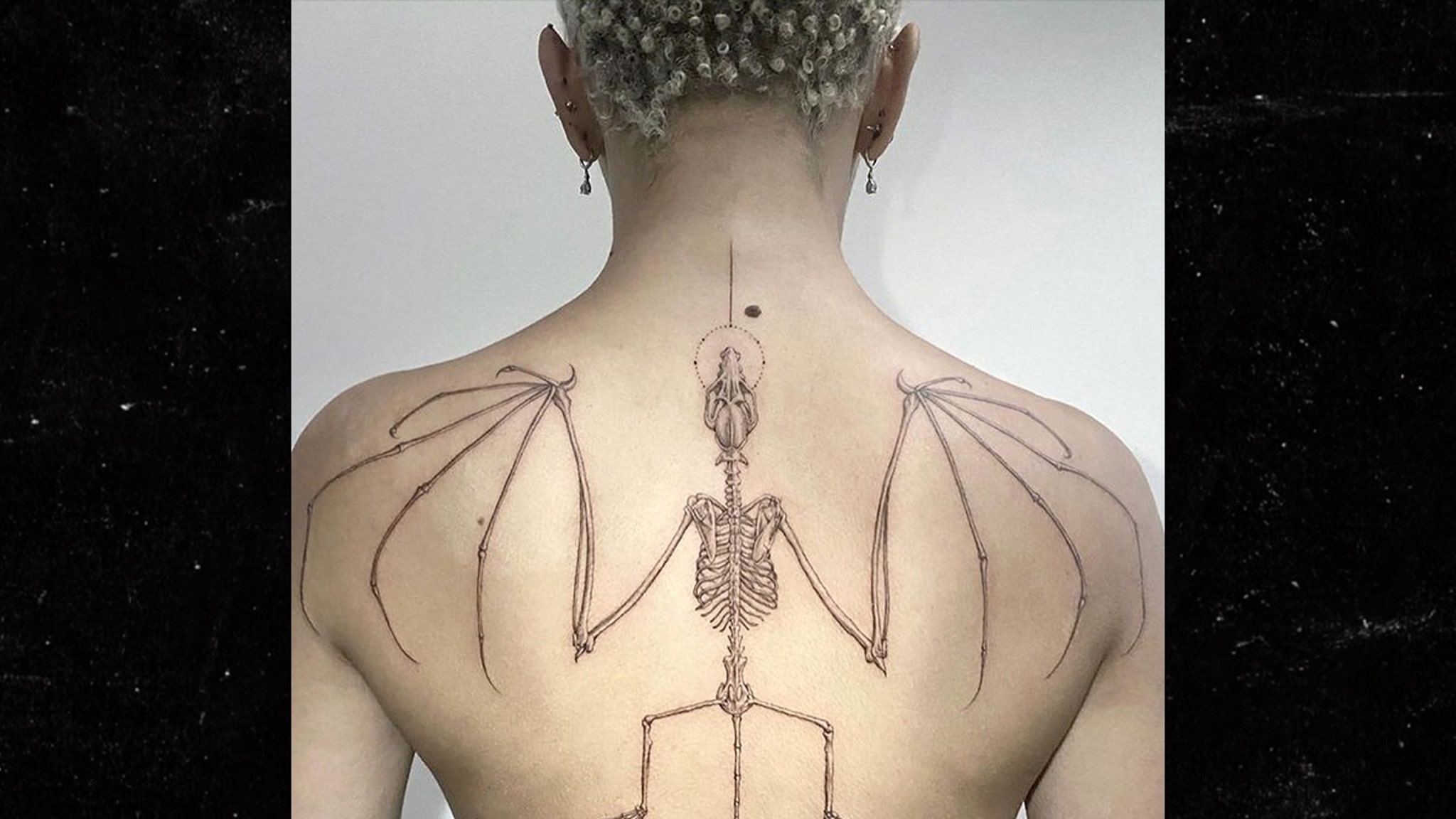
The bat skeleton is the largest and most striking tattoo Doja Cat has shown. It begins high on her back, with the skull near the upper spine, then spreads into broad wings over the shoulder blades. The ribs, joints and long wing bones use delicate linework instead of heavy black shading. From far away the shape reads as a symmetrical creature; close up, the small bones give it an anatomical quality.
Doja revealed the design in 2023 and connected it with a passage about bats representing death as letting go, followed by transition and new beginnings. She supplied a clear explanation for this piece, and it does not need to be stretched into a theory about her other tattoos. The meaning belongs to the bat, whose form fits the idea of leaving an old shape behind.
Mr. K of Bang Bang Tattoo is associated with the back piece. His fine linework shows in the repeated narrow contours of the wing bones and rib cage. A full-back photograph is important here: a close crop of the skull misses the wingspan, while a distant shot can make the centre look smaller than it is.
The design continues down the spine, and later photographs show a small spider near the lower back. It sits apart from the bat rather than blending into the skeleton. That gives the back a loose vertical rhythm: one large central creature, with a smaller insect below. The arrangement feels more considered than a single emblem.
The monster tattoo on Doja’s arm is an art reference, not a generic devil
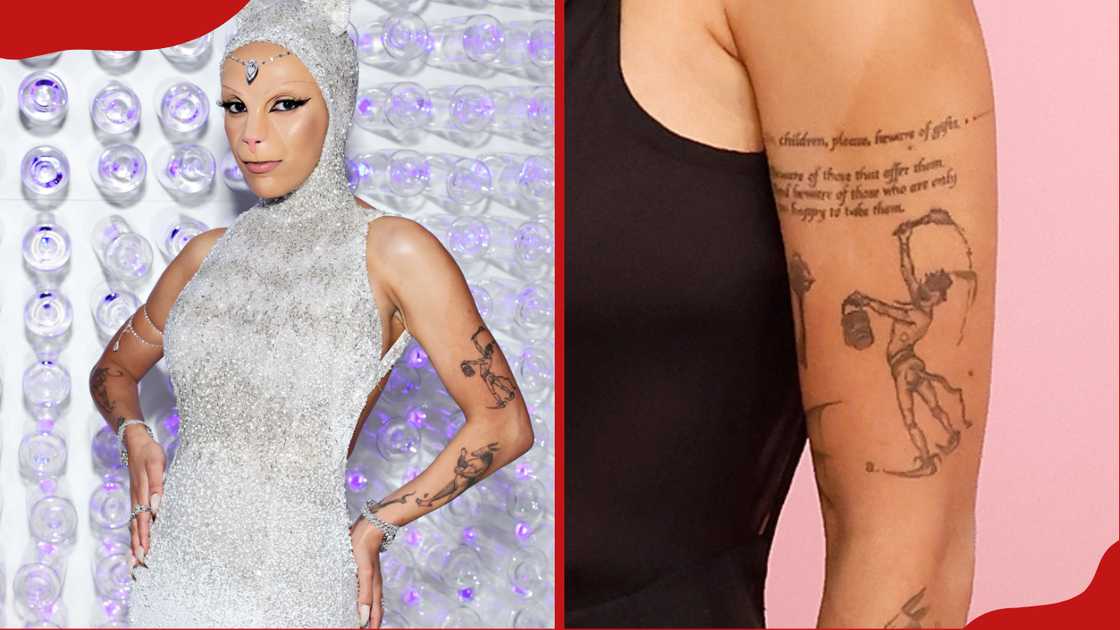
Doja’s forearm tattoo was often called demonic online, but she gave a more specific source for it. The strange figure comes from a 17th-century illustration associated with Fortunio Liceti’s writing on unusual forms in nature. Its distorted body is unsettling by design, which is why it can look like a generic devil at first glance.
She said the image was about imperfection and how nature can produce forms that look wrong to us while still belonging to its creative process. That context changes the reading. The horns, limbs and unusual proportions may feel theatrical, but the reference is closer to a historical curiosity than a declaration of religious belief.
The same arm has other fine linework around the figure, including a key and script. Their meanings have not all been confirmed. A key can be described without deciding what it unlocks, and text can be quoted without inventing the event behind it. Doja’s unusual designs invite speculation, which makes restraint useful.
The monster works best in a clear vertical arm photo, where viewers can follow the figure from upper arm toward forearm and see how surrounding lines frame it. A cropped face photo cannot establish the full piece. The image needs to show enough of the arm to compare the historical drawing with the tattoo’s placement.
The sword-through-an-eye tattoo sits across Doja Cat’s hand
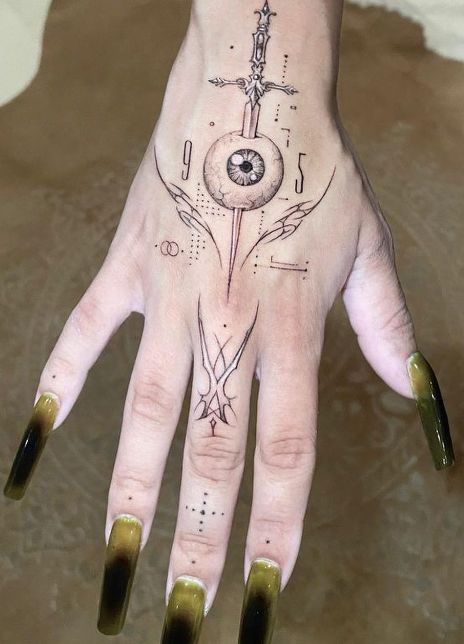
The hand tattoo is one of Doja’s most intricate small pieces. A sword passes through a realistic eye on the back of her hand, with fine ornamental lines reaching toward the fingers. Tiny dot clusters sit near the nails, and numbers including 9 and 5 appear in the design. It is detailed without becoming a solid block of black ink.
The eye anchors the composition. Its round iris gives the hand a focal point, while the sword creates a strong vertical line from wrist toward fingers. Flourishes around it keep the image from feeling like a single sticker and make the design shift as Doja moves her hand or wears long nails.
Mr. K is also associated with this group of newer work. Reports place the hand design around the same time as the back bat and lower-back spider, linking the three to one period of experimentation. Doja has not explained each number, dot or flourish. The clearest account stays visual: an eye, a blade, fine geometry and small finger details arranged in a surreal style.
Ordinary event photos can be misleading here. Jewellery, long nails and hand position may hide the blade or make the eye look like a ring. A straight-on close-up shows the tattoo more clearly and confirms that it sits on the hand, not the wrist or forearm, as some quick captions suggest.
The antelope skull and other wrist details stay deliberately fine
Before the large back tattoo, Doja showed a fine-line antelope skull on her left wrist. It is narrower and more delicate than the bat, with long horns creating a recognisable outline. Brian Woo, also known as Dr. Woo, is associated with the piece. His thin lines and small dots are visible in the skull’s clean shape.
Doja has not supplied a confirmed personal meaning for the antelope design. That uncertainty should stay in the description. A skull can suggest mortality, memory or change, but those are common associations, not Doja’s own account. The visible facts are the horned skull, its narrow wrist placement and the negative space around the lines.
Other wrist and arm marks appear in the same photos. Some resemble eyes or small geometric symbols; others are too blurred to identify. They should not be merged with the antelope just because they sit nearby. Tattoo lists become unreliable when an indistinct dot gets turned into a named design, so a clear photo and a cautious caption matter.
Fine-line work also depends heavily on lighting and distance. A bold traditional outline stays readable across a room; a small wrist skull can fade into a bracelet or vanish in flat light, then look crisp in a close-up. That change between photos is not a contradiction—it is how small wrist tattoos show up on camera.
Doja Cat’s scythe tattoo runs behind the ear toward the temple
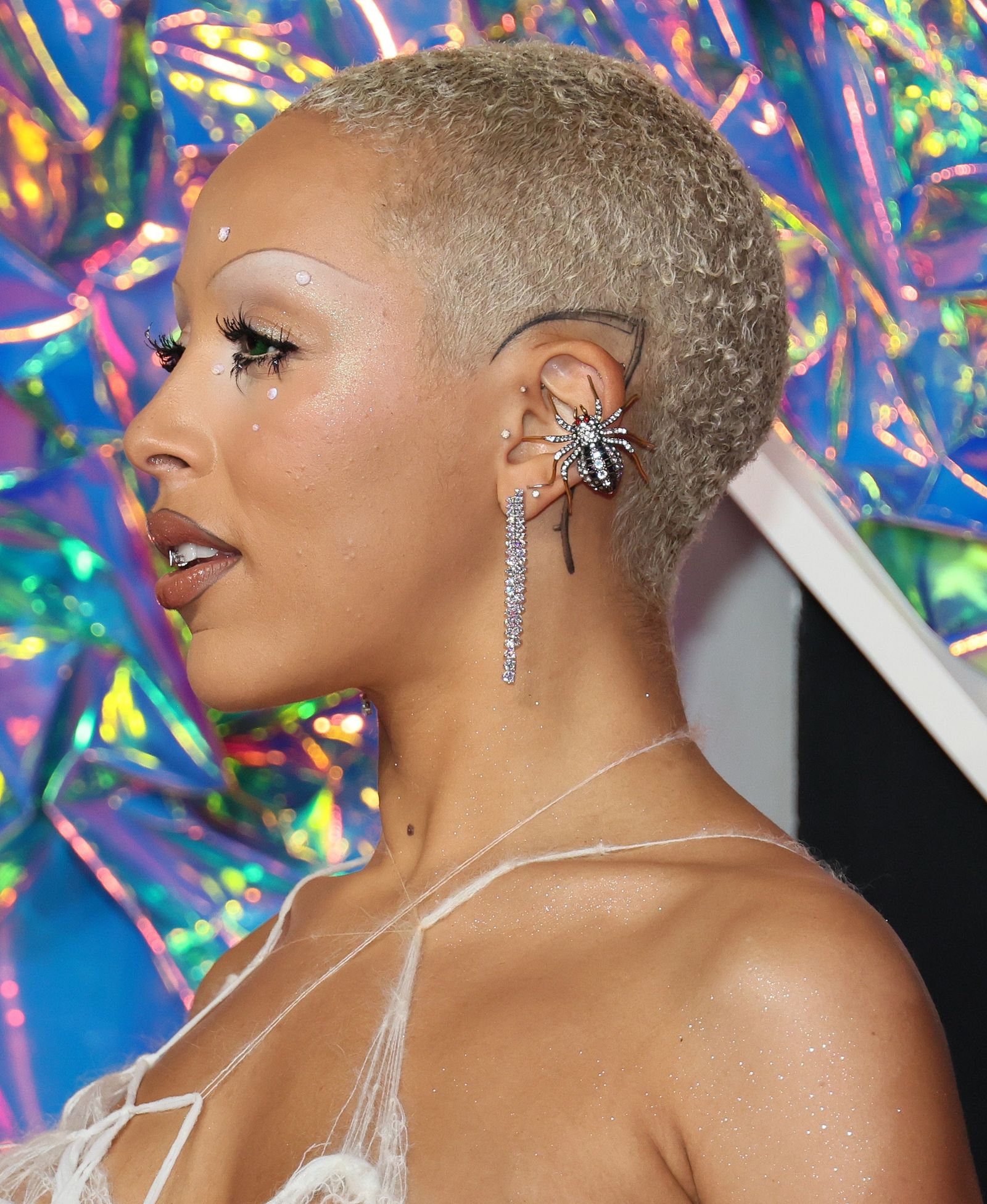
The scythe behind Doja’s ear is one of her most visible head tattoos. Its handle runs down behind the ear, and the blade curves up toward her temple. It follows the shape of her head, so a side profile or three-quarter view shows the full design best. From the front, only a thin line may be visible.
She revealed it around the 2023 MTV Video Music Awards, when her shaved head and light makeup made the tattoo unusually easy to see. The scythe fit the event’s gothic styling, but it is not just a costume detail. Turning her head can reveal the blade, hide the handle or make it blend into the hairline.
The design appeared near spider-themed styling from the same period. A spider earring and web-inspired clothes made the overall look feel connected, but they do not prove that the scythe has one fixed meaning. Historical associations can be mentioned as possibilities; the confirmed details are its design, location and when it became public.
Unlike the bat, the scythe is difficult to read from across a room. It rewards a close side view, which is why a high-resolution photo matters. A small red-carpet thumbnail can turn the blade into a stray shadow, while a clear profile shows how the tattoo wraps around the ear.
Alan Watts quotes give the arms a different kind of intensity
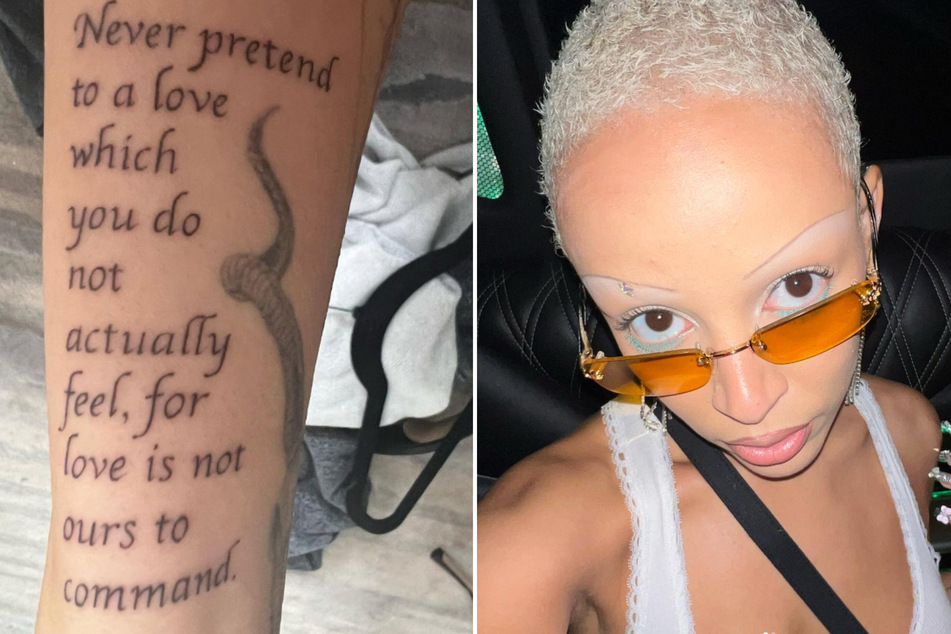
Doja later showed text tattoos linked to words by philosopher Alan Watts. One clearly photographed quote on her arm begins, “Never pretend to a love which you do not actually feel, for love is not ours to command.” The lettering runs vertically beside a snake-like drawing. Fine script and illustration make the piece feel like marginal notes rather than a conventional slogan.
Other reported lines touch on pain, fear, faith and the way problems can settle when left alone. Long script is easy to misread, especially when it curves around an arm, so each sentence should be checked against the photograph. A guide can quote what is visible without turning a few lines into a broad diagnosis of Doja’s life.
The quotes bring a different feeling from the anatomical and gothic images. A bat skeleton reads through its shape; a long sentence asks the viewer to stop and read. The words also move with her arm: when Doja bends her elbow, the line breaks and becomes part of the body’s movement rather than a flat block.
The cautionary quote from “Gretel & Hansel” is another substantial piece. Its wording warns children to be careful with gifts and people who offer them. Coverage places the line beside a key and an unusual figure, creating the feel of a small illustrated story. The source of the quote is better established than any claim about the life event that inspired it.
Lists also mention smaller designs such as a spider, a snake, an Om symbol, the number four and additional short quotes. Some are clearly photographed; others appear only in secondary lists or event pictures. The sensible approach is to keep confirmed pieces separate from uncertain ones and update the record as Doja adds work.
Doja Cat’s tattoos do not form a neat set of matching symbols. They move from a bat’s anatomy to a historical monster, from a sword through an eye to a fine wrist skull, then to a scythe and long philosophical passages. The throughline is her interest in unusual images and difficult ideas. Some meanings come from Doja herself; for the rest, the description should stay with design, placement and evidence.
That distinction also keeps temporary body art out of the permanent list. The name of designer Dilara Findikoglu written across Doja’s forehead at the Grammys was a memorable fashion choice, but it was not the same as the bat, scythe or hand tattoos. Makeup, rhinestones and temporary ink can look convincing in a photo; they still need to be labelled correctly.
3 thoughts on “Doja Cat’s Tattoos: The Bat Skeleton, Scythe, Hand Ink and More”