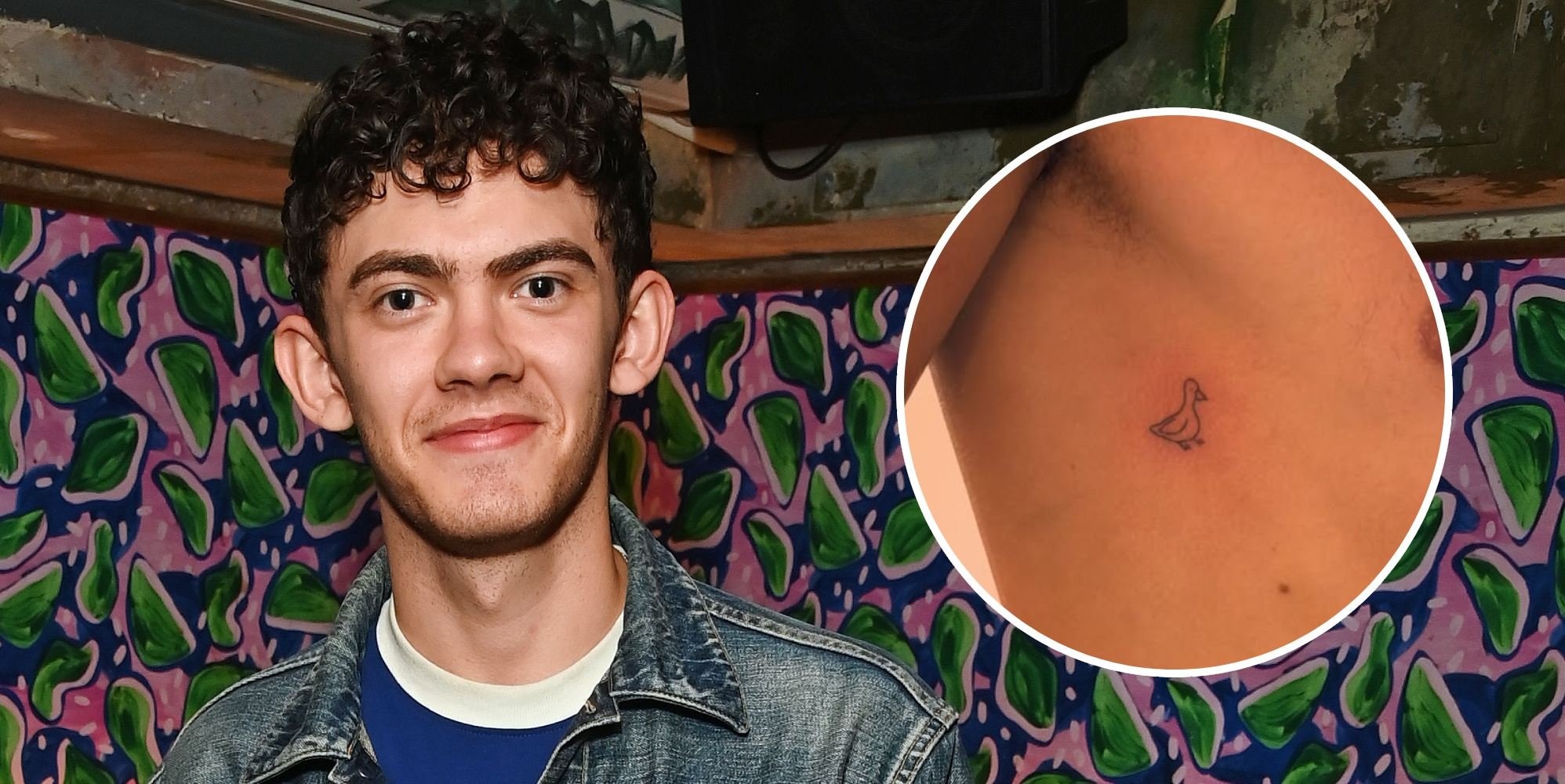
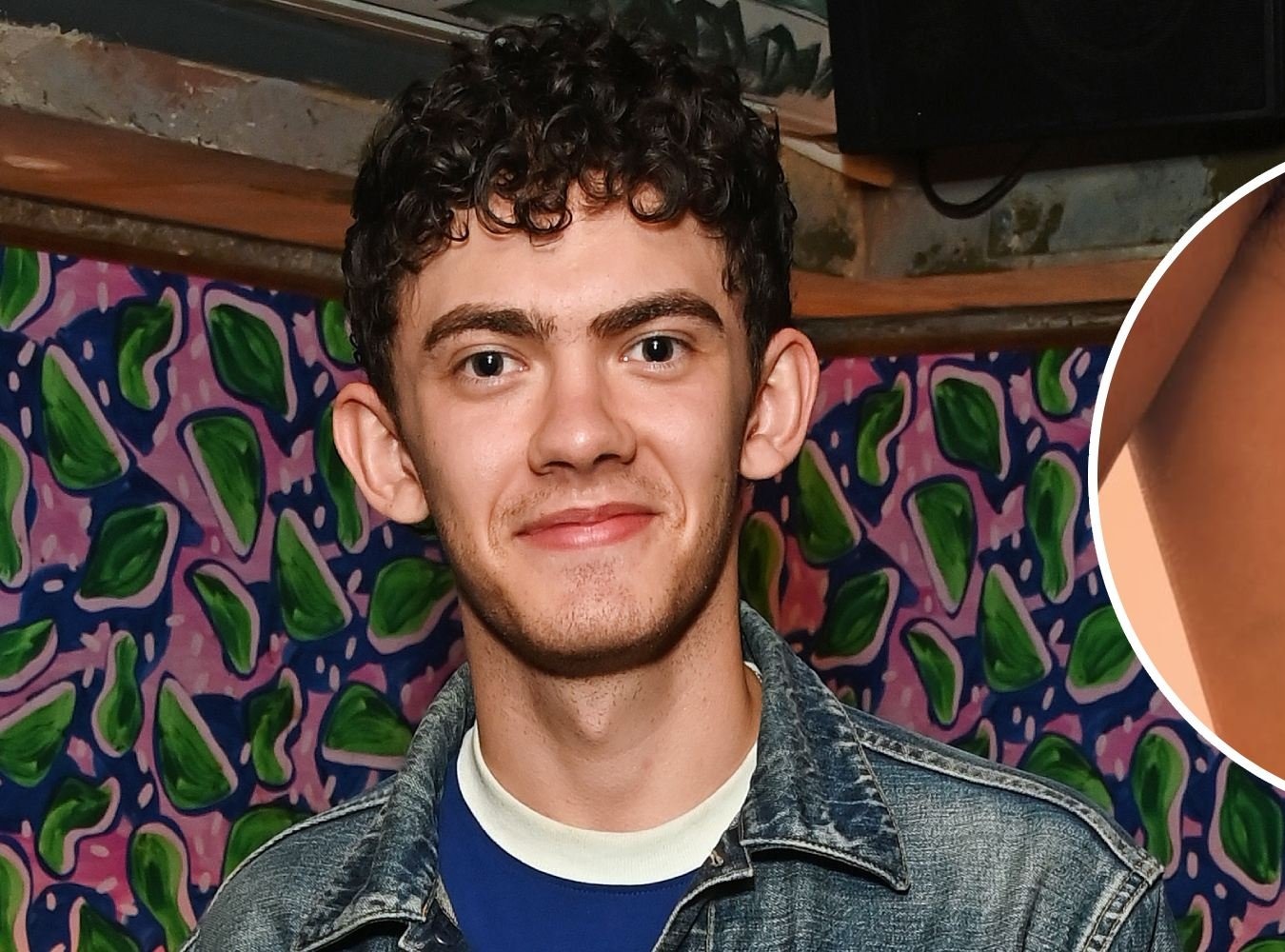
Joe Locke’s tattoo collection appears to be small. In a September 2026 summer photo dump, he showed a tiny duck outline beneath his arm. It is the clearest public view of his ink so far.
An editorial composite showing Joe Locke’s duck tattoo.
The duck appears in the last image of the carousel, with the caption “Summer of friends, fun, and duck tattoos in Ibiza.” Locke has not said why he chose the design, who tattooed it or when he got it. The caption connects it to that summer, but leaves the rest open.
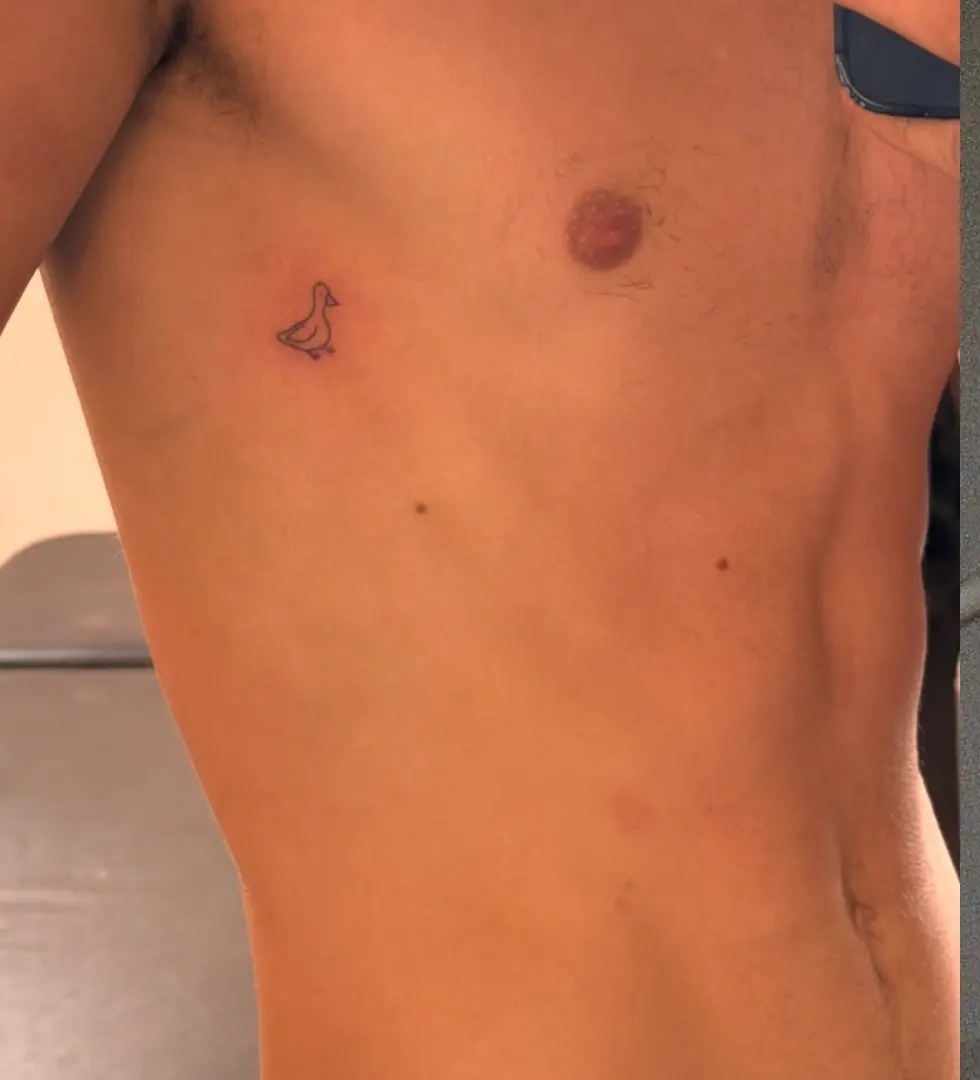
Joe Locke’s duck tattoo is a tiny outline design
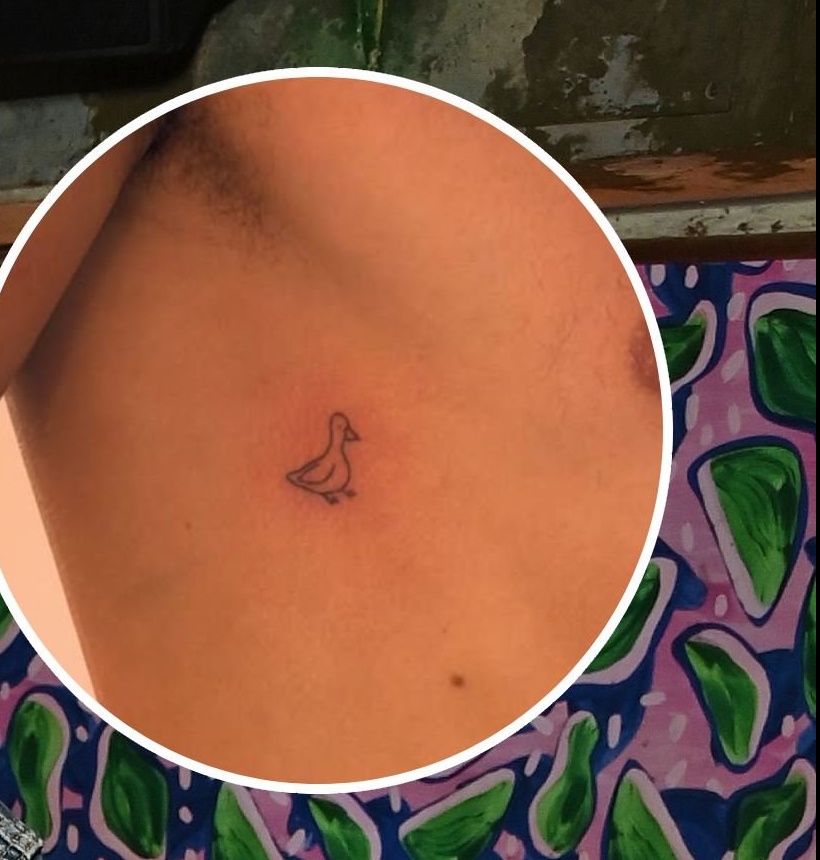
A close view of Locke’s outline duck tattoo.
The design is a walking duck drawn in a fine black outline. A few lines form the body, head, beak, wing and feet; there is no colour or heavy shading.
The open linework keeps the shape legible at a small size. The duck is easy to recognize without filling in the surrounding skin.
Where is Joe Locke’s tattoo?
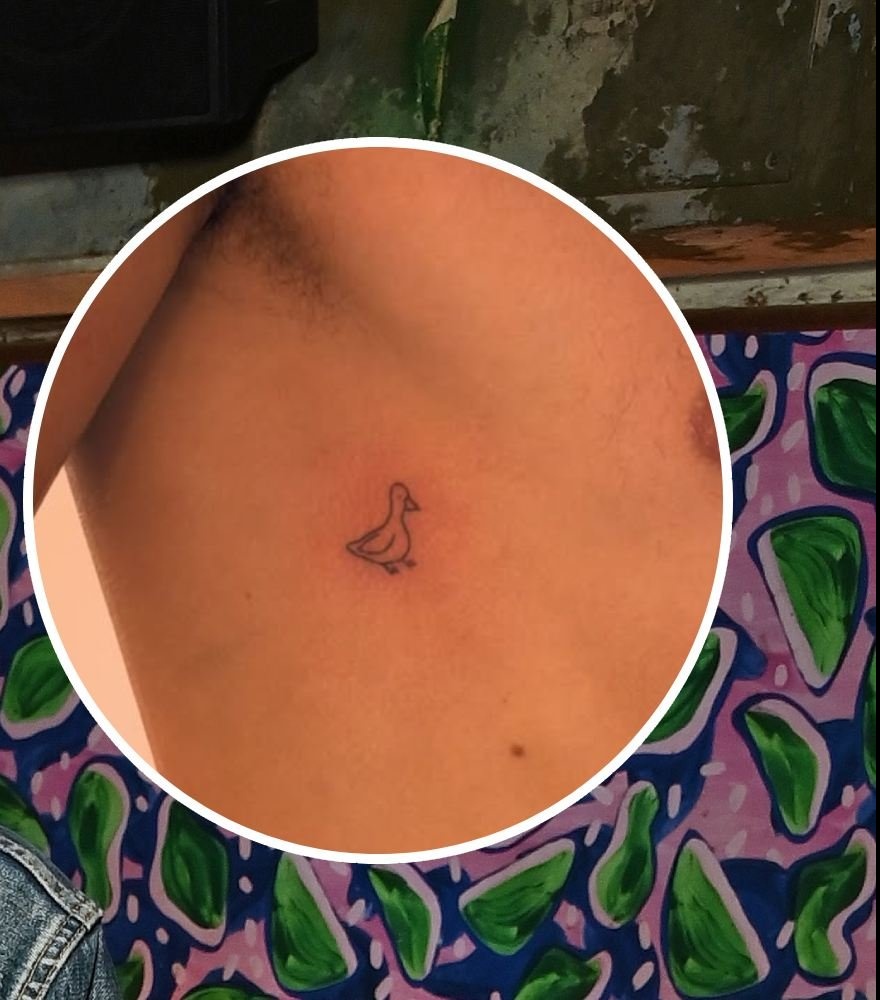
Close detail showing the duck below Locke’s arm.
The duck sits on the upper side of Locke’s chest, just below the armpit. It is off to the side rather than centred on the pectoral or running down the ribs.
With his arm lowered, the tattoo may sit in shadow or beneath a T-shirt. When he raises his arm, the outline is easier to see. That position explains why it only appears in certain photos.
The tattoo is small, but the placement makes it stand out
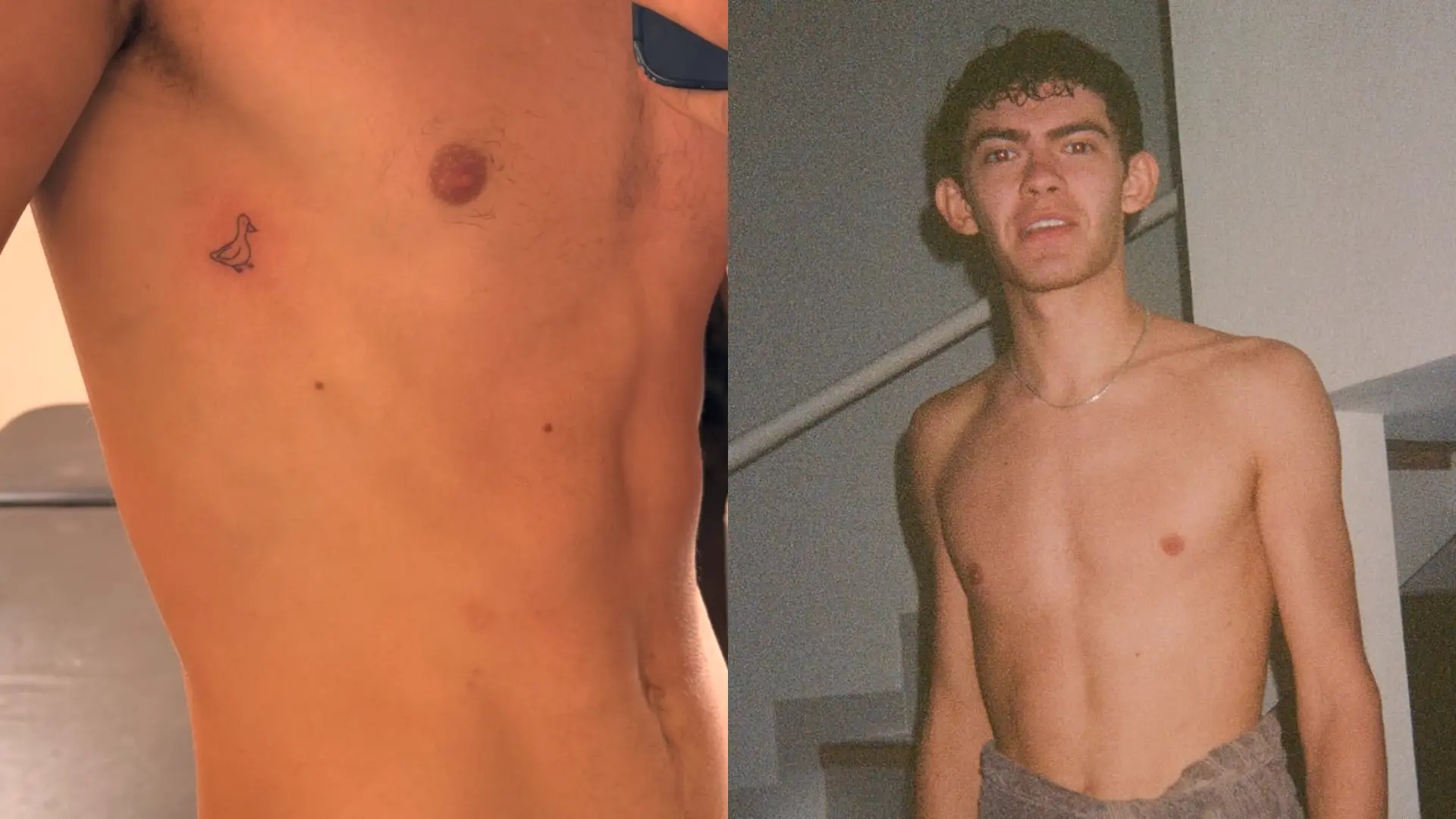
Locke shown beside a close view of the tattoo.
The open space beneath the arm draws the eye to the small outline when the camera catches the right angle. In other poses, it is easy to miss.
That placement keeps the tattoo fairly discreet. It can be covered by clothing, but it shows in a photo when Locke lifts his arm.
What does Joe Locke’s duck tattoo mean?
The duck sits beneath Locke’s arm on the upper side of his chest.
Locke has not explained the duck. The only public connection is the caption about “duck tattoos in Ibiza,” which links it to the summer trip but does not say what the design means to him.
It may have been a holiday souvenir or an in-joke with friends, but that is speculation. Until Locke explains it, the reason behind the tattoo remains his to share or keep private.
Is this Joe Locke’s first tattoo?
A full view of Locke alongside the tattoo detail.
It may be, but Locke has not confirmed that. The September reveal was described in coverage as a possible first tattoo because he had not been widely seen with other visible pieces. That is different from him saying it was his first.
For now, “first publicly documented tattoo” is the more accurate description. The artist, studio and appointment date have not been made public either.
Why the duck works as a tattoo idea
A small outline can still read clearly if the shape is simple and the lines have enough space. Locke’s duck keeps its details to a few strokes rather than relying on colour or shading.
The upper-chest placement is easy to cover, but visible in some poses. That may suit someone who wants a small design that is not on display all the time.
If you take inspiration from it, choose a symbol of your own and find an artist comfortable with fine-line work. There is no reason to copy Locke’s duck exactly.
Joe Locke tattoos: the confirmed picture
The duck is the only tattoo Locke has clearly shown in public so far. It is a small black outline beneath his arm, and his Ibiza caption is the only stated connection to its story. The reason he chose it has not been confirmed.
Whether he adds more or explains the duck later is up to him. For now, the photos show a small design in a discreet spot.
Watch Joe Locke talk on camera
A Joe Locke and Kit Connor interview appears below.
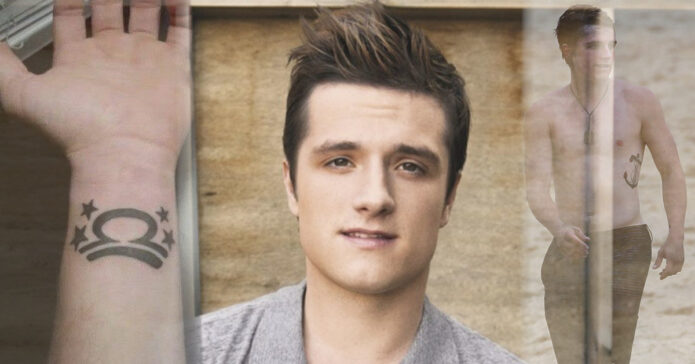
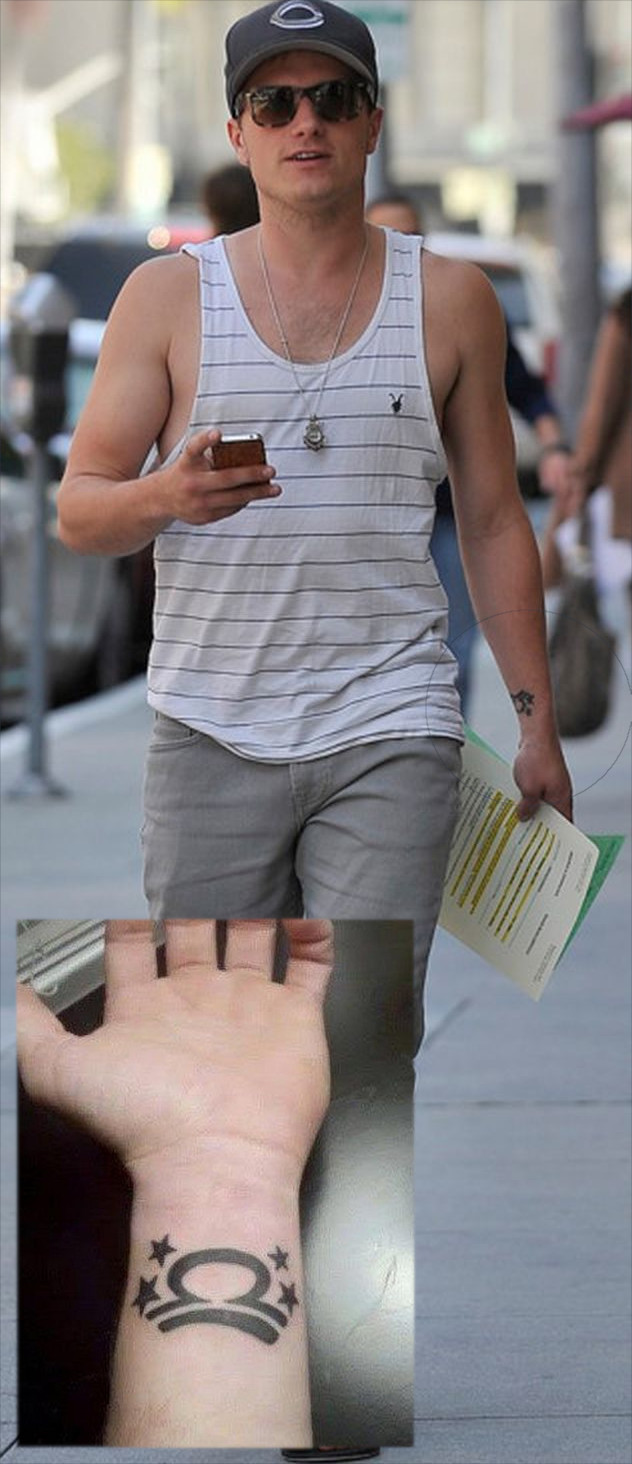
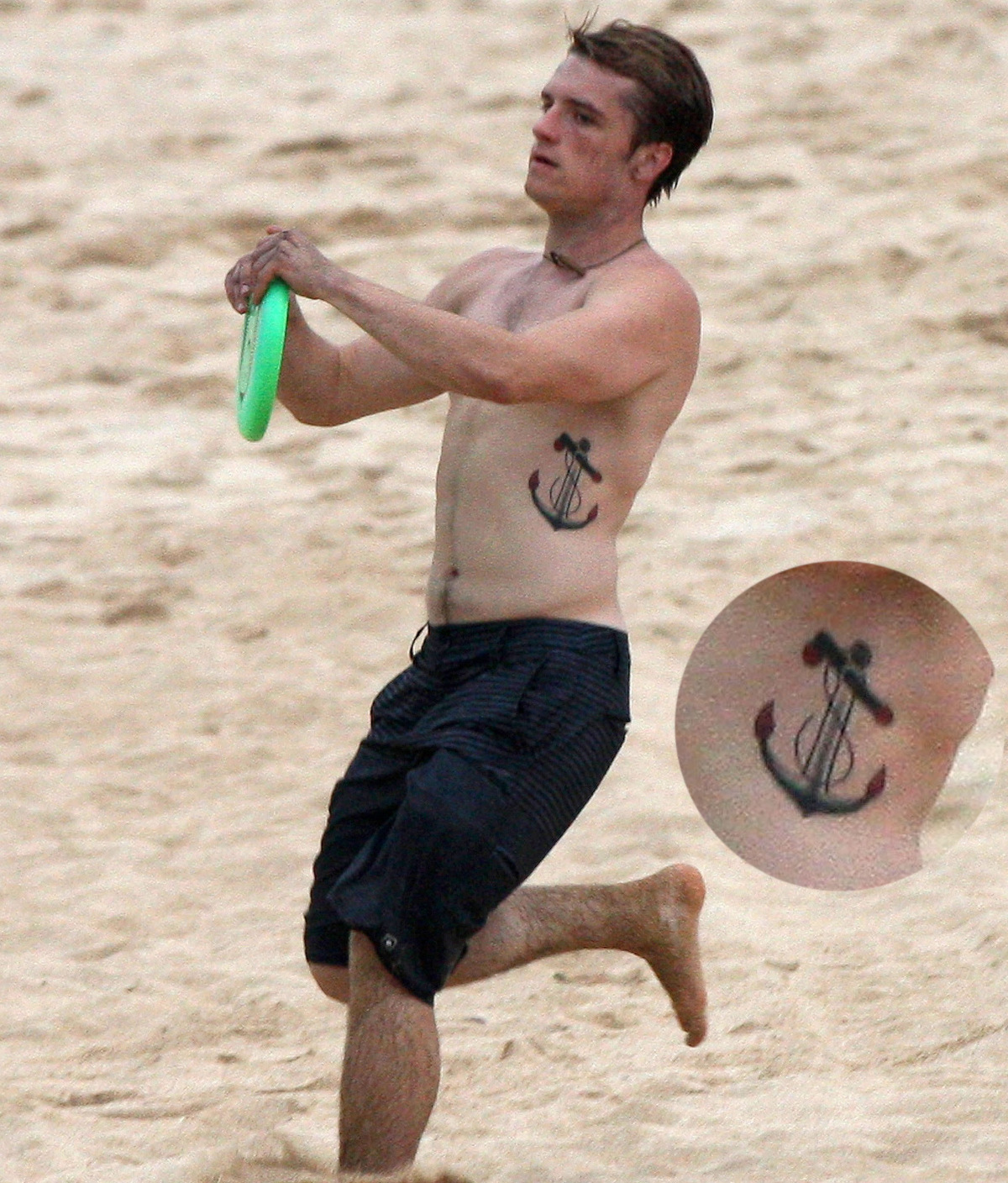
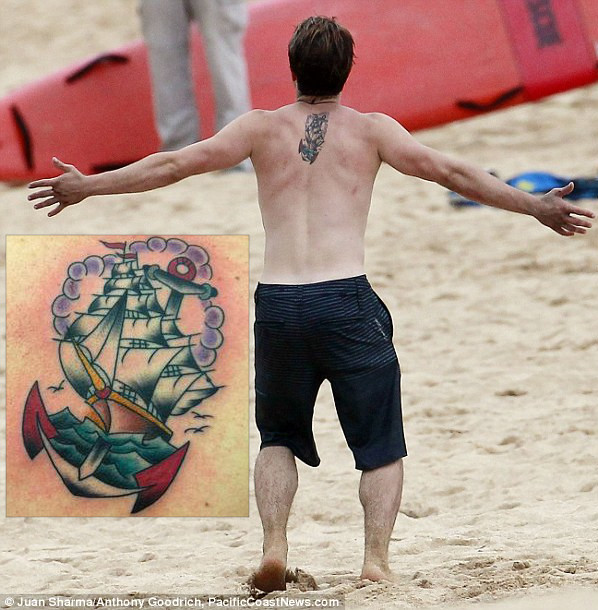
Josh Hutcherson’s documented tattoos number three: a Libra symbol on his wrist, a large anchor on his side, and a ship sailing into a sunset across his back. The wrist piece was his first; the two larger designs reflect his fondness for classic sailor-style imagery.
Those tattoos have also meant extra work on film sets. Hutcherson played Peeta Mellark in The Hunger Games films, where some scenes called for bare shoulders or a shirtless look. He has said the makeup team could spend about an hour and a half covering his tattoos. They are his real ink, even when a film needed them hidden.
Here is what can be documented about the three designs, without guessing at meanings he has not shared.
Josh Hutcherson’s Libra wrist tattoo
Hutcherson has a Libra symbol on his wrist. He has said he got his first tattoo as a teenager while filming Red Dawn in Detroit, with his mother there. Some older coverage says he was 16; Hutcherson has said 17, so the safest summary is that he was a teenager.
He has called his mother “a very cool mom” for sharing that first appointment with him. The simple black symbol is tied to more than his birth sign: it also marks a family memory and a permanent choice he made while young.
It is a compact design, not a large zodiac scene. The wrist can be covered for a role, but it also shows in candid photos, which is how many people first noticed that Hutcherson had tattoos.
There is no confirmed meaning beyond its connection to Libra and the story of his first tattoo. A symbol does not need an extra theory to be worth describing.
The giant anchor on Hutcherson’s side
The second documented design is much larger: a black anchor with red tips on the side of his torso. Hutcherson has said he likes old-school sailor tattoos, and the anchor follows that familiar style with a bold outline and a clear shape.
Basketball photos brought the tattoo into view in 2012. A sleeveless top exposed part of it, showing that his ink went beyond the small wrist symbol. The anchor sits along his side near the waist, where a shirt can cover it when needed.
That placement also makes film cover-ups more involved. Hiding a large, dark design on the torso takes more work than covering the wrist. In a scene where Hutcherson had to take his shirt off, the makeup team needed to conceal it so the character’s world would not suddenly include a modern tattoo.
Hutcherson has not given the anchor an elaborate personal story. He has said he likes the classic sailor look. Anchors can carry general associations such as stability, travel or endurance, but those are not confirmed meanings in his case.
The design is large enough to stand out in a candid photo, but it does not define his public image. It can be covered for a scene and seen again when he is off set.
Josh Hutcherson’s ship sailing into a sunset
His third tattoo sits across his back, between the shoulder blades: a ship sailing into a sunset, with birds and lavender clouds around it. Hutcherson has grouped it with the anchor as part of his interest in old-school sailor imagery. The two designs share a maritime feel without being identical.
The ship makes this piece read as a scene rather than a single emblem. The sunset, birds and clouds fill out the background and give the image more atmosphere across the back.
Hutcherson has not offered a detailed explanation for every element. A ship might suggest travel, escape or a new chapter, but those are possible readings, not his confirmed reasons. What he has said is that he likes the traditional sailor style and has kept the tattoo despite the extra cover-up work for film scenes.
The back is usually hidden by everyday clothes, but it matters on screen when a character is shirtless, at the beach or shown from behind. Hutcherson’s comments about makeup time give the tattoo a practical history as well as a visual one.
The anchor and ship make the collection feel connected. The Libra symbol was his first, personal design; the other two are larger choices from the sailor tradition. Together they form a small but consistent group.
Why Hutcherson stopped at three tattoos
Hutcherson has said he does not plan to keep adding tattoos, largely because covering them for movies is a hassle. That does not mean he dislikes the three he has. It is a practical comment about acting: a tattoo can matter to him and still add around 90 minutes of makeup before a scene.
The documented collection is straightforward: Libra on the wrist, an anchor on his side, and a ship with a sunset on his back. There is no well-supported record of a sleeve, neck tattoo or hidden fourth piece. Those claims need confirmation from Hutcherson or a reliable interview.
He chose a zodiac symbol as a teenager, then added two images he liked in the old-school sailor style. He has decided that is enough. The Libra tattoo carries the memory of his first appointment with his mother; the anchor and ship show his taste; the cover-up stories explain how the ink fits into his career.
Josh Hutcherson’s tattoo style in one look
Hutcherson’s designs lean traditional. The Libra sign is the simplest, while the anchor and ship use familiar sailor motifs, bold outlines and blocks of color. They are not a matching set or a single public campaign. The collection grew from a first tattoo into two images he genuinely liked.
We know the placements, the broad designs, the story of the first tattoo and his preference for sailor-style imagery. We do not know every private thought behind the sunset or the details of each appointment. Keeping that distinction clear makes the account more accurate.
The three photos show different scales: a small wrist symbol, the bold side anchor and the ship scene across the back. Together they explain why Hutcherson can look tattoo-free in a film and clearly inked in a candid photo from the same period.
Watch Josh Hutcherson talk about tattoos
In this Us Weekly interview, Hutcherson talks about tattoo regrets and the choices behind his body art. It adds his own perspective to the reporting about the Libra symbol, anchor and ship.
Photos from different points in Rourke’s life show his tattoos alongside stories about dogs, boxing and film roles. They don’t give a full inventory: some pieces are easy to identify, while others are partly hidden or too blurry. The arm lettering for Jaws has a reported story. For the rest, it helps to separate what a photo shows from meanings that only circulate online.
The best-known piece is Guapo Siempre, Spanish for “handsome forever.” Rourke’s late Chihuahua Jaws was nicknamed Guapo, and reports say he got the phrase in the dog’s memory. The arm lettering is one of the few tattoos with a reported personal story behind it: a memorial for a dog he loved.
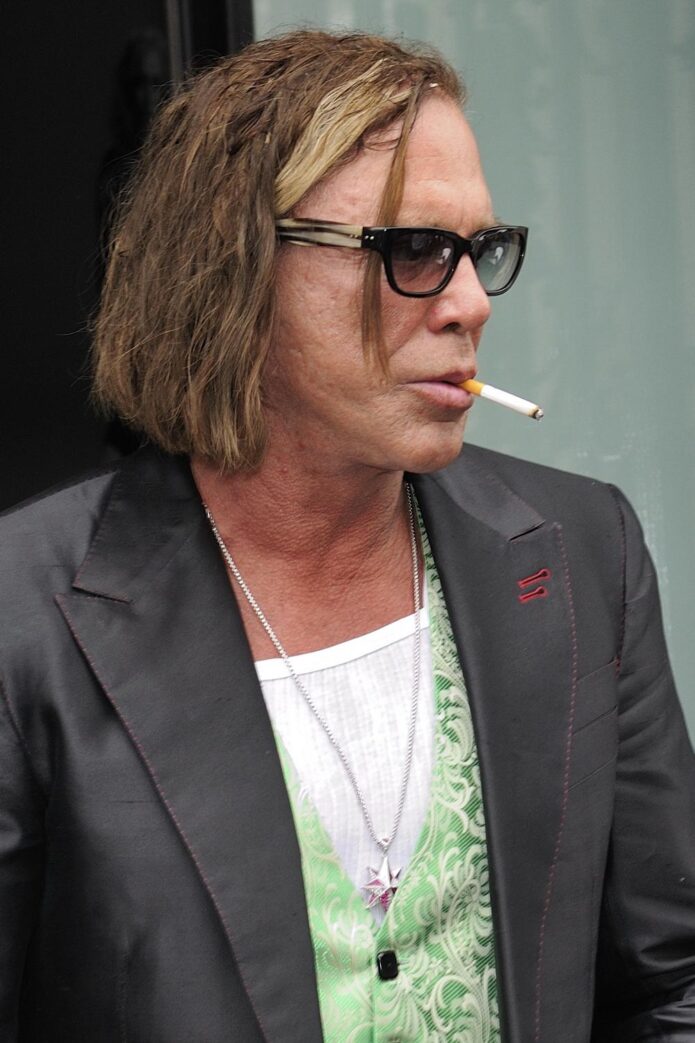
Several photos show an eye-like design on Rourke’s chest, along with darker marks around it. The shape is visible, but the surrounding work is hard to identify from a distance. It’s clearer to describe the bold, high-contrast chest tattoos than to name designs the photographs don’t show well.
The sun on his neck is another easy-to-spot piece. Online accounts have described it as a reminder to appreciate his journey, but I couldn’t verify that explanation in a direct interview. The tattoo itself is visible in open-collar photos; its meaning is less certain.
Other chest and arm marks are named inconsistently in online coverage. Some reports mention them without identifying each symbol. The photos suggest dark shapes and lettering, but they don’t support a full list of designs or meanings. The Guapo Siempre tattoo is clear; much of the rest is not.
Guapo Siempre and the memory of Jaws
The clearest personal story belongs to the arm tattoo for Jaws. Reports from 2015 said Rourke spent about two hours getting Guapo Siempre in large lettering. The phrase means “handsome forever,” using the Chihuahua’s nickname rather than a movie or stage reference. Rourke has spoken publicly about his dogs, and the tattoo keeps Jaws’ memory close.
The large script is easy to read in photos. It says “handsome forever,” but the connection to Jaws depends on knowing the dog’s nickname. That’s why reports often explain the story behind the words.
Some posts attribute other arm lettering to Jaws, but the photos don’t consistently show enough detail to confirm that. The tattoo that can be named with confidence is Guapo Siempre. The rest of the arm is not clear enough in the available images for a reliable catalogue.
Boxing, film roles and visual echoes
Boxing is part of Rourke’s history, though there’s no clear evidence that a specific tattoo refers to the sport. He boxed professionally in the 1990s and has since been photographed training or talking about fighting. His chest and arm tattoos appear in many of those images, alongside a physique shaped by years of boxing.
His film roles can add confusion to any tattoo list. In Iron Man 2, Rourke played Ivan Vanko, or Whiplash, whose tattoos were designed to suggest Russian prison culture. Those were created for the character; they aren’t part of Rourke’s personal collection. A film still can show makeup or costume design, not a permanent tattoo on the actor.
The Whiplash tattoos help tell the character’s story. Rourke has also discussed visiting a Russian prisoner while preparing for the role. That background belongs with the film’s design process, separate from the permanent tattoos seen in his personal photographs. It’s useful to keep the two sets of ink apart.
A 2021 set of photos taken during a cupping treatment gave another view of the tattoos on Rourke’s upper body. The cups and lighting make the images different from a portrait or red-carpet photo, but they don’t reveal what each tattoo means. They do give another angle for comparing pieces seen in older pictures.
The available photos show the Guapo Siempre memorial lettering on his arm, the sun on his neck, and the eye-like chest design. Other dark marks on his chest and arms are visible, but not reliably identified. There may be more; different photos show different parts of his body, and some tattoos are covered.
Rourke’s face, scars, boxing history and tattoos all appear together in many photos. The images give a sense of his look, but they don’t explain each design. Jaws’ memorial has a reported story. The neck sun and chest pieces are easier to describe by appearance than by meaning.
Tattoos can fade, change or look different as a person’s body changes. A piece that is clear in one photo may be partly hidden in another because of lighting, position or image quality. When pictures don’t match, that isn’t enough to conclude that an old tattoo disappeared; it’s better to leave the uncertainty in place.
Why the collection feels so personal
Rourke’s tattoos don’t form one coordinated sleeve. They vary in placement and style, and appear in photos from different periods. The tribute to Jaws has the clearest story. The chest designs are harder to identify, while the sun on his neck is easy to spot but has no confirmed meaning.
Rourke’s public image has shifted over the years, but his tattoos don’t explain those changes. They’re part of how he looks in photographs; only some of them have a public story attached.
The public record supports a short summary: Rourke has bold chest tattoos, a visible sun on his neck and arm lettering in memory of Jaws. The Whiplash tattoos from Iron Man 2 belong to the character. Other dark marks are visible in photos, but there isn’t enough evidence to assign every one a name or backstory.
Watch Mickey Rourke talk about tattoo design
The clip below covers the tattoo work created for Iron Man 2 and the preparation for Whiplash. It’s about the character’s designs, not a complete account of Rourke’s personal tattoos.
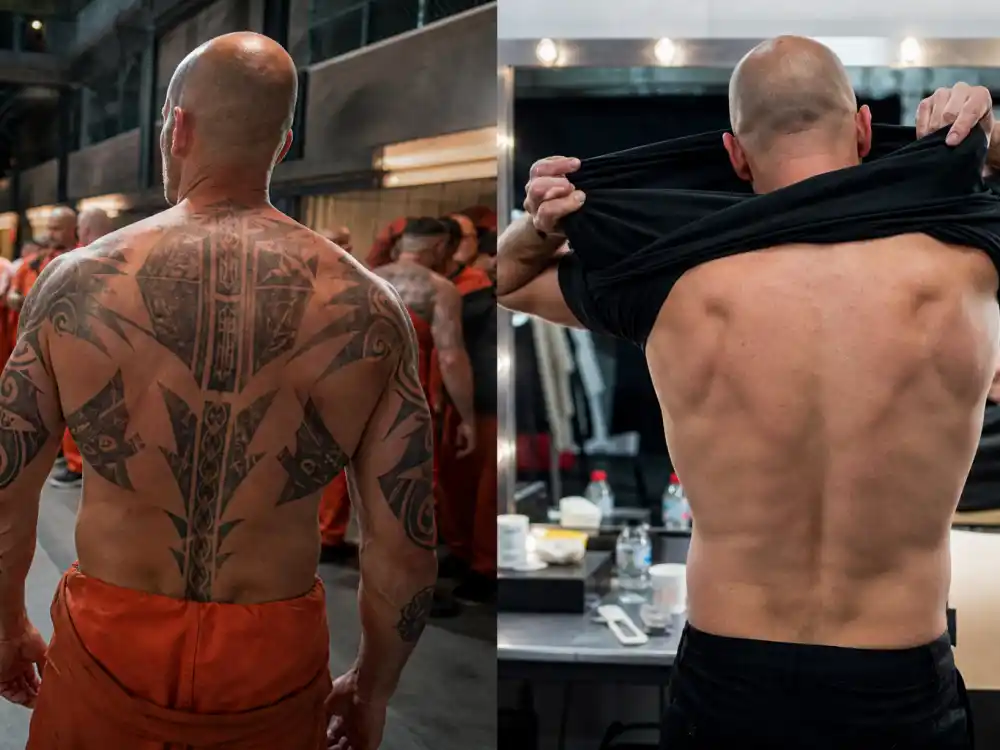
Photos of Jason Statham in Death Race often show him covered in dark prison-style tattoos. The ink belongs to Jensen Ames, the character he plays in the 2008 film, and was applied as makeup for the role. A convincing transfer can look permanent in a close still, especially when it follows the actor’s shoulders and catches the same light as the costume.
The designs are still worth looking at as screen tattoo references. They run across Ames’s back, neck and arms, fitting the mask, jumpsuit and industrial setting. But the film images are not evidence that Statham kept the same tattoos afterward. For more stories about actors’ ink, see the actor tattoo archive.
The distinction matters because the most familiar “Jason Statham tattoos” are production makeup, not a confirmed personal collection. The behind-the-scenes images show how the designs were applied and help separate the actor’s real skin from his character’s look.
The Death Race prison tattoos are the designs most people remember
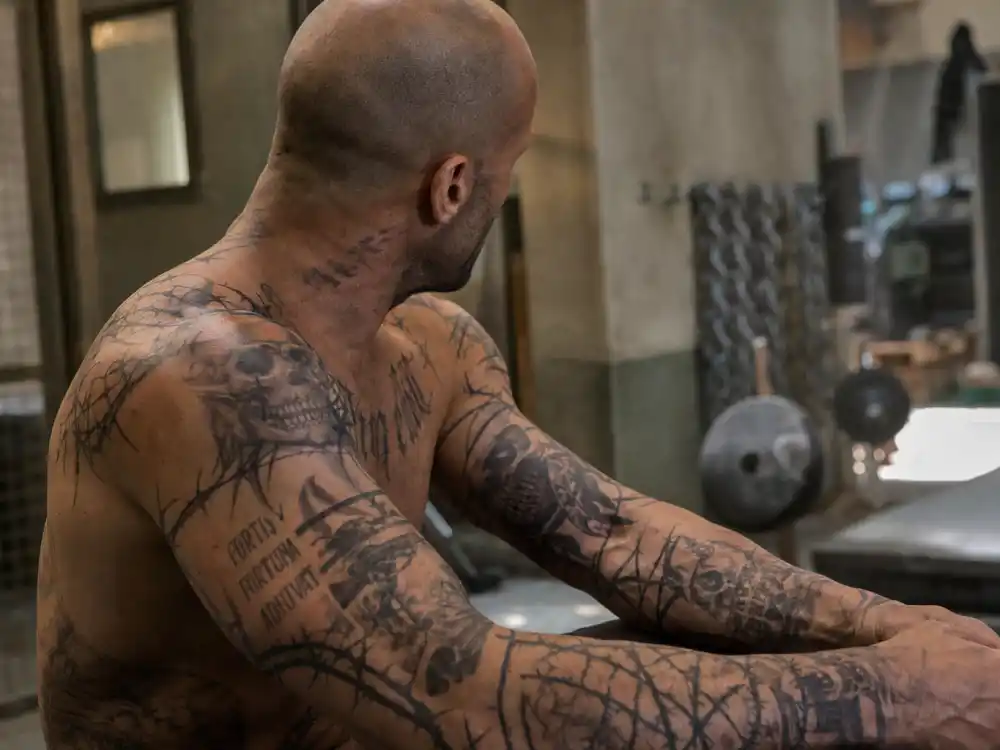
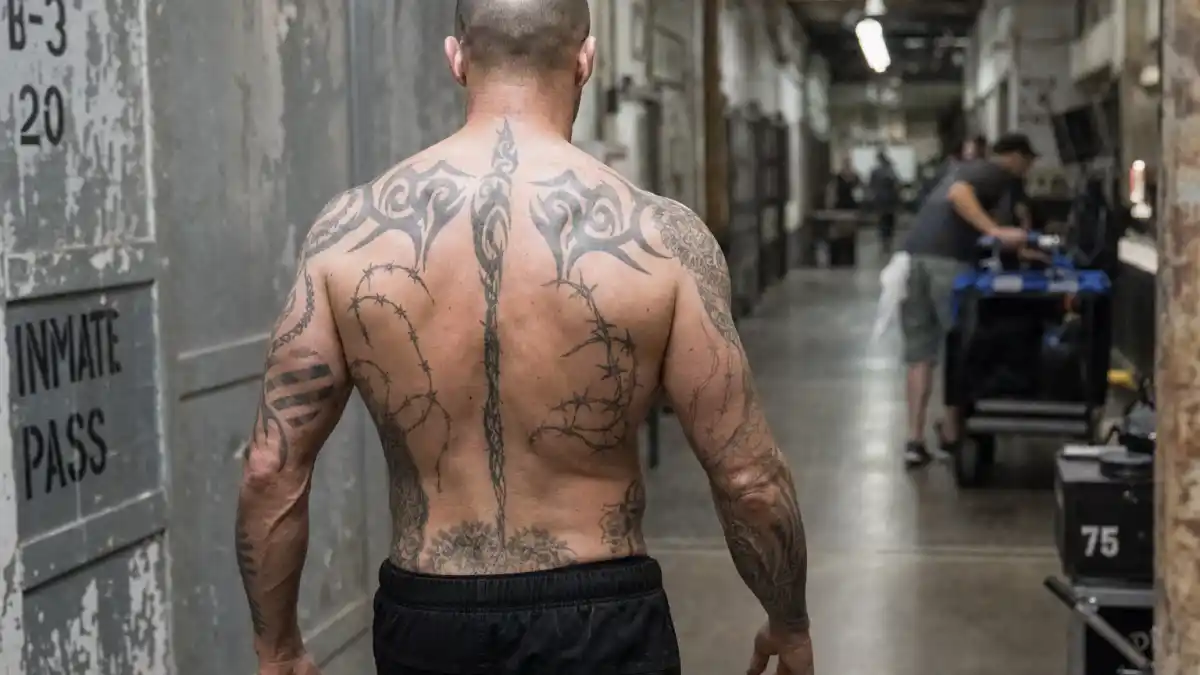
The dark tribal-style makeup in Death Race is the look most often mistaken for Statham’s own body art. In this still, broad shapes cover the shoulders and upper arms, with more marks around the neck and chest. The pattern is rough and heavy, giving Jensen Ames a prison history before the film explains much about him.
The large shapes stay visible through the driving and fight scenes. The character moves quickly and is often shown under hard light, so the tattoo design relies on bold lines and dark areas rather than delicate details. In a still, those shapes hold their place against the metal, dust and movement around him.
These should be described as tattoo makeup made for the film. The designs are real in the sense that the production applied them to Statham for the scenes, but they are not confirmed permanent tattoos on the actor. They belong to Jensen Ames.
The Frankenstein mask scene shows how the ink worked with the character
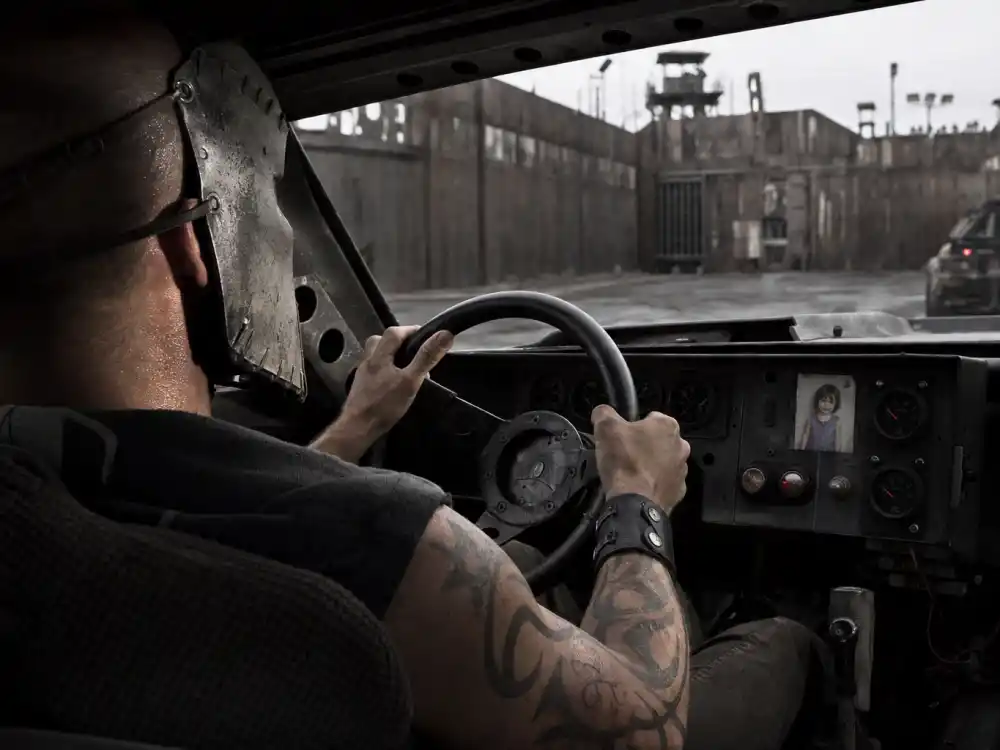
In the Frankenstein mask scene, Statham’s forearms are visible on the steering wheel. The ink continues the crowded, hard-edged look across his shoulders. With much of his face hidden, the arms and neck carry more of the character’s story, making the driver look as if he has already lived through a violent world.
The placement works in motion as well as in a still. The forearm designs stay visible while he drives, and their dark lines survive the quick cuts. Rather than a neat sleeve with open spaces between pieces, the coverage suggests prison-style marks crowded across the skin.
A viewer who sees only this scene could easily assume the tattoos are permanent. The skin, sweat, shadows and costume all help sell that effect. The realism shows that the makeup worked; it does not prove Statham got a tattoo.
The makeup department built the back design in layers
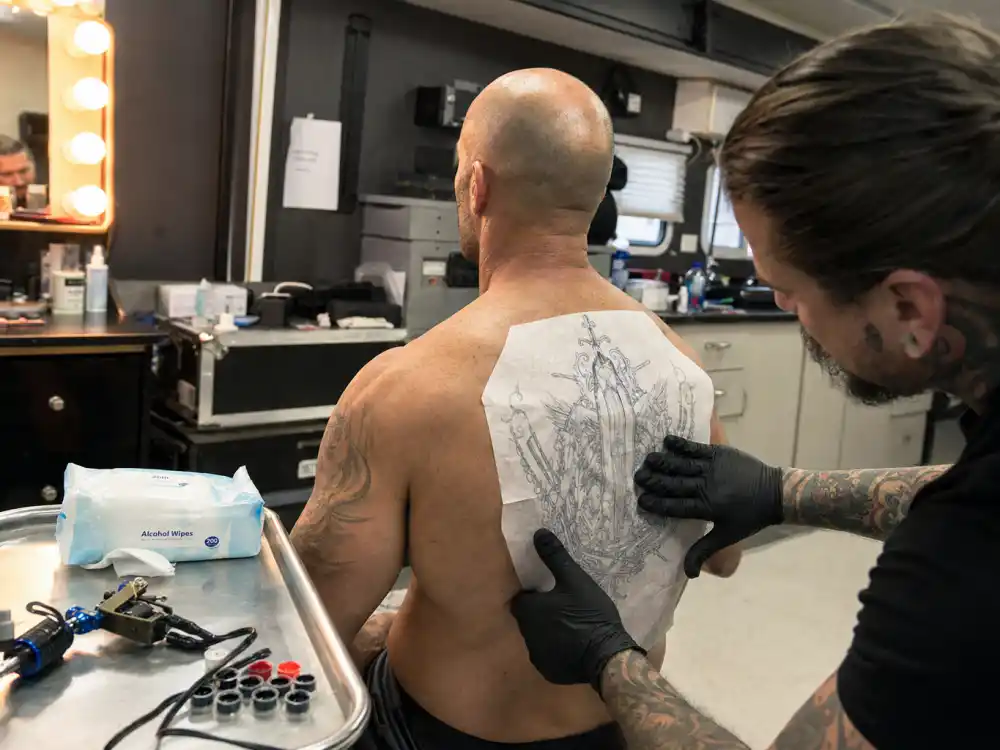
The behind-the-scenes photo shows a makeup artist positioning a large transfer across Statham’s back. The outline is held against the skin before the design is blended and finished. It captures the process that the film itself hides: the tattoo image was applied for the character.
A back design has to sit across the shoulder blades and still move with the actor. It also needs to line up with openings in the costume. A small shift can make the pattern look crooked when he bends or turns, so a transfer like this takes more care than the finished scene might suggest.
The close and wide views show different things. A close shot brings out the texture and dark lines; a wider view shows how the back piece connects to the shoulders and arms. Both help explain the makeup, but neither makes it permanent. The department created a consistent look for the character, not an addition to Statham’s real tattoos.
The film-versus-real comparison settles the permanent tattoo question
The side-by-side image gives the clearest answer. One panel shows Statham with the large makeup design across his back; the other shows the same area without it. The center shape, barbed lines and broad dark sections disappear when the production ink is gone.
That comparison is more useful than a repeated claim that he has a hidden sleeve. It shows the same area in two conditions and keeps the discussion tied to photographs. His tattooed screen appearances are associated with roles that call for a specific look; the Death Race designs are the best-known example.
The film stills are genuine production photos. What they show is temporary character ink. A real photograph of a tattoo does not establish that it is permanent. That distinction is easy to lose when convincing costume makeup is copied into celebrity galleries without the scene’s context.
The wide back view explains why the designs looked permanent on screen
The wide view brings the pattern together. A central tribal shape runs down the back, with sweeping lines reaching toward the shoulders and arms. The bare skin and hard lighting give the design room to fill the frame, which is why the image is so often used in searches for Statham’s tattoos. It resembles a finished back piece, even though it was made for the role.
The design fits the world of Jensen Ames. Death Race surrounds him with metal, concrete, cages and machinery; the heavy lines and sharp geometry echo that setting. The pattern was made for the character rather than placed randomly on the actor.
There are useful design ideas here without copying the film pattern: the center line, the spread across the shoulders and the way the arm shapes keep the composition readable when the body moves. A tattoo artist can use those broad principles to create original work suited to someone’s own body.
Statham’s action roles make the mix-up understandable. He often appears in scenes where bare arms or a back are part of the character’s look, and the ink fits the hard-edged image. Still, the clearest evidence comes from the application and comparison photos: the most recognizable designs were makeup for Jensen Ames.
The clean-skin view is part of the story too. It separates the actor from the character and shows why a gallery of similar film stills can give the wrong impression. Film makeup, body paint, digital effects and transfers can all look convincing; context helps identify what is actually on screen.
If you are looking to the Death Race tattoos for inspiration, study their scale and placement rather than copying the character’s exact design. The central back shape, shoulder spread and arm coverage were built to move with the actor. Original work can draw on those choices without turning a film transfer into someone else’s personal tattoo.
The short answer: the tattoos most often associated with Jason Statham are the prison-style designs he wore as Jensen Ames in Death Race. They are memorable because of their placement and production work, but they should be labeled as role makeup—not permanent ink on the actor.
Watch the production reference, then compare the film design with Statham’s skin:
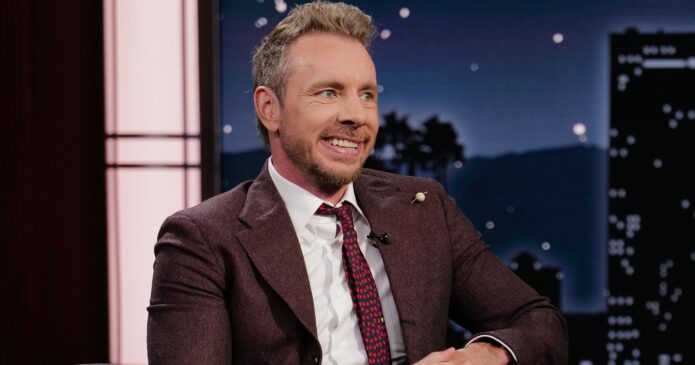
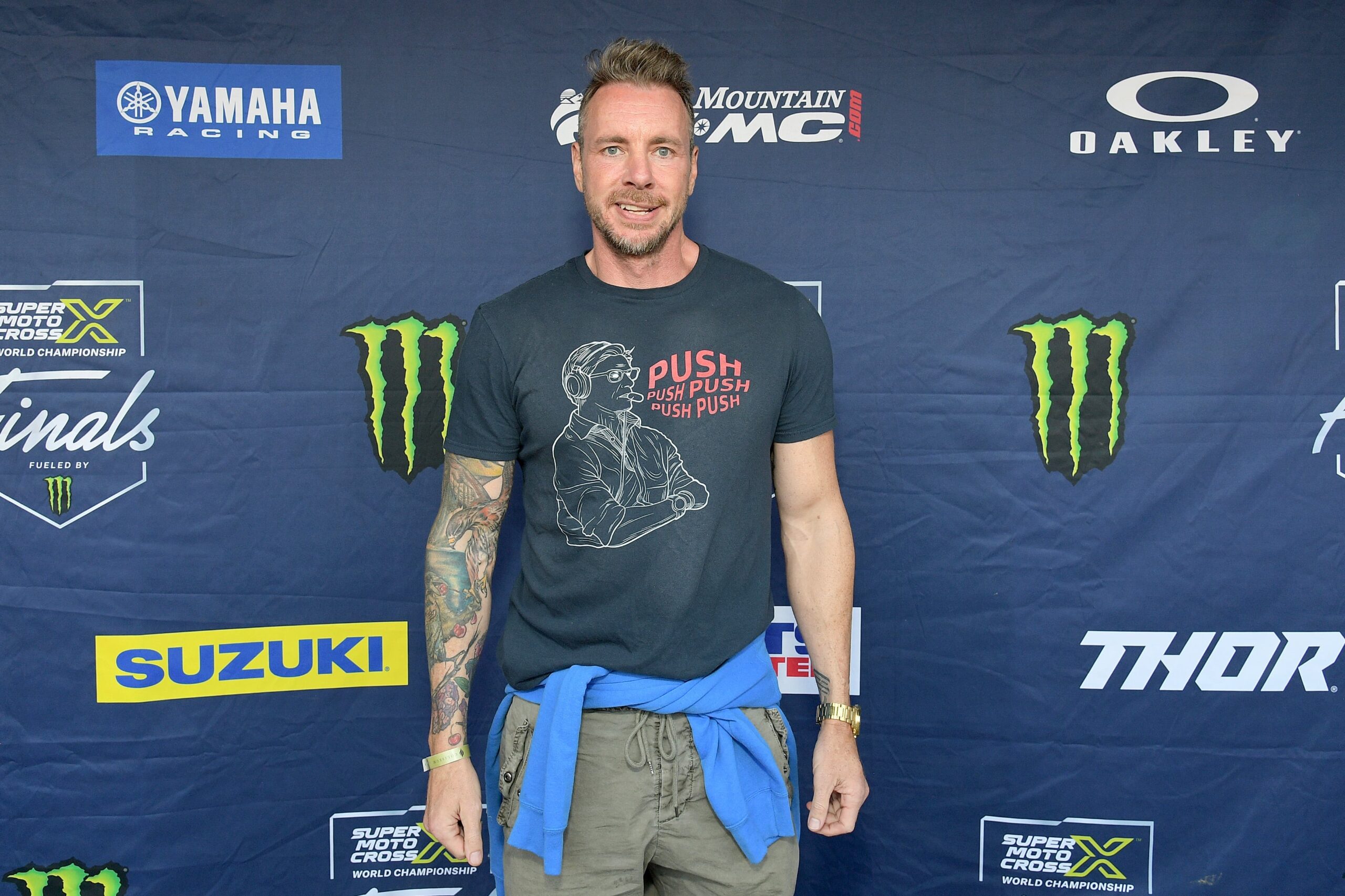
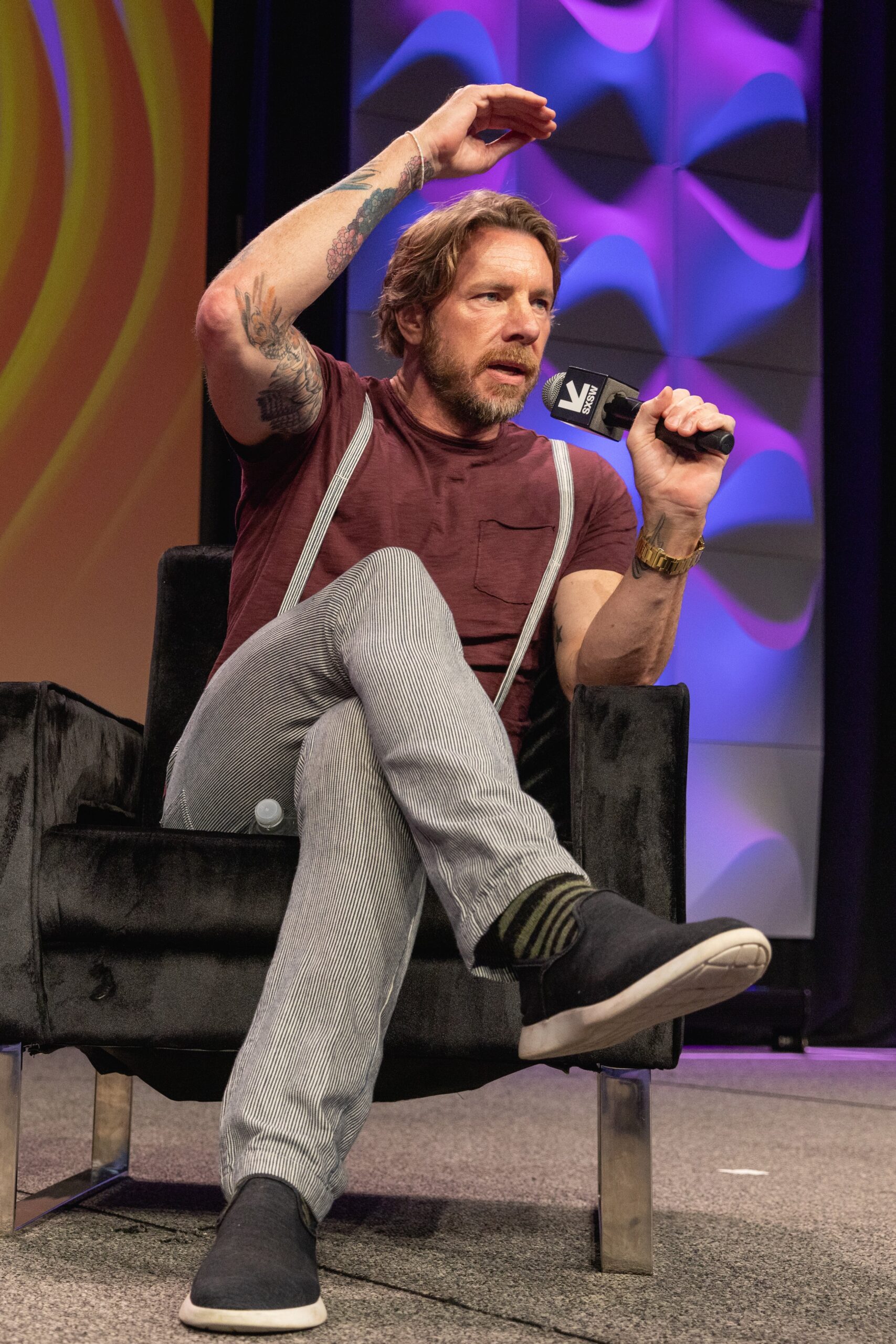
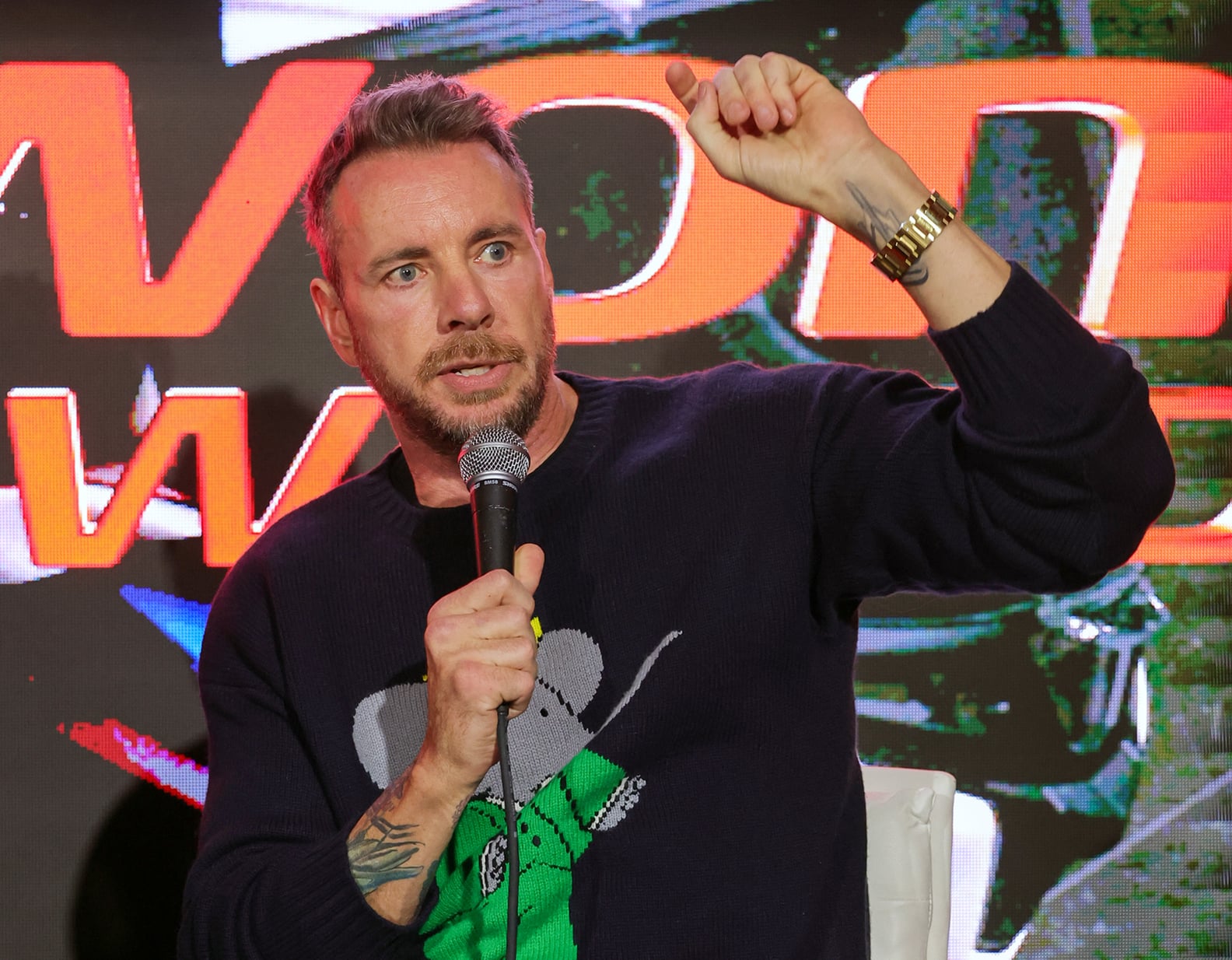
Dax Shepard’s tattoos range from a colorful cherry blossom tree across his right arm to four black stars on his left bicep, smaller wrist ink and a bell on his ring finger. The pieces don’t follow one matching style: the tree is detailed and botanical, while the stars and bell use simple shapes.
Published interviews and tattoo coverage explain some of the history. The tree covers an older design, Shepard has left the stars unexplained, and the bell is a wordplay tribute to Kristen Bell. Other small marks appear in event photos, but an unclear shape shouldn’t be given a made-up name.
The five photos below show the sleeve, stars, wrist and bell from different angles. Each image is useful for a different detail.
The cherry blossom sleeve is the big visual anchor
The largest piece in Shepard’s collection is the cherry blossom tree on his right arm. PopSugar describes it as a cover-up for an older tribal design. Newer photos show the tree extending from the upper arm toward the forearm, with branches, blossoms and shaded sections following the shape of his arm.
The event photo shows the sleeve with his arm resting naturally at his side. The dark trunk stands out against the lighter blossoms and open skin, so the design doesn’t read as one flat block of color.
Shepard has said the original tattoo was partly a practical choice. Before joining Parenthood, he didn’t want to spend time in makeup covering his arm tattoos for the show. That’s part of the story, though the finished sleeve is much more elaborate than a way to avoid makeup.
The cover-up also shows how a new design can work with older ink. Branches give the artist room to redirect the eye, while the blossoms create lighter areas over the tribal work.
The four black stars keep the left arm simple
Four solid black stars sit in a vertical line on Shepard’s left bicep. They’re a much simpler design than the cherry blossom sleeve, with plenty of open skin around them.
PopSugar says Shepard hasn’t publicly explained what the stars mean. The shape and placement are clear in photos, but their personal story isn’t. It makes more sense to describe the row than to guess at its meaning.
The two arms carry very different styles: a large, colorful tree on one side and compact black symbols on the other. The spacing between the stars keeps each one distinct and easy to see.
Wrist and forearm ink shows how the collection keeps spreading
A newer event photo catches small tattoos on Shepard’s wrist and forearm as he raises one hand. The dark wrist mark sits near his watch, while the opposite forearm has more colorful work. These pieces are less familiar than the tree and bell, but they show the collection extending beyond his shoulders.
The angle makes a difference. A mark can disappear when a wrist is flat, then show clearly when the hand is raised. Watches, sleeves and the bend of an arm can hide details in other photos.
PopSugar describes the wrist tattoo as difficult to identify and says Shepard hasn’t explained its meaning. The photo lets us point out the location and visible lines, but it doesn’t support a label or backstory.
Small tattoos also have to work around constant movement, washing and clothing. Here, the larger forearm design gives some scale to the smaller mark beside his watch.
The bell tattoo works as a tiny family tribute
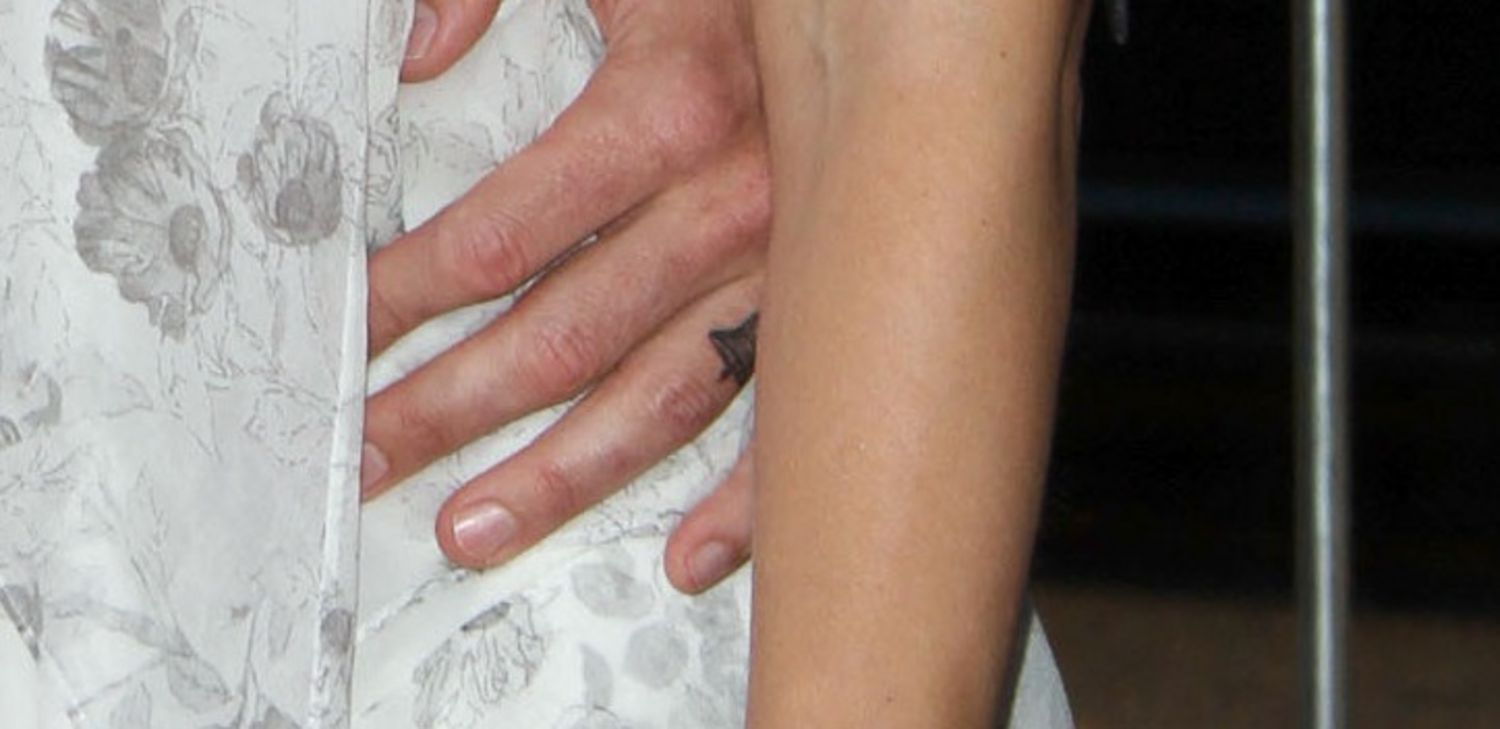
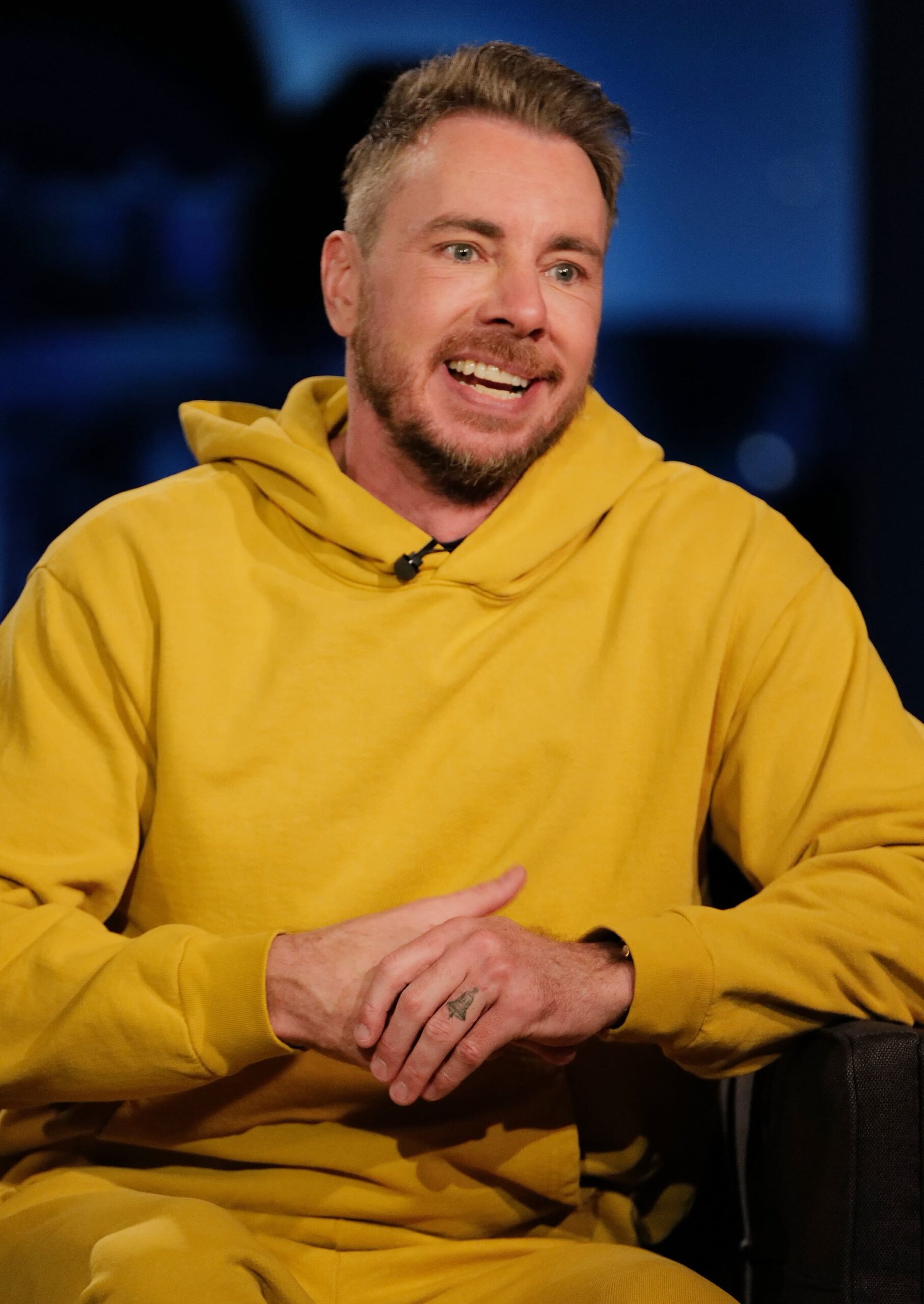
The small bell on Shepard’s left ring finger is the most personal piece in the collection. Glamour and Us Weekly reported on it in 2014: Shepard dislikes wearing jewelry, so he chose a permanent bell as a playful reference to his wife, Kristen Bell.
The close-up shows how small it is. The black-and-white bell sits where a wedding band would normally go. Glamour reported that the design includes the letters K, L and D for Kristen, their daughter Lincoln and Dax.
The joke and the family reference work together. The bell calls to mind Bell’s surname, while the initials add a private detail. It says more than a full name would, without taking up much space.
The ring finger is a small, high-use area, so the shape stays simple. The bold outline makes it readable without extra decoration.
A second bell tattoo photo shows why scale matters
This second photo shows the same bell in a wider view, with Shepard’s fingers, wrist and part of his arm in frame. The mark is small, but its dark outline keeps it visible. The close-up is better for the shape and initials; this image shows how it looks in a natural pose.
The bell works as an object and a reference to Bell’s name. The initials add one more layer without turning the finger into a block of text. Its placement is part of the idea: the design sits where a ring would go.
Placement ties the collection together. The tree follows the shoulder and arm; the stars rely on spacing; the bell sits on the ring finger; and the wrist mark appears beside a watch. Shepard has discussed the cover-up and the bell. Published coverage records the stars and points out the wrist tattoo, but it doesn’t confirm a meaning for every mark.
The cherry blossom sleeve is the clearest example of a cover-up taking on a life of its own. Branches create movement, blossoms add lighter detail, and dark areas help the design hold together from a distance. Older and newer photos show it at different stages.
The stars work in the opposite way. Four plain black shapes stand out because of their placement and the skin left around them. They don’t need extra shading or a story to be a clear visual choice.
The bell may be the smallest tattoo here, but its idea is easy to follow: a symbol that plays on a surname, with family initials, placed where a ring would sit. It doesn’t need to be large to carry a personal reference.
Together, the photos show a collection with different styles and levels of detail. Some pieces are colorful, some are simple black shapes, and some remain hard to identify. The images show different parts of Shepard’s actual ink rather than repeating one portrait.
If you’re using the photos for ideas, pay attention to where each design sits when the arm hangs, bends or turns. Spacing can keep a small mark readable. For a cover-up, movement and contrast can help a new image work with older ink instead of merely hiding it.
For more celebrity ink with clear placement photos, see the site’s actor tattoo guides.
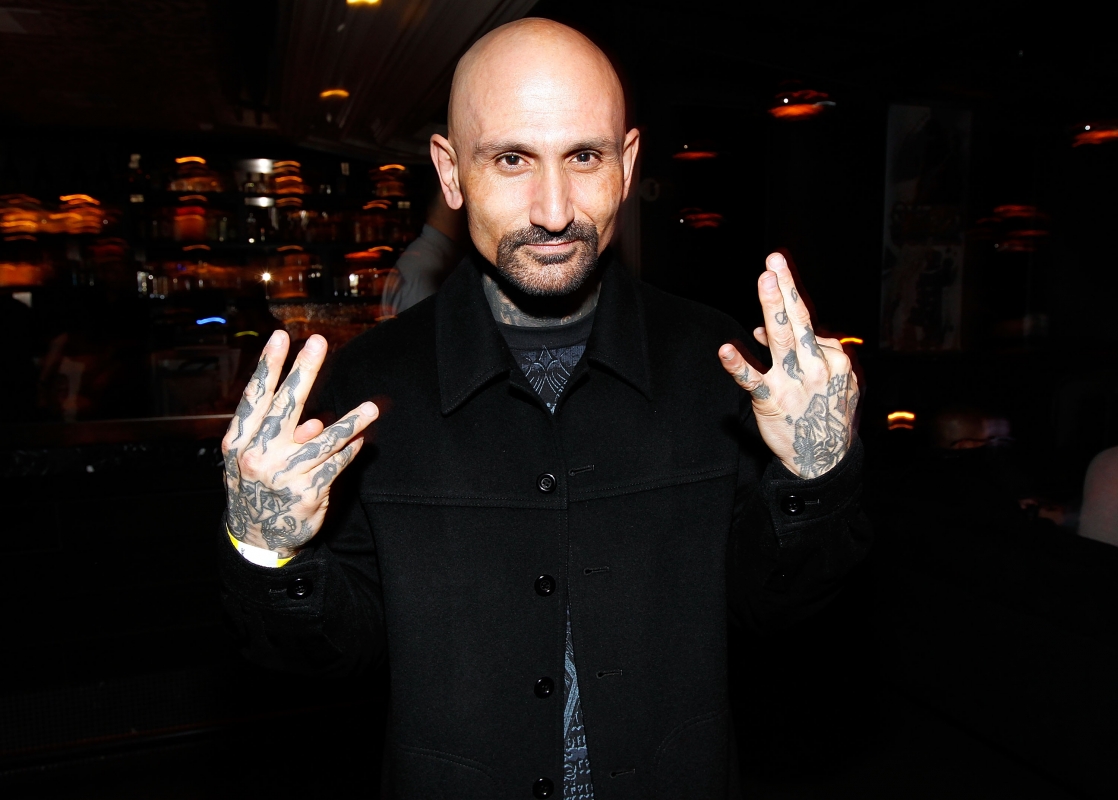
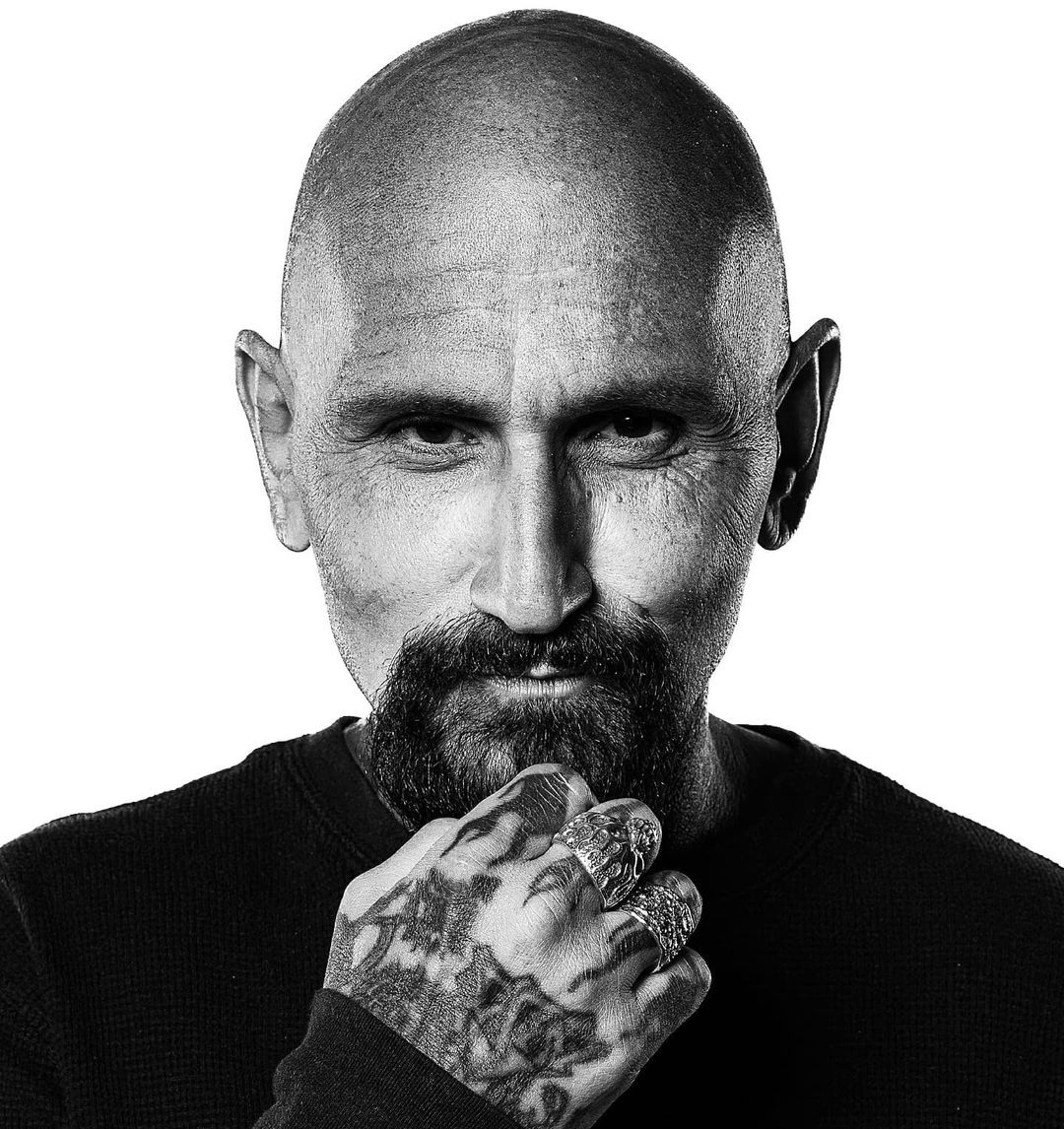
Robert LaSardo is the kind of actor you recognize before the name comes to mind. His shaved head, stare, voice, and tattoos make an impression all at once. The ink isn’t a few small marks under a sleeve; it covers his chest, neck, arms, and hands.
LaSardo has talked about tattooing as self-expression, long before heavily tattooed celebrities became routine on the red carpet. His collection feels lived in: skulls, dark fantasy figures, portraits, bold lines, and symbols that seem to belong to the same rough world.
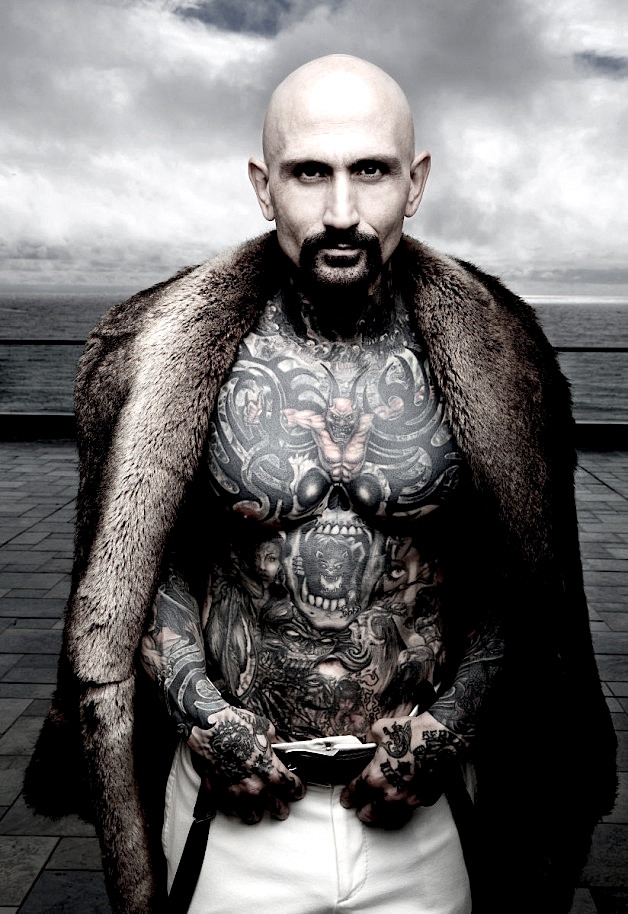
Layered tattoos cover Robert LaSardo’s chest and sleeves.
Here’s a closer look at the designs that show up in photographs, along with the parts of the story LaSardo has shared. Some meanings come from him; others are visual observations, and the distinction matters.
Robert LaSardo’s tattoo style at a glance
LaSardo’s body art is dark, crowded, and deliberately theatrical. There isn’t one neat theme, but heavy outlines, dense shading, faces, animals, and supernatural imagery give the different pieces a shared mood, even when they were added at different times.
The coverage is part of the effect. A chest and sleeve project changes the outline of the body, especially when a shirt is open at the collar or a role calls for bare arms.
The chest tattoo is the main canvas
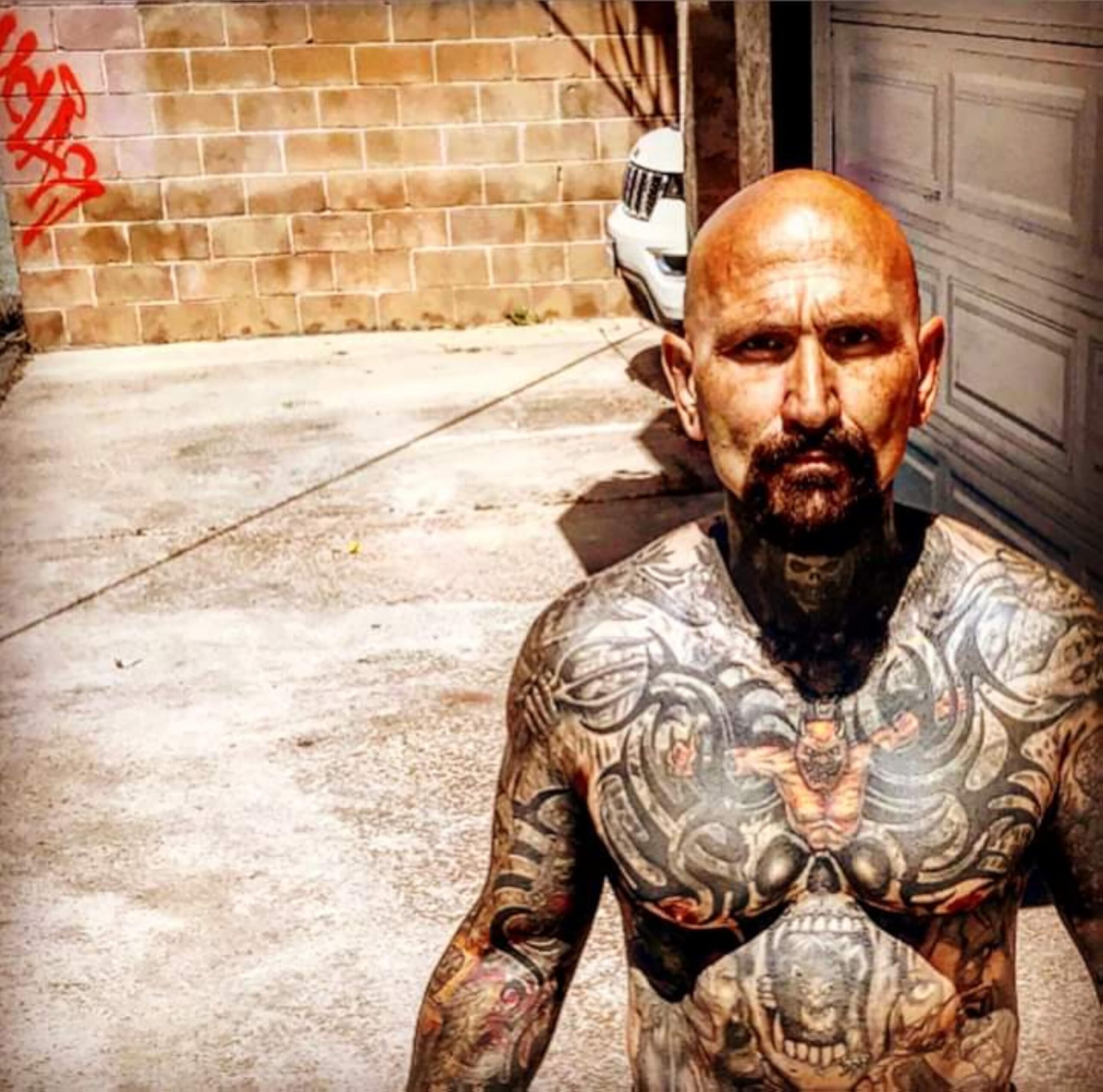
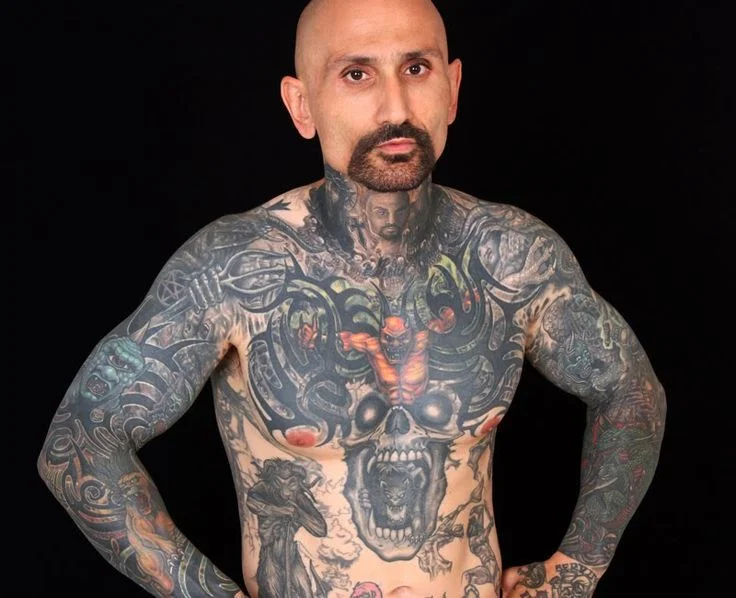
LaSardo’s chest is usually the first place people notice. Photos show a large composition with a skull low on the chest, a horned or demonic figure above it, and sweeping shapes that reach toward both shoulders. Faces and figures are layered into the design instead of sitting like separate stickers.
It reads more like a mural than a collection of individual flash pieces. Dark areas set off the lighter faces, while lines around the shoulders carry the design across the chest.
The full chest piece brings together a central skull, figures, and dense side panels.
Skulls, demons and fantasy figures
Skulls recur in LaSardo’s collection, alongside demonic faces, serpentine forms, winged shapes, and fantasy figures across his chest and stomach. Up close, you can see more than the outlines that make the first impression.
It would be easy to assign a symbol to every dark image, but LaSardo hasn’t published a complete explanation of the designs. They fit the dramatic, personal atmosphere of the collection without needing a fixed meaning for each one.
The neck tattoos make his face even more recognizable
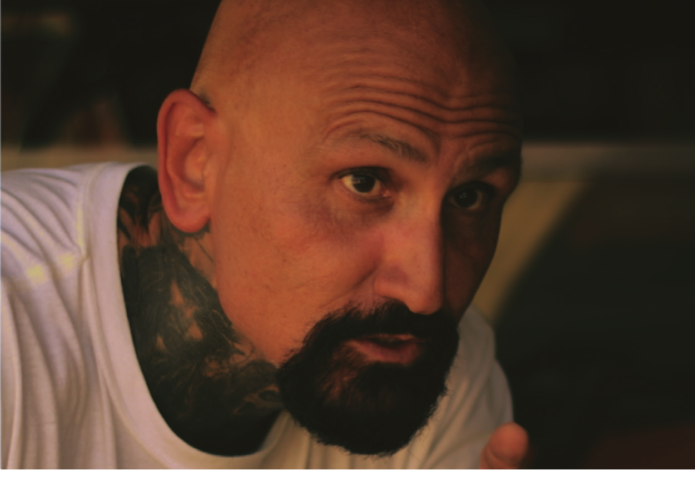
LaSardo’s neck is one of his most visible tattooed areas. A large dark design rises from his collar and wraps around the sides of his neck. It sits just beneath his beard and jaw, so from a distance it almost reads as part of his face.
In an interview about his tattoos, LaSardo recalled makeup covering the neck ink for his role on NYPD Blue, since the character needed to look less identifiable. It shows how visible neck tattoos could be treated as a casting issue, particularly on television.
The neck, chest, and stomach tattoos form one continuous front.
Both arms are covered in sleeves
LaSardo’s arms have the same dense look as his chest. Bold black shapes, curved forms, and smaller details run from shoulder to wrist. Depending on the photo and light, the sleeves can look almost black and grey or show muted colour in the figures.
The arms are visible in a simple shirt or tank top, which makes them a prominent part of his screen image. That was true well before social media made celebrity tattoos a daily subject.
The sleeves also show why a large piece needs planning. The designs overlap and share dark areas, so the arm doesn’t look like a row of unrelated tattoos placed side by side.
Hand and finger tattoos
The hand pieces are smaller than the chest work, but photographs show them clearly. LaSardo has tattoos across the backs of his hands and fingers, continuing toward the knuckles. Hands move and gesture, and they sit close to the face, so the ink is hard to miss.
Hand tattoos make a different commitment from an upper-arm piece. They’re difficult to hide and the skin gets plenty of wear. On LaSardo, that directness suits the rest of the collection.
The hand and finger work brings smaller designs right into view.
Portraits and faces in the ink
Faces appear across LaSardo’s chest and stomach. Some are realistic; others blend into the darker fantasy imagery around them. The portraits give the larger pieces an emotional center and keep the chest from reading as one solid field of black ink.
The faces also break up the rougher lines around them. There’s a lot to take in, but small changes in expression, eyes, and shading give the eye somewhere to land.
His first tattoo and the story behind it
LaSardo has described his first tattoo as a traditional 1950s-style prize fighter on the right side of his chest. He was young and hid it from his father for months. An arrest eventually exposed it, and his father told him to zip up his shirt.
That story puts the later work in context. The tattoos didn’t arrive all at once for a film role; they began early and accumulated through different parts of his life.
What the tattoos meant for his acting career
LaSardo has said people often read his appearance before they know his work. His tattoos made him a natural fit for criminals, outsiders, tattoo artists, and other intense characters, though he didn’t get the ink as a career costume.
There’s a tension in that. The same tattoos that made him memorable could also narrow the roles offered to him. He has talked about being judged by his ink while describing tattooing as a powerful way to express himself.
For LaSardo, the tattoos are more than a list of designs. They’re part of the look audiences associate with him on screen.
How the whole collection fits together
Look at the pieces separately and you’ll see skulls, dark figures, animals, portraits, tribal-style shapes, and lettering on the hands. Together, they make one dense composition: the chest anchors it, the sleeves extend it, and the neck and hands keep the ink visible in close-up.
The tattoos are part of why LaSardo has stood out in roles involving tattoo culture. They’re real, layered, and specific to him, rather than generic props.
The close-up shows how the hand and neck tattoos frame LaSardo’s face.
Robert LaSardo tattoos compared with other celebrity ink
LaSardo’s tattoos look more like a full character design than the smaller symbols often seen on actors. For a different kind of celebrity tattoo story, our Halsey tattoos guide covers a mix of small symbols, lyrics, and larger pieces.
For another bold placement, see Zayn Malik’s tattoos, where the chest and arm designs are easier to look at one by one. Fans of athlete ink can compare the scale and placement with Dustin Poirier’s tattoos.
The bottom line
LaSardo’s tattoos aren’t meant to look tidy. The chest, sleeves, neck, and hands form one bold collection of dark figures, faces, skulls, and old-school imagery. He started getting tattooed young and kept adding to the work, even when visible ink could make a role harder to land.
That mix of a strong visual style and a long personal history is why the collection holds attention. It’s part of the person viewers recognize on screen.
Watch Robert LaSardo talk about his favorite tattoo
Sylvester Stallone’s tattoos have changed enough to tell a story of their own. The large, colorful pieces are hard to miss when he wears a vest or T-shirt. The collection changed most visibly after he covered tattoos tied to his estranged wife, Jennifer Flavin. Before-and-after photos and comments from his publicist document that shift.
There is plenty of guesswork around the tattoos. A dark patch in an old photo isn’t necessarily another design, and a fan caption isn’t an official explanation. This article sticks to clear photos and details reported by People and Page Six, and leaves uncertain meanings open.
The Butkus tattoo now covers part of the old portrait
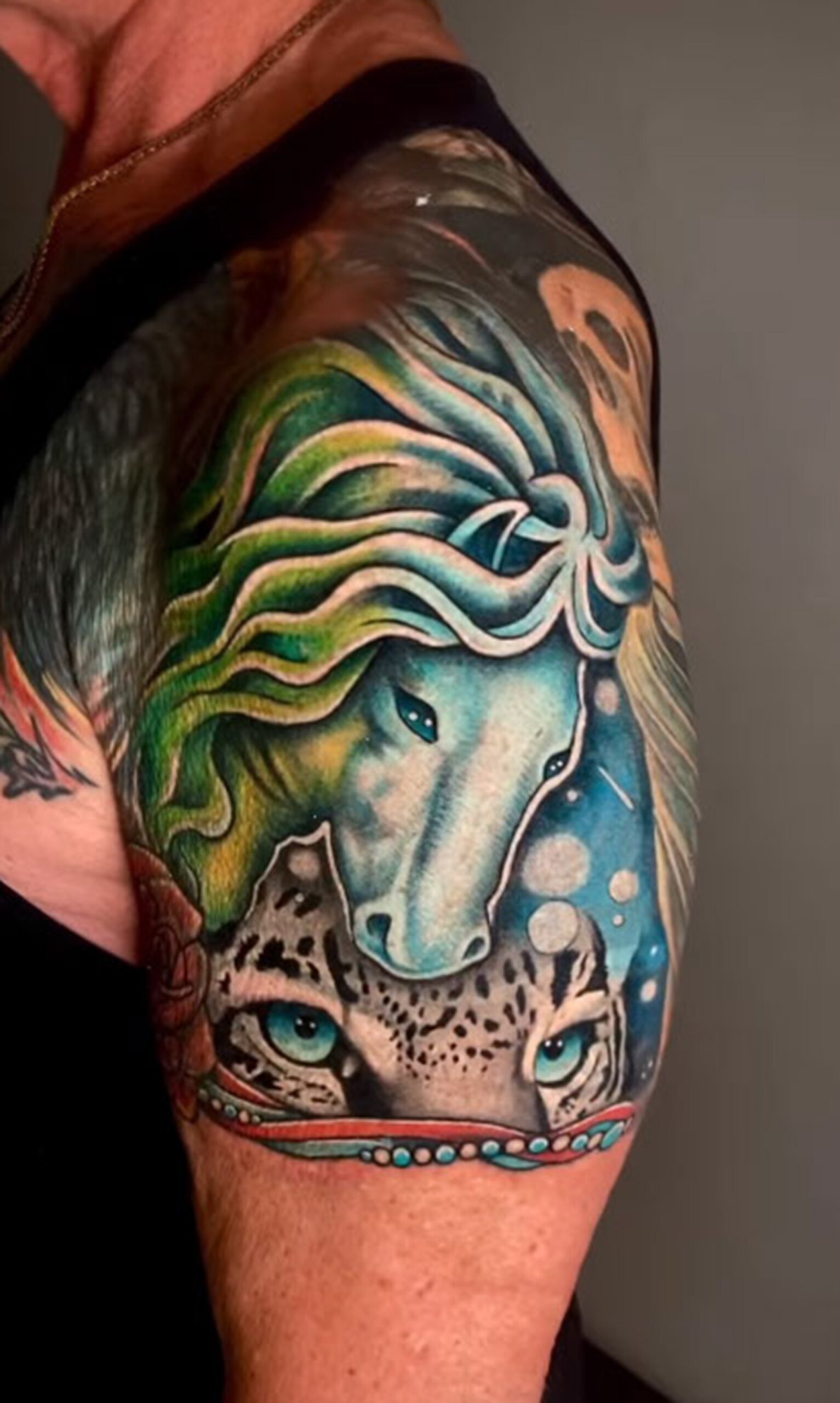
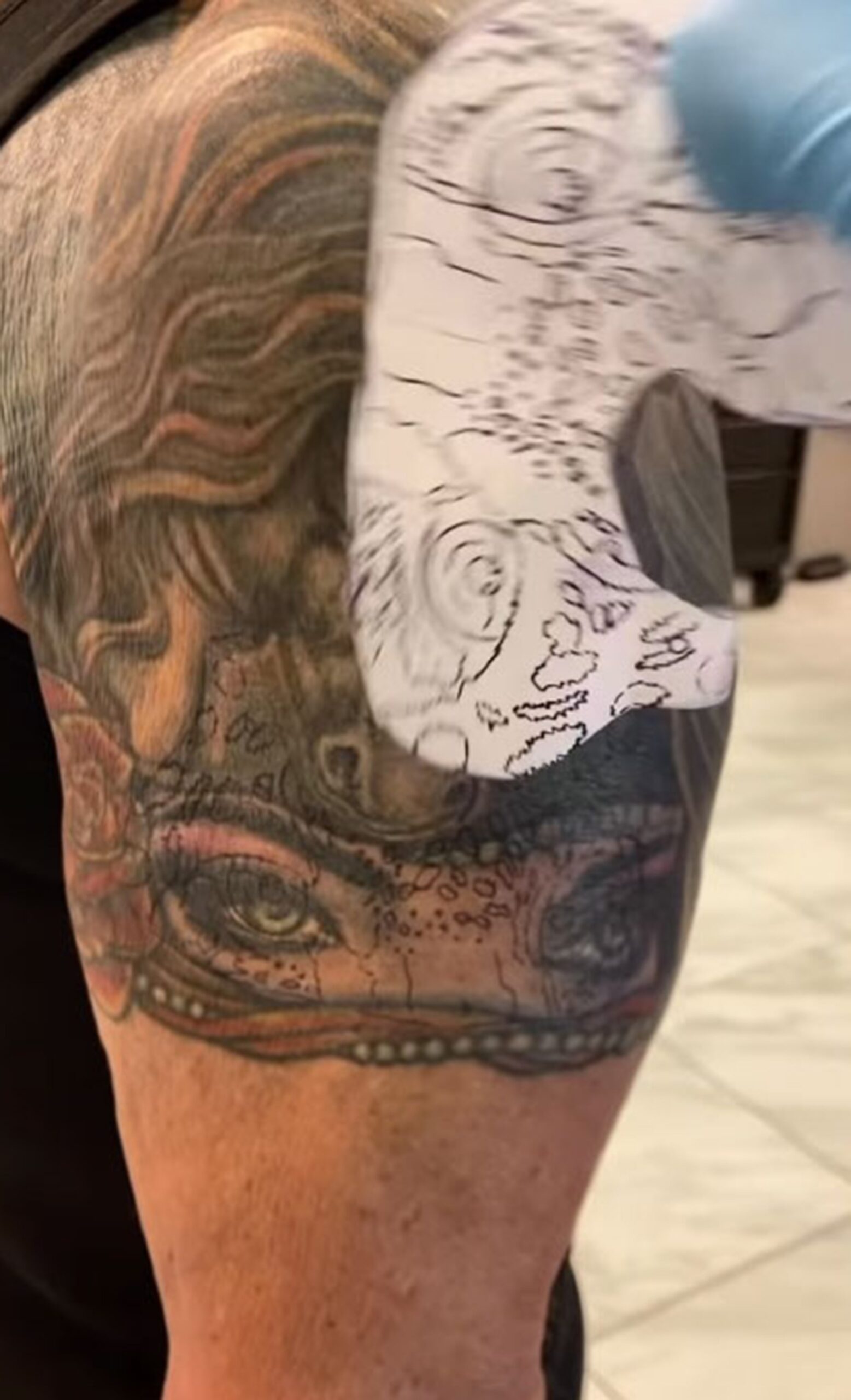
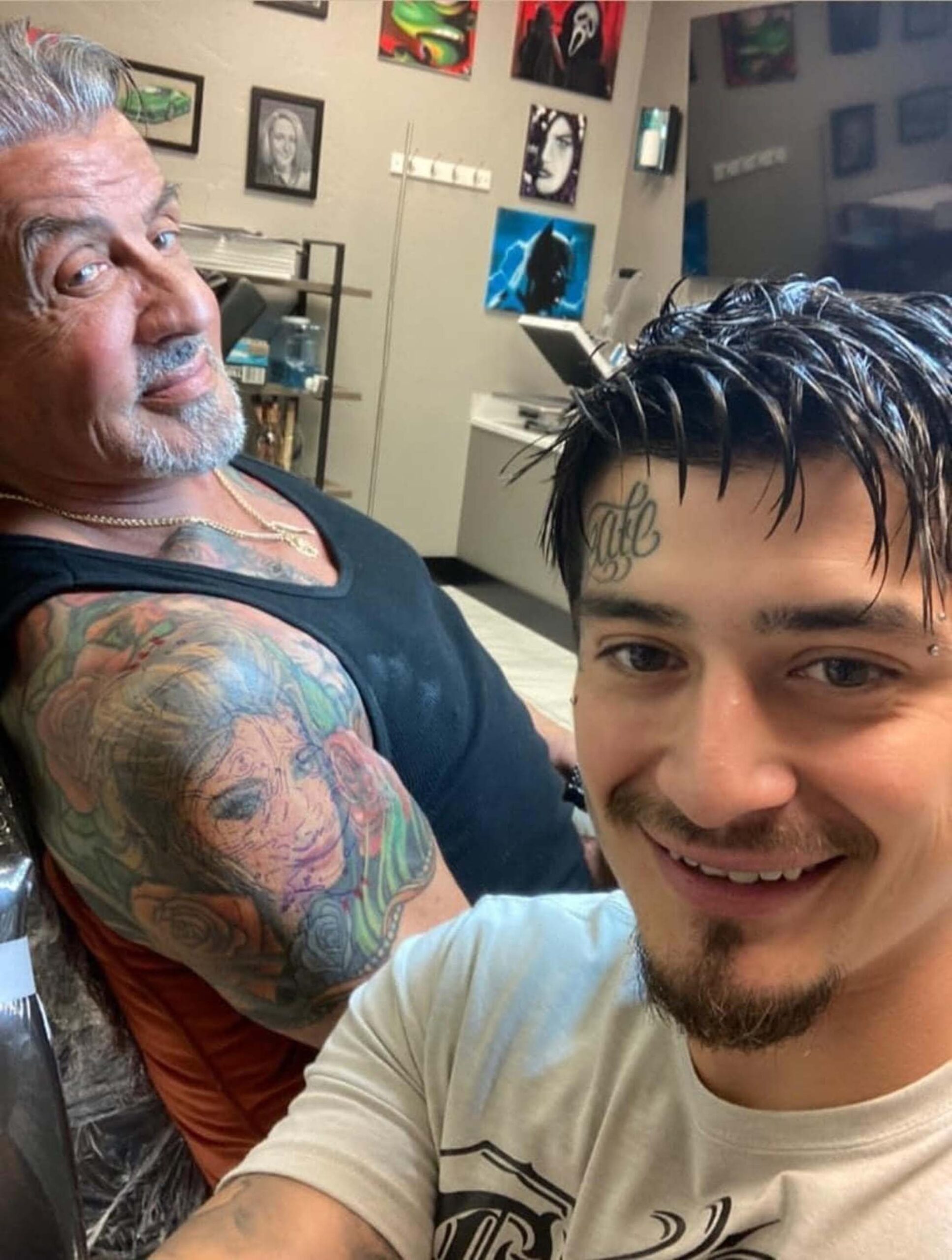
The most widely reported recent change is on Stallone’s upper arm. In 2022, he covered an earlier portrait of Flavin with an image of Butkus, the bullmastiff who appeared in Rocky and Rocky II. His publicist said Stallone wanted to refresh the Flavin image, but the result couldn’t be fixed. He then chose the dog portrait.
The Butkus cover-up is a large, colorful animal portrait with blue and green tones and darker shading around the face. Close photos make the layers easy to see, including a little of the older work around the edges.
This tattoo has the clearest confirmed story. Butkus was part of Stallone’s Rocky history, and Stallone has talked about how much the dog meant to him. That account is better documented than fan theories about smaller marks on his arms.
The earlier Jennifer Flavin portrait was much easier to recognise
Before the cover-up, Stallone had a large portrait of Flavin on the same upper-arm area. It showed her face, bright hair and flowers, taking up much more space than a small name or date. Older photos show how prominent it was and why replacing it was such a visible change.
The portrait looks different from one angle to another. Some photos show mostly the face and hair; others reveal more of the flowers and color along the lower edge. Several original photos give a fuller view than one tight crop.
News coverage and photos identify the portrait as Flavin. They don’t establish the exact date it was done or private details about the relationship. The image confirms the portrait; other claims need a source.
A second cover-up added a leopard to the story
The Flavin tattoo on his left arm changed too. Page Six reported that Stallone covered a tattoo of her eyes on his left tricep with a colorful leopard.
The leopard looks very different from the Butkus portrait. It uses an animal pattern and bright color in a traditional tattoo shape, covering the earlier design with a new image rather than a plain dark patch.
Tattoo-session photos show the work across Stallone’s upper arms and shoulders. Some surrounding lines are hard to identify, so the leopard and visible portrait-style pieces are clearer than any longer list of designs.
The shoulder and upper arm tattoos are packed with colour
Stallone’s arm tattoos extend beyond the two cover-ups. Clear studio photos show portraits, flowers and shaded sections over his shoulders and upper arms. The designs sit close together, making the area look like a large sleeve even though it was built over separate sessions.
Red, green and blue still show in newer photos, while black and gray shading gives the portraits their shape. The mix has more in common with a classic portrait sleeve than with the small tattoos many actors keep under their clothes.
Stallone has old surgery scars from his action-film years, and coverage of his tattoos often mentions them. Photos show the ink, but they don’t prove that every section was planned to cover a scar. Those claims should stay separate.
The tattoo session photos show how much work is on both arms
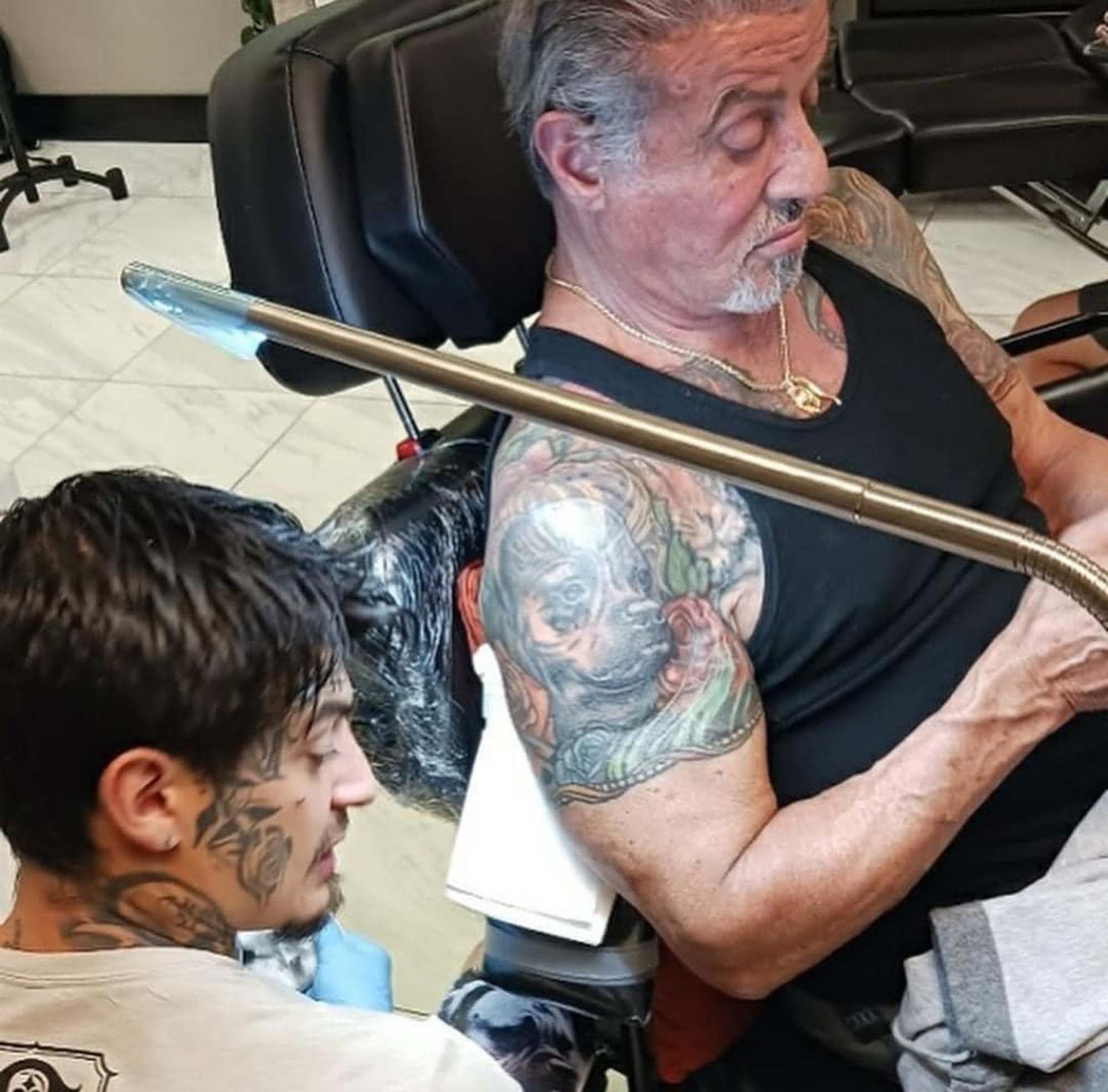
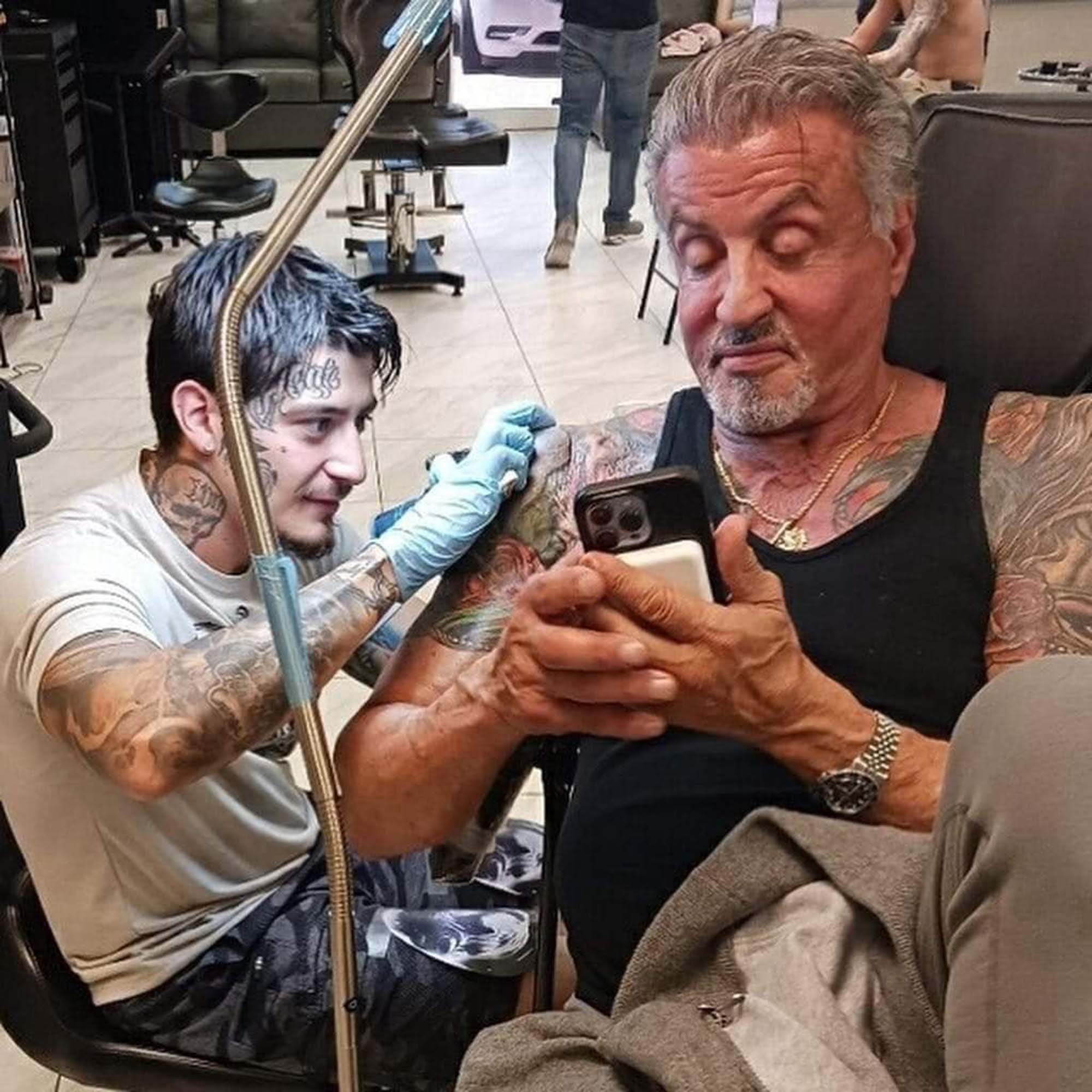
One useful view comes from the tattoo studio. Stallone is seated as an artist works near his shoulder, and the photo shows ink on both arms, across his upper chest and toward his neck. A phone covers part of his torso in one frame, but the rest still shows the scale of the collection.
Studio photos reveal more than the usual red-carpet shots, where jackets hide much of the ink. With his shoulders and upper arms visible, you can see how the portraits, color and darker outlines sit together. They also show why one close crop can’t tell the whole story.
Some shapes are partly covered by clothing or equipment, and others are too soft in the photos to identify. The clearest description is that Stallone has a large, colorful collection across his arms and upper body, with the Butkus and leopard cover-ups as the best-documented recent changes.
So what does Sylvester Stallone’s tattoo collection mean now? It keeps changing. The older Flavin portraits were relationship tattoos; the newer Butkus and leopard designs cover those pieces with something different. Butkus has the clearest public story, while Stallone hasn’t explained every part of the leopard design.
Photos from different years show a changing collection. Some areas look freshly colored, others older, and some are visible only when Stallone wears a vest or sits for a tattoo session. No single photo gives a complete inventory.
Stallone’s tattoos are loud and a little dramatic, tied to parts of his life fans know: Rocky, family, animals, injuries and a long career. They do not look like decoration added at random. Some designs have been covered or reworked as his life has changed.
The short video below discusses the Butkus cover-up. It adds background, while the photos above give the clearest view of the tattoos themselves.
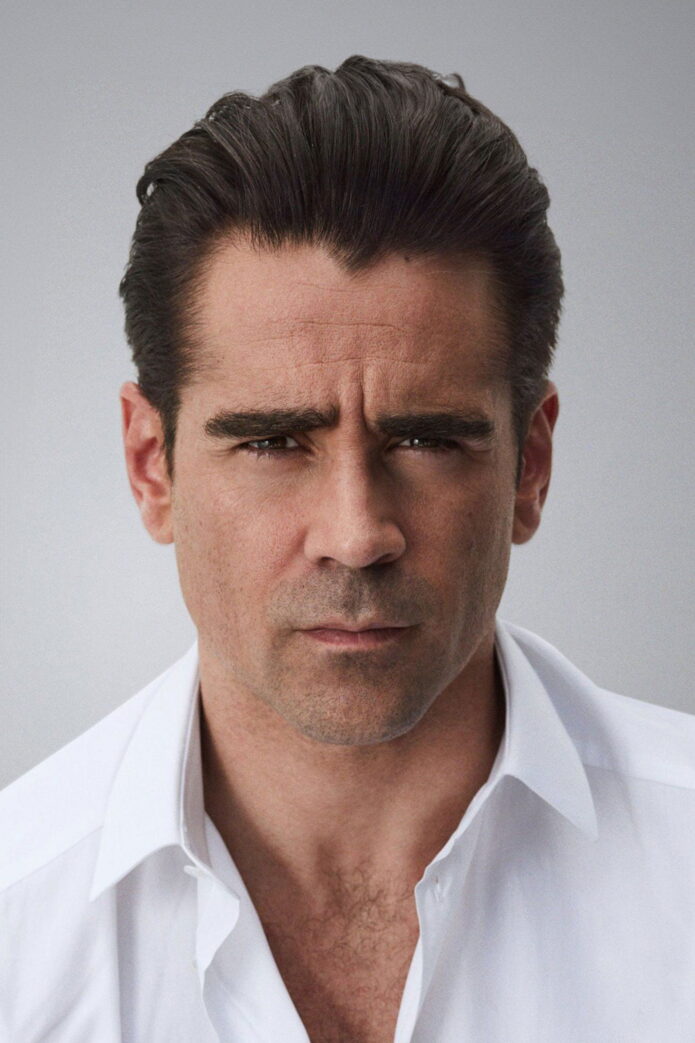
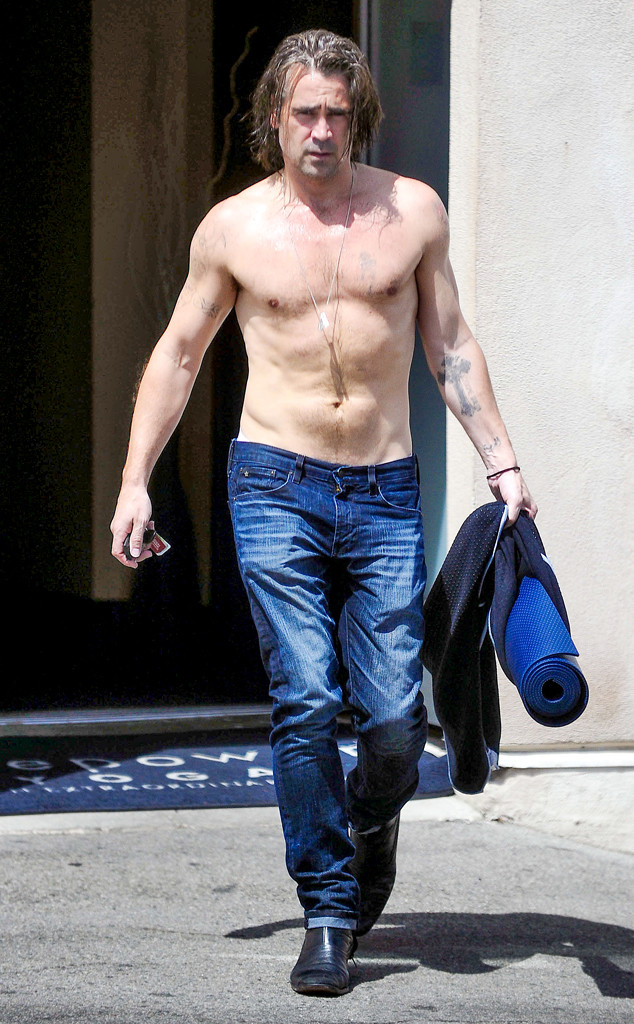
Colin Farrell’s tattoos can look different from one photo to the next. A large black-and-grey design wraps around his upper arm; chest lettering and smaller marks show in other pictures.
Some older designs have been reported as changed or removed, and a few marks are too faint to identify. This guide sticks to what can be seen clearly and to the tattoo stories Farrell has discussed.
Colin Farrell’s big tribal upper-arm tattoo
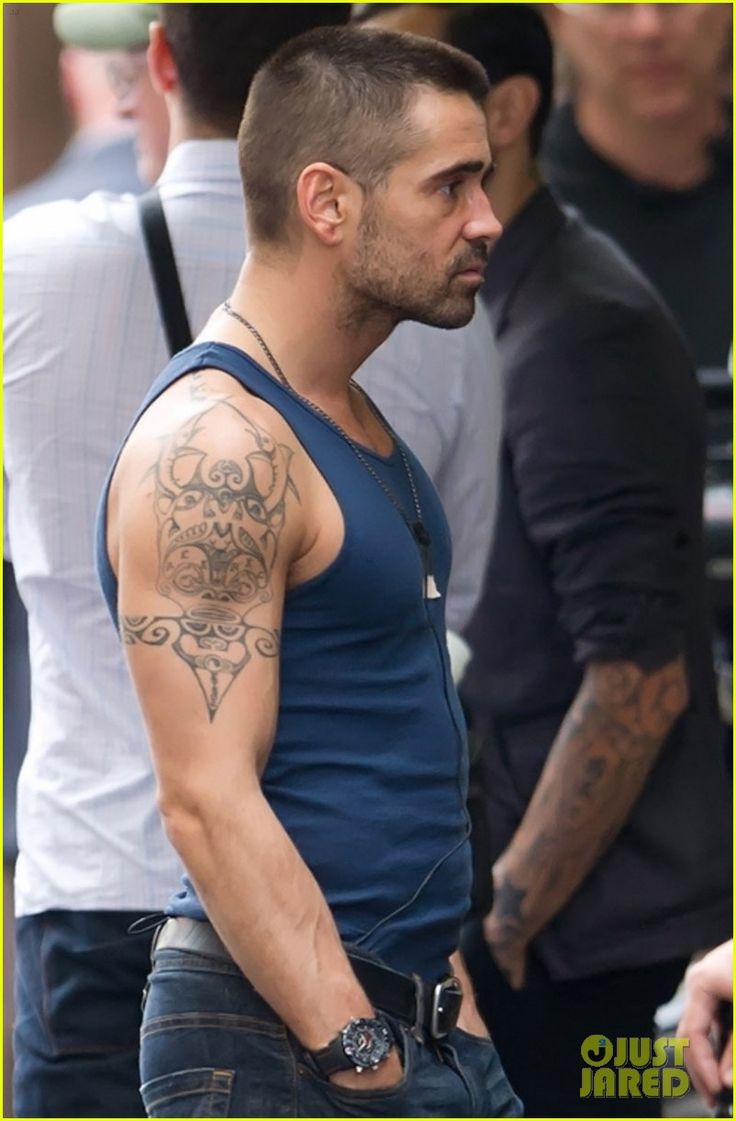
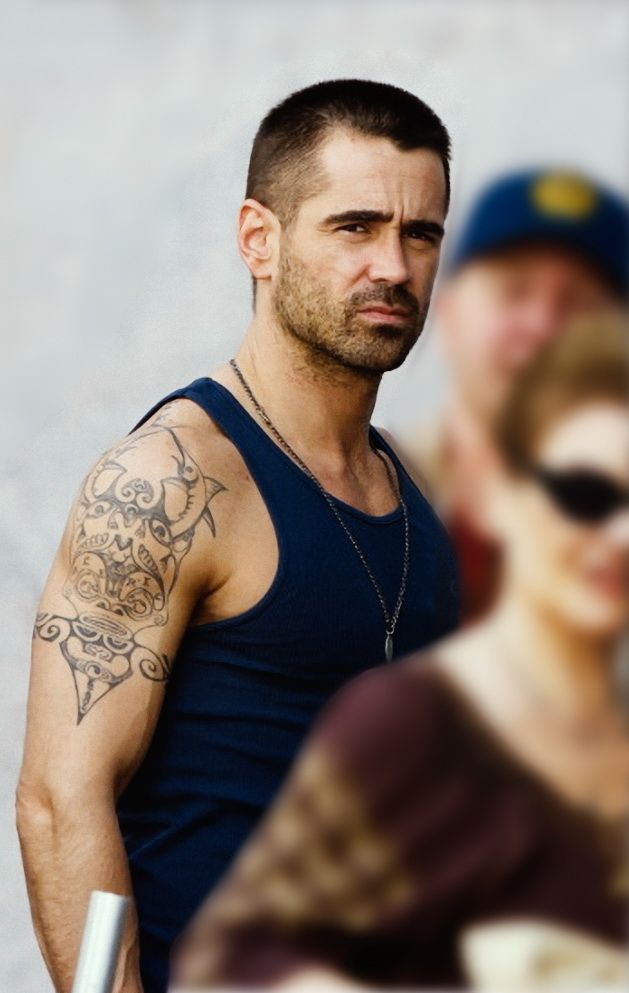
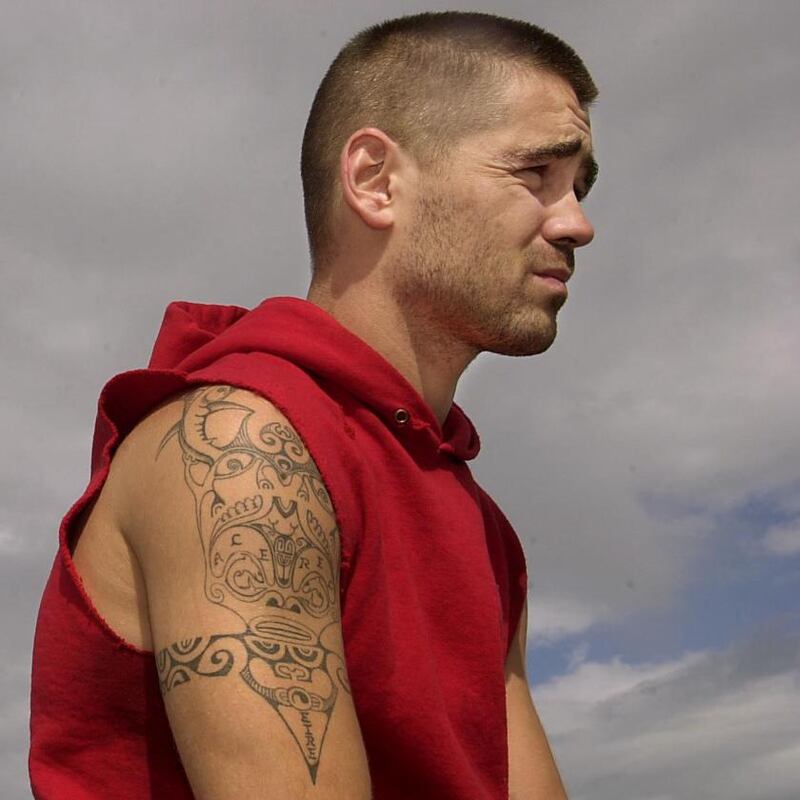
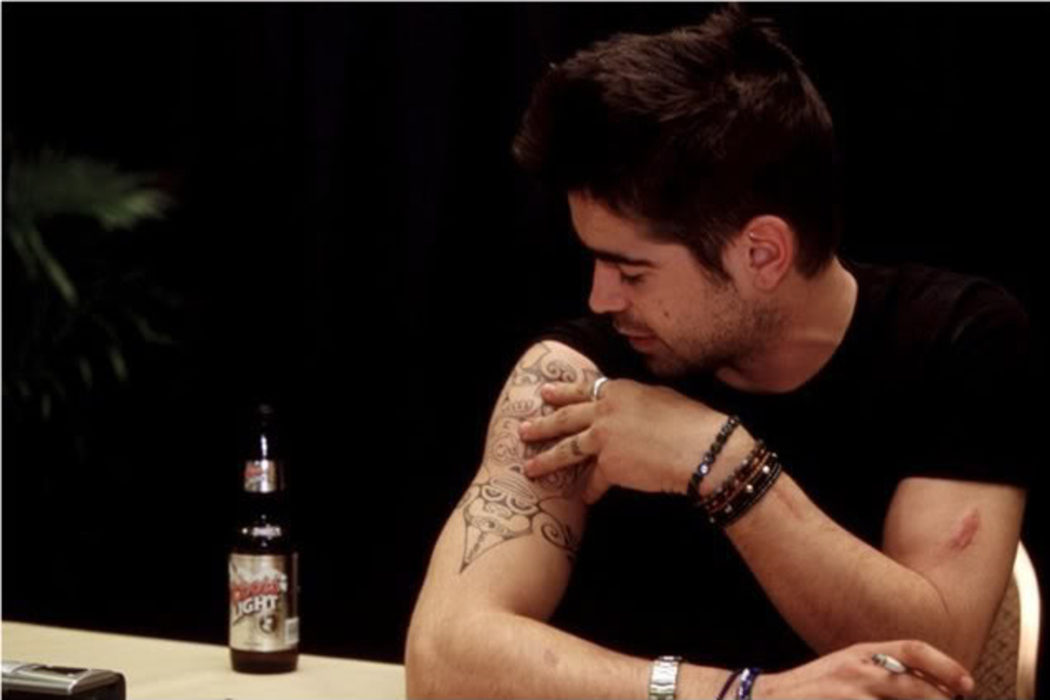
The largest piece covers Farrell’s upper arm. Curved black-and-grey shapes and smaller details lead to a pointed section near the bicep. From one angle it reads as a single design; from another, its parts are easier to see.
Coverage often describes it as tribal, though it has more detail than a plain band or a few thick lines. The tattoo wraps around the arm, so a side view shows more than a front-facing photo.
It appears in photos from red carpets, film promotion and casual outings over several years. Farrell has often worn sleeveless tops, which makes the design easy to spot.
The arm tattoo from the front and side
Side photos show the central shape, curved lines near the shoulder and smaller marks around the main piece. The design continues around the arm instead of sitting only on the outside of the bicep.
A cropped portrait may show just the shoulder; a wider image reveals the lower point and additional linework. The difference is the angle, not a separate tattoo.
Older reports also mention a cross and the words Carpe Diem, though their placement is hard to confirm in every photo. Faint lines are best left unidentified unless the image supports a clearer reading.
Chest lettering and the words “LOVE NO MATTER”
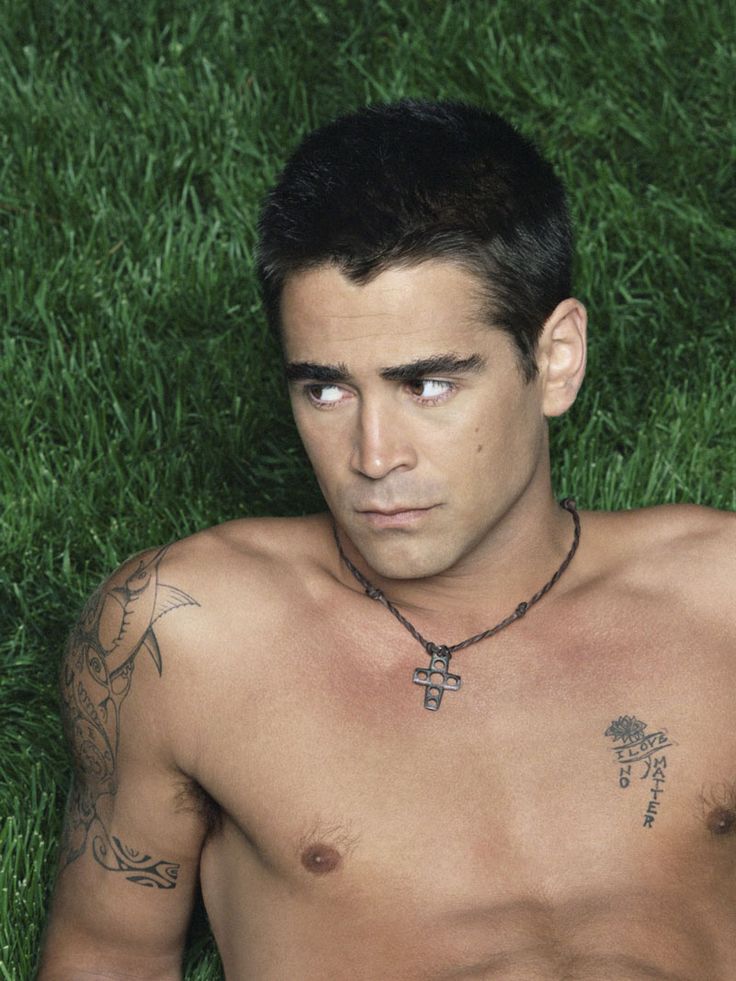
Shirtless photos show more ink across Farrell’s chest. The clearest lettering reads “LOVE NO MATTER,” arranged in stacked lines on one side.
The phrase is direct, but Farrell hasn’t given a detailed public explanation for it. It shows in open shirts and shirtless pictures, though the upper-arm tattoo is often more visible.
Other small marks appear in older photos, but some are too faint or partly covered to identify. The main designs are clearer than any exact count of every tattoo.
What shows up on his other arm
Farrell has visible ink on his other arm as well. Full-body photos show tattoos on both forearms and upper arms, though the shapes aren’t always sharp enough to name.
The photo above shows both arms in clear light. Older pictures also help: ink can fade, and a tattoo partly hidden by a sleeve, hair or shadow may be hard to see in a newer shot.
Group photos can cause mix-ups, especially when someone else is standing close beside him. Images where Farrell’s face and position are clear make it easier to tell which tattoos are his.
The red-hoodie photo gives the clearest look
The red-hoodie photo leaves Farrell’s shoulder and upper arm exposed. It shows the heavy outline, lighter details inside the design and the point that reaches toward his bicep.
The image also makes the scale clear: this is a large piece across much of the arm, not a small shoulder symbol that only looks big in a close crop.
Farrell has spoken about a rose tattoo he regretted or had removed. Accounts differ, so it’s safer to treat that as part of his reported tattoo history than to assume every old mark is still there.
Why the tattoo count is hard to pin down
The available pictures come from different years. Some show fresh, dark ink; others show older tattoos that have softened. Film-set makeup and costumes can add to the confusion.
Some reports say Farrell changed or covered tattoos after a relationship ended. People also add to designs or remove pieces, so one photo cannot stand in for his collection across every year.
The upper-arm design and chest lettering are supported by clear photos. Smaller marks vary from image to image, and some older tattoos may have changed or been removed.
What Colin has said in interviews
Farrell has talked in interviews about tattoo choices he later questioned. His collection includes large arm work, chest lettering and older designs, rather than one coordinated plan.
The video below adds context to a tattoo story he has discussed. It isn’t a full catalogue, but it gives a sense of how the designs belong to different stages of his life.
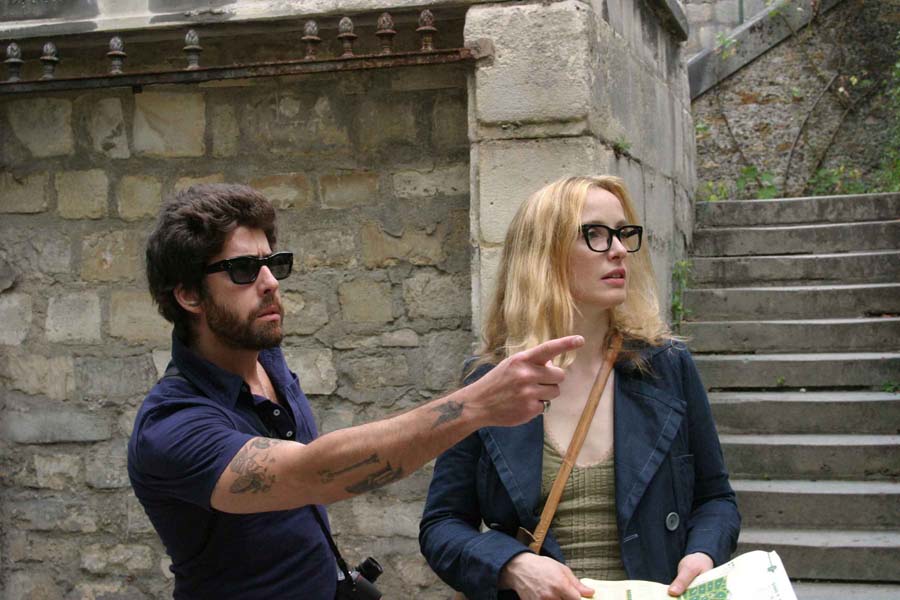
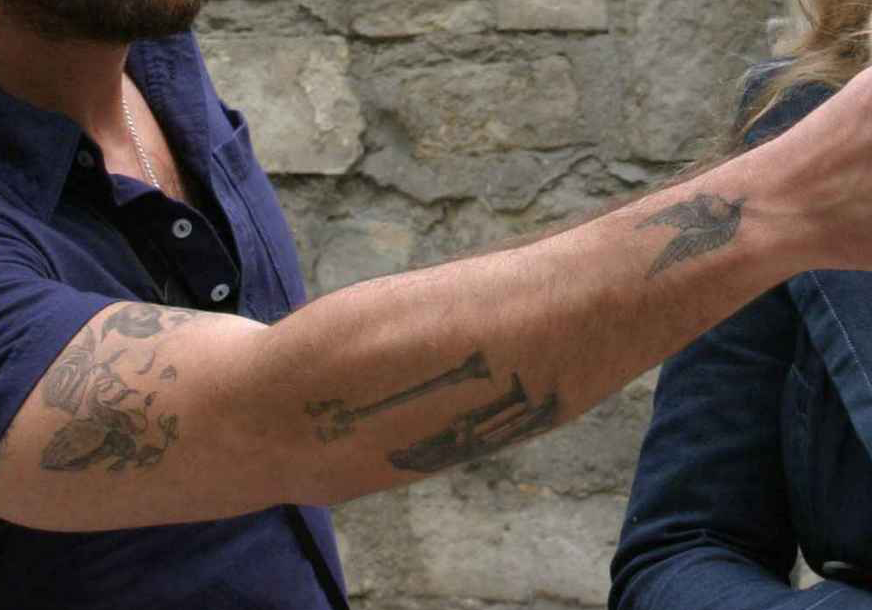
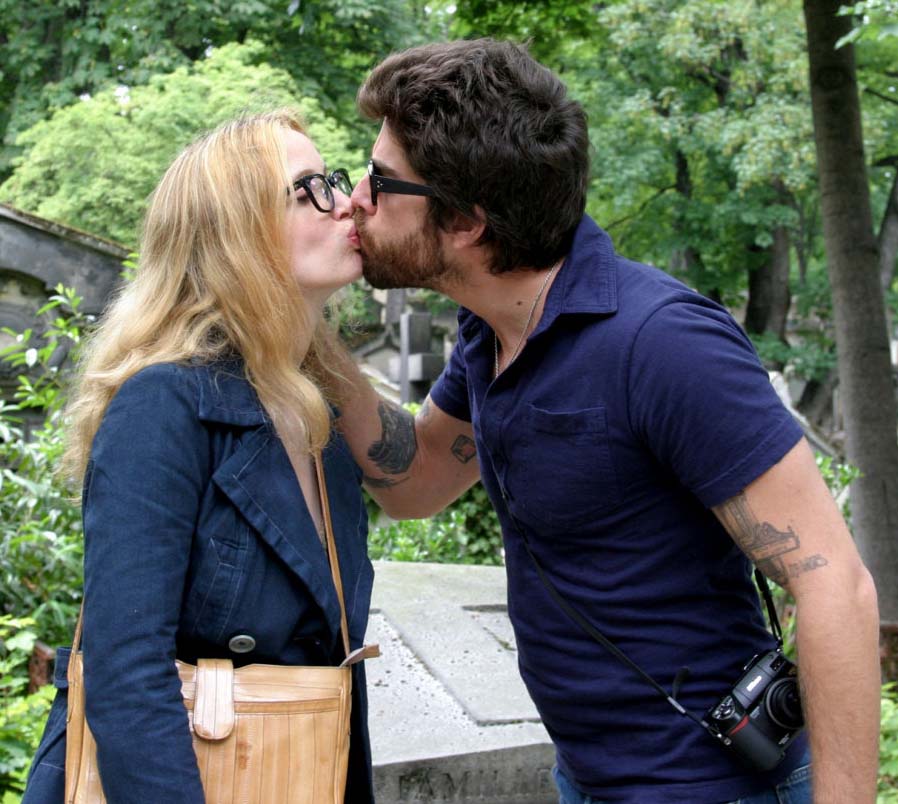
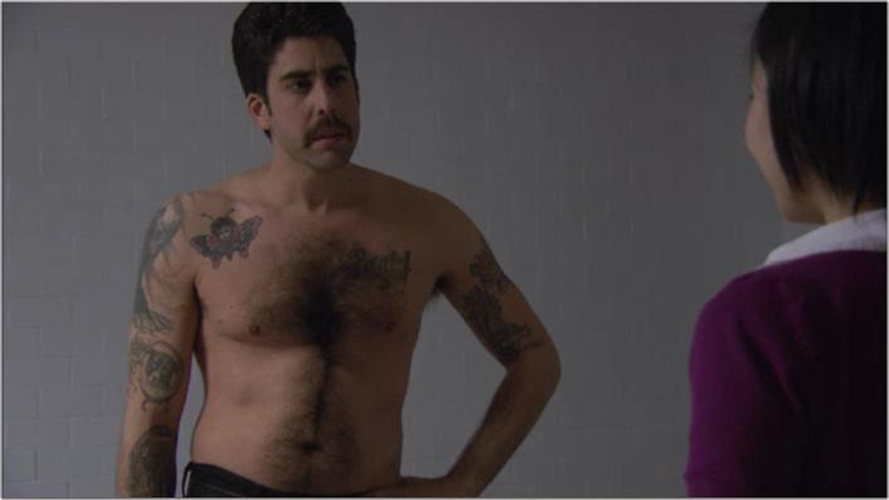
Adam Goldberg has described himself as a tattoo collector. His arms and shoulders carry a mix of jazz references, quotes, portraits and drawings. He has said that not every design needs a dramatic explanation.
His arm tattoos are packed with jazz references, including Waltz for Debby
Goldberg’s best-known tattoo stories are on his arms. He has quotes connected to Art Pepper, Billie Holiday and Chet Baker, musicians whose work mattered to him. As a teenager, he was also absorbed in John Coltrane, David Bowie and Elvis Costello.
The lettering comes from music he listened to, rather than a single matching design. In that sense, the tattoos work like personal liner notes spread across his arms.
The collection grew out of a real love of music
Goldberg has called himself a jazz fan and told a story about listening to Art Tatum records late into the night before taking the SATs. He joked that the music didn’t help his score.
That background helps explain why the jazz references feel personal. They’re tied to music he loved long before his acting career, not a look he adopted for a role.
Mark Mahoney has been a big part of his tattoo story
Goldberg has written about tattoo artist Mark Mahoney and worked with him at Shamrock Social Club in Hollywood. He has described Mahoney as the reason he ended up with so much ink, and the two have remained friends.
The collection appears to have grown over time, with different references and ideas added along the way. The designs don’t look like one coordinated sleeve.
His tattoos are easy to spot even when he is fully dressed
Goldberg’s arms are often the clearest sign of his tattoos in photos. He once joked that his young son recognized him by the ink.
In newer pictures, shirts can cover parts of the designs. On The Equalizer, where Goldberg played Harry Keshegian, the tattoos also helped viewers recognize him outside the usual suit-and-office look.
Not every tattoo needs a confirmed meaning
Goldberg has confirmed the jazz quotes and spoken about his love of music and his connection with Mahoney. Smaller designs aren’t all explained publicly, so there’s no need to assign a backstory to each line.
Some pieces may mark a person, record or moment that only Goldberg can identify. The collection doesn’t need a neat explanation for every tattoo.
Why Adam Goldberg’s tattoos feel different from typical celebrity ink
Goldberg’s tattoos aren’t built around one large image or matching sleeve. They connect to jazz, film, art and people he admires, and the collection has grown with him.
This panel is about Goldberg’s screen work, not a tattoo tour, but it offers another look at his career:
The clearest stories tie the jazz quotes to records and musicians Goldberg listened to for years. Other designs remain private, and don’t need an invented backstory.
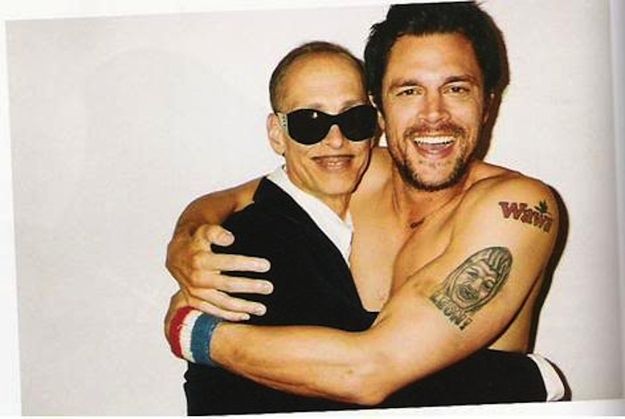
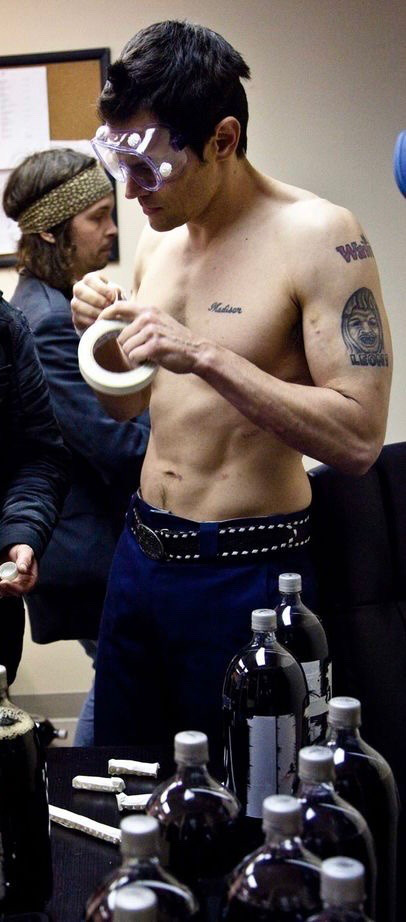
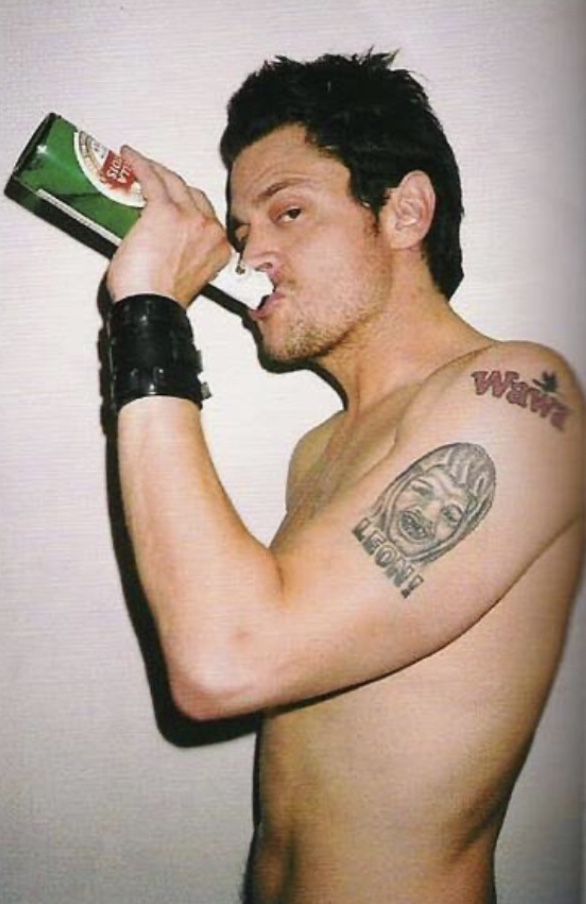
Johnny Knoxville’s tattoos share the offbeat humour of Jackass, but the collection includes family pieces as well as jokes. Documented designs include a blue cursive “Madison” across his left chest, a Wawa logo on his shoulder, a globe with three stars on his inner right wrist, and a small tattoo based on a drawing by his son Jack.
Older references also mention tattoos on his back and right shoulder, along with a “Leon” design that may have been removed. Photos don’t always show those marks clearly, so it helps to keep the well-documented pieces separate from the uncertain ones.
Madison is the most personal name in Knoxville’s collection
The clearest family tattoo in Knoxville’s collection is the blue cursive name “Madison” across his left chest. Public tattoo references link it to his daughter, Madison Clapp, who was born in 1996. The name is simple, but its placement keeps it close rather than tucked away on a wrist or ankle.
There’s no complicated story needed for a name tattoo: it marks a relationship. Knoxville is known for the reckless stunts and dry humour of Jackass, while the Madison tattoo shows a family dedication. Both sides of his public life are on the same body.
The script is usually described as blue and cursive, which distinguishes it from the smaller symbols elsewhere in the collection. Clothes and body position can partly hide it in photos, but the name is consistently identified.
It also shows that Knoxville’s tattoos aren’t all stunts or jokes. One of his most visible pieces honours his daughter; the humour in other designs doesn’t make them meaningless.
He wears his daughter’s name in blue ink across his chest.
The Wawa shoulder tattoo is exactly as strange as it sounds
Knoxville is also known for a Wawa logo on his shoulder. The convenience-store tattoo became part of Jackass lore because it turns an everyday brand into permanent body art. It has been linked to the crew’s time filming in West Chester, Pennsylvania. One tattoo artist’s post says he did the piece roughly 24 years earlier.
The logo is funny, but it also recalls a place and a period in the crew’s life. Knoxville made a passing joke into a tattoo and kept the memory on his shoulder.
Brand tattoos can look different as the years pass. The Wawa logo is memorable partly because it sits outside Knoxville’s other public work, and partly because it fits his willingness to commit to a bit.
Not every tattoo needs a deep explanation. This one is specific: a convenience-store logo from a time and place associated with the crew.
It’s visible without dominating the collection. Madison’s name is on his chest; Wawa is on his shoulder.
The globe and three stars sit on his inner right wrist
Older tattoo references describe a globe with three stars on Knoxville’s inner right wrist. It’s smaller and more graphic than the Madison name or Wawa logo. A watch or sleeve can cover the wrist, which may help explain why the design appears less often in photos.
The globe is easy to identify, but the public descriptions don’t give a confirmed meaning. It may relate to travel, a worldview or simply an image Knoxville liked. Sources place the three stars alongside it but don’t establish every detail of the design.
That uncertainty is worth keeping. Without Knoxville’s explanation, it’s safest to describe a globe and three stars without assigning them a story.
The wrist placement is less showy than the Wawa tattoo. A shoulder logo can be shown as a punchline; the wrist piece is easier to keep out of view.
Alongside Madison’s name, the globe shows the range in Knoxville’s collection: one tattoo names a person, another uses a small image and stars.
A drawing by his son Jack became another family tattoo
Another documented piece on Knoxville’s upper left arm is based on a drawing by his son Jack. Reports say the tattoo was done at Southside Tattoo in Austin. Its importance comes from who drew it, rather than from the image being a familiar symbol.
Photos don’t always show the design clearly. What’s been reported is that Jack’s drawing became permanent ink on his father’s upper left arm. The story behind the image is clearer than the image itself.
Madison’s name and Jack’s drawing are two different ways Knoxville has put family into his tattoos: one is lettering, the other a child’s artwork.
A child’s drawing can be uneven or unexpected. The tattoo keeps it that way instead of turning it into a polished emblem.
It’s a small piece, but the connection is easy to understand. It came from his son.
The other shoulder and back marks are harder to date
Older galleries and fan discussions mention other tattoos on Knoxville’s back and right shoulder. They suggest his collection extends beyond the Madison name, Wawa logo, globe and stars, and Jack’s drawing. Many of the photos are cropped, blurry or undated, so they don’t support a complete inventory.
One tattoo-tour discussion mentions a “Leon” design and suggests it may have been removed. That remains uncertain without a clear current photo or Knoxville’s own account. Older images can be hard to compare after fading or removal.
Some small marks on the right shoulder could be separate tattoos or parts of a larger design. The available photos don’t make that clear, and there are already several confirmed pieces to describe.
Because Jackass is known for spontaneous stunts, it’s easy to assume every tattoo was a dare. The Madison name and Jack’s drawing show that family is part of the collection too. Some pieces are jokes; others have a more personal source.
What Knoxville’s tattoos say about the Jackass years
The Wawa logo is a small time capsule. It connects Knoxville to a place, the Jackass crew and a particular joke. The story helps explain why he chose an ordinary store logo.
The family tattoos tell a different story. Madison’s name and Jack’s drawing make clear that Knoxville’s ink isn’t one long prank. The collection moves between jokes and family.
The globe and stars add a design whose meaning hasn’t been explained, and the “Leon” tattoo may have been removed. Tattoos can fade, be covered or disappear from view under clothing, so old photos don’t always show what’s there now.
There isn’t one signature style to Knoxville’s collection. It includes his daughter’s name, a Wawa logo, a globe and stars, a child’s drawing and other marks that are harder to document. It reads more like a record of family and jokes than a coordinated portfolio.
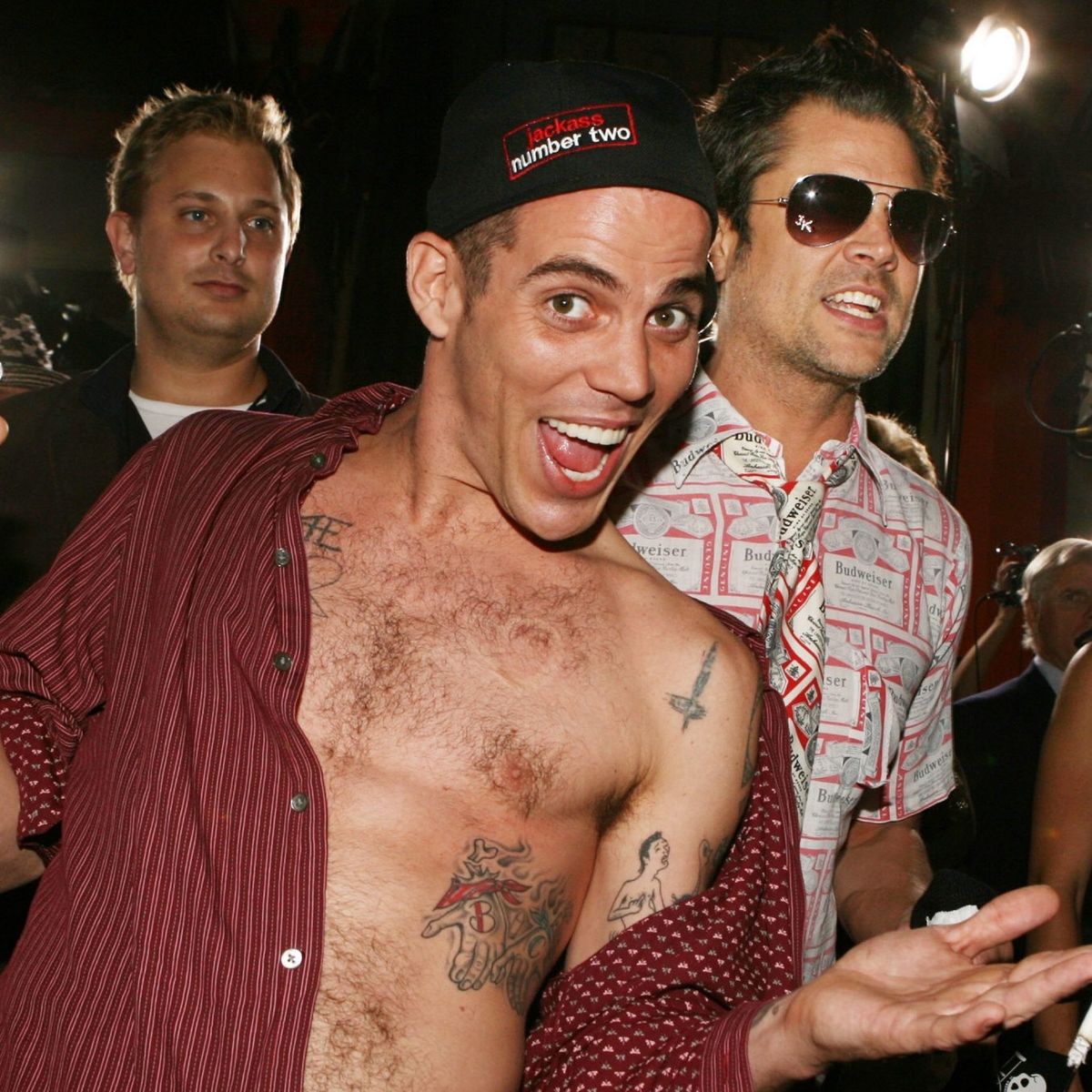
Watch the Johnny Knoxville and Steve-O tattoo story
This clip features Knoxville and Steve-O in the Jackass world behind many of the stories connected to his tattoos.