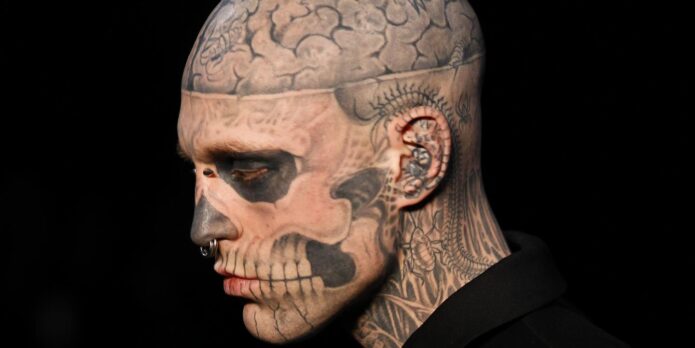
Rick Genest, known as Zombie Boy, covered most of his body in black-and-grey tattoos that follow the human skeleton from his scalp to his feet. A skull shapes his face; ribs and vertebrae run over his chest and back; insects fill some of the spaces between the larger forms.
Genest said his first tattoo was a skull and crossbones on his shoulder. In interviews, he also said Frank Lewis tattooed much of his head and torso during the main period of the project. The designs are easy to describe from photos, but those images don’t tell us the private meaning of every small mark.
The five body photos show different parts of the work: his face and neck, the scalp, chest, arms and hands, and the full back. The featured portrait is a separate face-visible image used for the post header.
The face and neck tattoos create Rick Genest’s living-skeleton illusion
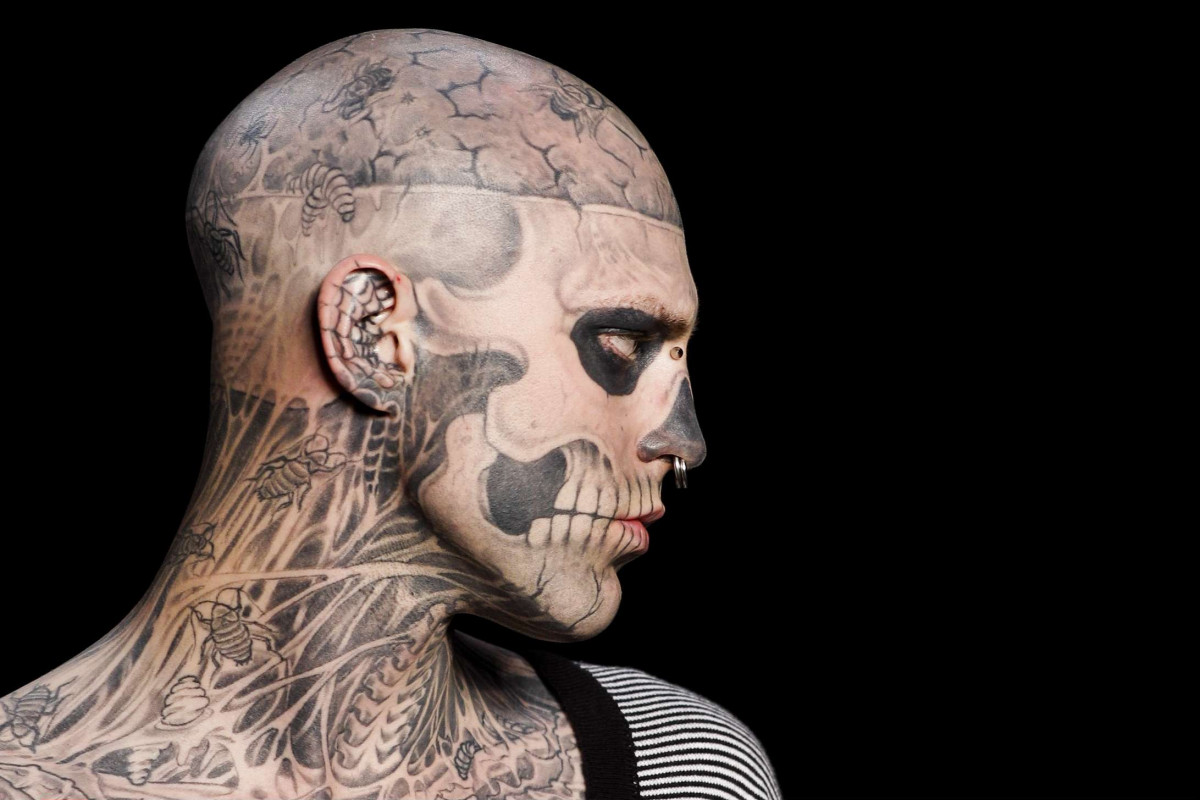
Genest’s face is the first thing most people notice. The dark eye sockets, shaded nose, cheekbones and teeth are arranged to resemble a skull, with lines that follow the planes of his face instead of sitting on top like a mask.
The side view shows how the design continues toward his ear. Lettering and teeth run along the jaw, while ribs, tendons and shadow fill the neck. The skull remains the focal point; the neck gives it a path down into the rest of the body suit.
The eye sockets carry most of the effect. Their solid black shapes stay recognisable even from a distance. Thinner lines around them suggest cracks and bone edges, and small insects sit among the details. Open skin between the dark areas keeps the face from becoming a single block.
The tattoo also changes with his expression. When Genest smiled, looked serious or turned his head, the design moved with him. That’s part of what makes face placement demanding: lines need to work with the face’s existing features and movement.
The brain and insect tattoos turn the scalp into a second layer
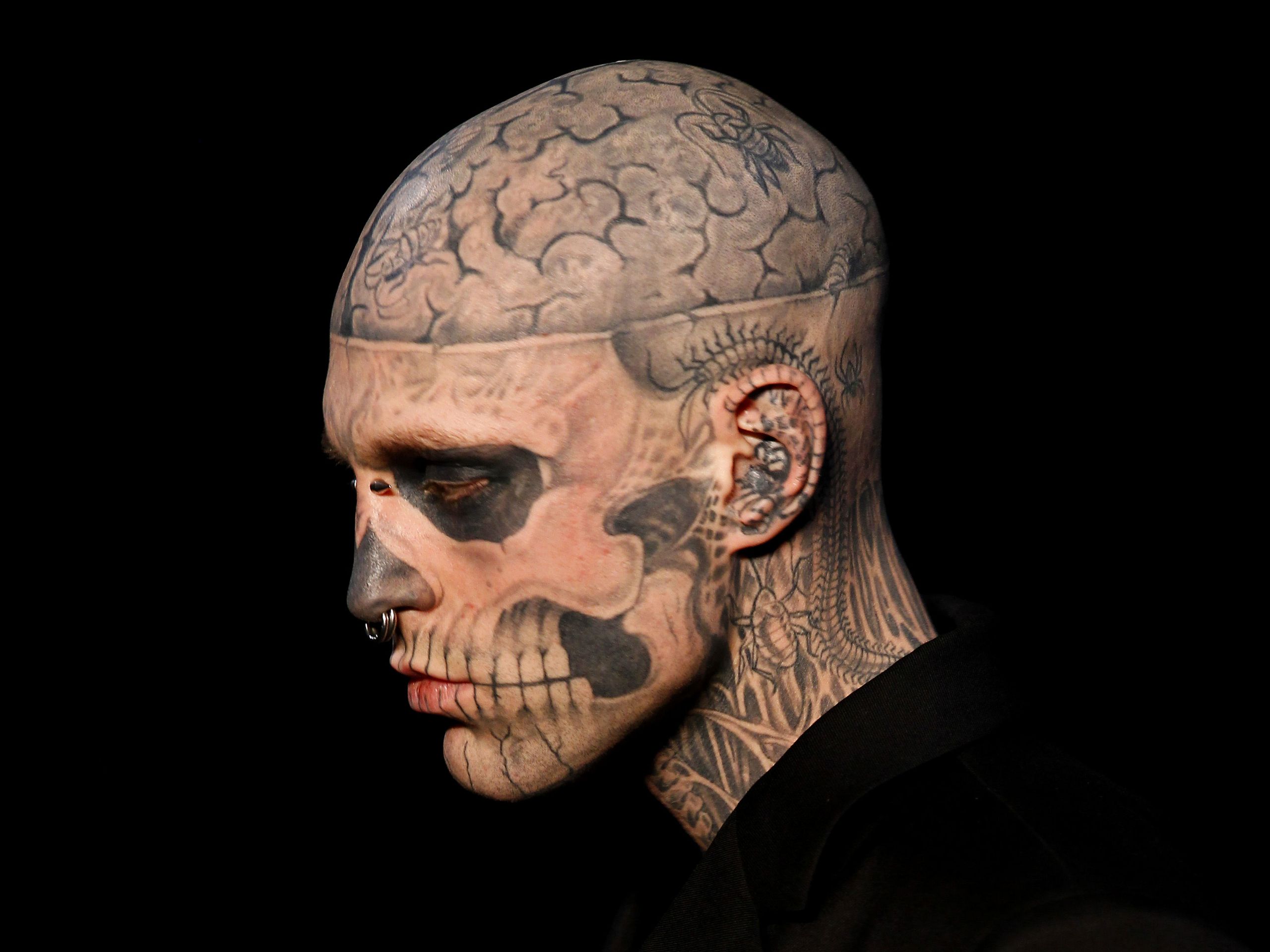
Genest’s scalp carries a large brain design above a horizontal skull band. In a close photograph, the winding lines look like an anatomical drawing. Open areas between the folds keep the shape legible against the dark bands around it.
Small insects appear around the scalp and neck. Some look like flies or beetles; others blend into the bone work and are harder to identify. Their fine shapes add detail to the head and sit beside the broader skull forms.
The scalp brings different shapes together. The brain uses rounded lines and softer shading, the skull band runs horizontally, and the insects add small marks with wings and legs. They share a limited area without all using the same scale.
Genest said Frank Lewis tattooed much of his head and torso during the main period of the transformation. The many separate designs were made over time, but the repeated anatomy and black-and-grey palette connect them.
The chest tattoos extend the skeleton idea below the jaw
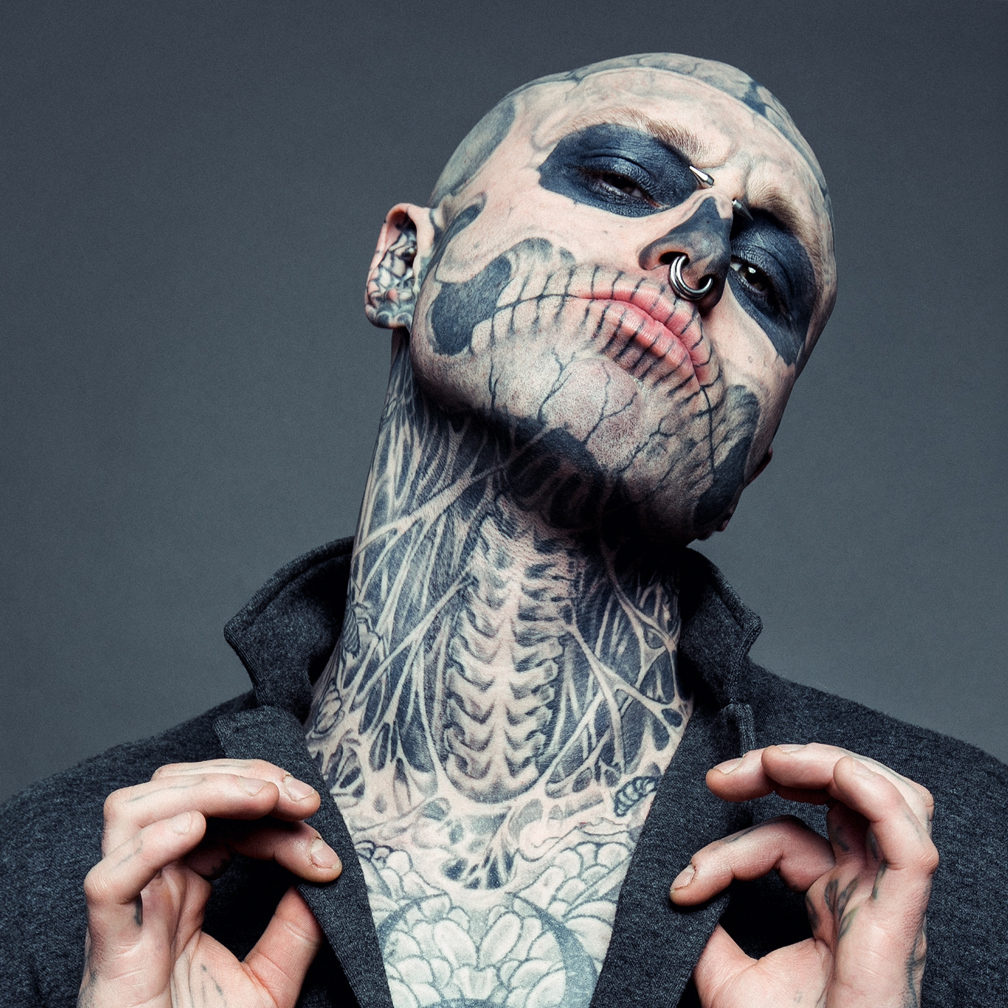
This front portrait traces the design from Genest’s jaw down to his torso. Teeth meet the neck, which gives way to ribs and tendons across the chest. The tattoos leave skin visible between the bones, so the chest doesn’t read as a solid black panel.
A central body design sits within the ribs, insects and darker areas. From a distance, the chest looks like one skeletal section. Closer up, the separate marks come into view. Lighting and camera distance can make the same area look quite different.
The chest links the upper and lower parts of the suit. Lines from the neck continue into the ribs, which widen across the torso before narrowing toward the stomach. The drawing changes scale as the body changes shape.
The tattoo’s consistent subject doesn’t depend on repeating one image everywhere. Anatomical lines carry the idea from face to chest, while insects and smaller symbols fill some gaps. The visible skin is part of the design too.
The arms and hands carry the smaller tattoos that make the suit feel lived in
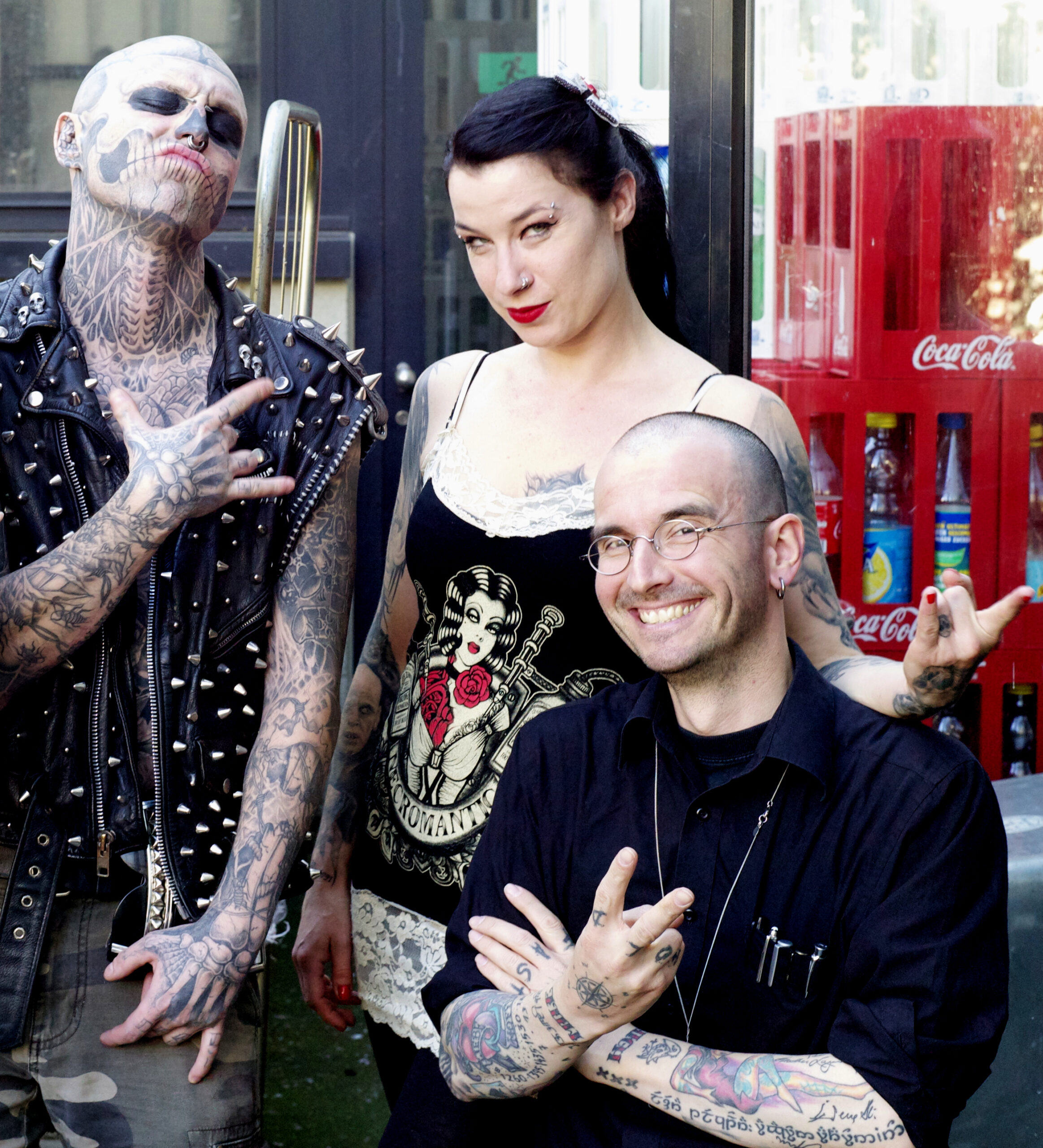
This public photograph from Zurich shows Genest’s arms and hands outside a studio portrait. Bones, insects, lettering and smaller symbols cover the forearms. His fingers are tattooed as well, and the marks are easier to see when he reaches toward the camera.
The arms are darker and busier than the face. That contrast leaves the skull readable while giving the forearms room for clusters of smaller pieces. Differences in line weight also make the collection look like it developed over time.
The hand marks are difficult to pin down from one image. Finger tattoos are exposed, small and constantly moving with the hand. Some shapes aren’t clear enough to name, so it’s better to describe their placement and appearance than to assign them a private meaning.
The smaller pieces add detail before the eye returns to the larger skeletal design. An insect, a bone or a short line of lettering can stand out on its own, even though it belongs to the broader body suit.
The back tattoo follows the spine like an anatomical map
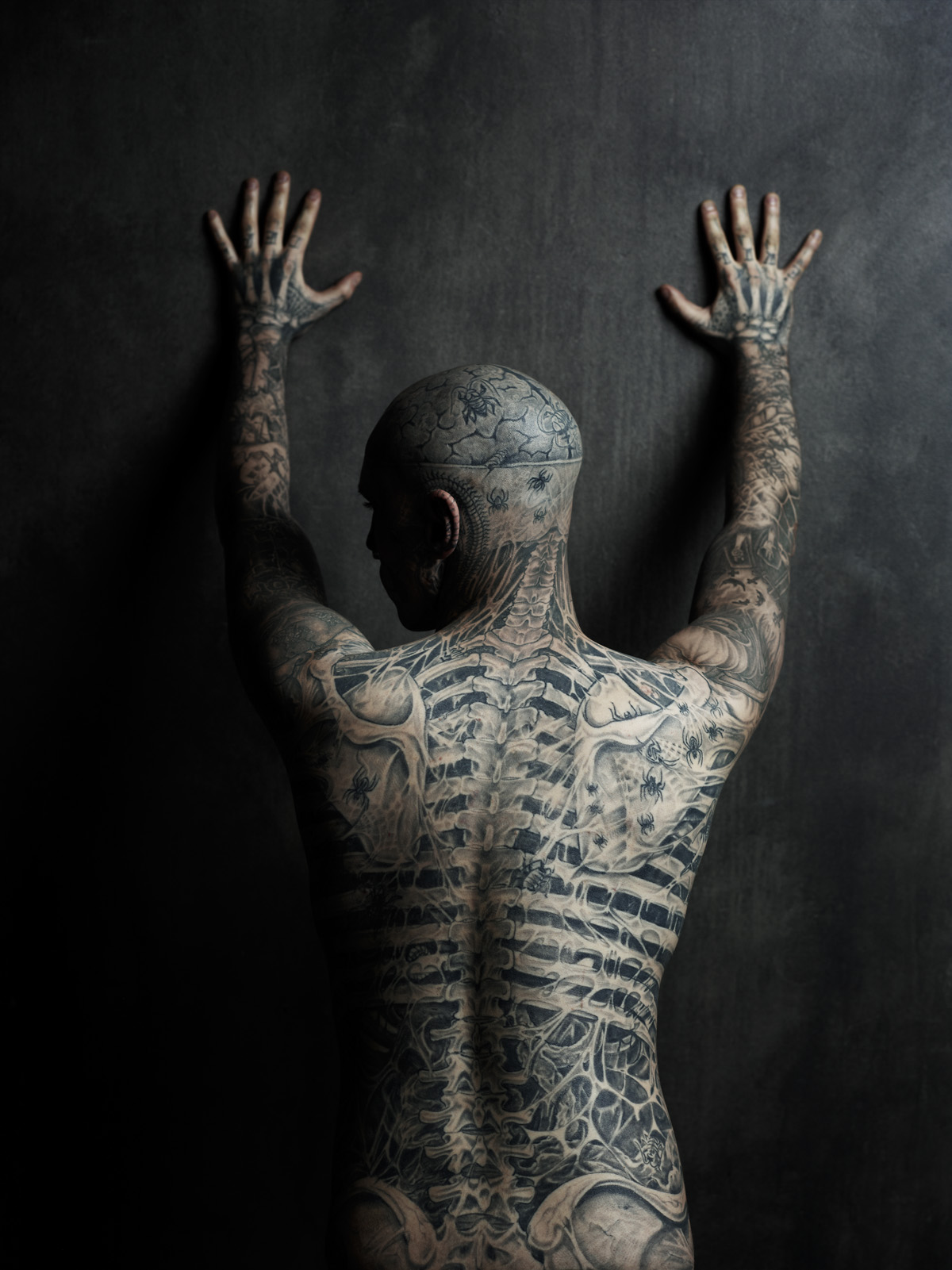
This rear studio photo gives the clearest single view of Genest’s back. He faces the wall with his hands raised, showing the skull at the back of his head, vertebrae down the neck and a long ribcage design. The spine anchors the composition, while the bones and insects around it keep the drawing from feeling like a straight diagram.
The shoulder blades form part of the upper skeleton. Ribs spread out from the spine and narrow again near the waist. The ink continues down the arms and into the hands, joining the back piece to the rest of the suit.
The design follows a body that bends and changes width. Genest’s spine gives the artist a centre line; the ribs and shoulders follow the body’s curves. The photo shows the overall arrangement even though he isn’t standing perfectly straight.
Photos from different years can vary as tattoos age and lighting changes the balance between skin and black shading. The same central idea remains visible here: bones, insects and skull imagery are arranged to suggest the body beneath the skin.
The collection uses one visual language across different areas. Skull shapes sit beside brain folds, ribs beside insects, and small marks fill gaps around the larger forms. The black-and-grey palette ties them together, while each area has its own scale and layout.
Zombie Boy became a public identity attached to Genest’s appearance, but the photographs also show a person making choices about his skin. His face drew attention first; the arms, chest and back show how much of the project extended beyond that first view.
Genest spoke about his first skull and crossbones tattoo and identified Frank Lewis as a major artist on the head and torso work. That doesn’t mean every small insect or bone fragment has a documented explanation. Where the reporting leaves a gap, the photos can still show the design without filling in a story.
News, tattoo and fashion coverage discuss the body suit from different angles. The images show the bones and insects; fashion photographs show how the work changed the way he was presented. The tattoos were often the focus of the camera because they covered so much of his body.
If you’re using Rick Genest’s tattoos for inspiration, study how one theme changes scale across a body. The face has a clear focal design, while smaller marks continue the idea onto the hands, neck, ribs and back.
Placement matters as much as the drawing. The eyes, nose and mouth guide the face design; the spine anchors the back; the ribs widen the chest. Those landmarks help the ink follow the person instead of sitting on a flat surface.
The photos work as a set because some are close enough to show the lines and others show where the designs sit. A headshot can’t explain how the work moves across the torso, so the chest, arm and back views fill in that picture.
For more musician and performance-world ink, see the site’s musician tattoo guides. Use photos for visible placement and rely on a clear interview or source before assigning a tattoo a meaning.
One thought on “Rick Genest Tattoos: Zombie Boy’s Skull and Full-Body Ink”