
GEN of HIKAGE has built a tattoo collection that reads like a visual diary of music, travel, admiration and stubborn forward motion. The vocalist, who formed the Sapporo band HIKAGE in 2019, got his first tattoo in Canada at nineteen and continued adding pieces as his life moved from Hokkaido to Tokyo and from band practice rooms to larger stages. A 2026 Tattoo Tour Tokyo interview gives the collection an unusually clear source trail, naming motifs, placements, artists and the stories GEN attaches to them.
The photographs from that interview matter as much as the written answers. They show a full-body collection rather than a single isolated mark, with the back logo, chest symbols, neck lettering, traditional imagery and dense sleeve work appearing in different frames. The strongest reading of GEN’s ink keeps those images and his own explanations together. It avoids turning every visible shape into a confident label while still recognising how coherent the overall body of work has become.
The HIKAGE back tattoo became a band piece
The largest and most immediately legible design is the vertical HIKAGE lettering on GEN’s back. In the Tattoo Tour Tokyo interview, he explains that the band name was designed by Ivan, a senior member of the band who is also a tattoo artist. GEN wanted to carry the name on his back after moving from Hokkaido to Tokyo and deciding that he needed to work harder on the group. The scale is part of the point. A small logo could have functioned as decoration, but the tall brushstroke form makes the name feel like a spine running down the body.
The interview says the piece took two sittings and hurt a lot. GEN also describes the vertical format as uncommon and likes the way the brush style suggests a backbone. That combination of meaning and shape gives the tattoo more depth than a simple band mark. It is a declaration of responsibility, but it is also designed to look good when the body turns. The back photograph shows the lettering as a single column, while the wider views reveal how it sits inside a much larger network of tattoos rather than floating by itself.

The HIKAGE back tattoo became a band piece adds a useful scale to the evidence. Read this passage with GEN’s own explanation, because placement, line weight and context work together in this collection.
The swallow chest tattoo carries the memory of Canada
GEN identifies a swallow as his first tattoo, received in Canada when he was about nineteen. He spent roughly a year and a half there, first at a language school and later on a working holiday with band members. The bird therefore belongs to a period of movement and uncertainty before the current HIKAGE lineup existed. Its traditional tattoo meaning adds another layer. GEN explains that sailors once received a swallow when setting out and another after returning safely, but he has not added the second bird.
That unfinished pair is important because it lets the tattoo remain open. The single swallow is not presented as a completed emblem with a neat beginning and end. It records departure, and GEN even jokes that it means he left and never came back. The front-facing photographs make the bird part of a crowded chest and arm landscape, but the interview keeps its personal chronology visible. It is a travel mark, a sailor reference and a reminder of the life that preceded HIKAGE.
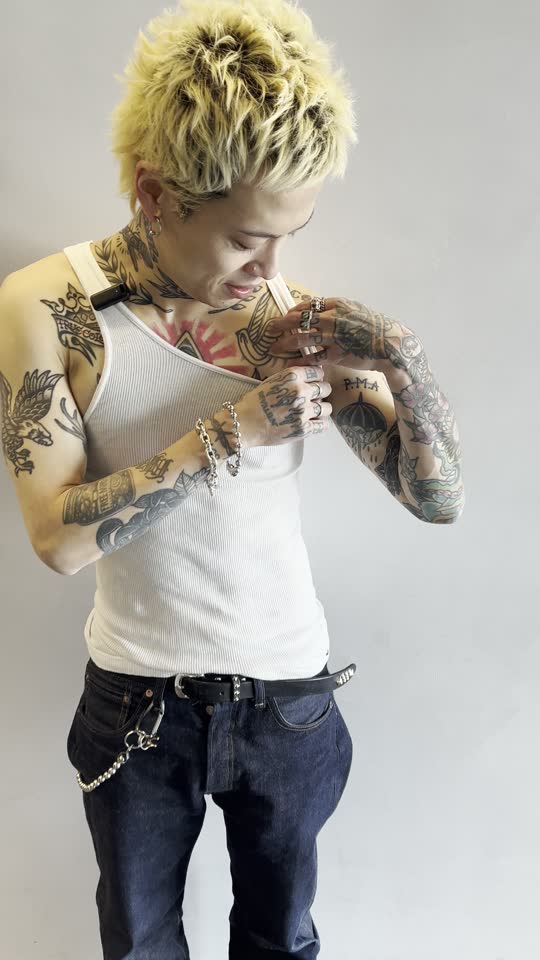
The swallow chest tattoo carries the memory of Canada adds a useful scale to the evidence. Read this passage with GEN’s own explanation, because placement, line weight and context work together in this collection.
The Gyakuten chest tattoo is an act of admiration
One of GEN’s most revealing tattoos is the inverted-heaven symbol known as the Gyakuten mark. He got it at about nineteen, inspired by JESSE, the vocalist associated with the mark and the TENSAIBAKA RECORDS label. GEN says he had not met JESSE yet, which makes the design a record of admiration that came before friendship or professional proximity. The symbol stayed meaningful because the person he admired later became part of GEN’s real musical world.
This is a useful example of how tattoos can preserve a feeling that would otherwise be difficult to date. GEN describes getting the mark while believing that his admiration would not change. The photograph shows it among other dense black and colour work, but the explanation supplies the emotional centre. The mark is not only a graphic borrowed from a musical influence. It is evidence of a conviction that survived the transition from being a young fan to working inside the same broader scene.

The Gyakuten chest tattoo is an act of admiration adds a useful scale to the evidence. Read this passage with GEN’s own explanation, because placement, line weight and context work together in this collection.
The elbow tattoo line turns a song into a rule
The words on GEN’s elbow, “Eat bad food, make good music,” began as a merchandise design before becoming a tattoo. In the interview he connects the phrase to HIKAGE’s song Yaiba and says it was borrowed from a line associated with Takuma of SPARK!!SOUND!!SHOW!!. The sentence has the shape of a joke, but it also describes the band’s creative attitude. Bad conditions, awkward choices and uncomfortable work can still be converted into something worthwhile if the music is honest.
The placement makes the phrase easy to discover in a close arm photograph and difficult to separate from the rest of GEN’s sleeve. It is not a decorative quotation placed on empty skin. It sits alongside flowers, birds, lettering, symbols and heavy black shapes, as if the collection itself is the visual version of the rule. The words are deliberately plain, which gives them force. Eat bad food, make good music is memorable because it refuses to make the artistic process sound clean.

The elbow tattoo line turns a song into a rule adds a useful scale to the evidence. Read this passage with GEN’s own explanation, because placement, line weight and context work together in this collection.
Neck tattoo lettering and the rose make a private vocabulary
GEN’s neck carries mirrored LOVE lettering and a rose, a combination that changes dramatically depending on whether the photograph is front-facing or taken from the side. The placement puts language close to the voice, while the flower adds a traditional image that softens the harder geometry of the lettering. The Tattoo Tour Tokyo photographs show why several angles are necessary. One frame can make the neck look like a single dark band, while another reveals the separation between text, petals and surrounding lines.
There is no need to force one grand explanation onto the neck. The combination works because it is visually layered. LOVE is readable but not presented as a slogan, and the rose gives the centre of the design an organic counterweight. GEN’s collection repeatedly moves between direct words and familiar tattoo motifs, so the neck piece feels like part of the same language as the swallow, the flowers and the large back logo.

Neck tattoo lettering and the rose make a private vocabulary adds a useful scale to the evidence. Read this passage with GEN’s own explanation, because placement, line weight and context work together in this collection.
How the collection grew
A chest image reveals an Eye of Providence motif surrounded by red and black rays, with additional lettering and symbols running across the shoulders and arms. The front of the body is busy without appearing accidental. There are areas of colour, patches of black, fine outlines and text that only become legible when GEN turns or lifts a strap. The collection has the density of a working archive. Each addition appears to have found a place beside older work rather than being planned as one uniform suit from the beginning.
The arm photographs also show the difference between a design being documented and a design being interpreted. A viewer can identify the swallow, the rose, the eye and the large back mark because GEN or the interview names them. Other elements remain visible but unnamed. That restraint is useful. What is known about the collection becomes more credible when unknown details are allowed to stay unknown. The photographs are rich enough without turning speculation into biography.
How the collection grew adds a useful scale to the evidence. Read this passage with GEN’s own explanation, because placement, line weight and context work together in this collection.
The artists behind the record
Tattoo Tour Tokyo lists several artists connected to GEN’s body work, including Ivan for the HIKAGE back logo and other artists for designs across the neck, chest, arms, hands and abdomen. Those credits change the way the collection can be read. GEN is not simply accumulating anonymous images. He is working with people whose styles, relationships and locations become part of each tattoo’s history. The artist list also explains why the collection shifts between brush lettering, traditional motifs, colour work and dense black forms.
The credits give the article a practical foundation. They do not tell us everything about every piece, but they make clear that the tattoo story is connected to a community around Japanese music, travel and specialist craft. The back logo, the Canadian swallow and the Gyakuten mark each have a different route into GEN’s life. The credited artists help preserve those routes instead of flattening the collection into a single aesthetic label.
The artists behind the record adds a useful scale to the evidence. Read this passage with GEN’s own explanation, because placement, line weight and context work together in this collection.
A record that keeps moving
HIKAGE’s music gives the collection its continuing present tense. GEN formed the current band after earlier musical experiences, and the Tattoo Tour Tokyo interview places his tattoos alongside the group’s songs, releases and live identity. The elbow phrase references Yaiba, the back piece carries the band name and the Gyakuten mark points toward a musical influence that later became a real relationship. These are not separate stories placed beside a singer’s appearance. They overlap on the body.
That overlap is why the collection feels unusually coherent even though it contains many styles. The tattoos preserve travel, heroes, band responsibility, songs, friendship and the simple pleasure of making a striking image. A full-body collection can easily become a catalogue of disconnected symbols, but GEN’s explanations keep returning to music. Every design is another way of carrying the work. The photographs make that idea visible, while the interview gives it a human timeline.
A record that keeps moving adds a useful scale to the evidence. Read this passage with GEN’s own explanation, because placement, line weight and context work together in this collection.
GEN’s tattoos are compelling because the source trail does not ask readers to guess. A documented first tattoo, a named band logo, a mark connected to JESSE, a lyric-derived elbow phrase and a set of credited artists create a record with clear edges. The photographs then show how those pieces share the same body. There is still room for details the public has not been told, but the known designs already make a substantial story.
The most honest conclusion is also the most interesting one. GEN wears his musical history as an evolving map. Canada remains in the swallow, HIKAGE is carried on the back, admiration survives in the Gyakuten mark, and songs become instructions on the arms. These are tattoos about movement and making, not just about appearance. Each piece keeps a moment close while leaving the collection open to whatever comes next.