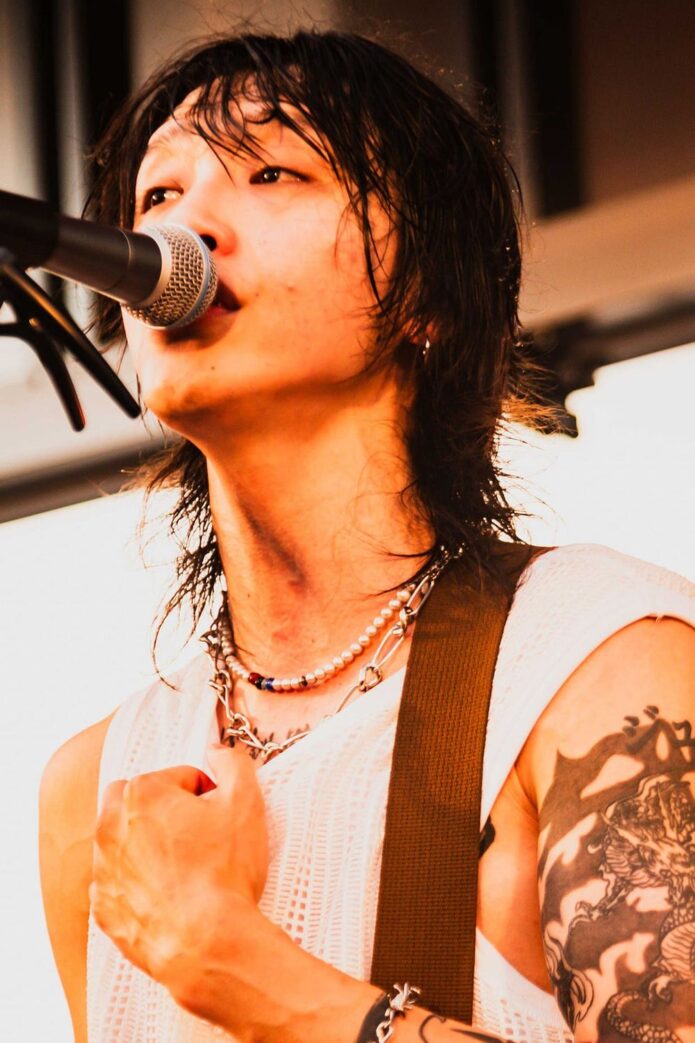
Ryo Takanami’s tattoos draw on several parts of his life: JYU, his hometown of Kushiro, family references and choices he made when he was younger. In a Tattoo Tour Tokyo interview, the band’s vocalist and guitarist explains the Japanese lettering, animal designs and studio marks. Some pieces connect directly to the band; others preserve an earlier version of himself or a place and person he wants to remember.
The JYU name and the idea of freedom
On Takanami’s shoulder, the word 自由 appears in red inside a tall frame, with a crane flying through the letters. He says 自由 is both the name of JYU and the Japanese word for freedom. He also hears a gun in the sound of the band’s name. JYU turns that tension toward language and music rather than violence.
The crane refers to Kushiro, Takanami’s hometown in Hokkaido, where the red-crowned crane is a familiar regional symbol. The design therefore joins the band name with a place he is from. In the full-body photograph, the shoulder piece sits among darker work across his body.
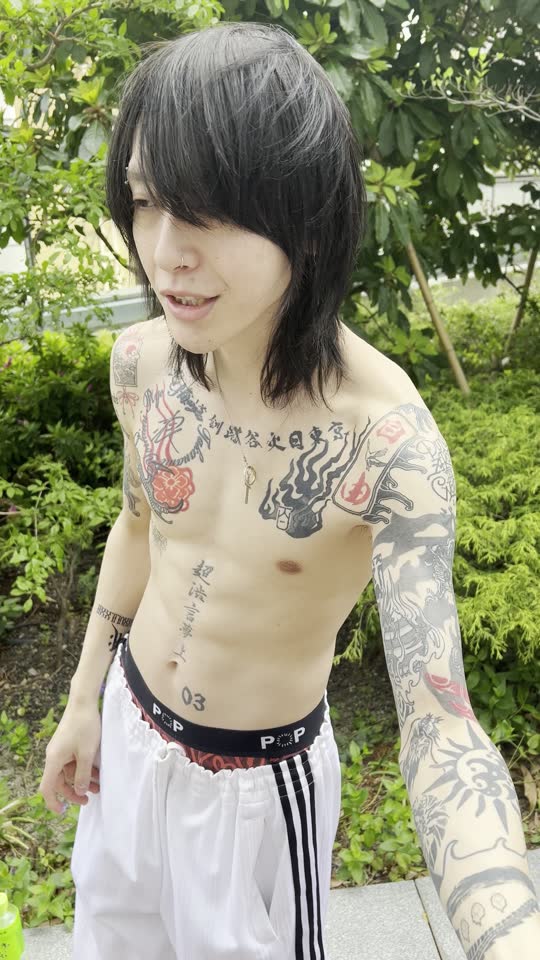
Most of Takanami’s tattoos use black or grey, with red added in selected areas. He says he wanted the red to draw the eye and help the collection stand out. The colour repeats across several pieces, while the lettering, animals and symbols have different stories. The shoulder design is one of the clearest places where that palette and the meaning meet.
The vertical stomach lettering and the first 03 tattoo
Five characters run vertically down Takanami’s stomach: 超渋言夢上. He made the phrase himself to express a wish to rise above dreams through words. One character connects to a senior musician he respects. He got the tattoo around age thirty as a reminder of how he wanted to live. The phrase has no fixed dictionary reading; its meaning comes from Takanami’s explanation.
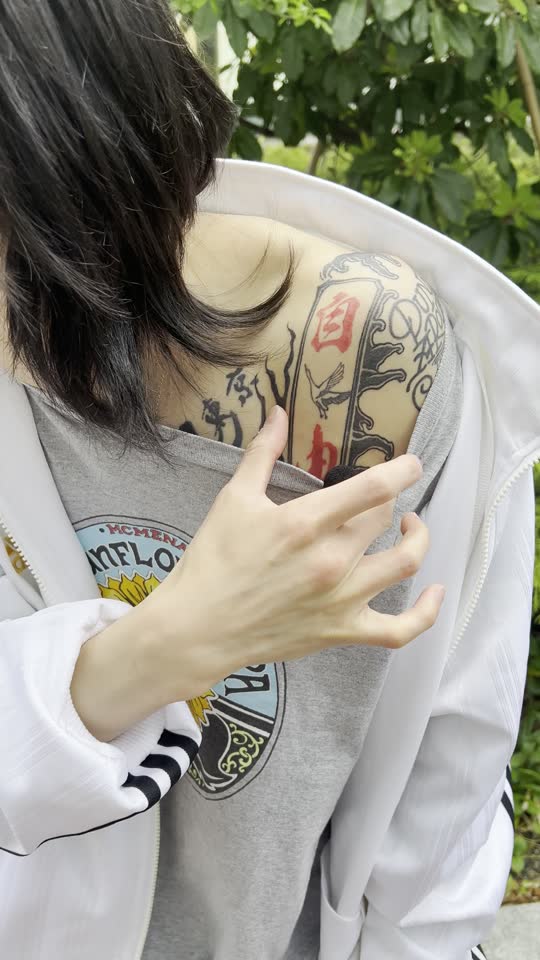
This close-up returns to the shoulder lettering and crane described above. It shows the red 自由 characters against the surrounding black lines, while the next image focuses on the stomach design.
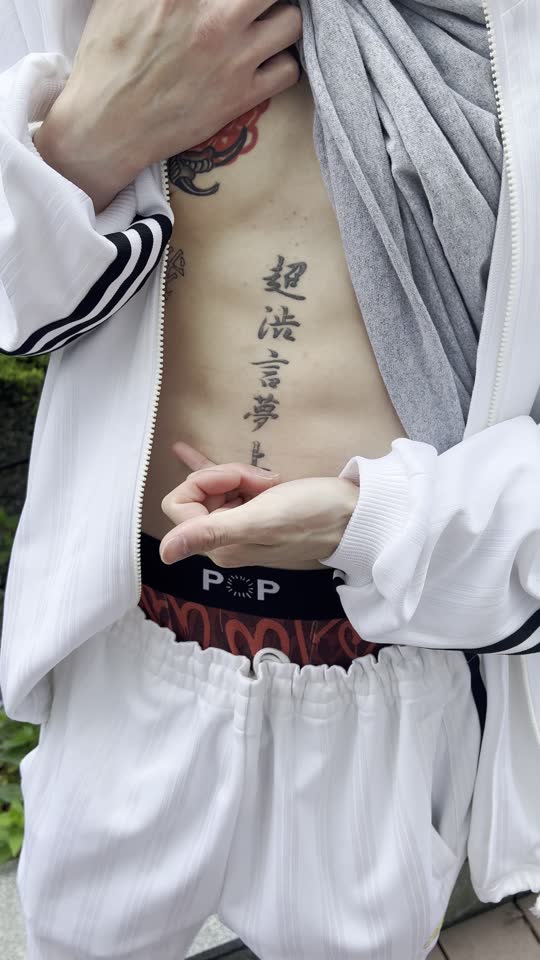
A small 03 sits below the five-character phrase. Takanami identifies it as his first tattoo, done in his final year of high school. The number held several goals for him: three more years of work, three extra repetitions at training and a leading zero because he wanted more than a single digit. He now tells the story with humor. The tattoo records the ambition he had as a teenager, while the larger phrase above it came later and reflects a more deliberate choice.
The chest: birth year, family lettering and flames
The chest designs include the numbers 1995, Takanami’s birth year, and a character for battle that he connects with his drive. Lettering along the collarbone refers to Kushiro, a family surname and his own phrase about keeping a fire burning through everyday life. A larger character drawn from his surname was originally written in his own hand. Takanami says he may refine it later, so the lettering is both a completed tattoo and a design he still thinks about.
He describes the paired flames on his chest as a reminder to keep himself lit and continue pushing forward. Their meaning comes from that daily effort, rather than from a general idea of toughness. The flames sit among words and symbols, and continue the black-and-red palette found in the shoulder work.
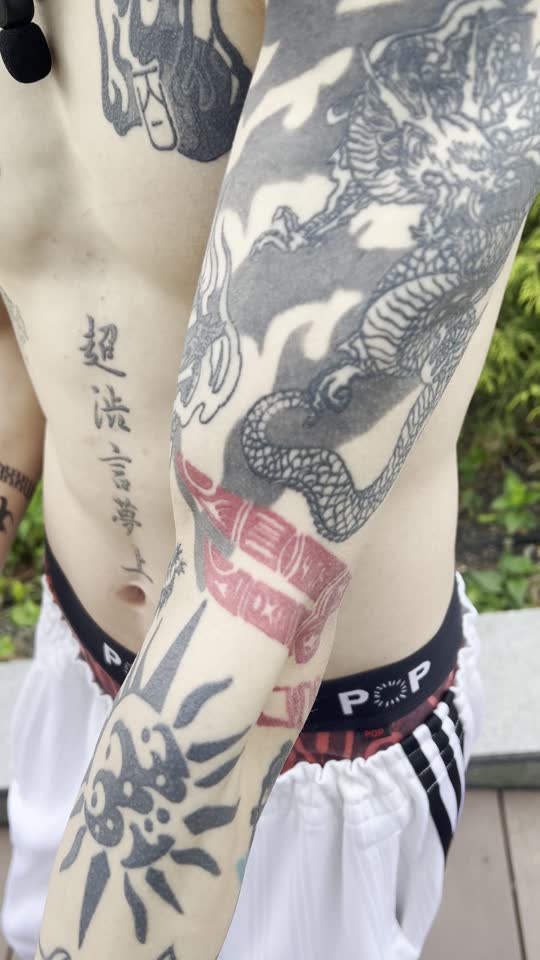
The arm close-up in this part of the gallery shows the black dragon and red details elsewhere on his body. It also gives a sense of how new designs sit beside the older tribal lines.
The Homeward Tattoo Parlor logo and punk connections
One shoulder carries the circular logo of Homeward Tattoo Parlor, a Yokosuka studio associated with tattooer SHUN. Takanami calls it a favorite because he wants to be a living signboard for the artist who has shaped much of his recent work. Nearby, PUNK AROUND THE WORLD names an event connected with JYU. He says the matching tattoo began with people involved in that event; the studio logo records the relationship that followed.
These designs point to people and music scenes in Takanami’s life. Their context comes from what he says about the studio and the event. The next image turns to his other arm, where a sun, bird and red accents sit among older work.
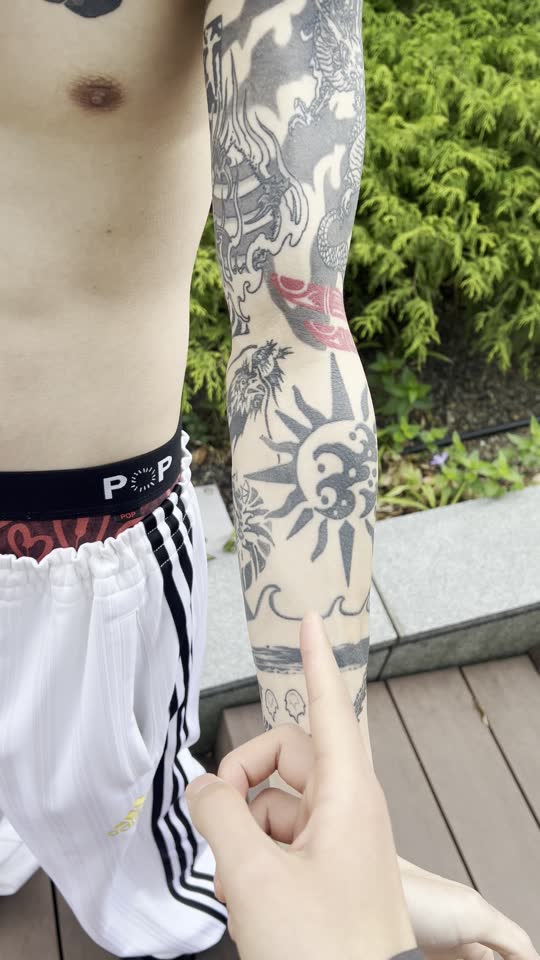
The dragon, giraffe and the importance of a tattoo’s gaze
On one arm, Takanami has a black dragon and a yellow-and-blue giraffe. The dragon was fitted into open space among older tribal lines. Takanami says he and the artist considered the direction of its eyes: when he plays guitar and sings into a microphone, he wants the dragon to seem to look back at him. Its placement was planned around how he moves onstage as well as how it appears in a still photograph.
The giraffe’s eyes have not been tattooed yet. Takanami says he has not decided where the animal should look, so he has left that part open. He talks about the unfinished detail without treating it as a problem that has to be solved immediately. The dragon’s scales and sweeping body are visible in the close-up, while the other arm photograph shows how these details sit within a larger group of tattoos.
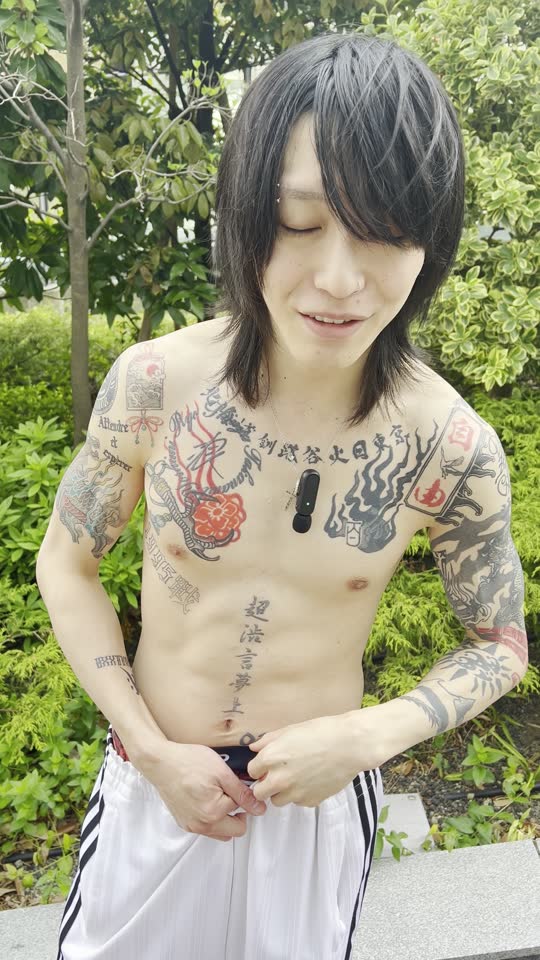
The other arm: sun, flame, lighthouse and bird
The opposite arm carries a sun, a flame, a lighthouse, a pale-blue bird and a red hand-and-gun mark that echoes JYU. Takanami says he chose many of those earlier designs while trying to look stronger. He still describes that motive plainly; he does not recast those tattoos to match the explanations behind his newer work.
The arm holds an earlier set of choices alongside later additions. Black lines and red marks connect some of the designs, but their subjects come from different periods of his life. The front-facing photograph shows how the arm work sits beside the chest lettering and flames.
How the full set reads on stage and off
Takanami began performing under his own name in 2018 and changed the name to JYU in 2021. The band is rooted in Kushiro, and he writes and performs its songs as vocalist and guitarist. Those details help explain the designs tied to JYU, Kushiro, the event and the studio. Other pieces reflect his own choices.
JYU’s 2026 album is titled 不自由で、自由. The article places the tattoos alongside Takanami’s music career; the designs remain personal work. A live photograph in the gallery shows him with a guitar and microphone; the close-ups elsewhere are clearer evidence for individual placements and details.
Ryo Takanami tattoos in summary
The tattoos tell several stories at once. 自由 and the crane connect JYU with Kushiro; the stomach phrase and first 03 preserve two different points in Takanami’s life; and the chest lettering brings together his birth year, family references and the image of keeping a fire burning. The Homeward logo and PUNK AROUND THE WORLD mark people and events tied to his music. The animal designs show how he has made room for new work around older tribal lines.
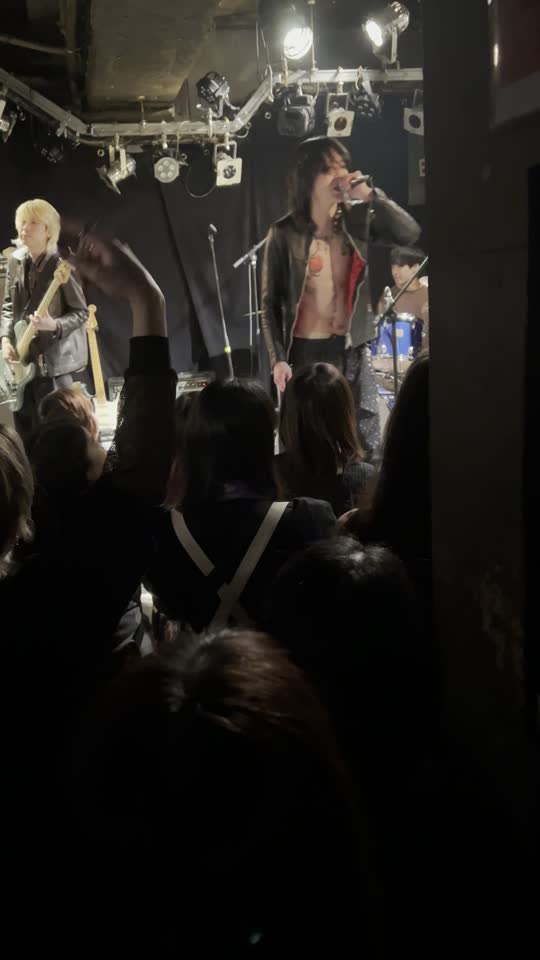
The stage photograph puts the tattoos in motion, while the detail shots show features such as the shoulder lettering, the stomach phrase and the dragon’s scales. Takanami supplies the meanings he has chosen to share; the images show placement, colour and scale.
Sources and a careful conclusion
The Tattoo Tour Tokyo interview is the source for Takanami’s explanations of 自由, the crane, the 03, the chest designs, the tattoo studio and the animals. The photographs help identify what is visible, while some of the design histories depend on his account. He also mentions that his collection is still developing, including the possibility of adding family names on his back; those names are a future idea, not a tattoo shown here.
His account ranges from a first tattoo made in high school to work chosen around a band, hometown, family and longtime collaborators. Across the collection, Takanami links designs to different periods and to JYU, Kushiro, family and collaborators.
Related documented tattoo coverage: João Guilherme Tattoos: The Clown, Chest Ink and 40-Tattoo Collection