Tom Hardy’s tattoos range from easy-to-read lettering to a much larger collection visible in shirtless film stills. A red-carpet photo might catch the famous Leo Knows All on his arm; the rest includes numbers, animals, family references, script and older traditional designs. Hardy has explained some pieces, publications have reported on others, and some details are only visible in photos.
This guide stays with the tattoos identified in close images: the DiCaprio wager, Padre Fiero, 1338046, the raven and Union Jack, the wolf, Till I die SW, the Fighting Irishman, the feather and Scribe, the sacred heart, tribal shoulder work, and the pit bull tribute and family lettering linked to his son.
Leo Knows All is the wager that became Hardy’s best-known tattoo
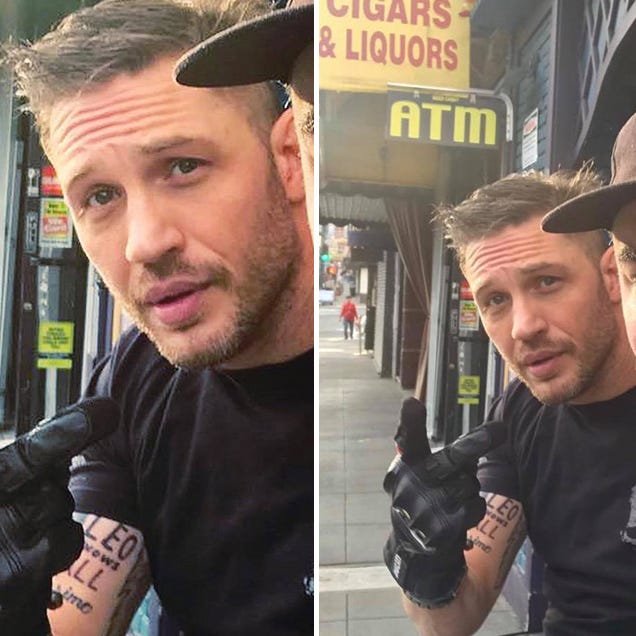
The words on Hardy’s right bicep read Leo Knows All. They began as a bet with Leonardo DiCaprio while the two were working together. DiCaprio predicted Hardy would be nominated for an Academy Award for The Revenant; Hardy wasn’t convinced. They agreed that the loser would get a tattoo chosen by the winner. After Hardy received the nomination, DiCaprio picked the phrase.
The origin is straightforward: an in-joke between two actors that became permanent. The lettering is plain and heavy, and close photos show it running across the upper arm instead of disappearing into the sleeve. The story has been repeated in interviews and entertainment coverage, making it one of Hardy’s best-documented tattoos.
The words are the whole design. It records the prediction, the friendship and DiCaprio winning the bet. There’s no need to treat each letter as a separate symbol or make it stand for Hardy’s entire career.
Padre Fiero puts fatherhood across the chest
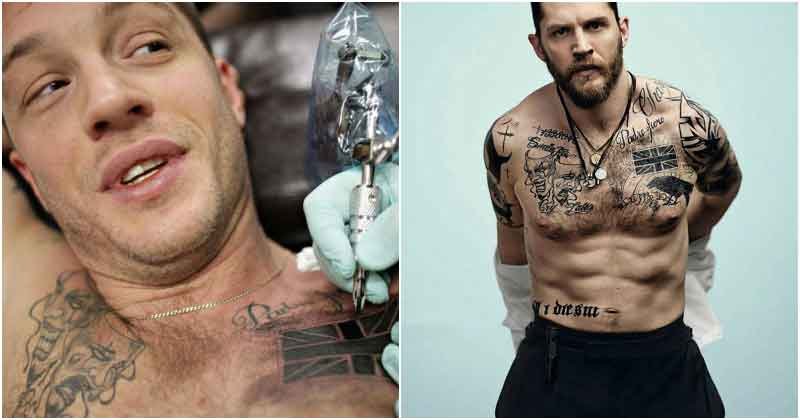
Across Hardy’s upper chest, Padre Fiero means “proud father” in Italian. The phrase is large enough to read in a wide torso photo, though older or distant shots can blur the exact lettering. Coverage often discusses it alongside his family-related tattoos.
This is a fatherhood tattoo, not a Latin motto. The large lettering reads like a personal statement and stands out among the numbers, faces, script and traditional motifs around it.
The Padre Fiero phrase doesn’t explain every tattoo on Hardy’s torso. It sits beside film references, an old friendship tribute and other designs whose meaning he hasn’t explained publicly.
The 1338046 number sits beside skull and face work
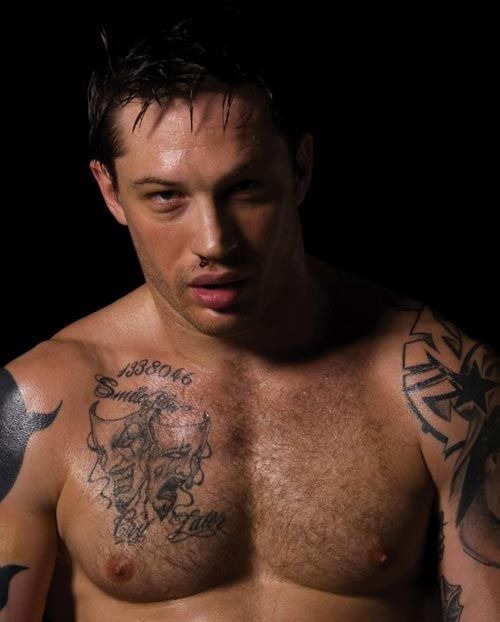
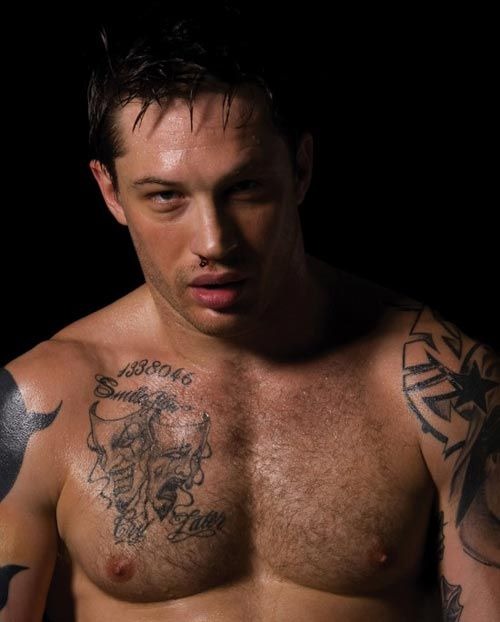
The number 1338046 appears clearly in Hardy’s chest photos. Tattoo publications commonly identify it as the Marine Corps service number of the father of one of Hardy’s close friends. It is reported as a memorial tribute, not a number chosen just for how it looks.
The digits sit among a skull, face-like images, script and dark lines. In compressed photos the shapes can run together; in a close crop the number separates from the surrounding art. The reported memorial story belongs to 1338046, not automatically to the nearby skull or faces.
Hardy’s chest also has theatrical faces and mask-like shapes. Photos show them, but there isn’t a reliable public explanation for each one. Describe their appearance and placement without assigning them to a specific film, character or period in his life.
A raven, Union Jack and bat shape connect the chest to his film years
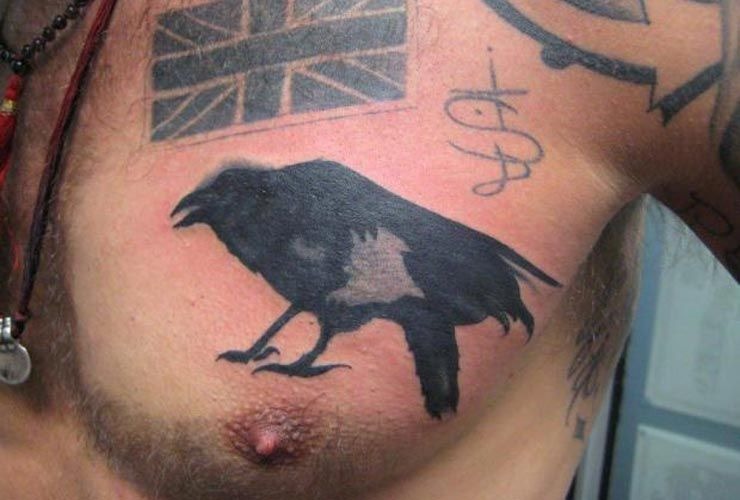
The raven on Hardy’s chest is one of the more distinctive pieces: close photos show a dark bird with spread wings and a Union Jack above it. The script and shading around the bird make the whole area look larger than a single tattoo.
Coverage links the raven and bat-like silhouette to Hardy’s screen work, especially around The Dark Knight Rises and Mad Max: Fury Road. That is a reported connection, not a design note from Hardy. Photos show the raven and flag; the film explanation comes from the coverage.
The Union Jack stands out in a tight crop, but the bird can disappear among the chest lettering in a full-torso photo. Up close, its beak, wings and dark body are easy to pick out.
The wolf is a separate image, not just another piece of the chest
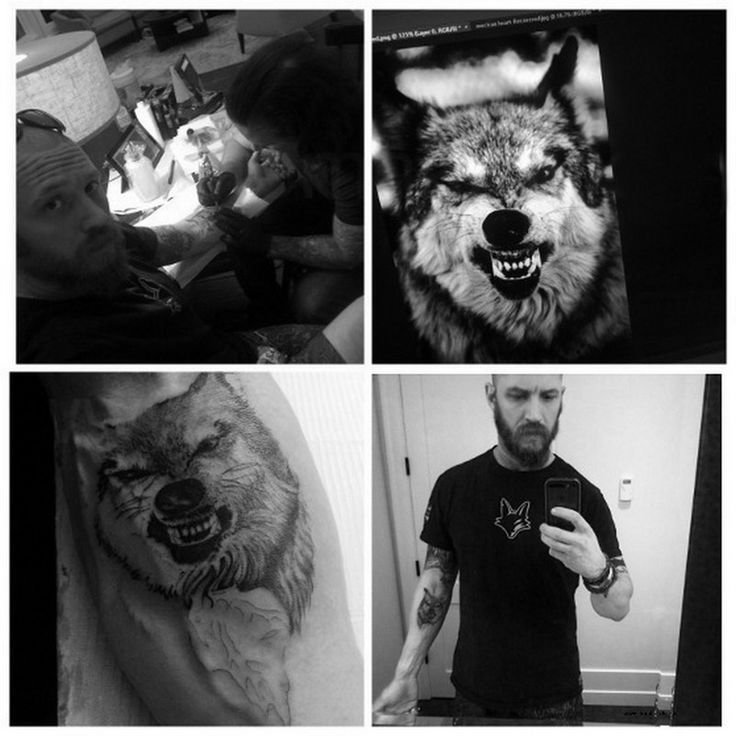
The wolf shows up clearly in close photos as a separate animal portrait. Coverage associates it with Hardy’s work on The Revenant and other physically demanding roles, but doesn’t give a precise reason he chose it.
People often associate wolves with strength, loyalty or independence, but there’s no evidence Hardy chose this one for those reasons. In photos it has a shaded face and strong outline among the older tattoos on his upper body. It belongs in its own section, separate from the raven.
The wolf breaks up the lettering with an image that takes a closer look. Leo Knows All and Padre Fiero are legible right away; the wolf’s eyes, muzzle, fur and shading resolve more slowly.
Older arm lettering includes Till I die SW, the Fighting Irishman and Scribe
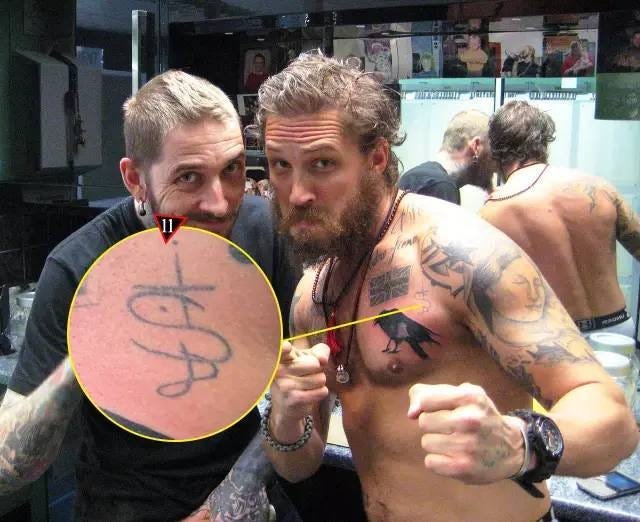
Several older tattoos on Hardy’s arms are easier to list individually than to force into one story. Till I die SW is commonly linked to Sarah Ward, his former wife. Reports read the letters as her initials and a phrase. The photos show the placement and lettering; coverage of their relationship supplies the context.
A Fighting Irishman is another recurring entry, described as a nod to Hardy’s mother’s Irish heritage. The traditional-style figure has a bold outline and compact shape, distinct from the fatherhood wording across his chest.
A feather with Scribe appears on his right arm. The long feather and script form a narrow vertical design. Hardy is an actor and writer, but that doesn’t justify turning the tattoo into a full biography; the word and image are enough to identify it.
An older tattoo map also records tribal work around the upper arm or shoulder, a sacred heart with a cross on the upper chest, and angel on the upper back. Their locations are reported, though sources don’t consistently explain what each one means.
Family lettering, the pit bull and tattoos that photographs only partly reveal
Some tattoos are hard to document because clothing hides them or they only show in certain poses. Tattoo coverage identifies a pit bull muzzle on the left side of Hardy’s back, described as a tribute to his dog. It rarely appears in front-facing photos, so a chest image can’t confirm its shape.
Reports also mention family-related Italian script reading ALL Bellissimo, linked to Hardy’s son. The spelling and crop aren’t equally clear in every photo, so treat it as a reported identification rather than a definitive reading from one image. Tattoo galleries also show phrases such as Smile? and Cry later, but Hardy hasn’t given a first-person explanation for them.
A photo can show a word, animal, number or location. An interview may add a family connection or tribute. When neither provides a backstory, leave it open instead of filling in the blanks.
What the record shows, and what it leaves unanswered
Hardy’s tattoos combine readable statements with dense imagery. The wager behind Leo Knows All is documented; Padre Fiero refers to fatherhood; 1338046 is reported as a memorial. The Fighting Irishman points to family heritage, and the pit bull is described as a tribute to his dog. These specific stories have firmer support than broad claims that all his ink means rebellion or toughness.
Other pieces—the raven, Union Jack, wolf, feather, sacred heart, tribal work, masks, faces and small lettering—can be described by what the photos show. Without a public explanation, avoid assigning each one a meaning. The images establish what is visible; interviews add context where Hardy has given it.
The tattoos don’t form one unified sleeve built around a single theme. They record friendships, family, acting jobs, past relationships and personal tributes, alongside designs Hardy may simply have liked. Giving each tattoo its own space, image and strongest supporting source makes the collection easier to understand.
6 thoughts on “Tom Hardy Tattoos: Leo Knows All and the Stories Behind His Ink”