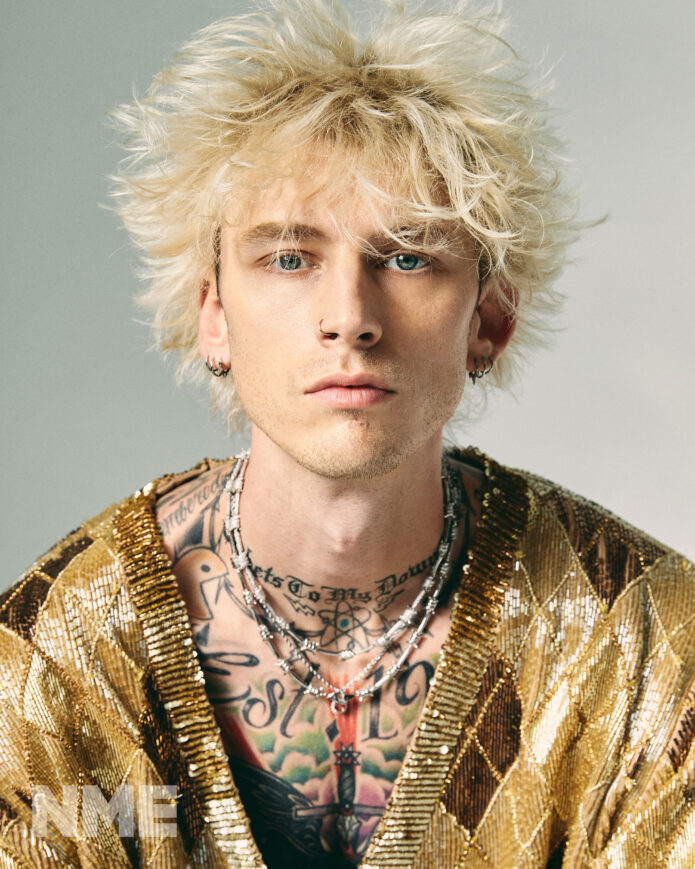
Machine Gun Kelly’s tattoos are easiest to follow as a timeline. Before the blackout, they included record references, drawings, jokes, a surrealist backpiece and designs he discussed in interviews. In 2024, tattoo artist ROXX covered much of his chest, stomach and arms in black. Since then, Baker has added smaller pieces in places that remain visible. The earlier work still tells part of the story, but it belongs to the collection he had before the blackout, not a complete picture of what can be seen today.
Baker has explained some pieces himself, and other designs are documented in interviews with artists or in established coverage. With so much ink and a major cover-up, older photos can be mistaken for current views.
The blackout covered a chaotic patchwork, not a blank canvas
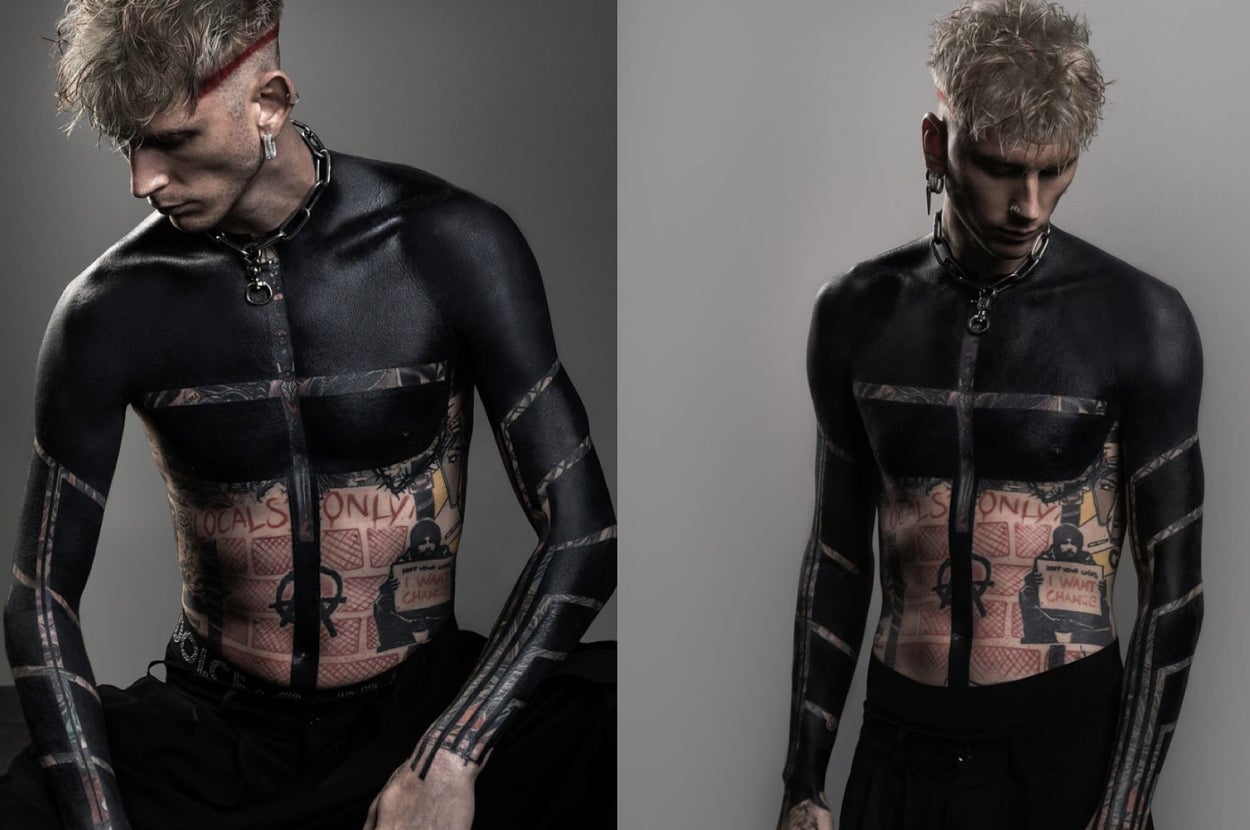
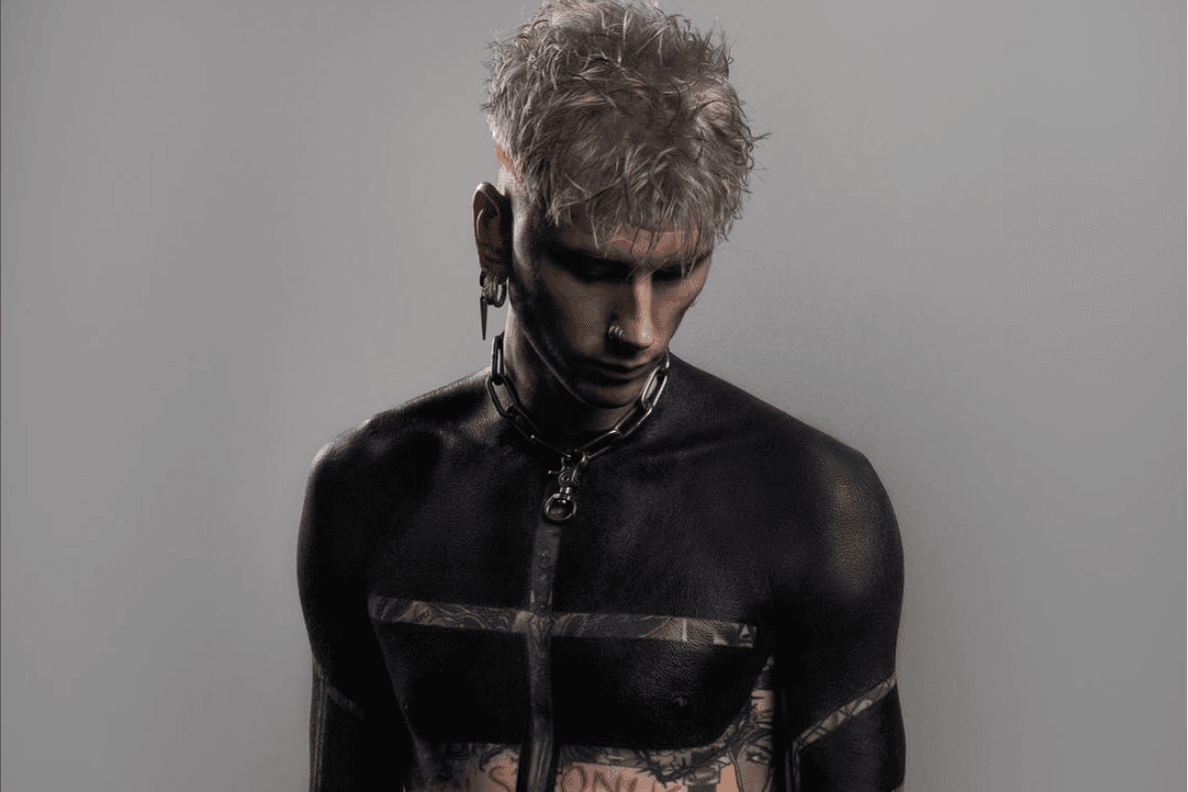
In February 2024, Baker revealed a broad blackwork cover-up by Los Angeles artist ROXX. The ink covers much of his upper body, including his arms, chest and stomach. Rather than place a new picture over each old tattoo, ROXX created a geometric blackout. An untouched cross-shaped area cuts through the chest, while narrow gaps and panels leave some earlier letters and symbols visible.
Baker captioned the project “for spiritual purposes only.” Early coverage said the full motivation was unclear. He later explained that he wanted to rethink how skin could look, in a 2025 interview, and told Billboard Canada in 2026 that older layers had come to represent periods he no longer wanted to carry. ROXX had proposed a project that might take about two years; Baker pushed to finish it in roughly two months. He said he became very ill during the process, describing yellowing skin, swelling or other changes around his lymph nodes, and difficulty moving parts of his upper body.
Early reports gave a more exact schedule: ROXX told TMZ that the sessions began in December 2023 and involved 13 appointments of six hours each. Baker’s 2026 interview helps explain why the compressed timetable was so punishing. The blackout was a sweeping change across his body, built from geometric work and cut-throughs of bare skin rather than a quick dark cover over a few designs.
His arms carried music, hometown pride and spontaneous ideas
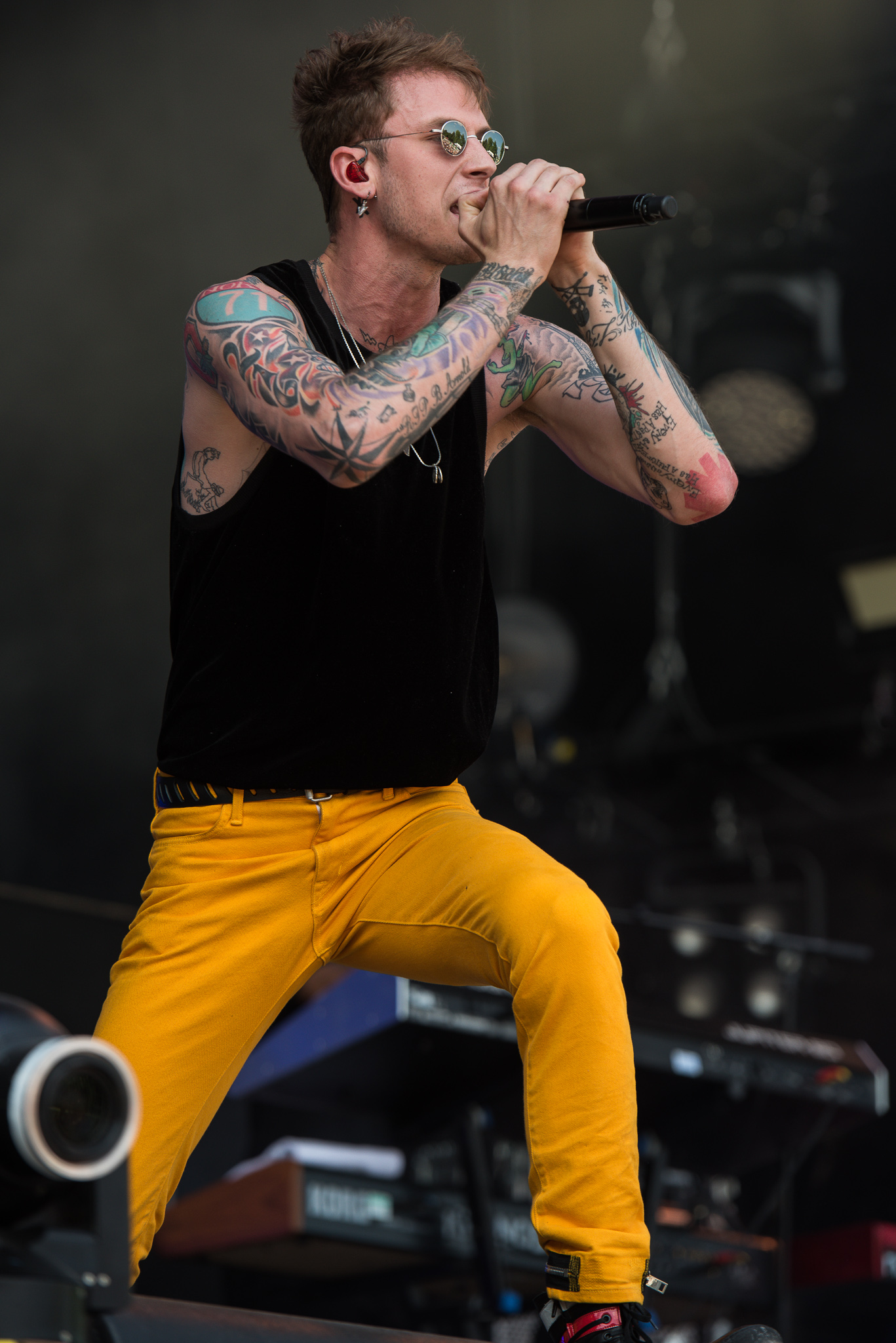
His arms were among the most densely tattooed parts of the earlier collection. Photos show overlapping text, symbols and small illustrations, but the clearest accounts come from Baker describing individual pieces himself.
In a 2013 interview with The Untitled Magazine, Baker said “Lace Up” appears twice. It was the title of his mixtape and debut album, but he also used the phrase for being ready to face a challenge. He said it was a greeting he shared with fans at shows. On his body, it worked both as a personal motto and a call-and-response with the crowd.
In the same interview, he pointed out a Tommy Lee “Mayhem” tattoo on his wrist. It is a clear Mötley Crüe reference; Baker said he was a fan of the band.
Baker told The Untitled Magazine that reading Anthony Kiedis’s memoir Scar Tissue helped him during a difficult period. His Red Hot Chili Peppers tattoo links the band he admired with a book he said mattered to him at the time.
Baker and Travis Barker shared a matching “Born with Horns” tattoo, named for the album title they were using then. The project name changed, but the tattoos were already on their arms. After the blackout, later photos cannot show which letters were covered, partly left open or altered; the earlier pictures record how the tattoos looked at that point.
In GQ’s 2016 Tattoo Tour, Baker described a tattoo tied to being hit by a double-decker bus in Manchester. He told the story with deadpan humor and called the tattoo one of his favorites, though the transcript does not reliably give its placement or full design. He also showed a blunt profanity tattoo that he said came from a late-night session. Both feel more like souvenirs of specific moments than parts of a planned motif.
Baker called Jessica Rabbit on the inside of his right upper arm his fantasy woman. In an iHeart interview, he said the most painful spot was near his armpit, where the artist worked. He remembered both the image and how much that spot hurt.
Near his inner elbow, Baker described the words “Kiss the Sky” beside a drawing by a friend. The phrase comes from a song on Bloom. He said it was about searching without knowing exactly what you are looking for, then letting something find you. He also connected it with nostalgia and a feeling close to nirvana.
In the same conversation, Baker discussed a rosebud and open rose he got around the release of Bloom. One stage showed a rosebud; another showed the bloom above it. The growth echoes the album title rather than being an interpretation added by a tattoo list. The interview does not establish the exact location of each design.
The chest mixed belief, heartbreak and a very large guardian angel
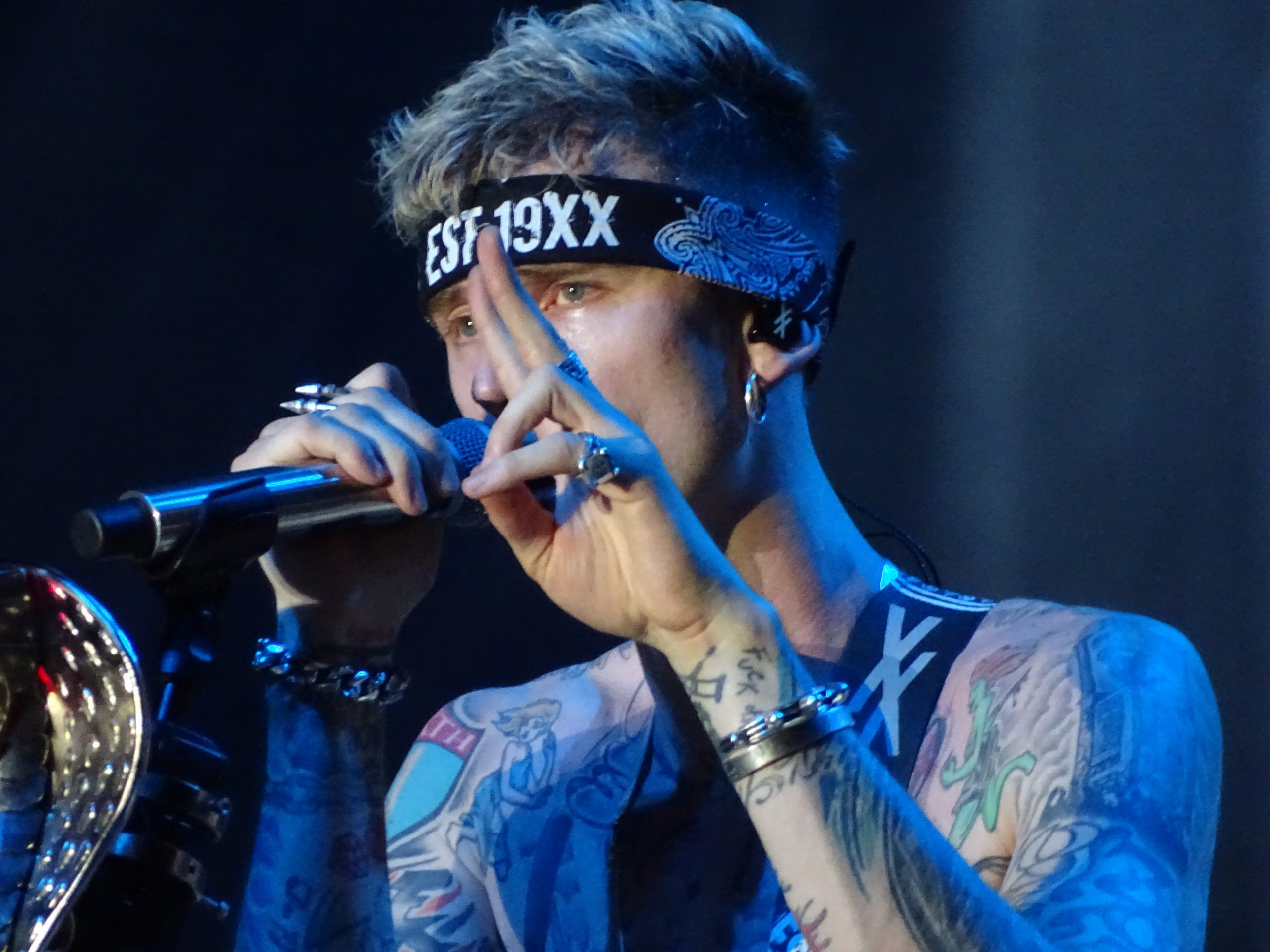
Baker said he got a guardian angel at about 16, when he had begun believing in God. Later interviews described it as one of the tattoos fans copied when dressing up as him. The piece belongs to that earlier period: the later chest blackout changed how it looks, so old portraits show the angel as it was then.
In a 2017 iHeart interview, Baker described a gash over his heart, with blood drawn from the wound. Asked where the idea came from, he answered, “Somebody ripped my heart out.” The tattoo pairs a literal image with a heartbreak line. He did not name a person or event, so the quote does not tell us more than that.
GQ’s Tattoo Tour also shows a black heart that Baker called a “stone cold heart.” He described it as armor he built in the music industry: after years of working in public, he felt he had to harden himself and let fewer people in. The interview preserves both the design and his explanation.
The anarchy “A” on his stomach became another instantly recognizable mark. In the iHeart interview, Baker named it among the tattoos fans copied when dressing up as him. Its visual impact is clear, but he did not give the symbol a separate personal backstory.
Older neck and face pieces are best read in dated photos
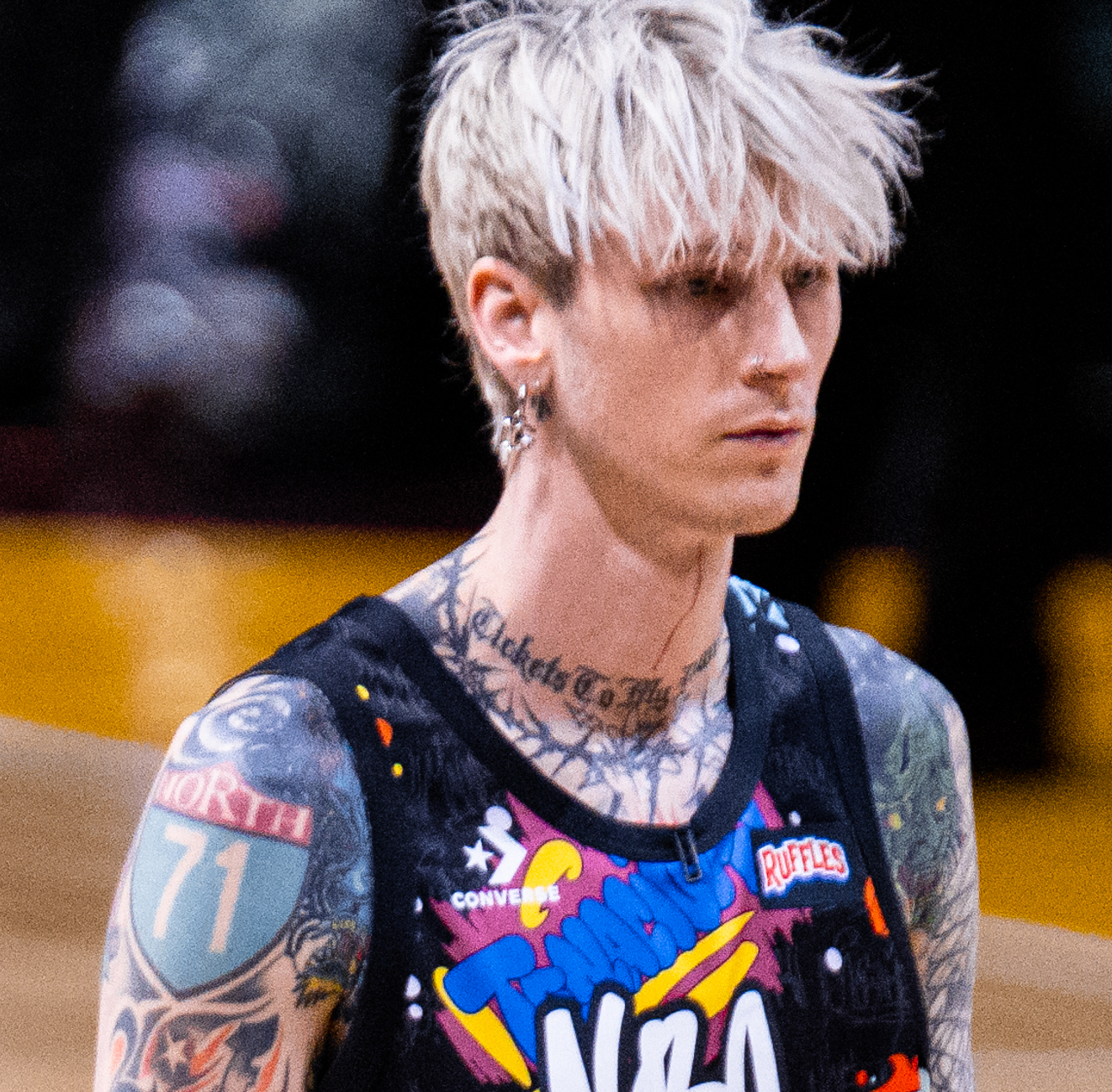
A 2022 photo captures the ink across Baker’s jaw, collarbones and chest before the blackout. Lines and lettering overlap, and not every word is legible. The image shows the density and placement at the time, but it cannot identify each symbol. Later stories sometimes name blurry marks without showing the close-up or explaining where the identification came from.
Dates help keep the face and neck tattoos straight. Later photos show newer work around both ears; those pieces should not be confused with the older neck lettering in this photograph.
A Dalí-inspired backpiece took the most time
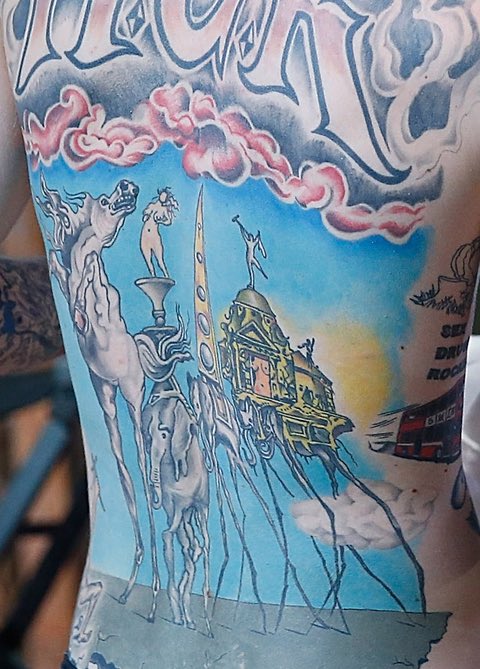
Baker called his back an “iconic piece” and told iHeart it took about 50 to 60 hours. GQ’s Tattoo Tour identifies a Salvador Dalí piece there: a colorful surrealist scene with elongated figures and architectural forms. Baker’s description supports calling it Dalí-inspired, but the interview does not identify one particular painting as its source.
Baker also told GQ about a session in Redding, Pennsylvania, when he stepped away to use the bathroom and found the bathtub in his hotel room full of urine. It is a strange detour in the story, but the backpiece itself is what he remembered: a near-full-back design he liked after dozens of hours of work.
Neck and ear designs kept changing after the blackout reveal
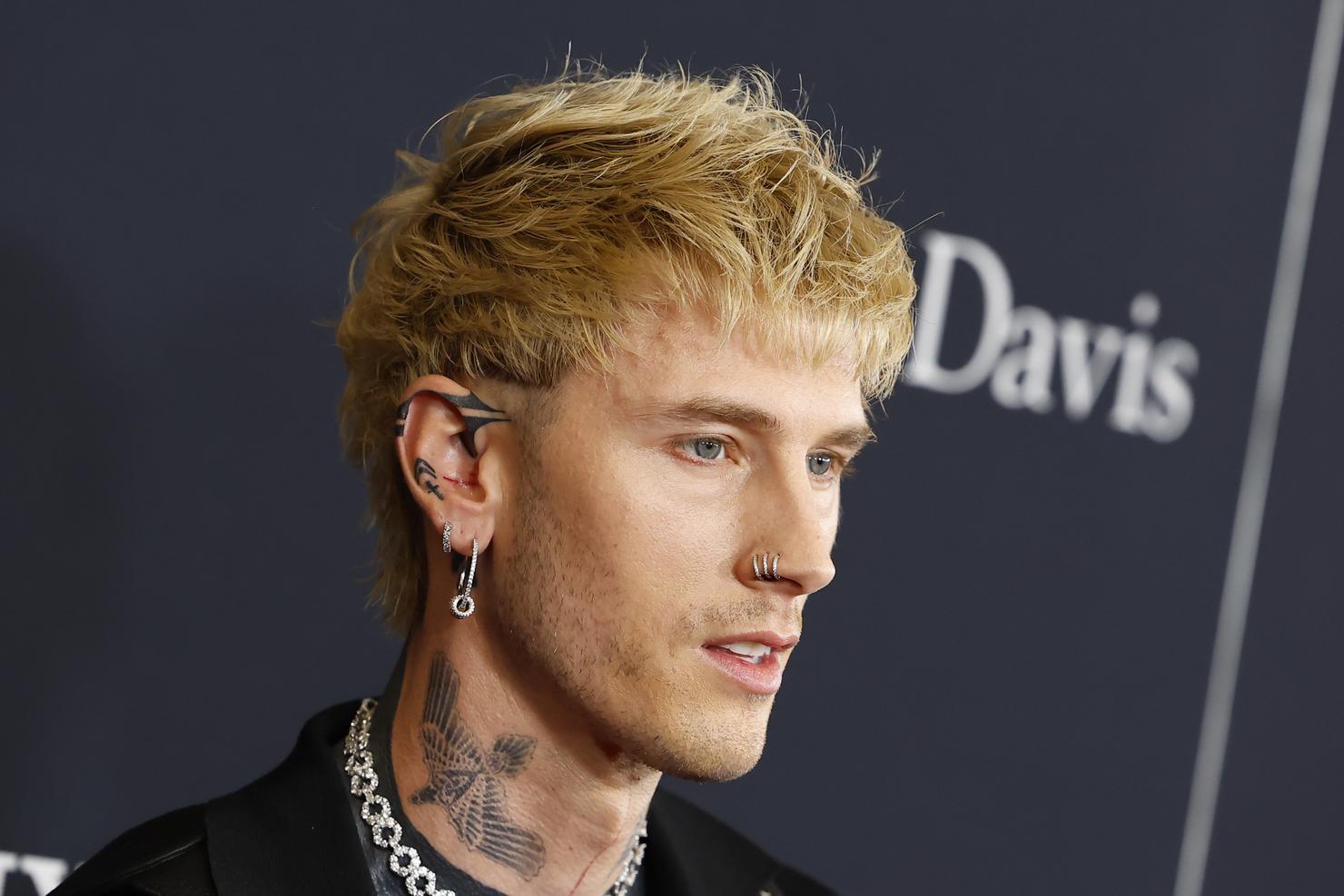
The neck forms a tight border between Baker’s face, chest and hairline. Older portraits show layered lettering and small marks; photos before the 2026 Grammys reveal new work around his ears. iHeart identified a red heart and the word “ether” on the flat of his left ear, a bass-clef mark along the edge of his face, and additional abstract lines on both ears. Hair and jewelry can hide the small designs in wide red-carpet shots, but the ear work changes the outline of his profile.
Older sources mention neck and face tattoos, but often leave the wording or exact placement unclear. A close photo of the ears supports the newer descriptions; a distant concert shot is not enough to identify every shadow as a confirmed symbol.
His newest family tattoo is “SAGA” on the right hand
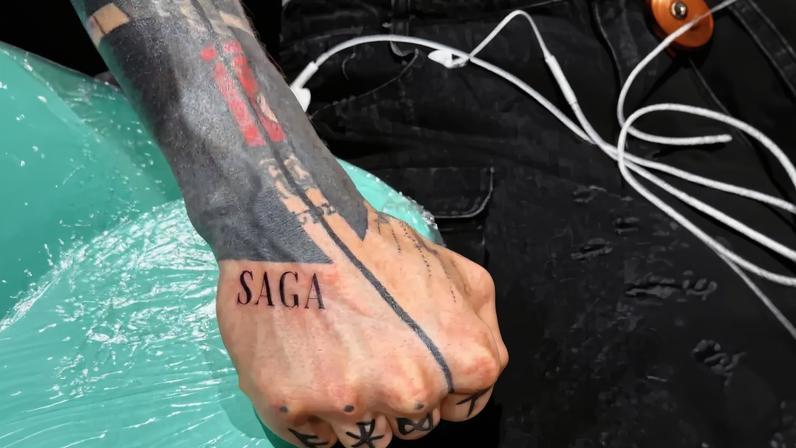
In early 2026, Baker had “SAGA” tattooed in capital letters on the back of his right hand for his youngest daughter, Saga Blade. Berlin tattoo artist Zsofi Csepai shared photos from a tour stop shortly before Saga’s first birthday. The lettering sits at the edge of the blackout, where untouched skin leaves enough contrast for the word to stand out.
In a 2025 interview about the blackout, Baker said he kept a small tattoo his older daughter Casie had done on him. He did not identify its design or placement. It is separate from the new SAGA tribute: one was made by Casie and kept, while the other spells his youngest daughter’s name. The two are not the same tattoo or a single design for both girls.
In April 2026, Inked reported that Baker showed “look” on the top of his left foot and “up” on the top of his right in an Instagram Story filmed in Perth. Together, the words read across his feet. The article’s photo is a stage shot rather than a close-up, so the written report gives a clearer account of the lettering than the image.
What the old tattoo lists get wrong
Roundups count Baker’s tattoos differently: some list each small mark, while others call an entire sleeve one tattoo. Cover-ups make the total harder to check. A 2017 photograph shows what was visible then, not what remained after later sessions and the blackout. Baker has said he began getting tattooed in his early teens, though his accounts give his starting age as either 13 or 14. There is no single official count.
The designs discussed most clearly include Lace Up twice, the Tommy Lee Mayhem reference, the Red Hot Chili Peppers tribute, the Bloom rose imagery, Kiss the Sky, Jessica Rabbit, the gash and black-heart designs, the guardian angel, the Dalí-inspired backpiece, the anarchy A, the Born with Horns matching tattoo, the 2024 blackout, Saga’s name, the ear marks, and the new words on his feet. That is already a detailed map without guessing at a total.
Some tattoos point to music Baker admired; others came from heartbreak, a strange night or an impulsive choice. The blackout changed how that history looks, but it does not mean the old work was unimportant to him. Dated photos and Baker’s own explanations show how the collection shifted over time.
3 thoughts on “Machine Gun Kelly’s tattoos, before and after the blackout”
Comments are closed.