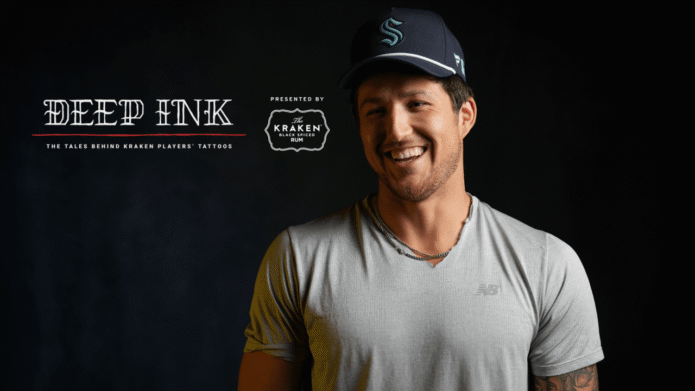
Brandon Montour’s tattoos read like a family album threaded through with hockey. The Seattle Kraken defenseman has ink for his parents, brothers, wife, children, dogs and grandfather, along with references to his Mohawk heritage and the career that took him from Ontario to the NHL. There is a lot there, but it does not feel random.
Montour has said his tattoos remind him of people and moments. “Mom” and “dad” sit on his wrist, where he can see them before and during games; an R on his ring finger stands for his wife, Ryian. After his grandfather died, the family turned one of the older man’s tattoos into a shared tribute. Palm trees and mountains mark places connected to his children.
The designs cover both arms, a thigh, his back and the area around his hip, and the collection is still growing. Montour has described his back as space for larger ideas, while the rest of his ink already reads like a loose timeline.
Frogs, owls and wolves fill the work in progress thigh
Montour’s thigh is still a work in progress, but it already includes a frog, an owl and a wolf. The animals give his upper leg a different feel from the lettering and family dates on his arms, with space left for future pieces.
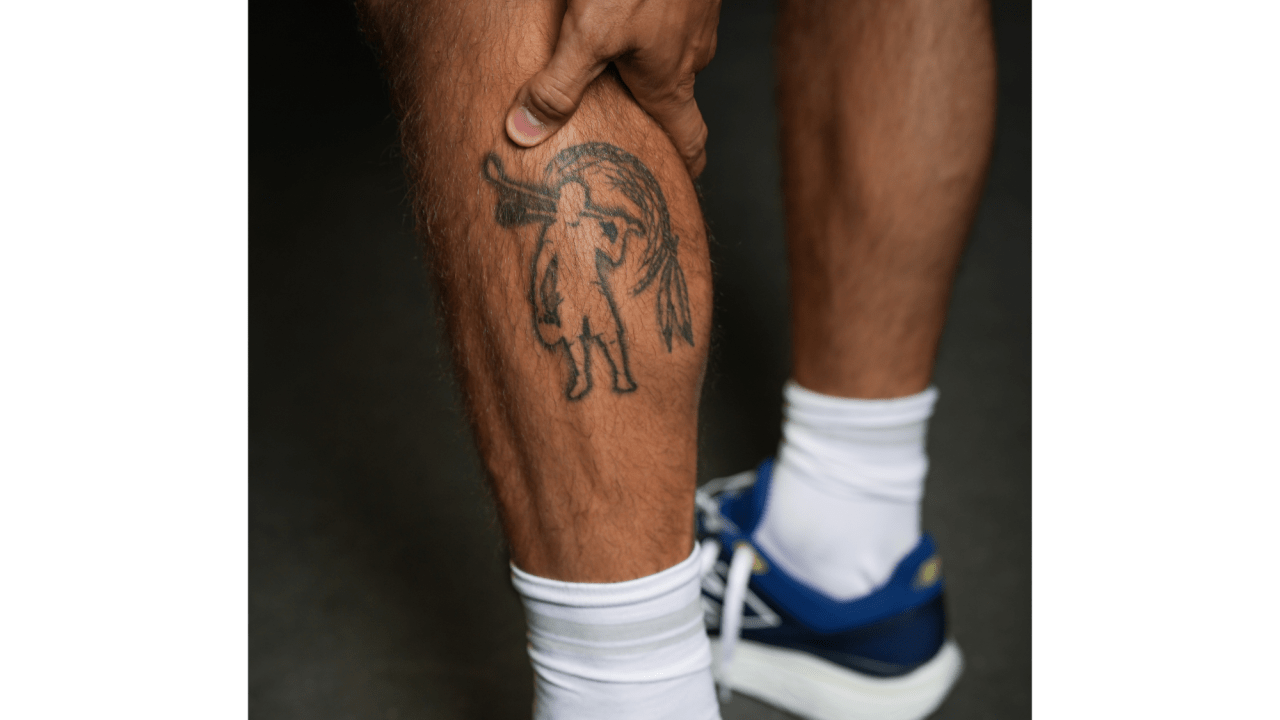
The story behind his first tattoo is just as personal. It brought hockey and lacrosse together, while the dreamcatcher puts family, community and heritage in the same frame.
Montour got that first design at about 16 or 17 and came up with it himself. He drew a silhouette of himself holding a hockey stick and a lacrosse stick, with a helmet beside him and a dreamcatcher behind. He said his parents accepted the idea once they saw it, though they asked him not to put it somewhere too wild.
That beginning set a pattern. Montour did not choose a generic symbol and find a meaning for it later; he started with an image that already felt like him. The collection has since grown in different directions, but the link to people, places and identity has stayed.
The family message sits among flowers, animals and a lion
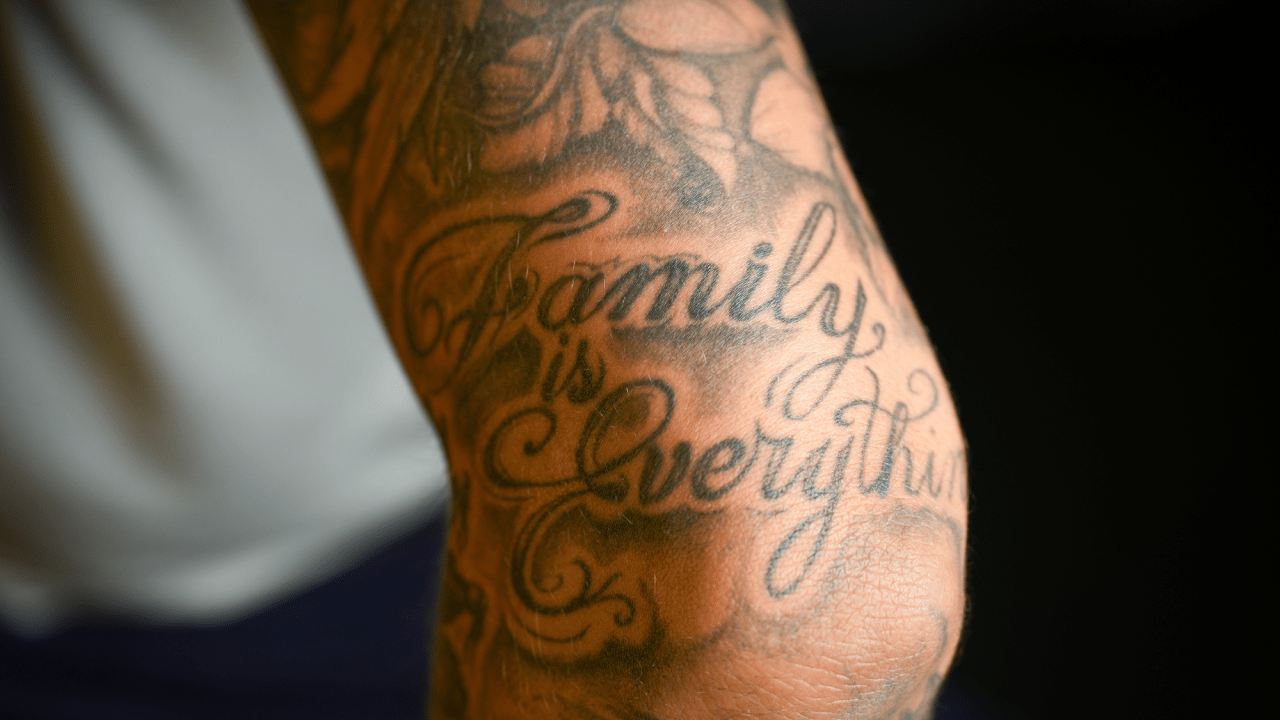
Much of Montour’s arm work circles back to family. One clear phrase reads “Anything is possible if you believe,” surrounded by flowers and animals. The words are motivational, but the names and dates nearby make the sleeve feel specific to him rather than like a generic slogan.
A lion fills part of the surrounding space, while palm trees connect with the start of Montour’s NHL career with the Anaheim Ducks. The sleeve moves between family, belief, travel and the places where his life changed direction.
Sports tattoos can easily become a wall of team logos, but Montour’s are more indirect. A palm tree can mark a city and a career chapter without spelling out the team. Flowers soften the lettering; animals fill the space while carrying their own associations.
The phrase offers a thought he can return to on a difficult day. Hockey demands that players recover after mistakes, and these words look forward rather than simply recording the past. It is the sort of sentence that can encourage him without needing to be explained each time someone sees it.
A Native American chief and an angel bring two sides of the collection together
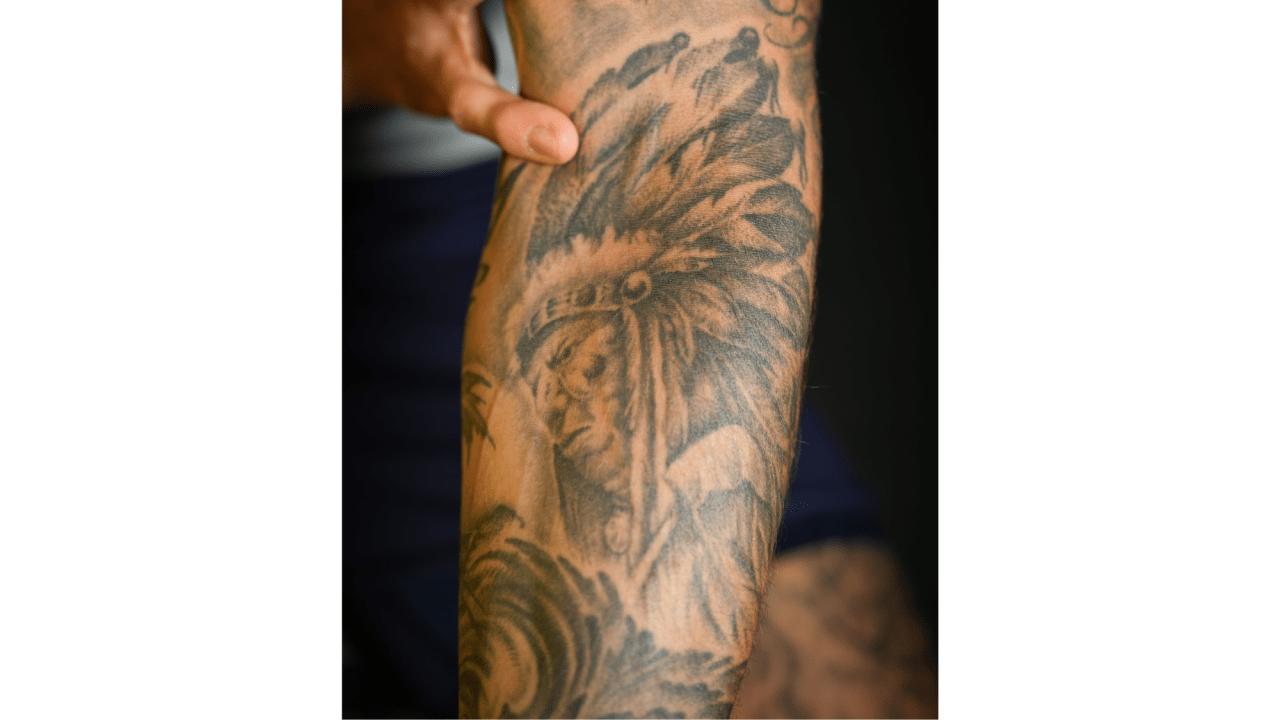
On his lower arm, Montour has a portrait of a Native American chief that he has connected with his Indigenous roots. Higher up, an angel represents “everyone,” according to the story behind the collection. One points to heritage and identity; the other has a broader, protective feeling.
Montour is of Mohawk descent and has described the chief as part of his own story. It is not simply a powerful-looking image. It sits alongside the family references and the dreamcatcher from his first tattoo.
The angel works differently. He has not described it as a portrait of one particular person; its reported meaning is wider, a dedication to the people around him. It can sit beside the specific “mom” and “dad” tattoo without competing with those names.
Together, the images make the sleeve feel like a set of connected ideas rather than one mural planned all at once. Some name the people closest to him; others speak to culture, belief or support. Their styles differ, but they do similar emotional work.
“Mom” and “dad” stay where he can see them during games
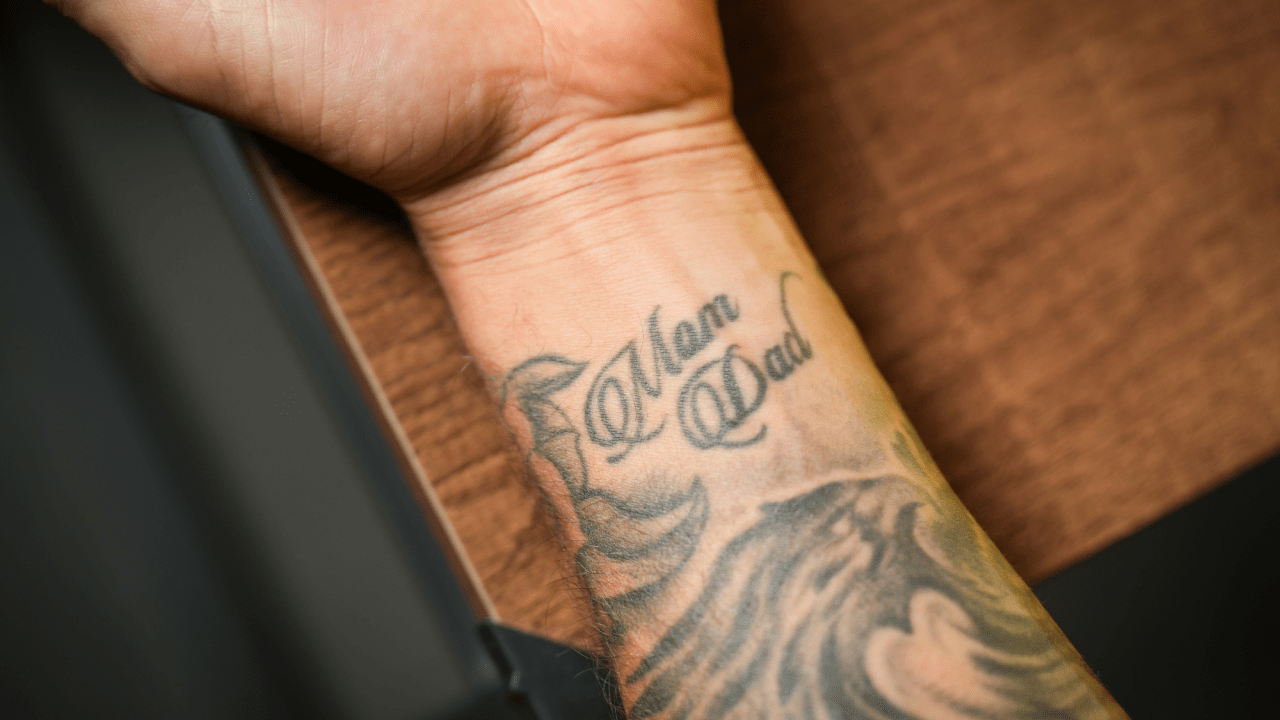
One of Montour’s most direct tattoos sits on his wrist: the words “mom” and “dad.” He chose the placement so he could look down at them before a game and even while playing. The dedication becomes part of his routine.
Athletes often have small rituals before competing. Montour’s reminder is always with him; he does not need a photograph or a lucky object nearby to think about the people who helped him get this far.
Other tattoos and shading surround the lettering, but its meaning is easy to read. There is no symbol to decode or translation to work out. That plainness helps it stand out among a collection full of scenes and imagery.
It also shows why Montour talks about tattoos as moments, not just pictures. An animal, a quote, a place or a family name matters because of what he sees in it when he looks down.
Family birth years turn the sleeve into a timeline
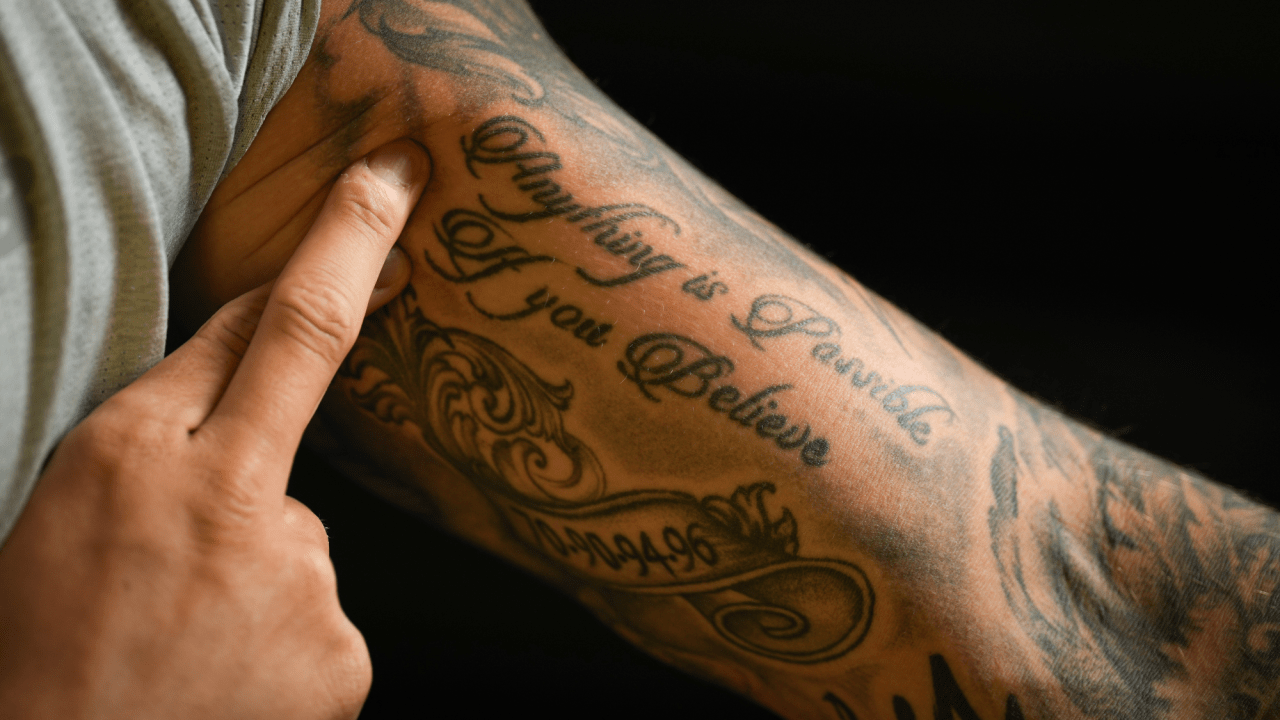
Below the wrist message are birth years for Montour’s parents and both of his brothers. They sit among flowers, animals and other decorative work, turning the sleeve into a family timeline rather than a single name tattoo.
The dates can be hard to make out from a distance, unlike a lion or portrait. Up close, they give the arm structure. It is not only a record of who his family are, but of the years connected with them.
Flowers soften the numbers and break up the lettering, while the animals add movement and nearby script helps the pieces hang together.
This is where the sleeve feels most like a family album. The dates are not there to impress a stranger seeing the tattoos for the first time. They let Montour carry the people and milestones with him while he travels for hockey.
The small LNG tattoo is for two dogs and a family joke
Montour’s tattoos are not only about his human relatives. He has an “LNG” tattoo for his dogs, Libby and Ginger. The letters keep both names close, and Libby has a playful backstory: it is short for LeBron.
A crown tied to the nickname adds another bit of fun. This is not a huge portrait or a dramatic memorial, just a small family reference that makes sense to people who know the dogs and the story behind the nickname.
That lighter side matters. Montour has serious tattoos for his Indigenous roots, his parents and his grandfather, but he leaves room for a dog joke too. A collection made only of solemn tributes could feel heavy; the LNG piece keeps it warm.
The tattoos do not all need to carry the same weight. Some hold grief or heritage; others make the wearer smile. His sleeve has room for both.
The “R” on his ring finger is for his wife Ryian
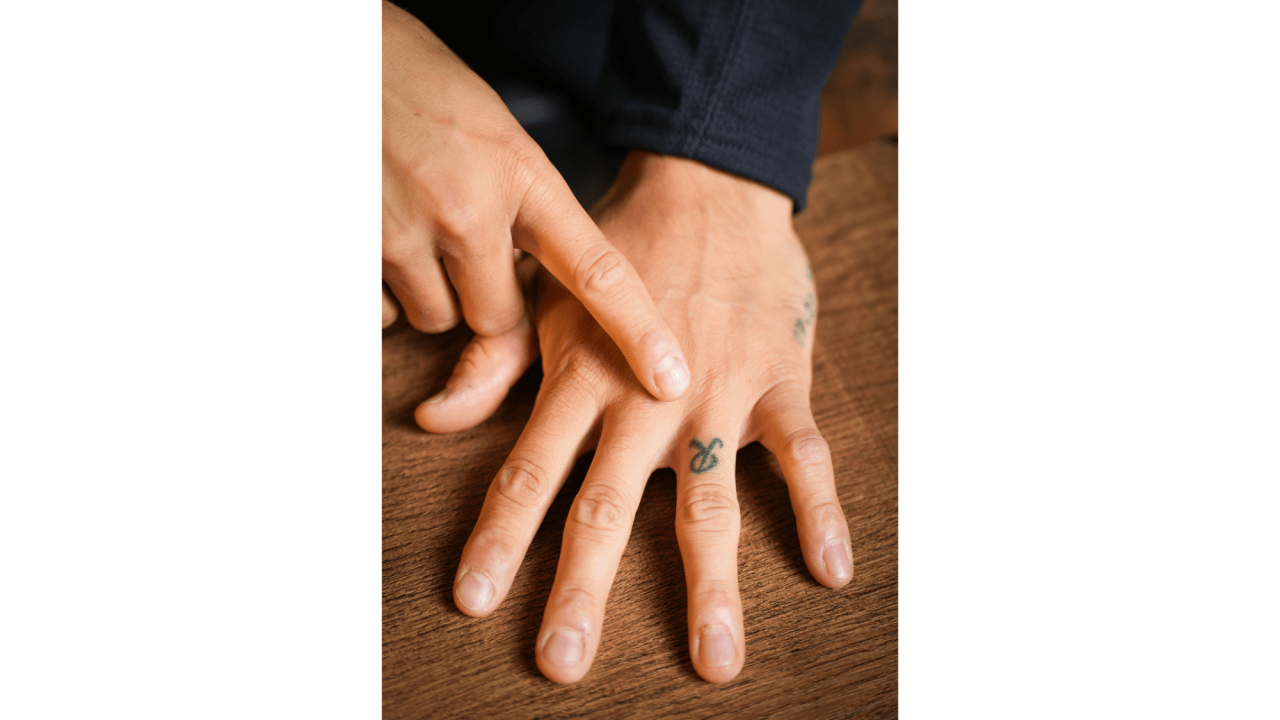
After marrying Ryian in Nashville, Montour added a small “R” on the ring finger of his left hand. It is among the simplest tattoos in his collection, but the placement gives the letter extra meaning. The finger already carries the idea of marriage, and the initial makes the dedication personal.
Beside the arm sleeve, the R is minimal: no flowers, animals or long phrases, just one letter where a ring would sit. That restraint fits Montour’s approach. A large piece can tell a whole story, while a small one works as private shorthand.
It also marks a later chapter in his life. His first tattoo came as a teenager thinking about hockey and heritage; the family sleeve grew as he established his career; the ring-finger initial belongs to the life he is building with his wife.
His back and hip tattoos mark quotes, children and championships
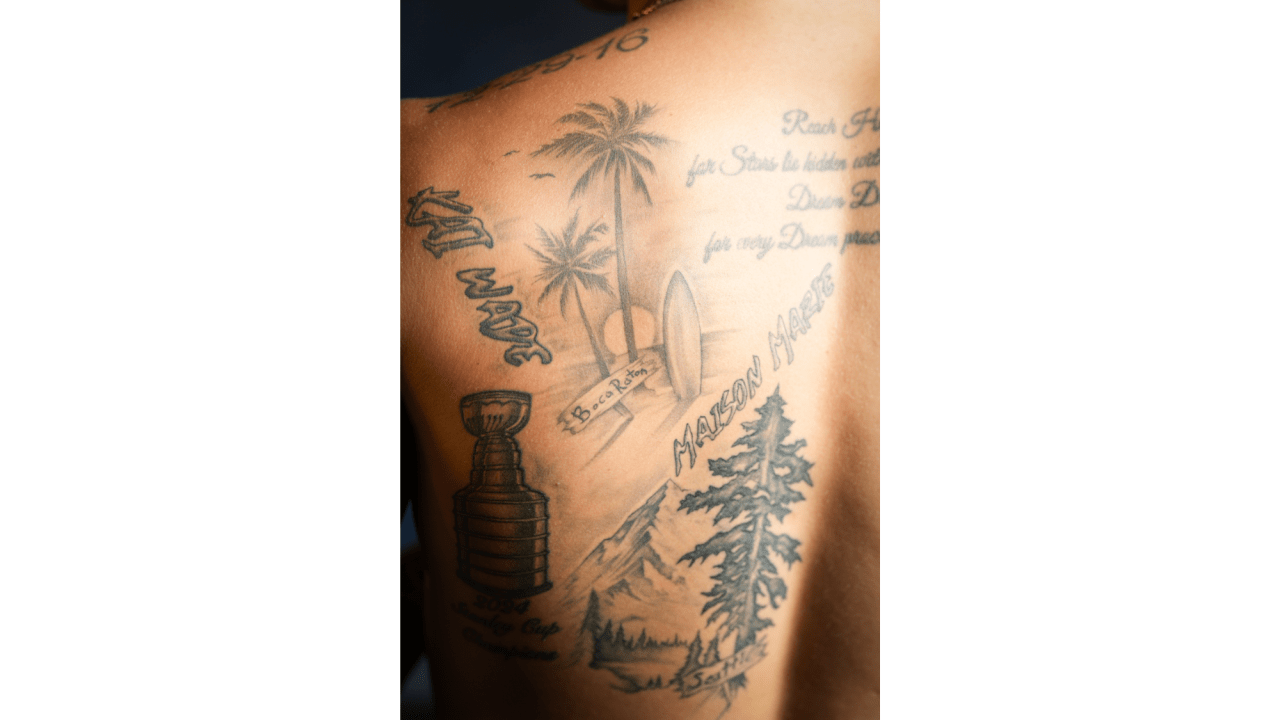
Montour has added larger work beyond the sleeve. A motivational quote covers his upper back, and a Stanley Cup above his left hip marks the 2023–24 championship he won with the Florida Panthers. Designs for his first two children sit around the Cup.
For his son Kai, Montour chose palm trees and a beach to represent Boca Raton, where Kai was born. For his daughter Maison, he added mountains and pine trees tied to the Pacific Northwest and her Seattle birthplace. They work as small landscapes rather than just names and dates.
The Cup marks a career milestone, while the surrounding scenery turns the same area into a story about home and family. Montour’s father has a slightly different version of the Cup design, adding another family connection to the championship.
Montour has joked that one of his favourite pranks is asking someone to scratch his back, knowing they will spot the Cup tattoo. It is a down-to-earth detail: even a major achievement can become part of a joke between friends.
The quote higher on his back is easier to read in a close-up than in a game photo. It occupies space he has set aside for larger work, and his back does not appear to be finished.
The upper back carries a quote he found for himself
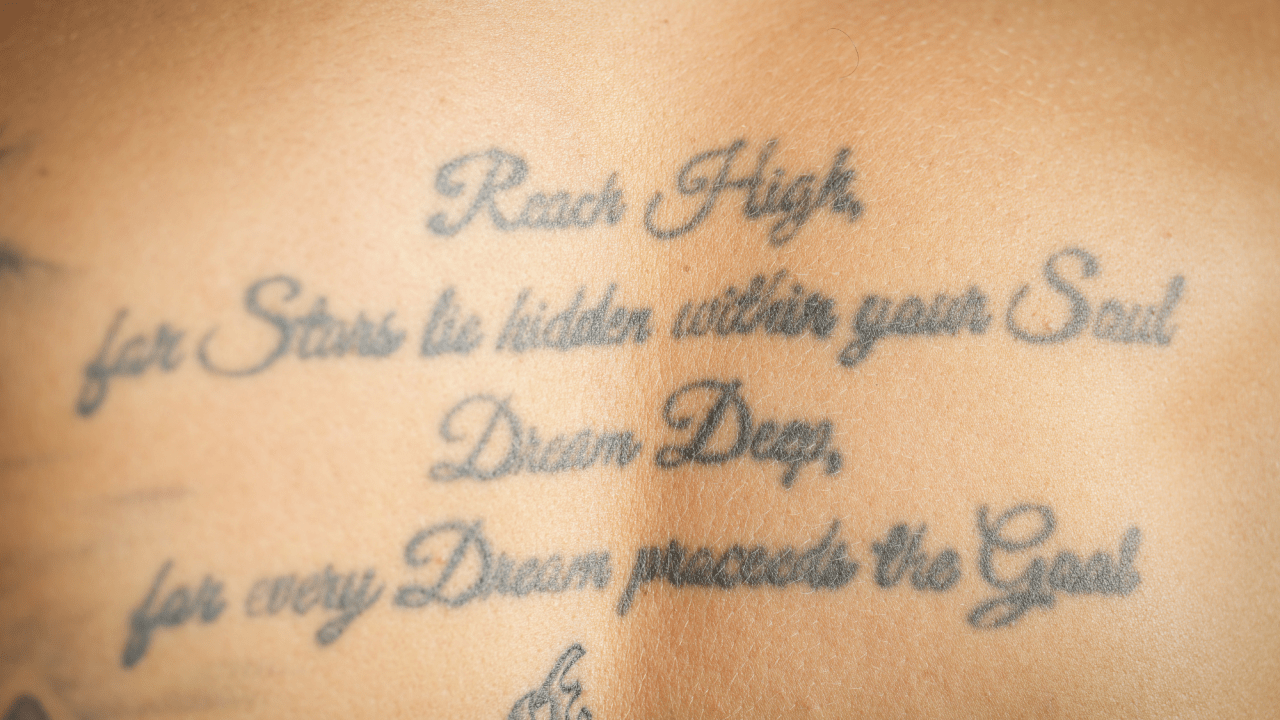
Montour’s upper-back tattoo is a longer motivational quote, better suited to a close-up than a quick view from the stands. It gives the back a different rhythm from the images across his arms and hip.
He has said the back is still a place for future ideas, so the quote is part of an unfinished area rather than a final centrepiece. That fits how he talks about tattoos generally: his collection is not a completed display, but something he can add to as life brings new moments.
Brandon Montour’s tattoos keep growing with his life
Montour has worked with several tattoo artists, though most of his ink was done by Steve Hill of 16 Aces in Ontario. He has described their process as sharing ideas and letting the artist help shape them. At a certain point, he says, a tattoo becomes the artist’s art too.
That collaboration shows in the collection. Some pieces are precise family markers; others are larger scenes that leave room for the artist to build. The designs do not look like they came from one catalogue because they were made at different points, around different stories.
Montour has said he does not expect to stop getting tattoos. That makes sense if the collection is a record of his life rather than a finished project. There is room for more family moments, career milestones and art.
The main theme is easy to spot. When Montour looks at one of these tattoos, he sees a person, a place or a moment that mattered. That is why the collection feels more like a living timeline than a set of disconnected designs.