Michael Folorunsho tattoos are documented most clearly as a collection of visible placements across football, editorial and interview photography. The publicly viewable photographs are not one studio catalogue. They move from a shirtless match image to a close-up where a hand crosses the face, then to Italy portraits, training-ground action and a direct Cagliari presentation image. Those settings expose different parts of the body, so each photograph is useful for a different reason.
Folorunsho is an Italian professional footballer whose public career has included Napoli, Verona, Fiorentina and Cagliari, as well as appearances for Italy. The GQ Italia portrait places him in the Azzurri context, Sky Sport documents an interview setting at Cagliari, and regional football outlets provide additional action frames. The visual notes below stay with what the originals show: neck, chest, arm, forearm and hand coverage. They do not assign private meanings to designs that have not been documented by Folorunsho himself.
Michael Folorunsho’s chest tattoos in the Euro 2024 frame
The MGR Online Euro 2024 photograph is the broadest tattoo-bearing view in this set. Folorunsho is photographed shirtless on the pitch after a match, with both arms, his chest and the lower neck visible at once. The frame shows a dense mix of linework, shaded areas and smaller marks rather than one isolated emblem. Because the camera is pulled back, the composition is more useful for mapping coverage than for naming every motif.
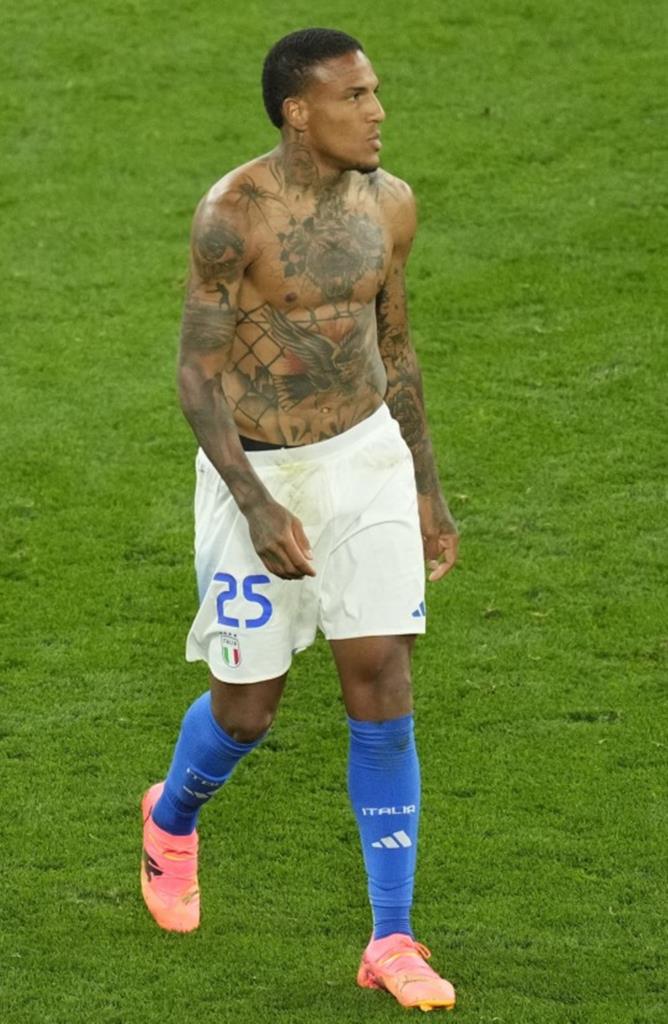
The chest acts as the visual centre of the tattoo layout. Darker marks sit against the torso while the arms carry the eye outward into longer bands of ink. A few shapes read as organic or illustrative at this distance, but the photograph does not make every contour precise enough for a confident inventory. It is more accurate to describe the pattern as layered chest and arm coverage than to invent a list of symbols.
The shirtless pose also explains why this image is important. Jerseys and training tops conceal much of the torso in ordinary football photography. Here, the body is visible in one uninterrupted frame, allowing the reader to compare the density of the chest with the more continuous work on the forearms. The photo is a match-context document, not proof of when each tattoo was added.
The tattooed hand and forearm in the Sky Sport portrait
Sky Sport’s Cagliari interview image provides a very different crop. Folorunsho raises a tattooed hand across his face, leaving one eye visible through the fingers. Ink continues from the hand into the forearm, and the gesture turns the tattoo into the main graphic element of the photograph. The stadium seating in the background is soft and secondary, which keeps attention on the skin, pose and expression.

The hand tattoo changes the scale of the reference. In the Euro 2024 frame, the arms read as part of a larger body map. In this close-up, individual lines and filled sections become more apparent because the hand sits close to the lens. The image still does not resolve every tiny shape, and the fingers overlap parts of the face, but it gives stronger evidence for the presence of hand ink than a distant action photograph could provide.
The forearm is also shown in relation to movement. The raised elbow creates a diagonal that links the wrist and hand to the upper arm, while the fingers create a second line across the face. This is a useful design-reference principle without turning the article into a reproduction guide: a tattoo can read differently when the limb is bent, raised or brought toward the camera.
Neck tattoos and forearm coverage in the GQ Italia portrait
The GQ Italia image places Folorunsho in an Italy training jersey with both forearms folded across the body. The camera is closer and the lighting is more even than in the pitch photograph. The neck area is visible above the collar, and the forearms show large dark sections that contrast with the blue kit. The pose is symmetrical enough to compare the left and right sides while keeping the face fully identifiable.

The neck work forms a bridge between face and torso. It begins below the jaw and meets the collar line, making it visible even when a shirt is worn. The forearms are heavier visual anchors in this frame, with ink extending across the exposed skin rather than appearing as one small mark. The image supports a description of broad forearm coverage and neck density, but it does not establish a complete sleeve boundary.
The crossed-arm pose also limits what can be concluded. Some portions of the wrists and elbows overlap, and the jersey hides the chest. That is why this image is kept separate from the shirtless MGR frame. It is not a replacement for the wider view. Instead, it adds a controlled portrait where the neck and both forearms can be studied under consistent colour and focus.
Training-ground arm tattoos in the Napoli action image
The AreaNapoli training photograph catches Folorunsho in a yellow bib over a Napoli kit while he moves across the pitch. Both arms are exposed below the sleeves, and tattoo coverage is visible from the upper arm through the forearm. The image is smaller than the editorial originals, yet the body position is distinct: the arms extend away from the torso and create an open, athletic silhouette.
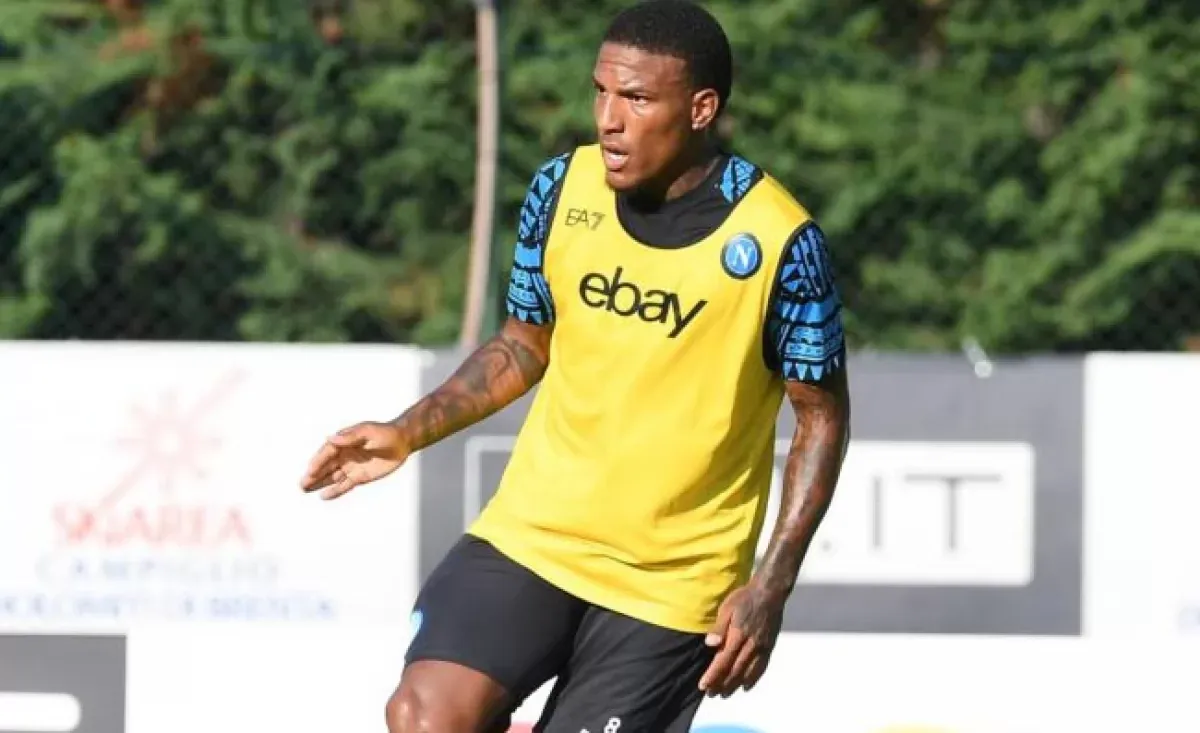
Action makes the arm tattoos read as directional bands. The left and right limbs are not held in the same plane, so the marks appear to bend with the body rather than forming a flat frontal panel. This is useful visual evidence for continuity across the arms, even though the compressed source limits fine detail. The photograph does not support naming individual designs that cannot be resolved.
The training setting also helps separate clothing from ink. The yellow bib, blue sleeves and black shorts create strong colour blocks, while the tattoos remain visible in the gaps below the sleeves. This is one reason to preserve the original context in the description. A crop that removed the kit would make the body placement less understandable, not more accurate.
The Fiorentina match image and a clear neck outline
The Viola News match photograph is a close, three-quarter action view of Folorunsho in a purple Fiorentina shirt. His face is turned to the side and the neck tattoos remain visible above the collar. A smaller mark near the side of the neck is easier to notice here than in the front-facing GQ portrait, while the shirt and shoulder position conceal most of the torso.
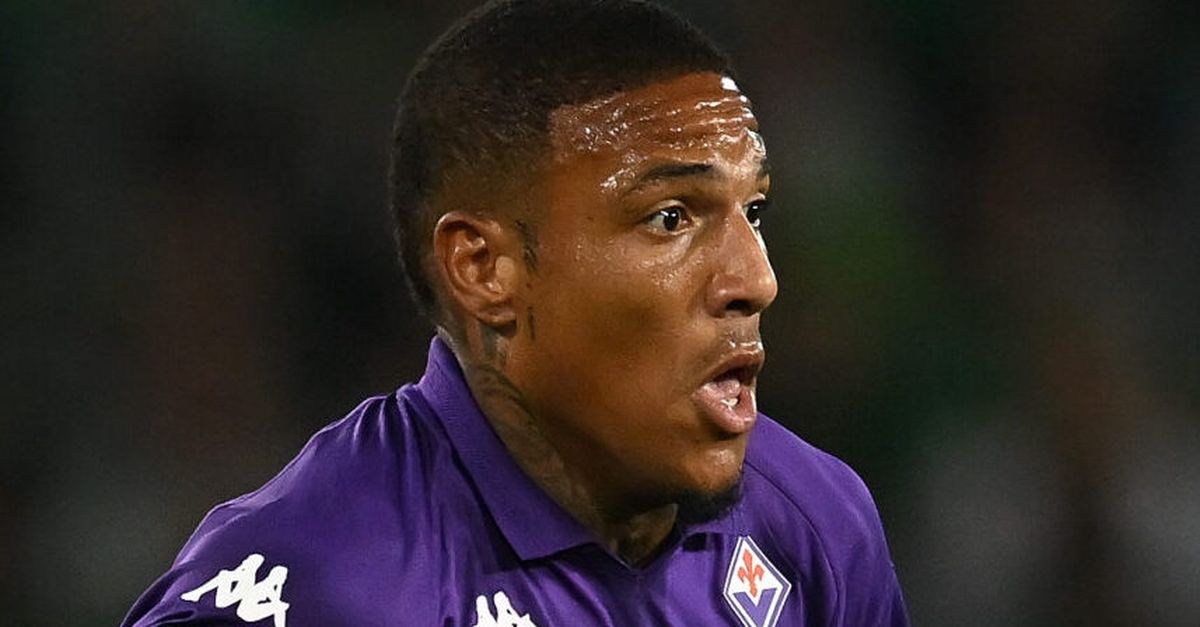
This frame is about the neck edge rather than full-body coverage. The collar creates a hard boundary that makes the ink above it legible, and the turned head shows how the pattern wraps toward the side. It would be excessive to treat the visible area as a complete neck inventory. Its value is narrower and more dependable: the image confirms the placement in another football context and under a different angle.
It also supplies a useful comparison with Sky Sport. The two photographs do not show the same pose or the same clothing, so they should not be merged into one reconstructed image. They do, however, expose the neck from different directions. When two independent frames agree on a placement, confidence in that placement rises even if the exact design remains undescribed.
How the photographs complement one another
Across the five tattoo-bearing originals, the strongest repeated feature is distribution. The chest appears as a dense central field in the shirtless Euro frame. The neck remains visible in portraits and match photography. The arms and forearms carry more continuous dark coverage, while the Sky Sport close-up confirms that the ink reaches the hand. These observations create a body map without pretending that the camera has documented every inch.
Coverage is easier to understand when each photograph keeps its own limits. A wide image establishes relationship between zones. A close portrait clarifies the hand, neck or forearm. An action shot shows how the work follows a moving limb. The sources are complementary, but they are not interchangeable. Their different crops, dates, lighting and clothing conditions are part of the evidence.
The collection also shows why a single portrait would be inadequate. A jersey hides the chest, a folded arm overlaps the wrist, a raised hand blocks the face, and a match pose can turn the body away from the camera. Rather than filling those gaps with guesses, the article records the area each original can actually support. This is a more useful approach for readers who want to understand placement, density and scale.
What the photographs can and cannot establish about meaning
Football coverage often encourages dramatic interpretations of a player’s image. Folorunsho’s tattoos are visually prominent, especially in shirtless or short-sleeved frames, but prominence is not evidence of personal meaning. The available sources establish the player identity, sporting context and visible body-art placements. They do not provide a verified statement explaining every shape, date or inspiration.
That distinction matters for the chest and arms. The MGR image shows floral-looking and geometric-looking passages, but visual resemblance is not a documented subject. The GQ portrait shows strong dark areas on the forearms, but it does not reveal whether those areas were made in one session or over time. The neck appears in several contexts, but the photographs do not create a chronology.
A grounded reading therefore stays descriptive. Folorunsho is repeatedly photographed with substantial neck and arm coverage, a visible hand tattoo and a broader chest field that appears clearly when the shirt is absent. Those are durable observations across the source set. Claims about symbolism, family, faith or personal milestones should be reserved for a direct interview or first-person statement.
What the source pictures can and cannot establish
For design research, the most transferable lesson is spatial rather than literal. The photographs show how a dense chest can act as a centre, how neck ink can connect the face to the torso, and how arm coverage can maintain visual weight even when a football shirt covers the body. They also show the importance of pose. A raised hand produces a close graphic crop, while an open training stance reveals how tattoos travel down both limbs.
Study the relationships, not the celebrity’s exact marks. A reference board can note broad placement, contrast, negative space and how clothing interrupts the view. It should not copy a recognisable design or imply that a guessed meaning belongs to the wearer. The same principle protects the distinction between documentation and invention: the photograph is a source for visual observation, not a licence to complete an unseen tattoo.
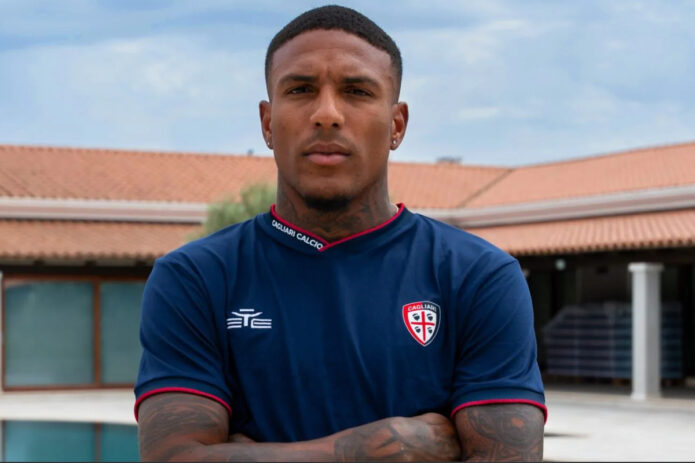
The separate featured portrait is kept outside the five-image evidence sequence. It gives readers a clean, face-visible identity anchor from a Cagliari source and shows the neck and arms in a different setting, but it is not used to inflate the tattoo-photo count. The five inline originals remain the foundation because each was selected for a distinct tattoo-bearing view.
The clearest conclusion from Michael Folorunsho tattoos
Michael Folorunsho tattoos are best documented through overlapping photographs rather than one dramatic claim. The Euro 2024 frame establishes the chest and arms. Sky Sport brings the tattooed hand and forearm close to the camera. GQ Italia balances both forearms and the neck in a controlled portrait. The Napoli training frame shows the arms in motion, while the Fiorentina match image confirms the neck from a separate angle.
Five distinct originals create better coverage because every image contributes new evidence. None is treated as a substitute for the others, and none is described beyond what the source and pixels support. That preserves the difference between a visible placement and a personal story. It also gives readers a practical visual archive of density, direction, scale and clothing interaction.
The record can grow as new interviews, club portraits or match photographs become available. Any future addition should be checked for subject identity, original source, visual quality and whether it duplicates an existing frame. For this set, the evidence is strong enough to describe a tattooed chest, extensive arm and forearm coverage, a visible hand tattoo and a neck design that remains legible across several football settings.