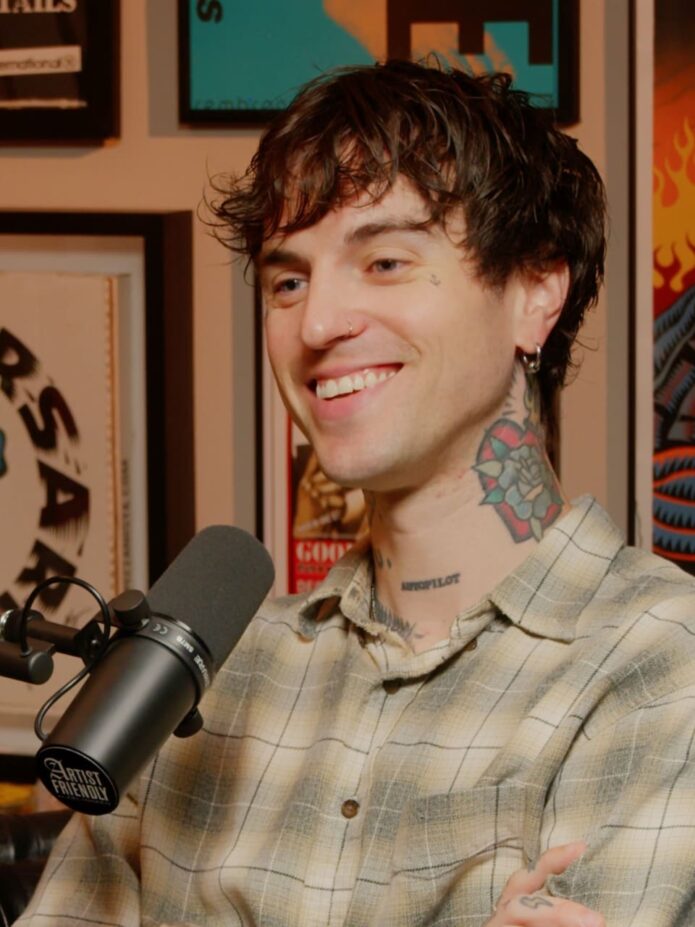
Jutes has built a tattooed visual identity from small private jokes, family memories, invented mottos and deliberately rough marks. The Canadian musician, born Jared Gutstadt, has described his tattoos in unusually direct terms, naming the pieces that matter most and the simple stick-and-pokes he made during quarantine. His images show the result: script across the chest and neck, dense sleeves, hand tattoos, a cheek mark and a patchwork of symbols that feel closer to a scrapbook than a single planned theme.
The most useful way to understand Jutes’ tattoos is to follow the stories attached to them. His first tattoo is a sentence he created as a teenager. His favorite designs connect him to his grandfather and his Toronto years. His self-made pieces preserve the boredom, humor and restless energy of quarantine. Recent portraits add another layer, showing how those individual marks sit together across his face, neck, chest, arms and hands.
Jutes’ first forearm quote tattoo
Jutes told Inked that his first tattoo arrived when he was 17 or 18. It is a quote on his forearm: “Even when there’s nothing to do, there’s no time to waste.” He said he made up the line in the shower and that it became a motto among his friends. The sentence came from a very specific setting, a small town where the group felt that there was little to do but still managed to find constant trouble, humor and activity.
That origin gives the forearm lettering a different tone from a conventional inspirational quotation. Jutes did not describe it as a borrowed lyric or a famous maxim. It was his own phrase, created for a particular group of friends and then carried into his adult life. The long line also suits the way his later tattoos developed. His body art keeps collecting fragments of language, figures and symbols instead of following one uniform visual system.
The forearm placement makes the sentence part of his everyday image. In tattooed portraits, the arms read as a continuous field of small designs, so the first quotation is not isolated from the later work. It sits among stars, faces, lettering and hand marks that turn the original private motto into one layer of a much larger personal history.
The bear on Jutes’ shoulder
Jutes names the bear on his shoulder as one of his favorite tattoos. Toronto artist Mike Storey made the piece, and Jutes connects it to his grandfather, who loves bears and asks about the tattoo whenever they see each other. The meaning is therefore carried through a recurring family exchange rather than a complicated explanation. “Do you still have the bear?” is the question that keeps the image active in his story.
The bear is important because it shows how Jutes separates tattoos that are visually striking from tattoos that remain emotionally useful. The shoulder design may sit within a busy field of black ink, but its role is unusually clear. It is a family marker, tied to a person who recognizes it and remembers it. That connection gives the tattoo a quieter weight than some of the more playful symbols scattered over his arms and torso.
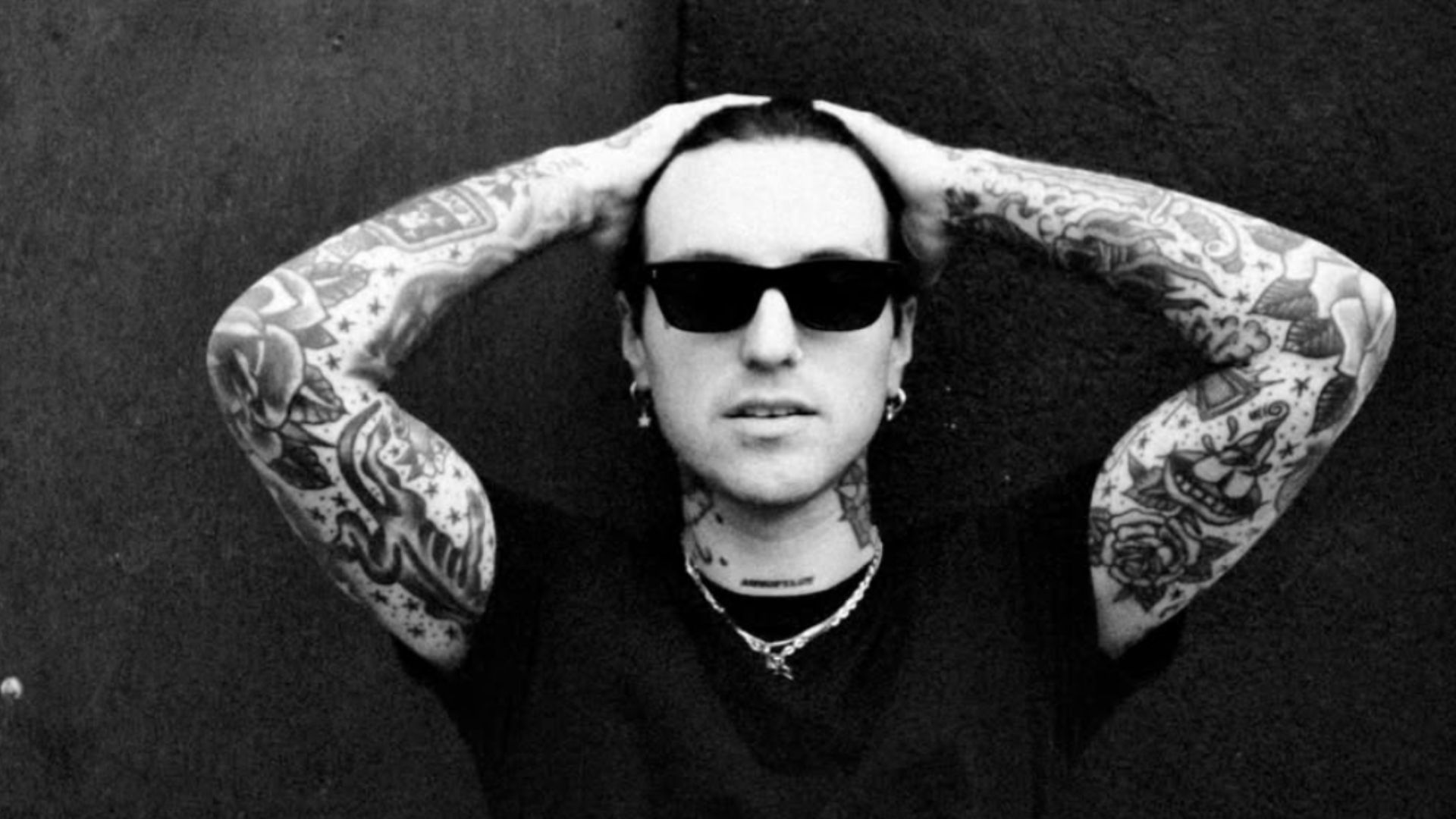
In the editorial photographs, the shoulder is surrounded by dense linework and small contrasting motifs. The bear belongs to that crowded landscape without disappearing into it. Jutes’ collection is not arranged as a clean gallery of single pieces. It is layered, with larger figures, script and tiny marks sharing the same visual space. The shoulder tattoo helps explain why the overall effect feels intimate even when the coverage is extensive.
The suicide king on Jutes’ hand
Jutes also singles out the suicide king on his hand, a design made by Toronto tattooer Matt Vanasse. The reference is a recognizable playing-card figure, but Jutes’ explanation places it within the same Toronto-centered history as the bear. He does not present it as a random flash image. It is one of the pieces he remembers when asked to identify the tattoos that mean the most to him.
Hand placement changes the way that design appears in photographs. The tattoo is visible when Jutes holds a microphone, touches his face or rests his fingers near his chest. His hands carry additional small marks, rings and lettering, so the suicide king becomes part of the expressive movement of his performances and portraits. It is a compact symbol with a strong outline, readable even when the surrounding sleeve work becomes dense.
Recent images also show how the hand tattoo sits beside the neck and forearm coverage. The transitions are not presented as a single sleeve with a fixed boundary. Instead, the designs overlap in scale and mood. A card figure, a short phrase, stars and small self-made symbols can occupy the same frame, making the hand an important anchor for the collection’s playful, slightly chaotic character.

Jutes’ self-done stick-and-poke tattoos
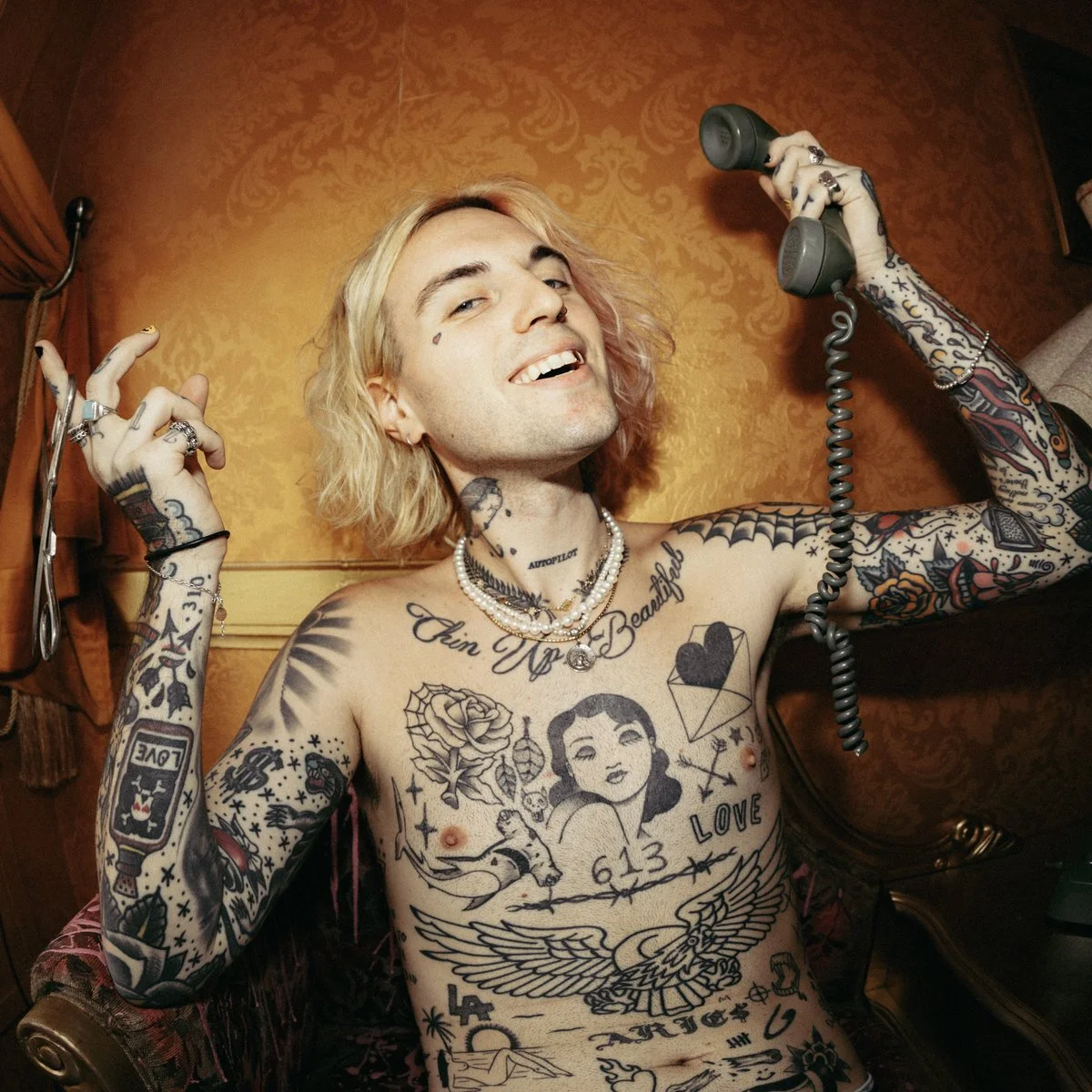
During quarantine, Jutes began making additional tattoos himself after a friend from Toronto visited Los Angeles and left him needles and ink. He told Inked that he had made more than 10 stick-and-pokes. The designs were intentionally simple and random: a heart, crosshairs, the number 613, dice, stars, a large LA, a skull and leaves are among the examples he listed.
The number 613 refers to the Ottawa area code, so even the smallest marks can carry a location. The large LA records the city where he was living and working. The heart, dice, skull and leaves are less heavily explained, and Jutes described them as fun rather than deeply symbolic. That distinction matters. His account does not turn every mark into a solemn biography. Some pieces preserve a mood, a joke or an afternoon of experimentation.
These self-made tattoos also changed the texture of the collection. The hand-poked symbols sit beside professional work by Storey and Vanasse, creating visible differences in scale, line weight and finish. Jutes has never described that contrast as a problem. The uneven mixture is part of the visual record. His arms and torso show decisions made at different times, by different people, under different circumstances.
Portraits from Nuance, The Hype Magazine and other music outlets make that mixture especially clear. Tiny stars and letters sit beside larger faces, flowers and bold script. The result is not a polished catalogue of matching designs. It is a body covered with reminders of friends, places, music, boredom, family and the impulse to add one more small idea.

Neck, chest and sleeve tattoos in editorial portraits
Jutes’ most recognizable visual feature is the way the tattoos connect across his upper body. The chest carries large script reading Chin Up Beautiful, along with the word LOVE and illustrated figures. The neck includes the word AUTOPILOT and additional linework. His arms are filled with traditional and illustrative motifs, while the hands and fingers add smaller symbols that become visible in close portraits.
The photographs do not show a blank center surrounded by isolated sleeves. They show a continuous arrangement that moves from the collar and throat down to the chest, shoulders and forearms. The large script creates a horizontal visual break across the chest. Below it, figures, wings, flowers, stars and small objects form a dense field. The lettering remains legible because it is larger and more open than many of the surrounding marks.
His face also participates in that arrangement. A small mark beside the eye is visible in several portraits, while the neck tattoos frame the jaw and collar. A Veeps interview portrait shows the neck color and lettering clearly, and Revolver’s red-background portrait brings the hand and neck into the same tight composition. The imagery makes the collection feel animated rather than static because the pieces move with his expressions, gestures and clothing.

A playful visual language built from small stories
Jutes’ tattoos share a visual language of contrast. Large script sits beside tiny stars. Traditional-looking figures appear next to crude stick-and-pokes. A bear connected to his grandfather is followed in the same conversation by a playing-card king and a list of quarantine experiments. That range gives the collection its personality. The tattoos do not all pretend to belong to one era or one artistic plan.
His explanations are equally varied. The forearm sentence has a clear origin and exact wording. The bear has a family association. The suicide king is a favorite made by a named Toronto artist. The 613, LA, dice, leaves and stars are described more casually. Together, the pieces show how meaning can be precise in one part of a collection and deliberately light in another.
That balance is visible in the photographs. A shirtless Nuance portrait exposes the density of the chest and sleeves, while a black-and-white Blunt image reduces the same body art to shapes, shadows and repeated patterns. The difference between the images does not change the documented tattoos. It reveals how much the collection depends on movement, lighting and the way Jutes presents himself.
What remains visible in the images
Across the available interviews and portraits, the consistent detail is not one signature motif. It is the relationship between placement and memory. The forearm quote preserves a teenage phrase. The bear keeps a family question alive. The suicide king marks a favorite piece from Toronto. The self-done symbols preserve Ottawa, Los Angeles and the strange free time of quarantine. The chest lettering and sleeve work carry those smaller stories into the public image of a working musician.
Jutes’ tattoo history therefore reads as an accumulation of ordinary details that became permanent. The collection includes professional work, friend-made pieces and tattoos he created himself. It includes script that can be read from across a room and tiny symbols that only appear when a hand or arm moves into view. The result is personal without needing a single master theme.
The strongest images show that the tattoos are not separate from Jutes’ identity as a performer. They shape the silhouettes of his arms, frame his face and neck, and turn gestures into visual punctuation. His documented ink is a changing scrapbook of Toronto, Ottawa, Los Angeles, family, friendship, music and private humor, preserved across skin in a style that is unmistakably his.
Jutes also appears in the tattoo-centered interview tradition through his music and visual work. The video Jutes – Bad Dream (Visualizer) belongs to the same period in which he was describing his first tattoo, his favorite pieces and his quarantine stick-and-pokes. Viewed alongside the interviews and portraits, it reinforces the central point of his collection: every design belongs to a moment, even when the finished image looks like one continuous sleeve.