
Cande Tinelli’s tattoos show up differently in each photograph. A rear studio view reveals extensive blackwork across her back and sleeves; portraits focus on the neck, chest and shoulder; a close-up records the word “Angel” beside her face. Taken together, the images give a clear view of the placement and style of her ink. They don’t explain the meaning of every line or shape, so those details are best left open unless Tinelli has spoken about them.
Tinelli is an Argentine singer, media figure and designer. She has discussed self-expression and the public reaction to her appearance. ElDoce, A24, eltrece and TN have covered different parts of her tattoo history, while an iNKPPL portfolio includes a separate side portrait. Each source captures a different angle or moment, from large areas of blackwork to smaller details around the face and hand.
Cande Tinelli’s full-back blackwork and sleeves
An ElDoce photograph shows Tinelli from behind, facing away with her arms crossed behind her. The pose leaves the back, arms and upper legs in view, along with her hands and the lower back. Solid black areas form the strongest shapes across her back. Lighter floral and ornamental lines break up the coverage at the shoulders and along the edges, giving the larger design a mix of dense shading and open skin.

The room has books and tattoo equipment in the background, and the clear rear view makes it easier to follow how the work covers the torso. This is the broadest look at the collection in the article. It shows that the back piece sits alongside extensive arm and leg coverage rather than on its own.
The design has a strong central area, with finer lines and ornamental borders around it. From this angle, some shapes overlap and blend into the larger black fields; the photograph doesn’t identify each motif. The visible contrast between dark coverage and uninked skin says more than a guess about what an individual flourish might mean.
The A24 portrait shows the neck and upper chest
A24’s black-and-white portrait brings the focus to Tinelli’s face, neck and upper chest. A dark section rises beneath her jaw and meets a geometric design across the chest. Her light shirt and the pale background set off the ink, so the edges are easy to see. The crop keeps attention on the front of the body and the way the tattoo frames the collar area.

The monochrome image makes the shapes clear, though it can’t show the ink’s colour. A broad dark field sits at the neck, with angular lines and open areas below it. The front portrait and the rear studio image are useful side by side: one shows the wider coverage across her back, while the other shows how the neck and chest work meet beneath the face.
The photograph doesn’t establish when each section was done or whether it was completed in one session. It does show the layout: the neck piece comes close to the jaw, and the design continues down over the upper chest instead of stopping at the collarbone.
The iNKPPL side profile and ornamental shoulder work
The iNKPPL portrait catches Tinelli in profile against a light background. Floral and geometric shapes spread over the shoulder and rise toward the neck. Bold lines cross the chest, with open skin between them. The angle also reveals a small line behind her ear that’s less noticeable in the front-facing A24 portrait.
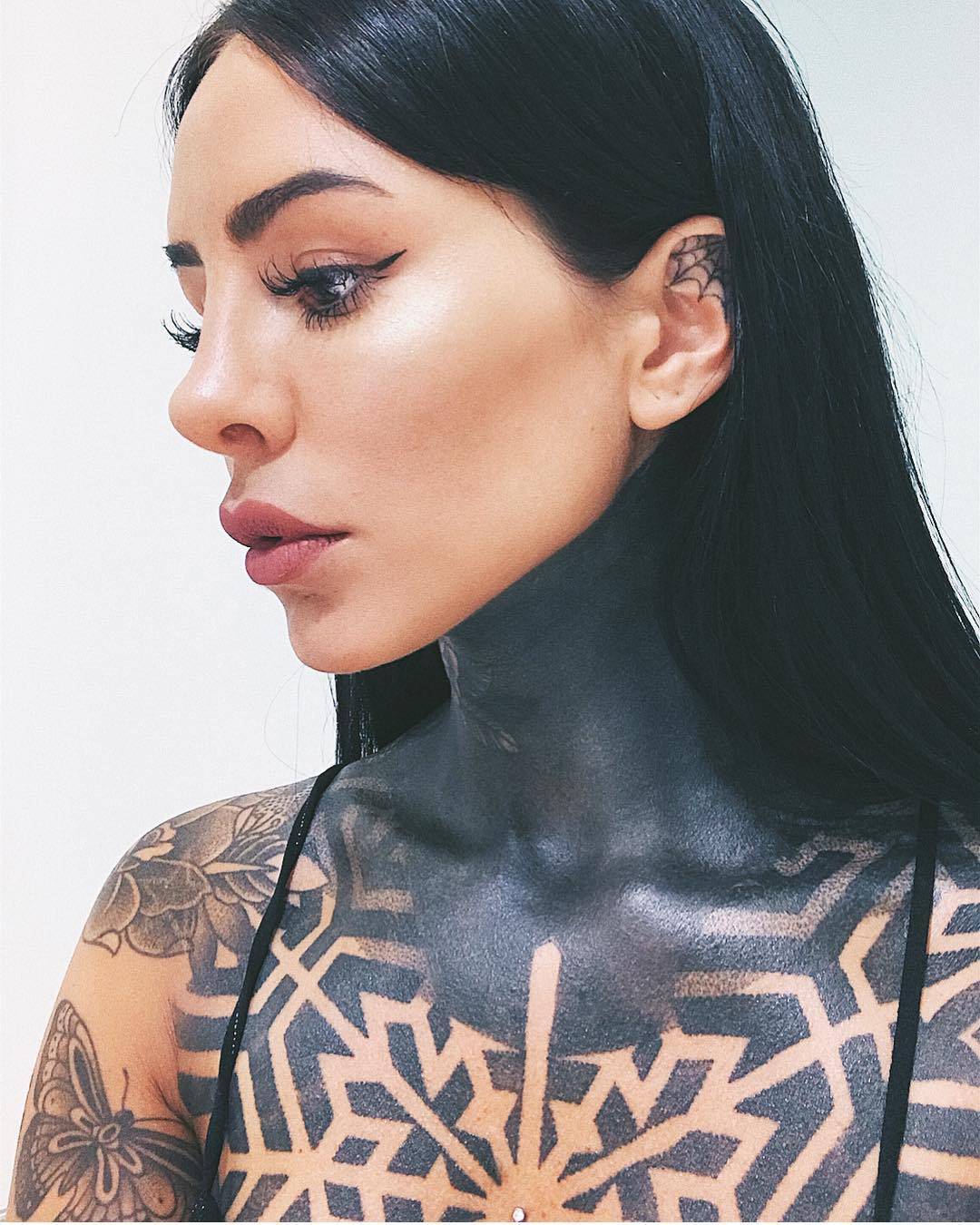
From the side, the shoulder design looks layered: some of it sits on the upper arm, and some turns toward the chest. That wrap is harder to see in a straight-on image, where the shoulder can appear flat. The portrait gives a better sense of how the blackwork follows the shape of her body.
This is a portfolio image rather than a close-up focused on one new tattoo. It helps fill in the area between the neck and the larger chest design, while the visible ear and cheek keep the portrait recognisable as Tinelli.
Hand tattoos in an orange-jacket portrait
In an eltrece photograph, Tinelli wears an orange jacket that has slipped off her shoulders and raises one hand in a peace sign. The pose makes the fingers and back of the hand easy to see. Parts of the neck, chest and upper-arm tattoos remain visible, while the jacket covers other sections. Hoop earrings and the darker interior give the picture a fashion-editorial feel.

The outfit breaks up the view of the tattoos. The chest design appears in sections, the shoulder is partly covered, and the raised hand becomes its own focal point. That makes the photograph useful for seeing how the ink looks with everyday styling, even though it doesn’t show the full extent of the collection.
The hand tattoos are small compared with the back and chest work, but their placement changes the feel of the portrait. A rear view makes the collection look expansive; here, the eye moves between Tinelli’s face, the lifted hand and the dark shapes at her neck. The picture records that contrast without telling us what each mark means.
The “Angel” tattoo beside her face
TN’s close-up shows the word “Angel” beside Tinelli’s face. Her hair is swept back, leaving the lettering visible near the side of her face, while the eye and cheek remain unobstructed. The neck and arm tattoos fill the area below it. Unlike the iNKPPL side portrait, this image is cropped tightly enough to make the facial lettering the main detail.

Most of the other photographs are about area and pattern: the back’s large black fields, the chest geometry or the shoulder’s ornamental lines. “Angel” is different because it’s lettering placed close to the face, where it’s easy to notice. TN identifies the word and its placement, making this a clearer record than a distant image where the letters would be hard to read.
The close-up documents one part of a much larger collection. The back, neck, shoulder, chest and hands each look different and need their own view. The facial tattoo is memorable, but it doesn’t stand in for all the other work.
Tinelli’s public comments on tattoos
The coverage shows that Tinelli has treated tattoos as a visible part of her appearance over time. ElDoce published a broad view of her blackwork; A24 covered criticism directed at her neck design; and eltrece reported on her comments about continuing to live with a visibly tattooed body. These accounts place the ink within a wider public conversation about her appearance and self-expression.
Her comments can give context to that conversation, but they don’t explain every design. The photographs show floral shapes, geometric lines, large dark areas and lettering. Unless Tinelli has described a particular mark, its personal meaning remains hers to explain.
The pictures also come from different moments, and they don’t provide a complete timeline of every tattoo or session. A newer close-up may show one addition clearly, while an older portrait captures a different amount of coverage. It’s possible to describe what each image shows without turning the order of publication into a full tattoo timeline.
Why the tattoos look different in each photo
Pose, clothing and lighting account for much of the variation between these images. The rear view shows the central back piece but not Tinelli’s face. The A24 portrait puts the neck and chest in the frame. The iNKPPL profile reveals the shoulder’s curve, and the orange-jacket photograph leaves only parts of the chest and arm uncovered. TN’s close-up brings the facial lettering forward.
The images also handle contrast differently. A24’s monochrome treatment makes the boundaries between dark ink and pale skin stand out, while the other photographs include colour and more of the surrounding room or clothing. A patch of negative space can look like a separate light-coloured shape in a small image, even though it may simply be bare skin. The clearest descriptions stick to what remains visible at full size.
Five photos, five views
Together, the five photos cover Tinelli’s back, front neck and chest, shoulder, hand and facial lettering. Several overlap around the neck and shoulder, showing the same area from different angles rather than documenting five separate tattoos. The featured portrait is separate: it identifies Tinelli, while these five images show her ink.
Blackwork, geometry and open skin
Across the photographs, the clearest visual theme is contrast. Broad black sections sit beside open skin; fine ornamental lines border heavier coverage; geometric shapes draw the eye across the neck and chest. The shoulder view shows the design turning around the body, while the hand and facial lettering bring the scale down to smaller details.
Those are useful ways to describe the style without treating Tinelli’s tattoos as a template to copy. The photos show placement, linework and the balance between dark ink and unmarked skin. They don’t identify every artist, date or personal reason behind the designs, and the different lighting means the images can’t settle every question about colour.
What the photos show
The photos establish placement and style: blackwork across the back and sleeves, dark neck and chest designs, ornamental shoulder work, hand tattoos and the word “Angel” beside her face. They show how the designs fit together, but leave their private meanings and a complete tattoo timeline for Tinelli to explain herself.
More tattoo guides
For more tattoos from Latin American artists, see Lunay’s tattoos and Karol G’s tattoos.
This site also documents Masego Tattoos: Jazz Knuckles, Instrument Symbols and the Tricep Tattoo.
One thought on “Cande Tinelli Tattoos: Blackwork, Sleeves, Neck and Facial Ink”