codex

Eryk Anders Tattoos: Truly Blessed Script, Praying Hands and Forearm Ink

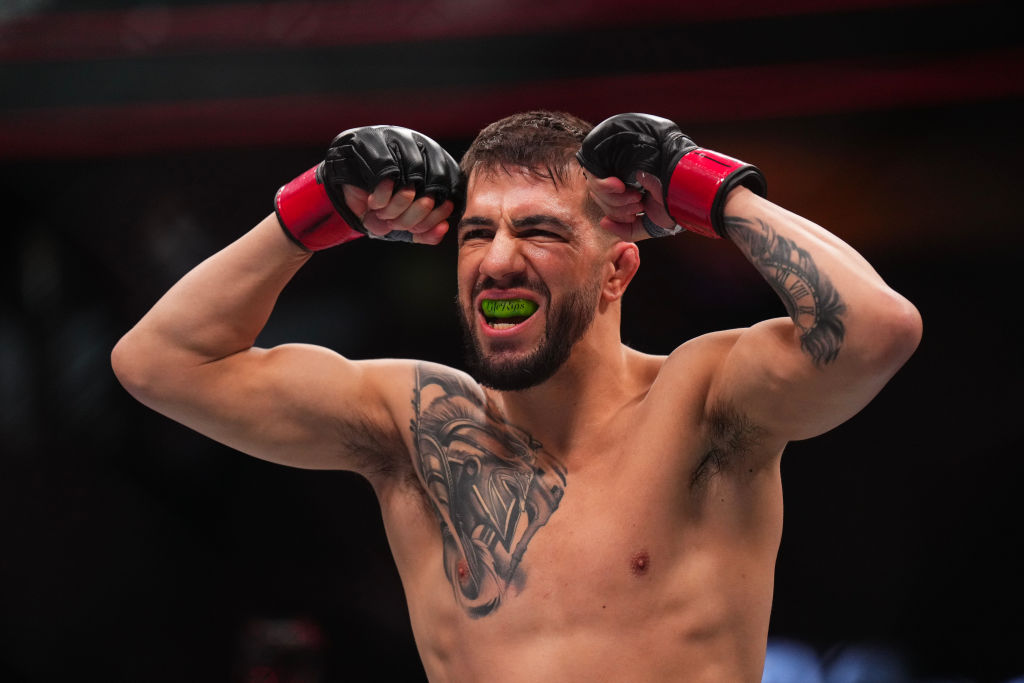
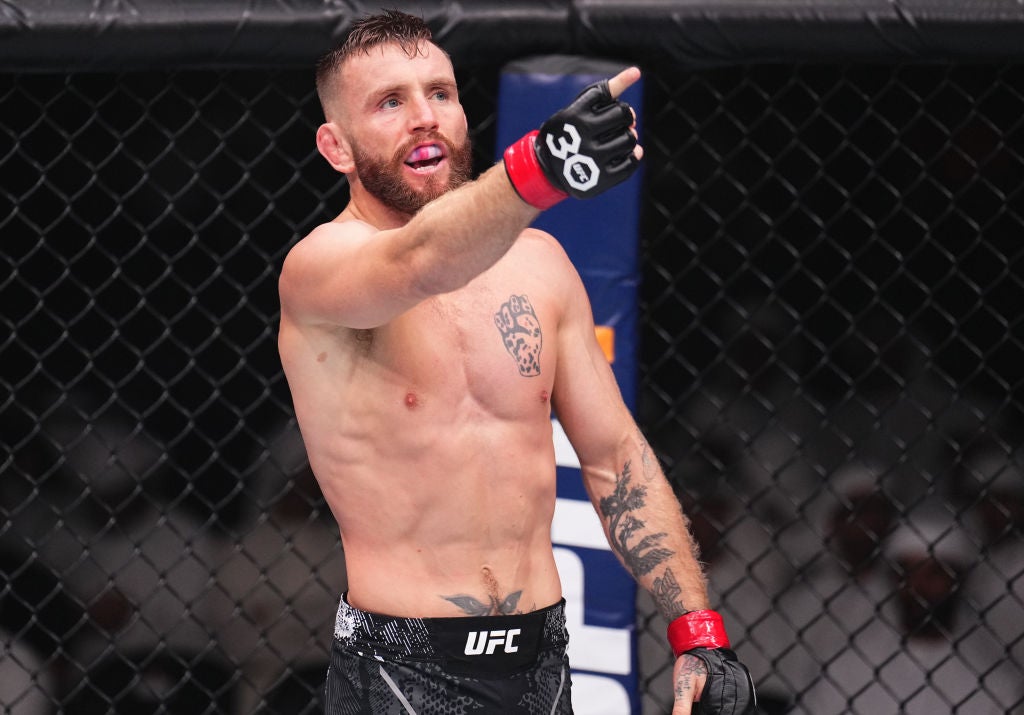
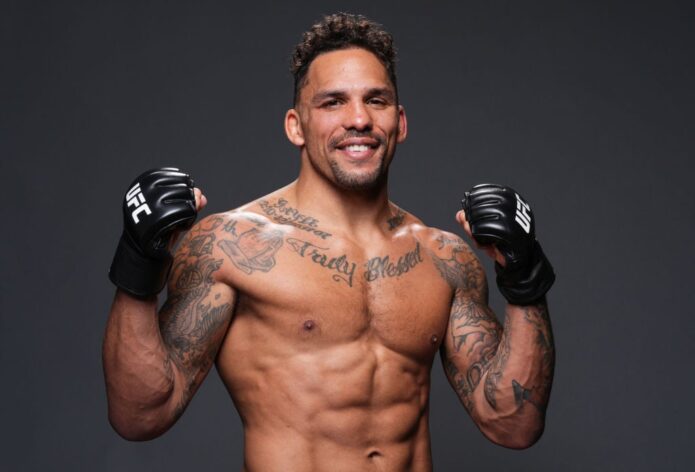
Eryk Anders’ chest reads “Truly Blessed,” with praying hands near one shoulder and smaller lettering around the collarbone. His upper arms have shaded figures and feathered forms, and a forearm carries a block of fine script. The pieces vary in size, leaving much of his lower torso open.

The Truly Blessed chest tattoo
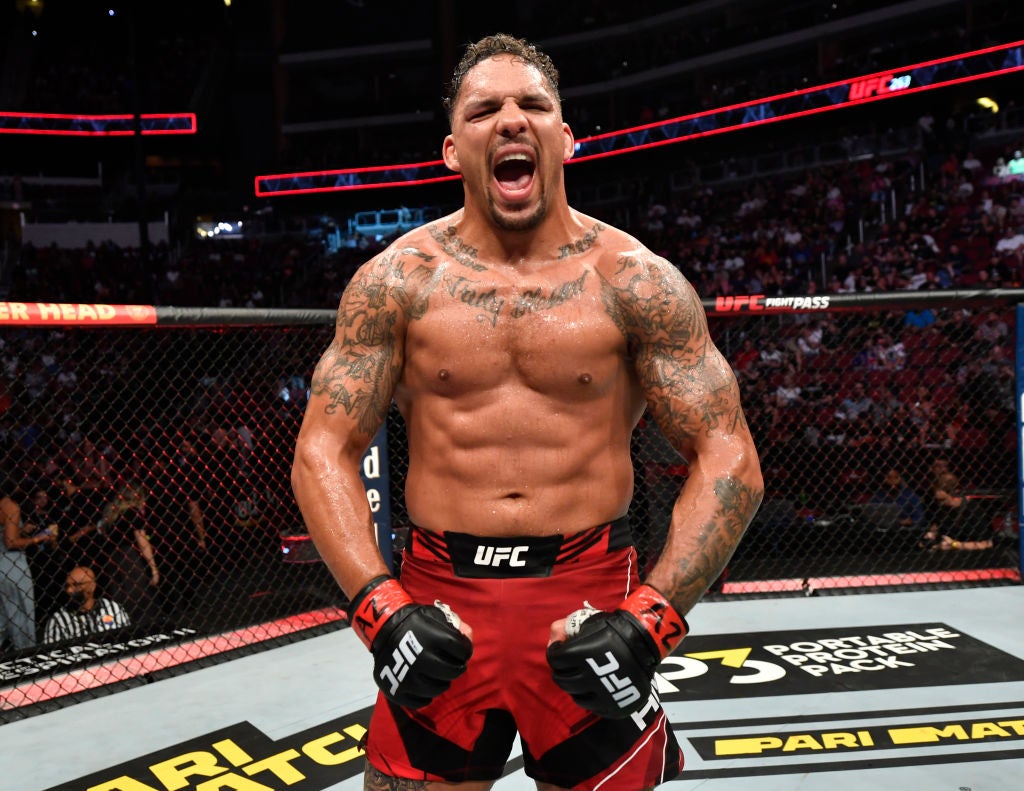
Eryk Anders tattoos: The Truly Blessed chest tattoo

In the celebration after his win over Darren Stewart, “Truly” sits across Anders’ right side and “Blessed” across his left. The decorative letters meet across the upper chest, with curls and flourishes around the main strokes. The phrase remains readable, and open skin below it keeps it separate from the heavier shoulder work.
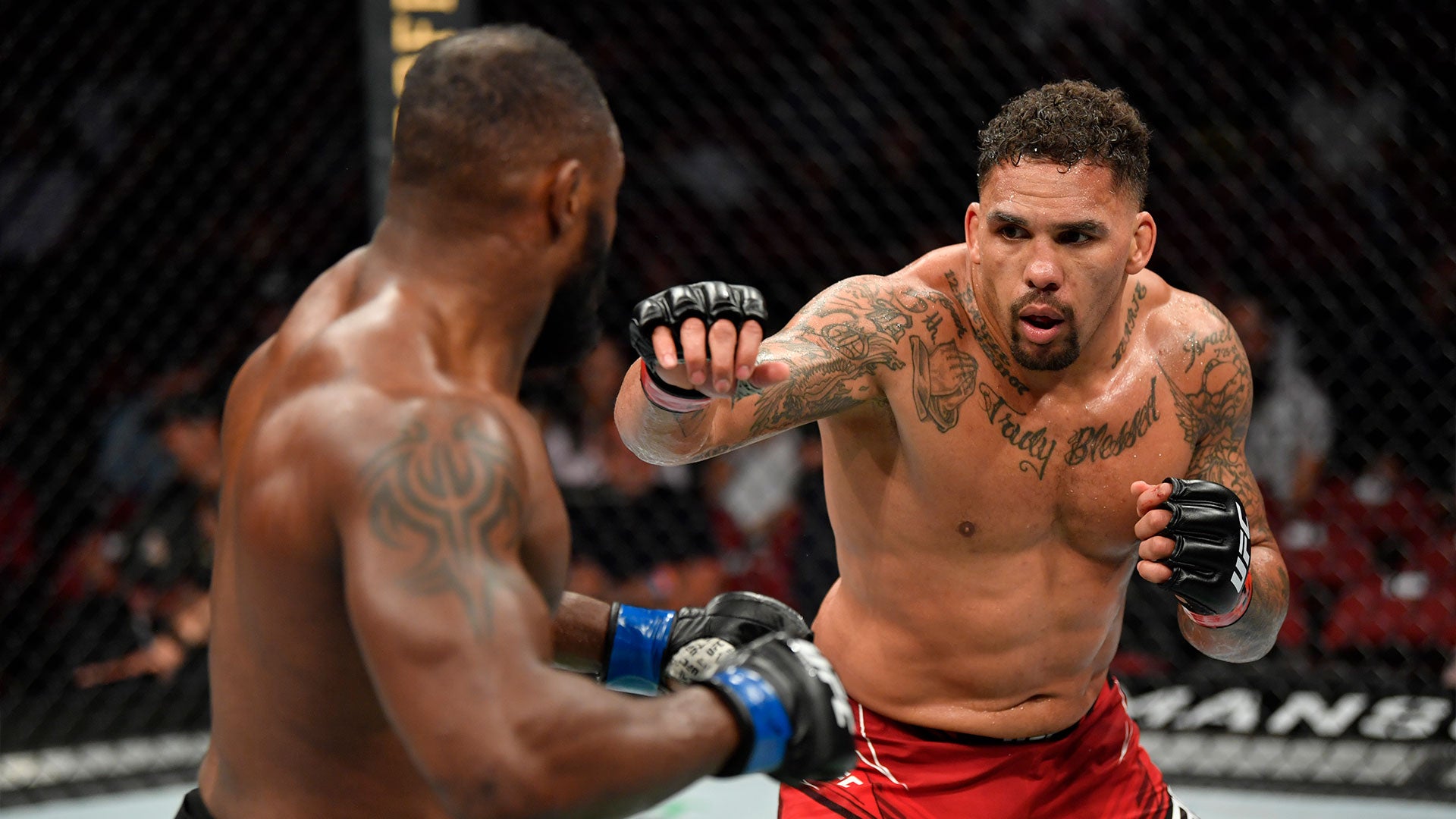
Eryk Anders tattoos: The Truly Blessed chest tattoo

A fight photo against Stewart shows the same words as Anders reaches forward. His posture bends the lettering, while praying hands and darker shoulder designs appear above it. The phrase and nearby hands can suggest a religious reading, but the photographs don’t give a personal origin story or date for either tattoo.

Praying hands and upper-arm tattoos
Eryk Anders tattoos: Praying hands and upper-arm tattoos

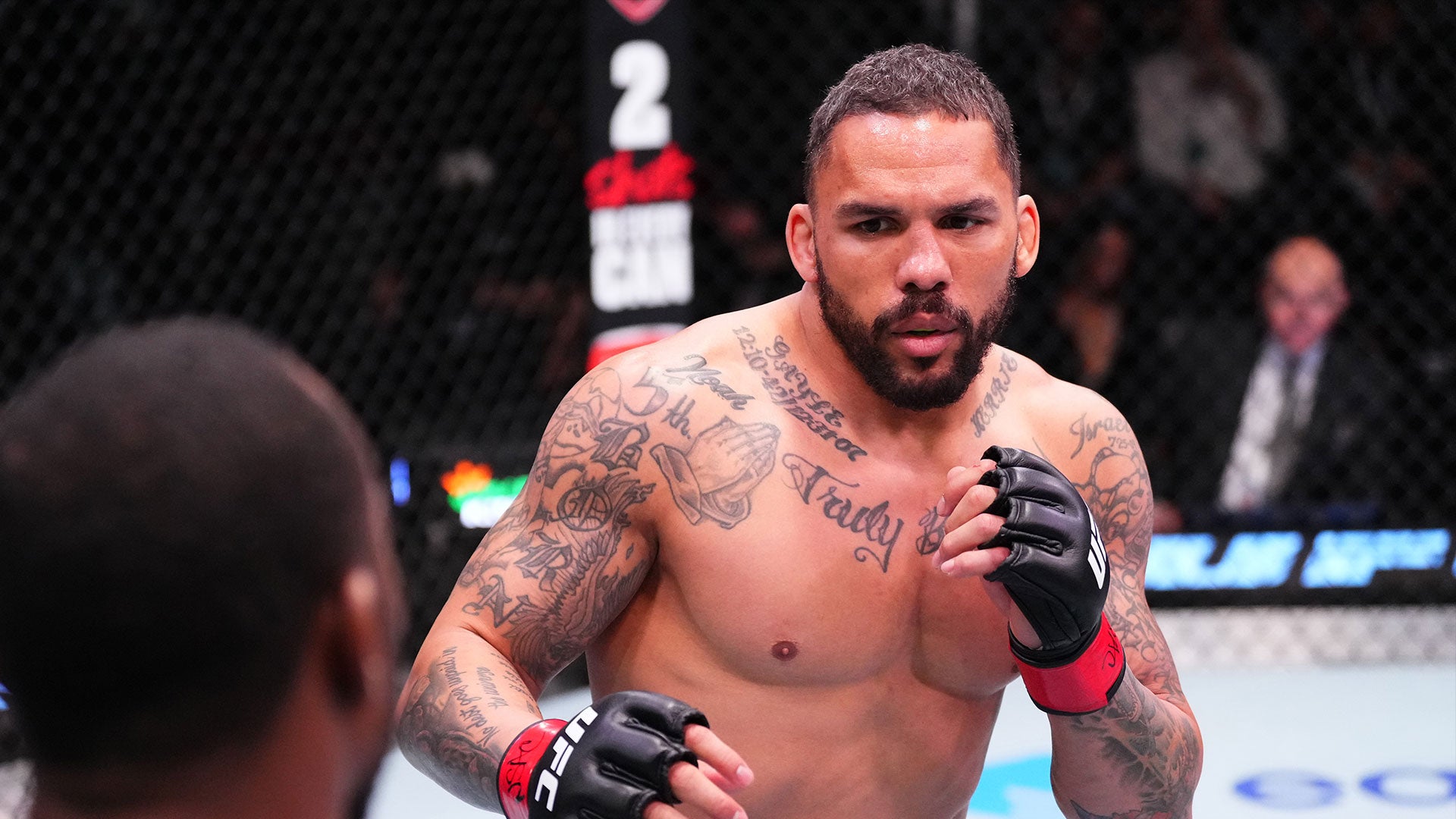
The praying hands sit on Anders’ right upper chest near the shoulder. Outlined fingers meet above cuff-like shapes, forming a compact vertical design beside the wide chest script. A photo from the Jamie Pickett fight gives the hands a clear view even though a glove blocks part of the lettering.

Anders’ upper arms carry denser work: shaded imagery and feathered forms sit among darker lettering. In an older fight photo against Rafael Natal, the left upper arm turns toward the camera, revealing a winged design. The pictures show the black-and-gray shading and placement, but don’t identify every figure or its meaning.
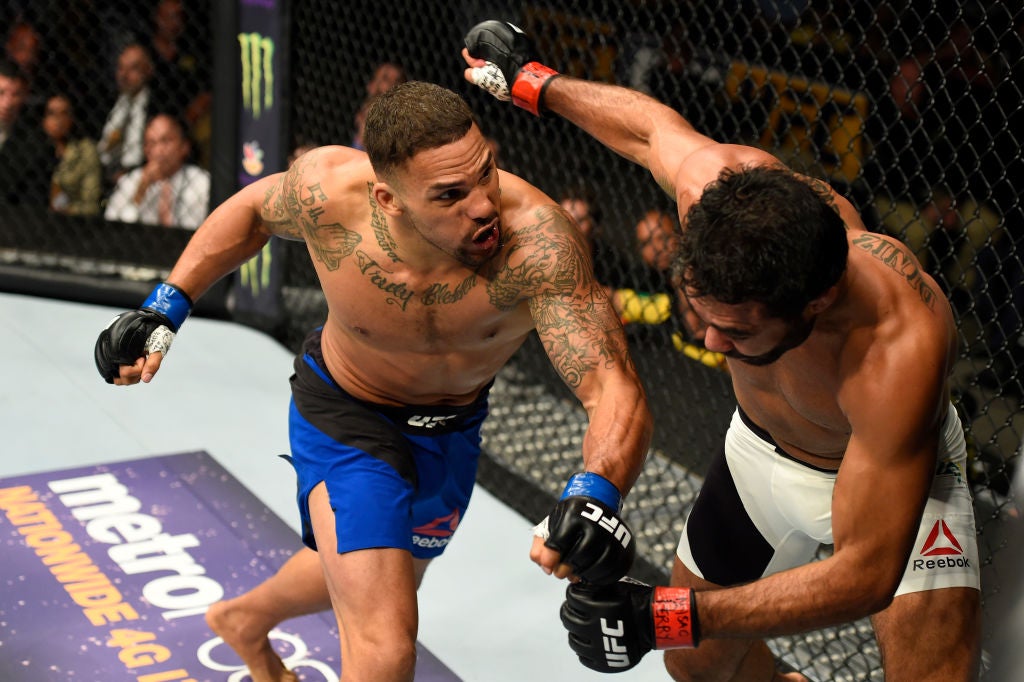
Eryk Anders tattoos: Praying hands and upper-arm tattoos

There are breaks of skin between the chest pieces, while the designs become more crowded toward the outer arms. For a more continuous approach to coverage, see Alessio Sakara’s tattoos.

The forearm quote tattoo
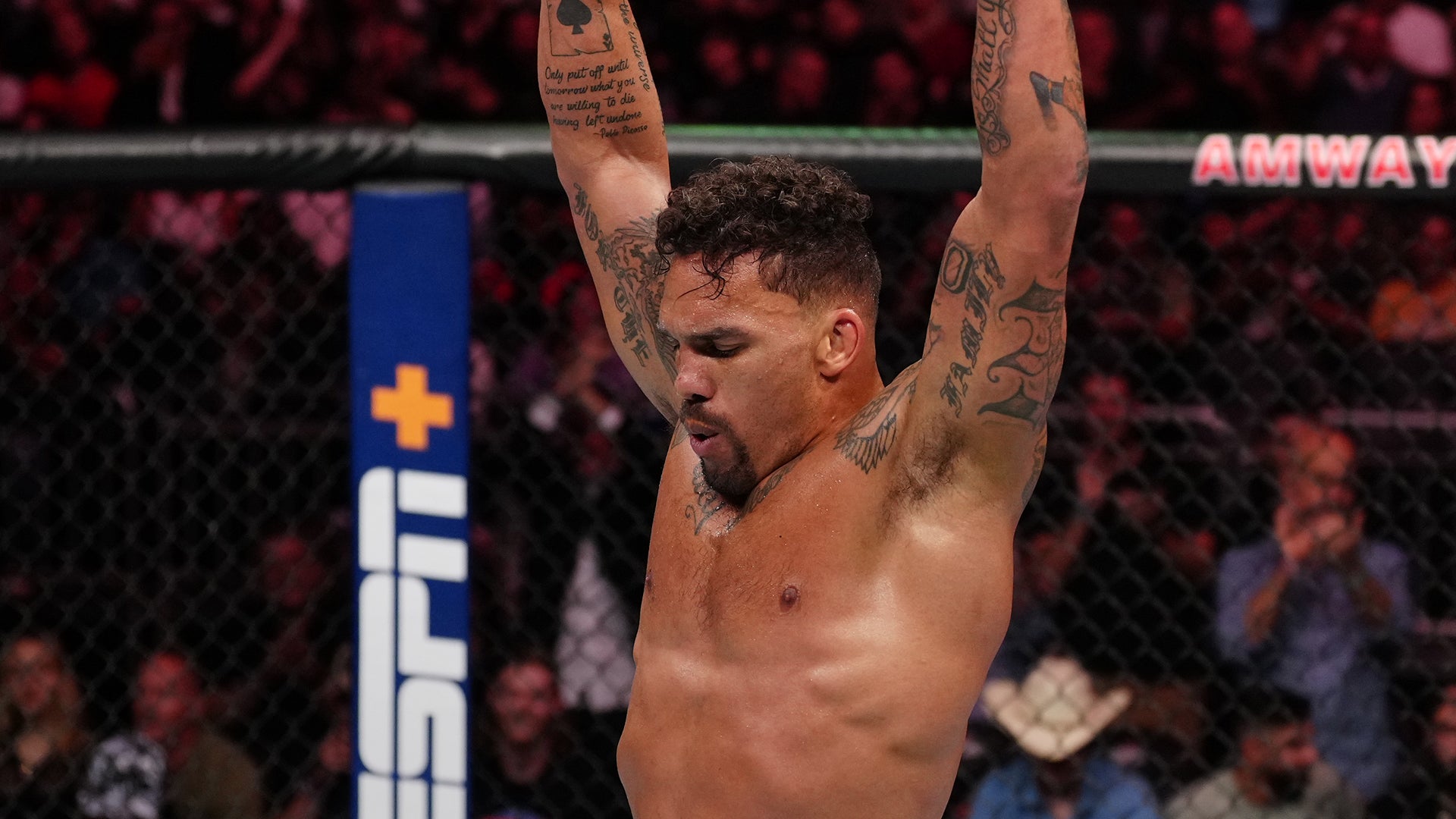
Eryk Anders tattoos: The forearm quote tattoo

After the Kyle Daukaus fight, Anders raised both arms and exposed the inner forearms. On his right side, an ace of spades sits above several short lines beginning “Only put off until tomorrow.” The words “Pablo Picasso” appear beneath the passage. The card’s dark spade is bold; the smaller script needs a closer look.

The name below the quote is part of the tattoo’s visible presentation, but it doesn’t by itself settle who first wrote the words. The opposite forearm has more lettering and small designs, partly cut off in this photo. Raised arms make those inner surfaces easier to see than a fighting stance does.

Training and the second sporting career
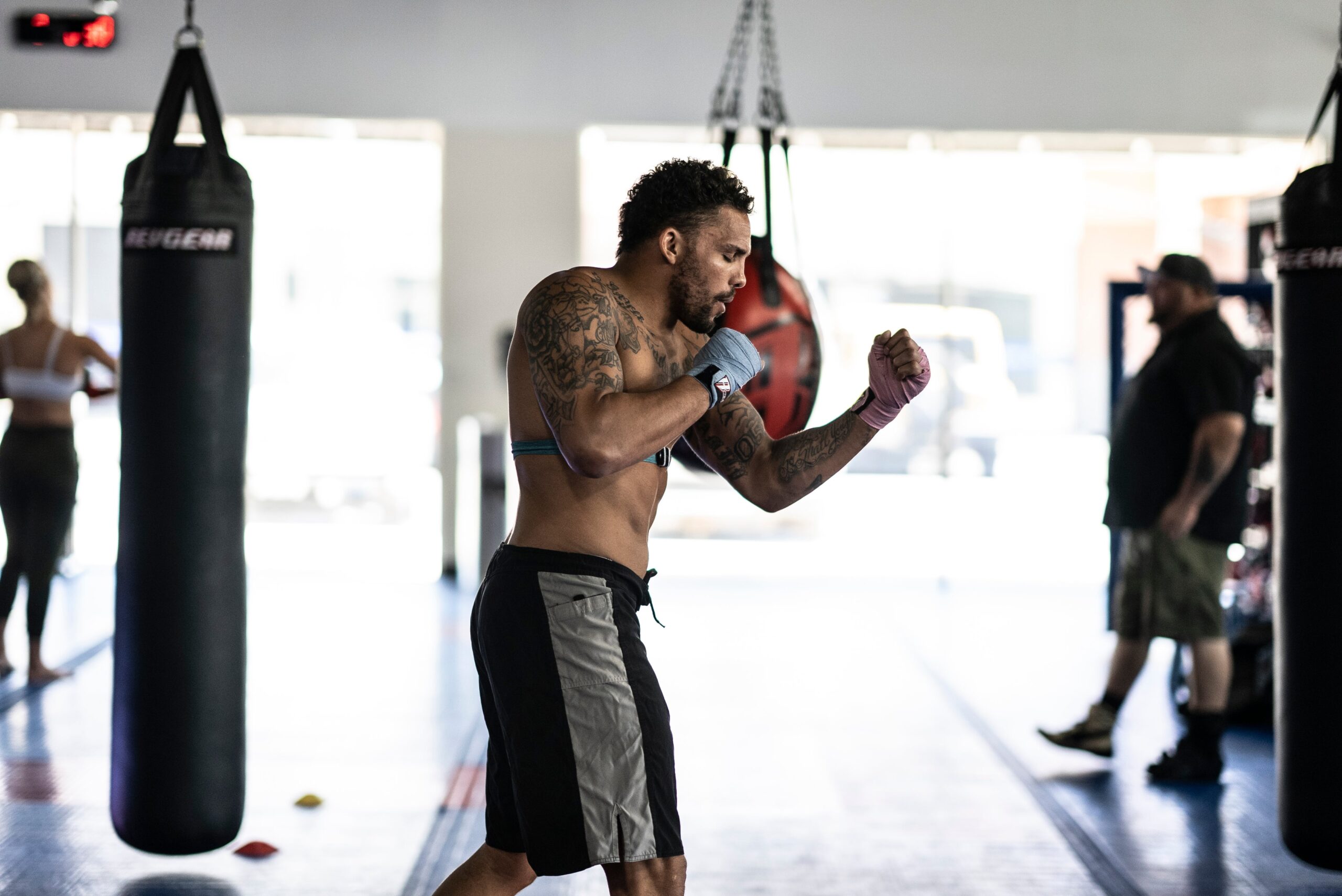
Eryk Anders in a contextual photograph: Training and the second sporting career; not tattoo evidence

A gym photo shows Anders shadowboxing in wraps and training shorts, with bags and other people behind him. Much of the tattoo work is visible, but the frame is about the session rather than a posed display.

Before his UFC career, Anders played linebacker at the University of Alabama and was part of the team that beat Texas in the 2010 national championship game. Ahead of his 2017 UFC debut, a UFC profile discussed how football had prepared him for media and large crowds. In a December 2021 feature, Anders also talked about continuing to learn from coaches and training partners. That background fills in his second sporting career without turning his tattoos into Alabama tributes.

Competition context
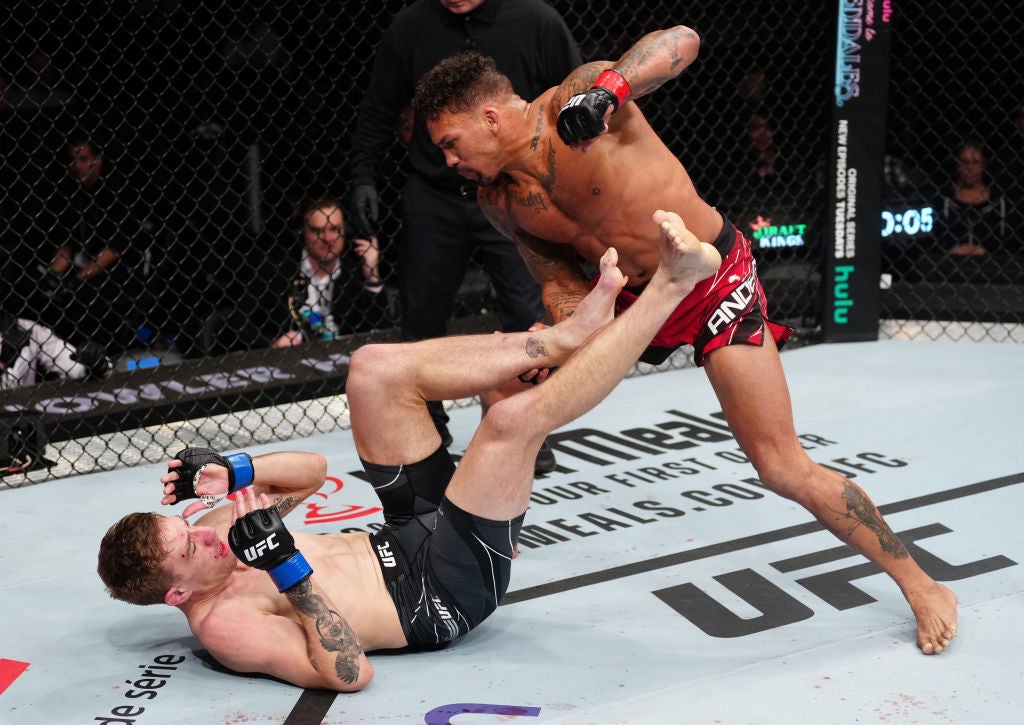
Eryk Anders in a contextual photograph: Competition context; not tattoo evidence

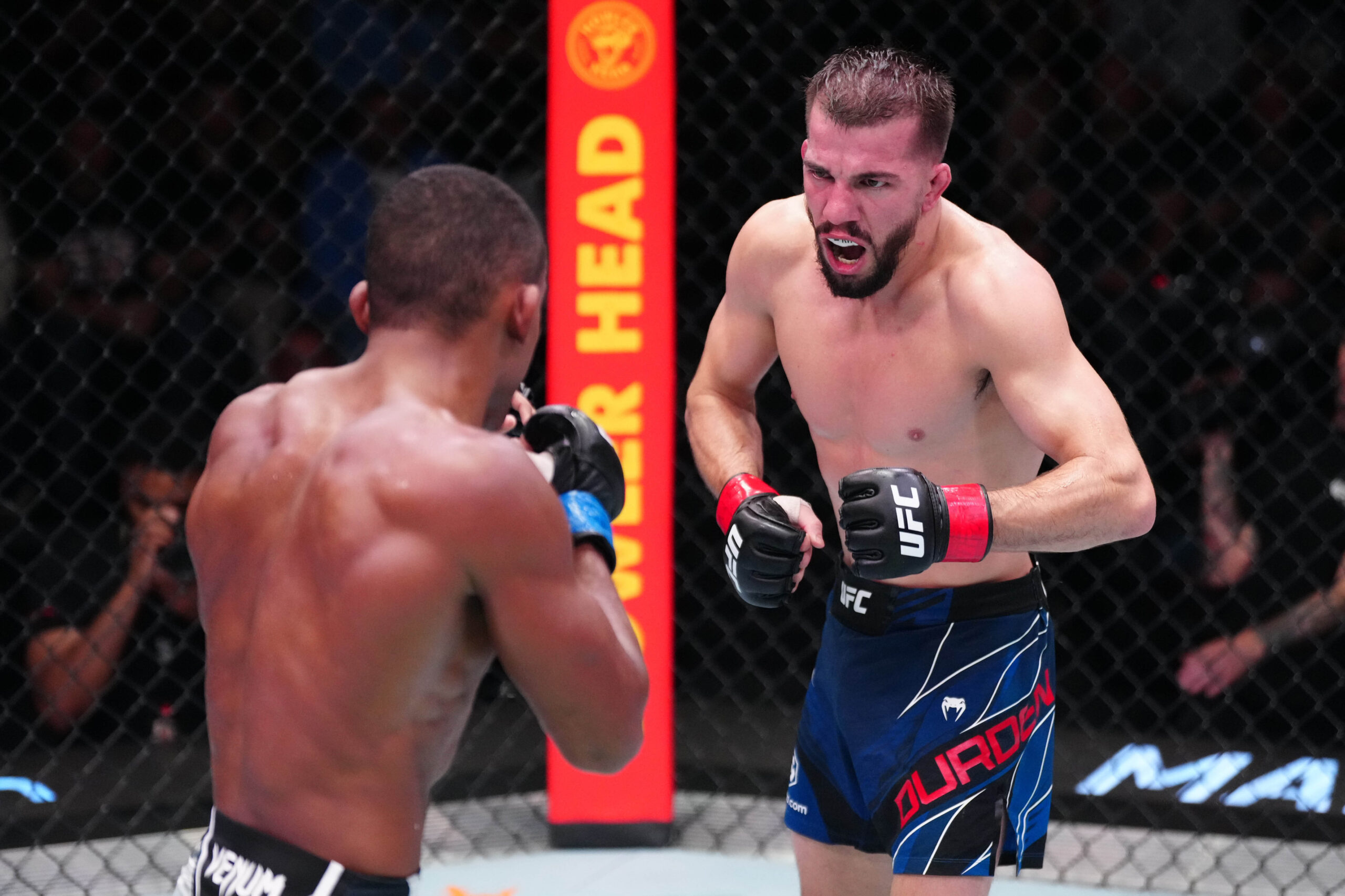
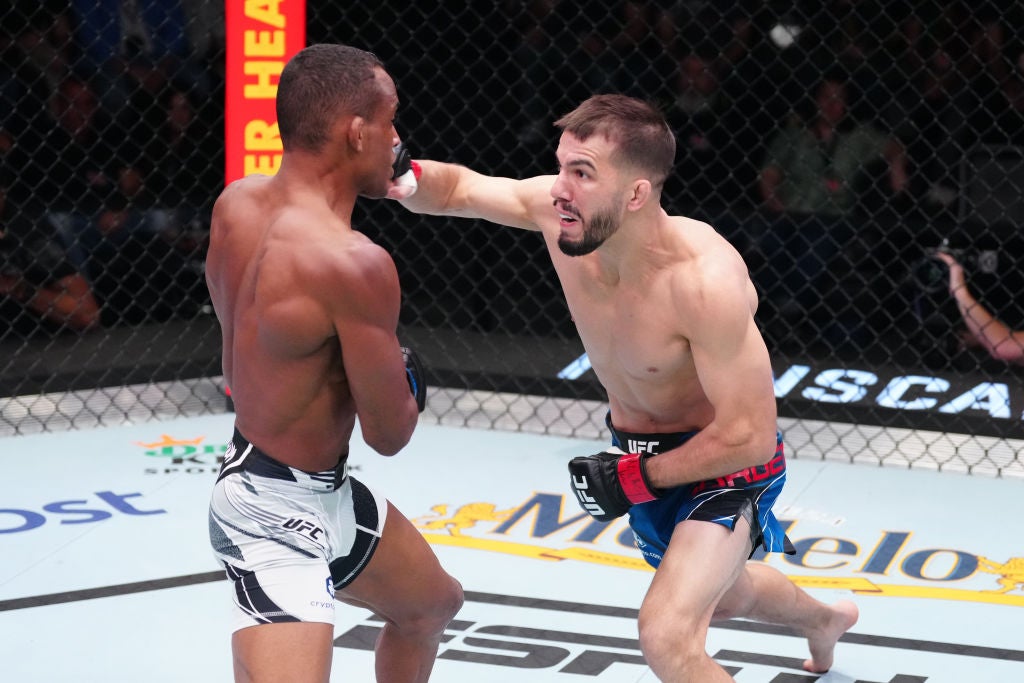
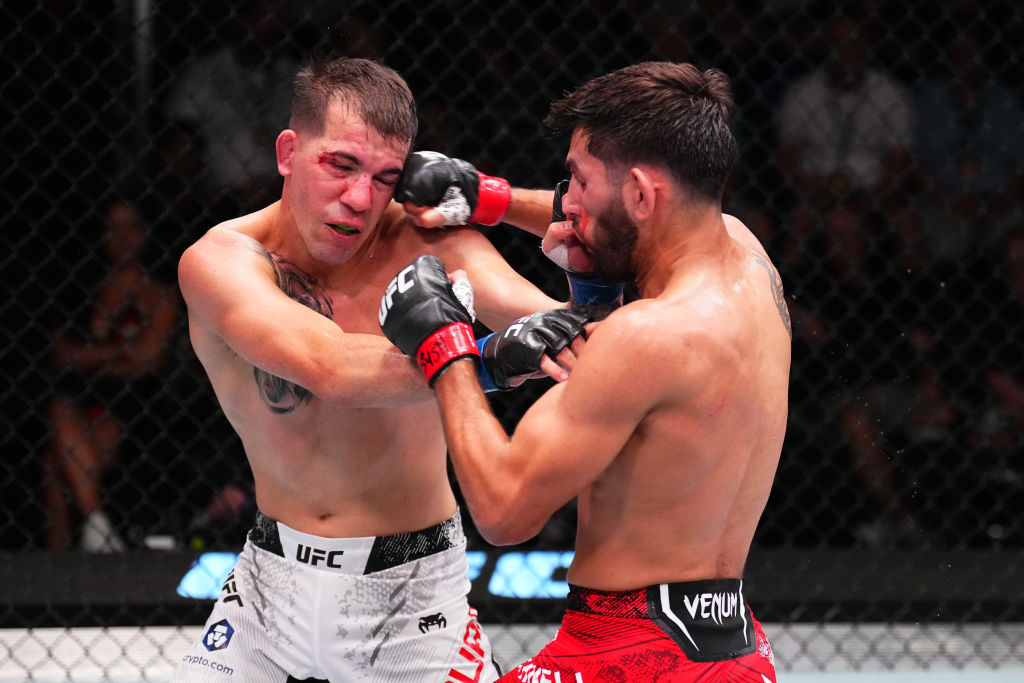
The wide photo from Anders’ December 2022 fight with Daukaus shows him in red shorts standing over his opponent and throwing a punch. Anders won in Orlando. At this distance the chest phrase and arm work remain visible, but the photo is better for the competition setting than for reading small script.

The other images from the event show the raised-arm celebration and a separate smiling portrait after the result. The official UFC interview below follows Anders’ win over Daukaus and brings the focus back to him speaking after the fight.
Cody Durden Tattoos: The Spartan Helmet and the 10:35 Clock

Cody Durden’s left forearm carries a lion and a clock set to 10:35—the time he got the call that brought him into the UFC. A Spartan helmet fills much of his right chest. The images are very different in scale, but both are tied to his life as a fighter: the clock marks a career milestone, while Durden has described the helmet through his idea of being a modern-day gladiator.

The Spartan helmet on his chest

Cody Durden tattoos: The Spartan helmet on his chest

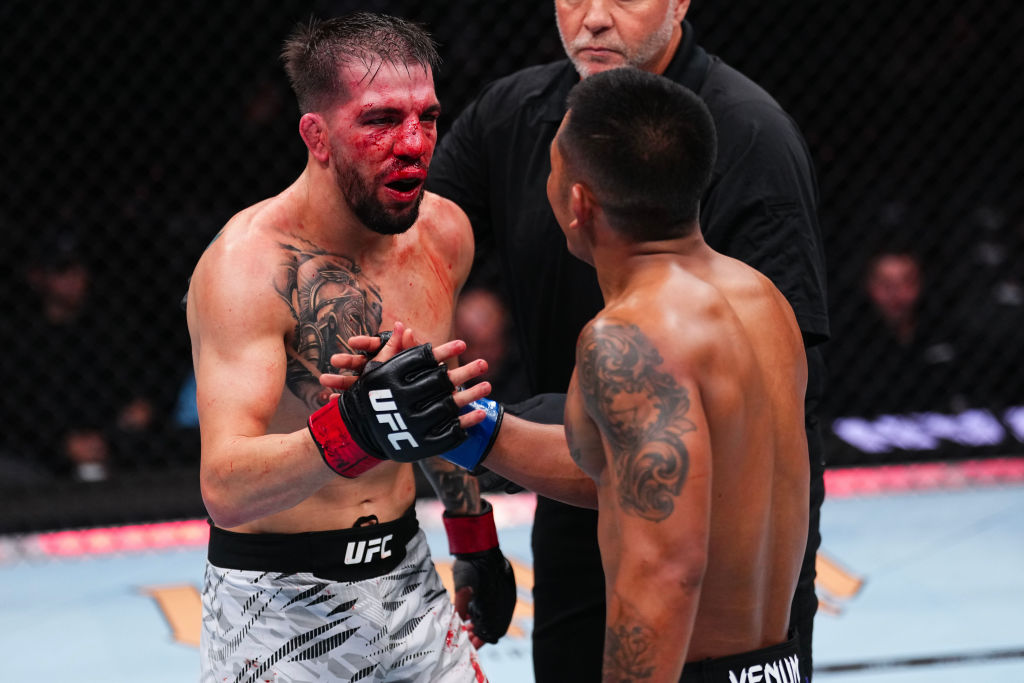
The helmet covers much of Durden’s right pectoral and reaches toward the shoulder. Its face opening, cheek guard and sweeping crest give it a distinct shape. Dark shading sits inside the openings, while lighter areas make the armor look raised. In a photo after UFC 310 against Joshua Van, Durden is on the left in white shorts and red gloves; a handshake crosses part of the lower chest, but the helmet remains visible. Van’s shoulder tattoo belongs to Van.

A June 2025 FOX 5 Atlanta profile connects the Spartan design with Durden’s idea of himself as a modern-day gladiator. The fighter context is specific enough; there’s no need to attach an imagined ancient battle or history to the image. For another MMA fighter with broader body coverage, see Alessio Sakara’s tattoos.

The lion and clock on his forearm

Cody Durden tattoos: The lion and clock on his forearm

The lion and clock sit on Durden’s left forearm. A raised-glove photo shows the round dial and Roman numerals within darker flowing forms. In a June 2025 interview with The Post-Searchlight, Durden explained that the clock reads 10:35 because that was when he received the call confirming his UFC place.

The time comes from his explanation, not from trying to read small hands in a compressed fight photo. The surrounding lion has no equally specific public explanation, so familiar ideas about strength or courage shouldn’t be presented as Durden’s own words. The circle of the clock also gives the longer forearm design a clear center.

Before the bigger pieces appeared

Cody Durden in a contextual photograph: Before the bigger pieces appeared; not tattoo evidence

An older photo from Durden’s bout with Carlos Mota shows him in blue shorts and red gloves, facing the camera with his hands up. His chest and exposed forearm look different from the later photos with the helmet and clock. It gives a before-and-after comparison, but not an exact date for either tattoo.

Fight images can hide a design behind a glove, turn it away from the camera or leave it in shadow. A tattoo that isn’t visible in one frame may simply be out of view; the photos don’t say when Durden had the pieces done or how many sessions they took.

Competition photos need a little care

Cody Durden in a contextual photograph: Competition photos need a little care; not tattoo evidence

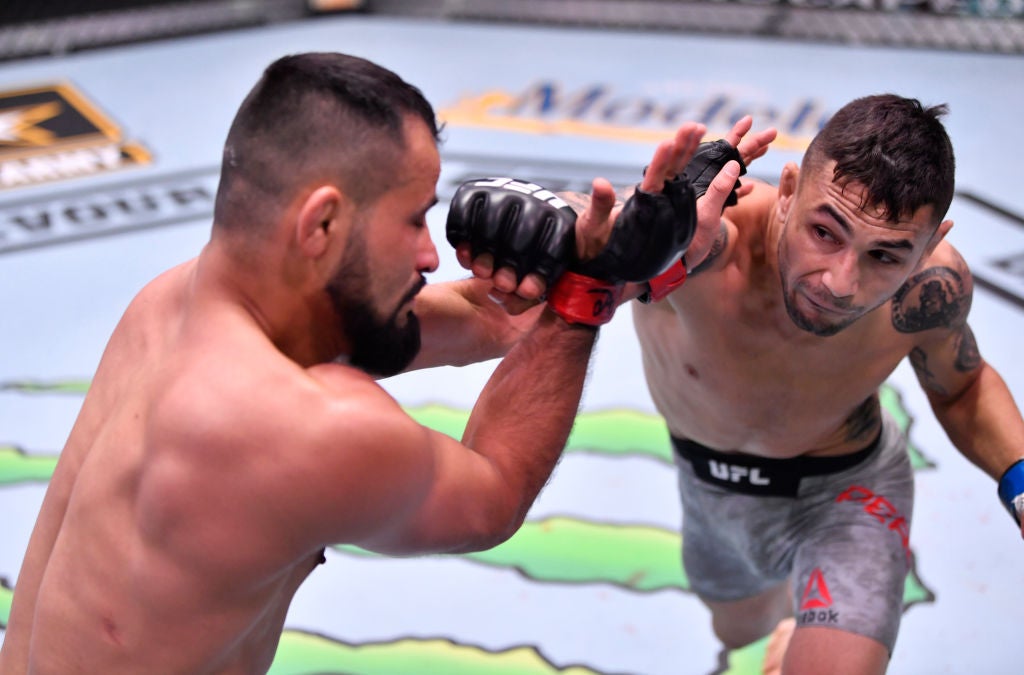
In this older action photo, Durden is on the right, extending a punch. It’s a useful view of the competition, but the moving exchange and the other fighter in frame make it a poor image for reading small details. Keep track of whose body the camera shows before attributing any visible ink.

Raised arms often give a clearer look at the chest and inner forearm, while a full-frame fight photo helps place Durden in the Octagon. Each image answers a different question.

The work behind the UFC call

Cody Durden in a contextual photograph: The work behind the UFC call; not tattoo evidence

Durden’s 2025 hometown interview describes a routine of finishing construction work and going straight to training. He stopped for espresso to get through the next part of the day, returned home late and started early again the following morning. The 10:35 tattoo keeps the moment when that work led to a UFC call.

The photo here shows Durden exchanging punches with Matt Schnell. It adds the competition setting rather than a close view of his forearm. The clock’s meaning comes from Durden’s hometown interview, while the wider fight image shows him at work in the sport.

An Octagon interview

Cody Durden in a contextual photograph: An Octagon interview; not tattoo evidence

The official UFC Vegas 97 Octagon interview below follows Durden’s submission win over Schnell. It’s a post-fight conversation, not a tattoo explanation, and pairs naturally with the competition and close-up photographs above.

Tim Elliott Tattoos: His Chest Fist, Forearm Tree and Their Details

Tim Elliott’s best-known tattoo is a raised fist high on his left chest. Its outline is easy to pick out in fight photos, while the irregular dark patches inside it draw the eye closer. Elliott has described a connection to a Rage Against the Machine poster, though the story of getting the tattoo was more spontaneous than planned. A branching tree and smaller designs cover part of his left forearm, giving that arm a busier look than his chest.

His account gives the fist a starting point. The other visible shapes are easier to describe than explain; without a statement from Elliott, assigning them a family tribute or personal message would be guesswork.

The raised fist on his chest

Tim Elliott tattoos: The raised fist on his chest

The fist sits high on Elliott’s anatomical left pectoral, above the nipple. In a front-facing photo, that places it on the viewer’s right. Its short wrist points down, with the curled fingers across the top. Irregular dark patches break up the hand, leaving the skin visible between them.

An Octagon photograph gives a clear view of the design against Elliott’s otherwise mostly bare upper torso. The outline makes the fist readable at a distance; up close, the uneven patches stand out. There’s no banner or frame around it, so the tattoo reads as a single graphic. The contrast is easier to see beside Alessio Sakara’s tattoo collection, whose collection has a denser overall look.

The patches can invite guesses about an animal pattern, but a photograph doesn’t confirm one. “A raised fist with irregular dark patches” is enough to describe what’s visible.

How Elliott explains the fist tattoo

Tim Elliott tattoos: How Elliott explains the fist tattoo

On the JAXXON Podcast, Elliott connected the image to a Rage Against the Machine poster and called it a “rise up fist,” according to Calfkicker’s October 2025 report of the conversation.

He also recalled how he got it: a college friend was tattooing, Elliott had been drinking and talking with him, and he woke the next morning with his shirt stuck to his chest. At first, he thought he’d been in a fight. That’s Elliott’s recollection; it doesn’t identify the poster’s edition, the friend, or when the tattoo was done.

A raised fist carries different associations for different people. Elliott’s account gives the poster reference, but it doesn’t spell out everything the tattoo has meant to him since. It’s best to keep that distinction clear rather than treat a viewer’s interpretation as his explanation.

The tree on his left forearm

Tim Elliott tattoos: The tree on his left forearm

The dark tree runs lengthwise along Elliott’s left forearm, with a central trunk and branches spreading outward. In the pointing photo, his right arm is raised and his left hangs at his side, leaving the tree facing the camera.

Other designs share the arm: lighter petal- or leaf-like linework sits near the elbow, and a compact angular mark appears closer to the wrist. Their different shapes and shading keep the forearm from reading as one solid strip of ink. The photograph doesn’t establish what the designs mean, who made them, or the order in which Elliott got them.

Competition context

Tim Elliott in a contextual photograph: Competition context; not tattoo evidence

The grappling photo shows Elliott in competition, but it’s a poor reference for small tattoo details. Bodies are pressed together, arms cross the frame and the lighting changes across the skin. A mark partly hidden near a glove may belong to the other fighter. Those conditions can obscure a tattoo; they don’t show that it has faded or changed.

The standing chest photos are clearer for the fist, while the pointing image gives a better look at the forearm. The bout image adds context about how the tattoos appear during a fight, not a close-up of the artwork.

A studio view and a longer conversation

Tim Elliott in a contextual photograph: A studio view and a longer conversation; not tattoo evidence

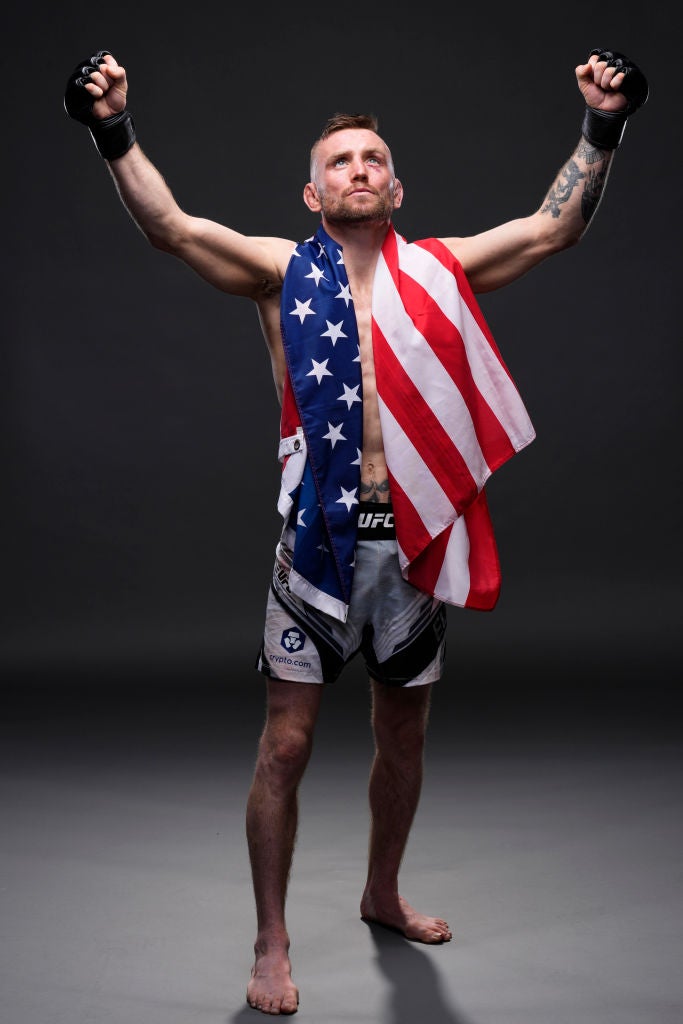
The studio portrait shows Elliott standing with both gloves raised, an American flag draped over his shoulders and torso. It covers much of his chest in this image; the flag is clothing, not a tattoo. His gray shorts, bare feet and the plain dark background make this a full-length portrait rather than a close view of the ink.

The JAXXON episode ranges across Elliott’s career, The Ultimate Fighter and the flyweight division. His tattoo story comes up as part of that wider conversation, not as a tour of every design. The episode is embedded below.

Alex Perez Tattoos: His Lion, Portrait, Shoulder Work and Rib Script

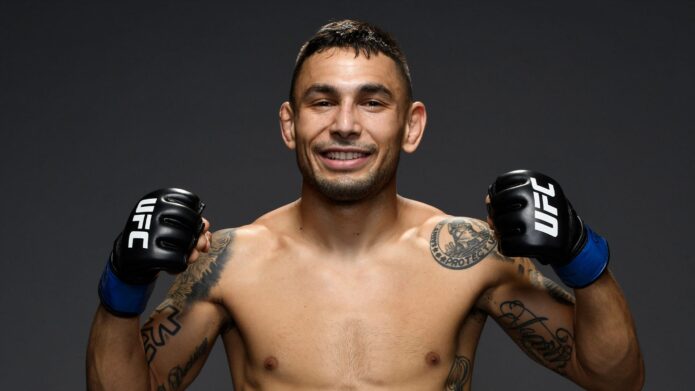
Alex Perez’s tattoos are concentrated on his arms and the left side of his torso. A lion covers his right shoulder, while a circular shoulder piece, a shaded face and several areas of script sit elsewhere on his arms and ribs. The styles vary: some pieces use portrait shading, others rely on outlined letters or radiating lines. His chest remains comparatively open.

The photos show where the designs sit and how they look from different angles. They don’t, by themselves, explain the personal meaning behind them.

The lion on his right upper arm

Alex Perez tattoos: The lion on his right upper arm

The lion’s head covers the outside of Perez’s right shoulder and upper arm. Its open mouth faces outward, and the mane spreads over the rounded shoulder. Dark shading gathers around the mouth and lower edge; lighter lines break up the fur.

In the first cage-side photo, Perez has his gloves raised and his right shoulder turned toward the camera.

Alex Perez tattoos: The lion on his right upper arm

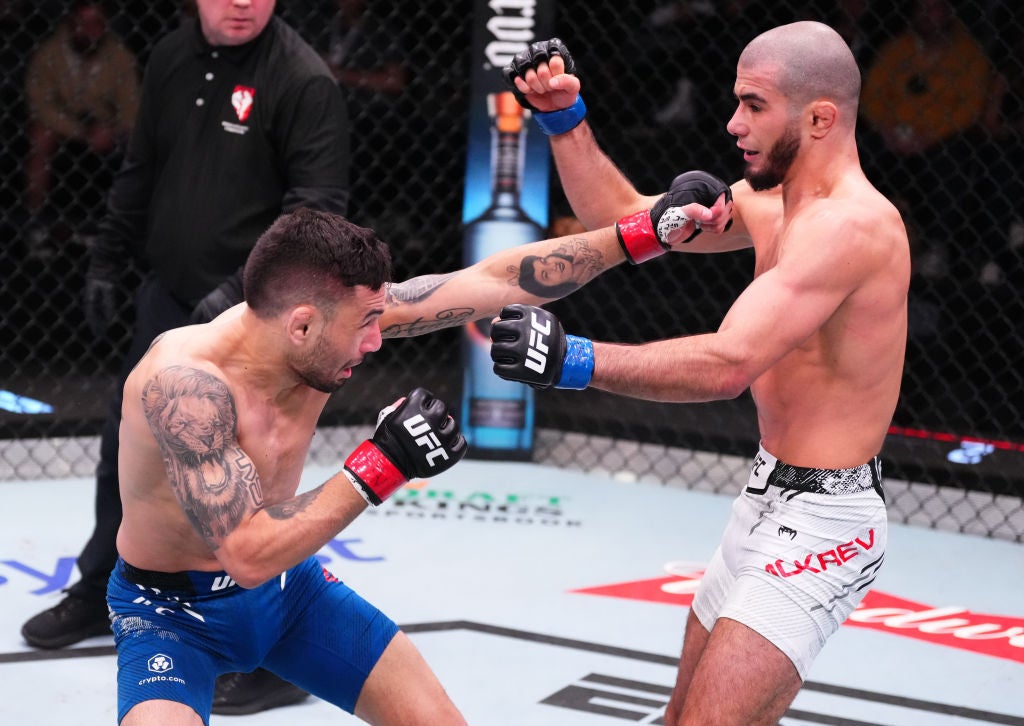
A second view, during an exchange with Muhammad Mokaev, shows the lion from a different angle. The turn makes its mouth and lower mane easier to see. The August 2026 profile in EssentiallySports describes the tattoo but doesn’t give a confirmed explanation from Perez, so its meaning remains unknown.

Outlined lettering below the lion

Alex Perez tattoos: Outlined lettering below the lion

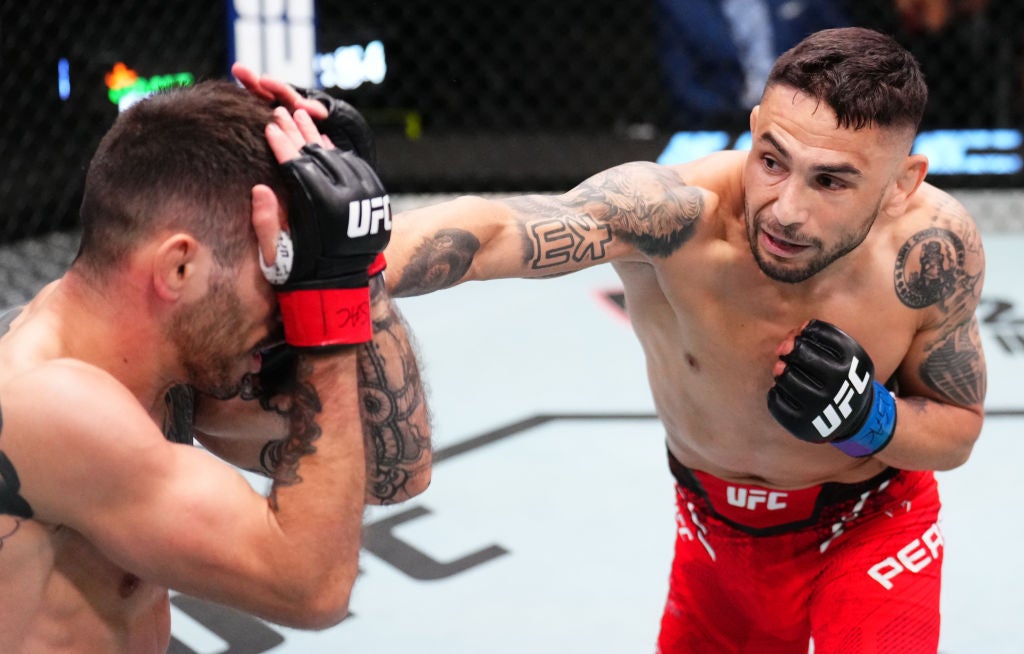
Below the lion, large outlined letters wrap around Perez’s right upper arm. Their dark borders and open centers contrast with the shaded mane above. In a photo of him reaching toward Matheus Nicolau, only part of the design is visible, including an E and an X. The full wording can’t be read from that angle.

Because the letters continue around the arm, one photo may show a different section from another. The visible outline is clear; a complete transcription isn’t.

The circular design on his left shoulder

Alex Perez tattoos: The circular design on his left shoulder

A circular design sits on Perez’s left front shoulder, close to the top of his chest. A figure appears inside it, with writing around the border. Segmented shapes fill the shoulder behind it, and a broader fan-like pattern extends down the outer upper arm.

The photo is from his bout with Tatsuro Taira; Perez is on the right, with his left shoulder facing the camera. The circle and surrounding linework are visible, but they don’t establish a particular religious belief or personal meaning. The open space between this piece and the center of his chest also keeps it distinct from the larger shoulder pattern.

The portrait on his left forearm

Alex Perez tattoos: The portrait on his left forearm

A shaded human face runs along Perez’s left forearm. In the celebration photo, his arm hangs low and turns outward, showing the portrait’s dark hair and lighter facial features. Its long shape follows the forearm rather than sitting in a small, framed area.

EssentiallySports mentioned Perez’s reported plan to get a tattoo of himself and his son, but didn’t confirm that this portrait is the result. The photograph shows a face; it doesn’t identify the person. The lion on his other arm uses a broad mane to fill the shoulder, while this narrower portrait follows the length of the forearm.

Script inside the upper arms

Alex Perez tattoos: Script inside the upper arms

With his arms raised, Perez’s inner upper arms show large, flowing script. The lines curve beneath the biceps and can be hard to read when the muscle turns or the lettering runs out of view. The raised-glove photo shows the placement and sweeping strokes, but not a reliable full transcription.

The script has a softer outline than the block letters below the lion. For another example of how lettering and shaded imagery share space, see Alessio Sakara’s tattoos.

The lettering down his ribs

Alex Perez tattoos: The lettering down his ribs

Large script runs down Perez’s left ribs. In a photo from his fight with Deiveson Figueiredo, the kicking motion turns that side toward the camera and reveals the tall, stacked design between his torso and waistband. The exact phrase is difficult to make out, but its vertical layout is clear.

His torso is twisted in the image, which changes how the lettering appears. The design follows the side of his body, leaving the front of his chest comparatively open.

Competition context and an Octagon interview

Alex Perez in a contextual photograph: Competition context and an Octagon interview; not tattoo evidence

In the knee-strike photo, Perez is on the right in green shorts; Charles Johnson is bent forward on the left. It shows the tattoos during a fight, though gloves and limbs can cover parts of the designs.

Alex Perez in a contextual photograph: Competition context and an Octagon interview; not tattoo evidence

An older exchange gives another view of Perez’s posture and the distance between the fighters. These wide shots provide bout context; the closer images are better for studying individual tattoos.

The embedded UFC Vegas 91 interview follows Perez’s knockout win over Matheus Nicolau. Daniel Cormier speaks with him after the fight. It’s a post-bout conversation, not a tour of the tattoos.

169 container

Matheus Nicolau Tattoos: His Left Sleeve, Chest Piece and Forearm Figure

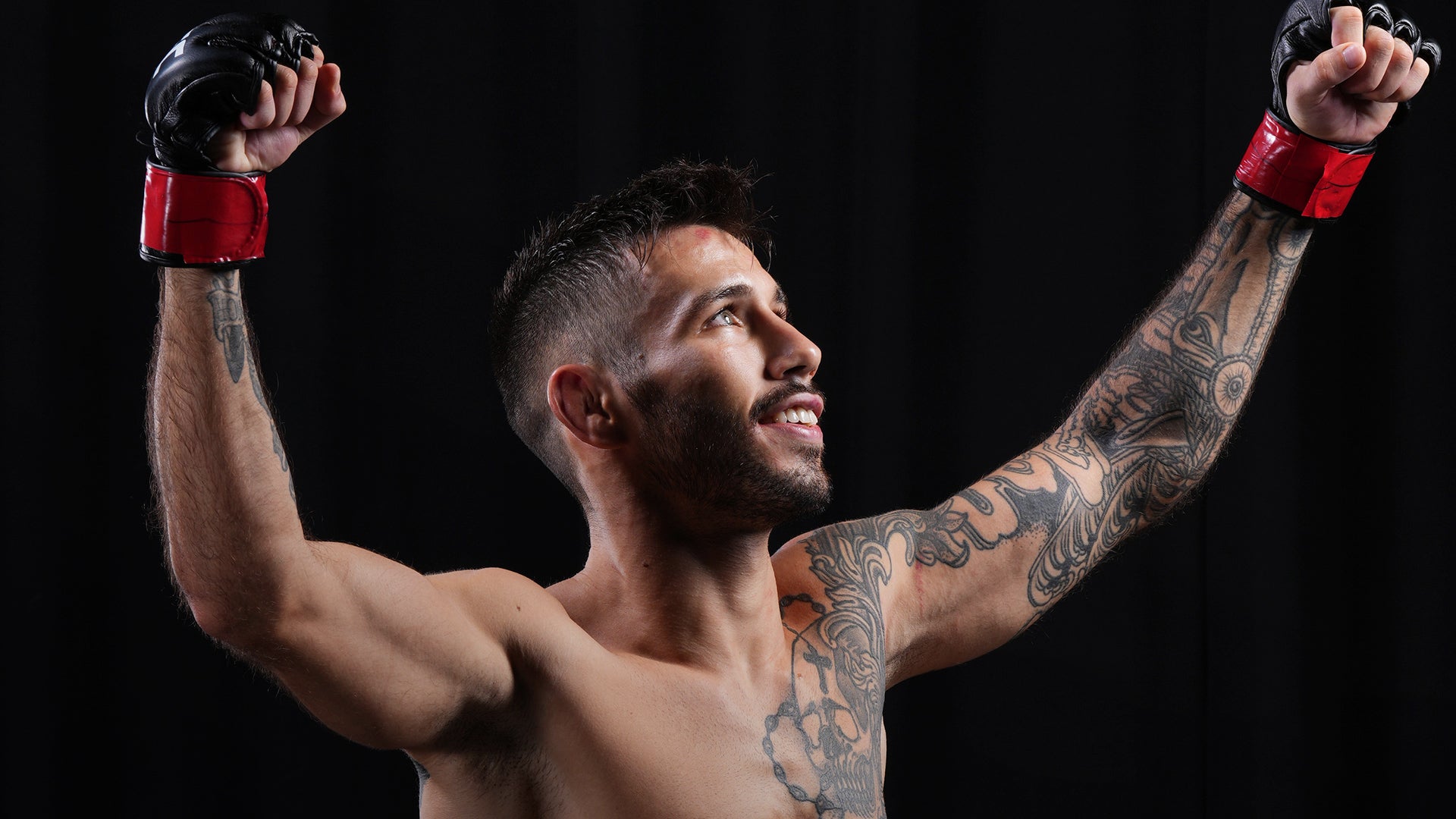
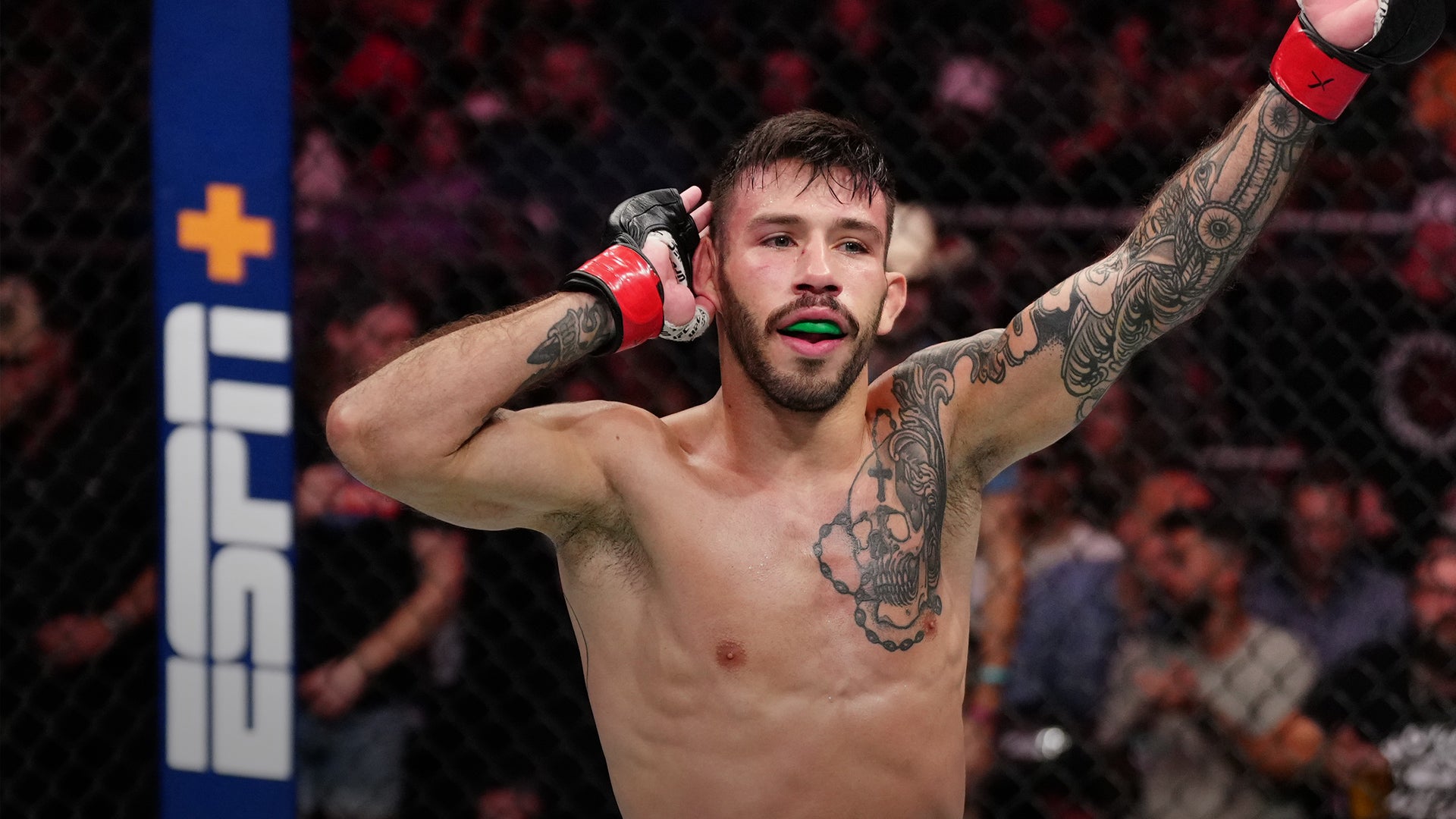
Matheus Nicolau’s tattoos are concentrated on the left side of his upper body. A flowing sleeve covers his left arm and meets a large, skull-like chest design framed by beads and a cross. On his right forearm, a smaller helmeted figure stands apart from the open skin above it.

The styles and coverage vary from one side to the other. The photographs make that contrast easier to see than a quick view during a fight, where overlapping lines can read as one dark patch.

The left sleeve and its flowing linework

Matheus Nicolau tattoos: The left sleeve and its flowing linework

The raised-arm studio photo shows Nicolau’s left sleeve from shoulder to forearm. Long curved lines bend around larger shapes, with feather- or leaf-like edges in places. Smaller circular details interrupt the flow, especially on the forearm.

The forms continue over the shoulder toward the chest rather than ending at a straight border. Open skin separates some of the lines, so the sleeve isn’t a solid block of black. A January 2024 profile in EssentiallySports discussed fan theories about Nicolau’s larger work, but those aren’t a confirmed explanation from him. For another connected collection, see Alessio Sakara’s tattoo collection.

The skull-like chest design, beads and cross

Matheus Nicolau tattoos: The skull-like chest design, beads and cross

A large skull-like face covers Nicolau’s left chest. Its row of teeth gives the lower half a mask-like look, while heavier curved lines shape the upper part and lead toward the shoulder. In the celebration photo, his raised left arm opens that side of the chest to the camera. The green item in his mouth is a mouthguard, not part of the tattoo.

Rounded beads loop around the face, and a cross sits above it within the upper section of the design. The chain gives the busy image a loose border without boxing it in. A cross is visible, but the photo alone doesn’t establish Nicolau’s beliefs or a personal dedication.

The helmeted figure on his right forearm

Matheus Nicolau tattoos: The helmeted figure on his right forearm

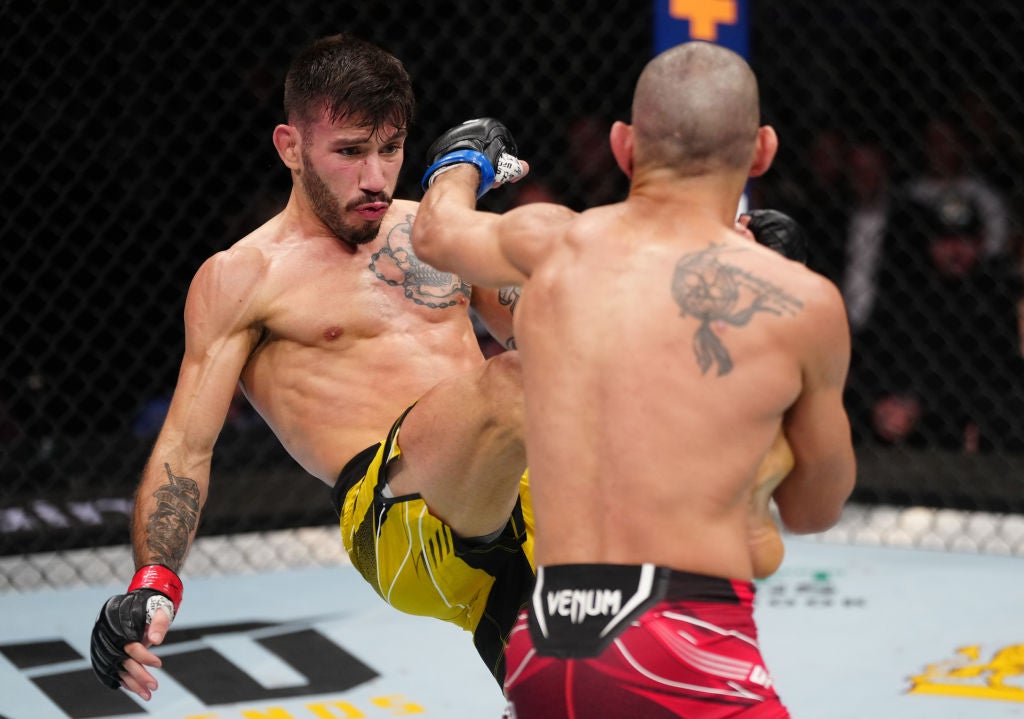
A smaller, shaded figure with a helmet-like outline sits on Nicolau’s right forearm. In the competition photo he’s on the left in yellow shorts, his right arm hanging with the outside of the forearm turned toward the camera. Matt Schnell, in red shorts, faces away; the tattoo on Schnell’s upper back belongs to him.

The forearm piece has a compact, upright shape, unlike the connected curves on Nicolau’s left arm. The image doesn’t identify a particular warrior or character. It’s a visual description, not a confirmed reference.

A full-length studio view

Matheus Nicolau in a contextual photograph: A full-length studio view; not tattoo evidence

The full-length studio photo shows Nicolau against a pale background in green shorts, with his arms crossed and feet visible. The pose covers part of his chest, while the heavily tattooed left arm stands out beside the more open right upper arm.

Because the chest is partly hidden, this photo gives a sense of the collection’s overall balance rather than a close view of every design.

Competition context and a conversation

Matheus Nicolau in a contextual photograph: Competition context and a conversation; not tattoo evidence

The competition image shows Nicolau with both gloves raised beside the referee. The cage and arena lights make it a different view from the studio photos; changing light and pose can affect how clearly fine lines show.

The embedded UFC Orlando interview follows Nicolau’s second-round knockout of Matt Schnell. Daniel Cormier speaks with him in the Octagon. It’s a post-fight conversation, not a guided account of his tattoos.

Deiveson Figueiredo Tattoos: His UFC Belt and Shoulder Design

Deiveson Figueiredo’s right forearm carries a small tattoo of a UFC championship belt. A separate curved design sits on his right shoulder, with plenty of open skin around both pieces. The belt has the clearest reported connection to his career: a profile linked it to his title win over Brandon Moreno.

The photos span different fights and years, so they show different moments rather than one complete inventory of his tattoos.

The UFC belt on his right forearm

Deiveson Figueiredo tattoos: inline

The belt tattoo sits on Figueiredo’s right forearm, just above the wrist. In the celebration photo, his gloves are lowered and the central plate faces the camera. The broad outline and angular edges make the design recognizable, though the smaller lettering isn’t sharp enough to read in full.

EssentiallySports reported that Figueiredo got the tattoo shortly after beating Brandon Moreno at UFC 270 in January 2022. The article describes wording that identifies him as world flyweight champion alongside the UFC belt design. That gives the image a specific career reference. A later photo of the tattoo shows the commemorative piece; it doesn’t by itself establish his title status on that later date.

The curved design on his right shoulder

Deiveson Figueiredo tattoos: inline

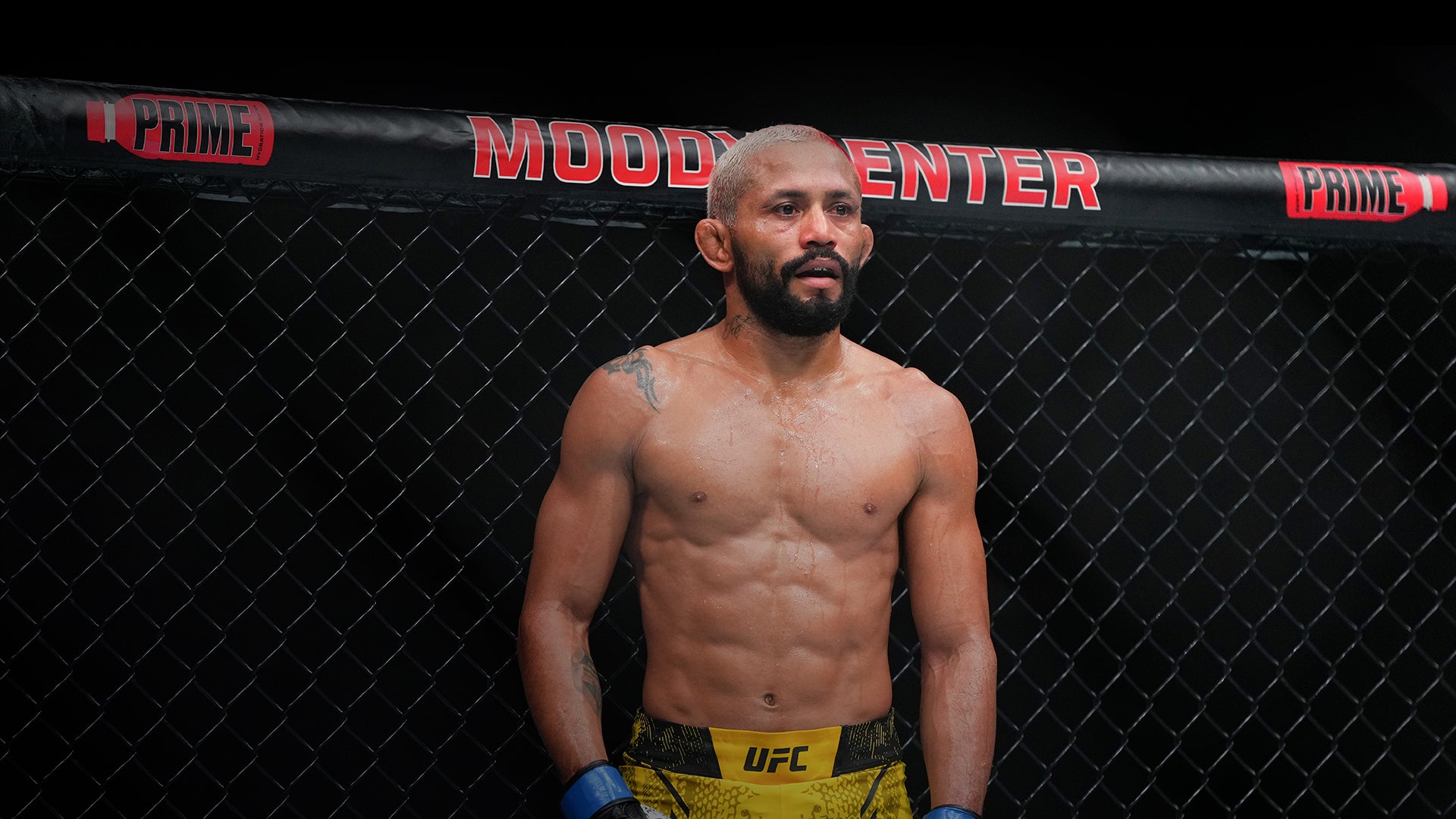
A curved black design follows Figueiredo’s right shoulder. In the front-facing Octagon photo, he stands in yellow shorts against the cage, with the tattoo on the viewer’s left. Its tapered lines follow the rounded shoulder and leave much of the upper arm uncovered.

Body Art Guru describes it as tribal-style work, but that label doesn’t confirm a cultural origin or Figueiredo’s reason for getting it. A small mark near his neck is also visible in the photo, though the lettering is too unclear to identify.

A fight photograph with Rob Font

Deiveson Figueiredo in a contextual photograph: inline; not tattoo evidence

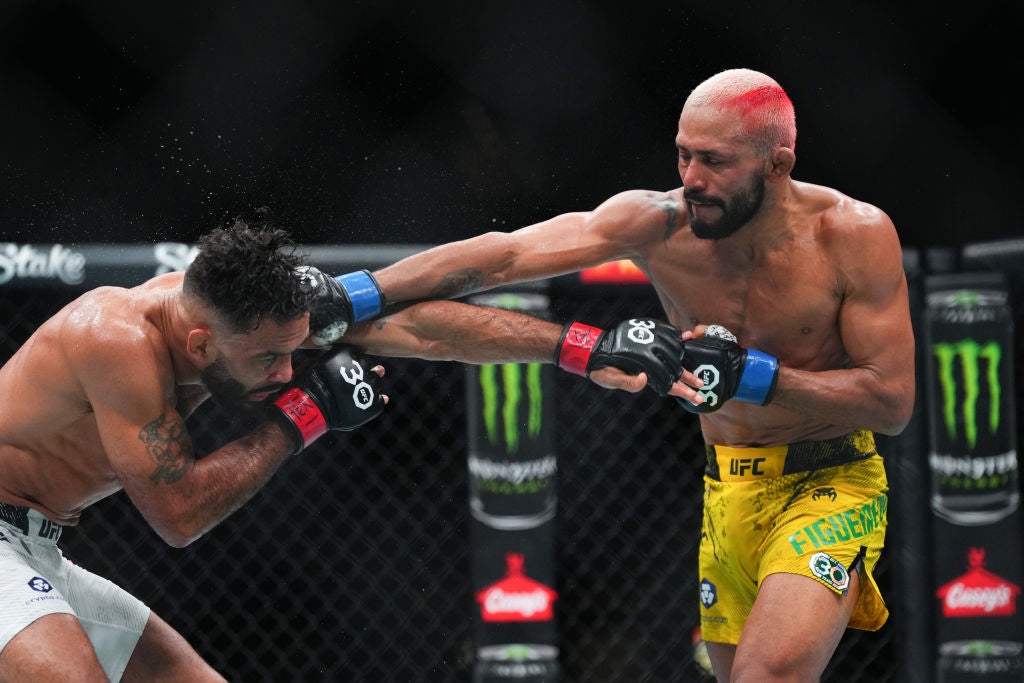
In the exchange with Rob Font, Figueiredo is on the right in yellow shorts with blue glove tape; Font is on the left in white shorts with red tape. The action and water droplets make this an effective fight image, but a difficult place to inspect small details. Figueiredo’s arm turns through the punch, and his gloves cover the hands and part of the wrists.

Those angles can hide ink without showing that a tattoo has changed. For a different approach to coverage, see Alessio Sakara’s tattoo collection.

The 2020 weigh-in photograph

Deiveson Figueiredo in a contextual photograph: inline; not tattoo evidence

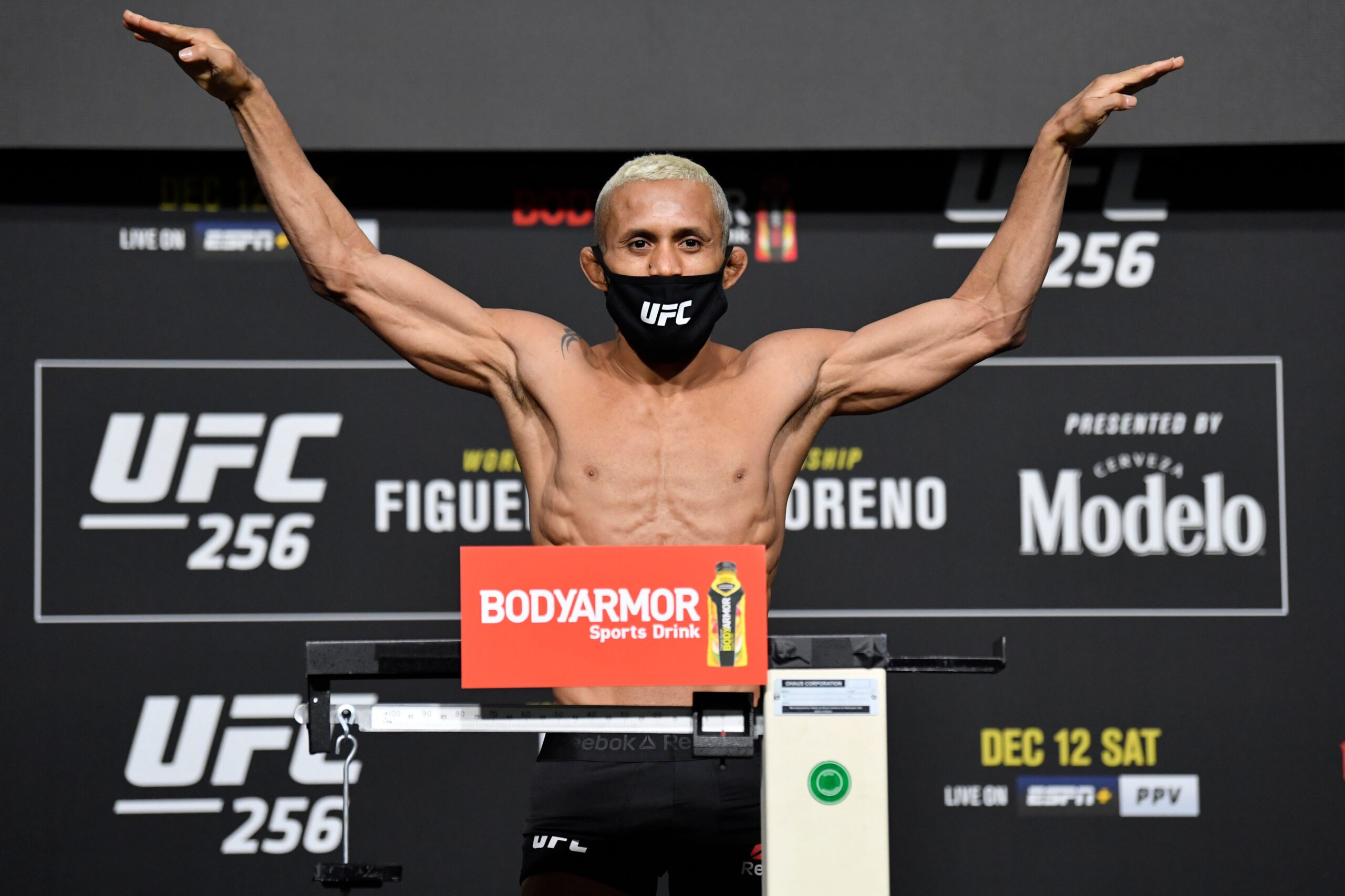
The UFC 256 weigh-in photo dates to 2020. Figueiredo stands on the scale with both arms raised, wearing a UFC mask. The scale blocks part of his torso, and the image predates the belt tattoo reported after UFC 270 in 2022.

Photos from different years shouldn’t be treated as one simultaneous inventory. This one records a weigh-in and gives a broad view of his earlier appearance, not a close look at every tattoo.

The real belt in a championship photograph

Deiveson Figueiredo in a contextual photograph: inline; not tattoo evidence

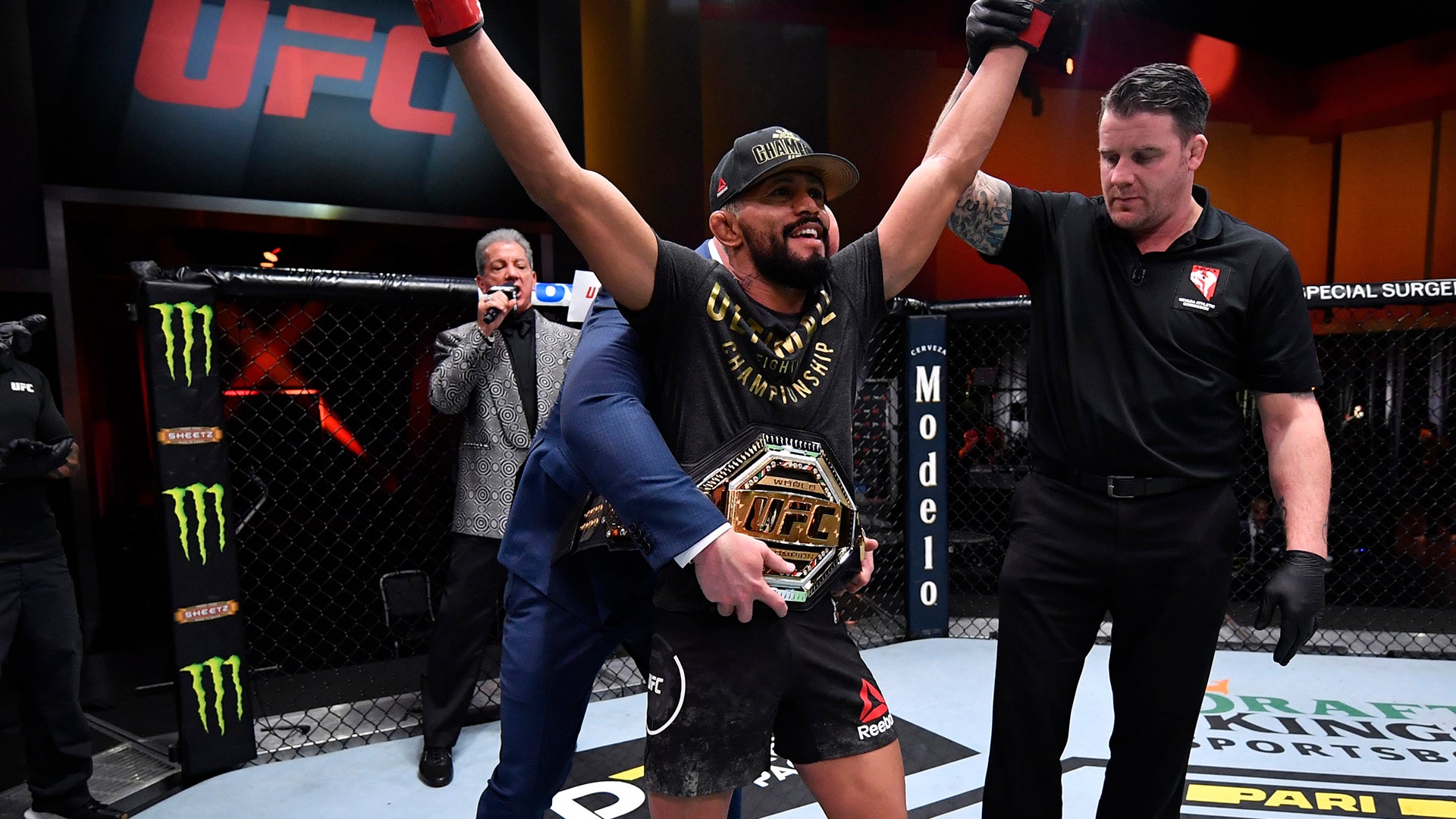
In the championship photo, Figueiredo wears a black champion cap and shirt while an official holds the physical UFC belt at his waist. The referee beside him has arm tattoos of his own; those belong to the referee. The real belt gives context for the object represented in Figueiredo’s forearm tattoo, though the metal plate and the smaller, darker design naturally look different.

The official UFC 300 Octagon interview below is a fight conversation, not a tattoo tour. The belt’s reported career connection is specific; the other marks are best left without explanations Figueiredo hasn’t given.

Alexandre Pantoja Tattoos: His Dragon Sleeve and Thigh Portrait

Alexandre Pantoja’s left arm is covered by a dense sleeve of dark shapes, curved lines and red accents. His opposite arm is much more open, while a separate portrait with flowers sits on his right thigh. The uneven coverage gives the collection a clear shape, but the photos don’t explain what each design means to him.

The dragon-themed sleeve on his left arm

Alexandre Pantoja tattoos: The dragon-themed sleeve on his left arm

A side view shows the tattooed arm bent across Pantoja’s body as he carries the physical UFC belt over his shoulder. The shirt covers part of the upper arm, but the elbow and forearm are visible. Scale-like details and red accents sit within darker, swirling forms.

EssentiallySports described the sleeve in May 2024 as Japanese-themed work with a dragon, clouds and flames. The report said Pantoja hadn’t explained its personal meaning. The imagery can be identified without assigning it a reason he hasn’t given. A patterned shirt in the photo has its own dragon and tiger print; that artwork is on the fabric, not his skin.

The sleeve wraps around the arm, so one angle can’t show it all. A round motif sits near the outer elbow, with longer lines continuing above and below. For another example of connected coverage, see Alessio Sakara’s tattoo collection.

A second view of the sleeve during a fight

Alexandre Pantoja tattoos: A second view of the sleeve during a fight

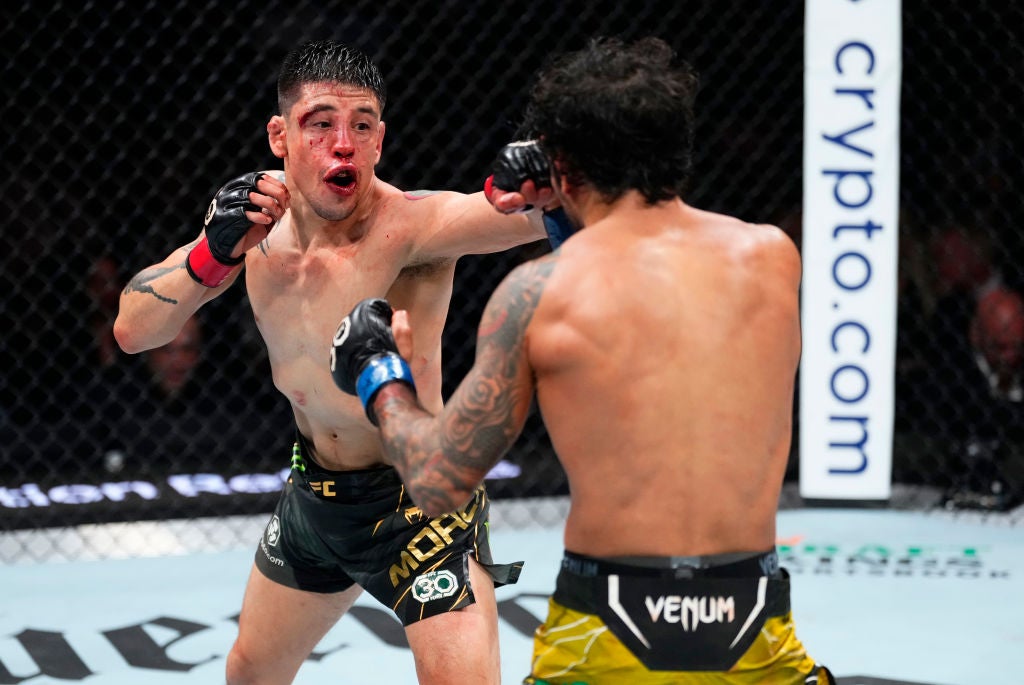
In this fight photo, Pantoja is on the right with his back toward the camera, wearing yellow shorts and blue glove tape. Brandon Moreno faces the lens on the left. The long tattooed arm nearest the viewer belongs to Pantoja; Moreno’s arm ink is separate.

This angle shows more of the sleeve’s length and how the dark outlines sit beside lighter spaces. Pantoja’s back remains comparatively open, giving the sleeve a clear edge. The photo helps show placement, though the opponent and cage make it harder to identify fine details.

The woman and flowers on his right thigh

Alexandre Pantoja tattoos: The woman and flowers on his right thigh

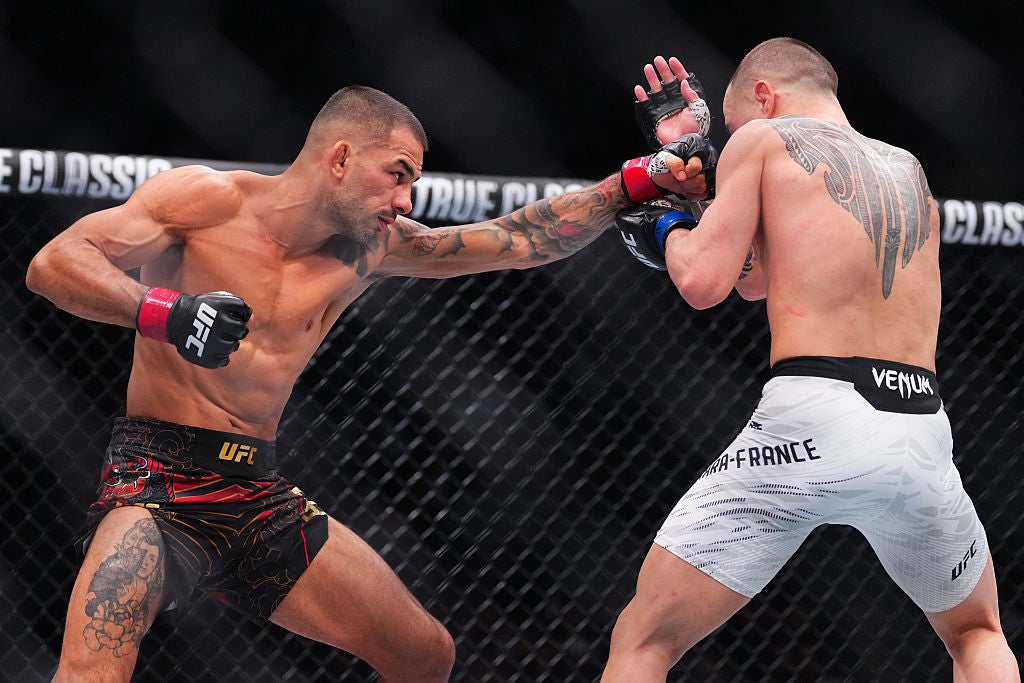
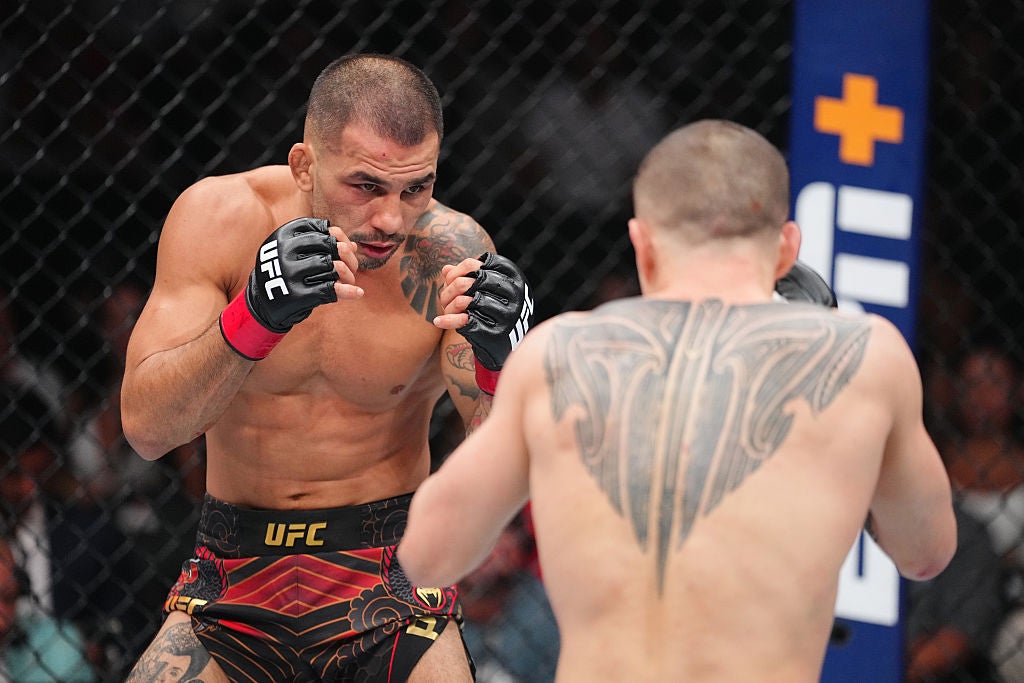
A woman’s face and flowers cover part of Pantoja’s right thigh. The portrait has dark hair and lighter facial shading, with outlined petals below. In the exchange with Kai Kara-France, Pantoja is on the left in black, red and gold shorts; Kara-France is on the right in white. The large tattoo across Kara-France’s back is his, not Pantoja’s.

EssentiallySports identified the woman as a geisha, but that doesn’t tell us why Pantoja chose the image. His shorts cover the top of the tattoo, and a dragon printed on the fabric is separate from the ink on his exposed thigh.

A promotional photograph in Rio

Alexandre Pantoja in a contextual photograph: A promotional photograph in Rio; not tattoo evidence

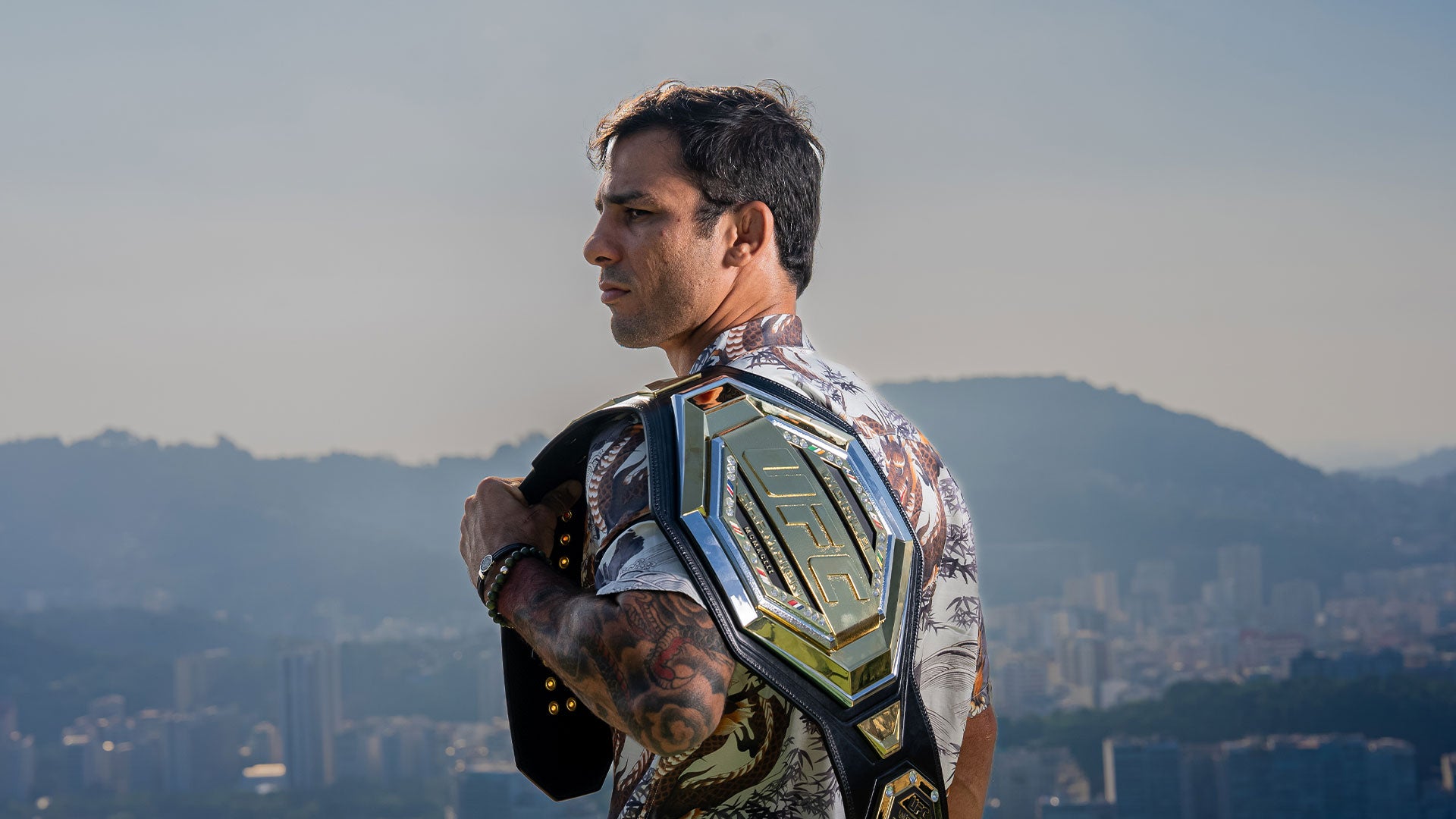
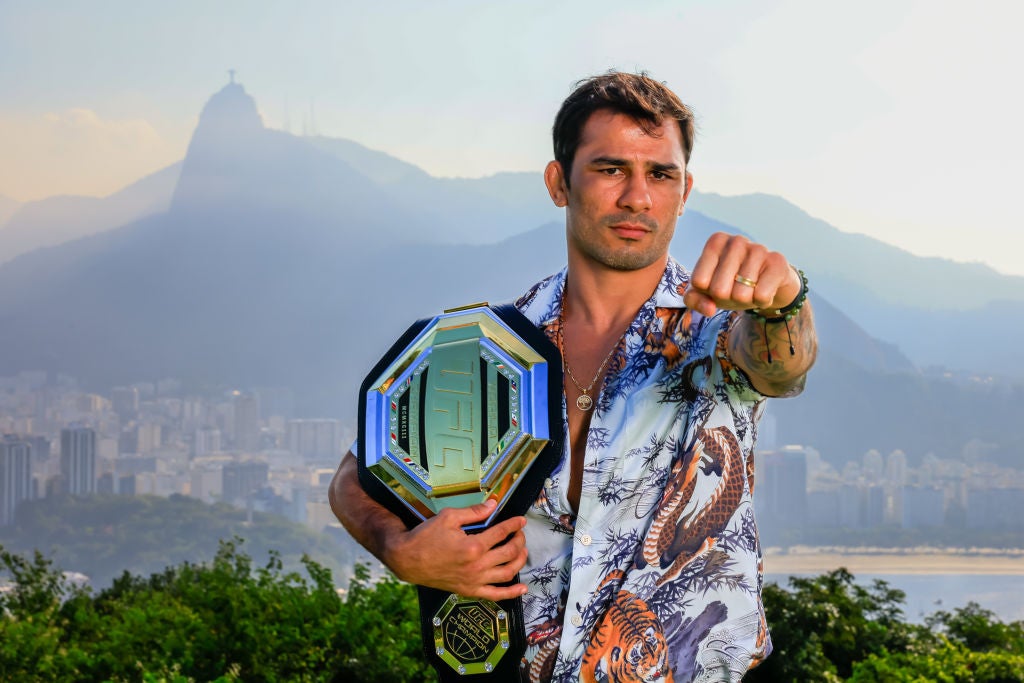
This promotional photo shows Pantoja at a Rio overlook, holding the belt against his body and extending a fist toward the camera. His patterned shirt has its own dragon and tiger illustrations. The pose foreshortens the arm and the shirt covers the shoulder, so the image gives broader context than tattoo detail.

The belt, bracelet and printed fabric also draw attention away from the skin. A clearer exposed-arm photo is more useful for studying the sleeve.

Competition context at UFC 317

Alexandre Pantoja in a contextual photograph: Competition context at UFC 317; not tattoo evidence

In this UFC 317 photo, Pantoja faces the camera with both gloves raised while Kara-France’s back fills the foreground. That back tattoo belongs to Kara-France. Pantoja’s gloves and turned shoulder obscure part of his sleeve, making it look shorter than in the other view.

The official UFC 301 Octagon interview below is a post-fight conversation, not a tattoo tour. The photos show a dense left sleeve and a separate portrait on Pantoja’s right thigh; his personal reasons for the designs remain his to explain.

Kai Kara-France Tattoos: His Back Design and Right Forearm Ink

Kai Kara-France has a broad, symmetrical black design across his back and curved work on his right forearm. A rear-facing fight photo shows the back piece spreading across the shoulders and narrowing into long points lower down. Training photos reveal the forearm. The dates matter: they show different areas at different times.

The symmetrical black design across his back

Kai Kara-France tattoos: The symmetrical black design across his back

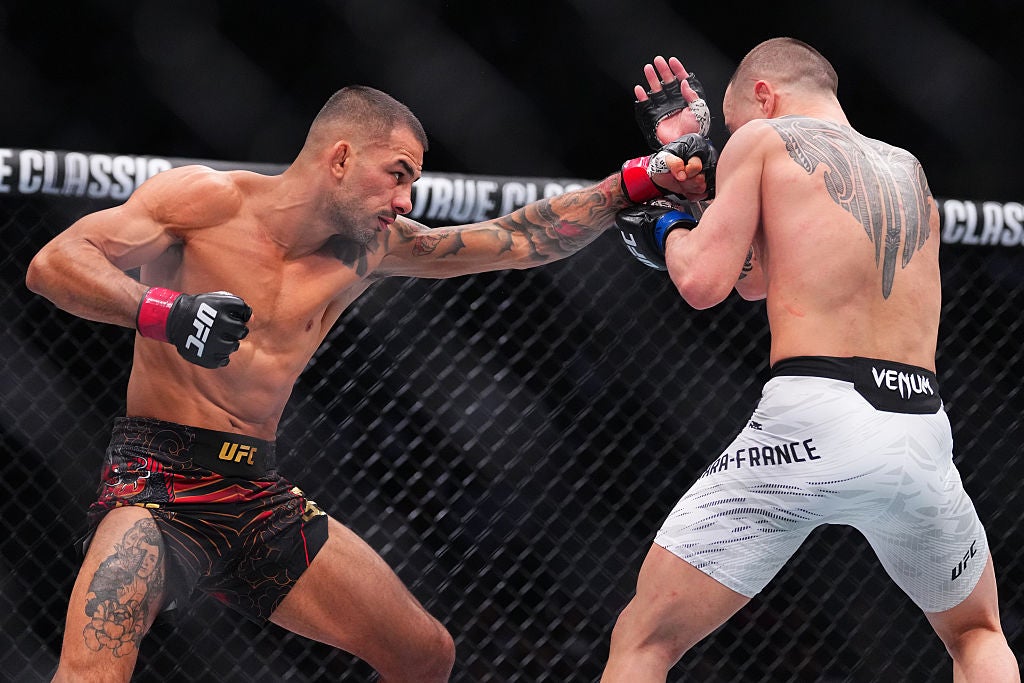
In this frame, Kara-France is on the right in white shorts with blue glove tape. Alexandre Pantoja is on the left in black, red and gold shorts; the arm and thigh tattoos visible there belong to Pantoja.

Kara-France’s design spreads over both shoulder blades, with curved bands drawing inward toward the spine and pointed shapes tapering down his back. Dark sections alternate with narrow gaps of bare skin and finer lines. The overall layout is symmetrical, though the photo shows it on a moving body with his shoulders raised.

EssentiallySports’ August 2024 profile connected the tattoo with Kara-France’s heritage and cited a caption from his reveal post. That reported connection doesn’t identify the meaning of every curve. The same report described the back piece as his only tattoo; June 2025 training photos also show forearm work, so that older count shouldn’t be treated as current.

The curved work on his right forearm

Kai Kara-France tattoos: The curved work on his right forearm

In this training photo, Kara-France is on the left in a black sleeveless top and green-and-gold gloves. The right forearm nearest the camera has bold curved lines and a narrower patterned band. His glove cuff covers part of the wrist, so the tattoo’s full lower edge isn’t visible.

The curves wrap around the arm, a narrower surface than the back. The photo shows their visible side but doesn’t tell us when he got them, who made them or what they mean. For another kind of arm coverage, see Alessio Sakara’s tattoo collection.

Heavy-bag training at the Performance Institute

Kai Kara-France in a contextual photograph: Heavy-bag training at the Performance Institute; not tattoo evidence

Kara-France works a heavy bag at the UFC Performance Institute. The bag fills much of the left side of the image and blocks part of his extended arm; his shirt covers the back design. His green-and-gold gloves stand out in the darker room.

The shorts have printed symbols and lettering, which belong to the fabric, not his skin. This photo shows the training setting, but the equipment and clothing limit what it can reveal about the tattoos.

A wide view of pad work

Kai Kara-France in a contextual photograph: A wide view of pad work; not tattoo evidence

The wide pad-work photo shows Kara-France on the right and the pad holder on the left, both barefoot inside the training cage. Kara-France extends one glove toward the target while keeping the other close. The frame gives a sense of the room and their distance, not a detailed view of either tattoo.

His top hides the back piece, while the short sleeves leave part of the arm visible. Light and shadow also change how dark the ink appears. The edges and placement are more reliable clues than comparing darkness across different photos.

A full-length training photograph

Kai Kara-France in a contextual photograph: A full-length training photograph; not tattoo evidence

The last photo shows Kara-France alone in the same training setting, gloves raised and the cage behind him. The shirt covers his back, and the gloves cross his torso, so this full-length view is mainly about his stance and the setting.

The official UFC 305 Octagon interview below is a fight conversation, not an explanation of his tattoos. The photos show the back and forearm in different contexts; the reported heritage connection belongs to the back design, and the forearm’s meaning remains unconfirmed.

Brandon Moreno Tattoos: His Right Shoulder and Tower Design

Brandon Moreno’s right shoulder is covered in bold black curves, with a shaded, tower-like design lower on the upper arm. The pieces use different levels of detail: the shoulder stands out from a distance, while the architectural image asks for a closer look. February 2026 reporting also described a newer Quetzalcoatl chest tattoo; it isn’t shown in the older competition photos here.

The bold black work on his right shoulder

Brandon Moreno tattoos: The bold black work on his right shoulder

The broad black design sits on Moreno’s anatomical right shoulder, on the viewer’s left in the front-facing photo. Sweeping bands end in pointed shapes, with gaps of bare skin separating the dark sections. The open spaces keep the curves distinct instead of merging into one solid patch.

Older coverage calls it tribal-style work, a description of its appearance rather than proof of a particular cultural source or personal meaning. The lines follow the rounded shoulder and extend toward the upper arm; the photo doesn’t tell us why Moreno chose them.

The tower-like design on his right upper arm

Brandon Moreno tattoos: The tower-like design on his right upper arm

Body Art Guru identifies the shaded design on Moreno’s right upper arm as a Tijuana clock monument. In the competition photo, its upright form has a rounded top, long vertical lines and smaller divisions that resemble windows. The angle and lighting obscure fine detail, so the overall tower-like shape is clearer than its smallest features.

The architectural image is more finely shaded than the bold shoulder bands above it. The reported Tijuana connection gives the subject a place reference, but the photos don’t supply a personal story from Moreno.

A promotional photograph in Mexico City

Brandon Moreno in a contextual photograph: A promotional photograph in Mexico City; not tattoo evidence

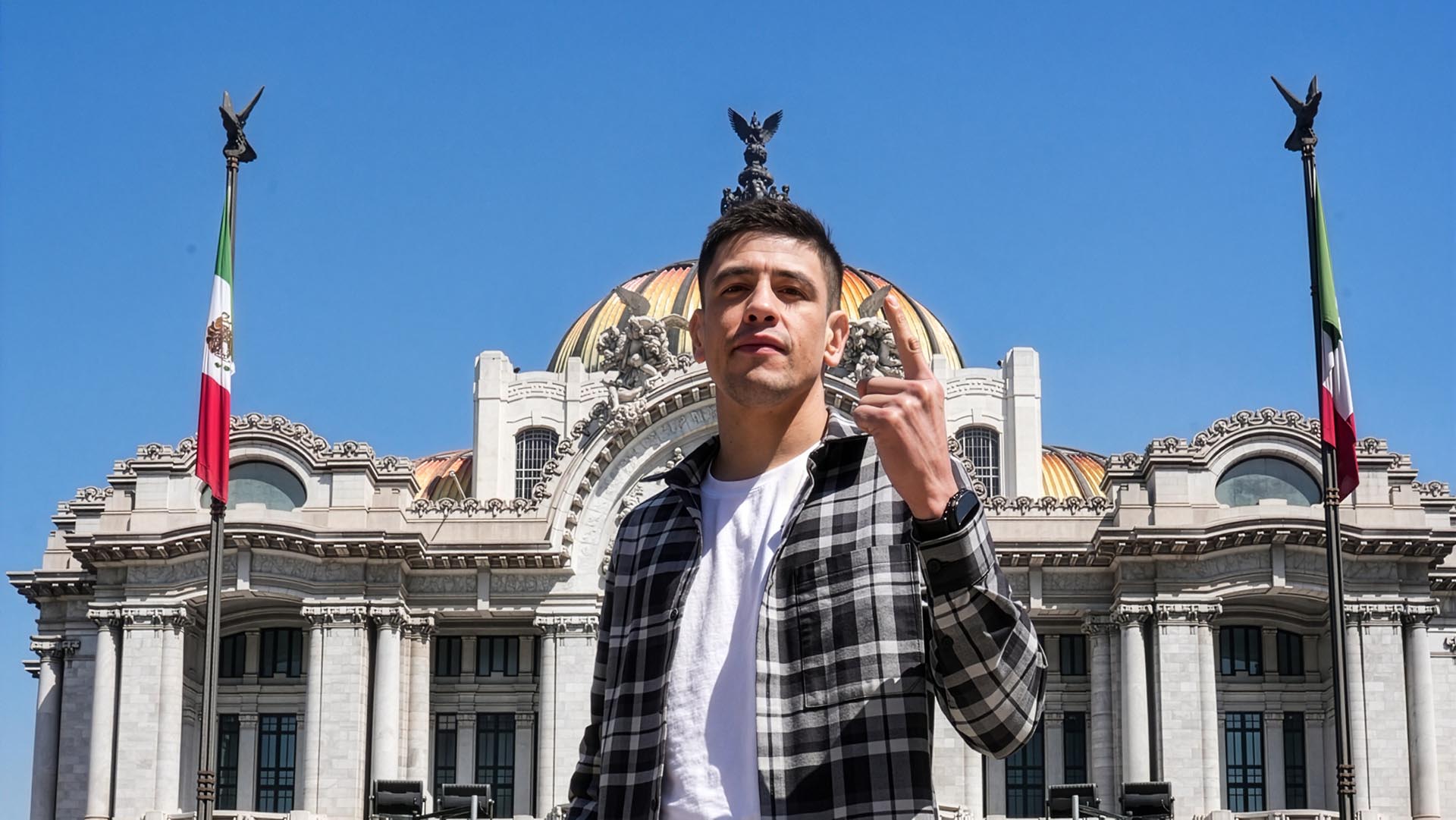
This promotional photo was taken outdoors in Mexico City. Moreno wears a plaid overshirt over a white top, with an ornate building, flags and a bright sky behind him. Most of the shoulder and upper arm are covered, so the image offers context rather than a close view of his tattoos.

The building in the background shouldn’t be treated as evidence of a match for the tattooed monument. They appear in different photographs, and the promotional setting doesn’t identify the design.

A wider competition scene

Brandon Moreno in a contextual photograph: A wider competition scene; not tattoo evidence

In this wider competition photo, Moreno wears a patterned black shirt, one glove near his face, while the referee raises his other arm. People in the background, including an announcer in a red jacket, help place the image in the event. The shirt hides the shoulder piece, and the exposed forearm is angled away.

The wider view is useful for the setting, but it doesn’t show enough detail to identify another design. For a broader collection to compare with Moreno’s, see Alessio Sakara’s tattoos.

An earlier Octagon photograph

Brandon Moreno in a contextual photograph: An earlier Octagon photograph; not tattoo evidence

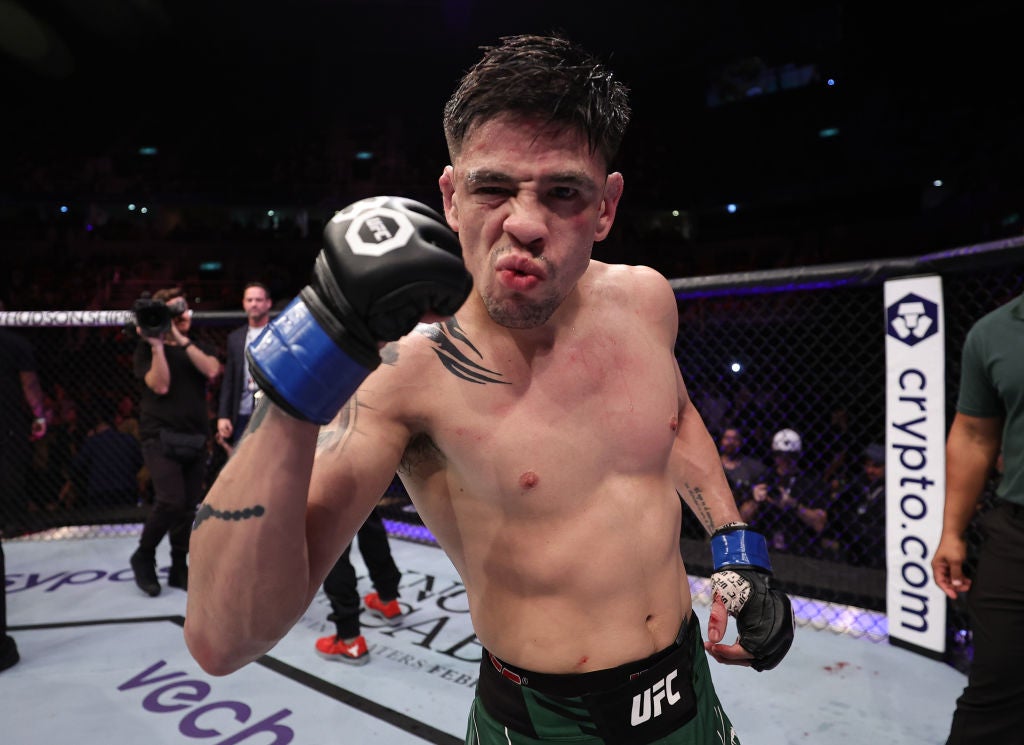
In this earlier Octagon photo, Moreno brings a blue-taped glove toward the lens. He wears green-and-black shorts, and the cage is visible behind him. The gesture gives the image its energy, but the glove also blocks part of the arm.

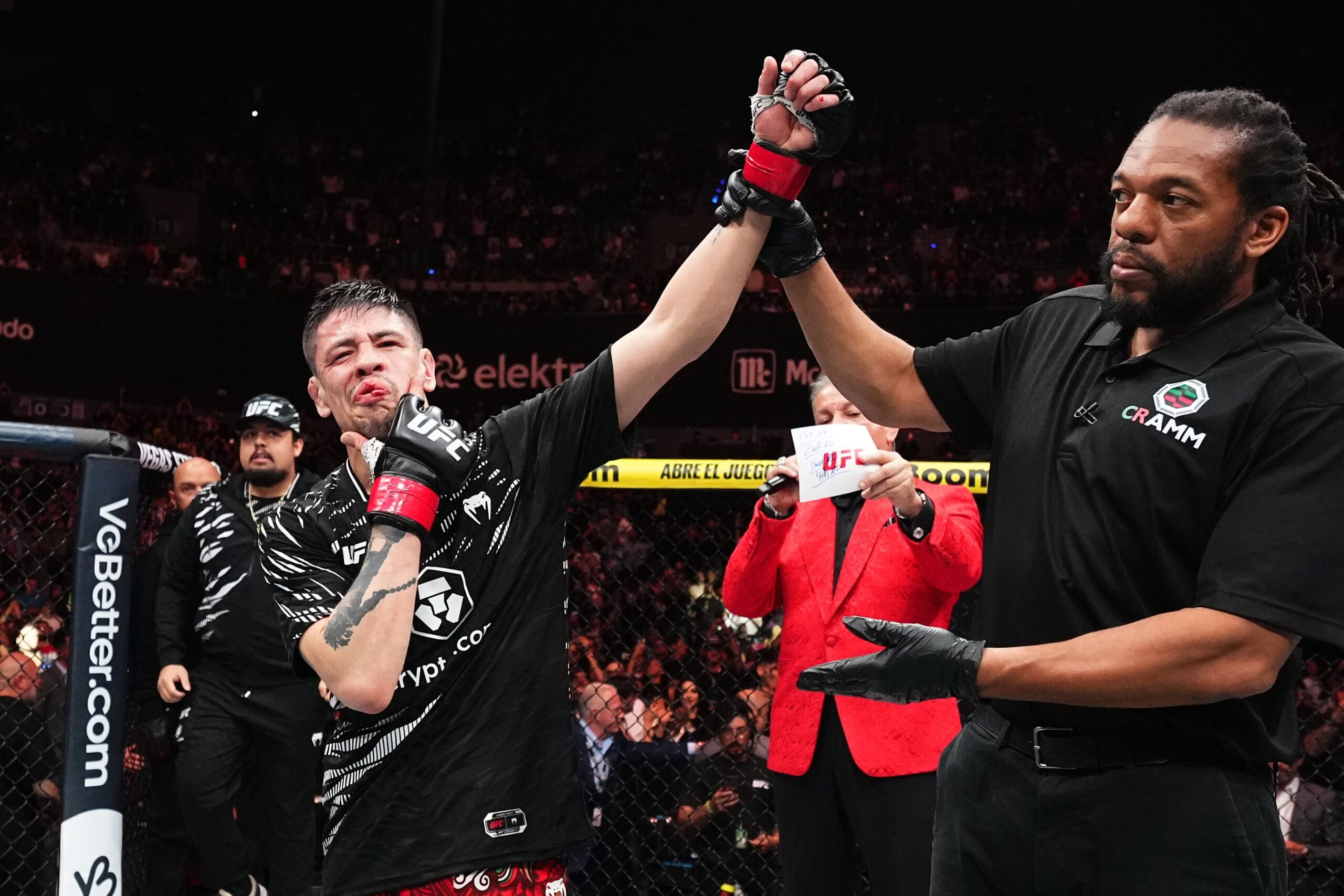
Older fight photos and the 2026 report about a chest piece record different moments. They don’t contradict each other. The official Octagon interview below gives more of the competition setting, but it isn’t a tattoo tour or an explanation of the designs.

Sergio Pettis Tattoos: Chest Lettering, Portrait and Arm Work

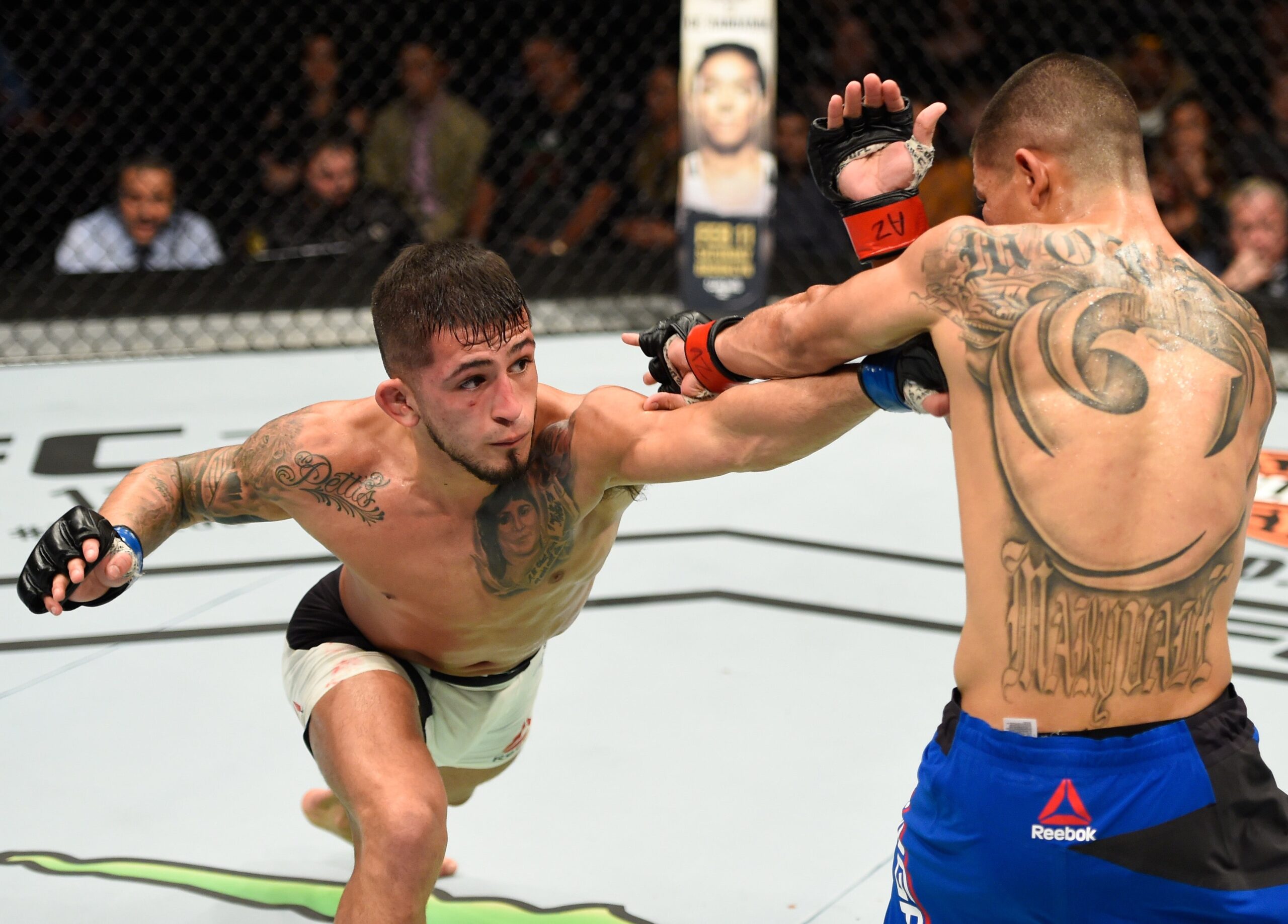
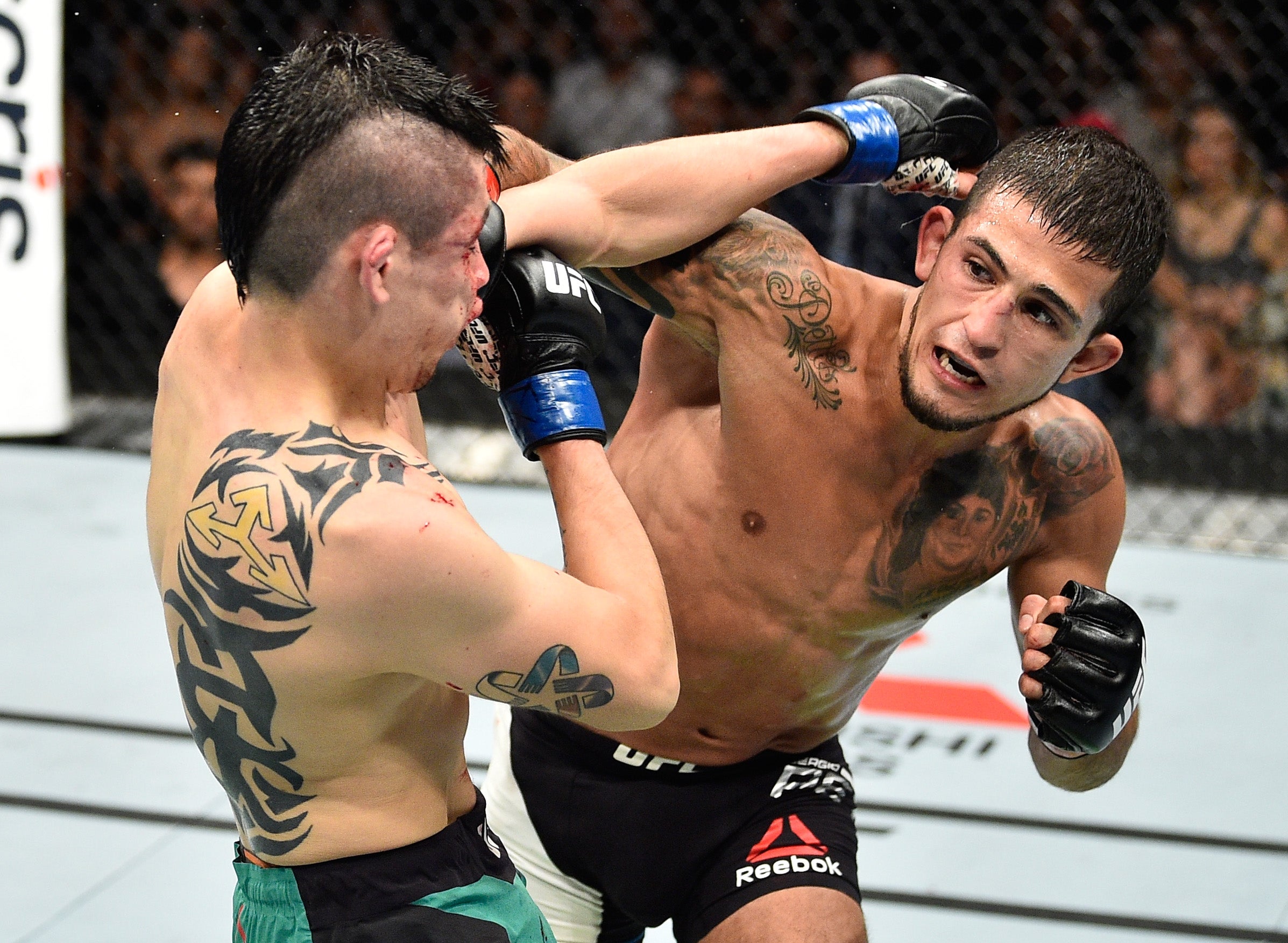
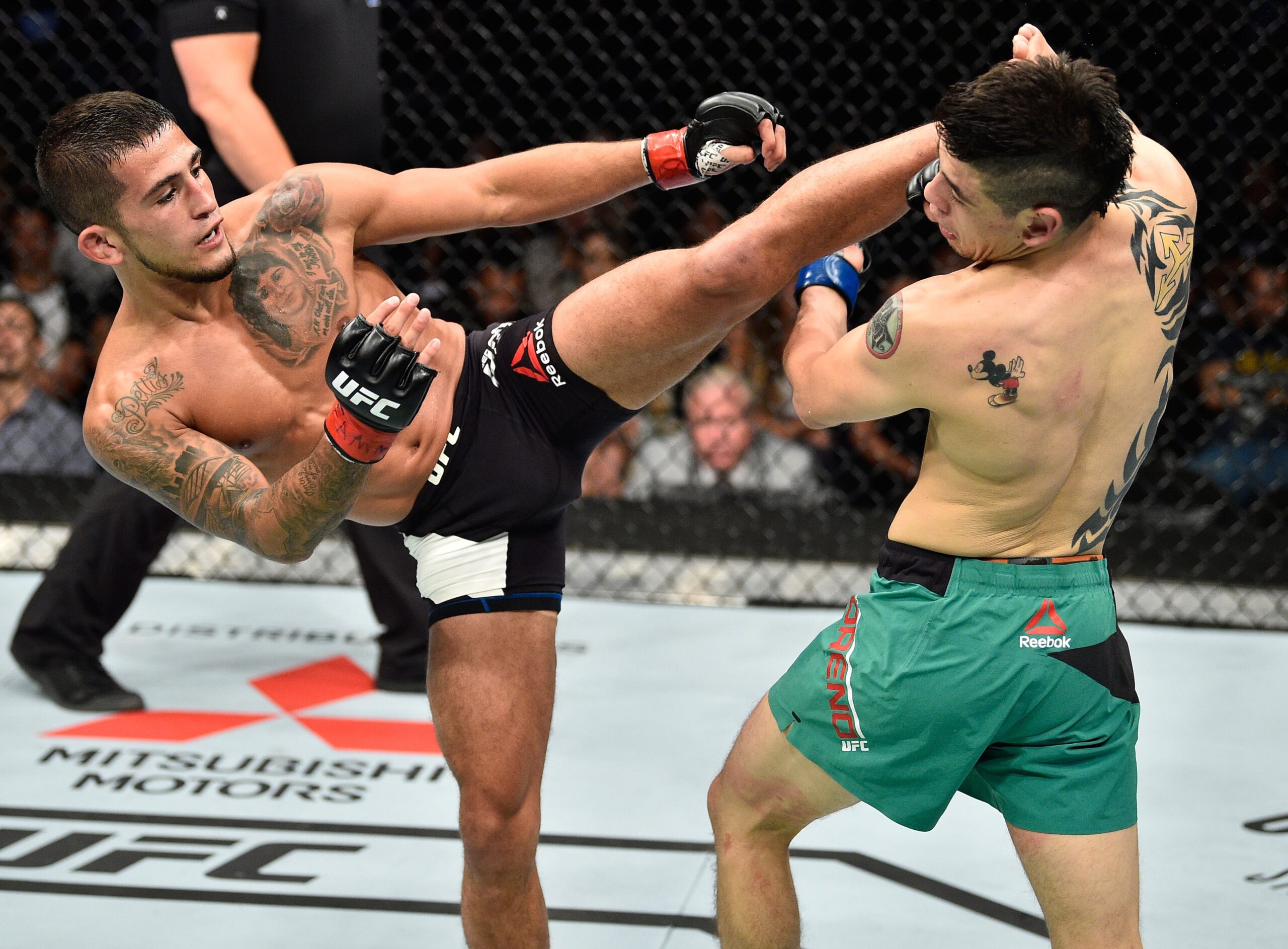
Sergio Pettis has flowing “Pettis” lettering on his right chest, a shaded portrait on his left, and denser work down his right arm. The pieces use different styles and are visible in separate fight photos. Body Art Guru also connects a separate forearm memorial with his father; that report doesn’t identify the chest portrait.

A guarded exchange in the Octagon

Sergio Pettis in a contextual photograph: A guarded exchange in the Octagon; not tattoo evidence

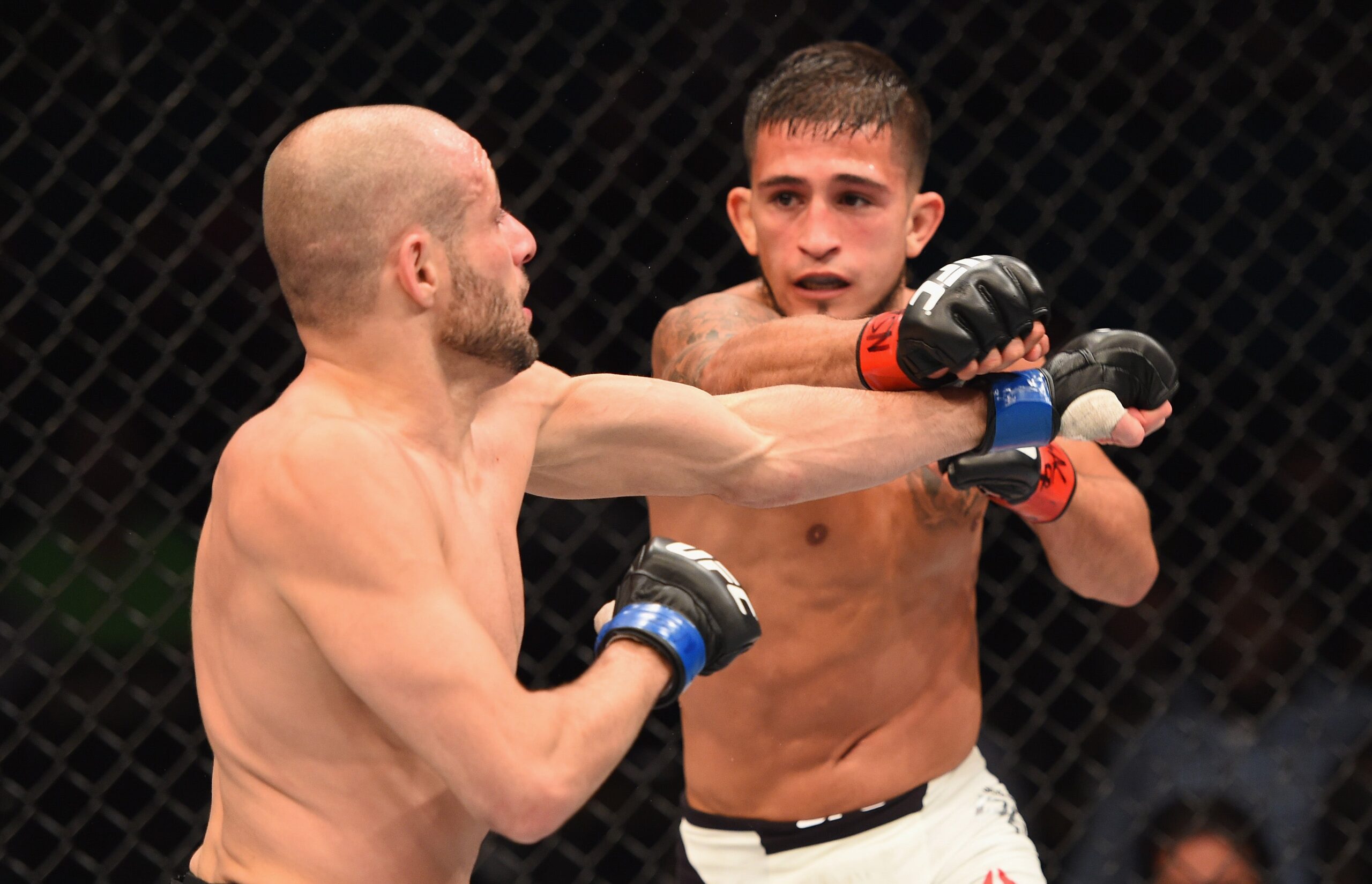
This guarded exchange shows Pettis on the right in white shorts and red wrist tape. An opponent’s arm crosses in front of his chest, so the image is more useful for the fight context than for close tattoo detail. His expression and raised gloves capture the action, while the obstruction leaves parts of the chest and arm out of view.

The Pettis lettering on his right chest

Sergio Pettis tattoos: The Pettis lettering on his right chest

The word “Pettis” is written in flowing script on his anatomical right chest. In this photo he’s on the left, leaning toward John Moraga. A curled capital and linked letters make up the name, with fine branching strokes beneath it as a leaf-like underline.

The script sits above the pectoral’s lower edge with open skin around it. The word is readable; the photo doesn’t establish a dedication, date or artist.

The shaded portrait on his left chest

Sergio Pettis tattoos: The shaded portrait on his left chest

A shaded woman’s face sits inside a decorative border on Pettis’s left chest, with a rose higher near the shoulder. In the punching photo he’s on the right and Brandon Moreno is on the left. The portrait takes up much of the pectoral, but the person’s identity hasn’t been confirmed.

It’s easy to confuse Sergio with his brother Anthony when searching for tattoo stories. An account of Anthony’s portrait shouldn’t be applied to Sergio’s. The face and rose are visible here; their personal meaning isn’t.

The patterned work on his right arm

Sergio Pettis tattoos: The patterned work on his right arm

The right-arm photo shows shaded imagery near the shoulder and curved, spoke-like lines lower down. Pettis is on the left, kicking toward Moreno on the right. His bent arm and the action obscure some boundaries, so the overall pattern is clearer than any one small symbol.

The lines may suggest different things to different viewers, but the photo doesn’t identify an object or meaning. For another fighter’s collection, see Alessio Sakara’s tattoos.

An airborne celebration in Mexico City

Sergio Pettis in a contextual photograph: An airborne celebration in Mexico City; not tattoo evidence

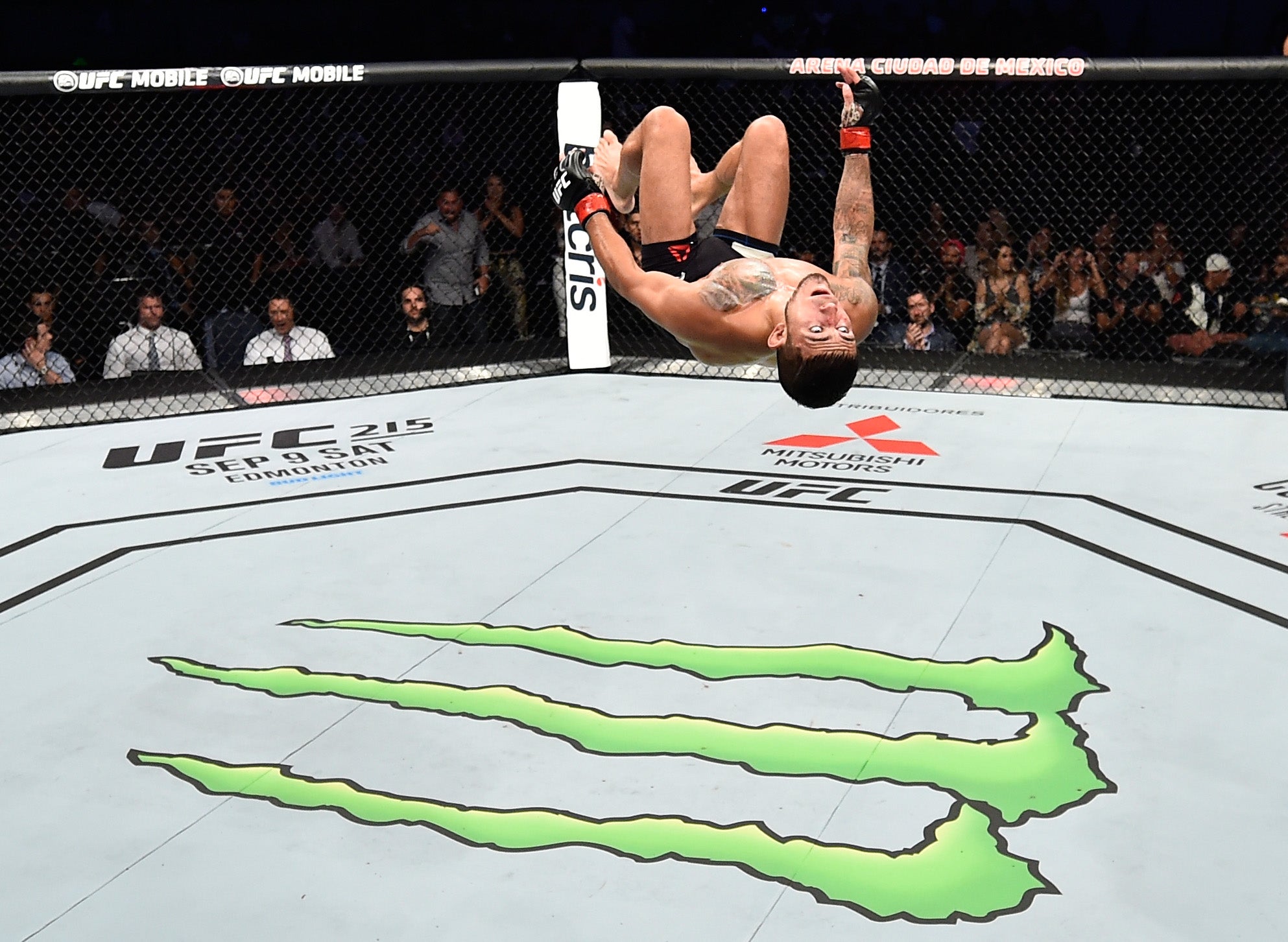
This Mexico City photo catches Pettis upside down in a backflip. The movement and the cage setting dominate; although some ink is visible, the angle and distance don’t work for reading small lettering or studying the portrait.

The embedded interviews are from Pettis and Moreno’s 2017 Mexico City fight. They add the event context, but they aren’t explanations of the tattoos. The clearest visible details remain the surname script, the separate chest portrait and the patterned work on Pettis’s right arm.