
21 Savage’s tattoos are closely connected to the way he has used his face and body to record identity, loss and affiliation. The best-known mark is the dagger between his eyes, but it is only one part of a larger collection that includes face symbols, chest lettering and words tied to his Atlanta music circle. A useful guide has to separate direct explanation from the details that are simply visible in photographs.
Dates also matter. The dagger story belongs to the period when 21 Savage was building his public image, while later portraits show a more extensive torso and facial collection. A design visible in a shirtless portrait is evidence of placement and appearance. It is not automatically evidence of a private meaning. The sections below keep those boundaries clear.
The dagger between 21 Savage’s eyes is a tribute to Tayman

The most documented 21 Savage tattoo is the dagger between his eyes. DJBooth reported that the design was inspired by the blade tattoo Tony Montana wears in Scarface. Savage and his brothers had discussed getting a similar mark, but his younger brother Tayman went further and placed the dagger on his face. After Tayman was killed, Savage got the same basic design as a tribute.
That account gives the tattoo a stronger documented history than the usual internet claim that a dagger simply represents toughness. The placement is visible in close-up photographs, and the family connection is supported by reporting about the design’s origin. The Scarface reference explains the visual source. The later tattoo turns that shared idea into a memorial link between the brothers.
The design is sometimes described as a cross in casual captions, especially when the photograph is distant. A close front-facing image makes the blade shape easier to distinguish. That is a useful reminder that a correct tattoo article needs to identify what the pixels show before assigning a label or meaning.
Slaughter Gang lettering makes the chest a public identity statement
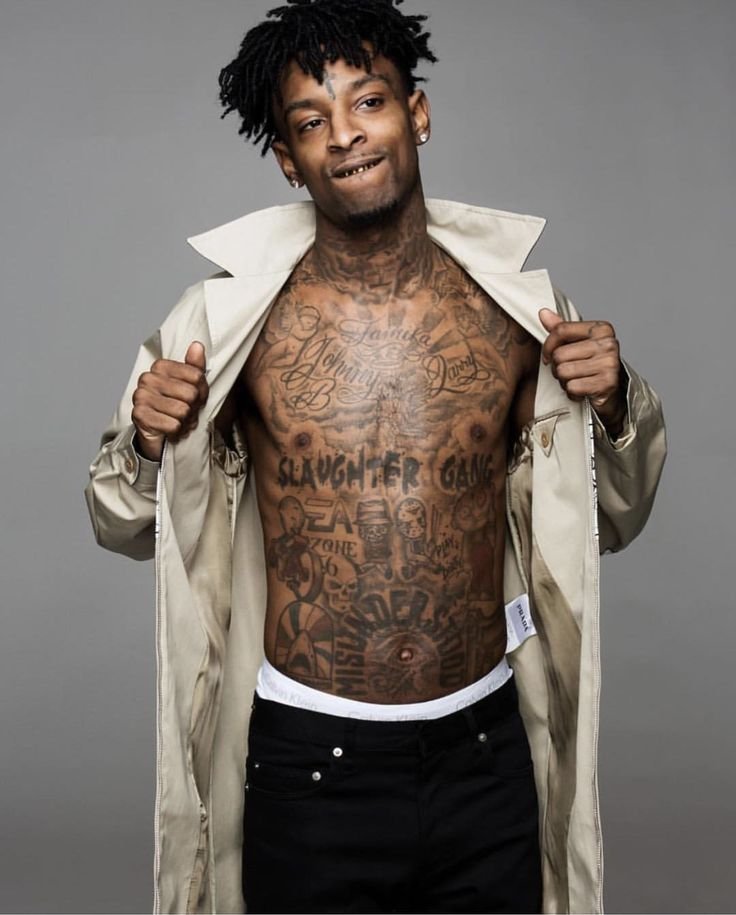
Across 21 Savage’s upper torso, the large Slaughter Gang chest lettering is one of the clearest examples of an affiliation becoming body art. The phrase is connected with the collective and identity surrounding his music, so it functions differently from a small personal symbol whose meaning has never been discussed publicly.
The lettering appears prominently in shirtless portraits and open-jacket photographs. Its scale makes it readable even when smaller chest and abdominal marks are not. The image record supports the wording and the general placement. It does not establish a complete list of every surrounding design, because the rest of the torso is densely tattooed and changes in lighting can hide individual lines.
It is tempting to treat the phrase as a complete explanation of the collection, but that would be too simple. Slaughter Gang is a public affiliation and a recurring part of Savage’s artistic identity. The face tribute has a family story, while the group lettering has a collective one. Those different contexts can exist beside each other without every tattoo being forced into one narrative.
Johnny B Dawg and the torso lettering
Portraits of 21 Savage also show smaller words across the chest and abdomen, including Johnny B Dawg and EA Zone 6. These phrases are visible in published images of his torso and are useful inventory entries because they can be read in the photograph itself. Their presence should not be confused with a confirmed explanation for every surrounding symbol.
The Johnny B Dawg wording is presented as a name or phrase in image records, while EA Zone 6 points toward the Atlanta area associated with Savage’s biography and musical identity. Those associations provide context, not proof of an individual backstory for each mark.
The torso photograph is especially valuable because it shows how the lettering sits among smaller symbols. A cropped face portrait may establish one facial mark but say nothing about the abdomen. A wide shirtless image can document the larger arrangement while leaving fine details uncertain. Both types of evidence have a place, provided the article does not pretend they show the same information.
The Forehead Cross and other face ink

Beyond the main facial mark, 21 Savage has been photographed with additional face and head tattoos, including lettering and symbols around the forehead, cheeks and sides of the face. GQ and HotNewHipHop coverage describe the face as a deliberate place of significance for Savage, but the available reporting does not provide a confirmed private meaning for every small design.
That uncertainty is not a reason to turn the section into a list of guesses. A face tattoo can be catalogued by its shape, approximate location and date of the photograph. If a source identifies a phrase or explains a mark, that detail can be added. If the image is too small or the design changes between periods, the article should say so rather than borrowing a standard interpretation from another person’s tattoo.
The result is a collection with several different layers: a memorial facial mark, collective lettering, torso words that can be read in portrait photography, and smaller symbols whose personal meanings are not always published. That is a more accurate picture than treating all of the ink as one symbol system.
The strongest visual record combines close face photographs with shirtless or open-jacket portraits. The face images are best for the facial work. The torso images make the lettering and family-related words easier to locate. Dated sources help readers understand that the collection expanded over time rather than appearing all at once.
There is no single official public inventory that settles every line. Some web pages repeat one another, some captions confuse symbols and letters, and some photographs show tattoos only at a distance. A careful guide therefore names the designs that can be seen or sourced and leaves unconfirmed meanings open.
21 Savage’s tattoos are most useful when read as a record of relationships and affiliations: a memorial at the center of the face, a collective written across the chest and personal or regional references distributed across the torso. The photographs show the ink. The strongest reporting explains the context. The responsible article keeps those two kinds of evidence together without pretending they are identical.