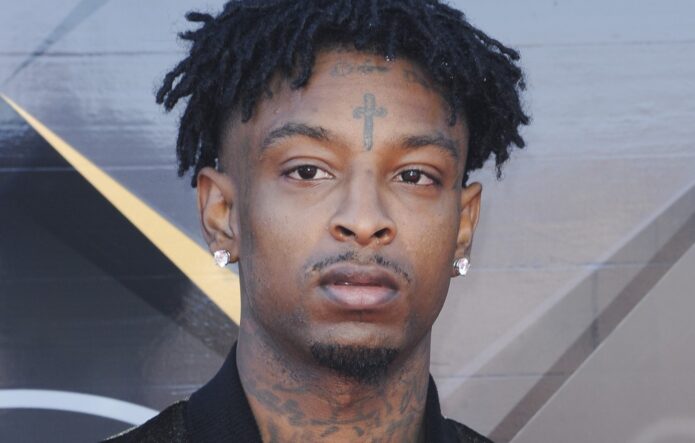
21 Savage’s tattoos tell several stories at once: the dagger between his eyes honors his late brother Tayman, Slaughter Gang spans his chest, and other words and symbols appear across his face and torso. Photographs show where the ink sits; interviews and reporting fill in some of its history.
The dagger dates to the period when Savage was building his public image. Later shirtless portraits show a fuller set of face and torso tattoos. Those images can establish what a design looks like and where it sits, but they cannot reveal its personal meaning on their own.
The dagger between 21 Savage’s eyes is a tribute to Tayman
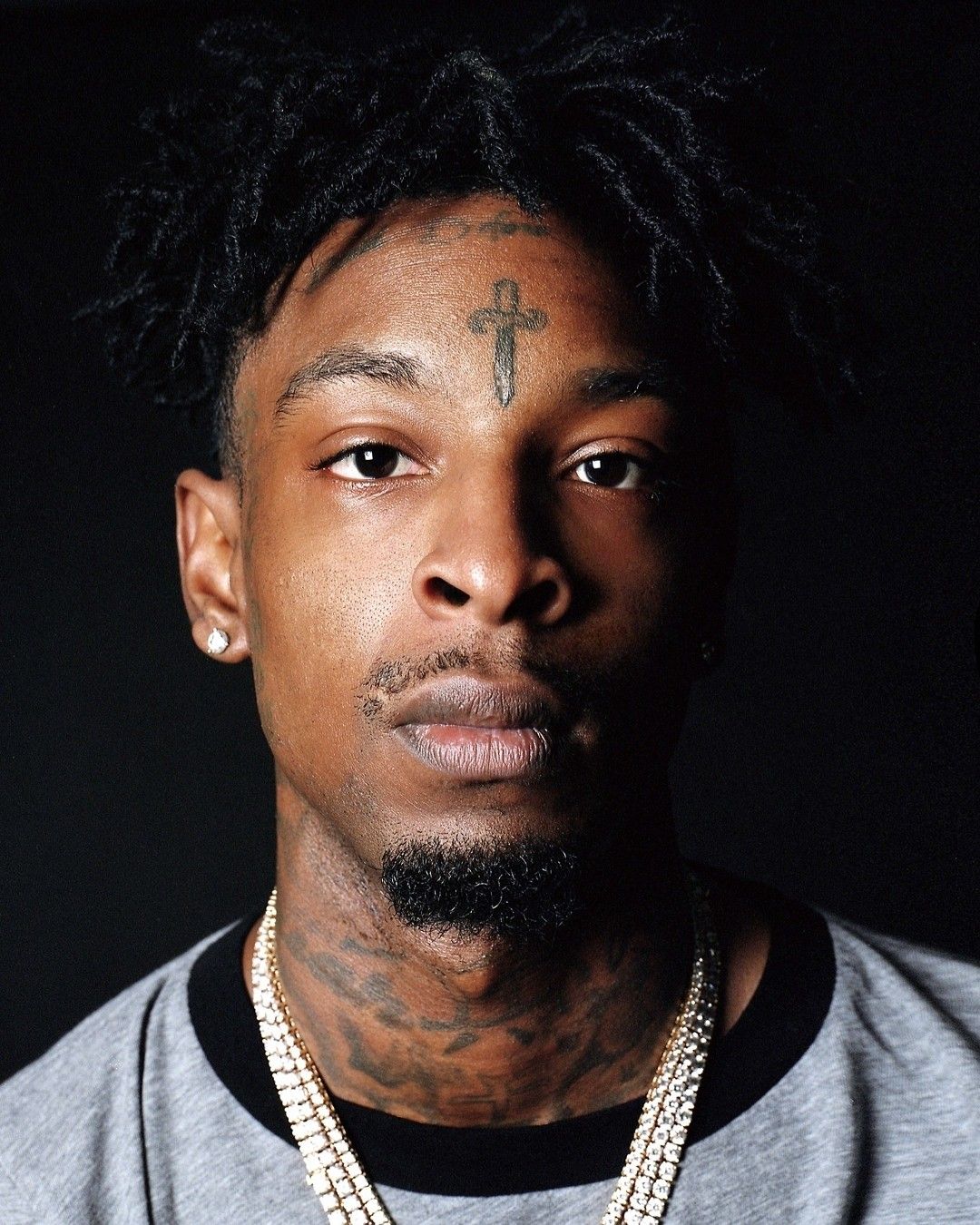
The mark with the clearest backstory is the dagger between his eyes. It draws on the blade Tony Montana wears in Scarface. Savage and his brothers had talked about getting one; his younger brother Tayman got the face tattoo first. After Tayman was killed, Savage had a similar dagger inked in his memory.
The tattoo joins a movie reference to a family tribute. Close-up photographs confirm its position, and reporting traces the design to Tayman. Claims that the dagger simply stands for toughness miss the story Savage has shared.
From a distance, some captions call it a cross. In a clear, straight-on photo, the blade shape is easier to see. The distinction matters because a small mark can be mislabeled when the image is blurry.
Slaughter Gang lettering makes the chest a public identity statement
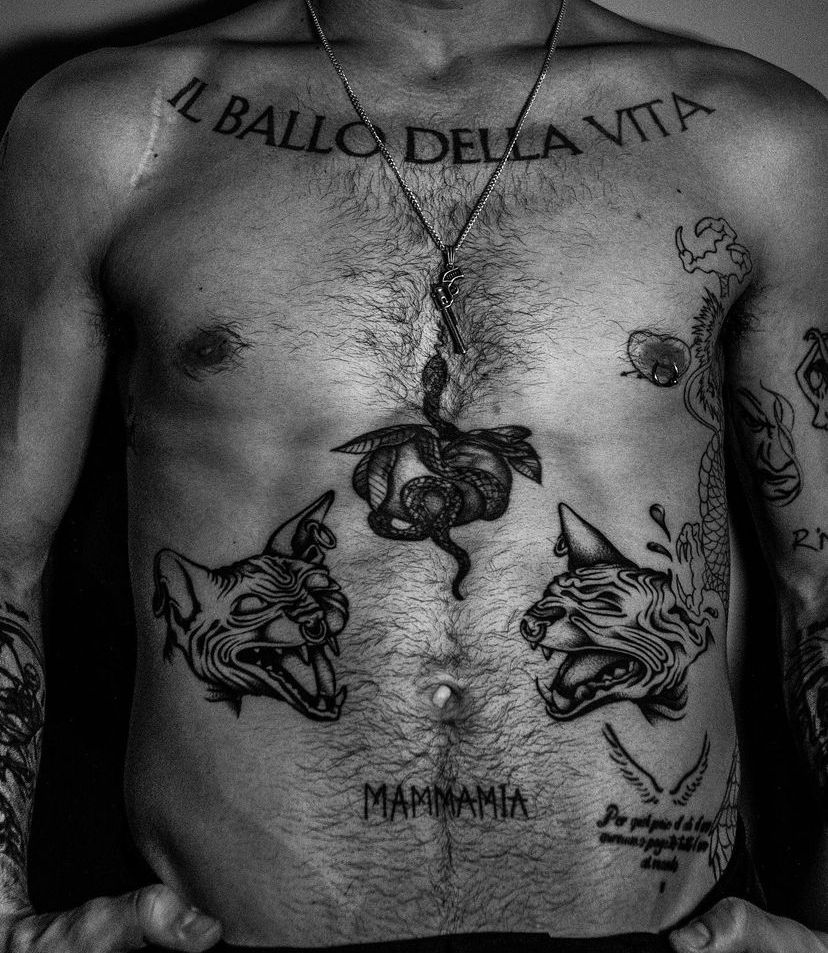
The large Slaughter Gang chest lettering stands out across Savage’s upper torso. It names the collective tied to his music and public identity, giving the chest piece a different role from a small symbol with no public explanation.
The words are easy to read in shirtless and open-jacket portraits. Smaller marks nearby are harder to make out: lighting, pose and dense tattooing obscure details. The photos confirm the phrase and its broad placement, but they do not provide a full inventory.
Slaughter Gang is one part of the collection, not an explanation for all of it. The dagger is tied to Tayman; the chest lettering points to a collective. Those stories sit together without needing one meaning to cover every tattoo.
Johnny B Dawg and the torso lettering

Torso photos also show Johnny B Dawg and EA Zone 6 across the chest and abdomen. Both phrases are legible in published images, though a readable tattoo does not tell us everything about why it was chosen.
Images identify Johnny B Dawg as a name or phrase. EA Zone 6 points to the Atlanta area connected with Savage’s life and music. That context is useful, but it does not confirm a private story for either tattoo.
A wide torso shot shows how these words sit among smaller symbols. A cropped face portrait may establish one facial mark while leaving the abdomen out of frame. Shirtless photos give a broader view, though fine details can still be hard to read.
The Forehead Cross and other face ink
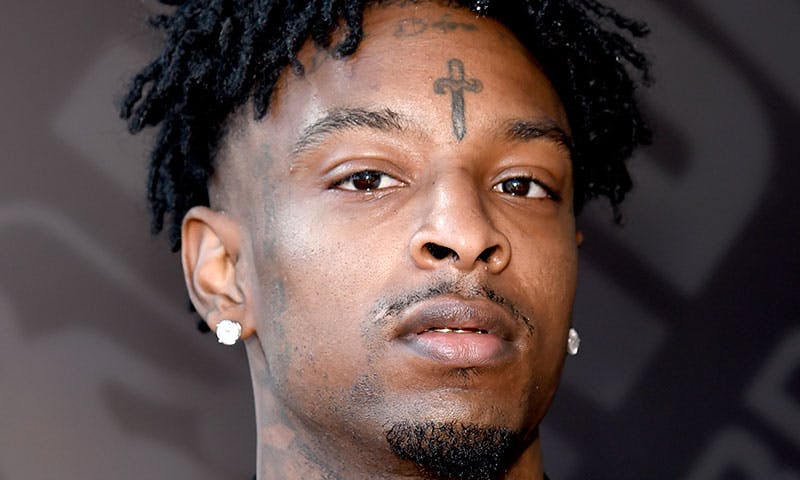
Photos show more ink across Savage’s forehead, cheeks and the sides of his face, including small letters and symbols. Public accounts do not explain the personal meaning of each mark.
For these tattoos, the visible details are often the most reliable ones: shape, location and the date of the photograph. A source may identify a phrase or give its history. When an image is too small or a design looks different in later photos, it is better to leave the uncertainty than borrow a standard meaning from someone else’s tattoo.
Taken together, the collection includes a memorial dagger, Slaughter Gang lettering, readable torso phrases and smaller face symbols whose meanings remain private. The tattoos carry different stories; they are not one code to decode.
Why the close-ups matter as much as the wide shots
Close-up face photos work best for the facial tattoos; shirtless or open-jacket portraits show the chest and abdomen. Dated pictures also help place later additions alongside older designs.
No single public inventory settles every tattoo. Online captions often repeat one another, misidentify symbols as letters or rely on distant shots. The clearest details are the ones visible in a good photo or traced to a source; the rest remain uncertain.
Viewed as a whole, the tattoos point to relationships and affiliations: Tayman’s tribute at the center of the face, Slaughter Gang across the chest, and personal or Atlanta references on the torso. Photographs show the designs; reporting adds context where it exists.
Slaughter Gang is placed to be seen. The broad lettering across the chest reads clearly in a straight-on photo; marks nearby need a closer look because the chest can curve or flatten depending on the angle.

Johnny B Dawg sits in a different context from the Slaughter Gang phrase. Both use lettering, but their placement sets them apart. Keeping them separate makes it easier to see which part of the torso each reference belongs to.
Face ink changes the way every other tattoo is seen. The Forehead Cross and smaller nearby marks become part of his expression, not just details in a full-body image. Makeup, hair and lighting can hide them, so a close portrait shows more than most event photos.
Some arm and torso tattoos can be described by their shape or placement even when their meaning is unknown. A clear symbol does not always come with a public explanation.
The collection has changed over time: new work appears, older tattoos fade, and later photos may show more face ink than earlier ones. Stage shots can hide his arms, while dated portraits make those shifts easier to follow.
The collection balances public affiliation and personal references. Slaughter Gang and the forehead marks are immediately visible; the dagger and smaller arm details become clearer in close-up.
When comparing older and newer photos, look for changes in colour, cover-ups or added lettering. A photo can show the change, but only Savage or a reliable source can explain the reason for it.
No single line explains the collection. Each tattoo has its own size, place and history, so the photos are most useful when they show the area being discussed.
That leaves room for each design to keep its own context: the chest lettering, the forehead marks and the smaller torso work can be described without assigning them the same meaning.
The photos make the main groups easier to follow: a memorial dagger, chest lettering, and smaller references on the face and torso.
A close portrait can confirm a mark; its backstory still depends on what Savage has said or what reliable reporting has established.
What the images don’t answer stays private.