
Cande Tinelli’s tattoos range from full-back blackwork and sleeves to neck, chest, hand and facial ink. ElDoce, A24, eltrece, TN and an iNKPPL portfolio show different parts of the collection. Tinelli, an Argentine singer and media figure, has discussed self-expression; the photos show placement, not the meaning of every design.
Cande Tinelli’s full-back blackwork and sleeves
An ElDoce studio photo shows Tinelli facing away, revealing blackwork from the shoulders down the back and onto the arms and upper legs. Solid dark areas sit beside ornamental lines and open skin. The source gives a broad view of the composition, but not a private meaning for every shape.

The neck and upper-chest blackwork in an A24 portrait
A24’s black-and-white portrait frames Tinelli’s face, neck and upper chest. Dark work rises beneath the jaw and meets geometric shapes across the chest. The monochrome image makes the contrast clear; it does not establish whether every section was done at the same time.
A24 also covered public criticism around the neck design. The portrait shows the tattoo’s placement, while the reporting supplies that context.

The iNKPPL side profile and ornamental shoulder work
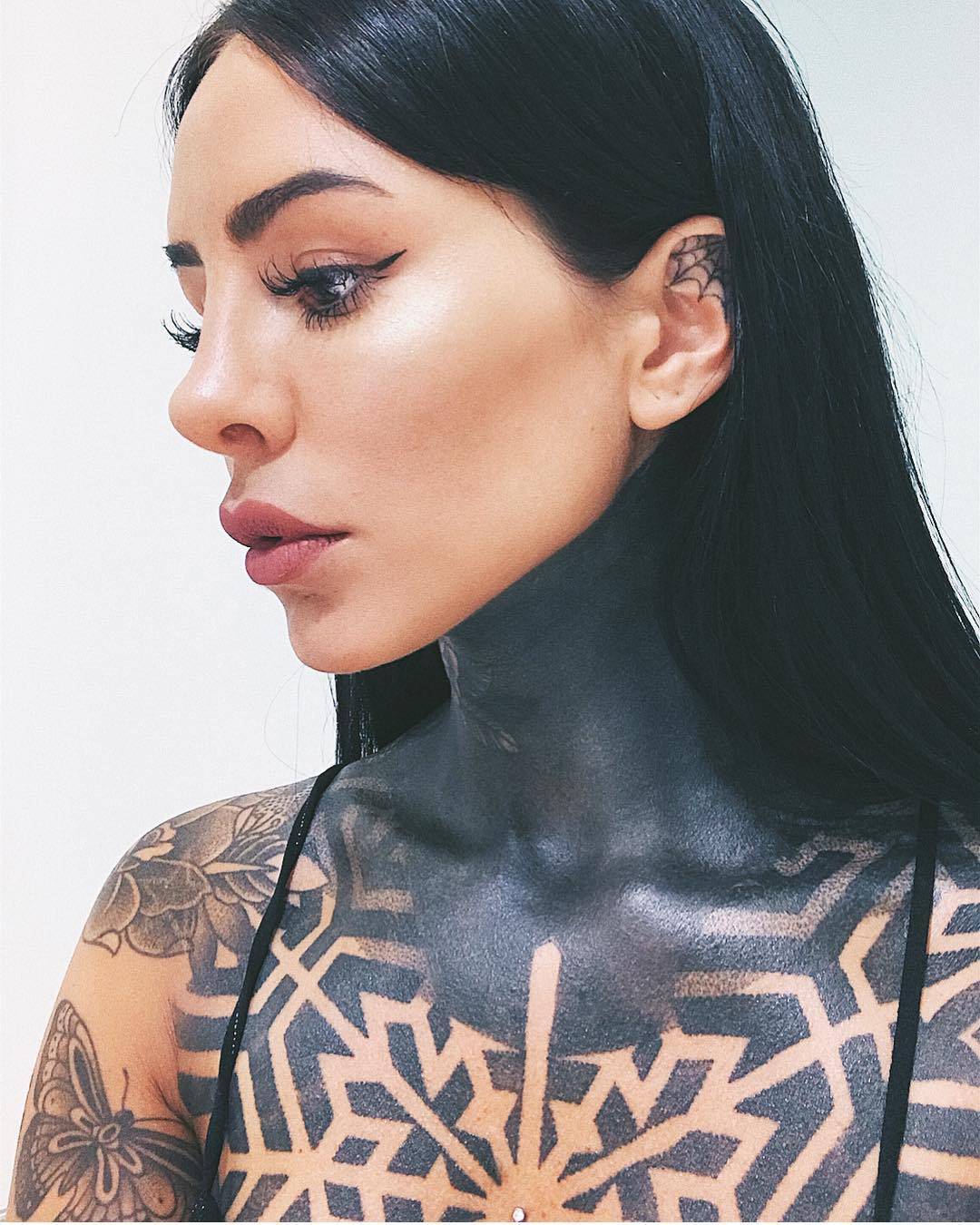
An iNKPPL portfolio portrait shows Tinelli in profile. Floral and geometric forms cross the shoulder toward the neck and chest, with fine linework behind the ear visible at this angle. The side view shows how the shoulder piece turns around the body.
The orange-jacket editorial frame and visible hand ink
In an eltrece editorial photo, an orange jacket slips from Tinelli’s shoulders as she raises a hand in a peace sign. The hand, neck and chest work are visible in fragments; the jacket covers part of the shoulder. This frame shows how clothing changes what can be seen, rather than revealing a complete map.

The facial Angel tattoo in a close-up report
TN’s close-up documents the word “Angel” near the side of Tinelli’s face. Hair is swept back, leaving the small lettering visible beside her eye and cheek, with denser neck and arm work nearby. The report identifies the design; the photograph gives its placement.

What the reporting confirms about her approach
ElDoce published the full-back view, A24 covered criticism of the neck tattoo, and eltrece reported on Tinelli’s willingness to live with visible ink. Regional outlets have also reported her comments about self-expression. Those accounts provide broad context, but do not explain every ornamental line or dark field.
The source record supports extensive blackwork across the back and sleeves, plus tattoos on the neck, chest, shoulder, hand and face.
Why the archive changes from photograph to photograph
Each photo gives a different view: the back studio image opens the full design; A24 shows the front of the neck and chest; iNKPPL reveals the shoulder’s depth; eltrece catches the hand beneath a jacket; TN isolates the facial lettering. Clothing, angle and contrast account for much of what appears to change between frames.
A restrained map of the collection
The five originals move from full-back coverage to the neck and chest, then around the shoulder, hand and face. The separate featured portrait is for identity context and is not counted as tattoo evidence. None of the inline images is a repeat of another.
Composition around the silhouette
The photos show how Tinelli’s designs use scale and contrast: broad back coverage, dark work around the neck, geometric chest shapes, ornamental shoulder lines and small facial lettering. A side angle reveals the shoulder’s wrap; an open-back view shows the larger field. These are observations about composition, not a template to copy.
A source-led conclusion
The published images document several tattooed areas and different settings, while the named outlets supply limited context about Tinelli’s approach. The collection’s full private meaning and the timeline of every session are not established. The interview below offers more of Tinelli’s own perspective.
One thought on “Cande Tinelli Tattoos: Blackwork, Sleeves, Neck and Facial Ink”