Photos of Wesley Sneijder show sleeve work across both arms, a biblical line on his chest, an image on his side and smaller marks on his hands and neck. Match, portrait and post-match frames reveal different parts of the collection rather than one complete inventory.
Sneijder, the former Netherlands, Inter Milan, Real Madrid and Galatasaray midfielder, has spoken about some tattoos directly. Reports also connect other pieces with his son and the Champions League. The images establish where the ink appears; personal meanings are included only where an interview or reliable report gives context.
The Netherlands close-up puts the arm sleeve first
A Goal photo from the Netherlands shows Sneijder with both arms raised. Black forms, lettering and smaller symbols run from upper arms toward the wrists, visible as he celebrates.

The pose makes the sleeve work read as broad coverage across both arms, though it doesn’t identify every design. The left and right sides aren’t identical, and a single close crop would miss that difference.
A shirtless post-match frame maps chest and family ink
An Associated Press photo carried by The Independent shows Sneijder shirtless after a Netherlands match. A long biblical line crosses his chest; a number 10 appears on his forearm, with a portrait on the side of his torso.

The frame shows how the lettering, side portrait and forearm pieces occupy different areas. Reports connect some tattoos with family and football, but the photograph alone doesn’t explain every design.
The Kurier tattoo photograph shows the full torso story
A Nordbayerischer Kurier feature gives a wider, higher-angle view of Sneijder shirtless on the grass. The chest text, side portrait and broad forearm band are visible together.

This is a separate original from the closer Independent image. Its wider crop shows how the torso and arm pieces sit in relation to one another, while still leaving parts of the body outside the frame.
An Inter-era portrait isolates the forearm lettering
An Inter-era Independent portrait shows Sneijder speaking into a microphone in a black-and-orange shirt. His raised forearm comes close to the camera, exposing lettering, curved bands and darker shapes while the rest of the body stays covered.

The arm detail is clearer here than in a full-body match photo, and the shirt leaves the chest out of view. The image records the sleeve in a public setting rather than a posed, shirtless portrait.
A later tattoo match frame keeps the collection in motion
A Fox Sports warm-up photo shows Sneijder turning toward the camera and laughing. His arm is bent, with the upper work, forearm and lower bands visible against the training top.
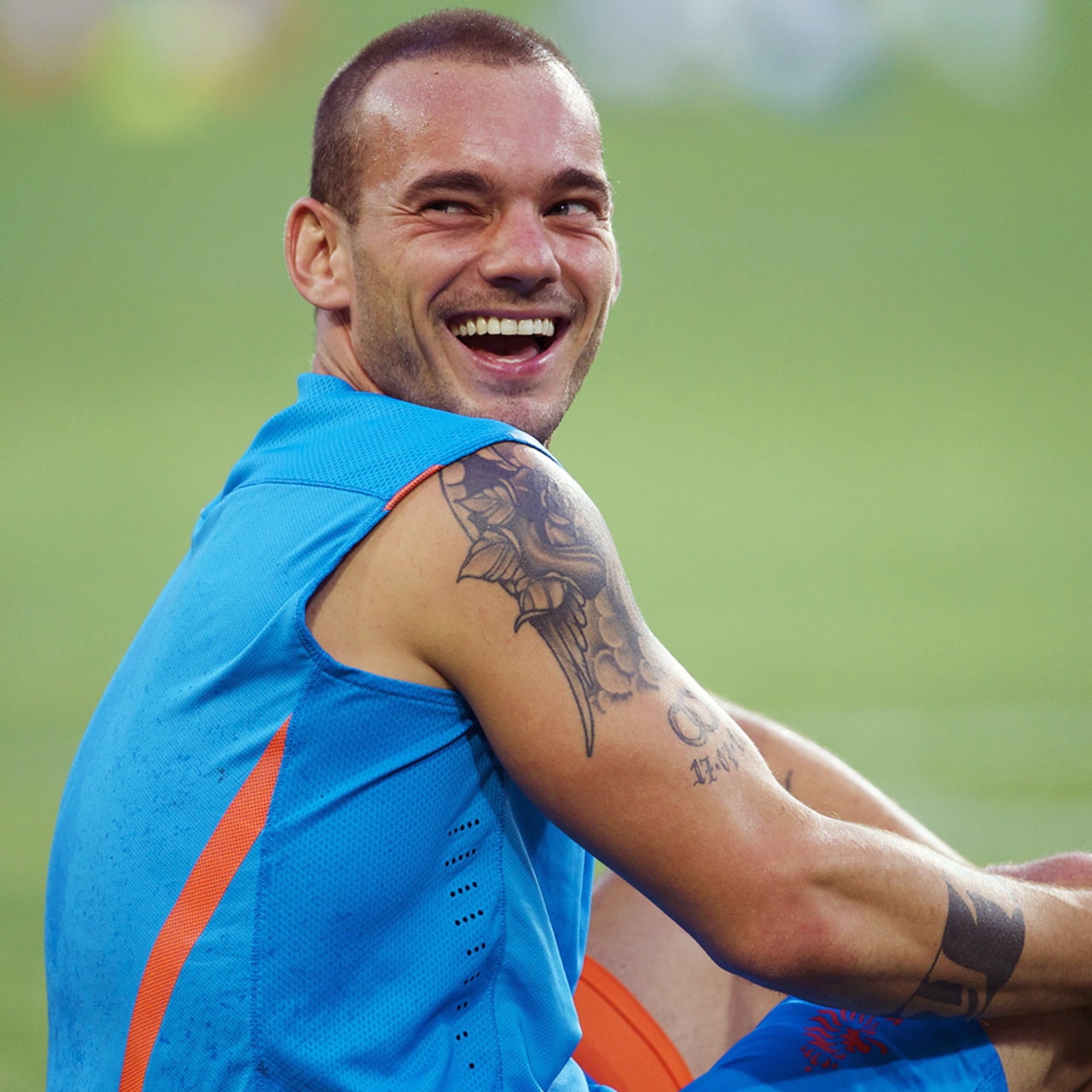
The bent arm changes how the sleeve looks, while smaller marks are partly hidden by the pose and light. It’s a distinct football moment, not a repeat of the raised-arm image.
What the documented interviews actually explain
RTL reported in 2011 that the portrait on Sneijder’s side was connected with Yolanthe Cabau. Shownieuws later quoted him saying he still stood by the tattoo. That records his own view without turning it into a prediction about their relationship.
TUDN connects a tattoo to his son and a Champions League reference, while Times of India describes a phrase for his child. Sky Sport’s gallery also documents his interest in the tattoo process. These sources support family and career context for particular pieces, not a meaning for every nearby mark.
Why a visual sequence is better than one frame
The five inline photos move from raised arms and a shirtless post-match view to a wider torso image, an Inter-era forearm portrait and a later warm-up frame. Together they show the chest, side and arm work from different angles. The separate featured portrait identifies Sneijder and is not counted as tattoo evidence.
A De Oranjezomer interview with René and Wesley laughing about tattoos appears below. It adds conversation, but the written reports remain the source for the specific meanings described here.
The clearest record is the visible sleeve work, chest text and side portrait, alongside the family and football references reported by credible sources. Other designs can be described by placement without guessing what they mean.