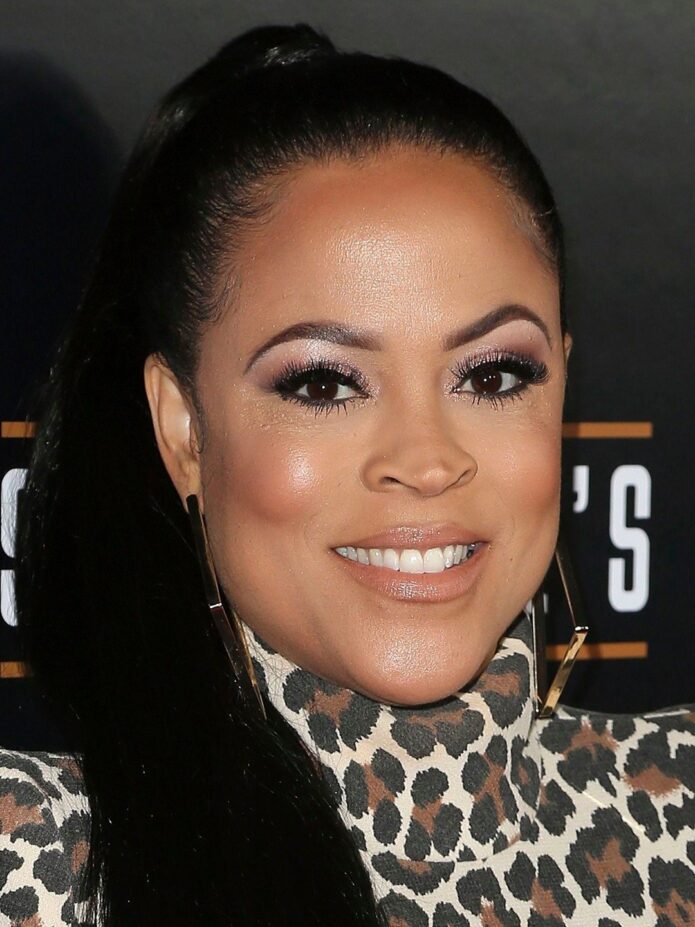
Shaunie Henderson’s tattoos tell a before-and-after story across her back and wrist. In June 2025, the Basketball Wives creator showed a large, colourful lotus flower covering an older rose-and-butterfly design. The earlier piece carried the names of her children, while the new image replaces the visible arrangement with layered petals, leaves and saturated blue, pink and red colour.
The new back tattoo was documented in footage from Houston tattoo artist Byron Lofton and in coverage from The Shade Room. Henderson explained that the covered design was about 25 years old and had last been touched up 19 years earlier. That history makes the reveal more than a simple new image. It shows one tattoo collection changing while an older family marker remains part of the story underneath.
Shaunie Henderson’s lotus tattoo cover-up
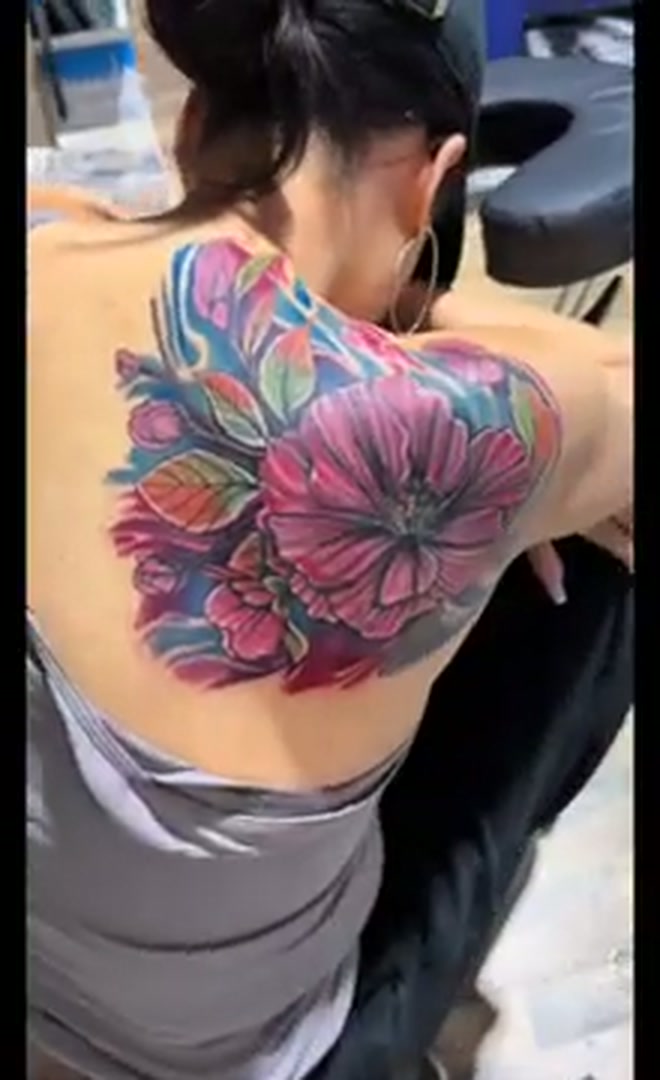
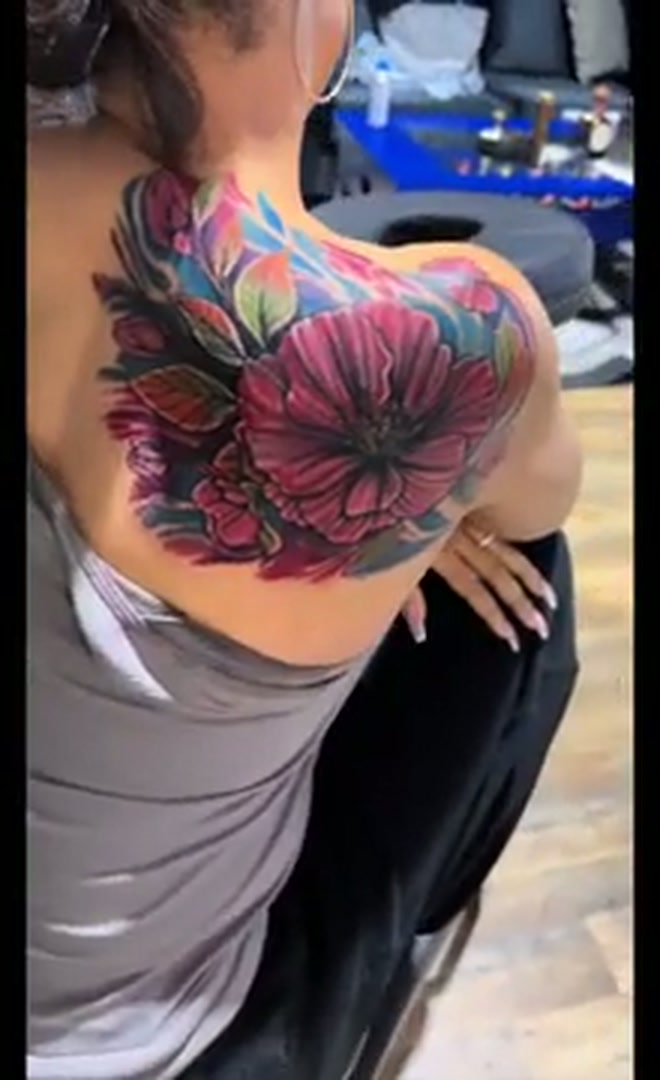
The finished lotus fills a broad section of Henderson’s upper back. The central flower is large and rounded, with densely layered petals in deep pink and wine tones. Around it, smaller blossoms and leaves extend toward the shoulders and lower edge of the composition, creating a floral field rather than a single isolated bloom.
Blue appears behind and between the flowers as a strong background colour. It separates the petals from the skin and gives the piece a painted, saturated appearance. Red and green accents sit inside the leaves and smaller blossoms, while darker outlines preserve the edges of the petals. The finished image is therefore built from colour blocks as much as from linework.
The back placement gives the design enough room to hide the older rose and butterfly. The image extends across the upper back instead of being limited to a narrow strip. That width is visible in the reveal photograph, where the lotus occupies the area around the shoulder blades and the surrounding flowers reach outward toward the shoulders.
The first view of the back tattoo reveal
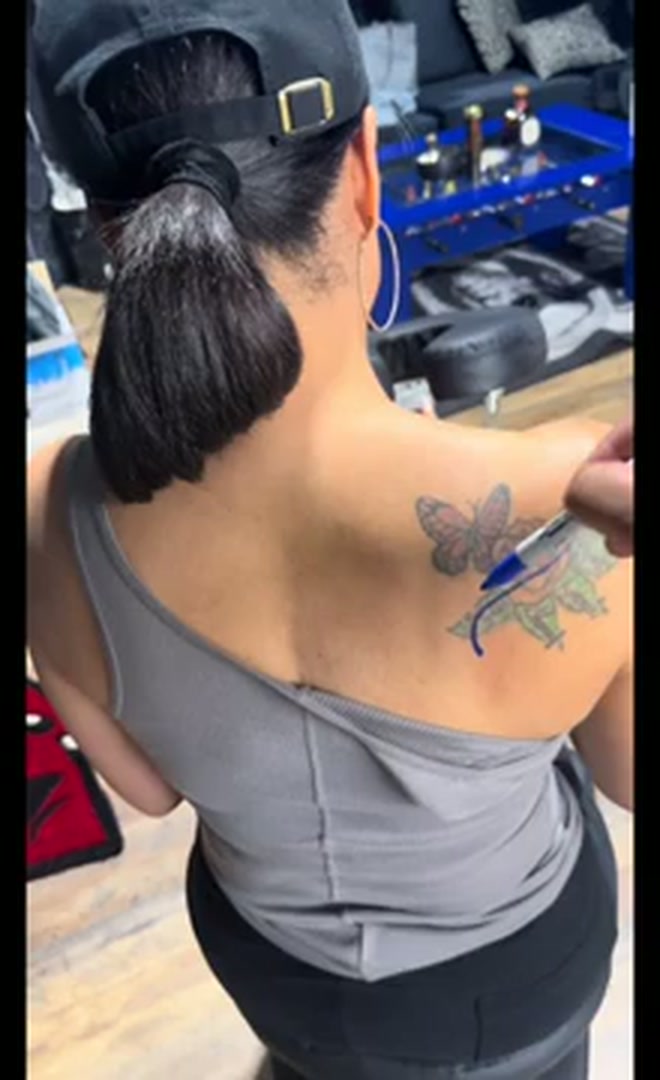
The reveal footage shows Henderson seated with her back turned while the finished work is displayed. Her face is not the subject of that tattoo frame. The image concentrates on the skin and the floral composition, which makes the scale and the coverage easy to see.
The main lotus is positioned slightly to one side of the back, with a large dark centre and petals that open in several directions. Smaller blossoms cluster along the edge, so the design does not end with a hard rectangular border. The outer shapes taper into leaves and curved colour patches that help the new image sit across the older area.
The composition has a clear visual hierarchy. The largest flower holds the centre of attention, the surrounding blossoms create a second layer, and the blue background fills the gaps between those forms. The result reads as one finished floral scene even though the tattoo contains several separate flowers and leaves.
The finished lotus tattoo image
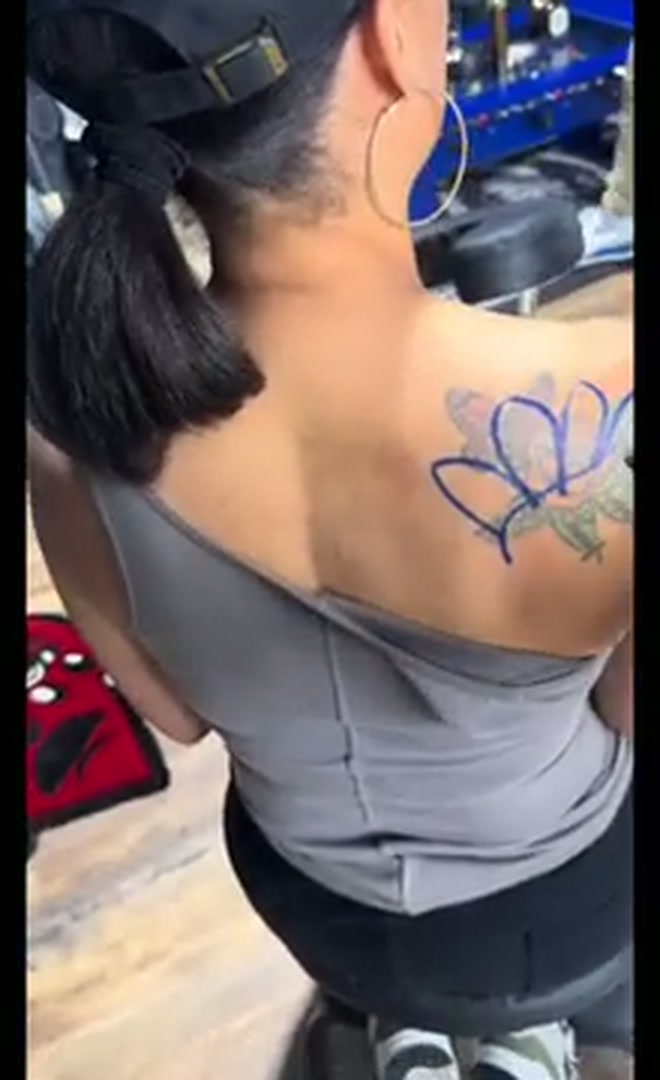
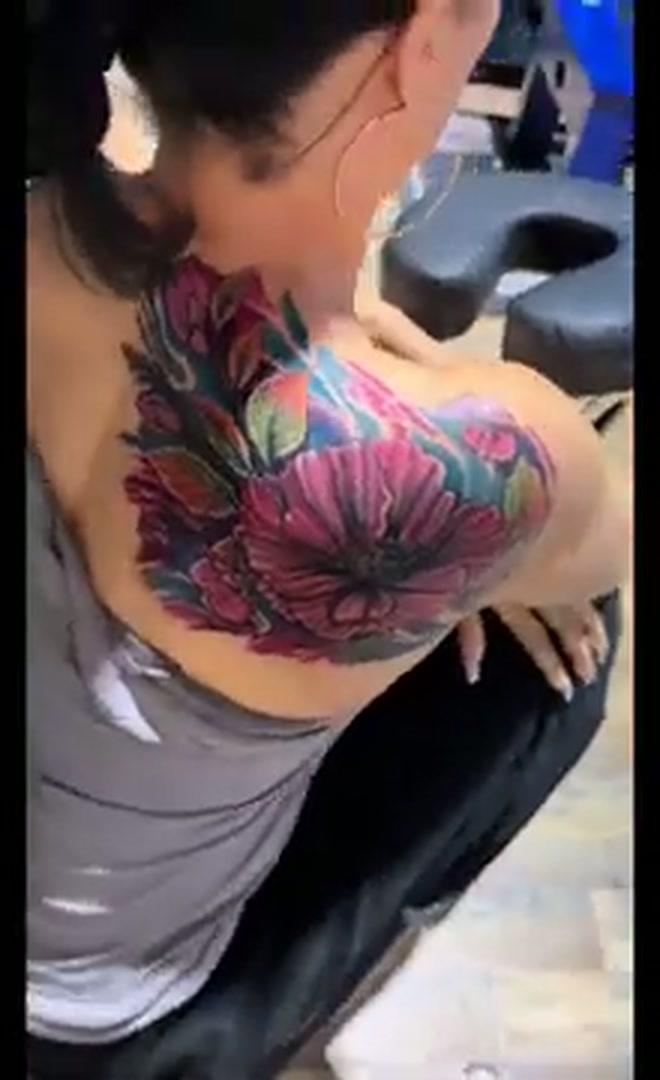
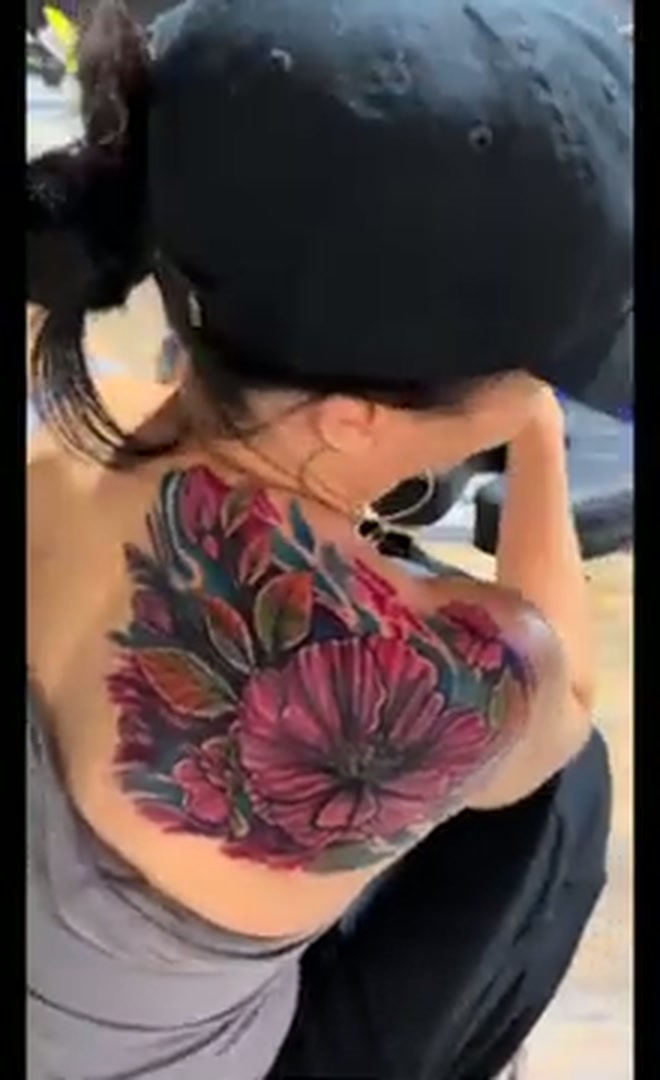
The completed tattoo uses a vivid palette that is immediately different from the family design described in the reporting. The older rose and butterfly were linked to names written inside the earlier arrangement. The new surface is dominated by flowers and colour, with the lettering no longer visible in the inspected photograph.
Pink petals create the strongest visual note. Some petals are pale near the edges and darker toward the centre, while other blooms use almost solid magenta and red. The blue background makes those warm colours appear even brighter and helps the large lotus remain legible from a distance.
Leaves add green and muted tones around the blossoms. Their pointed shapes break up the circular petals and give the back piece directional movement. Several leaves turn outward toward the shoulders, while smaller buds sit closer to the centre. This variety prevents the composition from looking like one repeated stamp.
The darker outlines are especially important around the centre flower. They define the petal overlaps and hold the individual forms together as a single large image. The new tattoo therefore has both the softness associated with floral imagery and the strong structure needed to cover an older design.
The earlier family tattoo marking
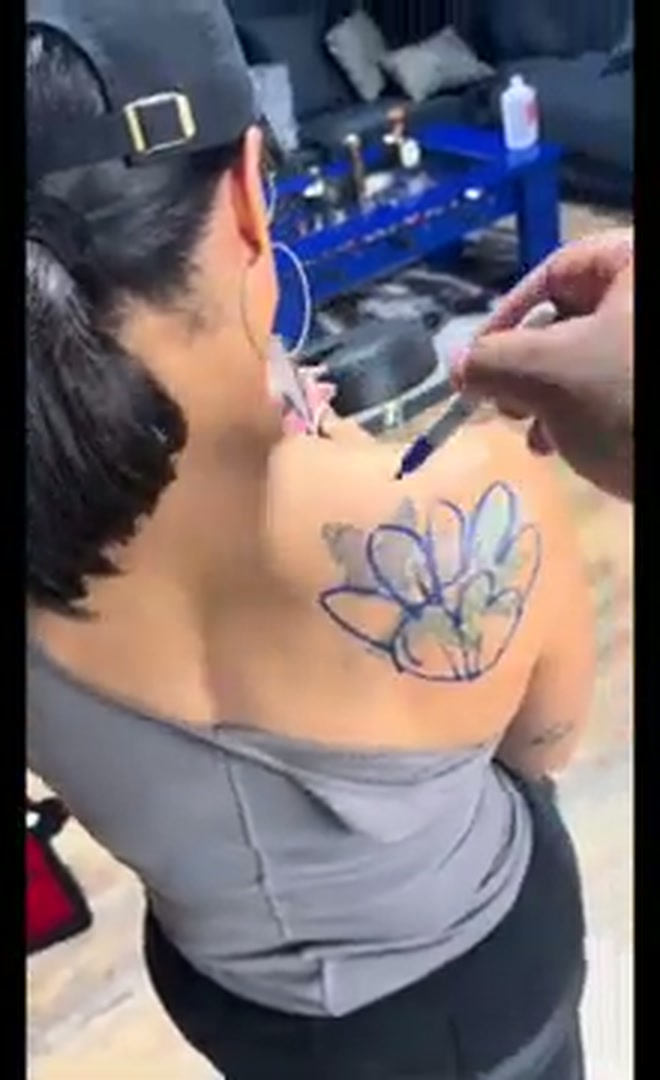
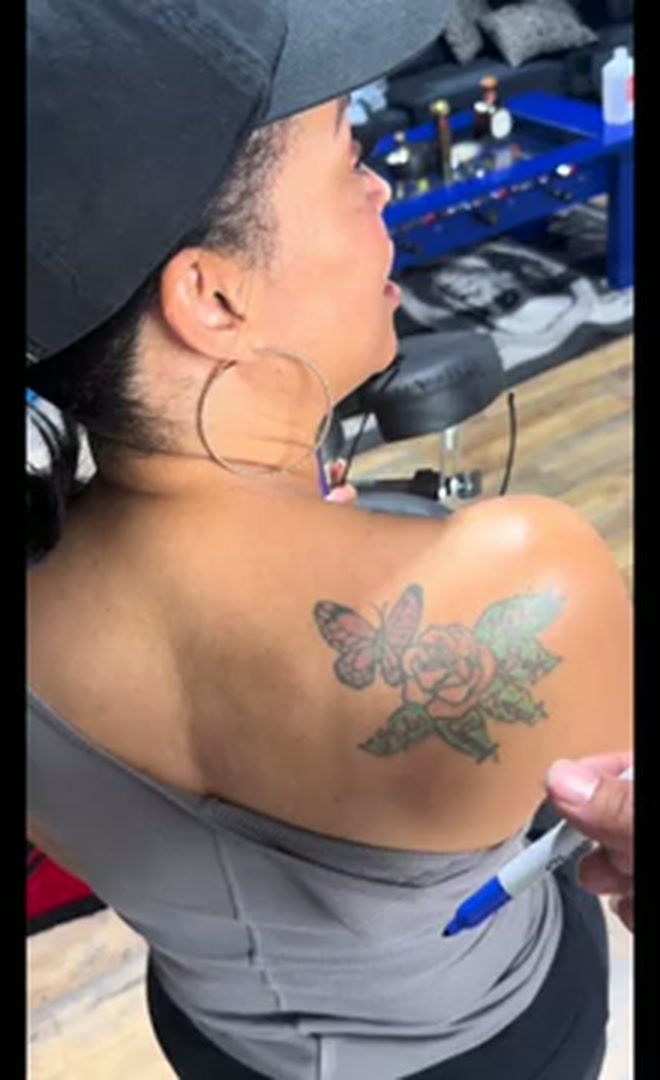
Before the lotus, Henderson had a rose and butterfly design on her back. Reporting from The Shade Room and the Times of India described the rose as having five leaves, with each leaf holding the name of one of her children. The butterfly accompanied the rose and formed part of the same family-focused arrangement.
Henderson said the old tattoo was approximately 25 years old. She also explained that the most recent touch-up, which added her youngest daughter’s name, had happened 19 years earlier. Those details place the original tattoo in a much earlier period of her life and explain why the old image had a long visual history before the cover-up.
The earlier design was meaningful because the names were visible inside the flower structure. The rose was not simply a floral symbol. Its leaves served as containers for family names, and the butterfly added another recognisable form beside it. The new lotus changes the visible imagery while the history of those names remains documented.
The cover-up consequently has two layers of meaning. The finished surface is a new floral composition, while the covered image records an earlier family tribute. The sources identify the older forms and the reason for the change without claiming that the new lotus erased the importance of the children represented underneath.
The names beneath the cover-up tattoo petals
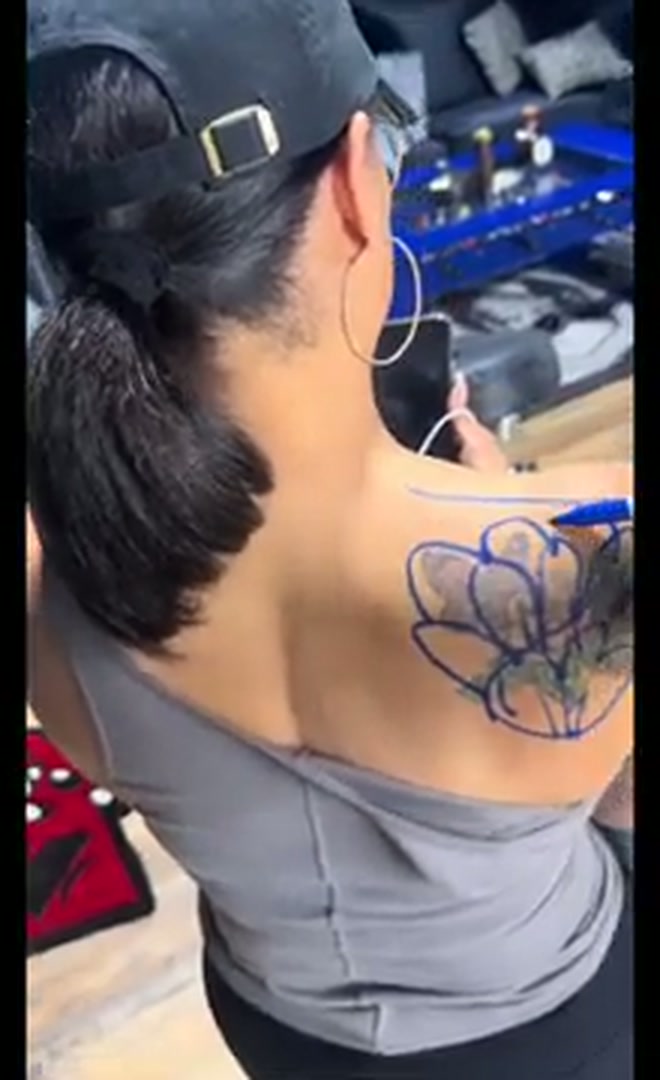
The old rose was described as having five leaves because Henderson’s children were represented individually. That detail gives the earlier back image a clear internal structure. Each leaf carried a name, so the rose functioned as a family diagram as well as a floral tattoo.
The reveal photograph does not show the names through the finished lotus. The new petals, leaves and blue background occupy the same broad area, and no lettering is legible in the inspected image. The visual evidence supports the presence of a substantial cover-up, not a claim that every underlying mark has disappeared at every angle.
The time span is also part of the record. A tattoo made roughly a quarter-century earlier had been revised once, then eventually replaced visually by a much larger floral image. Henderson’s own comments connect the old design with her children and the new work with a fresh floral composition, while the public images show the contrast between the two stages.
The change is therefore visible as both an image change and a timeline. The back once held names inside five leaves. It now holds a lotus with many petals and surrounding blossoms. The tattoo history belongs to both pictures, even though only the newer surface is visible in the finished reveal.
The lotus tattoo meaning in the footage
Lofton asked Henderson whether she liked lotus flowers during the tattoo process, and she confirmed that she did. The finished reveal followed that exchange. The documented meaning is therefore grounded in a specific conversation about the flower and a specific decision to replace the older rose-and-butterfly arrangement.
The available reporting does not assign one elaborate symbolic explanation to every petal or colour. It identifies the old family tribute, the age of that tattoo, the later touch-up and the large lotus cover-up. That limited record is enough to describe the design precisely without inventing a private meaning for the new details.
The lotus is visually different from the earlier rose. It has a broad central bloom, several surrounding flowers and a strong blue field. The change is not a small alteration to the original linework. It is a large-scale reworking of the back into a new floral composition.
The visible result also changes the way the back reads in photographs. The old design was organised around names and a butterfly. The new design is organised around colour, petals, leaves and layered coverage. Henderson’s tattoo history is consequently recorded through the contrast between a family inscription and a flower-led image.
The tattoo timeline of the change
The tattoo timeline begins with the rose and butterfly design from about 25 years earlier. The five children were represented by names inside the rose’s leaves, and the tattoo received a later touch-up when Henderson’s youngest daughter’s name was added. That revision was reported as taking place 19 years before the 2025 cover-up.
In June 2025, footage from Lofton’s studio showed the new floral work. The clip placed Henderson in the chair and then revealed the completed lotus. The Shade Room reported the process and the reactions that followed, while the Times of India described the earlier family design and the new colourful replacement.
The sequence is important because the new tattoo was not documented as an unexplained image appearing overnight. It followed an old piece, a later touch-up and a conversation about the lotus. The sources give the back tattoo a continuous history that stretches from family names to a large, saturated floral composition.
The dates also explain why the finished piece has such extensive coverage. The earlier design had been on Henderson’s back for decades and had already been modified once. The new image is broad enough to occupy the old area and visually establish a new focal point across the upper back.
The visible tattoo reactions
The Shade Room reported that the reveal generated strong reactions in its comment section. Some responses focused on the size and colour of the lotus, while others debated the presence of a large tattoo in relation to Henderson’s role as a pastor’s wife. Those reactions are part of the public context, not evidence of an additional tattoo meaning.
The finished photograph itself remains more useful for understanding the design. It shows the large pink central flower, blue background, green leaves and smaller blossoms around the edges. The visual details are clearer than the debate because they can be inspected directly in the published tattoo frame.
The public response also confirms that the cover-up was immediately noticeable. The piece is large, bright and positioned on the upper back, so it changes the visible silhouette of the tattoo area. The reaction to its scale mirrors what the photograph shows: this is a substantial replacement rather than a minor adjustment.
Henderson’s older family design remains relevant because the public discussion often treated the new image as a transformation. The story involved the previous rose, butterfly and names, the new lotus and the question of how a long-held family mark can become the base for a different visual chapter.
The 11:11 wrist tattoo detail
Separate reporting about Henderson’s tattoos identifies another piece on her wrist. In an account of her relationship with Keion Henderson, the couple described matching 11:11 tattoos that existed before their marriage. The detail gives the wider collection a small text-and-number design alongside the much larger back pieces.
The wrist tattoo is visually and physically different from the back cover-up. It is compact, tied to a repeated number sequence and associated with a shared relationship detail. The lotus is broad and colourful, while 11:11 is a small matching mark connected with a date and time that mattered to both people.
That contrast shows that Henderson’s documented tattoos do not follow one scale or one subject. The back contains a family design that became a floral cover-up, while the wrist carries matching numerals. The available sources identify both without requiring a claim that the two pieces were designed as part of one continuous visual set.
Seen together, the tattoos show a collection shaped by family, partnership and change. The wrist numbers preserve a shared detail, and the back preserves an older family tribute beneath a newer lotus. The meaning of each piece comes from its documented history rather than from a generic description of floral or numerical imagery.
Sources
The back tattoo account is based on The Shade Room’s report and the associated footage from Byron Lofton’s studio, with Times of India coverage supplying the earlier rose, butterfly, five names and touch-up timeline. Additional relationship coverage documents Henderson’s matching 11:11 wrist tattoo. The inspected image shows the finished lotus directly.
Conclusion
Shaunie Henderson’s documented tattoos include a large lotus cover-up on her upper back, an earlier rose-and-butterfly family design with five names, and a matching 11:11 wrist tattoo shared with Keion Henderson. The new back image is defined by pink petals, blue background colour, green leaves and broad coverage. Its story is the visible change from a decades-old family marking to a new floral composition.