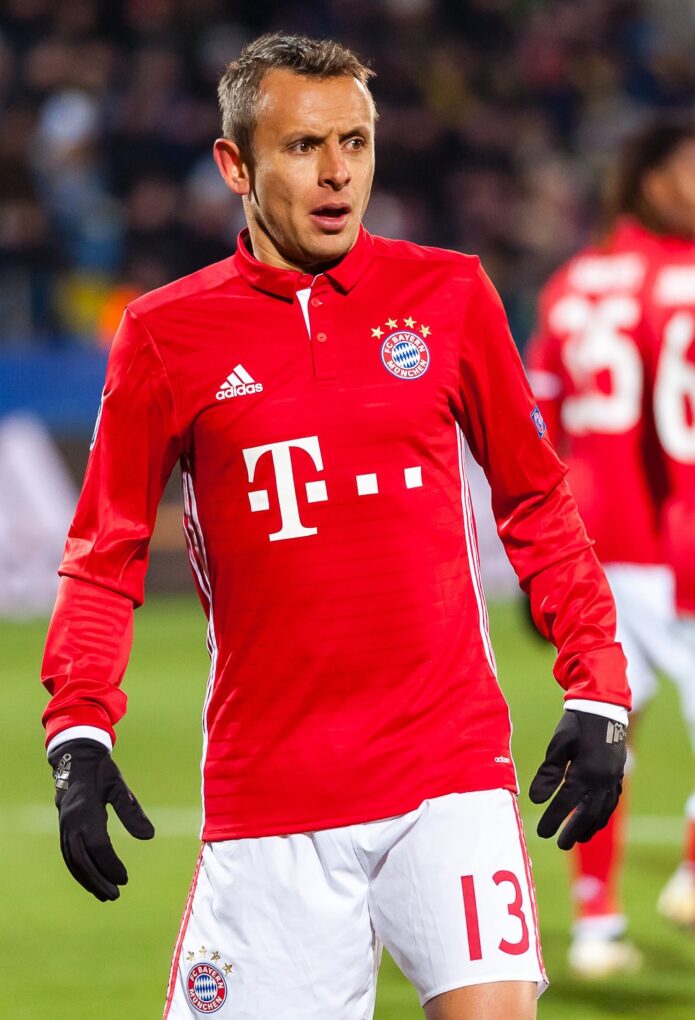
Rafinha tattoos document the Brazilian midfielder’s football career, personal milestones and family history. Public photographs show ink on both arms and his legs: lettering, shaded forms, stars, trophy outlines and football figures. A Bleacher Report interview describes his right-arm collection and the personal experiences behind some of the designs. The photos show a collection built in layers rather than one continuous sleeve.
Match and celebration photographs reveal the arm work when Rafinha raises his hands; seated shots show tattoos that a football kit usually covers. The viewing distance changes what stands out: a close crop makes individual figures legible, while a wider frame shows how the designs sit across an arm or leg. The descriptions below stick to what the images show and to meanings Rafinha has discussed.
The trophy sleeve and its football setting

In this Bayern celebration, Rafinha’s tattooed right arm appears beside a championship shield. He wears the club’s red kit, and the exposed arm shows dark figures, lettering and shaded shapes from the upper arm toward the forearm. The shield fills much of the foreground, giving the photo a clear football setting while leaving enough of the sleeve in view.
The wider frame shows the ink in relation to Rafinha’s shoulder, elbow and wrist. Several separate designs create a connected impression, with dark sections broken up by lighter interior areas. The image does not identify every figure, but it gives a better sense of the sleeve’s scale than a close crop.
The forearm lettering and wrist details

With both arms raised, the match photograph makes the forearm lettering easier to see. Compact lines of script sit near smaller wrist marks, alongside symbols and darker shaded areas. His white Bayern shirt sets off the ink, though the angle and light make some lines sharper than others.
The arm is heavily tattooed, but gaps of skin remain between parts of the work. Script and heavier shading sit close together without forming one solid panel. Rafinha has described tattoos as a record of life, but the photograph alone cannot tell us what each line says or means.
The number 13 footballer portrait

A close view of the inner forearm shows a footballer wearing number 13. The illustrated figure stands with a ball at his feet, framed by stars. Outlines and soft shading define the shirt, shorts and legs, while the number remains readable across the shirt.
The narrow placement gives the design a vertical shape. Its illustrative linework separates it from the surrounding script and other marks. The photograph records a personal football image, but it does not establish a more specific private meaning for the number or figure.
The trophy outlines across the leg
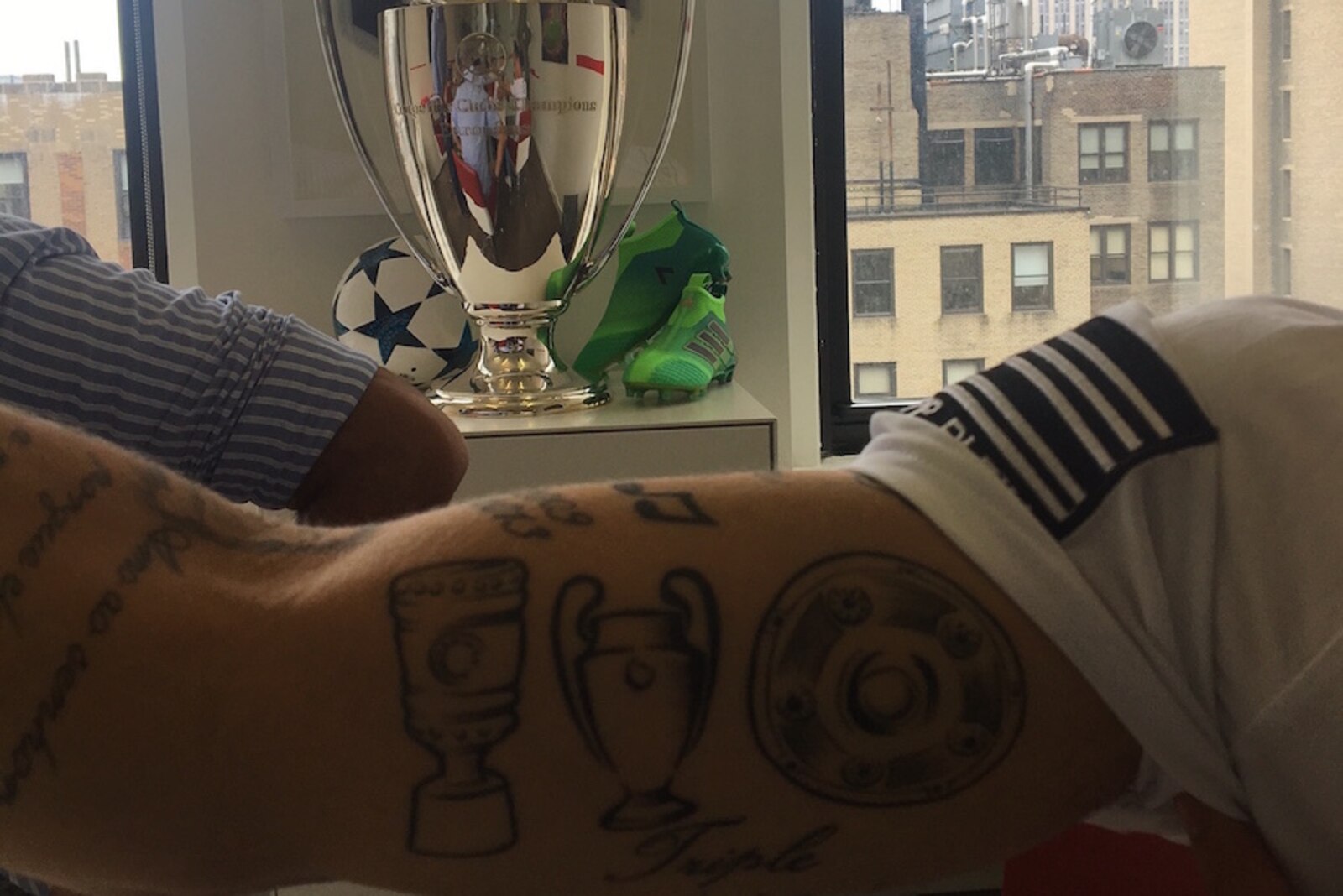
The leg photograph shows a different side of Rafinha’s collection. Open outlines of cups and trophies run across the exposed skin, with script and small dark symbols around them. One cup has a visible stem and bowl; another sits beside a circular football-related design. The lighter linework contrasts with the denser arm tattoos.
Each trophy is separated by open skin, so the forms can be read individually while still following the curve of the leg. The photo does not name the cups, but it clearly shows sporting imagery beyond the arm sleeve.
The layered sleeve views from match day

This second celebration image shows how the sleeve looks in motion. Rafinha’s raised arm exposes script near the wrist, heavier shading around the forearm and more marks toward the elbow. Against the green stadium and red shirt, the dark ink remains distinct.
The frame shows the relationship between pieces rather than the details of one tattoo. Small letters and thicker black sections run together as the arm bends, making the sleeve look denser from a distance than it does in the close number 13 photograph.
A body of work shaped over time
Rafinha’s interview describes getting his first tattoo as an adult and adding later pieces to mark people, experiences and important moments. That history fits the mix visible in the photos: football illustrations, trophy outlines, script and shaded sections, each with its own scale and linework.
The collection changes from one placement to another. The arm carries denser work, while the leg image leaves more room around the trophy outlines. In a wide celebration shot the sleeve can look nearly continuous; up close, separate designs and open skin become easier to distinguish.
Rafinha’s public image and football identity
Football imagery, personal lettering and a mix of outline and shade recur across the photographs. The number 13 footballer is the clearest illustration, the leg trophies are the most open forms, and the arm script adds a band of text through the sleeve. Their different styles remain visible even where the pieces sit close together.
The images also show why no single view tells the whole story. A close crop preserves the stars around the number 13 figure; a match photograph shows the sleeve bending with Rafinha’s raised arm; the seated shot reveals the leg designs. His comments about tattoos marking parts of his journey provide context, while the photos document the football figures, trophies and lettering without assigning a meaning to every mark.