
Monami Frost’s tattoos use heavy blackwork, realism, lettering, and a blackout section on one arm. The ink reaches across her face, neck, arms, hands, torso, and legs, so the collection reads as a body-wide mix of designs rather than a single sleeve.
The contrast between dark coverage and open skin keeps the pieces distinct. Fine lettering and lighter details sit beside large black areas, giving each part of the collection a different weight. The photos below show how those choices work across different parts of the body.
Monami Frost full-body tattoo layout
A full-body photo shows the amount of coverage across Frost’s arms, torso, and legs. The dark areas repeat across the body, while lettering and portraits add smaller details. The layout is easier to understand from the front, side, and back than from one close-up.
A collection can grow in stages. Taking photos of the existing work before adding more makes it easier to see where another piece would fit. A design that looks balanced straight on may leave a gap when the shoulder turns or an arm lifts.
Clothing also changes which tattoos are visible. A sleeveless top, crop top, or shorts reveal different parts of the layout, so it helps to plan around what you usually wear.
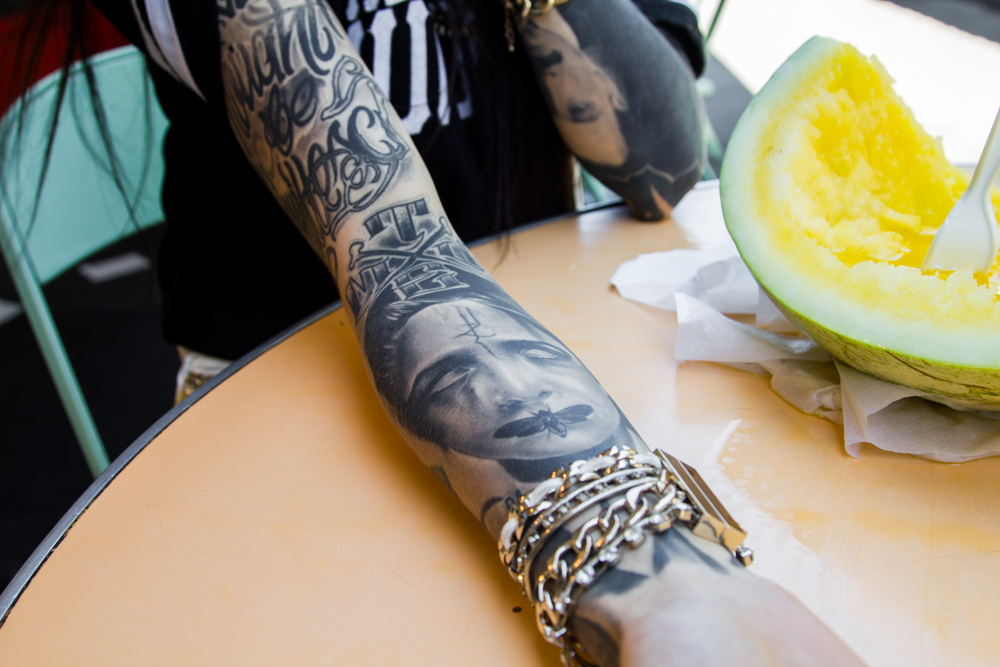
Monami Frost black arm and hand tattoos
The blackout section is one of Frost’s most recognizable tattoos. It forms a solid dark shape, while the other arm and the hands show faces, symbols, and lettering. The large block reads from a distance; smaller marks become clearer up close.
Blackout work takes planning. Previous tattoos, healing, touch-ups, skin, and the time needed for sessions all affect the result. An artist can explain what can be covered and show examples of healed work.
Hand tattoos have their own considerations: hands move often, get washed, and are exposed to the sun. Small lines can soften, so the design needs to be simple enough to remain readable. Clear shapes and realistic sizing work better than squeezing a detailed scene into a small area.

Monami Frost leg and thigh tattoos
The leg photo shows portrait work and ornamental shapes on the thigh. The broad area gives a portrait room for detail, while the knee and lower leg create natural breaks in the layout.
Leg tattoos can be covered more easily than ink on the face, hands, or neck. Before settling on a portrait, check the stencil while sitting, standing, and bending the leg. Muscle movement can change how the features line up.
A reference photo can show the expression or lighting you want, but the artist may need to redraw it for the curve of the thigh. A reference is a starting point, not a template to trace exactly.

Monami Frost face and neck tattoo details
Frost’s forehead lettering, cheek mark, and dark neck work frame her eyes and jaw. From a distance the tattoos make a strong outline; close up, the lines and smaller details become easier to see.
Face and neck placement changes with expression, hair, collars, and light. A stencil can be checked in daylight as well as in a studio mirror, with the head turned and the face relaxed.
These tattoos are visible in nearly every setting, which can matter at work, with family, or while traveling. A small mark still becomes part of how the face is seen, so it helps to choose a design you are comfortable carrying into everyday life.

Monami Frost white ink forehead tattoo
A close-up shows a pale forehead design that is subtle from some angles and easier to see when the light catches it or the hair moves away. A lighter detail can break up a dense area of blackwork.
White ink still needs careful placement and realistic expectations. Its appearance can change as it heals and with sun exposure or skin tone. An artist with healed examples can show how it looks in natural light.
A pale mark, a highlight, or an open shape can draw the eye across a darker section. Contrast can make a design clearer without making every part bolder.

How to build a collection with strong contrast
Frost’s collection pairs very dark work with lighter details and open skin. A blackout arm can sit beside fine face lettering; a portrait can share space with smaller marks. The contrast, placement, and scale connect the pieces without making them all alike.
Start with the subjects you expect to care about for a long time, then decide which areas of the body suit each one. Take photos of the existing tattoos from several angles before planning another piece. A clear space may help a portrait or line of text remain readable, and it can leave room for future work.
Choose an artist whose healed work matches the style you want. Portraits, blackout, lettering, and large body layouts each call for different skills. Ask how the design will move with the body and how it may look as it heals. A small change in scale can make fine lines easier to read.
Visibility is another part of placement. Face, neck, and hand tattoos show in most photos and introductions; tattoos on the torso or legs are easier to cover. Think about how that fits your life before deciding where a piece belongs.
Collections often develop over time. You don’t need to fill every open patch at once; living with the existing layout can make the next choice clearer. Follow the artist’s aftercare instructions and judge the result by the healed tattoo, not just the fresh photo.
The dark work is only one part of Frost’s look. The open spaces, fine lettering, and lighter forehead design affect how the heavier sections read. Use those choices as inspiration, then make the subjects and placement your own.
One thought on “Monami Frost Tattoos: Blackwork, Face Ink and Full-Body Style”