
The leg tattoo that turns Foley’s wrestling history into a scene
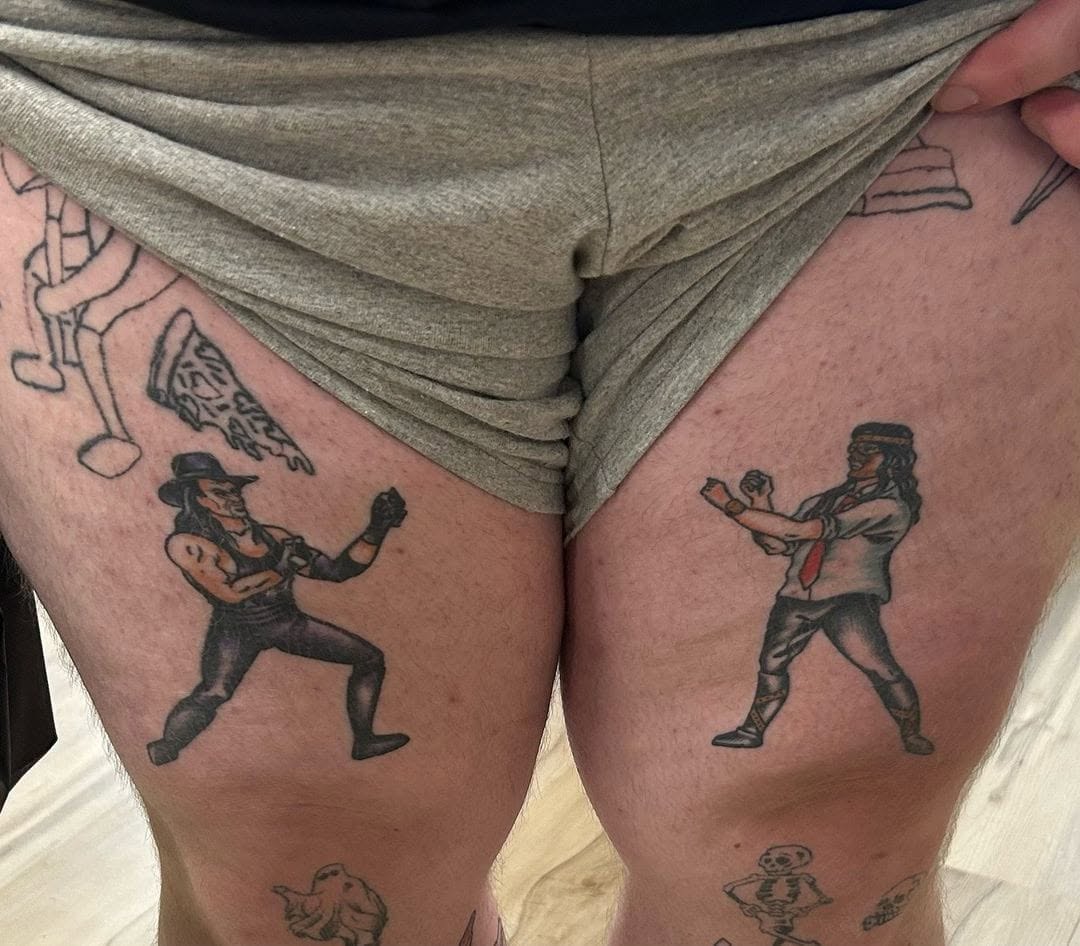
The best-documented tattoo in Foley’s collection is on his leg: a scene of him fighting The Undertaker. Wrestling posts identify it as a reference to their rivalry. It reads as a specific memory, not a logo or a small nod.
The scene is often linked to Hell in a Cell, especially the 1998 King of the Ring match, one of the best-known stories in Foley’s career. In photos, it reads as one larger composition. The subject is the two wrestlers together; there isn’t enough detail to catalogue every shape as a separate piece.
The leg placement keeps the tattoo covered in ordinary clothes and visible when Foley wears shorts. That suits a piece tied to a particular match: he can keep it private or show it when he chooses. The photos tell us more about the design than about its personal meaning.
Mankind, Cactus Jack and the problem with easy labels


Searches bring up images of Mankind, Cactus Jack and Dude Love, but many are tattoos on fans or designs posted by artists. Those characters sum up Foley’s career, so they make popular subjects. A search result alone doesn’t show that a tattoo is on Foley.
Tattoo artists have posted portraits of Mankind, and fans have combined Foley’s three characters in one piece. Those images document his influence on tattoo art, not his own ink. Foley inspires tattoos; that doesn’t make those tattoos his.
Recent stories show Foley visiting tattoo studios and trying tattooing himself. They place him around the tattoo scene but don’t document a new tattoo on his body. The confirmed inventory remains the leg scene and any other mark that can be clearly seen in photos of Foley.
What the tear drop story does and does not prove
A recurring search result connects a teardrop tattoo with Foley and Survivor Series. Wrestling images need context: marks may be makeup, character design or a temporary choice. Without a clear photo of the teardrop as personal ink, or a direct statement from Foley, it can’t be counted as permanent.
Foley’s personas also make this easy to confuse. Cactus Jack, Mankind and Dude Love are characters with distinct looks; fans may use their names or faces as tattoo designs. The leg image is a different case because it’s presented as Foley’s own tattoo.
The available evidence points to a collection built around selected memories, not full coverage. Foley has spent years discussing pain, performance, family and how wrestling moments stay with people. The leg scene gives one of those memories a place on his body.
Why Foley’s ink feels like wrestling memorabilia
Foley’s tattoo story is easier to follow through what has been documented than by counting every result online. The leg piece depicts him and The Undertaker; fan tattoos bring up the characters; the teardrop story needs context before it can be called permanent.
The limited evidence doesn’t make the subject thin. The leg tattoo turns a televised rivalry into something Foley can carry with him. It is one piece of wrestling history on his skin.
Mick Foley is documented as having a leg tattoo depicting himself and The Undertaker in combat. Public searches also show Mankind, Cactus Jack and Dude Love tattoos on other people. The teardrop story needs more context before it can be counted. Unless Foley or a clearer photo documents more, the leg scene remains the strongest confirmed part of his personal tattoo record.
Wrestling searches can mix real tattoos with scars, face paint, costume details and fan work. Foley’s personas are easy to recognize, so artists keep returning to them. That doesn’t mean he wears every version of those faces on his own skin.
The leg scene is stronger evidence because posts identify it as Foley and The Undertaker fighting, and photos show where it sits. Fan tattoos belong to their wearers. A fan might choose Mankind for personal reasons, but that meaning is separate from Foley’s record of his career.
The confirmed leg scene is more useful than guesses. It can be discussed alongside fan work, the teardrop story and Foley’s studio appearances, as long as those aren’t treated as the same evidence. That gives readers a clearer sense of what he wears and why his characters inspire other people.
When comparing photos, check whether the image shows Foley’s skin or a fan’s tattoo. Older wrestling photos can be low-resolution, and newer social posts may focus on the artist or fan. Until clearer photos or a statement add more, his collection is best described as selective, with one well-documented scene.
Watch Mick Foley tell a tattoo story
This clip is about the teardrop story and offers context for separating a wrestling performance from permanent personal ink.