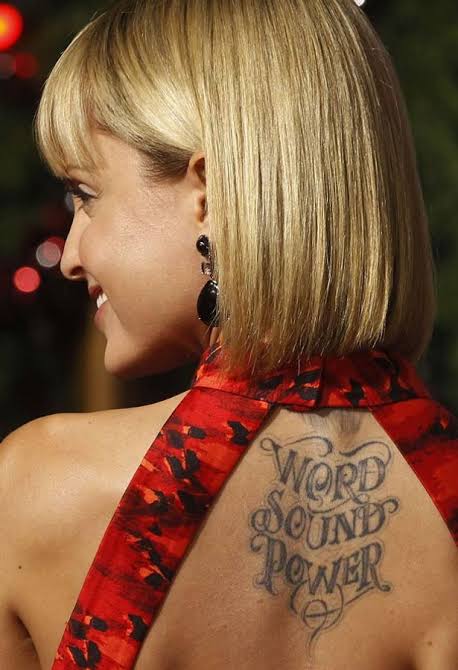
Mena Suvari’s tattoos are easy to miss until she turns around. The actress has a Lion of Judah on the back of her neck and “Word Sound Power” running across her upper back. It is a compact pairing that has remained recognizable in red-carpet photos over the years.
The lion gives the designs a visual anchor, while the words below it turn the back into a short statement. Public information about Suvari’s tattoos is limited, so it is best to stay with the pieces that appear consistently in photos and tattoo references rather than build a larger collection from blurry images.
The Lion of Judah sits at the back of her neck
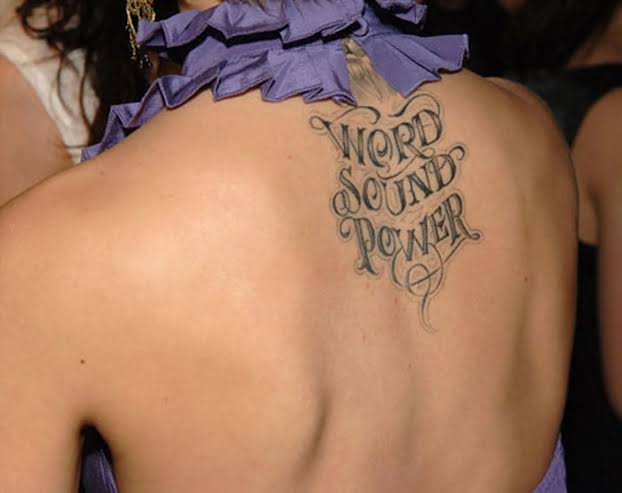
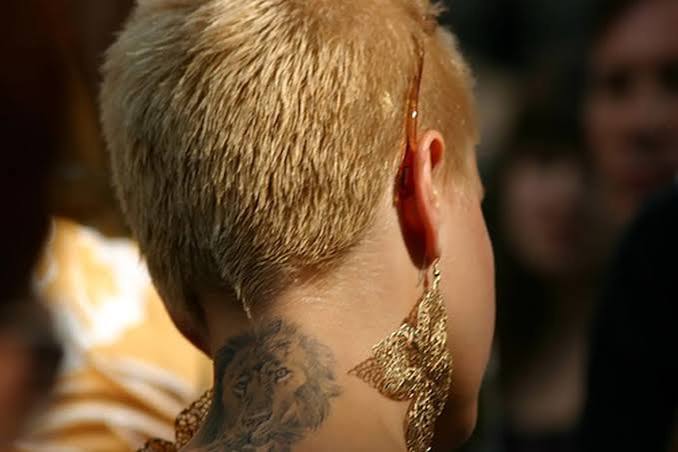
Suvari’s most recognizable tattoo is a lion on the back of her neck. Tattoo references identify it as the Lion of Judah, a figure associated with biblical tradition and Rastafari symbolism. Hair can hide it, while an updo or an open-backed outfit brings it into view.
A lion can stand for many things, but the Lion of Judah is more specific than a generic big-cat image. The Vanishing Tattoo describes Suvari’s design in terms of strength and spiritual courage, a reading that fits without claiming to know a private explanation she has not shared publicly.
The placement keeps the design compact, close to her head and shoulders rather than spread across her back. In a photograph, it can read almost like a crest. The tattoo sits where a collar or pendant might sit, but it stays with her when the styling changes.
It is easy to see why the image has become part of Suvari’s public look. A neck tattoo is memorable, yet her hair can cover it when she wants. She controls when the symbol enters the frame.
There is no need to guess at the lion’s pose or every line of the artwork. The documented details are its subject and location: Lion of Judah, back of the neck. The strength of the piece is in its clarity.
“Word Sound Power” turns her upper back into a sentence
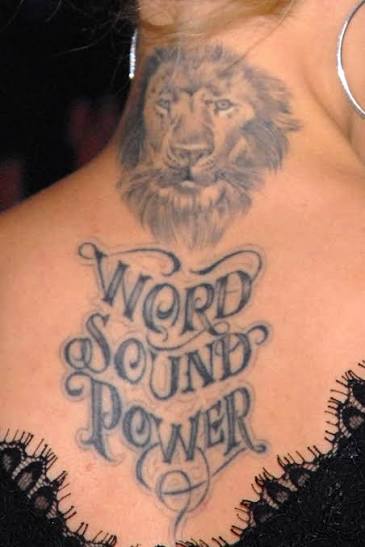
Below the neck tattoo, Suvari has the phrase “Word Sound Power” across her upper back. The wording gives the collection a thoughtful edge: language, voice and expression can all carry force.
The phrase stretches across her back rather than sitting in a small block. Beneath the lion, it forms a horizontal line that makes the two tattoos feel related: one is an emblem, the other a message. That is why photos of Suvari’s back often show the pair together.
Public references do not identify a longer quotation or a specific event that inspired the words. “Word Sound Power” is documented as the wording, but the exact private origin belongs to Suvari. The idea can be understood without pretending to know what led her to choose it.
A phrase on the upper back can also change meaning as its wearer does. Suvari’s words might bring to mind speech, music, art or self-definition, depending on the moment and the photograph.
There is a natural connection to her work as an actress, since performance depends on words and sound. That is an interpretation, not a confirmed explanation of her choice, but it makes sense alongside a phrase that treats language as power.
The two tattoos are designed to be read together
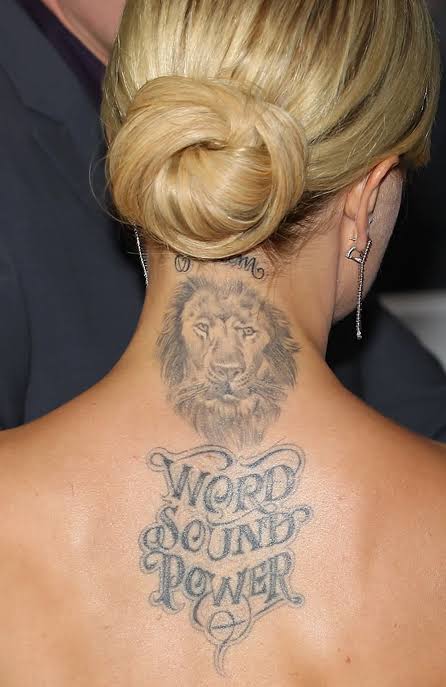
Celebrity tattoo collections are often presented as lists: one design on a wrist, another on the ribs, a third on an ankle. Suvari’s best-documented pieces make more sense as a small composition, with the Lion of Judah above and “Word Sound Power” beneath it. Her upper back becomes one visual field.
The sources place the tattoos near each other, but do not say whether Suvari planned them as a pair from the start. The visual connection is clear even if the order and original planning are not.
The placement gives both pieces room. The lion is visible on the neck without getting lost in the script, and the words can stretch across the back without shrinking into a caption. The result reads clearly in a photograph while remaining personal in everyday life.
There is a quiet confidence in the combination. The lion suggests strength without spelling out a whole story; the phrase gives words and sound their own force. Together, the tattoos leave room for physical, spiritual and expressive ideas.
The pair also works with different styling. Hair can cover the neck, while a dress can reveal or conceal the back. Suvari can decide how much of the designs a photograph shows.
What the public record does and does not document
The two tattoos most consistently named in public references are the Lion of Judah on the back of Suvari’s neck and “Word Sound Power” across her upper back. Older galleries and photo captions show the same areas, but often do not provide enough detail to build a longer, certain inventory.
A shadow, dot or partial line in a red-carpet photo is not necessarily another tattoo; hair, clothing and image quality can all mislead. Two well-documented pieces are more useful than a padded list of guesses.
The phrase’s precise meaning is similarly open. Its wording points to language and power, but there is no basis for assigning it a date, a particular spiritual tradition or a quote from Suvari that the available sources do not provide.
That care does not make the collection less interesting. The two known designs stand out because of their relationship and point of view, not because there are dozens of them.
Tattoos can also look different over time: ink softens, lighting shifts and the body changes. A photograph from the 2000s may show the same marks differently from a later image. The lion and the script remain the clearest identifiers.
The phrase gives the collection its lasting mood

If the lion is what viewers notice first, “Word Sound Power” is the thought that stays with them. The phrase has a rhythm, moving from written language to voice to influence, almost like a compact creative manifesto.
It is placed where people can see it when Suvari chooses an open-backed look, but it can also stay beneath clothing. The tattoo is personal, but it is not shy.
The words complicate the lion’s familiar association with toughness. Strength is followed by language, and language is treated as an active force rather than decoration.
There is restraint in the collection. Neither tattoo needs a dramatic origin story to create a mood: grounded, spiritual and expressive, with a little mystery left intact. Some ink invites a question instead of answering one.
Mena Suvari’s tattoos remain a small but memorable collection
Suvari’s tattoo inventory is compact and distinctive. The Lion of Judah at her neck is the emblem; “Word Sound Power” across her upper back is the message. They work separately, but the strongest photos show how the two pieces relate.
Placement matters. Hair and styling can hide or reveal the neck tattoo, while clothing can cover the phrase or make it central in an open-backed portrait. Placement gives Suvari control over when her philosophy becomes part of the image.
Beyond these pieces, the public record is less certain. There is no need to fill in the gaps: a careful tattoo feature can be satisfying without claiming access to every private choice.
In the end, the ink feels like a two-part statement. The Lion of Judah carries strength and spiritual courage; “Word Sound Power” sets language beside that strength. The result is visually clear and open to interpretation without becoming vague.
Watch Mena Suvari talk about trusting her instincts
There does not appear to be a reliable tattoo-tour video focused on Suvari’s ink, so this interview is included as a relevant fallback. The tattoo details above are based on the documented designs and placements.