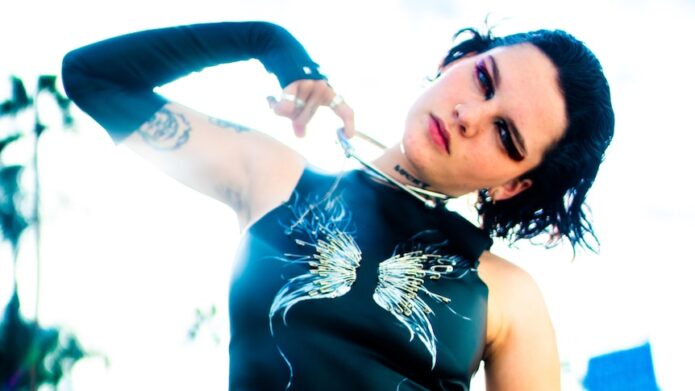
MAY-A (Maya Cumming) has tattoos on her throat, forearm, wrist and abdomen, documented across interviews, music artwork and editorial photographs. Those sources show several named designs, but they do not form a complete inventory of her ink.
The “lucky” tattoo on MAY-A’s throat
The Guardian’s 2026 profile identifies the small word “lucky” at the front of MAY-A’s throat. It describes the lettering as a reminder connected to a difficult period in her life, the clearest personal explanation attached to one of her tattoos.


The script sits low on the neck and stays visible in portraits when her hair, jewelry or clothing leaves the area uncovered. In the Guardian photographs, it is a short line of writing rather than a large graphic piece.
The spiderweb and forearm tattoos
A Guardian portrait shows a dark spiderweb across MAY-A’s forearm. The radiating lines form a compact, circular pattern, a sharper graphic shape than the throat lettering.

The web changes as her arm bends or turns toward the camera. In some photographs it looks nearly round; in others, the lines spread over the forearm and appear less even.
Other fine marks sit near the web, but the photographs do not make every small design easy to identify. The surrounding reports name a few motifs and leave the rest undescribed.


A music-cover detail from the photographed era
An official Spotify cover for “Time I Love To Waste” shows detailed butterfly imagery on MAY-A’s forearm. Tirade also identifies butterfly ink near her wrist, though the sources do not establish whether both references show the same design.
The butterfly in the cover art uses finer lines than the darker web. The sources document its appearance and placement, but do not give it a confirmed personal meaning.
A separate feature image from the collection
BMA Magazine’s feature on MAY-A records a scorpion tattoo on her abdomen, near the “lucky” lettering mentioned in the same coverage. The image shows a recognizable animal shape, separate from the word and forearm patterns.
The snake motif and the limits of published coverage
Tirade identifies a snake tattoo on MAY-A’s forearm. The named motif is part of the public record, but photographs do not make its exact size, direction or boundaries clear.
How the visual language fits a punk-pop era
Around the release of “Sweat You Out My System,” MAY-A spoke in music interviews about the look of the 1970s Sex Pistols era and the early-2000s New York scene. Those references describe her influences; they do not explain the meaning of each tattoo.
Leather, cropped clothes and exposed arms make some of the ink visible in portraits and performance images. The photos show how styling changes what can be seen, but they do not suggest that the tattoos were made as publicity.
What the documented photographs establish
The sources document different parts of the collection: the Guardian explains “lucky,” Tirade names the snake and butterfly, Spotify artwork shows a butterfly, and BMA records the abdomen scorpion. None provides a full count or description of every mark.
Why the collection reads through contrast
The designs also differ in form. The throat tattoo is lettering, the web is a dark pattern, the butterfly uses fine lines and the scorpion reads as an animal figure. Their placements keep them distinct in the photographs.
The lasting image of the collection
The public record is clearest about what the tattoos look like and where they sit. For most of them, the personal story remains with MAY-A.