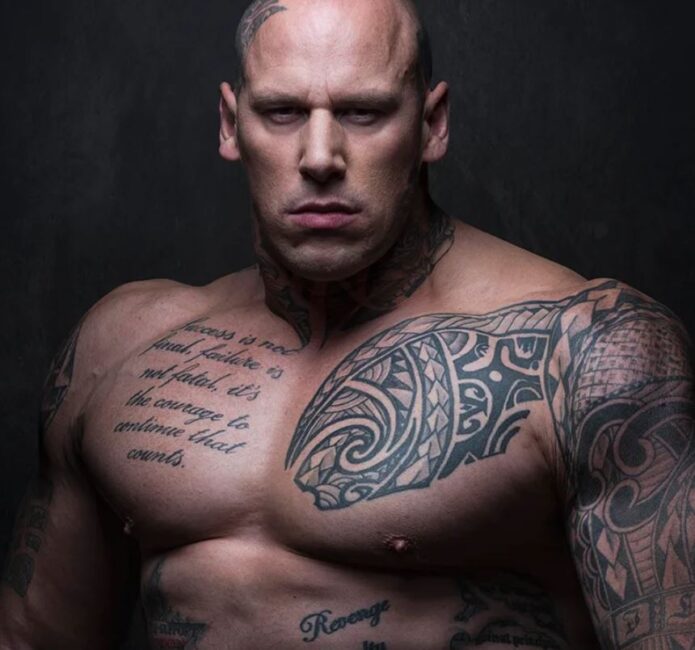
Martyn Ford’s tattoos are hard to miss. On a frame built for bodybuilding, the larger pieces have room to stretch across his chest, arms, neck and head. The look is mostly dark and bold, but it isn’t all tribal work: there are also roses, script and smaller symbols that seem connected to his life away from the gym.
This guide sticks to the tattoos that can be seen in clear photos. Ford has talked about some of his ink or shared it himself, while other designs remain personal. It’s best to separate what the pictures show from what we can only guess. The photos below show Ford’s actual tattoos, not generic body art or unrelated gym shots.
There’s a clear contrast in the collection. The large black pieces shape his frame, while the words and smaller designs feel more like reminders of people and moments. If you like comparing celebrity tattoo styles, our looks at Corey Taylor’s tattoos and Danny Trejo’s tattoos show two very different approaches.
Martyn Ford tattoo style at a glance
Most of Ford’s ink is black and grey, with shapes made to read from a distance. The arm and chest pieces use heavy outlines, solid dark areas and long curves. That scale suits his build: fine details can get lost in a wide shot, while these shapes still hold up in a vest or under harsh gym lights.
There are gentler details alongside the bold work. Roses sit around his neck and head, and writing appears in several places. So the collection doesn’t read as one repeated sleeve. One section is graphic and tough; another looks more like a name, memory or phrase. Those personal marks give the heavier tribal designs some balance.
1. The geometric tattoos across his back
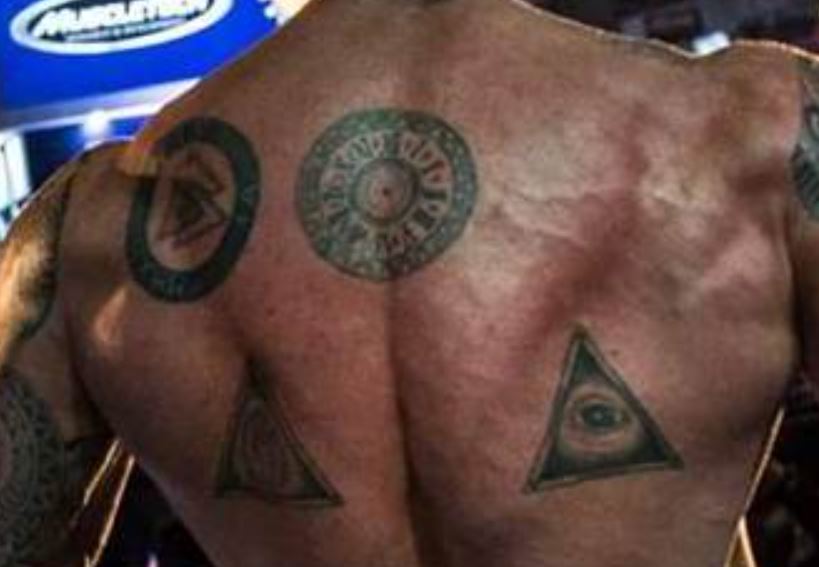
The back piece is easy to take in because its shapes spread over a broad, fairly flat area. The photo shows dark geometric forms and symbols across the upper and middle back. Open skin between them keeps the pattern from turning into one solid patch. From farther away it can look like armor; up close, the separate marks stand out.
The lines follow the width of his back, giving the design a strong center and drawing the eye from side to side. The placement also adds definition in photos. There’s no need to assign a hidden meaning to every symbol: the visual pattern is clear on its own.
2. The large tribal work on his left arm
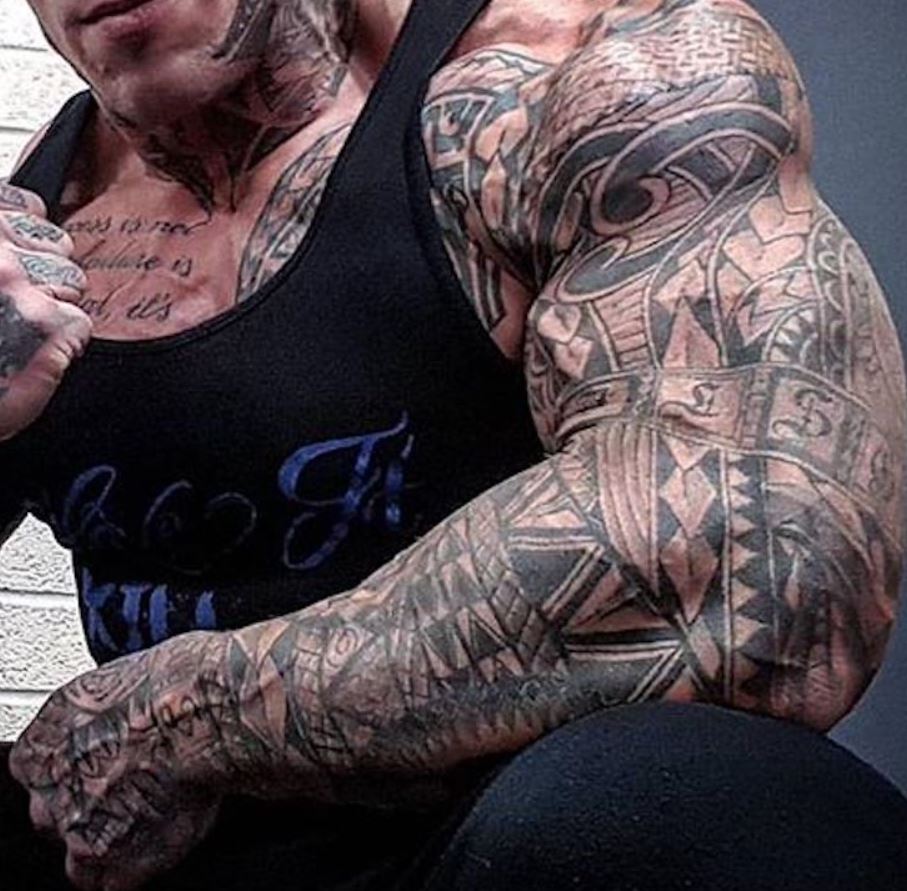
Ford’s left arm carries a large tribal design made of thick, flowing shapes. It wraps over the upper arm and shoulder instead of sitting in one small spot. The edges are easy to follow, and the dark fill stands out against his skin. In this close view, you can see how the lines move around the muscle.
A straight-on portrait would hide much of this piece. The side angle makes the sleeve’s shape clearer, including the points and curves that continue as his arm turns. It has plenty of presence without color and sets the tone for the rest of the collection.
3. The tribal design over his left chest
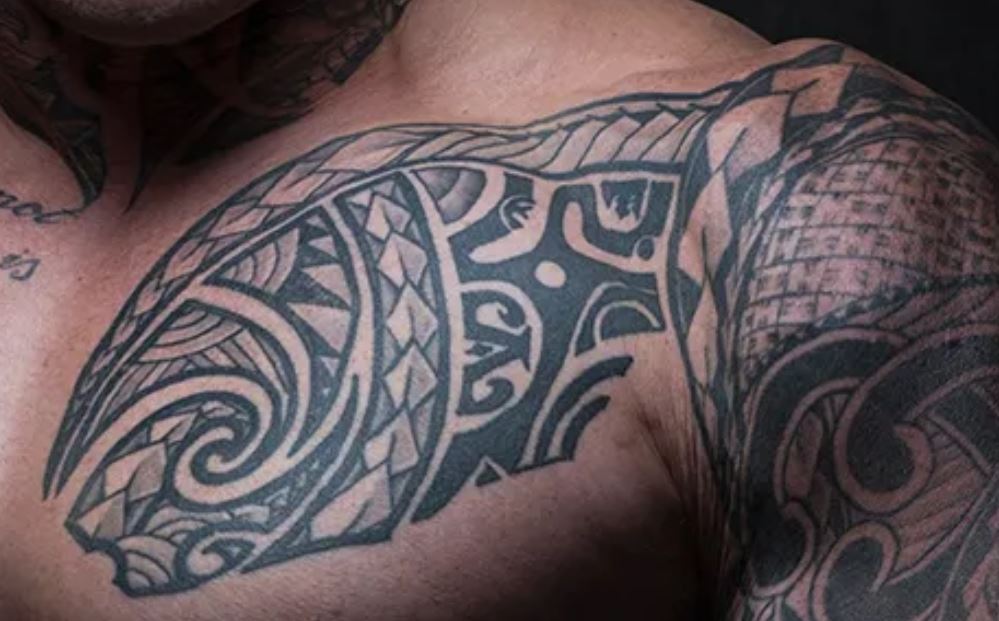
Another dark design spreads across the left side of his chest, from the pectoral toward the shoulder. Its shapes are heavier than the writing elsewhere, with pointed edges that give it a carved look. The pattern follows the chest rather than ending in a neat rectangle, so it moves with his build.
This piece has enough scale to stand out on Ford’s frame. The gaps between its black sections keep the pattern legible, and its outline is controlled rather than crowded. That clear silhouette is why it still reads well in an ordinary photo.
4. The script and writing across his right chest
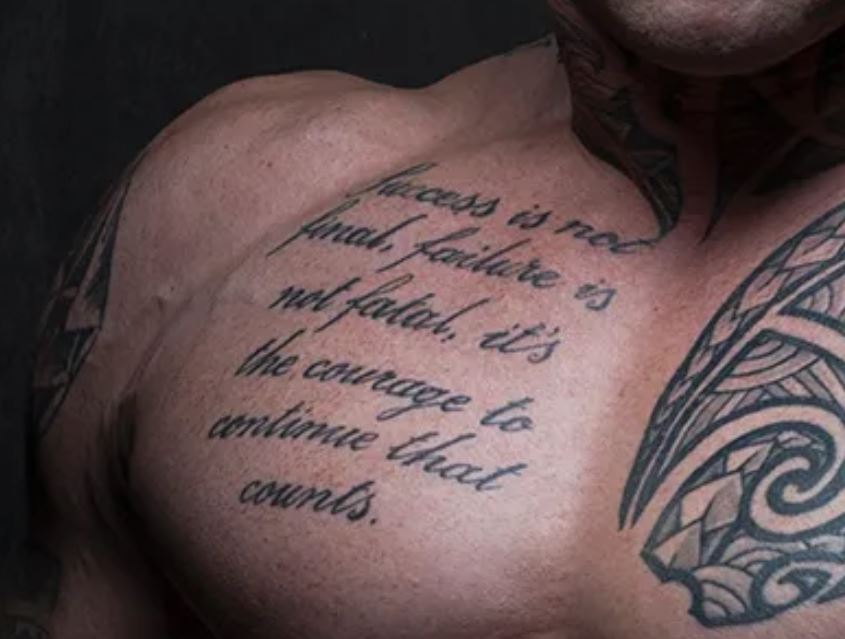
The right side of Ford’s chest looks quite different. This close view shows writing across the area, with the feel of a quote or personal reminder rather than a solid tribal pattern. Script can be hard to make out in a low-resolution image, but here the letters have room to show. The placement follows the shape of his torso.
Not every word is clearly documented, so there’s no point pretending otherwise. We can say that it’s a prominent text tattoo on his right chest. A phrase can matter to the person wearing it without needing a public explanation, and Ford has kept some of the meaning of his ink private.
5. Roses around the neck
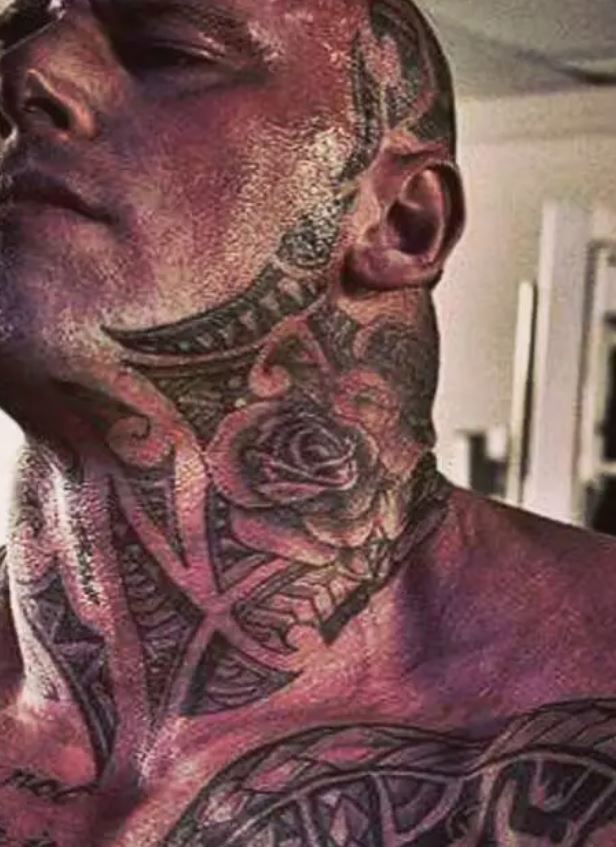
The roses around Ford’s neck bring a softer shape into the collection. Clear photos show flowers along the side and back of his neck, with dark leaves and petals close to the hairline. Roses are a familiar tattoo subject, but here their placement frames the neck and links visually to the ink on his head.
The curved petals also break up the broad black areas on his chest and arm. They give the design a different kind of movement. The collection can feel tough in one place and more delicate in another.
6. The head and side-of-face tattoos
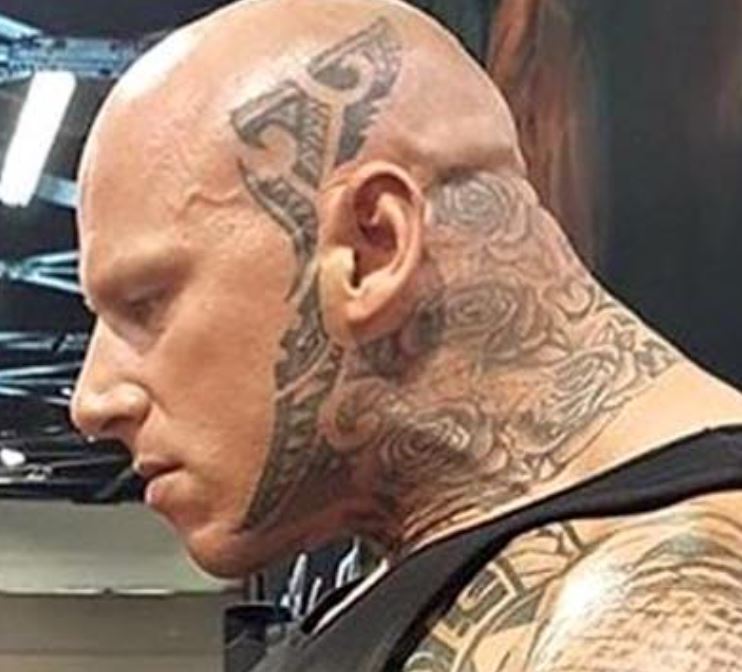
Ford also has visible ink along the side of his head and upper neck. The photo shows roses and lettering near the shaved area, making this one of the easiest parts of his collection to recognize. Head tattoos are difficult to hide and can be hard to photograph clearly, so a clean side view says more than a cropped portrait.
The head design connects with the roses lower on his neck, carrying the line of ink toward the side of his skull. That’s a highly visible placement, especially for someone who works in public and on camera. The floral shapes keep it from reading as one flat patch of black.
7. The forearm detail and round motif
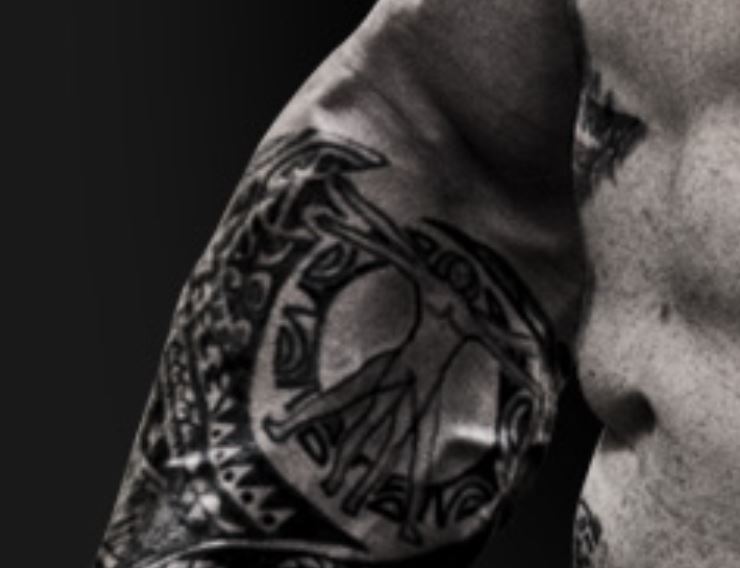
A smaller design sits on Ford’s forearm. The close-up shows a round central motif, surrounded by darker lines and shading. It can be easy to miss in a full-body photo, but the contrast makes it clear when the arm is shown close up. Its rounded center is a change of shape from the pointed tribal patterns on his chest and shoulder.
In a collection with so many large pieces, a compact symbol gives the eye somewhere else to go. Ford’s tattoos aren’t all about covering as much skin as possible; some of the smaller marks have their own meaning, even when he hasn’t explained it publicly.
8. The words across his chest
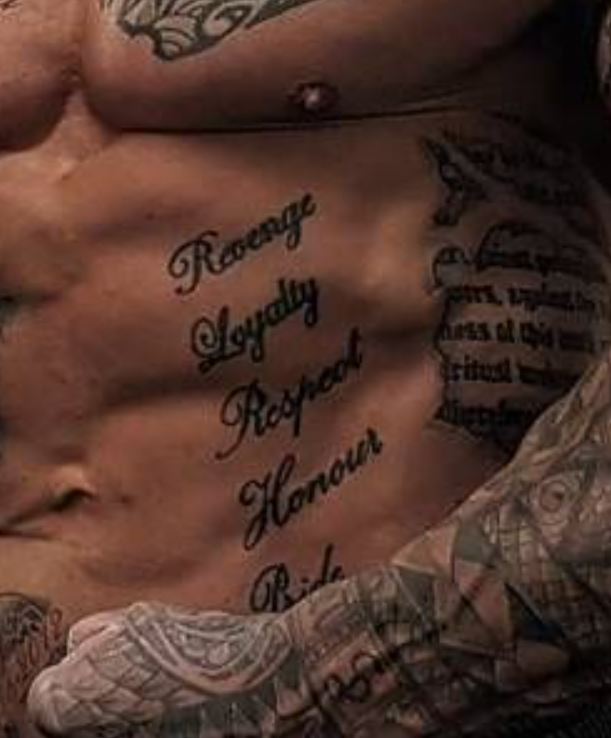
Another photo shows a separate group of words across Ford’s chest. The lettering feels direct rather than ornamental. It can be read as writing, though the full phrase isn’t clear in every public photo. It’s safer to describe how it looks and where it sits than to guess at a translation.
Visible words can still hold a private meaning. They might mark a promise, a person, a belief or a moment, and the wearer doesn’t have to explain all of it. Here, the lettering softens the hard edges of the tribal work. The collection feels less like one costume and more like several different parts of a life.
9. Writing on the stomach
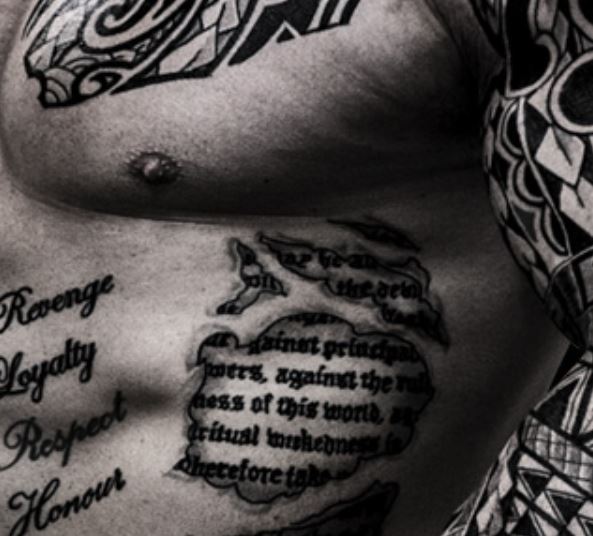
There is also writing lower on Ford’s stomach, inside a decorative, scroll-like shape. The photo shows that it is a separate tattoo from the chest script. It sits down the center of his torso and extends the collection below the larger upper-body pieces.
Posture can change how a stomach tattoo looks, so the overall layout is the clearest thing to describe. The banner frames the words and keeps them distinct from the surrounding ink. Ford uses lettering in different ways: as a broad statement on his chest and as a smaller mark lower down.
What Martyn Ford’s tattoos seem to say
From what’s visible, Ford’s tattoos combine bold style with personal references. The tribal pieces are large and graphic; the writing and roses suggest memories and relationships. Public descriptions have connected some of his ink with family, his children and his partner, but not every design has a full explanation. Those details are clues, not a complete guide to what each tattoo means.
Some tattoo meanings are private, and that’s normal. Ford’s collection has a recognizable visual style, but he hasn’t spelled out every personal story behind it. Not knowing every meaning leaves room for the tattoos to stay personal.
Why the tattoos suit his frame
Large designs and strong contrast help Ford’s tattoos hold their shape in a wide photo. Broad forms, firm outlines and open gaps keep the ink visible from across a room. The head and neck create a high point, the chest forms a dark center, and the arm and back pieces carry the design outward.
The lettering gives the eye smaller details to follow, while the roses interrupt the straighter edges and darker areas. That keeps the collection from reading as one flat block. The pieces make a visual whole, even if Ford added them at different times.
Martyn Ford tattoos FAQ
How many tattoos does Martyn Ford have?
There is no reliable public count that includes every small mark, so an exact number would be a guess. Clear photos show large pieces on his back, chest, arms, neck, head and stomach, along with separate script and symbols. It’s an extensive collection, not just one sleeve.
Does Martyn Ford have head and neck tattoos?
Yes. Public photos show floral and script-style ink around his neck and along the side of his head. That placement is hard to miss because, unlike a chest or back tattoo, it can’t be covered as easily.
Are all of his tattoos tribal?
No. Tribal shapes are a big part of the collection, particularly on his arm and chest, but there are also roses, writing, symbols and decorative banner-style lettering. The mix gives the tattoos more variety than a single-style body suit.
Has Martyn Ford explained every tattoo?
No, not publicly in a way that covers the whole collection. Some personal themes have come up, but a clear photo doesn’t tell you what a tattoo means to the person wearing it. It’s fair to describe what’s visible and leave private stories private.
Where can I see his tattoos clearly?
Close-up side views and training photos usually show the details best. A distant portrait can show that a tattoo is there, but it won’t reveal much of the line work. The images in this guide each focus on a particular tattooed area.
Final take on Martyn Ford’s tattoos
Ford’s collection brings together large tribal designs, visible head and neck ink, roses and personal writing. The big pieces fit his frame, while the smaller words and symbols make it feel less uniform. From a distance the tattoos read as bold shapes; up close, the lettering and details give you more to look at.
Watch Martyn Ford talk about his tattoos
In the video below, Martyn Ford talks through some of the stories behind his tattoos.