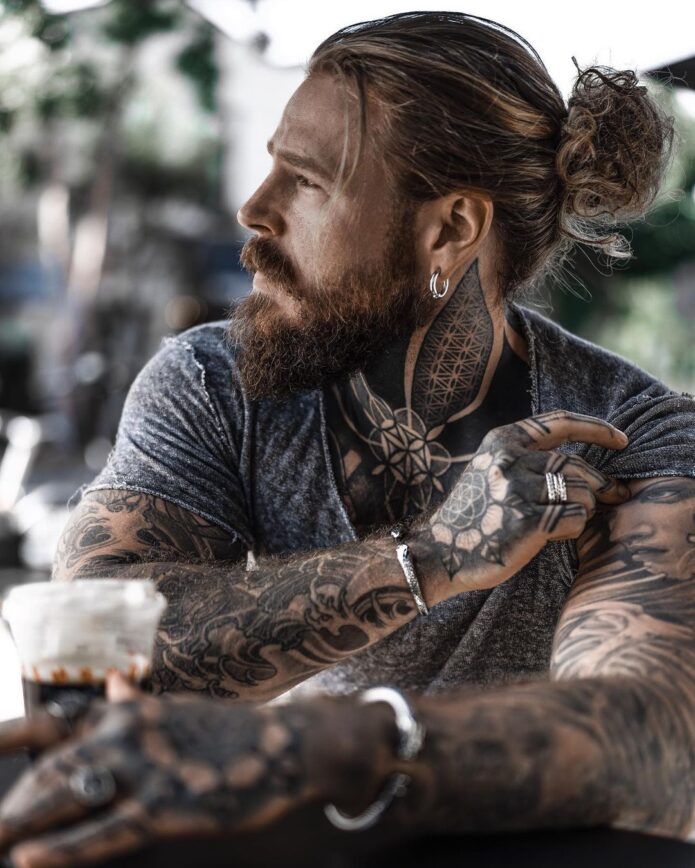
Kevin Creekman’s tattoos are hard to miss, but there’s more to look at than sheer coverage. The Creekman mixes big shaded pictures with crisp black shapes, leaving enough open skin for both to stand out. His neck has a patterned collar, his stomach carries an oversized skull, and his back is filled by a grinning mask. Even his hands and legs have their own clear focal points.
The model and musician has talked openly about his tattoos. Some have a personal story, while others are there because he likes the artwork. That’s a useful way to approach his collection: enjoy the shapes first, then get into the details he has actually shared. Here’s a closer look at five of his most noticeable tattoo groups.
Seed of life and blackwork neck tattoo
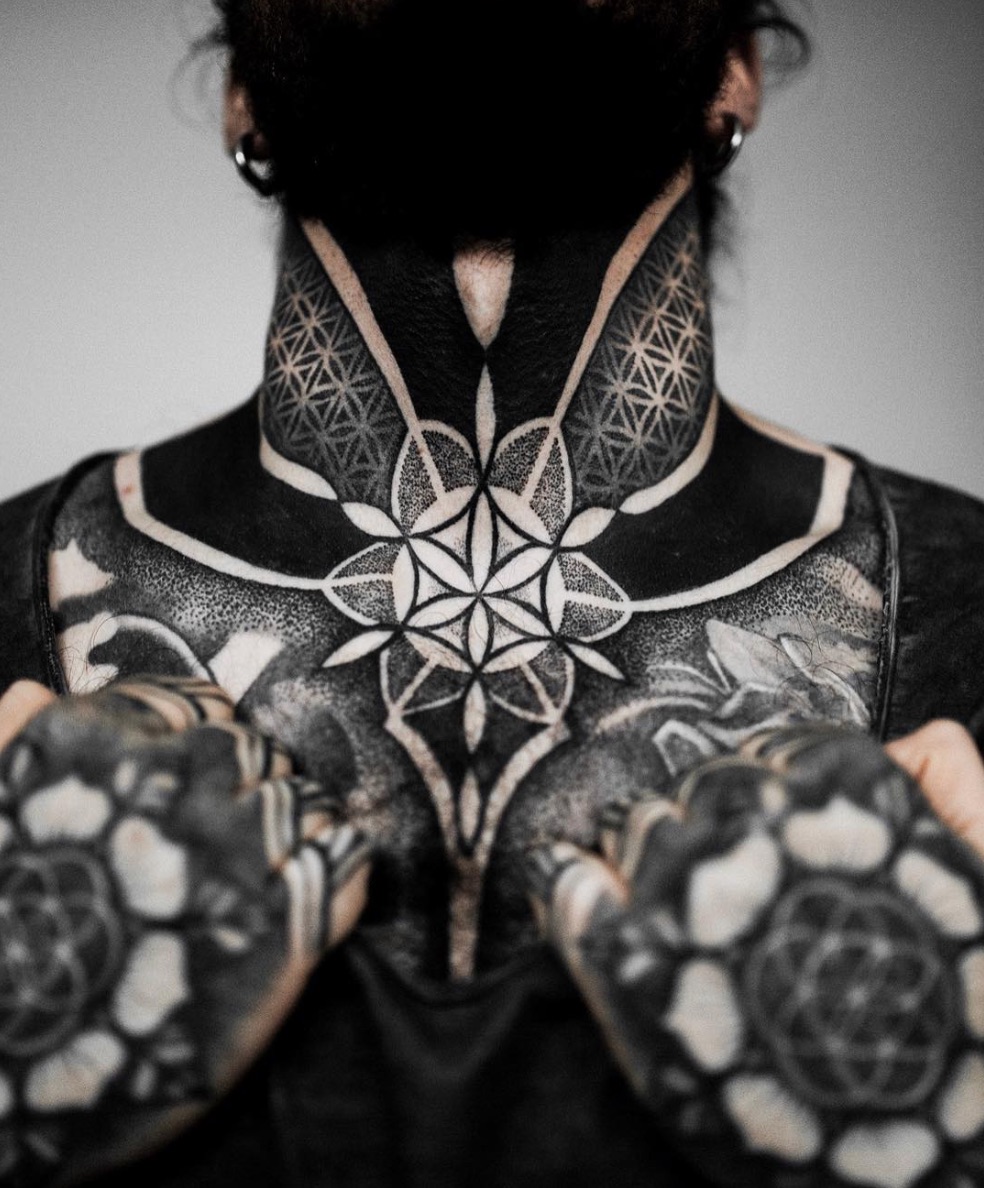
The neck is probably the quickest way to recognize Creekman’s ink. A pale geometric flower sits at the front of his throat, with looping lines crossing through its center. Thick black areas spread out around it, while two tall patterned panels run up the sides toward his jaw. It’s a busy design up close, but the overall shape is surprisingly easy to follow.
Creekman told OTSMagazine that Gerhard Wiesbeck started with a seed of life pattern at the center of his neck and built the surrounding design freehand. He connected the flowers and patterns loosely with his spiritual outlook rather than giving each part a fixed personal meaning. So there’s no need to assign a separate life lesson to every petal.
Look at how the center stays light. The curved lines are surrounded by skin, making the flower feel almost cut out of the darker collar. The side panels work differently. Their fine repeating shapes sit inside darker pointed outlines, bringing a much smaller rhythm into the same piece. That change in scale gives you something new to notice as you move from the front of the neck to the sides.
The blackwork also follows the neck’s shape instead of ending in a straight band. Its edges rise below the ears and drop toward the upper chest. With a shirt on, you still get the main outline. With the collar open, the lower point and the central flower come into view together. The design feels planned for both of those everyday views.
For anyone who likes geometric tattoos, the interesting part is the balance between solid black and open skin. Neither has to compete for attention. The darkest areas provide the frame, and the uncovered areas carry the fine pattern. Shrinking this whole design down would change that relationship quite a bit. The generous spacing is part of what makes Creekman’s neck piece so readable.
Oversized skull tattoo across the stomach
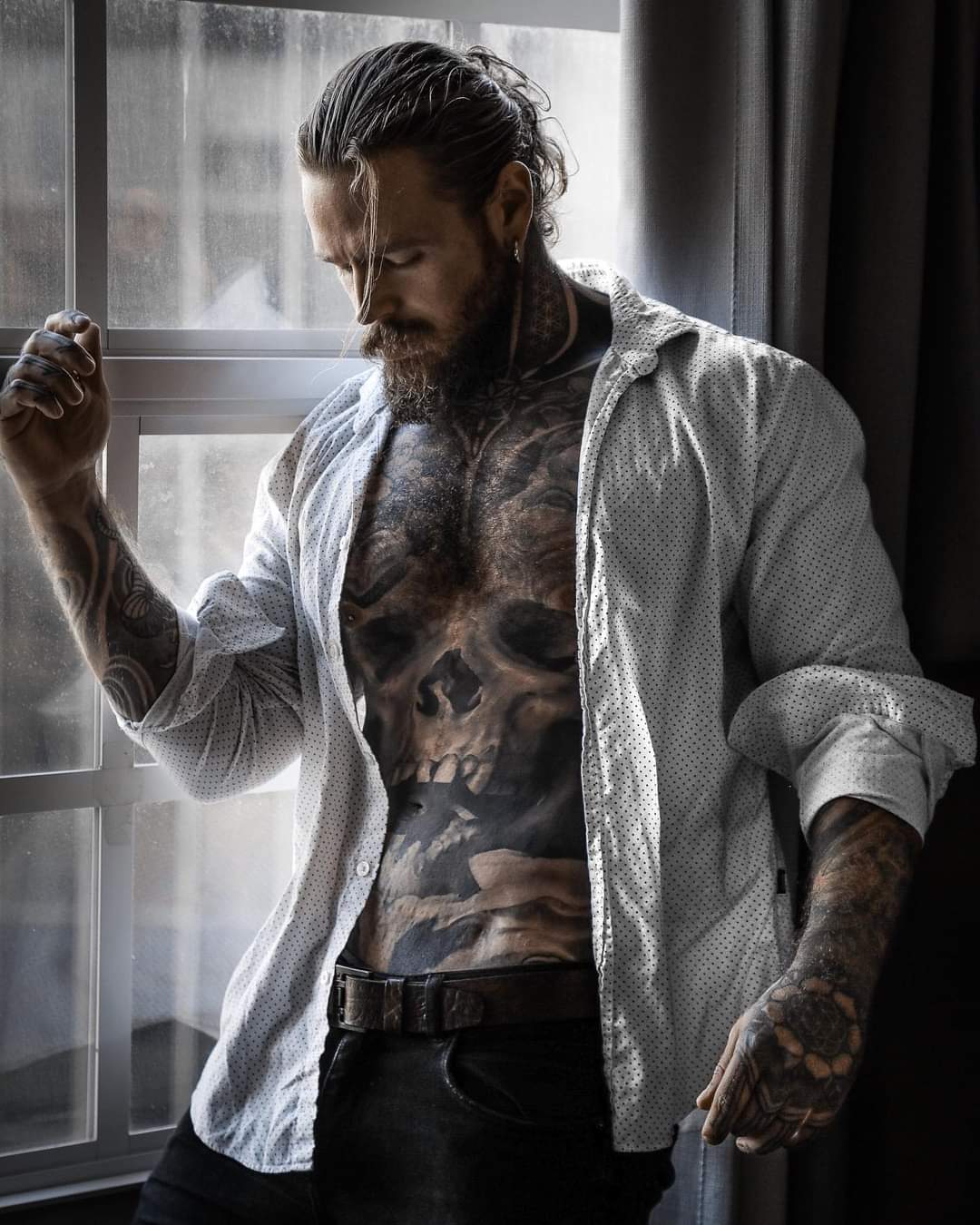
The stomach skull takes a completely different approach. Instead of a flat pattern, it uses shading to make the eye sockets, nose and teeth feel deep. The face occupies most of the visible abdomen, with pale bone shapes pushing forward against dark hollows. It’s a large image you can recognize before you’ve even had a chance to study the smaller marks.
Creekman credits Neon Judas with this tattoo. In his Tattoo Life interview, he explained that the skull’s uneven shapes and textures helped disguise scars from skin removal surgery. The practical reason matters, but so does the picture itself. This is a skull with enough detail and scale to be the main event on the front of his body.
The eyes are especially effective. They’re broad dark spaces with lighter edges, rather than little circles dropped into a blank face. The nose creates another strong shadow below them, drawing your eye down toward the teeth. Along the lower part, curved bone forms and softer shading keep the image from ending like a square sticker on the stomach.
There are several kinds of texture in the piece. Some areas look smooth, almost polished. Others have broken, mottled shading that suggests weathered bone. Those changes stop the big pale surfaces from looking empty. They also make the face feel less perfectly symmetrical, which suits the rougher character of the skull.
An open shirt gives this tattoo a natural frame. The fabric covers the sides while the middle of the face stays visible, so the skull can still read clearly without showing the whole torso. That’s a nice example of how a large tattoo can have more than one useful view. You don’t always need every edge in sight to understand the design.
The skull also makes an easy comparison with his neck. One relies on repeated lines and flat black; the other relies on light, shadow and texture. Both use a strong central image. Seeing them together shows how different tattoo styles can share space without looking like they came from the same drawing.
Samurai and Oni mask back tattoo
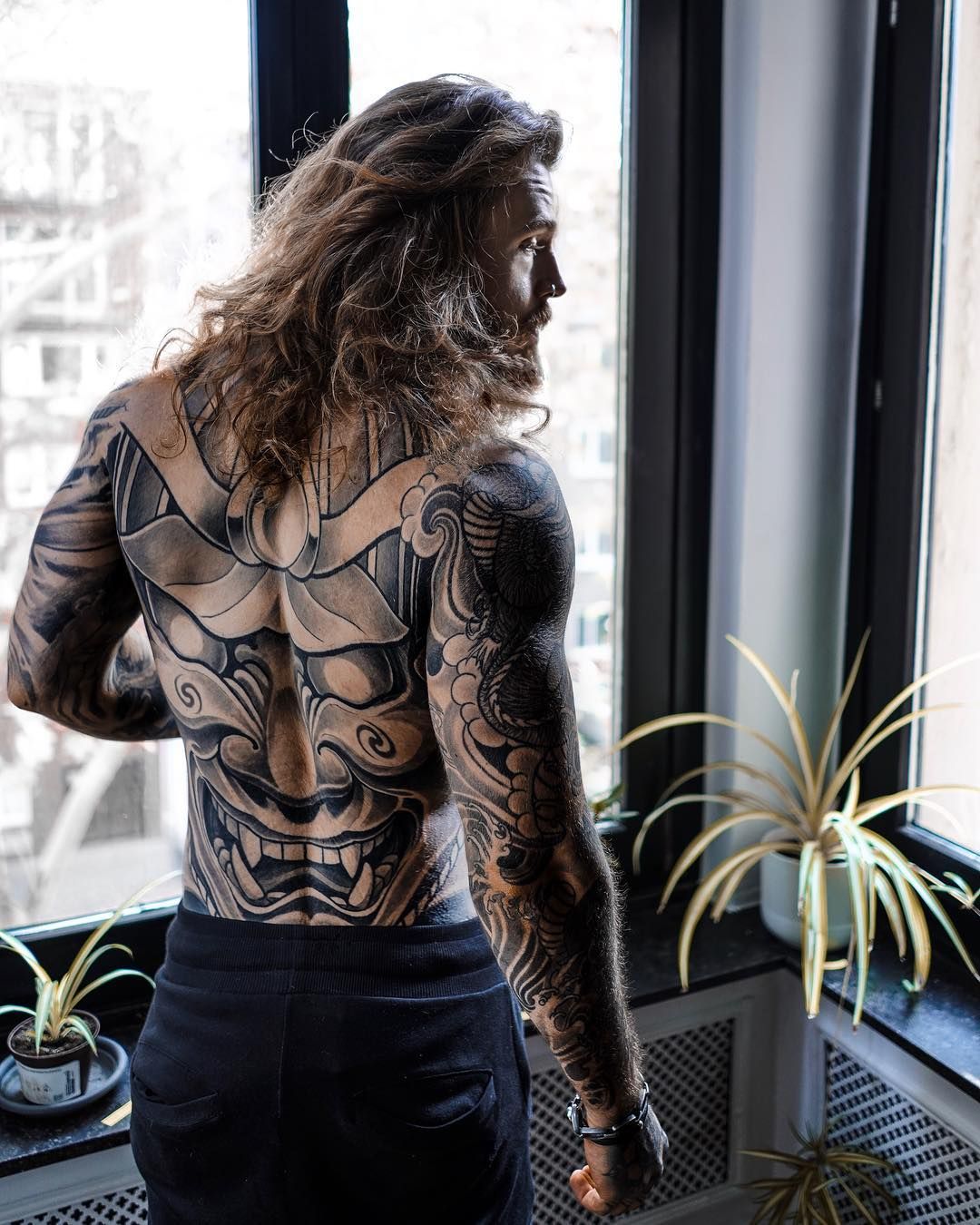
Creekman’s back tattoo goes big again, this time with a mask that stretches across the shoulders and down toward the waist. The face has narrowed eyes, a long nose and a wide grin with rows of teeth. Broad curved shapes sit above the eyes, while darker sections around the mouth make the expression stand out. It’s bold enough that the whole face stays clear from a few steps away.
He has described the design as a blend of a samurai mask and an Oni mask, created by Olli Lonien. That explanation is more precise than treating it as a random demon face. In the photograph, you can see both an armored feel in the upper shapes and a more exaggerated, almost snarling expression below.
The back gives the artist plenty of room to make those features large. The eyes don’t need tiny eyelashes or lots of fine shading to have an expression. The heavy outlines, slant and dark spaces do most of the work. The grin is similar: a few broad rows and a strong curve create a lot of character without filling every inch with little details.
Notice the way the face sits around the spine. The nose runs through the middle, with the mouth spreading across the lower back. The larger shapes are arranged to suit the width of the shoulders, so the upper part feels broad without making the bottom look cramped. It’s a good reminder that a back piece has a different outline from a poster or a page.
The edges don’t simply stop where the back meets the arms. Curled lines and cloudlike forms travel into the shoulder areas, where the sleeves are already busy with other imagery. That shared movement helps the huge mask feel connected to the rest of his coverage. Your eye can follow the curved shapes outward rather than meeting a hard border.
The appeal here is size with a clear expression. The mask has detail, but it doesn’t depend on every little mark being visible. If you’re drawn to large back tattoos, that’s the part to pay attention to: a design can be dramatic because of its main shapes, even before you get close enough to study the texture.
Flower and geometric tattoos on the hands
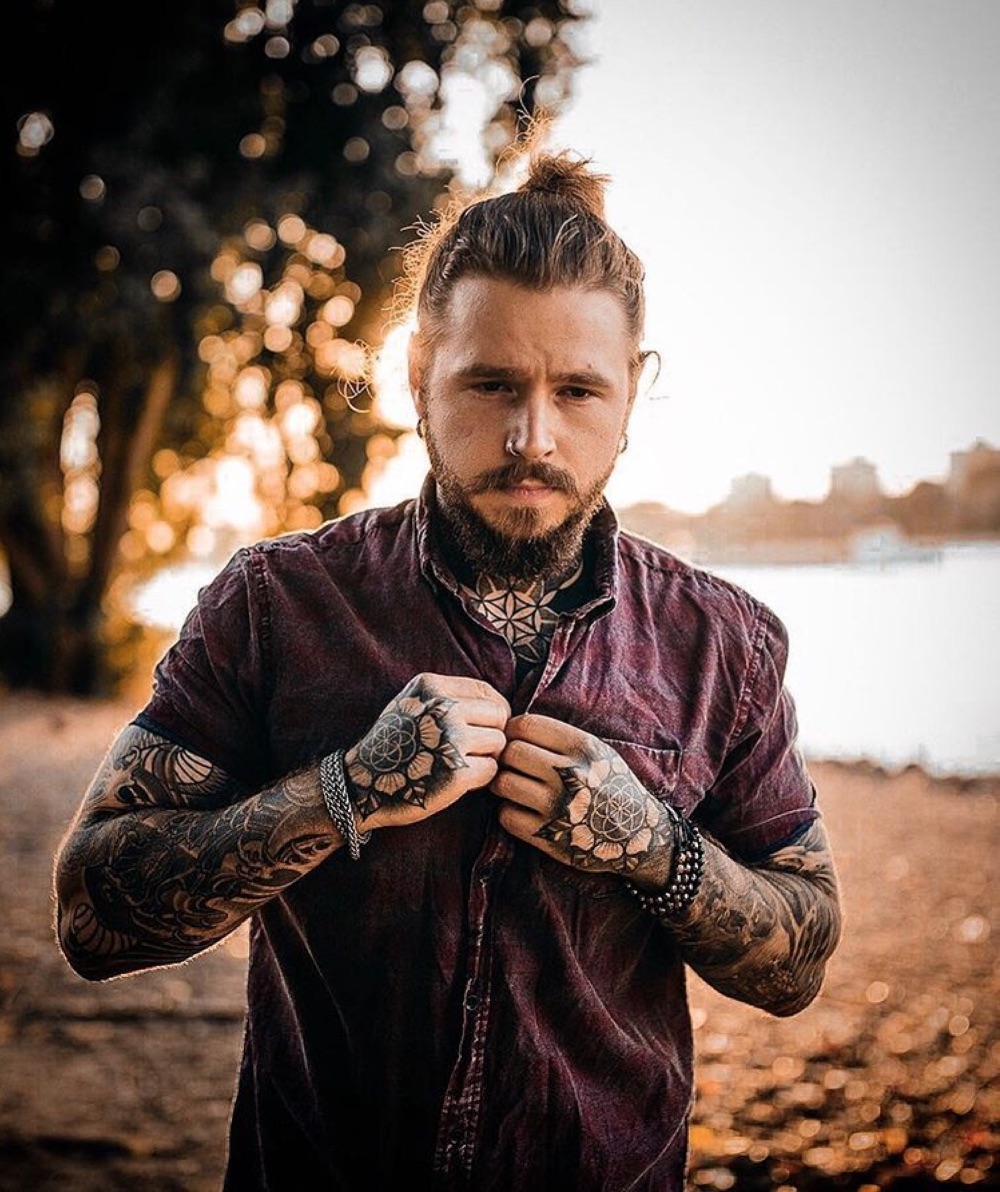
On the backs of Creekman’s hands, flower shapes surround small circles of overlapping lines. The petals have pale centers and dark outlines, creating a clear contrast with the shaded sleeves behind them. In the photo where he holds the front of his shirt, both hands face the camera, making it easy to see how the pair works together.
The circular centers echo the geometry on his neck. They’re smaller and more contained, though. The neck’s pattern spreads into a broad collar; on the hands, the flower sits inside the space between the wrist and the knuckles. That placement gives each one its own boundary without needing a rectangular frame or a thick border all the way around it.
Creekman has singled out Mike Wolf’s hand tattoo as one of his most distinctive pieces. He hasn’t credited every part of both hands individually, but the flowers share a similar shape and placement.
What makes these flowers work is how little they need to say. There are no large words running across them and no extra background scene to decode. The petals, central circles and pointed outer edges are enough. Jewelry and bracelets add to the photograph, but the tattoos have their own outlines and remain easy to pick out.
The petals are also a useful break from the darker arm coverage. Your eye reaches the wrists after following lots of curved, shaded forms through the sleeves, then lands on those brighter flower shapes. The change gives the hands a separate identity while the dark edges keep them connected to the rest of the ink.
You can enjoy the repeated geometry without treating it as a secret code. Creekman hasn’t given a detailed public meaning for every part of the hand designs. Visually, the connection is simple: circles cross, petals repeat, and the two hands answer each other. That repetition brings a little order into a collection that includes much larger faces and textured images.
Bold blackwork leg tattoos and open-skin patterns
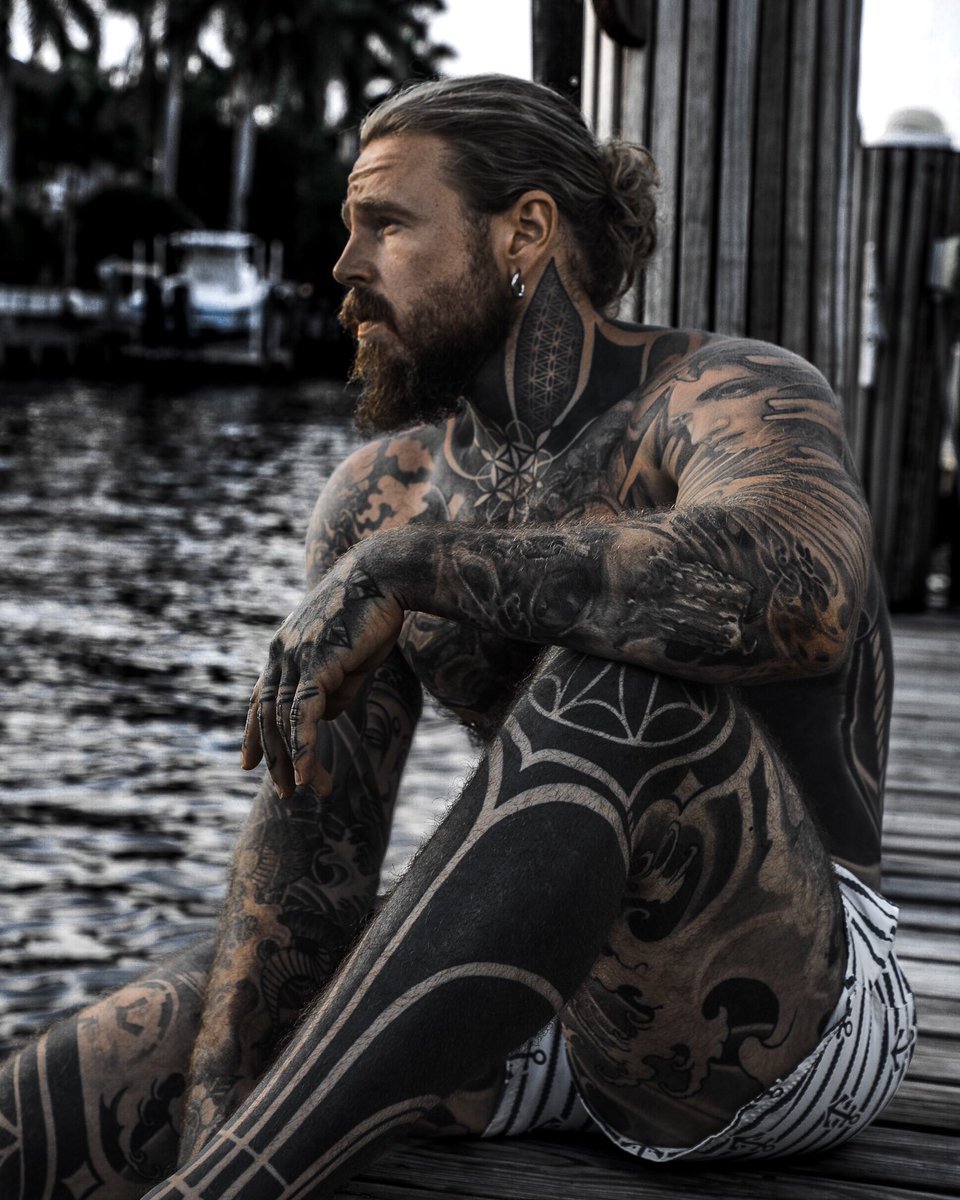
The leg tattoos bring back the thick black and lighter channels seen around Creekman’s neck. In the seated photograph, one bent leg becomes a broad display for the pattern. Dark curved areas sweep down the limb, separated by pale lines and open shapes. The other leg shows more illustrated detail, so the contrast is visible within the same view.
Creekman told OTSMagazine that getting his neck and legs tattooed in blackwork helped him fall for that style. The attraction is easy to see here. The biggest shapes carry the design. You don’t have to identify a portrait, read a phrase or work out which tiny object belongs to which section before the leg makes an impression.
The curved channels are doing as much work as the black areas. They separate the larger sections and give the pattern a direction. Around the knee, the lines bend with the leg rather than looking as though a flat drawing was pasted over it. Lower down, longer pale paths guide the eye along the limb.
This photograph also shows why position matters. With the knee bent and the body turned, some areas are stretched toward the camera while others disappear around the side. Even then, the large shapes remain readable. That’s a different kind of success from a tiny detailed tattoo that looks best only when viewed straight on.
There’s no need to give these lines a tribal origin or a symbolic meaning based on looks alone. The useful description is much more direct: broad blackwork, curving open skin and geometric touches. Those are the features you can actually see, and they’re enough to explain why the legs fit so well with his neck and hand tattoos.
Put all five groups together and the pattern in Creekman’s choices becomes clear. He likes artwork with a strong outline, a strong central image or both. The skull and mask bring the faces; the neck, hands and legs bring the repeated shapes. His collection has plenty going on, yet each major area still gives your eye somewhere clear to land.
Creekman talks about his life and work in this conversation with Sippin’ The Tea.