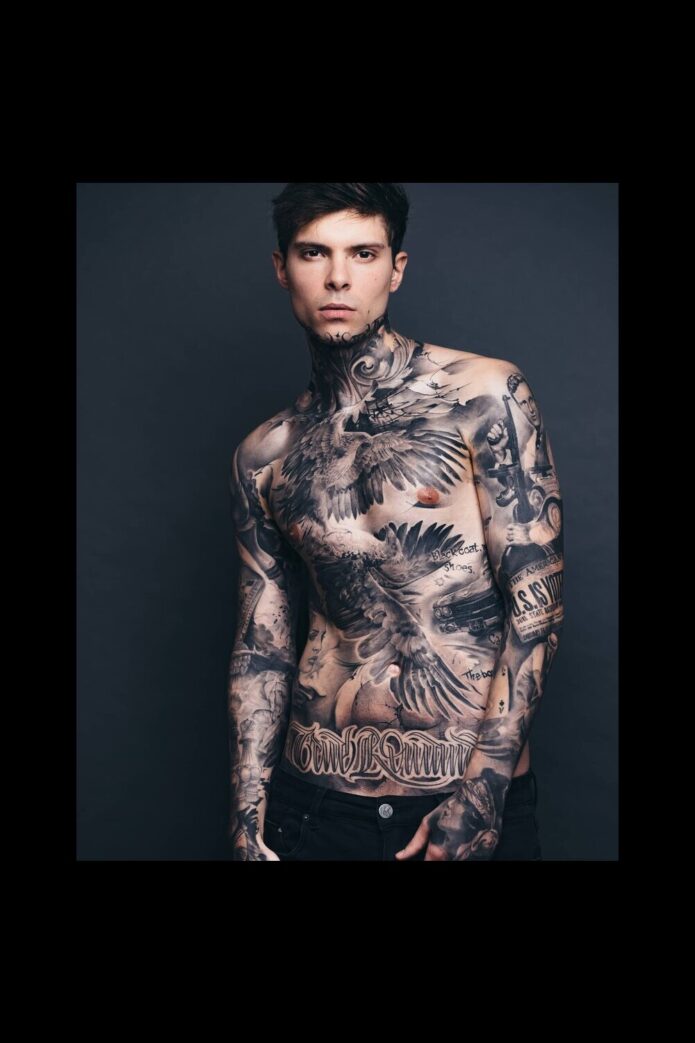
iNKPPL profiles Jonathan Martin as a French tattoo model living in Switzerland. He describes a long-running black-and-grey project with Teodor Milev that grew into a connected bodysuit.
The work includes two chest eagles, portraits on his hands, a French Revolution chess sleeve, Prohibition imagery and leg portraits. Script and ornament extend the coverage across his neck and torso.
Jonathan Martin’s black-and-grey realism
Black-and-grey realism runs through the photographs: dense shading, grey gradients and skin left open between faces, feathers, lettering and ornament. The subjects are separate, but the shading ties them together.
Curved lines frame his throat and continue into the chest birds. Feathers and shadow overlap, leaving small breaks around the main forms.
Two eagle tattoos across the chest
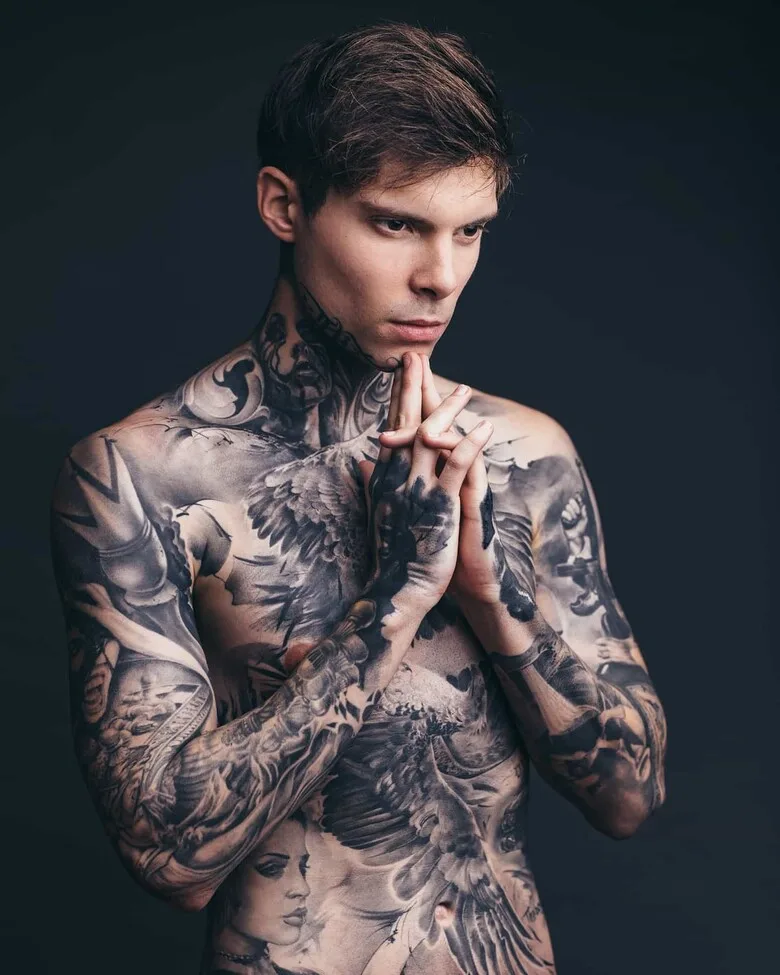
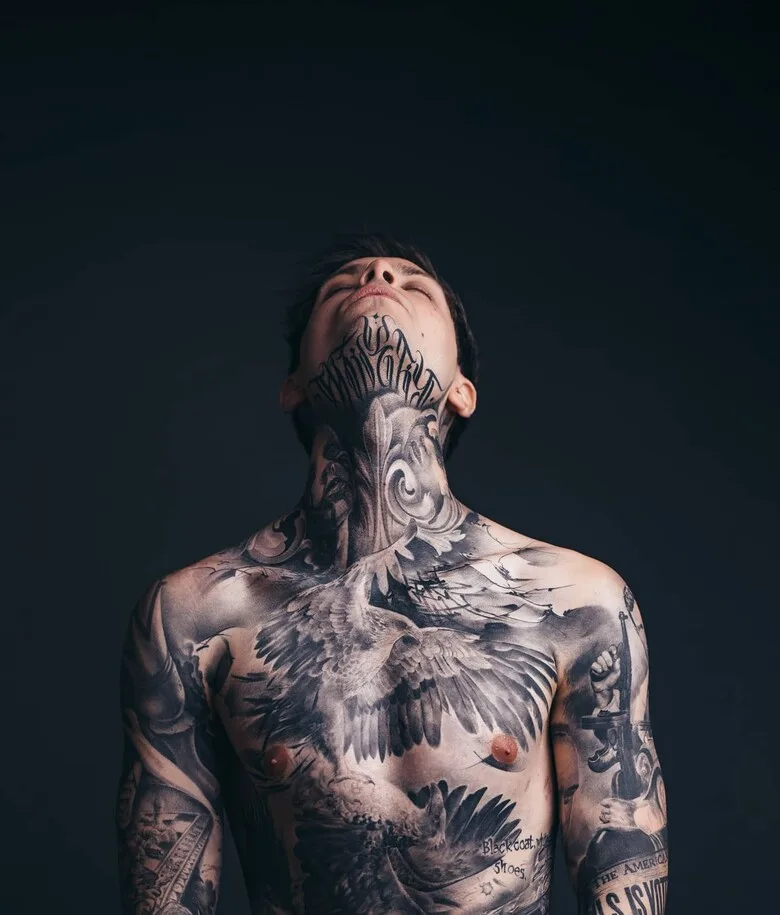
Martin identifies two eagles across his chest. In the portrait, their wings stretch across the upper torso; layered grey feathers and dark edges keep the birds visible against the surrounding work.
Smaller birds and ornamental lines fill around them. One bird sits higher and another lower on the chest, carrying the composition from neck toward stomach.
Martin doesn’t give the eagles a separate personal meaning in the interview.
Portrait faces on the hands and forearms
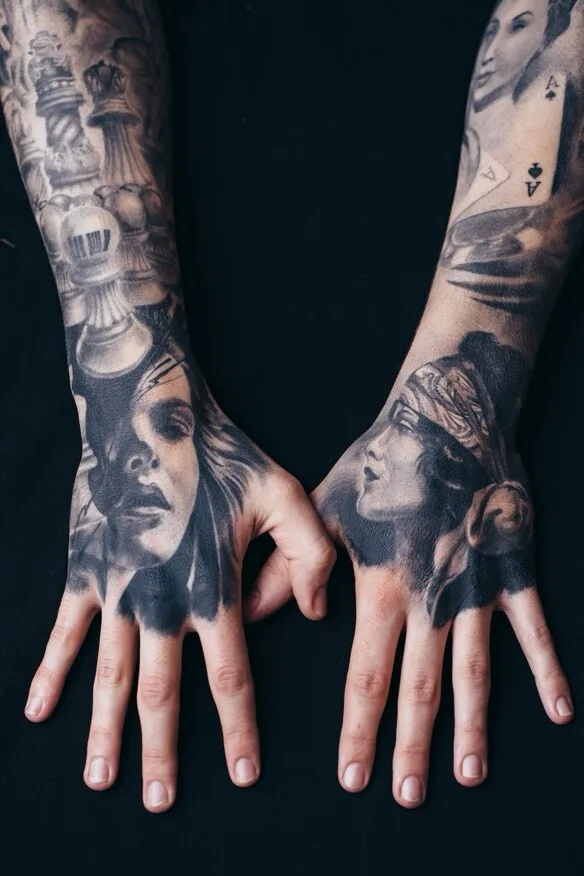
Two portrait faces run across his hands and forearms. Soft grey shading defines eyes, noses and cheeks; darker hair and background work frame them, with playing-card shapes nearby.
Because the portraits sit across moving joints, their position shifts as the fingers spread or wrists turn. The photo shows both hands and the linework continuing up his forearms.
Martin doesn’t name the people in the portraits.
The French Revolution sleeve as a chess scene
Martin describes one sleeve as a French Revolution scene built around a chess game. Portraits, card-like shapes and ornamental forms run from shoulder toward forearm.
The interview identifies the theme but not every chess piece or historical figure. In the photos, lighter faces sit against darker hair and background shading.
The Prohibition and Al Capone sleeve imagery
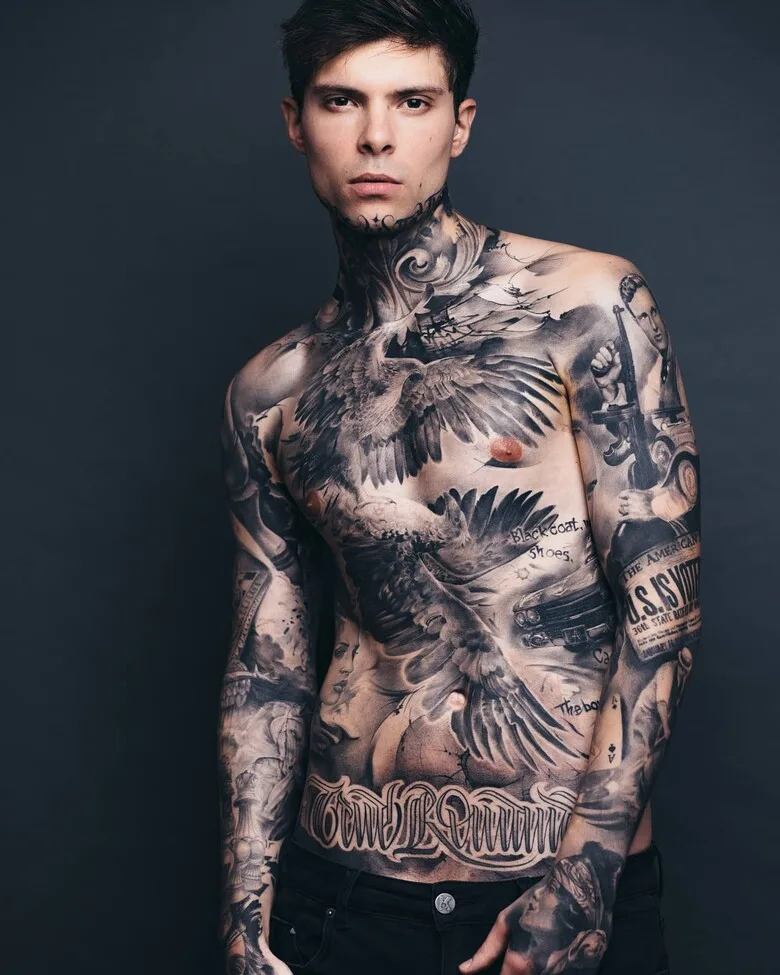
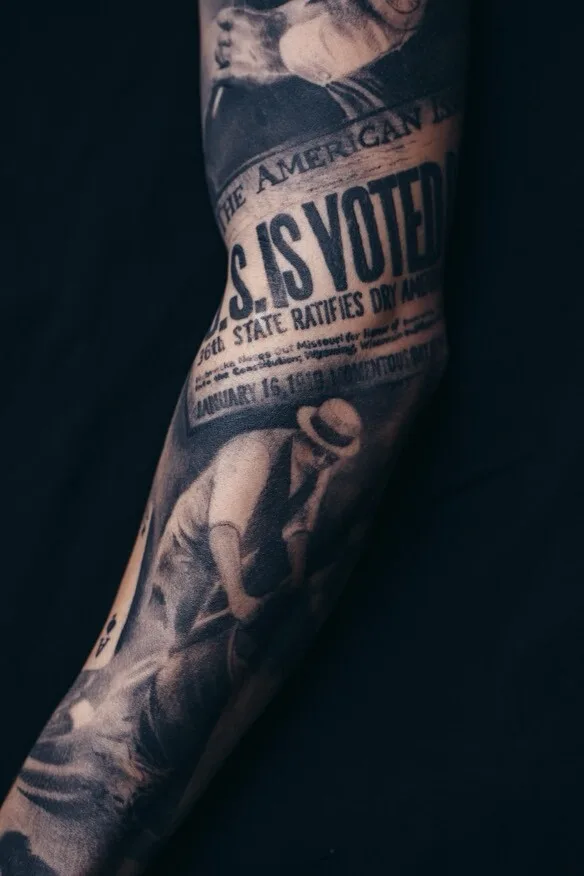
The other sleeve draws on U.S. Prohibition, and Martin names Al Capone. One photograph shows large vintage election-style lettering above a portrait and shaded detail.
Block capitals and smaller lines sit above and below the portrait. Martin identifies the subject but doesn’t explain every line of text.
The leg themes in Martin’s account
Martin describes two different leg themes: one built around love and death, and another with a dark romantic mood and female portraits.
The account gives those broad themes but doesn’t map every tattoo or identify each portrait.
Neck script, throat ornament and connected coverage
Black script and curved ornament rise under his jaw, with heavier shading around the throat. From the front, the lines frame his face and lead into the chest eagles.
In full-body views, the throat, shoulders and chest read as connected areas while keeping separate subjects.
More lettering appears across the lower torso and arm panels. Some words are clear; smaller text isn’t sharp enough to transcribe.
How the bodysuit developed
Martin says he started with a tattoo on his back and later chose to connect larger pieces. The full bodysuit grew over time; it wasn’t mapped out in advance.
He has worked with Milev for more than a decade and says their shared direction lets ideas develop quickly.
What Martin’s account leaves private
The interview names the themes but doesn’t identify the hand portraits or explain every eagle and ornament. Some smaller script is also too blurred in the photos to read.