
Jonah Hill’s tattoos are best understood through changing photographic contexts rather than through a single viral image. A shirtless paparazzi frame shows the large ship across his chest and multiple traditional-style designs on his arms. A separate selfie makes the forearm lettering readable. Later, a Vogue/WireImage premiere frame shows the chest tattoo again while Hill wears a pale suit without a shirt.
This guide keeps those tattoo-bearing originals separate from supplemental portraits. The featured image identifies Hill, the first three inline slots document genuine ink, and the final two inline slots are neutral context images used only after tattoo-specific searching was exhausted. The photographs are not treated as a complete inventory of every mark on his body, and the article does not invent meanings where published sources are silent.
The ship tattoo across the chest
The clearest broad view comes from a published paparazzi photograph in which Hill is shirtless beside a vehicle. The center of the frame is dominated by a detailed sailing ship on his chest, with animal-head designs flanking it. The same image also exposes dense work on both upper arms and forearms. It is useful precisely because it records several placements at once without requiring a cropped tattoo diagram.
The ship is the visual anchor. Its masts, rigging and hull sit between the two chest-side animals, while the arm pieces continue the old-school vocabulary of bold outlines and saturated color. The photograph supports a description of the designs and their placement; it does not, by itself, confirm that every smaller shape has a publicly stated meaning. The article therefore avoids turning common tattoo symbolism into a personal explanation for Hill.

The frame also establishes identity through the face, hair, beard and surrounding context. That matters because tattoo galleries often crop away the person and make a design look detached from its owner. Here, the skin, face and setting remain in one original composition. It is still a paparazzi photograph, so the caption stays factual and does not claim Hill posed specifically for a tattoo session.
Hello Beanie and the arm lettering
A different kind of evidence appears in the selfie reproduced in the same published tattoo coverage. Hill flexes one arm and the forearm lettering is readable in reverse because the original camera view is mirrored. The phrase is ‘Hello Beanie’, a tribute to his sister Beanie Feldstein that has also been documented in earlier interviews and entertainment coverage. The image shows the lettering as ink, not as a caption or temporary graphic.
The selfie is not a near-duplicate of the shirtless paparazzi photograph. It comes from a private, indoor setting, uses a phone-camera composition and concentrates on the arm. Other tattoos remain visible around the lettering, but the phone covers much of Hill’s face, so this slot is mapped to the forearm rather than used as the featured portrait. That division keeps a tattoo detail from being overstated as a complete identity image.
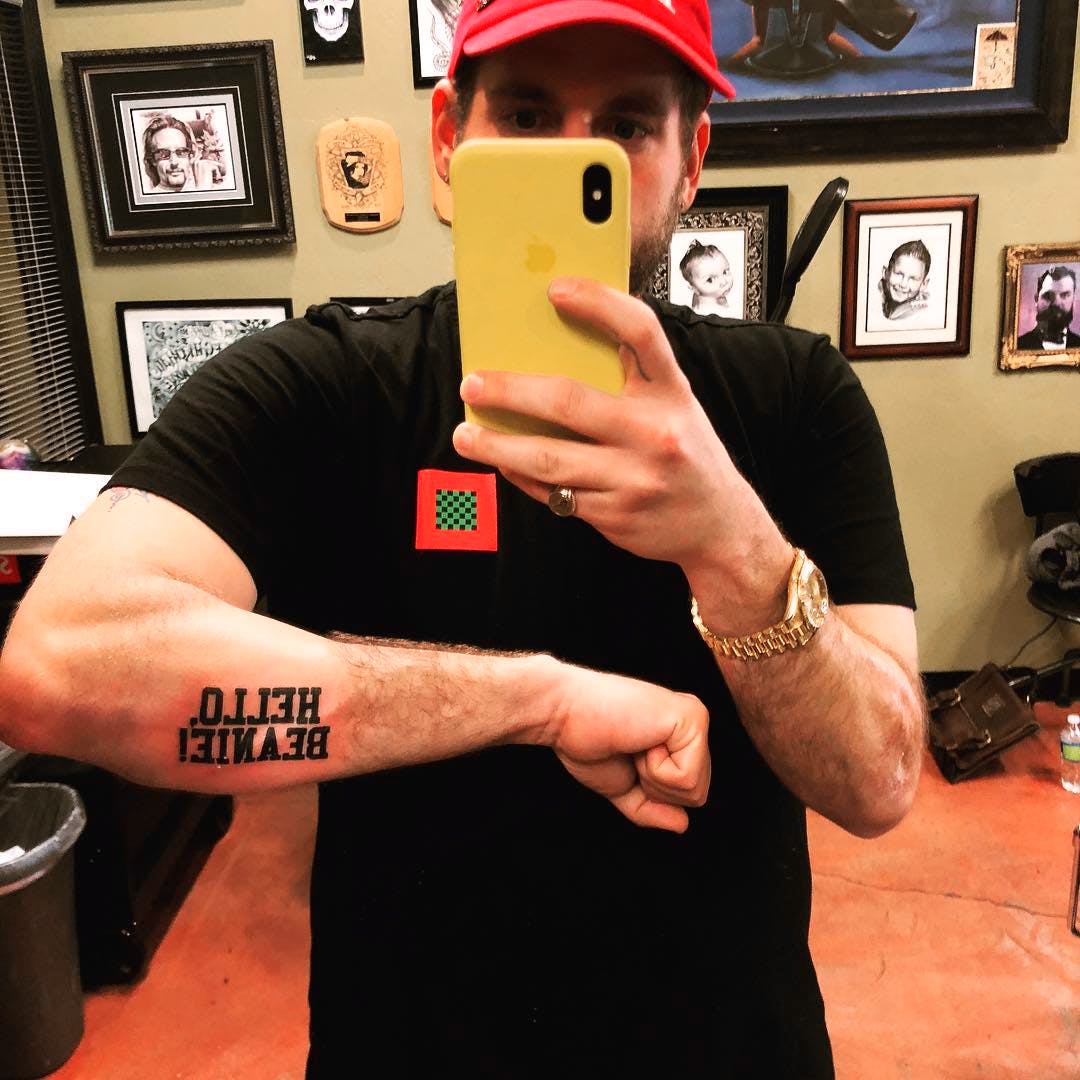
The sister tribute is one of the few designs with a clear public story. Reports connect it to Feldstein’s Broadway breakthrough, while the image itself confirms the visible wording and placement. The article does not assume that every nearby symbol shares the same story. It records the named tribute and leaves the surrounding designs at the level of visual description.
The ship tattoo in a second premiere view
The Vogue/WireImage premiere image supplies a second, independent view of the ship tattoo. Hill attended the Don’t Look Up premiere in a pale Gucci suit worn without a shirt, allowing the upper chest to remain visible. The ship is seen at a different distance and angle than in the paparazzi original, with the red-carpet setting and the suit changing the visual conditions around it.
This second view is important because it confirms the central chest design across time and context. It is not simply a duplicate crop of the shirtless frame. The ship remains in the same anatomical location, but the surrounding body, jewelry and jacket reveal different edges of the composition. The article uses the image as corroboration, not as permission to claim that every detail has been fully identified.

The premiere photograph also demonstrates why a tattoo guide needs more than a single close-up. A wide original can show how an image becomes visible through clothing and styling, while the paparazzi frame shows more of the arms. Together they establish a more reliable visual record than either image alone, even though neither tells the full story of Hill’s collection.
Identity and visual context
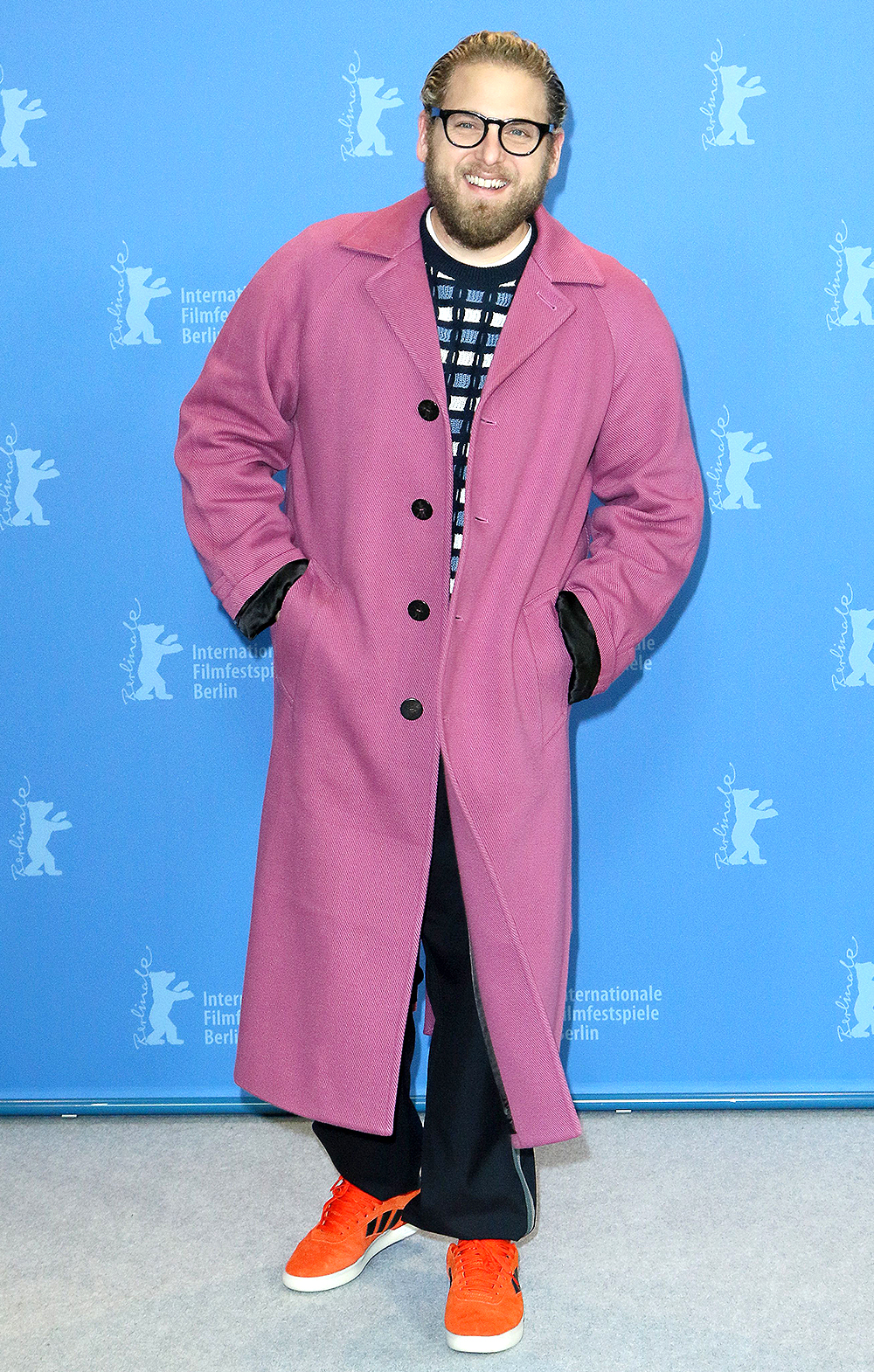
Two additional photographs are included as supplemental portraits. One shows Hill at a premiere in a black hoodie beside a co-star, while the other places him in a pink coat at the Berlin Film Festival. Both make his face and public identity clear, but their clothing covers the tattoo-bearing areas. They are deliberately mapped to a neutral section rather than presented as evidence of a new design.
This ordering reflects the evidence hierarchy. Tattoo photographs appear first because they do the primary editorial work. The portraits arrive later, after the tattoo search has been exhausted, and the prose between them explains why a face-visible image is useful without presenting it as a photograph of ink. No generic portrait receives tattoo-specific alt text or a tattoo-specific section heading.
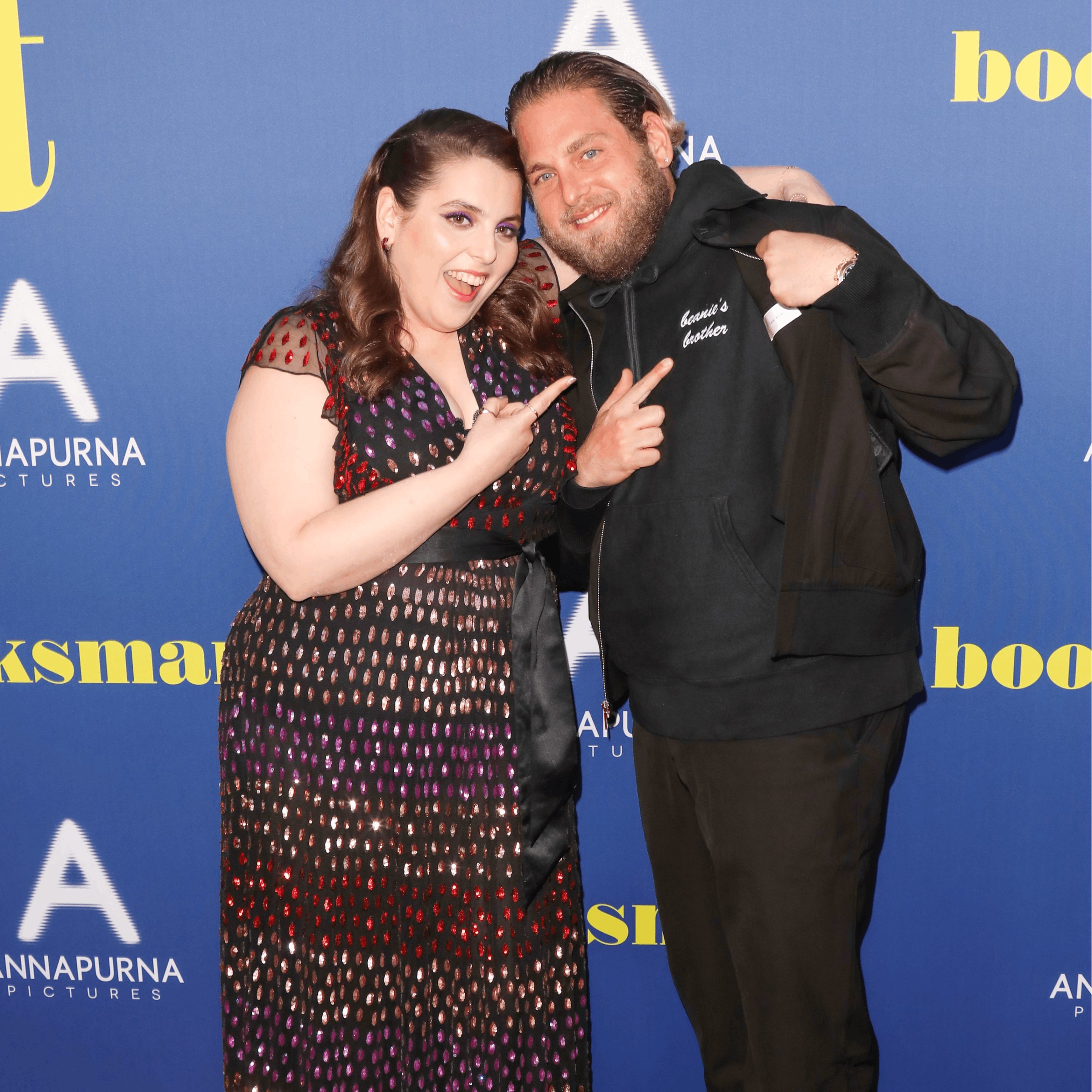
The two portraits are also different original photographs from different settings. They are not repeated versions of the featured image, and they do not pad the top of the article. Their role is to give the page visual rhythm and help readers keep the subject in view after the close tattoo details have been discussed.
What the photographs can and cannot prove
The selected images establish a strong but bounded set of claims: Hill has a large ship tattoo on his chest, multiple traditional-style pieces on his arms, and a forearm tribute reading ‘Hello Beanie.’ The original frames also show additional designs whose precise identities are not all settled by the sources used here. A responsible guide should distinguish visible placement from a complete catalogue.
Published reporting adds context around some pieces. Earlier coverage identifies “Nanny Rules” as a tribute to Hill’s grandmother, while the body-positivity tattoo has been reported as a ‘Body Love’ design connected to his public discussion of self-acceptance. Those accounts are useful for the dossier, but the final inline set does not pretend that a generic portrait shows either design when the selected frame does not visibly expose it.
The meaning of the ship, the animal heads and the smaller traditional designs is less firmly documented in the selected primary coverage. It is tempting to attach a standard symbolic reading to every ship, wolf or panther, but that would blur the line between tattoo culture and Hill’s own explanation. The safe wording is visual: the article describes what the photographs show and attributes personal meaning only where a source does so.
How the image set was assembled
The research pass covered Vogue’s red-carpet coverage, the Yahoo-published tattoo photograph set, the underlying image files, Entertainment Tonight’s report on the body-positivity tattoo, older interview references to ‘Nanny Rules,’ and tattoo-specific cataloguing pages used only as secondary visual leads. Tattoo-bearing originals were considered before any generic portrait. The final inline list contains three different tattoo photographs and two supplemental portraits.
The same-person search also checked close-ups, shirtless paparazzi frames, personal selfies, red-carpet angles, entertainment galleries and source-page image variants. Some files were rejected because they carried editorial circles or arrows, were low-resolution crops, or repeated an already-seen frame. A collage or annotated screenshot can help locate a design during research, but it is not automatically suitable as a publishable original.
The three retained tattoo photographs serve different jobs. The first gives a broad chest-and-arms view, the second makes the forearm lettering readable, and the third corroborates the ship at a premiere. The two portraits are last-resort supplemental context, separate from the tattoo record. Each source path and each downloaded file is unique, and no media ID is reused in the mapping.
This approach leaves room for uncertainty without leaving the article visually thin. Five inline slots are distributed through the body with prose before and after each placement. The reader sees the tattoo record unfold by placement and context rather than encountering a pile of images before the explanation begins.
What should not be inferred
A photograph can establish that a mark is visible, but it cannot automatically establish who designed it, when it was completed or what it means. The ship and animal heads are clearly part of Hill’s chest tattoo composition, yet the selected sources do not supply a personal explanation for every component. The article therefore keeps description and interpretation separate.
The same caution applies to coverage. An exposed chest does not prove that no back or leg tattoos exist, and a coat-covered portrait does not prove that the ink has changed. Clothing, cropping, camera angle and the timing of the photograph all affect visibility. Different images should be compared, not collapsed into a false before-and-after story.
Finally, the presence of tattoo imagery should not invite commentary on Hill’s body beyond the tattoo record itself. His published body-positivity statement is relevant because it explains the ‘Body Love’ design, not because it licenses speculation about his appearance. A source-led tattoo guide can document the art while leaving personal boundaries intact.
The result is a visual record with clear limits: three genuine tattoo-bearing originals, two supplemental portraits, and a dossier that distinguishes confirmed wording from visual description. That is enough to understand the central chest and arm work without pretending to have solved every detail of Jonah Hill’s collection.