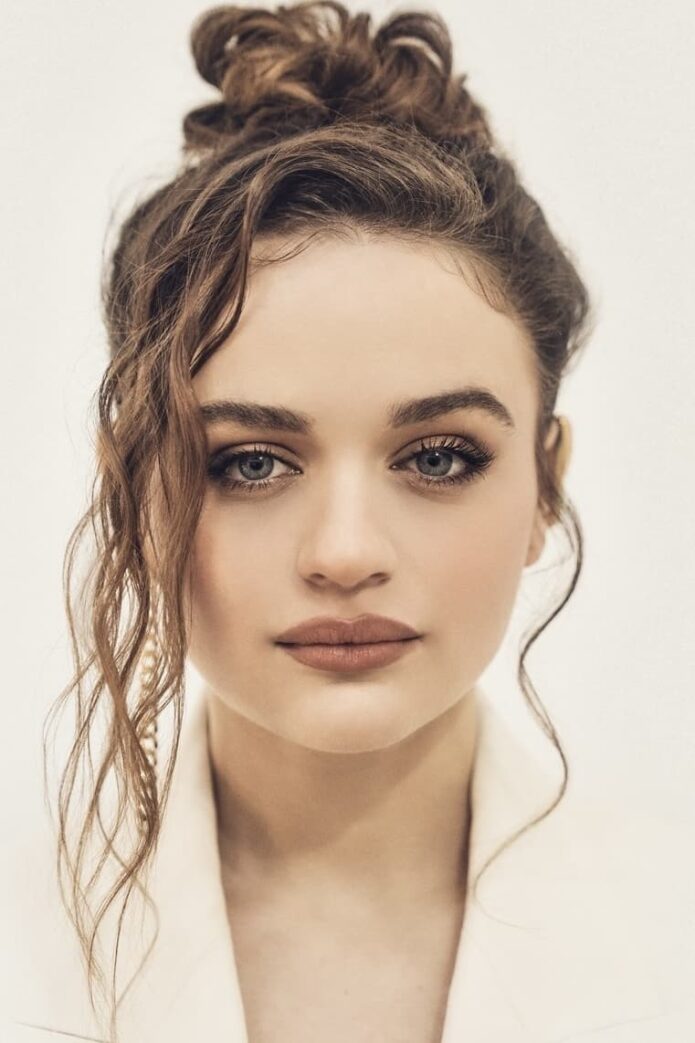
Joey King’s tattoos are small, personal, and a little more varied than you might expect. She has delicate insects, tiny script, a Hebrew food joke, and a few designs that only really make sense when you know who she got them with. Nothing about the collection feels like it was built to fill an entire arm or chase one trend. The pieces are scattered across her shoulders, wrist, hip, ankle, upper arm, and neck, which gives each one a bit of breathing room.
The most clearly documented group came from a tattoo appointment Joey shared with her sister Hunter. They chose matching designs and connected the day to a donation for A21, an organization that fights human trafficking. Joey’s other well-reported piece is the Hebrew word for hummus on the back of her neck, done by Israeli artist Ronni Winkler during a trip to Tel Aviv. There are also older photos that show a fine-line character tattoo on her upper arm.
That mix makes Joey’s ink useful inspiration if you like tattoos that stay quiet. The designs aren’t huge, but they still have enough detail to feel intentional. She also seems comfortable putting different ideas next to each other instead of forcing everything into one matching set.
Joey King’s style is small, fine-line, and personal
Joey’s tattoos don’t follow one strict visual rule, but most of the confirmed pieces share a light touch. The ladybugs are tiny illustrations connected by a dotted path. The Hebrew lettering is compact and clean. Other designs reported on her wrist, hip, and ankle are similarly small and easy to hide when she wants to.
That kind of collection can be harder to plan than a large piece. A big tattoo gives an artist room for shading, texture, and a clear focal point. Small tattoos have to do their job in a few lines. Placement matters just as much. A design on the ankle reads differently from the same design on the wrist, and a neck tattoo will always feel more visible than a tiny mark on the hip.
Joey’s choices also show why simple doesn’t mean random. The ladybugs have a relationship built into them. The hummus tattoo is tied to a very specific trip. Even the small band-aid reported on her ankle has the kind of playful, everyday quality that makes a tiny tattoo feel like it belongs to the person wearing it.
The matching ladybug tattoos with Hunter King
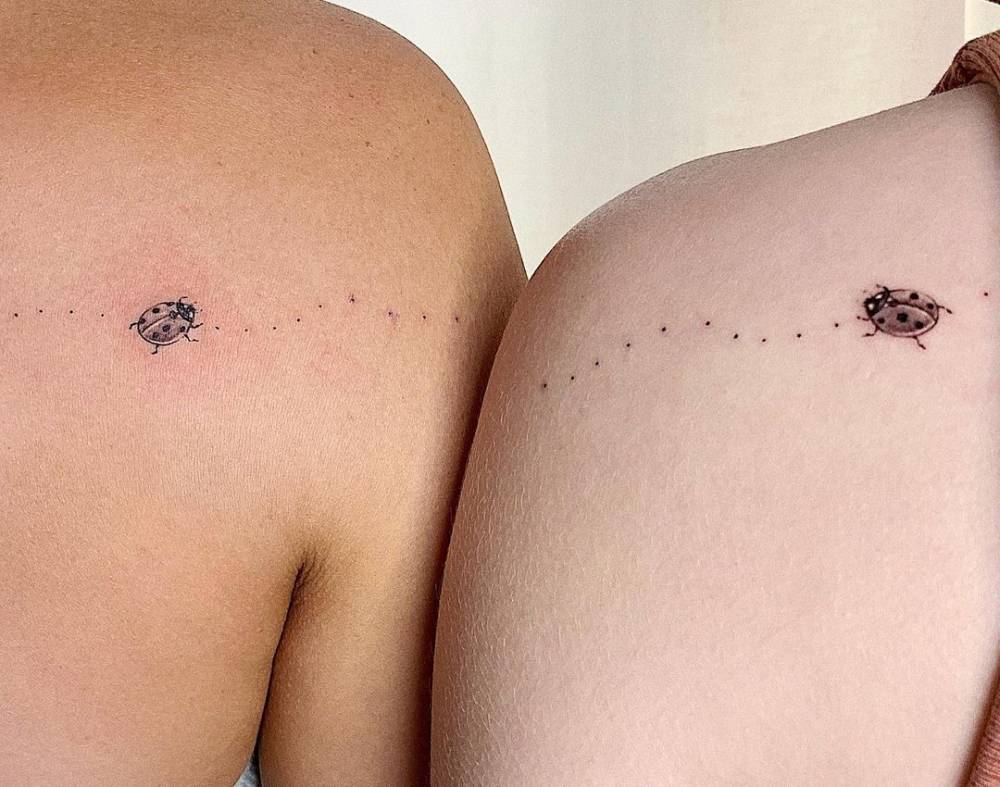
The best-known Joey King tattoo is the matching ladybug she got with her sister Hunter. The two tattoos sit on opposite shoulder blades, and a dotted line runs between the insects so the designs feel like one image when the sisters stand together. Each ladybug is small, outlined in black with darker spots and a little red color in the body.
That connecting path is the clever part. Matching tattoos don’t need to be exact copies, especially when the people wearing them won’t be in the same room every day. Joey and Hunter’s designs work alone, but the dotted line gives them a second reading when they’re side by side. It turns a familiar lucky symbol into a sibling tattoo without adding a lot of extra size.
The placement is equally thoughtful. Shoulder-blade tattoos can be covered by ordinary clothes, but they become visible with an open-back top or a swimsuit. They’re also large enough to give the dotted path a little room. A design this small would be much harder to read if the line were squeezed onto a narrow wrist.
Joey and Hunter got the tattoos as part of a donation effort for A21. The appointment was shared by the sisters and tattoo artist Haney, who posted about the visit and the cause. That context matters because the design isn’t only a cute matching tattoo. It marks a shared action, a shared cause, and a memory the sisters can carry separately.
If you’re thinking about sibling ink, the useful idea isn’t to copy the ladybug. It’s to build in a connection that still works when each tattoo is viewed on its own. A trail, a pair of stars, two halves of a small object, or even the same symbol placed on opposite sides can do that. The strongest matching tattoos usually have a reason to match.
A few other details from the sister appointment
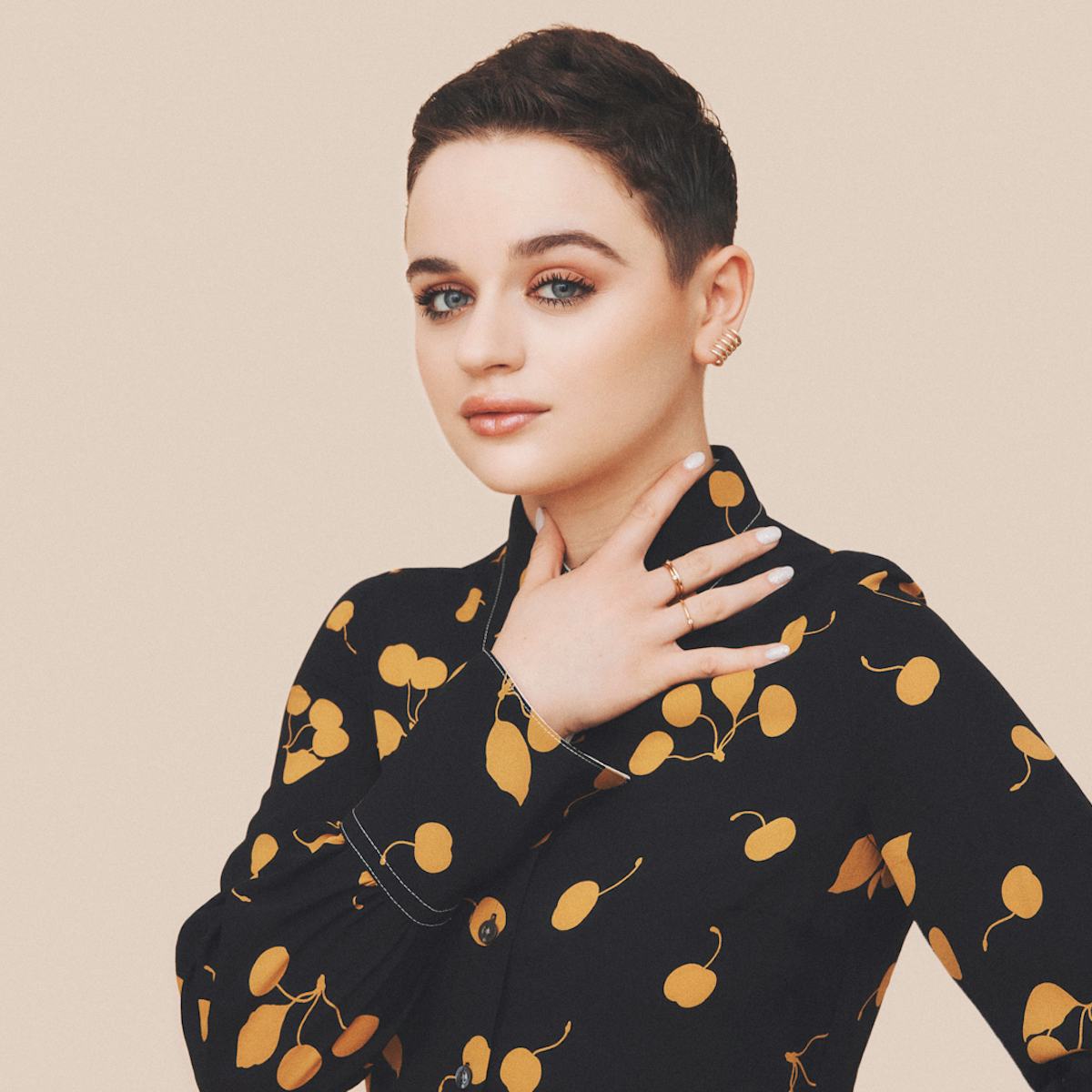
The ladybug gets most of the attention, but reports about the appointment also identify several other small tattoos. Joey has been shown with a flower and a semicolon on her wrist, interlocking hands on her hip, and a band-aid on her ankle. These are very different subjects, yet they fit the same low-key approach.
A flower is a familiar tattoo idea, so the appeal comes down to drawing style and scale. A tiny bloom can look soft and delicate, or it can be reduced to a few crisp petals. The semicolon brings a more graphic shape into the mix. It has a compact punctuation-mark silhouette, which makes it easy to keep small without losing its identity.
The interlocking hands are more unusual because they depend on a readable outline. At a small size, hands can turn muddy fast. The design needs enough separation between fingers and wrists to keep the gesture clear. That is a good reminder to give a tiny tattoo a little more room than your first sketch might suggest.
The band-aid is the playful outlier. It doesn’t pretend to be grand or mysterious. A tiny everyday object can be a better fit than a dramatic symbol when you want your tattoo to feel light. It also gives the collection some humor, which keeps the sister pieces from reading as one long sentimental statement.
These tattoos are spread across different placements instead of being packed together. That makes them easier to wear and easier to add to later. If you like a scattered collection, leaving open skin around each small design can help the pieces stay legible. Tiny tattoos still need visual breathing room.
The Hebrew “chummus” tattoo on the back of her neck
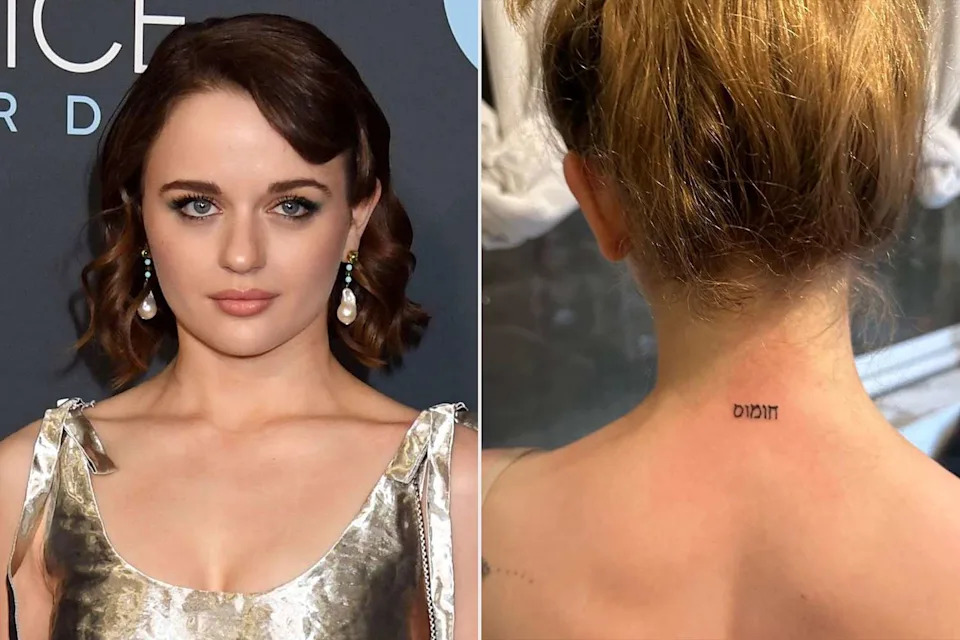
Joey’s most memorable recent tattoo is the Hebrew word “chummus” on the back of her neck. She got it in Israel during a Tel Aviv trip, and the tattoo was done by Israeli artist Ronni Winkler. The lettering is small, black, and placed just below the hairline, so it can disappear when Joey wears her hair down.
There is no complicated symbol to decode here. It is simply a food word Joey chose while spending time in Tel Aviv. That straightforwardness is what makes it fun. A tattoo doesn’t need to carry a sweeping life philosophy. Sometimes it can hold a place, a meal, a trip, or a joke that made sense at exactly the right moment.
The back of the neck is a good match for this type of lettering. It gives the word a clean horizontal area, and the hair creates an automatic cover when the wearer wants one. The downside is that small text has to be sized carefully. Hebrew lettering needs enough room for each character to stay distinct, especially as a tattoo settles and softens over time.
Joey’s photos from the appointment show how different the finished result looks from the process. During the session, the artist is working at the nape while Joey faces away. The final close-up is much simpler: brown hair pulled up, a small line of black characters, and a lot of open skin around it. That negative space helps the tattoo stay readable.
If you are considering lettering in a language you don’t speak, take the translation seriously. Work with a fluent reader and double-check the spelling before the stencil touches your skin. Joey’s tattoo works because the word is tied to a real experience, not because foreign lettering automatically looks exotic.
A fine-line Chinese-character tattoo on her upper arm
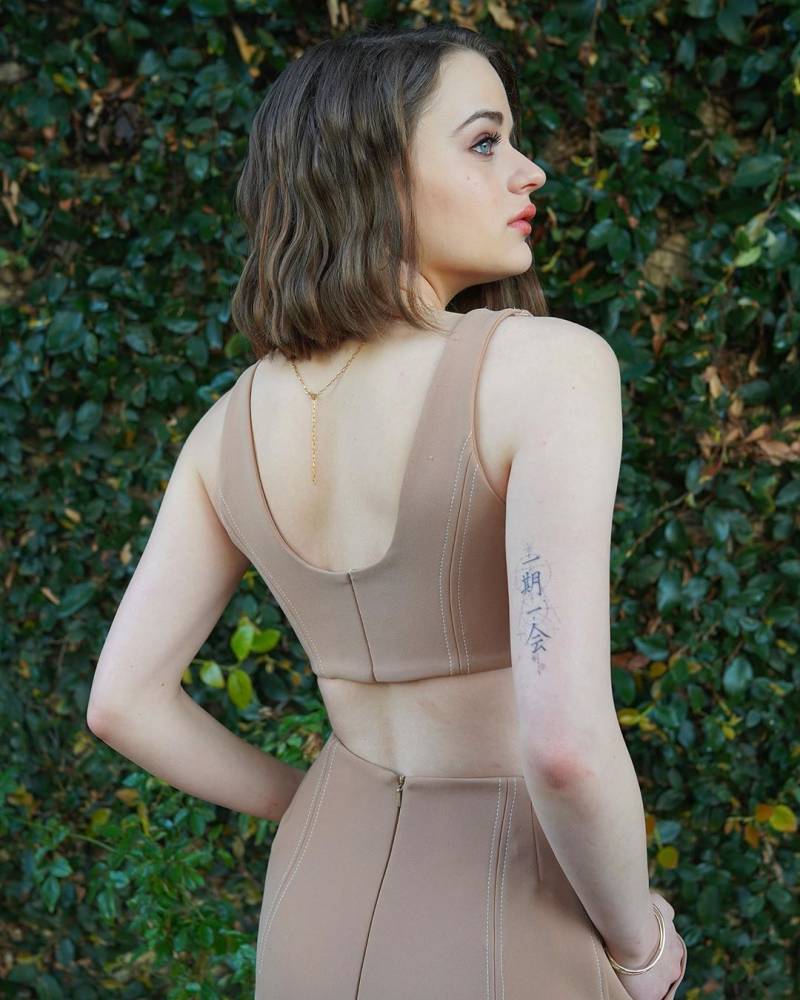
Another documented image shows Joey with a vertical line of Chinese characters on the back of her upper arm. The tattoo is fine and narrow, with the characters running down the arm rather than sitting in a horizontal line. In the photo, Joey looks over her shoulder so the placement is easy to see against the greenery behind her.
This is a different kind of text tattoo from the Hebrew word on her neck. The characters create a taller shape, so the design follows the length of the arm. The placement leaves plenty of space around the ink and gives the tattoo a clean, almost calligraphic feel.
There isn’t a reliable public explanation for the phrase’s meaning in the source that shows the image, so it is better not to invent one. That restraint is important with tattoos in another language. A photograph can confirm the placement and appearance without confirming the wearer’s private reason for choosing the words.
From a design standpoint, this is a good example of letting the body’s shape guide the layout. A vertical script tattoo can work nicely on the triceps or forearm because the line follows the natural length of the limb. The artist still needs to watch spacing, character size, and how the tattoo will look when the arm bends.
Why Joey’s choices work

Small tattoos can sometimes look like afterthoughts, especially when a celebrity has several of them. Joey’s collection avoids that feeling because the pieces have different jobs. The ladybugs connect two sisters. The hummus tattoo marks a trip. The wrist, hip, and ankle designs add small flashes of humor and personality. They aren’t all trying to be the main event.
Spacing helps too. When every tattoo is tiny, crowding becomes the biggest visual problem. Joey’s confirmed designs appear across separate areas of the body, which means each one keeps its own outline. That also leaves room for future pieces without forcing a full sleeve plan right away.
There is a practical side to this approach. A small tattoo is easier to cover for work, auditions, formal events, or simply a day when you don’t want to think about it. A neck tattoo can be hidden by hair. A shoulder-blade tattoo can disappear under a T-shirt. A wrist tattoo is more visible, but its scale keeps it from taking over the whole arm.
The tradeoff is that small work needs a good artist and realistic expectations. Fine lines can soften. Tiny details can merge. A design that looks crisp in a fresh photo won’t stay frozen that way. The best version of a small tattoo is usually the one with a clear silhouette, enough contrast, and no unnecessary detail packed into a postage-stamp space.
What to borrow from Joey King’s ideas
Joey’s ink offers a few useful ideas without asking anyone to copy her exact designs. For matching tattoos, build a relationship into the image instead of choosing two identical pieces at random. For travel tattoos, pick one small detail that actually belongs to the trip. A local food, handwritten word, street sign, or tiny object can hold more feeling than a generic souvenir symbol.
Her placements are worth studying as well. The upper arm and shoulder blade give fine-line designs enough room to breathe. The nape works for a short word that can be covered. The ankle is a natural spot for something playful and compact. Thinking about visibility before you settle on the artwork can prevent a lot of second-guessing later.
Most of all, Joey’s collection shows that tattoos don’t have to announce themselves. Some of the best pieces are only noticed when the wearer turns around, lifts her hair, or stands next to the person who shares the design. That quiet quality is part of the appeal. The tattoos feel like memories first and decorations second.
Before booking anything, take the time to confirm the design, translation, placement, and scale with your artist. Bring clear references, but leave room for the artist to adapt the idea to your body. Joey’s tattoos work because they are small enough to stay personal while still being specific. That balance is a pretty good target for anyone building a collection of their own.