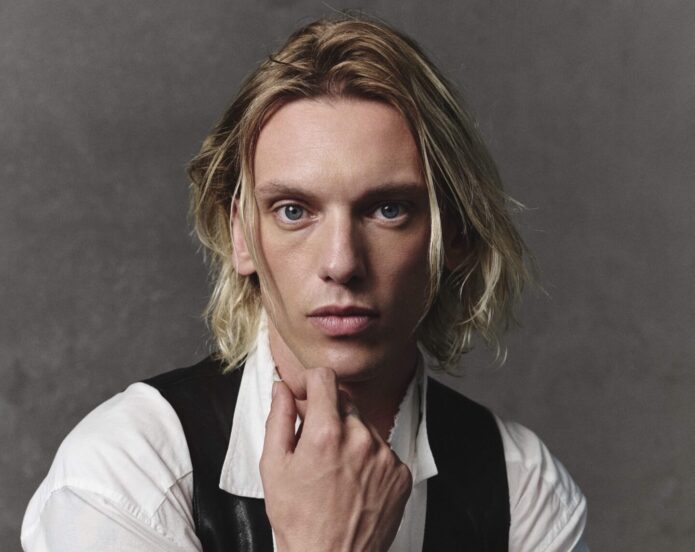
Jamie Campbell Bower’s tattoos sit at the intersection of music, acting and a very deliberate visual language. He has spoken about the collection in interviews, while photographs from different periods show how the ink moves across his chest, arms, hands and legs. The published record is not a complete catalogue of every mark, so this guide separates what Bower has explained from what the photographs make visible. Every inline photograph below is a different inspected source image and every placement is interleaved with the prose it supports.
The skull and black heart across the chest
The clearest starting point is the pair of chest tattoos visible in the backstage photograph. A skull sits on the left side of the image, while a dark heart with a dripping lower edge and butterfly details appears on the opposite side. The composition is easy to identify because the photograph is close enough to show the outlines without relying on a distant red-carpet frame.
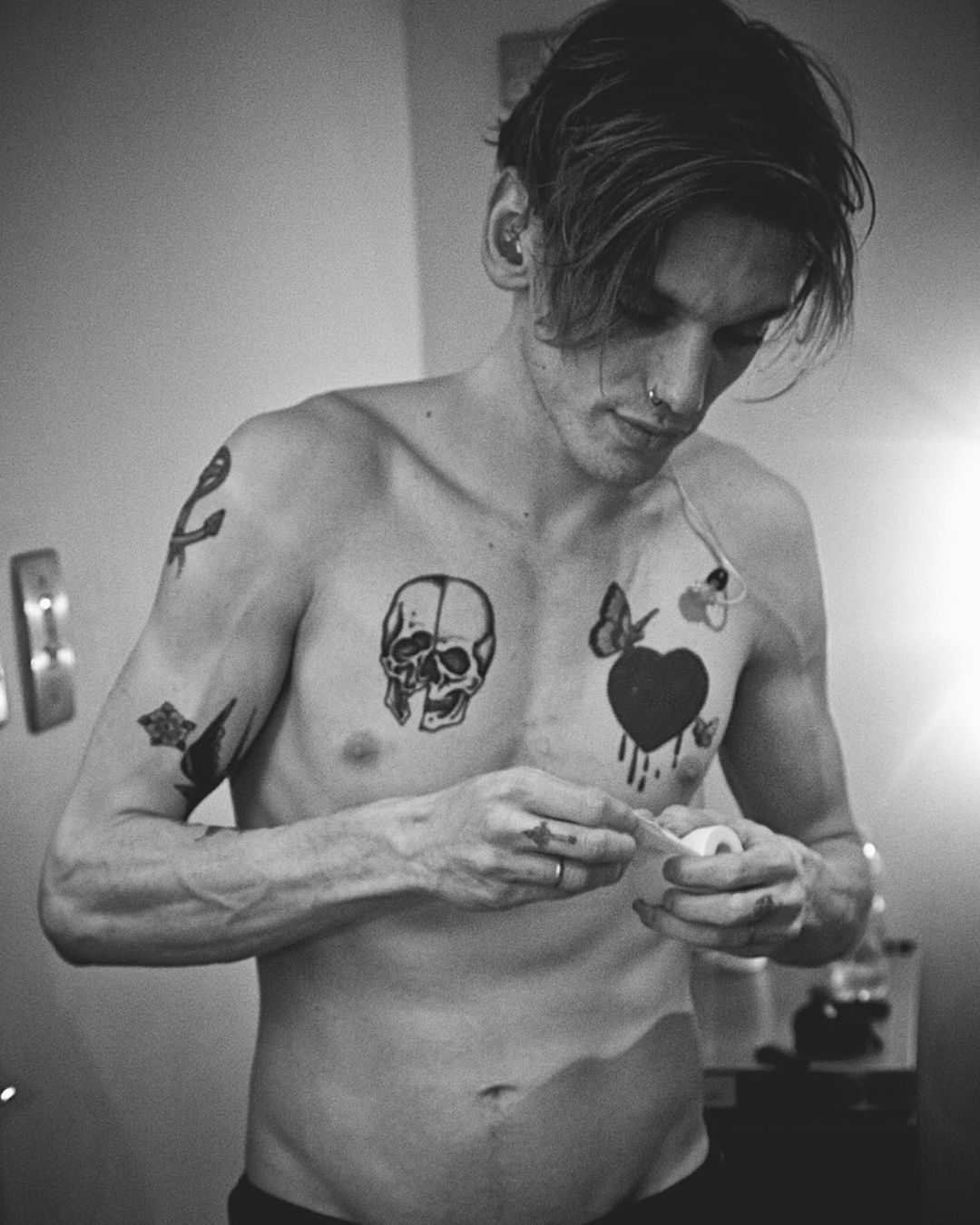
This photograph also shows smaller ink on the shoulders, upper arms and hands. The chest designs are treated as separate pieces rather than one connected emblem. Bower’s own comments support a broader light-and-dark idea in his collection, but the photograph itself is the evidence for the skull, the heart and the surrounding marks. It would be too strong to assign a private meaning to every small shape that happens to appear in the frame.
The image comes from a candid backstage setting rather than a film still. That matters because Bower has sometimes worn temporary character tattoos for roles, especially when a production required extensive body makeup. The permanent designs in this photograph are his own visible ink, not the rune transfers associated with Jace Wayland or the prosthetic work used for Vecna.
What Bower has said about light and dark
In a Cinema interview about The Mortal Instruments, Bower described the right side of his body as his light side and the left as his dark side. He mentioned a large skull, a black heart, a bird, a cross and a flower when discussing the tattoos he had at that point. That interview supplies useful context, but it does not turn every later photograph into a definitive map.
The distinction between the reported account and the visual record is important. A source can identify a design and the person can explain a personal framework, while a photograph can show how the ink actually looks on a particular date. Those forms of evidence work together without requiring the article to invent a meaning for a tattoo that Bower has never explained publicly.
The finger and knuckle tattoos
Bower’s hands carry a different scale of tattoo. The marks on his fingers and knuckles are small, high-contrast symbols that become easier to see in a close portrait than in a full-body performance photograph. In a Gigwise interview, he said that Doctor Woo did his finger tattoos in Los Angeles after he accompanied a friend to a studio. That is one of the more specific artist and location details in the published record.
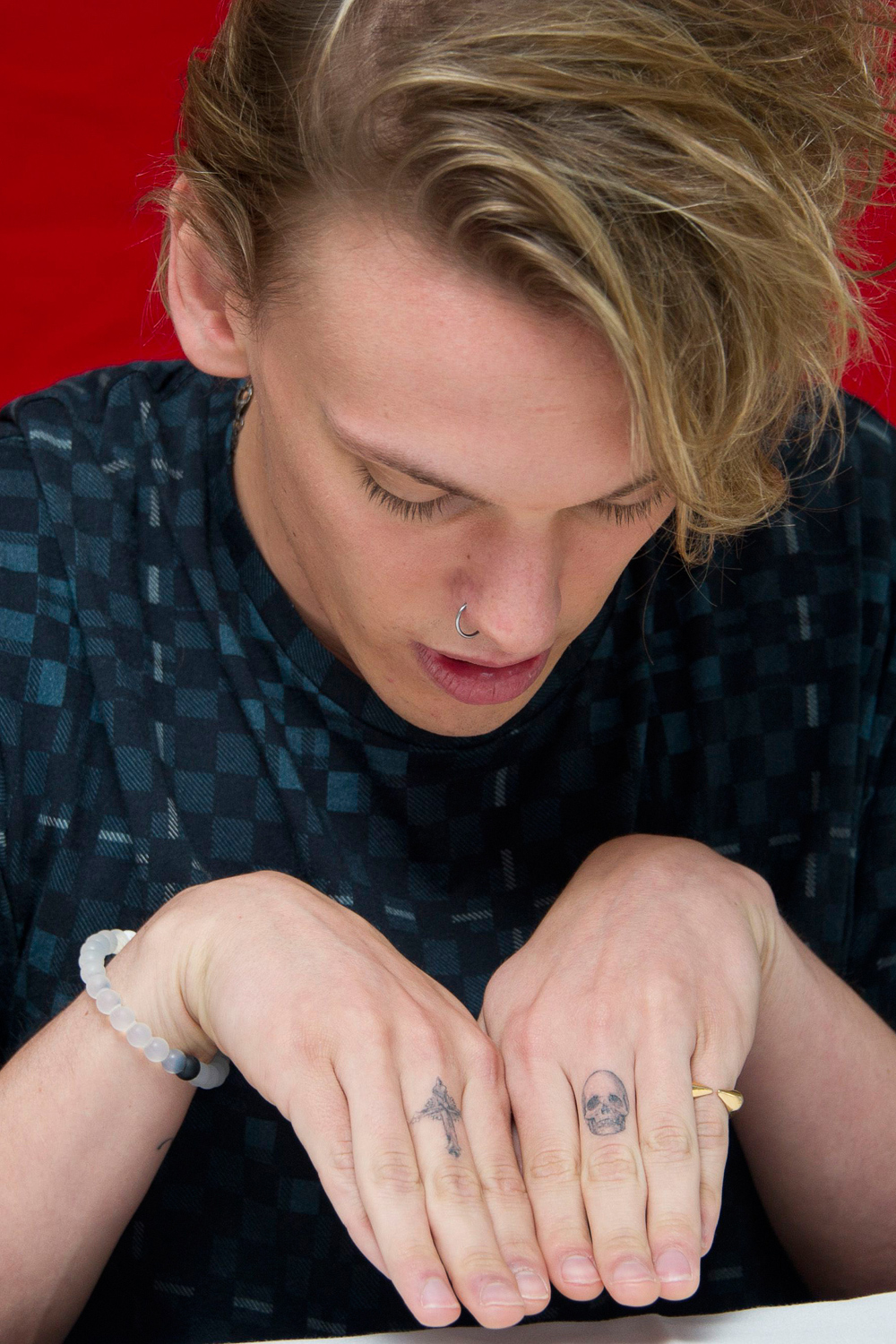
The inspected hand photograph shows the compact designs against the skin of his fingers and knuckles. It is used here because the hands are the subject of the section, not as a generic celebrity portrait. The source does not justify reading every line as a letter or naming a symbol that cannot be seen with certainty, so the article keeps the description at the level the photograph supports.
Finger tattoos also explain why different photographs can seem to show different collections. A hand can turn, close, disappear under a sleeve or sit in shadow. A close-up captures the small marks more reliably than a stage image, while an editorial portrait may show the same fingers from another angle. Those differences are photographic, not proof that one image is fake or that a tattoo appeared overnight.
The skull, heart and shoulder ink in a seated portrait
A second chest photograph presents the same broad tattoo story from a different pose. Bower is seated and looking toward the camera, so the skull and black heart can be compared with the more candid backstage frame. The heart’s rounded mass, dripping lines and butterfly shapes remain visible, while the skull’s split design reads more clearly against the chest.
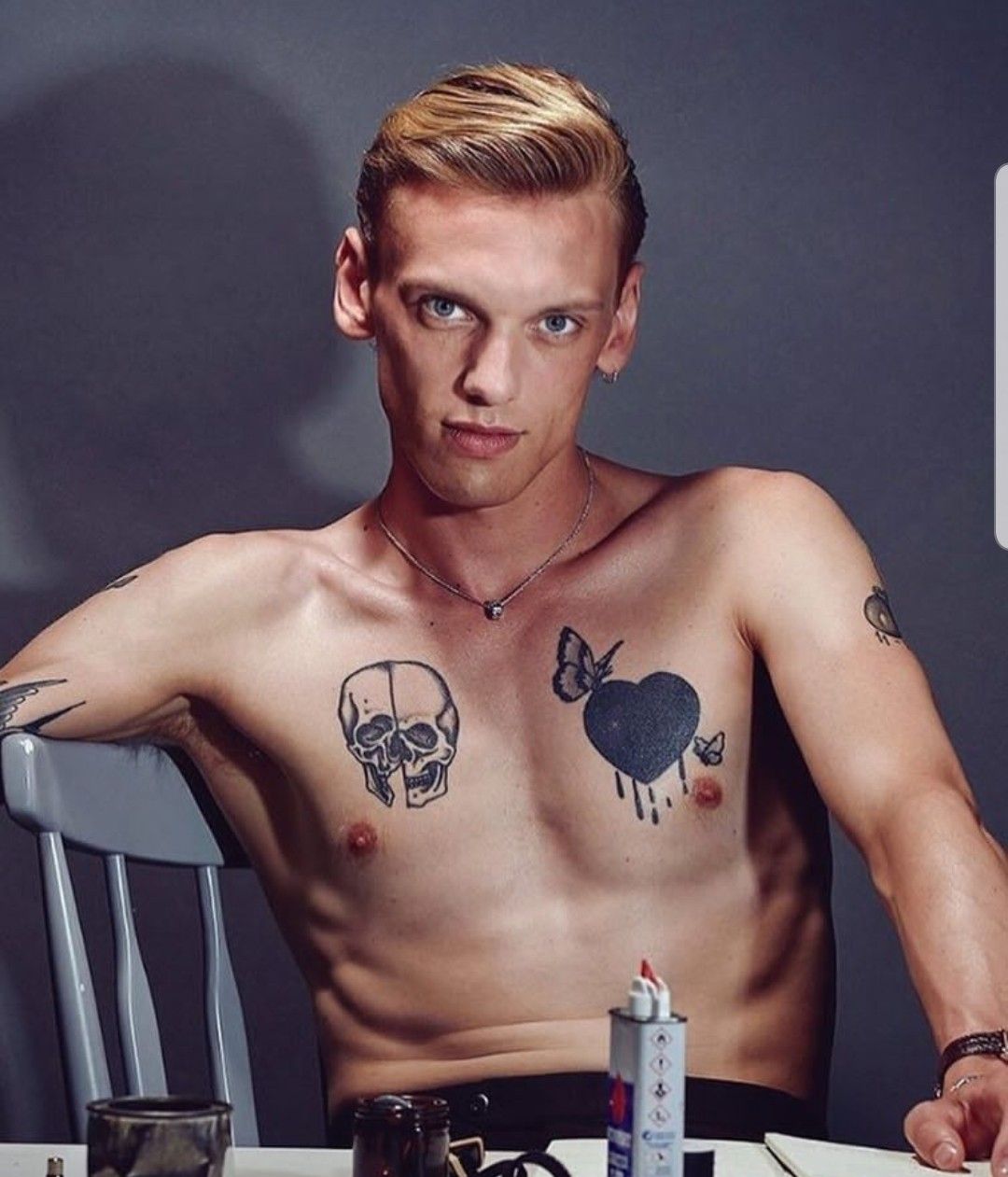
This is a separate original photograph, not a repeated crop of the first frame. The lighting, posture and background are different, and the visible tattoo area gives the reader another way to understand placement. The photograph also catches the upper arms, where additional designs appear, but the article does not turn every partial shape into a named entry.
Across the two chest views, the most defensible conclusion is simple: Bower has a prominent skull tattoo and a large dark heart tattoo with butterfly details on his chest, along with additional arm and shoulder ink. The images do not establish the date of each design or the exact order in which they were made.
Interview context beyond the photographed pieces
The early interview record describes more than the two chest pieces. Bower discussed a bird, a cross and a flower, and other reporting has identified a large skull on the leg. He has also spoken about tattoos connected to projects or characters, including an anchor associated with Anthony Hope and marks connected with The Prisoner and Camelot. Those references are useful because they come from interviews, but they should not be collapsed into one invented timeline.
When a celebrity has worked in film, music and fashion, body art can be photographed under very different conditions. A magazine portrait may reveal the hands. A performance frame may reveal the chest and arms. A costume fitting may hide most of the permanent ink while adding temporary designs. This profile keeps those contexts separate so the reader can tell which claims come from Bower and which are observations from a particular photograph.
The visible chest and arm tattoos in performance
One concert photograph shows Bower shirtless at a microphone with the skull and chest heart visible, while the arm and abdomen tattoos appear under stage lighting. A spider-like design can be seen lower on the torso in the inspected frame, and other ink runs along the arm. Because concert lighting can reduce fine detail, the image is used to confirm broad placement and the presence of multiple tattoos rather than to identify every small outline.
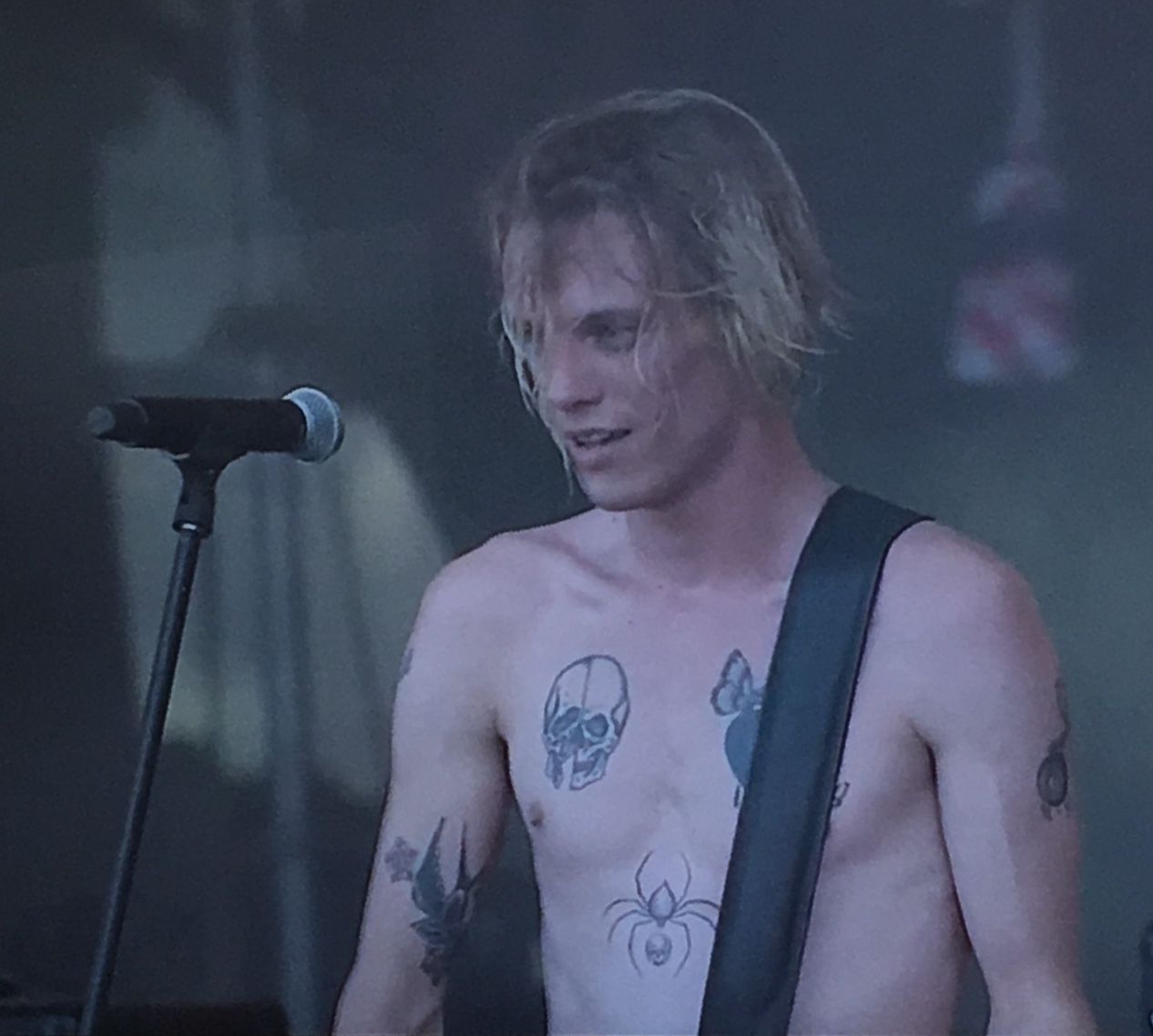
The performance setting adds something the studio photographs cannot. It shows the tattoos in motion and at the distance at which fans often first notice them. The angle is not a substitute for a close-up, but it demonstrates that the chest and arm pieces form part of a wider collection rather than isolated marks selected for one editorial shoot.
It is also a reminder that tattoo colour and contrast can change under blue or warm stage lights. A pale line may disappear, while a black outline becomes more prominent. The visual record is strongest when a concert photograph is compared with a neutral-light portrait, not when one dramatic frame is treated as perfect evidence for every design.
The chest and arm tattoos from another stage angle
A different performance photograph catches Bower in profile with a microphone and guitar strap. The skull and heart remain visible, and a spider design appears lower on the torso. A large upper-arm tattoo also emerges at the edge of the frame. The composition is distinct from the earlier live image, with a different pose, lighting pattern and relationship between the subject and the crowd.

That difference makes the photograph useful even though it does not reveal a new named tattoo with complete certainty. It lets the reader compare the chest placement from another angle and see how the arm designs continue toward the shoulder. The article does not claim that every blurred edge is a particular flower or animal. Visible evidence is described as visible evidence.
The Bob Dylan reference and personal context
The Quietus interview discusses a Bob Dylan tattoo, adding an important piece of context to the collection. Bower’s music career and his long-standing interest in performers help explain why a musician’s name appears in the published record of his tattoos. The available close-up is useful for confirming the lettering, but it is not needed to make the larger claim that the design is a tribute to Dylan.
Other tattoos have also been associated with people, roles or memories. The butterfly above the bleeding heart has been discussed by fan communities in connection with Bonnie Wright, while the anchor has been linked to Anthony Hope. Those links should be labelled as reported or discussed context, not presented as a complete official explanation for every design. The safest account follows the statements that can be traced to an interview.
How to read the published tattoo record
Bower’s tattoo record is unusually visual, but it is still incomplete. Older interviews describe designs that may be hidden in newer photographs, while later images reveal additional ink without always giving a name or meaning. A careful article can say that a skull is visible on the chest, that the heart has dripping lines and butterfly details, or that the fingers carry small marks. It should stop short of pretending to know the full private story.
The difference between observation and interpretation is especially important with tattoos. Placement is often clear even when meaning is not. A design can be located on the chest, arm, finger or leg without claiming why the person chose it. The public sources support that distinction, and it gives readers a more useful record than a list assembled from unsourced fan guesses.
Design notes from the photographed pieces
From a design perspective, the collection mixes bold black shapes with smaller symbols and lettering. The skull and heart create a strong chest focal point. The butterflies soften the edge of the heart, while the finger tattoos introduce a finer scale. The live photographs show how the designs sit with the body when Bower performs, and the close hand portrait shows the importance of small, high-contrast marks.
The arrangement is also asymmetrical. The chest pieces do not form a mirrored pair, and the arm designs extend the visual story instead of repeating it. That asymmetry is part of what gives the collection its lived-in character. It looks built over time, through different decisions, rather than planned as one single sleeve or one uniform chest panel.
These observations are design commentary, not claims about Bower’s private intentions. The articles and interviews supply the documented history, while the photographs supply the shapes, scale and placement. Together they offer enough detail for inspiration without turning uncertainty into false precision.
Why the tattoo record keeps changing
Jamie Campbell Bower has continued working across acting and music, so new photographs may reveal pieces that older coverage could not. Tattoos can also fade, be covered, or become harder to see when styling and lighting change. The current record is therefore a snapshot built from named interviews and distinct published photographs, not a claim to know every mark on his body.
The strongest documented picture includes the skull and black heart on the chest, the finger tattoos associated with Doctor Woo, the bird, cross and flower mentioned in interview coverage, the Bob Dylan lettering discussed in The Quietus, and additional arm, leg and torso designs visible in performance photographs. Some meanings are reported; others remain unconfirmed.
That balance is the useful part of Bower’s tattoo story. The collection is visually distinctive, but it does not need exaggerated mythology to be interesting. The photographs show a body of work that grew alongside his music and acting life, and the interviews explain selected pieces without claiming to decode the rest. Readers can see the designs, understand the documented context and recognise where the evidence ends.
The documented conclusion
Jamie Campbell Bower is visibly tattooed across his chest, arms, hands and legs. The published record supports a skull, a large dark heart with butterfly details, finger and knuckle designs, a bird, a cross, a flower, an anchor and a Bob Dylan tattoo, with additional pieces visible in photographs. The exact inventory is not fixed in one authoritative source, so each design is tied either to a named interview or to a specific inspected image.
The five tattoo-bearing photographs are placed beside the claims they support rather than stacked at the top of the article. They show the chest from two distinct seated and backstage perspectives, the hands in close detail and the chest and arms during two different performances. The separate face-visible portrait identifies Bower but is not used as tattoo evidence.
That structure keeps the article readable and keeps the evidence clear. Bower’s tattoos are part of his public visual identity, yet the most accurate account is also the most restrained: describe what the sources and photographs actually establish, preserve the personal context he has shared, and leave the unexplained designs open for future interviews or clearer images.