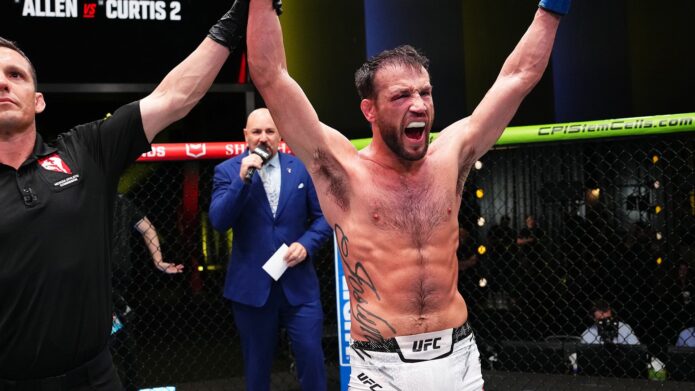
Damon Jackson’s most visible tattoo is a large name in script down his right side. The lettering runs along the ribs toward the waistband, with long loops and thick dark strokes that stand out against an otherwise fairly open torso. It’s much easier to examine in a standing portrait than during a moving exchange.
There’s also a firsthand explanation for a name tattoo in his collection. In a March 2022 UFC interview, Jackson said he already had his daughter’s name tattooed and joked about getting something more hardcore. That gives a real family connection to discuss without inventing a dramatic story for each curve in the lettering.
The photographs here keep two jobs separate. The posed portrait and kicking image show the rib script. The wider action and celebration pictures show Jackson in competition. A photograph can be sharp and clearly identify him without providing a close look at the tattoo itself.
The Name Script on His Right Side

The name tattoo sits on Jackson’s right ribs, extending down toward the side of his abdomen. In the official standing portrait, he’s turned slightly, leaving much of that side visible. The first large loop begins higher on the torso, while the remaining strokes travel toward the shorts.
The lettering has a connected cursive style. Some strokes are narrow, and others become much thicker as they curve. The long upper and lower extensions take up more space than a compact line of printed capitals would. That gives the name a flowing outline, even before the individual letters are read.
The placement is on the side, not across the center of the stomach. The middle of Jackson’s abdomen remains mostly open in this view. A front-facing cage camera can therefore miss much of the tattoo, particularly when his right elbow stays close to his body or his torso turns the other way.
Jackson’s own UFC interview establishes that he had a tattoo of his daughter’s name. The photograph shows a large name inscription in the relevant part of his collection, but the highly looped script deserves care when transcribing it. There’s no need to force an exact spelling from a partially angled image when the family connection can be stated without that extra claim.
The name has no broad illustrated background in these views. There aren’t shaded flowers or a portrait filling the skin around it. The loops and the changes in stroke width carry the design. Bare skin between the strokes helps keep the darker areas separate.
That contrast is one reason the tattoo remains noticeable in wider photographs. A single thin line could disappear at this distance. Here, the heavier curves create a recognizable dark shape along his side, even when the camera isn’t close enough to read every character.
The top and bottom aren’t equally visible in every picture. Shorts can hide the lowest stroke, and the upper arm can cover the start of the inscription. The standing portrait offers a calmer view of its overall path, with both the rib placement and the waistband in the same frame.
The Rib Tattoo During Movement
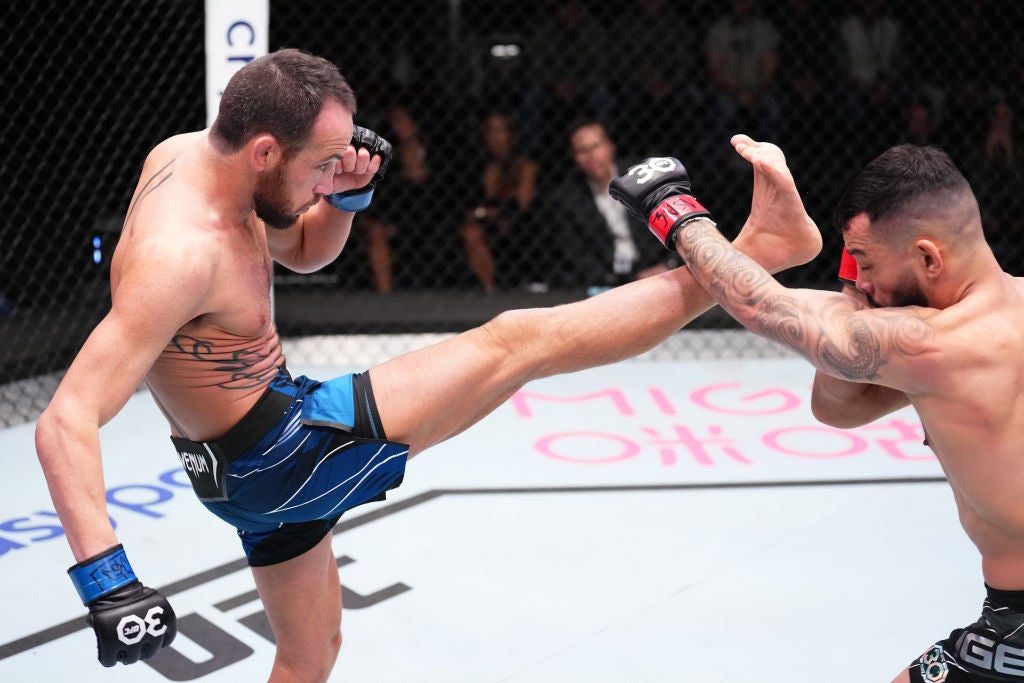
The kicking photograph shows Jackson on the left in blue shorts, with Dan Ige on the right. Jackson’s torso is bent and his leg is extended, so the rib inscription sits at a different angle than it does in the official portrait. The dark loops remain visible across the exposed side.
This is a useful second view because it shows how a long script tattoo follows the body’s movement. The name doesn’t sit on a flat sheet. It wraps around a curved rib surface that changes position when the waist turns, the arm lifts or the fighter leans back.
The shape changes in the photograph; the inscription hasn’t necessarily changed. A diagonal line of lettering can appear much closer to horizontal when the torso tilts. A loop that looks narrow from the front can open up in a side view. Those are perspective differences, not reasons to assume the tattoo was redone.
The name is also easier to separate from the rest of the body in this action image. Jackson’s arm isn’t pressed tightly against the ribs, and the exposed skin shows the broad dark strokes. The kick takes up much of the composition, but the lettering still has a clear position along his side.
A few dark marks are visible near the upper back in this angle. The photograph doesn’t provide a full, straight-on back view, so it isn’t enough to describe an entire back design or assign it a meaning. A small visible fragment shouldn’t become a whole illustrated story.
The opponent’s arm tattoos also need to stay separate from Jackson’s collection. Ige has heavier work on the arm raised to defend the kick. That ink belongs to Ige, not to the fighter wearing blue shorts. Identifying the people in the frame comes before describing the marks on them.
Between the portrait and the kick, the rib placement is well established. One shows the name in a still position, and the other shows it along a bent torso. Neither supplies the artist’s name, the session length or the date it was made. Those details would need their own source.
After the Bell
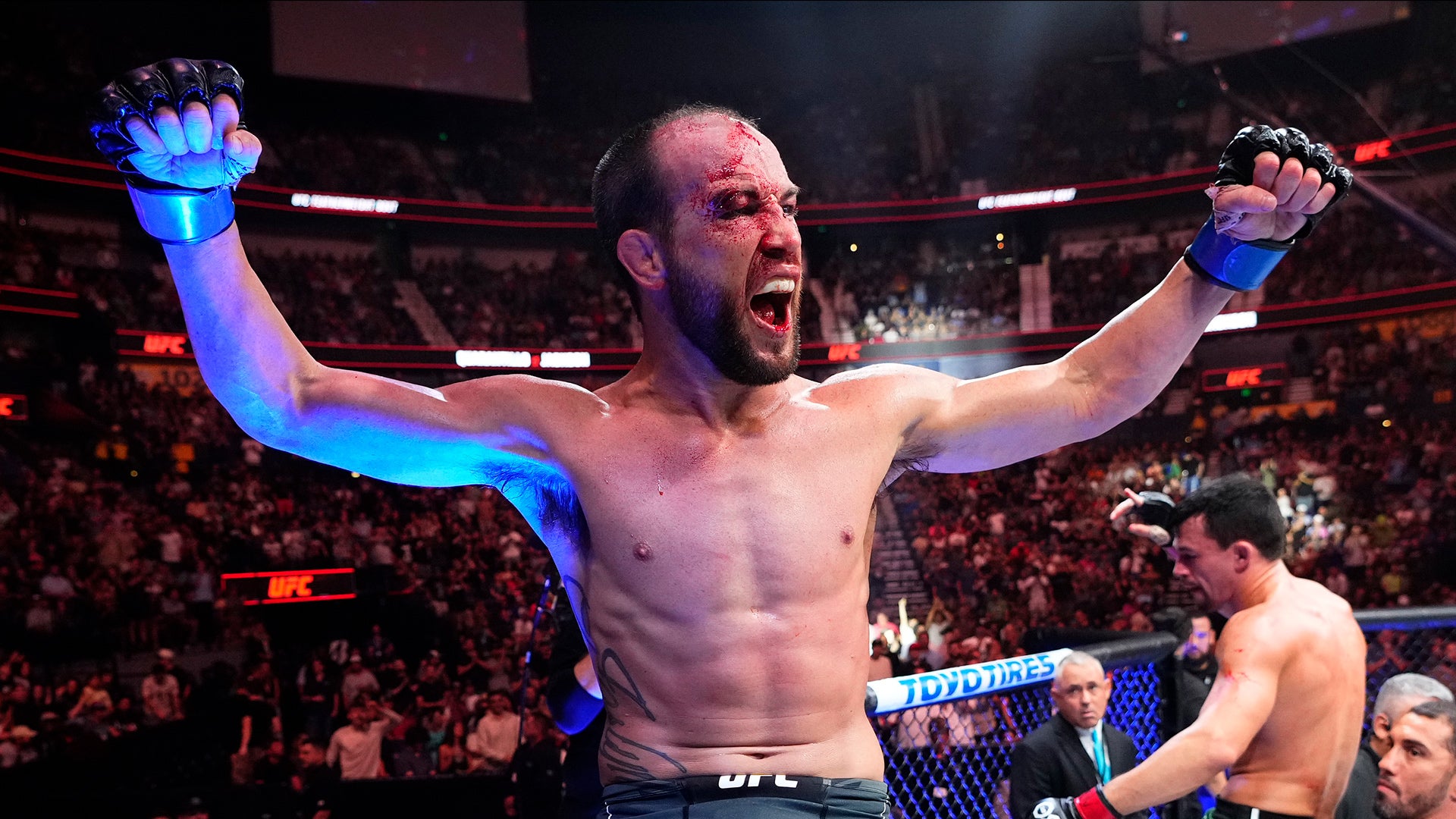
The celebration picture is included for the moment around Jackson, not as a close study of the inscription. He has both arms raised, with the crowd and another fighter behind him. The camera is close enough to identify his face clearly, but only part of the side lettering appears near the edge of his torso.
There’s blood on his forehead and face in this event photograph. That belongs to the competition setting; it doesn’t say anything about the tattoo or its history. The expression, the raised gloves and the people around him make this a different type of image from the official portrait.
A celebration image doesn’t explain a family tattoo. The connection to his daughter comes from Jackson’s own words in the UFC interview. It would be a leap to claim that a particular win, injury or emotional expression caused him to get the inscription.
His 2022 comment is also refreshingly ordinary. He acknowledged the tattoo he already had while joking about the visibility of other fighters’ ink. That doesn’t mean the family name was less important to him, and it doesn’t establish that every later mark was made for marketing. The remark should be kept in the context in which he made it.
The picture adds a face and a setting to the article while the earlier sections handle the actual lettering. It’s a photograph of Jackson, not a generic example of a name tattoo borrowed from someone else.
Exchanges at Distance
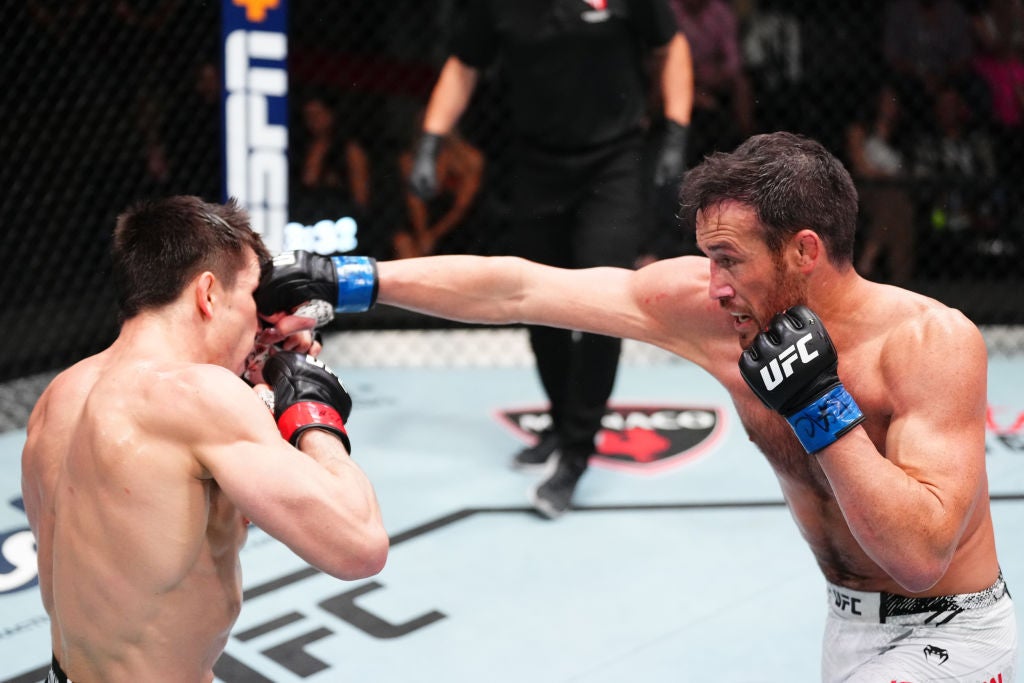
In the next photograph, Jackson is on the right in white shorts, extending a punch toward Alexander Hernandez. His other glove is close to his face. The rib area turns away from the camera, so this is competition context rather than evidence for a particular letter or stroke.
The body position helps explain why front-facing fight pictures often show very little of a side tattoo. A guarded elbow can cover the ribs, while a rotating shoulder moves the skin behind the arm. The inscription may be present throughout the exchange without being readable in that frame.
Visibility is not an inventory. A tattoo hidden by a guard position hasn’t disappeared, and a tattoo visible on an opponent hasn’t become part of Jackson’s collection. The distinction sounds simple, but it matters when photographs contain two people, moving limbs and several overlapping surfaces.
This image is useful for seeing the distance between the fighters and Jackson’s extended arm. The official portrait is useful for seeing the name. Giving each photograph a clear role avoids asking a wider sports image to provide details it doesn’t contain.
It also keeps the article from pretending that Jackson is covered in designs that aren’t visible. His chest and arms look comparatively open in the approved front views. That can be described as the appearance of those photographs without making a sweeping claim that no other marks exist elsewhere.
The Fighter Beyond the Photographs
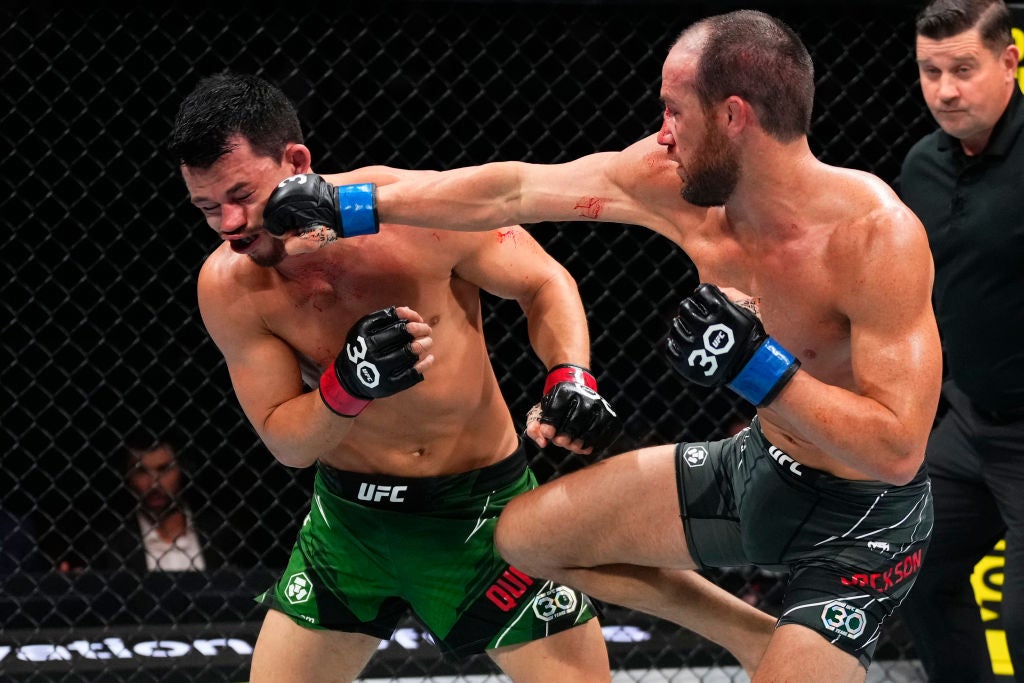
The final action picture shows Jackson on the right in gray shorts against Billy Quarantillo. The surname on the shorts helps identify him, along with his face and beard. He’s extending a punch while the right side of his torso stays largely out of view.
This is another contextual competition photograph. It isn’t a close-up of the rib script, and it isn’t used to explain a back tattoo. The value is the distinct moment: Jackson and his opponent are visible together, with their movement and positions clear.
Family also appears in Jackson’s public account of coaching. In a Sherdog interview, he said he began coaching a middle-school wrestling team because his daughter wanted to wrestle. He described enjoying the chance to work with younger athletes and watching them grow. That’s a separate firsthand story about his life, not an explanation of the tattoo’s lettering style.
The coaching conversation is useful because it gives the family connection some real context without turning it into a made-up account of a tattoo appointment. A daughter’s name can be discussed as a family inscription, while the reasons for choosing a particular font or rib placement remain unknown.
The interview below is that Sherdog conversation about his gym and coaching. It gives Jackson more room to speak than a still photograph can. The visible name script remains a simple part of his appearance, with a family connection he has acknowledged himself.