
HARDY’s tattoos are easier to understand when you stop treating the arm as one big sleeve. He has built it from pieces tied to Philadelphia, Mississippi, family, school, the animals he saw growing up and the places he has visited. The result is busy, colourful and very specific to him. There are magnolias, pine cones, a mockingbird, an Eastern mud snake, a Mississippi State cowbell and the word “home” across his knuckles.
He has also been pretty open about why he got a lot of them. In a recent conversation with Jimmy Fallon, he walked through the arm one design at a time. In another interview, he called the flower on his hand his favourite because it is his wife Caleigh’s favourite flower. The leg work follows a different idea, with tattoos linked to places he has visited. Here is the useful breakdown, without pretending every bit of shading comes with a secret story.
HARDY’s first home tattoo was a Neshoba County Fair bracelet

The red band around HARDY’s wrist is based on the admission bracelet used at the Neshoba County Fair in Mississippi. He has described that fair as one of the most important parts of growing up in his home county, and the bracelet became the first tattoo on the arm he later dedicated to home. It is a small design compared with the sleeve around it, but it gives the rest of the arm a starting point.
The detail that makes it personal is the colour change. HARDY explained that the real bracelets change colour each year, so the red version is not just a random stripe. It is a direct visual memory of going to the fair as a kid. He joked about the bracelet being a way to sneak into a future year, which is very much his style, but the reason for the tattoo is straightforward: it puts a local tradition on his skin.
That placement also works well as an anchor. The wrist is visible when he holds a microphone or guitar, while the larger pieces climb above it. A stage photograph may only show the band and a little of the forearm. A close shot reveals that the sleeve is not just a collection of traditional filler. It starts with one very specific place.
HARDY has talked about the fair in warm, homespun terms, describing the cabins, the food, the games and the way families return every year. The bracelet does not need a bigger symbolic meaning added to it. It already connects the tattoo to a real event and a real part of his childhood.
Magnolias, pine cones and the Eastern mud snake fill the Mississippi arm

The arm becomes much more recognisable once the Mississippi references are separated. HARDY pointed out magnolias because Mississippi is known as the Magnolia State. He also showed pine cones and a mockingbird, both of which fit the Southern landscape he grew up around. These are not vague country decorations. They are small local references placed beside one another so the whole arm reads like a collection of memories.
The Eastern mud snake is one of the most distinctive choices. HARDY said it was his favourite snake and remembered seeing them while growing up around the swamp. He also described the snake as rare and beautiful. That explanation matters because a snake tattoo is often given an automatic meaning about danger or transformation. Here, the reason is much more grounded. He chose an animal he knew from home.
The images show how the designs sit together. Flowers and leaves soften the darker sections, while the snake gives the arm a longer, more winding shape. The pieces do not all face the same direction, which keeps the sleeve from looking like one printed illustration. Some marks point toward the wrist, some wrap around the forearm and others sit higher near the elbow.
That mixture is why the arm needs more than one photograph. A live shot can show the overall colour and density, but it may hide the inside of the forearm. A seated portrait can show the hand and wrist while cutting off the upper arm. The tattoo record is clearer when those views are treated as different pieces of evidence rather than forced into a single image.
The stargazer lily is HARDY’s most personal hand tattoo

HARDY has said his favourite tattoo is the stargazer lily on his hand. The flower was chosen because it is Caleigh’s favourite flower, which gives the design a simple relationship story without needing a grand explanation. It is one of the softer images in a collection that also includes snakes, skulls, sports references and heavy lettering.
The hand placement makes the lily especially visible. It can appear in photographs when HARDY grips a microphone, points at the crowd or holds a drink. At the same time, hands are difficult to photograph well. Fingers bend, stage lights blow out the colour and a ring or watch can cover part of the design. A clear arm portrait gives a better sense of the flower than a distant performance shot.
The flower also changes the rhythm of the sleeve. A large botanical piece creates a patch of colour and movement rather than another block of lettering. It sits alongside the Mississippi references, but its meaning is more private. That difference is useful. Not every tattoo on the arm has to serve the hometown theme, and not every hometown tattoo has to carry a personal message about family.
HARDY has also mentioned other small hand and arm details in interviews and social posts. Some are easy to recognise, while others blend into the surrounding work. The safe approach is to name the stargazer lily because he has explained it, then describe any neighbouring shapes only when a photograph makes them clear.
“Home” across the knuckles keeps the message blunt

The word “home” across HARDY’s knuckles is probably the easiest piece for readers to spot. The letters are plain and direct, which suits the rest of the arm. There is no need to decode it. He has already said that the arm is about his hometown and Mississippi, and the knuckle lettering puts that idea in the most obvious possible form.
Knuckle tattoos also change with movement. When HARDY opens his hand, the word reads as one line. When he grips a microphone, the letters break across the fingers. That is why the tattoo can look slightly different in concert photographs without actually changing. The hand is constantly moving, and the camera rarely catches it straight on.
The lettering sits beside more detailed images, including the flower and the animal work. That contrast keeps the sleeve from becoming too busy. The word gives the eye a clean horizontal line, while the magnolia, pine cone and snake create the more decorative parts around it.
It is also a good example of HARDY’s laid-back way of talking about tattoos. He does not need to turn the word into a complicated philosophy. It means home. The supporting details tell us which home he means, and the photographs show how the lettering works with the rest of his hand.
Mississippi State and the Rockets bring school memories into the sleeve.
HARDY has identified a Mississippi State cowbell tattoo and a reference to his high school mascot, the Rockets. Both designs add school memories to an arm that is already full of state and hometown imagery. The cowbell is an especially recognisable Mississippi State reference, while the Rockets piece connects the tattoo collection to his own teenage years.
Those designs help stop the sleeve from becoming a generic map of Mississippi. The point is not just that HARDY comes from the state. It is that particular places and institutions shaped his life. The fair is one memory, the school mascot is another and Mississippi State represents a different kind of loyalty.
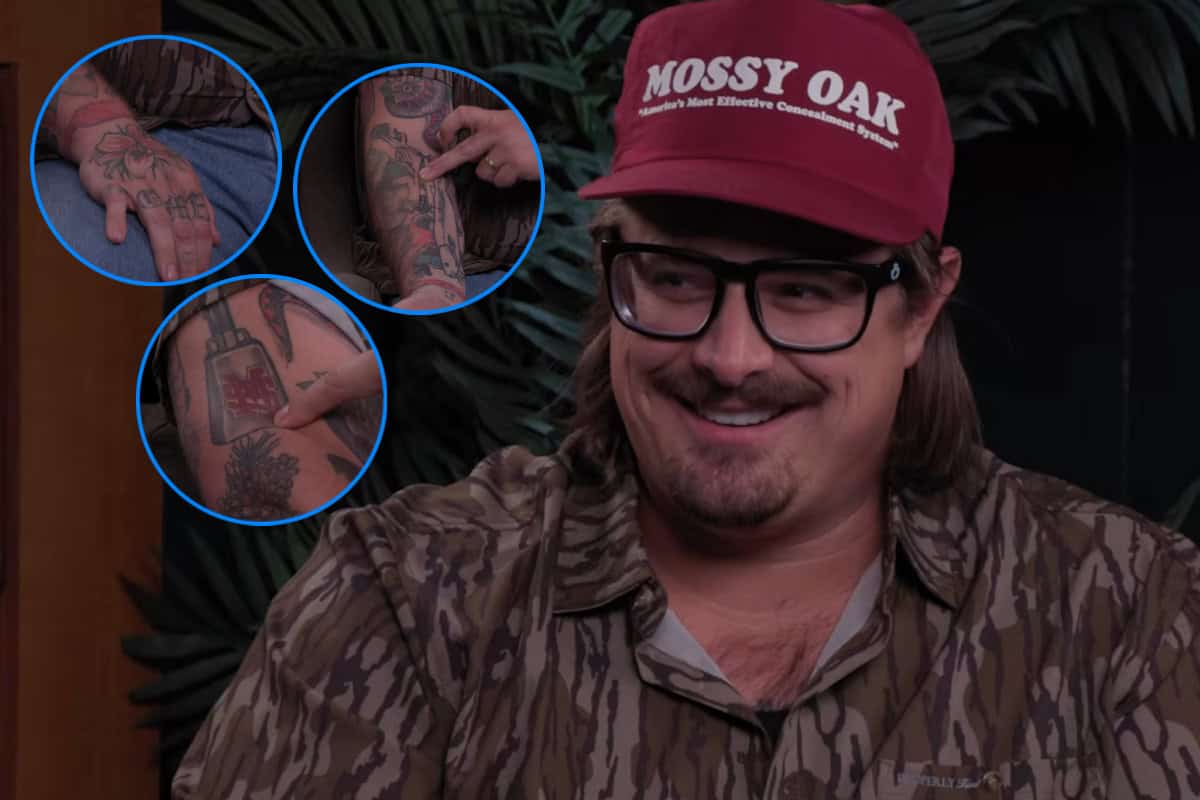
The smaller symbols are also easy to lose in a wide photograph. A shirt sleeve, microphone cable or guitar strap can cover them. When the arm is shown in a close portrait, the designs sit more clearly beside the flowers and animal imagery. That is another reason to use several different photographs instead of relying on one generic stage picture.
His leg tattoos record places outside Mississippi.
The arm is mostly about home, but HARDY has said his leg tattoos work differently. He has described pieces connected to places he has visited, including Italy, Thailand, New Zealand and Australia. That gives the legs a travel theme, although the available interviews do not identify every individual design in enough detail to assign each symbol to one country.

The distinction matters. A visible dice or small graphic on the thigh can be described as part of the leg collection, but it should not automatically be labelled as the Italy tattoo or the Thailand tattoo without a clear source. Travel tattoos often work as personal souvenirs, and the owner may know the connection even when a photograph cannot reveal it.
In live photography, the leg pieces are often harder to see than the arm. Shorts, stage lighting and movement get in the way. The clearest images tend to come from seated performances or relaxed portraits where the thigh is not hidden by a guitar or microphone stand. Even then, a photograph may show only one part of the leg, so the timeline and the placement should be kept cautious.
The travel work gives the wider collection a nice balance. The arm looks back toward Mississippi, while the legs hold reminders of places HARDY has reached through touring and life on the road. Those are different kinds of memory, and keeping them separate makes the article more interesting than calling everything a hometown tattoo.
The little details matter because the collection keeps growing
HARDY has a lot of tattoos, but they do not all need the same amount of explanation. The fair bracelet, the stargazer lily, the Mississippi references and the word home come with direct comments from him. The leg tattoos have a clear travel theme, but not every design has been publicly matched to a country. Other marks can be shown in photographs without being given a meaning that he has never stated.
The sleeve also keeps changing. New work can close gaps between older pieces, colour can soften and a different shirt can reveal or hide the same design. That is why a current guide needs photographs from different settings. One stage image may show the hand. A seated acoustic shot may show the thigh. A close portrait can make the flowers and lettering readable.
What comes through most clearly is that HARDY’s tattoos are not random filler. They are a mix of hometown pride, family, school memories and places he has visited. The arm is the most organised group because he deliberately dedicated it to home. The hand flower adds a personal relationship detail. The legs open the story out into travel.
That is enough of a story without making the ink sound more mysterious than it is. The strongest entries are the ones HARDY has explained himself. The images then do the practical work of showing size, colour and placement. Where a small mark remains uncertain, it is better to leave it labelled as uncertain than to turn a blurry shape into a confident claim.