Important timeline: the widely photographed Hustle Like You Broke lettering was an earlier right-forearm tattoo. Later photographs show a darker abstract cover-up over that area. The newer images below are included so the article does not present the old lettering as Kendrick’s current design.
Kendrick Lamar is not covered in the kind of instantly readable body art that turns every photograph into a tattoo inventory. Much of his ink is seen in short glimpses: a sleeve pulled back on stage, a forearm exposed during an interview, or an older photograph that catches a mark before clothing covers it again. That makes accuracy more important than padding the list with guesses. The strongest evidence comes from Kendrick himself, especially when he explained the large message on his right forearm. A second useful record is an early photograph labelled as his TDE tattoo. Other marks can be seen, but they should stay in the category of visible details rather than being given invented names or meanings.
This guide separates what Kendrick has personally explained from what photographs show. It also keeps dates in view. An arm photographed in 2012 does not automatically prove that every later image shows the same arrangement, and a blurred stage picture is not enough to identify a tiny symbol. The result is a shorter but more dependable map of Kendrick Lamar’s tattoos, centred on the pieces that can be connected to a source.
Hustle Like You Broke was an earlier forearm tattoo
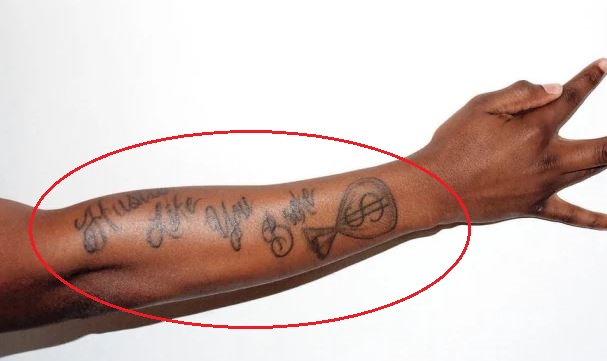
The clearest tattoo in Kendrick Lamar’s public record is the large script message running along his right forearm: Hustle Like You Broke $. The wording is not a fan’s interpretation of a photograph. Kendrick identified it during a 2018 Vanity Fair conversation, after pulling up his long-sleeved shirt and showing the interviewer the tattoo. He also explained where the phrase came from. Top Dawg, the head of Top Dawg Entertainment and one of the central figures in Kendrick’s career, had told him to keep the mentality of someone who had not escaped the need to work.
That context gives the lettering a practical meaning. It is not presented as a secret lyric or as a decorative piece chosen because the words sounded tough. Kendrick described it as a reminder not to become comfortable. The dollar sign at the end makes the line look like a compact slogan, but his explanation is about discipline rather than a promise of wealth. The important part is the verb implied by the phrase: keep hustling. That is why the tattoo fits so closely with the way Kendrick talks about his work, where long hours and constant revision matter as much as public success.
The placement also suits the message. The forearm is visible when Kendrick performs, gestures or rolls up a sleeve, so the lettering can appear without requiring a shirtless photograph. It is long enough to follow the arm instead of sitting as a small isolated word near the wrist. In the available image, the script sits within a larger field of dark ink, with smaller marks and bands breaking up the space below it. The photograph is useful for placement and scale, but it should not be used to claim that every surrounding shape has a known name.
There is a difference between reading the tattoo and explaining it. A viewer can make out the main phrase because the letters are large and arranged along the forearm. The smaller symbols near the wrist are less secure. They may be clear in one close-up and lost in another because of lighting, angle or the way Kendrick is holding his arm. The responsible description is therefore specific about the script and cautious about the rest. The message is confirmed; the full catalogue of nearby marks is not.
The phrase also says something about Kendrick’s relationship with Top Dawg Entertainment without turning the tattoo into a company logo. Top’s advice is part of the story, but Kendrick’s choice to carry the wording on his skin makes it personal. It records a working philosophy that existed before the biggest awards and remained relevant after them. That is a more grounded reading than calling the tattoo a generic symbol of ambition. The source gives us the speaker, the wording and the reason. It does not require an extra layer of symbolism.
In later photographs, the forearm can look different depending on the sleeve, the crop and the lighting. Black ink compresses easily in a low-resolution stage shot, and the lettering may be partly hidden by a watch or cuff. Readers comparing images should look for the long text along the right forearm rather than expecting one identical pose each time. The line’s scale and direction are more reliable identifiers than the exact shade of the surrounding skin or the amount of secondary ink visible in the frame.
This is also the tattoo that most clearly connects Kendrick’s visible collection to his public work ethic. He has spoken repeatedly about writing, studying and throwing away material that did not meet his standard. The forearm message gives that attitude a physical address. It is close to the hand that writes and gestures, and it can be read as a daily instruction without needing a private biography attached to every word. The documented explanation is enough.
The TDE tattoo is a separate mark of Kendrick’s label world
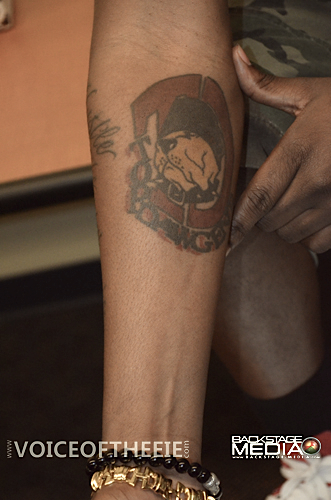
An older photograph from a 2012 Kendrick Lamar event is labelled Kendrick TDE Tattoo. The image shows a compact, dark tattoo on his upper arm, with the surrounding skin and nearby ink visible in the frame. TDE refers to Top Dawg Entertainment, the label and creative home that shaped Kendrick’s rise alongside artists such as Jay Rock and Schoolboy Q. The label connection is clear from the photograph’s caption and from Kendrick’s wider career history, but the image does not provide a long first-person explanation of when he chose the mark or what private feeling he attached to it.
That distinction matters because a small emblem is easy to overread. A reader can reasonably identify the mark as the TDE tattoo when the photograph is paired with its original label. It would be a step too far to claim that the design represents every member of the label, a particular album or a specific turning point unless Kendrick or the artist has said so. The safest description is that it is a visible sign of his connection to the company and the people around it during the early part of his career.
The photograph is valuable for another reason: it shows how different Kendrick’s tattoo record looks when viewed across time. The early TDE mark is compact and sits on the arm like a badge. The later forearm message is much larger and uses a full line of lettering. They do not create one perfectly planned sleeve. Instead, they show a collection built in stages, with some pieces tied to relationships and working life and others simply recorded by the camera without a public explanation.
Placement helps keep the two tattoos separate. The TDE mark is shown higher on the arm, while the Vanity Fair interview draws attention to the long message on the right forearm. A crowded photograph can make the upper arm and forearm seem like one continuous dark shape, particularly when Kendrick is wearing short sleeves. Comparing the location of each piece prevents the common mistake of treating every visible patch of ink as part of the same design.
The label tattoo also reflects the fact that Kendrick’s public identity was never built in isolation. TDE was not just a logo attached after fame arrived. It was the working network behind his early releases, tours and collaborations. Even without a detailed quote about the tattoo itself, its placement on the arm makes sense as a compact mark of belonging. That interpretation stays close to the evidence. It recognises the label relationship without pretending the photograph reveals a private story that has not been published.
There are smaller marks around the arm in early images, including dark lines and shapes that can look different from one angle to the next. Some tattoo catalogues and fan pages assign names to those details, but the available primary and editorial material does not consistently confirm them. This is where a good tattoo guide has to stop. A blurry shape is not automatically a symbol, and a visible symbol is not automatically a message. The TDE mark can be listed because the photograph names it. The uncertain surrounding marks should remain described as surrounding ink.
The image also shows why the word documented is useful. Kendrick has more visible ink than the two major pieces discussed here, but not every design has a reliable published label. That does not make the other marks imaginary. It means their inclusion requires a different level of confidence. A photograph can prove that ink is present. It cannot always prove a design name, date or meaning. The TDE image gives readers a concrete reference while leaving room for that honest limit.
What the photographs can and cannot identify
Kendrick’s tattoo history is a good example of why a celebrity tattoo article should not turn every dark patch in a photograph into a named design. The forearm lettering has a confirmed phrase and a confirmed explanation. The TDE tattoo has a useful photograph and a clear label. The smaller marks have visual evidence but not enough consistent reporting to support a confident inventory. Keeping those categories separate makes the article more useful to anyone trying to compare placement or recognise the pieces in later photographs.
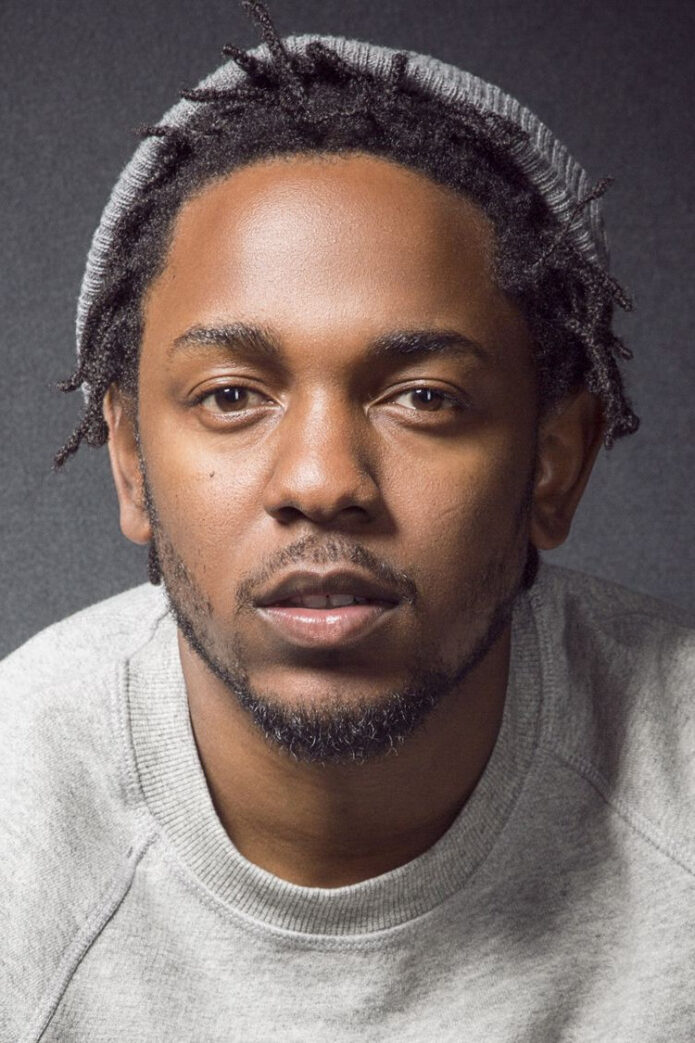
It also explains why the number of images should follow the evidence rather than a fixed quota. One close photograph can show the forearm message better than several distant stage shots. Another image can establish the upper-arm TDE mark. Adding a generic portrait would not improve the tattoo guide, even if it made the page look busier. The featured photograph is therefore separate from the tattoo figures: it identifies Kendrick clearly, while the body images do the harder job of showing the ink.
Kendrick’s visible tattoos are connected by work, loyalty and self-discipline, but the sources do not justify turning that into a neat symbolic system. The right forearm carries a phrase he explained himself. The TDE mark points to the label family that helped build his career. The rest remains a changing field of smaller details that needs sharper photographs or direct comments before it can be named. That balance gives readers a useful guide without making the ink say more than Kendrick has actually said.
The abstract cover-up is the current visual landmark on the right forearm
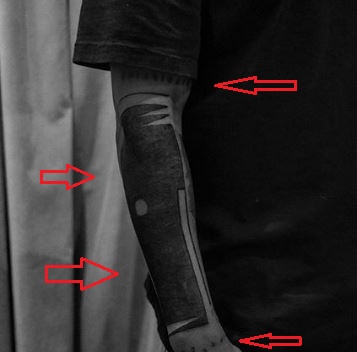
Later photographs show a broad abstract black design occupying the right forearm. The cover-up is denser than the old lettering and changes the whole balance of the arm. Instead of a readable sentence running down the skin, the newer work uses dark bands, shaded blocks and lighter breaks that follow the bend from elbow toward wrist. That is why a recent image can look like a solid sleeve even though the close-up reveals separate sections.
The available tattoo coverage describes this as a cover-up of the earlier phrase and money design. Kendrick has not publicly explained the meaning of every curve in the new work, so the visual description should stay visual. The image proves the placement, scale and change in surface. It does not prove that each dark shape represents an album, a lyric or a private event.
The change is useful for dating photographs. If the forearm shows large script, the image belongs to the earlier stage of Kendrick’s tattoo record. If it shows the heavy abstract field, it belongs to the later stage. Clothing and lighting can make the two versions look closer than they are, particularly when the elbow is bent or the sleeve covers the upper edge.
A cover-up is still part of the story even after the original design has disappeared. The older tattoo explains why Kendrick’s arm looked different in interviews and performances, while the newer design explains what viewers see now. Treating both as current would be inaccurate. Treating the old one as irrelevant would also lose the clearest first-person meaning attached to the arm.
The bands and small marks need closer photographs than a stage shot
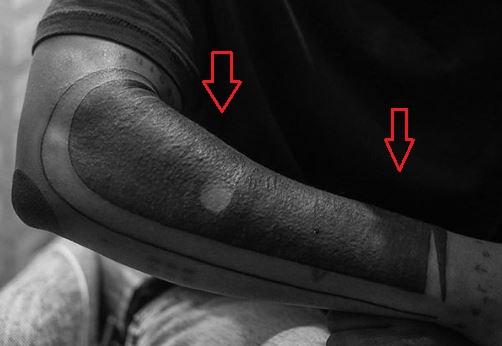
The close-up views of the newer arm show smaller elements around the main dark area: narrow bands, lettering-like marks near the edges and small shapes near the wrist. These details are real visible ink, but they are not all confidently named by independent sources. They should be grouped as surrounding marks rather than turned into a long list of invented symbols.
This is where image quality changes the reading. A distant performance photograph compresses black ink into one patch. A close photograph separates the arm into planes and lets the reader see where one band ends. It also shows why two angles may appear to reveal different tattoos. The forearm is curved, and a mark hidden on the inside can disappear when Kendrick turns outward.
The safest wording is specific about what the photograph actually shows. The newer work is a dark abstract cover-up with bands and smaller marks around it. The exact meaning of those smaller marks remains unconfirmed. That is more useful than assigning a symbolic story to every blurred line, especially when the tattoo has changed over time.