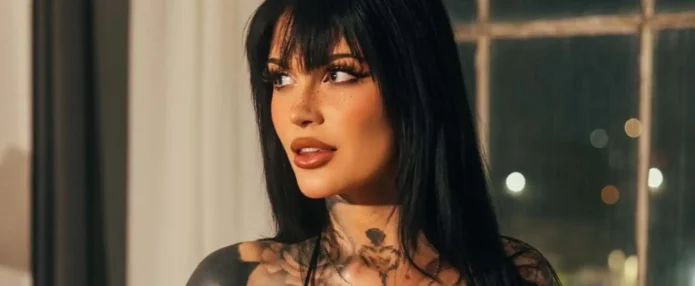
Chelsea Gabriellee’s tattoos have been changing for years, and that’s part of what makes the collection interesting. She started getting tattooed at 15, first with stars on her hips. Those early pieces have since been covered, and the rest of her ink has kept moving in a much bigger, darker direction.
Gabriellee is a Florida-born content creator and tattoo model now based in Los Angeles. She has said that many of her tattoos are inspired by horror movies she loved growing up. That gives the collection a clear mood, but it doesn’t mean every visible shape should be given a movie title. Some details are easy to see in photographs. Others are private, partly covered, or too small to identify honestly.
What you can see is a heavily tattooed body with full sleeves, dense chest and stomach work, decorated hands, and a large back piece. She’s also in the middle of changing things again, including work on her left sleeve and planned blast-overs on her knuckles. Her tattoo story isn’t finished. It doesn’t look like she wants it to be.
Chelsea Gabriellee’s horror-inspired tattoo collection

This front-facing photograph gives the clearest overall look at Gabriellee’s current style. Dark ink runs over both arms, across the upper chest and stomach, down the hands, and over the thighs. There’s a strong mix of heavy black sections, illustrative linework and colour accents. A red-and-black design stands out on the upper arm, while the stomach and thigh pieces create a much darker base underneath the lighter clothing.
The word “horror” comes from Gabriellee’s own description of her collection, not from guessing at blurry images. That distinction matters. You can say the tattoos have a dark, cinematic feel without claiming that a shadowy face is a specific character. The photographs show an alt, illustrated look with lots of coverage. The personal references are hers to explain.
There’s also a useful lesson in the way the collection has grown. Gabriellee originally imagined stopping at a half sleeve. Years later, the work reaches far beyond that first plan. Tattoos rarely stay inside the boundaries people imagine before they start. One piece changes the balance of the next, and soon a small idea can turn into a full-body project.
For anyone planning a similar look, the important part isn’t copying a particular design. It’s thinking about how the pieces will sit together over time. Dark areas can anchor a sleeve, while lighter skin breaks keep the whole thing readable. Colour can be used as a sharp accent instead of covering every inch. Her photos show both approaches working side by side.
Her full sleeves are the foundation of the look
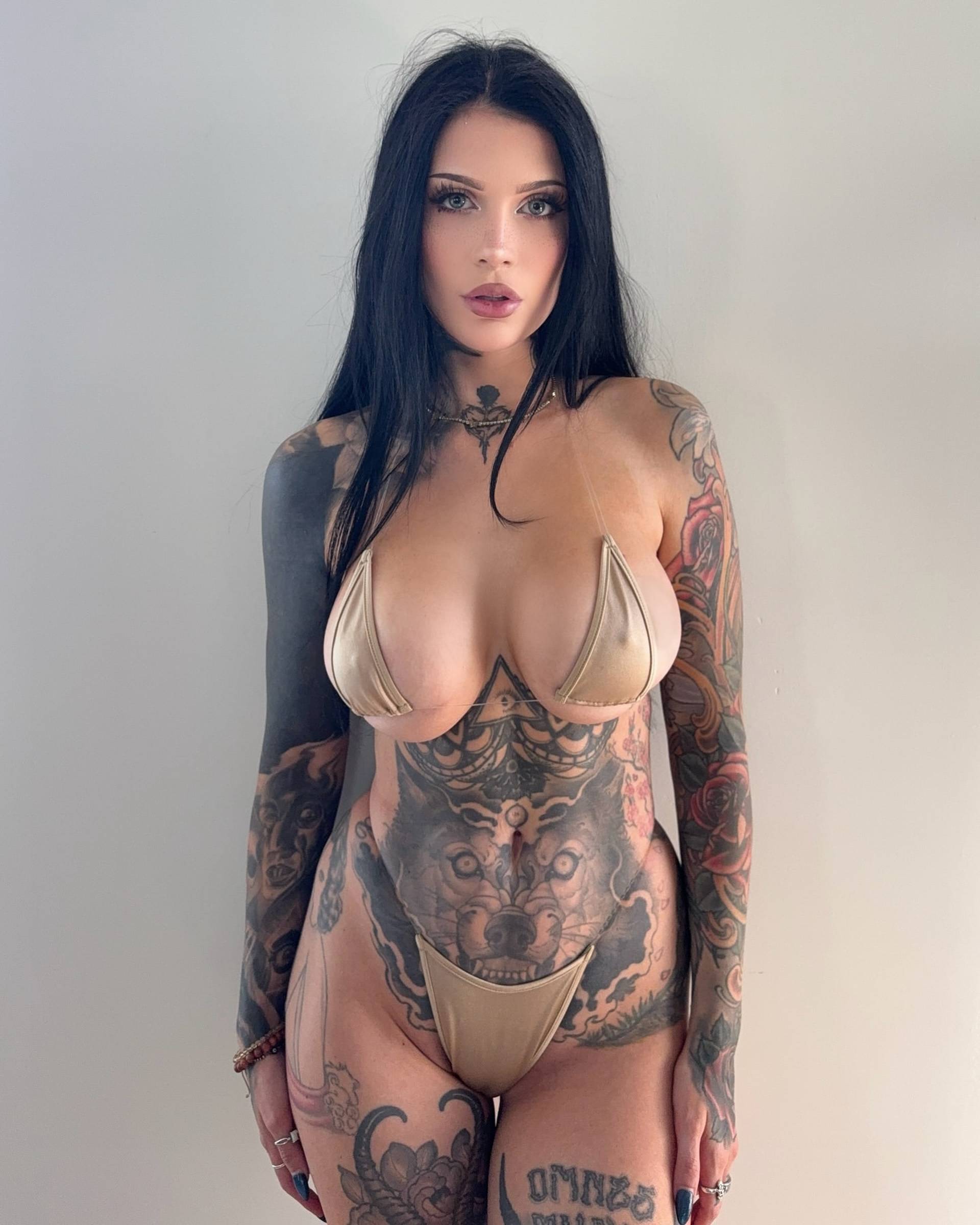
The clearest feature in this standing portrait is the pair of sleeves. Both arms are packed with tattooing from the shoulders down toward the hands, with the imagery changing as it travels around the body. The left and right arms don’t look like mirror images. They have their own arrangements, colour choices and darker sections, which keeps the collection from feeling too symmetrical.
On the arm at the viewer’s right, warm reds, greens and orange tones break up the black outlines. The opposite sleeve reads more heavily in dark ink, with several large forms layered close together. The visible work has the feel of a collection built across multiple sessions rather than a single matching set.
That kind of sleeve takes planning because the arm is always moving. A design that looks fine on a straight arm can bunch up around the elbow, disappear when the forearm turns, or create an awkward stop near the wrist. Placement matters as much as the individual drawing. Gabriellee’s ink is arranged with enough coverage to keep its impact from different angles.
She has said she’s reworking her left sleeve, so even these photographs are a record of a collection in progress. Reworking doesn’t always mean a tattoo has failed. Sometimes the wearer’s taste has changed, sometimes an older piece no longer fits the surrounding work, and sometimes a new artist sees a better way to connect everything. Her approach seems to leave room for that process.
The ornate stomach piece anchors the front

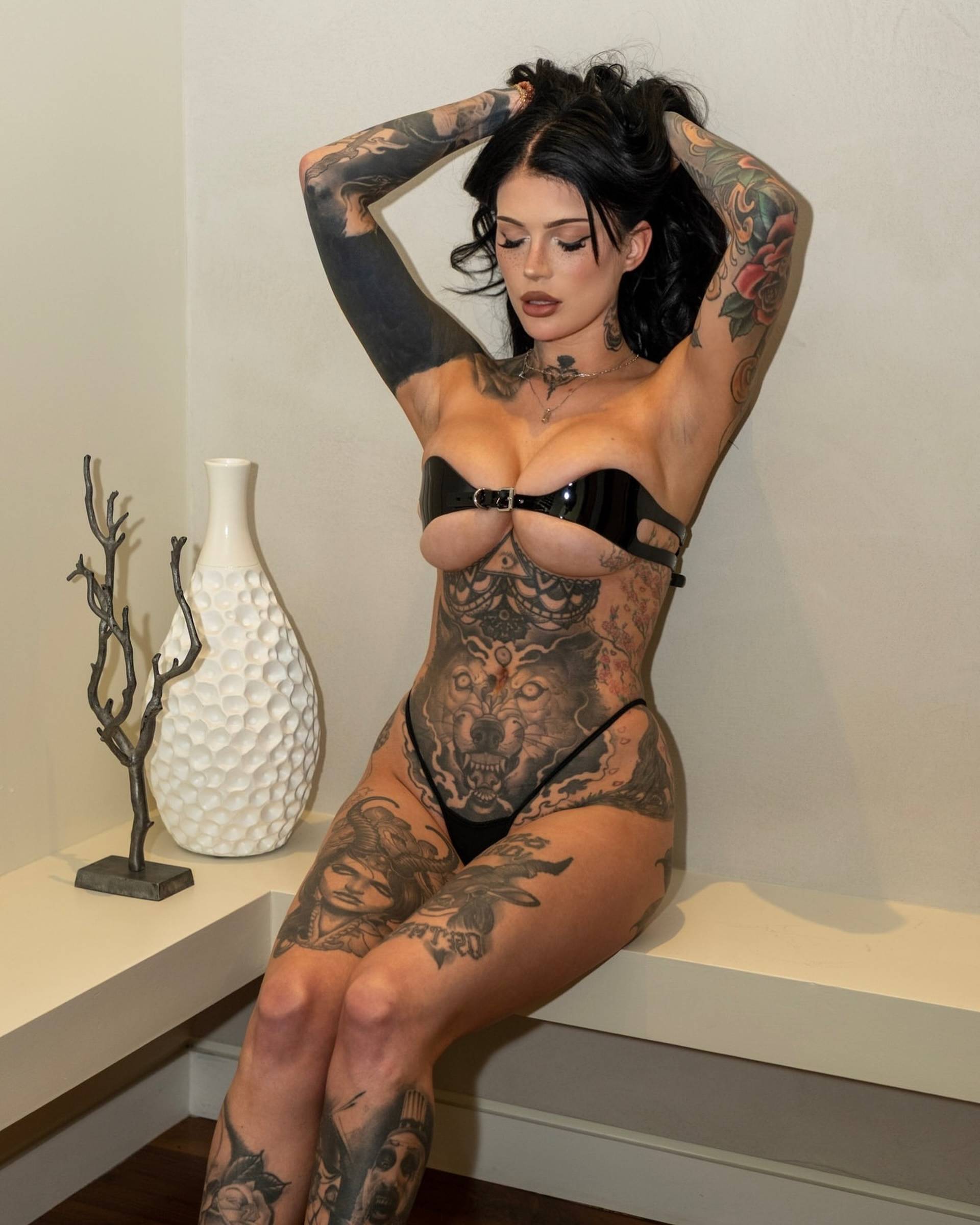
The ornate stomach piece is the visual centre of this seated portrait. It begins beneath the chest with a symmetrical, pointed shape, then drops into darker layers that form a face-like lower focal point. The photograph is detailed enough to show the structure, but not to identify the image as a named horror character.
Dark scalloped lines and repeated curves spread across the upper stomach, while the middle of the piece becomes heavier and more shaded. The design follows the body’s centre line instead of sitting like a rectangle on top of it. That makes the tattoo feel connected to the chest and the sleeves around it.
Gabriellee’s horror influence is confirmed by her own comments, but the image itself should still decide what can be described. It shows an ornamental, heavily shaded torso tattoo with a face-like lower section. The photograph doesn’t establish a movie title or character name.
The photo also shows how the same tattoo can look different depending on clothing and pose. The upper edges disappear beneath the black top, the arms sit away from the torso, and the lower section turns toward the camera. A tattoo artist planning a stomach piece would need to account for all of those changes before deciding how wide the design should run.
There is a separate World Tattoo Gallery photograph focused on Gabriellee’s back tattoo, but the front images are more useful for studying the ornamental centre of her current look. Keeping those views separate prevents a torso design from being described as if it were the back composition.
Chelsea Gabriellee’s leg tattoos carry large pieces of their own
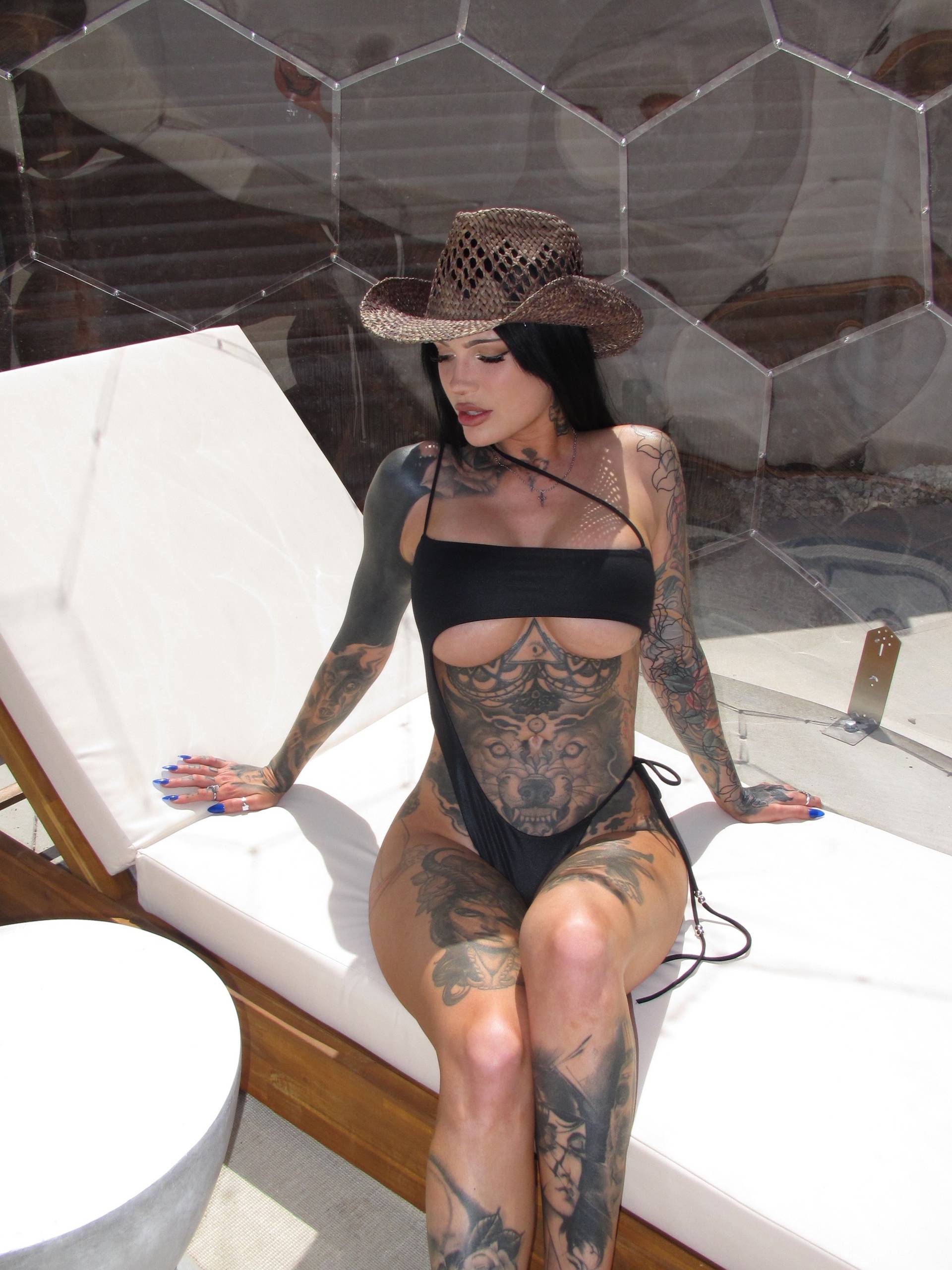
This photograph puts Gabriellee’s lower-body work in the frame. Large illustrative tattoos cover both thighs, with separate figures and ornamental shapes running down toward the knees. The pieces have more open skin around them than the stomach tattoo, so each design reads as its own section instead of merging into one dark field.
The contrast between the legs and the sleeves is useful. Her arms are packed with dense work, while the thigh tattoos leave more room for the outlines and faces to breathe. That doesn’t make one area more important than the other. It gives the body different visual speeds: heavy coverage above, larger individual images below.
The lower edge of the frame catches more ink continuing down the legs, but it doesn’t show every placement clearly. That’s why it’s safer to call these large thigh and leg tattoos rather than list exact subjects that the photograph doesn’t fully reveal. A good reference image can show scale without giving you every detail.
When a collection reaches the legs, planning becomes even more important. The knee moves, bends and creates a difficult transition between the thigh and shin. A big leg tattoo needs to work in motion. Gabriellee’s photos show why a large design needs to be considered from a standing angle, a seated angle and a bent-leg angle before it is placed.
Her hands and fingers add a sharper finishing detail
In this portrait, Gabriellee holds both hands near her neck, which makes the hand and finger tattoos impossible to miss. The ink continues over the backs of the hands and fingers, while the sleeves climb up both arms and the stomach piece appears below. Small hand tattoos can change the feel of a collection because they sit right beside the face and stay visible in everyday clothes.
The hand work also adds contrast to the larger pieces. A back tattoo or thigh design can disappear under clothing, but finger ink is much harder to hide. Hand tattoos change the visual weight of the entire collection. The shapes in this photograph look like a mixture of small marks and heavier linework rather than one single motif.
Gabriellee has discussed plans to blast over her knuckles. A blast-over keeps some of the old tattoo visible beneath a new layer, so it can create a rough, built-up effect rather than a perfectly clean cover-up. It’s a decision that needs a very experienced artist, especially on hands, where skin movement, sun exposure and everyday wear can affect healing.
There’s no need to copy the exact symbols to take something useful from this photo. The design lesson is about commitment and scale. Hand tattoos change the visual weight of the entire body, so they’re worth considering only after you’re comfortable with how your sleeves and forearms already look. They can be the final punctuation mark, but they’re not a casual add-on.
Why Chelsea Gabriellee keeps changing her ink
Gabriellee’s first tattoos were stars on her hips, and those pieces have since been covered. That says a lot about how her taste has developed. She isn’t treating old ink as something that can never be touched. The collection has been allowed to grow, cover, reshape and become more personal over time.
She has said she left home at 15, the same age she began getting tattooed. That doesn’t explain every design, and it shouldn’t be used as a shortcut for interpreting her body. It does give some context for why tattoos have been part of her life for so long. Her collection has grown alongside her, so older choices and newer plans naturally sit next to each other.
The horror influence gives the current work a loose thread, but it isn’t a strict uniform. You can see ornamental stomach work, colourful sleeves, dark back shading and hand tattoos in the same collection. That mix is more interesting than a body covered in identical flash. The pieces have room to be different while still sharing a heavier, illustrated mood.
Her next changes will likely make the contrast even stronger. Reworking the left sleeve, adding a knuckle blast-over and eventually starting a full leg sleeve would shift the balance again. For tattoo fans, that’s the fun part to watch. The most interesting celebrity tattoo collections aren’t frozen at their most famous photograph. They keep moving.
Ideas to borrow from her tattoo style
If you like Chelsea Gabriellee’s tattoos, start with the way she uses the body as a connected canvas. Think about the large areas first: sleeves, back, chest, stomach and legs. Then decide where you want the darker anchors and where you want skin breaks or smaller pieces to give the eye a rest.
It’s also worth planning for change. A half sleeve can become a full sleeve. A small symbol can be covered later, but a hand tattoo is a much bigger commitment. Leave space where you might want to expand, and choose an artist who understands how separate pieces will age together.
Most importantly, don’t invent a meaning just because a tattoo looks mysterious in a photograph. Gabriellee has publicly explained the horror influence and some of her plans, but the meaning of every visible shape hasn’t been published. That’s normal. A tattoo can work as art, memory or private reference without needing a caption for strangers.
Chelsea Gabriellee’s ink stands out because it feels lived-in rather than finished. The sleeves are bold, the back piece gives the collection a centre, the stomach work adds symmetry, and the hands push the look into more committed territory. At the same time, she’s still willing to rework old pieces and make room for what comes next. That’s a much more useful idea to take away than any single design: let the collection grow with you.
Here’s a video featuring Chelsea Gabriellee for a closer look at the tattooed model behind the collection.