
Emma Stone has never been the celebrity with a full sleeve or a collection of loud, instantly recognizable pieces. Her one widely documented tattoo is tiny, slightly wonky, and easy to miss if she isn’t wearing something that leaves her wrist uncovered. The story behind it, though, is much bigger than the mark itself.
Stone has a pair of small blackbird feet on her left wrist. She got the tattoo with her family after her mother recovered from breast cancer, and the design came from Paul McCartney. That sounds like the kind of Hollywood detail somebody might exaggerate, but Stone has explained it herself in interviews. The design is tied to The Beatles’ “Blackbird,” a song her mother loved, and to the line about learning to fly with broken wings.
The result isn’t a polished flash design. It looks more like a quick pencil sketch translated into ink, which is part of its charm. Stone has even joked that hers was done badly and has spread over time, while the rest of her family went to better tattoo artists. That mix of deep meaning and self-deprecating honesty makes the piece feel very much like her.
The blackbird feet wrist tattoo
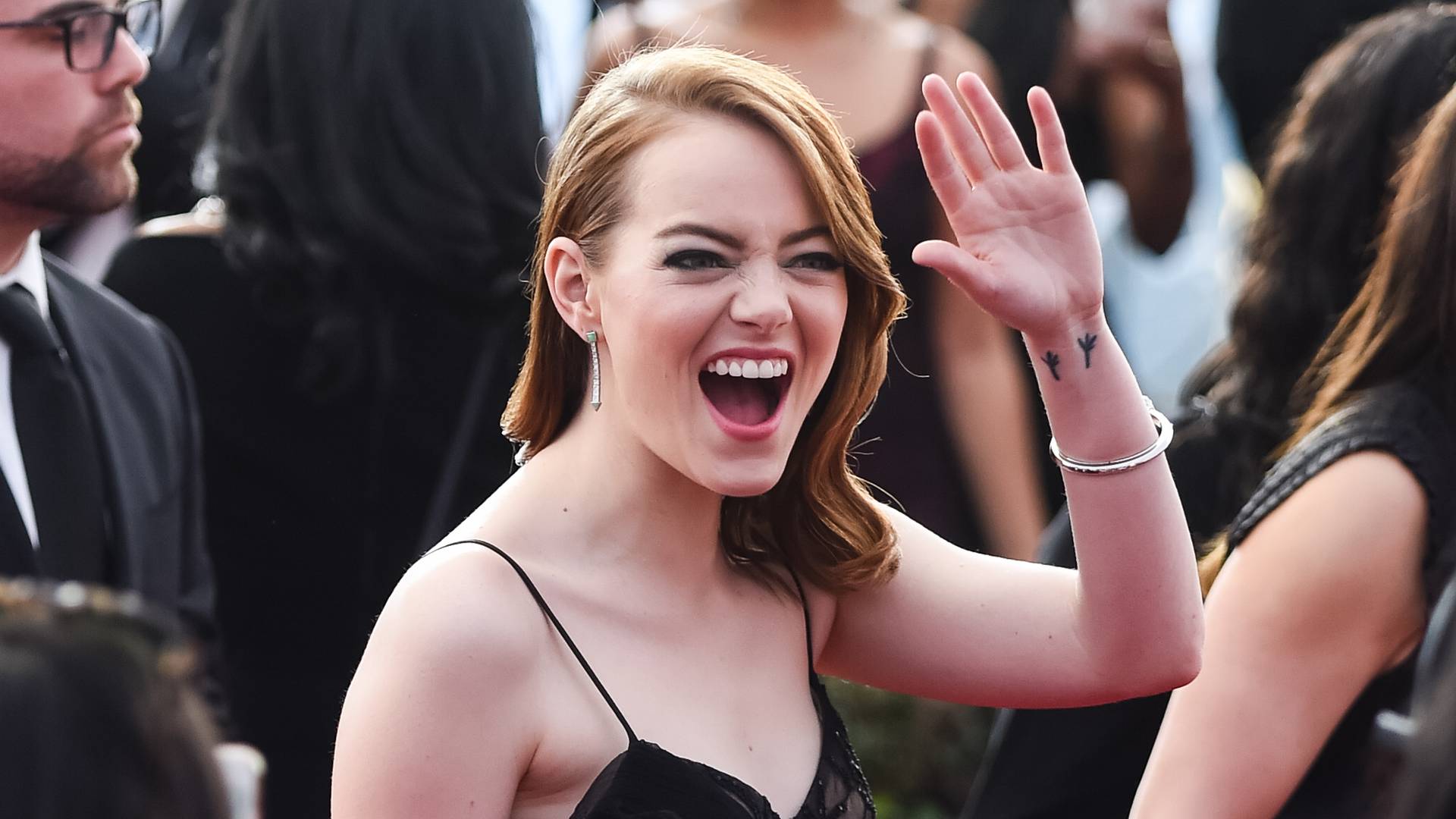
Stone’s tattoo sits on the inside of her left wrist, just above the hand. The design is made from two little sets of bird feet, drawn with thin black lines. In photographs, the marks can look a little uneven and soft around the edges. Stone has said that the tattoo has bled out more as the years passed, and she has talked about covering it for work.
That detail matters if you’re trying to understand the look. This isn’t a crisp, modern fine-line tattoo with perfect spacing and a laser-sharp outline. It has aged like an older small tattoo can age, especially on a part of the body that moves constantly and gets plenty of sun and friction. The design still reads clearly, but it has lost some of the clean pencil-thin quality Stone originally wanted.
Placement-wise, the inner wrist makes sense for a family tattoo. It’s easy to keep private when she wants to, but it can be seen without making a point of showing it. That balance is useful for anyone considering a meaningful tattoo that belongs to them first and the audience second.
The design is also small enough to work with different styles. Stone’s version is a simple black mark, but the same idea could be redrawn with lighter negative space, a slightly more delicate line, or a more hand-drawn finish. The key is keeping the proportions quiet. Two bird feet don’t need extra shading, a background, or a giant bird attached to them to carry the reference.
A tiny mark with a real family story

The first thing to understand about Emma Stone’s tattoo is that it wasn’t chosen as a fashion accessory. Her mother went through a difficult battle with breast cancer, and the family wanted to mark the point when she came through it. Stone’s mother, father, brother, and Stone herself all got matching versions of the design.
Matching family tattoos can go in a lot of directions. Some people choose names, dates, initials, or symbols that only make sense to the people involved. Stone’s family went with something more indirect. Instead of tattooing a word like “survivor” or adding a date, they used two little bird feet connected to a song that already carried emotional weight for them.
That decision keeps the design personal without making it overly literal. Someone looking at the wrist might only see two small black marks. The people who know the story see a family memory, a recovery, and a reference to a song that helped give the whole moment a shape.
It also explains why the tattoo is so small. A huge piece would have changed the feeling. These are meant to look like the traces of a bird landing or taking off, not like a realistic bird illustration. The scale lets the meaning stay close to Stone instead of turning the tattoo into a public announcement.
What the family chose

The Beatles’ “Blackbird” gives the tattoo its emotional center. Stone has said that the song was her mother’s favorite, and the family chose the bird-foot idea as a nod to it. Paul McCartney, who wrote the song, drew the design after Stone contacted him. That is the part people tend to remember because it is such an unlikely chain of events: a fan writes a letter, the songwriter sends back a drawing, and the drawing eventually becomes a family tattoo.
The song’s image of broken wings learning to fly makes the tattoo feel especially suited to the reason it was chosen. Stone has connected it to the line “Take these broken wings and learn to fly.” Her mother had gone through a serious illness, and the family wanted something that recognized survival without pretending the difficult part never happened. The bird feet are a small, sideways reference to movement and freedom. They don’t show a bird in flight, but they suggest that one has just been there or is about to leave.
That kind of reference is a good example of how a tattoo can be meaningful without being obvious. You don’t have to spell out the whole event in the design. A symbol can do the work if the people wearing it know the connection. It also gives the tattoo room to change meaning over time. The original reason remains, but the mark can become a reminder of other hard seasons the family got through together.
There is a nice contrast between the grand name attached to the design and the very ordinary way Stone says it happened. She didn’t turn it into a precious, perfectly staged art moment. She wrote a letter, got a sketch, and went to a random tattoo shop when she was young. The mark carries a famous musician’s idea, but it still feels like something that happened in real life.
Keep the proportions quiet

Small tattoos get treated like they are automatically easy, but tiny designs still need good decisions. The bird feet on Stone’s wrist are simple enough that every line matters. If the spacing is too tight, the two feet can blur into a dark smudge. If the lines are too light, the tattoo can fade quickly. If the shape is overworked, it stops looking like a quick sketch and starts looking like a miniature illustration.
Stone’s tattoo is a reminder that a meaningful tattoo doesn’t need to fill a large area. The design has enough breathing room to remain recognizable, and the wrist gives it a natural scale. Somebody planning a similar idea could keep the footprint shape but change the size slightly based on their own wrist and how much detail their artist thinks the skin can hold.
The other useful lesson is that the tattoo doesn’t need to look perfect forever to keep its meaning. Stone has openly admitted that hers was not executed especially well. Instead of hiding that fact, she makes it part of the story. The family versions aren’t all identical in quality, and the point was never to create a matching set for a magazine spread. They were made to mark something that mattered to them at the time.
That doesn’t mean you should ignore quality when choosing an artist. It means the emotional reason comes first, while the practical tattoo decisions still deserve care. A good artist can keep a small design readable, place it where it will age well, and explain what will happen to fine lines over the years.
A personal piece, not a trend piece

Emma Stone’s tattoo stands out because it doesn’t feel designed for a red carpet photo. It happened years before the tattoo became a recurring detail in celebrity style coverage, and Stone has never built a public image around having lots of ink. Most of the time, the mark is either covered by wardrobe or too small to notice.
That low-key quality fits the design. The tattoo has a famous connection, but the finished piece is modest. It doesn’t announce Paul McCartney’s involvement, the song reference, or the family history to everyone who sees it. You need the explanation before the two little sets of bird feet become more than a small wrist mark.
It also shows why copying a celebrity tattoo exactly is usually less useful than understanding the idea behind it. The important part of Stone’s tattoo isn’t only the shape of the feet. It’s the combination of a family event, a song, a hand-drawn design, and a decision to keep the final mark understated. Someone inspired by it might choose a different song, a different family symbol, or a different placement and still arrive at something that has the same kind of quiet weight.
If you like the concept, start by deciding what the tattoo needs to remind you of. Then strip the design back until the symbol still works without extra decoration. A small tattoo can hold a lot, but it works best when the lines have room and the reason for getting it is clear to the person wearing it.
Stone’s blackbird feet are not a catalogue of celebrity ink or a technical showcase. They’re a family mark that happens to have an unusual designer and a song attached to it. The slightly imperfect finish makes the story more believable, not less. It feels like a real keepsake: small, private, easy to cover, and still there whenever she wants to look down and remember what it means.