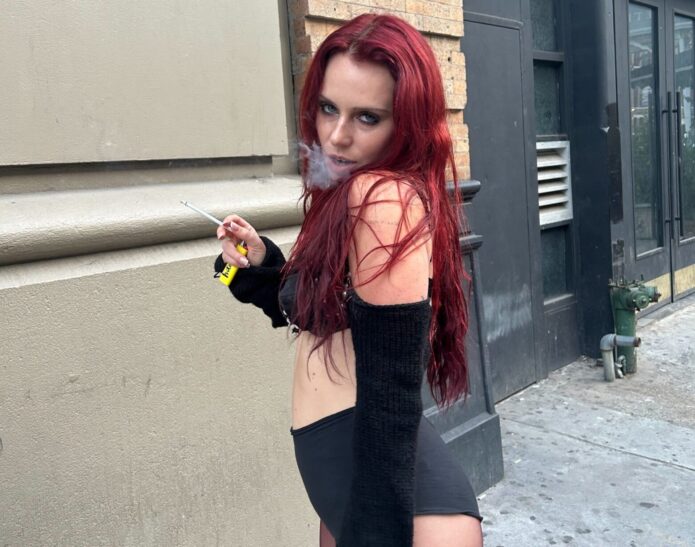
Slayyyter’s tattoos fit the rest of her work pretty well. They’re dramatic, a little theatrical, and tied to the strange mix of glamour, Catholic imagery, pop culture and personal history that runs through her music. She isn’t covered in random flash. The pieces that are easiest to trace have a reason behind them, whether they’re linked to an album, a part of her family, or an image she finds impossible to ignore. The strongest pieces are the ones with a clear reason to exist.
The clearest place to start is the Jesus portrait on her upper left arm. Mark Mahoney did the piece at Shamrock Social Club in West Hollywood, and it was documented during Slayyyter’s 2024 Interview Magazine feature. That session gives us the best close look at the tattoo, while a later Pitchfork profile fills in more of the collection. Slayyyter has also spoken about growing up Catholic, going to Catholic school, and keeping a complicated connection to religious imagery. That background matters here. The tattoos aren’t just decoration for a stage persona.
She has described herself as someone who was raised very Catholic but didn’t feel comfortable with the strict version of faith she grew up around. That tension makes the religious pieces more interesting. A Jesus portrait can be traditional, beautiful, rebellious, funny, sincere, or all of those things at once. On Slayyyter, it sits right in the middle of that mix.
The Jesus Portrait on Her Left Bicep
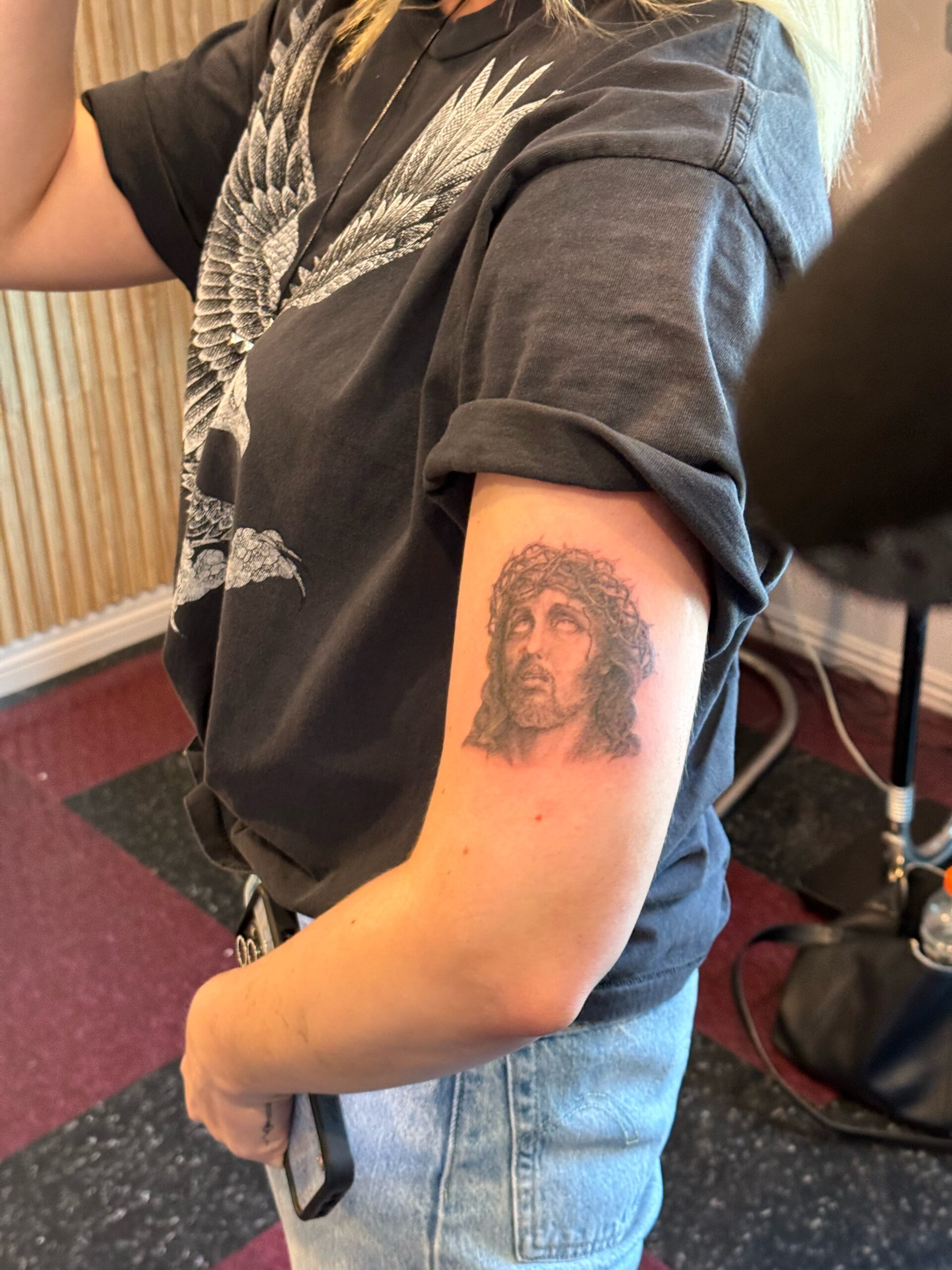
Slayyyter’s Jesus tattoo is a compact black-and-grey portrait placed on the outer part of her upper left arm. The image shows Jesus facing slightly upward, with a crown of thorns framing the head. The shading is soft enough to keep the face readable without turning the piece into a heavy black block. It has the look of an old religious portrait translated into tattoo form, which is exactly the kind of work Mark Mahoney is known for.
The placement does a lot of the work. The upper arm gives a portrait room to breathe, but it can still disappear under a shirt sleeve when she wants it to. In the close-up from the tattoo session, the portrait sits neatly below the rolled sleeve of her T-shirt. You get the full shape of the arm and enough surrounding skin to see that the piece isn’t trying to become a sleeve. It’s one strong image, kept fairly self-contained.
She chose Jesus because Mahoney has spent much of his career working with religious iconography, and because the image already had a personal connection for her. During the interview, she talked about her Catholic upbringing and said her next album had a lot of Catholic imagery in it. She also called Jesus one of the most recognizable faces in history. That’s a very Slayyyter way to explain it: part spiritual figure, part cultural icon, part instantly readable pop image.
There is also something deliberately old-school about the choice. A fine-line symbol can feel anonymous. A portrait has a point of view. The eyes, the crown, the shadows around the face and the choice to keep it black and grey all make the piece feel closer to a devotional painting than to a trendy micro tattoo. If you’re looking at Jesus tattoo ideas, this is a good example of why the reference image matters. The strength comes from the face, the contrast and the expression, not from adding extra decoration around it.
Inside the Studio
The Interview feature is useful because it captures more than a finished tattoo. The photographs show Slayyyter sitting in Mahoney’s studio, wearing a black T-shirt and sunglasses while he works. One image is a wider scene with the artist beside her, tattoo equipment and framed religious pictures in the room. It gives the Jesus piece a setting without pretending the wider photograph is a close-up of the ink.
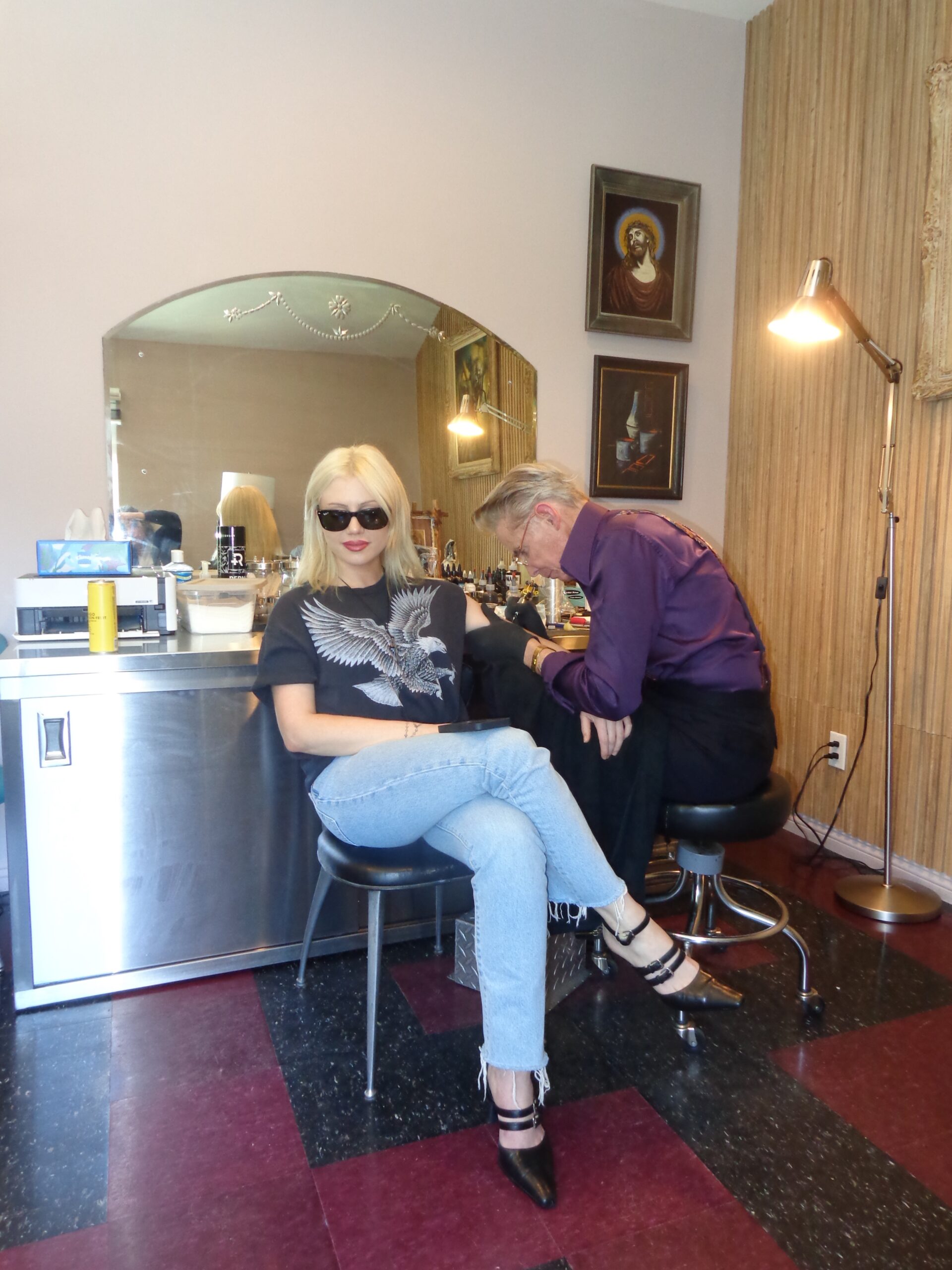
That setting feels important to the overall mood. Mahoney’s shop has a classic Los Angeles tattoo atmosphere, with old paintings, wood, polished floors and a lot of history hanging in the background. Slayyyter’s choice of artist makes sense because she wasn’t chasing a generic piece. She wanted a portrait with the visual weight of traditional religious art, and Mahoney’s style gives it that lived-in quality.
It also sounds like she enjoyed the process itself. She talked about tattoos as a chance to sit, talk and connect with the artist. That idea comes through in the interview. The conversation wanders through religion, punk, old Hollywood, film noir and the strange way celebrity clients move through Mahoney’s studio. The tattoo is the anchor, but the atmosphere around it is part of why the piece feels personal.
When Album Titles Become Permanent
Slayyyter’s right-hand knuckle tattoo reads “Paradise” in gothic lettering. Pitchfork linked it to her 2021 debut album Troubled Paradise. It is a simple idea, but the placement changes the tone. Knuckle lettering is hard to hide and hard to ignore. Every time she holds a microphone, reaches for a phone or throws a hand gesture onstage, the word becomes part of the image.
The word also has a nice bit of friction in it. Paradise sounds soft and idealized, while gothic lettering brings in something darker. That push and pull is all over Slayyyter’s music. She likes glossy pop surfaces, but she fills them with bad decisions, messy emotions, lust, anxiety and jokes that can turn sharp without warning. A pretty word in heavy lettering gets that across quickly.
Album tattoos can be risky because an artist’s relationship with an old record can change. Slayyyter has said she got tattoos connected to her first two studio albums, but she later developed a superstition around doing it again. After WOR$T GIRL IN AMERICA, she said she would not get another album tattoo because she worried that the pattern might make the next record flop. That gives the older pieces a little extra weight. They mark the early chapters, before the rule changed.
Her second album-related tattoo is “Starfucker,” written across the left inner forearm. Pitchfork describes the lettering as looking like an A-lister’s hurried signature. That is a good fit for the 2023 album, which played with fame, celebrity fantasy and the idea of turning yourself into a character people can’t stop watching.
The forearm is a more private spot than the knuckles, but it still appears in photos and onstage when her arms are bare. A phrase there can be read as a diary entry, a joke, a warning or a title. With Slayyyter, it probably works as all four. She has always understood that pop names are a kind of costume. “Starfucker” is blunt enough to puncture the glamour while still sounding like something you’d see written on a backstage pass.
These two text tattoos make a nice pair. “Paradise” looks outward and ties to a debut record. “Starfucker” sits on the forearm and names the machinery around fame more directly. Neither one needs a complicated symbol to make the point. The lettering carries the attitude.
The Catholic Thread Running Through Her Visual World
Religious imagery keeps coming back in Slayyyter’s work, but it doesn’t land as simple devotion. She has talked about being raised Catholic, attending Catholic school and feeling the pressure of a strict religious environment. At the same time, she still finds the pictures, language and drama of Catholic art powerful. That is a complicated relationship, and the tattoos leave room for that complexity.
The Jesus portrait is the most obvious example. It borrows an image with centuries of visual history, then places it on the arm of a pop artist whose music is full of synthetic sparkle and deliberately trashy humor. The contrast is the point. The tattoo doesn’t have to match the rest of her image in a literal way. It works because she likes the friction between sacred pictures and loud modern pop.
When she spoke about the tattoo in the Interview feature, she described Jesus as the most famous man who ever lived and compared him to a rock star. That doesn’t sound like someone trying to make a quiet, private reference. It sounds like someone who is fascinated by the way an image can survive for centuries and keep getting reinterpreted. A portrait tattoo is a natural fit for that kind of thinking.
How the Visual World Fits Together
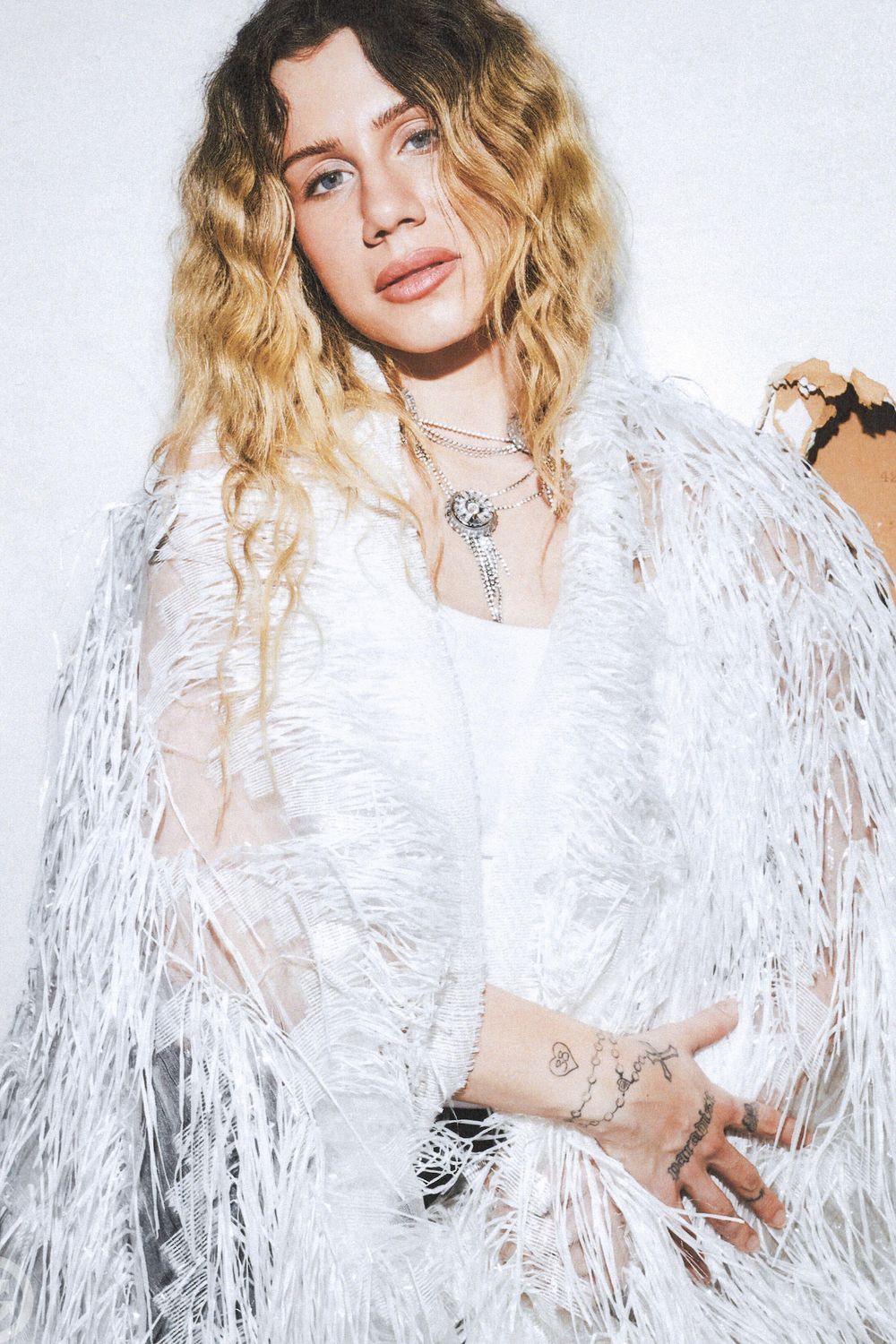
Slayyyter’s public image has changed a lot since the early SoundCloud days. The first version leaned hard into Y2K gloss, webcam photos, fake glamour and the mystery around a pop star who wasn’t yet showing much of herself. Later eras got louder and more physical. She started directing videos, making stage clothes and building whole visual worlds around her songs.
The tattoos work because they don’t feel like a separate brand exercise. The hand lettering and forearm script look like things that could have existed before the current album cycle. The Jesus portrait has a real studio story behind it. Even when the pieces are connected to records, they still look like objects she chose to keep on her body.
That is probably the most useful design lesson here. You don’t need every tattoo to match. A portrait, a word on the knuckles and a phrase on the forearm can sit together if the choices feel deliberate. The shared thread can be mood, history or a particular kind of contrast. Slayyyter’s collection mixes old religious imagery with blunt album lettering, but it still feels like one person’s taste.
Building a Collection That Fits
If you’re pulling ideas from Slayyyter’s tattoos, start with the decisions rather than copying the exact designs. A small black-and-grey portrait can work on the upper arm if the reference image is strong and the artist knows how to build a face with limited space. Lettering on the knuckles needs a font that will stay readable as it ages, and it needs careful spacing because hands move constantly. Inner-forearm script gives you more room, but it still has to be sized for the way the arm bends.
Think about why the design belongs to you. Slayyyter’s “Paradise” connects to an album, while “Starfucker” captures a whole attitude toward celebrity. The Jesus piece links her to Catholic imagery and to a particular artist whose work she wanted on her skin. Those reasons make the pieces feel less like random inspiration and more like a personal collection.
Placement matters just as much. The bicep portrait can be covered. The knuckle lettering is always in the room. The forearm phrase lands somewhere between private and public. Before you book an appointment, decide whether you want a tattoo that appears in every photo or one that only shows when you choose to reveal it.
Slayyyter’s tattoos aren’t a giant catalogue, and that is part of what makes them easy to read. Each one has enough space around it to hold its own mood. The Jesus portrait is the centerpiece, the album lettering gives the collection its words, and the rest of her visual style fills in the atmosphere.
Watch Slayyyter’s official “DANCE…” video below for a little more of the pop world these tattoos live in.