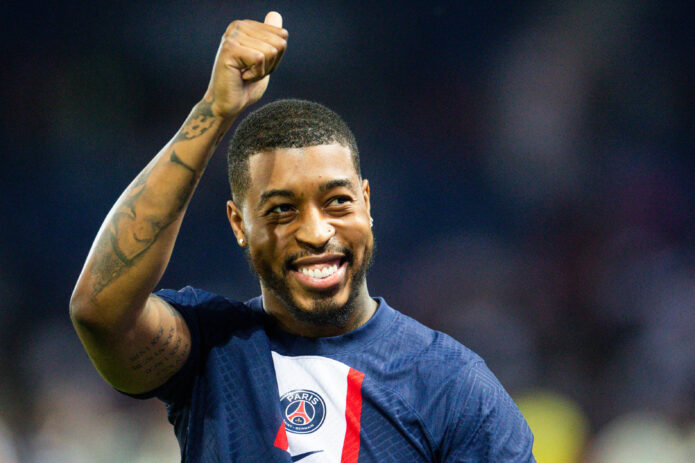
Presnel Kimpembe’s tattoos are most visible in the photographs that show his arms, hands and neck in motion. The former Paris Saint-Germain defender has built a dense collection of dark linework across both arms, with additional lettering and imagery visible on the hands, forearms and upper body. A Horace profile describes him as having more tattoos than he can count and connects the collection to personal meaning, while match and training photographs record how the ink sits on his body.
The published sources are stronger on placement and visual detail than on a complete inventory of every individual design. Kimpembe has not published a full catalogue that names each image, and the available photographs show pieces from different years and angles. What they do establish is a recognizable visual pattern: broad arm coverage, compact lettering, darker illustrative shapes, and tattoos that continue around the wrists and hands. The collection reads as accumulated work rather than one single sleeve completed in one session.
That distinction matters when looking at Kimpembe’s tattoos. The images support descriptions of where the ink is visible, how dense the blackwork appears, and how the separate pieces overlap. They do not automatically identify a private meaning for every symbol. The following record keeps the focus on the documented designs, body placements and the small amount of personal context that Kimpembe has discussed publicly.
Kimpembe’s arms show the collection’s strongest visual contrast
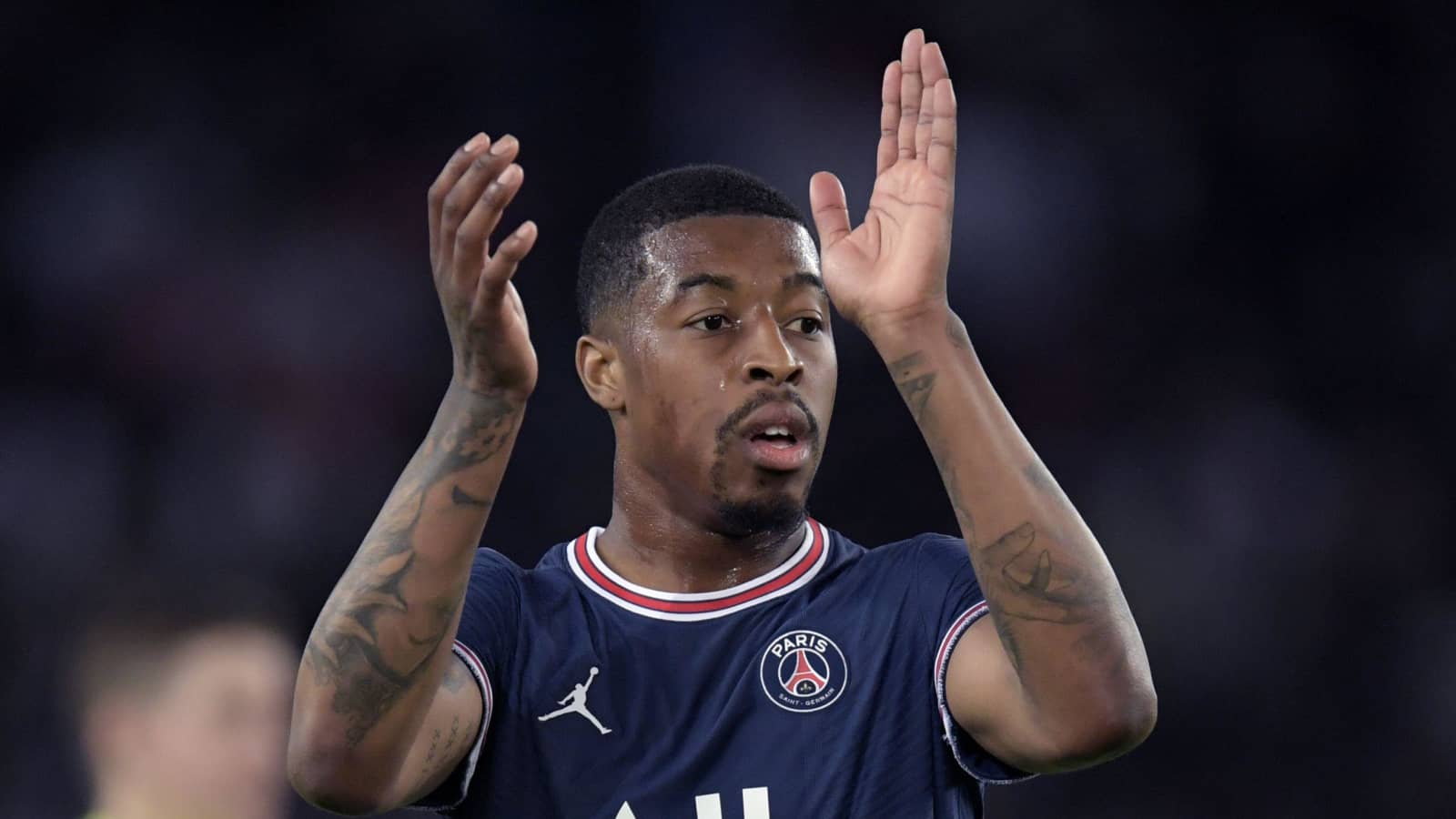
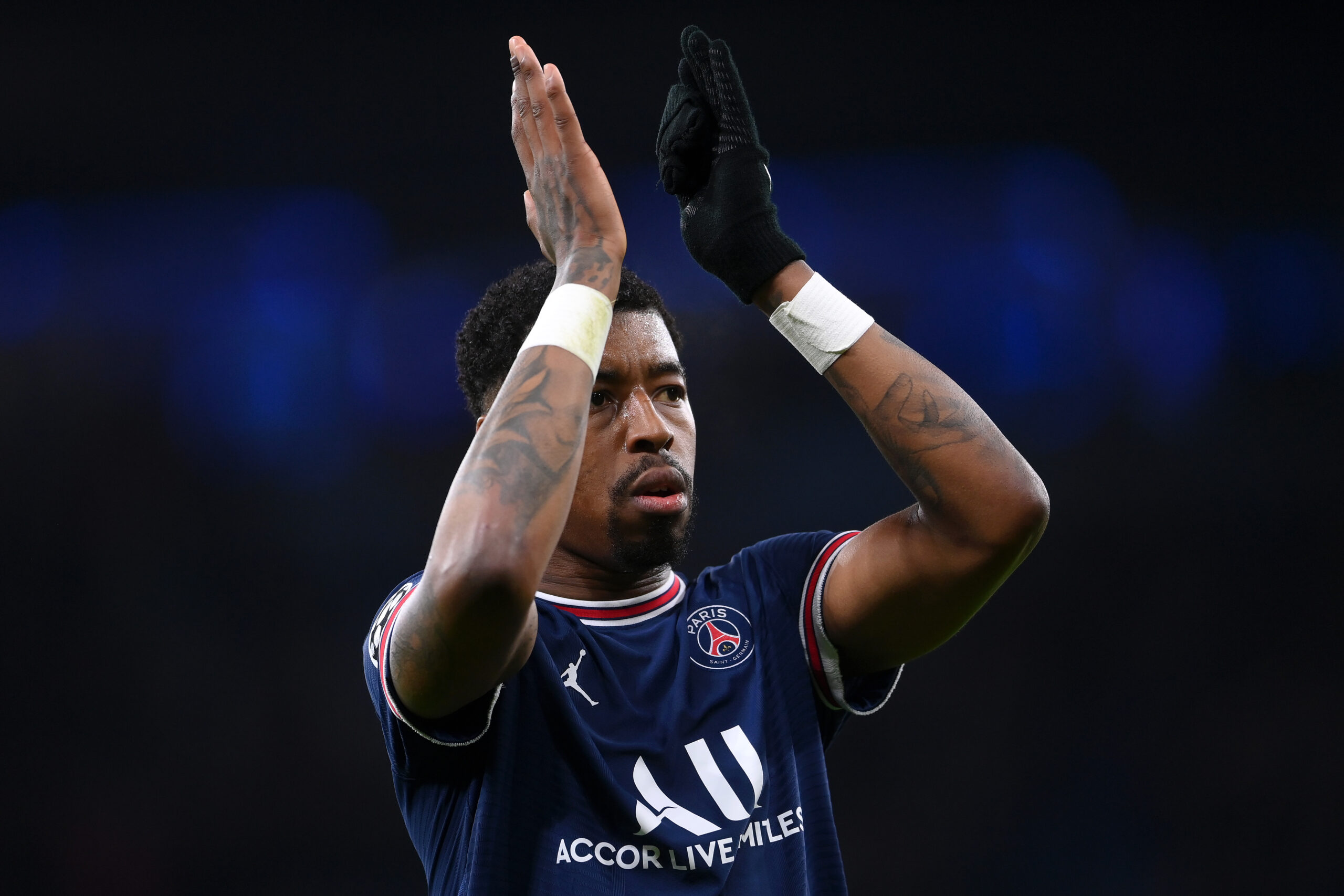
The clearest overview of Kimpembe’s arm tattoos comes from a match photograph in which he raises both hands above his head. The pose exposes the inside and outside of both forearms, along with sections of the upper arms. Dark shapes run from the wrists toward the elbows, while separate pieces sit higher on the arms beneath the short sleeves of the PSG shirt.
The left and right arms do not appear to be mirror images. One side carries larger shaded forms that merge into a heavier field of black and grey, while the other shows more open skin between visible symbols and lettering. The difference gives the collection an assembled quality. The tattoos share a dark visual weight, but they do not follow one perfectly repeated pattern. The forearm coverage changes noticeably as the arms turn toward the camera.
Small marks around the wrists and hands become important in this view. They are less dominant than the larger upper-arm work, yet they extend the collection beyond the sleeve line of the football shirt. Kimpembe’s tattoos are therefore visible in the same frame as his match identity, with the ink becoming part of the silhouette created by his raised arms.
The upper-arm blackwork becomes clearer in match photographs
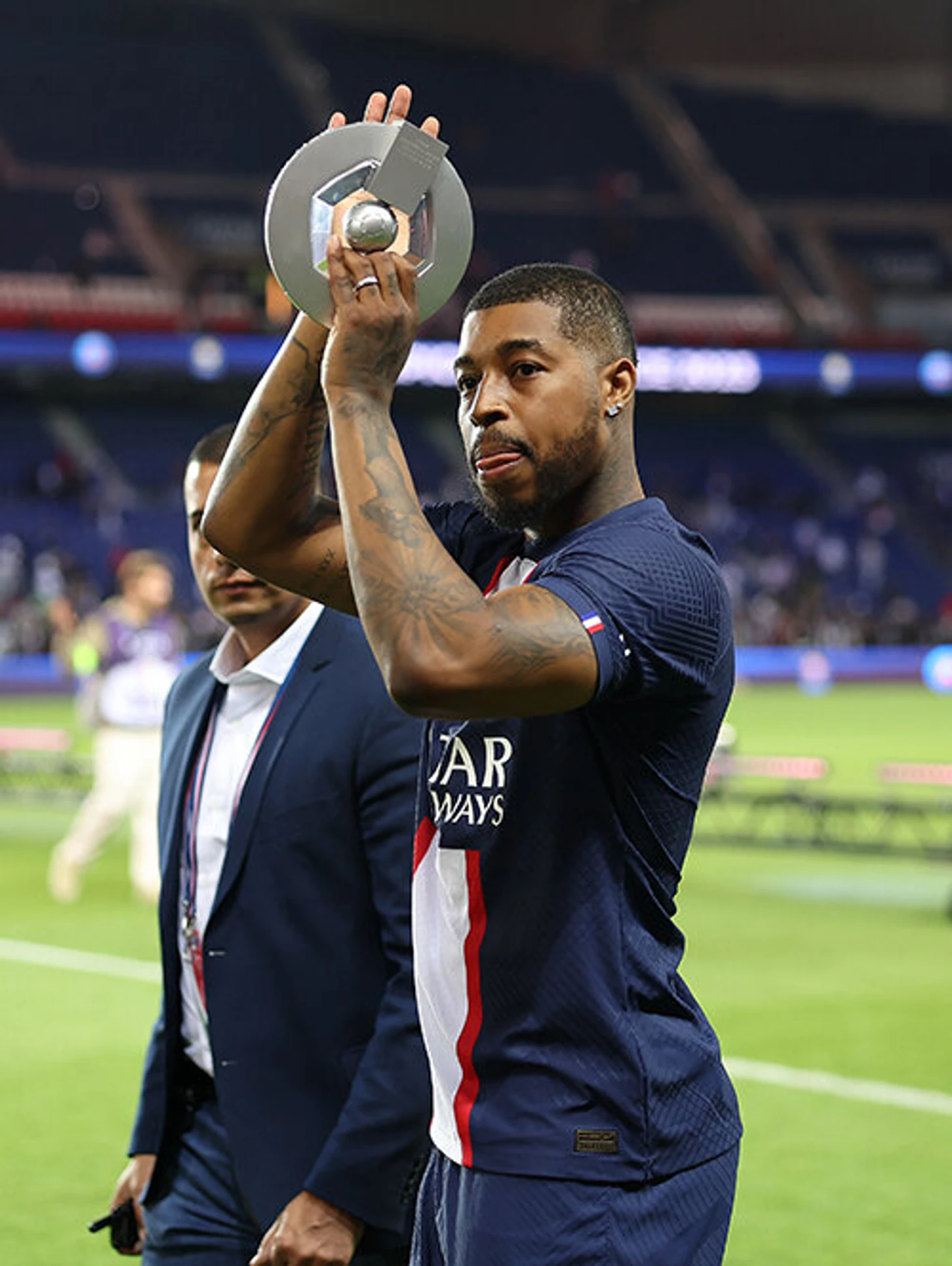
A second photograph, taken during a trophy celebration, shows Kimpembe from a closer side angle. The image gives a better view of the arm that is partly hidden in the wider front-facing shot. Layered black and grey forms cover the forearm, and a larger design continues around the upper arm beneath the sleeve.
The close angle also makes the relationship between individual tattoos easier to see. Some lines are fine enough to remain separate from the surrounding shading, while other areas have been filled so heavily that several designs read as one continuous section. The result is not a blank space with one isolated emblem. It is a working surface of overlapping marks that has grown over time. The upper-arm imagery remains visible even beneath the football shirt.
Photographs like this do not identify every symbol, but they do preserve the visual facts that are easiest to lose in a distant match image. The arm coverage is substantial, the ink reaches around the wrist, and the pieces vary in scale. The collection has both small lettering and larger imagery, with the contrast between them creating much of its character.
The tattoo session that shows how the collection grew
Kimpembe’s tattoo history also includes a photograph from a tattoo session in which he sits shirtless while an artist works on his upper arm. Existing tattoos are visible across the chest, shoulder and arm, and the image records the process of adding another piece to an already established collection. The setting is useful because it shows the tattoos without a football shirt covering the torso.
The visible chest work is built from dark, curving forms that sit beside the shoulder coverage. The upper arm contains larger areas of shading, while the forearm and wrist show smaller marks and lines. The photograph does not provide a complete view of the back or lower body, but it confirms that the collection extends beyond the arm sections normally seen during matches. The chest and shoulder tattoos sit close together without becoming one flat field of ink.
The post connected the session with Tony Yoka and used the phrase “Le sang” alongside the hashtag “LAFORCE.” That caption provides context for the moment, but it does not assign a meaning to every visible tattoo. The reliable visual record is more direct: Kimpembe’s chest and shoulder already carried substantial ink, and the upper-arm work was still being expanded in the photograph.
The shoulder and hand details stay visible in motion
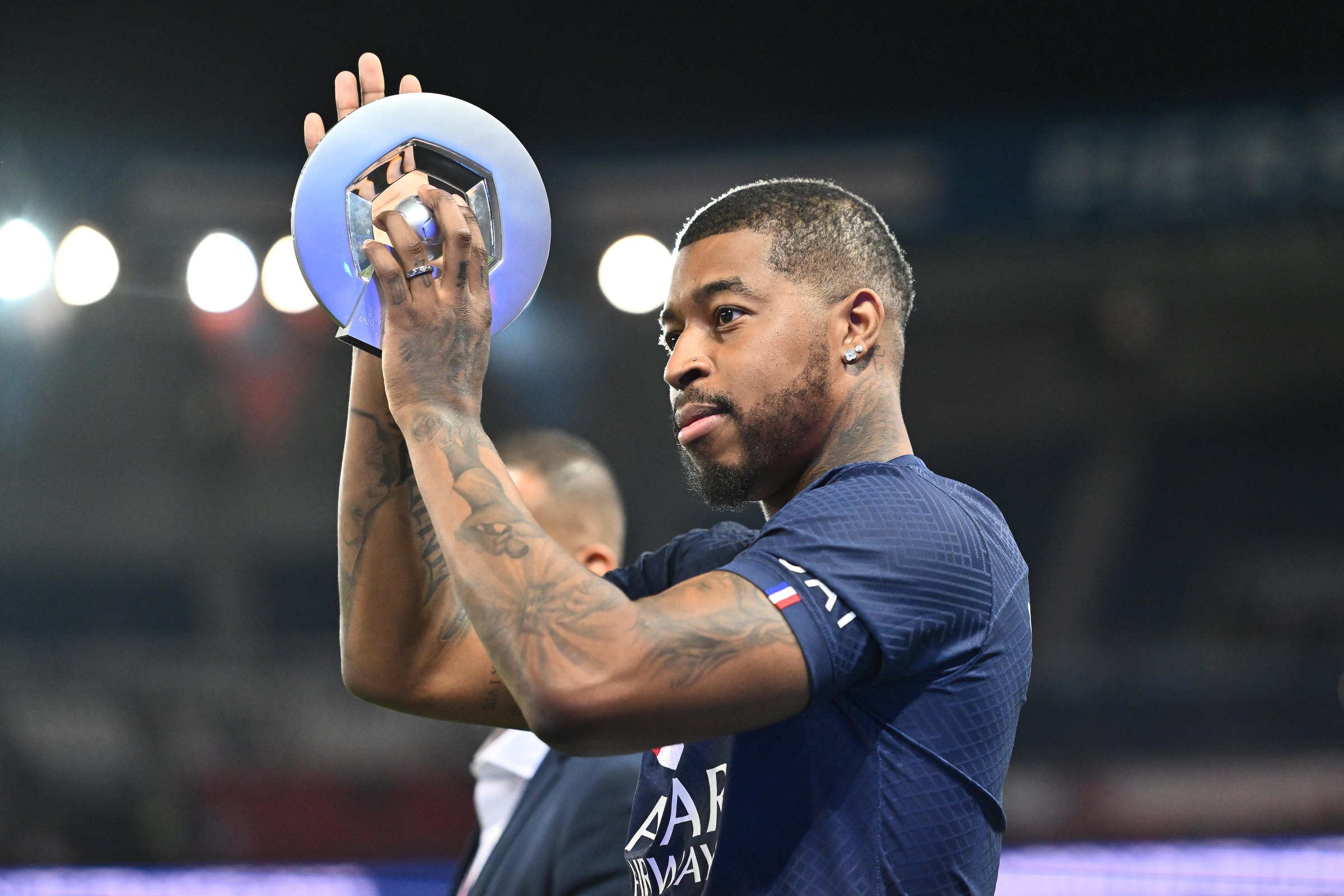
A different celebration photograph brings the hands and lower arms into focus. Kimpembe’s fingers, palms and wrists contain smaller tattoos that appear beside a larger pattern running up the forearms. Some of the lettering is partly obscured by the trophy and the angle of his hands, but the presence of hand ink is clear.
The tattoos on the hands change the way the larger arm pieces are read. They create a gradual movement from the fingers to the wrist, then into the heavier forearm work. The marks are not all the same size or density. Small dark shapes sit next to more open lines, and the mixture gives the hands a layered appearance rather than a single solid block. The hand ink is especially noticeable when the fingers are raised around the trophy.
His shoulder and upper-arm tattoos are also visible above the shirt sleeve. The edges are soft in the distance, yet the overall coverage is unmistakable. Kimpembe’s collection frames the arm from several directions, so the designs remain visible whether his arms are raised in celebration, held across his chest or moving through a match.
The shirtless celebration shows Kimpembe’s arm tattoos
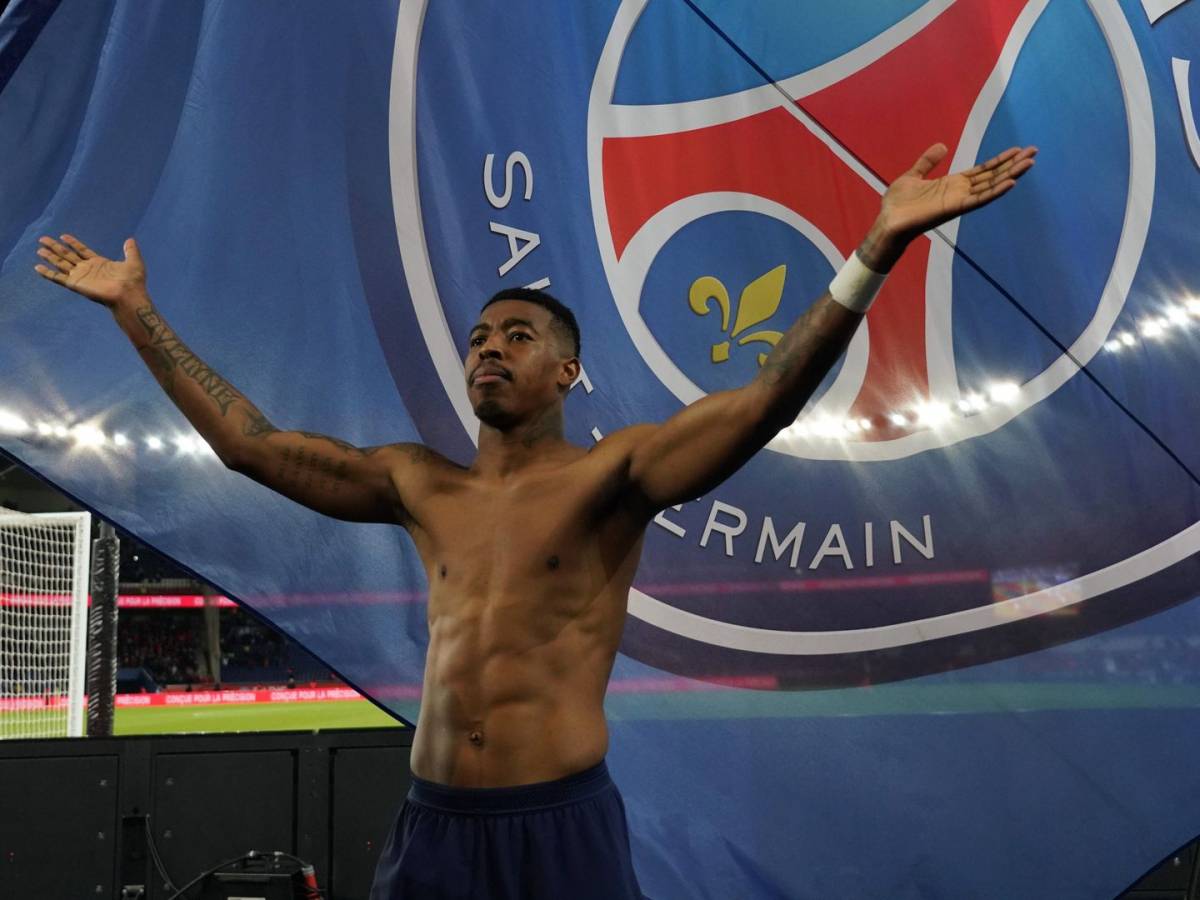
One of the strongest contextual photographs shows Kimpembe shirtless in front of a large PSG crest. The image exposes both arms and the upper torso at once. Tattoos run along the forearms and upper arms, with darker lettering and symbols visible against the skin. The pose also shows the spacing between the arm work and the comparatively open centre of the torso.
This view helps separate the collection’s major zones. The arms carry the densest coverage, the shoulders connect the upper pieces to the chest, and the hands continue the line of smaller marks toward the fingertips. The visible designs do not form a single flat panel. They leave areas of skin between different compositions, which makes the body placement easier to understand. The arm tattoos remain the dominant visual feature.
The photograph is also useful because it avoids the distortion created by a short sleeve or a raised trophy. Kimpembe’s face is visible, but the main subject of the frame remains the relationship between his body, the PSG setting and the tattoos that cover his arms. It documents the collection as part of his public appearance without claiming that every hidden tattoo has been identified.
Why Presnel Kimpembe’s tattoos stand out
Kimpembe’s tattoos stand out because the collection combines density with visible gaps. The arms are heavily worked, yet the individual pieces retain different edges, scales and levels of shading. A block of darker ink may sit beside a fine-line inscription, and a larger upper-arm image may meet a smaller wrist mark without becoming one uniform sleeve.
The collection also changes depending on the setting. In a match photograph, the tattoos become part of the movement of his arms. In the studio image, the chest and shoulder coverage becomes easier to examine. In the shirtless celebration, the spaces between the arm pieces are visible. The same designs therefore read differently when Kimpembe is photographed in motion, at close range or without a shirt.
That visual variety is consistent with the limited personal explanation available in published interviews. Horace records Kimpembe saying that his tattoos have meaning, but it does not turn the collection into a list of public explanations. The photographs carry much of the evidence. They show a body marked by repeated additions, personal symbols and large sections of dark work that have accumulated around his football career.
What the documented record can and cannot confirm
The available sources confirm extensive tattoos on both arms, the wrists, hands, shoulders and parts of the chest. They also show that Kimpembe has continued to add work over time. The Horace profile describes a collection too large for him to count, while the tattoo-session image documents an artist working on an upper-arm design. Match photographs independently confirm the same arm coverage from different angles.
The sources do not provide a complete, authoritative list of names, dates and meanings for every visible piece. It would be inaccurate to assign a private story to a symbol simply because its outline can be seen in a photograph. The safer description is visual: Kimpembe’s ink includes dark illustrative forms, lettering, shaded sections and smaller hand tattoos arranged across both arms and the upper body.
Presnel Kimpembe’s tattoos are therefore best understood as an evolving collection rather than a finished checklist. The strongest documented details are the arm coverage, the chest and shoulder work visible during the session, the marks on his hands and wrists, and the way the pieces sit together in photographs from football and tattoo settings. The published sources preserve the scale and visual character of the ink while leaving room for the parts Kimpembe has chosen not to explain.