
Pierre Bruno grew up around tattoos. Rugby World reports that his father, Maximilian, runs a tattoo studio in Genoa and that his mother is heavily tattooed. Bruno began his own collection at 18 and said he had finished its first major phase by 26.
Bruno plays on the wing for Italy and Zebre Parma. The interview names a dragon, a tiger, a Buddha and a Japanese god among his tattoos, and says his father inked the work. The photos below show how much of both arms is covered; they do not establish the meaning of every mark.
The Zebre portrait shows the full arm coverage

In the Zebre Parma portrait, Bruno stands with his arms crossed in a blue-and-yellow shirt. Both arms are visible, and the tattoos extend across the sleeves. The posed frame makes their scale easier to see than a match photo where an arm may be turned away or blocked.
The interview supplies the named designs; this portrait shows the coverage. It is useful to keep those two kinds of evidence separate rather than guess at a motif from a cropped image.
Dragons, tigers and Japanese imagery shape the tattoo canvas

Rugby World identifies a dragon, a tiger, a Buddha and a Japanese god. Bruno said his father worked on the tattoos, connecting the collection to the studio where he grew up. The subjects differ, but they were made within that family setting.
The Six Nations running photograph shows one sleeve while Bruno carries the ball. It records the arm in motion, though the interview does not assign a fixed meaning to each animal or figure.
The arm work remains visible during a Six Nations try
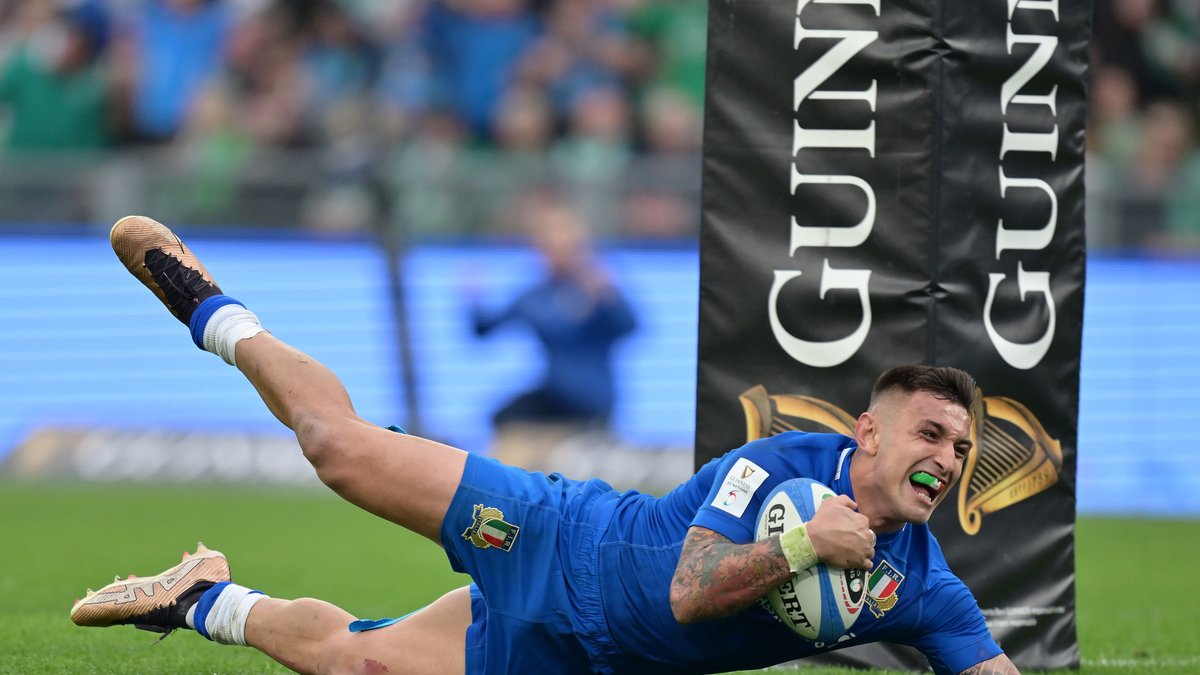
Rugbyrama’s frame catches Bruno diving to finish the interception try against Ireland. The arm nearest the camera remains visible in the action. It gives a clear look at the sleeve during a match, not just in a posed portrait.
The photograph documents placement and coverage. Bruno’s family account comes from the Rugby World interview, which is the source for why tattooing was part of his upbringing.
The Zebre presentation makes the lettering readable

In this sleeveless Zebre presentation image, several lines of lettering and a circular design are visible on Bruno’s arm. Other work continues down the forearm and across the opposite arm.
The lettering is too small here to transcribe confidently, so it is best left undescribed. The photo shows how text sits alongside larger shaded designs, without confirming what the words say.
A Rugby World action frame connects ink and identity

This Rugby World action frame shows Bruno sliding over the grass with the ball under his chest. Both tattooed arms are visible as he reaches the ground, giving another view of the sleeves in play.
Read alongside the interview, the image places the body art within Bruno’s rugby career and the family tattoo tradition he described. It does not reveal the story behind each individual mark.
The collection grows beyond the public image
Bruno told Rugby World that he has tattoos on both arms and his chest. The selected photographs mostly show his arms, while a shirt or training top covers the chest. His account gives the broader placement and the timeline: he began at 18 and considered the first major phase finished at 26.
That span puts the collection in context without suggesting that it could never change. The visible work includes large animal and character designs alongside lettering, made over several years by his father.
Some of the story remains private
The chest tattoos are mentioned in the interview but cannot be examined in these arm-focused photographs. The gap is simple: Bruno has described the placement, while the available images do not show the work clearly.
The separate RaiNews portrait serves a different purpose, identifying Bruno in an interview setting. The five inline photographs document the tattoos; the portrait is not used as evidence about their design.
What the documented record actually establishes
Rugby World’s interview records Bruno’s family connection to tattooing, the ages when he began and finished the first major phase, the placements on both arms and chest, and four named subjects: a dragon, a tiger, a Buddha and a Japanese god. The photographs show extensive arm coverage in posed and match settings.
The published account does not explain the symbolism of every tattoo, and the lettering cannot be read clearly in these frames. The article sticks to what Bruno said and what the photographs show.