
Pamela Anderson’s best-known tattoo is the barbed-wire band around her upper arm, associated with her role in Barb Wire. Photographs and tattoo references also document a narrow lower-back design, “Tommy” lettering on a finger, a small ankle mark and a reported butterfly near her chest.
The arm tattoo was later lightened and removed or substantially faded, changing how it appeared in public photographs. The other pieces are less consistently visible, so their record depends on clothing, pose and close-up images.
Pamela Anderson’s documented tattoo collection

Anderson’s ink is a group of compact designs rather than a full sleeve. The upper-arm barbed wire is the most recognizable; the lower-back piece is a narrow vertical design. References also list small finger, ankle and chest details that appear only when the camera or clothing exposes them.
The pieces belong to different periods in her public life. The arm band is tied to Barb Wire, while smaller marks are recorded in the context of relationships and family. Later coverage documents the arm tattoo’s fading and removal.
The barbed-wire band around her upper arm

The barbed-wire band circles Anderson’s upper arm in a narrow line of repeating points. Production accounts say it was tattooed on her rather than painted on for each scene in Barb Wire, making the design part of the film-era look she carried into publicity images.
Its placement leaves much of the arm uncovered. From the front, only part of the line may show; in profile, the thorned band reads more clearly around the arm.
Archival photographs preserve the tattoo’s original look

Archival photographs show the barbed wire before later changes. Anderson has described it as an eyesore and pursued removal; reports say it was lightened over time, with more recent coverage describing it as removed or substantially faded.
The older images preserve its original dark, crisp look. They also document how the tattoo’s public role changed from a screen-linked signature to a piece Anderson no longer wanted.
The long lower-back design
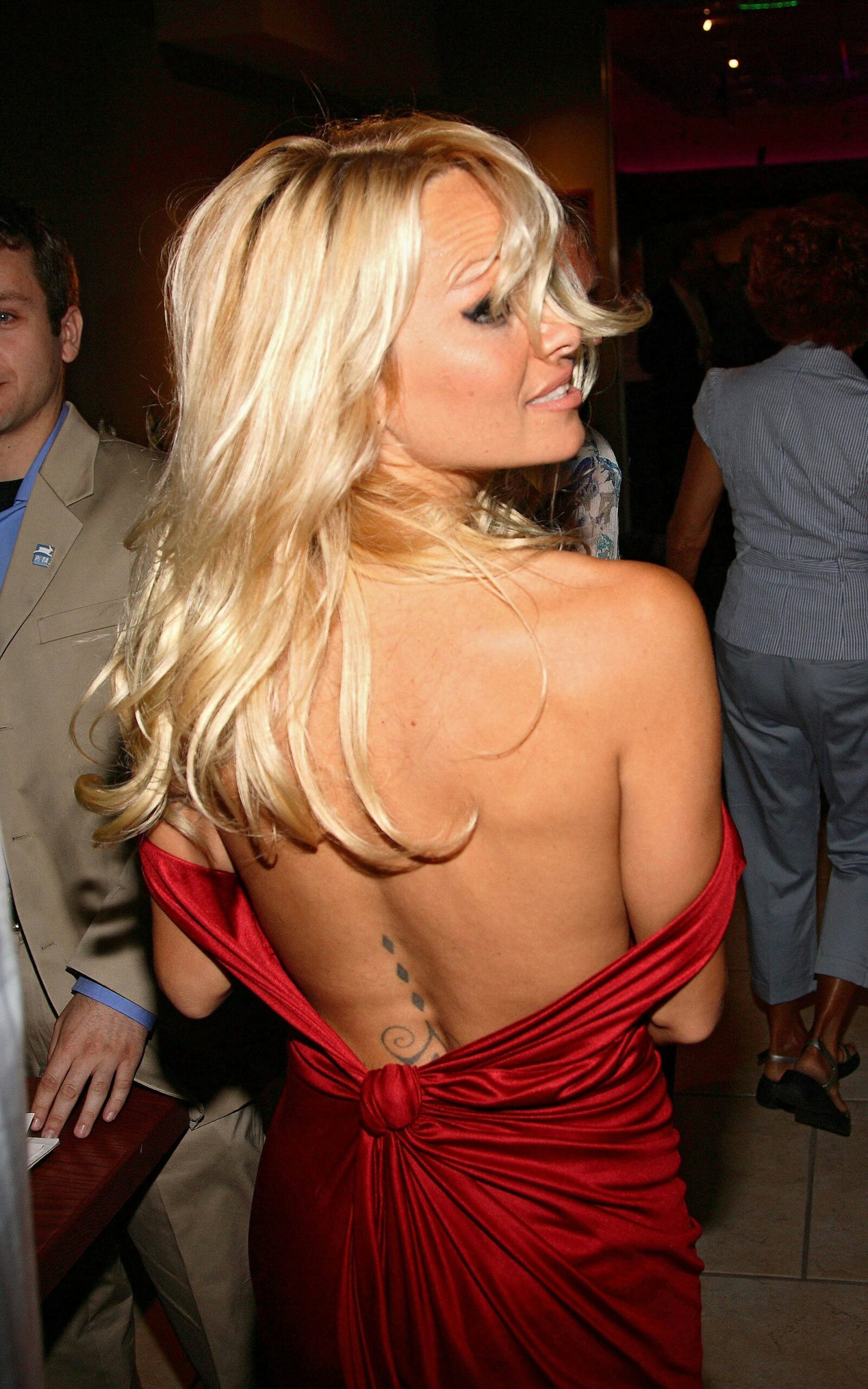
A separate decorative tattoo runs vertically along Anderson’s lower back. It appears in backless outfits as a slim line on the lower spine, distinct from the horizontal band around her arm.
Captions and tattoo references use different labels for the design, including tribal or decorative. The photographs establish its placement and narrow shape more clearly than its exact category or meaning.
The small personal tattoos: finger, ankle and chest details

Tattoo archives record “Tommy” lettering on one finger, referring to Tommy Lee. Anderson has discussed the couple sharing a tattoo needle during the period she spoke publicly about her hepatitis C diagnosis. Later accounts say the lettering was changed or covered, so its appearance varies across photographs.
References also list a small ankle tattoo, but do not give a firm explanation for it. Celebrity coverage has reported a butterfly near her chest; straps, hair and necklines often hide it from view.
How the collection changed over time
Across the decades, the arm band’s condition changed while the other tattoos appeared only when clothing and camera angles exposed them. Early photographs show a dark, sharply defined design; later images show it softened and then largely faded or removed.
The lower-back, finger, ankle and chest marks remain part of the photographic record, though the sources give different levels of detail about each.
The tattoo record across red-carpet and public photography

Red-carpet photographs often show the arm band; backless gowns reveal the lower-spine design. Casual or archival pictures may catch the finger, ankle or chest details. Each setting exposes a different part of the same documented history.
The barbed wire has the clearest public context through Barb Wire. The finger lettering has a reported relationship reference. For the lower-back, ankle and chest marks, the sources establish placement and appearance more firmly than personal meaning.
What the documented meanings do and do not establish
The photographs can show where a tattoo sits and how it looks, but they do not establish a private explanation on their own. Anderson’s record is clearest when film and relationship context are attributed to reporting and the less certain designs are described without assigning them a story.
A video interview about Anderson’s tattoo history appears below.