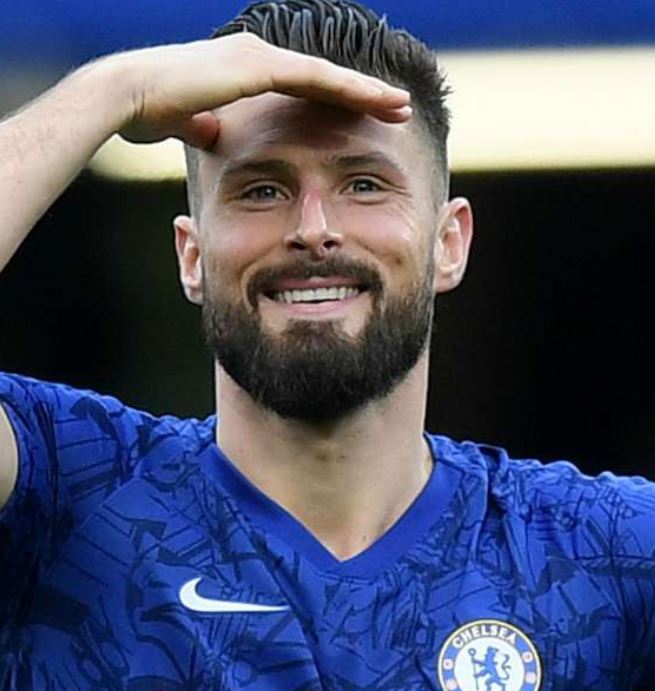
Olivier Giroud’s tattoos return to a few subjects: faith, family and bold geometric patterns. The collection includes a winged cross across his upper back, a Polynesian-inspired design on one arm, a tribal tattoo on his leg, and a Latin Bible verse on his forearm. His children’s names are part of it too.
Different photos show different parts. A shirtless portrait reveals the back cross, a training shot shows the arm pattern, and a seated close-up makes the verse easier to read. Match photos add context but can be too distant to identify small details. Giroud has also spoken about his tattoos, which helps put some of the designs in order.
In a Chelsea interview, he said the tribal leg tattoo came first, followed by Psalm 23, the Polynesian piece and designs connected with his children. That gives the collection a timeline rather than a single theme added all at once.
The winged cross is the clearest back tattoo
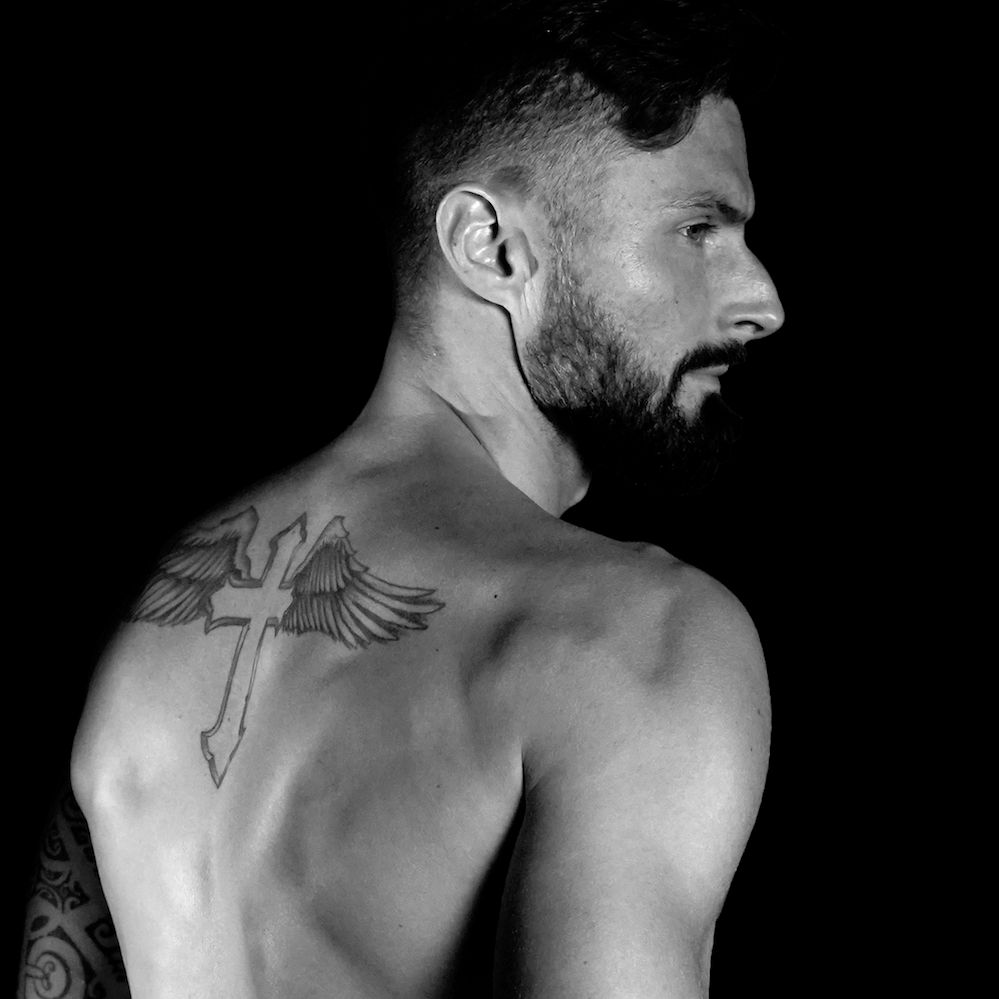
The winged cross is his most striking single piece. It sits high on the back, with a cross at the center and wings spread across the shoulder blades. The black-and-white GQ portrait gives it space: the feathered edges look light, while the cross creates a clear vertical line.
Giroud has said David Beckham’s similar tattoo inspired the design. That is a starting point, not evidence that Giroud copied the exact piece. His version has its own scale and linework. The wings keep the cross from reading as one solid block.
The upper back gives the design room to spread. The wings follow the shoulder blades, while the cross drops along the spine without crowding the neck. Its width gives it presence; every part of the area is not filled with ink.
The back piece sits alongside the more personal details elsewhere in the collection. The forearm carries scripture in words, while the back uses a symbol that is easy to recognize. One invites you to read; the other can be understood at a glance.
The arm tattoo uses Polynesian-inspired geometry
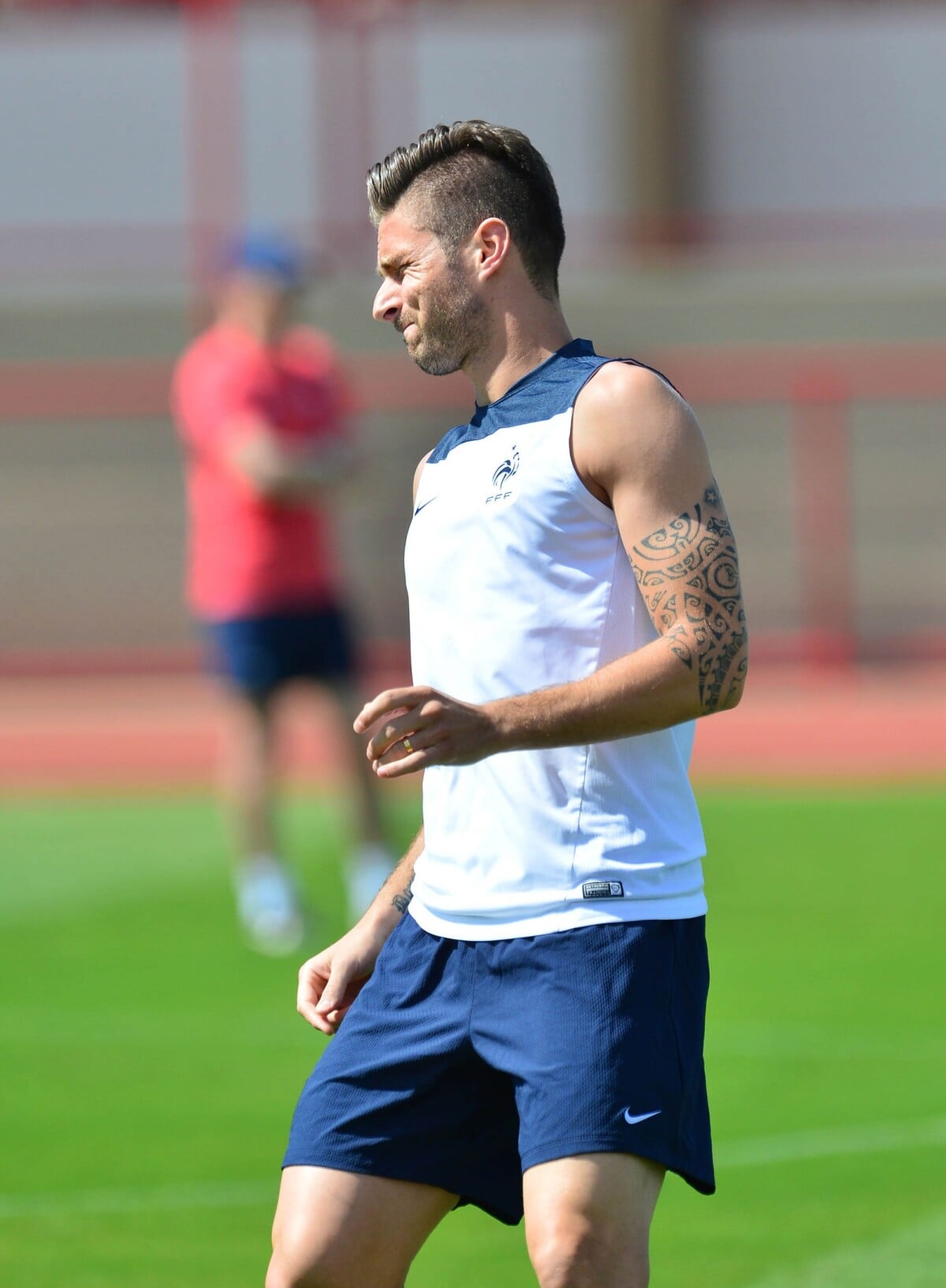
The arm design is made of repeated lines, curves and compact shapes. Sources describe it as Polynesian-inspired and associate its symbols with family, love, faith and health. In the training photo it wraps around the upper arm and continues toward the elbow. The dark pattern holds its outline, with open skin between sections.
It is more than a simple band. The shapes shift direction as they follow the muscle, so the pattern changes when Giroud’s arm is relaxed or moving. It is designed to wrap around the body rather than sit like a sticker on top of it.
Giroud has mentioned rugby as an influence. That gives some context for his choice of a bold, structured style, but it does not explain every mark. Polynesian tattoo traditions have their own cultural meanings, so it is more accurate to call this Polynesian-inspired and avoid translating the individual shapes from a photo alone.
There is also a large cross on the back of his upper arm. From the front, the geometric pattern dominates; turn the shoulder and the cross comes into view. Checking more than one angle helps, because some details only appear as the arm rotates.
The pattern follows the arm around its joints and changing muscle. If you use it as a reference, bring an artist the rhythm and density you like and ask them to redraw it for your body. A flat image may bunch up near the elbow if it is copied without adjustment.
The Psalm 23 lettering balances the tribal sleeve
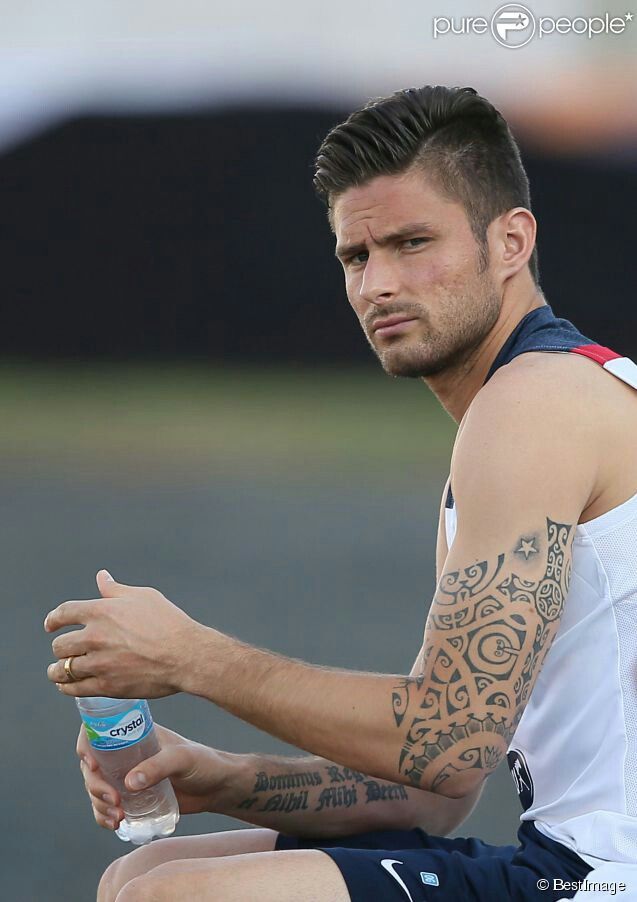
On his other arm, Giroud has the opening of Psalm 23 in Latin: Dominus regit me et nihil mihi deerit. It translates as “The Lord is my shepherd; I shall not want.” The words run along the inner forearm and show when he lifts his arm or sits with his hands together. This piece is about reading and memory, rather than the repeated shapes of the arm pattern.
The verse has a clear personal meaning. Giroud has said he has been a believer since childhood and asked his mother what she thought about a Bible reference. He has also said that reading it makes him feel grateful. There is no need to add a more dramatic explanation over his own words.
The close photo shows how script follows the forearm. The letters are long and narrow, and the arm bends as the hand moves. A typeface that looks elegant on paper can become difficult to read when it curves around skin. Giroud’s lettering follows the length of the forearm and stays fairly compact.
The two arms use different visual languages. The Polynesian-inspired pattern is built around shape and movement; the Psalm is meant to be read. One can be recognized across a pitch, while the other rewards a closer look.
With any long quote or verse, check the wording and translation, then talk through letter size and spacing with the artist. The text may matter most to you, but it still needs to work as a tattoo.
The close portrait shows how the arm tattoos fit together
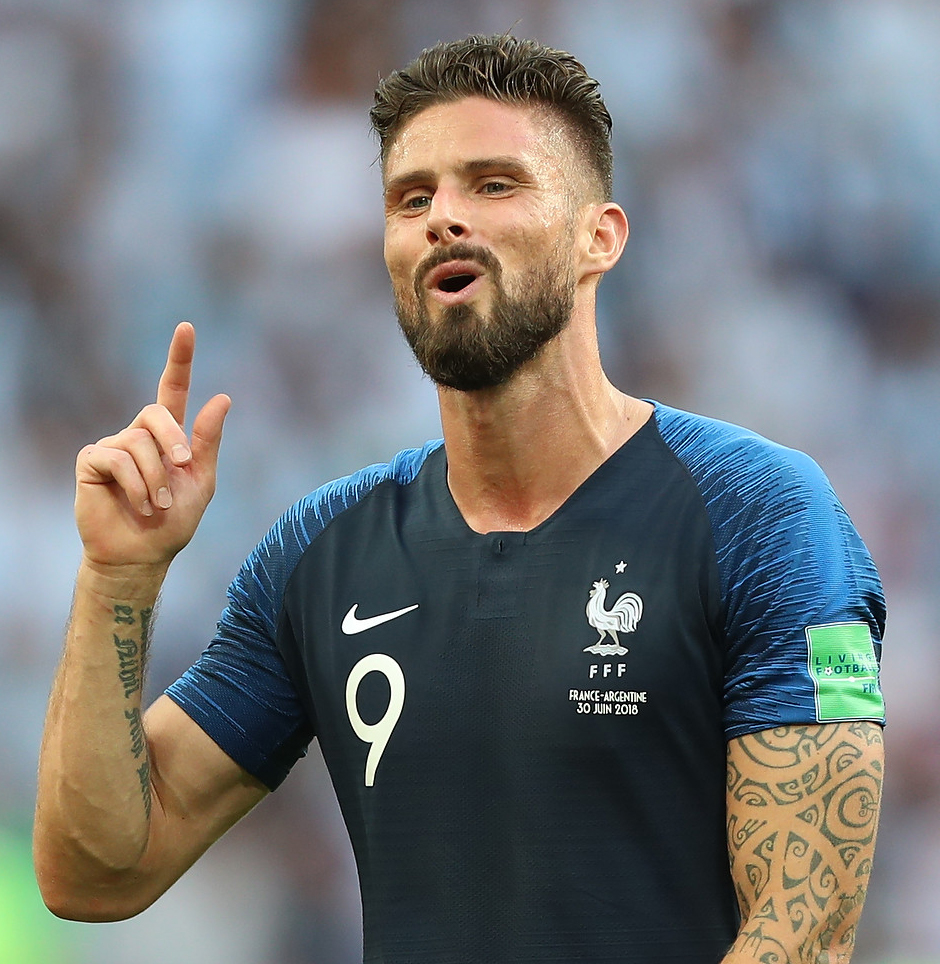
This France portrait is close enough to show both arms. The lettering sits as a narrow line on one inner forearm; the other arm has heavier Polynesian-inspired geometry. The contrast is easy to see in a single frame.
The script follows the inner forearm, while the patterned work covers more of the upper arm and reaches toward the elbow. The two pieces do not fight for the same space, so the arms remain distinct even when both are visible.
Faith appears in several places: the Latin verse, crosses and winged back design. Each uses a different form. The verse is intimate, the cross is direct, and the wings make the back piece feel wider and more open. A shared subject does not require repeating the same image.
The view changes when he turns his wrist or bends his elbow. One pose hides the lettering; another reveals the cross or a darker part of the pattern. Wider photos show how the pieces sit on his body, while close images help with the linework.
His children are part of the collection as well. An AC Milan feature on his tattoos mentions their names on his chest, adding a family reference near the heart alongside the larger pieces on his arms and back.
Older tattoo photographs help place the collection in time
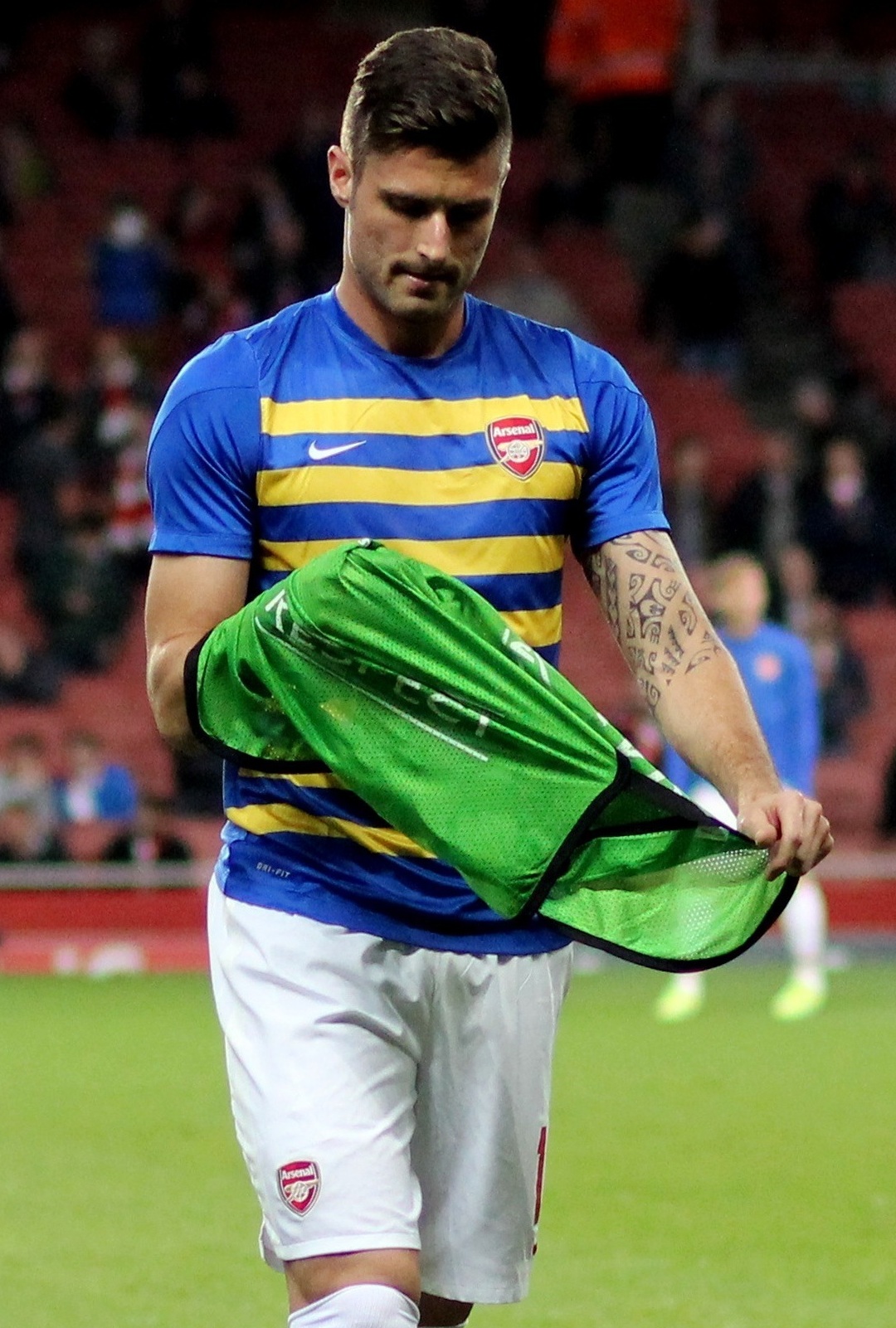
The 2013 match photo is not a close-up, but the tattooed arm is visible. It helps place the bold pattern in Giroud’s Arsenal period, years before the GQ portrait.
His own account gives the order: the tribal tattoo on his leg came first, followed by the Psalm, the Polynesian design and later family tattoos. The collection developed in stages rather than appearing as one completed sleeve.
The leg piece can be easy to miss in football photos because of shorts, socks and movement. Giroud has described it as his first tattoo, chosen when he was young; Body Art Guru identifies it as a tribal design on the side of his right leg.
The children’s names on his chest are smaller and more private than the broad back cross. That difference in scale keeps the body from reading as one continuous wall of ink. The designs move between a large symbol, compact lettering and patterned coverage.
Each part suggests a different design consideration: the back cross needs room and a clear center; the geometric work follows the body’s movement; the verse depends on careful spacing; and family names need a placement that will still feel right years later.
Giroud’s build and the way he is photographed give a large back piece room to show. Someone else might choose a smaller version or a different placement. Often a detail from the reference works better than copying the whole tattoo.
Our Kieran Trippier tattoos guide covers a different football collection, with flowers, portraits and layered sleeves. Giroud’s is more focused on faith, family and pattern. Comparing them makes the different choices easier to see.
The collection balances meaning with structure. The cross fills the back without losing its outline, the arm pattern wraps around the muscle, the Psalm follows the forearm and the children’s names sit close to their family connection.
These photos show the tattoos at particular moments; later images may reveal additions or changes. They are useful references, not a guarantee that a design will look the same on another body. A consultation can turn the parts you like into work that suits your own skin.
In AC Milan’s official Under My Skin feature, Giroud talks about the stories behind his tattoos in his own words. The interview provides context for what the photographs show.