Marcos Rojo tattoos form a football biography written across the chest, arms and legs. Published sources do not offer one official catalogue of every design, but they do give a surprisingly strong set of photographs and reports: a chest covered in script and imagery, large arm pieces visible in Manchester United training, a documented tribute to Diego Maradona on the right leg, and club references tied to Estudiantes and Boca. Read together, those sources show an athlete whose ink is connected to memory, family and football identity rather than to a single decorative style.
Rojo’s career gives the designs their context. He came through Estudiantes, played in Europe for Sporting CP and Manchester United, represented Argentina at major tournaments, and later became a Boca Juniors captain. Several sources describe the tattoos in relation to that path. The images below are mapped to the body area each original actually exposes, while the written sources supply the specific meanings that can be documented. Where a photograph shows dense ink but no published explanation, the design is described visually and left open.
The archive is strongest when it separates what is seen from what is reported. A shirtless match photograph can establish placement and scale. A TyC Sports article can identify the Maradona portrait and its artist. A club-centered profile can explain why Estudiantes and Boca appear repeatedly. None of those sources should be stretched into a complete inventory of private decisions.
Chest lettering turns family into the first visual anchor
The Record photograph from 2013 is the clearest early wide view of Rojo’s upper body. He is shirtless and facing the camera, so the chest lettering sits in the center of the frame while the arms show separate, heavier work. The image is valuable because it lets the reader see the collection as a body map rather than as isolated close-ups. Script across the chest creates a horizontal anchor, and the arm coverage pulls the eye outward on both sides.
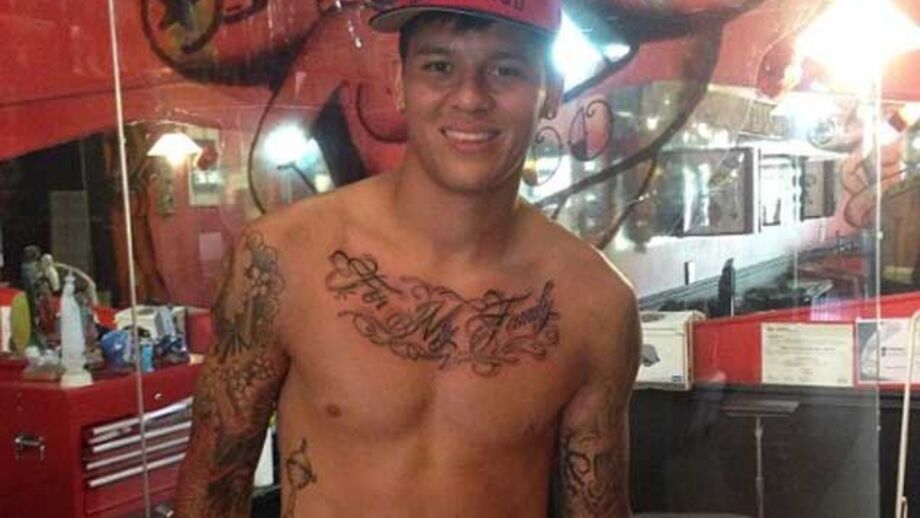
The phrase associated with this area is “For My Family”, a line also visible in later photographs. It is a useful example of how lettering can be both personal and legible. The words are arranged across the upper chest, where the curve of the torso gives the script a natural arc. Around it, smaller symbols and shaded elements create a denser field without erasing the central message.
The photograph does not prove the meaning of every surrounding mark. It proves that the chest and arms were already substantially tattooed when the image was published. The careful reading is therefore two-layered: family lettering is reported and visible, while the rest of the composition is described by line, scale and placement. That restraint makes the image more useful for design study because it avoids turning background detail into invented symbolism.
Manchester United training reveals the arm and leg scale
The Youm7 training photograph changes the reading of Rojo’s collection. He stands in a sleeveless Manchester United training top with both arms exposed, one boot in hand and a ball underfoot. The tattoos extend along the arms and continue onto the legs, making it clear that the body art is not confined to a chest piece. The relaxed standing pose also gives the viewer a better sense of proportion than a tightly cropped portrait.
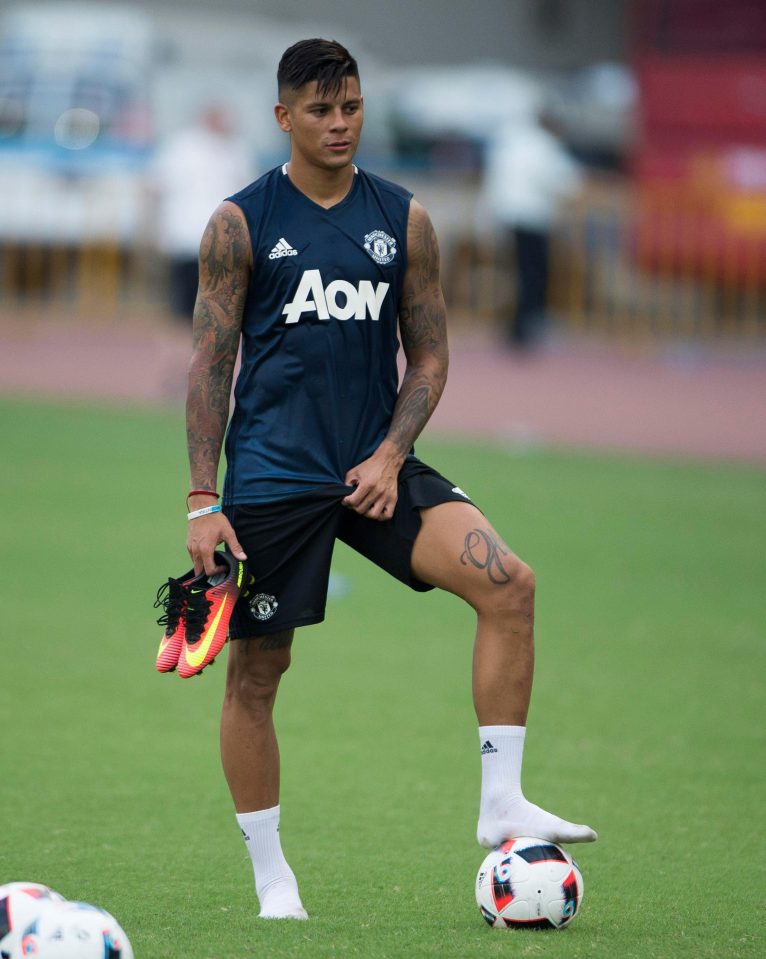
The arms carry the heaviest visual rhythm in this frame. Black outlines, shaded panels and larger illustrative sections sit beside smaller lettering and symbols. The right leg has a separate visual language: the tattoo is larger and more open, with the curve of the thigh and knee affecting how the design reads. Because the image is a full-body training view, it supports a placement description without pretending that every line can be named.
Football clothing explains why the collection can look inconsistent across photographs. A sleeveless top exposes the arm, while shorts reveal the leg but can still interrupt the lower edge of a design. Match-day images also freeze movement and change the apparent width of the skin. Comparing this training frame with the shirtless chest photograph is more reliable than treating either one as a complete catalogue.
A gym portrait shows the collection without a football kit
A photograph reproduced from Rojo’s physical trainer gives the archive a different setting: an indoor gym, plain lighting and no club shirt covering the torso. Rojo stands front-facing with his chest, shoulders and both arms visible. The source identifies the image as part of his preparation for joining Boca, but its editorial value for tattoo research is visual. It shows how the script, portrait-style shading and small symbols sit together when the body is presented as the subject.
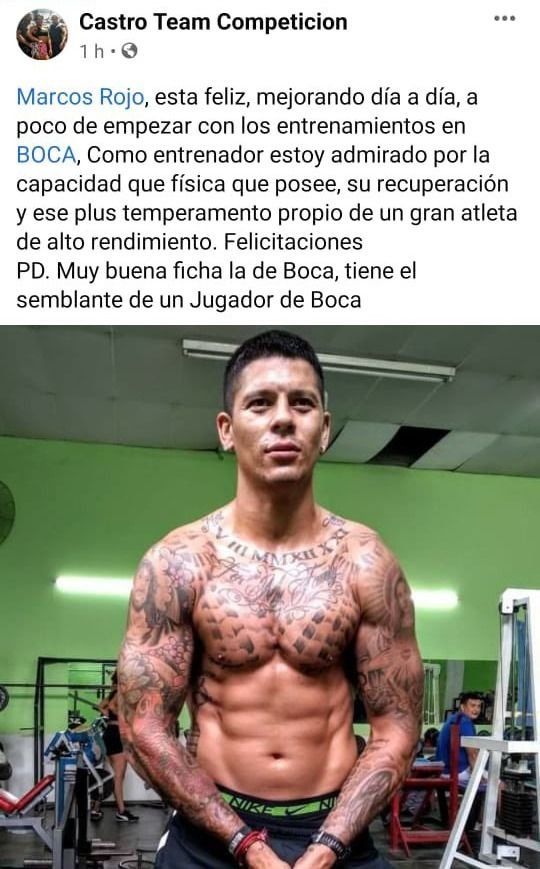
The collarbone lettering is especially readable here. Roman numerals span the upper chest, and the family phrase sits lower in the central field. A portrait on the upper arm creates a darker vertical mass, while the opposite arm balances it with layered black-and-grey work. The two sides are not mirror images. They feel like a collection built in chapters, with different sizes and subjects occupying the available space.
The gym image also demonstrates the role of negative space. The skin between the chest lettering and the lower abdomen keeps the main words from collapsing into one dark block. On the arms, the open gaps around flowers, faces and script give each motif an edge. This is a practical design lesson, not a claim about Rojo’s private intentions: detailed work stays readable when it has room to breathe.
The Maradona portrait makes one leg tattoo unmistakable
In January 2021, TyC Sports reported that Rojo had a portrait of Diego Maradona tattooed on his right leg. The article describes the reference image as Maradona in the Boca stands, wearing a cap and smoking a cigar, and names Yeyo as the tattoo artist. The close-up of the finished first session is the strongest source in the dossier because it isolates the tattoo itself instead of asking a match photograph to carry the full explanation.
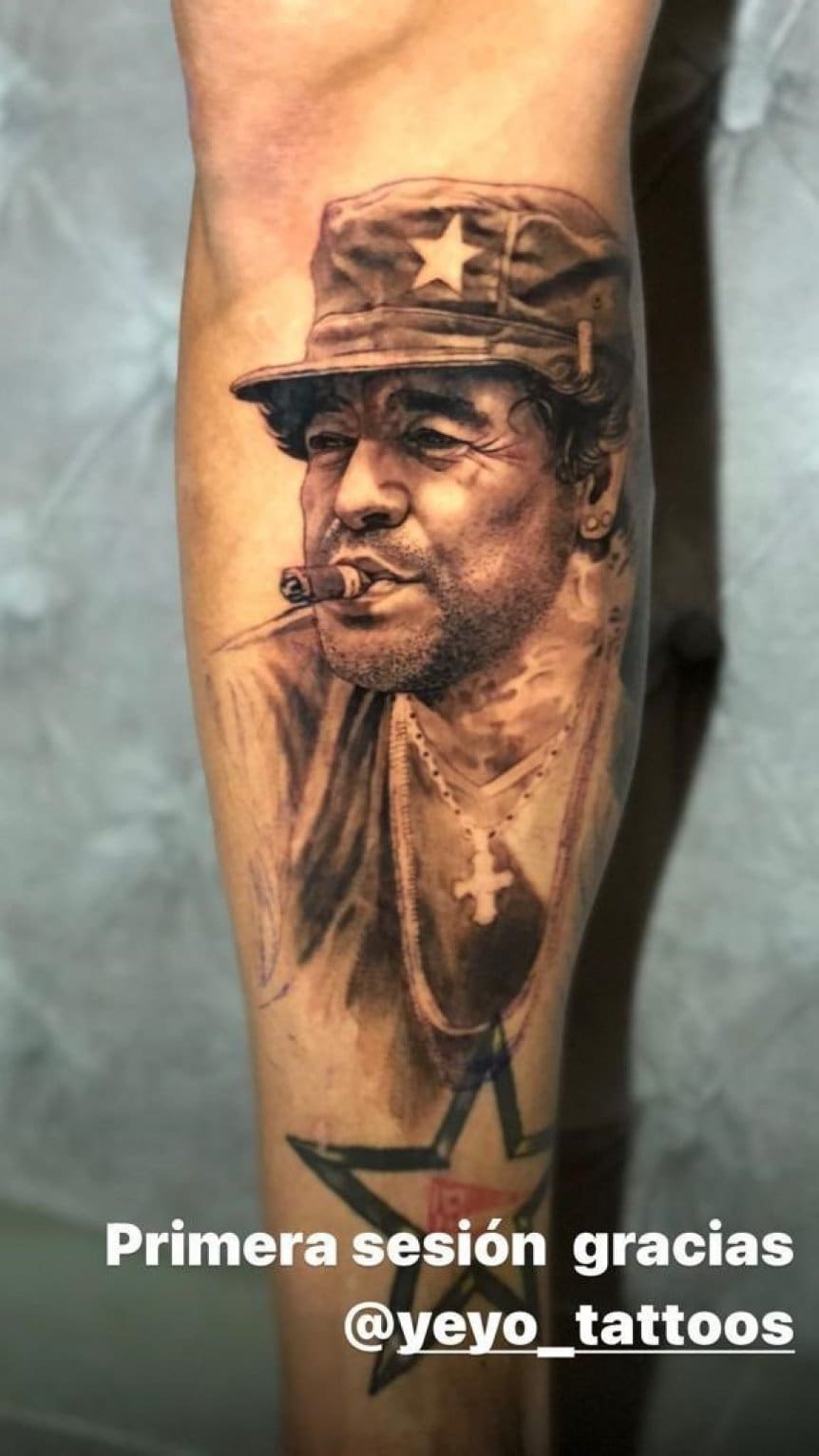
The piece is a black-and-grey portrait with a recognisable face, cap, cigar and cross necklace. The design uses the length of the lower leg to build a vertical composition. A background of shading frames the face, while the darker lower section gives the image weight. The tattoo is not described as a generic portrait: the source explicitly links it to Maradona and to Rojo’s Boca connection.
TyC’s report also records the timing. The tattoo appeared while Rojo’s future was being discussed and before his move to Boca, so the image carried football context as well as personal admiration. That context should not be confused with proof that every Boca-related tattoo was made at the same time. The safe conclusion is narrower and stronger: this specific leg portrait is documented, visually inspected and linked by the source to Maradona.
The ESPN match frame connects the chest to the arms
An ESPN photograph from Rojo’s Manchester United period captures him shirtless after a match, with the face, chest and both arms clearly visible. It is a separate original from the Record and trainer images, and it shows how the collection reads under stadium light. The central script and Roman numerals remain visible, while the left arm’s portrait-style work and the right arm’s heavier shading create two strong vertical anchors.
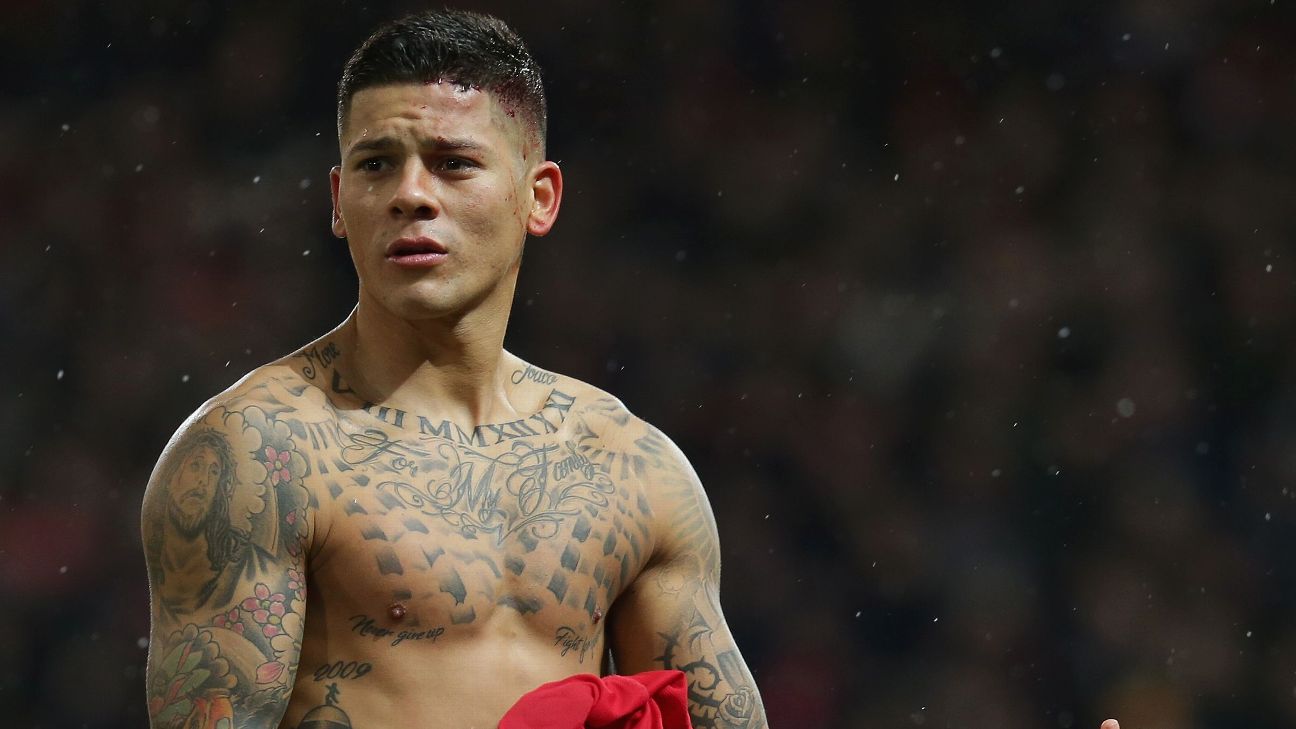
The image is useful because it carries emotion without becoming a posed tattoo diagram. Rojo’s expression and the wet skin of the match setting make the tattoos part of an active football life. The body art is still readable, but the frame reminds us that tattoos are seen in motion, under changing light and alongside the physical demands of sport. A design that looks soft in one photograph may look sharply outlined in another.
Comparing the ESPN frame with the gym photograph shows continuity. The same broad chest lettering is present, the arms remain densely covered and the upper-body arrangement reads as a connected collection rather than a newly invented image in each article. The difference is the context: ESPN shows the player after competition, while the gym source shows preparation. Together they establish identity, time and placement without requiring a speculative chronology for every tattoo.
Estudiantes and Boca are carried as visible belonging
LA NACION’s reporting gives the tattoos a club-history layer. It describes an Estudiantes shield on the lower left leg and the club’s colours on the right side of the abdomen. The article also quotes Rojo recalling that, in 2017, he pointed to the Estudiantes shield and said that his future return would be to that one club. This is unusually strong evidence because the source connects the visible tattoo to a direct statement rather than relying on fan interpretation.
That history makes the later Maradona portrait more legible. Boca is not simply a new shirt in a transfer photograph; it is part of Rojo’s family and childhood identity as described in the reporting. At the same time, the Estudiantes shield remains on the body, creating a tension between two football homes. The tension is best described as a visible record of belonging, without turning it into a private psychological claim.
Club symbols also show why placement matters. A shield on the lower leg can be displayed in shorts and match action, while colour on the abdomen appears only when the shirt lifts or the player is photographed shirtless. The same story therefore needs several original images. A club emblem is not equally visible in every setting, and a portrait frame can reveal a design that a full kit hides.
What the image trail can and cannot establish
The five inline photographs are deliberately different. The Record image gives the earliest wide chest view. Youm7 shows the full-body training scale. The trainer’s gym photograph removes the football kit and clarifies the chest and arms. TyC Sports provides a close-up of the Maradona leg portrait. ESPN places the upper-body work in match context. No frame is repeated, and no generic portrait is used as a substitute for tattoo evidence.
This variety also limits overclaiming. The sources support the family phrase, the Estudiantes shield, the Boca and Maradona connections, and the visual presence of dense arm and chest work. They do not provide a final list of every letter, flower, face or symbol. A responsible guide describes those elements as visible forms when no source names them. It also acknowledges that later tattoos or cover-ups may have changed the collection after any one photograph.
Identity and evidence
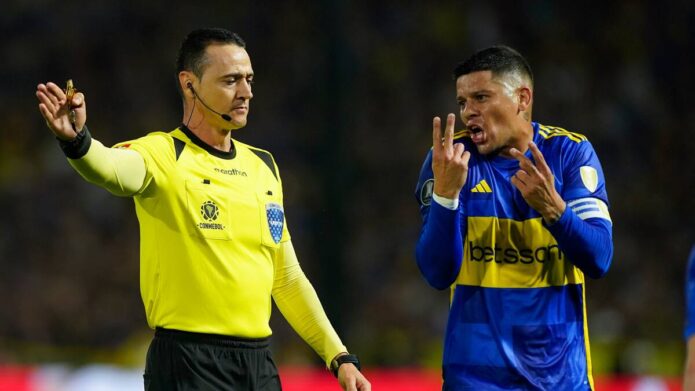
A face-visible featured portrait is kept separate at the top of the article. It identifies Rojo in a Boca match setting, but the page does not ask it to prove a tattoo. That separation makes the page easier to understand: the featured image establishes the subject, while each inline photograph is mapped to a specific tattoo-bearing section after explanatory prose.
Rojo’s layered collection also offers a practical design lesson.
Rojo’s tattoo archive is useful to readers because it combines several scales. The chest uses horizontal lettering and Roman numerals. The arms use larger portraits, flowers, script and shaded panels. The legs carry club references and a full portrait composition. These are different visual jobs, and they are distributed across body areas that move differently. A custom design inspired by the archive should begin with the wearer’s story and anatomy, not with a request to copy the same motifs.
The strongest practical lesson is to give a central element enough surrounding space. The family phrase reads because it has a clear horizontal field. The Maradona portrait reads because the leg provides vertical room for the face, cap and lower shading. The arm pieces remain legible because the photographs show separation between dark masses and open skin. These are transferable principles even when the subject matter is entirely original.
Photography should be planned at the same time as the tattoo. A chest piece needs a straight-on view; an arm sleeve needs relaxed and bent positions; a leg portrait needs a frame that shows the body landmark without cropping the composition. Rojo’s public images are a useful reminder that one photograph can show scale while another reveals detail. A good record is part of the design story.
The documented conclusion
Marcos Rojo tattoos are best understood as a collection of family lettering, football belonging, portrait work and dense illustrative coverage. The chest and arms establish the central visual identity. The Estudiantes references connect the collection to his beginnings, while the Boca and Maradona pieces document a later chapter in Argentine football. The photographs show the ink from several distances and settings, and the reporting supplies the meanings that can be defended.
The most reliable reading is therefore precise. The tattoo on the leg is a documented Maradona portrait. The Estudiantes shield and related colours are described by LA NACION alongside Rojo’s own words. The family lettering is visible in several shirtless photographs. The rest of the collection is described by placement, scale and form unless a source identifies it. That approach gives readers a useful visual map without pretending that a public image archive reveals every private decision.
A final visual reading
The lasting design lesson is not to reproduce Rojo’s symbols. It is to build a personal body map with the same care: choose the story, choose the surface, test the design in motion and preserve enough negative space for the image to remain readable. The archive succeeds because the tattoos carry a life outside the photograph. A new design should do the same.