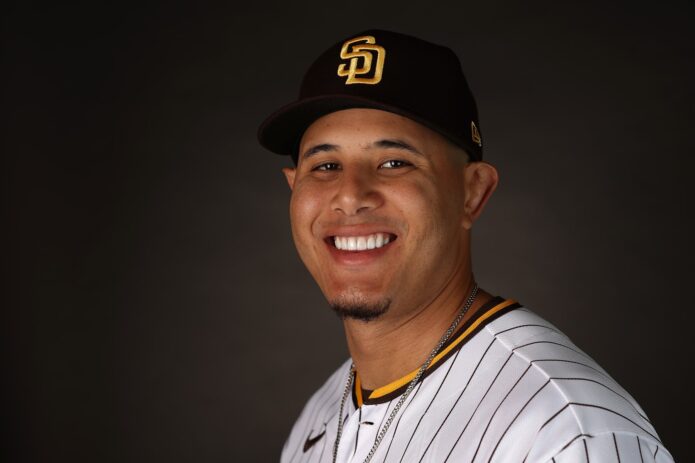
Manny Machado tattoos are most recognisable through the portraits and family references that appear across his forearms, but the visible record is wider than one famous piece. Major League Baseball coverage documented the portrait of his wife, Yainee, while later baseball photography shows the surrounding arm work during spring training, games and public appearances. The result is a collection that moves between private devotion and the practical visibility of an athlete whose arms are regularly photographed.
The strongest evidence comes from different kinds of sources. MLB and FOX Sports identify the wife portrait directly, an ESPN-sourced training photograph shows the tattooed arm in context, and game images reveal how ink appears when a uniform, glove or batting motion changes the frame. Those photographs do not prove that every design has a public explanation. They do establish where the visible work sits, how it reads at different distances and why several distinct originals are necessary for a useful guide.
This article keeps those categories separate. Tattoo-bearing images come first, the close portrait is treated as its own documented design, and one later Washington Post game image is used only as supplemental context after the tattoo-photo search. The wording stays with what the sources and inspected pixels actually support, while the wider baseball timeline supplies the background needed to understand the collection.
The wife portrait is the clearest documented centerpiece
The most firmly documented design is the black-and-gray portrait of Yainee Alonso on Machado’s forearm. MLB’s Cut4 coverage identifies the subject and the location, while FOX Sports preserves a close source-page image that makes the face, hair and large flower beneath it easy to inspect. It is a realistic portrait rather than a small emblem, and the scale gives the inside of the arm the visual weight of a full panel.
That placement carries a practical tension for a baseball player. The forearm is visible during batting, fielding and celebrations, so a portrait chosen for personal meaning is also exposed to cameras and the ordinary wear of a season. The design is not described as a team logo or a temporary statement. It is presented as a permanent tribute to his wife, which is why it remains the anchor for any careful discussion of his ink.
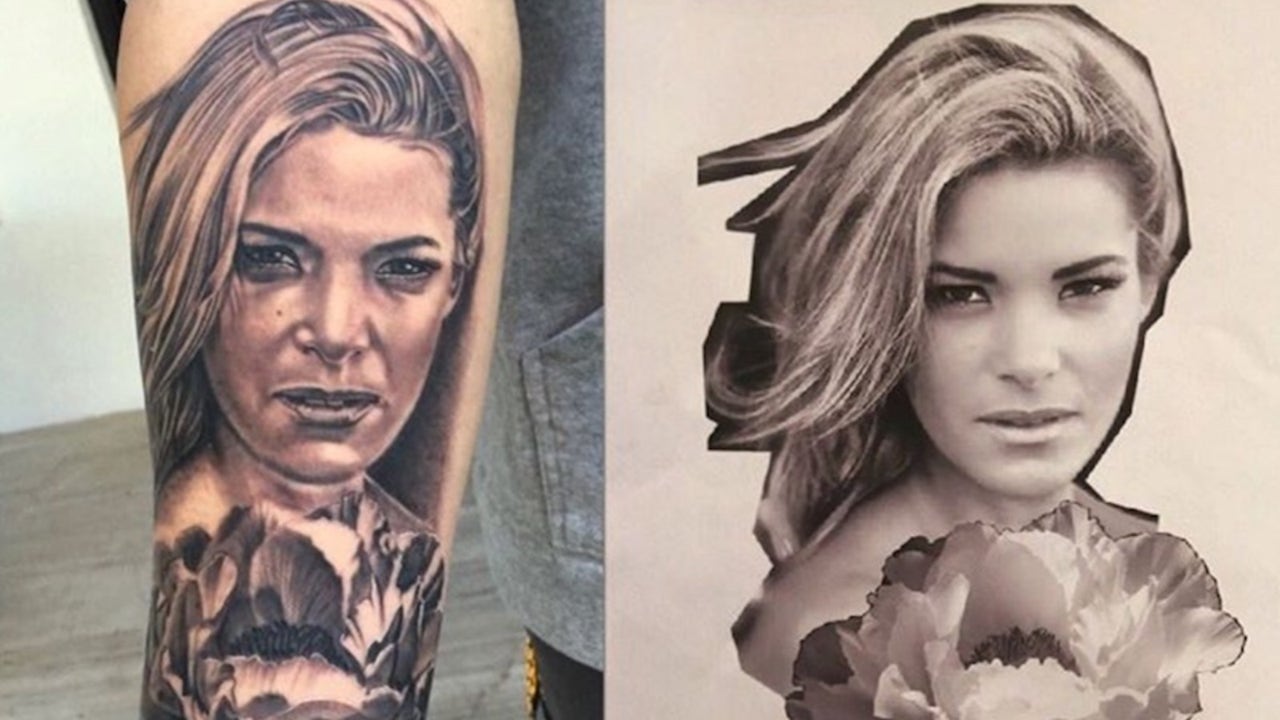
The close-up also shows why a source page matters. A cropped social repost might tell readers that a portrait exists, but the editorial image reveals the smooth shading, the transition into the flower and the amount of skin covered. The portrait reads as a single composition, with the face carrying the recognition and the flower giving the lower half a broader, more decorative finish.
Source note 1. This inspected original is kept separate from the other slots so its setting, crop and tattoo visibility remain clear.
A spring-training portrait shows the surrounding sleeve work
The Padres spring-training photograph from Friars on Base changes the scale completely. Machado faces the camera with his arms folded, wearing a sleeveless jersey in front of a chain-link fence. The right arm is covered by a dense collection of black and gray forms, and the image is large enough to show that the wife portrait is part of a broader tattooed surface rather than an isolated mark floating on bare skin.
This frame is valuable because it is neither a tattoo reveal nor a cropped close-up. It is a sports portrait in which the arm happens to be central to the pose. The subject match is straightforward: face, build, team setting and uniform all align. The tattoo match is equally direct because the artwork occupies the arm that the MLB and FOX reports already identify. Context and detail reinforce one another here.

The folded-arm pose also changes how the collection is read. Overlapping skin and forearm orientation make some shapes harder to separate, but that is part of authentic coverage. A tattoo guide should show what a viewer sees in a normal photograph, not redraw the sleeve into imaginary panels or assign names to every dark patch that the source never identifies.
Source note 2. This inspected original is kept separate from the other slots so its setting, crop and tattoo visibility remain clear.
A training photograph brings the ink into an everyday setting
The ESPN-sourced training image places Machado beside a batting cage with his arms crossed and a confident smile. The tattooed right arm is visible against a sleeveless Padres top, but the mood is quieter than the stadium photographs. There is no crowd reaction and no celebratory gesture. Instead, the picture shows how the artwork appears during rehabilitation and preparation, when the body is presented as an athlete’s working instrument.
That setting matters for interpretation. The arm is not being displayed as a standalone design, yet it remains legible because the clothing leaves it uncovered. The photo therefore supports a modest claim: Machado’s tattoos are integrated into ordinary public sports imagery, not limited to the single moment when his wife portrait was first reported. It does not support a claim that every visible mark has a separate story.
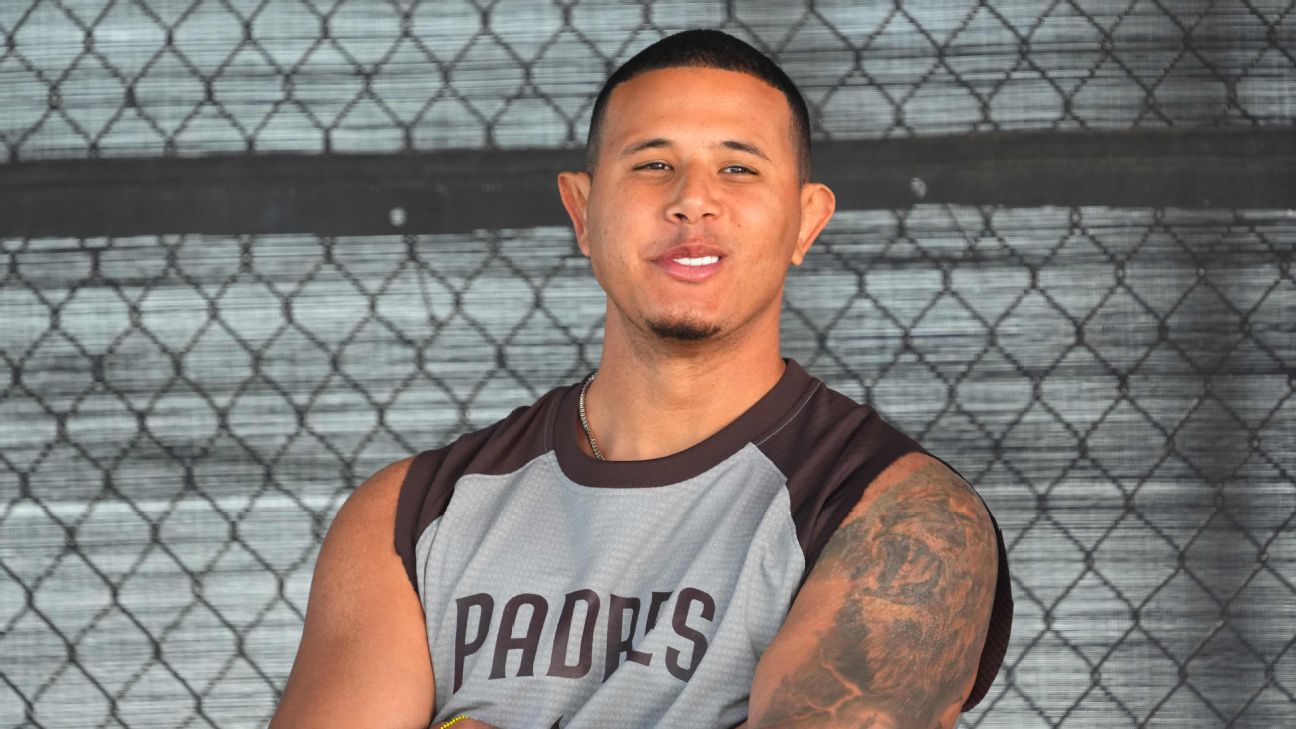
The composition also gives readers another angle on the sleeve’s texture. The forearm sits closer to the lens than the shoulder, while the netting and muted background reduce visual competition. Different surroundings expose different parts of the same collection, which is why the training image adds evidence instead of merely repeating the close-up.
Source note 3. This inspected original is kept separate from the other slots so its setting, crop and tattoo visibility remain clear.
Game photography shows the sleeve in motion
The MLB action photograph captures Machado swinging in an Orioles uniform, with the tattooed arm extended toward the bat. Here the ink is not posed for inspection. It is stretched by movement, partly interrupted by the sleeve and framed by the mechanics of a swing. That makes the image a useful record of how the tattoos look when the body is doing the work that made Machado famous.
The difference from the spring-training portrait is substantial. The arm is longer in the frame, the hand and glove pull attention toward the bat, and the face turns away from the viewer. Yet the visible tattoo coverage remains clear enough to connect the subject with the previously documented artwork. The image should be described as a game photograph with tattooed arms, not as a complete catalogue of every design.
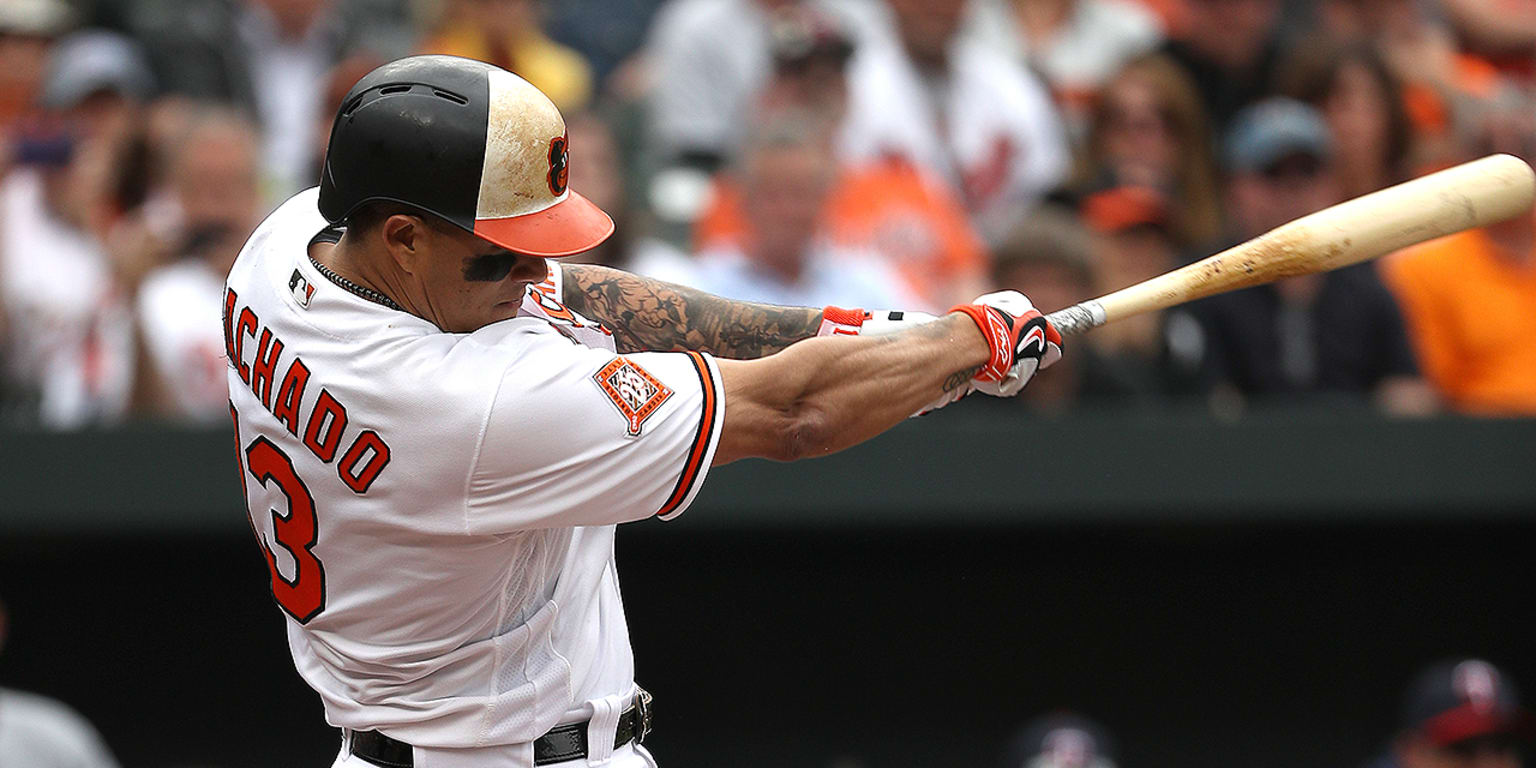
A second MLB image from the Spanish-language profile shows another batting moment and a different uniform context. The two frames are retained only because they are separate originals from different settings, not because a single swing needs to be counted twice. When action changes the angle, it can reveal how placement travels with the athlete.
Source note 4. This inspected original is kept separate from the other slots so its setting, crop and tattoo visibility remain clear.
A homecoming frame adds the baseball setting
The Washington Post homecoming photograph is less about body art than about public setting. Machado acknowledges the Baltimore crowd in a Padres uniform, with his face, helmet and the stadium audience easy to recognise. The frame does not reveal a new design, so it is kept after the tattoo-bearing photographs and used to connect the collection to the larger baseball timeline.
That distinction should remain visible in the writing. The photograph can establish the person, the uniform and the emotional setting of a return to Camden Yards. It cannot establish the exact meaning of any hidden mark or replace the sharper source images that document his forearm portrait and arm work. A responsible dossier treats it as context rather than tattoo evidence.
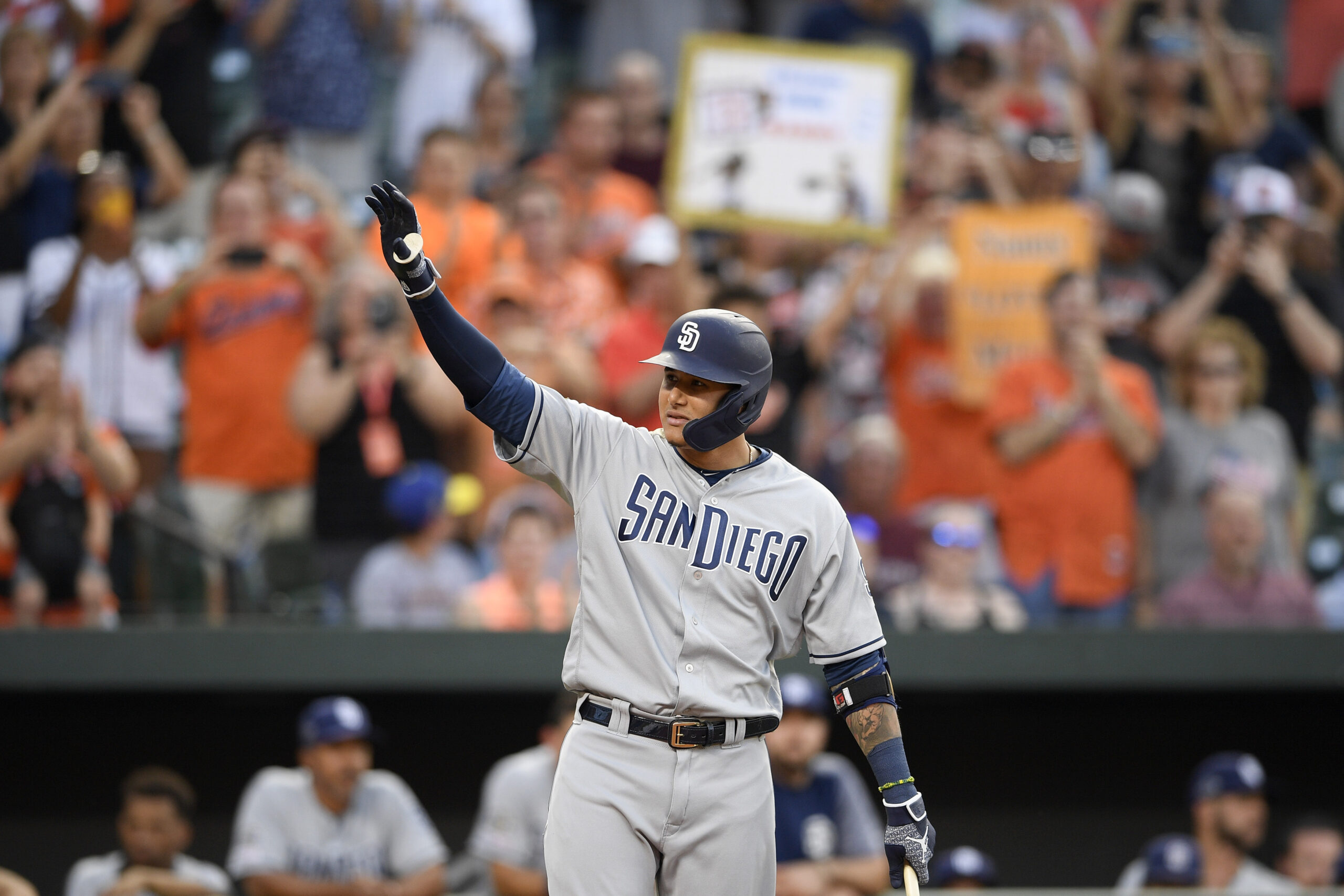
Placed at the end of the image sequence, the homecoming frame keeps the ordering honest. Readers encounter the documented portrait first, then the denser arm views, then a public baseball moment without a forced tattoo claim. The sequence moves from detail to context instead of padding the top of the article with a generic celebrity portrait.
Source note 5. This inspected original is kept separate from the other slots so its setting, crop and tattoo visibility remain clear.
The baseball timeline changes how the collection is seen
Machado’s tattoos sit inside a long sports timeline rather than outside it. A portrait first reported by MLB can later appear in training photographs, game action and team coverage without becoming a different design. What changes is the camera distance, the clothing and the movement around the arm. Those shifts explain why one close-up cannot stand in for the full visual record.
The timeline also shows why careful source separation matters. The wife portrait has an explicit identification, the denser sleeve work is visible in the Padres and ESPN portraits, and the action photographs confirm that the arms remain tattooed when the player is performing. The sources support continuity, but they do not invite a made-up inventory of symbols or a confident translation of unreported lettering.
A homecoming frame adds the baseball setting
The Washington Post homecoming photograph is used as supplemental context only. Machado acknowledges the Baltimore crowd in a Padres uniform, and the frame makes his face and baseball setting easy to recognise, but it does not reveal a new tattoo detail. It belongs later in the sequence because it helps locate Machado’s public identity without being mislabelled as tattoo proof.
That distinction is part of the article’s method. Generic or context-only portraits can help readers follow the person, but they cannot replace tattoo-bearing originals. The inline order therefore exhausts the available tattoo photographs first, then uses one clearly labelled contextual frame. The feature image remains a separate face-visible portrait and is not reused in the body.
What the retained photographs establish
Read together, Manny Machado tattoos tell a story about devotion, visibility and the conditions of sport photography. The portrait of Yainee is the clearest documented centerpiece. The surrounding arm work appears in a spring-training portrait, a rehabilitation setting and the repeated movement of a game. Those images do not flatten the collection into one meaning; they show how personal ink can remain visible while the athlete’s public circumstances change.
The most defensible inventory is therefore compact. There is a large black-and-gray wife portrait with a flower, a dense body of arm work that appears across later sports photographs and older public frames, and a set of game images that demonstrate how the ink moves with the swing. The retained sources do not establish every individual motif, so the guide stops at the level of detail the photographs can support.
For readers studying placement, the forearm is the anchor. It is close enough to the camera for portrait detail, exposed enough to appear in sleeveless training pictures and active enough to stretch through a batting motion. That combination gives the tattoo collection a distinctive visual rhythm. It is not a studio-only display; it is part of the body that performs in public.
The final image order keeps that rhythm intact. Tattoo-bearing originals lead, each is mapped to a different section and later prose separates one placement from the next. The homecoming frame follows only after the tattoo search is exhausted, and its alt text describes a baseball setting rather than inventing tattoo evidence. The result is a source-backed visual guide that respects both the detail of the ink and the limits of the record.